Blog Archives
The Others (2001) [Review Re-View]
 Originally released August 10, 2001:
Nicole Kidman has saved the summer of 2001 – it is now official. In what would have been deemed a pit of mediocrity and nightmares consisting of Angelina Jolie as some raider of tombs or Marky Mark making dough-eyes at attractive apes, has now been bookended by two terrific Kidman films. First Moulin Rouge ushered us in and now The Others is leading us the way out.
The Others is the tale of Grace (Kidman) trying to take care of her two ailing young children shortly after the end of World War II. Kidman is waiting for the return of her husband from the war and is all alone in a giant Gothic mansion. Her two children suffer from a rare allergy to sunlight that is so severe that if exposed long enough their bodies will develop markings and they will asphyxiate to death. To accommodate this illness the entire Kidman household is in the dark and grounded in stern rules. No door is to be unlocked without locking the last, like trapping water in compartments of a sinking ship.
 Grace discovers that she does need help and accepts three mysterious strangers that have said they were caretakers to this house once before. Before long the children start reporting odd events occurring that resemble ghosts; a door is opened when it shouldn’t be, someone is making noise where there is no one, and the children report having interaction with otherworldly spirits. Grace scoffs at any notion of the paranormal and goes back to instructing her children with the Bible and its accounts of penance and hell. The incidences begin to build further and further until The Others becomes a full-fledged ghost spectacle.
Spanish writer/director Alejandro Amenábar’s first English feature film is one of carefully textured craft and effective mood. The Others follows the points of ghost stories closely from dark hallways to the creepy and slightly dilapidated house closely. Every move, though, is so well in tune that they are highly effective in creating actual suspense and spookiness. One may have seen the same items numerous times before, however The Others utilizes them so gracefully that it achieves the full desired impact each can bring. Amenábar has created a ghost story that is genuinely creepy and at times scary.
Kidman shines as the dutiful and determined mother. Her performance is one of great dedication and she just consumes whole-heartedly the distress, confusion, and fear of this lonely mother. She is a true anchor for a film. Watching every moment of her on screen is amazing as well as invigorating. This role may lead to possible Oscar buzz come the end of the year but that is just speculation for now.
 The rest of the acting is very thorough and well handled by the few other cast members. James Bentley and Alakina Mann portray Kidman’s afflicted children and have much of the movie hinging on their performances. Not to worry, these two excel and give credence to being two of the more gifted child actors in a while. Their efforts greatly induce sympathy as well as great scares at key moments.
The story of The Others by Amenábar may seem simplistic, or even predictable, but the more I thought of the structure and the order of events the more well oiled and calculated it became. This is a delicate story told with great precision with a fantastic knockout ending that had me reworking everything. The Others is an example of why screenwriting is not yet dead in Hollywood.
The Others is a wonderfully brooding film with real scares and great performances, as well as terrific turns in writing and directing by Amenábar. Nicole Kidman has thankfully done it again, and if anyone dares doubt the power and newfound importance of her then see the rest of the summer of 2001’s offerings.
Nate’s Grade: A
——————————————————
WRITER REFLECTIONS 20 YEARS LATER

They don’t really make movies like The Others any more. It’s a patient movie with lots of old-fashioned craft and has more in common with horror movies from a different era. While I would claim that the popular Conjuring franchise, at least the James Wan entries, is a successful Old School horror throwback, its execution can also become quite extreme and ridiculous. Something like The Others dutifully takes its time and nips at your nerves, knowing precisely what key piece of information to tantalize and when to provide more, just enough to grab you deeper into its central mystery and worry over the looming danger for the characters. Twenty years later, the movie plays just as splendidly as it did initially in 2001 but now I have more reverence and appreciation for how it goes about telling its ghost story in a very methodical manner. Not every horror movie ages well. I’m sure that modern audiences could watch The Exorcist and laugh at what, in 1973, scared people to the point of vomiting in theater aisles. If you’re not executing at a high level, it could make for a tragically boring movie. It’s a good thing then that The Others is a PG-13 horror movie that plays all of its limitations to its many artistic advantages.
 Coming at the end of a mediocre summer slate of movies in 2001, The Others was a surprise hit, earning over $200 million dollars on a modest budget of $17 million. It helps when your entire movie takes place in one Gothic house and one of the biggest fears is being caught in the light. The premise involves a World War II-era estate where Grace (Nicole Kidman) is seeking help for her two children, Anne and Nicholas, who have a rare photo sensitivity allergy. Direct sunlight will cause them to break out in lesions and potentially asphyxiate (this is a real and rare condition afflicting around 1000 people on the planet). This is a brilliant turn because it means that most of the movie must take place in darkness and even the hint of light could be enough to start causing trembles. A late scare in the movie is simply the realization by Grace that all of the curtains have been removed from the house. Taken without context, that can seem laughable or ludicrous for a horror movie. With the proper context, it becomes a devastating turn. Much like A Quiet Place so brilliantly made sound the enemy, The Others makes the prospect of light the enemy. We start to associate darkness with safety, and then writer/director Alejandro Amenabar uses that environment to drive minimalist horror to great effect. The sound design of whispers, of footsteps, of something that shouldn’t be there is elevated, and the intrusion into the safe space of the vulnerable children makes us all feel a little more vulnerable. It takes the familiar setting of old Gothic horror tales about dark corridors and creaky attics and elevates it anew.
The story is simple but so excellently structured and performed. A mother and her two children are terrorized by ghosts in an old house. Three caretakers arrive to help who know more than what they let on. These characters allow Grace to have someone to question and share her emotional state of mind but they also provide dramatic irony and dread for the audience. They know what’s going on with the house and they’re hiding something, initially tombstones they will later reveal but who do they belong to? They know the house intimately but what is their actual connection to its history? Early on we already have our concerns, as the notice Grace sent out seeking help was never mailed. Halfway through, the caretakers discuss among themselves a secret they are hiding relating to the history of the house. By this point, we have already had a few ghostly encounters so our assumption is that it will relate with the otherworldly intruders. These characters are conflict stirring and keepers of secrets to be revealed in time. Amenabar has a divine instinct of when to drop a new clue, when to pick up the escalation, and when to finally lay out his plot particulars. The big twist has been hiding in plain sight from the start, from the very opening image of Grace gasping awake in her bed and coming down from her frantic distress.
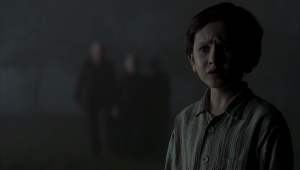 The ultimate revelation that Grace and her children are not being haunted by malevolent spirits but are in fact the real malevolent spirits is a terrific rug-puller. Much like the best twist endings, many of which occurred in contemporaries like The Sixth Sense and Fight Club, you can re-watch the movie and see all the clues you missed or how the added perspective reinterprets sequences for added depth. It’s not just a great twist but a culmination of an emotional catharsis; much like The Sixth Sense, it’s a ghost coming to terms with accepting their ghostly identity. Unlike The Sixth Sense, our ghostly protagonist refuses to go gently into the light. Grace has her children repeat to her, “This is our house,” and they refuse to budge. One of the final images, of Anne dancing in the sunlight, is both a victory and condemnation. She can at long last not worry about the rays of sunlight harming her and can live life like an average child. However, she has no life to live and can never leave the house, never grow old, and refuses to part under the rigid determination of her mother, the same woman who killed her and doomed her to purgatory. In some regard it’s a happy ending because hooray the kids can relax, and in many other more disturbing implications, it’s a guilt-ridden murderous mother refusing to let go of her children even after killing them. The movie serves as an empathy experiment to provide back-story for the kind of specters that would haunt an old Hammer horror movie. It might make you rethink other ghost stories or at least try and see things from the ghostly perspective.
I will say that this movie was also maddeningly hard to hear at times. I had to crank up my TV to unheard of volume levels to clearly make out what people were saying. Kidman is quite good but she has a habit of falling back on very breathy acting, relying on whispered intonation. I’m glad I already saw the movie but the sound levels forced me to actively pay attention. Maybe your TV will be different.
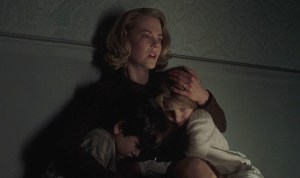 Amenabar is a Spanish filmmaker that rose to international acclaim with 1997’s Open Your Eyes, starring Penelope Cruz and later remade into Vanilla Sky, also starring Penelope Cruz (coming to a Re-Veiw in December!). The Others was a significant breakthrough, and in 2004 Amenabar won the Academy Award for Best Foreign Film for The Sea Inside, a true-life drama where Javier Bardem portrays a man fighting for the right to end his own life. He seemed like an international director on an accelerated ascent, and it all came to a crash with 2009’s costly historical intolerance drama, Agora, starring Rachel Weisz and Oscar Isaac that examined the contentious relationship between Christians and Pagans in fourth century Egypt. It cost $70 million dollars, was over two hours, and made a pittance at the U.S. box-office. From there, Amenabar has primarily worked within the Spanish cinema (2019’s While at War), Spanish TV (2021’s La Fortuna), and one schlocky horror movie about a Satanic cult (2015’s Regression, a title that is too on-the-nose perfect). Admittedly, I haven’t watched any of these follow-ups and the Spanish productions could genuinely be great. I think Amenabar’s early success helped pave the way for another Spanish filmmaker, J.A. Bayona, whose 2007’s haunted manor movie The Orphanage was an excellent Old School horror that could be sincerely scary while still patiently building its unsettling atmosphere.
Looking back at my review from 2001, I think my love of Moulin Rouge carried over into my overly enthusiastic evaluation of Kidman’s increasingly unraveled performance. She’s good but she’s not quite at Oscar levels of accomplishment here, and yet Kidman was nominated for a BAFTA for this role instead of the singing courtesan. The child actors are both good, though neither acted again in credited roles after the mid-2000s, but for me to cite them as “two of the most gifted child actors in a while” reads like hyperbole. My original analysis didn’t get too deep into the mechanics of why everything worked so well, for fear of spoiling its big surprises, and instead kept to admiring its craft, care, and execution, aspects that are still easily apparent and admirable in 2021 as well. The Others is a splendid ghost story no matter the year and will likely still prove to be many years from now.
Re-View Grade: A
Share this:

G.I. Joe: Rise of Cobra (2009)
 While plenty stupid, the big-budget G.I. Joe movie is actually passably entertaining. Sure the characters are one-note, the motivations and romances are strained, the acting is abysmal, Dennis Quaid looks to be in particular pain, the plot has too many unneeded flashbacks, the special effects are cheesy, and the movie is crammed with deliberate toy merchandizing connections, but I had fun with this flick. Director Stephen Sommers (The Mummy) works the right kind of stupid, the loud noisy kind that manages to tickle a childlike sense of glee like watching an eight-year-old’s imagination blown up on screen. The scale of weapons and special vehicles and special suits and special ladies in special leather outfits for engaging in criminal activity should delight younger film goers. The action is frenetic (if there is a pane of glass within 100 miles, the movie assures that you will see it shatter) and the international collateral damage is colossal, so much so that G.I. Joe almost comes across as a goofy, straight-laced version of Team America. Certainly the benefactor of rock-bottom expectations, G.I. Joe: Rise of Cobra is a brash blast of acceptable action movie stupidity. Grab a big bag of popcorn, shut off your brain, and enjoy the film’s cartoonish yet entertaining qualities.
Nate’s Grade: C+
Share this:

28 Days Later (2003)
 Zombies have generally seemed one of the little brothers of the horror genre. Certainly not as complicated or Freudian as Frankenstein or Jekyll and Hyde, and no where near as seductive as vampires and werewolves. Zombies are stumbling, bumbling cement-shoe wearing monsters. Theyre usually conduits for some kind of social message, like George Romeros classic Night of the Living Dead and Dawn of the Dead. The scary part of zombies is the methodical eventuality they exhibit. They may be stupid, they may be slow, and they may be really stupid, but theyll keep coming. They’re dead and they got no where to be. And there’s the pull – that they will eventually get you. You’ll give in, something will happen, and they’ll seize upon that unfortunate misstep (I did an extensive paper on the symbolism of zombies in Romero’s films and the connections between religion and horror. I think I deleted it though, so this is the best analysis you’re gonna get). Now there’s director Danny Boyle’s indie horror flick, 28 Days Later, which gives the zombie genre a few good shocks to the system.
We open up with stark television clips of violence, genocide, and all around mayhem around the world. Its basically what the cable news stations are now, except in this case, the viewership of these broadcasts are monkeys. Yes, it seems that the British government is experimenting on the nature of rage by strapping monkeys onto slabs and forcing them, A Clockwork Orange style, to watch all kinds of icky video. Animal rights activists break into the facility and plan on freeing the primate prisoners. A lab assistant tries to deter the monkey theft. He says alarmingly that the animals are infected with rage (as are most drivers it seems), and that this infection is highly contagious. The animal rights activists scoff at his concern and open the cages to the primates. For their altruistic virtues the activists are instantly attacked, bitten, mauled (can one be mauled by monkeys? It just seems like bears and lions have a monopoly on this verb) and infected with this deadly rage disease. This is likely the worst PR set-back for the animal rights activists since PETA clubbed baby seals. Look it up.
 Flash to the titular 28 days later. Jim (Cillian Murphy) comes to in a hospital bed, and like previous films, Boyle finds an outlet to shoehorn in some full-frontal male nudity. Its almost like a directors trademark. Jims a bike messenger and has been in a coma for about, oh, lets just say for the sake of it, 28 days. Jim wanders through the vacant hospital calling out for anyone. He hits the streets of London to find them startlingly empty, like some Twilight Zone episode. City kiosks are papered with numerous pictures for missing relatives or good-bye letters. A scattered newspaper says London has been evacuated. Jim meets two other survivors, Mark (Noah Huntley) and Selena (Naomie Harris). They wax chunky exposition to tell us what we already know: the virus got out, spread rapidly, is transmitted through the blood. Selena does have more unsettling news about the nature of the disease. It turns out that once infected a person has about 10-20 seconds of rational thought left before they fully turn into the rabid, crazed not-dead zombies. Jim demands to see his parents and the two agree to lead him to his home in the morning.
The next morning the surviving trio trek through the empty streets and residential areas. Jim enters his home calling out for his parents. He immediately has to cover his nose with his shirt sleeve. He walks into his parents bedroom to find both curled up next to each other long dead. On the nightstand are a bottle of wine and a slew of pills. His mother holds a picture of Jim as a child. On the back Jim reads: “We left you sleeping. Now we’ll be with you again.” At the bottom it says, ”Don’t wake up.” Jim is devastated.
They find refuge in the apartment building of a Frank (Brendan Gleeson) and his daughter Hannah (Megan Burns). The two have been surviving since the outbreak. Frank is delighted to find other survivors. He shares a radio message he picked up. The message, though slightly garbled, is from a military base a ways away. They say they have discovered the answer for infection and will provide shelter for any survivors. The foursome pack up their belongings in Franks car and head for the military base with a new sense of hope.
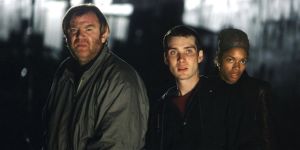 The cinematography of 28 Days Later is wonderful. It’s the best I’ve ever seen digital video. The choice of shooting on that medium also amplifies the horror and creates a more immediate sense of danger. The musical score could have been written by one of those popular Brit-rock bands. It’s propulsive, effectively building, and wonderfully sonic.
Harris is the star of the film, whether the makers know this or not. Shes one tough cookie but also reflects great moments of vulnerability as she opens up to the group and starts kindling some feelings for Jim. Gleeson is one of the best character actors out there, as evidence by a great turn in Scorsese’s Gangs of New York. Acting is never the strongest suit for horror flicks but 28 Days Later has some nice exceptions to this norm.
28 Days Later has a resonating sense of truth to it, if that can be said about apocalyptic cinema. When one character regrettably becomes infected they order their fellows to stand back, but before succumbing they say, Just know that I love you. This felt so genuine to me. Like if a comet was hurtling to decimate the planet within seconds, and your loved ones were around you, would you not act the same way? How does one compress all their feelings and appreciation and love in closing seconds? Something tells me its something like what is displayed in 28 Days Later.
Boyle, as has been ingrained into me from the blurb-heavy ads, has indeed reinvented zombie horror. However, what you may not know is that zombie horror doesn’t exactly have many titles to it. I think I’ve already mentioned most of them. Boyles zombies aren’t dead, just infected human beings. They don’t move at that lumbering drag-your-feet speed of classic zombie lore, no these not-so-undead move with great velocity and ferocity, like rabid junkyard dogs. The new touches here and there provide some interesting dynamics to the genre.
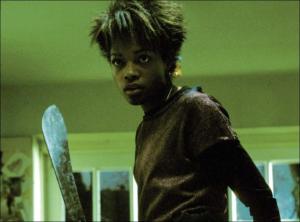 Perhaps what is different than most zombie films is that the audience grows to like the characters and root for their survival. In most horror films the characters are either too stupid or sketchy that it allows the audience to wait in amusement for their eventual horrific deaths. Its simple: we want to see these people die because its titillating (Maybe I was wrong about all the zombie analysis I still had in my head).
Boyle does service a slight message in his zombie film when the group gets to the military base. Perhaps, he muses, our military and trusted leaders are no better than those rabidly wandering the streets. The idea of a thriller set against a biological pandemic also feels very timely and relevant. The film kind of drags in the middle during the stretch between London and the military base. And the end was a bit too much Die Hard for my taste, but is suitably climactic.
Boyle has crafted a creepy, smart, and engrossing piece of entertainment. I hope people dont confuse this film with that Sandra Bullock clunker, 28 Days. They may be spending the entire time wondering where shirtless Viggo is and when Bullock will start her endless pratfalls (You knew I was going to talk about that movie somewhere).
Nate’s Grade: B


 nathanzoebl
You must be logged in to post a comment.