Blog Archives
The Old Guard 2 (2025)
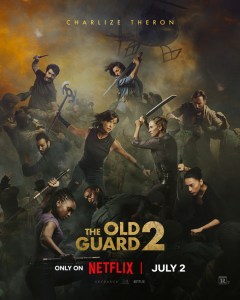
I wasn’t a big fan of the 2020 immortal action movie The Old Guard, but apparently it became one of Netflix’s most viewed movies, so here we are five years later with a sequel about the ancient conspiracy of warring immortals co-starring Chiwetel Ejiofor (not to be confused with Infinite, which is about an ancient conspiracy of warring immortals who are reincarnated into new bodies co-starring Chiwetel Ejiofor). I found the action and the general world-building to be underwhelming, but Old Guard 2 makes The Old Guard look like Michael Bay in comparison. There are two key developments in this sequel. Uma Thurman plays the first immortal and she wants to destroy the world or whatever. The second is that anyone injured by our newest immortal, Nile (Kiki Layne), loses their immortality. The rules of this universe get awfully hazy. I’m taking this directly from the film’s Wikipedia summary: “Additionally, anyone who has lost their immortality can regain their power by another wounded immortal who can transfer their power to the host they choose.” Still following? So we have one person who can make immortals mortal, but any mortal immortal can also choose to have their absent immortality bequeathed to a mortal immortal of their choice, reasserting their immortality. Okay. The confusing rules would be mitigated if we found any of the characters compelling. The sequel does bring back Andy’s (Charlize Theron) ex-beloved Quynh (Veronica Ngô) who was locked into an iron maiden coffin and dumped overseas. The established rules had immortals reawaken from death, so this poor woman would keep waking back up again only to drown instantly and repeat the horrifying process again. Let’s do the math here. On average it takes about two minutes to drown (FYI, I typed into Google “how long does it take to drown,” and now my computer is worried about my mental health). Let’s cut that in half from the extra water pressure filling her lungs. So let’s say she dies every minute. That means she dies 1440 times a day. Over the course of 500 years she has died 262,800,000 times. Rescuing this woman should be a recognition not just of her relentless suffering but the fact that her mind should be shot. Having to endure that horror would break anyone, and Andy coming to terms with her inability to heal someone who cannot die but is also unable to continue life any longer woukd be interesting. That’s my preferred sequel. Instead with The Old Guard 2 we get a bunch of lackluster fights and convoluted lore, and it doesn’t even offer a conclusion, more an implied hand-off to a third movie where the characters may indeed be able to finish what they’ve started. It’s time to let these mortal immortals just die in peace.
Nate’s Grade: C-
Share this:

Monster (2003) [Review Re-View]
 Originally released December 24, 2003:
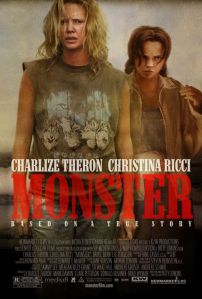
Monster follows the life of Aileen Wuornos (Charlize Theron, now nominated for a Best Actress Oscar), Americas only known female serial killer. In the late 1980s, Wueros was a roadside prostitute flexing her muscles with Florida motorists. She describes hookin’ as the only things shes ever been good at. One day Wuornos has the full intention of taking her own life, but she meets 18-year-old Selby (Christina Ricci) at a lesbian bar and finds a companion. Driven by a growing hatred of men from sexual abuse, Wuorno’s starts killing her johns to try and establish a comfortable life for her and Selby.
Let’s not mince words; Theron gives one of the best performances I have ever seen in my life. Yes, that’s right. One of. The. Best. Performances. Ever. This is no exaggeration. I’m not just throwing out niceties. Theron is completely unrecognizable under a mass of facial prosthetics, 30 extra pounds, fake teeth and a total lack of eyebrows. But this is more than a hollow ploy to attract serious attention to the acting of a pretty face. Theron does more than simple imitation; she fully inhabits the skin of Aileen Wuornos. The closest comparison I can think of is Val Kilmer playing Jim Morrison in The Doors.
Theron is commanding, brave, distressing, ferocious, terrifying, brutal, stirring, mesmerizing and always captivating. It may be a cliché, but you really cannot take your eyes off of her. Her performance is that amazing. To say that Theron in Monster is an acting revelation is perhaps the understatement of the year.
With previous acting roles in Reindeer Games and The Cider House Rules, Theron is usually delegated to pretty girlfriend roles (who occasionally shows her breasts). Who in the world thought she had this kind of acting capability? I certainly did not. If Nicole Kidman can win an Oscar for putting on a fake nose and a so-so performance, surely Theron should win an Oscar for her absolute transformation of character and giving the performance of a lifetime.
With this being said, and most likely over said, Monster is by no means a perfect film. Minus the terrific central performance, Monster is more of an everyday profile of a grotesque personality. The film weakly tries to portray Wuornos more as a victim, but by the end of the film, and six murdered men later, sympathy is eradicated as Wuornos transforms into the titular monster. Some supporting characters, like Ricci’s narrow-minded Christian up bringers, are flat characters bordering on parody. The supporting characters are generally underwritten, especially the male roles that serve as mere cameos in a film dominated by sapphic love.
Monster is proof positive that human beings will never be phased out by advancing machinery when it comes to acting. Monster boasts one of the greatest acting achievements in recent cinematic history, but it also coasts on sharp cinematography and a moody and ambient score by BT (Go). Monster is a haunting film that you won’t want to blink for fear of taking your eyes off of Theron. She gives an unforgettable tour de force performance that will become legendary.
Nate’s Grade: B
——————————————————
WRITER REFLECTIONS 20 YEARS LATER

Monster was a revelation for Charlize Theron, an actress who until then had mostly been known for parts that asked that she be good looking and little else. Twenty years later, Theron is one of the best actresses working in Hollywood and it almost never happened without her breakthrough performance where she brought to startling life the horror of Aileen Wuornos’s tragic life and tragic desperation. When this movie came out originally in 2003, I doubt anyone but Theron’s closest friends suspected she was capable of a performance this raw and spellbinding, but that’s also a condemnation on all of us. How many other actresses out there could maybe rival the best of the best if they just had the right opportunity? How many actresses are stuck playing the same limited roles because that’s all they’re ever asked to do? How many actresses are wrongly assumed to be of limited talent simply because of their comely appearance? That isn’t to say there’s some hidden universal equation that the uglier you are the better at acting you have to be (though it sure has worked out for [insert your example of a conventionally unattractive actor here]), but this movie is a clear indication that too many actors are never given enough opportunities to shine.
Back in early 2004, I credited Theron’s performance as one of the best I’ve ever witnessed in my then-twenty-one years of moviegoing (although that number should be smaller considering I wasn’t keenly watching Scorsese as a baby). She is very good, but I’d like to claw back some of my rapturous words of praise now that we’ve seen twenty years of Theron acting excellence. Looking over her career, I might actually cite 2011’s Young Adult as her finest performance, and that one didn’t even nab an Oscar nomination (she’s since been nominated twice since, for 2005’s North Country and 2019’s Bombshell). The draw of the movie is the head-turning performance from Theron and she just disappears completely inside the skin of her subject. It’s hard to remember at times that this is Theron, thanks to the richness of her startling performance but also the accomplished makeup effects, which were not nominated. At every point, you feel the fire burning behind the stricken complexion of Theron, a fire that will eventually consume her and everything she loves. While highly compelling, this is not a performance of subtlety and restraint. This is a big performance, and the movie is often prone to making loud pronouncements about its subjects and pertinent themes. It’s loud, brash, and maybe for some it will seem a little too loud, a little too unsubtle, but it’s a movie that refuses to be ignored for good reason.
 In my original review I raised some reservations with the rest of the movie, and I’m here to recant one of them. I wrote back in 2004, “The film weakly tries to portray Wuornos more as a victim, but by the end of the film, and six murdered men later, sympathy is eradicated as Wuornos transforms into the titular monster.” I’m positive that many will still cling to this same idea but oh boy have I come around in twenty years. By the time the movie is over, you wonder why more women haven’t just snapped and gone on killing sprees. Wuornos is indeed a victim. She’s responsible for terrible deeds but that doesn’t change the fact that she started as a victim and continued as one until put to death by the state of Florida in 2002. She was a sexual assault survivor, groomed into prostitution, and then trapped by a society that saw her as little other than trash, something to be pitied but ultimately forgotten. She comes of age as an adult thinking her only value is the fleeting moments of pleasure she can provide for men, and in the narration, we hear her dreams that one of these men who repeatedly tell her how pretty she is would take her away to another life, like a princess. Alas. It’s impossible to separate her past as a victim of predatory men from her actions when she turns on predatory men. Being forced into prostitution out of desperation is one of the definitions for sex slavery and trafficking. The movie does try to make her last few johns more ambiguous over whether or not they are “good people” and thus “deserving” of their fates, like a scale is being introduced and we’re doing the calculation whether Wuornos will strike (#NotAllMen, eh felas?). There’s a clear dark path where the murders get considerably worse. She begins by defending herself against a rapist, but by the end, it’s just a kind family man who picked her up without even the intention of having sex. We’re meant to see her transform into the titular monster, but I kept wondering about Aileen Wuornos as the societal stand-in, accounting for thousands of other women who lived and died under similar tragic circumstances.
I also found myself growing increasingly contemptuous of the love interest character played by Christina Ricci (Yellowjackets). When we’re introduced to Selby, she’s a wide-eyed naif testing her boundaries of comfort but clearly tapping into repressed homosexual feelings. Their relationship is meant to serve as the emotional rock for Wuornos, the reason that she’s acting more rash is because she’s trying to earn enough money for the two of them to run away together and build a new life. She is her motivation, but Selby is absolutely the worst. You can excuse some of her hemming and hawing about striking out on her own and leaving her controlling parents, as she’s fighting against repression as well as trepidation for starting out independently, but this lady becomes fully aware of the dangers and dehumanization that Aileen goes through to earn her meager amounts of money, and Selby encourages her to do so. Not just encourages her, Selby pressures her to do so, to get back out there and “provide” for her, knowing fully well what that means, knowing fully well how these men have treated Wournos, repeatedly abusing her. What are you doing to help things out, huh Selby? She’s embarrassed hanging around Wuornos around some other lesbian friends she just met, so she’s already looking to upgrade and move past her lover. By the end, as she’s trying to coax a confession of guilt from her girlfriend to save her own skin, Selby becomes just another user, taking what they want from Wuornos and discarding her when they’ve had their fill.
 This was the directorial debut for Patty Jenkins, who also served as the sole credited screenwriter, and while the indie darling-to-franchise blockbuster pipeline has been alive and well in Hollywood, it was quite a surprising leap that her next movie after Monster was none other than 2017’s Wonder Woman. To go from this small character-driven true crime indie to leading the big screen solo outing for comics’ most famous female hero is quite a bizarre but impressive jump. Her only other feature credit is the much less heralded 2020 Wonder Woman sequel. She was attached to direct a Star Wars movie about fighter pilots but that seems to have gone into turnaround or just canceled. So is the way with Star Wars movies after 2019’s Rise of Skywalker. Just ask the Game of Thrones creators, Josh Trank, and Taika Watiti how that goes.
Monster is a phenomenal performance with a pretty okay movie wrapped around it in support. Twenty years later, Theron is still a monster you can’t take your eyes away from. It changed her career destiny and I think acts as an exemplar for two reasons: leaving the viewer with the question how many other wonderfully talented performers will never get the chance to showcase their true talents because of faulty assumptions, and how many other women are out there living in quiet degradation like Aileen Wuornos.
Re-Veiw Grade: B
Share this:

F9: The Fast Saga (2021)
 Has a multi-billion-dollar franchise ever had this much confusion and inconsistency with a name? The Fast and Furious saga, which is what we’re now calling it I suppose, began twenty years ago in 2001 and has undergone all sorts of titular irregularity. We’ve had different adjectives favored (Fast Five, Furious 7) and even gone the route of number-related wordplay, like 2018’s very soap opera-sounding The Fate of the Furious (spelled F8 in some incarnations). The ninth entry is titled F9, and by the logic of the previous sequel, I would assume that was intended to stand for “Fff-nine,” or likely “Fine,” and at this point an implicit admission of the franchise just not even trying to be relatable to any kind of recognizable pattern or order or even coherency. Alas, the title is apparently only supposed to be read as F-9, followed by the also soap opera-sounding The Fast Saga subtitle (sorry, “Furious,” maybe you’ll regain credit billing in the tenth movie in 2023). Maybe that will include the soap opera-sounding subtitle, “As the Wheels Spin.” It’s all just a curious way to handle name recognition for a twenty-year blockbuster franchise. F9 was delayed a year from COVID, a phrase that will be repeated a lot with upcoming fall releases, and after watching the 130-minute sequel, I think the franchise has finally exhausted its general appeal for me.
 I’ll begin by stating my own apologist stance on the Fast saga. I’ve never been invested in this franchise for the characters (with the exception of The Rock because he is The Rock) or for the stories, and I doubt few others who even consider themselves fans would differ. I watch these movies for their ridiculous stunts and action set pieces that don’t just defy the laws of physics but make the ghost of Isaac Newton vomit. As long as those action set pieces delivered the goods, I was able to forgive much. And I have had to ignore or forgive a lot but until now I have found those set pieces able to clear an increasingly elevating hurdle, the baggage of these characters and trying to make me care even as they become impervious superheroes that have long left the earthbound trappings of a scrappy team of underground street racers lead by Vin Diesel back in 2001. Now Diesel is 54, every member of his beloved crew/family will never die even after they appear to die, and the filmmakers have decided to introduce a long-lost adult brother played by John Cena, never mind the fact that these two muscle men don’t look like they share a single shred of DNA. It doesn’t matter, and the question remains what even matters any longer for a franchise defined by its brain-melting excess? It’s a soap opera with spy missions. It’s dumb fun to eat popcorn to. That’s all.
I acknowledge the inherent absurdity in bemoaning the over-the-top nature of a franchise whose very appeal was its over-the-top nature. It’s hard to define but every movie universe has a line of sustainable believability. Once that line is crossed, you feel it. The Fast saga has played with this tenuous tonal demarcation line for over a decade. In the eighth movie, the cars were outracing a nuclear submarine and cracking ice floes and The Rock redirected a torpedo with his biceps. That’s crazy, but remember The Rock is a superhero among us mere mortals. In the seventh movie, the cars parachuted out of a cargo plane and drove through skyscrapers. In the sixth movie, they faced off against a tank. And yet, I happily accepted those flights of fancy because they kept me entertained ahead of that nagging sense of incredulity that they were able to somehow outrace. With F9, even with the return of director Justin Lin (Fast 3-6), it feels like the franchise finally crossed that line for me. I completely understand any reader that wants to point and shout “hypocrisy.” In the arms race of action imagination where the producers have had to come up with bigger and more wild set pieces, I think they have inevitably gone from self-parody into ironic self-aware self-parody and back into self-parody again. The best way I can describe it is with the two Expendables movies. The first was amusing action bravado self-parody but then the second film tried to be in on the joke, and all the winking “we get it too” meta commentary just sapped all the enjoyment out of it. The same thing happened with the two so-bad-they’re-good Birdemic disaster movies, with the first a sincere bad movie, and the second trying to be an ironic bad movie, and it just wasn’t the same. The appeal was gone. For me, F9 is the signal that this franchise has begun its descent into Birdemic 2 range and yes, they go to space in a space car and isn’t that what all us irony-drenched fans wanted? It’s like the disappointing be-careful-what-you-wish-for warning of Snakes on a Plane all over again.
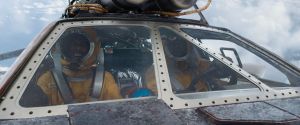 Another factor that sank the movie for me was the inclusion of the long-lost brother storyline, especially considering the Diesel character is all about the vague platitude of family. In order to justify this significant oversight, the storyline has to resort to numerous flashbacks to fill in the sordid family details between the feuding brothers. I cannot overstate just how much I do not care about the characters in this franchise, so devoting more time to introducing complicated family histories with melodramatic flashbacks is not what I want to experience during the downtime in between the next explosion. By trying to take these characters and their relationships seriously, or seriously enough, we’re forced to slog through personal drama nobody asked for or actively desires. Better to embrace the soap opera absurdity and just have Cena show up and then every other set piece another long-lost brother shows up, and then we keep cutting back to the same singular flashback but now it’s revealed that another brother was there too previously unseen on the peripheral of the camera. The same thing goes for having to bend over backwards to explain the re-emergence of Han (Sun Kang), a character killed in the sixth/third movie by the-then bad guy (Jason Statham) that we like too much now to be the bad guy. I don’t care that he’s alive again, and the convoluted yet still unsatisfying vague plot to explain his fake death is unwanted as well. Apparently, the only character who will remain legitimately dead in this series is Gal Gadot (for now).
For the hard-core fans, there may be enough nitro juice in F9 to still provide a satisfying jolt of high-octane entertainment. Lin still has a nice command on action sequence visuals and there’s some large-scale carnage that tickles even while it’s undermining every concept of magnetism. Unfortunately, the joy I felt with previous action incarnations from the series was not recaptured this time. It just doesn’t feel as memorable, at least in a positive way. Going to space is memorable, but not in a positive way, unless they had to race a universe of aliens on the moon to save the Earth. I genuinely like Cena as an actor, but he’s far too strait-laced and dull here. Watch the recent Suicide Squad reboot to be reminded just how charming and comically talented he can be in the right role. Diesel seems to be putting less and less effort into every performance almost like a dare to the audience on how little they will accept. There were a few shots I watched where I felt like he was on the verge of going to sleep. The villain is lame, the movie has too many competing comic relief characters, and it’s all too long. I’ve been a defender of the blockbuster bombast of the Fast saga. I’ve considered myself a fan of its outlandish set pieces and ludicrous stunts. I’ve been able to ignore what didn’t work. Alas, the time has come where I can no longer do that. I just felt mostly indifferent and bored for much of F9, and its action highlights couldn’t save the extra emphasis on convoluted soap opera melodrama. Your mileage will vary as far as what you can forgive, but F9 feels like the appropriate off-ramp for me.
Nate’s Grade: C
Share this:

The Old Guard (2020)
 What do you do with an action movie where the action is actually the least interesting part? The new Netflix film, The Old Guard, is based on a comic book series by Greg Rucka (Whiteout) about a mercenary squad staffed with immortals through the ages. Lead by Charlie Theron, whose character Andy traces back to at least the Medieval period, leads the team and sees promise in their newest recruit, Nile (Kiki Layne, If Beale Street Could Talk), a U.S. soldier who is shocked to discover she can come back to life. It’s through this new recruit that we get an introduction to the hidden world of immortals and their hidden history, and it’s these flashbacks that I found the most entertaining aspect of the entire two-hour movie. Watching Theron swing a Viking battle axe is a lot more fun than watching her stalk corridors with a gun. There’s also some great little moments that show an attention to developing the characters and their psychology. Andy has a centuries-old love that was trapped in a suit of armor and thrown into the sea. Besides the fact that drowning is horrifying, imagine dying, then reviving, and then drowning again and again, every few minutes, for an eternity. Wow that is a new level of horrifying. Each of the characters has an interesting history and some degree of dimension, and it’s these soul-searching conversations that I enjoyed the most as they discuss the costs of living forever. However, it’s not quite forever, because immortal heroes have an obvious problem about holding stakes, so at some point the immortals will lose their healing ability, though they don’t know when. It’s something, but it feels more arbitrary, and the super smarmy pharma CEO villain (Harry Melling) is a non-starter as a threat. The action sequences almost feel like a chore, like the filmmakers are checking boxes instead of using them to advance the plot in meaningful and exciting ways. The action isn’t bad but just mundane, lacking memorable set pieces or engaging complications. Even their use of taking punishment is under-utilized in the design. Simply put, a movie with this kind of premise and with Theron as your lead should be more exciting. I loved Mad Max: Fury Road. I loved watching Theron lay waste to goons and gangsters in 2017’s Atomic Blonde, a movie built around her physical capabilities and smartly constructed action set pieces. However, the action we get with The Old Guard lacks the same transformative ability and fight choreography. It’s just thoroughly fine, at best, and I kept wondering if they were saving themselves for a big finish. Sorry to disappoint, it’s just more office hallways with limited gunplay. The energy level is lacking and the music choice throughout the film affects this as well, with the same kind of downer tracks playing again and again. I would rather have spent these two hours listening to the immortal stories around a campfire.
Nate’s Grade: C
Share this:

Bombshell (2019)
 More an expose on toxic work environments than anything overtly political, Bombshell is an effective true-life drama about the many pitfalls, humiliations, traps, harassment, and compromises that women face in the workforce. We follow the downfall of news magnate Roger Ailes (John Lithgow), the imposing man who built the Fox News empire and who also bullied his employees and solicited sexual favors from the many women who were on his payroll. Margot Robbie plays an invented character meant to provide that entry point into Ailes the creep in creepy action. She’ll be harassed and pressured for sex by a man described as “Jabba the Hut,” and Robbie is terrific in her big dramatic moments portraying what the pressure and shame does for her ambitious anchor. The other two main characters wrestle with how far to go in a corporate culture of keeping secrets from very powerful, very dirty old men. Gretchen Carlson (Nicole Kidman) is consulting lawyers for a personal harassment lawsuit against Ailes the person, not Fox News, but she needs other women to come forward. Megyn Kelly (Charlize Theron) is struggling with the scrutiny she has endured after then-presidential candidate Donald Trump turns his small Twitter thumbs against her. The Fox bigwigs won’t go on record to defend her, and their journalists, because they need Trump to drive ratings. The movie uses several Big Short-style narrative tricks to help tell its sordid tale, including swapping narration and fourth-wall breaks; a run through of hearing from Ailes’ past victims in their own words is striking, especially a woman who says she was only 16 at the time. Part of the fun are the many many cameos and just watching actors portray different Fox News personalities (Richard Kind as Rudy Guiliani!). The makeup is also phenomenal and Theron looks unrecognizable as Kelly. The film itself doesn’t feel like it’s telling you anything you already don’t know about the subject; people will compromise their morals for personal gain, power leads to exploitation, women are unfairly treated, and it’s easier to fall in line than stand up to power. There’s still a thrill of watching the downfall of a serial abuser, and the acting is strong throughout, but Bombshell can’t shake the feeling of being a slicker, more star-studded TV movie version of recent history. Even with the urgency of the topic, it feels light, and not because of its use of incredulous humor. I could have used more behind-the-scenes details, and maybe that’s where Showtime’s miniseries The Loudest Voice comes in, retelling the same story with Russell Crowe as Ailes. It’s a solid movie on a very pertinent subject and worth seeing but it also makes me wish for a harder-hitting, more widely sourced expose on this very bad man who felt forever protected by the status quo of power.
Nate’s Grade: B
Share this:

Long Shot (2019)
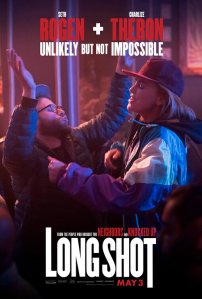 Secretary of State Charlotte Field (Charlize Theron) is preparing for the moment she feels her whole life has been leading up to: a presidential run. the current president (Bob Odenkirk) has decided not to run for a second term and wants to endorse her. Charlotte and her team of dogged, loyal assistants (June Diane Raphael, Ravi Patel) are sifting through ways to improve her negatives as a candidate, and that’s where Frank Flarsky (Seth Rogen) comes in. He’s an activist journalist that has just been fired and he also happens to personally know Charlotte; she was his babysitter. He comes aboard her campaign with the condition that she really fights for what’s important and not cave to the powerful lobbies and interest groups. He rewrites her speeches and the two of them grow closer together, bonding over their past and a possible future, not just as president but as boyfriend-girlfriend. They must keep their feelings a secret for the time being. If the press found out it might kill her candidacy before it ever really began.
The film’s biggest strength is the emphasis with the leading characters and the crackling chemistry between Rogen and Theron. It’s a fairly familiar dynamic between the more buttoned-up personality learning to cut loose and the more wild and impulsive personality learning a degree of self-restraint and responsibility. And to be fair Long Shot does pull from this familiar foundation for a starting point with its odd couple dynamic. However, it goes further by making their differences more attuned to politics and compromise. Fred is unwilling to back down for the things he knows are right and would rather have nothing than a watered-down version of the important issue he had been fighting for. Charlotte is more the political animal and used to working with others, including scoundrels and morons, in order to affect change. She’s about incremental, pragmatic change for the greater good and he’s about ideological purity as a moral imperative. This isn’t just a small character quick either; it’s a defining conflict between both characters and a subject that gets further examination as Charlotte confronts the realities of running for president and the many compromises of self and vision may or may not be needed.
 Being a woman running for president is an obstacle course of having to deal with latent sexism and other people’s expectations of what is socially appropriate. Charlotte is going to be judged harsher for the same behaviors men will be excused for; this isn’t a new observation by any means (apply your favorite double standard here) but the film makes you understand the pressure and scrutiny that befalls her at every turn. It defines her character, which is why finding someone she can unwind with and be her true self away from the cameras is such an understandable and desirable escape valve. She’s running to inspire little girls that they too can be president but at she also has to assess the cost of how much she’s willing to hide or lose from herself in order to get across that finish line, and if she does, what will be left? That’s the role for Alexander Skarsgard, the Justin Trudeau-like Canadian prime minister, who represents what is left of a person after bowing to opinion polls. Again, this isn’t new material, especially as anyone who can recall the 2016 presidential election will recall the questions of physical and mental fortitude that only seemed attached to one candidate and not as much the other. What this political reality does is provide a relevant substance for the romance and comedy portions of the film, making the characters feel more human. When Fred is articulating just what he must do to serve as a secret boyfriend for Charlotte, and a potential future they would have, you can hear his heartbreak with each new syllable. You also realize that he shouldn’t have to endure that and maybe these two are destined not to be together because of how unfortunate our politics and media environment have become.
Rogen and Theron are a blast together and have a fun rhythm they play off each other for unexpected comedy beats. His mellow vibes and good-natured joviality, as well as general awkwardness around people in power, are a nice fit with her sterner self. The best parts of the movie are just watching both of these actors enjoy their company. I won’t say that the romantic spark became overly apparent but what was undeniable was how well they paired as an onscreen buddy duo. With each new movie and every different role, Theron proves she’s one of the best actors of her generation. She can kick your ass, she can make you cry, she can win your heart, she can make you bust a gut. In short, Charlize Theron can do anything. She has several disarmingly funny moments, like when she’s high on ecstasy and pulled into an international crisis and has to maintain her cool. Rogen could easily fall back on his ease playing the oafish, insecure, crass characters of his past, but he does a fine job imbuing his charm, energy, and authenticity with Frank. Rogen is an anxious and generous scene partner who typically elevates his costars, and he and Theron as so good together that it sells their romance even better than the writing.
 Thankfully, Long Shot is consistently funny and bases much of its humor on the characters and their needs and developments. The movie isn’t just a retread of the incredulous fantasy of some ugly dude successfully romancing a beautiful woman. We’ve already had this dynamic explored in another Rogen comedy, 2007’s Knocked Up (in another universe where Katherine Heigl’s career didn’t stall, I could have seen Long Shot serving as an unofficial reunion for her and Rogen). There are jokes to be had about the unbelievable nature of this central romance and Rogen’s overall appearance, and that’s expected. What made me happier was that these wisecracks served a purpose to highlight how professionally damaging this potential relationship could be for Charlotte’s chance of winning office. They didn’t just feel like gratuitous put-downs. The joke emphasis is heavily tilted in favor of our two leads but there are nice moments with the supporting cast, like Raphael’s constant passive-aggressive comments, Bob Odenkirk’s buffoonish sense of betrayal with TV being turned against him, Randall Park’s frankness, and Skarsgard’s awkward and obsequious flirting. I don’t think the filmmakers fully knew what to do with O’Shea Jackson Jr. and provide some last-minute character shading that felt clumsy.
Long Shot follows the Judd Apatow rom-com formula closely and demonstrates that if you get funny, talented people together, provide them solid characterization and realistic conflicts, you can produce a winning romantic comedy that matters. Rogen and theron make an excellent team, the political content is savvy without getting too far into the weeds, and the romance is sweet and agreeable, with two genuinely enjoyable people coming to realize what they would be willing to risk for the other person. Long Shot is a reliably funny, bawdy, and heartwarming little movie with a little more on its mind than gross-out comedy set pieces. It’s worth seeking out this summer. I’d happily vote Theron for anything, especially if she was running for elected office as Furiosa. That’s a candidate that get results.
Nate’s Grade: B
Share this:

Tully (2018)
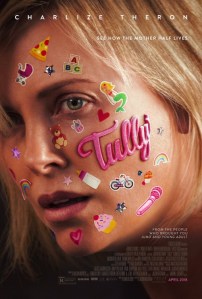 Tully is a Young Adult reunion, bringing back writer Diablo Cody (Juno), director Jason Reitman (Up in the Air), and star Charlize Theron (Atomic Blonde), and for people without kids, it can feel more like a horror movie. Numerous movies have conveyed the challenges of parenthood, the put upon moms and dads struggling to juggle schedules and lunches and homework, all without much time to themselves for self-care. Usually these movies will begin by displaying the hardships of parenthood but ultimately put a cheery bow on things by the end and conclude, “Yeah, but it’s all worth it.” Tully doesn’t provide that easy bow and I appreciated that. Motherhood can be a real bitch.
Marlo (Theron) is a 40-year-old mother who feels overwhelmed with life. She’s about to have baby number three and her “atypical” youngest son requires a lot of intensive supports and is upsetting his school. Her husband, Drew (Ron Livingston), is away for work often and late at night he plays online games and keeps to his side of the bed. Marlo’s rich brother (Mark Duplass) takes it upon himself to hire a “night nanny,” a person who watches the newborn baby during nighttime hours and allows the mother to get some restful sleep. Marlo is adamant about not letting a stranger watch over her child but soon relents and calls for the nanny. Enter Tully (Mackenzie Davis), a mid-twenties godsend who is wise beyond her years, competent, and nonjudgmental. With Tully’s assistance, Marlo is able to make steps toward becoming the person she remembers.
 Through its depiction, it feels like parenthood has a lot in common with incarceration. It feels like a new parent goes away for a multi-year sentence, loses all sense of sleep, is indentured into work often without any compensation, and required at a moment’s notice at all hours. Marlo’s life is certainly unglamorous but it’s also taking its toll. The needs of her children, including one with undiagnosed special needs, are snuffing out her sense of self and taking an unremitting physical and mental toll. The opening of the film has Marlo days away from her third pregnancy and she looks like she’s smuggling a beach ball. Her brother’s wife cheerfully adds, “You look glowing,” that age-old pregnancy praise, and Marlo’s unfazed reaction is more of a, “Really?” She then proceeds to compare herself to the trash barge that floated along the East Coast in the 1980s, a perfectly plucked pop-culture allusion from Cody. At no point do you doubt the love Marlo has for her family, but the servitude is driving her crazy and with no relief in sight with baby number three. There’s a pristine montage of her daily routine of feeding, pumping, changing diapers, and absent sleep, the days just melting into one another, and it’s so horrifying in its mind-numbing execution that it reminded me genuinely of Darren Aronofsky’s Requiem for a Dream montages of drug-abuse and despair.
It’s a third of the way into the film when Tully enters the picture and serves as the long-needed change agent for Marlo. She’s the miracle worker nanny that works at night like a whimsical little elf, and the next morning the house is clean, the baby is taken care of, and Marlo has been allowed a rejuvenating night of sleep. You can chart the change in the quality time with the family, where quickie microwave pizza dinners become more advanced home-cooked meals with multiple ingredients and food groups. You can also chart the change through the magnificent performance of Theron, who appears to be regaining her sense of self and placement in the family. Tully serves as a refreshing, therapeutic conversationalist, able to get Marlo to introspectively reflect upon her life’s goals and setbacks and her sense of what she should be as a woman and not just as a mother. Tully is wise but also winsomely hopeful and optimistic; she recharges the battery for this family and Marlo in particular. These gentle, observational conversations are the best part of the film and Theron and Davis are wonderful together. Each woman seems to be learning from the other and providing a support system.
 Cody’s early screenwriting was dinged for its obsession to be quippy and hip, but it has matured and depended over the years. Young Adult was an incisive character study in kamikaze narcissism, and it was as cold as Tully is warm, even-handed, and honest. Having a talent as surefire as Theron is a great asset, but it’s Cody’s storytelling that gives the movie its sting and its sweetness. This is something of a comfy thematic middle ground between the ironic, quippy yet sentimental Juno and the dark spiral of stunted growth in Young Adult (seriously, rent that movie again if you can, it’s vastly underrated). Tully is a movie that is lifted on wry observations and honest dialogue. It feels very real, so much so that I was convinced the reality show-within-a-show Gigolos (Marlo is a bashful fan) was the real deal for most of the movie [Edit: it has come to my attention this is a real show. Ahh, still a nice detail about Marlo character]. I also loved the drive into Brooklyn being relegated to jump cuts, each new jump playing a different Cyndi Lauper track on an album, which feels very biographical and authentic. The details of Cody’s story feel sharply developed and authentic, and that’s the biggest draw of this movie. It’s an unvarnished look into the realities of motherhood and each little detail helps further contribute to the larger portrait of Marlo’s exhausted life. The supporting characters do get a bit of short shrift here, kept as one-dimensional peripheral portrayals. I was expecting more from her husband Drew since their relationship and the platonic valley they’ve found themselves stuck in is another significant aspect. However, the movie is really about the relationship of Marlo and Tully and how they build up one another. Marlo even sees herself in the younger nanny, and she’s also wistful of a time that her body more closely resembled that of Tully’s flat tummy and compact derriere.
Theron continues to establish with role after role what a phenomenal acting chameleon she can be. I know we gush about Cate Blanchett, Amy Adams, and Kate Winslet as the finest actresses of their generation, but I feel like Theron deserves to be in that same hallowed Pantheon. She gave one of the best performances I’ve ever seen in 2003’s Monster and I think she was deserving of nominations for work as varied as a one-armed post-apocalyptic feminist warrior. Theron gained fifty pounds for this beleaguered role, which is an impressive commitment, but she doesn’t just let the weight gain serve as the focal point of her performance. She uses every exhausted muscle to communicate Marlo’s plight. When she’s slumped over in a chair and just rips her off stained shirt, you feel her utter defeat and desperation (“Mom, what’s wrong with your body?” one child asks). This is a woman who is tired to the bone. She’s taking everything life gives her and soldiering onward, afraid to speak up. This is best voiced when she describes her relentless day and staring into a closet and thinking, “Didn’t I just do this?” Theron’s renewed vitality as mother, wife, and most importantly, person, is a rewarding development to tag along with. Theron’s breadth of tenderness, sadness, and hard-won insight is easily relatable and emotionally engaging.
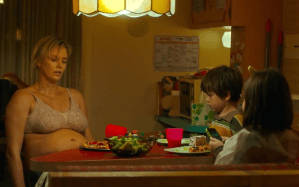 The one thing that holds me back from fully embracing Tully is a late story decision that I’m still wrestling over. It feels a bit like tonal whiplash and I immediately felt like it was completely unnecessary and that I was happy with the movie already being told. It left me jarred although I admit this decision helped provide better context for some unexpected turns in the middle between characters. Having deliberated for a couple of days, I can see how this decision plays into a larger sense of theme and character, while also tapping into something primal about motherhood and the emergency lifelines needed and provided. I’m warming to Cody’s decision and can see the rationale behind it. Still, there will be plenty of audience members that will be left questioning the thought process here.
Tully is the third collaboration between Cody and Reitman and they bring out the best in one another. After two duds in a row, I was worried that Reitman had become all too mortal after his 2006-2011 run of amazing films. It’s reassuring to find Reitman back in finer form and to also experience the maturing growth of Cody’s exceptional writing. I wish there was more with the supporting characters but this is a character study of our main momma. The late plot turn will divide audiences (I’ve already identified with both sides) but it serves the film’s larger focus on the well-being and recuperation of Marlo. Tully is a funny, compassionate, and unflinching movie about the perils of motherhood and the steps we all need to take to activate a little necessary self-care.
Nate’s Grade: B+
Share this:

Atomic Blonde (2017)
 Atomic Blonde is based on a 2012 graphic novel called The Coldest City (by Antony Johnston and Sam Hart), a title I doubt many were that familiar with. Charlize Theron was. She snapped up the option rights before it was published and saw it as a vehicle for herself to cut loose, have fun, and show off her affinity for fight choreography thanks to her background in dance. If you don’t walk out of this film with an uncontrollable crush on Theron, then I don’t know what movie you saw, my poor friend.
Set in 1989 Berlin, on the eve of the wall going down, Lorraine Broughton (Theron) is working undercover for her Majesty to uncover who is killing British agents in East Germany. Her local contact is David Percival (James McAvoy), a black-market kingpin and popular mover and shaker. One of his contacts (Eddie Marsan) has committed secret spy files to memory and wants an escape to West Germany. He’s even gotten the attention of other spooks, including French intelligence agent Delphine Lassalle (Sofia Boutella), who gets intimately close to Lorraine. The smuggling of the contact goes bad, lives are lost, and Lorraine has to explain to her superiors (Toby Jones, John Goodman) what went wrong and who is secretly the murderous traitor.
 This film could have just as easily been re-titled Sexy Charlize Theron: The Movie. It is a two-hour celebration of the actress and her many formal gifts. Watch her look sexy in this sexy outfit (i.e. every outfit Theron wears or doesn’t wear). Watch her look sexy strutting down a hallway in slow mo. Watch her bathe in ice. Watch her dispatch bad guys with ease, sexily. And then there’s the sapphic romp with Boutella (The Mummy), which is just an explosion of sexy that might be too much for the weaker-hearted audience members to handle. A female friend of mine used to refer to Angelina Jolie in the early 2000s as “walking sex,” a woman that simply oozed sex appeal with her every glance and movement. I think that term deservedly applies to Theron in Atomic Blonde. The surface-level pleasures are rampant, from the 80s chic clothing, to the pumping New Wave soundtrack, to the very stylized way people take long dramatic drags from their cigarettes, the movie exudes a sense of cool with every frame. There is plenty to ogle, and that includes the casual nudity of a 41-year-old Theron, who has plotted this showcase role for years as an unapologetic badass statement and maybe the nonchalant nudity is part of that (“You think women over 40 are unattractive? Well take a good gander at this, Hollywood”).
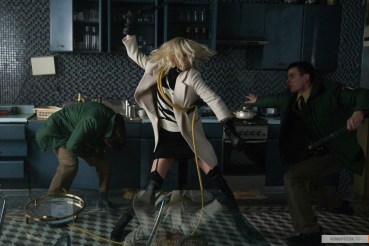
The film has style to spare but thankfully it also has enough substance to match, and by that, I mean its depiction and development of action. Coming from David Leitch, one of the co-directors of the John Wick franchise, I expected very fluid and well-choreographed action sequences, and Atomic Blonde delivers. I am happy that we have moved away from the Bourne-style docudrama approach of the jangled edits and gone the other direction, treating action sequences like the dance routines they are and allowing an audience to fully take them in and appreciate the skill and artistry. The showstopper everyone will be talking about is an extended fight sequence that closes out the second act. Lorraine ducks into a tenement building and gets into a bruising fight with several goons. This sequence goes down several floors, careens into empty rooms, and eventually ends up in the middle of a speeding car trying to make a desperate escape. It’s filmed to be one long take and the sequence is exhilarating and only becomes more so with every passing minute.
 Admirably, Atomic Blonde also brings a sense of realism to all its action. As the fight continues, Lorraine becomes understandably fatigued, as do the baddies. She is not impervious to their attacks. She’s gutsy but still vulnerable, still human. You feel the blows and the intense duration, which makes me marvel all the more at Theron’s sheer balletic grace when it comes to her ass-kicking capabilities. Having an experienced, accomplished fighter opens up the complexity of the action sequences. The stunt work is a consistent joy in this movie and what will make it stand out amidst the pack.
The only major gripe I have with the film is its rather convoluted spy plot. The Cold War as well as East Berlin is just a backdrop for the cool shenanigans. The movie toys with spy movie pastiches but clearly it only amounts to genre window dressing. It’s almost on par with the music, used to evoke a mood and not much more. It feels like even Atomic Blonde recognizes this and just blurts out more nonsensical “who can you trust?” plot mechanics to get to the next sexy set piece. If you don’t already know who the eventual traitor will be by the end of the first act, you haven’t been doing the math. The communist bad guys are an unremarkable lot but they do make for solid punching bags.
The opening scene sets up the death of a British spy as a personal blow to Lorraine (she kept a photo of the two of them in her dresser drawer) but he’s quickly forgotten and never mentioned. His assassination doesn’t even stir any simple impulses of revenge. The non-linear framing device also seems designed just to skip ahead to the good stuff or provide a break in the action where Lorraine’s superiors can provide disapproving, fuddy-duddy commentary about her blasé behavior. The plot is a bit too needlessly complicated and muddled for what the film needs. It’s as if screenwriter Kurt Johnstad (300) was given the edict to make things obtuse with paranoia and intrigue just long enough. There’s an extended coda that feels like a reshoot; however, it also has several significant plot revelations that completely change your understanding of the characters.
 Atomic Blonde is the kind of movie that knocks you around and overpowers you with its spiky attitude. At its best, the movie pulsates with a buzzy rush of adrenaline, setting up dangerous dilemmas for Lorraine to take out with her fists, feet, and any old thing lying around. Her ingenuity during the fight sequences adds a welcomed degree of unpredictability and satisfaction, and it makes the locations become an integral part of the fight choreography as well. There’s a reason I’ve been expending most of my review on the action sequences and sense of style, because there isn’t much more to Atomic Blonde. It’s all retro fashions, stylish artifice, an overeager soundtrack, and lots of too-cool bravado, but unlike say Suicide Squad, it actually pulls it off. It’s not posturing when it works. Theron is a absurdly convincing as a super sexy super agent, and it feels like they dropped her into a James Bond story (with Sofia Boutella as the Bond girl). The added realism and long takes allow the film to feel even more viscerally kinetic. If this is the start of a Charlize Theron franchise then I say we are living in the sexiest of times.
Nate’s Grade: B
Share this:

The Fate of the Furious (2017)
 I’ve written before that all I demand from the ever-ascendant and popular Fast and Furious franchise are its eye-popping action set pieces that teeter into madcap lunacy and impressive stunt work. A fiery meteor could crush all the characters, short of The Rock, and I wouldn’t shed a tear. Despite the super serious plaudits about the importance of family and loyalty and blah blah blah, I’m only here for the action spectacle that obliterates the laws of physics. I’ve said before there’s a fine line between stupid action and stupidly awesome action, and the Fast and Furious franchise has planted its flag like few others. Nobody today goes to the level of action spectacle that the Fast and Furious films achieve, bringing to life exciting action set pieces that feel fully plucked from the imagination of an exuberant child, and I don’t mean that at all disparagingly. These movies deliver like few others nowadays. We’re a long way from undercover cops and underground street racing. Vin Diesel and his team are essentially superheroes and their power involves doing amazing things with cars. I’m not a gearhead, I don’t care a lick about automobiles, but I’ve come to eagerly anticipate this franchise. It delivers ridiculous action on a ridiculous scale like few others. It’s earned my confidence. The Fate of the Furious, the eighth film, still delivers the high-octane goods even if it can’t quite keep up with the best of the franchise’s entries.
Dom (Diesel) has been preaching the virtues of family for years but now he’s turning his back on them. The notorious cyber terrorist Cipher (Charlize Theron) extorts Dom into helping her get her hands on nuclear codes. Dom’s crew (The Rock, Michelle Rodriguez, Ludacris, Tyrese Gibson, Nathalie Emmanuel) is wondering whether the man they know is still there. Government agent M. Nobody (Kurt Russell) reassembles the team to track down Dom, and they’re working with some unexpected help. Deckard Shaw (Jason Statham) has been released from maximum-security prison to thwart Cipher.
 This is a franchise that soared to new heights of commercial success after it left behind its inhibitions of the imagination. It’s a franchise that lives or dies depending upon its giddy action set pieces. As I wrote about Furious 7: “The set pieces of the last few films have been stunners, and at its height, the franchise can make you feel giddy like a child watching the unreal unfold with such delight. There’s a tremendous and infectious high watching a well-executed action scene on such a large scale. With every movie our expectations are hungrier, and the franchise has found a way to satiate our action movie demands.” Fortunately for the eighth film, there are two standout action set pieces that are some of the stronger ones in the history of the franchise. The first is a car chase through New York (though filmed primarily in Cleveland) that builds and changes as it continues, an essential element for any great action sequence to stretch forward. At one point Cipher takes control of an armada of hackable, self-driving cars and pilots them as a collective weapon of mass destruction. They resemble a herd of runaway bulls. The destructive fleet leads to some impressive sights such as a bevy of cars plummeting from a parking garage. It’s a strong sequence that also finds room for the other characters to try and take down Dom, and it allows Dom the ability to outsmart them, adding the personal element. The other standout is the entire third act set around the Arctic Circle in Russia that climaxes with the dizzying heights of a nuclear sub chase and The Rock manually redirecting a speeding torpedo. There are multiple points of action and mini-goals that lead logically to the next, allowing escalation to mount. It’s dangerously over-the-top even for this franchise and it’s generally awesome and I loved it.
Eight movies in and Fast and Furious is really becoming an expansive ensemble series. The core team has been picking up players here and there with each additional movie, building its diverse definition of a diverse family. This is getting to be a crowded film and there’s just not enough room to go around for everyone to contribute meaningfully, which means it’s more likely from here on out, unless there is some judicial pruning, that characters stay religiously archetypal. Ludacris is the tech guru, but isn’t Emmanuel now also the tech guru, or does she only specialize in the tech subgroup of hacking? Why do I need Scott Eastwood (The Longest Ride) to join the gang as the awkward rookie trying to look cool? Isn’t that a milder version of what Tyrese Gibson offers as the comic relief bravado? Admittedly, I only started really paying attention to this franchise once it added The Rock, but I’m still unsure what Rodriguez brings to the dynamic beside history and romance. This general sense of the characters settling into their expected roles is exemplified in the in-car banter and one-liners. It appears often that they’re just talking to themselves for these lines. I could do with far less Tyrese reaction shots and Rodriguez one-liners. Theron is also generally wasted as the new villain du jour. She’s got the icy glare down and looks to be having fun, but she’s not given anything interesting to do. Without going into greater spoilers, I will say that Dom’s heel turn is wrapped up by the end of its 135-minute running time. No need to turn it into a multi-film arc.
 Paul Walker’s character is understandably absent and I’d hate for them to bring him back after the very sweet and surprisingly poignant sendoff at the end of Furious 7, but he does still exist in this universe. I can agree with characters not wanting to get him involved in their dangerous missions across the globe, but at the end when they’re all dining as one big family, wouldn’t they also invite Dom’s sister, brother-in-law, and their children too? It gets into the Avengers territory where you start wondering why the Avengers haven’t assembled for the world-destroying threats from their respective solo film adventures.
The best post-Rock addition to the franchise has easily been Statham (Spy) and he proves it with his limited but highly entertaining time on screen. His appearances were a fun disruption in the previous film and he served as the most formidable villain. Reintegrating him onto the team was a smart move because he adds charisma, unpredictability, and a new dynamic that also seeds conflict. It was also smart because more Statham means including hand-to-hand combat action sequences that can involve a higher degree of stunt choreography, even if the former Transporter is starting to show his age. His scenes with The Rock were a natural highlight. However, adding Deckard onto the team to tackle a bigger baddie presents some weird questions. By the film’s end, everyone seems rather chummy with the man who straight up murdered their friend Han (Sung Kang). Sorry dude but it seems like everyone is rather relaxed with your murderer and big government having unlimited and regulation-free surveillance powers. My advice to future Fast and Furious installments, and there will be various, is to try and include as much Statham as possible (it’s essentially a repeat of The Rock Rule).
Where the movie has rougher terrain is in the area of drama and comedy. Look, nobody is going to confuse the Fast and the Furious films as great works of human drama. Director F. Gary Gray (The Italian Job, Straight Outta Compton) takes over for James Wan (The Conjuring) who took over for Justin Lin (Star Trek Beyond), and the discrepancy is noticeable. While having two excellent set pieces that place highly along the big board of the franchise, they’re not as well shot. Gray’s command of visuals is more than adequate but lacks the sizzle and vision of his predecessors. Wan was able to adopt the house style of the franchise and deliver a satisfying though lesser experience (Lin is king). Gray has a harder time with the material. The CGI approaches cartoon levels at points and Gray doesn’t better maintain tone. He doesn’t know when to pull back, which is unusually exemplified in the comedy asides. Everything that gets a laugh will be repeated until it becomes somewhat annoying, in particular a scene with Statham and a baby. It begins fun and cheeky, and Statham even uses the baby carriage as part of the fight choreography, but then it overstays its welcome like the other comedy bits. The dramatic moments are also far too overwrought, even for this franchise. It can be a bit much.
 This is a franchise that revels in the ridiculous, that embraces being a big dumb action movie in the best way, delivering imaginative and often eye-popping action that deserves the full big screen treatment. Fate of the Furious falls somewhere in the middle of the franchise from a quality standpoint. It’s not as good as seven, which wasn’t as good as six, which wasn’t as good as five, but it’s still good enough. It’s definitely lesser and the new director doesn’t have the same natural feel for the preposterous as previous directors, and even after eight films I’m still mostly indifferent about the far majority of the characters on screen. As I’ve written before, though, thankfully the movie has the good sense to know what the audience is paying to see. It’s here for the fast cars, eye-popping stunts, and gratuitously framed camera angles highlighting women’s derrieres (I think there’s a contractual law that a close-up of booty shorts must make a grand entrance in the opening minutes of every film). Fate of the Furious is just enough of what I want from the franchise, though it’s getting harder to keep up with every new movie. Furious 9 and 10 are already in the works, and it’s only a matter of time before we get Fast and Furious in Space. It’s getting further and further removed from a sense of reality but as long as it keeps up with incrementally raised expectations and employs enough charming actors to compensate for Diesel’s enormous lack of charisma, then they’ll keep fans like me happy in the short run.
Nate’s Grade: B
Share this:

Kubo and the Two Strings (2016)
 At this point the Laiki studio (ParaNorman, The Box Trolls) has earned as much good will and credibility as Pixar in their pre-Cars 2 prime. I almost was going to write off their latest, Kubo and the Two Strings. For the first forty minutes or so I was somewhat indifferent to it. Sure the stop-motion animation was stunningly realized and the creation of the environments was very meticulous, but I just couldn’t connect with the movie’s story of a young boy, Kubo, and his quest to claim magic items to thwart the advances of his dangerous and estranged mystical family. Then the first big set piece happened and then the next, and then the plot made some deft reveals and provided a strong emotional foundation, and I was hooked. This is Laika’s first real action film and the wide shots and long takes do plenty to serve the action and allow you to further marvel at the painstaking brilliance of these hard-working animators. It’s a full-fledged fantasy epic that tickles the imagination and provides a poignant undercurrent of emotion especially during the final act. As Kubo declares his real strength are his memories of loved ones past, I was starting to get teary. It’s a lovely message to top off an exciting and involving action movie with creepy villains and side characters that do more than throwaway one-liners. Art Parkinson (Game of Thrones) gives a very expressive and emotive performance as our lead. Charlize Theron is outstanding as Kubo’s maternal protector who just happens to be a monkey. Rooney Mara is also genuinely eerie as an ethereal pair of flying sisters trying to snatch Kubo. Matthew McConaughey isn’t the best vocal actor due to the limited range of his vocal register but he’s still enjoyably daft. The Japanese setting and culture are recreated with loving touches that celebrate rather than appropriate. I still regard the arch silliness of The Box Trolls as my favorite film but Kubo is more than a worthy follow-up. The slow start is worth it by film’s end, so stick with it if you start to doubt yourself, because the emotional wallop of Kubo and the Two Strings, not to mention its creative high points, is well worth the invested effort.
Nate’s Grade: A-


 nathanzoebl
You must be logged in to post a comment.