Blog Archives
The Village (2004) [Review Re-View]
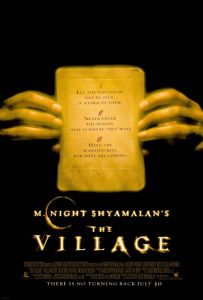 Originally released July 30, 2004:
When saying director names you can play a fun little game of word association. Someone says, “George Lucas,” and things like big-budget effects, empty storytelling, and wooden dialogue come to mind. Someone says, “David Lynch,” and weird, abstract, therapy sessions dance in your head. The behemoth of word association is M. Night Shyamalan. He burst onto the scene with 1999’s blockbuster, The Sixth Sense, a crafty, moody, intelligent thriller with a knock-out final twist. Now, though, it seems more and more evident that while The Sixth Sense was the making of M. Night Shyamalan, it also appears to be his undoing. His follow-up films, Unbreakable and Signs, have suffered by comparison, but what seems to be hampering Shyamalan’s growth as a writer is the tightening noose of audience expectation that he kowtows to.
With this in mind, we have Shyamalan’s newest cinematic offering, The Village. Set in 1897, we follow the simple, agrarian lives of the people that inhabit a small secluded hamlet. The town is isolated because of a surrounding dense forest. Mythical creatures referred to as Those We Dont Speak Of populate the woods. An uneasy truce has been agreed upon between the creatures and the villagers, as long as neither camp ventures over into the others territory. When someone does enter the woods, foreboding signs arise. Animals are found skinned, red marks are found on doors, and people worry that the truce may be over. Within this setting, we follow the ordinary lives of the townsfolk. Ivy Walker (Bryce Dallas Howard) is the daughter of the towns self-appointed mayor (William Hurt), and doesn’t let a little thing like being blind get in the way of her happiness. She is smitten with Lucius (Joaquin Phoenix), a soft-spoken loner. Noah (Adrien Brody), a mentally challenged man, also has feelings for Ivy, which cause greater conflict.
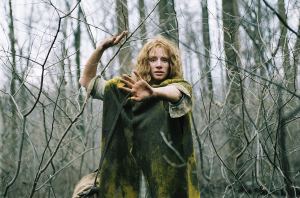 Arguably, the best thing about The Village is the discovery of Howard. She proves herself to be an acting revelation that will have future success long after The Village is forgotten. Her winsome presence, wide radiant smile, and uncanny ability to quickly endear the character of Ivy to the audience. She is the only one onscreen with genuine personality and charisma, and when shes flirting and being cute about it you cannot help but fall in love with her. And when she is being torn up inside, the audience feels the same emotional turmoil. I am convinced that this is more so from Howard’s acting than from the writing of Shyamalan. She reminds me of a young Cate Blanchett, both in features and talent.
It seems to me that Shyamalan’s directing is getting better with every movie while his writing is getting proportionately worse. He has a masterful sense of pacing and mood, creating long takes that give the viewer a sense of unease. The first arrival of the creatures is an expertly handled scene that delivers plenty of suspense, and a slow-motion capper, with music swelling, that caused me to pump my fist. The cinematography by Roger Deakins is beautifully elegant. Even the violin-heavy score by James Newton Howard is a great asset to the film’s disposition.
So where does the film go wrong and the entertainment get sucked out?
What kills is its incongruous ending. Beforehand, Shyamalan has built a somewhat unsettling tale, but when he finally lays out all his cards, the whole is most certainly not more than the sum of its parts. In fact, the ending is so illogical, and raises infinitely more questions than feeble answers, that it undermines the rest of the film. Unlike The Sixth Sense, the twist of The Village does not get better with increased thought.
Shyamalan’s sense of timing with his story revelations is maddening. He drops one twist with 30 minutes left in the film, but what’s even more frustrating is he situates a character into supposed danger that the audience knows doesn’t exist anymore with this new knowledge. The audience has already been told the truth, and it deflates nearly all the tension. It’s as if Shyamalan reveals a twist and then tells the audience to immediately forget about it.
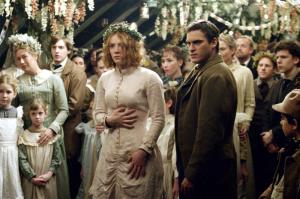 Shyamalan also exhibits a problem fully rendering his characters. They are so understated that they don’t ever really jump from the screen. The dialogue is very stilted and flat, as Shyamalan tries to stubbornly fit his message to ye olde English vernacular (which brings about a whole other question when the film’s final shoe is dropped). Shyamalan also seems to strand his characters into soap opera-ish subplots involving forbidden or unrequited love. For a good hour or so, minus one sequence, The Village is really a Jane Austin story with the occasional monster.
The rest of the villagers don’t come away looking as good as Howard. Phoenix’s taciturn delivery seems to suit the brooding Lucius, but at other times he can give the impression of dead space. Hurt is a sturdy actor but can’t find a good balance between his solemn village leader and caring if sneaky father. Sigourney Weaver just seems adrift like she’s looking for butter to churn. Brody is given the worst to work with. His mentally-challenged character is a terrible one-note plot device. He seems to inexplicably become clever when needed.
The Village is a disappointment when the weight of the talent involved is accounted for. Shyamalan crafts an interesting premise, a portent sense of dread, and about two thirds of a decent-to-good movie, but as Brian Cox said in Adaptation, ”The last act makes the film. Wow them in the end, and you’ve got a hit. You can have flaws and problems, but wow them in the end, and you’ve got a hit.” It’s not that the final twists and revelations are bad; it’s that they paint everything that came before them in a worse light. An audience going into The Village wanting to be scared will likely not be pleased, and only Shyamalan’s core followers will walk away fully appreciating the movie. In the end, it may take a village to get Shyamalan to break his writing rut.
Nate’s Grade: C+
——————————————————
WRITER REFLECTIONS 20 YEARS LATER
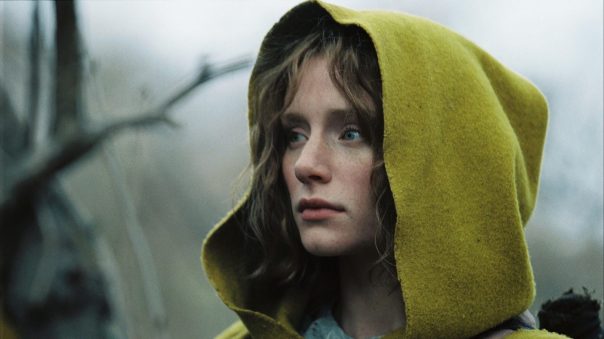
Usually in the M. Night Shyamalan narratives, 2004’s The Village is where the cracks first started to show in the filmmaker’s game. While 2000’s Unbreakable didn’t exactly reach the box-office successes of The Sixth Sense and Signs, it still earned $250 million worldwide and was definitely ahead of the cultural curve, introducing a grounded superhero story before the oncoming wave of superhero cinema. No, it was The Village that started the questioning over whether Shyamalan’s need for big twist endings was hampering his creativity. While still earning almost the exact same box-office as Unbreakable, The Village was seen with more hesitation, a cautionary tale about a filmmaker, as Matt Singer recently put it, flying a little too close to the sun. From here, Shyamalan entered his down period, from 2006’s Lady in the Water, to 2008’s The Happening, and the big-budget sci-fi misfits of 2010’s Last Airbender and 2013’s After Earth. This was the beginning of the general public becoming wise to Shyamalan’s tricks.
The real kicker is that, twenty years later, it’s clear to me that The Village is two-thirds of a good-to-great movie, ultimately undone by the unyielding desire to juice up the proceedings with an outlandish twist ending. For that first hour, Shyamalan has done a fine job of dropping us into this outdated community, learning their rules and restrictions, and gradually feeling the dread that the old ways might not protect them from the monsters just along the boundaries. There’s an efficiency and confidence to that first hour, with carefully planned shots that establish key points of information, like little girls panicking at the sight of a red flower and burying it in the ground before going back to their chores. The cinematography is elegant and moody, and the violin-soaring score by James Newton Hoard is a consistent emotive strength. The first encounter with the monsters roaming around the town is fraught with tension, especially as our one character holds out her hand waiting for her friend/love interest to return. The cloaked monsters are also just a cool design, with their long claws and porcupine-like frills extending from their hides.
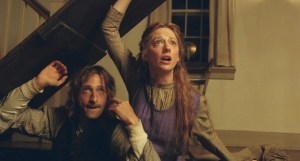 The greatest strength is Bryce Dallas Howard (Jurassic World) as our surprise protagonist, Ivy, daughter of the community founder, Edward Walker (William Hurt). Howard had made small cameo roles in her father’s films, but she was cast by Shyamalan after he watched her perform on stage. She is spellbinding as Ivy, a woman of great vulnerability and strength, of integrity and charisma. The scene where she sits down on the porch beside Lucius (Joaquin Phoenix) and dance around the edges of flirting is sensational, and when she talks about seeing people’s colors, or auras, and then smirkingly whispers, “No, I will not tell you your color, stop asking,” in the same breath, I defy anyone not to fall in love with her like poor Lucius. This simple love story actually works well. Lucius is an introverted man given to great emotions he doesn’t know how to fully express, which pairs nicely with the chatty and ebullient Ivy. The protagonist shift works wonderfully as well. For the first hour we believe we’re following Lucius as our main character, especially since at this point Phoenix’s star power was rising and Howard had none. Then, with the sudden sticking of a knife, Lucius is taken down and the movie becomes Ivy’s story and her quest to save her beloved. Her cry of not being able to see Lucius’ color is a well-coordinated punch to the gut. This is an example of a rug pull that really works, elevating the stakes and presenting the real star, the girl so many have overlooked for one reason or another, who will be our hero when we need her most.
But then it all falls apart for me once Shyamalan reveals two twists: 1) the monsters are not real, merely costumes the adults wear to enforce their rules through fear, 2) the setting of this village is not 1897 but modern-day, with the villagers living in a secluded nature preserve. Apparently, Edward was able to gather enough violent crime victim relatives to begin this experiment in “returning to our roots.” He served as an American History professor, so who better than to create a thriving community? You know how to establish safe drinking water there, my guy? How about cabin-building? I assume one of the elders must have had some wealth as it’s revealed later, via Shyamalan’s onscreen cameo role, that the government got paid off to stop having airplanes fly over the nature preserve. I actually kind of hate this twist. It feels the most superfluous of all Shyamalan’s fabled twist endings. I was genuinely enjoying the movie and how it was spinning up until this point, but Shyamalan cannot leave well enough alone. I get that Shyamalan is crafting an allegory for the War on Terror and the constant anxiety of post-9/11 America, replete with color codes meant to serve as warning signs. I get that we’re meant to find the town elders as villains, keeping their community repressed through the fear of convenient monsters. The lessons are there to dissect, but I’m disappointed because I was enjoying the allegory on its literal level more than its intended themes. It’s also because I feel like the twists overburden the movie’s charms.
 Another reason the twist really falters is that it creates all sorts of nagging questions that sabotage whatever internal logic had been earlier accepted. Adults deciding to break free from modern society so they can start their own secluded LARP community can work as a premise, but it requires a lot more examination that cannot happen when it’s slotted as a concluding twist. Imagine the kind of determination it would take to retreat from modern society and rekindle an agrarian life from hundreds of years ago. That means abandoning all your family, friends, the comforts of modern-day, and the sacrifices could have been explored, but again, it’s just a twist. There are present-day communities, most famously the Amish, that shun the technological advances of modern society to retain an outdated sense of homespun culture and religious community, but often the members have grown up in this culture already. Regardless, retreating into the woods to start your own 18th century cosplay is a commitment, but when you know all the adults are in on this secret, why are they staying in character at all times? When it’s just two adults talking to one another, why are they keeping to their “characters” and talking in that antiquated jargon and syntax? Is it collective Method acting? Is it a sign they’ve ref-ramed what they consider normal? Have they gone so deep that their muscle memory is to say “thee” and “thou” vernacular in the mirror? They went through this elaborate facade because they lost people in the “real world,” but human impulses, violence, and accidents can occur in any community, no matter if you got cell phones or pitchforks. It starts to gnaw away at the tenuous reality of the scenario, a reality I was accepting until the late rug pull.
It also eliminates some of the stakes of Act Three when Ivy travels beyond the boundaries and may face the wrath of the monsters. It’s maddening that Shyamalan reveals the monsters are not real, mere tools to scare the children into obedience, and then has a supposed suspense sequence where Ivy stumbles upon a thicket of red flowers, the dreaded color the monsters hate. But wait, you might recall, there are no monsters, so then why does it matter? When you realize that her dad could just have taken a hike and driven to a drug store to gather medical supplies, without the supernatural threat keeping them confined, it kind of seems silly. Here you were, worried about the fate of this blind girl, when there’s no reason she had to even venture into this danger because one of the adults could have performed the same task without risking their big secret. I know they think Ivy’s blindness might uphold their secret, but why even risk her possible danger from falling down a hill she couldn’t see or a rock that twists her ankle? Her dad would rather have his blind daughter venture into the woods than do this trek “to the next town” himself. At the same time, her personal journey outside the community is robbed of the supernatural danger and it also re-frames the father as someone burdening his blind daughter with a task he could have achieved. He says she has the power of love and that will guide here, but you know a compass could also help. You could make the argument that maybe his guilt was eating away at upholding such a big secret, maybe he wanted to get caught, but I don’t buy it. Edward argues with his fellow elders that it is the next generation that will keep hold to their traditions and ways of life, and they must ensure this survival. That doesn’t sound like the perspective of a man wishing to break apart the close-knit community he helped build.
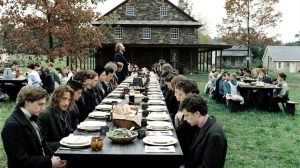 What to make of Adrien Brody’s mentally challenged character, Noah? He’s living in a time that doesn’t know how to handle his condition, but he’s also set up as a quasi-villain. He’s the one who stabs Lucius out of jealousy that Ivy favors him. He’s the one who breaks free, steals a monster get-up, and antagonizes Ivy in the woods. He also falls into a pit and dies alone. I don’t really know how to feel about this character because I don’t think Shyamalan exactly knows what to do with him.
Having recently re-read my original 2004 review, I’m amazed that I am sharing almost the exact same response as I did with my younger self. Even some of the critical points have similar wording. My concluding summation still rings true for me: “It’s not that the final twists and revelations are bad; it’s that they paint everything that came before them in a worse light.” You can rightly tell an allegorical story about people rejecting modern society and living a secluded and hidden life. You can rightly tell a story about adults posing as monsters to keep their children in line and obedient. However, if you’re going to be telling me that story, don’t supply an hour’s worth of setup that will be damaged from these revelations. After The Village, it was a steady decline for the filmmaker once dubbed “the next Spielberg” until 2017’s stripped down thriller Split, anchored by a tour de force performance from James McAvoy. It’s frustrating to watch The Village because it has so much good to offer but ultimately feels constrained by the man’s need to follow a formula that had defined him as a mass market storyteller. This was a turning point for Shyamaln’s fortunes, but the quality of The Village has me pleading that he could have shook off the need for ruinous twists and just accepted the potency of what was already working so well.
Re-View Grade: B-
Share this:

Argylle (2024)
 Knocked around by critics and tagged as the latest excuse for the Death of Filmmaking thanks to its overwhelming budget and general ironic indifference, Argylle is a goofy spy comedy that, while lesser, is an easy watch and would earn regular rotation as a TNT afternoon giant. It’s not trying to be more than a good time, and while its quippy attitude can feel forced and approaching irony overload, it’s also the kind of movie that entertains as breezy escapism. It’s fun. Enough.
Elly Conway (Bryce Dallas Howard) is a best-selling spy novelist with a dashing super spy Lothario lead character by the name of Argylle (Henry Cavill in the worst haircut of his career). She’s journeying with her pet cat, her closest relationship, when she’s stopped on a train by Aidan Wilde (Sam Rockwell). He tells her that he’s a real spy and that everything she’s written in her five novels has come true, and different covert agencies are taking notice. She’s got teams of assassins and spies coming for her, while Aidan tries his best to protect her and get her to remember key details that could save the world from nefarious forces.
 Argylle is too breezy and too predictable by half. It’s a spy thriller that I’m positive many will be able to predict the big twists miles before they occur. Why do all these spies want Elly Conway, and how could she know about the intricate world of international spy craft? The answer is exactly what you’d expect, if you’ve watched more than your share of twist-laden thrillers. Thankfully, director Matthew Vaughn (Kingsman, X-Men: First Class) and company dispatch with this central twist after an hour, providing more time to deal with the aftermath and build off of its story impact. Ah, dear reader, but there’s going to be another twist once you know the first, and again, if you can predict the first, you’re likely to predict the second, because stories about universally good people are often dull, and movies have provided a new medical maxim that characters use maladies to re-evaluate their prior life and choose to be better (oh how nimbly I’m dancing around these spoilers). What makes these predictions forgivable is that the movie seems to know you will anticipate them and has more to offer.
That’s because in this silly universe, very little seems to matter besides getting to the next scene. It’s not a satirical send-up of the genre like Vaughn’s Kingsman movies. Instead, it’s more of a generic distillation of spy thrillers, complete with bad guys walking through mission control banks of computers and barking impotent orders. The only added cleverness that sets the Argylle world apart is Elly’s writing, the fictional version of this far more bland spy universe. In the book parts, Vaughn takes note to raise the style as well as the tongue-in-cheek comedy. It’s supposed to be tone-deaf and dumb and ridiculous, because it’s the big screen version of bad genre writing. You can have fun with that, with characters so serious to the point of parody, with nonsensical technology and near escapes. But when you try to do the same thing in the so-called real world, then the movie starts to eradicate any sense of a baseline for credulity. I did like the practical advice of Aidan on how to crush the skulls of your downed enemy (“Just imagine you’re dancing The Twist.. twist and smash”). By the end of Argylle, Elly and Aidan can do just about anything because they’re practically superheroes. The entertainment of the fish-out-of-water aspect of Elly’s story is short-lived and unfulfilled because the movie becomes more of a tale of automatic self-actualization rather than growth.
 The direction feels rather drab at points, and many locations and scenes have a general sense of missing… something. Just watch any set and it appears so drastically empty that I questioned whether they cut back on the set dressers and props. Empty dance clubs. Empty streets. Empty hallways. Everything is too pristine, too sleek, and too empty and green screened (might be a result of COVID filmmaking). This carries over into the disappointing visual aesthetic, as Vaughn’s signature style feels dampened by the pesky CGI additions of many sequences, adding to the unreality rather than building out this minimalist world. If there had been an extra EXTRA twist that everything was also a story-within-a-spy-story, I would not have been that shocked, and it honestly would have explained the underwritten and underwhelming world of clandestine spy-making.
Vaughn errs in the core creative decision of having his main character mix reality and fantasy, not through the idea itself, which could be ripe, but through its confusing execution and editing. Having Elly hallucinate Agent Argylle in place of a real secret agent is fine, as we can contrast from her idealized version of a super spy, her James Bond, versus the actual grunts struggling to win the day. There are a couple problems with this execution though and firstly that the “reality” isn’t that far removed from the fantasy. This is still a world where Rockwell’s spy is able to commit amazing acts of dexterity and martial arts and balletic violence flying around rooms, but I guess he falls down more. The difference isn’t that fantastic when it’s already a hyper-stylized action world. The bigger issue is just how confusing it all plays out visually because we’re seeing Elly’s perspective and in rapid blinks Cavill will turn into Rockwell and vice versa. It makes for a jarring sequence that doesn’t fully capitalize on the comic potential while keeping the audience distant from fully engaging with the sheer simple pleasures of watching a fun fight. This happens throughout the first half of the movie and severely hampers the action scenes from being accessible. I think we needed a longer duration for this to work. We see Elly’s version for a period of time, and then we cut to the real world where Aidan is bouncing into walls, falling down, and flailing. By continuously jumping back and forth, not just in the scenes but in the same shots, Vaughn has made his movie harder to watch and harder to comprehend, and with a loud soundtrack blaring.
 There is one sequence of great filmmaking for Vaughn, but to explain such will require some spoilers, so beware, dear reader. There are three instances of the whirly-bird dance where a woman is lifted spread-eagle atop a man’s shoulders who then spins her around. The first time, it’s Agent Argylle and Legrange, played by Dua Lipa (Barbie) dripping with sexual energy. The second time is when Elly and Aidan are on a mission and he lifts her up, to her amusement and flirtation. She’s living out her fantasy version, with Rockwell standing in for Cavill and Howard standing in for Dua Lipa. We’ve gone from these stunningly attractive human specimens to people who look more ordinary, including a fuller figured woman engaging in the same sexy shenanigans as the conventional blonde bombshell. She can be her dream version of herself. Finally, the third occurrence happens during a climactic showdown where Elly and Aidan team up against an onslaught of faceless armed henchmen. With the aid of colorful smoke canisters, their offensive surge plays out like a couples’ dance routine, including holding one another for high kicks to incendiary devices. It’s all set to Leona Lewis’ cover of Snow Patrol’s “Run,” and as the music swells, it’s easy to get swept up too. Even the gunshots are set to the beats of the song, culminating in the final whirly-bird dance, except it’s not Elly being lifted, this time it’s Aidan. See, she’s not the Bond girl bombshell, she’s James Bond. It’s a silly moment but with the added setup, thematic underpinnings, and Vaughn’s virtuoso stylistic seizing of the moment, it plays out as empowerment and an expression of love. For real.
I can understand being generally disappointed with Argylle. It looks and feels like it’s been built on the parts of other better spy franchises and desperately lacks the charisma and personality of Vaughn’s Kingsman movies, themselves giddy and perverse satires. I wasn’t the biggest fan of 2017’s The Golden Circle sequel, but it’s got oodles of style to spare compared with Argylle. I wish Vaughn would push himself beyond the orbit of making cheeky, winky spy action comedies, the same genre he’s been playing in since 2015 and now for four movies. While the original Kingsman was a breath of fresh air with fun characters, a snarky attitude, and slick style, Argylle is all snark and minimal style. There’s so much comedy that feels like it should be funnier, from the travails of Elly’s CGI-enchanced cat to the floundering hand-to-hand combat. When recognizable names start showing up playing forgettable genre stock types, and then they start dabbling in accents as other genre stock types, it feels like the whole exercise is a miss. However, the central buddy relationship between Rockwell and Howard is where the movie works, and fortunately that’s the element that has the most foundational effort. This is a movie that, in the future, if it was on TV during a lazy day, you’d sit down and watch the rest and mostly be happy about it. Argylle isn’t anything new or fresh but it’s buoyed by its stars, and not the magazine cover models but its real stars, Rockwell and Howard. In their hands, even lesser spy comedies can still be fairly worthwhile escapist entertainment. Still, I must deduct some points for the movie missing a perfectly setup opportunity to have Henry Cavill and John Cena kiss onscreen at the end. It was right there, folks, and we all deserved it.
Nate’s Grade: C+
Share this:

Jurassic World: Dominion (2022)
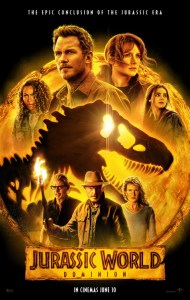 Jurassic World: Dominion has received, by far, the worst reviews and reception of the six-film franchise that has taught us the valuable life lesson that dinosaurs will eat people. Director Colin Trevorrow (Jurassic World) is back though he remained a screenwriter for the entire World trilogy along with Derek Connolly (Safety Not Guaranteed). It’s also bringing the band back together by including Sam Neill, Laura Dern, and Jeff Goldblum as their beloved original trilogy characters (there’s also B.D. Wong, again, if that does anything for ya). I’ve delayed seeing the movie because of my own sense of caution and resignation. Is it as bad as feared?
It’s years after dinosaurs have become reintegrated into the human world. Owen (Chris Pratt) and Claire (Bryce Dallas Howard) are living out West together with the clone girl from 2018’s Fallen Kingdom. He’s lassoing wild dinos and she’s breaking them out of illegal testing sites. The BioSyn CEO (modeled after Apple’s Tim Cook, here played by Campbell Scott) has big plans for… world domination? It’s actually unclear besides general profit. The evil businessman hires kidnappers to abscond with the little clone girl, the baby dinosaur to Blue, America’s favorite family-friendly raptor, and for good measure, he’s also unleashing swarms of killer locusts. Owen and Claire are hopping the world to find their missing family (Owen promises the raptor he will return her baby) and uncover yet another evil scheme from an evil rich person.
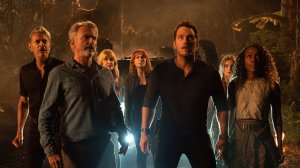 There is a lot going on with Jurassic World: Dominion and yet so little is happening, at least from an intellectual standpoint. This feels like three different movies inartly slammed together and it is overstuffed with subplots all competing for screen time, so every few minutes feels like a possible off-ramp for another episode of what the opening concept portends. The concept of a world where humans are forced to co-exist with dinosaurs is a genuinely exciting starting point, and it’s a Jurassic movie I would want to see, and I do… for a montage to open and close the movie. It’s a shame that the most interesting part of this movie, the global acclimation of creatures of an older millennium rejoining our ecosystem, is kept as literal background. I suppose by the end nature just took care of itself. Instead, the majority of the movie is split between two less engaging stories: giant locusts and a rich guy’s private dino enclosure. Yes, dear reader, you read that correctly. After five movies of dinosaurs in parks, where we begin with dinosaurs in the real world, it’s back to spending time in another glorified dino park, and would you believe that something goes wrong at this park too? Why even bother setting up an exciting premise if it’s abandoned so completely? The movie we do get is a lesson in diminished returns and accepting disappointment. This feels more like a giant locust movie for half, about a villainous corporation weaponizing genetically modified plagues to kill their competitors’ stock. It’s certainly something that seems plausible for a massive corporation, but what is this doing in my Jurassic World movie? Why did we need another blankly evil CEO, this time the guy who appeared in one scene in Jurassic Park, as if that mattered? Why do we need more extraneous characters taking away oxygen from the legacy characters returning especially when they seem too similar to the already established characters? Why should I care about three dinosaurs fighting at the end like I’m personally invested in any of these creatures? My sadness manifested watching this franchise descend into even more farcical dumb blockbuster nonsense.
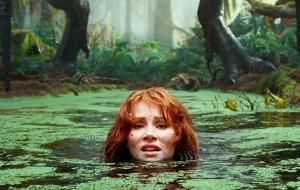
The best part of this movie might actually be its most ridiculous. There’s a mid-movie set piece where our heroes infiltrate an underground dinosaur fighting ring in Malta. That’s cool, and we’re introduced into new secondary villains we can enjoy get their just desserts once the dinosaurs inevitably get set loose. The lead trafficking lady says the raptors have been trained to kill anything that she shines a laser pointer on, which was also introduced in the last film. She targets Claire and then it becomes a foot chase between Claire and a determined raptor. It’s a silly excuse for a chase but it has an extra sense of urgency. It’s also completely ridiculous and ridiculously fun. Claire transforms immediately into Jason Bourne and is leaping from rooftop to rooftop and crashing through windows. Owen is riding a motorcycle through the narrow streets while being chased himself. It’s all action movie pablum and it works for what it is in the moment. Treverrow’s action set pieces have some moments that pop, especially Claire cautiously slipping into a pond to escape a supposedly blind dinosaur. There are even dinosaurs with feathers now. Alas, the movie can only work as dumb fun for so long before it just becomes infinitely more of the latter.
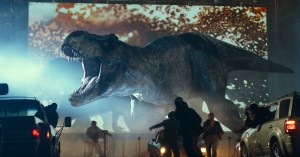 There are so many moments on repeat here that Dominion feels like it’s stitched together like another genetically modified dinosaur clumsily patched with parts of the franchise’s past. Oh, and you better believe we’re going three movies in a row with a new genetically-modified super monster to better sell toys (at least this one isn’t stated as being part raptor). The appeal of this movie, besides the concept abandoned above that I mentioned, is the old characters coming back together, even though Goldblum and Neill each headlined a Jurassic sequel. This action is also a tacit condemnation of the investment in the new trilogy’s main characters. I doubt anyone is going to say, “Wait, Owen Grady and Claire Dearing are back for another movie? Count me in.” I bet most people didn’t even remember either of their names. But if we’re bringing back important characters of franchise past, let’s give them something important to do. They get into danger and scrapes but it’s also always with a wink and a nod that is grating. Goldblum gets to wave his arms around to distract like he did in Jurassic Park. Dern gets to cuddle a triceratops like she did in Jurassic Park. Even Neill features in a dangerous teetering automobile like he did in Jurassic Park. The contrivances to get them all in the movie were already there, but then you give them little to do other than go through the motions of their past (I will always demand more Goldblum time). There are certain dinosaurs reappearing to hit that nostalgia button. It’s the poison-spewing dinos, the ones that blinded and killed Nedry (Wayne Knight), and they’re back, except they can also have their mouth grabbed shut in the most unintentionally hilarious moment. Why even bring back an evil CEO barely mentioned in 1993? Do we need that strained connection for a role recast because the original actor is in jail for assaulting a minor? It’s an excellent example of losing track of the appeal of nostalgia by metric volume.
As far as I’m concerned, that little clone girl, a.k.a. Maisie (Isabella Sermon), is responsible for all the pain and suffering in the world because of deadly dinosaurs. At the end of Fallen Kingdom, this little kid single-handedly rescues the dinosaurs from extinction because, as she said, “They’re alive, like me.” I guess her reasoning is they weren’t supposed to exist, but they do, so we should value life. The problem with that occurs when that creature also happens to be a predator. I would have loved Dominion to explain why Maisie is living in an isolated cabin is because she’s the world’s most wanted person, as mobs of victims blame her for their loved ones dying at the hands, feet, and claws of dinosaur mayhem. The world is in chaos because of this little kid’s rash decision. This cloned girl storyline was the worst part of Fallen Kingdom and now she gets to be the worst part of Dominion as well. Her entire presence is once again as a plot device. I guess she served a purpose as her realization over her identity lead to her decision to save the poor dinosaurs, but here she’s a literal savior cure with legs. Apparently, the reason why the big bad corporation kidnaps her, along with baby Blue, is because her DNA is the key to eradicating genetic disorders. Fortunately, you only need some blood or saliva for a DNA sample and kidnapping seems like overkill. You could have just asked her nicely for a sample, fellas.

Why would this gesture work on other dinosaurs?
However, the dumbest aspect of this requires some sticky spoilers discussion, so you have been warned. Maisie was the grandchild of Benjamin Lockwood (James Cromwell), a retcon character to elbow in another rich co-founder of Jurassic Park that we just never heard about until the fifth movie. Except she was really his daughter but as a clone. Well now we get even more retconning because Maisie’s mom, herself, gave birth to her… self. The adult Maisie impregnated herself with her own clone (because this was the easiest way to have a child?) but she’s also genetically modified her DNA to exclude a terminal disorder killing the adult Maisie. If adult Maisie wanted to save others from having her genetic disorder, why not publicize this valuable information? Why not tell her colleagues? Why leave her clone as the lone evidence? This new info makes me kind of hate the adult Maisie. She brought her clone into the world and made her a target. This seems cruel and unnecessary. It also doesn’t make sense for a person supposedly valuing life or the larger scientific community or even her own child. I’ll say it: she’s a bad mom.
The wild swings and retcons reminded me of what happened with the newer Star Wars trilogy. In 2015, both The Force Awakens and Jurassic World are released to massive success and kickoff reboots of their respective franchises. Both of the movies purposely leaned onto nostalgia for their originals, even repeating similar plot beats and reminders to trigger positive association. Then both directors, J.J. Abrams and Treverrow, left the franchise and the second movies, 2017’s The Last Jedi and Fallen Kingdom, took big swings, tried to be something different from the mold, and were met with divisive responses from the larger fanbase. I appreciate both of these movies attempting to do something different with something so entrenched in formula. Then for the concluding movie, both franchises had the original director return to essentially retcon the retcons, to bring the movies back to what was familiar and ultimately dull. It’s even more interesting when you take into account that Treverrow left the Jurassic series to spend a year of his life developing Episode 9 before being fired and hastily replaced with Abrams.
 I remember the meta-commentary in Jurassic World about modern audiences becoming jaded and complacent to scientific wonders mirroring movie audiences becoming blasé to what used to marvel us in the realm of special effects extravaganzas. As it leaned into its considerable nostalgia, it was doing so in a thinly veiled satirical criticism of, “Is this what you want?” Now all the meta-commentary and irony have been stripped clean and it’s simply a big, dumb, lumbering beast awaiting its own creative extinction as it meets an end. The franchise is still a colossal moneymaker and Dominion has a chance of topping one billion in box-office, so there will be more adventures cannibalizing the past for inevitably diminished returns, and then we’ll get the special reappearances of, like, Jake Johnson’s character or Guy at Computer #4 to the celebration of few if any. None of the Jurassic movies have ever come close to capturing that certain magic from the first movie but they have all been, in some way, serviceably entertaining even at their worst. Dominion is the worst of the franchise and feels devoid of passion and awe and curiosity. To paraphrase a clever man, the studio execs were too busy thinking about whether they could and less busy worrying about whether they should. I guess you could shut off your brain and possibly enjoy it but that’s admitting defeat. Jurassic World: Dominion makes dinosaurs dull and that’s a disservice of imagination.
Nate’s Grade: D+
Share this:

Rocketman (2019)
 It seems like Bohemian Rhapsody was a trial run for actor-turned-director Dexter Fletcher. He had previously directed an inspirational sports movie (2015’s Eddie the Eagle) amongst other smaller films but he really came to attention when he filled in for the final weeks of Rhapsody after the original director Bryan Singer was removed. Fletcher helped steer the movie to its finish, and what a finish it had, collecting $700 million worldwide and four Oscars. Now Fletcher is a lone credited director of another musical biopic, Rocketman, chronicling the highs and lows of Elton John’s personal and professional career. Does it soar?
Elton John (Taron Egerton), nee Reggie Dwight, struts into rehab and tells his life story, from his humble days in England with distant, unsupportive parents, Sheila (Bryce Dallas Howard) and Stanley Dwight (Steven Mackintosh), meeting lyricist Bernie Taupin (Jamie Bell) and forming an instant connection, signing a record deal and traveling to America, blowing up immediately in popularity, his on-again-off-again relationship with his manager John Reid (Richard Madden), and all the drugs, parties, and excesses of rock and roll that Elton turned to in order to feel better about his own crippling loneliness.
 I wish more musician biopics took the approach of Rocketman, blending real-life with glitzy, dreamy fantasy sequences to create a musical fantasia. It just makes running through the typical tropes of biopics that much more entertaining. I appreciate the fluid nature of being able to dip into the fantastical at a moment’s notice, opening to a world of dance and delights, which keeps things lively and serves as a better integration of the artist’s songs. Take for instance last year’s Bohemian Rhapsody, which showed the formation of some of Queen’s most famous songs in comically abbreviated, almost impossibly easy creative sessions. They go from clapping to cutting away to a completed “We Will Rock You.” That movie became a series of sequences demonstrating how the band made its songs. With Rocketman, the songs are more designed as vehicles to the emotional journey of Elton John. When he thinks back to his childhood, we blast “The Bitch is Back,” and when he’s talking about his first performance experiences in his town’s pubs, we get “Saturday Night’s Alright (For Fighting).” When Elton’s family is at a breaking point, each member sings a section of “I Want Love.” When Elton feels alone in a giant party, and nursing his unrequited feelings for his writing partner, he warbles “Tiny Dancer.” When he’s caught up in his attraction to his manager, they duet, “Don’t Go Breaking My Heart.” By going this route, the filmmakers have opened their movie to more narrative and emotional potential.
The steps into fantasy also communicate Elton’s emotional state, especially as he starts spiraling into more drugs and loneliness. His elation translates into feeling like he and the audience are floating on air in one scene. His sense of succumbing to addictions and urges is demonstrating by a darker rendition of “Bennie and the Jets” where he crowd surfs into a sweaty orgy of flesh, people pulling at him, wanton desires obscuring anything else. It also plays into Elton’s fraying mental state. After a fantasy number, he says, “Where am I?” We too don’t know where he is. We too don’t know how much time has passed. It’s a clever conceit to get the audience to feel the protagonist’s distaff confusion about what is real and what is drug-addled. This approach also allows for some obvious visual metaphors that seem more palatable. When Elton literally hugs the child version of himself, and thus is allowing himself to finally be loved by himself, in a literal physical act, you mostly buy into it as catharsis because of the flights of fancy.
 The use of songs comes into play in three shapes: 1) breaking out into song as a fantasy sequence meant to communicate the inner emotional state of the characters, 2) Elton or others performing songs as diagetic musical performances happening in real life, and 3) the musical score built upon other Elton John tracks. It pretty much means the film is wall-to-wall Elton John, which works especially well considering it is the man’s biopic, but it also creates a world of sound that belongs to this man. Even the musical score adopts his signature tunes, which provides a nice undercurrent since he is telling his own story, so why wouldn’t he rely upon his own music score to provide that extra oomph?
There is a notable downside to the interwoven fantasy angle and that’s instilling a sense of added skepticism with the audience. Every biopic is going to make fictional inventions for the sake of storytelling, be it combing characters, making the internal external, or reordering scenes for maximum drama. It’s when a biopic goes overboard with the deviations from the truth that it can alienate the audience (though this didn’t bother the $700 million gross for Rhapsody). By Rocketman choosing to amp its fantasy elements, this is going to test the believability of scenes. I’m not talking about whether or not the crowd at L.A.’s Troubadour actually floated for Elton’s first U.S. live performance. Obviously that’s an exaggeration. But it calls into question moments like Elton and Bernie Taupin meeting by coincidence, Elton storming off from Madison Square Garden straight to rehab, and in particular his relationship with his parents. There’s a phone call where an adult Elton comes out to his mother, and she responds that she always knew her son was gay. It’s at this moment where the audience may be thinking, “Oh, that’s a sweet little moment to bring out her humanity.” Then in the next breath she castigates him for “choosing” a lifestyle that will condemn him to never knowing love. Yikes. It’s such an outlandish statement that I questioned whether this scene actually happened or was dramatic license to further sock it to Elton (apparently Howard had the same concern and it’s legit). The downside of asking an audience to accept the unbelievable additions is that they may be in search of them too.
The movie hinges upon its star and Egerton delivers. He previously sang Elton John (Sing) and previously saved the real Elton John (Kingsman: The Golden Circle), so it seems like his career has been destined for this role. Egerton is great at capturing the magnetic presence Elton had as a performer. He’s sprightly, larger than life, and fully inhabits the manic stage presence that became a force to reckon with. He also does a great job of communicating the insecurities, doubts, and yearning of a person who has been fighting for acceptance and affection and feels he is incapable of either. Being in the closet is only one aspect to Elton’s self-loathing (he did come out as bisexual in 1973). The character’s biggest emotional hurdle is loving himself, which might sound corny but is given genuine pathos by Egerton, who rages for that fleeting feeling. Egerton has been a charismatic performer from the first moment I saw him, and he feels like a natural fit for this role, ably handling all his own singing to boot. Not even Oscar-winner Rami Malek did that.
 The other actors do fine with their smaller roles. The problem is that the supporting cast is kept in tidy boxes of one-note requirements. Taupin is supportive. Reid is manipulative. Sheila is self-absorbed. Stanley is detached and non-approving. Each serves a very distinct purpose, and their underwritten natures would be more of a hindrance if the film weren’t entirely predicated upon Elton John’s personal experiences and interpretations of those events. I will say I was surprised that Sheila was played by Howard (Jurassic World: Fallen Kingdom). I kept thinking to myself, “I need to look up this actress.” I didn’t recognize her with the weight gain and, later, the dodgy older age makeup.
With all these wild visuals and extravagant consumes, the strangest thing to me about this whole movie is the role of Elton’s primary lover and manager, John Reid. This person makes another appearance in another musical biopic — Bohemian Rhapsody. This same character was played by Aiden Gillan (Game of Thrones) and he got Queen to new heights before seeming to glom onto Freddie Mercury and convince him to leave the band for a solo venture. He’s portrayed as a conniving villain in Rhapsody, and he’s portrayed as another conniving user in Rocketman, and two different actors who were both on Game of Thrones play both versions. Where’s this guy’s biopic?
Fletcher has found a clever and playful approach that accentuates his story and provides insights into a clever and playful musician. I was routinely smiling throughout Rocketman, which knowingly takes elements that would be campy and corny and says, “So what?” It’s also an R-rated movie that doesn’t shy away from John’s sexuality in a safe manner, at least “safe” for a Hollywood studio film aimed at mass appeal. I enjoyed myself throughout Rocketman as it floated by on its sense of whimsy and heartache, anchored beautifully by Egerton, a compelling and charismatic young lead who gives it his all. Rocketman is what more movie biopics should aspire to be like, sequins and everything.
Nate’s Grade: B+
Share this:

Jurassic World: Fallen Kingdom (2018)
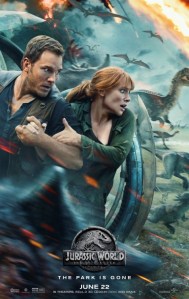 There has always been an element of suspension of disbelief with the Jurassic Park films even with the hubris-pushing premise, but the sequels specifically have had to manage a rising tide of incredulity and sense of dumb. You can only keep going back to a dinosaur-infested island or thinking this time mucking with the DNA of large, extinct, highly advanced killing machines will be different. Jurassic World: Fallen Kingdom may be the dumbest yet, and while it does have moments of fun and excitement, the dumb outweighs all else.
Years after the deadly attacks at Jurassic World, the volcano on the island has reactivated and the remaining dinosaurs are in imminent danger of another extinction (except for the flying ones, but whatever). Claire (Bryce Dallas Howard), with sensible footwear this go-round, is looking to raise money and awareness to save the thunder lizards. A wealthy magnate (James Cromwell) wants to save the dinosaurs and whisk them to a wildlife preserve far from mankind, but first they must secure the raptor Blue, and in order for that to happen Claire needs to convince her former flame and co-worker Owen (Chris Pratt) to go back. They venture back to the endangered island only to run into more trouble from stampeding dinosaurs, new super predators, and a plot to house and sell the creatures off the island.
 Maybe it’s just a side effect of being the fifth movie in a generation-spanning franchise, or maybe it’s a holdover effect of the 2015 film’s meta-commentary about audiences becoming complacent with what used to inspire awe, but it feels like returning screenwriters Colin Trevorrow (The Book of Henry) and Derek Connolly (Safety Not Guaranteed) couldn’t be bothered picking a tone or developing their plot. It reminds me of the seventh season of HBO’s Game of Thrones, specifically the back half of episodes. It felt like the creators had certain conclusions in mind and rather than smartly develop storylines that would naturally reach those conclusions, the “how” of the narrative became jumbled, confounding, and frustrating. I felt the same way while watching Fallen Kingdom; the stylish set pieces were likely established first and foremost and the stuff in between, you know the story and characters and their interaction, was given far less attention. It didn’t matter how we got from one set piece to another. This lack of consideration leads to many moments that keep you from fully engaging with the movie, namely dumb and/or awful characters doing dumb things for dumb reasons. The conclusion of Fallen Kingdom seems meant to leverage interest in a third movie, which is already scheduled for release in 2021. Was this 128 minutes the best way to get there?
When people repeatedly do stupid things, it tests your limits of empathy. This happens to me with horror movies and it happened for me with Fallen Kingdom. It’s the kind of movie where a little girl runs into her bedroom and hides under her covers from an approaching hungry dinosaur. The ensuing image of the stalking beast entering the bed with the claws is a killer image, but what did we lose getting here? This little girl was not established as some dumb kid either. The preceding hour showed her as resourceful and plucky, so this just erases all that. There’s another moment where characters have to choose between escaping through an ordinary door or an open window and crawling along the edge of the roof… and guess what they choose. This is the kind of movie where characters will be in danger and then, hooray, another character arrived in time to save the day, and then another character arrived to save the shortly-after next day. Then there’s a bad guy who enters a dinosaur cage simply to retrieve a dino tooth for his personal necklace of dinosaur teeth. I’ll repeat that. He’s not extracting them to sell to another bio-engineering company for its DNA (the opening scene presents this very example). He’s removing dinosaur teeth for his own personal decorative hobby. My preview screening groaned in unison loudly at how stupid all of this was. How am I supposed to even enjoy this dumb character’s inevitable death when they’re this dumb and undefined?
 The dumbest action of all is tied to its central premise of saving the dinosaurs. When Jeff Goldblum’s Ian Malcolm (relegated to a two-minute cameo, don’t expect much) was championing letting the dinosaurs go extinct again and the folly of mankind playing God in the realm of genetics, I was right with him, and I’m no GMO spook. Bringing gigantic, killing machines back to life was clearly a mistake as five movies have now shown in great, bloody detail. At some point a lesson must be learned. I know that Fallen Kingdom is meant to imbue the dinosaurs in an animal rights lens, with Claire trying to atone for her time shaping and selling these creatures for public consumption. The animal rights angle never clicked for me. There are moments the film really tries, wanting you to shed a few tears for the fate of these gigantic creatures. Maybe you will, and there are a few shameless sequences to make you (the child sitting next to me was losing it at points). That’s why it’s not enough to have the bad guys have bad guy plans but they also have to be cruel and abusive in their treatment of the dinosaurs. The multi-million dollar ploy to weaponize the dinos also baffled me. Are they going to be that much better than firepower? There’s a reason we don’t just drop hungry lions into our war zones.
The new characters fail to add anything of merit to the story and larger Jurassic world. Cromwell’s Benjamin Lockwood is basically just a John Hammond stand-in (“Oh, there were TWO super rich dudes who funded the research and park now”). He’s confined to a bed for most of the movie and adds little besides his bank account. Then there are the two main team members, computer whiz Franklin Webb (Justice Smith) and med vet Zia Rodriguez (Daniella Pineda). He’s only here for comic relief and to do computer magic whenever called upon, and she’s only here for spiky attitude (she gets called a “nasty woman” for commentary?) and to do medical magic when called upon. Each of these characters is less a person than a handy plot resolution. When the movie transitions into its second half, both of them are kept on the sidelines. Then there’s little Maisie (Isabella Sermon) who has her own secret that really doesn’t come to much of anything and begs further examination. I suppose her perspective relates to a difficult moral choice at the end over the value of life, but she still felt underdeveloped. Even the villains are disappointing with the exception of Toby Jones (Atomic Blonde) as a slimy, one percent businessman looking for new thrills. I wish the screenplay had devoted more time to establishing the rich’s entitled sense of privilege even as it comes to a new world with living dinosaurs as the next big, commoditized play thing to buy and sell.
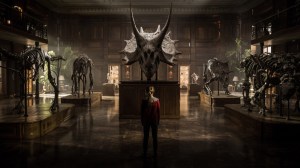 With all that said, there are moments of enjoyment and excitement to be had with Fallen Kingdom. Director J.A. Bayona (A Monster Calls) has a great gift for finding the right image and holding onto it for maximum impact. He showcased this in his crafty, brooding, and highly effective ghost story The Orphanage and in his emotionally uplifting and harrowing tsunami survival drama The Impossible. With his first crack at a major studio movie, Bayona comes most alive in its second half when the movie transitions into a haunted house thriller in a mansion of secrets. His command of visuals and mood comes into sharper focus and there are some tense, delightful sequences. As much as I wrote about Fallen Kingdom being a movie of set pieces and little else, those set pieces are actually pretty entertaining. The island material only lasts about a half hour, wasting little time in getting the important pieces in play. There’s one long take inside a submerged capsule taking on water that keeps spinning and ratcheting up the tension that reminded me a bit of Alfonso Cuaron’s Children of Men. There’s another sequence involving a blood transfusion that I thought married comedy and tension better than anything else in the film, and it served a purpose that was credible.
If you can shut off your brain and stuff your mouth with a steady supply of popcorn to thwart your incredulous grumbling, there might be enough to enjoy with Jurassic World: Fallen Kingdom. It’s technically well made and the special effects are pretty good, the photography is evocative, and there are potent set pieces and imagery to stimulate the pulse. It’s loud, dumb fun, but for me, this time, the dumb outweighed the fun.
Nate’s Grade: C
Share this:

Pete’s Dragon (2016)
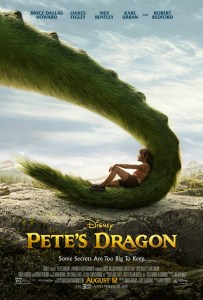 I have no personal love for the original 1977 Pete’s Dragon. I thought you, dear reader, deserved to know this morsel. I never felt a sense of wonder from the animated dragon creating mischief while a town tried to rid itself of an orphan and a bunch of hillbillies sang an ode to child abuse (it was a different time?). Disney has gotten into the self-cannibalizing habit of dipping into its own past and remaking its animated hits for a new generation of moviegoers. It worked splendidly with last spring’s Jungle Book, and the new version of Pete’s Dragon is further proof that when Disney aligns the right artist with a vision and gives them latitude to express that vision, rewards are generously reaped. This is a delightful, heartwarming, and enchanting summer movie that got me crying.
Pete (Oakes Fegley) is a young boy who lives in the wooded reservations with one very special friend, a furry green dragon he has named Eliot. He’s been living in the woods for six years after Eliot rescued him following a car accident that claimed the lives of Pete’s parents. One day a park ranger, Grace (Bryce Dallas Howard), comes across Pete and brings him back into town for medical evaluation. He’s a mystery child, a bit feral, and demands to return home into the woods. Grace incites Pete into her home and her family, but there are worries about the boy acclimating to society. All the while Eliot is looking for his best friend and mournful that they might have to part ways after all.
 Pete’s Dragon is a simple story but this is not a detriment to its ultimate effectiveness. Rather the filmmakers take care to treat this childhood fable with enough heart and earnest emotion that the movie feels fully developed to its aims. The characters and their journeys aren’t exactly revolutionary, but I didn’t mind at all. This is an old-fashioned family film told without irony and set in a nondescript past that adds to the universal appeal of its message. It’s elegantly simple but there are poignant themes running under the surface, namely an unmistakable level of melancholy with Pete’s process of growing up. This feels like Disney’s version of Spike Jonze’s Where the Wild Things Are, a movie that examines the hard but necessary transitions of childhood and the acceptance of a sort of loss among the fantastic. This movie isn’t consumed with a dour interpretation of childhood as an oppressively hellish existence of misunderstanding (I didn’t connect with Where the Wild Things Are if you couldn’t tell) but it does acknowledge a loneliness of being absent a family to call your own. Pete’s life with Eliot is filled with boyish excitement and adventure but he knows he can’t hold onto that world much longer, and this realization magnifies the remaining time with Eliot. From start to finish, Pete’s’ Dragon is bursting with warmth and resonant emotions.
I was unprepared for the emotional wallop that this film delivered. Not since perhaps Pixar’s Up has a movie so effectively triggered my sympathies in its opening ten minutes. In a beautiful yet tastefully restrained sequence, Pete becomes an orphan and is rescued by Eliot, and the vulnerability and compassion of this moment already had me tearing up. Full disclosure: I’m a sucker for the “boy and his dog” stories, and while Eliot is a special dragon by design he is, at his core, a rendition of man’s best friend. Their relationship is one of love, companionship, and protection. They’re a pack. When Eliot spots Pete cozy in a family house, he’s crestfallen but accepts that a placement in the human world is where Pete belongs. And then at the end after a fraught situation, Pete instinctively runs to Eliot and leaps into his arms, and Eliot takes him in, holding him dearly, and it was at this point that I couldn’t stop the flow of tears even if I wanted to. Happy tears, people. The takeaway of the film is the formative bonds of family and the need to reach out for that nourishing companionship. While it’s highly emotional, it’s all earned and avoids cheap maudlin, manipulative theatrics, short of one extended sequence of Eliot’s capture.
I never would have expected such an old-fashioned yet preternaturally charming movie from the team responsible for the somber indie Western Ain’t Them Bodies Saints. Director/co-writer David Lowery is locked-in with its goals and finds ways to build its characters through small, cumulative actions. The film also has a marvelous sense of place as get a strong feel for everyday life in this foggy Pacific Northwest environment. Contributing to that sense is a terrific soundtrack of low-key folk songs that thrum with a lovely homespun gentleness that taps into the earthy magic of its setting. The score strings-heavy by Daniel Hart is perfectly attuned to the emotional rhythms of the film without becoming overbearing. The photography is often gorgeous and the editing near invisible with how effortlessly it presents its story with room to breathe. There’s a standout sequence that highlights just how well all of these individual elements come together to form a greater whole. Pete escapes from the town’s hospital and desperately runs outside. He is dazed by the activity of the modern world and the geography of the town, and the residents of this town are just as dazed about Pete, a wild child exploring his alien surroundings. He hops aboard a school bus and the children inside are amazed at Pete’s daredevil antics. The chase sequence is set to the Lumineers’ “Nobody Knows” and it builds upon the sense of discovery, community, and mutual awe. It’s a wonderful sequence that develops patiently.

Part of the success of the movie is also due to the skill and implementation of the special effects team. Eliot is a cuddly creature you want to take home with you yet he can still be intimidating under the right circumstances. He’s on screen a lot but his magical qualities don’t diminish. This is one highly communicative dragon and it’s easy to empathize with him (those exquisitely emotive canine eyes help). There’s a tenderness to him that convinces the audience early on to take a journey with Eliot and see what happens next.
The human specimens are heartfelt and enjoyable as well. Ostensibly the main character, his name is in the title after all, the role of Pete rests on the tiny shoulders of actor Oakes Fegley, and he aces the part, tapping into the rougher, wilder edge while also selling the dramatic moments in a clear relation to his interpretation of the character. The next main character is Howard (Jurassic World) and she’s quite good. She gives a maternal performance that doesn’t go overboard while still allowing her to come across as an independent, thinking woman with her own desire for proof of the fantastical. She has several tender moments with Fegley. The actors all perform ably. Even Wes Bentley (TV’s American Horror Story) works well in the movie, and when was the last time that could be said? Karl Urban (Star Trek Beyond) is enjoyably hammy as the villain who’s not much of a villain. I wish Redford (Captain America: The Winter Soldier) was in more scenes because his grandfatherly presence is so enjoyable to watch and he so easily slides into the part.
Disney is two-for-two when it comes to 2016 live-action remakes of its old catalogue, and if The Jungle Book and now Pete’s Dragon are any indication, then bring on the remakes. The original Pete’s Dragon was never a memorable or enjoyable film for me, so there was already much to improve upon, which is what the new version does in every way. It’s poignant, heartwarming, earnest, and bursting with feeling. It’s a simple story told exceptionally well with artistry and grace. There’s a dash of indie flavor to the mainstream filmmaking. I think this movie will appeal to people of all ages, grown ups that are looking for some magic in their movies, as well as families looking for a movie that will entertain children but won’t rot their brains. It’s fortunate that we can end such a mediocre summer at the movies on a high note, and Pete’s Dragon is a wonderful infusion of the old and new, magic and reality, heartache and triumph. It’s a movie dripping with purity, and one that demands to be seen and hopefully cherished.
Nate’s Grade: A-
Share this:

Jurassic World (2015)
 Director Colin Trevorrow won the proverbial lottery after his 2012 film, Safety Not Guaranteed. The charming indie gem won many hearts, one of them Steven Spielberg. Trevorrow went from a rom-com that was made for under a million dollars to directing a Jurassic Park franchise reboot. Even last year’s Godzilla director, Gareth Edwards, had a previous film that somewhat primed a logical path for his impressive new gig. Enough time has passed for Jurassic Park to be new again, and the extra varnish of cutting-edge special effects, high-profile stars, and a renewed sense of fun remind us just how universally enjoyable it is to watch dinosaurs and then watch dinosaurs eat people.
Jurassic World has been open for a decade plus now and audiences are getting bored. As a result, the board of directors for the park is looking to “up the wow factor.” They’ve genetically engineered a new hybrid dinosaur (Indominous Rex) that has never existed before in history, but nothing bad could happen, right? Owen (Chris Pratt) is a Navy trainer who is working on training a group of raptors to follow commands. A security leader (Vincent D’Onofrio) is convinced that there’s money to be made with military applications if dinosaurs can follow orders. Claire (Bryce Dallas Howard) is in charge of the day-to-day operations at the park. Her nephews (Ty Simpkins, Nick Robinson) are visiting as one last holiday adventure before mom and dad get divorced. She knows little about her nephews (she’s a workaholic – what originality), but when they’re put in mortal danger, Claire’s protective nature kicks into overdrive. The Indominous Rex escapes its paddock and heads from pen to pen deeper into the park, killing for sport. It’s up to Claire, Owen, and a team of trained raptors to stop this newest monster.
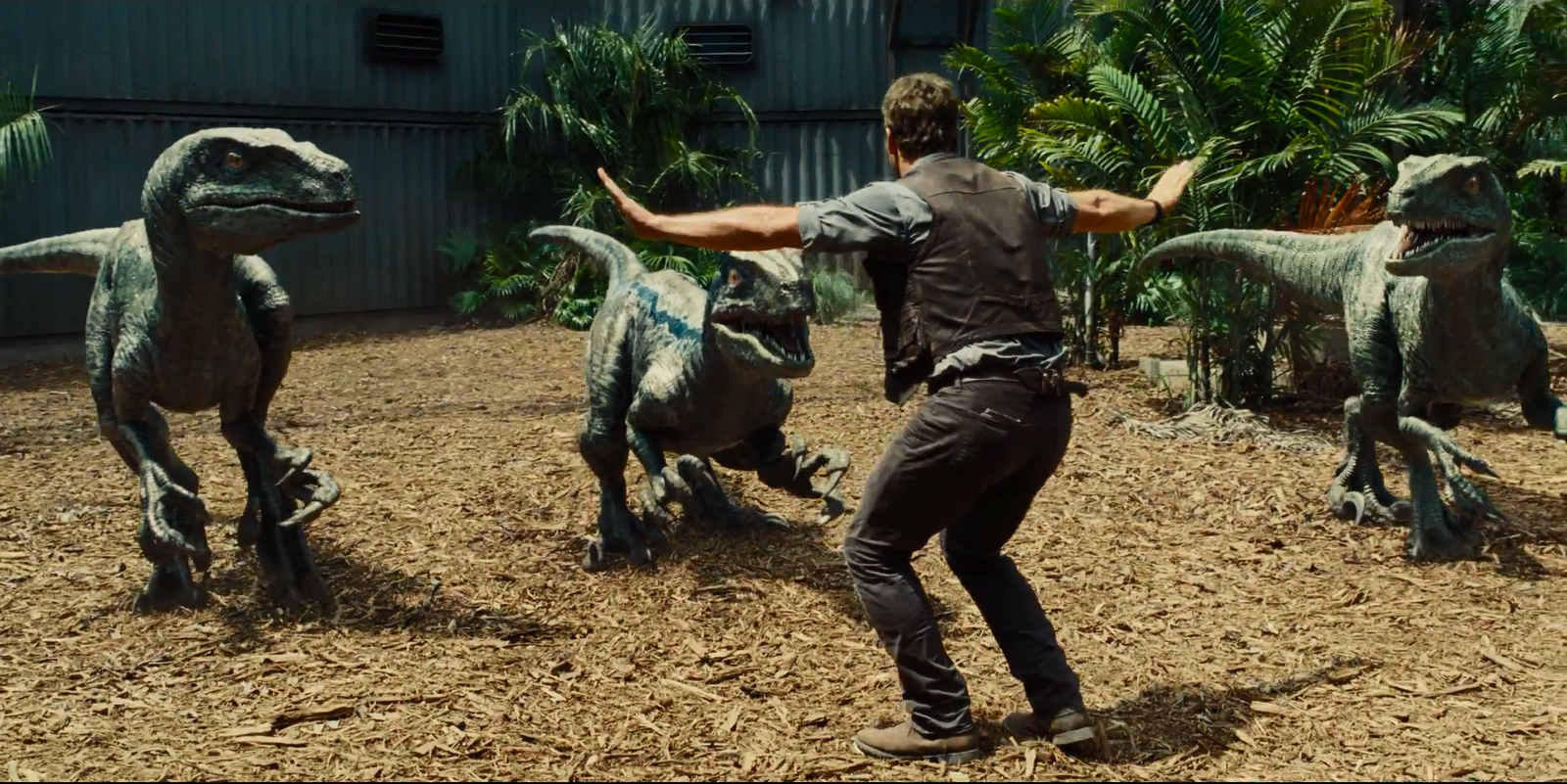 What Trevorrow and his Safety writer Derek Connolly do well is establish a summer thrill-ride that places fun above all else, and it achieves this goal. Jurassic World is consistently entertaining and engaging, with action sequences that are shorter but constantly push the narrative forward. With all the Jurassic films, there’s a palpable sense of dread, of holding back before things get really nuts, and Trevorrow has fun teasing an audience; however, he also delivers on what he promises. The dinosaur action is visceral and rather violent for a PG-13 film, but the segments are diverse in orchestration that it never feels like the movie is repeating itself. That’s quite an accomplishment considering that the Jurassic sequels have mainly been a series of chases. There’s a definite nostalgic reverence for the original 1993 film, summed up with Jake Johnson’s geeky control center character. Trevorrow takes more than a few nods from the almighty Spielberg with his own directorial style. There’s also a surprise sense of humor, which can be quite amusing in moments and far too comically broad in others, like the forced screwball romance between Owen and Claire. The story this fourth time is less a cautionary tale of science and more of a monster romp, imploring a finale that feels reminiscent of Godzilla being called out to save the rest of us tiny humans from the newest and biggest monster. It feels like Trevorrow and Connolly accepted they would never recreate the magic of the original, so they’re aiming to just make the best sequel possible instead. If you’re looking for dinosaur mayhem, Jurassic World has plenty and a sense of what makes summer movies work, mixing in the right amount of suspense, humor, and well-crafted payoffs.
There are a few subplots that have to be swallowed or ignored for maximum benefit. The Raptor Force Five subplot is either going to be cool or silly, or both, and will go a long way to determine your overall feelings on Jurassic World. I know this idea has been in the works for several Jurassic sequels, so there doesn’t seem like there was ever going to be a movie that did not involve raptors being trained into some kind of combat role. This subplot connects to other points in the film about the nature of control/accepting being out of control, the building of a relationship, and the coordination for corporate interests. There’s a reason that the Indominous Rex seems to have special abilities that the handlers were not informed about, and this will be carried over into an assured sequel. For me, I thought the raptor hunting party was more fun than dumb. It had a Disney Wild Adventure feel for it, like we’re crossing over into Call of the Wild. I liked making the raptors allies to the humans who could be rallied for the final fight.
I appreciated how thought out the world building was; Jurassic World feels like a living, breathing amusement park in operation. From the Seaworld-like Mosasaurus aquatic shows, to the baby dinosaur petting zoo (I would totally spend hours there), to the celebrity-recorded comedy bits educating riders about safety supervision, to the listless park employee wishing each new rider to have a happy day. During the pterodactyl attack sequence, which is the most frenzied and exciting sequence, the crowds run for cover, including one guy who runs away while still carrying a clearly identified margarita in hand. That’s fantastic because it means that the park probably has a cheesy pun-laden menu of adult beverages (Tea Rex?) but it also means that even during an attack, a customer is determined not to lose his, likely, $10 margarita. While the “we can’t close the beaches” corporate mentality is somewhat tired as a plot obstacle, it’s still entirely fitting in a modern setting. It was the little details that told me that Trevorrow and company really thought the premise through and made their world feel far richer.
 One could also look at the social commentary in a fairly cynical manner and find Trevorrow giving in to the summer movie machine. Claire’s character explains that after years of operation, the public has grown tired of dinosaurs, and so they have to engineer a new bigger, badder dinosaur just to grab flagging interest. What once was magical has now become accepted and everyday. It’s easy to apply this critique on movie audiences themselves; we’ve become jaded from movie spectacles. What once blew our minds, like the original Jurassic Park, has now become passé. We’re constantly looking for the shiniest new toy but will lose interest soon enough. And then there are the fleeting images of people being more involved with their cell phones than the spectacle they paid to see. That’s right, annoying moviegoers who are unable to break from their phones for a two-hour window, Jurassic World is making fun of you, and rightfully so. The chief product of this desperation to give the audience what it wants is Indominus Rex, a beast that slashes a rampage through the island. In a sense, Trevorrow is externalizing the audience’s demands into the antagonistic monster, and finally just gives in, essentially saying, “This is what you want, right?” I can’t tell whether the social commentary holds up well, especially with the end that relies upon a metaphorical power of nostalgia to conquer the manifestation of audience apathy, or if Trevorrow just gives up. Is the concluding monster-on-monster brawl just mass appeal pandering?
I have a major solution to this dangerous park scenario. First, only herbivores allowed. Is any person going to reasonably refuse to go see millions-year-old multi-story extinct creatures because they primarily eat plants? I’m sorry, no way. That right there would solve most problems if the animals inevitably get loose. I would not believe a single person who would refuse to see living dinosaurs just because they lack a T.rex or other predators. That’s like Internet cretins refusing Angelina Jolie as a one-night stand because they don’t like the way her knees look. Nobody is this picky when awe-inspiring greatness waits. From a legal standpoint, I would also make sure guests sign a waiver before entering the park, thus mitigating any potential lawsuits over being attacked and eaten. How expensive is this park by the way? You have to charter a boat off the coast of Costa Rica, so that sort of price range already eliminates plenty of would-be customers.
I know many millennials who consider Jurassic Park to be their own Star Wars, a film that delighted the imagination and imprinted a love of movies at a young, impressionable time. Movies have never been the same since, especially in the sea change of computer generated effects replacing practical (Oscar-winning Sam Winston is retiring because of our over-reliance on CGI). We all want to experience that sense of awe again, like when we saw the T.rex roar for the first time. Movie moments like that send shivers but they are rare, so it’s unfair to compare Jurassic World to Park. However, it’s fair game to compare it to the lesser sequels, and that is where World stacks pretty favorably. Its sense of fun above all else, while remaining true to its larger vision of a real park, is a satisfying summer diversion. The dinosaur mayhem is satisfying and occasionally scary. The script does just enough to keep you from wanting to watch the human characters get squashed. In the wake of its box-office shattering opening weekend, expect the park to stay open.
Nate’s Grade: B
Share this:

The Help (2011)
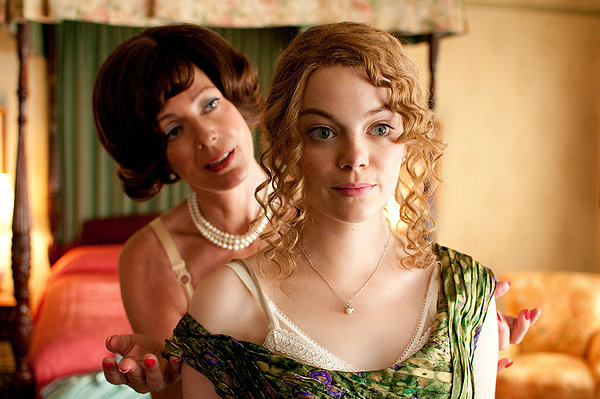
 Kathryn Stockett’s bestselling publishing phenomenon has now become a box-office smash. In 1963, Jackson, Mississippi, Eugenia “Skeeter” Phelan (Emma Stone) is coming home after graduating from college. Her ailing mother (Allison Janney) is convinced that she will die without any grandchildren and pressures Skeeter to find herself a man. Instead, she finds herself a job writing for the city newspaper. She answers reader household and cleaning questions as “Miss Mryna.” She seeks help from Aibileen Clark (Viola Davis), a middle-aged woman who’s worked as a maid to rich white people her whole life. Skeeter soon changes her focus and wants to interview other maids about the indignities they experience. She wants to get their story out there. This is a time where it was actual Mississippi law that anyone working against segregation could be imprisoned. They try reaching out to Minnie (Octavia Spencer), a maid recently fired from the services of Mrs. Hilly Holbrook (Bryce Dallas Howard), the queen bee of the Southern belles. Minnie is much more outspoken and her mouth causes her to get into trouble. The only job she can find is in the household of Celia Foote (Jessica Chastain, The Debt), a woman ostracized by Hilly’s forces. Skeeter transcribes the life stories of a dozen maids and the results become an anonymous bestseller that sets Jackson tongues a waggin’.
The Help enlists a colorful cast of characters (no pun intended) and tells a familiar story about people taking a stand during a tumultuous time in history. This is traditional classic Hollywood storytelling with the respective characters banding together, leaning upon one another, building camaraderie and victory, and then finally able to stand up to their antagonists, which in this case is really just Howard’s snooty racist character. It’s well told, well directed (both credits to Terry Tate, childhood friend of the author), very well acted by every member of the cast, and watching all 145 minutes is like being fed a heaping helping of home cooking. You leave feeling full and sated, and some may even feel nourished. You feel good about yourself. I tried to resist but resistance was futile. I can’t help but enjoy The Help. And even though I walked away liking the film, something stuck in my craw. It felt a little too prefabricated, too eager to be liked, to go down easy, gentle, a sweet Southern story about women taking a moral stand and finding their voices. But what is the film’s real focus when it comes to race relations?
 Naturally nobody is going to look as The Help as an exhaustive document of the Civil Rights era, but the movie seems to seriously downplay the intensity of that struggle. Sure it pays lip service to Medgar Evans assassination but by this time there were riots, churches being bombed, children being killed, open collusion between law enforcement and the Ku Klux Klan, and the Freedom Riders were being met by violent mobs. There are a lot of bigger things going on than black maids sitting down for interviews with a college girl. Come on, this is Mississippi we’re talking about here, the home of racism. I understand that the Civil Rights movement had thousands of anonymous acts of courage and the actions of these (fictional) women should not be out rightly discounted. However, the parting message of the film seems to be not about the courage of the black maids but the tenacity of Skeeter, a middleclass white woman who herself grew up with “help.” The Help’s mixed message on race relations reminds me of a similar situation with 2009’s beloved The Blind Side. That movie wasn’t so much about the triumph of a black athlete so much as a glowing picture to how great rich white people can be. And Sandra Bullock got an Oscar for it; that’s how great a white lady she was. The Help is another example of Hollywood taking a story primarily about minorities and having white people necessary to tell that story. Why are white people always necessary to tell some other race’s stories? Skeeter is an open-minded gal that speaks her mind and stands up to the Jim Crow South. That’s how she starts. By the film’s end, she’s now… an open-minded gal that speaks her mind and stands up to the Jim Crow South and now she has a publishing career. Good for her! Good for heroic white people! They had so much to lose back then.
I guess my main fault is that this is not Skeeter’s movie. I don’t even think she’s needed. Yes she provides the outlet for the stories and secrets of an undervalued class of people. But did she need to be the co-lead? Does she need her own storyline where she stands up to her mother cowing to racist social norms? She had her own maid (Cicely Tyson) unceremoniously dumped while she was at school. Surprisingly this does not give too many insights to Skeeter’s character. Do we need any scenes of her going out on dates so that we can forever be reminded how ahead of her time she was, how liberal and progressive she was and destined to be unappreciated by a pool of men who were looking for only pretty housewives? As my friend China Gentry said, we’d all like to think we’d be the forward-thinking progressive voice of change in these historical dramas, to make ourselves feel better, but we’d most likely just be another silent face in the background. The boyfriend storyline is a complete waste of time. Skeeter goes out with a drunk jerk, he comes back and apologizes, they go out again, then after she gets published he freaks out and storms out. And that is the last we see of this guy. That’s the end of his story. He apparently puts his foot down when it comes to dating a female author. This storyline adds nothing to the overall narrative or to the character of Skeeter. There’s entirely too much Skeeter in the movie, and I say this as a gigantic fan of Emma Stone (Easy A). It’s not the actress’ fault either because she performs well in her first dramatic film role. This is just not her movie. This is not a movie about heroic white people; at least it shouldn’t be. This is a movie about the help, so let’s devote more time to them, notably Minnie and Aibileen. The movie opens and closes with Aibileen’s voice over. She is the star of this story. Why do I need another character just to coax out her story? Yes, I understand the limitations to a woman in Aibileen’s position in those days, but that’s no excuse. She deserves to be the focus.
Davis crushes in this movie. She is a one-woman force of devastation. You can just see the wear on her face, the tremor in her eyes, the sadness etched into her face. This is a woman beaten down by her position, and Davis is excellent. How good is this woman? She’s so good she got nominated for an Oscar for a single eight-minute scene in 2008’s Doubt. That’s Judi Dench territory right there (Dench famously won a Best Supporting Actress trophy despite only appearing onscreen for about nine minutes in Shakespeare in Love). She has a few big acting moments but mostly she’s not an outspoken woman. She’s more a downtrodden woman used to the many disappointments of her lot in life. She raises other people’s children while seeing very little of her own son. She develops close relationships with those kids, and the kids feel more attached to their maids than their mommies. And there’s the shattering disillusionment that these children, who once loved their maids, will transform into spitting images of their parents. The help gets treated less like family and more like a disposable, impersonal employee. The ease of severing ties can be heartbreaking. And Davis lets you feel all that without even having to speak. Spencer (Dinner for Schmucks), in easily her biggest role of her career, is enjoyable with the more outspoken role. She’s more the mouthpiece for the audience.
 As I admitted in my review of 50/50, I don’t think there’s any role that Howard (fun fact: both Howard and Stone will play film versions of Gwen Stacy) can play where I won’t fall in love with her somewhat. This is more a hypothesis than a theory at this point. Hilly is a social queen, the Southern belle who likes things just the way they are. She has influence over the other middleclass wives in Jackson, but she does make for a pretty marginal main antagonist given the time period. She can threaten the livelihoods of the maids, so she is a threat, and her worldview is decidedly racist (she thinks using the same toilets will spread “black diseases”). She’s built up enough to be a threat but not enough to be unstoppable. She’s defeatable, unlike the intolerant ideology so prevalent in the South. We can’t defeat racism but we can topple one racist white lady. Well, we can laugh at her and bring up the fact that she ate something very gross once. I won’t go into spoilers, but this plot point where Minnie gets wreaks personal vengeance on Hilly via baked goods feels out of place for the tone of the film. It doesn’t fit.
I resisted seeing The Help for so long, believing it would be a painful experience with mushy emotions and many life lessons served up on an easy platter. And to some degree, the movie is exactly that. But it’s also hard to dislike the sweep of the old fashioned storytelling. The Help is a nice movie, extremely well acted, and filled with period details that will make the audience sense its authenticity. It’s easy to get caught up in the writing and the acting, so it’s easy to ignore the otherwise somewhat questionable examination on race relations. I don’t know why we still need white people to tell “their story.” The Help is a well-crafted movie but it fails to move the conversation forward. Perhaps that’s an unfair expectation. Not every Civil Rights era story is required to properly educate the public, let alone a work of historical fiction. Maybe I should just sit back and enjoy the story like so many million readers have. But the power of Davis’ performance claws at my memory, telling me she deserves a better movie focused on her character. For once, I’d like to see a Hollywood movie about race relations that doesn’t require white people as a framing device. Let’s let the right people tell “their story” for once.
Nate’s Grade: B
Share this:

50/50 (2011)
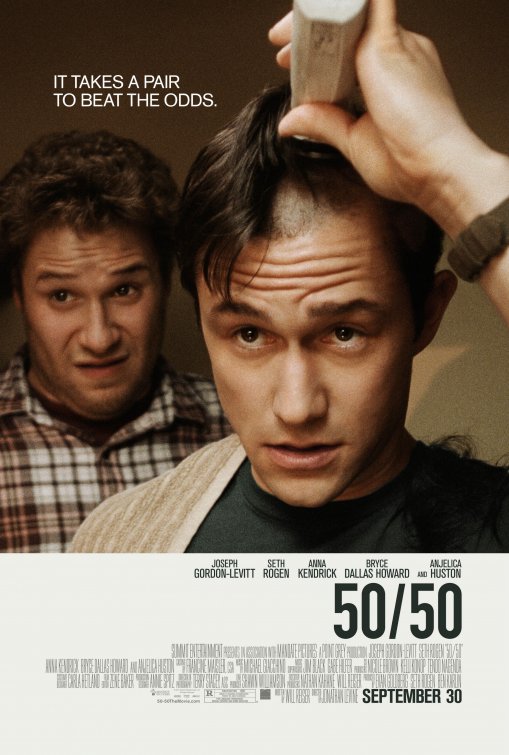 50/50 is based upon the experience of screenwriter Will Reiser, a writer for HBO’s Da Ali G Show who contracted cancer before his 30th birthday. Reiser’s real-life travails with his buddy Seth Rogen (who serves as executive producer) through the good times and bad. I guess when you get cancer it helps to have an established movie star as your good friend. It also helps when you write a terrific script, which Reiser has accomplished. Originally titled I’m With Cancer, I guess the studio felt that a movie with “cancer” in the title was a hard sell to mass audiences (On a related note, Showtime’s comedy-drama The Big C, about Laura Linney finding the humor through cancer treatment, was previously titled The C Word. I don’t know about you, but when I heard “the c word” the first thing that comes to mind is not “cancer.”). Even with a more oblique title, 50/50 manages to walk between comedy and drama with flair. It’s probably the funniest movie you’ll ever see about cancer. Definitely funnier than My Sister’s Keeper.
Adam (Joseph Gordon-Levitt) is a relatively healthy 27-year-old. He likes his job writing for a Seattle National Public Radio station. He likes his girlfriend, Rachel (Bryce Dallas Howard), an aspiring painter. He likes his best friend, Kyle (Rogen), a dude prone to speaking whatever is on his mind. Then one doctor’s visit changes everything. Adam has a very serious form of spinal cancer. He begins chemotherapy to try and stop the tumor’s growth. Rachel drives him to his hospital treatments, helps him during his long nights of nausea, but ultimately it proves too much to bear. She leaves him. Luckily, Adam has a young therapist, Katherine (Anna Kendrick), helping him put his life in order. Adam’s chances of surviving this rare cancer are exactly as the title proclaims, 50/50. As he comes to grips with the measures needed to survive, Adam finds himself growing closer to his therapist in a completely unprofessional degree.
50/50 may be the least sentimental movie I can recall about the realities of living with cancer, and that is its greatest attribute. That doesn’t mean that the movie doesn’t cover serious issues in a flippant manner. Instead of hitting cheap sentiment and milking cancer for easy tears, the movie, thanks to Reiser’s sharp script, forgoes false feelings and finds something more rare and true. There’s no real playbook for something as unexpected as a person in their 20s being diagnosed with terminal cancer. It seems like a cruel irony to be stricken with an illness so young. Adam doesn’t drink, doesn’t smoke, and doesn’t even drive due to the danger. He’s pretty mild-mannered and a bit of a pushover. Adam tries to not let cancer get to him, to shrug off the heavy implications, and to just make it seem like any other personal setback. If he doesn’t treat it like a big deal, maybe it won’t be and his friends and family can follow his lead. This kind of self-manufactured blasé attitude, even in the face of cancer, seems like an apt approach for a younger relaxed generation. Naturally, this denial-heavy approach doesn’t exactly work. It’s too easy to confuse numbness with acceptance. Fortunately, Reiser does not let his story slip into easy maudlin theatrics. We don’t need anybody reminding us, or Adam, how serious his situation is. On the other hand, we also don’t need anybody moralizing about any self-help slogans. Not everyone sees adversity as a blessing into Discovering Who You Truly Are. Reiser refrains from his characters making anything approximating Big Life Statements. Cancer does not lead to automatic personal epiphanies. If it did, we’d have a lot more people inhaling carcinogens and volunteering to work in the Chernobyl ruins.
 50/50 doesn’t ignore the sometimes odd and dark humor that arises from life’s predicaments. That means this is the only cancer movie where the guys try and use the disease as a way to convince girls to sleep with them. At no point do I remember this occurring with Terms of Endearment or Beaches. And this opportunistic babe hunting doesn’t make the boys come across as sleazy. Adam can’t even enjoy the one-night-stand as his back pain robs him of the pleasure of his nubile well-wisher. The tone is very controlled. The raunchy comedy is not a distraction; at no point does any situation feel like a comedic setup. The comedy comes from the characters being genuine to who they even through the trying circumstances. If your friends are funny, chances are they’ll still be funny talking about cancer. The humor doesn’t make light of things nor does it just play everything for laughs. Humor is how we humanize, how we make the insurmountable digestible.
50/50 also treats its characters with a bittersweet sense of reality; these people are flawed and relatable. They are not instantly made into self-actualized saints thanks to cancer. Adam’s girlfriend actually breaks down because she cannot handle the extra responsibilities and emotional wear and tear. Their relationship fizzles. This seems far more realistic considering many people will feel like they did not sign-up for sleepless nights, 24-hour care, and watching their loved one waste away. It’s a strong individual that can endure that kind of collateral pain, but the movies make it seem like every romantic partner is unnaturally selfless. They become ideal partners, but really most of us would just bail. Reiser easily could have easily written his ex-girlfriend as an insensitive shrew. While she does cheat on the guy, thus making her easy to dispel, Howard makes her vulnerability relatable. She even comes back trying to make amends, forcing kisses upon him to weaken Adam’s resolve. Kyle relishes the opportunity to finally be able to tell off Rachael, a girl he admits to disliking from the start. I don’t get the instant hate, but maybe it’s my complete adoration for Howard even when she’s playing a bad girl that blinds me to her offenses. To dismiss her as a “bitch” seems unfair. How would you react if your boyfriend/girlfriend were suddenly diagnosed with cancer? Could you last?
I found all of the characters to be empathetic and relatable (though a lead who waxes about the glory days of radio and works for NPR seems a bit hipsterish), especially in their personal struggles surrounding Adam’s illness. Adam’s mother, Diane (Anjelica Huston), can be overbearing and would have easily been kept as a caricature in other movies. In 50/50, the film examines her own struggle – a husband with Alzheimer’s who can’t talk to her and a son with cancer who chooses not to talk to her. The isolation she feels, the loneliness, always putting other people’s needs ahead of her own, this is culmination of the caregiver, a role as I’ve stated that too often gets canonized. In 50/50, the reality of living with illness is dealt with in a meaningful manner. The people surrounding you are also affected by your illness. You cannot shut them out to spare them from pain. Adam realizes this too as the film progresses to its moving conclusion.
 The heart of 50/50 concerns two sets of relationships. The one that will catch the most attention is Adam’s budding romantic relationship with his therapist. Their romance feels like it emerges naturally, albeit in a slightly hurried up pace for our small timetable. It’s a romance built upon the chemistry of the two actors, the strength of their individual performances, and the fact that Reiser forgoes anything obviously romantic. He cleans out her car. She gives him a ride home. It’s little things that seem like they matter on a personal level, not the outsized theatrics of romantic gestures. The movements are small but they add up, and we can feel it too. So when Adam, at his lowest point, calls her and says, filter down and radiating in emotion, “I bet you’d be a good girlfriend,” it’s a moment that feels earned. I also greatly appreciated Katherine’s own insecurity about being a therapist. Too often movies depict therapists as omniscient beings that have a fortune cookie answer for all of life’s mysteries. Kendrick hides behind evaporating smiles as her character’s defense mechanism. In 50/50, we get to see a character that is honest about her insecurities about a job that advises others. It’s refreshing. The other main relationship is between Adam and his best friend, Kyle. His best buddy is his spark, the guy who gets him out, who shakes him from moping around. He cares but goes through unorthodox methods to show that care, including trash talking and ball busting. He remains likable to his shaggy core because he has Adam’s best interests in mind, even if that means scoring with girls.
Director Jonathon Levine (The Wackness) gives the movie an improbably beautiful look. This is one cancer comedy that is simply pleasing to watch for the cinematography alone. He doesn’t overpower the narrative with self-aware visual touches, though there is one that stands out. When Adam receives the news from his doctor, the audio becomes distorted after the shocking word “cancer” is uttered. The picture becomes blurred. The world seems to have been swept away. I imagine this sonic body blow is pretty much how Reiser recalls receiving the news, and if not it still feels authentic. The score by Michael Giacchino (Up, Super 8) is subtle and doesn’t intrude too often, ably assisting the drama instead of smothering it.
50/50 is an unsentimental film that manages to be moving and genuinely entertaining on its own terms. It can be rude but that doesn’t mean it lacks sincerity. The characters and their dilemmas feel all too relatable, even the ones we hope don’t become us. The 50/50 production has followed a subdued edict, forgoing sappy melodrama and easy pathos. These emotions are earned the old fashioned way, through characters we care about and drama that feels truthful. The mixture of the course and sweet gives the film a decidedly Judd Apatow (Knocked Up) flavor even though his name is nowhere to be seen. Gordon-Levitt, who at this point can do no wrong in my eyes, gives one of the best performances of his already accomplished career. The comedy, lead by Rogen’s obnoxious best friend, keeps the movie from being bogged down in melodrama. It’s the only way to stay sane, and 50/50 recognizes this and delivers a film that earns its tears and laughs.
Nate’s Grade: A-
Share this:

Eclipse (2010)
 This may be an obvious statement but I will never be a teenage girl. Shocking news to anybody who never knew of the existence of my Y chromosome. Regardless, it’s hard for me to empathize with the madness that surrounds the cultural juggernaut that is the Twilight series. I cannot work myself into a frenzy. I cannot get madly passionate about the merits of Team Jacob vs. Team Edward (though full disclosure: I lean more toward Jacob). I cannot even understand the appeal of the main character and why she’s worth every human, vampire, and werewolf fighting over her. I just can’t walk in the same shoes of the Twilight faithful and their devotion to author Stephenie Meyer’s series. I get the appeal because its adolescent wish fulfillment with the flashes of danger muted by the overall security of traditional values (the vampire wants to wait until marriage before they have sex). I fully acknowledge my divorce from this conjured reality of the Twilight series. But that doesn’t mean I can’t judge the films on their merits. The first film worked for what it was, the second one was resoundingly bad, and now the third film, Eclipse, manages to reheat the same love triangle squabbles and call it something fresh.
Bella Swan (Kristen Stewart) is about to graduate high school and, presumably, graduate from the human race. Her vampire boyfriend, Edward Cullen (Robert Pattinson), has pledged to grant her wish and make her a vampire so they can truly be together forever. Bella’s friend/werewolf/ab model Jacob (Taylor Lautner) is vehemently against this plan. He wants Bella to be with him instead. He’s the safer choice and she doesn’t have to become dead for a happily ever after. Bella is torn between her two romantic options, again. However, Victoria (Bryce Dallas Howard) is out their plotting vengeance against Bella and the Cullen clan of “vegetarian” vampires. She’s creating an army of newborn vampires in Seattle. The army is so powerful that the Cullens reach out to the werewolves for an alliance. Mortal enemies comes together, including feuding paramours Edward and Jacob, to protect Bella and vanquish Victoria once and for all.
 For starters, stuff actually happens in the third Twilight movie. I know that’s a fairly damning comment in itself that one must wait until the third movie for action. But here’s the thing: the plot fails to advance more than an inch. At the end of New Moon, Bella pretty much made her choice when she decided to whisk to the other side of the earth at the very utterance of Edward’s name, leaving poor Jacob high and dry. In Eclipse, she solidifies her choice. In New Moon, Bella implores Edward to turn her into a vampire, which he agrees to do after she graduates from high school (what a bizarre academic motivation strategy). In Eclipse, Bella further implores Edward to turn her into a vampire, which he is reluctant to do, but eventually he agrees. In New Moon, the werewolves and vampires don’t like each other. In Eclipse, that’s about the same, but they form an uneasy alliance to protect Bella, the most important girl in the whole wide world. The third film feels like a student’s paper revision; characters now add supporting evidence to explain their decision-making. Bella now gets to expound in further detail why she should be turned into a vampire (hint: she doesn’t feel like she fits in), Jacob adds to a budding Master’s thesis on why he is the better romantic option for Bella, and Edward gets plenty of opportunity to be the wet blanket, whether he’s turning down a horny Bella (no action there) or warning her about the dire lifestyle of today’s modern vampiric American. Much of Eclipse is people sitting around and chatting about their decision-making, verbalizing stuff that Meyer has no ability to place as subtext. By the end of the movie, at least you feel satisfied that everybody has weighed their options, even if they keep making the same dumb mistakes.
Speaking of action, Eclipse greatly benefits from having an external threat throughout the movie. The first two films felt prosaic and self-involved partially due to the fact that an antagonist was never introduced until the final act of each movie. The first two movies were two hours of brooding and making cow-eyes at each other, followed by a requisite climactic fight that felt anything but climactic.
 With Eclipse, we have Victoria building her army of newborn vampires, and we see that army form, wreck havoc on the streets of Seattle, and for once the Twilight series feels like it has a real threat. That’s because Victoria has never ever felt like a threat. I don’t know how she’s represented in Meyer’s books, but in three movies, this curly-haired vampire has always come across as woefully unintimidating. She feels like a Kate Hudson romantic comedy character with fangs. It just doesn’t work no matter how fast the filmmakers show she can run through forests. The Cullen clan will occasionally chase after her, that is, when they’re not lining up like they’re making superhero posse poses. Victoria has never cut it as a villain, so it’s a good move for her to amass an army of super vampires that will do her bidding. The audience is repeatedly told, rather than shown, how serious the newborn vampires are because, you see, newborns still have some human blood in them. Never mind that the Twilight movies have never made mention of this power before. What’s puzzling is that Victoria has been building up her base of bloodsuckers for over a year, so why aren’t there like a ton more? The army of newborns consists of like twelve vampires. I understand the logistics of having to feed and house multiple vampires, but if I was planning for a brutal assault I’d want as many of these super vampires as I could sire.
Let me rephrase some of what I just said. New Moon did have an antagonist and her name was Bella Swan. She was sullen, whiny, self-involved, casually hurtful, and she led around Jacob on a leash. The dude is obviously in love with her, and even tells her face-to-face in Eclipse. Bella toyed around with her self-described “best friend” for whatever she needed and then she screwed him over for her sparkly vampire. In Eclipse, she starts to repeat this same pattern of behavior. Every movie makes it emphatically clear that Bella and Edward are destined to be together, and yet every movie has Bella engage in this annoying, wishy-washy “Maybe I’ll be with you, maybe I won’t” dance to make the boys fight over her one more time and thus validate her existence. I’ve seen this type of behavior before; it’s loathsome. She’s less unlikable and callous in Eclipse. Bella is absent any defining characteristic so that the millions of Twilight readers can insert themselves into the story as the girl everybody wants to fight over. Edward practically hounds her at every turn to marry him, which also seems like another case of wish fulfillment. Bella seems defined by whatever man she has at the current time. I’m surprised more of Meyer’s readers don’t find this fact insulting. Well, in Eclipse Bella doesn’t magically sprout a personality so you’re stuck yet again with the Bella bores.
 Director David Slade (Hard Candy, 30 Days of Night) was an interesting choice to handle all this teenage melodrama. The visual aesthetic is much more refined and accomplished, and the pacing is infinitely better. New Moon was 130 minutes but felt eight times that long because of all the repetitious plotting and brooding, not to mention the gratuitous beefcake shots. Eclipse is only six minutes shorter than its predecessor and yet it moves along at a steady jaunt thanks to the immediate external threat. It still has to fit in all those beefcake shots to make the soccer moms swoon, but at least the movie maintains that pulpy teenage synergy from the first Twilight movie. The special effects have greatly improved as well, which makes the wolves vs. vampire fight scenes more entertaining to witness for the right reasons.
The screenplay for Eclipse includes all sorts of extras to round out the Twilight universe, though they are tangential to the plot at best. Jasper (Jackson Rathbone) and Rosalie (Nikki Reed) get their back-stories revealed, which means flashbacks with costumes! While each is momentarily diverting, why am I getting time taken out from the movie to flesh out the lives of what are, essentially, background characters? At least Slade doesn’t just let the actors jaw away with exposition; he shows the audience their pre-vampire lives. Screenwriter Melissa Rosenberg has adapted every movie so far and she seems well aware of what her audience expects. Eclipse has the exasperating habit of not leaving anything implied. When Rosalie warns Bella about choosing to become a vampire, Bella promises she’ll never want anything more than Edward. “There’s one thing more you’ll want,” Rosalie says. And then, because the audience is perhaps too thick to pick up that subtlety, she adds, “Blood.”
Our threesome of young actors all seem to have their parts well memorized at this point. One part pouting, one part glowering, and two parts yearning. This is the meatiest film yet for the actors as they all get to assemble heir cases. Jacob argues that he’s best for Bella and tries to convince Edward that if he truly loves her, he won’t let her become a vampire. Edward knows the heartache that comes with transforming into a monster and watching as everybody you love dies while you seem to be standing still. Oh, and there’s that whole insatiable desire to drink blood thing, which is just gross. Bella realizes she’s in love with two guys at the same time. She also realizes that in order for her relationship with Edward to last, she will inevitable have to be turned into a vampire. It’s the fork in the road every “girl who dates vampire” story must ultimately lead.
 Stewart and Pattinson give serviceable performances, though Stewart seems like she’s doing you the favor of acting, like she’d rather be elsewhere. Once again, Lautner, who seems to have the most fun with his role, upstages them. There’s a sequence where the threesome share a tent in the mountains, and Bella is freezing and the ice-cold Edward cannot warm her. A plan is hatched: Jacob will crawl into the sleeping bag with Bella and warm her with his body heat. The ridiculousness of the scene is pierced by Lautner deadpanning, “Well, I am hotter than you” (which left my packed theater screaming in approval). Even though he’s saddled with quasi-stalker dialogue like “You love me, you just don’t know it yet,” Lautner makes the most of his wolf-boy licking his wounds.
Here’s another revelation thanks to Eclipse: vampires are apparently made of porcelain. When a vampire is destroyed in the Twilight world, they literally can have limbs snapped off like it’s nothing. They look like dolls getting ripped apart. Occasionally someone will have their head beaten and the vampire cranium will just shatter into thick pieces, much like a porcelain doll. Weirdest of all, whenever a vampire gets hit they are accompanied by this rattling sound effect, like inside the vampires are filled with rolls of nickels and dimes. It’s bizarre and distracting. I don’t ever remember this happening to vampires in the previous two installments. Why not go the Buffy route and just have dead vampires turn into ash? It doesn’t have to be as violent and nauseating as vampires getting staked on HBO’s superior True Blood, but I expect more than vampires just breaking. These are the creatures of the night. They should not be fragile little porcelain dolls. I know Slade and the producers went this route so that they could ramp up their bloodless action and get away with more onscreen.
The fact that something other than two-hours of lovey-dovey romantic declarations and intense, self-indulgent brooding happens means this is by far the most action-packed film in the Twilight series yet. It’s still not that good but it is a vast improvement over the dour suckfest that was New Moon. In fact, since Eclipse repeats many of the same plot points there really is no reason to ever watch New Moon. Skip it altogether. Once again, little of consequence happens in the film but at least Bella isn’t insufferable and we get some nice supernatural fight scenes out of it. The appeal of the series has failed to be translated on the big screen. It’s all about the swoon, and Eclipse will keep the Twi-hards swooning as they take in their male sex objects brought to visual life. Once again, I will state that the Twilight series comes across like a tedious teenage soap opera scrubbed clean of teenage hormones. Eclipse is probably the most guy-friendly of all the films so far, but even that isn’t enough to keep old material interesting the third time it’s reheated.
Nate’s Grade: C+


 nathanzoebl
You must be logged in to post a comment.