Blog Archives
12 Years a Slave (2013)
 In 1841, free black man Solomon Northup (Chiwetel Ejiofor) lives in Saratoga Spring, New York, performing as a trained violinist. Some traveling performers offer him serious money if he’ll play with their circus act in Washington, D.C. Solomon bids goodbye to his family, never knowing he will not see them again for a dozen years. He’s kidnapped, imprisoned, and sold down South to a series of plantation owners. He insists he is a free man, but who will believe him? He’s a black man in chains, and frankly many people just do not care. He learns to adjust to the rules of his new life, finding some companionship with the fiery Patsey (Lupita Nyong’o), and looking for a trusted source to mail a letter to Solomon’s family. It’s a life of daily terror and Solomon could be killed at any moment if word got out that he knew how to read and write.
12 Years a Slave is, as expected, a hard movie to watch at times but it is an essential movie to be seen. A friend of mine literally had this conversation with a movie patron (I wish I was only making this up):
Customer: “Yeah, I don’t think I’ll end up seeing 12 Years.”
Friend: “Oh. Well it is a hard movie to watch.”
Customer: “It’s not that. I’m just waiting for a movie that finally shows all the good slave owners doing nice things. It wasn’t all bad.”
 This brief conversation exemplifies for me why a searing drama like 12 Years of a Slave is still vital in 21st century America. This is a slice of history that cannot be forgotten, but just as sinister is the amelioration of its cruelty. As time passes, and those with direct personal experience are long gone, then the mitigation begins, and you have ignorance consuming people who want to whitewash America’s original sin, like the above movie patron. I’ve even read, simply on message boards for this very film, a dubious prospect I admit, people arguing, “Can’t we just move on already?” and posing false equivalences like, “Well the poor Southerners who worked as indentured servants had it just as bad.” I swear I am not deliberately setting up a straw man argument, these are actual gripes people have. It’s as if acknowledging the totality of the horror of slavery is, in itself, some kind of insult to people today. It’s history and vital history that need not ever be forgotten or mitigated, and we need more films dealing with this subject.
There is zero equivalency to treating people as subhuman property, stripping them of all human rights and dignity, separating them from their families, beating them, raping them, murdering them without consequence, being punished for defending yourself, and kept in a constant state of terror where anything horrible can happen to you at any time without reason. Sorry slavery apologists, but even the notion of a “kindly slaver,” which the movie actually showcases, is erroneous. Whether they don’t beat their slaves as often or addressed them as people, slave owners are still profiting from the institution of slavery, and as such the notion of a “good slave owner” is antithetical to the very insidious nature of plainly owning another human being.
With all that said, 12 Years a Slave is an unflinching look at the cruel reality of slavery but one that demands to be seen. Director Steve McQueen (Shame, Hunger) doesn’t pull his punches when it comes examining the unrelenting misery of slavery. There’s a whipping scene where he are in the safe position of focusing on the faces of those involved, studying their horror, but then McQueen has the camera turn around and you see, in graphic detail, the ravaged back of an innocent woman, the bloody result of every one of those whippings that we watched at a comfortable distance at first. This is a gory example, and the film is rather restrained when it comes to this aspect. This is not simply wallowing in sadism. Hollywood has yet to have a definitive film showcase the traumatic reality of slavery. 1997’s Amistad gave you glimpses, but most of Steven Spielberg’s movie was set in courtrooms arguing the philosophical nature of inherent rights. I wish they would remake the classic miniseries Roots; today’s TV landscape would be more permissible at showing the graphic terror of slavery than 1970s network television. With 12 Years a Slave, there are several uncomfortable moments that will make you gasp, but overall, while retrained on the gore, you feel the overall devastation of a slave’s predicament. Every moment of life was at the whims of another, and a victim could be trapped at every turn. Solomon is beaten soundly, and after he defends himself, he is rounded up to be lynched for his audacity. The aftermath is portrayed with stark tension, as Solomon is left hanging by a noose, his feet barely touching the muddied ground, trying to maintain his stance or else choke to death. And like the long takes in shame, McQueen’s camera just holds us there, trapping the audience in the same strenuous dilemma. The worst goes to Patsey, who is raped by her master and tormented by the master’s jealous wife. Both Solomon and Patsey are damned with every decision. By the end, Solomon is rescued and reunited with his family, but you can’t help but think about all those other unfortunate souls left to mire in slavery. For millions of them, there was no set limit to their desolation.
 From a script standpoint, the movie flows more as a series of scenes rather than a traditional three-act arc. Writer John Ridley (Red Tails, Three Kings) works from Solomon’s own autobiography and does an incisive job of recreating the dimensions of mid-19th century America and the diseased mentality that accepted slavery. No more is this evident than in the frightening character of Edwin Epps, played with chilling absorption by Michael Fassbender, McQueen’s favorite collaborator. Epps is the kind of man who uses selective Scripture to justify his heinous actions. “A man can treat his property how he likes,” he quips with authority. Epps’ plantation is the worst along Solomon’s hellish odyssey. Fassbender (X-Men: First Class, Prometheus) spookily possesses Epps with great ardor, bringing out the snarling dangers of a man and his unsavory convictions. You’ll cringe over all the unwanted lascivious attention he gives to Patsey. He is a weak man through and through, but one who rages against others with his weaknesses. Fassbender is electric and keeps an audience extra alert when onscreen.
The acting is exceptional and infuriating. Ejiofor (Serenity, Salt) is commanding in a performance that stays with you. There is so much the man has to communicate with his eyes, those great orbs of his. Because of his circumstances he must hold back his ire, do what he can to make it another day, and his adjustment to the horrors of slavery are heartbreaking in itself. He must always be cautious, and when he dares to risk trusting a white man, we feel the same tremors of trepidation. There’s a great scene where Solomon, having been betrayed, has to come up with a credible alternative in the moment, with so much riding on his improvisation skills. It’s as suspenseful a moment as most Hollywood thrillers. The most heartbreaking performance, though, belong to Nyong’o, who is making her film debut in a major way. As Patsey, she symbolizes the mounting torment of unremitting victimization, a woman begging for death but too proud to make it happen. She has some intense monologues where not one word feels false. She is a broken woman struggling to find her footing, and watching her get abused in so many different ways is gut wrenching. She’s more than a martyr and Nyong’o shows you that.
Undeniably a good movie, there are still enough filmmaking choices that hold it back for me, and it all comes down to Solomon as the protagonist. The movie’s center was not as strong as it needed to be, and that is chiefly because our focal point, Solomon, is not well developed as a character. I feel pings of something approaching shame just bringing up the subject, but I must profess that Solomon is just not given much to do beyond suffer. As a free man, his adjustment to the absurd cruelty of the institution of slavery is meant to serve as an entry point for a modern audience, to have the safety of our lives suddenly stripped away. But if I had to describe Solomon as a character, I could say that he mostly vacillates between two modes: shock and solemn dignity (“I don’t want to survive. I want to live.”). Strange that Patsey and Epps and even Epps’ wife are shown more dimension than the lead character. I’m not asking for Solomon to suddenly become a more active character and to rise up, Django Unchained-style; the context of slavery limits his opportunities to express himself. I just wanted more to this guy to separate him from the others suffering onscreen. And maybe, ultimately, that’s the point, that Solomon is, at heart, no different than any other slave. I can agree with that in philosophy, however, this approach also nullifies my ultimate investment in the protagonist. I feel for him because he suffers, I feel for him because I want him to find some semblance of justice (an impossible scenario given the circumstances, I know), and I feel for him because he is a good, honorable man. But I do not feel for him because I have an insight into the character of Solomon Northup. Fortunately, Ejiofor does a superb job of communicating as much as he can non-verbally. It just wasn’t enough for me.
 To criticize 12 Years a Slave makes me feel awkward due to the seriousness of its subject matter, but hey, plenty of people make mediocre movies exploring Holocaust atrocities too (does anyone ever dare say, “Get over it,” to Holocaust survivors?). A horrifying historical subject does not give filmmakers cart blanche to slack when it comes to the important elements of storytelling, like story and characterization. 12 Years a Slave, by extension, is an exceptionally made movie with moments to make you wince and cry, gifted with powerful acting and sensitive direction. It is a searing recreation of the many facets of slavery, not just the sheer brutality of the beatings. You will understand on multiple levels the terrorism that was the institution of slavery, a vicious reality that should never be forgotten by a complacent citizenry. I can applaud 12 Years a Slave for its technical excellence, depth of performance, and historical accuracy; however, my personal investment in the protagonist was somewhat limited because Solomon Northup was not developed sufficiently enough. I certainly empathized with the man, but too often I felt like I was watching Solomon as a suffering symbol rather than a character. He’s obviously an interesting figure and I wanted more dimension. While not exactly rising to the level of a Schindler’s List for the institution of slavery (as some have dubbed), 12 Years a Slave is an enthralling movie in so many ways. It’s just a shame that an underdeveloped protagonist would hobble a film so otherwise worthy.
Nate’s Grade: B+
Share this:

The Counselor (2013)
 The magnitude of author Cormac McCarthy’s involvement should not go understated in discussions over The Counselor. The acclaimed, Pulitzer Prize-winning author has written modern classics often exploring the darker side of humanity. McCarthy’s first screenplay must have seemed like a hot commodity for all of Hollywood. It attracted director Ridley Scott (Prometheus) and a score of A-list actors. The anticipation was that McCarthy could match the brilliance of his prose. The Counselor, a dreary and lackluster thriller in every conceivable way, proves that McCarthy still has an uphill learning curve when it comes to serviceable screenwriting.
The titular Counselor (Michael Fassbender) seems to have a nice life. He’s just proposed to his girlfriend, Laura (Penelope Cruz), and their sex life is vigorous. Then an old client, Reiner (Javier Bardem), invites the Counselor in on a shady drug transportation deal. The allure of easy money is too much for the Counselor to resist. Naturally, things do not go according to plan. A Mexican cartel intercepts the transport truck, bodies pile up, and the stakes get very personal for the Counselor.
 To be blunt, if McCarthy had submitted this script under a different name, it never would have made its way to the big screen. This is the award-winning author’s first screenplay and it shows. The pacing is shockingly slack, with the film rarely having any sense of life onscreen. I’m not a slave to the standard three-act structure of Hollywood screenwriting, but you need to produce something that keeps pushing the film forward, heading to a finale that seemed inevitable. McCarthy’s script is bogged down with pointless scene after pointless scene, little arias that get away from him, indulging his characters to monologue at length about philosophical nonsense. There are lengthy conversations about diamond shapes, the very nature of existence, and all sorts of Matrix Reloaded-like lingual excesses. These characters talk round and round; it feels like there aren’t even other characters in the room. Their lengthy, pretentious conversations also do little to push the narrative along or reveal essential bits of character. You get to hear one crime kingpin talk about his favorite poet. Great, but what can you say about him beyond the fact that he’s well read? Every character in this movie, from top to bottom, is a vapid space. Some of them have interesting aspects/quirks, like owning cheetahs or masturbating on car windshields, but not one character can be described as interesting. Beyond the terms “ruthless,” “pragmatic,” and “naïve,” I cannot even fathom a way to describe anyone in this film. They don’t even really work as plot devices because that would imply causality. When you couple the void of characterization with ponderous, rambling dialogue, then you’re already sabotaging your entertainment chances.
The plotting is muddled beyond all comprehension. I like to consider myself a pretty sharp moviegoer, but I was left scratching my head far too often. With a paucity of characterization and some idle pacing, I was confused as to what exactly was going on, sometimes even just at a literal level. What was this plan? How do all the players fit in? Why are the betrayers acting as they do? Who works for whom? Why should I be shocked about revealing the identity of a betrayer when it was made all too obvious in a previous scene (note: this is so directly transparent that it cannot count as foreshadowing)? Why does the appearance of a DVD signify finality after a previous phone conversation already did the same thing? And most of all why should I care? Watching this movie is like traveling through a long, impenetrable fog. There are serious, ongoing clarity issues, which make those florid digressions and overall pointless character nattering to be even more maddening. There are well known actors that come in just for single scenes, and then those scenes amount to little to nothing on the overall bearing of the plot. The Counselor doesn’t feel like a fully formed story; it feels like a collection of 30 scenes served as disposable sides for actors during preliminary auditions.
Even worse, for a film about drug deals gone badly, murder, and Cameron Diaz masturbating on a windshield, The Counselor is deathly boring. I grew restless before the halfway mark and just kept hoping beyond all evidence that the film was going to find some direction and pick up the intrigue. It did not. The film’s essential story structure, criminals getting in over their heads and paying a price, is a familiar one. This structure can work to marvelous results both grand (Goodfellas) and small (Things to Do in Denver When You’re Dead). Hell, even McCarthy’s own novel lead to the brilliant, Best Picture winner No Country For Old Men. Look at how the Coen brothers approach the macho, nihilistic material as opposed to its author. They created a sense of all-consuming dread with efficiency, elegance, and their characteristic macabre sense of humor. Watching The Counselor, it’s like the turgid knockoff of a McCarthy novel. When I got home I felt like I had to watch a Quentin Tarantino movie to wash the bad taste out of my mouth. Tarantino is given to long indulgences of elaborate dialogue as well, but he makes his characters interesting, with personalities that grab you and stand out, and listening to his dialogue is a pleasure unto itself.
McCarthy’s brand of ruthless killing has its peculiar intrigue, but again it only functions as morbidly fascinating little asides. The use of tripwire is given high priority by the killers onscreen, decapitating a speeding motorcyclist and cutting into the jugular with another character. It’s a strange, harrowing, and gruesome manner of death, but is it at all practical? I know I’m treading dangerous waters bringing the concept of reality to a murky film, but what killer decides to set up a wire approximately neck high across a road? It seems likely that another car would travel that same road in the hours of buildup. It also seems highly lucky to adjust the wire to the exact height to cut into the neck. I’m no professional killer but it seems like a lot of setup and guesswork. I have to imagine there are far easier ways to kill a speeding cyclist or a man walking along the street. Attention professional hit men of the movies: stop making your job more difficult than it has to be. Nobody is awarding you a ribbon for Most Inventive Kill.
 There are plenty of pretty faces in this movie, genuine acting talent, and to strand them with precious little characterization is an outrage. Fassbender (12 Years a Slave) is a little too sly to play naïve, and his later actions lack a necessary sense of desperation to sell his emotional plummet. Cruz (Pirates of the Caribbean: On Stranger Tides) is so effortlessly sensual but is put on the sidelines early and stuck in the damsel-in-distress box. Brad Pitt (World War Z) is the slick snake charmer we’ve seen plenty of times before. But the worst lot goes to Diaz (Bad Teacher). She’s supposed to be mysterious and threatening as Reiner’s sexually adventurous girlfriend but Diaz plays things so stone-faced serious. This poor woman is given the most unerotic, bizarre sex scene in modern history to enact, and I don’t know whether to applaud or pity her. Sure she gets to uncork some meaty monologues about Malkina’s trenchant world perspective, but this is the movie that will be defined by Diaz humping a windshield. At least the movie plays this out somewhat realistically, with Reiner more horrified than aroused. What did that outrageous scene add up to? Also, Penelope Cruz plays a “Laura” and Cameron Diaz a “Malkina”?
I know it’s a petty thing but it really irritated me how often people refer to Fassbender’s character as “Counselor.” The end credits do reveal this to be his name. If you thought it got irksome hearing Leonardo DiCaprio say “ole sport” after every other sentence in The Great Gatsby, then enjoy the repetitive declaration of Fassbender’s lone job title. “What do you think, Counselor? I don’t know, Counselor. I’d think things over, Counselor.” Do people really refer to somebody by this title as their name, and so frequently? He also doesn’t seem to be a competent lawyer at all.
The Counselor is such an unforgivably boring slog, languid and rudderless when it should be thrilling and complex. The characters are nonexistent, the plotting is muddled and confusing, the dialogue often laborious and roundabout, and the overall film is too meandering to properly engage an audience. Even talented people can produce bad movies, and here is further proof. With this cast, with this crew, there is no excuse for The Counselor to be overwhelmingly stilted and tedious. I cannot fathom what attracted the talent to this film beyond the cache of working on “Cormac McCarthy’s first screenplay.” If the results of The Counselor are any indication, I don’t know if we’ll be seeing too many McCarthy screenplays in the future, or at least McCarthy scripts that haven’t been vetted by other writers who better understand the contours of the medium. His florid arias and abstract, directionless plotting can be forgiven on the page but not on the screen. Scott doesn’t help matters, taking great care to film the luxury of the lifestyles on screen. What we’re left with is a tepid movie about bad people meeting bad ends, with little entry for an audience to care or even find entertainment. The art direction is given more care than the characters. In the weeks leading up to its release, The Counselor adopted a tagline from a quote by Laura: “Have you been bad?” It was turned into the Twitter hashtag promoting the film. Well, Counselor, you’ve been very bad.
Nate’s Grade: C-
Share this:

World War Z (2013)
 No movie this summer has had such a dark cloud of bad buzz like Brad Pitt’s World War Z. Based upon Max Brooks’ 2006 novel, it’s a global zombie action adventure that Pitt, as producer, has developed for years. He hired director Marc Forster (Finding Neverland, Monster’s Ball) and after a very protracted shoot, according to reports, neither was on speaking terms. A Vanity Fair article highlights the fascinating challenges World War Z endured, the biggest being a third act that, while filmed, did not work. The movie’s release date was pushed back twice, from summer 2012 to December 2012 to finally summer 2013. That sort of talk usually raises critic hackles, anticipating a bomb that all parties are trying their best to salvage some investment. It’s something of a small miracle then that the finished film actually kind of sort of mostly works. It still feels lacking and under developed but World War Z is not the fiasco many had feared.
Gerry Lane (Brad Pitt) is an ex U.N. inspector pulled back into the field to do nothing less than possibly save humanity from the undead. The world is under siege by a new sort of pandemic, one that reanimates the dead. Gerry and his family barely escape Philadelphia alive and find refuge on a U.S. aircraft carrier offshore. Gerry bids his family goodbye and zips around the globe looking for Patient Zero. If he can crack the mystery of how it all began perhaps mankind can develop a cure.
 For fans of the book, it’s best to come to terms with the fact that the only thing World War Z has in common with its source material is the fact that there are zombies. There is one reference to Israel’s response to zombie rumors, but that’s it. Believe me, I know the book is excellent but allow me to play devil’s advocate here. Would a strict adaptation of Brooks’ book work as a movie? Perhaps, but it takes place years after the titular World War Z. I understand the producers’ wishes to set the movie in the middle of the crises, adding urgency and an immediate sense of suspense. Once you go that route, there are certain limitations to your storytelling. Unless you were going to go the Crash-style ensemble route, you’re going to need a central character/hero to tie it all together, and that too limits your storytelling options. Gerry can hop around the globe but we’re still only following one man’s personal experiences. While in the air, we see in the distance below a mushroom cloud rising. Who detonated an atomic bomb and why? We never know, and it’s that sort of in-the-moment fog of war madness that helps the movie operate. I enjoyed watching the small moments of society breaking down. Factoring in all that, I’d say that the big-screen edition of Brooks’ book is a passable starter, an appetizer that gets you hungry for more.
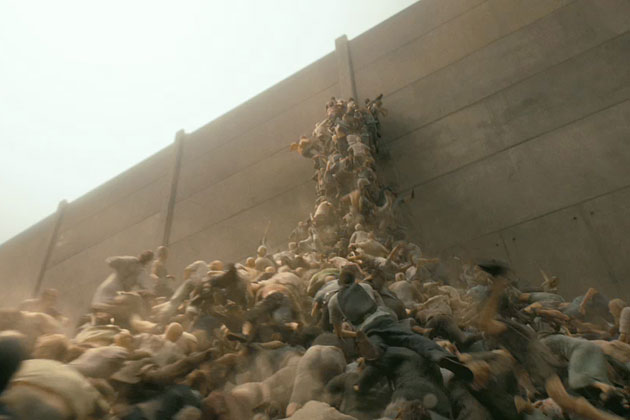
This movie is one of the first global-scale zombie outbreak films I can recall. Usually the zombie subgenre is told in confined spaces, remote locations, intimate settings. Danny Boyle had some larger London set pieces with 28 Days Later but that was still a film about dark corridors and small places. The scale of World War Z is what sets it apart. There is a degree of fascination watching the world come apart, and watching it fall apart in so many places adds to that. Gerry hops from one hotspot to the next in his quest and we watch as each new location goes to hell. It gives a greater sense to the dire threat out there. In the information age, and with Gerry’s U.N. connections, he can get global reports, and to learn that nowhere is safe helps maximize the pandemic threat and sense of urgency. I didn’t even mind Forster’s decision to present the teeming armies of the undead like there were a swarm of bees, rolling and tumbling over one another, forming formidable human pyramids. It’s a fairly spooky image and relates back to the nature-undone alchemy that makes zombies tick, plus it gives an extra sinister edge to the zombies. High-walled structures are not the sanctuaries we might have assumed. The true terror afforded by zombies, beyond the fact that the monster is us, is its inevitability; it doesn’t matter what you do, they will get you. There are more of them, and they don’t require food, water, sleep, and have only one goal. Adding to that sense of doom I think is a good move, and the raging sea of human bodies also helps Forster keep the PG-13 rating the studio dictated. I didn’t really miss the blood/gore, though one sequence where Gerry slices off a soldier’s infected arm seems a bit too clean and precise.
I criticized Forster’s skills directing action after 2008’s deeply disappointing Bond misfire, Quantum of Solace. The man showed no real feel for action sequences. Perhaps the man found a greater appeal to World War Z because there are some genuinely thrilling action and suspense sequences here and Forster deserves credit. The Israel sequence degenerates at a horrifying speed, and I loved the touch of caged passageways being erected through streets as a last-second defense from falling zombies. The initial stop in South Korea is at night and in the rain, thwarting Gerry and his team from seeing too far into the distance. It makes for a rather suspenseful sequence that makes good use of darkness and cover. The zombie actors in this movie deserve some recognition. They really get into all their clicks and clacks and add some creepy authenticity to the proceedings. Then there’s the airplane attack, zombies on a plane, that is all over the film’s advertising blitz. It’s a rather entertaining sequence, though one can’t help but provide some class subtext when the first class passengers barricade themselves while the coach passengers are torn apart. I still think Forster would be more at home with smaller dramas but he shows much more prowess for larger material.
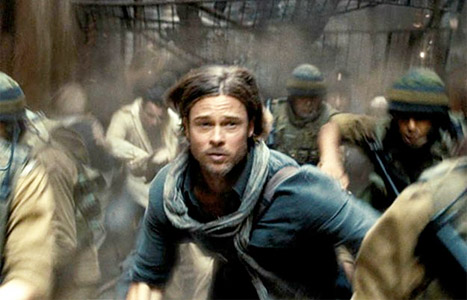 The reshot third act, thanks to added writers Damon Lindelof (TV’s Lost, Prometheus) and his pal Drew Goddard (The Cabin in the Woods), drastically scales down the scope of the pandemic. After two acts of all-out global chaos, we retreat back to the zombie film roots: a small, secluded place. The third act is almost like its own little separate movie. Partly because it’s something different, more horror/suspense than action, as well as being in the confined space, but also because Lindelof and Goddard do a fine job of structuring this concluding chapter. When Gerry gets to a World Health Organization outpost in Wales, he has a simple goal: get from one end of a lab to another. Oh, there are zombies all over the lab. Its narrative simplicity, as well as the clear focus, is a satisfying way to close out a movie that was sort of all over the place. Forster seems to really enjoy the suspense setups that he gets to have fun with in the third act, things like ducking around corners, avoiding zombie detection. The very end provides a ray of hope for humanity… until you fully think out what the consequences are for that hope (the first line of defense shall be hookers). Anyway, it sets up a sequel where mankind can begin fighting back. How do I know this? None other than Gerry’s closing lines are: “This is only the beginning. This war isn’t over.” A bit of hope on Pitt’s part as well there.
And yet with the world falling apart and Pitt our savior, I found myself from the outset very emotionally unengaged with the film. Pitt’s performance is perfectly suited for the material. It’s just the whole family man angle that doesn’t work. I understand it gives Gerry some personal stakes in doing his job but wouldn’t, I don’t know, saving the world be enough when it comes to motivation? It’s your standard reluctant hero’s tale, but the family stuff just kept dragging down Gerry’s character. To begin with, a man looking like Brad Pitt who voluntarily makes pancakes for his kids every morning… sounds like the stuff of fantasies for many. However, it almost keeps him away from his mission, the greater good, and there’s actually a sequence in South Korea where his family literally endangers Gerry’s life by making a phone call. Then the movie keeps cutting back to their existence on an aircraft carrier like I have equal interest in this storyline. One storyline involves Gerry flying the world over and escaping zombies. The other storyline involves whether Karin and the kids will be kicked off the ship. Which would you rather spend time with an as audience member? I didn’t really care about Gerry’s sad wife, played by Mireille Enos from the sad TV show The Killing. I had more invested in the Israeli soldier (Daniella Kerteesz) Gerry teams up with. My father even wanted them to run off together by the end and ditch Karin. I won’t even speak to the awkward storyline where Gerry’s family unofficially adopts a Hispanic kid after his parents die. If only those poor souls had listened to the knowledgeable white man who they took care of.
 The big-screen version of World War Z bears little resemblance to the book of the same name, and that’s okay. Some adjustments are necessary in adapting, like bringing the actions of the story into the present, centering on a major character. As a book fan, I was somewhat disappointed in the unfulfilled potential presented, but as a movie fan I’m more disappointed by the film’s overall execution. There’s a lot of money in this production, the most expensive zombie film of all time, and a lot of talent on both sides of the camera. And yet after even pulling off a mostly effective ending, World War Z is more middling than it ever should be. Brad Pitt is saving the world from zombies; that should be enough, but it’s not. The movie shows flashes of intelligence, of socio-politico commentary, of something greater, but those moments are fleeting and ground down to make way for a mass-appeal action blockbuster. There’s nothing wrong with those sorts of movies (Roland Emmerich does them exceptionally well), but World War Z doesn’t have the brain-headed flair to pull it off. It’s thrilling, in spurts, interesting, in spurts, and entertaining, in spurts, but it fails to coalesce into something truly worthwhile. My allegiance to the book, as well as zombies in general, guarantees I’ll be there for more if World War Z spawns sequels. Hopefully there will be more because there are so many great stories from the book yet to be told (namely, everything).
Nate’s Grade: B-
Share this:

Killing Them Softly (2012)
 A funny thing happened while watching Killing Them Softly, the latest film from writer/director Andrew Dominik (The Assassination of Jesse James by the Coward Robert Ford). After an hour, I noticed a couple people stand up and leave, never to return. Then another and another like permission had been communally brokered. I counted ten walkouts at my showing, which was more than I had at Cloud Atlas, a film that I can at least understand the possible exodus. But this? It also got a rare F grade from CinemaScore, joining the ranks of The Devil Inside, Wolf Creek, and The Box. Before you put that much stock in what is essentially a movie going exit poll, Alex Cross was given an A grade from audiences. But why all the venomous hate? I can only theorize that the mainstream audience feels it was sold a bill of goods, a crime thriller with one of Hollywood’s biggest stars. The audience did not want to go on the lengthy talky detours. They wanted people to get dead. Whatever the reason, Killing Them Softly has killed its audience, who choose not to go softly in their disapproval.
Set amidst the economic meltdown of 2008, Frankie (Scoot McNairy) and Frankie (Ben Mendelsohn) are two lowlife thugs hired to rob a mob-affiliated card game. The trick is that local gangster Markie (Ray Liotta) had previously paid a group of guys to rob his own card game, fleecing his own customers. In his drunken revelry, Markie admitted as such to his pals. Now the situation is ripe for exploitation. Because any future robberies will have their suspicions pinned firmly on Markie, whether he had anything to do with them or not. As a result, no one is gambling, the public has lost confidence in the markets, and the mob needs to get things back to business. Jackie (Brad Pitt) is called in to make that happen. He’s a professional killer, who prefers to kill at a distance, without all those messy emotions. He has to trace the culprits responsible and give them the reckoning they have coming.
 From a plot standpoint, Killing Them Softly is pretty thin. It’s just about the ramifications of two nitwits robbing a card game. This lack of narrative depth will rankle most filmgoers, but I didn’t mind it so much because Dominik uses the crime thriller veneer to examine the sheer ugliness of a criminal lifestyle. This is a pretty character-driven crime flick, and it has to be when there’s a malnourished plot. It takes some lengthy sidesteps, notably with James Gandolfini’s (Zero Dark Thirty) character, Mickey. He’s supposed to be a professional, but the man is a complete wreck. He’s belligerent to those in service positions (waiters, prostitutes), chronically drunk, and weirdly empathetic for his struggling wife, yet seemingly powerless to change his life’s downward slide into self-medicated self-destruction. Mickey is the ghost of Christmas Future, the vision of what this lifestyle does to people who make a living out of it, who actually live into their retirement age. The two young crooks, Frankie and Russell, are idiots yes, but even when they have money their lives are so empty. Russell is so disgusting, sweating profusely, that you can practically taste his stank. Frankie is a little more cognizant of the danger he’s in, and yet the moron doesn’t leave town after his big score. I’d think that’s the first thing you do when you rip off the mob. The day-to-day anxiety of a life of crime is just not worth the effort. You constantly have to look over your shoulder, a life dominated in paranoia, where every stranger or furtive glance could have sinister meaning. Even when you make money, you’re theoretically taking money away from someone else’s profit, and these are the kind of people that don’t take kindly to friendly competition. This is no enviable, glamorous life.
I think Killing Me Softly would be a better, easily more satisfying movie had it eschewed the attempts at extra weight and commentary. It’s no surprise that the scenes that follow a more traditional crime thriller route are the best. There’s palpable tension when Frankie and Russell are in over their heads. The conflict is prevalent and the suspense is nicely stretched out, notably during the card game robbery. Being neophytes, you don’t know what they’re liable to do but you can bet it won’t be smart. This is when the movie is most alive, most engaging, and most entertaining. When it plays it straight, and explores the sliding power plays at stake in a world of cash and guns, it can be a nasty but taut little movie. I’m just sorry that Dominik took a functional crime thriller and gave it an extra sheen of Important Things to Say (”America’s not a country. It’s a business.”). The political parallels never feel more than tacked on attempts to grope for deeper meaning. Oh I get it, I understand the comparison of mob enforcers and corrupt Wall Street execs, hoodlums and crooks in different casual wear, but that doesn’t mean the parallel is that meaningful. It’s on-the-nose and a bit in your face (really, people are watching C-SPAN in dive bars?).
 Given Domink’s last film, I expected there to be some visual flourishes, though I’m unsure of whether they added much to the proceedings. Dominik sure can make violence entrancing, setting a slow motion slaying in the rain with stirring beauty to ironic Motown music. But he can also make the violence feel brutal, like a beat down on Markie that uses choice sound effects and editing to make you feel the punches. Even the opening seconds feel like an artistic assault to the senses, the loud static of noise interrupted by bursts of Obama’s sound bytes. The extreme camera angles, the visual felicities, the ironic music selections, they all seem to underscore the movie’s subtext-as-text approach.
Pitt (Moneyball) doesn’t come into the movie for the first thirty minutes. You’re welcome to see him, especially since he has such a coolly threatening demeanor, but also because here’s a character that will mix things up. I found myself rooting for the guy, partially because he was an accomplished professional but also because I wanted there to be consequences for idiots doing dumb to powerful enemies. I enjoyed the slow-burn intensity of Pitt when he was turning the screws on the screw-up. Richard Jenkins (Cabin in the Woods) is also enjoyable as a mob shill left to communicate the wishes of his higher-ups. McNairy (Argo) gives a performance that screams desperation, as he realizes the depth of trouble he finds himself into. And even Liotta (Charlie St. Cloud) does a fine job as a lout who misjudges the friends he keeps, discovering the costs of bragging.
In many ways, I feel like Killing Them Softly is akin to last year’s Drive, a more meditative crime thriller with bursts of gruesome yet beatific violence. Likewise, many filmgoers will be sore thinking they were catching straight crime thrillers and been given arty genre ruminations instead. And like my ambivalent feelings toward Drive, I can’t work up that much enthusiasm for Killing Them Softly either. It’s certainly got more ambition than most crime flicks but I’d rather it concentrate on telling a more engaging story. Dominik’s film is a bit too indulgent for its own good, given to visual flourishes and a narrative routinely sidetracked. And yet, I found it fairly interesting at just about every turn, well-acted, and intensely suspenseful and effective at different points. But it doesn’t add up to enough to recommend. The political allegory probably rubbed the walkouts the wrong way as well. The political allegory is too obvious, too pat with its “they’re all crooks” broadside. I wish the movie had abandoned the squalid, nihilistic art house ambitions and just kept things straight. When it has less on its mind, it works best. But for many, Killing Them Softly will be too tedious to see to the bloody end.
Nate’s Grade: B-
Share this:

The Tree of Life (2011)
 If a Terrence Malick film (The New World, The Thin Red Line) is the closest thing cinema has to creating a religious experience, turning the theater into a church, then I choose to worship elsewhere. After four movies I can decisively say that I am not a Malick fan. The man is more interested in making ponderous nature documentaries attached with pretentious, whispery, obtusely poetic voice over. The man is not interested in narrative filmmaking. The Tree of Life, the inexplicable winner of the Cannes Palme d’Or, is less a movie than an impressionistic experience inside a dying man’s brain. It feels like all the synapses are sizzling, memories and fantasies bouncing around and melding. We see a 1950s childhood and a pushy father (Brad Pitt), but then we also see mom (Jessica Chastain) floating at one point, and Malick also manages to squeeze in a 15-minute sequence charting life from the Big Bang to the end of the dinosaurs. What? The Malick faithful declare their man a singular auteur, a man who uses cinema to explore the unanswerable questions of life, the universe, and everything. Terrific. However, most of these edits are only a couple seconds, and with little narrative momentum the scenes drag and drag, and every Malick minute feels like a thousand hours. Sean Penn, as the adult son, probably filmed his stuff during a pee break from another movie; it’s that short. The film is a technical marvel, the cinematography making tremendous use of different light levels, but that’s all this movie is for me — pretty pictures. It’s yet another frustrating, pompous, punishing “film,” a term I’m being generous with, from Malick. The Tree of Life moves so slowly and intractably that I wondered if literally watching grass grow would be a better use of my time. Sorry Malick disciples, I guess I am a movie secularist.
Nate’s Grade: C
Share this:

Moneyball (2011)
 Moneyball, based on the non-fiction book by journalist Michael Lewis (The Blind Side), finds a new way to reinvent the David v. Goliath tale with a man who reinvented the business model of baseball.
In 2001, the New York Yankees (team payroll: $125 million) have just knocked the Oakland As (team payroll: $41 million) out of the playoffs. Oakland General Manager Billy Beane (Brad Pitt) also has to suffer a summer where his biggest players leave the team to sign hefty free-agent contracts with bigger teams. He’s left with sizeable holes, a meager payroll, and the expectations to carry on winning. Beane is convinced that his group of paid scouts will be of no help. They’re men of an older era, sticking to the old ways of selecting talent (why the hell do these guys even calculate stuff like “good face” and “ugly girlfriend”?). Beane finds a kindred spirit in Peter Brand (Jonah Hill), a Yale grad with a degree in Economics. Brand’s mathematical data focuses on one all-important stat – on-base percentage. Without getting on base a player can’t score runs, and no runs make it hard to win a game. Brand and Beane calculate a series of players undervalued by other teams. Their more cost-efficient model for success becomes known as “moneyball.” Together they put together a team of castoffs and misfits to contend for a championship against teams that have three times the Oakland As’ payroll.
Moneyball could be described as a baseball movie for people who don’t like baseball, but that’s a little too glib by half. It’s very much a sports film but it takes the underdog approach in a new, sleekly modernized manner. It’s about a guy bucking the traditional mode of thinking, the established order, and the chaffing and nay saying of those entrenched in the traditional, outmoded, establishment. There’s always something inherently entertaining about an innovator fighting the system and eventually being proven right after all the trials and tribulations. And with Pitt, a major movie star, giving a movie star-caliber performance, self-effacingly charming with a twinkle and a swagger, Moneyball just seems to fly by like a spirited caper. We’re watching a smooth operator work the room, playing other general managers off one another and secretly accruing his talent while duping his peers. At its best moments, Moneyball feels almost like a breathless con game. The intelligent, stats-heavy dialogue doesn’t stoop for much exposition. The stats and acronyms whiz by, with Social Network-style crispness thanks to Oscar-winning screenwriters Steven Zallian and Aaron Sorkin. It’s a pleasure listening to top actors savoring the smart dialogue. You just want to kick up your heels and relax like you’re watching a game at home, rooting for your team to pull out an unlikely coup. Moneyball plays best for baseball fans who won’t bat an eye at the stat-heavy chat. For non-fans of the game, well, you can watch Pitt spit chewing tobacco into a cup a lot.
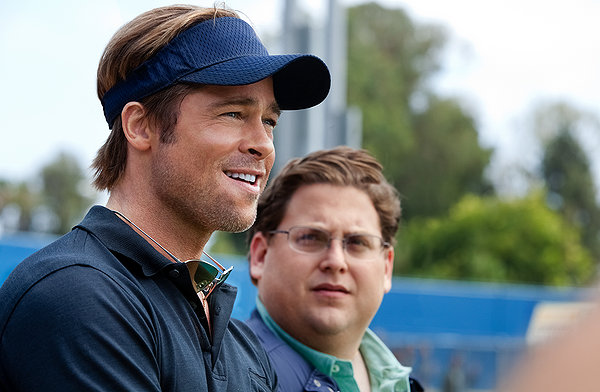 Beane chooses not to get to close to his players so that eventual roster cuts and trades will be all the easier without emotional involvement. The movie kind of follows suit. The characters are kept at a surprising distance. The movie seems practically ambivalent about people. Moneyball seems to lack an emotional center; and people thought The Social Network was cold. Beane is given flashes of back-story about his flameout in the majors, which supposedly provides the guy a motivation to prove himself against his legion of detractors. But these flashes are not enough. Director Bennet Miller (his first film since 2005’s Capote) incorporates way too many scenes where we watch Beane driving, silently contemplating his life-changes. The feud between Beane and his curmudgeon manager, Art Howe (Phillip Seymour Hoffman with the unkindest of haircuts), never comes to a head. Howe is upset at the thankless job of corralling a team of misfits and cast-offs into a competitive team. But like many other conflicts, the movie ducks from finding a real purpose for its integration. Howe just seems to be another naysayer who shakes his head at Billy. Surely the relationship between GM and manager should be more complicated than as presented. The Beane family flashbacks and his scenes with his daughter (the adorable Kerris Dorsey) are attempts to further humanize a man who has abandoned the advice of people for spreadsheets.
It’s easy to get caught up in the romanticism of the nation’s oldest sporting games, but Moneyball’s tone seems to toggle between reality and romanticism. For Beane, there are no small victories. Even success is deemed failure under the metrics of championship-or-nothing. “People only remember your last out,” he says despondently. So when the Oakland As fail to make a run into the playoffs (is a 2002 playoff series considered a spoiler?) the movie is left with a listless conclusion. Brand tries to prove to his boss the significance of what they have accomplished on their meager payroll, at one point winning a record 20 games in a row. But a winning streak of 20 games is not the same as a championship. Moneyball rightly proclaims the game of baseball as a rigged sport, where the divide between “haves” and “have nots” is vast. It is the only major league sport without a salary cap. The teams with the big pockets can afford the marquee talent. There’s a reason Lewis’ book has the subtitle “The Art of Winning and Unfair Game.” The implications of Beane’s accomplishments are unclear. His cost-efficient, stat-heavy approach was co-opted by the Boston Red Sox and turned into championships in 2004 and 2007. Is that a real vindication for Beane? It seems to me that the game’s issue of wealth disparity is still in full effect. Even if teams follow Bean’s approach, it still means that the bigger city, wealthier teams like the Red Sox or the Yankees can still outspend their competition. So it seems like to me that Bean’s moneyball approach simply meant that the focus changed on less costly talent. It did nothing to alter who could outbid their peers for the now-cheaper talent. It’s hard to squeeze a happy ending out of a story that concludes with the rich getting richer.
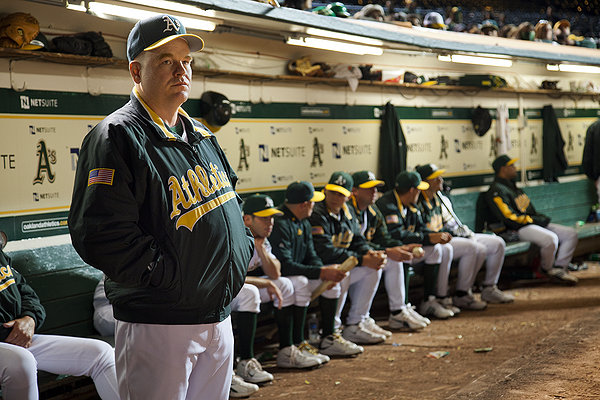 The movie is pretty much a buddy comedy, granted Beane is a much more dominate personality. Pitt feels like he’s coasting on charisma, though the actor gives a greatly entertaining performance. It’s not so much nuanced but he’s enjoying himself. The man looks eerily to be aging into Robert Redford, which begs the question about the nature of time travel. Hill (Superbad, Get Him to the Greek) gives a surprisingly adept dramatic performance. The comedic actor seems subdued next to the charisma of Pitt, like the character is continually awed by Billy. The Oscar-talk for the comedian seems a tad premature. He’s good but just because Hill delivers a good dramatic performance does not mean people should automatically start fielding his name as an award contender. That’s like saying let’s give an award to Paris Hilton because she could remember her lines. It’s also fun watching actors like Chris Pratt (TV’s Parks and Recreation) portray players that are still recognizable.
Moneyball says that baseball is not a game about heart, sweat, or the love of the game. It’s about numbers. That’s something of a cold message but Billy Beane is not one for false comforts. At its best, the film is a breezy caper with crisp dialogue and slick editing, but it’s also hamstrung by an inconsistent tone, a methodical pacing (133 minutes!), and a dearth of strong characterization. Beane was destined to be a baseball star but it wasn’t to be. Baseball is the most mental of all national sports, and it’s hard to crack such an insular model of play. That’s why baseball movies resort so much to romantic staples about the lore of this game. This is not a romantic movie; it toys with romanticism but ultimately sides with the science and number crunching. The emotion seems to have been squeezed out of the story thanks to the statistics. Moneyball is a baseball movie that fantasy baseball nerds have been waiting for. I’m not particularly a baseball fan (too slow), but I still found the movie to be a rewarding night out sans crackerjacks.
Nate’s Grade: B+
Share this:

Megamind (2010)
Y ou’ve seen this movie before, and pretty recently too given in the influx of superhero tales in the last decade. Megamind recycles heavily from numerous other super forbears, and yet this animated tale about a tired hero (voiced by Brad Pitt) and his inept nemesis (Will Ferrell). While it’s never as funny as its premise and cast should make it, the movie does pack a lot of fun and even a little bit of heart. The action sequences are inventive enough and the movie has a tone that drifts from sincere to self-conscious satire, while never settling down but doing enough right not to inflame your sense of irritation. The concepts of identity, good and evil, the duality of man, striking a life for your own… they’re all here. It’s a sloppy message that feels copied out of a plot playbook. Ferrell is funny but a bit more restrained than I like him. I think he works best when he cranks up his absurdist tendencies with a jolt of enthusiasm. Megamind doesn’t come close to approaching the magic, thrills, and emotions of How to Train Your Dragon, but it’s still many ways better than stuff like Monsters vs. Aliens and Shark Tale. It’s overly familiar story given a super spit shine.
Nate’s Grade: B
Share this:

Inglourious Basterds (2009)
 Quentin Tarantino has always been an artist that thumbs his nose at convention. Just as critics accused his last film, Death Proof, as wallowing in exploitation muck, here comes Inglourious Basterds, very loosely based on the correctly spelled 1978 Italian movie. War movies seem like a natural fit for the QT mold with their staunch violence, tough guy bravado, and vengeance-filled storylines. Tarantino has been working on the script for this film for over ten years, taking a break to produce the Kill Bill features. The finished product is a bloody alternative history wish-fulfillment fantasy with little conscience. This isn’t any sentimental, well-meaning, reflective war movie. This is war Tarantino-style and a celebration of war movies in general. Cinema becomes the weapon we win the war with.
In 1944, Lt. Aldo Raine (Brad Pitt) is given a unique mission. He is to assemble and lead a crew of Jewish-American soldiers for one purpose — to kill Nazis. They will be dropped into German-occupied France and will use guerilla tactics to dismember Nazis and strike fear into the higher ranks. Aldo personally assigns each soldier with the task of collecting 100 Nazi scalps. “And I want my scalps,” he commands. The “basterds,” as they’re called, face steep opposition. S.S. Colonel Hans Landa (Christoph Waltz) has earned the nickname “Jew hunter” for his terrifying precision at sniffing out Jews hiding along the French countryside. In the film?s terrific opening sequence, he systematically interrogates a French farmer into giving up the Jews he is hiding. Shoshanna (Melanie Laurent) is a Jewish teenager who manages to miraculously escape this bloodbath.
Years later, she owns and operates a movie theater in Paris. The German high command wants to screen their newest propaganda masterpiece, Nation’s Pride about the exploits of sniper Fredrick Zoller (Daniel Brühl), in Shoshanna’s theater. Finally she can plot her vengeance, except that Landa will be providing security for the special screening. Meanwhile, Aldo and the basterds scheme to meet up with German actress Bridget von Hammersmark (Diane Kruger), who is secretly working with the British as a spy for Operation Kino. The top-secret mission involves attending the movie premier at Shoshanna’s theater and then killing all the high-ranking brass in attendance, thus ending the war.
 Those looking for a rip-roaring good time of watching Pitt prance through the countryside dispatching evil Nazis will be disappointed to learn that Inglourious Basterds is, after all, a Tarantino movie. That means there is talking. Lots of talking, but it’s great, glourious talking with deep undercurrents of menace. The movie boils down to about six set pieces and most of that time involves long, drawn out conversations where the tension percolates underneath the surface. The characters play a cat-and-mouse game of deception, and the conversation transforms into a slow fuse waiting to go off. The characters engage in an “I know, and you know I know” bout of play acting, going about their business as if all is calm, when each is waiting for the next move. Tarantino turns dialogue scenes into slow-burning combat, and eventually those lit fuses do finally go off and the scene will erupt in a great splash of violence. Then we are left to assess the situation and collect our bearings, much like the characters if they are fortunate enough to be alive. This is a talky war movie, and Tarantino does fall in love with his dialogue rhythms and allow his characters to overindulge and circle the same plot points more than is needed, like the sequence with von Hammersmark in the bar, but the naysayers looking for an action romp that complain nothing goes on are missing the point. A tremendous amount is going on, you just have to look beneath the surface, lie in wait, and luxuriate in the simmering tension that Tarantino plays like a pro.
Tarantino has an encyclopedic knowledge of film that allows him to blend and deconstruct genres, and Inglourious Basterds feels like an homage not to World War II but war movies in general, with a dash of spaghetti westerns. When the French farmer watches Landa drive up to his home, linked with the great Enrico Morricone’s score, you definitely feel like you’re in a western transported into mid-twentieth century Europe. The conversations feel like high-noon showdowns. Tarantino’s direction feels less stylized and idiosyncratic this time. He still plays around with time and back-story, even recruiting Samuel L. Jackson to be a God-like narrator, but Ingloruious Basterds is mostly a literal and linear pop deconstruction of war movies. When Tarantino deviates sharply from the known historical timeline, it feels within reason given the cracked mirror world he?s created. Tarantino can turn World War II into a campy Warner Brothers cartoon, replete with goofy over-the-top caricatures of Hitler and Goebbles. He can also takes digressions and hard right turns with his story, allowing characters to chew over the finer intricacies of German silent cinema. It’s bloody, messy, but boy is it entertaining as hell.
 Any conversation over Inglourious Basterds is inevitably going to gravitate to its fascinating central villain, Hans Landa. German actor Waltz plays the infamous “Jew Hunter” and he is astounding to watch; he enlivens every moment onscreen and won a Best Actor award at the Cannes Film Festival. Landa is an extremely intelligent and polite inquisitor. He comes across almost like a diabolical S.S. version of Colombo: he’s three steps ahead, feigns ignorance, circles his prey, and finally strikes after mentally tearing down the suspect. Waltz is practically giddy in some sequences, enthusiastic for such sick endeavors. He likes to screw with people and make them nervous. And yet, thanks to the wily brilliance and magnetism of Waltz, you develop a perverse appreciation for the man. Despite the horrors he is responsible for, you may actually find yourself liking Landa. He has moments of great cunning, like his deliberate reasons for switching to English with the French farmer or his off-the-cuff destruction of von Hammersmark’s alibi. When he suddenly and fluently launches into his fourth language, it is one of the film’s finest “oh crap” moments. This is a truly memorable character that dominates every scene, and Waltz gives an astounding star-making performance destined to be remembered when it comes time to draw Oscar nominees.
The rest of the actors do well but no one approaches the planet that Waltz resides on. Pitt seems to knowingly be shooting for parody with his performance. His accent is twangy and coats every word in a honeyed glaze; you almost expect him to wink at the camera after each line. He’s still amusing to behold in the rather few instances that Aldo graces the movie. Laurent (The Beat That My Heart Skipped) and Kruger (National Treasure) both have intriguing albeit underwritten roles, and both actresses give the best performances in the film after Waltz. Eli Roth (writer/director of Cabin Fever, one of my favorite movie indulgences) looks the part as the commanding “Bear Jew” with his lean physique and Louisville slugger, but I couldn’t tell what he was doing with his accent. Is he supposed to be from New York or Boston? In war movies, there was usually a colorful collection of characters but Inglourious Basterds doesn’t really do much to accentuate its second tier players. The only basterd that leaves an impression is Til Schweiger (Driven, Far Cry), all humorless resolve and flinty stares. And what happened to the basterds in the final act? Where did everybody go? Yes, that really is Mike Myers doing one of his Austin Powers-esque British impressions.
 What is truly surprising is that Basterds unflinchingly looks at all the ugly aspects of war. The movie doesn’t neatly categorize the villains and the heroes. Zoller is a German sniper that killed 300 Allied troops and yet he is portrayed as grounded and romantic, a film lover able to chip away at Shoshanna?s steely reserve. To the basterds, they refuse to see past the uniform and armband; there is no difference between a Nazi and a German soldier. They will mutilate both on principal. Tarantino also gives time to examining the collateral damage of war, watching innocents gunned down in the name of duty. Shoshanna’s plot for vengeance involves the horrific deaths of scads of people whose only sin may have been being German in Paris. Operation Kino is described by Landa as a “terrorist plot” and isn’t it, really? But then Aldo disputes that a “Nazi ain’t got no humanity” and that collaborators and bystanders are just as culpable. Aldo and his basterds march through France committing what could sensibly be described as war crimes, and these are the good guys! Even with all the camp and stylized violence, there may be moments where you want to cringe and ask yourself, “Am I supposed to be enjoying this??
There are those that bemoan that Tarantino is wasting away his remarkable talents on such low-rent enterprises. He is too caught up in genre filmmaking, they claim. He needs to go back to his earlier audacious works, like Reservoir Dogs and Pulp Fiction, films of startling intelligence and playfulness. He needs to stop making collages of movies and go back to making real movies, they cry. Ingloruious Basterds will not please these critics. This is a verbose deconstruction of war movies that runs over 150 minutes and mostly involves characters seated and chatting. It will clearly not be for everyone, especially those sold into thinking Basterds was going to be a more graphic version of The Dirty Dozen. This movie is more Cinema Paradiso than The Dirty Dozen. If Tarantino wants to keep making high-gloss genre goofs, that’s fine with me as long as the end results are as creative and entertaining as this movie. Who else is going to make a World War II fantasy with excellent use of David Bowie’s song “Cat People”? No one makes movies like Tarantino. I rest my case.
Nate’s Grade: A
Share this:

The Curious Case of Benjamin Button (2008)
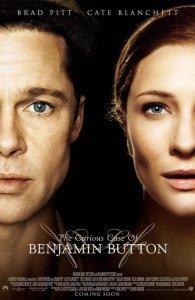 This lavish and long-winded spectacle is curious, all right. Director David Fincher (Se7en, Zodiac) has all the technical wizards at his disposal to produce a near three-hour fantasy about life, love, and death. The Curious Case of Benjamin Button works around the bizarre gimmick of a man going through the process of aging backwards. It’s loosely based on F. Scott Fitzgerald’s short story, adapted by Eric Roth (Forrest Gump), and the results are befuddling. Benjamin is a handsomely mounted and incredibly expensive work engineered for one purpose: to win Oscars. Benjamin Button is a film that strives for making grand statements and wringing a maximum amount of tears, but it’s also a film that lives more in a series of moments than as a cohesive whole. It’s a fine piece of work but feels overburdened by its urgent desire to be profound.
Benjamin Button (Brad Pitt) is born on the day the first World War ended in 1918. He is born as a small infant that better resembles an 80-year-old man (in Fitzgerald’s short story he is born as a full grown old man, which means it must have been fun for his mother). Benjamin is aging backwards but his mind is still as it should be, so while he is all wrinkly, arthritic, and covered in liver spots, Benjamin is like other small kids who want to make friends. Benjamin’s father (Jason Flemyng) is horrified by his son’s condition and abandons him at the steps of a nursing center. Queenie (Taraji P. Henson) raises Benjamin as her own child and he grows up (down?) surrounded by a colorful cast of elderly residents (one woman remarks that a young-old Benjamin looks just like her ex husband). It is here that Benjamin meets the love of his life, Daisy (played by Cate Blanchett in her older years). She’s enchanted by Benjamin’s condition but she has her youth to live and Benjamin is left behind. Daisy becomes a trained ballerina and tours the world. Benjamin goes on a series of escapades, like working on a tugboat, traveling to Russia and having an affair with a diplomat’s wife (Tilda Swinton), and discovering his biological father and the family business of buttons. But he’s always been waiting for Daisy, and eventually they “meet in the middle.”
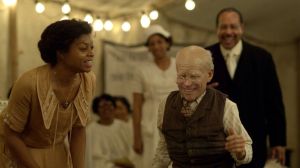 The very nature of the premise means that the movie isn’t going to have many pure, joyful moments. The idea of a romance that needs to take 40 years to connect, and even then has a limited shelf life before they go in their separate aging directions, is beautiful and heartbreaking. Waiting decades for a glimmer of your happiness with your mate, that’s a hard pill to swallow. Benjamin Button explores a similar situation covered by vampire-immortal romances, where you must endure watching your precious loved ones grow old and die. The entire movie radiates with an overwhelming sense of melancholy. The movie manages to find humor and grace amidst its melancholic dirge. The reflections on mortality are ever-present though rarely profound. It may not say anything new or original but it has many things to say about life, death, and the fleeting moments in between. By that notion, the film is structured so that the beginning, where Benjamin is a young old man, it’s more comic and beguiling, then as he and Daisy match up we finally get the pairing we’ve been pining for from the start. The pent-up passion provides great conflict, and then we barely get to enjoy the coupling before reality strikes. The final twenty minutes of the film, where old Daisy cares for old young Benjamin, are incredibly moving and have an indelible symmetry to them, watching an old lady lead a child by the hand.
 So then why do I feel so hesitant about fully accepting this movie? The story follows a similar Gump like pattern of incidents but the movie refrains from being mawkish. The main character is mostly passive with little personality; he’s nice but take away his unusual condition and not many folks would remember their time with Mr. Button. Before he gets with Daisy the film feels a bit episodic with the chapters of Benjamin’s life, and they are entertaining asides but they fail to amount to much more. Benjamin Button feels like something important is absent; it’s not cold as others have claimed but it feels, perhaps, remote, stopping just shy from being a full emotional investment by keeping the audience at a somewhat objective distance. This may be Fincher’s own design because Fincher ensures that a film about living life to the fullest doesn’t degenerate into sentimental claptrap. The end hits hard but not as hard as it could if I was more invested in Benjamin as a character. The Hurricane Katrina framing device seems tacked on, but then again the story mostly takes place in New Orleans and Katrina is rather noteworthy, you could say. The “elderly lady recalls her life story” is reminiscent of Titanic, and might not even be necessary though it offers Daisy the ability to look back over her years with added insight. The layers of realistic makeup piled onto Blanchett are impressive, though I worry what would happen if the actress had to go to the bathroom.
Technically, the movie is nearly flawless. The visual effects are astounding, seamlessly allowing Pitt to play the role even as a young child. The Curious Case of Benjamin Button is a glorious experience to watch but a mildly curious experience to register. The film is so meticulously crafted and it has all the right components of a tragic romance for the ages, but it somehow misses the mark. It’s an entertaining and moving film but it leaves something to be desired. The most resonant moments are also the ones that are the simplest, the ones that lack the window dressing of expensive special effects. I appreciated the film’s expressions of symmetry, but I have the nagging feeling that Benjamin Button both tries too hard and perplexingly doesn’t try hard enough. It keeps audience involvement at a distance, wishing to comment on humanity without embracing humanity. It is difficult for me to articulate what is lacking, because it is an enjoyable if overly long movie, but it falls into the “almost” category of poignant filmmaking. It’s almost a challenging movie, it’s almost an affecting movie, it’s almost a movie worth falling in love with. The film’s story and sensitivity and scope cannot match the technical audaciousness.
Nate’s Grade: B
Share this:

Burn After Reading (2008)
 The Coen brothers tend to follow serious works with silly, and now that they have a heap of Oscars from 2007’s No Country for Old Men audiences can expect extreme silliness. Burn After Reading is a farce in the best sense of the word; it’s a send-up of the spy thriller where morons inhabit every role. The incompetent characters repeatedly act impulsive and the whole movie’s tone is cranked to outlandish heights. The score by Carter Burwell is like a continuous thundercloud that underscores the ridiculous and faux ominous atmosphere. The Coens have been accused of ridiculing their characters and being too detached and clinical as screenwriters. I do not believe this for a moment. Anyone who watches Burn After Reading can tell that the Coens love their characters, especially Brad Pitt’s ebullient personal trainer. Pitt is a comic joy and brings fresh life to his fun character, a highly cheerful doofus who can’t stay still. Even the funky way Pitt walks is worth a giggle. Burn After Reading takes some surprising twists and turns and could have been much longer than 96 total minutes. The Coens go to such terrific lengths establishing great oddball characters and great comedic scenarios, and then the whole movie just comes to a close when it feels like it’s hitting another gear. Still, Burn After Reading may be no masterpiece but its yet another unconventional and mostly entertaining comedy from the reliably quirky Coen brothers.
Nate’s Grade: B+


 nathanzoebl
You must be logged in to post a comment.