Blog Archives
The Black Phone 2 (2025)
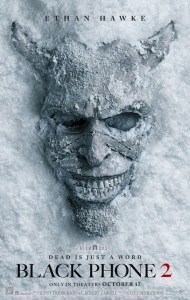
The original 2022 Black Phone was a relatively entertaining contained thriller where a kid was relying upon the ghosts of victims to escape the clutches of an evil kidnapper. It had other elements to fill it out as a movie, like a psychic sister, but the central conceit and execution worked well, especially a disturbing performance by Ethan Hawke as The Grabber, the aforementioned grabber and locker-away-er of unfortunate children. Then it was popular enough to demand a sequel, but where do you go when the villain has been killed and the source material, a short story by Joe Hill, has been exhausted? The answer is to turn the very-human Grabber into a Freddy Krueger-style supernatural predator terrorizing our survivors in their dreams. The kids from the first film are now teenagers and really the psychic sis is the main character. She’s the one most affected by the Grabber’s supernatural vengeance. Most of the movie is watching the sister get tossed around invisibly in the real world and talking to irritable ghost kids. There’s a mystery about uncovering the truth about what happened to their deceased mother, who too could have a personal connection to the Grabber from a Christian summer camp located in the far mountains. The snowy locale makes for a visually distinctive setting, though once you see the Grabber ghost ice skating it does take a little of the mystique away from the overall menace. The Black Phone 2 just didn’t work for me, feeling like another “let’s help these dead kids be at peace” adventure like a weekly TV series, but the scenario just didn’t have the draw and satisfaction of the original. I suppose the returning filmmakers wanted to expand their universe and its mythology, Dream Children-style, but the material doesn’t seem there to build a franchise foundation. The first film was simple and complete (makes me think of a variation on a line at the end of Bioshock Infinite: “There’s always a Grabber. There’s always a black phone. There’s always a ghost”). The sequel cannot compensate for that, and so it feels overstretched, underdeveloped, and goofy. At least they tried something different than just a straight replica of the original but it would have been best to leave the Grabber and us at rest.
Nate’s Grade: C
Share this:

Night Swim (2024)
 It feels like the genesis of Night Swim was somebody saying, “We need a new way to do a haunted house movie so… what if…?” and then just pointed to different parts of the home and questioned whether it could be haunted. What I’m saying is we were probably a coin flip away from a terrifying tale of a haunted barbecue grill (working title: Dead Meat). A haunted pool would naturally lead to the question, “Well, why don’t you stay out of the pool?” and, well, we don’t really have an answer, so the pool can’t do too much because it’s immobile. There’s a possibility here with some spirit linked to the pool water seeking sacrifices and offering rewards in return, but this is downplayed so much and eventually forgotten during the muddied reasoning that concludes this confusing movie. I don’t think the film can even stick to its own rules. It needs to be either goofier, fully embracing its ridiculous premise of a haunted swimming pool, or going even darker and deeper with its back-story and rules and how this corrupts the new family, not because of some evil possession but from the simple wish-granting opportunity of feeding this monster for personal gain. There’s a way to make this concept work, specifically bringing the revelation earlier and dealing with the devil’s bargain implications and moral relativism. Alas, instead we get a movie about a husband being possessed by evil spring spirits and literally playing a game of Marco Polo with his children and, upon stalking them, pounces by ominously shouting, “You’re supposed to say ‘Polo’!” Just keep swimming, folks.
Nate’s Grade: C
Share this:

Five Nights at Freddy’s (2023)
 I’ve learned so much more about pre-teen horror video games in the years since I’ve become a parent. There is no shortage of horror-themed games, many of them available through Roblox, that act as gradual entry points for burgeoning new horror fans that might not be emotionally ready for more intense horror (for my money, the creepy smiley creatures with dozens of teeth are more frightening than Michael Myers on any day). This brings me to the Five Nights at Freddy’s movie based on the insanely popular video game series that essentially said, “What if Chuck E. Cheese was, like, evil?” The game involved shifting between security cameras to keep watch on some frisky animatronics that have a hard time staying put, and of course jump scares and bloodless deaths. It’s a game about alternating camera feeds and waiting, and so the big screen version is also a movie very much about waiting for the creatures to stir. That’s probably why a quarter of the feature is watching Josh Hutcherson (The Hunger Games) travel into a dream-space to try and communicate with mysterious children to figure out what must be some of the more obvious plot revelations that he just can’t seem to grasp about this sleepy town and its history of missing kids. Why are we spending this much time on the human character’s back-story when we have killer robots to maim dumb teenagers? There are more scenes with the ghost kids than the animatronics of fame. The protagonist’s motivation seems wishy-washy since he’s putting his life on the line to keep his little sister and then makes an ill-advised bargain with the robots to get rid of her because… we need a moment for him to realize what really matters most? Huh? The scenes of horror rely much more on impressions, favoring shadows and implied violence than featuring anything too overt. I found the revelation of the ultimate villain to be laughable, no matter if it matches up with whatever the convoluted lore is for a game that, again, is flipping through TV channels and trying not to get eaten. There just isn’t a whole lot going on here, and the human drama of Hutcherson trying to win custody of his little sister feels a bit too dramatic and real for something this silly. He can’t get any other job than guarding an abandoned pizza parlor? Why does anyone just not enter the restaurant? He keeps returning to the job even after he realizes the danger. Unless you’re a diehard fan thrilled to just see live-action versions of your favorite furry friends, Five Nights at Freddy’s fees like four nights too many.
Nate’s Grade: C
Share this:

M3GAN (2023)
 It’s early January, typically a dumping ground for the unwanted leftovers of Hollywood studios, but an unexpected meme queen has emerged in the form of M3GAN. The latest hit from Blumhouse is styled as a horror-comedy and from the same writer as 2021’s Malignant, which was a delightfully gonzo horror movie that only got more absurdly entertaining the crazier it went. My hopes for M3GAN were confirmed early as I laughed within seconds of the movie. There isn’t much in the way of genuine scares as a PG-13 chiller, so M3GAN leans into the knowingly awkward camp comedy. An advanced robot is given to an orphan to test-drive and the little robot forms a strong attachment that cannot be broken even by bloodshed. It’s a crazy killer doll movie combined with a crazy killer robot movie as well as a corporate satire. When the little robot literally bursts out into song to help cheer up her human counterpart, there’s nothing to do but laugh and acknowledge this is what the filmmakers wanted in response. It’s a fun movie that doesn’t overstay its welcome but needed a little more crazy or a little more biting satire to really satisfy. I was hoping for a more Malignant-style escalation of crazy and was left wanting. Still, it’s a goofy horror comedy that just wants to have fun with the uncanny valley of your expectations.
Nate’s Grade: B
Share this:

Nope (2022)
 Within two movies, and most likely just with his first in 2017, Jordan Peele catapulted himself as a brand name in the world of horror. At this point, you’ll see a Peele horror movie sight unseen because you know what you’re getting is going to be a unique experience. There are plenty of modern horror directors that have built a rabid fandom, like Ari Aster or James Wan, but nobody seems to be given the same platform as Peele has earned at this juncture. The writer/director has become what M. Night Shyamalan used to exhibit, the director whose creative visions were each highly anticipated event movies. Nope is Peele’s first foray into science fiction territory and the results are messy, disturbing, and, at points, astounding.
The Haywood family ranch has been involved in the motion picture industry since its very beginning. One of the first film images, a black man astride a horse, was the great-great-great grandfather of Emerald (Keke Palmer) and Otis Jr. (Daniel Kaluuya). The brother and sister are trying to save the family ranch after the untimely and strange passing of their father (Keith David) who was felled by debris falling from the sky. Their neighbor, Ricky “Jupe” Park (Steven Yeun), is spinning his notoriety as a child actor into a Western theme park attraction. Ricky’s claim to fame was being one of two survivors of a 1990s sitcom where the trained chimpanzee, who in the context of the show was his adopted sibling, snapped and went on a killing spree. Emerald and Otis Jr. begin to suspect that there is a real unidentified flying object hanging over their land, so they set out to capture living proof and become rich and famous. The alien, hiding in an unmoving cloud over the course of six months, has other plans and intends to assert its claim on the Haywood territory.
 Peele is proving himself more and more as a major director of genre spectacle and vision. Each of his three directorial efforts will hit people differently; I think they’ve incrementally gotten a little sloppier in the writing department, but Peele is only growing stronger as a visual stylist and orchestrator of big screen spookery. There is a grandeur to the visual arrangements, owing as much to the expansive language of Westerns and the awe of early Steven Spielberg. I wish I had seen the movie in IMAX as Peele intended, since he went to all the trouble of planning specific sequences for the grand IMAX cameras. There are several moments that are jaw-dropping and stirring in horror and wonder. A literal rain of blood and viscera and expelled non-organic items is a striking image. Even the unnatural way that helpless people are thrown off the ground can be jolting and primal. There’s a claustrophobic interior sequence of desperate people that really conveys the terror of the doomed. A big addition to the eerie atmosphere is the brilliant sound design. The otherworldly-ness of the alien encounters is heightened by a really in-depth sound design that can make the hairs on the back of your neck stand at attention. Even the sound of rain, and its distance, can be an indicator of the proximity of danger. There are also the distant sounds of horrible screams circling through the clouds high above, and it’s a deeply unsettling design trick that works every time. Even when the movie wasn’t quite as engaging from a narrative or thematic standpoint, Nope is always engaging on a simple delivery system of spectacle. The way Peele distributes his visual clues and keys, sometimes literally, always provides something for an audience to anticipate.
I was also starting to grow impatient from Peele’s coy narrative games. The plot moves in frustrating starts and stops, teasing an intriguing development or proffering a question and then skipping backwards, denying the viewer a sense of gathering momentum. There’s a toying sense of teasing out how far he can go before an audience gets too impatient and quits. Much of the first half also takes place during night or sequences of sustained darkness, which can definitely play into the the fear of what could be in those shadows, but it makes for a fitfully frustrating experience when you’re trying to unravel a science fiction mystery. I kept wondering how all these pieces were going to come together, especially the ongoing subplot about this killer chimpanzee, but I had faith in Peele (mostly). That faith was rewarded but I’ll admit for the first hour I was wondering if Peele was too evasive for his own good.
 Nope begins as Close Encounters of the Third Kind and then transitions into Jaws and stays there, and it was during the second half that my interest magnified exponentially. It’s around the hour mark that the movie finally puts all its cards on the table and declares what it is and what the remaining movie is going to be about. All the stutter steps and vagaries are cast aside, and the movie finally shifts into its grand entertainment of a group of humans learning about an overwhelming and unusual threat and plotting their unorthodox plan of attack. I’ll still try and play around spoilers without getting too deep into specifics. It’s a great relief when Peele no longer has to tease his threads and mysteries and can at last be open and let the conflicting components come together. The annoyances I felt in the first half melted away, and I was satisfied as the movie picked up a genuine momentum and smartly tied in many prior plot elements for the bigger picture, like the inflatable tube men, old timey picture-taking souvenir machines, and even the very vague almost carwash-esque imagery from the opening credits. The second half of the movie is more fun because it’s a big hunt and it allows our characters to make use of what they have learned to form conclusions and strategic moves and adjustments. It’s characters making smart decisions. It’s a scenario that finally allows Peele to finally play with all the setups he’s spent an hour cheekily hiding around.
While the climax is great, and the movie gets consistently better, I don’t feel like all of its many thematic ties come together. Being a Jordan Peele horror movie, we’re now expecting there to be extra layers of social-political commentary and allegories. The back-story for Ricky as a child actor is given a lot of attention and screen time for a two-hour movie, and I don’t know if what it adds up to is equal to the time it was given. Thematically, you can make some speculative reaching about the exploitation of animals for spectacle, about underestimating and not respecting nature, and even setting up for later tragedy, but it all seems less meaningfully integrated than any other Peele movies’ elevated subplots. With the Ricky back-story, there is even a literal anticipation of a literal shoe to drop, which seems so obvious as a visual metaphor but I cannot link it directly with what follows. I can keep digging and find connections but it requires far more effort than Peele’s other works of horror. The family history of working for Hollywood as horse wranglers feels underdeveloped. There are also rules that it establishes that Peele isn’t fully consistent (just don’t look?) that left me questioning. I figured that colonialism would be an obvious parallel with invading aliens (H.G. Welles even made use of the analogy 120 years ago), but maybe that was too obvious territory for someone like Peele. My friend Ben had a crazy early theory that the aliens themselves would resemble horses and thus they were returning to free their equine brothers and sisters from human exploitation. I guess I’ll go ahead and spoil you, dear reader, that this does not happen in any shape with Nope.
 I’d rank Nope the third best Jordan Peele horror venture, and while it clearly makes use of science fiction concepts and its rich iconography, it’s still very firmly a movie rooted in horror, the horror of the unknown, the horror of being small and helpless, the horror of being left behind. Not all of Nope’s many ambitions quite land, and the themes feel a bit more jumbled or underdeveloped, but I want Jordan Peele to continue making the movies he wants on his terms. Not every one is going to hit exactly the same for me, or for any viewer, but we’re all better when unique artists like Peele are given the latitude and support to bring their personal visions to the big screen. As long as he’s still achieving a baseline of quality, something that befell the middle Shyamalan period, then I say swing away and let’s see where you’ll take us all next, Jordan Peele.
Nate’s Grade: B
Share this:

The Black Phone (2022)
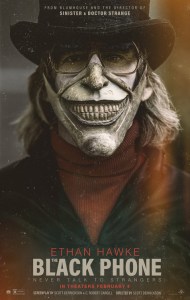 This is the movie that director Scott Derrickson made after departing Marvel over “creative differences” with the Doctor Strange sequel, differences I feel like I can agree with. Based upon Joe Hill’s short story, The Black Phone is a return to Derrickson’s horror roots, along with regular screenwriting collaborator C. Robert Cargill, and you can feel the director’s reflexes resetting. It’s like three movies in one, not all of them needed or entirely coherent. It’s about generational trauma and abuse, a survival thriller about escaping a psychotic serial killer, and a little kid trying to hone her nascent psychic powers. The stuff with Ethan Hawke as “The Grabber,” a kidnapper of children who imprisons them in a locked basement dwelling with a broken black phone attached to the wall, is great, and Hawke is fascinating and unsettling. Each mask he wears seems to come with a slightly different persona attached, so with each appearance we get another sliver of who this disturbed man may have been. The story of survival is made even more intriguing when our protagonist, young Finney (Mason Thames), learns that the past victims can communicate with him through the mysterious black phone. The scene-to-scene learning and plotting is fun and efficient and requires Finney to be a little bit of a detective, exploring his dank surroundings and the failed escape attempts of the other kids to utilize for his own hopeful plan. The ghost kids also have limited memory of their experiences, which is smart so that he isn’t given a clear advantage without limitations. The parts that drag are where Finney’s little sister tries to convince the skeptical police officials that her dreams are real and can help find her missing brother. There is one hilarious moment where she prays to Jesus for guidance and then profanely expresses her disappointment, but otherwise it feels like a Stephen King stereotype leftover (Hill is his son; apple meet tree) that doesn’t amount to much besides padding the running time. It doesn’t even lead to big breakthroughs for Finney to be rescued. As a small-scale creepy contained thriller, The Black Phone is an engaging survival story with a supernatural twist that works as well as it does. It doesn’t have much more depth or meaningful characterization, it’s really just about a kid using the power of neighborhood ghosts to escape a crazy man, and that’s enough at least for a passably entertaining 100 minutes.
Nate’s Grade: B
Share this:

Firestarter (2022)
 I have never seen the 1984 original movie starring Drew Barrymore but I have to assume it’s got to be better than the 2022 Blumhouse remake. Stephen King adaptations have a very wide range in quality, and from other reports Firestarter is one of King’s most straightforward novels. The most interesting aspect of this movie is that the score is provided by legendary horror director John Carpenter, as well as Cody Carpenter and Daniel A. Davies, and Carpenter was going to be the director of the 1984 Firestarter before the studio replaced him after the poor box-office performance of 1982’s The Thing, widely regarded now as a classic of its genre. Otherwise this is a pretty generic chase movie where people with superpowers are trying to stay hidden from evil government agencies looking to capture them and use them as weapons. I was reminded of that X-Men TV series The Gifted that lasted one season in 2017 for much of the movie. The dialogue is quite bad, including one climactic line that had me howling: “Liar, liar, pants on fire,” and she doesn’t even set the person’s pants on fire. The parenting miscues for Zac Efron’s psychic dad character are manifest, and it’s still strange to see the High School Musical star enter the dad part of his career. Efron’s character and his onscreen wife bicker about how best to protect and support their powerful little daughter who could go nuclear and has, in anger, set her mom on fire. Apparently, ignoring a problem isn’t the best solution. Regardless, the father-daughter moments are weakly written and you won’t care about any characters. There’s also a really extended and disturbing sequence of an animal in misery after being burned by out little firestarter, so that’s great at creating empathy. Even at just 90 minutes, this movie is a boring slog. By the end, I didn’t care who was being set on fire because the big thing that went up in smoke was my patience and my time.
Nate’s Grade: C-
Share this:

The Forever Purge (2021)
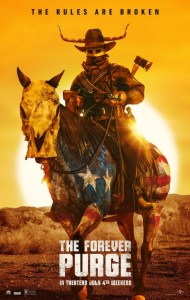 While the franchise is starting to diminish, there’s still enough blunt power and appeal to the Purge series that I welcome a new addition every few years. Coming at a time of renewed political peril, and where the world of its satire seemed to be indistinguishable from regular headlines, the Purge series for me has gained a renewed relevancy, and while many scoff at how blunt the filmmakers are with their commentary, I say we live in blunt times and sometimes a social sledgehammer is more applicable than a scalpel. Once again, the franchise seems prescient with its premise for The Forever Purge, a band of violent extremists refusing to accept the end of their murder party and thinking that the laws no matter apply to them because they are the real American patriots. There’s a definite perverse pleasure to be had watching these racist goons getting taken out one-by-one by the predominantly Mexican cast of heroes. In a post-Capitol insurrection universe, this movie can be a necessary release for many patriots who view that awful day with risible contempt. The U.S. government, once again under the control by the evil party that introduced the Purge, is now fighting against the white supremacist forces they have riled up and can no longer control for their own benefit. The Canadian and Mexican governments are offering a limited time open border to any American seeking refuge from the chaos and violence of its own government. There’s more heavy use of jump scares with The Forever Purge and the supporting characters and scenarios aren’t given enough attention to stand out or really savor (sadly, there is no Skeletor reappearance). It lacks a strong sense of climax; more so they just ran out of goons to kill. And yet, I appreciate that this movie reminds us how quickly outsized evil can come back when we think we have it vanquished, something to think about in a post-Trump presidency that doesn’t feel very post-anything close enough eight months later. This is probably the weakest movie of the franchise so far but it’s still a serviceable B-movie with enough action and comeuppance to please fans of the anarchic series.
Nate’s Grade: B-
Share this:

Freaky (2020)
 A body swap movie set in a slasher universe, Freaky is a fun and gory romp that still feels like it could have been even more entertaining with the possibility of its premise. A masked serial killer (Vince Vaughn) stabs a teenage girl (Kathryn Newton) with a magic Mayan knife and they swap places and must learn to cope in their new bodies and roles. The teen-in-adult body is wonderfully played by Vaughn, who seems to be really enjoying himself with a silly role that pushes him outside his smooth-talking leading man roles. He might be playing up the girlishness and higher-pitched voice but his energy level is high and provides plenty of entertainment with the absurdity. There are a few inspired moments developed from the crazy premise, like when Vaughn has a heart-to-heart with his/her mother at work, able to offer insight into the daughter she feels she is failing, and the mother becomes romantically intrigued by this mysterious man. There is a first kiss sequence in the backseat of a car that is so awkward but owns its outrageous quality. I wish the movie from co-writer/director Christopher Landon (Happy Death Day) made better use of its fruitful premise. There are so many more bizarre scenarios that could be gleaned here, especially if the masked serial killer had more of a personality. Clearly modeled after the silent stalkers like Michael Myers and Jason Voorhees, this makes the film feel too one-sided with ideas. Sure the teenage girl is now to be feared, dresses sharper, and kills her high school annoyances, but it doesn’t make for much of a creative cat-and-mouse game when it comes to outsmarting the original owner of this new body. I will also champion the gory kill scenes as above average in their conception and execution. It’s really over-the-top and memorable and I wish there had been even more wild splatter. Freaky is a decidedly fun movie from the Blumhouse assembly line but I can’t help wishing it was a little bit funnier, a little bit weirder, and little bit more imaginative. The parts were there to make this hilarious and brilliantly creative, and settling for chuckles and disposable entertainment feels like a nagging compromise.
Nate’s Grade: B
Share this:

The Craft: Legacy (2020)
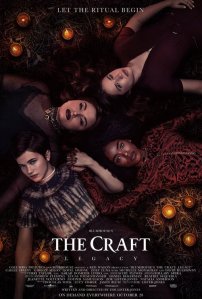 I don’t know who this new 2020 Craft is intended for and I don’t think the movie knows as well. If you’re a fan of the 1996 original, which has developed quite a reputation for many millennials, then I think you’re going to be relatively disappointed with this remake/reboot/sequel, whatever Blumhouse is calling this. By that description it should be evident that The Craft: Legacy has a bit of an identity crisis. It’s not exactly a remake because it retains so little from the original except in its witchy teenage premise, it’s not exactly a reboot because it doesn’t come together on its own for a new identity, and it’s not exactly a sequel because the only tangential connection to the original is tacked on in the literal final seconds of the movie. If it was trying to please fans of the original, it’s too lacking, and if it’s trying to chart its own course for a new generation of fans, well that doesn’t work either. As a result, it’s another PG-13 remake of an R-rated move that feels like it’s playing to a different crowd.
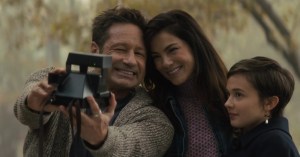
Lily (Cailee Spaeny, Bad Times at the El Royale) is the new girl at school. Her mother (Michelle Monaghan) is remarrying Adam (David Duchovny), a popular motivational speaker with three older sons of his own. She befriends a group of diverse teenagers when they suspect Lily might have the potential for special gifts. The girls try sending Lily a psychic message and then ask her to join their fledgling coven. The four of them combine their powers and promise to use their synchronicity for good to push back against the patriarchy.
 That narrative uncertainty of writer/director Zoe Lister-Jones (Band-Aid) seeps into every moment of the 97 minutes. You get a sense that Jones had a central topic she wanted to provide commentary and then a checklist of “witch stuff” to include that she wasn’t sure about. The activation of the powers in the original related to outcasts grabbing a power denied to them, getting even, going too far, learning some lessons, and then our protagonist having to topple her new friends and the danger they posed thanks to their new powers. With The Craft: Legacy, the magic feels like an afterthought to changing hearts and minds. We only really see one spell and its lengthy outcome where Lily makes her high school bully woke, and he stays that way and joins the girl group as their sensitive pal. This is, by far, the most interesting part of the movie, and yet there’s a larger implication that the movie ignores because it would place our heroines in an uncomfortable light. They’ve reformed the bully into a model citizen of a modern mature man who can admit his vulnerabilities, but they’ve also robbed him of agency and free will. Is this version of him what’s really hiding underneath, or is he simply being manipulated by their spell? This subplot gets more attention than any of the other witches combined. I don’t know anything about the other friends in the group, besides they take their witchy duties seriously and one of them is trans. They get assigned elemental powers later (Earth, Fire, Wind, Water) and that is more definite characterization than anything else. If you asked me what their names were or their defining personality traits I would be stumped.
After last year’s Black Christmas remake, it’s peculiar how closely The Craft: Legacy is following a similar formula. I applaud the diversity behind the camera and having female directors remake these stories for a new time and a new audience, and the concept of toxic masculinity as a threat to all women is potent and provides plenty to work into a horror/thriller dynamic. Yet Black Christmas had to go one step further by saying the evil fraternity that was preying upon women was secretly mind controlled by an evil magic goo of evil. It lets them off the hook. Now with The Craft: Legacy, we have an obvious villain as a symbol of toxic masculinity, and because he’s so obvious I kept waiting for him to be a more insidious foe, manipulating young men into a warped way of thinking about strength and virtue. However, this doesn’t happen. The antagonist feels like any generic abusive husband on any disposable Lifetime original TV movie. The topic doesn’t feel explored or nuanced for its big theme or cleverly matched up with the iconography of horror for extra genre commentary. What about the different sons? couldn’t they reflect different stages of his influence? Or the young and more innocent son, couldn’t he be a target of reprogramming? The movie doesn’t give us anything to really chart. It feels like much must have been left behind through several edits. If Jones and her team wanted to use their movie to make a pertinent statement on toxic masculinity, I was hoping for more than a relatively obvious, “It’s not good.” Even the Black Christmas remake gave its theme more consideration than this and talked about its generational impact.
 In the original, each member of the foursome has a backstory, a personality, a central conflict before and after developing her powers. While the conclusion was like Wicca X-Men, the rest of the movie was an effective high school drama with relatable characters. They were Catholic schoolgirls rebelling against their school and their families in the 1990s by practicing witchcraft. It was a statement. Now, the girls practicing witchcraft in a regular school during modern times just feels like an accepted experimentation from a culture that has become more tolerant, and that’s fine, but that means the movie has to provide other avenues to make new statements. The lackadaisical response to the supernatural really harms the movie. It makes it feel like the hook could have been anything. If the characters are given great power, use it sparingly, and then decide they might not be responsible enough so soon after, that’s simply boring storytelling. That’s the equivalent of a man finding a wish-granting genie, and then after the first wish where he asks for new pants he decides, “Oh, too much for me.” This is what I mean by The Craft: Legacy being too timid about being a supernatural horror thriller. It’s got the feminist perspective you’d expect from the underdog characters gaining powers, but it’s lacking a fundamental understanding or appreciation of its genre. It’s mostly confined to multiple nightmares and the occasional jump scare. The concluding good powers versus evil powers face-off is so awkward and cheesy that it deflates any good will earned.
The Craft: Legacy is a perfunctory remake/reboot that doesn’t seem interested in its characters, in its supernatural horror aspects (a sleepwalking brother that’s used as a jump scare and never explained?), or even in the exploration of its major theme on toxic masculinity. There isn’t much in the movie that is outright bad but there is nothing that shines either or proves to be memorable. The 1996 original isn’t exactly a genre classic but it looks so in direct comparison to this flat rehash.
Nate’s Grade: C


 nathanzoebl
You must be logged in to post a comment.