Blog Archives
The Rip (2026)
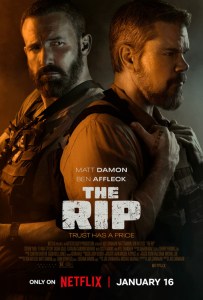
Director Joe Carnahan (The A-Team, Narc) excels at machismo, and I mean that not as a detriment. He makes muscular action-thrillers, often about corrupted men coming to terms with their ruination. 2012’s The Grey is still one of the best movies I’ve ever seen released in January. Well here comes The Rip, also released in January, starring Matt Damon and Ben Affleck as combustible Miami cops who follow a tip to a cartel stash house that holds a cache of twenty million dollars. The cops are supposed to follow protocol, call it into their superiors, but with that kind of money, much more than what the tip reported, it’s hard to resist the life-altering implications of indulging in that kind of haul. I thought The Rip, named after the seizure of contraband, was going to be a modern-day Treasure of the Sierra Madre, where the power of greed is irresistible and leads to betrayals and murder among our characters. It does that, with each questionable decision going against protocol making us question who might be most susceptible and who might be heading for a collision. The movie, co-written by Carnahan, is strictly genre boilerplate. The characters are never more than archetypes, the dialogue is aggressively expository often reminding us of all the conflicts and characters on the periphery that haven’t been brought back yet, and the majority of the film is a contained thriller awaiting trouble at the stash house. And yet I was entertained from start to finish thanks to the cast and a simmering tension that Carnahan unleashes between his paranoid characters. There are some late plot turns that I don’t know if they’re actually clever, convoluted, or both. It’s the kind of thing that’s meant to excuse bizarre behavior that we’d have no reason to assume differently, so it feels a little bit like being jerked around. However, The Rip is a fairly fun way to blow through two hours built upon movie stars unleashing their swagger.
Nate’s Grade: B-
Share this:

The Accountant 2 (2025)
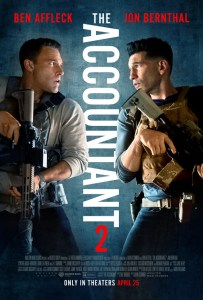 I’m going to start this review by doing what everyone loves to read, the author patting themself on the back. Back in 2016, I found The Accountant to be an enjoyable thriller with a compelling main character that answered the question, “What if Jason Bourne was actually interesting as a character?” I concluded my original review with this observation: “It’s rare that a movie leaves me wanting more, and it’s even more rare when a movie leaves me wanting to watch a weekly variation of Christian Wolff living as whiz kid accountant by day and enforcer of justice by night.” Over the years, The Accountant became one of the most popular streaming movies, a real word-of-mouth sensation that gave it life long after its theatrical release. It was enough that another studio, Amazon MGM, wanted to buy the rights to pay Ben Affleck to produce a sequel that hit theaters and now is available on streaming, thus ready to be the next great movie that dads fall asleep to. It took longer than expected but The Accountant 2 does fulfill my request, showcasing what a regular series could be, for better and worse.
Christian (Affleck) is like Batman if Batman had Autism and did his own taxes. He has a multi-million-dollar foundation that looks for wrongs to right, and this time he’s called back into the action by the sudden death of Ray King (J.K.Simmons), the retired agency head who was tracking the elusive accountant for years. Ray was obsessed with a family lost to human trafficking and hoped to find the missing child. Christian takes up the case and invites his once-again estranged brother Braxton (Jon Bernthal) to help.
 The positives from the original Accountant still shine through, namely the entertainment value of Christian as an outsider character trying to fit into the larger world. He’s an unexpected and often funny person but also a man with his own code of justice, and it’s a treat to watch him bomb through a marathon of speed dating one moment and punch guys in the throat the next moment. Affleck is still enjoyably dry as the lead, and the movie is at its best in the moments where Christian and Braxton are butting heads. It takes a longer than it should to reintroduce Braxton and bring him back into Christian’s orbit, but once the brothers are together, the movie coasts on a chummy buddy comedy dynamic that can reliably work no matter the setting. That’s one of the features that led me to apply the movie into a TV adaptation; the characters are what make ordinary encounters that much more entertaining, and TV is the premiere realm for characters. We tune in on a weekly basis because we want to discover what the characters we love will do next. While The Accountant 2 is certainly a few steps behind its predecessor, the core dynamic that made it enjoyable for so many should still prove appealing to those same legions of fans.
The movie also demonstrates some creaky choices and execution that manages to make it feel less like a full and vital sequel and more like an iffy showcase for turning the franchise into that weekly TV series. The central mystery feels lifted from any generic crime procedural about discovering a human trafficking network. The particulars aren’t that interesting or complicated or even that surprising given the general public’s understanding of human trafficking nowadays. I was waiting for this storyline to give us a little insight into the people most affected, the vulnerable families being exploited as they risk everything to search for a better life or more stable employment. I was waiting for something extra that felt like this storyline would be anything more than a ripped-from-the-headlines rescue mission, and it just doesn’t materialize. Much like 2023’s Sound of Freedom, the complex issue of human trafficking gets boiled down to whether or not our characters can save one unfortunate child. Hilariously, during the climax, the movie keeps cross-cutting between the brothers riding to liberate the kids from their imprisonment and an excavator digging a hole intended to be the kids’ mass grave. One inclusion is enough for us to understand the stakes, but the movie keeps cutting back repeatedly, as if anxiously asking, “Oh no, will the bad guys get the grave completely finished in time for the kids to be dumped inside?”
Already it feels like we’re sanding things down in order to fit a formula. Another indication is the relationship between the brothers. Apparently the brothers have not seen nor spoken with one another since the events from the first movie eight years ago. This is odd considering much of that movie’s story was divided with the Braxton character in parallel and finally recognizing his long-lost brother. After all their years apart it feels more likely that they would have stayed in touch or better. By not going that route, the sequel gets redundant reuniting the brothers again, but this time they’ll actually stick it out because they’ve gone line dancing together and killed even more dudes, the two most brotherly-bonding activities possible. It feels like setting up the team for more fun adventures.
 Although redundancy is part of what holds back the movie. Take for instance back-to-back introduction scenes for Braxton. Our first scene is him trying to psych himself up, and we may think it’s for a date or to talk to a woman he likes, but it’s actually to ask whether or not he can adopt his selected puppy even earlier. Funny, sure, and gets to his loneliness. The next scene he’s trying to have a conversation with a woman who is clearly not as interested and this perturbs him, and upon him leaving we see the trail of bodies he has left behind in the aftermath of some job. Both of these scenes are accomplishing the same thing: Braxton has difficulty connecting with others and is lonely. Why did we need the first scene when the second conveys the same information plus his formidable nature? Braxton even brings up his desire to get a dog later and Christian considers his brother more a “cat person” because he lacks the stable job and responsibility to care for a canine. This moment could have been the first time the film introduced Braxton’s desire for a pet. We don’t gain much from knowing this already. This may seem slight but it’s indicative of a movie that is filling time (hence the mass grave cutaways). For a movie over two hours, there is a surprising amount of fat that could’ve been reduced for narrative redundancy and pacing.
The most obvious sequel idea for a special-skilled accountant would be to meet his match, and The Accountant 2 does and doesn’t do this (some spoilers to follow in this paragraph). Much of the movie is about locating two people, the child stuck in human trafficking and a mysterious woman (Danielle Pineda) who the bad guys are after. She is linked to the missing child but she’s also a highly-skilled killer who is seeking vengeance of her own. It turns out this woman, who I won’t identify, had a traumatic experience and has now become a savant action superhero. This revelation is meant to explain how an ordinary woman could become this badass killing machine, but it awkwardly feels like a ret-con to try and apply Christian’s condition to anyone under unique circumstances (you too could transform, kids). Except the first Accountant made it abundantly clear that Christian was as skilled and methodical as he is because of being on the Autism spectrum, allowing him a unique dedication and attention to detail. Obviously, Autism is not some shortcut to super powers. If it were, RFK Jr. would actually try and read something relevant about medicine. But it was established that the same skills that Christian uses to be such an exacting accountant are the ones he taps into to become a crushing crusader. As someone who has worked with many on the Autism spectrum, I didn’t see this portrayal as insulting or insensitive, especially since much of the movie is about humanizing people with differences and showing how their capabilities can rise above the preconceived perception of others. It wasn’t saying Christian was like all people with Autism, but this is, again, only my nuer typical perspective. I don’t know if in the ensuing eight years that returning screenwriter Bill Dubuque (Ozark) decided that it was less problematic to have the secret formula be the brain’s response to trauma rather than being on the spectrum. It opens up the movie to other highly-powered super spy assassins, but it also takes away something from the premise.
 The actual bad guys are a rather uninspired gathering of goons and shadowy business types. At no point will you feel like our characters are genuinely under threat, and at no point will you remember anything about these villains except for their rote application in the plot. The main trafficker is an evil Boston crime boss (Robert Morgan) that could have been ported over from any other generic crime thriller. His one quirk is that he whistles “Pop Goes the Weasel,” even when he’s murdering migrants in the desert. So there’s that. His main muscle is just… some guy. Literally there is no even cursory attempt to provide any point of characterization for this guy, and he’s supposed to be one of our biggest threats? They could have given this guy, bare minimum, like an eye-patch or an affinity for pop songs, anything. As a result, we have two sets of antagonists, one of which is revealed as an avenging antihero while the others are so disposable to be laughable. At least the first Accountant film gave us a real opponent who, granted, ended up being the younger brother to our main character, but there was a real question what could happen when their paths crossed. Would they use their skills to eliminate the other?
The Accountant 2 might not add up to the same degree of entertainment and thrills that its first outing offered, and there are several missteps and redundancies that take away the edge and uniqueness of that original, but as long as Christian is still determined to help others, I’ll always find this possible franchise worth watching. Now look out for that eventual Amazon TV series to be scheduled right after Reacher.
Nate’s Grade: C+
Share this:

Jersey Girl (2004) [Review Re-View]

Originally released March 25, 2004:
Writer/director Kevin Smith (Dogma) takes a stab at family friendly territory with the story of Ollie Trinke (Ben Affleck), a music publicist who must give up the glamour of the big city to realize the realities of single fatherhood. Despite brief J. Lo involvement, Jersey Girl is by no means Gigli 2: Electric Boogaloo. Alternating between edgy humor and sweet family melodrama, Smith shows a growing sense of maturity. Liv Tyler stars as Maya, a liberated video store clerk and Ollie’’s real love interest. Tyler and Affleck have terrific chemistry and their scenes together are a playful highlight. The real star of Jersey Girl is nine-year-old Raquel Castro, who plays Ollie’’s daughter. Castro is delightful and her cherubic smile can light up the screen. Smith deals heavily with familiar clichés (how many films recently end with some parent rushing to their child’’s theatrical production?), but at least they seem to be clichés and elements that Smith feels are worth something. Much cute kiddie stuff can be expected, but the strength of Jersey Girl is the earnest appeal of the characters. Some sequences are laugh-out-loud funny (like Affleck discovering his daughter and a neighbor boy engaging in “the time-honored game of “doctor””), but there are just as many small character beats that could have you feeling some emotion. A late exchange between Ollie and his father (George Carlin) is heartwarming, as is the final image of the movie, a father and daughter embracing and swaying to music. Jersey Girl proves to be a sweetly enjoyable date movie from one of the most unlikely sources.
Nate’s Grade: B
——————————————————
WRITER REFLECTIONS 20 YEARS LATER

When I started putting together my list of 2004 movies to re-watch for this year’s slate, my wife was not pregnant. We had been trying for a year and experienced some heartbreaking setbacks, but now, as I write my review of Jersey Girl, my reality is that my wife is indeed pregnant, and we’re expecting a baby this October and very excited. As you can expect, I’m also nervous. Now this movie about the changes of fatherhood has significantly more meaning for me personally.
In 2004, I was but a 22-year-old soon-to-be college graduate but also a devotee of writer/director Kevin Smith since my teenage years of discovering movies in the oh-so-exciting go-go decade of 1990s independent film. This was supposed to be Smith’s career pivot, as he’d reportedly closed the book on his View Askew universe of crude comedies and stoner hi-jinks with 2001’s Jay and Silent Bob Strikes Back. Smith had become a parent in 1999 and, naturally, this altered the kinds of stories he wanted to tell. Although this didn’t last too long. In 2004, America was sick of Bennifer 1.0 and Jersey Girl was the second movie in less than a year pairing real-life couple Ben Affleck and Jennifer Lopez. The stink from 2003’s Gigli, and the tabloid overexposure, had tamped down the country’s demand for more Bennifer, so Miramax removed all publicity of Lopez from the movie, pushed the release date back half a year, and even publicly revealed that Lopez’s character dies in childbirth in the first ten minutes. Even with its relatively modest budget for a studio film, Jersey Girl under-performed, critics lambasted it, and Smith returned to his vulgar adult comedy playground with 2006’s Clerks II, the sequel to where it all began. With the occasional stop into horror, Smith has stayed in his own insular world and only gotten more insular with sequels to his early comedies for his ever-shrinking fandom.
 More so than any other movie, Jersey Girl is the outlier, the oddity, the path not taken. Watching it again in 2024, I’m more forgiving of this outlier even if it proves harder to love. Much of this is likely my own relatability with the main character’s plight, a New York City workaholic publicist Ollie Trinkie (Affleck) who loses everything in a short window of time, namely his high-profile city job and his wife Gertrude (Lopez). Now he’s back living with his father Bart (George Carlin) in New Jersey and raising a little girl Gertie (Raquel Castro) on his own. It’s not a revolutionary film concept, a selfish adult takes on the responsibility of another and changes their perception of themself and the world. In a way, it likely happens to every new parent, or I would hope, a paradigm shift of perspective. The insights that Jersey Girl offers about parenthood and priorities are nothing new but that doesn’t mean they are bad or not worthwhile. Without the context of Smith’s tonal pivot, Jersey Girl would likely be forgotten, more than it already has been to history. It’s Smith’s spin on the family movie cliches we’ve seen before, and that means there’s a limit to how much further he can take the overly familiar.
It’s a little deflating to watch an artist known for his imagination and vocabulary utilizing the building blocks of maudlin family movies for his new story. Even with a different storyteller, they are still the same recognizable pieces seen before in hundreds of other feel-good movies about parents learning that children are more important than that big meeting or promotion. Of course reducing everything down in life is reductive, and maybe that big meeting could allow the parent to be more present for their kid, provide a better life being neglected, but whenever you set up the climactic choice between family and career, family always wins. Maybe David Wain (They Came Together) is the kind of subversive genre artist who could send up these age-old cliches and end with the workaholic parent choosing their selfish career. Regardless, the movie’s strengths are its sincerity rather than ironic detachment. It would be hard to make this kind of movie from a cynical smart-alecky approach, and Jersey Girl reveals what any View Askew fan has long known, that deep down at heart Smith is a big softie. It’s more apparent nowadays with Smith’s recent output of increasingly sentimental movies about relationships, as well as Smith’s copious social media posts showcasing his torrent of tears in response to a movie or TV show (as a man who frequently cries from movies and TV, this is no affront to me). Smith wanted to tell a personal story of his own life changes through the familiar family movie vehicle, and while it doesn’t entirely stretch beyond its copious influences, it’s still singing true to Smith’s sincerity.
 This is far from the disaster many have made it out to be in the past twenty years. Lopez is really good in her brief opening appearance with a natural radiant charm that makes you mourn her absence just like Ollie. Liv Tyler (Armageddon reunion) shows up midway through as Maya, a sexually progressive video store clerk who becomes the next love interest for our widower. When she discovers, to Ollie’s embarrassment, that he hasn’t had sex for seven years, the entire time after his wife’s passing, she takes it upon herself to help the guy out with some charitable casual sex. The scene is funny and finally makes use of a setup Smith has taken time with prior, Gertie not flushing the toilet after use (something I can already regrettably relate to raising children). When his daughter comes home early, Ollie and Maya hide in the shower, and it appears they have gotten away with it, except Gertie finally remembers to flush the toilet, sending a burst of hot water that causes Maya to screech and reveal their half-naked tryst. From there, little Gertie sits them both down, reminiscent of what Ollie did with her and a friend when he caught them playing “doctor,” and she squares her gaze and intones, very maturely: “What are your intentions with my father?” Even the big climactic event, the children’s musical performance the parent can’t miss lest they break their child’s heart, gets a little edge when Gertie and her family perform the throat-slitting/pie-making number from Sweeney Todd. There’s a terrific exchange between Ollie and Will Smith all about the changing dynamic of fatherhood, what they do for their kids, and how rewarding it proves, and having Smith be your ace-in-the-hole is great.
It would be neglectful of me to forget the postscript that, nearly twenty years after the demise of their engagement, that Affleck and Lopez reunited and married in 2022. We’re in the current realm of Bennifer 2.0 (unless your version of Bennifer 2.0 was when he married Jennifer Garner, but I’ll let you decide if this era is 2.0 or 3.0) and Lopez has released a companion documentary to her 2024 visual album (a.k.a. collection of music videos) that features her relationship with Affleck, and it’s called The Greatest Love Story Never Told, and it’s gotten good reviews. Also of note, Castro grew up into a budding pop idol and appeared on The Voice and Empire.
 There are things that work here, enough that Jersey Girl might honestly age better than the majority of Smith’s rude and crude comedies (see: re-reviews for Dogma and Strike Back, and Reboot). It will never garner the love of Smith’s more successful movies, but it doesn’t deserve any reputation as a forgotten stepchild among Smith’s oeuvre, especially when you consider the man also has Yoga Hosiers on that resume. In 2004, I referred to Jersey Girl as a “sweetly enjoyable date movie,” and this still stands twenty years later. I’m a little softer in several ways and more forgiving as an adult cinephile, and more welcome to genuine acts of sincerity, so the winning moments of the movie still hit their mark for me. I write this as my wife is still in her first trimester, and while the due date seems so far away I know it will rush by, and then I, like Ollie, will be juggling my life as I knew it with my life as I now know it (you better believe the scene where he loses his spouse in childbirth hit me harder as a new intrusive nightmare to occupy my mind). Jersey Girl isn’t anything new or special, but it was special for Smith, and he finds ways to make you understand what that means for him, and what it might mean for you. I’ll take that.
Re-View Grade: B-
Share this:

Gigli (2003) [Review Re-View]
 Originally released August 1, 2003:
It’s the feel-good movie of the year revolving around a lunkhead mobster (Ben Affleck) and his mentally challenged kipnapee and their attempts to covert a lesbian hitman (Jennifer Lopez) in between her yoga/horrific monologues concerning the superiority of female genitalia. Believe the hype people; Gigli is indeed as bad as they have told you. It’s not even entertainingly bad, like Bulletproof Monk, no folks; Gigli is just mundane and awful. During the entire two-hour stretch, which feels much much longer, I kept saying one thing aloud: “How could anyone making this think they were making a good movie?” Did they think audiences would find it funny that Affleck’s mother (the mother from My Big Fat Greek Wedding) shows us her big fat Greek behind? Did they really think that a mentally challenged kid (who has an affinity for gangster rap and wishes to travel to the mythical “Baywatch”) would come off as endearing? Well instead it comes across as insulting. And what else is insulting is the laugh-out-loud dialogue Lopez is forced to spit out concerning her attraction for women. I can’t think of any actress that could say the line, “I love my pussy” convincingly. And I’m sure a lot of actresses out there have true affection for it. The writing is just atrocious. And so much else fails as well. The score is a perplexing mix of upbeat jazz and inappropriate string orchestra. I don’t understand what emotions they were going for during scenes in Gigli but a full string orchestra playing music better suited for a real drama does not fit. Maybe it was for a tragedy. In that case, then it’s right on the money. You won’t see a more sloppily executed, horribly acted, painfully written, lazily directed, inept film this year. And what the hell did Christopher Walken walking in have anything to do with anything?
Nate’s Grade: F
——————————————————
WRITER REFLECTIONS 20 YEARS LATER

Gigli. It’s a word that instantly trigger shudders and shivers, a code name for fiasco, for career-destroying miscalculations. Writer/director Martin Brest was a Hollywood heavyweight with hit adult comedies like Going in Style, Beverly Hills Cop, Midnight Run, and Scent of a Woman, and since the cataclysmic disaster that was Gigli in 2003, this man hasn’t directed a single thing in these twenty years. The man is still reeling from the wafting stink from this very bad movie. I thought it might be worthwhile to revisit what I dubbed the worst film of 2003, though I was not the only critic to make this distinction, but now I’m questioning why I even bothered. It’s not like this movie was somehow going to get that much better with two decades of safe distance. The amazingly miscalculated artistic decisions will still be the same, still bad. I guess it must have been primarily my own morbid curiosity, much like revisiting 2001’s Freddy Got Figured, about whether this famous flop could still live up to its reputation. Well, dear reader, allow me to put any lingering doubts to rest you may have had about Gigli. It’s still very very very bad.
I might possibly recommend watching this once in your life (depending upon how many years you are lucky to earn) for the sheer fascination; Hollywood so easily makes mediocre and boring and familiar movies that feel like pale imitators of some prior hit, but Gigli is something different in the realm of studio stinkers, a project where just about every single creative decision warranted the incredulous Tim Robinson gif response: “You sure about that? You sure about that?” Gigli feels like two tonally dissonant movies in conflict at every moment. The plot elements feel lifted from some mid-to-late 90s indie crime comedy, the likes where they would just throw together a grab-bag of ironic provocative plot elements you wouldn’t expect together. “Mobster doofus kidnaps mentally challenged kid who is obsessed with gangster rap and wants to visit the ‘Baywatch’ which he thinks is real! Romance with a lesbian! Severed thumb ruses!” The collection of strange parts feels like it’s supposed to be a madcap, wacky comedy, and yet the tonal approach is complete treacle, with a shockingly syrupy score that rises and falls throughout, trying to convince you that what you’re watching is quixotically aiming for Oscars. It is astounding if you stop and pay attention to the film score at any moment, no matter how strange, as it attempts to provide jazzy saunter to “comedy” scenes, like an ex-girlfriend showing up into an unstable situation, and then it segues to Spielbergian emotional heft, like when that same ex-girlfriend attempts to take her own life to convince Jennifer Lopez to come back. There were so many moments where my only response possible was to avert my eyes, shake my head, and wonder whether anyone at any stage had any misgivings, tried to reach out to Brest, but then shrugged and dismissed their very legitimate worries as, “Well, he made Midnight Run after all. What do I know?” You know enough that these different tonal approaches will not work.
 Apparently, the movie was intended to be a straightforward mob comedy but the studio wanted the focus to shift toward a romance because of the actual romance between its stars, Lopez and Ben Affleck. Whenever actors begin a relationship after a movie or over the course of making one together, it provides another lens to review the movie, to gauge their chemistry and, if you’re so lucky and observant, able to “see” them falling in love with one another. That is nowhere to be found with Gigli. Maybe it was the shared experience of finding what they could to cling to while making this movie that nobody fully understood but committed to anyway (I guess love can be described the same way under some circumstances). Regardless, the romance between the two characters is, like all other plot elements, haphazard and spontaneous and foolhardy.
The characters are all awful and they never remotely come across like relatable or even remotely interesting people. Affleck’s Italian lunkhead Larry Gigli is just awash in early 2000s misogyny and bravado, dubbing himself the “sultan of slick, the rule of cool, the straight-first-foremost, pimp-mack, hustler, original gangster’s gangster.” Allow that macho boast to also exemplify another critical problem with the movie in that almost all the dialogue will make you cringe. There’s an entire monologue by Lopez, while she’s contorting her body in a plethora of lithe yoga positions, all about how superior the vagina is in appearance and function. What about when Lopez, as an indication that she wants to engage in heterosexual congress, utters the immortal phrase: “It’s turkey time. Gobble gobble.” Larry slams a kid’s computer on the ground and triumphantly says to suck an appendage of his, but then adds, “dot com” because the kid’s a nerd or something because he likes computers. Ho ho, the kidnapped young man insists that he be read to before going to bed, and what does Larry have at his disposal? Not books, oh no, so he’s forced to read him instructions on shampoo and toilet paper. Hilarious, right? What about when this same mentally challenged kid says, “When my penis sneezes, I say, ‘God bless you.’” The early 2000s weren’t an enlightened time with depiction of mental handicaps, and poor Justin Bartha (National Treasure, The Hangover) goes fully into the worst of these impulses, making the performance feel like a minstrel show for those with mental challenges. At least this aspect is not alone. Nothing ages well in this movie and its comedy only falls flatter and the drama is only more inexplicable twenty years later. It’s a special kind of bad so rarely achieved at this level of Hollywood.
Given that the majority of the movie consists of kidnapping a naïf, most of the movie is set in Gigli’s apartment keeping the man unseen and unheard from. This makes the movie feel for a long stretch like a glorified one-set play, with special appearances from traveling guest actors popping through for a brief moment in the spotlight. Here’s Christopher Walken dispensing with a monologue and then never being seen again. thanks for coming. Here’s Al Pacino, yelling so hard I’m surprised Lopez and Affleck didn’t need to wash the layers of spittle off. Here’s Lanie Kazan (My Big Fat Greek Wedding) who needs an insulin shot in her butt and let’s make sure we see her thong while we’re at it. These incursions of well-known actors re-explain the plot, not that it was hard to keep up with, and it all feels like stretching for time when the movie is already two hours long. The resolution, where our characters drive off into their sunny endings, lasts twenty minutes itself, which feels as long as the endings of 2003’s Return of the King. It’s a screenplay that feels like it’s holding itself on ice, content that the kooky characters butting heads and trading quips and monologues would be enough, and one that feels unsure of those same impulses, relying upon a revolving door of one-scene guests to remind us what we already know. It makes you feel simultaneously trapped with awful characters yet also in the hands of someone who doesn’t quite think you’re understanding the nuance and hilarity of the strained effort.
 I’m not an automatic Affleck hater. I enjoyed his rise from the films of Kevin Smith to Hollywood leading man. I can understand the draw of working with a filmmaker like Brest, and it’s probably that same appeal that lead him to also star in 2003’s Paycheck, directed by John Woo, who like Brest never worked in Hollywood again. This was the period where Affleck’s star was on the decline, and Bennifer was dominating tabloid space, and if it weren’t for the failures we might not have ever gotten Affleck as film director, so maybe we never would have gotten The Town or Argo or Gone Baby Gone had it not been for Gigli, so there’s a silver lining for you.
Look, you already know you shouldn’t even get near Gigli and with good cause. It’s a rarity to see something this colossally bad with this level of artistic freedom to be bad, not simply having too many cooks in the kitchen but having one very wayward chef nobody felt they could interfere with. This was a runaway chef, the kind of fiasco that only comes from unchecked artistic hubris. In that regard, there may be some rubbernecking appeal here for those who can endure bad characters, bad drama, bad comedy, bad acting, and horrible depictions of human beings who never at any point sound like human beings. It’s hard to watch and two hours of your precious time. 2003 began as a rough year for movies, sporting fascinating disasters like Bulletproof Monk and The League of Extraordinary Gentlemen. Watch those movies if you’re looking for a good-bad time. With Gigli, it’s only going to be a bad-bad time, whether it’s 2003, 2023, or any year until the sun explodes. Hey, if Ben Affleck and Jennifer Lopez could put this movie behind them and reunite, and even get officially married in 2022, then we can put it behind us as well.
Re-View Grade: F
Share this:

The Flash (2023)/ Spider-Man: Across the Spider-Verse (2023)
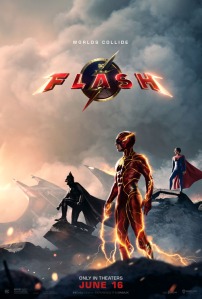
Released within two weeks of one another, two big summer movies take the concept of a multiverse, now becoming the norm in comic book cinema, and explore the imaginative possibilities and wish-fulfillment that it proposes, but only one of them does it well. Spider-Man: Across the Spider-Verse is the sequel to the Oscar-winning 2018 revolutionary animated film, and it’s a glorious and thrilling and visually sumptuous experience, whereas DC’s much-hyped and much-troubled movie The Flash feels like a deflated project running in place and coming apart. Let this be a lesson to any studio executive, that multiverses are harder than they look.
Barry Allen (Ezra Miller) has the ability to travel at fantastic speeds as his superhero alter ego, The Flash. He’s tired of being the Justice League’s errand boy and still fighting to prove his father is innocent of the crime of killing Barry’s mother. Then Barry discovers he can run fast enough to actually travel back in time, so he returns with the intention of trying to save his mother. Except now he’s an extra Flash and has to train his alternate self (also Miller) how to control his powers. In this different timeline, there is no Justice League to combat General Zod (Michael Shannon, so thoroughly bored) from destroying the planet for Kryptonians.

This is the first big screen solo outing for The Flash, and after none other than Tom Cruise, Stephen King, and James Gunn calling it one of the best superhero movies of all time, it’s hard to square how trifling and mediocre so much plays out as an example of a creative enterprise being pulled in too many directions. Miller was cast as the speedster almost ten years ago, and this tale has gone through so much tortured development, leaping through numerous filmmakers and writers, that its purpose has now gone from being a pillar of the expanding DC cinematic universe began with Zack Snyder’s Man of Steel in 2013 to becoming the Snyderverse’s death knell. The premise of traveling back in time is meant for Barry to learn important lessons about grief and responsibility and the limits of his powers, but it’s also intended as the reboot option for the future of these cross-connected comic franchises. It allows Gunn, now the co-head of the new way forward for DC movies and TV, to keep what they want (presumably Margot Robbie and Jason Momoa) and ditch the rest (Henry Cavill, Ben Affleck, Black Adam, Shazam, and Zack Snyder’s overall creative influence). So reviewing The Flash as only a movie is inadequate; it’s also a larger ploy by its corporate overlords to reset their comic book universe. In that regard, the quality level of the movie is secondary to its mission of wiping the creative slate clean.
Where the movie works best is with its personal stakes and the strange but appealing chemistry between the two Millers. It’s an easy starting point to understand why Barry does what he does, to save his mother. This provides a sturdy foundation to build a character arc, with Barry coming to terms with accepting his grief rather than trying to eradicate it. That stuff works, and the final talk he has to wrap up this storyline has an emotional pull that none of the other DCU movies have exhibited. Who wouldn’t want one last conversation with a departed loved one, one last opportunity to say how you feel or to even tell them goodbye? This search for closure is a relatable and an effective vehicle for Barry to learn, and it’s through his tutelage of the other Barry that he gets to see beyond himself. The movie is at its best not with all its assorted cameos and goofy action (more on both later) but when it’s a buddy comedy between the two Barrys. The older Barry becomes a mentor to himself and has to teach this inexperienced version how to hone and control his powers as well as their limits. It puts the hyper-charged character into a teaching position where he has to deal with a student just like him (or just him). It serves as a soft re-education for the audience alongside the other Barry without being a full origin story. The impetuous young Barry wanting to have everything, and the elation he feels about his powers, can be fun, but it’s even more fun with the older Barry having to corral his pupil. It also allows the character an interactive checkpoint for his own maturity and mental growth. Miller’s exuberant performances are quite entertaining and never fail to hit the comedy beats.

The problem is that the movie puts so much emphasis on too many things outside of its titular hero. Much was made of bringing back Keaton to reprise his Batman after 30 years. I just wish he came back for a better reason and had legitimate things to add. His role is that of the retired gunslinger being called back into action, and there’s an innate understanding with Barry wanting to go back in time and save his family, but too much of this character’s inclusion feels like a stab at stoking audience nostalgia (the callback lines all made me groan). I highly enjoyed Keaton as Batman and appreciated how weird he could make the billionaire-turned-vigilante, but he’s no more formed here than a hologram. The same thing happens with the inclusion of Super Girl a.k.a. Kara Zor-El (Sasha Callie). In this universe, there is no Superman, so she’s our requisite super-powered alien that Zod is hunting to complete his plans for terraforming Earth. She’s an intriguing character as a tortured refugee who has lingering doubts about whether humanity is worth the sacrifice, but much of her usage is meant only to make us think about Superman. She’s not given material to make her own impression, so she simply becomes the imitation of the familiar, the shadow to the archetype already being left behind. But these character additions aren’t even the worst of the nostalgia nods, as the final climactic sequence involves a collision of worlds that harkens to just about every iteration of the famous DC heroes, resurrecting several with dodgy CGI and uncomfortable implications (spoilers… the inclusion of George Reeves, when he felt so typecast as TV’s Superman that he supposedly killed himself because he thought his acting career was over, can be galling).
The action of The Flash is mostly fine but with one exceptional example that boggles my mind. In the opening sequence, no less, Barry is trying to help clean up a crumbling hospital when it collapses and literally sends a reign of babies falling through the air. I was beside myself when this happened, horrified and then stupefied that this absurd action sequence was actually happening. Barry goes into super speed to save the day, which more or less reverts the world into super slow-mo, though he needs to power up first, so we get a quick edit of him stuffing food into his face to load up on calories. We go from Barry breaking into a falling vending machine, stuffing himself in the face with snacks, getting the green light from his suit which I guess measures his caloric intake, and then grab a baby and literally put it in a microwave to shield it from danger. Just describing this event makes me feel insane. I figure the filmmakers were going for an over-the-top approach that also provides light-hearted goofiness to separate the movie from the oppressively dark grist of Snyder’s movies. However, this goes so far into the direction of absurdity that it destroys its credibility. It’s hard for me to fathom many watching this misguided and horrifying CGI baby-juggling sequence and say, “Yes, more please,” rather than scoff and shake their head. It’s not like the rest of the movie keeps to this tone either, which makes the sequence all the more baffling. There are Flash rules that are inconsistently applied to the action; Barry’s caloric intake is never a worry again, and the effects of moving a person during super speed don’t ever seem to be a problem except for one spewing gross-out gag.
While not being an unmitigated disaster, it’s hard for me to see the movie that got so many figures in the entertainment industry raving. The Flash has some notable emotional stakes, some amusing buddy comedy, and some goofy special effects sequences that run the gamut from amusing to confounding, but it’s also quite a mess of a movie, and too many of its nods to the fandom feel like empty gestures of nostalgia compensating for imagination. For all it gets right, or at least keeps interesting, it seems like another cog in a multi-billion-dollar machine, a stopping point also intended to be a reset and starting point. It feels like the character wasn’t trusted enough by the studio to lead his own solo movie even after years of buildup with Miller, nine seasons of the popular TV series, and 80-plus years of prominent placement in DC comics.
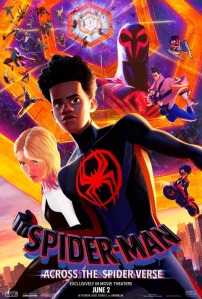
Conversely, Across the Spider-Verse is a sequel that expands an already stuffed story but knows what stories and themes to elevate so they don’t get lost amidst the fast-paced lunacy. Taking place a year later, Miles Morales (voiced by Shameik Moore) has grown into his role as the new Spider-Man for his world. He strains to meet the expectations of his parents, and keep up his grades, while fulfilling the duties of a superhero jumping into danger. When Gwen Stacey (voiced by Hailee Steinfeld) reappears to discuss joining the multiverse police, Miles jumps at the chance, having genuinely missed his other Spider friends, especially Gwen. There are countless Spider people in countless worlds, even including a Spider-T. Rex and a Spider-Car (Peter Parked Car, I believe the name was). Miguel O’Hara (voiced by Oscar Isaac) is the Spider-Man tasked with keeping order across the many interconnected multiverses, and he insists that sacrifice is essential to maintain balance, one that hits too close to home for Miles to abide.
The 2018 original is a hard act to follow, and while Across the Spider-Verse doesn’t quite overrule its predecessor it is a more than worthy sequel that has everything fans loved about the first trip. The visual inventiveness has been taken even higher, with the mixture of even more different animation and art styles. I loved seeing each Spider person and how they fit into their unique art style of their world, like the living water colors of Gwen’s world and the punky paper collage style of Spider-Punk (voiced by Daniel Kaluuya). There’s a villain that comes from a paper universe, so he resembles a three-dimensional paper construction with hand-scribbled notes appearing around him like Da Vinci’s commentary. There is something to dazzle your senses in every second of this movie. The visuals are colorful, creative, and groundbreaking with the level of detail and development. There’s probably even too much to fully take in with just one viewing. I want to see the movie again not just because it’s outstanding but so I can catch the split-second vernacular asterisk boxes that pop up throughout the movie. Going further into living comic book aesthetics, new characters will be introduced with boxes citing their comics issue reference point, and certain names and vocab will get their own citations as well. These are split-second additions, nothing meant to distract from the larger narrative. Simply put, this is one of the most gorgeous looking movies of all time, animated or live action. It’s bursting, thrumming, nearly vibrating with life and love stuffed into every nook and cranny, and it’s exhilarating to just experience a vivid, thriving world with animators operating at peak talent.

However, the movie has an engrossing story to better position all those eye-popping visuals. The worry with any modern multiverse story is that the unlimited possibilities of variations and opportunities for characters to do just about anything will overwhelm a narrative, or like The Flash, become a checklist of overburdened and empty fan service. The screenplay by Phil Lord, Christopher Miller, and Dave Callaham is all about relationships. If Miles’ relationship with his stern police lieutenant father (voiced by Brian Tyree Henry) wasn’t such an important focal point, then the emotional stakes of the movie would be meaningless. We see a relatable struggle from both sides, the parents trying to connect with their growing child and give him enough space to find himself, and the child who clearly loves his parents but doesn’t fully appreciate or understand their concerns. They worry about Miles leaving them and whether others will love and support him like his parents. Miles has to experience a wider world of possibility, but these experiences make him appreciate what he has at home, and what could be permanently lost. I don’t mind saying there were more than a few moments that caused me to tear up. I found Gwen’s storyline equally compelling, and her turmoil over keeping her secret identity and then coming out to her father was rather moving. The family bond resurfacing will get me every time, and the simple action of a hug can be as heartwarming and fulfilling as any romantic ode. Across the Spider-Verse makes sure we care about the characters and their personal journeys.

At a towering 140 minutes, this is the longest (American) animated movie ever, and it’s still only one half of a larger story. I knew ahead of time this was only the first part so as soon as we entered Act Three I kept gearing up for the cliffhanger ending. Every five or so minutes I thought, “Okay, this is going to be the end,” and then it kept going, and I was relieved. Not just because I got to spend more time in this unique universe but each new moment added even more to raise the stakes, twist the intrigue, and make me excited for what could happen next. I was shaking in my seat at different points, from the excitement of different sequences to the emotional catharsis of other moments. I cannot wait to experience this same feeling when the story picks back up reportedly in March 2024, though I fear it will get delayed to late 2024.
Even with the unlimited possibility of jokes and silly mayhem, the filmmakers keenly understand that it doesn’t matter unless we care about the characters and their fates. I am shocked that a goofy character I thought was going to be a one-scene joke, The Spot (voiced by Jason Schwartzman), could end up becoming the ultimate destroyer of worlds. I think this reflection nicely summarizes the impeccable artistry of Across the Spider-Verse, where even the moments or characters misjudged as fleeting or inconsequential can be of great power. It’s a movie that is full of surprises and thrills and laughs, all in equal measure, and a blessed experience for a movie fan. In the crush of comic book multiverse madness, Across the Spider-Verse is a refreshing and rejuvenating creative enterprise, one that builds off the formidable talent of its predecessor and carries it even further into artistic excellence that reminds us how transporting movies can be. If you see one superhero multiverse movie this summer, the choice should be as obvious as an inter-dimensional spider bite.
Nate’s Grades:
The Flash: C
Across the Spider-Verse: A
Share this:

Hypnotic (2023)
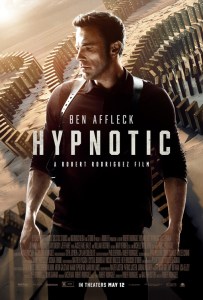
Powerfully forgettable except for its time-wasting twists and erasure of stakes, Hypnotic is an action thriller that feels out of time from the 1990s. In this movie’s universe there are a clandestine group of “hypnotics,” people with genetic powers that can manipulate others to do whatever they want. Ben Affleck plays a detective who is also searching for his abducted daughter and the case is mixed up with uncovering the secrets behind hypnotics and a mysterious and devious man (William Fichtner) who commands people to kill themselves. This should be a fun movie from its premise, Affleck chasing after killer physics like Scanners. It’s written and directed by Robert Rodriguez based on a script he’s been dying to make since the early 2000s. The problem with Hypnotic is that it wastes so much of its structure on playing into the expected, and once that happens it more or less invalidates the first hour of the movie. Once they introduce the concept of hypnotics erasing their own memories and placing triggers to remember key things, it’s not so hard to determine where the ultimate twist is heading. It leads to some serious wheel spinning from its plot, and then the end relies upon a standoff where one side is so all-powerful that there is no real danger. Therefore the emphasis of this movie hinges on the “wow” factor of its twist with little else to keep your waning attention. I suppose the appeal for Rodriguez from a directing standpoint were the sequences where the hypnotics are altering perception, watching the world bend onto itself in trippy Inception-style visuals. I wish there was more of this. The problem with Hypnotic is how unremarkable it is and how inevitable it will be forgotten (with or without your own psychic powers).
Nate’s Grade: C
Share this:

Air (2023)
 Who exactly could get that excited about a movie about selling a shoe? Apparently, plenty of critics and audiences judging by the success of Air, the dramatization of the eventual formation and presentation for the first Air Jordan sneaker. It’s Amazon’s first original movie that they’ve given a theatrical release since 2019’s Late Night, and it proved a moderate success for a mid-range adult drama before debuting on its streaming service. I was intrigued by the creative pedigree, as I’ve been an ardent fan of Ben Affleck as a director, and the uniformly strong critical reviews, but I kept thinking, “It’s just a shoe.” It was hard for me to imagine getting that drawn into a drama about a bunch of guys trying to get Michael Jordan’s endorsement. I just couldn’t see the movie in this scenario. Now that I’ve actually watched Air, I can credit it as a well-written and well-acted movie about passionate people putting forward a presentation. That’s the movie, and while entertaining, it’s still hard for me to understand all the fuss.
It’s 1984 and Nike isn’t the market-leading trend-setting company that we think of today. They dominated the running world but few if any saw them as hip. They were struggling behind Adidas and Converse in popularity and cultural cache, and CEO Phil Knight (Affleck) had tasked his basketball head of operations Sonny Vaccaro (Matt Damon) with snagging endorsements from the new NBA rookies. Sonny wants to go all-in on just one athlete, a special case that Sonny thinks can revolutionize the game, and one that could propel Nike to the next level. But first he’ll have to convince Jordan’s mother, Deloris (Viola Davis), that this smaller company with its smaller reach is going to be the best fit for her son’s potential future earnings.
 This is still a movie about a shoe, but it’s really a movie about people who are good at their jobs and trying to change a paradigm of thinking and the Way Things Are Done. I’ve seen it said that Air is “Moneyball for sneakerheads,” and that’s an apt comparison. It’s about a bunch of smart guys fighting for clout, a group of underdogs going up against the entrenched winners, but it’s really about passionate people trying to get others to recognize their passion. So it’s scene after scene of Sonny trying to break through and get others to understand why his way of thinking is going to be the best. It’s also structured entirely around the big presentation with the Jordans, with each stop at a competing shoe company as its own act break. It makes the movie feel very streamlined and focused. It allows moments for minor characters to get their own moment, to make it seem like there’s a larger world behind every scene. It makes the team feel more filled out, and as each person and artist comes together, it’s reminiscent of movies in general, about various talents coming together to put on a big show. With our hindsight already locked in before the opening credits, it’s got to be the journey that matters here, because we know the eventual coupling, so Air has to justify why the before time could be captivating. It’s engaging because it’s a story built upon underdogs and smart people getting to flex their smarts.
Of course, it’s also not too difficult to make someone look smart with the power of hindsight. This was one of the more maddening features of Aaron Sorkin’s frustrating HBO series, The Newsroom. The focus was on a TV show on a cable news network but it existed in our universe, covering the big stories from the recent past. Rather than providing insight into the struggles of journalists trying to break big stories and follow their leads, Sorkin’s show was his turn to rewrite the news, showing how the foolish journalists should have covered these major events. It was his condescending attempt to tell professionals how they should have done their jobs. However, he had the extreme benefit of 18 months or so of hindsight and seeing what was important and what was less so, which just made his critiques all the more condescending (“Why don’t you know all the things that I know from the future, stupid present people?”). I could do this myself, writing a story about a guy in the 1930s talking down to these people hoarding their gold and how they should, instead, invest in a burgeoning computer industry. It’s not hard to look smart when you have history already in your pocket. This is also the case with Sonny in Air, who says over and over how special Michael Jordan is, and we know this too with our personal hindsight, so it makes him look transcendent. However, there could be any number of guys in history that had a similar hunch about Sam Bowie, the player picked one spot ahead of Jordan in the 1984 NBA Draft and whose career was cut short by rampant leg injuries. That could have happened to Jordan too. Sometimes the greatest athletes are the recipients of just horrible luck (look at Bo Jackson, a modern-day Greek God who could have been an all-timer in two sports).
 Where Air glides is with its snappy dialogue and attention to its supporting cast, thanks to debut screenwriter Alex Convery. Despite my reservations on the subject matter, this is proof that a good writer can make any story compelling as long as they channel into the right universal elements. A movie about selling a shoe to a future billionaire becomes an underdog story and one about a group of middle-aged guys trying to live out their dreams by picking the right player to become their vicarious capitalistic dream. The side characters played by Chris Messina as a foul-mouthed agent, and Jason Batemen as an exec who mostly just wants to spend more time with his kids following a divorce, and Matthew Maher (Our Flag Means Death) as a lonely shoe designer, are welcomed and I enjoyed spending time with them all before the big decision. It’s pleasurable just to sit and listen to the conversational banter. If you can find a way to make characters debating the particulars of their industry and make it interesting regardless of industry, then that’s the sign of a good writer. There’s plenty of conflict thrumming throughout, like Sonny pushing to spend his entire department’s budget on one player rather than spreading the risk around, and the climax involves whether or not a billion-dollar company is willing to split some of its earnings with the athlete they’re making mega-million from. It was a first-of-its-kind deal that changed the industry, giving athletes more leverage and direct money for the use of their likenesses, and considering how integral Jordan was to the explosion of the NBA’s popularity, it was money well spent.
There’s no distinct directing flair from Affleck, as I think he recognizes the strengths of this script and how best to utilize them, which is to support his actors and give them space. The most noticeable directing feature is the repeated use of period-appropriate songs and archival footage, which might explain the movie’s staggering reported $90 million budget (for a shoe movie?). Affleck keeps things moving at a light-hearted tone but knows when to slow things down too.
 Air is an amusing drama with good performances and good writing and direction that understands how best to hone both of those selling points. It’s very streamlined while still feeling developed, and it manages to make a decades-old shoe deal feel interesting in 2023. I enjoyed it but I would have enjoyed this cast in just about anything, and I feel like the screenwriter and Affleck as a director have better stories on their docket waiting. It’s an enjoyable and intelligent drama with crackling good dialogue. It’s a solid movie but I guess I won’t ever understand the adoration it received, and that’s fine. Air proves you can indeed tell a compelling movie about a shoe deal. There you have it. Now back to that chicken/egg dilemma.
Nate’s Grade: B
Share this:

Daredevil (2003) [Review Re-View]
 Originally released February 14, 2003:
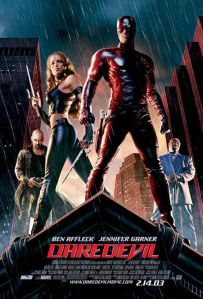
Not as bad as it could have been. That’s the best way to sum up Ben Affleck in tights.
Nate’s Grade: B-
——————————————————
WRITER REFLECTIONS 20 YEARS LATER

For many years, 2003’s Daredevil has become my handy threshold for assessing superhero cinema: if I liked the movie better than Daredevil, it was likely a good movie, and if I liked it worse than Daredevil, then it was a bad movie. It’s also fascinating to think back to a time after X-Men but before the behemoth of the Marvel Cinematic Universe, where superheroes could be cheesy while trying to be edgy and cool. This is a time before Ben Affleck was Batman, before Jon Favreau kickstarted the MCU by directing 2008’s Iron Man, before the gritty Netflix TV series of the same character, and before Colin Farrell became a widely respected actor. Behold the cheesefest that is the big screen Daredevil, written and directed by Mark Steven Johnson, previously best known as the writer of Simon Birch and Grumpy Old Men. Johnson is an avowed superfan of the comics and blind crime-fighter from Hell’s Kitchen, but in a recent 2023 interview on Yahoo, even Johnson admits his fandom sank the movie. The director admits to trying to cram in too much to appease fans and hook new audiences, and then there’s the obvious studio notes trying to make Daredevil into more popular and well-known super folk.
In the age of dour, gloomy superheroes that are held to unreasonable standards of gritty realism, or the creative control of the MCU, it’s fun to look back and see something stand out, even for some of the wrong reasons. Daredevil is still, to this day, a cheesy delight that you can have fun with or you can laugh yourself silly. Early into my re-watch, I settled into the kind of movie I was in for, with a smile on my face and the knowledge that things were going to be goofy. Young Matt Murdock is looking for his dad when he comes across him shaking down someone for money. Oh no, his dad really is a mob goon, and after he swore to his son it wasn’t so. Matt runs away from this traumatic realization only to get magic toxic waste sprayed into his eyes, but before he does so, he drops a paper in the alleyway, and it just so happens to be his report card with straight As that he couldn’t wait to show his not-a-goon dad. I laughed out loud. Daredevil cannot be taken seriously and that’s okay. He leaves a calling card of two criss-crossed D’s written in flammable liquid on the ground, which is a mystery how someone would discover this and even funnier thinking of Daredevil writing this signature after his work. Another fine example is the entire introduction to Elektra (Jennifer Garner) where adult Matt smells her before she arrives, becomes infatuated with her enough to use his blind status as an excuse to hit on her, then grabs her hand and refuses to let her go, which corresponds to the two of them flirt-fighting on a playground. It is an absurd, and occasionally creepy, sequence from start to finish, and that’s not even accounting for the blood-thirsty children chanting against the fences for the adults to fight. I was smirking or chuckling throughout Daredevil, and while I doubt that was Johnson’s artistic intention, it’s his movie’s best selling point from an entertainment standpoint.
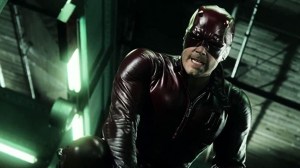 There is too much going on here, which makes all the storylines feel clipped, underdeveloped, and ultimately also worthy of derisive entertainment. We get two scenes with Elektra before she’s fallen in love with her blind man in shining leather, and then the next moment she blames Daredevil for her father’s death, and then the next moment she’s seeking vengeance, and then she’s dead, but she’s not really dead because she’s been resurrected… somehow… and spun off into her own solo movie that will be released in 2005. In this regard, being over crammed with side characters and storylines with the intent on setting up later movies, conflicts, and commercial chains of characters is very in-keeping with today’s overburdened, interconnected IP universe. It’s the same with the villains. We have two; Kingpin, the hulking crime boss played by Michael Clarke Duncan, and Bullseye, a hired killer with killer aim played with gusto by Farrell. It’s not enough to make the Kingpin the big boss of crime, the movie has to also make him literally the one responsible for the death of Matt’s father in Act One. Jack Murdock (David Keith, not to be confused with Keith David) is a washed-up boxer who wants to try again but be legit, so he ignores the warning to take a dive and is murdered for his pride. Seriously, I know his kid wanted him to win, but I think Matt would rather have an alive father with wounded pride. Bullseye is a contract killer from Ireland but why would Kingpin hire him and fly him across the Atlantic to just bump off one of the man’s subordinates? Surely there are any number of more efficient and less time-wasting manners to eliminate an underling. I guess he’s another of those comic book villains that just gets so involved in their overly complex schemes. Maybe it’s really the schemes that bring him to life (Evanescence nod) and keep the big guy from getting bored.
The action vacillates greatly from decent to ridiculous. I am absolutely positive that the Fox executives saw those 2002 Spider-Man box-office records and said, “Hey, put some of that building jumping stuff in there too.” This is a Daredevil where he just dives face-first off of buildings and plummets to the ground. Remember, he has advanced hearing and other senses, but he’s still supposed to be a human being, not a mutant, not a meta human, not a god. Diving face-first off of high buildings seems like a sound way to practice your eventual suicide. He also leaps and kicks like he’s in The Matrix, including dodging bullets too, which seems like his skills are pushing the “faster than a speeding bullet” realm of other heroes. In fact, Daredevil’s abilities seem to rival that of Superman with his intense hearing. Apparently, the man can lock in on a specific conversation blocks away. It’s these heightened moments of super impunity that make him less vulnerable even though the movie also wants to highlight his scars and bruises. This is the guy that needs to sleep in a water-filled sensory deprivation chamber (so pruny) but will throw himself into battles with multiple points of competing gunfire. The fight choreography has some slick moves but is also fairly mediocre, and it’s worse when the rubbery CGI Affleck is slotted into action to make even more preposterous moves (never dodge when a glorious backflip could do). I was beside myself when Bullseye collected broken stained glass, that he plucked from the air like snowflakes, and then piled into his hands like a server balancing stacks of plates, and then he started hurling them at Daredevil. For a guy whose notoriety is not missing, you think he would readjust or figure out that a guy flipping backwards is always going to have a turning middle of mass.
 The movie is struggling to juggle all these characters, all these storylines, and all of its would-be brooding themes and Catholic imagery of sacrificial bloodshed. It makes the movie feel like you’ve accidentally sat on the remote, speeding up the process of its 105 minutes. Johnson had a longer cut of the movie with a whole subplot of lawyer Matt Murdock, but that’s not what the people come to see. The character arc of Matt finding love and losing love is rushed and feels insufficient, more of a checkbox for the studio. Given the material, it’s surprising that Affleck and Garner would fall in love in real life and get married in 2005 (and then divorced in 2018). The arc of him learning restraint, to not be “the bad guy,” is laughably simplified to the point where just not killing the big crime lord is supposed to qualify as applause-worthy character growth. It’s enough that the crusading journalist (Joe Pantoliano) trying to bring light to this case decides to become part of the conspiracy and withhold information, enough so that he stares out of his home, jacket slung over his shoulder, and sees Daredevil watching from atop the street (how would he know?) and says, “Go get ‘em,” like he’s Mary Jane Watson cheering on her web-slinging beaux. It’s moments like this that you can’t take seriously but can appreciate as goofy mid-level supes entertainment. Daredevil is not great but it could have been much worse.
After the reception of this movie, it’s surprising that Affleck would want a second chance to suit up as a superhero, but then again being Batman is like playing Hamlet in our modern society. With Daredevil, he does seem uniquely qualified as a handsome man staring blankly. Garner was ascending thanks to her breakout role in J.J. Abrams’ Alias, and Farrell was becoming a Hollywood It boy in 2003 before finding a higher artistic ceiling with 2008’s In Bruges. He’s a hoot in the movie but he might have twenty total spoken words. It’s more a performance of grunts and scornful growling. Duncan was a controversial casting but an early example of race-blind casting traditionally white comics characters. It’s rare to find an actor of imposing size and stature that can still, you know, act well. With respect to Vincent D’Onofrio, who was my favorite part of the Netflix Daredevil series, but if the Kingpin were cast today, it would be Dave Bautista (Knock at the Cabin) hands down. Johnson was given another chance at superhero franchise-making with 2007’s Ghost Rider, which was also enjoyably goofy but also bad. I feel for the guy because he was fighting battles for genre credibility and superhero universe logic that most of the filmmakers in the MCU today take for granted. He walked so that James Gunn could run.
Twenty years later, Daredevil still kind of works as my superhero movie grading threshold. It’s not traditionally good but it has a nostalgic charm, an artifact of a time before the eventual boom. It’s so goofy and so early 2000s-edgy (the hard rock soundtrack is its own contribution of hilarity). With the right mindset, I think Daredevil can be fine albeit dated and cheesy passing enjoyment.
Re-View Grade: C+
Share this:

Clerks III (2022)
 I’m at a crossroads with writer/director Kevin Smith. Well, I might actually have already switched sides but don’t want to fully admit it yet even if it’s self-evident. I’ve written about this before but Smith was one of those major cinematic voices that helped shape my sense of indie film and even comedy during my formative teenage years. I became a diehard fan, watched every movie several times and had all their interconnected Easter eggs memorized, and I’ve seen the man in person three times, one time recorded for a college Q&A DVD release. In short, I was most definitely a Kevin Smith super fan. Then over the last five years or so, things began to change, or more accurately my perception of Smith’s movies began to change. The attempts at humor were strained, obvious, and gassed, and it felt like his biting wit and raunch had transformed into mawkish nostalgia. The man in his twenties who made comedies I identified with and loved became a man in his forties with different priorities and a different perspective. He evolved. However, I am no static creature, and I too was evolving, and my fanfare for Smith’s comedy sensibility has transformed into more of a pained grimace. I re-watched Dogma in 2019 and Jay and Silent Bob Strike Back in 2021, as well as its second-banana imitation Jay and Silent Bob Reboot in 2019, and my assessment was only reaffirmed with each movie: I’ve outgrown my old influence. As a big screen storyteller, Smith has become more and more insular, inaccessible, and beholden to eroding fan-service, almost like he too is trying to bid goodbye to his own universe of characters. Maybe that will be the big reveal, Smith putting all his toys back away while he still can.
Clerks III is a return to the old QuickStop convenience store in Red Bank, New Jersey, last seen in 2006 with friends and malcontents Dante Hicks (Brian O’Halloran) and Randall (Jeff Anderson) as the new owners. Clerks II seemingly ended on a moment of triumph, of the guys returning to their roots but also stepping up, assuming ownership responsibilities. However, many can also view the ending as a darker indictment on what the future held for these men. Sixteen years later, what have these men accomplished? That’s the thrust of this third film, following Randal’s brush with death from a heart attack (based upon Smith’s own life-threatening experience). He re-evaluates his life at 50 and yearns to make a movie about his life and his personal experiences, which just happens to be life in service at the QuickStop. He bands together with Dante as producer and they put together a ragtag crew, including old buddies now selling their own state-approved brand of bud, Jay (Jason Mewes) and Silent Bob (Smith), to make their movie.
 In many ways, Clerks III is like a remake of Clerks with the characters of Clerks making their own version of Clerks only thirty years removed from the actual scenes of Clerks. There’s a bit of a snake eating its own tail feeling; many scenes are re-creations of moments from the original Clerks and with the same actors. It’s slightly fun to see even the smaller non-actors come back to recreate these moments, but it also makes the movie feel like an extended high school reunion (“Oh look, that guy lost his hair.”). If you were not a fan of Clerks, well you shouldn’t really be watching the third film in the series, but if you didn’t have an attachment to these characters and this odd world, seeing older versions of former fleeting characters, from the Chewlie’s Gum rep to the angry ruse-baiting video store customer or the woman who manually masturbates caged animals, would feel like flipping through someone else’s photo album, devoid of whatever nostalgic or emotion was intended.
As a lifelong fan of Smith’s filmography, or at least a former lifelong fan now transitioning to accepting a parting of ways, it’s neat to see this reunion of sorts, but it’s also ultimately pointless from a narrative standpoint. Smith is treading the same ground now with irony and distance. Actually, the irony gives way more to sentimentality. It’s not an insult to say that Smith has gotten increasingly softer as he’s gotten older, blunting much of his comedy edge. He comes across as a sincere man who really cares for the people in his life, including these very people that contributed their time and efforts in 1992 to help make a young man’s dream come true. I understand his desire to pay back all the little people, to check back with them one more time, and to have Clerks III serve as a love letter to those who were there from the very beginning. If you’re plugged into this universe, you might smile and you might also feel some of the love.
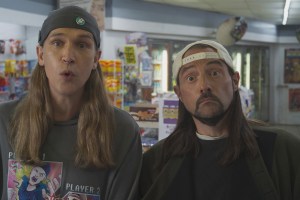 There are famous cameos to balance out the lesser known faces from the original Clerks. You’ll see Ben Affleck hamming it up, Justin Long doing a funny voice, Fred Armisen grasping for something to do, and Sarah Michelle Gellar’s first film role since 2012 and first live-action film role since 2009’s Possession (Gellar was a voice on Smith’s Masters of the Universe animated series on Netflix). The two big additions from Clerks II also return. Trevor Fehrman, returning as the socially awkward coworker Elias, is the funniest part of the movie as his character goes through a spiritual crisis. He feels let down by Jesus and commits himself to Satan, and his runway show’s worth of crazy outfits and cosplays throughout the movie is the funniest joke that never even bears mentioning, which only makes it funnier (he too has his own Silent Bob-esque quiet sidekick played with good spirits by Austin Zajur). Elias was the voice of a younger generation of Internet fandom in Clerks II, allowing Smith his opportunity to criticize modern geek pop-culture, like the Star Wars prequels and Lord of the Rings. That doesn’t really happen in Clerks III despite 16 years of Dante and Randal’s cinematic absence. Smith doesn’t even nibble or good-naturedly rib any pop-culture landscape. Even the jokes about NFTs feel hesitant and wishy-washy and lazy. Smith was defined by his ribald wit and hyper-literate dialogue, and now his comedy has become inane slapstick and pandering nods meant to serve as a replacement for an absent punchline. It’s disappointing how little the comedy registers now.
The biggest addition to the Clerks trilogy was Rosario Dawson, now even more popular as she’s firmly solidified in the Star Wars TV empire. I figured she would have been written out of the franchise as her availability was going to be far more limited. It’s not a spoiler considering it’s revealed within the first minute or so, but Dawson’s character, Becky, who was pregnant with Dante’s child and this presented a new route for his future, is dead. Not only is Becky gone but she died in 2006 from a drunk driver, which means that her unborn child with Dante also died, though this is never touched upon and that seems truly bizarre because much of Dante’s characterization in this movie will be his prison of grief he’s been unable to break from. It’s been 16 years and Dante has not moved on, and I wish more of this was explored thoughtfully. He views himself as a man stuck, now in his 50s, and having missed his off-ramp to another and better life. Without more careful attention, it can come across like a schlub holding onto his grief as a mistaken form of identity. Even that description could be interesting, but you’re not going to get that level of drama in something like Clerks III. Dawson does have a few appearances as a ghostly memory trying to help Dante move on, though if this is the case, I feel like she should be reaching some kind of breaking point after 16 years of effort.
 By the end of Clerks III, it’s clear that Smith intends for this to be the concluding chapter, sending off these characters as reflections of his own film history. The focus of the final act is far more dramatic, as the act of retelling one’s life story as a movie becomes its own way of sharing the love and admiration of a decades-long friendship. I don’t quite think Smith gets to the dramatic heights he’s reaching for, even when some pretty significant and surprising events play out. Too much of the movie is like watching a low-budget remake of Clerks thirty years late, and while I’m a sucker for movies about the making of movies, and those fun found families of creatives banding together, the structural vehicle and conceit for Clerks III left much to be desired. If you remember the scenes of 1994’s Clerks, watching Clerks III is like reliving them as a strange Lynchian dream where the edges are smudged and everything isn’t quite as it should be. At this point, a new Kevin Smith movie is made strictly for the most diehard of fans. I can see that ever-shrinking pool of fans warmly smiling and chuckling from the movie but more in nostalgic recognition of time gone by. It’s nice to revisit these characters, as I’ve been eager to see what life has dealt them since Clerks II. You can feel Smith’s affection for these people, the ones who catapulted him into fame, but the movie is too backward-looking and uninterested in its own comedy as Smith winds down.
Nate’s Grade: C
Share this:

Deep Water (2022)
 Whatever happened to the steamy Hollywood erotic thriller? This adult genre used to dominate theaters, especially during the 1980s and 90s (Basic Instinct was the highest grossing movie of 1992). With the rise of the Internet and a plethora of personal options, many people don’t feel like they need to go to the movies in order to feel some heat. I’m sure more international movies are picking up this American slack, but there has been a real dearth of the erotic thriller (I’ll theorize why later) and this corresponds with the absence of director Adrian Lyne, one of the kings of the erotic drama. Lyne is responsible for Fatal Attraction, Nine and a Half Weeks, Indecent Proposal, Flashdance, and 2002’s Unfaithful, which happened to be the director’s last movie. Yes, it’s been twenty whole years since Lyne made another movie, and his newest is mining the territory of old, but Deep Water sure does feel dated and not worth the extended wait.
Melinda (Ana de Armas) and Vic (Ben Affleck) have a special understanding with their marriage. She sleeps with other men while he allows it and feels jealous about it. Vic jokes about killing one of his wife’s former lovers, and when the man winds up dead, he becomes the police’s first suspect.
 I have a theory why these movies have become less and less over the ensuing years, and it mainly comes down to the fact that it’s hard to do well. Erotic thrillers are easy to fall into camp, or being overwrought, and they skirt the line between exploitation and enjoyably trashy. It’s meant to be tantalizing but that usually just amounts to repurposing the same familiar male gaze compositions. There gets to be a same-y feel to many of them, enough that there was an erotic thriller spoof in the 1990s, the decade where just about every genre got its spoof movie. It feels like the same ogling of feminine beauty we’ve been getting for decades, the same heavy breathing, the same blue-tinted lighting, the same lip biting, the same arched backs, etc. It’s also a delicate line between arty eroticism and smut (see: Fifty Shades franchise), and that can also be very personally subjective.
Beyond that, I think this subgenre has also suffered in the light of the recent MeToo movement, wherein Hollywood has, reportedly, taken a closer look at its depiction of women. That doesn’t mean things are magically better today, but it does speak to the general culture becoming more conscious of sexual harassment and problematic portrayals, and the erotic thriller genre is built upon the bedrock of dangerous, sexy, experimental, loose women as problematic. I’m not saying these movies can’t be enjoyed on some level, but I think most audiences find them more sleazy than steamy, and I think the heavy male gaze and gratuitous nature of a majority of the movies, as well as the substandard scripting, lead to that dismal conclusion.
With all that being said, Deep Water mostly flounders because it’s just so contrived and boring. This is one of those movies where characters continually make dumb or aggravating decisions because the plot requires them to. I routinely said, “Why is [Character X] doing [stupid thing]?” and there was never a really supportive answer. The very premise of the movie is flawed. Vic and Melinda have an open marriage and apparently the whole town knows this, but this open relationship is built upon placating Melinda. She doesn’t want to have any intimacy with her husband and seeks out the company of other men. Vic is less an understanding party and more a jealous husband, proving this decision to be one-sided. Vic isn’t helping his wife find her next lover, he’s stewing in the corner and glowering at the newest man. As a starting point for a relationship drama, this is fine, but the screenplay has to offer a valid reason why this character would agree to these terms. What is keeping this marriage alive while he suffers in stern silence? The answer is even less. Vic agrees to let his wife sleep with other men so they won’t get divorced. That’s it. Is this the nineteenth century? Would being divorced be so scandalous? This is preposterous reasoning for prolonging this character’s obvious discomfort and turmoil.
 The other question, never answered, is why Vic would want to keep Melinda. Of course de Armas (No Time to Die) is an attractive woman, and everyone in this movie’s comically absurd small universe seems to be infatuated with her, but for what reason? At no point in the film’s 110 minutes does Melinda come across as charming, or intriguing, or even remotely interesting. That’s because she’s not a real character here but a trophy, a prize for men to covet. She’s also clearly understanding what torment she is causing her husband or she is the most oblivious person on the planet, which could also be true because the characterization on display isn’t exactly human. She seems to enjoy teasing her husband and cutting off their attempts at physical intimacy, which then leads to sad bike rides or angry bike rides. Look, there is a comical amount of bicycle usage in this movie, including one car chase that had me laughing out loud. Regardless, Melinda is portrayed as a lousy human being but, even more criminal, she is a boring character. In short, it’s a mystery why Affleck’s glum character would continue his marriage to this awful person.
Another frustrating choice is its lopsided structure. The first half is rather boring and repetitive, as we watch man after man come into the picture only to be scared off by Vic, who gloats that he killed one of Melinda’s last lovers. First off, this character has actually gone missing, so why would any character, no matter how self-destructive they can be, publicly joke about this on multiple occasions, enough so that every member of this gossipy community can recollect? It’s revealed later that this character is indeed found dead, and Vic becomes an immediate suspect because of course he would be, even without his “bad joke.” The problem is that the movie spends far too long playing this silly game of whether or not Vic is the killer when only two possible outcomes can emerge. Either he is the killer and we’ve been wasting time leading to an obvious conclusion, or he is not the killer and not enough work has been put in to present an alternate scenario that could be credible. The movie makes a definite choice in that matter (I’ll detail in a spoiler paragraph below) and I couldn’t help thinking it was the wrong choice. The question over Vic’s culpability is not enough to sustain this movie.
 And now let’s delve into spoilers, so if you wish to remain pure and virtuous, well you should skip this movie entirely, but you can also skip to the next paragraph. The question over whether Vic is guilty can be a bit confusing because there are flashes throughout the first half that you cannot determine whether they are Vic imagining killing these suitors or Vic remembering killing these suitors. The police force of this town must be the worst because Vic is a terrible murderer. Yes, dear reader, he really is killing all of his wife’s lovers, which would seem to obviously implicate him as far as what these men all have in common. He’s also bad at leaving behind evidence and hiding corpses in shallow bodies of water (the title is its own joke). If this was the eventual reveal, the movie spends far too much time getting here without any significant doubt beforehand. There are no alternate suspects presented. If it was going to be Vic the entire time, this is a turn that’s best to be revealed as the Act One break, not late in Act Three. This doesn’t work as a final reveal but more as an early development, and then we would follow the character as he bumbles his way through covering up his crimes, only getting into bigger and bigger trouble. Then it becomes more of a farce, but it at least has a more pleasing plot structure of watching a character try and get out of their own danger rather than the audience being ignorant.
So is there a real reason to dive into Deep Water? Not really, even if you’re a fan of the woe begotten genre of erotic thrillers. It exists in one of those hilariously bourgeoisie universes where everyone is having these unrealistic house parties where dopey rich people canoodle all the time, white win in hand, and snipe at one another like it’s catty Regency England. What are Lil’ Rel and Tracy Letts doing here? The characters are just flat-out dull and frustrating to watch, and not even in a somewhat fun sexual tension kind of way. Affleck and de Armas carried on a relationship after this movie but you’d be hard-pressed to wonder why over the course of 110 minutes of exasperated edging. The structure of this movie is all wrong, which makes it feel so boring, and contrived, and repetitive, and if you’re looking for something smoldering or sexy, well it’s the same old same old, and even that is in shocking short supply. Deep Water works best as a movie to yell at in confusion. It’s also further proof about why the erotic thriller is mostly an artifact of the past and why it should likely remain so. There is nothing deep about this movie.
Nate’s Grade: C-


 nathanzoebl

You must be logged in to post a comment.