Blog Archives
Drive-Away Dolls (2024)
 Drive-Away Dolls is an interesting curiosity, not just for what it is but also for what it is not. It’s the first movie directed solo by Ethan Coen, best known as one half of the prolific filmmaking Coen Brothers, who have ushered in weird and vibrant masterpieces across several genres. After 2018’s The Ballad of Buster Scruggs, their last collaboration, the brothers decided to set out on their own for an unspecified amount of time. This led Joel Coen to direct 2021’s atmospheric adaptation of Macbeth, and now Ethan has decided that the fictional movie he really wants to make, unshackled by his brother, is a crass lesbian exploitation sex comedy. Well all right then.
Set in 1999 for some reason, Jamie (Margaret Qualley) is an out lesbian who unabashedly seeks out her own pleasures, even if it brings about the end of her personal relationships. Her friend, Marian (Geraldine Viswanathan), hasn’t had a lover in over three years and is much more prim and proper. Together, these gal pals decide to drive to Tallahassee, Florida using a drive-away service, where they will be paid to drive one way, transporting a used car. It just so happens that these women have mistakenly been given the wrong car, a vehicle intended for a group of criminals transporting contraband that they don’t want exposed. Jamie is determined to get laid and help Marian get laid all the while goons (Joey Slotnick, C.J. Wilson) are trailing behind to nab the ladies before they discover the valuable contents inside the trunk of their car.
 Drive-Away Dolls is clearly an homage to campy 1970s exploitation B-movies but without much more ambition than making a loosey-goosey vulgar comedy consumed by the primal pursuit of sexual pleasure. I was genuinely surprised just how radiantly horny this movie comes across, with every scene built in some way upon women kissing, women having sex, women talking about having sex, women pleasuring themselves, women talking about pleasuring themselves, and women talking about pleasuring other women. When I mean every scene I mean virtually every scene in this movie, as the thinnest wisp of a road trip plot is barely holding together these scenes. From a representational standpoint, why shouldn’t lesbians have a raunchy sex comedy that is so open about these topics and demonstrates them without shame? Except it feels like the crude subject matter is doing all the heavy lifting to make up for the creative shortcomings elsewhere in the movie, which, sadly there are many. The script is co-written by Coen and his wife of many years, Tricia Cooke, an out lesbian, so it feels like the intent is to normalize sex comedy tropes for queer women, but the whole movie still feels overwhelming in the male gaze in its depictions of feminine sexuality. I’m all for a sex-positive lesbian road trip adventure, but much of the script hinges upon the uptight one learning to love sex, which means much of the story is dependent upon the promiscuous one trying to then bed her longtime friend and get her off. Rather than feel like some inevitability, the natural conclusion of a friendship that always had a little something more under the surface, it feels more like a horny and calculated math equation (“If you have two gay female leads, you can get them both kissing women by having them kiss each other”).
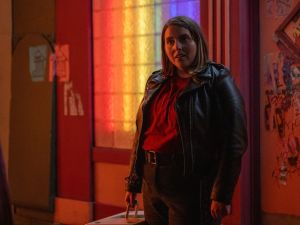
I’m sad to report that Drive-Away Dolls is aggressively unfunny and yet it tries so hard. It’s the kind of manic, desperate energy of an improv performer following an impulse that was a mistake but you are now watching the careening descent into awkward cringe and helpless to stop. The movie is so committed to its hyper-sexual goofball cartoon of a world, but rarely does any of it come across as funny or diverting. When Jamie’s ex-girlfriend Suki (Beanie Feldstein) is trying to remove a dildo drilled onto her wall, she screams in tears, “I’m not keeping it if we both aren’t going to use it.” The visual alone, an ex in tears removing all the sexual accoutrements of her previous relationship, some of which can be widely over-the-top, could be funny itself. However, when her reasoning is that we both can’t use this any longer, then the line serves less as a joke and more a visual cue for the audience to think about both of them taking turns. It doesn’t so much work at being funny first and rather as a horny reminder of women being sexual together. The same with a college soccer team’s sleepover that literally involves a basement make-out party with a timer going off and swapping partners. It’s not ever funny but features plenty of women making out with one another to satisfy some audience urges. I will admit it serves a plot purpose of first aligning Jamie and Marian into awkwardly kissing one another, thus sparking carnal stirrings within them.
 My nagging issue with the movie’s emphasis is not a puritanical response to vulgar comedy but that this movie lacks a necessary cleverness. It doesn’t really even work as dumb comedy, although there are moments that come close, like the absurd multiple-corkscrew murder that opens the movie. It’s just kind of exaggerated nonsense without having the finesse to steer this hyper-sexual world of comedy oddballs. The crime elements clash with the low-stakes comedy noodling of our leads bumbling their way through situation after situation that invariably leads to one of them undressing or inserting something somewhere. The brazen empowerment of women seeking out pleasure is a fine starting point for the movie, but the characters are too weakly written as an Odd Couple match that meets in the middle, the uptight one learning to loosen up and the irresponsible one learning to be less selfish. The goons chasing them are a pale imitation of other famous Coen tough guys; they lack funny personality quirks to broaden them out. There’s a conspiracy exposing political hypocrites condemning the “gay agenda,” and I wish more of this was satirized rather than a briefcase full of reportedly famous phalluses. If you got a briefcase full of famous appendages, I was expecting more jokes than blunt objects.
I feel for the actors, so eager to be part of a Coen movie, even if it’s only one of them and even if it’s something much much lesser. Qualley (Once Upon a Time… in Hollywood) is a typical Coen cartoon of a character, complete with peculiar accent and syntax. She’s going for broke with this performance but the material, time and again, requires so little other than being exaggerated and horny. There is one scene where her physical movements are so broad, so heightened to the point of strain, that I felt an outpouring of pity for her. It feels like a performance of sheer energetic force lacking proper direction. Viswanathan has been so good in other comedies and she’s given so little to do here other than playing the straight women (no pun intended) to Qualley’s twangy cartoon. Her portrayal of sexual coming of age and empowerment was better realized, and funnier, in 2018’s Blockers, a superior sex-positive sex comedy.
 As a solo filmmaker, Ethan Coen seems to confirm that his brother is more the visual stylist of the duo. The movie is awash in neon colors and tight closeups of bug eyes and twangy accents, but the most annoying stylistic feature, by far, is the repeated psychedelic transition shots, these trippy interstitials that don’t really jibe with anything on screen. It felt like padding for an already stretched-thin movie that can barely reach 75 minutes before the end credits kick in. That’s why the extended sequences where the intention seems exploitation elements first and comedy second, or third, or not at all, makes the whole enterprise feel like a pervy curiosity that has its empowering yet obvious message of “girls do it too” as cover. Agreed, but maybe do more with the material beyond showcasing it. Ethan Coen is a prolific writer who has written short story collections (I own his 1998 book Gates of Eden), poetry collections, and he even wrote five one-act plays before the pandemic struck in 2020. I’d love to see those plays. This man has true talent but it’s just not obviously present throughout this film.
Drive-Away Dolls is an irreverent sex comedy with good intentions and bad ideas, or good ideas and bad intentions, an exploitation picture meant to serve as empowerment but still presents its world as exploitation first and last. It’s just not a funny movie, and it’s barely enough to cover a full feature. I suppose one could celebrate its mere existence as an affront to those puritanical forces trying to oppress feminine sexuality, but then you could say the same thing about those 1970s women-in-prison exploitation pictures. It’s a strange movie experience, achingly unfunny, overly mannered, and makes you long for the day that the two Coens will reunite and prove that the two men are better as a united creative force; that’s right, two Coens are better than one.
Nate’s Grade: C-
Share this:

The Humans (2021)
 I was left cold and confused by The Humans. It’s an adaptation of a Tony-award-winning play, by the playwright himself, and I don’t know what all the fuss is about. It’s a sparse movie set during a tense Thanksgiving dinner while a dysfunctional family moves one of their own into her New York City apartment. The conversation style is very natural and the characters behave like recognizable people; however, that doesn’t make them particularly interesting. This was the same issue I had with last year’s Shit House movie, a movie that confused realistic conversations with interesting conversations. Just eavesdropping on people and getting the occasional spark of conflict is not enough. I was relatively bored throughout and then when the movie tries to lurch into paranoia horror I had no idea what was happening. It feels like a dull drama that had no real ending and then someone said, “What if we spent the last ten minutes of this chamber piece conversation walking down dark corridors and inspecting noise?” The acting talent here is tremendous, including Amy Schumer in a rare dramatic role, and it just feels like a waste of their time. I don’t know what proved so appealing to critics here.
Nate’s Grade: C
Share this:

Booksmart (2019)
 Booksmart is the directorial debut of actress Olivia Wilde and it’s a hilarious, heartfelt, and often delightful teen sex comedy that has more on its mind than studying. The focus is on two overachieving best friends (Beanie Feldstein, Kaitlyn Dever) who realize, on the last day at school, that they haven’t cut loose for their entire high school careers. They pledge to find a big party, make a move on their crushes, and show all the popular kids just how much fun they can be too. The concept might resemble Superbad (including starring Jonah Hill’s sister, Feldtsein) but this is much more than simply a “female Superbad.” The movie doesn’t do anything revolutionary in the teen movie mold, but it adapts to its new settings. There’s a prominent gay first love storyline that leads to elation and heartache. There’s a strong feminist undercurrent about what expectations are placed on women, fairly and unfairly. There’s also a wider sense of empathy and complexity to the whole movie; the large ensemble of supporting players get considerate shading, which makes them more than how they’re casually perceived. It all relates to a larger theme that people are more than their appearances and reputations. It’s also wonderfully funny and had me laughing routinely from beginning to end including some big moments and set pieces that were smartly developed. There are fantastic running jokes and great surprises, while not losing the grounded sense of what makes the film special. The humor is also character-based and there’s a genuine honesty to its depiction of the reality of being young in modern America. Dever and Feldstein are a terrific pair and feel like legitimate best friends. The whole movie floats along with such effortless charm, tying up our wide ensemble of characters in a concluding graduation ceremony that feels downright joyous. I really cared about these women by the end. Booksmart is the kind of movie more teen comedies should aspire to be, and it’s worth definitely worth checking out.
Nate’s Grade: A-
Share this:

Lady Bird (2017)
 Coming-of-age movies typically coast on a combination of mood, sense of place, and character, and Greta Gerwig’s Lady Bird excels in all areas and supplies a straight shot of happiness to the senses. Gerwig serves as solo writer and director and tells a semi-autobiographical story of “Lady Bird,” a quirky, determined, feisty, self-involved, and vulnerable teenager (Saoirse Ronan) trying to leave the lower-middle-class confines of her Sacramento life for bigger pastures. Ronan (Brooklyn) is spectacular in the title role and displays a heretofore-unseen sparkling sense for comedy, punctuating Gerwig’s many witty lines with the exact right touch. This can be a very funny movie and it has a deep ensemble of players. Ronan’s character is a magnetic force of nature that commands your attention and finds ways to surprise. The film follows her high school senior year’s ups and downs, potential new friends, bad boyfriends, social orders, family struggles, jobs, and most importantly her dream of getting into an East Coast college and leaving the trap she sees is her hometown. Her parents (Laurie Metcalf, Tracy Letts) are stressed and exasperated with their demanding daughter. Metcalf (TV’s Roseanne) is outstandingly affecting as the beleaguered matriarch. Much of the movie’s ongoing conflict, and later triumphs, revolve around the fraught mother/daughter relationship, and Ronan and Metcalf are never better than when squaring off. This is a movie rich in authentic lived-in details and observations. It can stray into overly quirky territory but Gerwig as director has a remarkable feel for when to hold back. There’s a genuine and poignant family drama at its heart that doesn’t get lost amid the whimsical additions that cater to Lady Bird’s vibrant personality. By the end of a coming-of-age movie, the characters should feel a little wiser, having learned through heartache, bad choices, and changes in perspective. This isn’t a movie about big moments but about the ebb and flow of life and the formation of one’s sense of self. We should enjoy having spent time with these characters on their journeys. With Lady Bird, I couldn’t stop smiling like an idiot.
Nate’s Grade: A-
Share this:

Neighbors 2: Sorority Rising (2016)
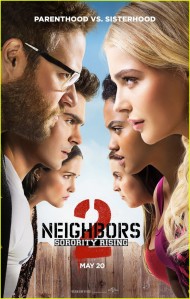 The first Neighbors was a pleasant surprise, a gross-out comedy with heart, cross-generational appeal, and a surprising degree of sincere attention to round out its cast and supporting characters. For my money it was a comedy that checked all the boxes. Now two years later comes a sequel that looks to repeat just about all the plot mechanics of the first except with a sorority replacing the fraternity. It looks like it’s checking the standard more-of-the-same sequel boxes. I was again pleasantly surprised, especially how little Neighbors 2 repeated the comic setups and jokes of the original (the malignant comedy disease known as Austin Powers Sequel Syndrome) and how much I still enjoyed these characters. Seth Rogen and Rose Byrne are now expecting their second child and trying to sell their house. They have to pass a 30-day escrow period without their buyers rescinding their purchase. That’s when Chloe Grace Moritz transforms the next door home into an off-campus sorority. She’s appalled at the gross and derogatory nature of fraternity-hosted parties and an unfairly arbitrary rule that sororities can’t host parties. She and a couple one-note stock fiends throw a female-friendly party house (Feminist Icon parties and bawling your eyes out to The Fault in Our Stars) where they won’t cotton to uncheck male ego. I was laughing throughout the movie with some big laughs at key points. Rogen and Byrne maintain a wonderful comic dynamic and the warring generations premise can still produce plenty of entertaining set pieces. The jokes can be sly and come at you from different angles, taking you be surprise (a “bun in the oven” joke had me almost spit out my drink). There are some things that don’t quite work, mostly how listless and self-involved the female coeds come across and some of their hollow arguments in the name of feminism. I guess equality does mean that women can behave as badly as men. Neighbors 2 replaces a bit of the heart of the first film with an excess of slapstick. There’s also a weird corporate synergistic tie-in with Minions that never quite settles. Still, Neighbors 2 is a satisfying sequel that reminds you what you enjoyed about the first film while not being indebted to what made it succeed.
Nate’s Grade: B


 nathanzoebl
You must be logged in to post a comment.