Blog Archives
Emancipation (2022)
 There is a question with every new movie depicting the Holocaust or slavery or some other horror of the past, why do we need this still? It’s a suitable question but one that rests upon the fleeting assumption of history being settled upon. “We all agree slavery was bad,” some opponent might say, “So why do we need another movie to convince us what we already know?” One need only look at the last couple years and the diverging controversies over teachers covering the ills of America’s past with clarity, and it’s clear that the idea of settled-upon history is an illusion. There will be people arguing slavery wasn’t as bad as history has perpetuated, that even the Irish experienced something similar as indentured servants (but they were still legally viewed as people). Some will erroneously argue that slaves were there by choice, or that their masters weren’t all cruel, and that even by having a roof over their head and the bare minimum for sustenance that they were “looked after.” There are battles happening all over the country, with one side trying to present the evils of slavery in an unvarnished manner and the other trying to obfuscate, mitigate, or distract from the facts because accepting a reality that your country has made mistakes somehow means being unpatriotic or loving your country considerably less. So to answer the question, as long as we have others denying history for political expediency, then yes, we need more media to remind us that the horrors of the past were indeed horrific. With that in mind, Emancipation is meant to be a rousing spectacle about one man’s incredible fight for freedom, but what it really comes across is a fumbling awards movie as awkward action movie.
Peter (Will Smith), or known as Gordon, is separated from his family and forced to work on the Confederate railroad in 1863 Louisiana. He hears about President Lincoln’s Emancipation Proclamation freeing the slaves and believes if he can just get to a Union camp, then he can return to his family. Peter fights back and escapes into the swamps and heads for Baton Rouge, a five-day journey. On his trail is the dangerous slave catcher Jim Fassell (Ben Foster), who will stop at nothing to secure Perter and prove his racial superiority to his fugitive.
 There are two competing impulses running through Emancipation that never seem to coalesce, always pulling the movie in opposite directions or at least undercutting its value in entertainment or substance. On the surface, Emancipation looks like an awards-ready spotlight. It’s got Will Smith playing a real-life historical figure who suffered greatly but triumphed in the end, a man whose image lives on in our history books (well, depending upon your state) and contributed to the abolitionist movement. He was a real person who made a real difference during a tumultuous time. I get a strong sense that Smith was following the 2015 template of Leonardo DiCaprio’s The Revenant for this project, and especially the Academy-friendly model of physical torment equaling Oscar gold as it did for Leo. It’s hard not to feel like the movie was formulated as an awards gamble, that sizing up all the elements, Smith saw a fast track back to the Oscars (this was in production before Smith did win his first acting Oscar for 2021’s King Richard). Naturally, Smith isn’t the first person to select Oscar-friendly roles for the purpose of earning some serious acting trophies. Nor should he be inordinately penalized for that ambition. All that matters is the end result, and it’s there where Emancipation struggles with its own identity crisis and where its transparency becomes a hindrance.
This movie wants to be a substantive drama that can enlighten us about the perseverance of the human spirit, and for the first thirty minutes Emancipation feels honed from the likes of 12 Years a Slave. Then at the Act One break, Peter and several other slaves break free, and from there the story becomes a tense chase movie for an hour, only to conclude its final half hour as a war movie akin to Glory. It’s a tonal balancing act that doesn’t quite work. I was interested in the first 30 minutes, which establishes the brutality of slavery in a way that feels empathetic but tasteful. It’s a question whether or not historical horrors should be watered down, made palpable to a wider audience, and if in doing so dilutes the power of history, but that’s another debate. When the movie becomes an elongated chase sequence is where my patience began to wane. This is where director Antoine Fuqua really seems to settle in, playing into his background of action movies (Training Day, The Equalizer, Olympus Has Fallen, The Magnificent Seven). Fuqua’s instincts are for action movies, and that’s what Emancipation becomes, but it so clearly wants to also be Something More and doesn’t quite accumulate into that. The Revenant stretch is reliant upon episodic survival and the final half hour is about a war charge. I suppose one can be generous and say that Peter’s canny survival skills are overt characterization, or that the environmental threats are representative of a larger hostile world, but the action movie parts were pretty to look at but also emotionally inert for me.
 I considered the lead character in 12 Years a Slave to be the least interesting person in his own story, but the movie found plenty of space for more immediately compelling figures. Not so with Emancipation, as once Peter goes on the run, it feels like overall characterization is put on hold. Smith is perfectly reasonable as a determined and dehumanized individual pushing back against the monstrosity of slavery, restricting much of his performance to the physical realm. The sheer intensity of his eyes can convey plenty that the script characterization lacks. Smith lowers his voice modulation, adopts an inconsistent Haitian accent, and gives a rather subdued performance given the sensational material. I think it’s because the film is geared more as an action movie rather than as an in-depth character study, so when we’re left with the characters, their limitations emerge.
This paucity also extends to the supporting characters. At first I thought that Charmaine Bingwa (The Good Fight) was going to be relegated as the suffering wife for our protagonist to get home, but then the movie keeps cutting back to her like she’s having prophetic dreams. What is happening here? The check-ins with Peter’s wife all deliver the same obvious information, namely his family misses him. This woman doesn’t even get a storyline of her own in the meantime, a conflict to overcome to keep her family out of further harm in the absence of Peter. The biggest supporting character is the villain, and even he is boring. Foster made a name for himself playing psychopaths in late 2000s cinema and has matured with more nuanced roles in The Messenger, Hell or High Water, and Leave No Trace. He’s one of our best actors, and yet he’s given so little here. His slave catcher gets a monologue that’s meant to provide insight into his admiration for the intelligence of black people. I kept waiting for something more with this guy to define him beyond a stock racist. I guess maybe the movie is saying he’s not as racist because he begrudgingly concedes that slaves aren’t stupid, but he’s still massacring them, so it feels like a minimal distinction of character. He also gets defeated in such an anticlimactic manner. If he’s only a stock villain, at least give us the thrill of defeating him.
 The cinematography by Robert Richardson (Once Upon a Time… in Hollywood) is at once gorgeous and also confounding. The emphasis is on deep focus, so you can see lots of rich details in elegantly framed compositions. There are sweeping camera movements, especially during the war-torn finale worthy of Matthew Brady, that are breath-taking, again calling attention to its handsomely mounted pedigree. However, the color palette has taken notes from Zack Snyder and drained away all color to the degree of looking monochromatic. Repeatedly throughout the movie, I would comment to myself about how beautifully filmed a scene was… and then complain about how the dour color grading sucked the life out of it.
Emancipation is a genre movie that envisions itself as a high-minded Oscar contender, and when it attempts to be something more than a crisp-looking chase movie, that’s where it exposes itself as lacking the substance it so desires. The life of Peter, or Gordon, is meaningful, the person behind the famous photo of the scarred back that made the cruelty of slavery a vivid picture. The experiences of every person who endured the hell of slavery is an indictment worthy of being told, but the personal story becomes grounded down into familiar B-movie pap. If the production was content to be a thrilling B-movie, that would be one thing, but it’s clearly engineered to be Something More, which is usually adjacent to Something Important. I think following The Revenant as a model was a mistake, and I think giving the reins to Fuqua was a mistake, and I definitely think the limited characterization and color palette was a mistake. Emancipation is a strange movie to watch. It’s about the horrors of slavery, and it’s also at the same time about a man wrestling a gator in the swamp. Emancipation is a movie that wants to pretend to be something it’s not but also won’t fully trust its deeper instincts and impulses.
Nate’s Grade: C+
Share this:

Infinite (2021)
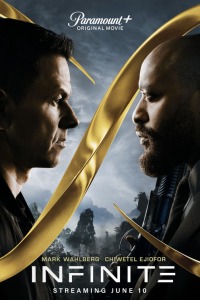
The cast and crew of Infinite were taken by surprise when their corporate overlords decided to shuttle the big-budget action movie to its fledgling streaming service, Paramount Plus. Fortunately for me, I had just purchased a yearlong subscription plan because I wanted to watch Bar Rescue whenever I pleased, so I was one of the lucky ones to gain access to this first “Paramount Plus Original Movie” as it quietly premiered. It might be for the best after all. Infinite is a high-concept action movie by committee that feels so lacking in just about every critical department.
Evan McCauley (Wahlberg) is a man suffering from schizophrenia, or so he believes. He has strange visions in his head from past historical time periods and he instinctively knows how to forge a samurai sword. He’s interrogated by Bathurst (Chiwetel Ejiofor) who recognizes Evan as an ancient foe that he has fought through multiple past lives. Bathurst wants to kill Evan before he can remember who he is and stop Bathurst’s evil scheme. Evan is rescued by Mora (Sophie Cookson, Kingsman) who informs him that he is one of the Believers, a group of immortals who get reincarnated after each death. They’re waging a secret war against the Nihilists, lead by Bathurst, who want to obliterate the world rather than be reborn into it again. Evan must relearn his many pasts and help the Believers recover a hidden doomsday weapon his past self hid.
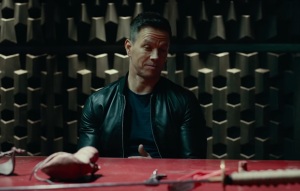
You’d be forgiven if you thought you had watched Infinite before, perhaps in a past life, because it’s so highly derivative. The story runs on two very well-worn tracks of science fiction storytelling, the Chosen One plot and the Secret War plot. You’ve seen variations on both in plenty of familiar sci-fi action movies, comic books, and the central pillars for countless Young Adult titles. Think about being told this statement: “Your ordinary life has been merely an elaborate cover, and you’re no ordinary person but secretly a powerful and important [fill in the blank] and there’s been a war going on in the shadows between [fill in the blanks] and you’re the key to solving this ages-old conflict.” I bet many of you can already think of similar titles that apply. There’s Harry Potter and Highlander and The Matrix and the Assassin’s Creed series and even more specific examples like Wanted, where it too features a sexy woman rescuing our lead in a sexy car and fending off bad guys while she informs him of his secret true calling. Even Ejiofor was in a strikingly similar movie just last year, 2020’s The Old Guard. It’s all so vaguely familiar at every moment that you’ll question whether it’s all built from spare parts.
Then there’s the added reincarnation angle, where people have amazing skills that they never knew they possessed (The Matrix, Wanted) and souls going from host body to host body (Cloud Atlas). In fact, David Mitchell, the author of Cloud Atlas, essentially wrote this very story in his 2014 novel, The Bone Clocks. In that novel, we learn that there are two factions of immortals who are reborn after every death, one group that preys upon the souls of mankind and another trying to defend the innocents. That book explores a lot more in the realm of identity (characters are reborn in different genders and races), time, and purpose than with Infinite, which settles for a recycled B-movie doomsday plot that even video games are getting tired of now. If past lives and reincarnation is just another disposable gimmick for super powered beings duking it out over a cataclysmic MacGuffin, then why bother with the existential possibility of the premise?

For a movie that takes so much time to spit out clunky exposition, Infinite is fairly incoherent and, occasionally, self-defeating. When you’re entering any new territory, there’s going to be a learning curve. Imagine how Neo learned about his misconception of reality, the war and history with the machines, and his capabilities he was opening himself up to. Exposition is best done in portions equally spaced out and tied to action, so our characters can learn through doing and failing and then succeeding. With the gimmick of past lives, it could open up such intrigue and possibility about human potential as well as the difficulty of these immortals finding one another across the globe for centuries, restarting with every rebirth (a fact explored in The Bone Clocks). It also would lend itself to characters being reckless with action movie stunts because, at worst, they die and take a twenty-year or so timeout before getting back into the action. Nothing of real interest happens with the past lives gimmick. The movie treats it as a shortcut to give its characters superpowers, and by tapping into those memories, now they have all these crazy super abilities that no mortal could accomplish in merely a single lifetime (sorry Bruce Lee). Imagine if in The Matrix, instead of Neo learning and training that they just uploaded everything into a Chosen One 3.0 security patch they downloaded (yes, he downloads skills, but we see the process demonstrated as visual progression). It’s boring to watch. The movie even could have explored more about these past lives, experiences, and lessons learned rather than in kaleidoscopic flashbacks. For the entire premise, Infinite seems so strangely limited in scope.
Then there’s the plot device that destroys the scheme of the villains. The Nihilists are tired of the eternity of being reborn and stuck with the accumulation of their memories. Bathurst says when he begins anew in the womb, he is a fully cogent adult brain and it’s nine months of torture. This, ladies and gentlemen, is the only interesting component in the entire movie that relates to the reincarnation premise. The Nihilists want to destroy all life so then they can never be reborn again, though this still seems theoretical. They have also developed a special device that will store a person’s consciousness onto a computer hard drive or microchip, supposedly stopping that consciousness from being reintegrated into a new host body. If this is the case, why isn’t Bathurst and his Nihilist fellows taking advantage of this? They’ve already developed a solution that works and doesn’t involve the destruction of all life on the planet. I don’t even know why Infinite introduces this absurd plot mechanic considering the damage it does. I guess it was an attempt to raise the stakes with immortals where death isn’t permanent, but for the purposes of the movie, a death means they are taken out of this present fight for the fate of the world. The stakes are still there. The implications are also nebulous, as they talk about souls as currency but can human souls be downloaded onto a portable technological deice? This entire plot device is silly in conception and even worse in execution, with big swirly bullets that also glow as they zip along.
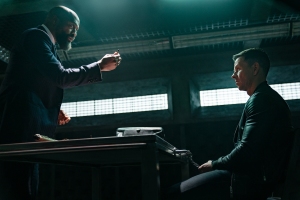
Wahlberg (Spenser Confidential) is on autopilot for the entire movie. He’s laconic and nonplussed and without any hint of humor or fun to be had. His under-performance is compensated by the overacting of Ejiofor (Doctor Strange) in a disastrous dynamic that reminded me of the 2011 Oscar hosting performance by the tandem of James Franco (under performing) and Anne Hathaway (over performing). At least Ejiofor is holding my attention with his high energy level and a maniacal glee that reminded me of James Bond villains. The problem is that nobody else is delivering this same arch level of camp. Everyone else in the cast is trying to play things so icy cool and nonchalant, and it just makes all the characters feel like boring robots.
And yet all of this could be forgiven if Infinite had some memorable and exceptionally exciting or well-developed set pieces to entertain. Much can be excused or mitigated if an action movie delivers upon its action. Alas, Infinite cannot escape the orbital decay of its lack of imagination. The derivative nature extends to the action, which consists of a series of rote chases and gunfights. There is one sequence that had promise for the scale of its destruction, a car chase through the different floors and levels of a police building. It’s viscerally entertaining to watch all of the many things gets smashed while raising the question just how fragile concrete walls are constructed to be in downtown metropolitan architecture. This is also the moment that Evan is brought into the new world, which means it’s all downhill from here. Antoine Fuqua (The Equalizer) is an action genre veteran and can be counted on for some degree of style to jazz up the proceedings, but he can only do so much with sequences lacking points of interest and tension. Infinite would play better as campy nonsense, but it won’t acknowledge this identity.
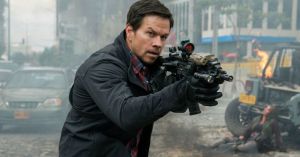
Given how derivative everything appears, it’s surprising Infinite is based on an original work, the self-published 2009 novel The Reincartionist Papers by D. Eric Maikranz. The author offered his readers ten percent of his advance for whoever helped get him to sell the film rights to Hollywood (true to his word, Maikranz paid out in 2019). Already, this is more entertaining to me than anything provided in the 106 plodding and incoherent minutes of Infinite as a movie. The high-concept premise is reduced to a lazy shortcut for superpowers for a group of know-it-alls trying to act cool and strut while delivering exposition by the truckload. The action is stifled, the characters are dull, and the world feels so sprawling but without needed definition. This could have been any combination of Chosen One and Secret War story elements. What about Harry Potter battling the bullet-curving killers from Wanted? Or what about Neo facing off against the ancient society of werewolves and vampires in sleek lather catsuits? Or an immortal special ops crew that must track down other immortals before they can do lasting harm? This mix-and-match formula belies how truly interchangeable the story elements are with Infinite. It closes on voice over by Wahlberg that genuinely made me guffaw. Looking to the future, he says, literally, “Well the possibilities are… infinite.” For this hopeful film franchise, I strongly doubt that.
Nate’s Grade: C-
Share this:

The Equalizer 2 (2018)
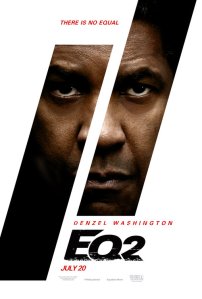 The Equalizer 2 is lucky that the threshold for entertainment is just low enough to cover even middling affairs where Denzel Washington dishes out righteous justice to the cocky criminals and ne’er-do-wells of the world. This is very much a strict formulaic second entry for 2015’s original movie, based on the TV series. It’s lesser in just about every regard although it returns Washington, director Antoine Fuqua, and writer Richard Wenk. It’s hard not to feel like a paycheck venture where everyone went on some autopilot. The plot takes a bit long to get into gear and it’s desperately missing the first movie’s lead mob investigator to create an enticing game of cat and mouse. I miss the gradual escalation, as Washington’s character gets in worse and worse trouble as he moves up the ranks of the Russian mafia. I would actually say Equalizer 2 is a movie that peaks in its first act (my favorite moment was an episodic dishes of violent retribution with a group of arrogant sexual assaulters). There just isn’t anything truly memorable here. The action can often feel murky with how it’s been photographed, and there is the occasional questionable quirk that would take me out rather than fully engage (baking flour is combustible now?). There is a satisfying storyline where Washington reaches out to an at-risk youth to dissuade him from joining a gang. It has some nicely drawn character moments that feel meaningful, but then it’s back to the grind of whatever an Equalizer movie means in the twenty-first century. I enjoyed the first Equalizer as a modern-day Canon action vehicle with some pretty sickly entertaining deaths and taut action/suspense sequences. It was a movie that made its presence felt beyond Washington’s cool charisma. With the sequel, all we’re left with is Washington’s charisma performing the heavy lifting.
Nate’s Grade: C+
Share this:

The Magnificent Seven (2016)
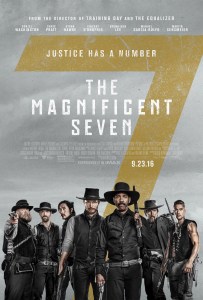 Obviously the new Magnificent Seven remake was never going to be as good a Western as the 1960 original, or as good an action movie as its source material, Akira Kurosawa’s legendary Seven Samurai. Once you accept that, the question becomes whether simply being an enjoyable Western action movie qualifies as a success given its storied pedigree. If you can’t do better than the original, why bother making it as my friend Ben Bailey would question. The answer is of course blunt (money) but the conundrum is how does one improve on classic film masterpieces? I think the new Magnificent Seven found its footing by accepting its unquestioned ceiling and instead going down a different path, instilling the essence of what made the older films so superb, and just trying to be the best B-student it can be with its new set of guidelines for broad entertainment.
The dusty town of Rose Creek falls under attack by ruthless industrialist Bartholomew Bogue (Peter Sarsgaard), who wants the land for his mining company. He installs loyal toadies as lawmen for the town and to ensure any troublemakers are put to “justice.” Emma Cullen (Haley Bennett) wishes to avenge her fallen husband and recruits a famous outlaw, Chisolm (Denzel Washington). He agrees to help and rustles up a powerful posse of gunslingers to defend the town from Bogue and his cruel forces.
There’s a reason this story still works as well as it does and that’s because the structure is ready-made for payoffs and audience satisfaction if the director and actors are capable. Act One establishes the threat and our two main roguish heroes, and then Act Two starts off with the gathering of the team, routinely one of the greatest sequences in screenwriting, and then the Act Two midpoint involves toppling the corrupt thugs controlling the town, and Act Three is the culmination between the forces of anti-hero good versus evil over the ultimate battle for the town. It’s an against-all-odds underdog tale with good but possibly doomed forces against a villain used to steamrolling through vulnerable citizens. I don’t care whom you are, that story structure worked then and it still works now. Fuqua and company don’t break a winning formula and know what strengths they have and how best to maximize them for top entertainment value.
 The biggest asset is this glorious cast, headlined by Washington and Chris Pratt (Guardians of the Galaxy). There isn’t admittedly much to these characters from a development standpoint. They’re given back-stories, though some of them are fairly airy and provide a bare minimum of effort. Red Harvest (Martin Sensmeier) in particular just kind of shows up and everybody shrugs and says, “Why not?” more or less. Also, while on this subject, it’s a bit contrived that when the bad side has their own villainous Native American that the script has to conspire for the only two Native Americans to face-off, especially when we’ve been given no history or connection between them prior to this climactic showdown. Back to the main cast, Washington settles into his suave badass persona we’ve come to expect from the man. He even fades into the background at times, ceding space for the other characters to have their moments. Make no mistake, though, because Washington’s character is a strong central anchor for this movie and even on autopilot this actor still produces attitude with style and gravitas. There’s also the simple pleasure of just watching Washington in a Western. The man was made for this setting of taciturn badasses. The brightest star of the picture is Pratt, expertly cast as a charming rogue with a big personality. What the characters lack in development they make up for in colorful personalities, which is acceptable in a genre that rewards memorably outsized figures of entertainment. Pratt is a fun rascal with a penchant for sarcasm and playing around with his prey. Every minute Pratt commanded the screen was a minute that captured my full attention.
The rest of the cast is solid and make the most of their screen time, putting in memorable supporting performances to compliment the stars. Vincent D’Onofrio (Jurassic World) is basically like a human equivalent of a bear or yeti. He’s this massive and animalistic creature and I appreciated D’Onofrio’s gusto in embracing the peculiarities. In a film of great casting and memorable characters, he nearly steals the movie. Ethan Hawke (Boyhood) has one of the more credible character arcs in the film as well as the best name (Goodnight Robicheaux). He’s haunted by a lifetime accumulation of killing. His flinty co-star Byung-hun Lee (RED 2) is the strong silent type and the two of them have a nice gunslinger chemistry, nicely contrasting but still a believable brotherhood in arms. Bennett (Hardcore Henry) is going to break out in a big way in 2016. She has a very arresting face (it’s her eyes) and an instant screen presence, which is hard to do with these guys soaking up much of the oxygen. She also gets to prove her mettle and not be treated as a romantic object, so hooray. My one concern with Bennett was that the costume designer had let her down, as it seemed the top of her gown was dangerously close to slipping off her shoulders at several key points. I understand this is designed to squeeze in a slight surge of sensuality for what is very much a PG-13 action flick but it became distracting with its obviousness. Bennett deserved better, though she might be another figure of T&A with her role in The Girl on the Train. We shall see (maybe much). The only sore spot is the villain, a wasted Sarsgaard (Black Mass) who never quite lives up to a diabolical nature worthy of the attention of our colorful cadre of anti-heroes. He’s a bully but he doesn’t seem formidable enough or that interesting.
 Fuqua (The Equalizer) hasn’t been the most consistent stager of action with his up-and-down career but he puts out all the stops with The Magnificent Seven to great effect. The action sequences are robust and shot with great attention to geography and escalation. I knew exactly what the stakes were with each sequence and gun battle, and I knew the different people and their placement and the goals. With a crew of seven and counting, it can be difficult to adequately find room for each of the fighters to be well utilized and have at least a moment that matters (just look at what happened with Suicide Squad). The second half of Act Two is our team plotting how to compensate for the overwhelming forces coming down their way, and the plotting produces plenty of opportunities as the audience watches the setups and waits for the payoff jamboree. There are little payoffs, big payoffs, crowd-pleasing payoffs, character arc pleasing payoffs; it’s an action movie that knows the climax should be the best part, and it doesn’t disappoint. The town may be in rubble and strewn with corpses by film’s end, but you’ll be happy and content from the wealth of tense and smartly directed action. Helping things along, Fuqua’s Wild West photography is often strikingly beautiful with its use of natural light.
The Magnificent Seven makes up for its lack of originality and rich characters in colorful personality and the sheer scope and intensity of its action. It can’t contend with John Sturgis and Akira Kurosawa, but what modern movie can? I don’t fault the movie for failing to live up to the standards of two classics in two different genres. I instead credit the movie for knowing its strengths and knowing how best to develop and deliver them for maximum mass appeal enjoyment. The cast is wonderfully selected and given fun characters to dig into, and the onscreen camaraderie of our seven might not rise to the level of magnificence but it’s pretty good by all accounts. That’s a rather keen summary of the movie writ large; with modestly recalculated expectations, the movie may not be magnificent but it’s plenty good and plenty entertaining. Washington and Pratt are stars making full use of their broad star appeal. The action sequences are well staged and peppered with payoffs, and it’s worth congratulating the team on having several parallel lines of action and keeping all of the shifting particulars understandable for its audience. The Magnificent Seven is about as good as I expected any remake to be, and while it doesn’t rise to those storied heights it does achieve its goals with vigor and style.
Nate’s Grade: B
Share this:

The Equalizer (2014)
 If your idea of a fine time at the movies is watching Denzel Washington be a badass and murder people in grisly fashion for two hours, then The Equalizer is right up your alley. There’s not much to the plot of this loose remake of the 1980s TV show of the same name; Denzel plays a man with a mysterious past who works at a large Home Depot-esque hardware store. He sees injustice transpiring against his pals, and he fixes it in a violent fashion. The movie is two storylines that don’t converge until the final act, namely the Russian crime syndicate trying to ascertain who this vengeful badass just might be, and Denzel doing his episodic vigilante good deeds. The climactic act is a drawn out showdown where Denzel uses every part of the hardware store to deadly results. There’s definitely a pleasure in watching Denzel dispatch tough-talking baddies, and that’s what the film delivers, no more, no less. The confrontations are generally well written and ratchet tension nicely, especially when Denzel has some chilly conversations with his soon-to-be-victims before they inevitably make their bad decisions. The tense sit-downs were more entertaining for me than the bloody violence. Director Antoine Fuqua (Training Day, Olympus Has Fallen) goes about his business in a more than competent manner; the technical qualities are above average, though the film has moments where it seems too infatuated with its slick sense of style (slow-mo rain gun battles?). With a stream of bad guys to be toppled at a steady interval, The Equalizer can start to feel like an assembly line of cocksure carnage, a ready-made vehicle for audience blood lust. Still, watching Denzel be a badass and kill a whole lot of bad people is enough for a movie. Just don’t expect much more than that scenario and you may be satisfied if you’re not too squeamish when it comes to bloodshed.
Nate’s Grade: B
Share this:

Olympus Has Fallen (2013)
 Remember in the late 90s when studios seemed to develop similar projects every few months? In 1997, we had two volcano movies (Volcano, Dante’s Peak), and in 1998 we had two animated bug films (Antz, A Bug’s Life) and two asteroid action flicks (Deep Impact, Armageddon). With the wealth of unproduced screenplays, there’s definite merit to different writers coming up with similar concepts independent of one another. Now in 2013 we have two action movies that, boiled down, are essentially Die Hard in the White House. The first out of the gate, Olympus Has Fallen, is an entertaining action vehicle that reminds me of the 90s Jerry Bruckheimer era of big explosions, big body counts, and irony-free pleasures.
Mike Banning (Gerard Butler) is a top Secret Service agent still reeling from his inability to save the President (Aaron Eckhart)’s wife (Ashley Judd) in a freak accident. He now provides security at the nearby Treasury Department, the President afraid to see Mike’s face and be reminded of his loss. Then one sunny day, a cargo plane fires on D.C. citizens, armed terrorists assault the White House, and North Korean nationalist Yang (Rick Yune) has taken the President and his cabinet members hostage. The Speaker of the House, Trumbull (Morgan Freeman), has ascended to America’s Commander in Chief and he has to navigate tricky issues like how to save the president. Luckily, they have a man on the inside. During the firefight, Mike scrapped his way inside the White House. Now it’s one man versus a bevy of terrorists and nationalists.
 The overall execution reminds me of the heyday of mid 90s action cinema, with its mixture of the ridiculous played completely sincere. It doesn’t really matter that North Korean terrorists are able to take down the White House so easily. Sure we can nitpick the very prospect of a large foreign aircraft getting so close to D.C. before getting intercepted, and only with two fighters at that. But if you can tuck away that nagging voice reminding you of the implausible nature of everything, then Olympus Has Fallen is a serviceable action thriller. Every fifteen minutes or so our hero has a new mini-goal to accomplish. It keeps things fresh and holds your attention away from analyzing the sillier elements (Gatling guns atop the White House?). The debut script by screenwriters Creighton Rothenberger and Katrin Benedikt follows the Hollywood blockbuster blueprint down to the smallest detail. Of course there’s another blueprint it mirrors, namely that of Die Hard. Beyond the premise of one man left to his wits in a hostage standoff, there’s also the moment where the bad guy poses as a good guy to the ignorance of our hero, there’s the failed outside tactical use of force, and the bond forged between the man on the inside and the link outside, whom isn’t given the level of respect deserved. That’s not just an application of the Die Hard premise to a new setting (like Air Force One or Under Siege), but a sampling of the very plot beats from Die Hard. Then again if you’re going to steal then steal from the best.
There’s a certain throwback bravado vibe going on here that makes it all easier to swallow. It’s got big silly action sequences and some in-your-face jingoism (a character, when faced with the notion of execution, literally starts reciting the Pledge of Allegiance), enough that Michael Bay would be misty-eyed, but treating the subject matter with such thoughtless swagger makes the reality easier to accept. Having D.C. attacked, civilians mowed down, national monuments crumbled, and the White House in ashes, well you’d naturally think back to the very real horrors of 9/11, and you may shudder. By embracing the implausible nature of the action and achieving a tone that prioritizes popcorn thrills, Olympus Has Fallen dances around pitfalls of exploitation and simply becomes another big, dumb, but enjoyable action movie. I say this without a hint of derision or irony.
I haven’t been a fan of Antoine Fuqua as a director. He can compose a good looking movie, but Shooter, Tears of the Sun, and King Arthur were enough to convince me the man could not properly stage exciting action. I think perhaps the limitations of the setup brought out the best in him because there are some genuinely gripping action sequences on display here. Also, the man does a fine job of establishing the geography of his action and presenting a surprising variety. Fuqua, aided with the shifting script, makes sure that the audience never gets bored. Sure there are storylines that don’t exactly work, like Mike finding the First Son, a character never heard from again, but the movie keeps changing shape, getting bigger, and finding enough satisfying payoffs. This is an effective, serviceable “turn off your brain” action movie, and it does enough right that you don’t fret about turning that brain back on until the end credits. The R-rating also ups the ante, providing bloodier and brutal escalation to what should be life-and-death stakes. If you’re going to give me “Die Hard in a…” then you best make sure your movie doesn’t wuss out. You’ll recognize plenty of action movie tropes and clichés, but the action is worthwhile and the plot constantly moving that you simply don’t mind.
 It’s nice to see Butler (Playing for Keeps) find a role that plays to his, admittedly limited, strengths. His character is your standard tough guy with a tragic past, haunted by the life he couldn’t save, looking to make amends and forgive himself. It’s probably the fact that the role has so little to it that Butler is able to slide effortlessly into gruff action star mode, a preferential place (though I prefer the man to be bearded as well). The rest of the movie benefits from actors who are far better than the material: Freeman, Eckhart, Melissa Leo, Radha Mitchell, and Angela Bassett. They all provide better-than-average performances for this type of movie. Even Dylan McDermott (TV’s American Horror Story) gets room to shine. Rick Yune (Ninja Assassin, The Man with the Iron Fists) makes for a very sinister bad guy. The part is Generic Antagonist #301, but Yune finds fun ways to enjoy the menace, soak it up without hamming it up. He transforms a generic villain into a dude you want to see righteously toppled.
After last fall’s updated Red Dawn (scrubbed free of invading Chinese forces) and now this, I must ask if North Korea has become the go-to military enemy for American action movies. Olympus Has Fallen takes the added step of never having the government of North Korea involved or approve, like the terrorists are acting on their own. We wouldn’t want to upset the government of North Korea; that’s what Red Dawn is for. But does anyone really view North Korea as a credible military threat? They are seen as a rogue nation, yes, and they claim to have nuclear arms, so they should be taken seriously, but does anyone realistically think we’ll wake up tomorrow and be conquered by North Korea? I suppose this criticism lies more with Red Dawn than Olympus Has Fallen, a movie that only needs a handful of dedicated foot soldiers rather than an invading army. I also find it laughable that the only thing holding back North and South Korea from war, in this fictional scenario, is the presence of about 28,000 U.S. troops. Also, if these events played out as they do, who doesn’t think that the U.S. would respond with military action against North Korea? We started a war with Iraq and they weren’t even responsible for the actions of a handful of terrorists. I guess the North Koreans are the new Hollywood Boogeymen.
With a hook of a premise, some exciting action, and more than a few borrowed plot beats from Die Hard, it’s still a pleasant surprise at how entertaining Olympus Has Fallen works. It’s a movie that simply does enough right to justify watching. Its action is good enough, its plot is familiar enough but offers enough forward momentum, its actors are good enough, and it does enough right to quell potential boredom. I appreciated its throwback feel to the mid-90s action movie, a time of elevated popcorn thrills and powerful bravado, all without a hint of irony no matter how ridiculous things got. It lands on shakier ground when it tries to become a rah-rah kind of patriotic rally, but I’d be lying if I denied the certain pleasures of watching a Secret Service agent take out the bad guys on his turf. Time will tell how the second Die-Hard-in-the-White-House movie will fare, but if you’re looking for big and dumb but enjoyable, Olympus Has Fallen is like a summer popcorn film only in March.
Nate’s Grade: B
Share this:

Shooter (2007)
 A passable albeit mediocre action thriller, this humorless tale about an elite sniper framed for a presidential assassination is more interested in the nitty gritty of sharp-shooters than building a credible plot. Mark Wahlberg grumbles through uninspired action sequences but who really draws attention is a villainous Danny Glover. The man has a lisp and carries it until the end of the film, and it is never explained. It’s so weird and distracting and it feels superfluous, like Glover was hard-pressed to make his rote villain interesting, so he thought, “Why not a lisp?” Shooter is more proof to my ongoing assertion that Antoine Fuqua (King Arthur, Tears of the Sun) is a director with little interest in storytelling; he’s studied at the Tony Scott school of Visual Indulgence. The characters are either stock roles or superhuman, and how in the world does a man get pinned for almost taking out the President and then buy mass quantities of weapons with the clever disguise of sunglasses?
Nate’s Grade: C
Share this:

Tears of the Sun (2003)
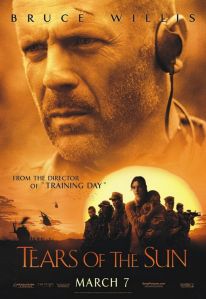 Bruce Willis is an ARMY squad leader called in to rescue a doctor (the sultry Monica Belucci) at a missionary in Nigeria. The country is in great turmoil after very very evil rebels have assassinated the entire royal family. Oh, but the good and very hot doctor refuses to leave without Willis’ squad taking the refugees out of the missionary with them. He begrudgingly accepts and they as a group travel through the countryside of Nigeria, all the while the very rebels are not far behind.
The film takes a tonal shift when Willis’ men come to the choice of staying with the refugees and trying to save them all, or following their mission protocol and getting the hot doctor onto an ARMY helicopter and shipped out ASAP, with no regards to the refugees. The shift in morality isn’t as smooth as Three Kings but now the film tries to place an emphasis on the human scale of genocide (even though ALL of these refugees who have lived in squalor have sterling white teeth, go fig). The weight of the topic easily alludes what is little more than a by-the-numbers action film.
With action films there will always be gaps of logic. However, there was one monumentally glaring miscalculation of forward thinking that prevented me from getting into the film again (*Spoilers ahead, big angry spoilers*).
 Okay, so African Rebels are chasing Willis and his team and the refugees. Got it. But then we find out later that one of the refugees is actually the, wait for it, heir to the throne of the country! All right, sounds hokey and more than a little culturally pretentious but I can follow. Hold on a second then. This heir to the country, who is obviously so important that people would risk their lives and safety for his own, why did these people not put him on the ARMY helicopters earlier that flew a handful of refugees out and to the safety of a U.S. air craft carrier. It makes no freaking sense whatsoever to have this golden opportunity that would 100% ensure the safety and longevity of THE HEIR TO THE KINGDOM and say, “Nah, you know what? Well catch the next ARMY helicopter guaranteeing safety to the man who would be king. Well sweat it out and have the rebels chase us, we could use the exercise anyway.” What has just happened to this movie?! After this, it was never the same for me; not that it was anything special to begin with.
Tears of the Sun is an action movie that attempts to be an action flick with a heart and a social conscious. There is a segment of the film where Willis and his cadre stumble onto ANOTHER batch of DIFFERENT but still very EVIL rebels assaulting a town, you know, rape and pillage and the like. Willis and company essentially save these people from the rebel tyranny but at this point the films core message has been well lodged into your gray matter: Africa needs the white man’s saving. More than a little arrogant and a tad racist, don’t you think? I mean not every country can wait patiently for Willis to liberate them.
Tears of the Sun does have some lovely examples of cinematography and some competent pieces of action here and there. In the end the film is an overblown and culturally insulting entry into the genre of people shooting and people falling down.
Nate’s Grade: C
Share this:

Training Day (2001)
 Denzel Washington won an Oscar for this? Instead of Malcolm X? For THIS?! Yes he gets to huff and puff as he plays against type as a dirty cop, but is this reason alone to give an Academy Award to such a forgettable and collectively implausible film? Ethan Hawk, his co-star, is actually better in the film. All I can say is right actor, wrong movie. It’s like rewarding Kevin Spacey for Pay It Forward over the other screamingly better movies. It doesn’t make sense. There are plenty of hip-hop stars making cameos or small roles (Dr. Dre, Snoop, Macy Gray) but most of the time Training Day feels like tired and dead air especially as the contrivances begin to pile onto one another the longer this day goes. And Denzel is huffing and puffing but the house still stands. Man, the voters must really have not wanted Russell Crowe to win.
Nate’s Grade: C-


 nathanzoebl
You must be logged in to post a comment.