Blog Archives
Thor (2011)
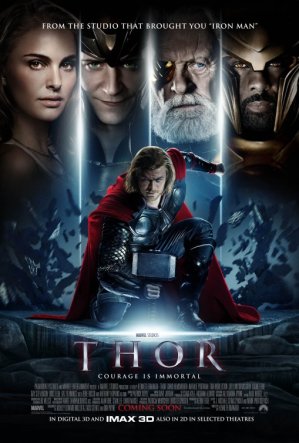 I had strong misgivings going into Thor. How was a powerful Norse god going to seem remotely relatable? How was the most improbable member of Marvel’s Avengers ensemble going to be explained in a way that didn’t feel like a ton of cheese richly slathered in hokum? I was expecting this movie to be a silly, trippy, LSD-enhanced flashback (rainbow bridges! Pass the bong!) that could barely strain any sense of believability. It’s one thing to have stories about super heroes who have gotten their powers via genetic defect, scientific accident, or act of God. But what about when your character happens to be a god? It just seemed too goofy for it all to be pulled off with any conviction. A Thor movie seemed destined for some Xanadu-level of camp. Get a load of the blonde with the big hammer, boys. Not every super hero flick has to be as brooding and dark as The Dark Knight. Marvel’s own Iron Man was a great example of a briskly entertaining movie. Now that I’ve prefaced my experience, let me publicly admit that Thor is indeed a somewhat silly but mostly fun entry in the mighty realm of summer blockbusters.
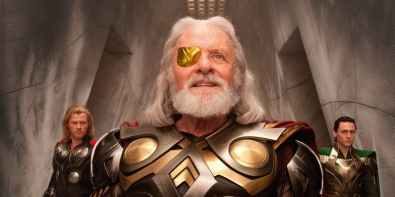
Thor (Chris Hemsworth) is the god of thunder on Asgard, a distant planet populated by the Norse mythical figures (apparently, they visited Earth and the Scandinavian amongst us worshipped these… space aliens?). Thor waits to inherit the throne from his father, Odin (Anthony Hopkins), a wise king who has kept a tenuous truce with the fierce Frost Giants, inhabitants of another planet. But Thor is not ready to assume the responsibilities of leadership. He’s quick to action and temper, arrogant, and defies his own father’s orders by trying to start some intergalactic conflict with the Frost Giants on their home turf. Thor is robbed of his powers, his mighty hammer, and banished to Earth to walk amongst the smelly Earthlings. He crashes in the New Mexico desert and is retrieved by a team of scientists (Kat Dennings, Stellan Skarsgard) led by Jane Foster (Natalie Portman). The group wants to learn where exactly this man from the sky came from. So does the government, led by the S.H.I.E.L.D. agency who takes possession of Thor’s hammer. Thor thinks if he can reunite with his beloved hammer, then he can go home. But for a thunder god, he’s got a lot of lessons to learn. While Thor is out of the picture, his younger brother, Loki (Tom Hiddelston), plots to take what he feels he is owed – the kingdom of Asgard.
 The biggest surprise for me was that the Asgard sequences are the best part of the movie; thankfully the majority of the running time is spent in this fantastic realm. I credit Kenneth Branagh’s direction, which neither hides the silliness of the material nor fully acknowledges it. By the time Thor hurtles to Earth, I was completely engaged in the operatic tale of fathers and sons, gods, jealousy, hubris, intergalactic conspiracies, you know, the stuff of juicy drama. It jus so happened that these characters wear funnier costumes. The family dynamic between Thor and Loki, the infighting and the scheming, intrigued me. Some critics have thrown around the word “Shakespearean” to describe the movie’s outsized family conflict, but I think that’s just the critical community getting lazy. Would they even approach that term is Branagh was not the director? This opening section of Thor effectively explains the history of Asgard as well as its place with the other eight worlds, the shaky relationship with the Frost Giants, the family responsibilities at play as Odin must decide the future of his ABBA-infused nation, as well as the various mechanics of how this different world operates, like Idris Elba (The Wire, Luther) stationed at the end of the rainbow as a gatekeeper to the other worlds. I liked discovering how all the pieces of this world fit together. If analyzed out of context, any part of the Asgard section just seems stupid. But taken in the film, Thor‘s crazier, more fantastic elements come together and spark genuine interest. I wanted to spend more time in this magical realm. The more ridiculous and fantastical that Thor got the more interesting it became.
But unfortunately Thor was sent tumbling to our ordinary planet. It is the Earth section that seriously deflates the movie’s vibe. It’s a relief that the fish-out-of-water comic relief is kept to a minimum, because the character of Thor isn’t an idiot, just an arrogant brat. But it’s the period on Earth where the God of Thunder learns his Really Important Lessons and finally understands what it means to be a good leader. It’s all very expected and the execution is less than inspired. The trio of scientists that Thor encounters (Portman, Skarsgaard, Dennings) could easily have been consolidated into one character. Their contributions to the story are weak. Skarsgard is mostly there for fatherly advice and the occasional expository ejaculation. As a gawky little sister scientist, I don’t even know why Dennings is in this film other than to make my eyes happy. I anticipated that Portman would assume the “love interest” spot in comic book movies that we now reserve for Oscar-winning actresses, and I assumed that role would be underwritten. But I never expected Portman’s part to be this underwritten. She’s practically nonexistent except for that winning smile of hers. Over the course of… two days, she falls in love with our banished brute. But to be fair, it’s not every day that a guy looking like Hemsworth falls out of the sky. New Mexico isn’t exactly looking like a great singles mingles hotspot. Anyway, their relationship is supposed to be the trigger that makes Thor realize he’s been a selfish and reckless fool. But their scenes lack any tension, any charm, anything of interest. They feel like two actors sitting in chairs telling stories. You don’t feel any romance between them. The drabby Earth sequences only serve as a losing contrast to the crazy Asgard territory. You can’t compete with rainbow bridges (imagine the tolls on those suckers).
 Branagh has never directed anything of this magnitude in size before, and it shows at parts. While none of the action sequences are particularly bring, none of them are particularly thrilling. The beginning battle between Thor and his pals on the Frost Giant planet (Jotunheim) is so poorly lit that the darkness forces you to squint to focus on what’s happening. Why spend $150 million on a super hero flick and shoot a dankly lit action scene? What’s the point in that? The choppy editing can also be too hectic to follow with all the quick-cuts that fail to orient the action geography. Really, there are only three serious action sequences in Thor, but then again I remember Iron Man having a light load when it came to on screen action. That film was devoted to character and performance. This film, under Branagh’s watch, is devoted to just making the entire universe of Thor credible. It’s a lot to take in, and Branagh’s biggest accomplishment is producing a sense of grandeur to the film that saves it from falling into the sticky clutches of camp. The world of Asgard feels convincing in production design and infrastructure; the cities look like pipe organs. Branagh’s film expands the Marvel universe significantly, broadening the scope for future installments. Mercifully Thor does not hard sell the upcoming Avengers movie as appallingly as Iron Man 2.
The acting in Thor is as splashy as the Asgard scenery. Hemsworth gave a notable performance as the doomed father of James Kirk in 2009’s Star Trek. He as only in the film for that ten-minute prologue, and yet the actor found a way to do much with what he was given. You got to see his character hurdle through a gauntlet of emotions: fear, duty, relief, desperation, and acceptance. His sacrifice still can make me tear up, and Hemsowrth deserves some of that credit. However, Thor is a different matter entirely. Obviously it’s going to be a more challenging role to play a buff cocky god with a magic hammer. Buff he does quite well. Cocky he does fairly well, but this is not a great starring vehicle for the actor. Hemsworth looks too self-satisfied, like he’s playing his character as an intergalactic hotel heiress. In sharp contrast, Hiddelston (Wallander) commands your attention. Those penetrating eyes, the cold yet calculated demeanor, this is an actor who feels like he walked off a Shakespeare production and just changed his headgear. You want to spend more time with Loki than watch Blondie futz around on Earth. Loki has much more depth to him than Thor; he feels betrayed by his family and an outcast to his society. I’m glad that we’ll be seeing more from this trickster in future Marvel movies (have I said too much?). Hopkins knows how to sell silliness like few other actors. And for those who have been wondering where Renee Russo has been for the last six years, well here she is, as Thor and Loki’s mother, a role that’s best suited to confirm that she is still alive.
 I was expecting far worse judging upon the scraps I had seen from the Thor advertising campaign. So I suppose that beating my low-flying expectations might not necessarily be something to champion. Thor is an inherently goofy, yet mildly satisfying and credible action film. It doesn’t have the style or panache of other heroes, but the fact that Branagh could make a two-hour Thor film that didn’t cause me to laugh derisively from start to finish is an accomplishment. Again, that sounds rather dismissive. I’m just very surprised that this movie works. Because if you take it apart, it doesn’t seem like it should. The acting ranges wildly in quality, with Hiddelston outshining everyone else. Thor is a solid if inconsistent start to the summer season of blockbusters. If you must turn your brain off for some movie, you’d do far worse than Thor. It has pretty colors.
Nate’s Grade: B
Share this:

The Wolfman (2010)
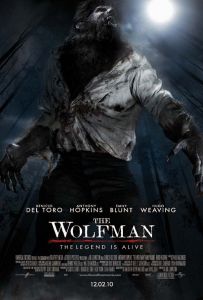 After re-shoots, reedits, a second director late in the process, and delayed release dates, it’s no surprise that The Wolfman is a bit of a shaggy mess.
In 1880, Lawrence Talbot (Benicio Del Toro) is an actor who returns home to England when he learns that his brother has been killed. Gwen (Emily Blunt), the fiancé to Talbot’s dead bro, writes that the departed brother was mauled, which points toward some kind of vicious creature roaming the woods. Inspector Aberline (Hugo Weaving) has been called in to clear the matter. Talbot’s father, Sir John (Anthony Hopkins), welcomes his prodigal son back but warns him of the dangers lurking in the countryside. The villagers are ready to blame the gypsy caravan and their chained bear when the feral creature strikes again, thus exonerating the bear. Talbot is bitten by the beast but survives only to transform into the cursed werewolf once every full moon.
Structurally, this movie feels like it’s all Act 1 and Act 3 with about ten minutes in between. By that I mean it’s all protracted setup and climax and little to connect the two. The beginning takes so long, with characters walking around like zombies who have no sense of wonder or fear given the extravagant circumstances. This is a movie that confuses set changes with plot advancement. Dour characters enter half-lit rooms and say little that isn’t cryptic or terse about the unusual happenings. This is what you have to look forward to for about an hour. The central mystery of who is the initial Wolfman is pretty easy to figure out when you play the economy of characters, which only compounds the movie’s sluggish pacing problems. You’re going to have definite pacing issues when your monster can only appear once a month, so say hello to massive time-lapse montages with the moon. It makes it hard to keep track of how much time is actually elapsing.
 There is little cogent explanation for why anything happens and the movie does an extremely poor job of maintaining a credible suspension of disbelief. What exactly are the rules here? What are the limitations for the Wolfmen? How far back does this whole thing go? The movie traces it back to an Indian kid, who looks like Gollum, in a cave, but where did he get it from? What is the history of this lycanthropy illness? When you turn into the monster, do you have any control? Are you a slave to your animal impulses? Are you culpable for what happens? Is it more like having multiple personalities except one of them is harrier? Nothing is really made clear and the movie just plows along while the unanswered questions continue to pile up, never to be addressed.
The Wolfman does a fine job of establishing an ambiance that feels ripped right from the old Hammer horror films, but fog and shadows and art direction can only take you so far. Every room looks like it’d be a prize-winning example of how to build a haunted house, though the lighting tends to be overly murky. Danny Elfman also provides a darkly lush score that mingles well with the onscreen atmosphere. But the refined sets only tease a better movie. An attack at the gypsy camp can get interesting. The beast flaring up at an insane asylum calls for something wickedly entertaining and scary, but everything is over before it really gets going, and we’ve moved on to the next scene of character sitting glumly in the dark. There’s nothing to startle beyond some overused jump scares. The movie lacks good scares because the film fundamentally can’t sustain a mood because the plot is never elaborated.
The character work is exceedingly shallow. Talbot is the main character but what do we learn about him? He’s an actor, he left town, he gets bit by a wolf, he skips stone’s with his dead brother’s girl, and that’s about it, folks. There’s an entire back story about Talbot spending time in a mental ward, which could prove to be fascinating but it’s just another set piece and nothing more. Talbot is pretty much a placeholder for a character; he’s the dude that has to get bit for there to be a story. He’s more catalyst than character, and you can feel that painful realization in how Del Toro (Traffic, Che) plays his non-character. Del Toro is a truly capable actor but he sleepwalks through the entire movie and mumbles most of his lines. Despite being a dead ringer for Lon Chaney Jr., he brings no energy to his role, nor does he ever seem truly concerned with his beastly transformation. You got more reaction and contemplation from Michael J. Fox in Teen Wolf.
The rest of the actors try and make good with the parts they’ve been tossed. Blunt (Sunshine Cleaning) can be a very good actress but she’s playing the thankless task of the underwritten love-interest-to-monster part. She’s no more fleshed out than the blonde damsel that screams and faints in the old classic monster movies. Blunt has the annoying habit of her voice turning into this simpering whine when she’s distressed. Hopkins (Fracture) pretty much gives the plot away with his maniacal cackling and incessant ear-to-ear grinning. You can pretty much faithfully assume where his character is going from the first malevolent twinkle in his eye. The screenplay exerts no effort to disguise its easily telegraphed character reveals. The person who comes out best is Weaving as the inspector, but that may be directly linked to the fact that he has the least amount of screen time of any of the main characters.
The special effects are fairly good and the practical makeup effects by screen legend Rick Baker are even better. The actual Wolfman is a snarling, spooky creature, but I wonder why we don’t get more shots allowing us to fully view the makeup work. Director Joe Johnston (Jurassic Park 3, Jumanji) seems to be more of a proponent of CGI, which means that we get scenes of Wolfie jumping from ye olde rooftop to rooftop like he’s any sort of wily creature. There’s nothing in the movie that really makes use of the specifics of being a Wolfman. We get a few POV shots of the Wolfman running extremely fast, but little else takes advantage of what makes the Wolfman a creature to be reckoned with. We only get a slew of decapitations and sliced innards that display the ferociousness of those wolf claws. Johnston isn’t afraid of gore but he doesn’t help his case when he fails to create any feeling of dread. It’s hard to dread what you can barely understand and with people you don’t really care about. Consider me stubborn, but when I got to a movie called The Wolfman I want some attention paid to the title animal.
 As I was watching The Wolfman I began to disassemble it in my head and piece together my own version of the film, an infinitely better version. For the sake or argument, I’ll explain my version and you can tell me which seems like the superior product. In my imaginary version, I completely eliminated Blunt, Hopkins, and most of the other side characters. I focused on Talbot and the Inspector and their relationship. Talbot has known about his lycanthropy for some time but he’s been able to control it for the most part, until recently. It haunts him, his inability to stop the sinister urges inside him that take over. The inspector is called in after the mysterious murders have picked up and they resemble some equally gruesome murders from 20 years prior (when Talbot first grappled with his hairy alter ego). The bent of the plot would then be on the relationship forged between the two men, how it turns into mutual affection and admiration all the while Talbot is trying to stay one step ahead of the investigation. Then my Act 2 break would be the Inspector finally realizing who is responsible for the murders (his friend!) and struggling with his own moral obligation to meet justice. Maybe this sounds too much like a crime thriller, but to me that sounds like a better film than watching two CGI werewolves claw at each other and spit.
The Wolfman is yet another misguided remake in a genre being gutted by horror remakes. The old monster movies of old were more than creature features and deserve better treatment than this bloody mess. I suppose few films can survive given the retooling process this one went through. This super serious monster movie has terrific production design, some alluring atmosphere, and a whopping void where a story should be. Characters will bumble about and the plot hums along with no explanation or elaboration given, meaning that setup often immediately crashes into climax. That’s not a satisfying recipe for a moviegoer. The Wolfman is mostly suspense-free and the actors are phoning it in; Hopkins is a kook, Blunt trembles her lower lip, and Del Toro seems to be drugged. This is mostly a costume drama with a little gore splashes in for good measure. It’s boring and half-baked and the best attribute is the scenery. If I wanted to watch scenery I’d flip through a Home and Gardens magazine. I was expecting entertainment here but instead it’s just another reminder to stick with the original.
Nate’s Grade: C
Share this:

Beowulf (2007)
 Taking note of director Robert Zemeckis’ new motion-captured animated version of Beowulf, I began to wonder what other classic works of literature could use a good CGI sprucing up. Dusty old tomes would have greater relevancy to the youth of today if they were coated in animation and presented in a 3-D format. Just think of the works of Jane Austin with a flying, zooming camera and the aristocratic families repeatedly jutting marriage contracts toward an audience. This might be the only way to make The Great Gatsby tolerable.
The 1000-year old story begins in the dining hall for King Hrothgar (Anthony Hopkins). Their loud and drunken reverie is interrupted by the monstrous creature Grendel (Crispin Glover). The creatures rips men apart, lays waste to the hall, and munches on a few heads for the long journey back to his cave. The King offers a reward for anyone who can slay the monster and bring peace to the Danish lands. Enter Beowulf (Ray Winstone), a determined warrior and competitor who seeks eternal glory. He brags that he will kill their monster and then kill Grendel’s mother (Angelina Jolie) next. However, the slinky lass offers a tempting promise that she can make Beowulf the greatest story in all the world.
 This is not the same Beowulf you were forced to read in high school English. I confess never having read the 3,183-line ye olde English poem, but I don’t think it had scenes of burping, public urination, a “coming” sexual joke, and some unexpected man-on-monster action (not the kind you’d readily think). This is a bloody and often exhilarating retelling intent on jazzing up a classic work for a younger generation. The action sequences have tremendous scope and can be relentless, and when witnessed in 3-D they are even more immersive and breathtaking. Stepping aside from the thrills and chills, Beowulf also works as a cautionary tale about the dangers of lust and particularly pride. Beowulf is a boastful and arrogant fellow, enough that he chooses to fight Grendel in the buff so that it will be even more challenging and thus ego stroking (as they battle, objects conveniently obscure the audience from seeing Beowulf’s manhood). The main deviation from the poem, connecting the various characters on a much more personal level, works with he context of the story and the overarching theme about the costs of vanity.
I encourage all potential Beowulf ticket-buyers to seek out where their nearest 3-D screening resides and to plan and, if needed, carpool to that theater immediately. This thing is meant to be seen in three dimensions, and in that environment Beowulf is amazing to behold. This is my first encounter with the next generation of 3-D and it is a giant leap beyond the funny glasses with blue and red lenses. Hollywood has hopes that this technology will be the next great invention that drives people to the movies and turn it into a unique experience that cannot be duplicated in the quiet privacy of your own home. I must say I was thoroughly impressed with how immersive the process becomes. Beware, though, because of the deep focus your eyes will dart around the screen resting from object to object, marveling at the different planes of depth; you may feel some strain and a headache after awhile. Objects keep sneaking into your peripheral vision and the movie takes many opportunities to hurl things at the screen, and thus the audience, be they coins, swords, arrows, limbs, heads, pots, and blood splatters. The CGI animation coupled with the 3-D technology makes for a compulsively stunning first-rate spectacle.
The visual look is a great step forward from 2004’s The Polar Express, the first time Zemeckis used his newfangled motion-capture toys. I really disliked the look of Polar Express, and the kids and their dead, glassy eyes creeped me the hell out. I’m still not entirely sold on what motion-capture even brings to the world of animation; to me, it seems like animators can dictate movement just as well as copying from an actor. Where the animators do make strides is in their depictions of real people. It’s not photo-realism, in fact sometimes the characters look like plastic dolls, but you can see all the pores in the skin and follicles of hair in bristling detail. The look of the movie reminded me a lot of the video game God of War, especially when Beowulf is slicing and dicing one-eyed sea monsters. I think that’s a pretty fair assessment ultimately, that the film better resembled a slickly produced video game cut scene than reality.
 In the end credits, I noticed that someone is specifically singled out and credited for the design of Grendel’s mother. I’m all for credit where it’s due, but Grendel’s mother was simply designed as Angelina Jolie with a tail coming out of her head. The character design looks remarkably like its big name actress and she struts around mostly naked, though her body drips with a melting gold finish that stops the nudity from having any real definition (it’s kind of like she’s in a melty candy shell). This may be enough for frisky moviegoers that must have missed out on the other movies Jolie bares her flesh for, or perhaps the head-tail fetish folk will finally have their day. It makes a lot of sense for Zemeckis to choose Jolie for the seductress role. It seems that mortal men just can’t help themselves around her and they end up doing the nasty, which produces little nasty creatures. If there were anyone in today’s world that could make men weak with overwhelming lust, it would be Jolie. Just ask Brad Pitt.
The character work on Grendel, however, is fascinating and startlingly grotesque. He resembles a cross between Frankenstein, Dobby the elf, and a coffee pot, all covered in rotting, patchy skin. The amount of detail is amazing and simultaneously stomach-churning. Glover offers a magnificently eccentric frame to build from. Grendel comes across less like a monster and more like a misunderstood wretch that just wants some peace and quiet by any means necessary. The screenplay gives Grendel some deeper backstory and a motivation for his murderous rampages (the poor guy is hyper sensitive to music, which blares in his head and causes agony).
Beowulf does have some slow moments and a noticeable lag in the middle before it sets up a climactic dragon battle. I was actually starting to nod off somewhere along the middle. The screenplay, adapted by Neil Gaiman and Roger Avary, squanders a load of underwritten characters, like a queen, a young concubine, and a religious advisor that asks if they should also pray to this new Roman God, Jesus something or other. Zemeckis is too enamored with the 3-D technology at his fingertips and clutters his screen too often to play around with the depth of field. I cannot fathom how this movie would play out in a regular 2-D environment, but needless to say, I’m sure the constant barrage of things pointing at the screen would get old quick.
Beowulf is a rousing and thrilling experience when seen in its intended 3-D format, otherwise it might get a tad tiresome and the visuals would come across as less accomplished. Zemeckis is getting better acquainted with the limitless freedom his motion-capture technology afford him and his imagination, however, I mourn the loss of Zemeckis ever directing another live-action film again. He seems to be completely taken with his technology and while it will improve with age I just wish the man who gave me so many wonderful movies like Back to the Future and Who Framed Roger Rabbit? would just go back to basics.
Nate’s Grade: Movie itself: B
3-D presentation of film: A-
Share this:

Fracture (2007)
 This is a genre movie, pure and simple, but it has a tricky plot and is aided by two exceptionally high caliber performances from Anthony Hopkins, once again personifying evil and confidence, and Ryan Gosling. He imbues such meaty resonance to a character that would have seemed flimsy and altogether stock in another actor’s hands. Gosling and Hopkins have great tit-for-tat moments where each is trying to outwit the other, and their verbal chess match provides the best scenes in this procedural thriller. The disintegrating murder case keeps the audience guessing, but it’s Hopkins and Gosling that elevate the material into delicious crackling Southern-fried entertainment.
Nate’s Grade: B
Share this:

Alexander (2004)
 I was standing in a theater weeks ago and saw a large banner for Oliver Stone’s epic about Alexander the Great. I listed the names; Colin Farrell, Angelina Jolie, Val Kilmer, Rosario Dawson, Jared Leto. This had to be perhaps the greatest assembly of pretty actors ever in a motion picture. There’s a whole lot of sex appeal there, and Anthony Hopkins, as the film’s reflective narrator, isn’t too shabby looking himself for a man his age. After having seen Alexander, it’s safe to say the actors sure are pretty but the movie is far from it.
Alexander (Farrell) is one of the greatest historical figures. He rose to become a Macedonian king, dominated much of the known world before he was 30, and then died mysteriously at a young age. In flashes to his youth, we see Olympias (Jolie) coaching young Alexander on his future glory. Standing in her way is one-eyed King Phillip (Kilmer), Olympias’ husband though not the father to Alexander. She frets that he will sire a direct heir to the throne, and upon Phillip’s assassination, Alexander reaches new heights. He travels to Babylon with the purpose of avenging his father’s death, rumored to be paid for by Persian gold.
Alexander keeps traveling east conquering new lands but returning kings to their rule and assimilating “barbarians” into his armies. His generals begin to question Alexander’s actions, especially his surprise marriage to an Asian peasant woman (Dawson). He is unable to sire a male heir with her. Hephaistion (Leto), Alexander’s childhood friend and lifelong lover, worries that Alexander has become power hungry and distrustful of those around him. Many of his men only want to see home after seven years of battle. After defeat in India, Alexander decides to turn back but he never sees home again.
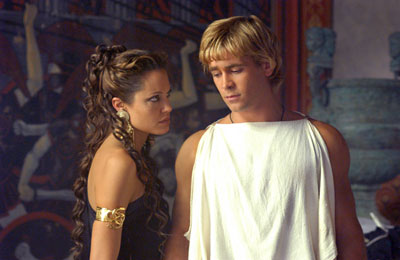 For such a lavish biopic, Alexander seems fairly remote. We don’t really get to know much about the psychology of Alexander. He’s a historical figure with equal parts good and bad ready for debate, but whenever Alexander does hit some of its star’s less-than-stellar moments, it seems to gloss right over them. Hopkins will narrate about some town that resisted, then we’ll see a quick image of it burning, and then we move on. Or we’ll see a slew of dead army officials and Hopkins will say, “He slaughtered all he felt were responsible for mutiny, but I’d expect any general to do the same.” There are several moments where we’ll hear Alexander massacred a town, or sold people into slavery, and then we get the next scene. It’s quite comical, almost as if Hopkins is a tour guide at a museum saying things like, “And then Alexander ate all of the first born babies. Moving on now…”
There are just so many awful laugh-out-loud, loopy moments in Alexander. It’s not enough that Jolie speaks in some bizarre accent; to make sure the audience understands that she’s duplicitous she has a snake wrapped around her in every scene. I’m not kidding; every scene that Jolie is in she has snakes coiled around her.
There’s a moment late in the film that is so hilariously dreadful, it’s hard to believe what you’re seeing. Hephaistion has caught ill and is on his death bed. Alexander is wrought with emotion but then strolls over to a window and begins another huge speech that ends up being all about his glory. What makes the scene go from bad to I-cannot-believe-they’re-doing-this bad is that Hephaistion, in the background, is convulsing and dying. You see his body tense up, twitch, leap into the air, and practically do some kind of triple axle, all while Alexander speechifies blithely unaware. I challenge anyone not to laugh.
Stone needlessly complicates his film with flashbacks, giant leaps forward in chronology skipping Alexander’s rise to respected leader, and skittish hallucinations. Stone is accustomed to breaking up the chronology of his films, but Alexander is too long and too campy to play around with for effect.
The acting of Alexander is set to overkill. Farrell seems miscast and doesn’t have the weight to carry such a historically meaty role. He looks pretty, and he can snarl like a pro, but the only thing worse than his overblown performance is his terrible blonde hair. This just wasn’t the right role for this talented actor. Jolie is so naturally seductive that she could have played her role mute and been effective, maybe more so. Kilmer seems to be working some kind of Irish accent but he comes off the best of the three. Leto gets overshadowed by his bangs.
Alexander also seems to speed over its star’s bisexuality. It wasn’t uncommon for men to bed both sexes, but the movie seems terrified of portraying anything beyond longing glances. Alexander and Hephaistion are reduced to some whispers here and there, but the limit of their physical affection stops at hugs. It actually is kind of funny the amount of times they hug, which I think is over five. You can tell the filmmakers wanted more but then were like, “Eh, let them hug again.” In some weird turn, it seems the film shows more depth with Alexander’s relationship with his horse than with his lifelong lover.
For a three hour movie about a military man who conquered much of the known world, there’s a shocking lack of action. Alexander has two action set-pieces and then that’s it. The first set-piece is a battle between Alexander and the vastly numbered forces of the King of Persia. The battle lasts twenty minutes and is disjointed, bloody, and perfectly indicative of the confusion of war. Stone cuts back and forth between majestic aerial shots showing the progress of battle and hand-to-hand combat amid the sand and dust clouds. Stone also labels certain sections of the armies, which gives a greater understanding of the battle. It shouldn’t be a surprise that this battle is the highlight of Alexander.
The only other action set-piece comes very late in the movie. Alexander’s forces have marched all the way into India. Warriors on the backs of monstrous elephants stampede onward to intercept Alexander’s armies. This battle is also chaotic, and Stone utilizes a lot of quick point-of-view shots like people getting squashed by pachyderms. The action is satisfying if a bit over the top (a warrior gets impaled on a slow-moving elephant’s tusks), that is until Stone goes off the deep end. Alexander gets wounded in battle and suddenly the film switches tints, bathing everything in reddish and bright neon hues. Everything has a tin outline. It’s rather ridiculous and unfortunately reminds me of Ralph Bakshi’s misguided animated Lord of the Rings.
 That’s all you get for action, so I hope you like speeches rich with superfluous historical name-drops, because that’s what Alexander is all about. I’d bet money that nearly an hour of this three-hour opus involves people delivering speeches. Alexander rallies his men, Phillip talks about the Greek tragedies, Olympias strokes Alexander’s greatness and need for kingship, his generals talk about his decisions, and then we get endless moments of Alexander talking about a new world, bringing people together, and respecting other cultures. Alexander seems to go dead as soon as some character pulls out a soapbox. Worst of all, many speeches involve lots of historical references that an audience cannot be expected to keep up with. The overall effect is like listening to an unwanted party guest drone on. Alexander may be trying to talk to death his enemy.
What makes all of this worse is that the dialogue and the drama are so melodramatic. The center of Alexander’s creaky psychology is a domineering mother and a scornful father who scream at each other a lot. Whenever someone has a disagreement in Alexander they resort to over emotive screaming. You may start tuning the actors out after awhile. Much of the dialogue is terrible, but there is the occasional howler line like, “It is said that the only defeat Alexander suffered was Hephaistion’s thighs.” You may concur with Alexander’s men and want to return to your family as soon as possible after watching this.
I was trying to think how something like this, so misguided and off the rails, could chug along without a peep from someone saying, “Hey, maybe this isn’t working.” Then I got it. You see, Alexander is Oliver Stone. Both men are revered for previous victories, both men are generals that take full control of their armies, and both men are fiercely stubborn. If someone questioned Alexander’s decisions, chances are they could be killed. Now I’m fairly certain Stone wouldn’t go that far (there may be many graves dug over the grumblings over U-Turn), but I can see how difficult voicing dissension might have been.
Stone’s long in the waiting Alexander epic is bloody, ponderous, exaggerated, talky, sumptuous and off-the-charts loony. This is a giant mess only a visionary director could amass. Only historical junkies might be entertained by Alexander, and the rest of us will just be glazed over. We never get to really know Alexander, nor do we even get our money’s worth for action, so unless you click your heels to the thought of hours of speeches, skip Alexander. Trust me, it’s far from great.
Nate’s Grade: C-
Share this:

The Human Stain (2003)
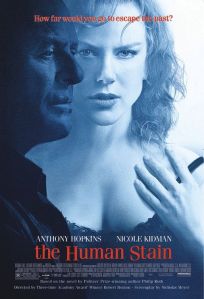 Anthony Hopkins as a black man? Nicole Kidman as a white trash janitor? And the two are LOVERS? This is a movie that is sunk by some lamebrain casting decisions. It’s one of those art pieces that yearns to be something more but just gasps for air.
Nate’s Grade: C
Share this:

Red Dragon (2002)
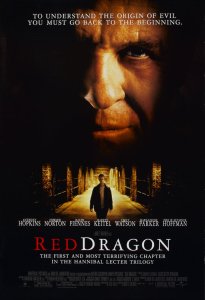 The following is a conversation overheard between two studio producers:
Person #1: So this Hannibal movie made like a ton of green. What else can we do to squeeze out some more money?
Person #2: Hey, do you remember a movie called Manhunter based on the first Lector novel?
Person #1: Nope.
Person #2: That’s fine because nobody else does.
It’s official folks: Hannibal Lector, America’s favorite cannibal, is now more comical than scary. See the element that 1991’s Silence of the Lambs carried with it was a stealthily gripping sense of psychological horror. It hung with you in every closed breath you would take, surrounding you and blanketing your mind. I mean, there aren’t many serial killer movies that win a slew of Oscars. And while the follow-up, last year’s Hannibal, gleefully bathed in excess at least Ridley Scott’s sequel was so over-the-top with its Baroque horror that it was entertaining. So what’s Red Dragon, the latest Lector flick based on Thomas Harris first novel like? Well it’s like the bastard child of Lambs and Hannibal after a drunken one-night-stand neither would be proud of in the pale light of morning.
 In an extended prologue we see the capture of the good doctor with a good appetite, Hannibal Lector (Anthony Hopkins, completing his trilogy of the character). FBI Agent Will Graham (Edward Norton) seeks his advice on a profile of a serial killer, not knowing that Lector more than fits the bill. A violent struggle ensues that leaves Graham with a long scar across his abdomen and Lector locked away for nine consecutive life sentences.
Turns out there’s another madman on the loose. The Tooth Fairy, dubbed by tabloid journalist Freddy Lounds (Phillip Seymour Hoffman), has butchered two families in their homes and inserted shards of broken mirror into their eyes. The FBI coaxes Graham out of retirement to try and track down the Tooth Fairy. But it seems in order to make any significant ground he must seek help from an old advisor – Hannibal Lector.
The crux of the film follows Graham’s attempts to figure out the identity of the Tooth Fairy, which we learn fairly fast is pretty boy Ralph Fiennes. Seems Fiennes has a cleft palette and years of physical and sexual abuse to toil over. He desires to transform into a mythical Chinese creature known as the Red Dragon. But wait, the lonely Fiennes is befriended by a lovely blind woman (Emily Watson) who identifies having people look differently at her. Can her affections melt the cold heart of a cold-blooded killer? Well, if they did thered be no other half of this movie.
What Red Dragon feels like is more of a checklist of what we expect to see in a Hannibal movie than anything of creative nourishment. It’s like a slimmer version of Lambs plot. Once again there’s an FBI agent who recruits Hannibal for advice on tracking down a serial killer. Once again there’s a disturbed killer trying to transform himself. Once again Hannibal Lector scares the crap out of anyone at will. Check, check, and check. Creative stagnation? Double check. The most disappointing aspect is the rudimentary feel this whole exercise has. Even though Red Dragon is a prequel it still seems like it’s begging to meet our expectations of two earlier films.
The first stab at the Red Dragon novel was in 1986 by director Michael Mann (Ali, The Insider) with the thriller Manhunter. William Peterson (before his work at CSI) was a more brooding Graham, Tom Noonan was a spookier Tooth Fairy, and the tension was stacked better. There were no comparative expectations.
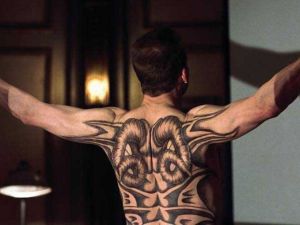 Norton is the finest actor of his generation but has certain trouble breathing life into Graham. The character is far more straight-laced than what we’ve been told is an expert at delving into the minds of killers. Grahams relationship with Lector doesn’t have any of the complexity, or interest, that Jodie Foster’s Clarice Starling had. He can even be very flat-footed in his detective work for a specialist. He stares at the home videos of the two slain families for about an hour wondering what the connection is while we in the audience shout it out to him. Lets go to the videotape Ed!
Anthony Hopkins returns as the devil in the flesh and seems to have another grand old time. Lector worked in Lambs because he was caged up, like a wild animal not meant for four glass walls. You never knew what would happen. He’d get in your head and he would know what to do with your gray matter — not that he didn’t have a culinary degree in that department with Hannibal. With Red Dragon, Hannibal is just window dressing to another serial killer. He’s a supporting character in a story that he has nothing to do with. He’s reduced to comic relief with his sudden attacks of chattering teeth and velvety voice. The amazing supporting cast of actors all do well, especially the beaming Watson who will shine in anything you put her in. Just try.
Ultimately the story of Red Dragon is far from flawless and meanders for quite a while. It would have been a marginally competent movie had it not been trying to replicate Silence of the Lambs so damn hard. So, is this the last youll see of Hannibal Lector? No as long as clinging cash registers can still be heard. Cue evil laughter.
Nate’s Grade: C+
Share this:

Hannibal (2001)
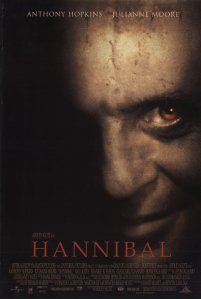 Trying to sequelize Silence of the Lambs is surely harder than trying to sequelize The Blair Witch Project. The novel Hannibal by Thomas Harris I don’t think will be confused as a necessary burst of creative ambition, and more of a chance to cash in on the love of Hannibal Lector. Though I’ve not read a line from the book from what I’m told the movie is faithful until the much hated ending. Starting a film off a so-so book isn’t a good way to begin, especially when you lose four of the components that made it shine Oscar gold.
 The element that Silence of the Lambs carried with it was stealthily gripping psychological horror. It hung with you in every closed breath you would take, surrounding you and blanketing your mind. I mean, there aren’t many serial killer movies that win a slew of Oscars. Lambs excelled at psychological horror, but with Hannibal the horror turns into a slasher film more or less. What Lambs held back and left us terrified Hannibal joyfully bathes in excess and gore.
Julianne Moore, a competent actress, takes over from the ditching Jodie Foster to fill the shoes of FBI agent Clarice Starling. Throughout the picture you know she’s trying her damndest to get that Foster backwoods drawl she used on the original down. The problem for poor Moore though is that her character spends half of the film in the FBI basement being oogled by higher-up Ray Liotta. She doesn’t even meet Hannibal Lector until 3/4 through. Then again, the title of the film isn’t Starling.
Anthony Hopkins returns back to the devil in the flesh and seems to have a grand old time de-boweling everyone. Lector worked in Lambs because he was caged up, like a wild animal not meant for four glass walls, and you never knew what would happen. He’d get in your head and he would know what to do with your grey matter – not that he doesn’t have a culinary degree in that department in this film. Lector on the loose is no better than a man with a chainsaw and a hockey mask, though he has a better knowledge of Dante and Florentine romantic literature. Lector worked bottled up, staring at you with dead unblinking calm. He doesn’t work saying goofy “goody-goody” lines and popping out of the shadows.
 Since the director, screenwriter, and female lead didn’t show up for the Lambs rehash, it feels a tad chilled with Ridley Scott’s fluid and smooth direction. The cinematography is lush and very warm.
Gary Oldman steals the show as the horribly disfigured former client of Lector’s seeking out revenge. His make-up is utterly magnificent and the best part of the film, he is made to look like a human peeled grape. Oldman instills a Texan drawl into the character yet making him the Meryl Streep of villainy.
Hannibal is no where near the landmark in excellence that Silence of the Lambs was but it’s not too bad. It might even be good if it wasn’t the sequel to a great film. As it is, it stands as it stands.
Nate’s Grade: B-
Reviewed 20 years later as part of the “Reviews Re-View: 2001” article.
Share this:

Mission: Impossible II (2000)
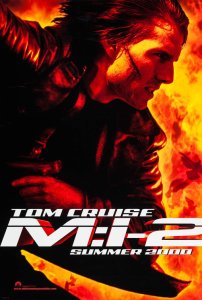 John Woo’s loud and flashy sequel to DePalma’s overwrought Mission: Impossible comes with both guns blazing — and doves flying. Since EVERYONE from the show, minus Tom Cruise, was killed in the first movie, the series starts off with a fresh cast complete with weak villain. Dougray Scott plays the rouge MI agent who steals a virus and its subsequent antidote to only release the super virus onto the world and make a super steady pharmaceutical profit from the the antidote. One wonders what the MI agency does except create rogue operatives for movie plotlines. Oval-faced, glass-eyed beauty Thandie Newton, who was last seen croaking and spitting river water in Beloved, plays Cruise’s new love interest. Her role isn’t really fleshed out but she provides the sparkle and charm, not to mention plenty of spice, that is necessary. The real problem MI:2 has is the action. Now Woo is a marvelous choreographer of action, his visions are poetry — but they all seem so cliche now that most of the action came across as hollow and just empty noise. There are moments of excitement but they are few and far between a hackneyed lumbering plot. Still, in a summer wishing for fireworks you can’t fault MI:2 for delivering.
Nate’s Grade: B-


 nathanzoebl
You must be logged in to post a comment.