Blog Archives
The Flash (2023)/ Spider-Man: Across the Spider-Verse (2023)
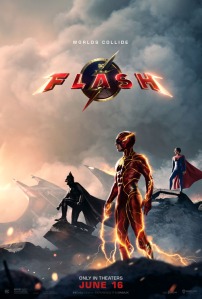
Released within two weeks of one another, two big summer movies take the concept of a multiverse, now becoming the norm in comic book cinema, and explore the imaginative possibilities and wish-fulfillment that it proposes, but only one of them does it well. Spider-Man: Across the Spider-Verse is the sequel to the Oscar-winning 2018 revolutionary animated film, and it’s a glorious and thrilling and visually sumptuous experience, whereas DC’s much-hyped and much-troubled movie The Flash feels like a deflated project running in place and coming apart. Let this be a lesson to any studio executive, that multiverses are harder than they look.
Barry Allen (Ezra Miller) has the ability to travel at fantastic speeds as his superhero alter ego, The Flash. He’s tired of being the Justice League’s errand boy and still fighting to prove his father is innocent of the crime of killing Barry’s mother. Then Barry discovers he can run fast enough to actually travel back in time, so he returns with the intention of trying to save his mother. Except now he’s an extra Flash and has to train his alternate self (also Miller) how to control his powers. In this different timeline, there is no Justice League to combat General Zod (Michael Shannon, so thoroughly bored) from destroying the planet for Kryptonians.
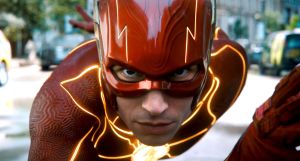
This is the first big screen solo outing for The Flash, and after none other than Tom Cruise, Stephen King, and James Gunn calling it one of the best superhero movies of all time, it’s hard to square how trifling and mediocre so much plays out as an example of a creative enterprise being pulled in too many directions. Miller was cast as the speedster almost ten years ago, and this tale has gone through so much tortured development, leaping through numerous filmmakers and writers, that its purpose has now gone from being a pillar of the expanding DC cinematic universe began with Zack Snyder’s Man of Steel in 2013 to becoming the Snyderverse’s death knell. The premise of traveling back in time is meant for Barry to learn important lessons about grief and responsibility and the limits of his powers, but it’s also intended as the reboot option for the future of these cross-connected comic franchises. It allows Gunn, now the co-head of the new way forward for DC movies and TV, to keep what they want (presumably Margot Robbie and Jason Momoa) and ditch the rest (Henry Cavill, Ben Affleck, Black Adam, Shazam, and Zack Snyder’s overall creative influence). So reviewing The Flash as only a movie is inadequate; it’s also a larger ploy by its corporate overlords to reset their comic book universe. In that regard, the quality level of the movie is secondary to its mission of wiping the creative slate clean.
Where the movie works best is with its personal stakes and the strange but appealing chemistry between the two Millers. It’s an easy starting point to understand why Barry does what he does, to save his mother. This provides a sturdy foundation to build a character arc, with Barry coming to terms with accepting his grief rather than trying to eradicate it. That stuff works, and the final talk he has to wrap up this storyline has an emotional pull that none of the other DCU movies have exhibited. Who wouldn’t want one last conversation with a departed loved one, one last opportunity to say how you feel or to even tell them goodbye? This search for closure is a relatable and an effective vehicle for Barry to learn, and it’s through his tutelage of the other Barry that he gets to see beyond himself. The movie is at its best not with all its assorted cameos and goofy action (more on both later) but when it’s a buddy comedy between the two Barrys. The older Barry becomes a mentor to himself and has to teach this inexperienced version how to hone and control his powers as well as their limits. It puts the hyper-charged character into a teaching position where he has to deal with a student just like him (or just him). It serves as a soft re-education for the audience alongside the other Barry without being a full origin story. The impetuous young Barry wanting to have everything, and the elation he feels about his powers, can be fun, but it’s even more fun with the older Barry having to corral his pupil. It also allows the character an interactive checkpoint for his own maturity and mental growth. Miller’s exuberant performances are quite entertaining and never fail to hit the comedy beats.
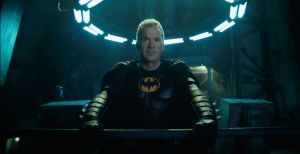
The problem is that the movie puts so much emphasis on too many things outside of its titular hero. Much was made of bringing back Keaton to reprise his Batman after 30 years. I just wish he came back for a better reason and had legitimate things to add. His role is that of the retired gunslinger being called back into action, and there’s an innate understanding with Barry wanting to go back in time and save his family, but too much of this character’s inclusion feels like a stab at stoking audience nostalgia (the callback lines all made me groan). I highly enjoyed Keaton as Batman and appreciated how weird he could make the billionaire-turned-vigilante, but he’s no more formed here than a hologram. The same thing happens with the inclusion of Super Girl a.k.a. Kara Zor-El (Sasha Callie). In this universe, there is no Superman, so she’s our requisite super-powered alien that Zod is hunting to complete his plans for terraforming Earth. She’s an intriguing character as a tortured refugee who has lingering doubts about whether humanity is worth the sacrifice, but much of her usage is meant only to make us think about Superman. She’s not given material to make her own impression, so she simply becomes the imitation of the familiar, the shadow to the archetype already being left behind. But these character additions aren’t even the worst of the nostalgia nods, as the final climactic sequence involves a collision of worlds that harkens to just about every iteration of the famous DC heroes, resurrecting several with dodgy CGI and uncomfortable implications (spoilers… the inclusion of George Reeves, when he felt so typecast as TV’s Superman that he supposedly killed himself because he thought his acting career was over, can be galling).
The action of The Flash is mostly fine but with one exceptional example that boggles my mind. In the opening sequence, no less, Barry is trying to help clean up a crumbling hospital when it collapses and literally sends a reign of babies falling through the air. I was beside myself when this happened, horrified and then stupefied that this absurd action sequence was actually happening. Barry goes into super speed to save the day, which more or less reverts the world into super slow-mo, though he needs to power up first, so we get a quick edit of him stuffing food into his face to load up on calories. We go from Barry breaking into a falling vending machine, stuffing himself in the face with snacks, getting the green light from his suit which I guess measures his caloric intake, and then grab a baby and literally put it in a microwave to shield it from danger. Just describing this event makes me feel insane. I figure the filmmakers were going for an over-the-top approach that also provides light-hearted goofiness to separate the movie from the oppressively dark grist of Snyder’s movies. However, this goes so far into the direction of absurdity that it destroys its credibility. It’s hard for me to fathom many watching this misguided and horrifying CGI baby-juggling sequence and say, “Yes, more please,” rather than scoff and shake their head. It’s not like the rest of the movie keeps to this tone either, which makes the sequence all the more baffling. There are Flash rules that are inconsistently applied to the action; Barry’s caloric intake is never a worry again, and the effects of moving a person during super speed don’t ever seem to be a problem except for one spewing gross-out gag.
While not being an unmitigated disaster, it’s hard for me to see the movie that got so many figures in the entertainment industry raving. The Flash has some notable emotional stakes, some amusing buddy comedy, and some goofy special effects sequences that run the gamut from amusing to confounding, but it’s also quite a mess of a movie, and too many of its nods to the fandom feel like empty gestures of nostalgia compensating for imagination. For all it gets right, or at least keeps interesting, it seems like another cog in a multi-billion-dollar machine, a stopping point also intended to be a reset and starting point. It feels like the character wasn’t trusted enough by the studio to lead his own solo movie even after years of buildup with Miller, nine seasons of the popular TV series, and 80-plus years of prominent placement in DC comics.
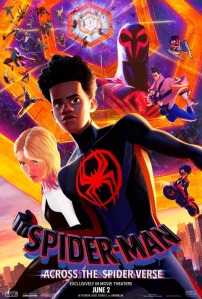
Conversely, Across the Spider-Verse is a sequel that expands an already stuffed story but knows what stories and themes to elevate so they don’t get lost amidst the fast-paced lunacy. Taking place a year later, Miles Morales (voiced by Shameik Moore) has grown into his role as the new Spider-Man for his world. He strains to meet the expectations of his parents, and keep up his grades, while fulfilling the duties of a superhero jumping into danger. When Gwen Stacey (voiced by Hailee Steinfeld) reappears to discuss joining the multiverse police, Miles jumps at the chance, having genuinely missed his other Spider friends, especially Gwen. There are countless Spider people in countless worlds, even including a Spider-T. Rex and a Spider-Car (Peter Parked Car, I believe the name was). Miguel O’Hara (voiced by Oscar Isaac) is the Spider-Man tasked with keeping order across the many interconnected multiverses, and he insists that sacrifice is essential to maintain balance, one that hits too close to home for Miles to abide.
The 2018 original is a hard act to follow, and while Across the Spider-Verse doesn’t quite overrule its predecessor it is a more than worthy sequel that has everything fans loved about the first trip. The visual inventiveness has been taken even higher, with the mixture of even more different animation and art styles. I loved seeing each Spider person and how they fit into their unique art style of their world, like the living water colors of Gwen’s world and the punky paper collage style of Spider-Punk (voiced by Daniel Kaluuya). There’s a villain that comes from a paper universe, so he resembles a three-dimensional paper construction with hand-scribbled notes appearing around him like Da Vinci’s commentary. There is something to dazzle your senses in every second of this movie. The visuals are colorful, creative, and groundbreaking with the level of detail and development. There’s probably even too much to fully take in with just one viewing. I want to see the movie again not just because it’s outstanding but so I can catch the split-second vernacular asterisk boxes that pop up throughout the movie. Going further into living comic book aesthetics, new characters will be introduced with boxes citing their comics issue reference point, and certain names and vocab will get their own citations as well. These are split-second additions, nothing meant to distract from the larger narrative. Simply put, this is one of the most gorgeous looking movies of all time, animated or live action. It’s bursting, thrumming, nearly vibrating with life and love stuffed into every nook and cranny, and it’s exhilarating to just experience a vivid, thriving world with animators operating at peak talent.
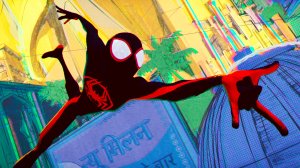
However, the movie has an engrossing story to better position all those eye-popping visuals. The worry with any modern multiverse story is that the unlimited possibilities of variations and opportunities for characters to do just about anything will overwhelm a narrative, or like The Flash, become a checklist of overburdened and empty fan service. The screenplay by Phil Lord, Christopher Miller, and Dave Callaham is all about relationships. If Miles’ relationship with his stern police lieutenant father (voiced by Brian Tyree Henry) wasn’t such an important focal point, then the emotional stakes of the movie would be meaningless. We see a relatable struggle from both sides, the parents trying to connect with their growing child and give him enough space to find himself, and the child who clearly loves his parents but doesn’t fully appreciate or understand their concerns. They worry about Miles leaving them and whether others will love and support him like his parents. Miles has to experience a wider world of possibility, but these experiences make him appreciate what he has at home, and what could be permanently lost. I don’t mind saying there were more than a few moments that caused me to tear up. I found Gwen’s storyline equally compelling, and her turmoil over keeping her secret identity and then coming out to her father was rather moving. The family bond resurfacing will get me every time, and the simple action of a hug can be as heartwarming and fulfilling as any romantic ode. Across the Spider-Verse makes sure we care about the characters and their personal journeys.
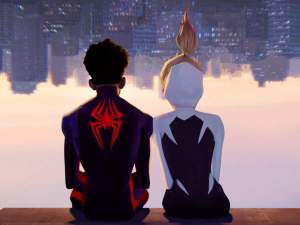
At a towering 140 minutes, this is the longest (American) animated movie ever, and it’s still only one half of a larger story. I knew ahead of time this was only the first part so as soon as we entered Act Three I kept gearing up for the cliffhanger ending. Every five or so minutes I thought, “Okay, this is going to be the end,” and then it kept going, and I was relieved. Not just because I got to spend more time in this unique universe but each new moment added even more to raise the stakes, twist the intrigue, and make me excited for what could happen next. I was shaking in my seat at different points, from the excitement of different sequences to the emotional catharsis of other moments. I cannot wait to experience this same feeling when the story picks back up reportedly in March 2024, though I fear it will get delayed to late 2024.
Even with the unlimited possibility of jokes and silly mayhem, the filmmakers keenly understand that it doesn’t matter unless we care about the characters and their fates. I am shocked that a goofy character I thought was going to be a one-scene joke, The Spot (voiced by Jason Schwartzman), could end up becoming the ultimate destroyer of worlds. I think this reflection nicely summarizes the impeccable artistry of Across the Spider-Verse, where even the moments or characters misjudged as fleeting or inconsequential can be of great power. It’s a movie that is full of surprises and thrills and laughs, all in equal measure, and a blessed experience for a movie fan. In the crush of comic book multiverse madness, Across the Spider-Verse is a refreshing and rejuvenating creative enterprise, one that builds off the formidable talent of its predecessor and carries it even further into artistic excellence that reminds us how transporting movies can be. If you see one superhero multiverse movie this summer, the choice should be as obvious as an inter-dimensional spider bite.
Nate’s Grades:
The Flash: C
Across the Spider-Verse: A
Share this:

Elemental (2023)
 The joke is how Pixar has taken its storytelling motif of examining The Secret Life Of [Blank] and showing what happens in our world when we just aren’t paying attention. We’ve had toys with emotions, bugs with emotions, fish with emotion, cars with emotion, robots with emotion, rats with emotion, and even emotions with emotions, so why not break things down to their basics and give the elements of carbon-based life their own emotions too?
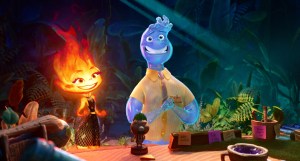
In Element City, Ember (voiced by Leah Lewis) belongs to the fire community living on the outskirts of town, as the big city wasn’t built for their kind. The earth people, and water people, and air people go about their business while the fire people form their own thriving offshoot. Her father and mother came across the sea to give their baby a new life, and the family shop will pass over to Ember’s management when her traditionalist father thinks she’s ready. Her whole life has been about serving her family and trying to live up to their hopes and dreams. This gets more complicated when Wade (voiced by Mamoudou Athie), a water person and a health inspector, has to report her family’s shop for code violations. They work together to save the shop and also learn from one another’s cultures and differing perspectives, and then this unexpected friendship becomes an even more unexpected romance, but can elements so different stay together?
 I was pleasantly surprised at how enjoyable Elemental is to experience and how wondrous its visual presentation is to watch. It is a certifiable treat for the eyes, with so many dazzling colors and quirky but easily readable character designs. There’s a mixture of hand-drawn animation used as Spider-Verse-style accents that provides a pleasing element that allows the images to pop even more. I was never bored looking at a single second of this movie, and even with my theater’s 3-D presentation, the glasses didn’t darken the screen and lessen my overall enjoyment. By existing within a fantasy universe, it allows for every scene and every location to better inform you about this new world and its rules and highlights (fire baby carriages that are barbecue grills). This is a bright, colorful, and supremely enchanting movie to watch because, at least visually, it feels very well developed as far as its world building and atmosphere. What would a community of fire people tend to look like? What would their jobs be? What would their celebrations be like? Their heritage from the Old Country? Naturally, with any fantasy universe, you can nit-pick it to death with questions, such as why do people even bother wearing clothes in this world? What part of the exposed fire or water is observed as obscene? How exactly do these different communities have their offspring? What does air exactly eat for food?
Where Elemental really takes off is with its charming and affecting romance. It’s been a while since romance was at the forefront for a Pixar movie, since 2008’s WALL-E (a.k.a. the greatest Pixar movie). Now there are themes and resonance that go beyond the romance and also enrich it, like Ember’s personal conflict of being a first-generation immigrant daughter and upholding the traditions and wishes of her family at the expense of her personal desires, but the core of this movie is on the burgeoning feelings between Ember and Wade. The movie begins with them butting heads as two elements seemingly in conflict but it doesn’t exactly follow an enemies-to-lovers path. She runs hot and explosive with trying to keep things under control whereas he is deeply empathetic of others and wants to help them become their best selves. He accepts who he is, and the movie doesn’t equate his full-bodied embrace of big feelings as some point of weakness. It brings about laughs from exaggeration, the streaming rivers that burst forth from his eyes upon crying, but it’s his compassion and acceptance that challenges Ember for the better and helps her assert her sense of self. They’re good together, and Wade helps serve as a guide to the wider world for Ember as she’s been isolated her whole life. Their interactions are cute and heartwarming and elevated by pleasant vocal performances. I was drawn into their story and cared about their well-being, enough that I don’t mind sharing that I shed some water myself by the end (I guess this could also make some people mistake that I peed my pants, and I assure you that was not the case, dear reader).
 While the core relationships are poignant and winning, the world building and metaphorical allegories feel half-finished and a tad confusing. The movie also goes surprisingly soft exploring its miscegenation metaphor of two elements being forbidden to mix romantically. This universe has four communities of living elements, though air is represented as clouds and those are, literally, water vapor, and the xenophobia and discrimination that the fire people endure feels like a direct parallel to a disadvantaged minority group. However, this isn’t explored in any satisfying depth. We’re told that fire people aren’t really wanted in the city, and the city isn’t really built for them, which is typified by a rail line that splashes water discharge. There’s a lot more that could have gone into this including a more elaborate examination of the harm of red-lining and restricting the economic mobility of one group for bigoted reasons (I know, I can already hear people scolding me for even asking for such socio-political commentary in a family film). However, this metaphor gets a little murky when you take into account the literal danger that living fire exudes. Yes, you can drown, and you can get crushed under earth, but these creatures aren’t walking incendiary devices. This doesn’t translate directly to people, and thus applying class metaphors to actual races can be circumspect. Ember’s worry is that she’ll explode if she gets too angry, and this causes literal physical destruction around her. You can say it’s meant to represent when hurt, angry people lash out that they can inadvertently harm others, but not everyone can incinerate a block because they lose their temper. This kind of undercuts the lesson on misplaced fear.
Also, so much of the external story consists of bad public planning and everyone’s lackadaisical attitude toward fixing this infrastructure miscue. Again, if the larger point was a society that is actively hostile to the fire people, then the ignorant city planning that actively harms a disenfranchised group of people makes sense, but without that larger underlying conflict, it all seems so strangely forgotten. Much of this conflict is on the structure of a wall against a coming buildup of water, something possibly deadly to the fire community, so you would think this community would be a lot more concerned about this looming conflict. You might think that others would organize to provide better safeguards or maybe they would get the city’s attention. That this threat goes unreported and is played at such low stakes makes it all feel forced and manufactured. If the characters don’t seem to think it’s a big deal, then who are we to worry as well? And I can hear some of you trying to branch this out into, say, a metaphor for larger problems that go ignored, like climate change or societal inequalities, but that’s giving Elemental too much credit.
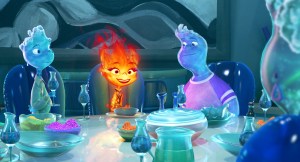 Elemental reminds me of 2020’s Onward, coincidentally one of the last movies I saw in theaters before the pandemic shutdown. I was worried that the core story looked weak but it was actually the world-building that was a bit hazy and under-developed and the emotional core was strong and authentic. It’s the same with Elemental, and while I can quibble about its dropped potential and misshapen world, it has a strong foundation that matters more. The relationships between Wade and Ember and Ember and her family are what makes the movie work and ultimately what made me smile and tear up. It’s an emotional nourishment that makes the movie feel satisfying and worthwhile no matter the lingering questions for this bizarre world. It’s also one of Pixar’s best looking movies, fully deserving of being seen on a large screen for added impact. Elemental has the right DNA for a charming and enjoyable family film for everyone.
Nate’s Grade: B
Share this:

The Super Mario Bros. Movie (2023)
 Colorful and eminently pleasant, The Super Mario Bros. Movie is about everything you would expect from an Illumination project. To begin with, there’s not a lot of story in the 30-plus years of Mario video games, so it’s not surprising that the story is kept relatively familiar with characters each inhabiting simple motivation (Mario wants to impress his dad, Luigi wants to be brave, Peach wants to protect her people, Bowser wants to be accepted by his unrequited love). Much of the movie is establishing a new location and giving some moment of fan service before moving on, like an extensive Mario Kart Rainbow Road sequence or Mario meeting Donkey Kong. It feels like the risk-averse creative process started with a list of characters, levels, and references and then how to squeeze them in. This is a movie kept at a kiddie level, which is fine even for adults to enjoy, but it means there is a lowered ceiling of ambition (so… many…. needle-drop song selections…). Much of the movie is fleeting and fine, with highlights including Jack Black’s performance as the love-struck Bowser, the training sequences making use of the bizarre physics and accoutrements of the Mushroom Kingdom, and a delightfully nihilistic little blue star with a cheery child’s voice. The movie is earnest to the point of being a little corny, which might be refreshing for parents and children used to a recent slate of overly glib kid’s movies trying to act smarter than they are. This movie is cute and harmless and a sugar rush to be forgotten after it wears off. Now re-watch the 1993 version that attempted to take the same source material and make a parallel world Blade Runner with Dennis Hopper as King Koopa. There’s also one hundred percent less Chris Pratt.
Nate’s Grade: B-
Share this:

Puss in Boots: The Last Wish (2022)
 Puss in Boots: The Last Wish is, surprisingly, genuinely great. No kidding. It’s very very good. It’s been eleven years since the first Puss in Boots spinoff, and that itself was seven years after the character was introduced in 2004’s Shrek 2, and there hasn’t been a Shrek movie since the franchise-killing Forever After in 2010. I would have assumed that Dreamworks had just moved on from this character in the ensuing years, especially as How to Train Your Dragon became their big new commercial franchise, until they too ran that into the ground with 2019’s disappointing third film. I had little expectations of greatness once I heard there was a new Puss in Boots feature, even after I started hearing the growing critical consensus. Early in, only mere minutes, I realized that a Puss in Boots sequel was one of the best movies of 2022 and an exciting and heartfelt sequel that proves that with the right artists and storytellers, any old character can still have vibrant relevance. It’s a children’s movie that can appeal to everyone.
Puss (voiced by Antonio Banderas) is a famous adventurer, sword fighter, and lover of women, but he’s also nearing the end of a long journey. He’s used up his eight lives and is now on his ninth and last, and to escape Death, he sets out on a quest to retrieve a fallen star that will grant one person a wish. It just so happens there are a lot of other characters in this fairy tale kingdom that want to get there too.

It is amazing how hard this movie goes. In its opening sequence, it establishes its bold artistic style that enlivens every second onscreen, it establishes its caliber of exciting action that feels akin to wild comic books and anime, and an emphasis on mortality that provides a sense of danger and emotional foundation for what could have been just another shoddy animated sequel drafting off brand recognition. Let’s just focus on the animation style to begin with. I was expecting the same old CGI that has dominated the world of animation for twenty years, but The Last Wish has been clearly inspired by the greatness of 2018’s Into the Spider-Verse. There is a distinct 2D edge given to the designs, accenting the imagery, and during bouts of action they will lower the frame frate, making the movements much more stark and pronounced. Add to this a lovely, painterly watercolor visual style, more emphasis on the overall impression than finite definition, and the movie is a consistent feast for the eyes. There are stylized sequences that communicate fear and desperation, as well as sequences that exemplify the kinetic movement of superhuman action, smartly altering its visual appearance to better serve whatever emotion it wants you to feel. I hope more and more animation companies continue this magical hybrid of CGI and traditional animation techniques, as also seen in 2021’s The Mitchells vs. the Machines. It’s a great step forward combining the old and the new into a stylized look that allows the creators to make the best of both animation worlds.
The action is also satisfying and surprisingly well developed. The opening sequence involves Puss awakening a giant behemoth and it made me think of the exaggerated and intense action of anime series with giant kaiju monsters like in Attack on Titan. The camera will freely circle and zoom around the theater of action, heightened with exaggerated motion lines and split screens and POV swaps. I also love that the filmmakers understand the inherent qualities of what makes for good action, incorporating the personality of the characters into the situations, providing organic consequences, tailoring to the geography, and providing clear mini-goals. After introducing the secondary antagonist of greedy Jack Horner (John Mulaney), as well as Goldilocks (Florence Pugh) and the three bears (Ray Winstone, Olivia Coleman, Samson Kayo) “crimin’” gang, the movie transforms into a delightful and unexpected fantasy version of Midnight Run. There are multiple groups racing against one another to a destination, all the while jostling for supremacy and bumbling into one another’s way. It makes for a fun series of events as every group has their own reasons for gaining the wishing star. Because of this, their behavior feels in-character and the cross-purpose motivation allows for fun combinations of characters getting in the way of one another and utilizing the specifics of their fantasy character details. There was a midpoint sequence combining all sides in a colorful brawl, including unicorn horns exploding into confetti upon contact, and I just felt a surge of pure incandescent joy.

In yet another of the movie’s pleasant surprises, it has one of the best villains of the year as it deals with the concept of mortality with actual nuance. The main antagonist is literally Death itself, personified as a red-eyed, grinning bounty hunter wolf and voiced by Narcos’ Pablo Escobar, Wagner Moura with a menacing purr. This Wolf is after Puss because he’s now on his last life and the Wolf is personally offended at the idea of having multiple lives. Their first encounter makes Puss feel fear for perhaps the first time in his nine lives. In a morbidly amusing montage, we zip through Puss’ previous eight lives and specifically the moments leading to their comical end. He’s flippant with an unchecked ego, and Death seriously humbles him, being the first to ever land a blade on Puss in Boots, a detail he’d been bragging about even in song. From here, Puss is deathly afraid and the hairs of his body will stick up whenever he suspects the return of the Wolf, who certainly enjoys terrorizing his targets with an ominous whistle to announce his presence. So at a moment’s notice, the crazy and colorful hijinks can stop from hearing that familiar yet eerie whistle. In some ways, it’s a family-friendly depiction of working through trauma. The larger theme is Puss acknowledging his moral shortcomings with his many lives, the time wasted on frivolity and ego, and making the most of the time he has left. The need to re-up his lives is a fine starting motivation based upon fear, personified as trying to literally escape the scary wolf, but it’s also what makes Puss confront his own behavior and want to change as well as hold himself accountable.
The heartfelt portion of the movie is its emphasis on found families, and it was done so well that I actually teared up at points. Yes, dear reader, Puss in Boots 2 had me on the verge of tears more than once. Goldilocks is the leader of her gang of squabbling thieves, but she still views herself as an orphan first, whereas the bears view her as an equal and valued member of the family and crime gang. Even her character arc comes to a poignant conclusion where she realizes that her real family isn’t the one she comes from but the one who makes her feel that she belongs. This theme is also demonstrated with little Perrito (Harvey Guillen, What We Do in the Shadows TV series) as the adorable and undying optimist puppy sidekick. His selfless vantage point contrasts with Puss, and greatly annoys him, but Perrito also has his own goal. He wants to be a comfort dog, and one of the sweetest moments of the movie involves him helping Puss come back from a traumatic response through a shared moment. Even typing these words makes me tear up. The screenplay knows how to develop characters that can grow as friends and family and the drama is directly connected to well-honed characters and thoughtful story without being overly sentimental and maudlin, a slippery slope to doom many child-friendly animated efforts with messages.

Puss in Boots: The Last Wish does everything well. It’s funny and colorful and exciting and meaningful and heartfelt and everything you would want in any movie, let alone one featuring a talking cat swashbuckler in tiny boots. No matter your mixed feelings on Dreamworks animated movies, or their iffy sequels, or even children’s movies as a whole, I whole-heartedly recommend that everyone give this magical movie a fighting chance. The animation is gorgeous and vibrant and colorful, the vocal performances are terrific, the action is fun and well-developed, and the themes and character arcs have substance to provide meaningful layers and emotional heft. This is superior entertainment and all in about 90-some minutes. While I’d slot it below Guillermo del Toro’s masterful stop-motion Pinocchio, this is a wonderful movie and one of the best to ever bear the Dreamworks mantle. It’s the 2022 sequel you never knew that you needed but will be oh so happy that it rightly does.
Nate’s Grade: A-
Share this:

Marcel the Shell with Shoes On (2022)
 The feature-length movie based upon the short stop-motion films about a mollusk in sneakers, Marcel the Shell with Shoes On might just be the most precious movie of the year. It’s set like a faux documentary where a lonely filmmaker discovers a magical inhabitant in his Air B&B, a very soft-spoken little guy with a heart much bigger than his actual size. Marcel (voiced by co-creator Jenny Slate) is looking for his lost family who were unknowingly absconded when the original couple who lived in the house broke up and gathered their things quickly before storming off. Dean (Dean Flesicher-Camp, also the movie’s director) records Marcel and his innocent little observations on life and the bigger world and posts the videos online, and Marcel becomes Internet famous, for good and bad. The plot of the movie is less important than its overall gentle nature. There’s not a lot that happens in the movie, but you dont mind because it’s really an 80-minute sit-down with Marcel. The entire movie is just so sweetly innocent that it’s hard to resist. It also has some bigger things to say about our place in the world as well as mortality. Marcel has a loving yet ailing grandmother shell (voiced by Isabella Rossellini) who is beginning to lose her lucidity, and it will hit home for anyone who has watching a loved one suffer from mental decline. Marcel the Shell with Shoes On is a perfect little antidote for our modern cynical lives. It’s overwhelmingly adorable and wholesome and winsome and just plain cute.
Nate’s Grade: B
Share this:

Guillermo del Toro’s Pinocchio (2022)/ Pinocchio (2022)
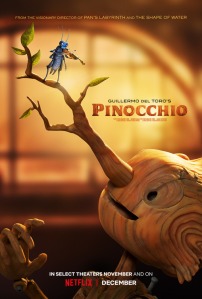 It seems 2022 has unexpectedly become the year of Pinocchio. The 1883 fantasy novel by Carlo Collodui (1826-1890) is best known via the classic Walt Disney animated movie, the second ever for the company, and it was Disney that released a live-action remake earlier in the year on their streaming service. Now widely available on Netflix is Guillermo del Toro’s stop-motion Pinocchio, so I wanted to review both films together but I was also presented with a unique circumstance. Both of these movies were adaptations of the same story, so the comparison is more direct, and I’ve decided to take a few cues from sports writing and break down the movies in a head-to-head competitive battle to see which has the edge in a series of five categories. Which fantastical story about a little puppet yearning to be a real boy will prove superior?
1. VISUAL PRESENTATION
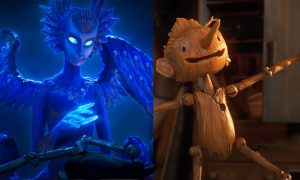
The Netflix Pinocchio is a lovingly realized stop-motion marvel. It’s del Toro’s first animated movie and his style translates easily to this hand-crafted realm. There is something special about stop-motion animation for me; I love the tactile nature of it all, the knowledge that everything I’m watching is pain-stakingly crafted by artisans, and it just increases my appreciation. I fully acknowledge that any animated movie is the work of thousands of hours of labor and love, but there’s something about stop-motion animation that I just experience more viscerally. The level of detail in the Netflix Pinocchio is astounding. There is dirt under Geppetto’s fingernails, red around the eyes after crying, the folds and rolls of fabric, and the textures feel like you can walk up to the screen and run your fingers over their surfaces. I loved the character designs, their clean simplicity but able readability, especially the sister creatures of life and death with peacock feather wings, and the animation underwater made me question how they did what they did. del Toro’s imagination is not limited from animation but expanded, and there are adept camera movements that require even more arduous work to achieve and they do. I loved the life each character has, the fluidity of their movements, that they even animated characters making mistakes or losing their balance or acting so recognizably human and sprightly. There’s a depth of life here plus an added meta-textual layer about puppets telling the story about a puppet who was given life.
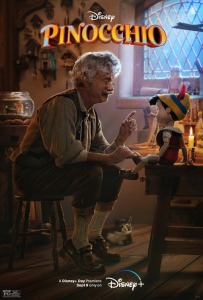 In contrast, the Disney live-action Pinocchio is harsh on the eyes. It’s another CGI smorgasbord from writer/director Robert Zemeckis akin to his mo-cap semi-animated movies from the 2000s. The brightness levels of the outside world are blastingly white, and it eliminates so much of the detail of the landscapes. When watching actors interact, it never overcomes the reality of it being a big empty set. The CGI can also be alarming with the recreation of the many animal sidekicks of the 1940 original. Why did Zemeckis make the pet goldfish look sultry? Why did they make Jiminy Cricket (Joseph Gordon-Levitt) look like a Brussel sprout come to life? It might not be the dead-eyed nightmare fuel of 2004’s The Polar Express, but the visual landscape of the movie is bleached and overdone, making everything feel overly fake or overly muddy and glum. The fact that this movie looks like this with a $150 million budget is disheartening but maybe inevitable. I suppose Zemeckis had no choice but to replicate the Pinocchio character design from 1940, but it looks remarkably out of step and just worse. When we have the 1940 original to compare to, everything in the 2022 remake looks garish or ugly or just wrong. The expressiveness of the hand-drawn animation is replaced with creepy-looking CGI animal-human hybrids.
Edge: Netflix Pinocchio
2. FATHER/SON CHARACTERIZATION
The relationship between Pinocchio (voiced by Gregory Mann) and Geppetto (David Bradley) is the heart of the Netflix Pinocchio, and I don’t mind sharing that it brought me to tears a couple of times. As much as the movie is about a young boy learning about the world, it’s also about the love of a father for a child. The opening ten minutes establish Geppetto’s tragedy with such surefooted efficiency that it reminded me of the early gut punch that was 2009’s Up. This Geppetto is constantly reminded of his loss and, during a drunken fit, he carved a replacement child that happens to come to life. This boy is very different from his last, and there is a great learning curve for both father and son about relating to one another. This is the heart of the movie, one I’ll discuss more in another section. With del Toro’s version, Geppetto is a wounded and hurting man, one where every decision is connected to character. This Pinocchio is a far more entertaining creature, a child of explosive energy, curiosity, and spitefulness. He feels like an excitable newborn exploring the way of the world. He’s so enthusiastic so quickly (“Work? I love work, papa!” “I love it, I love it!… What is it?”) that his wonder can become infectious. This Pinocchio also cannot die, and each time he comes back to life he must wait longer in a netherworld plane. It provides even more for Pinocchio to understand about loss and being human. This is a funny, whimsical, but also deftly emotive Pinocchio. He points to a crucifix and asks why everyone likes that wooden man but not him. He is an outsider learning about human emotions and morals and it’s more meaningful because of the character investment.
 In contrast, the Disney live-action Pinocchio treats its title character as a simpleton. The problem with a story about a child who breaks rules and learns lessons by dealing with the consequences of his actions is if you have a character that makes no mistakes then their suffering feels cruel. This Pinocchio is simply a sweet-natured wannabe performer. He means well but he doesn’t even lie until a sequence requires him to lie to successfully escape his imprisonment. The relationship with Geppetto (Tom Hanks) is strange. This kindly woodcarver is a widower who also has buried a son, but he comes across like a doddering old man who is quick to make dad jokes to nobody (I guess to his CGI cat and goldfish and multitude of Disney-tie-in cuckoo clocks). I don’t know what Hanks is doing with this daffy performance. It feels like Geppetto lost his mind and became stir crazy and this performance is the man pleading for help from the town, from the audience, from Zemeckis. It’s perplexing and it kept me from seeing this man as an actual character. He bounces from catalyst to late damsel in distress needing saving. The relationship between father and son lacks the warmth of the Netflix version. Yet again, the live-action Pinocchio is a pale imitation of its cartoon origins with either main character failing to be fleshed out or made new.
Edge: Netflix Pinocchio
3. THEMES
There are a few key themes that emerge over the near two-hours of the Netflix Pinocchio, which is the longest stop-motion animated film ever. Sebastian J. Cricket (Ewan McGregor) repeats that he “tried his best and that’s the best anyone can do,” and the parallelism makes it sound smarter than it actually is. The actual theme revolves around acceptance and the burdens of love. Geppetto cannot fully accept Pinocchio because he’s constantly comparing him to Carlo. When he can fully accept Pinocchio for who he is, the weird little kid with the big heart and unique perspective, is when he can finally begin to heal over the wound of his grief over Carlo, allowing himself to be vulnerable again and to accept his unexpected new family on their own terms. There’s plenty of available extra applications here to historically marginalized groups, and del Toro is an avowed fan of freaks and outcasts getting their due and thumbing their nose at the hypocritical moral authorities. By setting his story in 1930s Italy under the fascist rule of Benito Mussolini, del Toro underlines his themes of monsters and scapegoats and moral hypocrites even better, and the change of scenery really enlivens the familiar story with extra depth and resonance. All these different people want something out of Pinocchio that he is not. Geppetto wants him to strip away his individuality and be his old son. Count Volpe (Christoph Waltz) wants Pinocchio to be his dancing minion and secure him fame and fortune. Podesta (Ron Perlman) wants Pinocchio as the state’s ultimate soldier, a boy who cannot die and always comes back fighting. When Pinocchio is recruited to train for war with the other young boys to better serve the fatherland’s nationalistic aims, it’s a far more affecting and unsettling experience than Pleasure Island, which is removed from this version. In the end, the movie also becomes a funny and touching exploration of mortality from a magic little child. The Wood Sprite (Tilda Swinton), this version of the Blue Fairy, says she only wanted to grant Geppetto joy. “But you did,” he says. “Terrible, terrible joy.” The fleeting nature of life, as well as its mixture of pain and elation, is an ongoing theme that isn’t revelatory but still feels impressively restated.
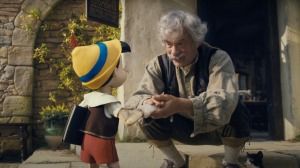 I don’t know what theme the Disney live-action movie has beyond its identity as a product launch. I suppose several years into the Disney live-action assembly line I shouldn’t be surprised that these movies are generally listless, inferior repetitions made to reignite old company IP. For a story about the gift of life, the Disney Pinocchio feels so utterly lifeless. I thought the little wooden boy was meant to learn rights and wrongs but the movie doesn’t allow Pinocchio to err. He’s an innocent simpleton who gets taken advantage of and dragged from encounter to encounter like a lost child. The Pleasure Island sequence has been tamed from the 1940s; children are no longer drinking beer or smoking cigars. They’re gathered to a carnival and then given root beer and told to break items and then punished for this entrapment. The grief Geppetto feels for his deceased loved ones is played out like a barely conceived backstory. He’s just yukking it up like nothing really matters. By the end, when he’s begging for Pinocchio to come back to life, you wonder why he cares. If you were being quite generous, you might be able to uncover themes of acceptance and understanding, but they’re so poorly developed and utilized. That stuff gets in the way of Pinocchio staring at a big pile of horse excrement on the street, which if you needed a summative visual metaphor for the adaptation, there it is.
Edge: Netflix Pinocchio
4. EMOTIONAL STAKES
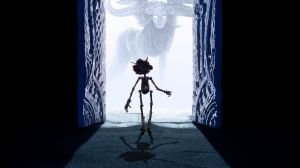 One of these movies made me cry. The other one made me sigh in exasperation. The Netflix Pinocchio nails the characterization in a way that is universal and accessible while staying true to its roots, whereas the Disney live-action film feels like a crudely packaged remake on the assembly line of soulless live-action Disney remakes. By securing my investment early with Geppetto’s loss, I found more to relish in the layers of his relationship with Pinocchio. In trying to teach him about the world, Geppetto is relying upon what he started with his past son, and there are intriguing echoes that lead to a spiritual examination. Pinocchio is made from the tree from the pinecone that Carlo chased that lead to his death. Pinocchio hums the tune that Geppetto sang to Carlo. Is there something more here? When he visits Death for the first time, the winged creature remarks, “I feel as though you’ve been here before.” These little questions and ambiguity make the movie much more rewarding, as does del Toro’s ability to supply character arcs for every supporting player. Even the monkey sidekick of the villain gets their own character arc. Another boy desperately desires his stern father’s approval, and he’s presented as a parallel for Pinocchio, another son trying to measure up to his father’s demands. Even this kid gets meaningful character moments and an arc. With this story, nobody gets left behind when it comes to thoughtful and meaningful characterization. It makes the movie much more heartwarming and engaging, and by the end, as we get our poignant coda jumping forward in time and serving as multiple curtain calls for our many characters, I was definitely shedding a flurry of tears. Hearing Geppetto bawl, “I need you… my boy,” to the lifeless body of Pinocchio still breaks me. Under del Toro’s compassionate lens, everyone is deserving of kindness.
As should be expected by now, the Disney live-action movie is lackluster at best when it comes to any kind of emotional investment. The characters stay as archetypes but they haven’t been personalized, so they merely remain as grubby facsimiles to what we recall from the 1940 version. Jiminy Cricket is meant as Pinocchio’s conscience but he vacillates from being a nag to being a smart aleck who even breaks the fourth wall to argue with his own narration. I hated every time he called the main character “Pee-noke” and he did it quite often. He’s far more annoying than endearing. There’s also a wise-cracking seagull that is just awful. The Honest John (Keegan Michael-Key) character is obnoxious, and in a world with a talking fox who dresses in human clothing, why would a “living puppet” be such a draw? He even has a joke about Pinocchio being an “influencer.” The only addition I liked was a coworker in Stromboli’s traveling circus, a former ballerina who injured herself and now gets to live out her dancing dreams by operating a marionette puppet. However, the movie treats the puppet like it’s a living peer to Pinocchio and talks directly to the puppet rather than the human operating the puppet, and the camera treats her like she’s the brains too. Safe to say, by the end when Pinocchio magically revives for whatever reason, just as he magically reverted from being a donkey boy, I was left coldly indifferent and more so just relieved that the movie was finally over.
Edge: Netflix Pinocchio
5. MUSIC
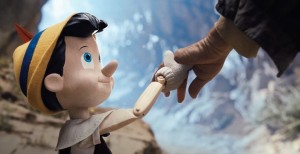 This was one area where I would have assumed the Disney live-action film had an advantage. Its signature banger, “When You Wish Upon a Star,” became the de facto Disney theme song and plays over the opening title card for the company. It’s still a sweet song, and Cynthia Erivo (Harriet) is the best part of the movie as the Blue Fairy. It’s a shame she only appears once, which is kind of negligent considering she sets everything in motion. The Netflix Pinocchio is also a musical and the songs by Alexandre Desplat (The Shape of Water) are slight and low-key, easy to dismiss upon first listen. However, the second time I watched the movie, the simplicity as a leitmotif really stood out, and I noticed the melody was the foundation for most other songs, which created an intriguing interconnected comparison. While nothing in the Netflix Pinocchio comes close to being the instantly humable classic of “When You Wish Upon a Star,” the songs are more thoughtful and emotionally felt and not just repeating the hits of yore, so in the closest of categories, I’m going to say that Netflix’s Pinocchio wins by a nose (pun intended).
Edge: Netflix Pinocchio
CONCLUSIONS
One of these Pinocchio movies is a visual marvel, heartfelt and moving, wondrous, and one of the best films of 2022. The other is a hollow vessel for corporate profit that copies the imprint of the 1940 animated film but only more frantic, scatalogical, and confused. In the year of our lord Pinocchio Two Thousand and Twenty-Two, there is only one movie you should see, and at this point ever see as it concerns this old tale. Guillermo del Toro has harnessed magic, and we are all the better for his bayonet imagination and enormous heart for his fellow outsiders.
Nate’s Grades:
Guillermo del Toro’s Pinocchio: A
2022 Pinocchio: C-
Share this:

Lightyear (2022)/ Luck (2022)
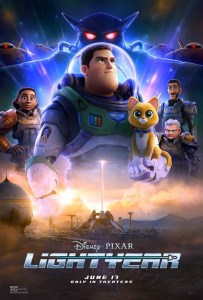 After two years and three movies sent straight to Disney’s burgeoning streaming service, Pixar returns with a theatrical movie that taps back to the very beginnings of this storied storytelling company. We’re told, via opening text, that Lightyear was Andy’s favorite movie and thus the reason he was so excited to bring home a Buzz Lightyear action figure in the first Toy Story. However, if this is Andy’s “favorite movie,” then this kid needs to be exposed to more movies. It’s an acceptable sci-fi story about Buzz (voiced by Chris Evans) learning the value of others and that being vulnerable is not the same as being weak. He’s a space ranger stranded on an alien world. Every time he attempts to restart their fuel system, it jumps him forward in time four years, and soon enough he’s a man out of time and those stranded have built a colony civilization over 100 years. There’s a band of misfits, who aren’t terribly funny, and some laser fights and action sequences, which aren’t terribly exciting, and the third act twist is predictable. The animation is top-notch, but the storytelling is definitely a few notches below infinity and beyond. What astounds me is that Andy could watch this movie and want a Buzz toy instead of the real breakout, the robotic cat Sox (voiced by Peter Sohn) who is wonderfully droll. I cannot fathom anyone watching this movie and desiring owning another character above this delightful supporting character. This movie makes me think a little less of Andy as a discerning arbiter of pop-culture zeitgeist. Lightyear is fine as escapist entertainment but too facile and inessential to the Toy Story universe.
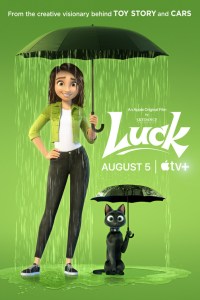 Luck is the first animated feature from Skydance, a production company that entered the animated realm by hiring former Pixar head John Lasseter as their chief creative executive. In some ways, Luck feels reminiscent of early Pixar movies, exploring the “secret life of” those in charge of dictating the forces of luck. The problem with Luck is that it is overwritten and overburdened with world building that crushes the emotional core. We follow a young woman aging out of the foster system and she’s been besieged with bad luck all her life. She follows a talking cat and discovers a hidden world where workers mine luck crystals and have lucky pennies as portal generators and there’s a dragon, for some reason, as the CEO of Good Luck, and to get back home she needs to team up with the cat to find a thing, but to find that thing they need to go to a place, but to go to that place they need to – and you get it. The plot is overworked with a chain of tasks that explain more of this world’s mechanics without connecting to the emotional journey of the character, like in 2015’s Inside Out. I was amazed that this woman lacks even a shred of bitterness about her own trenchant bad luck. There’s a nice message about accepting the bad with the good in life, and how both are opportunities for growth, but I kept wondering why our hero didn’t once lash out at those responsible. I’m also a little hesitant about using whether a little girl will be stood up by her potential new foster family as the stakes of completing the good luck reset goal. That seems pretty heavy for wackiness. The animation isn’t quite at the level of Pixar, or the best of Dreamworks, but it’s colorful and bright even if lacking more advanced lighting and texture. Luck lacks enough gravitas and development to really appeal to adults but it’s also probably too busy and convoluted to entertain small kids.
Nate’s Grades:
Lightyear: B-
Luck: C+
Share this:

The Bad Guys (2022)
 Even though it’s based on a popular series of children’s books, if you’ve seen Zootopia, you’ve seen the better version of The Bad Guys. As far as entertainment aimed at the wee ones, you can certainly do worse. It’s brisk, silly, and the animation is quite enjoyable, adding hand-drawn overlays and accents that really make the images pop and provide additional, gratifying textures. The story, on the other hand, is the same old-same old. We have a group of “scary animals” in a world where anthropomorphized creatures walk side-by-side with humans. These spooky creatures get a bad rap because people fear them, so they lean into social prejudices and become a notorious criminal gang. Except now they might want to go good because being good feels better than being bad. Thematically, it’s the same territory that Zootopia trod and with better world-building. We have “bad animals” that are tired of being looked as bad because people wrongly interpret them as scary threats. It’s the predator/prey dynamic but without the depth. Having an all-animal heist crew provides some creative entertainment and Ocean’s 11-style moments of frothy fun; I especially enjoyed that the giant shark is the team’s master of disguise and always very obvious. The character arcs, supposed betrayals, redemption, and plot should be familiar and predictable, which means much of the movie must coast on the appeal of the animation, vocal actors, and general sense of humor. The comedy can be amusing but too often falls upon cheap gags, like the piranha’s defining trait of being a nervous farter. The Bad Guys is suitable for animation aficionados, fans of the book series, and people who have never seen Zootopia, and if that’s you, then just watch Zootopia.
Nate’s Grade: C+
Share this:

Turning Red (2022)
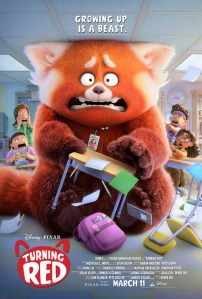 It’s fair to start to wonder whether Disney has some kind of grudge against Pixar at this time. The last three Pixar movies have been pulled from theatrical release and made exclusively available as part of their streaming war chest with Disney Plus. You can blame COVID for Soul being pulled, and the theatrical market was still recovering by the time Luca was scheduled to be released during the middle of summer 2021, but this didn’t stop Disney from releasing both of its own in-house animated efforts to theaters. Both Raya and the Last Dragon and Encanto played in theaters in 2021 and both under-performed at the box-office, which is clearly not close to where it was pre-pandemic. No animated movie has earned over $100 million at the U.S. box-office since COVID, and maybe that’s the reason that Turning Red has become the third Pixar movie to go directly to streaming. There are rumors that this trend has been demoralizing for Pixar employees, and explanations by Disney brass that these movies move valuable subscribers to their service, but I guess we’ll see when the Buzz Lightyear movie comes out summer 2022. Regardless, Turning Red is a high quality movie that made me feel warm and fuzzy all over.
 Meilin Lee (voiced by Rosalie Chiang) is a 12-year-old student trying to live her best life in Toronto circa 2002. That means she’s one way with her friends and one way with her domineering mother, Ming (Sandra Oh). Mei is an overachieving student, devoted daughter to her family’s business caring for a Chinese temple honoring their ancestors and red pandas, and a fangirl in the extreme for the popular boy band, 4-Town (even though there are five members). Mei’s mother does not approve of her devotion to this band, or the influence of her friends, and doesn’t understand the new person her daughter is turning into. However, Mei also happens to turn into a giant red panda whenever she feels any strong emotion. She has to keep herself in check, which is hard to do with mean students, an embarrassing mother, and the prospect of scrounging up enough money so she and her three besties can see their favorite boy band live.
I had to consider what about Turning Red worked for me and what about Luca did not. They’re both relatively smaller scale movies about characters who transform into fantastical creatures, who have to hide their secret, deal with parental disapproval, and come of age while pushing their personal boundaries and re-examining who they are and what they felt was important. There are several points of comparison but I found Luca to be broadly lackluster and low in stakes. With Turning Red, I found the movie to be much more engaging and poignant. So what’s the difference where one feels shallow and the other feels personal and resonant? I think the difference is that Turning Red’s relationships feel more realized and complex. The mother-daughter dynamic is fraught with tension, as trying to live up to the standards of the prior generation is often a surefire way to disappointment. That stuff is relatable, and the drama is potent, but the movie doesn’t lose sight of the generational love underneath all the headaches. Both movies are in essence about growing up and finding your identity, relishing different parts of you that stand out as unique, and coming to terms with differences in perception, but I felt with Turning Red that the film embraced these themes, integrated them better, and also built a sturdier foundation of enriched character relationships.
 The animation is irrepressibly gorgeous but I really enjoyed the added style of Turning Red. It had a more tactile physical presence that reminded me of the Aardman models (Wallace and Gromit, Chicken Run). The color balance also emphasized bright colors that popped with subdued hues as a background. I especially enjoyed playful little touches from anime that emphasized the overly dramatic nature of the personal stakes, like when Mei is sweating over whether her mom will find her notebook filled with pictures of a crush that she felt compelled to draw. There’s a definite energy to this movie that’s missing from plenty of other Pixar movies. It follows the perspective of its heroine, so it’s joyfully excitable and goofy at points and definitely over-the-top, like when she’s calling out her besties and we flash to a rotating mountain they’re all triumphantly scaling. It’s adopted her perspective in a way that makes the movie feel more personable, and I appreciated Mei’s character even more. Special credit should go to whoever was in charge of designing the fur textures for the red panda. When she fully panda’s out, Mei resembles a wonderfully realized version of a Totoro-styled demigod.
It was the third act where Turning Red went from amusing to surprisingly poignant for me. The central conflict is between Mei trying to be herself and the version her mother thinks she should be, which is naturally more deferential and devoted to the family at the expense of independence. This isn’t the first story to explore the difference between traditional families and their children becoming more influenced by Western pop-culture. It’s also not the first story about finding your voice and making a stand, or about parents coming to terms with the realization that their little kid isn’t so little any more. That’s fine. The supernatural elements are also pretty straightforward to follow and in service of the central relationships and metaphors. It’s the personal details that make this movie feel specific to its voice while still being accessible and relatable. It’s easy to cringe when Mei’s mother shares Mei’s private drawings with her fleeting crush. While many of us might not have been diehard fans of a boy band, we all had some phase where we felt more mature, more grown up, and dramatically different because of what this interest meant for us. I found myself battling genuine tears by the end. The end comes down to a conflict between mother and daughter, itself an echo of past conflicts, of overbearing generations being less flexible. It’s also ultimately about acceptance, but the idea that the aspects about yourself that you feel embarrassed or insecure about do not need to be expunged from your identity I think is a worthwhile message about growing up. It’s not about shedding parts of yourself, killing off things you dislike. It’s more about transformation and acceptance of self.
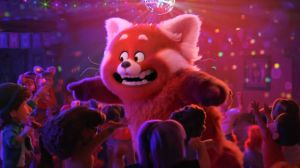 Turning Red is a briskly paced comedy with a precise, charismatic lead character letting us in on the pressures of her world and of being a teenage girl in the early twentieth century. It’s colorful and frenetic at points but feels completely in keeping with the personality of our plucky protagonist. The combination of puberty and monster transformation has been a ripe area for films especially in the realm of horror. This also might be the horniest Pixar movie to date, and a climactic confrontation involves shaking one’s butt, as they kids are wont to do in leisure. It’s got the substance I felt was missing with Luca and the simplified and streamlined world building that I felt could have improved Soul. In short, Turning Red isn’t top-tier Pixar but it’s an irresistible urban fantasy that has plenty of heart and whimsy to enchant audiences no matter the age.
Nate’s Grade: B+
Share this:

Rumble (2021)
 No more and no less than exactly what you’re expecting, Rumble is a giant monsters wrestling movie that’s cute enough to entertain young kids and pass the time agreeably and not much more. The world isn’t exactly fleshed out and the characters are very archetypal and the plot is entirely predictable, but I found it mostly fun and low-level escapism. It’s nothing that will wrestle with the better animated films of the year, but if you have little ones that are fans of wrestling or giant monsters then that might be enough to keep their attention for 90 minutes.
Nate’s Grade: C+


 nathanzoebl
You must be logged in to post a comment.