Blog Archives
Mission: Impossible – The Final Reckoning (2025)

It’s not just the increasing age of producer and star Tom Cruise, the Mission: Impossible movies have become victims of their own outlandish success, and this might have led to their ultimate end. This franchise has become known for its amazing stunts and placing Cruise in the thick of them. After every gasp-inducing, eyeball-popping stunt, the inevitable question arises, “What could top that?” And so writer/director Christopher McQuarrie, who has steered the franchise for a decade straight, has placed himself in a filmmaking arms race of action set pieces, and these budgets keep getting bigger and bigger, to compensate for the increasing scope and scale. As a result, these movies need to make an even higher amount of money to break even to cover their expanding expenses, and it doesn’t look like the M:I franchise has reached that next level of success (six of the previous seven movies have grossed between $175 million and $220 million domestically). As a result, Final Reckoning is the winding down of the franchise, or at least this incarnation, and it has enough to satisfy long-time fans, yours truly included, but it’s also a reminder of how things have gotten away from the series in the name of chasing spectacle.
Agent Ethan Hunt (Cruise) is tasked once again by the Impossible Mission Force (IMF) to save the world. In a continuation from the 2023 movie, Dead Reckoning, an evil A.I. known as The Entity is taking over the world’s complex computer networks and taking over control of nuclear missiles. It’s only a matter of time before the last four nations fall victim as well, so Ethan and his team (Simon Pegg, Ving Rhames, and now Hayley Atwell as Grace) must work together to get the only code that can kill The Entity.

Final Reckoning is the Scream 6 of the Mission: Impossible franchise. For those who never saw the sixth entry in an irony-drenched, self-reverential slasher series, it was intended to be the final entry in the franchise, and in doing so that made it try to tie back as many elements and moments as possible to the previous five movies. It was meant to feel not just final but full-circle for the fans. Naturally, the problem for Scream 6 is that it wasn’t going to be the final movie, and so a sequel is scheduled in 2026, and all that finality and franchise-reflection seems a bit like misguided internal stargazing. Coincidentally, the Mission: Impossible franchise also began the same year as the first Scream, 1996, and so this movie is intended to (possibly) close the door on the 30-year franchise and on (possibly) Ethan Hunt’s career as the best damn agent the IMF has ever had and yet whom they always doubt his motives in every movie.
M:I 8 takes far, far too much time trying to set up its stakes, which were already set up in M:I 7, which at the time was titled Dead Reckoning Part One before the “Part One” was scrubbed. Seriously, the first 45 minutes or so is awash in M:I clips from the previous seven movies and sloppy attempts to connect everything back together. Now the evil A.I. threatening the world has been revealed to be born from… the “Rabbit’s foot,” the undetermined MacGuffin from the third Mission: Impossible in 2006. Is that better? Does anyone really care about that? How about one of the cops being the son of a previous character? Does that change your opinion of Chasing Cop #2? How about the one guy in the first movie who found Ethan’s knife after he broke into the CIA in that movie’s most memorable sequence? Did you ever wonder what happened to him? Did you ever care about his well-being? I strongly doubt it. These Easter eggs to the older movies would be less egregious if this supposed final movie didn’t squander its first 45 minutes going over its own history as a means of trying to convince the audience This Stuff Really Matters. It’s even more egregious when the running time is 165 minutes long. All of this backward-looking ret-coning and clip show montages feel like an attempt to add weight to a franchise that never needed it. Let the stunts and set pieces stand for themselves. I don’t need all this nostalgic congratulatory back-patting.
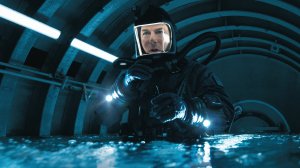
And there is a truly outstanding action set piece that anchors this movie, so much so that it actually comprises a full hour of the film. Set up in the preceding movie’s prologue, we know the only way to kill the evil A.I. is by securing a code located in a Russian submarine at the bottom of the Bering Sea. Just planning to find the location is the first hurdle that Ethan and the team have to surmount. Then there’s getting onto a clandestine U.S. submarine and launching out its tubes to swim to the bottom of the ocean, securing passage inside the fallen sub, and working one’s way through the different chambers, filled with frozen dead bodies, while the sub rolls around, tumbling further and further along the ocean floor. Each smaller sequence has a clearly defined series of mini-goals and organic complications, the kind of exciting escalations that make these set pieces so much better. It’s not enough for the pros to come up with a comprehensive plan, there needs to be unexpected complications that force them to improvise. A foolproof plan that goes perfectly is anathema to action cinema. This sequence has it all, which is why I have no qualms about its length because McQuarrie has justified every link in this set-piece chain. It’s also fantastic visually and really taut, especially as Ethan is tumbling through the innards of the sub with torpedoes falling over and pinning him underneath. This is a prime example of the maximalist virtuoso blockbuster filmmaking excellence that people have come to expect from the franchise.
The problem is that there’s an entire hour after this sequence and, once again, an M:I movie has peaked early. I think only Fallout and Dead Reckoning have their best moments during their actual climaxes. It hurts that Gabriel (Esai Morales) is the weakest villain the franchise may have ever had. I don’t care that the prior film tried to ret-con younger Gabriel into killing Ethan’s love and thus motivating him for vengeance and entering into the IMF. That personal connection and tragedy is a transparent attempt to make this character more important and menacing, and frankly, I am still astounded that this guy… THIS GUY… killed Rebecca Ferguson’s Ilsa. I can confirm, sadly, she is still dead, a reality that astounds me in the realm of a spy thriller where people assume identities. It’s she that Ethan should be fantasizing about in what could be his final moments, not Grace, and I will stand by that (no disrespect to Atwell, who is a genuinely fun and flirty addition to the team as an expert thief).

Regardless, back to Gabriel, who is just an empty suit of a villain, partly because the real villain is the scary A.I. conquering the world’s nuclear arsenals. It’s hard to really vilify a computer code for a movie, so enter this human handler, but he was uninspiring, so they added the secret back-story connection. It doesn’t work. I don’t really care about this guy being defeated, nor do I find him particularly threatening, miraculously killing Ilsa notwithstanding. The ultimate fight atop warring biplanes is visually impressive with its aerial photography, but the conclusion feels anticlimactic and the thrill of the set piece feels even slightly redundant when we remember Cruise has already hung from the side of a plane in M:I 5 and dangled from a helicopter in M:I 6. There’s yet another ominous timer ticking down, yet another deadly device with wires needing to be cut, and yet another side character possibly bleeding out to death. It feels rather par for the series, perhaps a thematic distillation of all those clips. There’s also some extra Fail Safe-style political hand-wringing at the highest levels of the U.S. government whether to give Ethan the benefit of the doubt or resort to some unorthodox methods for added stakes. It just adds up to a final hour of some strong moments in passing and too much of the same for a franchise that chartered new heights.
Placing it through the M:I pecking order, Final Reckoning is probably the weakest of the McQuarrie Era and arguably lesser than Mission: Impossible III, but it is leagues better than the first two Mission: Impossible entries. Realistically, this isn’t the end of the Mission: Impossible franchise, which has grossed close to five billion dollars over the span of its eight movies, but it is the end of Cruise as our star. The franchise was already previously engineered to hand off to Jeremy Renner in 2011’s Ghost Protocol, but then the movie proved too popular to persuasively function as writing off Ethan Hunt (unlike the other franchise also trying to hand off to Renner at the time, 2012’s Bourne Legacy, which proved so unpopular that Matt Damon came out of Bourne retirement). Cruise is now 63 years old and probably aware that these kind of death-defying stunts might be behind him even at his pace. Though I think the three separate shirtless scenes with Cruise are intended to dissuade you about the limits of his age (hey, I hope I look as good as Cruise’s abs when I’m 63). Final Reckoning is another chance to bid goodbye to its seminal action hero, which may be why there’s so much looking back and connecting unnecessary dots. This franchise is a celebration of the highs of big–budget action storytelling with the most game superstar with a death wish Hollywood could provide, so it’s bittersweet to see it reach some form of an end. McQuarrie, the David Yates of the franchise, has been an excellent shepherd with a kinship with Cruise for grand popcorn entertainment. It’s not the best entry but even a lesser M:I movie still rises above just about most studio action cinema. It’s definitely underdeveloped, too long, and structurally questionable with its pacing and climax, but at its best, it still reminds you why this franchise rose above the rest.
Nate’s Grade: B
Share this:

Damsel (2024)
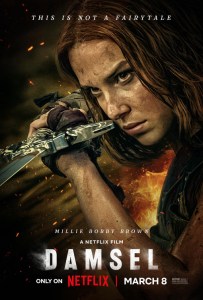 After a decade of having a creative partner who literally has compiled over 4,000 pitches for possible movie and TV concepts, it was inevitable that Hollywood would eventually get close to some of them. This has happened before a few times, again given the significant library of my friend’s imagination, but never has it gotten as close as Damsel, Netflix’s new action fantasy film flipping the script of the shrinking violet being sacrificed to the clutches of a monster. In my friend’s pitch, the young girl is presented to a dragon with the implication that this regular offering will spare her small town from angry dragon fire. Just as she’s waiting to be eaten, the dragon undoes her bindings and they talk, because the dragon can talk, and he’s very curious why these people keep leaving him young girls every so many years. The revelation is that the dragon is not savage but intelligent, and the two bond, forming a partnership where she brings the dragon back to her community and shows them the error of their long-standing prejudices. Of course it all gets bigger from there, with warring kingdoms wanting to harness the last dragon to capture this unparalleled weapon of mass destruction. There was even a budding romance between the dragon and the young woman, with the possibility of the dragon turning into a human Beauty and the Beast-style. The title: Damsel. While my friend’s Damsel and Netflix’s Damsel have some core similarities, they do tell different stories built upon the same premise of the virgin sacrifice and the killer creature being more than what they seem.
Unfortunately, Netflix’s version is too narrow to be fully satisfying with its fairy tale script flip. We have Millie Bobby Brown as our titular damsel, Elodie, a woman trying to do well for her family, notably her father (Ray Winstone), stepmother (Angela Bassett), and younger sister. The young prince needs a bride, and the Queen (Robin Wright) isn’t too shy to still turn up her nose at her new in-laws that she sees as merely a means to an end, nothing more. Of course it’s revealed that this end is as “human sacrifice” to a dragon that has reportedly stalked the kingdom for centuries. Elodie is thrown down a vast canyon into the lair of an angry dragon (voiced by the unmistakable Shohreh Aghdashloo). From there, Elodie must use her wits to survive the dragon, escape above ground, and save her younger sister from being doomed to a similar fate.
 The premise is so strong, upending ages-old tropes of the female sacrifice and the monstrous creature, as even with Netflix’s Damsel the dragon is a victim of historical slander. There’s so many places you can go with this, especially building upon the dynamic of the two of these discarded outcasts banding together to push back against the cruelty of society. However, that’s not the movie Netflix’s Damsel becomes. It sort of is, at the very end in resolution, with a latent promise of possible further adventures, but it’s mostly a locked-in survival thriller.
I was not expecting the majority of Damsel to be Elodie’s basic survival once she’s been hurled into the pit by her recently dearly beloved (just following orders from mom, he says). It works, but it feels very constrained creatively. Now, I am generally a fan of these kinds of stories, the step-by-step survival tales where we are thinking alongside the plucky protagonist. I find them fun and follow a satisfying structure of amassing payoffs. It’s naturally enjoyable to watch a character tackle problems and succeed. However, it’s also vital that the audience understands the problem to know the challenge. In a fantasy setting, this requires more time to establish new rules and circumstances. Here we have a few sequences like when Elodie discovers bio-luminescent slugs and uses them as a light source for exploring her captivity (bonus: their sticky slime is healing). The timeline is relatively short, maybe a day at most, so it’s not like Elodie has to think about long-term survival; it’s much more immediate about escaping from the wrath of the predator. Just finding a safe hiding spot is enough. It’s engaging but by limiting the focus to an almost real-time survival cat-and-mouse game, it caps the movie’s creative possibility. I was far more interested in the prospect of eventually moving beyond the initial amity between Elodie and the dragon, where they could share their royal rage together. I kept waiting for this initial battle to give way into a different level of understanding, something to deepen and alter this relationship, but this doesn’t arrive until the very resolution of an hour after Elodie first hides from the fearsome dragon.
While I was never bored by watching Elodie think how to get over a crevasse, or how to navigate a treacherous pass, I was reminded of 2022’s The Princess, a spirited and gleefully violent feminist romp with a similar starting point of a damsel taking matters into her own hands and fighting for her freedom. With that film, the upturned premise was simple, but each new floor down the tower revealed something about our heroine, each new challenge was different and relied upon a different skill or tactic. Unfortunately, that movie was “deleted” from the Disney/Fox/Hulu library for tax purposes, though you can still rent or purchase it on Amazon but, as of now, no physical media exists. This is an excellent example of a movie with a limited scope that knows how to play to the limitations of story while still revealing character through action. While that movie lost some momentum and clarity when the princess was kicked out of her tower imprisonment, I found much to celebrate with the movie’s ingenuity and spirit. With Netflix’s Damsel, I was getting antsy to leave the cave and move things along. The twist about the true nature of the dragon, and her past with the legendary royal hero, should be obvious to most.
 Let it be said that this is where Brown (Enola Holmes) graduated to being a steely and capable adult actress. She’s the star of the movie and has to command our attention and hold it for long stretches on her own. Brown throws herself into the physicality of the role with a relish that only makes her eventual triumph feel that much more worthy. The side characters don’t amount to much but have reliably winning actors to draw our attention. Aghdashloo (The Expanse) is a wonderful scene companion even with only a smoky voice. Wright (Wonder Woman) is haughty to the point of thin-lipped camp. Although this is a criminal under-utilization of the talents of Bassett (Black Panther: Wakanda Forever), who plays the concerned stepmother. That’s what happens when most of your movie is about one girl in a cave. The other characters are confined to the opening and closing of your survival thriller.
I suppose I’m being cheeky by referring to the movie as “Netflix’s Damsel” considering there isn’t any other version out there. I’m not accusing Netflix or screenwriter Dan Mazeau (Wrath of the Titans, Fast X) of ripping off my friend; it’s more an example of parallel thinking playing around with old fantasy tropes and giving them a new spin for modern times. I mostly enjoyed Netflix’s Damsel but couldn’t help but wonder what might have been, not just with my friend’s competing take on the material but with the story possibilities not taken here thanks to its limited scope. As a survival thriller in a fantasy setting, it works. There was just more that could have been, and while I should judge the movie that exists rather than the movie that could have been, Netflix’s Damsel is a fantasy action vehicle that swings its sword ably but had so much more potential to slay.
Nate’s Grade: B-
Share this:

Black Panther: Wakanda Forever (2022)
 It’s hard to talk about Black Panther: Wakanda Forever without first discussing its missing whole, namely Chadwick Boseman. It was a shock when Boseman died during the summer of 2020 of terminal cancer, which he had kept hidden except for a small number of close confidants. I remember hearing the news and being in disbelief, figuring this must be another celebrity death hoax, but then the terrible news was confirmed. It’s one of those celebrity deaths that you remember when you found out, mostly I think because here was an actor in his prime and headlining Oscar-nominated movies and precedent-setting blockbusters. It felt too soon to be gone. It felt wrong. It’s that grief that the characters of Wakanda Forever are also wrestling over. Reflecting real life, the sequel to 2018’s hit Marvel Cinematic Universe (MCU) entry elects to have T’Challa (Boseman) pass away in the movie as well, off screen, and from a cause more human than super, dying from a disease. The movie is knowingly channeling our grief for the loss of Boseman into a story about characters also mourning the loss of this good man. This loss hangs over the entire movie and provides it more gravitas and emotional depth it would have had otherwise. Wakanda Forever is a suitably exciting and expansive sequel, especially following the empowering cultural model writer/director Ryan Coogler followed with the first film, but it’s hard not to feel the loss of Boseman, both in presence and in storytelling.
We open with Shuri (Letitia Wright) diligently trying to save her brother’s life only to be out of time. The nation of Wakanda is in full mourning, losing their champion and king. In the wake of this loss, the outside world sees opportunity. Having come out of hiding, Wakanda is being pressured to share its valuable vibranium mineral resources with other nations, and some are eager to take them by force if necessary. This has inadvertently created a gold rush for vibranium, and the C.I.A. has discovered traces of the rare mineral on the ocean floor. This undersea incursion has provoked a heretofore unknown underwater community into action. Namor (Tenoch Huerta) is a super-powered mere mutant, able to fly with tiny wings on his heels, and able to breathe under the sea just like the inhabitants of Talochan. Namor has declared war on the surface world and seeks Wakanda to be an ally, and if not that, then their first conquest.
This is a movie dominated by the women of Wakanda, and they bring the fury. Everyone is processing the loss of T’Challa in different ways. Shuri is rededicating herself to her scientific research, as she blames her brother’s death on her inability to solve his ailment in time. T’Challa’s mother, Ramonda (Angela Bassett), has been appointed leader of Wakanda and must represent her nation’s interests while still grieving for her son. Nakia (Lupita Nyong’o) has retreated from the larger world of spycraft to open a school in Haiti. Okoye (Danai Gurira) is supposed to be the chief security officer for Wakanda, and she busies herself with new threats and armor rather than dwell on being unable to save her king. Each character feels the weight of the loss and opens up reflections of grief, as each knew T’Challa on a different level: mother, sister, lover, protector. The attention that Coogler allows for their and our grief allows the movie to work on a communal cathartic level (I teared up a few times myself). Wright (Death on the Nile) has some heavyweight emotional moments, and the movie is structured around her path of healing as well as the wayward detour of vengeance and hate. It’s a conclusion that hits upon the expected spectacle of superhero action but hinges upon, foremost, an emotional arc.
Coogler is two-for-two when it comes to creating dynamic, engaging villains who have strong perspectives that cause the heroes to better reflect upon their own roles. Killmonger (Michael B. Jordan) is one of the MCU’s best villains, and I think it’s interesting that the first Black Panther ends with the hero realizing the villain’s perspective is right and adjusts from there. With Wakanda Forever, we get Namor protecting his people, and his reasoning sounds a lot like the Wakandan leaders who wished to remain separate from the larger world in the earlier film. The background for Namor is completely rewritten by Coogler and co-writer Joe Robert Cole and for the better. They’ve invigorated the character by attaching a rich Mesoamerican culture to Namor’s people and history. We have another hidden world of minorities that are super-powered and developed beyond the reach of colonialism. The flashback for Namor, dating back to the sixteenth century, is startlingly effective, establishing his strange origins, the great change for his tribe to being sea-dwelling, and what happens when he returns to the surface world to honor his late mother’s funeral wish. When he returns, the Spanish have built plantations and have captured the indigenous into being their chattel. Namor sees this exploitation in the name of a foreign God and swears off the surface world. This cultural angle imbues the character’s focal point but it’s also just plain neat to watch an ancient Mesoamerican culture given the big screen superhero treatment with reverence and awe. By providing a compelling villain, it also makes the emotional stakes more compelling. We’ll likely side with the women of Wakanda, but you might also be rooting for Namor too. I also think it’s fun that the underwater Atlantean prince character for DC and Marvel is portrayed by a Mexican-American actor and a Polynesian actor. 
Where the movie doesn’t work as well is with its introduction of Riri Williams (Dominique Thorn, Judas and the Black Messiah) who is the human McGuffin. She’s a brilliant engineer who accidentally discovers a vibranium detection device, but why does nabbing her matter to Namor? With the device already created, the proverbial horse has left the barn. Kidnapping the inventor after her technology has already been utilized seems too late. There’s no real reason she could not be replaced with an inanimate flash drive except that this establishes the character up for her 2023 Disney Plus TV series. It’s this larger corporate portfolio push that I’ve always worried about with each new MCU edition, now 39 in total, that they will be forced to set up future movies and shows at the detriment of telling a focused and satisfying movie. The MCU movies I’ve generally liked the least are the ones that fall under this pressure the most, like Age of Ultron, Iron Man 2, and Multiverse of Madness. I found the character of Riri Williams to be fun, but her inclusion always seemed like a distraction to the larger story. I’m sure you can make thematic connections, a young brilliant black woman finding solace in Wakanda, but if you were looking to trim down an already overlong movie, I think Riri is the easiest to eliminate.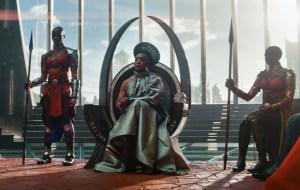
With Black Panther: Wakanda Forever, Phase Four of the MCU has officially closed and Phase Five will begin shortly with Ant-Man 3 in February, 2023. In the wake of the conclusion of the multi-phase Infinity series and 2019’s Endgame, this phase felt dominated by closure and exploration. The Disney Plus series provided little conclusive offshoots for many of the original Avengers characters. It’s also been a period of experimentation, with Marvel broadening its tone and scope from martial arts movies, spy thrillers, romantic epics, and familiarizing audiences to the concept of the multiverse with good movies (Spider-Man: No Way Home) and not-so good movies (Doctor Strange 2). And of course Wakanda Forever is the biggest edition yet on fulfilling a sense of closure, though it had never been intended to be before Boseman’s passing. It’s a sturdy sequel with a palpable emotional undercurrent and an engaging villain to boot. I called 2018’s Black Panther as agreeable, mid-tier Marvel entertainment, and I’d say the same for its sequel. However, with Boseman’s passing, it’s naturally elevated. Wakanda Forever is long and overstuffed but also emotional and engrossing and satisfying.
Nate’s Grade: B+
Share this:

Gunpowder Milkshake (2021)
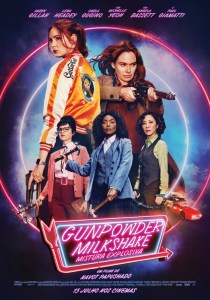 The reason we typically watch crime/action movies is for the slick style, the gonzo action, and the over-the-top characters cutting loose in the most violent of manners. We watch these movies to capture that whiff of cool, something flashy and entertaining with its eye-popping combo of sight and sound. Think Snatch, and Drive, and Atomic Blonde, and what appears to be the upcoming James Gunn Suicide Squad sequel. By these standards of stylized violence and colorful anti-heroes, Netflix’s Gunpowder Milkshake falls too flat to be duly satisfying.
Sam (Karen Gillan) is a hired killer working for the secretive order, The Firm. Her handler (Paul Giamatti) has accidentally assigned her the son of a commanding mobster who now demands vengeance. Her lone way to keep the protection of her employers is to kill a man who robbed them, which she does, but then regrets her actions. The troubled man had stolen the money to pay the kidnappers ransoming his daughter, Emily (Chloe Coleman). Sam decides to get involved and save this girl, and in doing so loses protection. The scornful mobster sends teams of goons to track Sam and kill her, forcing her to find refuge with her absentee mother (Lena Headey).
 The problem with playing in this stylized sandbox is having little to back up the attitude and style. Admittedly, those two aspects go far in a sub-genre dominated by appearances, but if you just have tough-looking shells of characters posturing and acting tough, it doesn’t matter how much style you dump onto the screen, it will only distract for only so long. The characters in Gunpowder Milkshake are so powerfully bland and all adhere to the same lone character trait. They’re all glib and badass and brusque and smug and fairly boring. It’s like somebody took the John Wick universe of clandestine killers and copied and pasted the same default personality.
If everyone is super cool, and super deadly, and super nonchalant, then you need to put even more work into making the characters stand apart. They’ll need specific quirks, competing goals, faults and obsessions, some key nub of characterization even if its superficial (a guy with one eye he’s insecure about it, etc.). With Gunpowder Milkshake, there’s nothing to work with. The screenwriters made this so much harder on themselves. I guess we’re merely supposed to be won over by the casting and the imagery of these bad ladies holding powerful weaponry. The protagonist is boring. She is the familiar hired killer who grows an inconvenient conscience. That’s an acceptable starting point but the moral growth is hindered when her young charge, the little girl that forces her paradigm shift, wants to be her apprentice to learn to kill people. The fraught mother/daughter relationship resorts to a lot of “I didn’t want this life for you,” “It’s the only life I’ve known” roundabout conversations, and neither furthers our understanding of either side.
With all that being said, there are moments of bloody fun that can be enjoyed. There’s a middle portion of the movie that gave me hope the film had transformed. At one point, Sam is indisposed and unable to use her arms, which dangle without any muscle control. She’s about to be beset by angry if bruised bad guys and must plan what to do. The resulting clash is a burst of creative choreography and an excellent demonstration of Sam’s resourcefulness and drive. Watching her dispatch a dozen armed men so indifferently, always knowing where and when to turn and dodge is not nearly as entertaining or engaging as watching her struggle and solve a problem. This sequence is extended and makes clever use of its location and the elements that would be available. Then we go a step further, as Sam and her youngster must drive a car to flee except the uncontrollable arm problem persists. Sam will pump the pedals and give directions while Emily sits on her lap and turns the steering wheel. This made me excited. We had organic complications and potential solutions that involved both characters having to rely upon one another. That is solid screenwriting and finding a way to spice up an ordinary parking garage chase sequence. By the end of this sequence, my hopes started to dwindle because Sam reverted to her earlier super cool, impervious version. She knew every exact move to make, and the small-scale car chase started losing my interest even with the extra driving dynamic. I wish the filmmakers could analyze how these sequences differed to better harness that creative surge.
 The concluding act of Gunpowder Milkshake is a deluge of false climaxes and waves of bad guys that never pose any discernible threat. It all feels too repetitive and like a video game. This group of people need to be killed, and then this next group of people need to be killed, and then this next next group of people need to be killed, and I just started getting bored. There is the occasional fun burst of violence and style, but the enemies are stock and dispensable, so it doesn’t feel like it matters what the numbers are. Whether it’s a dozen or a thousand, nothing really seems to matter because our super team of badass women will never be stopped. If you’re going to establish the protagonists as so far ahead of their competition, then work needs to be done to provide another outlet for audience interest. Use that time to explore the peculiarities of the cracked-universe world, like in the John Wick franchise. Use that time to meaningfully push the characters toward personal confrontations with one another. Alas, it’s all slapdash style with the same dead-eyed cool stare from start to finish (with the noted exception above). The entire final act could have been five minutes or fifty. It’s filler violence until the director tires out.
The cast is blameless and eminently watchable. I’ve been a fan of Gillan’s since her early Doctor Who days, and it’s been fun to watch her come into her own with the major spotlight afforded from franchises like Guardians of the Galaxy and Jumanji. She’s more than capable of kicking ass and looking cool doing so but this is the thinnest of characters. Once Sam chooses to put her safety at risk to save an innocent girl, it’s the end of her character growth. I suppose you can argue everything she does from there further proves the lengths she will go to solidify this important choice. Gillan deserves a worthy star vehicle. It’s fun to watch Angela Bassett, Michell Yeoh, Carla Gugino, and Headey push back with a grin against the misogyny of the overconfident wicked men who wish to do them harm. I wish they were better integrated into the world to have more significance other than as old allies who double as a weapons depot. There’s only so many guns-in-books jokes you can have before it too feels overdone.
 For fans of stylized violence, there may be enough cooking with Gunpowder Milkshake to meet out its near two-hour investment. The neon-infused, candy-colored production design and cinematography can enliven moments. The actors are fun to watch. Some of the fighting is brutally choreographed and cleverly executed, like the sequence where Gillan has no control over her arms. It’s got slow-mo violence set to wailing pop music tracks. If you’re looking for a pretty movie with some style, then it might be enough. If, however, you’re looking for a movie with interesting characters with memorable personalities, well-developed action with variance, and a story with a nice array of twists and turns and payoffs, then maybe look elsewhere.
Nate’s Grade: C+
Share this:

Mission: Impossible – Fallout (2018)
 Coming down from the surging adrenaline rush, I was trying to determine when was the last time an action movie made me feel the immersive, delirious highs that Mission: Impossible – Fallout offers in spades, and what I came up with 2015’s Mad Max: Fury Road. Simply put, this is the best straightforward action movie in three years. It’s the best Mission: Impossible movie in the series, which, if it hadn’t already, has assumed the peak position of the most consistent, most entertaining, and best action franchise in Hollywood. Allow me to explain how returning writer/director Christopher McQuarrie (Jack Reacher) makes an action movie that demolishes the competition.
Ethan Hunt (Tom Cruise) has been pulled back into spy action thanks to the lingering fallout (eh, eh?) of the capture of Solomon Lane (Sean Harris), whose followers, nicknamed The Apostles, have stolen three plutonium cores. It’s Ethan Hunt’s fault the nuclear cores got loose, and so he and his team, Luther (Ving Rhames) and Benji (Simon Pegg), must clean up after their mess. The CIA sends its own asset, the burly August Walker (Henry Cavill), to help oversee the mission and specifically Ethan Hunt, who must pose as a shadowy terrorist broker to maintain appearances with important figures in the criminal underworld. In order to get the nuclear parts, Ethan Hunt has to retrieve Solomon Lane and release him back into the open. Complicating matters further is Ilsa Faust (Rebecca Ferguson) who needs Solomon dead to clear her own spy debts.
 Every action movie lives or dies depending upon its unique set pieces, often the first thing constructed by a studio and then the plot mechanics are ladled on merely as the barest of connecting tissue. They need to have stakes, they need to have purpose, they need to be memorable, and they need to be understood and develop organically. Mission: Impossible – Fallout could be taught in filmmaking schools about how to properly build action set pieces. They are brilliant. McQuarrie finds interesting ways to set them up, complicate them, and just keep the escalation going in a manner that still maintains the believability of the moment. Take for instance a foot chase where Ethan Hunt is trying to nab a bad guy through downtown London. Where McQuarrie pushes into the extraordinary is by having that foot chase on a multi-level terrain. Ethan Hunt has to chase after his target but multiple stories above the ground, and so he’s leaping out windows, jumping over rooftops simply to keep up. It’s a simple twist that takes what we’re familiar with and, literally, elevates it to new heights. Or take for instance the mission in Paris to capture Solomon Lane. At first it’s capture, then it’s flee police, then it’s flee another assassin. There are multiple stages to this sequence, each with a new goal, each with new complications, and each with new eye-popping stunts and escapes. The action finds natural points to progress, making smart use of the geography, and keeping different elements at play to come in and out to add more problems. This is how you do action right. As soon as the half-hour mark settles in with the arrival of Walker, the movie is practically nonstop in its set pieces until the very end. At a steep 147 minutes, this is the longest Mission: Impossible movie yet but it’s breathless in its execution.
Amazing set pieces that are cleverly designed is one aspect of a great action movie, but if you can’t tell what’s going on, what’s the point of all that cleverness? Fortunately, McQuarrie understands this and adheres to a visceral depiction of the action that creates gloriously immersive and pulse-pounding sequences. The set pieces are terrific, so it stands to reason the stuntwork should be terrific, and to make sure you appreciate the stuntwork, McQuarrie makes sure the photography highlights the verisimilitude. It’s a symbiotic (or as the Venom trailer tells me, “sym-BI-oat-ic”) relationship but when done correctly, as evidenced in this film, it’s the key to truly kinetic action sequences. Take for instance a parachute jump that marks the start of the second act. McQuarrie films it as a sustained long take, and as the camera plummets to the ground chasing after the two men, our brains can tell us that there is some special effects trickery to mitigate the dangers, but our senses are overwhelmed with the sustained illusion of tension. The fight choreography is equally up to the challenge. A bathroom brawl with Ethan Hunt and Walker and another man becomes a lesson in how many things can be smashed and what can be used as a weapon. A high-speed motorcycle chase through Parisian streets gets even more frantic when Ethan Hunt drives against traffic, and the scene becomes even more exciting when McQuarrie’s lens allows us to see the danger in all its glory.
 The Mission: Impossible franchise has been notable for its insane stuntwork but also, chiefly after the second installment, its edict to practical effects and maintaining the believability of its reality. It’s still movie spy shenanigans and globetrotting adventures, yes, but the moment-to-moment thrills feel like they’re really happening. The Fast and Furious franchise has gained great acclaim for the bombast of its physics-defying spectacle, and the Mission: Impossible franchise seems to have gone purposely in the opposite direction. It’s real Tom Cruise jumping off that building, it’s real Tom Cruise riding through traffic on a motorcycle, and it’s real Tom Cruise falling and climbing up a speeding helicopter during the thrilling finale. Cruise has had a death wish when it comes to throwing himself into the high-wire stunts of his franchise, but even at 56 years old he’s still at it, essentially trying to commit suicide on film for all of our amusement. Cruise is one of the few remaining movie stars and his commitment is without question.
This is also the first Mission: Impossible film that feels like the characters matter. It’s a direct continuation from the previous film, 2015’s Rogue Nation, bringing back the (somewhat lackluster) villain, the newest spy counterpart/potential love interest, the CIA and IMF brass, and the essential supporting team members from prior engagements. Because of this it feels more like what happened previously was establishment for a new story building upon that foundation. Rather than starting all over, the characters find ways to deepen their relationships, and the film opens up Ethan Hunt as a character and the toll his duty takes on those closest to him. There are some nice quiet moments that examine these characters as actual people. Several complications are as a direct result of personal character decisions, some good and some bad. I was joking with my pal Ben Bailey beforehand about wondering whether they’d find a way for Ving Rhames to matter, since he hasn’t been much more than “a guy in the van” for four movies, and by God they make him matter. They make each team member matter, finding moments to give them, mini-goals they’re entrusted with. During the dizzying helicopter chase in the finale, supporting players are left with their own task. Luther has to defuse a bomb but doesn’t have enough hands. Benji has to find something valuable in a very needle-haystack situation designed to torment and waste precious time. Ilsa is at cross-purposes for most of the film, not wanting to harm her fellow allies but also being given her own orders to prove her loyalty and protect her future. All of this comes to a head and it makes the parts feel as important as the whole. That’s great storytelling.
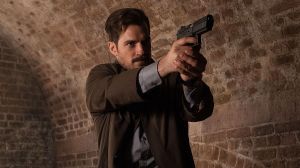 Let’s talk about that million-dollar mustache of Cavill’s. It was a year ago that Justice League re-shoots required Cavill and the Mission: Impossible team refused to allow their actor to shave his mustache, thus leading to that unsettling fake baby lip Superman was sporting in a majority of his scenes in the haphazard Justice League film. I just read an AV Club interview with McQuarrie where he for the first time discusses the whole mustache brouhaha and apparently Paramount estimated that it would have cost them three million for the effects to uphold Cavill’s upper lip continuity. Warner Brothers refused to pay up and so went down that ill-fated CGI mustache-removing route. It was shortly afterwards that Cruise shattered his ankle in a roof-leaping stunt (that is in the finished film and advertisements) and the production had to shut down for a month. If only Warner Brothers had waited, perhaps we all could have avoided this mustache mess.
Mission: Impossible – Fallout is a new highpoint for the best action franchise going in movies today (I’m still waiting for a third Raid film, Gareth Evans). The set pieces are memorable and unique, leading from one into the next with exquisite precision and thought. The action sequences are stunning and shot with stunning photography, highlighting the stunning stuntwork by the best death-defying professionals. It’s the first Mission: Impossible movie that doesn’t climax at its middle; in fact there’s a pretty obvious reveal that feels like it was going to be a late Act Three twist, but McQuarrie recognizes the audience thinking ahead, and there’s like a whole other exciting 45 minutes after. The stakes are better felt because the characters matter and are integrated in meaningful ways. This is the most I’ve enjoyed Henry Cavill in a movie (with possible exception of another spy movie, Man From U.N.C.L.E.), and you know what, his mustache works too. While the vertigo-inducing Burj Khalifa sequence is the best set piece in the franchise, Fallout has everything else beat at every level. Mission: Impossible – Fallout is a reminder that there are few things in the world of cinema better than a properly orchestrated, properly filmed, and properly developed action movie operating at full throttle. This is one of the reasons why we go to the movies, folks. See it in IMAX if possible. Soak it up.
Nate’s Grade: A
Share this:

Black Panther (2018)
 Black Panther is unlike any other Marvel Cinematic Universe (MCU) film prior. It’s unlike any other super hero film prior. Yes, there have been African-American leading men in comic-based movies, notably Wesley Snipes’ half-vampire-all-badass Blade. However, this is the first movie I can think of with this kind of budget, this kind of backing, and with this kind of ownership over its cultural heritage and the heavy burdens it carries.
We last saw T’Challa (Chadwick Boseman) in Captain America: Civil War mourning the loss of his father, the king of the African nation of Wakanda. The outside world does not know that Wakanda sits on a vast supply of virbanium, the strongest and more durable metal in the world and the key to Wakanda’s impressive technology. Under a holographic cover, Wakanda is a thriving metropolis with flying cars, skyscrapers, and next gen weapons. T’Challa goes home and must earn the right to the throne. However, Erik Killmonger (Michael B. Jordan), a former top-level black ops solider, is looking for his own path into Wakanda and onto the throne. Killmonger teams up with arms dealer, Ulysses Klaue (Andy Serkis), to force Wakanda to deal with being cut off from the world.
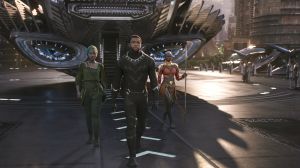 This is a movie populated almost entirely by black faces, notably black women (more on that later), and they are given a mainstream platform that celebrates its multitudinous African roots and traditions thanks to co-writer/director Ryan Coogler (Creed). This movie is proudly black, which will rankle some on the fringes of society, as if celebrating one’s own identity is somehow denigrating those who do not apply to that status. Black Panther is not an exclusionary movie because of its content and execution; this is a very accessible movie to a mass audience, even those who haven’t been paying attention to every nitty-gritty detail in the previous seventeen MCU entries. There are only two characters from other MCU films that appear, one as a post-credits cameo and the other an officious representative (Martin Freeman) of the outside’s clandestine organizations. This is a unique world isolated from the long shadow of colonialism. Wakanda has never known, to our knowledge, the depravity of the European and American slave trade. They have continued to develop uninterrupted by conquerors, slave traders, and the crippling aftereffects of racism. The Wakanda people could very easily be the conquerors themselves. They’re the most technologically advanced nation on the planet and hide as a “third-world nation,” utilizing the ignorance of the Western world to its security. The world of Wakanda is a fascinating, awe-inspiring, and defiantly independent nation.
The larger theme is over the responsibilities inherent to those with privilege. The nation of Wakanda is vastly successful by all conventional metrics. T’Challa must wrestle with whether to continue their exclusionary stance, ignore the plight of the larger world and say it’s none of their business or engage with the world, potentially putting his own kingdom’s peace and prosperity at risk. It’s a simple enough theme and yet it has tremendous weight to it especially when you account for those on the other end of the Wakanda borders. The character of Killmonger is a direct reflection of this. His experiences in Oakland are not the ideal pairing with the luxury of Wakanda. Killmonger sees Wakanda’s great influence as a way to protect beleaguered black citizens of the world and especially in the United States. It’s a way to prevent more senseless deaths from black citizens who were slain as a result of the fear of just being black (a powerful example was Coogler’s debut film, Fruitvale Station). It’s a pointed political statement that doesn’t get too heavy-handed (even though I would have preferred that). It questions the value of isolationism especially when suffering can be prevented. Killmonger works as a villain because you can understand his point of view. He goes beyond the need for vengeance. The wrongs he wants to right are larger and historical. Even Killmonger’s last line really attaches itself to this theme. T’Challa offers him a way out but with imprisonment. “No,” Killmonger declines, “My people were the ones who leaped over the sides of the slave ships. They knew death was better than bondage.” The emphasis is “his people,” not T’Challa’s, not Wakanda. His people were the ones who suffered from slavery. Could Wakanda have possibly prevented it?
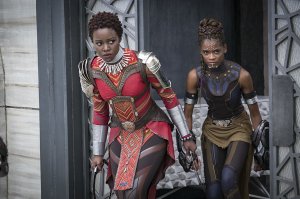 Another wonderful surprise of Black Panther is its incredible all-female ensemble that provides expert support to their king. T’Challa has the good fortune of four strong women, each of them having a different and vital relationship to him. The standout will be Danai Gurira (TV’s Walking Dead) as the fierce chief of security, Okoye. She has a swagger that vacillates between being intimidating and being brashly enjoyable. Okoye has many of the best lines and she throws herself into every fight. There’s also a sense of duty that transcends a single man that challenges her loyalty. Letitia Wright (TV’s Humans) plays Shuri, the Q of this world, the top scientist and creator of many a gadget. She’s T’Challa’s little sister and their interplay is very competitive and teasing. She’s looking to be more involved in the action and a highlight is when she teams up with her big bro. Lupita Nyong’o (The Jungle Book) is Nakia, a former flame of T’Challa’s who comes in and out of his life as an undercover spy. All three of these women have a powerful sense of agency and are integrated in important and essential ways. Even though Nakia may slide into that romantic interest role, she still has a vibrant life outside whatever feelings she may or may not have for the hero. Then there’s T’Challa’s mother, Ramonda (Angela Bassett), who radiates strength and fortitude. These women gave me some of the biggest moments of entertainment in the entire 135 minutes of movie.
Now some careful readers might note that I haven’t done much to emphasize the actual action of the super hero action movie, and that’s for a good reason. Black Panther stands stronger on theme and character than it does its actual action sequences. Coogler had a wonderful sense of scale and verisimilitude with 2015’s Creed, relying on long takes to put the audience in the heightened drama of the boxing ring. With Black Panther, the action sequences can lose a sense of immediacy. Many happen at night or are filmed and edited in ways that diminish some of their impact, like hand-to-hand combat in splashing water where the splashes obscure the activity. Other scenes felt like a video game CGI cut-scene. Speaking of video games, Black Panther’s suit has a crazy ability to absorb the kinetic energy of weapons, which means the stakes take a dip when our hero can merely just stand and allow himself to get shot repeatedly. The payoff for this absorption is a giant energy shockwave but it plays out like a fighting game’s special feature. It’s an aspect that’s not really utilized in a satisfying or unique way. The final showdown between Black Panther and Killmonger feels too weightless in execution. It’s meant to even the playing field by nullifying their extra abilities, but if they both have the same “Panther powers” isn’t the field already even? The third act, the usual punching bag for MCU critics, is the best part of the movie from an action standpoint. It utilizes the characters in significant ways and allows for organic complications while still maintaining its wider sense of spectacle. Plus it’s one of the few action sequences that allow all the pyrotechnics to be enjoyed during the visibility of day.

Boseman (Marshall) was an excellent choice for a stoic and too-cool-for-school character that can glide right on by. The ageless Boseman is at his best when he’s working off the other actors, especially his female posse. He has a couple of very effective emotional confrontations as he learns of his family’s secrets. As steady and soothing a presence as Boseman can be, this is Jordan’s movie. Michael B. Jordan (Creed) has been Coogler’s cinematic good luck charm and we’re still benefiting from that divine kinship. His character is at the heart of the central thematic question. While T’Challa is ultimately the one who has to decide, it is Killmonger who embodies that need for change and the desire to rectify the past. There’s a flashback with Jordan that got me to tear up, and this guy was the villain! It’s one of the film’s biggest mistakes sidelining Jordan for far too long. After his introduction, Killmonger is strangely absent for the next hour or so of the movie, ceding the spotlight to Serkis (War for the Planet of the Apes), a more antic and goofy scenery-chewing baddie who has a few regrettably “faux hip” lines of dialogue that land awkwardly. Serkis is having a blast but can feel like a holdover from a different film.
Much like last summer’s Wonder Woman, this is a movie that is going to mean a lot to a lot of people. It has a personal significance that I will not be able to fully tap into, no matter the expansive powers of empathy. Black Panther, as a long-awaited cultural moment, will have many ripples of inspiration. After my early screening, I sat back and watched an African-American boy, no older than seven or eight, walk out of the theater in a daze. His eyes were wide, his mouth agape, and he said in astonishment, “That was the best movie ever.” That kid has a hero he can call his own. That matters. Black Panther, as a work of art, is rich in topical themes and has a wide supporting net of exciting, robust, and capable women. I enjoyed how personal and relevant and political the movie could become, folding new and challenging ideas onto the MCU formula. Coogler is a marvelous director and storyteller showing rare acumen for being able to handle the rigors of a Hollywood blockbuster and deliver something hearty. The action has some issues and there are some structural hiccups that hold it from the MCU’s upper echelon (I enjoyed all of the 2017 MCU movies better). Black Panther is a winning movie when it features its sterling cast celebrating their virtues and solidarity and a still respectable enough action spectacle when called upon for big screen duty.
Nate’s Grade: B
Share this:

Olympus Has Fallen (2013)
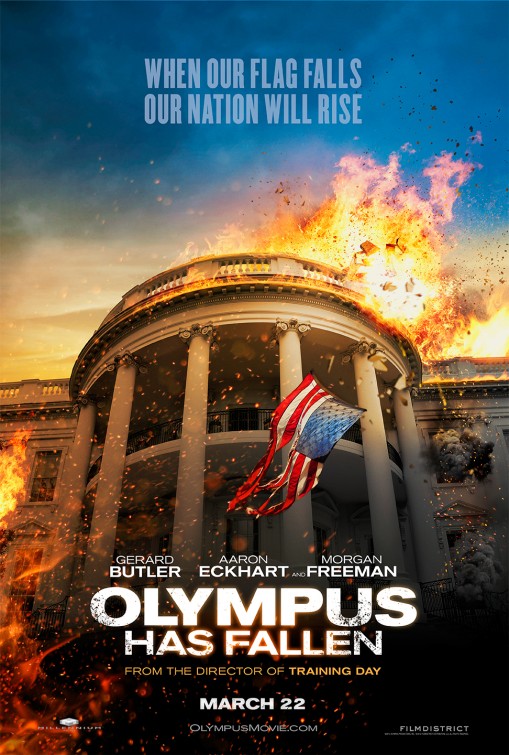 Remember in the late 90s when studios seemed to develop similar projects every few months? In 1997, we had two volcano movies (Volcano, Dante’s Peak), and in 1998 we had two animated bug films (Antz, A Bug’s Life) and two asteroid action flicks (Deep Impact, Armageddon). With the wealth of unproduced screenplays, there’s definite merit to different writers coming up with similar concepts independent of one another. Now in 2013 we have two action movies that, boiled down, are essentially Die Hard in the White House. The first out of the gate, Olympus Has Fallen, is an entertaining action vehicle that reminds me of the 90s Jerry Bruckheimer era of big explosions, big body counts, and irony-free pleasures.
Mike Banning (Gerard Butler) is a top Secret Service agent still reeling from his inability to save the President (Aaron Eckhart)’s wife (Ashley Judd) in a freak accident. He now provides security at the nearby Treasury Department, the President afraid to see Mike’s face and be reminded of his loss. Then one sunny day, a cargo plane fires on D.C. citizens, armed terrorists assault the White House, and North Korean nationalist Yang (Rick Yune) has taken the President and his cabinet members hostage. The Speaker of the House, Trumbull (Morgan Freeman), has ascended to America’s Commander in Chief and he has to navigate tricky issues like how to save the president. Luckily, they have a man on the inside. During the firefight, Mike scrapped his way inside the White House. Now it’s one man versus a bevy of terrorists and nationalists.
 The overall execution reminds me of the heyday of mid 90s action cinema, with its mixture of the ridiculous played completely sincere. It doesn’t really matter that North Korean terrorists are able to take down the White House so easily. Sure we can nitpick the very prospect of a large foreign aircraft getting so close to D.C. before getting intercepted, and only with two fighters at that. But if you can tuck away that nagging voice reminding you of the implausible nature of everything, then Olympus Has Fallen is a serviceable action thriller. Every fifteen minutes or so our hero has a new mini-goal to accomplish. It keeps things fresh and holds your attention away from analyzing the sillier elements (Gatling guns atop the White House?). The debut script by screenwriters Creighton Rothenberger and Katrin Benedikt follows the Hollywood blockbuster blueprint down to the smallest detail. Of course there’s another blueprint it mirrors, namely that of Die Hard. Beyond the premise of one man left to his wits in a hostage standoff, there’s also the moment where the bad guy poses as a good guy to the ignorance of our hero, there’s the failed outside tactical use of force, and the bond forged between the man on the inside and the link outside, whom isn’t given the level of respect deserved. That’s not just an application of the Die Hard premise to a new setting (like Air Force One or Under Siege), but a sampling of the very plot beats from Die Hard. Then again if you’re going to steal then steal from the best.
There’s a certain throwback bravado vibe going on here that makes it all easier to swallow. It’s got big silly action sequences and some in-your-face jingoism (a character, when faced with the notion of execution, literally starts reciting the Pledge of Allegiance), enough that Michael Bay would be misty-eyed, but treating the subject matter with such thoughtless swagger makes the reality easier to accept. Having D.C. attacked, civilians mowed down, national monuments crumbled, and the White House in ashes, well you’d naturally think back to the very real horrors of 9/11, and you may shudder. By embracing the implausible nature of the action and achieving a tone that prioritizes popcorn thrills, Olympus Has Fallen dances around pitfalls of exploitation and simply becomes another big, dumb, but enjoyable action movie. I say this without a hint of derision or irony.
I haven’t been a fan of Antoine Fuqua as a director. He can compose a good looking movie, but Shooter, Tears of the Sun, and King Arthur were enough to convince me the man could not properly stage exciting action. I think perhaps the limitations of the setup brought out the best in him because there are some genuinely gripping action sequences on display here. Also, the man does a fine job of establishing the geography of his action and presenting a surprising variety. Fuqua, aided with the shifting script, makes sure that the audience never gets bored. Sure there are storylines that don’t exactly work, like Mike finding the First Son, a character never heard from again, but the movie keeps changing shape, getting bigger, and finding enough satisfying payoffs. This is an effective, serviceable “turn off your brain” action movie, and it does enough right that you don’t fret about turning that brain back on until the end credits. The R-rating also ups the ante, providing bloodier and brutal escalation to what should be life-and-death stakes. If you’re going to give me “Die Hard in a…” then you best make sure your movie doesn’t wuss out. You’ll recognize plenty of action movie tropes and clichés, but the action is worthwhile and the plot constantly moving that you simply don’t mind.
 It’s nice to see Butler (Playing for Keeps) find a role that plays to his, admittedly limited, strengths. His character is your standard tough guy with a tragic past, haunted by the life he couldn’t save, looking to make amends and forgive himself. It’s probably the fact that the role has so little to it that Butler is able to slide effortlessly into gruff action star mode, a preferential place (though I prefer the man to be bearded as well). The rest of the movie benefits from actors who are far better than the material: Freeman, Eckhart, Melissa Leo, Radha Mitchell, and Angela Bassett. They all provide better-than-average performances for this type of movie. Even Dylan McDermott (TV’s American Horror Story) gets room to shine. Rick Yune (Ninja Assassin, The Man with the Iron Fists) makes for a very sinister bad guy. The part is Generic Antagonist #301, but Yune finds fun ways to enjoy the menace, soak it up without hamming it up. He transforms a generic villain into a dude you want to see righteously toppled.
After last fall’s updated Red Dawn (scrubbed free of invading Chinese forces) and now this, I must ask if North Korea has become the go-to military enemy for American action movies. Olympus Has Fallen takes the added step of never having the government of North Korea involved or approve, like the terrorists are acting on their own. We wouldn’t want to upset the government of North Korea; that’s what Red Dawn is for. But does anyone really view North Korea as a credible military threat? They are seen as a rogue nation, yes, and they claim to have nuclear arms, so they should be taken seriously, but does anyone realistically think we’ll wake up tomorrow and be conquered by North Korea? I suppose this criticism lies more with Red Dawn than Olympus Has Fallen, a movie that only needs a handful of dedicated foot soldiers rather than an invading army. I also find it laughable that the only thing holding back North and South Korea from war, in this fictional scenario, is the presence of about 28,000 U.S. troops. Also, if these events played out as they do, who doesn’t think that the U.S. would respond with military action against North Korea? We started a war with Iraq and they weren’t even responsible for the actions of a handful of terrorists. I guess the North Koreans are the new Hollywood Boogeymen.
With a hook of a premise, some exciting action, and more than a few borrowed plot beats from Die Hard, it’s still a pleasant surprise at how entertaining Olympus Has Fallen works. It’s a movie that simply does enough right to justify watching. Its action is good enough, its plot is familiar enough but offers enough forward momentum, its actors are good enough, and it does enough right to quell potential boredom. I appreciated its throwback feel to the mid-90s action movie, a time of elevated popcorn thrills and powerful bravado, all without a hint of irony no matter how ridiculous things got. It lands on shakier ground when it tries to become a rah-rah kind of patriotic rally, but I’d be lying if I denied the certain pleasures of watching a Secret Service agent take out the bad guys on his turf. Time will tell how the second Die-Hard-in-the-White-House movie will fare, but if you’re looking for big and dumb but enjoyable, Olympus Has Fallen is like a summer popcorn film only in March.
Nate’s Grade: B
Share this:

Akeelah and the Bee (2006)
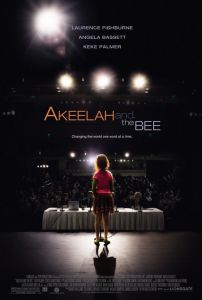 It’s a familiar story and it may be predictable at every turn, but this movie shines when it comes to performances. Young Keke Parker plays the title super speller with equal parts fire, heartbreak, shyness, and pure glee. You easily fall in love with her and it makes her rise among the spelling ranks worth watching. Laurence Fishburne and Angela Bassett give stirring performances to compliment a strong cast. The new angle Akeelah has going for it is its urban education perspective, seeing Akeelah have to hide her smarts out of fear of her peers. The movie is fun, and Akeelah’s budding relationship with a fellow speller is cute as can be. Akeelah and the Bee is a smartly written and uplifting family film with a lot of heart and a dash of schmaltz. Look for “Booger” (a.k.a. Curtis Armstrong) as the inner city school principal that pins his hopes on Akeelah.
Nate’s Grade: B+
Share this:

The Score (2001)
 Marlon Brando, Robert De Niro, Edward Norton, three of the greatest actors of three generations. This draw alone warrants a stroll to view The Score one would assume. But not so fast my friend. If you venture out to witness this movie chances are you will fall asleep within the first hour.
The plot runs through the all too familiar terrain of so many crime capers and heist flick predecessors. There’s the old pro who wants to retire (Robert De Niro) who gets pulled into a risky heist planned out by a young pup with some bite (Edward Norton). Will the old pro forgo his plans of retiring on a beach side with little umbrella drinks for one last shot at the big score? If you have to think about this question then you need to get out more. The scheme is to break into the Montreal Customs building and steal a scepter that could be worth as much as 30 million dollars. Stealing a scepter from French Canadians? Was this idea written on the back of a napkin at a bar?
This is in essence the plot of The Score. The characters are mere shells and never fleshed out. With any heist picture there should be the scenes where the characters engross themselves with the ins and outs of their scenario, the rehearsing and practicing, and finally the big move. The Score decides to lightly touch the first, skip the second, and barely give the audience much of the third. The film just isn’t playing by the rules it gives.
 The Score is muddily directed by famed puppeteer Frank Oz. He has directed comedies over the past few years but his first foray into drama, or action, or whatever you want to call it, is downright embarrassing. The entire film waddles in muggy darkness, as if they didn’t have enough money to light the damn picture. After so many scenes of watching the outlines of actors or making out just their faces it just becomes fruitless to even watch. Maybe some of the money should have been poached from the stars’ hefty salaries to make sure that they were adequately lighted.
The beginning hour of The Score may very well be the worst time I’ve had in a theater all year. It’s drawn out beyond its own bounds to establish a set-up that could have been done properly with only a few minutes. This half of the film is leaden and wallowing in boredom, and it feels like it’s never going to end. I think I was actually contemplating suicide at one point.
The structure of The Score is easy to diagram. The first half has to do with the superfluous set-up, then we have ten minutes of the actual heist sequence, and then… it’s done. The film actually ends about three minuets after the heist complete with the now requisite twist ending that anyone with a functional brain will see coming a mile away. What needed to be done is to consolidate that slow-as-a-glacier beginning into something like twenty minutes, then double the length of the heist sequence and actually give it tension. Finally then have the rest of the movie play as a cat-and-mouse game of who has the upper hand with their burgled prize. This would have played with the actors more and at least keep the audience guessing and awake. As it stands, The Score is an incredibly unsuccessful effort when it comes to story structuring. This could be a future classic example of how not to tell a story.
 Norton is the only real punch of intensity in the movie. When Norton reappears onscreen it’s as if The Score regains a sense of renewed life. He’s great to watch, either as the young ambitious hotheaded criminal or as his mentally retarded janitor cover. De Niro must be getting a good long distance plan because he phones in yet another performance. He plays his character too smooth that the audience can never fear that he is actually in any danger. Brando is basically for comic relief, that is, if you can understand him through his garbled mumbles. Did this man have a stroke or something? Angela Bassett is useless in this film and wasted. Her role is the frequently off camera girlfriend who urges her man to settle down and let this last one go.
The Score is a lousy heist picture and a lousier attempt at entertainment. It lacks tension, proper story structuring, and even basic movie fundamentals like proper lighting. The Score is a wasted ensemble of a great cast that could only echo the silly cartoon that was Con Air. See The Score if you dare, but make sure to take some NoDoz for the first half.
Nate’s Grade: C-


 nathanzoebl
You must be logged in to post a comment.