Blog Archives
Battleship (2012)
 On the surface, the classic board game Battleship would seem like a rather peculiar property to develop into a feature film. Unless someone was going the crafty Das Boot route, why would anybody even want to adapt the board game? And for that matter, why would anyone want to adapt the game and add killer aliens from outer space? Well actor-turned-director Peter Berg looked at the classic board game with the little pegs and the declarations of battleships sunk and said, “There’s a big summer movie in there.” With a hefty budget of $200 million, which is becoming alarmingly the norm for summer tent pole releases, Berg’s efforts have given birth to Battleship: The Movie. If it becomes a hit maybe it will start a trend. Who wouldn’t want to see Hungry, Hungry Hippos as a monster movie, or Connect Four as a searing domestic drama about alcoholism?
Off the Hawaiian Islands, the Navy is conducting an annual series of international war games in the Pacific. Oh but little did they expect to have to combat intergalactic foes. Alien spaceships crash land to Earth, emerging from the Pacific and creating a force field barrier. Along for the high seas action are the stoic Stone Hopper (Alexander Skarsgard), his screw-up little brother Alex (Taylor Kitsch), a Japanese captain (Tadanobu Asano), and a mess of other Navy personnel, including pop star Rihanna. On the other side of that force field is Alex’s girlfriend, Samantha (Brooklyn Decker), a naval physical therapist who finds herself in the middle of the aliens communications plans. The handful of Navy ships, some American and some Japanese, must figure out a way to topple the aliens before they get their communications up and running to broadcast that Earth is ripe for the taking.
 For some, Battleship will be the symbol of everything wrong with big-budget Hollywood filmmaking, a perceived slapdash effort meant to appeal to as many mass markets as possible, combining clichés and empty action sequences into a cacophony of noise deigned entertainment. And for most of those charges, I cannot defend Battleship. It has its fair share of clichés, gaps in logic, and some especially corny moments (WWII geezers save the day!). And yet, I found myself becoming entranced by Berg’s siren song, laughing at the comic relief, enjoying the stock characters enough to root for their triumphs, and having a total gas with the action sequences. I was shocked at how much fun I was having with Battleship. Perhaps that means that from a mechanical standpoint it knows all the pinpoints of the summer blockbuster model and knows how to craft a satisfying crowd-pleaser of an action movie. Or perhaps it just means I have lost my mind. Or maybe this is Berg’s expertly crafted satire of the Michael Bay School of filmmaking, brilliantly capturing the beautiful bombast and cheery jingoism of Bay’s career, especially when those salty WWII vets get to strut in slow motion. A movie based upon the board game Battleship is clearly not meant to be taken seriously, and Berg’s nautical adventure wants nothing more than to entertain the masses. Whatever the case may be, Battleship, weirdly enough works, and for some significant stretches, it works really well in the mold of summer spectacle.
I’m relieved that Berg has left behind his rigid docu-drama cinema verite approach he’s patterned after working on 2004’s Friday Night Lights. Berg’s verite style felt completely mismatched with 2008’s Hancock, an inexplicable global hit. With Battleship, Berg’s cameras settle down and give you plenty of action to soak up. Berg’s first foray into action, 2003’s The Rundown, was like the announcement of a great new talent and the herald of The Rock’s ascent in action. I’ve been waiting for Berg to return to that style he displayed with The Rundown, a slick, highly stylized flair, brimming with robust energy that popped at all the right moments. Thankfully, with his biggest budget yet, it’s like the return of the old Berg. Perhaps it’s just a reaction against the overindulgence of the “shaky cam” action style popularized by the Paul Greengrass Bourne films, but it’s nice to be able to actually follow what is happening. Berg’s cameras find different and exciting ways to frame the action. I enjoyed the speedy zoom outs to illustrate the size of the field of battle. The visuals really do feel like Berg is parlaying Bay’s shooting style, the tawny glow of people’s skin, especially women, a.k.a. sex objects, the fetishized ogling of giant toys/military hardware, the soaring camera. But unlike most of Bay’s pedigree, it’s spectacle on a mass scale without turning into a glorified video game.
The action in Battleship is huge but never dull. The scale of the demolition does not get out of hand because the movie works in shifts, focusing on pockets of action before ramping up to something even bigger and better. The alien tech, particularly the spheroids that munch through metal like the Langoliers (please, somebody tell me they remember that Stephen King TV movie), is impressively powerful without feeling completely over matched. Being totally obliterated in the movies has its own thrill, but seeing a slug fest between man and alien is more compelling. Watching the Navy go blow-for-blow and eventually triumph through ingenuity in the face of adverse odds makes for some pretty satisfying action. The Navy is learning through trial and, much, error about how to combat these alien antagonists. I enjoyed the tactile nature of the battles. I must say I found the film to be weirdly informative about the attack features of naval war vessels. I don’t know if its genius or absurd that the movie finds a way to organically squeeze in the actual Battleship game play (the alien bombs also look like pegs from the board game). The aliens are something of a mystery and kept that way. When we do see them minus their Halo helmets, you wish they kept those helmets on. They have some unexplained moral code, as we cut to alien POVs that scan for threats, choosing to spare innocent lives in other circumstances. When the alien spacecraft fist appear, they take up position in a row and wait for their Earthly challengers to strike. It reminded me of the fighting sequences in turn-based RPG video games. These aliens are more sporting than your typical interstellar advanced civilization just interested in conquest. These aliens are into turn-based RPGs. These aliens are nerds.
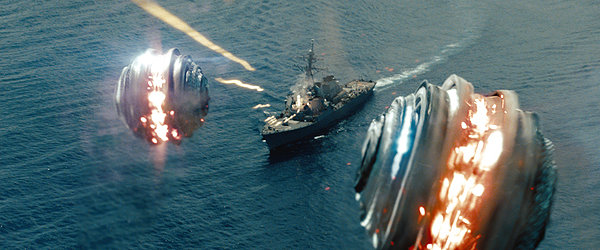 With all that surprising praise now established, Battleship the movie is still chock full of ridiculous moments and a rather leaky plot. The subplot involving a double-amputee veteran getting back his groove via alien invasion never feels well grafted to the major storyline. It feels like it was crowbarred in after the producers or Berg saw real-life double-amputee Gregory D. Gadson and declared, “This man needs to be in a movie.” He’s likeable enough but over the course of 130 minutes you realize likeable isn’t the same as being a skilled actor. This entire subplot involving Gadson, Samantha, and a computer techie (the amusing Hamish Linklater) strains credulity even for a dumb action movie. The fact that three easily over matched people can take out a load of well-armed aliens with little more than a Jeep and a briefcase mitigates the life-and-death stakes at sea. If these alien bad guys can lose so stupidly, then what’s the hold up? Also, the movie inserts a lot of bizarre tension between Japan and the U.S., like it’s trying to iron out the last unresolved conflict from the Second World War. The term “inelegant” cannot come close to describing the nativsm conflict and its dopey resolution. And then there’s the fact that the movie is long giant recruitment ad for the U.S. Navy. I suppose after the Marines had their own alien-fighting flick/recruitment ad last year (Battle: Los Angeles), the other branches of the armed services felt left out. I pray no one ever enlists over something this silly. No major life decisions should be made over the big screen adaptation of Battleship, people.
There’s a paucity of solid characters here. We get the bad boy younger brother who will discover his mettle and leadership by the end (by the by: having characters keep talking about how much “potential” somebody has is the annoying non-fantasy equivalent of talking about a prophecy being fulfilled). Kitsch comes off better than he did in Disney’s costly flop John Carter, but he seems too stiff and sullen for a leading man. If Battleship sinks, expect his leading man status to get dry-docked (okay, I’ll lay off the puns). Decker (Just Go with It) is still working out the kinks of transitioning from model to actress. Her romance with Kitsch is about as contrived as these things get in big action movies, a pathetic bone thrown to a deflated female audience who would rather see Decker in What to Expect When You’re Expecting. The additional seamen, including Rihanna’s acting debut (insert your “S.O.S.” joke here), are given one-note to play for over two hours. And as far as Ms. Umbrella-ella-ella is concerned, it’s certainly not the worst acting debut by a pop star (see: Crossroads, or better yet, don’t). Most disappointing is Neeson (Taken) who spends the far, far majority of the movie on the wrong side of the force field. I want this guy kicking ass and not barking impotently into a phone.
I don’t know if I can look myself in the mirror and declare, with solemn dignity, that Battleship is a good movie by the normal standards of objective excellence. Screw it, I had far too much fun with this film to stand back and pretend the movie’s flaws are too overpowering. Berg has slapped together what may be the most formulaic, pinpointed Big Summer Movie I’ve witnessed in some time, but I’d be lying if I said it didn’t win me over. They may be pushing buttons but Berg and company pushes them so well. Plus, I’m still uncertain whether or not the entire bloated affair is really the most expensive, subversive swipe at Michael Bay ever attempted. This is probably just wishful thinking from a critic looking to justify liking this movie. It’s got plenty of action, though doled out into bite-sized portions before the ACDC “Thunderstruck” montage ramps up the finale. Every now and then, you need a movie that gives you the right kind of stupid, and Battleship is the right kind of stupid for the summer movie season.
Nate’s Grade: B-
Share this:

The Avengers (2012)
 For the past four years, Marvel has been seeding its all-star super hero collective in the storylines of its summer blockbusters. And with six super heroes, The Avengers carries some super expectations. The creative mind behind the film is none other than Joss Whedon, best known for creating and shepherding cult TV shows like Buffy the Vampire Slayer, Angel, and Firefly. Not exactly the first name you’d think Marvel would assemble to front a $200 million movie. For geeks, Whedon has become a reliable standard of quality (the patchy TV show Dollhouse notwithstanding). Here is a man who can marry big ideas with sharp characterization and delightfully skewed dialogue. In Whedon, geek nation has a savior, and Marvel knew this. The Avengers is 142 minutes of geek arousal stretched to orgasmic heights.
Nick Fury (Samuel L. Jackson), head of the agency S.H.I.E.L.D., has a dire need for Earth’s mightiest heroes. Loki (Tom Hiddleston) has traveled through a portal and plans on conquering Earth thanks to an approaching alien army. Fury has tasked Tony Stark (Robert Downey Jr.) a.k.a. Iron Man, Steve Rogers (Chris Evans) a.k.a. Captain America, and special agent Natasha “Black Widow” Romanof (Scarlett Johansson) with stopping Loki and rescuing one of S.H.I.E.L.D.’s own agents, the skilled marksman Clint “Hawkeye” Barton (Jeremy Renner), who is under Loki’s devious mind control. Loki’s brother, Thor (Chris Hemsworth), would like to cite jurisdiction and bring his wicked brother back to his home world. The only person who may be able to locate Loki’s path is Dr. Bruce Banner (Mark Ruffalo), a guy with his own anger issues. With this many egos, it’s bound to get dicey. As Banner puts it, “We’re not a team. We’re a time bomb.” Can they put aside their differences to unite to save the Earth? Does a Hulk smash?
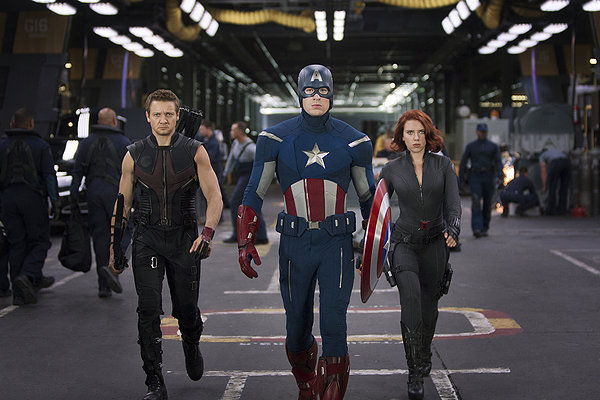 Whedon, the king of clever genre deconstruction last seen in the excellent meta-horror film Cabin in the Woods, plays it relatively straight, giving his big, effects-driven film a straight-laced sense of sincerity. It’s not making fun of these sort of big-budget, effects-driven smash-em-ups, it just wants to deliver the biggest smash-em-up yet. To that end, The Avengers achieves maximum smashitude (trademark pending). By its rousing finish, the movie has become so massively entertaining that you forget the draggy first half. The scope of this thing is just massive. The last thirty minutes is solid action across miles of crumbling, just-asking-to-be-exploded city landscape. But the trick that Whedon pulls off is how to orchestrate action on a monumental scale without losing sight of scale, pacing, and character. You’d think with a full deck of superheroes that somebody would be shortchanged when it came time for the rough and tumble stuff. Not so. Instead of fighting one another, the prospective Avengers work together in all sorts of combinations. The characters are well integrated into the fracas, making particular use of their abilities, and finding new locations of focus every few minutes. This expert hero shuffling keeps things feeling fresh amidst the constant din of chaos.
In fact, the movie finds time to give every hero his or her due, finding a small moment to reveal some characterization. I thought Whedon’s biggest challenge was going to be the juggling act of balancing so many heroes and so much screen time, but the man found a way, like he regularly does, to squeeze in character with ensemble action. The Hulk fares the best. After two movies, it feels like Whedon has finally nailed the character; granted, this success may be credited to the fact that Bruce Banner (all hail Ruffalo) is kept as a supporting character. The struggle of the character being likened to a recovering addict is a smart way to present the character without getting too morose (I enjoyed the revelation that the “Hulk” half prevented Banner from killing himself). When he’s told his mission is to smash, you can feel the exuberant joy of an unleashed Hulk id. The Hulk had two great audience-applause moments that made my theater go berserk. I also really liked the attention given to Black Widow and her lonely back-story. Hawkeye was a complete badass, though he only gets to do fun stuff in the madcap finale. The trouble with the hero team-up franchises is that not everyone’s on the same level of power. Thor is a god for crying out loud, Iron Man has super weapons, Hulk is Hulk, Captain America at least has superhuman strength but what do Hawkeye and Black Widow bring to the team? When you’re competing with all that power, being good with guns or a bow seems pretty puny. And with Hawkeye, there’s going to be a limit to his effectiveness unless he has a magic bag of replenishing arrows. Still, Whedon finds ways to make the heroes badass and humane in equal measure, and surprisingly funny, which is welcomed.
It’s hard to believe that Whedon had only directed one feature film before (2005’s Serenity, based upon Whedon’s canceled Firefly show) being given the keys to the Marvel universe. He’s directed several TV episodes of his signature shows but the man has never produced anything on this scale before. Given a gigantic canvas, Whedon delivers the goods. His action sequences are rollicking and fun and, best of all, shot and edited in a fashion where you can understand what is happening (take some notes, Hunger Games franchise). The action is well choreographed and elevated with organic complications and particular attention paid to location, like the Nicky Fury airship. Whedon is a master of the plot payoff, setting up his elements and then piloting the narrative to satisfying conclusions and integrations (Cabin in the Woods is also a pristine example of this gift). If you’re going to introduce an airship, you better believe that sucker is going to threaten to crash. I’m glad that Loki was brought back as he was the best Marvel big screen baddie yet, though I’m disappointed they essentially put him on ice for an hour.
 The technical elements are ably polished even for this kind of film. The cinematography by Seamus McGarvey (Atonement) is terrific, utilizing bright color in a way that the visuals pop. The special effects are top-notch and you just feel immersed into the action. The destruction is cataclysmic but rarely does the movie feel phony. I was impressed by the Hulk designs and the sequences in inky space with our alien adversaries. For that matter, are these aliens robots? It’s unclear whether the giant flying centipede-like ships are creatures. The 3D conversion is one of the better outings due to the fact that it doesn’t keep throwing stuff in your face. Plus, viewing Johansson’s leather-clad assets in 3D certainly has its own appeal, as does Gwyneth Paltrow in jean shorts. Hey How I Met Your Mother fans, Cobie Smulders looks practically smoldering in her S.H.I.E.L.D. agent outfit too. Okay, I swear I’m done with the female objectification.
I hesitate calling The Avengers the greatest super hero/comic book movie of all time, as the teaming hordes of Internet fanboys foaming at the mouth are wont to do. If your definition of a comic book movie is a giant sandbox with all the coolest toys, then this is your film. This is a comic book turned flesh. The Hulk and Thor fight and prove who is the strongest Marvel man, that’s got to be a geek’s wish come true. Many of the infighting sequences felt like, servicing the tastes of the fanboys, and after a while the constant hero on hero action felt tiresome. I get that we have a clash of egos going on here, but the movie suffers from a lack of narrative cohesion, by which I mean that the first hour of the movie feels like a series of guest appearances by heroes on loan. The movie doesn’t fully come together until the point where the team comes together; I doubt Whedon intended that symbiotic relationship. The movie feels more like a patchwork of standout scenes and memorable moments that a fully formed and cohesive story. If you haven’t seen the previous four Marvel movies (Iron Man, Iron Man 2, Thor, Captain America), you’ll be pretty hard-pressed to follow the story. Loki’s motivation and plan seems rather sketchy other than causing discord amongst the heroic ranks. His powers seem inconsistent and vague. Also I found the musical score by Alan Silvestri to be bland and unworthy.
The Avengers is sure to be geek nirvana for many of the comic book faithful. It’s an audience pleaser of mass scale, and I’m sure that your theater will be cheering in abundance. Whedon has pulled off the near impossible. The movie is a thoroughly entertaining, exciting, and witty popcorn spectacle of the first order. But where the movie hits the ceiling, at least for me, is that it ONLY wants to be the best super hero movie and this seems like limited ambitions. It’s like making the very best possible women in prison movie (great, but is this really all you set your sights on?). I had a great time watching Whedon’s handiwork but I wish it mined the outsized territory for bigger themes, a little more than audience-satisfying pyrotechnics, something I feel that X-Men: First Class did a better job of handling. Don’t get me wrong, I greatly enjoyed The Avengers and it’s a fantastic start to the summer movie season, but by no means is it The Dark Knight or even aspiring to be, and that’s okay. Enjoy the busy escapades of Marvel’s next smash franchise. Who knows when they’ll be able to wrangle everyone together for another adventure, but judging by the sounds of ringing cash registers, the answer is sooner than we think.
Nate’s Grade: B+
Share this:

John Carter (2012)
 John Carter has been in the longest development hell of any movie project in the history of cinema. If nothing else, that’s at least an accomplishment. Author Edgar Rice Burroughs first published his tale of interplanetary adventure in “A Princess of Mars” way back in 1912. It was his first published work, even before the phenomenon that would make him a star, Tarzan. Ever since 1931, filmmakers have been trying to realize Burroughs’ grandiose sci-fi vision but have never been able to finish. In the last decade, the movie has gone through different stages of development, with Robert Rodriguez, Kerry Conran (Sky Captain and the World of Tomorrow), and Jon Favreau attached as director at different points. Then Disney snatched up the rights and hired one of its own, Pixar director Andrew Stanton, to do what nobody has been able to do for 80 years –bring Burroughs’ vision to the big screen. It doesn’t hurt when Disney gives you a reported $250 million to spend.
John Carter (Taylor Kitsch) is a Civil War veteran haunted by his past. He’s chased by a group of bandits and stumbles into a cave that transports him to Mars, known as Barsoom to the natives. Carter discovers that he’s found himself in the middle of another civil war, this time between the cities of Zodanga and Helium. The Tharks are a race of 10-foot tall four-armed warrior creatures, and their leader, Tars Tarkus (Willem Dafoe), sees Carter as the turning point in getting his people’s lands back. Carter will also help solidify Tars Tarkus’ place as leader to his people. John Carter is a coveted free agent on the red planet. Princess Dejah Thoris (Lynn Collins) wants John to help her people survive against the Zodangans, lead by Sab Than (Dominic West). Dejah’s father (Cirian Hinds) has brokered a shaky peace on the promise that she and Sab Than will marry. The mysterious Therns, lead by Matai Shang (Mark Strong), are the real power players on Mars. They have offered a powerful new weapon known as the “ninth ray” to give Sab Than the upper hand. All John really wants to do is return home, but first he has to find a way back.
 John Carter is an amusing, entertaining throwback to old-fashioned B-movies. Even the depiction of life on Mars is charmingly retro, what a future would look like to a man from the early twentieth century perspective. As a result, the aliens fight with Bronze era weapons and guns that behave like trinkets from a Western. Even the minimalist alien design, the Roman-esque costumes, the fact that everyone can breathe air, and low-grade technology of these advanced species (flying machines that look like Da Vinci designed them) come across as nostalgic, vestiges of the past more so than insights into the future. It’s like watching those old sci-fi TV shows from the 1950s and how they predicted man would have colonized the solar system by now and already have a working lunar colony (Newt Gingrich is trying his best). The movie channels the spirit of old adventure serials and captures a certain gee-whiz, childlike sense of fun. There are moments where Stanton has a playful sense of storytelling, like a near montage of Carter’s determined escapes from officer Powell (Bryan Cranston? Why not?). While being PG-13, there is still a feeling of the Disney-fication of the tale, complete with tamer outfits for Dejah Thoris (do a Google image search) and an adorable alien “dog” sidekick that befriends John.
The best moments are easily the scenes where John integrates into the indigenous Thark tribes, finding a sense of community and a bonding with Tars Tarkas. If the movie had only featured this alien race instead of all those warring people-who-have-red-henna-tattoos-on-so-they-must-be-aliens-right, I think the movie would have succeeded better. One alien race focuses the narrative but instead we get four (three?). When our climax does come into view, the pieces have all fallen into place and the action is suitably thrilling. Stanton’s live-action debut isn’t the homerun that Brad Bird’s Mission: Impossible 4 was, but the large-scale action is satisfying and imaginative enough. The payoffs work and Stanton has nicely intertwined his storylines so that everything comes to a head. The Earthbound framing device, with Edgar Rice Burroughs (Daryl Sabara) reading the diary of his rich departed Uncle John, enriches the narrative once the full context is revealed, gearing up the audience for a long-awaited reunion to end the movie on a perfect high note.
What John Carter also has going against it is the pull of time. It’s hard not to see how derivative the story and characters are; Burroughs’ original novels were hugely influential to science fiction writers, and you can see similarities in Star Wars, Avatar, and other works. Scenes in this movie will feel like rip-offs from other movies, like an arena battle with giant alien hordes from Attack of the Clones, riling up a native alien species against its imperial antagonists in Avatar, Deja Thoris clearly has her DNA all over Princess Leia, and the dynamics of jumping through space travel via gateways made me think of how excellent a movie Stargate was (watch it again; it’s terrifically executed). Carter can easily be credited as the predecessor to superheroes. Now it’s unfair to say that John Carter rips off these other sci-fi movies when every one of them was released long after Burroughs’s novels had been widely published. It’s unfair, but you can’t help but feel the way you feel, and I was feeling a fairly resounding sense that I had seen much of this tale before and better. The actual terrain of Mars is a little less than inspiring. Its rocky vistas don’t make it feel too noticeably alien. We don’t ever really get a good view of alien culture outside of the Tharks. John Carter’s one big addition is that the character, given his physiological makeup and Mars’ gravity, can leap to impressive heights that were only previously known by Italian plumbers in video games. This means we get a lot of John Carter jumping up, jumping around, jumping like a Martian jumping bean. But just because you can jump really high, doesn’t that mean you’d be plummeting at a high rate of force? Wouldn’t John seriously break his legs leaping 500 feet in the air and then landing?
 The script, credited to Stanton, Mark Andrews (co-director of Pixar’s upcoming Brave), and Pulitzer Prize-winner Michael Chabon, is weighed down with expositional slog that it cannot break until the third act. I was expecting a better and more graceful story given Stanton’s previous film, WALL-E, which could be taught in film classes as a textbook example of elegant visual storytelling. With John Carter, it feels like we’ve been hit with the Martian phone book. We’re inundated with unfamiliar names and given scant time to adjust. While a gamble that the audience intelligence will catch up, it also makes for a confusing half of a movie. It’s hard to keep track of all the different names; Tharks this, Hellium that, Zodanga this, Jeddak that, Therns here, Barsoom there, etc. The movie doesn’t gradually expand its Martian history, it just plops us, along with Carter, right into the middle. The opening structure is also a bit confusing, as we’re jumping around time without any proper setup. Still, the movie cannot be accused of being stupid; hokey and convoluted, yes, but not stupid.
And boy do we get a lot of talking for an action movie set on Mars. The middle section is quite heavy with yapping. Kids who came thank to their trust of the Disney name will probably be bored as the movie explains to us things we already know and things we don’t care about knowing. For a two-hour plus film that has a lot of political infighting, I’m surprised that the movie is pretty pedestrian when it comes to its politics. It all really comes down to an arranged marriage to broker peace. That’s not very complicated. The main villains, the ghostly Therns, are completely incomprehensible when it comes to motivation. I have no idea what they stood to gain. If they have a gateway that can take them to Earth, or they have their own copies on Earth, why aren’t they using this to their advantage? Why aren’t they grabbing more Earthmen to form an army of jumping Jacks? Why the significance of the “ninth element” when we all know the fifth element is love? But more importantly, as last year’s Green Lantern proved, it hurts your movie when your hero can’t be bothered to be heroic. It takes far too long for John Carter to seem like he gives a damn about anything. I understand he’s a war-weary vet, but the movie feels like 90 minutes of him shrugging while everyone on Mars desperately pleads with him to save them.
Kitsch (X-Men Origins: Wolverine) is going to be having a fairly big breakout year given his mug appearing in several high-profile, high-budgeted movies. The guy has already proven with steady work on TV’s Friday Night Lights that he can act, though the results are not so convincing with John Carter. I think he was going for some sort of gruff, Clint Eastwood-esque loner but he just comes across as wooden. Add his character’s reluctant nature, and it makes for a pretty uninvolving hero. Fortunately for Kitsch (what an unfortunate last name), the supporting cast is there to pick up the slack. Collins (TV’s True Blood) is the real breakout star of the movie. She’s feisty and strong and passionate and altogether easy on the eyes she could give Leia a run for her money in a metal bikini competition. Collins’ performance is filled with urgency, like she’s compensating for our taciturn lead actor. When she’s on screen you feel engaged in the story. Dafoe (Spider-Man) finds the right mixture of humor and pathos as the leader of the Tharks. West (300) has such a slimy sneer to him, it’s magnificent to watch. I’m starting to think that Strong needs to take a break from playing villains (I count eight bad guy roles sine his breakout in 2008’s RocknRolla) except that he’s so good at playing them. I think if Mark Strong ever plays himself in a movie about his own life, he’ll inevitably be the bad guy.
John Carter is an entertaining throwback to the adventure serials of old, a retro sci-fi action film that falters somewhat from a talky, uneven, exposition-laden script. When this movie works, it works quite well. There’s just too much stuff in this movie, too many alien races, too much exposition, and too many other movies that make John Carter feel derivative. What was once amazing and imaginative in 1912 will not have the same effect on audiences in 2012, especially those who have grown up on pop culture inspired by John Carter. I don’t think anyone can say the final product was worth the wait, but John Carter is a modestly fun adventure. I wouldn’t mind taking another trip to Mars, just as long as it doesn’t take 80 years.
Nate’s Grade: B-
Share this:

Cowboys & Aliens (2011)
 Never as good as a film should be given the talent involved, nor as bad as its detractors might have you believe, Cowboys & Aliens is an entertaining genre mash-up that’s about 60 percent Western, 30 percent alien thriller, and 10 percent naked Olivia Wilde, which is too small a percentage in my opinion. For a solid hour, the movie follows the rhythms of classic Westerns and Daniel Craig has a face vividly made for the Western canvas. The sci-fi elements feel well integrated in small doses, however, when the movie goes all-out intergalactic gun slinging is when the narrative gets swallowed whole by the crude blockbuster nature of this beast. The plot is pretty standard Man with a Dark Past stuff, and can we put a moratorium on people suffering amnesia and choosing to be better people? The characters never really feel real but they feel believably stock for their genre. For a PG-13 movie, the violence can get pretty gruesome, especially in its gooey disembodiment of the alien invaders. You almost feel sorry for these nefarious gold-hoarding (yes, you read that right, the aliens are after our gold – Glen Beck was right!) creatures. The action sequences are a notch above average, the emphasis on practical effects is appreciated, and the movie takes some darkly comic turns, which kept me amused even when the movie’s IQ was dropping at a precipitous rate for the last act. Cowboys & Aliens never pretends to be anything more, or smarter, than its blunt title.
Nate’s Grade: B-
Share this:

The Thing (2011)
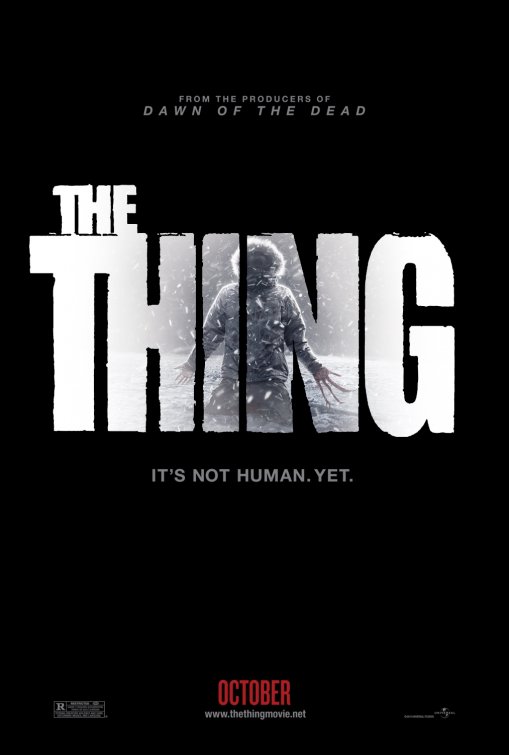 Has any modern filmmaker endured more crappy remakes of their films than John Carpenter? The man has suffered through remakes of Halloween, The Fog, Assault on Precinct 13, and now his 1982 creep-fest The Thing, itself a remake of the 1951 Cold War allegory, The Thing From Another World, gets the same awful treatment. This new Thing is some hybrid of remake and prequel, because it’s set before the events of the 1982 film but it pretty much follows the same overall plot. Once again a group of scientists (this time they’re Norwegian!) on a remote Antarctic outpost discovers an alien body buried in the ice. Once again the alien breaks loose and can assume the fleshy form of man. But this new film forgoes the rampant paranoia and rising tension of Carpenter’s film for cheap Boogeyman thrills. The alien monster is introduced early and the rest of the film succumbs to people looking around pensively, afraid it will jump out and attack. This alien creation is an odd quirk of evolution; a species that seems to be made of nothing but gnashing teeth, spindly legs, and vaginal imagery. How these things built and fly spaceships, I have no idea. Some of the gore effects are crafty and stomach-churning, but nothing is as memorable as the practical effects used sparingly and to great effect in the 1982 flick. This Thing is too much of a familiar monster to make an impact.
Nate’s Grade: C
Share this:

Attack the Block (2011)
 Attack the Block is the hip new sci-fi comedy/thriller from across the pond. The Brtis know a thing or two about elevating genre movies to an art form. While not rising to the same level of executive producer Edgar Wright’s oeuvre, this is one of the most fun experiences I’ve had in a movie theater all year.
On New Year’s Eve in a South London ghetto, a very different kid of firework is lighting the moonlit sky. An alien race is crashing to Earth as fiery meteorites, which the kids of the neighborhood term “Gollums.” Moses (John Boyega) is the leader of a group of teenage wannabe hoodlums. Their crazy night begins with mugging Sam (Jodie Whitaker), a nurse who lives in the boys’ apartment complex. Moses and his crew later run into Sam and need her help when one of their own is injured. The alien monsters have descended upon their block, scaling the apartment building looking for easy prey. Moses and other block residents band together to battle a common foe, the outer space monsters, which have the misfortune of trying to invade the wrong neighborhood.
Attack the Block is a refreshing spin on a genre that seemingly had covered every ground. But lo, it never covered the modern urban landscape, or, as the tagline succinctly puts it: inner city vs. outer space. It’s not long before you realize that writer/director Joe Cornish (writer of the upcoming Tin Tin flick) is the real deal. The camera angles are lively and inventive, without crossing over into self-infatuation for style’s sake. The cinematography by Thomas Townend is delightful to look at, often making our own home feel like an alien landscape with harsh color tones. The movie has the slick look we associate with music videos and commercials, but never does the movie let the visuals overwhelm the story. The edits are crisp and quick, packing a lot of material into a small 99 minutes and doing well to quicken your pulse during several iterations of the alien attacks. But most of all, the film is completely, unabashedly fun with a capital F. It has a swagger to it, adopting the same cocksure attitude of its main characters. The accents and the breathless jargon take some adjusting, but by the time we’re running from aliens you’re pretty much at the same pace of astonishment with the characters, forgetting the language barrier. I was quickly sucked into the world of this movie, able to enjoy the depth of skill by the invisible technicians. There’s an immense sense of satisfaction watching this crew band together to take out superior numbers of baddies, some of them even Earthlings. Cornish confines his narrative focus to one apartment building over the course of one night, setting up our orientation to the building so that when we have characters running back and forth, and various storylines criss-crossing, we are kept in the loop. As people start becoming monster chow, the stakes get even higher.
 The dialogue is regularly clever without having to stoop for self-aware gags. This is not a genre spoof. This is played relatively straight, just with amusing characters (“You’d be better off calling the Ghostbusters, love.”). One of the kids, who is on a pay-as-you-go cell plan, breathlessly says, “I only got one text left. This is just too much madness for one text!” Attack the Block is the right combination of scary and funny, the same fine line that its forebear, Shaun of the Dead, so successfully walked. This is the kind of movie that genre fans tell their pals about in breathless declarations of awesome before falling over dizzy. Nick Frost, star of Hot Fuzz and Shaun of the Dead, even has a minor roll as the neighborhood pot supplier. While Block doesn’t approach Shaun’s utter genre-spoofing greatness, there is enough of squandered potential in Cornish’s script, particularly how the various pieces ultimately stack together for its standard but effective fist-pumping climax, to keep Block from being crowned an instant genre classic. The characters remain little more than types, distinguishable by the few traits thrown to the actors like meager breadcrumbs (kid with glasses, angrier kid, white kid, etc.). If you’re a fan of Shaun of the Dead, and witty, bloody sci-fi, then you already know that Attack of the Block is destined to beam into your home.
The aliens themselves deserve a special mention since they break away from the traditional mold of cosmic movie monster we’re familiar with. These minimalist aliens look more like giant yeti creatures that run on all fours. They’re all black, like inky black hole light-cannot-penetrate black, which is scary but also a clever way to hide the shortages of a limited budget and the reality of people in suits. The only thing that stands out is a set of fluorescent blue jaws that snap wildly. It’s like the monsters ate a can of glow sticks. This aspect is smartly used at points to pump up suspense. It’s a novel approach that veers away from the H.R. Geiger (Alien) stuff that’s been copied and recopied to death for the last 30 years. These aren’t smart aliens. They’re more like rabid beasts overwhelmed by their biological impulses. These aliens don’t come across as organized as other movie aliens. It seems like they’re just floating around through the void of space waiting to land on the right rock and multiply.
The musical score is greatly enhanced through the talents of Felix Buxton and Simon Ratcliffe, better known to big beat electronica fans as Basement Jaxx. The musical duo provide a score tinged with their famous electronic mélange of sound, including pieces that sound like retro video game sound effects (Space Invaders?), 1950s sci-fi movie scores thick with Theremin use, and an ongoing sludgy beat that weaves in and out of the picture. Working with Steven Price (Scott Pilgrim vs. the World), traditional rousing musical pieces are enhanced with the Basement brothers’ dubsetp influenced bass and drum lines. The score perfectly matches the frenzy of what’s happening onscreen, evoking a fuzzy mood. I have been listening to clips of the Attack the Block score for days. It’s not as integrated and essential to the film as Run Lola Run’s famously kinetic electronica score (the standard bearer of all electronica-enhanced scores), but I was delighted every time it remerged. With the Chemical Brothers score for Hanna and Oscar-winner Trent Reznor’s score for the Girl with the Dragon Tattoo later this year, this may be the best time yet for film lovers that enjoy toe tapping to some electronic beats. These kinds of scores age so much better than synth scores, one of the absolute worst things ever to happen in the history of movies (Apocalypse Now is almost unmatchable thanks to its dreadful synth score).
 Of course your level of enjoyment is going to severely rest upon whether you want the main characters to survive or get eaten. Attack the Block begins with an empathy deficit, meaning it puts its hoodlums immediately in a hole that they might not get out of. Our first introduction to Moses and the gang is watching them mug Sam. Later on one of the guys says the knife that was bared was just for show, and that the boys were just as scared as she was. I doubt that. When you’re on the receiving end of a weapon, and outnumbered, and surprised, it sure seems like you got it worse. The movie then spends the rest of its running time with these wannabe ruffians, and we do get to know them slightly better but really only slightly. Some of the kids have absentee parenting situations, which isn’t too shocking, and occasionally a character will take a moment to reflect, thinking beyond the situation, blaming the government in a fit of paranoia for being behind the alien nasties. One kid even makes a curt remark when he finds out Sam’s boyfriend helps impoverished kids in Africa. “We don’t got poor kids here that could use some help?” he comments. Well, kid, I wouldn’t dismiss the magnitude of systemic poverty in the African continent, but you could have made your point without seeming like a dick. And these are our characters. They blather a lot; in fact they rarely stop talking. Eventually they do apologize to Sam for mugging her and Moses does take the mantle of hero to redeem himself. However, by that time some audience members may have checked out. Attack of the Block is decidedly less fun if you don’t give a fig for its wannabe thug figures.
Attack the Block is like a delirious head rush, witty, full of energy and style to spare, and an infectious attitude that washes over you. The movie delivers what Super 8 promised, namely the bond of kids coming together to thwart an alien invasion on their home turf. This is a high-energy flick that succeeds as a comedy and a thriller, with a few nasty splashes of gore thrown in for good measure. It has some issues that keep it from the pantheon of genre greatness, but I won’t quibble the movie to death. Not when I get something as deliriously entertaining as Attack the Block.
Nate’s Grade: A-
Share this:

Paul (2011)
 This sci-fi comedy by the guys behind Hot Fuzz and Shaun of the Dead, though absent director Edgar Wright (Scott Pilgrim came a callin’), is an irreverently fun flick that lovingly sends up just about everyone in its sights. Simon Pegg and Nick Frost play a pair of British sci-fi geeks road tripping through the American southwest when they come across Paul (voiced by Seth Rogen), an alien on the run. Together they outrun various pursuers, from government agents to angry rednecks, and Paul transforms into a delightful road comedy with the different characters ping-ponging back and forth, narrowly missing but still in the hunt. It’s a cheeky even rollicking action comedy in the vein of a Midnight Run, though with way more stoner jokes. The plot nicely weaves these various elements and characters together, creating a satisfying escalation in suspense and comedy. The characters are pretty familiar and some of the gags are below the caliber of talent onscreen (really, more “people think we’re gay” jokes?), but the final product is unabashedly fun and it’s easy to feel Pegg and Frost’s enthusiasm. Paul is a light-hearted, funny, even tender sci-fi comedy that borrows from better movies but still manages to charm.
Nate’s Grade: B+
Share this:

Apollo 18 (2011)
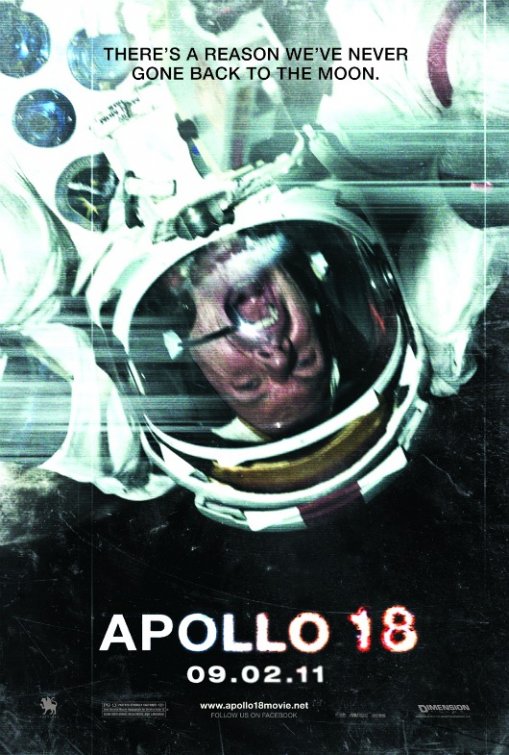 Apollo 18 is the latest in a swelling subcategory of films known as “found footage,” movies that purport to be discovered documents and aesthetically adhere to this premise. That means lots of handheld camerawork, selective editing, and other efforts meant to convey that what the audience is watching is not a movie made by professionals. It’s a professional attempt to look unpolished and amateurish, which is like having a four-star chef make you Taco Bell. 1999’s The Blair Witch Project popularized the found footage concept, and to this day there are still people today hoodwinked into believing it as unvarnished reality. Maybe that’s why NASA issued an actual press statement this week wishing to inform the general public that Apollo 18 is a work of fiction. I don’t think they have much to worry, because very few people will be seeing Apollo 18 and even fewer will enjoy it.
Apollo 18 concerns the failed secret mission of three astronauts (Warren Christie, Lloyd Owen, Ryan Robbins). The astronauts were sent to the moon for the Department of Defense, which means this is the second film of the year to concern a covert reason for landing on the moon. The two astronauts who actually land of the moon’s surface discover a dead Cosmonaut and some strange occurrences. They realize that they have been lied to by their own government and placed in a danger that few can comprehend.
But an intriguing premise can only get you so far and Apollo 18’s clumsy execution makes the movie disintegrate upon reentry, or, any critical thought. A secret NASA mission that went horribly wrong sounds like a great start to a conspiracy thriller, that is until you realize all you’re being presented with is the fake found footage. That means that we spend an eternity watching guys in suits float around, biding their time. Then they go outside and wander around the lunar surface. Then they hear an occasional noise. Or did they? Then they go back to floating around, to make up for the lost time they weren’t floating around. Really, this movie is an hour of nothing. It fails to create a sustainable atmosphere of dread or even basic curiosity. But when locked into the found footage concept, we are generally left with a lot of time on our hands. You would think that the basic premise that people have reassembled this footage would lead to cutting a lot of the filler and just getting to the good parts. It seems almost resentful that this hypothetical editor trying to showcase a long-buried truth would decide that the important stuff can wait. I was so thoroughly bored with Apollo 18 that I started counting stars.
 The structure of the story is just too insular and limited in scope. I strongly feel that Apollo 18 would have benefited greatly by opening up its storytelling parameters. It could have kept the found footage motif, but instead of being an entire 90-minute movie the found footage would be one component of a wider faux documentary. Interviews with science experts, conspiracy theorists, former NASA employees speaking under the protection of anonymity, and even family members, particularly the now grown-up son of one of the astronauts holding out hope, would add some balance. It would make the story feel larger and more authentic, let alone give the audience something new to watch. There could have been a parallel story of the discovery of this evidence, the process of getting it authenticated, and the potential dangers that would be exposed. It all seems a little too slapdash and simplistic to just say the footage was uploaded to a website. Anything, really, is what I’m looking for to broaden Apollo 18. There’s so much more that could have been added, but alas we’re stuck with three blander-than-bland, interchangeable characters collecting moon rocks and battling interstellar cabin fever.
Now I’m about to enter into the orbit of some serious spoilers concerning the ending to Apollo 18, so skip to the next paragraph if you wish to remain pure. The entire premise of this mission gone wrong (why did NASA create Apollo 18 uniform patches for a secret mission? It seems counterintuitive to create merchandise for something meant to be covert) is that there is something on the moon that the higher-ups in government want to investigate. This dangerous mystery claimed the life of a Russian cosmonaut, whose body is discovered by our American squad. When exactly the Russians put a man on the moon is never explained; yet another ingredient that would have worked better as a faux documentary. So you have one dead man on the moon, but soon the body count rises. It’s not some strange cosmic virus that infects the astronauts, leading them to psychotic episodes and murder. No, that would have been too plausible. You see, the villain of Apollo 18 is the moon rock. The rocks themselves somehow can transform into spider-like creatures that like to scurry around. Never mind the fact that we’re dealing with life that evolved in an environment without any atmosphere, but what have these moon rocks been doing for billions of years? It seems to me that after Neil Armstrong stepped onto the moon, the rocks must have been like, “There goes the neighborhood.” After twelve moon walkers, my only explanation for the motivation behind these killer rocks is that they just got sick and tired of being disturbed so often (“You stomp around like you own the place, you leave your trash behind, that’s it!”). A post-script tells us that these moon rocks were brought home and sent as “gifts” (their emphasis, not mine) to leaders and dignitaries of foreign countries. What are the implications with this? That the United States has kept its place atop the world because of the threat of moon rocks? Do the moon rocks even work on a planet with a vastly different climate than the arid moon? For that matter, since Apollo 18’s mission ended circling the moon, how the hell was any of the film footage retrieved? It wasn’t broadcast, so how did NASA or any truth-seeker come a hold of this damning evidence of killer lunar rocks? And to think we once thought that the moon was made of cheese. Oh how naïve we all were.
Apollo 18 is probably the most boring of all the found footage horror movies thus far. It does nothing to justify being 90-minutes, lacks any minor thrills or chills, and seems creatively stagnate. There are some cheap jolts, including having a character awake from a dream screaming twice. This Paranormal-Activity-on-the-moon fails to live up to the possibilities of its intriguing premise, instead settling for something aiming for slow-burn but achieves no-burn. The laughable conclusion is meant as a payoff but only for the nuttiest of geologists. Apollo 18 sticks with its core limited concept to the bitter end. This is a disappointment from all angles. It fails to scare, it fails to stimulate, and it fails to entertain big time. In space, no one can hear your boredom.
Nate’s Grade: C-
Share this:

Transformers: Dark of the Moon (2011)

After the obnoxious, oafish mess that was 2009’s Transformers: Revenge of the Fallen, a sequel that took everything good from the first flick and undermined it and took everything awful and magnified it, I wasn’t expecting much. True, low expectations have benefited this franchise built upon merchandizing, product placement, and giant freaking robots that fight. I still remain a fan of the first film back in 2007, and I do feel like director Michael Bay (Bad Boys, Armegeddon) is a natural fit for this material. But after another overlong, overblown, and overloaded Transformers film, I’m starting to think that the franchise’s best days left with Megan Fox and her cut-off jean shorts.
Sam Witwicky (Shia LaBeouf) has graduated from college and is now perusing a job in Washington D.C.’s vast center of government contracts. He’s living with his new girlfriend, Carly (Rose Huntington-Whiteley), the assistant to a rich billionaire (Patrick Dempsey) and his fleet of collector cars. Sam gets a job with at a military private contractor run by a angry loon (John Malkovich). But Sam’s post-collegiate journey once again runs afoul with killer alien robots. The villainous Decepticons are plotting to steal a spaceship that crash-landed on the dark side of Earth’s moon. Inside that spaceship are teleporter orbs and a sleeping robotic giant known as Sentinel Prime (voiced by Leonard Nimoy, hooray). Optimus Prime, leader of the noble Autobots, revives his predecessor. Together, the group attempts to thwart the Decepicons, lead once again by Megatron (voiced by Hugo Weaving).
The Transformers films have been getting larger and larger in scope and destructive power; the first film messed up some L.A. streets, the awful second film trashed Egyptian pyramids (only Six Wonders of the World left in your punch card, Bay), and now the third film pretty much obliterates downtown Chicago in stunning and overblown fashion. The climactic Windy City beatdown lasts a solid 50 minutes and may just be the greatest thing Bay has ever put onscreen, which admittedly might be faint praise to many. Perhaps the city of Chicago thought this would make for good tourism: ”Hey kids, come see the buildings that were turned to rubble in your favorite summer movie!” The impressive special effects are uniformly terrific, and the integration of reality and fantasy seems seamless. That goes without saying. I must credit Bay for creating sustainable action that is, here it goes, actually coherent. I know that “Bay” and “coherency” rarely go together, so I’m as shocked as everyone. No longer does geography become a hindrance to understanding. During this climactic Chicago onslaught, the locations are established, the objectives are clear, and the audience has a crisp understanding of the different teams, their paths, and their organic roadblocks and setbacks.
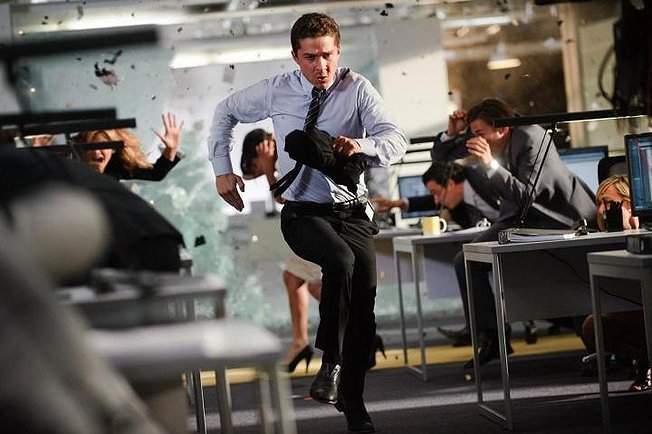 There’s a strong set piece within this 50-minute assault where Sam and company enter into a crumbling skyscraper that then teeters on its side. The organic complications allow for some nifty, almost ingenious, split-decisions utilizing a specific location, the hallmark of good action sequences. One moment they’re climbing up the floors, the next moment they’re tumbling through the floors, then sliding down the sheer glass wall, then firing at the glass to fall back inside and tumble some more. All the while a giant worm-like robot is churning through the foundation of this collapsing building. The scale of the sequence is quite thrilling for the time being. And yes, the 9/11 imagery is undeniable and relatively unearned without even a nod to solemnity or anything less than brainless summer spectacle. Sure the “cool-ness” of the individual parts never really materializes into something greater, and yeah maybe the action would have more impact if you actually felt for the characters, or knew who some of them even were, but you take what you can get in Michael Bay world. The extended climax for Transformers: Dark of the Moon is relentless and will beat you into submission, admiring the intrinsic beauty unique to Bay’s epic, albeit mind-numbing, demolition of the senses.
But Dark of the Moon is also the most visually coherent of Bay’s troika of Transformers flicks because the man has finally settled down when it comes to editing. Now no one will confuse this movie for Rope or Russian Ark (look it up, Transformers geeks), but the edit/panic button is given a slight reprieve. The shots last longer; the editing is far less frenetic and chaotically ADD-addled, and no longer does a Transformers action sequence look like jumbled, mechanical scrambled porn. Image A and Image B make a logical connection, at long last. You can tell which robot is which, for the most part. Perhaps this editing epiphany was a result of Bay’s corporate betters insisting that the film be shot in 3D (I chose to see the film in good old boring 2D, feeling that 150-minutes of Michael Bay with headache-inducing glasses was not worth the extra dough). Perhaps Bay had to consciously think about his audience’s well being so his shot selections lasted longer than his usual whirlwind of cuts. Perhaps the secret was loading Bay with cameras that weigh the same as couches. Maybe a little extra weight was all the man needed to formulate lucid action sequences.
And yet Dark of the Moon is just as stupid, outlandish, and tonally disjointed as the other movies, particularly the abysmal Revenge of the Fallen. The comedy remains at a puerile, sophomoric level. Bay’s sensibilities have always somewhat mirrored that of a snickering 14-year-old boy; the love of destruction, the fascination with things that go “boom,” the ogling of lithe feminine bodies. No joke, the first image seen directly after the film’s title is a close-up of Huntington-Whiteley’s ass ascending a staircase. I imagine there were plenty of men spasming in their 3D glasses trying to reach out and grab the circumference of a Victoria Secret model’s talents. I wrote about the second film: “Women don’t seem to exist in the Michael Bay world, only parts and pieces of women.” Huntington-Whiteley’s character certainly leaves much to be desired, outside aesthetics. At least Megan Fox’s character had, you know, some character traits. I also wrote: “Amazingly enough, [Fox] manages to lose more clothes the more she runs in slow-mo, allowing the male audience members to follow the nuance of her bouncing breasts. She’s clearly not the next Meryl Streep but this girl deserves more than being wordless arm candy.” Seems apt to me. Carly is as bland as she is blank-eyed beautiful, just the way Bay likes ‘em.
The first 90 minutes of the film is spent with the humans and it’s like being trapped inside a bad comedy. There has always been a strong comedic bent to the franchise ever since the first film in 2007; however, the latter films have taken to grotesque caricature. In Dark of the Moon, the comedy is so deeply unfunny but so consistently antic, trying to overwhelm you with its bad taste. There’s a scene where Ken Jeong (yes, you read that right) corners Sam in a bathroom stall to distribute his crackpot manifesto. Then Sam’s boss walks in and, oh boy, he overhears and thinks they’re having a homosexual liaison in the men’s stall. What a hoot. Then Sam’s mother gives him dating advice, stating there’s no earthly way her son is going to nab a third “hottie” unless her boy has a giant…. and trials off (wouldn’t a mother kind of have an idea about that subject?). And then there’s the little Autobots, the size of remote control cars (perfect presents for Christmas mom and dad), who wheel around spitting smart-alecky backtalk. The entire Malkovich portion could have easily been cut from the film without damaging a soul. The Ken Jeong stuff should have been eliminated first. There’s something to be said when John Turturro’s returning Agent Simmons is the least annoying comic sidekick in this movie. But hey, at least there aren’t any overt racist depictions and jokes about robot scrotums. Nope, there’s only infantile humor and nonchalant misogyny. The comedic pit stops and non-sequitors never allow the movie’s tone to gel.
 Before the movie descends into an all-out series of explosions and shrapnel, the setup actually has some genuine interest. Then it just all goes nuts at warp speed. The fact that the space race to the moon had a sinister ulterior motive, investigating alien technology, is an intriguing start. Bay even shoots the 1960s sequences like he’s ripping off Oliver Stone, swapping film stocks and black and white film to showcase his historical reinactors (three presidents get represented, including Obama). Apparently after this film and X-Men: First Class, the breakout star this summer is archived footage of JFK (man did he have a full plate, mutants and robots, and the man still found time to bang Marilyn Monroe). There’s even a cameo by the real Buzz Aldrin, which served to make me remember his better cameo on TV’s 30 Rock (“Would you like to yell at the moon with me?” he politely asked Tina Fey). The space race was a pretense for getting our human hands on some alien technology. Of course we were warned years ahead of time via Pink Floyd but nobody could put the pieces together. But there’s more alternative history to be had. Turns out that the disastrous nuclear accident at Chernobyl was caused by the Russians trying to operate alien/Transformer technology. I’m sure modern-day Ukrainians will adore having their deadly tragedy turned into a plot point in a stupid movie about fighting robots. The Decepticons wicked plan is to open a teleportation portal and bring their dead planet, Cybertron, to Earth. Then they will use Earth’s human population as slave labor to bring their dead planet back to life. My question is this: when you’re a huge robot the size of a building, wouldn’t puny little humans make for a terrible labor force with their stunted little legs and feeble muscles? I know there’s billions of them, but there’s a reason human beings have never turned on ants and forced them to become a labor force for our construction projects. How many more deadly things from Cybertron are secretly going to be hidden on Earth? And yet none of this is even one-tenth as stupid as Transformers’ heaven in Revenge of the Fallen.
Transformers: Dark of the Moon is likely everything fans would want from a franchise. There’s wanton destruction, a plethora of noisy explosions, and plenty of eye candy both in special effects wizardry and pouty, full-lipped women. But at a colossal 150-minute running time, this is a Transformers film that punishes as much as it entertains. There’s really no reason a movie about brawling robots should be this long. There’s no reason it should have to resort to so much dumb comedy. There’s no reason that the women should be fetishized as if they were another sleek line of sexy cars. There’s no reason why something labeled a “popcorn movie” can’t deliver escapist thrills and have a brain too. Dark of the Moon is saved by its long Chicago-set climax, which gives way to some staggering action set pieces. The newest Transformers movie is just as stupid as the rest (what the hell is up with the weird Igor robots tending to Megatron that just seem to grumble and grunt?) but, unlike the previous installment, it’s not offensively stupid. Dark of the Moon is an exhaustive experience whose thrilling high points even feel mechanical and pre-programmed. Is this the future of Hollywood? Bay and his army of robotics and excessive spectacle have taken over the world. When it comes to big-time summer entertainment, the machines of Hollywood are going nowhere fast and even louder.
Nate’s Grade: C+
Share this:

Green Lantern (2011)
 To quote that sage Kermit the Frog and his words of wisdom concerning Green Lantern: “It ain’t easy being green.”
Hal Jordan (Ryan Reynolds) is a cocky pilot working for his ex-girlfriend, Carol Ferris (Blake Lively). Hal never takes anything too seriously and seems to freeze up in moments, recalling his own father’s crash. Then one day a purple alien crash-lands on Earth and seeks a replacement. This alien belongs to the Lantern Corps, a group of intergalactic policemen for the universe. He was mortally wounded by Parallax, a creature that grows stronger on fear but looks like a big rain cloud. The alien’s ring chooses Jordan as the replacement. Next thing you know, the guy is training on the alien world Oa and meeting lantern officers from all over the universe led by Sinestro (Mark Strong). Jordan is unsure of his heroic destiny, though we are reminded many times “the ring does not make mistakes.” In the meantime, Hector Hammond (Peter Sarsgaard) is dissecting the dead purple alien and gets infected with the fear cloud/Parallax. He lashes out at his father (Tim Robbins), at Jordan, and signals to the giant evil rain cloud that Earth is an all-you-can-eat fear buffet ready for the binging.
For starters, he power is a bit silly and hard to explain. I fall in with the majority of the public when I say, “Green Lantern who?” So the guy’s super duper power is to channel his imagination into green-tinted reality? It’s a bit vague and hard to quantify. So when a helicopter is falling to earth, instead of, say, picking it up or steadying it, Jordan creates a green Hot Wheels racetrack for it to zoom around to a stop. When the evil rain cloud fires its energy projectile, Jordan conjures a catapult to catch the projectile and fire it back. And of course at some point he materializes a green gun to use in combat. I’m sorry but for me this just seems silly. It’s one thing to say, “His strength is the power of his imagination,” and I can see where young kids would gravitate to this stuff, but when it’s realized on the big screen is seems infantile. What are the rules here exactly? It just seems dumb. I can better accept a magic ring that allows Jordan to fly or shoot sparkly lasers. If a healthy imagination is key, then the rings should be choosing some of the world’s greatest living authors and artists. Can you imagine Charlie Kaufman (Being John Malkovich) with a lantern ring, or Neil Gaiman (Sandman)? Surely those guys would come up with something more interesting than catapults and racetracks. But you see, the rings, and the lantern world itself, runs on the power of will. Will power is their energy resource (talk about going green). The enemy, the cosmic rain cloud, runs on the power of fear, which is represented by yellow energy. What are the other colors of the rainbow? Is the power of love red? Is the power of envy a darker green? Is orange the color of hunger? Is brown the color of painful bowel movements? Is the power of apathy… forget it.
The biggest misstep is all the time the screenplay squanders on boring old Earth. Just like Thor, the alien worlds are the best part of the movie. But in Green Lantern, we see the training home world (Oa) and the thousands of weird, fun-looking aliens staffed to police the universe. We get a taste of the lantern life and the heavy responsibilities. We get a sense of the powers. And… then… Hal… quits. He up and quits. He says, after about five minutes of training, “You got the wrong guy,” and we head back to Earth. What the hell? We then get to spend the majority of Act II with this guy moping over whether he should or shouldn’t be a superhero. Memo to Hollywood: no one spends this kind of money on a movie where the main character can’t be bothered to accept being a hero with amazing super powers. I can’t be bothered with a hero who can’t be bothered. The screenplay structure should have been: Act I spent on Earth, Act II spent on Oa and in space, Act III return to Earth to save the day. Instead we get about ten minutes spent on Oa. And while I’m on the subject, whenever we see this alien planet it’s like a non-stop Green Lantern convention (does Oa host other conventions? Is next week the semi-annual gathering of amateur ornithologists?), so who is left policing the universe? I understand that a majority of the universe is empty space, but if the lanterns keep getting together for pep rallies on Oa, what’s to stop a universe full of criminals from stealing everybody’s car stereos? Also, lanterns intervene in the universe when evil is afoot, but nobody seemed to give a damn about planet Earth until we got lantern representation with Hal Jordan.
So the bad guy here is a semi-formless rain cloud with a head that sucks people’s fear. It feeds on fear. That is its energy source (get a job in the media, son). Like much else in the film, the rules concerning the villain are never fully explained. At times, this rain cloud thing seems invincible. Most of the time it’s never explained what exactly this thing could do. See, if you explain things then you box in your characters. So if you don’t establish rules for your villain, your heroes, their respective powers, the history of the universe, etc., then they are limitless. It also means that everything onscreen lacks any sort of logic, internal or otherwise. So the villain is really just a fuzzy concept of fear. Hal Jordan and the lanterns have nothing to fear but fear itself. That means that the screenplay falls prey to a plethora of hackneyed messages that feel ripped out of some Saturday morning cartoon series. Everyone feels fear. Accept your fear. Courage means rising above. It’s the same patter that’s been rehashed for hundreds of episodes of people in tights teaching schoolchildren it’s okay (take a drink every time a character utters the word “afraid” or “fear”). The simplistic moralizing on fear and courage made me yearn for a ring so that I could imagine a better villain. Lastly, there’s a scene where our dastardly cosmic rain cloud descends to Earth and starts sucking away people’s fear/energy/souls. There’s a shot of a school bus screeching to a halt and children dashing away. I imagine children’s fears are more heightened since their healthy imaginations and lack of world experience would exaggerate scary things that adults would try and simply deny. Their fear has to be like a delicacy. I guess what I’m getting at is, if I were a giant space cloud that fed on people’s fears, I’d go for the children first.
Director Martin Campbell has crafted some truly spellbinding, breathless action sequences in movies like Goldeneye and Casino Royale, but you can tell that he seems to be straining against the onslaught of computer effects. Campbell is more at home with the open world of practical effects and the tangible. Being confined to the realm of green screen and CGI seems like a shackle for this guy’s own imagination. He constructs solid action sequences, admittedly, but nothing worth bearing the name of Campbell. It’s a special effects bonanza without a hint of realism, like a computer start vomiting onto the screen. It feels weightless and formless, like a giant evil rain cloud. The film reportedly cost over $200 million, which is a high figure for a movie that spends so much freaking time on Earth! Here’s an example of a costly filmmaking expenditure – the suit. Hal Jordan has a skin-tight green suit that is complete a computer effect. That means that every second Reynolds is seen onscreen in his signature outfit, it’s another effect that people labored over for months. Why? I’m pretty sure that in this day and age we have the technology for clothing. Campbell succumbs to the limitations of the material and Green Lantern ends up feeling more like a TV pilot with a runaway budget than the beginning of an epic franchise for its parent company.
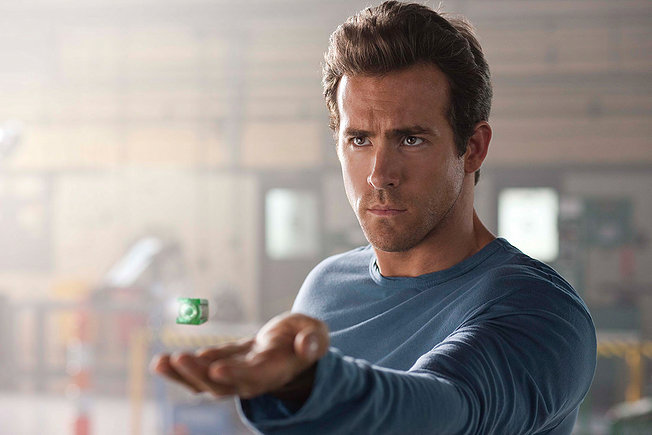 Reynolds (The Proposal) is an extremely likable actor whose biggest drawback is that he rarely seems serious, last year’s Buried a notable exception. He’s got this carefree attitude, practically bobbing his head and winking to the audience, and you like the guy even when he’s being a cad or a wimp. His character’s arc is supposed to be the guy who accepts responsibility, learns to accept and move beyond his fears, and it’s a character track that has been long journeyed and will continue to be. It makes for a simplistic hero’s journey storyline that seems to do the least work necessary to move things along. The movie did not fail on Reynolds’ shoulders; you can blame the four screenwriters and a ballooning budget for that one. Lively showed that she really could act in The Town. She shows no proof of this ability in Green Lantern. She speaks every line in a flat, monotone delivery, so much so you start to think she has like an inner-ear infection and can’t hear her own modulation. Her character is the weak love interest/damsel in distress role that regularly peoples these kinds of movies. Her monotone delivery does nothing for the lukewarm chemistry between her and Reynolds. Only Sarsgaard (An Education, Orphan) comes away mostly unscathed. His underwritten villainous character undergoes a monstrous transformation that would elicit sympathy from the Elephant Man.
Green Lantern is a movie that will thrill twelve-year-old boys and few others. It’s full of special effects, noise, and little clarity or wit. It’s not even a particularly fun movie. It repeatedly tells the audience things it should be showing, and it can’t help showing the audience character points (like Hal’s dead dad) that could have been handled with smoother nuance. The movie never feels like it can trust its audience for anything subtle. This is the kind of movie that needs to spell out everything. Green Lantern is muddled, tonally disjointed, the rules are not established, the villain is abstract, the messages are simplistic, the powers are ill-defined and also silly, the action is lackluster and overly dependent on often needless CGI, and the hero can’t even be bothered to accept his super powers. Apparently Green Lantern has about 60 years of comic history and a rich sci-fi universe, and this is the best four screenwriters could come up with? This is the best stuff they pulled from? Green Lantern is a movie that feels dimmed from start to finish.
Nate’s Grade: C


 nathanzoebl
You must be logged in to post a comment.