Blog Archives
Civil War (2024)
 In writer/director Alex Garland’s Civil War, the United States has broken after a third-term president (Nick Offerman) has disbanded the FBI, attacked his own citizens, and used the power of the government to remain in office. The forces of California and Texas have joined an unlikely alliance to depose the American president. With this conflict escalating, we follow a group of journalists, primarily prize-winning war photographer Lee (Kirsten Dunst) and her would-be protege Jessie (Priscilla’s Cailee Spaeny), as they drive from New York down to D.C. with the intention of getting one more interview with the president before it all comes to a bloody end.
Civil War is Garland’s (Ex Machina, Men) attempt to evoke the ethos of journalists who stress merely trying to depict the world rather than question it. It’s a movie really about shared trauma, as these characters are plunged into a world where your neighbor might be stringing up men at the car wash. Garland’s sound design does him major credit at being able to keep his audience unsettled, not just in the melange of gunfire and explosions but also the absence of sound. After one close explosion, the sound drops completely for over a minute. During key parts of the frantic action, the movie will cut to the black and white images of our photographers, providing an immediate reprieve to contemplate as a depiction of what is taking place. Garland’s movie keeps things on a realistic level and is really less of a movie about an America on the brink than a story of journalists going about their dangerous job. It just so happens that instead of it being Afghanistan or Syria or other more familiar war zones that it’s the United States. As a simplified, point-A-to-point B war zone road trip, the movie works well enough, unless, that is, you’re expecting anything more than the quasi-objective documentation of terrible acts.
 However, that same ethos of centrist non-engagement also kept me struggling to really invest in the movie. I kept waiting for… simply more to happen, for insightful exchanges with our characters, for harrowing moments really crystallizing the state of this nation, for clues that gave a clearer picture of the larger conflicts and how the United States got to this point. For anyone expecting much from Offerman’s presidential character, he’s literally in the movie for, at best, two minutes. The far majority of the movie follows along on this road trip with these undeveloped characters taking pictures of occasionally upsetting and occasionally mundane events, although the totality of these events fails to add up to a clearer picture or more coherent social commentary. I just kept waiting for the characters to get more compelling, along with the conflict, and it just didn’t. I think we were following the wrong characters, people who are trying to stay objective and above it all, because then they’re just stand-ins for a camera and a microphone. We know Lee is a celebrated war photographer, and we get snippets of her past worldwide skirmishes, but what else do we know about her? What else do we know about Jessie, besides she’s an aspiring photographer who idolizes Lee? Does a mentorship relationship form? Not really. Does a rivalry form? Not really. The characters are just there, opaque, acting essentially no more than a stand-in for the audience. Now there’s a deeper conversation to be had about the ethics of embedded journalism, of documenting horror rather than intervening, or turning tragedy into digestible art for the masses. What are the ethics of non-intervention and holding to one’s moral objectivity in the face of the most objectionable? However, this is not the movie interested in having that conversation.
 The world of this civil war felt strangely unaffected. Hotels are going about their business, WiFi is carrying on, local shops are carrying on their discounts. I understand that part of this is meant to be surreal, the juxtaposition of a nation going about business as usual, even though these are unusual circumstances, but it makes the movie feel less significant, and the cavalier attitude of the characters continually betraying the stakes of the drama. If it’s just another assignment, how bad can it be? It makes Civil War feel like there’s hardly much of a civil war going on, which begs the question why even tackle this concept if this is it? If you have a movie about an American civil war but pussyfoot around on the why, forgo making the impact felt, and have the majority of the characters shrug it all off, then why are you even going through this story? The apolitical nature makes it so that many viewers will project their own perspectives and prejudices to fill out the unspoken history. It’s an interesting artistic decision but also one that nagged at me as a “both sides are bad” declaration to the middle to tell us that polarization is the real enemy.
There are a few sudden jolts and unsettling moments in the movie, but watching Civil War feels like I’m only watching 45% of a movie that will never be filled in. By that I don’t mean I need every point spoon-fed to my stupid plebeian brain, but I needed a movie where the time added up to something more substantial than “people do bad things during war.” I kept mentally going back to The Purge franchise, a concept that asked what people might do if they had a brief window of lawless freedom, and what that says about us as a society when the rules are put on hold. That is a franchise that embraces its genre roots and premise but finds ways to make its concept a reflection of our troubled times, and while it’s blunt commentary, when we have Nazis marching in the streets, maybe blunt times call for blunt commentary. Civil War feels so timid to say anything really that might be relevant to our current anxious and fractious political climate. Civil War was disappointing to the point that I was longing for the clarity and conviction of The Purge franchise.
 There are so many different versions of this story and concept that can prove compelling, so it’s all the more mystifying for me why Garland wanted to pick this version. Imagine a grueling Downfall-style drama about the last hours inside the White House of a three-term fascistic president who turned on his own people and enacted a bloody civil war, and imagine watching those closest to him reconcile with their own culpability as well as the resignation of the end coming for all of them and what they have done. Or even imagine a similar version about being behind enemy lines and looking for safe harbor, not knowing which American could be trustworthy and which might ultimately be a defector (as Jesse Plemons so ominously says in the movie’s intense high point, “Okay, but what kind of American are you?”). There’s a little known indie war movie from 2017 called Bushwick, starring Brittany Snow and Dave Bautista, that has a similar premise, following a military invasion of Brooklyn (Texas allies with the Southern states to attack the big cities, though they didn’t expect so much push-back from the locals). This is a better version of the similar modern civil war premise, with characters that are more compelling, a conflict that keeps upending our sense of safety, and some gutsy filmmaking choices, not all of them successful (the ending is too bleak and mean and deserved a ray of hope). There are myriad ways to tell this story and make it engaging and though-provoking, and Garland inexplicably chose this dull option. You could do worse than Civil War, but with such tantalizing dramatic potential, you could do better.
Nate’s Grade: C+
Share this:

Men (2022)
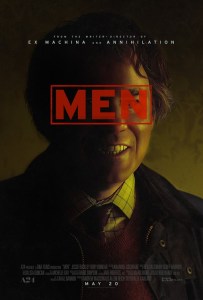 Longtime Hollywood go-to genre screenwriter Alex Garland has only directed two other movies, 2015’s Ex Machina and 2018’s Annihilation, both using the realm of science fiction to explore feminine trauma and the sea change of societies on a precipice. I loved Ex Machina and admired but didn’t fully enjoy Annihilation. His newest movie, a small-scale indie horror titled Men, lands somewhere in the middle. It’s in keeping with his other movies, following a woman named Harper (Jessie Buckley) dealing with trauma, and it’s atmospheric while still maintaining a clear point of view that could likely rub people the wrong way. It’s an uncomfortable nightmare of a horror movie and one that isn’t as deep as it appears to be.
Men accomplishes what I had been hoping with 2021’s Chaos Walking, namely portraying everyday life as a woman as a living horror movie. It’s a highly metaphorical and atmospheric movie but, at its core, it’s all about the danger, discomfort, and indignities that women endure on a near daily basis dealing with men. I don’t think the movie has as much to say on the topic or is as ambiguous as others are presenting (more on this later), but its central theme is so bracingly direct and deeply unsubtle but sometimes a sledgehammer is better than a scalpel. This is an intense movie from the start and a frequent reminder of the hazards of being female in a patriarchy. Each of the men that Harper encounters represents a different facet of toxic masculinity. The seemingly kindly priest, who places his hand on Harper’s thigh to “calm her,” is projecting guilt and blame onto her for the actions of men and views her femininity as a corrupting and tempting influence, very akin to Eve. The little boy, who likes wearing creepy masks, is a brat who refuses to accept no for an answer and turns on a dime into verbal attacks, much like the men of the Internet ready to flip at a moment’s notice. The police officer is dismissive of Harper’s account of being harassed and threatened, representing a legal arm that often downplays and diminishes women as victims. There’s even Geoffrey, who seems almost like the best man in town by default, is aloof, doesn’t understand boundaries, and is trying to present himself as a “nice guy” looking for his delayed dues. The only person in town that seems sympathetic to Harper is the one female police officer who takes her statement. Each man is played by Rory Kinnear (Our Flag Means Death) for thematic reasons. I’ve read people complain, “Why wouldn’t Harper realize this obvious similarity in the town’s men?” The answer is simple: it’s because the men do not literally all look the same. It’s meant to reflect Harper’s perspective, much like 2015’s Anomalisa where the protagonist viewed every person as looking and sounding like Tom Noonan until one unique voice cuts through the malaise and monotony. This movie is wall-to-wall with uncomfortable, seething misogyny in many forms, and given the times we live in, I wouldn’t blame any woman saying, “No thanks.” I’m glad I watched this one alone and without my now-fiance, as she would have brought this up forever as a “You made me watch…” tease.
 The flashbacks with Harper’s unstable ex-husband James (Paapa Essiedu) are the most personally illuminating and make up a significant portion of the narrative, as Harper is forced into her painful memories from her present encounters. Her husband showcases clear signs of being mentally ill and is also verbally and physically abusive to her. He greets her news about seeking a divorce by declaring that if she doesn’t take him back, he will kill himself. This emotional blackmail feels par for the course in this relationship and another sign why Harper would want out for her own well-being. The movie opens with Harper watching James fall to his death, and this trauma is what she’s processing through every male interaction. James is indicative of a kind of man that imposes demands on their partner without holding themselves to the same standards, but it goes beyond hypocrisy; it’s about a damaged person who holds another hostage with further threats of their damage. It’s a person who puts the entire onus of their existence onto another, removing their own personal responsibility, and thus blaming the convenient external party when something inevitably goes wrong. This central relationship is revisited in different ways throughout the movie, and you could even argue that Men is a metaphorical journey of Harper trying to shed herself from the weight of this disturbed dead man.
However, the real draw of Men is its allegorical nature and that is bound to rub plenty of viewers differently. The best comparison I can make is 2017’s mother!, a deeply polarizing movie from Darren Aronofsky (Black Swan, Requiem for a Dream) that completely existed as a none-too-subtle Biblical allegory as the primary plot. Usually, screenwriters will work with metaphor and allegory as subtext, adding extra depth and meaning to their storytelling. We don’t expect it to serve as the primary narrative. With Men, like mother!, it is indeed the primary narrative. I can reduce the plot down to this description: woman explores English countryside and is harassed by men of various forms. To be fair, Jaws could be reduced to “guys try to kill big shark,” so this is a little reductive. The emphasis is on exploring the experiences that Harper is enduring, her exploration of nature and seclusion that, at each turn, gets sabotaged by a man. If you’re not open to a narrative that is a little looser and more atmospheric, you’ll find the movie to be plodding and overwrought. When Act Three kicks in, the movie goes full-on into bonkers horror and isn’t even flirting with a direct correlation with reality any longer. I can safely say that some of the bizarre imagery is truly some of the strangest and grossest things I’ve ever seen in any movie. The chief symbol (toxic men begetting toxic men) is central to the icky body horror cavalcade.
 However, the movie’s allegory doesn’t lend itself to much in the way of interpretation. That’s not exactly a creative hindrance; stories can simply be what they are intended to be. Men is fairly obvious what it’s about even from the starting point of its one-word title. It’s a movie heavy in allegory but the allegory itself is also pretty unambiguous and straightforward. There may be interpretation for this symbol or that but Garland’s horror movie is pretty much thematically obvious. It all supports his theme about the horror of being a woman in modern society, magnified across a metaphorical horror movie canvas. I’m sure there will be others who go into great detail to dissect this movie but all of it seems to come to the same basic conclusion, and that’s fine.
Men is the kind of movie that almost wears out its welcome at 100 minutes. The technical merits are strong, the photography and imagery are lush and transporting, and Buckley (The Lost Daughter) is a great actress to hinge a story of mounting distress and terror. If you’re the kind of person that seeks out new cinematic avenues of nightmare fuel, then the final act and its chief monster with its distinct disfigurement will sate your morbid appetite. It’s an effective and evocative movie but it’s also the same thesis statement hammered again and again. While the movie has some perplexing moments, there isn’t much to unpack as far as meaning, and ultimately that can limit some of the play of a movie built on the engine of metaphor. It feels like a scream against the overwhelming and entrenched social forces of misogyny, and I cannot say whether it’s worth 100 minutes of squirm-inducing discomfort of art imitating all-too-real life.
Nate’s Grade: B-
Share this:

Annihilation (2018)
 Alex Garland has been one of Hollywood’s most stable sci-fi screenwriters for some time. In 2015, Garland made his directorial debut with Ex Machina, a sly and invigorating potboiler that made you think. It helped make Alicia Vikander a star and Garland himself was nominated for an Academy Award for his original screenplay. The movie even won an Oscar for best visual effects, beating out some pretty pricey competition. With one movie, Garland displayed a natural knack for directing. His follow-up, Annihilation, is based on a book by Jeff VanderMeer and has already run into some trouble. After poor test screenings, the producer tried to force changes but these were refused. In a face-saving outreach, Annihilation will only be playing theatrically in North America and will debut on Netlfix weeks later for the rest of the world. The suits are not confidant in the larger public clicking with Annihilation, and they might be right. This isn’t going to be one of those films that people leave declaring their love over in effusive terms, despite what the critical praise may lead you to believe. This is a movie that you leave saying, “Huh.” It’s so powerfully inscrutable to the point that most other conventional forms of cinematic entertainment and narrative are smothered. And yet, it’s that inscrutability that might be the movie’s biggest point and might be its biggest asset.
Lena (Natalie Portman) is a biologist whose husband (Oscar Isaac) has been missing for a year ever since he ventured into a strange environmental disaster zone. Then he reappears with a mysterious illness and little memory of the events. Lena joins an all-female crew of scientists (Jennifer Jason Leigh, Tessa Thompson, Gina Rodriguez, Tuva Novotny) to find out some answers by exploring The Shimmer, the site where an alien meteorite collided with coastal land and has been changing local life forms at an alarming pace.
 Like I said, this movie is a conundrum, not just in a “What did I just watch?” sort of analysis but also in a, “Did I actually like that movie?” personal introspection. There isn’t really a mystery here to unpack as there is an enigmatic experience to explain. I’m doing something I don’t normally like to do, which is immediately type my review shortly after seeing a movie. I generally like to marinate on my feelings after experiencing a movie; however, with this one I felt compelled to put furious fingers to the keyboard, trying to explore my myriad conflicted feelings and find my way out the other side, or at least articulate that journey. I’ll try and steer away from any major spoilers though I worry that even discussing some of my confounding responses will require some thematic and plot context, so beware readers who wish to go into this experience completely pure.
Annihilation is an existential horror movie about biology’s indifference to mankind; at least that’s my best thematic interpretation. In the beginning, Lena is explaining the history of cellular life, the simple splitting of cells that begat all life on the planet. There was no larger forethought, no agenda, and no malice, only the enacting of DNA programming. Ultimately, I think the alien mutations are running on a similar principle. This isn’t an invasion by any traditional definition. This isn’t anything nefarious. This isn’t even anything as clearly identifiable as a virus spreading its illness. This is simply life stirring in a few new recipes. There’s a general level of indifference to the overall setting, which makes the environmental wonders and horrors more dispiriting. For those who demand clear answers from their storytelling, they will be left sorely disappointed. Annihilation doesn’t have any real answers for why these things are happening. They just are occurring, much like the beginning steps of cellular life that found new modes of survival on Earth billions of years prior. It’s just another stage in the development of life. The fact that humanity can be so easily cast aside, it’s hard not to feel insignificant. There’s a mounting sense of existential dread about man’s inevitable demise. One character dubs their mission suicidal and is corrected by another. “People confuse suicide with self-destruction,” she says. “Very few people are suicidal, but all of us are self-destructive.” The plotline confirms this as characters fall victim to hubris and curiosity. However, one may argue there is biological in destruction and reconstitution.
 Be warned, dear reader, this is a rather slow movie with a lot of space for breathing, the kind of thing meant to establish a particular atmospheric mood. If you connect with the material, it works, obviously. The problem with Annihilation is that because it’s so inscrutable, because it keeps you at a distance on purpose, that it allows more opportunities to check out. We’re anticipating weirdness and a general breakdown in the group of scientists, and Garland seems to understand this, which may be why he gradually delivers his genre scares. There is an amazing sequence in the middle that is the fuel of nightmares, made all the more searing and scaring by a horrifying sound design that’s even worse when you connect it with the visual source. I was almost compelled to look away and spare my memory this ghastly sight. There are other unsettling moments and the overall feel of the film is definitely one of discomfort and dread, but it’s this scene I’ll always remember and that also solidified the nasty surprises from Mother Nature. Unfortunately, these moments are few and far between. The eventual ending should be easy enough to predict thanks to Garland’s flash-forwards tipping your expectations, that is, if you can actually understand the ending. I still cannot say for certain what happened and why or whether I cared about a why. If, as stated above, the point of the movie is man’s inability to find a recognizable motive in the replication of life by biological factors, then that lends itself to a generally unsatisfying end.
One interesting idea that I regret gets short shrift is just the fact that this is an all-female group of scientists venturing where literally only men have gone before. I’m not celebrating this as some sort of nod at feminism but because it offered an interesting storytelling avenue. All the previous groups were all men and they either were killed by the new environmental dangers or went crazy and killed each other. Minor spoilers, but the women fall under the same sway, destined to the same fate, and it feels like a shame. If you’re going to make a point of questioning whether the deterioration of order and sanity is related to an all-masculine entanglement of thinkers, then don’t just have the women repeat the same decline. Or maybe that’s the point? I don’t know.
 Portman (Jackie) does an convincing job of alternating looking confused and spooked, mimicking most of the audience reaction. Her character isn’t asking to be found likeable, only capable, though the first time we get a little taste of her as a person is far too late into the movie. Her marriage might not have been built on the strongest foundation, which again leads to the potential thematic deliberation over self-destruction and rebirth. Leigh (The Hateful Eight) is a bit too flatly monotone for my liking. It feels like she’s sleepwalking through the film, like maybe she was on Ambien and can’t remember even performing in this movie. Tessa Thompson is underwhelming especially with knowing how fully captivating she can be onscreen (see: Thor: Ragnarok). The other notable actress is Rodriguez (TV’s Jane the Virgin) who put on some muscle and swagger and has a terrific breakdown sequence that showcases some unnerving desperation.
I still cannot even say if I liked Annihilation. There are aspects I can definitely admire, like the commitment of its actors, the emphasis on a more scientific approach to an outbreak/invasion thriller, and Garland’s general sense of place. I still think the majority of audiences are going to leave shrugging. Annihilation is more akin to an Under the Skin or Solaris than a monster hunt. It’s quiet, philosophical, and also often boring. It has its thrilling points, its moments of mystery and intrigue, but it also feels like a slow windup to the eventually disappointing reveal that won’t be enough to justify the lethargic pacing. In the end, this is a difficult movie, but not in a way that requires a thorough decoding like mother! or even in a way that requires repeat viewings to play out the twists. Annihilation is difficult by design, keeping its audience from fully engaging, and then offering little in the way of answers or resolution. And I still don’t know if I like that. Dear reader, this is a confounding movie but it might not be the good kind of confounding.
Nate’s Grade: C+
Share this:

Ex Machina (2015)
 Alex Garland is a screenwriting staple in Hollywood. He’s a science fiction specialist, adapting everything from Kazuo Ishiguro’s wrenching Never Let Me Go to the Halo movie. He’s worked with Danny Boyle, adapting his novel The Beach, and then on 28 Days Later and Sunshine. If you’ve noticed a theme with the titles, Garland tends to subscribe to a pessimistic view of human nature. And yet each film is grounded by the humanity of its characters no matter the extreme circumstances. Garland’s gift is making the fantastic grounded on a recognizable human level. Ex Machina is his latest and his directorial debut but you’d never have guessed it with how controlled and polished the film comes across. It’s a cerebral sci-fi film that haunts, enchants, and consistently engaged the imagination.
Caleb (Domhnall Gleeson) wins a corporate contest to spend a week’s vacation in the home of a reclusive Google-esque tech billionaire, Nathan (Oscar Isaac). Caleb is here to test out Nathan’s newest invention – artificial intelligence. He’s built an android woman named Ava (Alicia Vikander) and he wants Caleb to interview her.
Ex Machina throws you right into the hook within minutes, and it was mere minutes for me to get hooked. Garland does a glorious job of teasing an audience with his story and unlocking further mysteries that develop intrigue. At the start, knowing the Turing test, we’re just as interested in Ava as Caleb is, trying to figure her out and how lifelike she may be. But then the conversations start to linger and, during a brief power outage that cuts the feed to the omnipresent cameras, Ava warns Caleb that his host is not whom he thinks. As soon as the power is back and running, it’s as if the comment never happened. The pristine underground quarters have an eerie tranquility to them, almost as if Apple is designing high-end prisons. Garland’s movie becomes consumed in paranoia. Is Ava being honest? Is Nathan being honest or underhanded? What’s in some of those “off limits” rooms? What is the true test at hand? Who is the silent Asian assistant? At one point, Caleb slices open his own arm to search for circuitry, and you completely understand his reasoning. This mounting sense of paranoia and dread, tagged with Garland’s mysterious and well-developed storyline, are enough to keep your eyes glued to the screen and rapidly second-guessing and triple-guessing your shifting loyalties.
 Garland also smartly doesn’t dance around the obvious plot device of having a beautiful robotic woman, namely the inevitability of romance to bloom. What is it about android women that science fiction seems to love so much? From Blade Runner to Fritz Lang’s Metropolis, the genre loves the concept of robotic women. Perhaps this is merely a byproduct of a genre written by a majority of men, or perhaps it taps into something more unconscious about the desire to control women, or a fear of women, but that’s a conversation for another day. Ava is certainly a stunning creature, thanks to Vikander, but also from the sleek production design that makes her feel like the world’s most gorgeous Mr. Potato Head with her lycra-like skin for easy detachment. Her exposed stomach of bolts and bulbs is also a constant reminder of her “other-ness.” There’s an obviously sexual dynamic to the character, and while she’s technically nude for most of the film, watching her slip out of stockings and a dress has a strange erotic quality. Thankfully, the percolating would-be romance between man and machine actually plays a vital part throughout the script and especially with the end. There’s even a darkly comic yet disconcerting reveal about why Ava looks as she does. Is Ava capable of feelings? Is she falling for Caleb, or does she merely view him as a means to an end?
It’s essentially a sci-fi play with limited locations and three primary actors. The power is on Garland’s effortlessly engaging script, which is far more cerebral and philosophical and nuanced than you might expect from its premise. This is a film that allows its characters to breathe, to organically develop relationships and doubts. The concept of A.I. has been explored in many sci-fi stories before but Garland finds fresh resonance by paring down his story to a manageable trio. Nathan’s reclusive home is like a twenty-first century version of the haunted house and full of fun detours begging to be explored. Garland’s cinematography and production design are reminiscent of the cool artifice of David Fincher’s films. The world feels like a small step into the future but constantly unsettling. Garland’s story always has another mystery to unlock, always driving the story further as Caleb’s weeklong stay is coming to a close. Garland has a natural eye for images and composes several startling sequences that can equally evoke beauty as well as disquiet. There’s a moment where Ava passes a wall of faces as if they were simply a row of hats. Simple moments like Ava “dressing up” are given a gentle poignancy that isn’t overplayed for effect. Garland’s film is what I wanted 2014’s Under the Skin to be. Both of them are unsettling, moody, and atmospheric with striking Kubrickian imagery, but Garland’s film is less purposely oblique.
The trio of actors provides strong work, especially Swedish actress Vikander (Seventh Son, A Royal Affair). As the film is told from Caleb’s perspective, she has to find a very exact balance with her performance with elements of innocence, uncertainty, and ethereal curiosity. She’s rather placid but you always feel like there’s more just under the surface, whether it’s the ache of sentient realization or something more sinister. She’s a test subject, a captive, and a possible romantic interest. Vikander hits every right note to remain mystifying and beguiling. Gleeson (Unbroken) is becoming a go-to young actor for Hollywood. His awkwardness and enthusiasm to be part of history is an easy channel for the audience, but as Garland’s script spins along, Gleeson’s enthusiasm ebbs to concern, for Ava and then himself. The source of Ex Machina’s surprising font of humor is Isaac (A Most Violent Year) as a too cavalier tech genius. He’s so nonchalant and chummy, usually soused, that you start distrusting his amiable nature.
 It’s a shame then that the film couldn’t quite hold onto these ambiguities to the end. Garland has had third act missteps in many of his films, some tone-altering and simply losing momentum like 28 Days Later, and some as disastrous as Sunshine’s blurry slasher killer, which ruins a perfectly good-to-great sci-fi thriller. Ex Machina too exhibits its own share of third act issues, namely a confluence of contrivances with the characters. There are certain revelations you should already be suspecting giving the nature of the film, and if you’ve watched other movies before. Those reveals work in relation to Garland’s plot; however, the climax feels a bit too forced and obvious for a movie that has been, up to that point, expertly keeping the audience on its toes. Nathan spilling the beans on all the different levels of the experiment comes across not as an outlet of his character’s blasé narcissism and more a need for the script to force a confrontation. The different levels of intrigue fade away to what is a rather conventional climax that feels poorly developed and woefully inadequate for the story being told. I will credit Garland with the courage of his resolution, though, which provides deliberate decisions that cast the rest of the film in another dimension. It also feels completely right, while still allowing for Garland to work his Kubrick fetish fully to its eerie erotic ends.
Ex Machina is a hard movie to pin down because it balances various genres with delicacy, providing a little something for every sci-fi fan. It’s a well-developed mystery that constantly unravels new layers that only hooked me further, but then I was hooked from the immediacy. The relationship between the main three characters is enough to hold an entire film thanks to Garland’s scripting. I started doubting my own senses and that is a testament to Garland’s artistic vision. It’s a nice antidote to the louder bombast of Hollywood, especially with science fiction films that confuse shrill and busy with appealing and satisfying. Here is a film that doesn’t forget to entertain but respects an audience enough to take its time to properly develop its mysteries, tension, and characters. Ex Machina is a stellar debut for Garland as a director and I wouldn’t be surprised if he starts shifting more of his attention to getting back into the director’s chair. It’s not a perfect film, as it too suffers from Garland’s streak of third act troubles, but it’s a remarkably assured, sleek, and absorbing movie that gets under your skin.
Nate’s Grade: B+
Share this:

Dredd (2012)
 In 1995, Sylvester Stallone starred in Judge Dredd as the titular law enforcer. This big budget sci-fi action flick was goofy and violent and had the added punishment of Rob Schneider as pained comic relief. No wonder it failed at the box-office. I was never a fan of the comics so I can’t say how close the movie was to the source material, but given the presence of Rob Schneider, I’d say it’s doubtful. Because the 1995 film was such a flop, nobody wanted the rights to the character when they went back up for sale. That’s what allowed screenwriter Alex Garland (28 Days Later) to swoop in and write a new version. Dredd is an attempt to resuscitate a franchise that never got started. I don’t know if it’s particularly a good Judge Dredd movie, but as an action film it’s viciously entertaining and it has 100 percent less Rob Schneider.
Dredd (Karl Urban) works for the police of Mega City 1, one of the last metropolises of the irradiated waste land that is the United States. Crime has taken over and crime lords rule neighborhoods. Ma-Ma (Lena Headey) is the leader of a gang pushing Slo-Mo, wa drug that alters people’s perception of time. She controls the 20-story high rise that serves as her base of operations. Dredd is partnered with a young cadet, Anderson (Olivia Thirlby), who also has psychic abilities. She could be an asset to the force, but first she needs to be field tested. They get called to arrest Ma-Ma, but this prostitute-turned-ruthless drug kingpin isn’t going quietly. She locks Dredd and Anderson inside her high rise and orders her inhabitants to take care of the pesky officers.
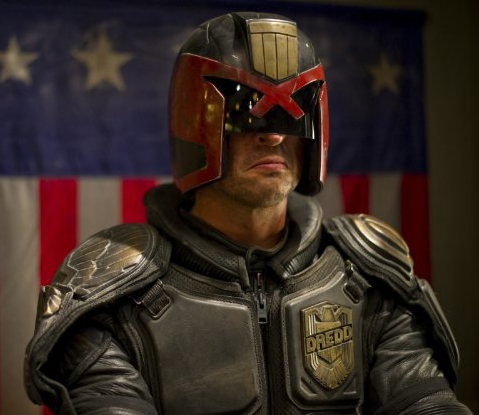 I had my doubts, but when it comes to action Dredd delivers. As soon as I saw the trailer, I screamed that this film was little more than a Hollywood remake of the awesome action film from Indonesia, The Raid: Redemption. The plots are identical but I’ll give Garland the benefit of the doubt that he came to his story independently. Whereas The Raid was heavy on martial arts and different fighting styles, and creative weapons, Dredd is really all about the firepower, the gunplay, the blowing up of material, the riddling of bodies with bullets. Each floor presents a new challenge and gives another opportunity for Dredd to outgun or outsmart the competition. This plot model feels like a video game come to life, clearing stage after stage, awaiting boss battles, collecting power ups. Readers will know I am not a strong believer that video games will ever give birth to a solid movie, but I’m ready to concede that this specific plot structure can allow for kickass action. The plot is simple but when given enough attention to geography and organic consequences, then great action can be unleashed, and Dredd is great action unleashed. It looks great, it’s constantly offering something new, raising the stakes, bringing in new elements to contend with, and it’s more than just things going boom. There are some genuinely suspenseful sequences to go along with all the stylish shoot-em-ups.
And the gunplay is vicious and bloody, reveling in the gory display of bodies being blown apart. There are slow-mo bullets traveling through people’s faces, all the better to see the care CGI artists put in to the gore. The ruthless violence is practically casual, and we’ll just see character walk by and fire into the backs of downed characters, giving us another explosion of blood to marvel upon. It would be really easy to call this movie sick, except it works so effectively as an action thriller that the bloody violence feels like a constant jolt. Our introduction to Ma-Ma is her hurling three men off the roof of her 2000-foot high penthouse, watching them splatter below. These are some nasty people and Dredd is dispelling some nasty justice, but because we recognize the antagonists are ruthless, and a real threat, then the violent dispatching of them doesn’t feel exploitative. It feels like keeping pace with some bad folk. Maybe that’s just a contrived way for me to justify that I found the brutish violence entertaining. Simple pleasures.
As far as a Judge Dredd adaptation, the Dredd elements almost feel grafted on, inconsequential. The screenplay could have been completely wiped of the Dredd elements and the plot would essentially be the same. It’s a dystopian world where crime has run amok and the police have resorted to become ruthless enforcers of justice. Dredd as a character, his worldview, his rookie partner who needs to prove herself on the mean streets, all of this is boilerplate cop movie stuff. It has some sci-fi stylizing but the content is still the same. I enjoyed the advanced gun that follows voice commands but nothing in the plot hinged on this element. Dredd just as easily could have been Cop #1 running from room to room, floor to floor, taking out the bad guys. So in this regard, Dredd works really well as a confined action movie but it’s questionable whether this is an effective adaptation of the comics.
 I’m surprised that with a drug called Slo-Mo that the movie didn’t make more use of this plot device. We get sequences of people blissfully on the Slo-Mo; the world looking like it was filmed through a glistening soap bubble. It’s neat but it can really become something cool for the sake of cool, ultimately superfluous except for a snazzy visual that plays into the 3D. It doesn’t appear like the drug lasts long either. But if time slows down for the people on this drug then wouldn’t you think somebody would want to make use of this when fighting Dredd? Perhaps it would sharpen their reaction time by making the world seem to slow to a crawl. However, if this is just an altered state of the drug, I think there could have been a fun moment where a Slo-Mo user tried to take on Dredd and we get differing points of view. For the user, time seems slow and they seem at an advantage. For Dredd, the user would just be acting slow and stupid. It’d punctuate the illusion of the reality-altering drug and explain why none of these gang members spark up before battle.
The acting in Dredd is competent and hardly dreadful (forgive me, it had to be done). Urban (Star Trek) goes the entire movie with his helmet screwed on. You never see the top half of the man’s face, presenting an interesting acting challenge (just ask Tom Hardy how tricky it is to act with your face obscured). The man has a permanent grimace carved into his face, grumbling his line throughout. Dredd is supposed to be a grim, no-nonsense enforcer. He’s not exactly got a lot of dimension to him. Urban inhabits the role well but you get the impression anybody could have been in that suit and the film would roughly be the same. Dredd also answers the question of what Olivia Thirlby (Juno) has been up to since 2008. She acquits herself well in all the bloody business and she’s not a bad blonde either. Headey has got the sneering villain act down cold thanks to TV’s Game of Thrones.
Dredd is your best bet when it comes to action movies right now. You’ll get the biggest bang for your buck. The action is brutish and routinely entertaining. It pulls no punches and the bloody melee is full of beautiful carnage. It’s a simple story with pretty simple characters and relatively shallow depth, but where Dredd succeeds is in execution. The emphasis is spent on constructing thrilling actions sequences that build, that change, that impress. It’s not for the faint of heart but for those hungry for a hard-R, bloody, sci-fi thriller, the likes of Paul Verhouven, then I suggest checking out Dredd. And you better hurry, because this version of Judge Dredd is also failing at the box office. Maybe Rob Schneider has been vindicated after all.
Nate’s Grade: B
Share this:

Never Let Me Go (2010)
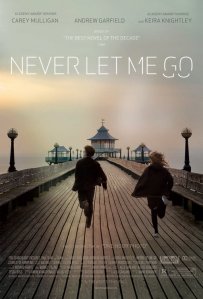 You’ll be excused for mistaking Never Let Me Go as one of those austere boardinghouse dramas the English are fond of cranking out. I mean it even has Keira Knightley in the thing for goodness sakes. Pretty lily-white British actors trying to find their place in a reserved society spanning the 1970s to the mid 1990s. You’d be forgiven for stifling a yawn. But then Never Let Me Go takes a sudden left turn into a realm of science fiction morality play. It becomes something much deeper and menacing. I am about to go into some major spoilers concerning the sinister premise of the movie, so if you’d prefer to stay pure then politely excuse yourself from the remainder of this review and come back at a later time. I won’t think less of you but only if you promise to come back.
Kathy (Carey Mulligan) and her pals Tommy (Andrew Garfield) and Ruth (Knightley) all grew up in the remote countryside school of Hailsham. It’s like any other school in most regards, except at Hailsham the children all wear monitoring bracelets, are afraid to leave the boundaries of school for fear of being murdered by outside forces, and are told that her physical fitness and internal health are of “paramount importance.” Figured it out yet? My then-partner leaned over and whispered, “Are these kids organ slaves?” Kathy and her friends find out their true identity when an outside third-grade teacher (Sally Hawkins) takes pity on them. She reveals that the students of Hailsham are clones whose sole purpose is to be raised into healthy adults who will then give “donations” to the ailing public at large. Most clones will go through one to four “donations” before “completing,” unless they so desire. You see Never Let Me Go exists in a realm where medical science has made momentous breakthroughs and now people can live to 100 years of age on average. Kathy and her friends are the dirty details.
 The rest of the movie flashes through our trio’s teen years. Kathy has always been kind and affectionate to Tommy, but before she could seal the deal Ruth swooped in and took Tommy for her own. Kathy has waited in vain for the two to break up, but that day just never comes. The trio ventures out to a small farmhouse in their teens to do some work and see the outside world. They’re living with a few other Hailsham alums that show them the knack for social interaction with outsiders. There are two rumors at play. One is that the Hailsham alums think they’ve found Ruth’s “original,” the person she’s been cloned from. The second rumor has greater significance: if two Hailsham students can prove that they’re in love, deep, honest love, then they can defer their donations for a few years. This idea takes hold of Tommy and consumes him. Except, we don’t really know whether Ruth or Kathy will be his partner in love.
So why don’t these people run away, or fight back, or do anything of defiance once they discover the horrible truth that will befall them? I have read several critics taking the film to task for being so painfully prosaic and passive, and Never Let Me Go can admittedly fall prey to those detractions at times. However, this is not the Hollywood version where the abused (clones) fight back for their survival and regain independence in a hostile world. That movie was called The Island, plus the several other films that Michael Bay sort of ripped off and then added extra loud explosions. Never Let Me Go has nary an explosion or moment of triumphant revolution. There is no revolt coming because the film doesn’t want to let anyone off the hook; these people are society’s collective collateral damage. They have been bred to be walking, talking, mostly demure, fleshy warehouses for spare parts. It’s only a matter of time before they leave everything on the operating room table, and these people benignly accept their doomed fate (“We all complete”). They march forward, trying to find some level of dignity and beauty before they get the call for “donations.” These people don’t know what it means to rebel; they have no real concept of liberty. They’ve been conditioned since childhood to obey, and that’s the whole point of the film. They have no self-preservation instincts. Likely any cloned child that was expressing strong feelings of boldness was removed, and destroyed, so as not to taint the rest of group. These people are like gown-up versions of veal. They’ve been cultivated since birth for the purpose of destruction, and their knowledge of the world is limited and cruelly self-serving. Watching innocent characters march off to a merciless fate can be very emotionally draining. It should also make you angry.
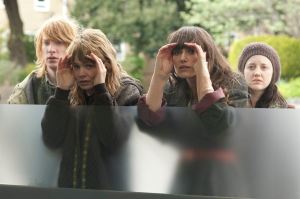 These people are hopeless so that the movie’s full impact is absorbed. This isn’t some far off nightmarish scenario, because we as a society are already reaping the rewards of a lifestyle, a lifestyle that we’re loath to think about the mechanics of how we got so fat and happy. I can go to a Walmart and buy a T-shirt for a dollar. I am a happy consumer, but what did it take for me to get that product at such a discounted rate? Sure there are variables up the wazoo, but there are many negative factors that go into why that price stays low, invisible hand of the market be damned. Workers clock long hours in unsafe conditions in order to meet supply, earning a penance just enough to keep them alive and moving product. Environmental concerns are overlooked because that would mess with production. Long-term generational poverty can develop. The worker has ceased to be a person and is merely a dispenser of product, much like our clones in the film. This is not a definitive example of what goes on in the world, mind you. Never Let Me Go isn’t some far off scenario; we’re already there, albeit less explicitly. If the price of gas rose a dollar a gallon but it meant that people in other countries could have safe, uncontaminated water and enough food to stay healthy, what do you think would happen?
With all of that said, Never Let Me Go can’t fully fight the trappings of inert drama. For two hours we are watching somewhat nice, somewhat bland British kids gawk and smile their way toward the inevitable. The conceit calls for the breeding of rather milquetoast personalities. It simultaneously makes the characters more innocent and less emotionally involving. The screenplay relies on our sense of outrage and injustice to fill in the gaps of emotional connection. There are little molehills of characterization at best. You’re supposed to be choked up on indignation and sadness so as to not notice that the threesome of character are all rather good-natured but boring. That even may be an aim of the screenplay to accentuate the terrible fate that awaits, or maybe I’m just being overly analytical. Never Let Me Go reveals its awful truth fairly early at about the 40-minute mark, making sure that the audience is fully aware that we are definitely not headed for a happy ending. As it is, the actors are all lovely and talented but there’s only so much silent emoting and teary eyes can conjure.
 It’s credit to the talents of the actors that you do feel a storm of emotions from such otherwise frail characters. Mulligan (An Education) showcases her great gifts for communicating sadness. Her face just crinkles up, her eyes get glassy, and you want to hug her. She’s our dramatic linchpin. Her looks of conflict and yearning do well to communicate the inner struggle of her character’s abbreviated life. There’s a lot left to the imagination and Mulligan once again crushes it. Garfield (The Social Network) is stuck playing a wishy-washy character, which makes him seem a bit thick at times. He’s the most naïve and hopeful of the three, so when those hopes get crushed again and again his breakdowns have the most emotional heft. Knightley (Pride and Prejudice) has been in six period films since 2005, so she’s got this thing down pat. Ruth is a bit more assertive and angry than her friends, and it’s a pleasure seeing a more calculating side from the actress. It seems like the filmmakers had a troublesome time trying to downplay the attractive features of their cast. So it seems that they relied on the actors eating less. Knightley, and particularly Garfield, look rather gaunt and puckish, even before they begin “donations.”
I’ve gone this far without even mentioning director Mark Romanek’s (One Hour Photo) contributions, or the fact that the film is based off the 2005 novel by author Kazuo Ishiguru (Remains of the Day) and is adapted by Alex Garland (28 Days Later). Great artists that shaped the vision of this film. It’s a shame then that the impact of Never Let Me Go is blunted. It’s an intelligent, poetic, haunting, and emotionally wrenching film experience, and yet it could have been far more penetrating and devastating. The passive nature of the characters accentuates their doom and our sense of outrage. But that same passive nature makes them less than engaging characters. It’s been days since I saw the film and it still lingers in my memory, a testament to the moral quandaries and acting prowess. The existential drama of the film is better suited for the page where the questions of identity and morality can be given more careful and rewarding examination. The movie has an oddly detached feel to so much suffering. Never Let Me Go is a hard film to let go but also a hard film to truly embrace.
Nate’s Grade: B
Share this:

Sunshine (2007)
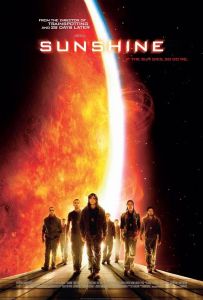 Danny Boyle is one of the more interesting film directors out there today. He seems to dabble in every genre. He’s done paranoid thriller (Shallow Grave), substance abuse drama (Trainspotting), zombies (28 Days Later), and a genuine family film (Millions). Boyle has a bountiful imagination. Now he and his 28 Days Later partner, writer Alex Garland, are going where many have gone before in the film world – outer space. Just don’t confuse the film with the 1999’s Sunshine where Ralph Fiennes plays three generations of a Jewish family with rotten luck. Come to think of it, both Sunshine movies fall apart in the final act. Note to filmmakers: just stay away from this title. It will doom your ending.
Fifty years into the future, the sun is dying. Earth is under a solar winter as it undergoes less and less light. The crew of the Icarus II has a very important mission: restart the sun. Attached to their spacecraft is a giant bomb intended to create a new star inside an old one. They have a giant reflective shield to protect them from the direct heat of the sun. The ship has eight crew members, including the physicist responsible for the bomb (Cillian Murphy), a botanist (Michelle Yeoh) with a garden to provide recyclable oxygen reserves, and a hotheaded handyman (Chris Evans) that believes nothing could be more important than their mission. As they drift closer to the sun they pick up a distress call that belongs to the previous Icarus I spacecraft which vanished under mysterious circumstances seven years ago. The crew decides that two bombs are better than one and changes course to intercept the Icarus I. anyone who has ever seen a horror movie knows you don’t go poking into the spooky place when you don’t have to.
 Boyle sure knows how to make things look pretty, or interesting, or pretty interesting, and this helps because Sunshine is rather shopworn with familiar sci-fi staples. The premise itself almost seems identical to a 1990 film called Solar Crisis, a movie I only remember marginally because of the female nudity my young eyes caught glimpse of (in those days we didn’t have any of yer fancy Internets). Besides this, the film borrows liberally from 2001, Solaris, Star Trek, Alien, Event Horizon, The Core, and the super crappy Supernova. Most every aspect of Sunshine can be traced back to a different science fiction film, but sci-fi is one of the few genres that don’t necessarily suffer from being derivative. A cookie-cutter sci-fi movie is forgivable as long as the filmmakers treat the audience with respect and attempt to be smart with their story. I don’t care that Sunshine reworks plot elements that have been worked since giant alien carrot people frightened necking teenagers in the 1950s, and that’s because the genre is built for being borrowed.
Sunshine is often beautiful to watch with awe-inspiring images of that great ball of fire, our sun, but even better is the fact that the film is pretty much the opposite of Armageddon – it’s smart. The movie discusses the realities of space travel, communication, oxygen levels, trajectories, sub-zero temperatures, sacrifice, and how to live so close to the sun where the human eye can only safely look at 3.1 percent of its light emissions for 10 seconds. It’s a bit slow but rather fascinating just to witness how day-to-day life functions for the crew and how the time, or lack of discernible time, plays with their psychology. This respectful intelligence helps when the crew debates altering their mission to inspect the mysterious space vessel. The audience knows that only bad things will happen but the crew argues with reasonably sound logic about the potential benefits.
Sunshine is a thinking man’s sci-fi treat for its first two acts and then it completely devolves with a disappointing turn of events; it becomes a slasher film in space. There’s genuine awe and intrigue, along with some brainy scientific discussions and some considerable religious/philosophical pondering… and it all just stops dead for a madman chasing people with pointy things. Sigh. It’s an artistic free-fall that Sunshine never quite fully recovers from. Boyle makes the strange decision to keep his space slasher out of focus so the audience never gets a clear look; even stranger are camera shots where the killer will walk into frame and then transform his area to an unfocused blur like a blurry infection. It’s an artistic choice that doesn’t quite work (“The blurry man’s coming to get you, Barbara!”). The film then morphs into your standard race-against-time and then balloons with trippy computer effects and snazzy light filters. Sunshine was exceedingly more entertaining prior to picking up the unwanted visitor.
 The cast does a fine job mulling their life-or-death options, but the two standouts are Murphy and Evans. Murphy and his piercing baby blues make for a strong lead. He provides soulful glimpses into his stock scientist role. Evans is the surprise of the film. Best known as the Human Torch in the dreadful Fantastic Four films, he exhibits a wider range of emotions from macho hardass to duty-bound soldier. This is a film heavy with noble sacrifices, and Evans is the reminder of all that is at stake.
Sunshine is visually pleasing and intellectually stimulating, especially for a sci-fi film built from the discarded pieces of other films. It’s a tense and exciting time, that is, until the movie just throws up its hands and transforms into a laughable slasher film. This movie did not have to go this tiresome route; there could have been an on-board mutiny when they discussed the idea of killing one of their own so they had enough oxygen to complete their mission, there could have been further psychological torments from within the crew, or even easier, the spaceship could just have undergone more malfunctions. Sunshine is a thoughtful, slightly meditative sci-fi thriller, but then it loses all of its better senses.
Nate’s Grade: B-
Share this:

28 Days Later (2003)
 Zombies have generally seemed one of the little brothers of the horror genre. Certainly not as complicated or Freudian as Frankenstein or Jekyll and Hyde, and no where near as seductive as vampires and werewolves. Zombies are stumbling, bumbling cement-shoe wearing monsters. Theyre usually conduits for some kind of social message, like George Romeros classic Night of the Living Dead and Dawn of the Dead. The scary part of zombies is the methodical eventuality they exhibit. They may be stupid, they may be slow, and they may be really stupid, but theyll keep coming. They’re dead and they got no where to be. And there’s the pull – that they will eventually get you. You’ll give in, something will happen, and they’ll seize upon that unfortunate misstep (I did an extensive paper on the symbolism of zombies in Romero’s films and the connections between religion and horror. I think I deleted it though, so this is the best analysis you’re gonna get). Now there’s director Danny Boyle’s indie horror flick, 28 Days Later, which gives the zombie genre a few good shocks to the system.
We open up with stark television clips of violence, genocide, and all around mayhem around the world. Its basically what the cable news stations are now, except in this case, the viewership of these broadcasts are monkeys. Yes, it seems that the British government is experimenting on the nature of rage by strapping monkeys onto slabs and forcing them, A Clockwork Orange style, to watch all kinds of icky video. Animal rights activists break into the facility and plan on freeing the primate prisoners. A lab assistant tries to deter the monkey theft. He says alarmingly that the animals are infected with rage (as are most drivers it seems), and that this infection is highly contagious. The animal rights activists scoff at his concern and open the cages to the primates. For their altruistic virtues the activists are instantly attacked, bitten, mauled (can one be mauled by monkeys? It just seems like bears and lions have a monopoly on this verb) and infected with this deadly rage disease. This is likely the worst PR set-back for the animal rights activists since PETA clubbed baby seals. Look it up.
 Flash to the titular 28 days later. Jim (Cillian Murphy) comes to in a hospital bed, and like previous films, Boyle finds an outlet to shoehorn in some full-frontal male nudity. Its almost like a directors trademark. Jims a bike messenger and has been in a coma for about, oh, lets just say for the sake of it, 28 days. Jim wanders through the vacant hospital calling out for anyone. He hits the streets of London to find them startlingly empty, like some Twilight Zone episode. City kiosks are papered with numerous pictures for missing relatives or good-bye letters. A scattered newspaper says London has been evacuated. Jim meets two other survivors, Mark (Noah Huntley) and Selena (Naomie Harris). They wax chunky exposition to tell us what we already know: the virus got out, spread rapidly, is transmitted through the blood. Selena does have more unsettling news about the nature of the disease. It turns out that once infected a person has about 10-20 seconds of rational thought left before they fully turn into the rabid, crazed not-dead zombies. Jim demands to see his parents and the two agree to lead him to his home in the morning.
The next morning the surviving trio trek through the empty streets and residential areas. Jim enters his home calling out for his parents. He immediately has to cover his nose with his shirt sleeve. He walks into his parents bedroom to find both curled up next to each other long dead. On the nightstand are a bottle of wine and a slew of pills. His mother holds a picture of Jim as a child. On the back Jim reads: “We left you sleeping. Now we’ll be with you again.” At the bottom it says, ”Don’t wake up.” Jim is devastated.
They find refuge in the apartment building of a Frank (Brendan Gleeson) and his daughter Hannah (Megan Burns). The two have been surviving since the outbreak. Frank is delighted to find other survivors. He shares a radio message he picked up. The message, though slightly garbled, is from a military base a ways away. They say they have discovered the answer for infection and will provide shelter for any survivors. The foursome pack up their belongings in Franks car and head for the military base with a new sense of hope.
 The cinematography of 28 Days Later is wonderful. It’s the best I’ve ever seen digital video. The choice of shooting on that medium also amplifies the horror and creates a more immediate sense of danger. The musical score could have been written by one of those popular Brit-rock bands. It’s propulsive, effectively building, and wonderfully sonic.
Harris is the star of the film, whether the makers know this or not. Shes one tough cookie but also reflects great moments of vulnerability as she opens up to the group and starts kindling some feelings for Jim. Gleeson is one of the best character actors out there, as evidence by a great turn in Scorsese’s Gangs of New York. Acting is never the strongest suit for horror flicks but 28 Days Later has some nice exceptions to this norm.
28 Days Later has a resonating sense of truth to it, if that can be said about apocalyptic cinema. When one character regrettably becomes infected they order their fellows to stand back, but before succumbing they say, Just know that I love you. This felt so genuine to me. Like if a comet was hurtling to decimate the planet within seconds, and your loved ones were around you, would you not act the same way? How does one compress all their feelings and appreciation and love in closing seconds? Something tells me its something like what is displayed in 28 Days Later.
Boyle, as has been ingrained into me from the blurb-heavy ads, has indeed reinvented zombie horror. However, what you may not know is that zombie horror doesn’t exactly have many titles to it. I think I’ve already mentioned most of them. Boyles zombies aren’t dead, just infected human beings. They don’t move at that lumbering drag-your-feet speed of classic zombie lore, no these not-so-undead move with great velocity and ferocity, like rabid junkyard dogs. The new touches here and there provide some interesting dynamics to the genre.
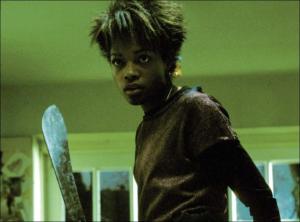 Perhaps what is different than most zombie films is that the audience grows to like the characters and root for their survival. In most horror films the characters are either too stupid or sketchy that it allows the audience to wait in amusement for their eventual horrific deaths. Its simple: we want to see these people die because its titillating (Maybe I was wrong about all the zombie analysis I still had in my head).
Boyle does service a slight message in his zombie film when the group gets to the military base. Perhaps, he muses, our military and trusted leaders are no better than those rabidly wandering the streets. The idea of a thriller set against a biological pandemic also feels very timely and relevant. The film kind of drags in the middle during the stretch between London and the military base. And the end was a bit too much Die Hard for my taste, but is suitably climactic.
Boyle has crafted a creepy, smart, and engrossing piece of entertainment. I hope people dont confuse this film with that Sandra Bullock clunker, 28 Days. They may be spending the entire time wondering where shirtless Viggo is and when Bullock will start her endless pratfalls (You knew I was going to talk about that movie somewhere).
Nate’s Grade: B


 nathanzoebl
You must be logged in to post a comment.