Tulip Fever (2017)
 Tulip Fever was originally filmed back in 2014 and has endured two years of delayed release dates. In the time it took the studio to make and release Tulip Fever, Alicia Vikander filmed The Danish Girl, it was released, and she won an Oscar, and now she’s going to portray Lara Croft in a new Tomb Raider franchise. The question arises why something seemingly so innocuous would take so long to release. The studio seems quite hesitant about the finished product. The Weinstein Company even packaged a rare red band trailer for their movie, something more associated with ribald comedies and bloody action films. A movie about tulips and love affairs seems like an odd choice, but hey, people got to see some extra Vikander nudity for free. It’s being dumped into theaters over a tepid Labor Day release and the advertising is billing it as an “erotic thriller,” which is a mistake on two fronts. It’s not truly erotic, lacking a primal carnal power, and it’s not really a thriller. It all smells less than rosy and more of desperation.
Set in the early 1600s in Amsterdam, and the nation has gone wild for tulips. The flowers are being traded and sold in the backs of taverns, and the tulip market seems limitless. Meanwhile, Sophia (Vikander) is a young woman who is married off to Cornelis Sandvoort (Christoph Waltz), the self-described “king of peppercorn.” The relationship lacks passion as their nightly sessions fail to deliver a child. Cornelis, thinking about his legacy, hires a painter, Jan Van Loos (Dane DeHaan), for a portrait of he and Sophia. The painter falls in love with his subject and he and Sophia begin having an affair. The servant woman, Maria (Holliday Grainger), is witness to her mistress’ secrets, and as their affair continues, both parties devise an elaborate means that they can be together.
 Tulip Fever is awash in strange and ineffective plotting. Firstly, the film never presents a suitable rationale for why Sophia would fall into bed with Jan. It presents her frustrations and malaise with her husband, so being in a position for finding a passionate alternative and outlet is established. After a few painting sessions with Jan, apparently they’re smitten with one another, though the movie never does the slightest work to establish a spark between them. It’s not like much would have been required. Make Jan a charmer who makes Sophia feel valued and desired. A handful of careful exchanges hinting at an inappropriate fascination are all that was needed. Instead their coupling feels largely arbitrary and from thin air. Movies directly hinging upon romantic affairs succeed on the virtue of making you feel the desire of the characters, whether that’s a romantic yearning or even just simple hardcore lust. Sexual tension is a paramount necessity. I felt no chemistry, desire, or even sexual tension between DeHaan and Vikander. There was no heat or sensuality here. Then there’s the matter of Sophia’s relationship with Maria, our curiously chosen narrator. We’re told that Maria sees Sophia like a sister, but once again the movie doesn’t show anything to indicate a particularly close relationship between the two. Then when Maria announces her pregnancy she threatens her “sister” if she gets thrown out of employment. She’ll tell Sophia’s husband what she’s been up to with her painter pal. Maybe it’s the hormones but that doesn’t exactly sound like a close, sisterly relationship. Although just when it seems like Maria might be a thorn in her mistress’ side and upset the power balance, the story abandons this idea altogether and Maria recedes back into a harmless cherubic aid.
It’s during Maria’s pregnancy where Tulip Fever’s plotting becomes its most tonally egregious, becoming a 17th century episode of Three’s Company. Sophia’s mission ever since her wedding has been to get pregnant and produce a son for her husband to carry on his family line, but due to a combination of erectile dysfunction and impotence, this seems like an unlikely task. So when Maria is pregnant, the two ladies scheme to do a switcheroo; they’ll pretend that Sophia is really pregnant, downplay Maria’s changes, and then pretend the newborn is Sophia’s child. This plan leads to several almost comical sequences to maintain the ruse, like when Sophia pushes Maria aside to take claim over her recent spate of morning sickness. The entire time I kept thinking that wouldn’t it be so much easier for Sophia just to get impregnated from her younger lover? Instead we’re given this storyline that approaches farce, and that’s not the end of it. Tulip Fever also features faking one’s death, sending the drunkest person out to retrieve the most valuable item in the country, a character conscripted into the Navy immediately, and contrived mistaken identity developments that also require characters to never do any follow-up questions to confirm the worst of what they think they just witnessed. These kinds of farcical plot elements indicate that the filmmakers were not confidant that their central relationships could sustain a narrative unto themselves. And yet I’ll admit that these unexpected plot turns provided a level of entertainment that was lacking beforehand.
The actors do what they can with their characters and marshal forward with straight faces. Vikander (The Light Between Oceans) is a luminescent actress who can communicate paragraphs through her tremulous eyes. She very capably conveys Sophia’s mixed emotions over her marriage, her gnawing sense of loyalty, and when in the throes of passion, an unburdening that serves as a personal awakening. Sadly, those romantic throes are paired with DeHaan, an actor I’m becoming more and more skeptical with every new performance. In the recent sci-fi bomb Valerian and the City of a Thousand Planets, he chose to speak in a bizarre voice that mimicked 90s Keanu Reeves. With Tulip Fever, I understood the origin of that voice, because in this movie he sounds like 90s Keanu Reeves gamely attempting his woeful British accent in Dracula. Does Dane DeHaan have range or is he incapable of playing anything without ironic detachment? He makes for a pretty pitiful romantic affair option, and I never cared what transpired to him. Waltz (Spectre) becomes the most sympathetic character by the film’s end and has a genuine character arc that might elicit some real emotion. He’s pompous and a bit oblivious, but he never really becomes the film’s villain. He doesn’t mistreat Sophia. He doesn’t threaten anyone. He just wants a child, and a wish he made to God haunts him. He truly cares about his wife, and it’s only later that Sophia realizes what her plot machinations have done to this man. Waltz’s performance is well within his nattering wheelhouse. The supporting cast includes Judi Dench, Cara Delevigne, a hilariously pervy Tom Hollander, Kevin McKidd, and an unrecognizable Zach Galifianakis. It’s enough to make you wonder what in this story got them all here.
 The story seems to exist only in parallel with the tulip market that gives the film its title. It feels like two different movies on different tracks that rarely come together. I hope you enjoy textbook economics lessons on market bubbles, because you’ll get plenty information imported on the buying and selling power of tulips. These little flowers just kept going up and up in value and investors believed that they would never go down (oh how familiar this sounds). At times the movie hints at being a Big Short in 17th century tulips futures. This could be an interesting topic because of how foreign it is today, the thought of flowers being so valuable that a person’s life savings might get squandered. However, the story that takes shape in Tulip Fever feels generally unrelated. It’s a love affair with comical complications but the only time the bullish tulip market factors in is when supporting characters get rich quick from some lucky bulb prospects. They just as likely could have gotten their fortunes through any form of gambling. It didn’t have to be tulips. The setting doesn’t feel integral to the story the movie wants to tell, which is a waste of such a supremely unique moment in world economics history. Although there is a moment where Maria narrates that a madness took over people, and I so dearly wanted her to follow up that statement with, “A tulip madness.” Unfortunately, she did not.
Tulip Fever is a costume drama that may have appeal for those usually left cold by the stuffy genre of half-glances and unrequited passions. It does have some screwy plotting linked to its screwy couple, so while it doesn’t quite work as a developed story with engaging characters, it does make for a fitfully entertaining experience. The messy plotting and arbitrary coupling limit the power and empathy. I ultimately felt more for Waltz’s character by the end than anyone else, and I don’t know if that was intended. It’s a handsomely made film with strong production design, costuming, and cinematography. If only the characters and their exploits were worthy of such efforts.
Nate’s Grade: C
Share this:

Detroit (2017)
 Something akin to an art house exploitation film, Kathryn Bigelow’s Detroit is a pressure cooker about the horror of institutional racism, but it’s also a limited drama that lacks any sense of catharsis for an audience. Set among a hellish series of days in 1967, the film follows the events at the Algiers Motel, where Detroit police officers killed three innocent black men in their pursuit of what they believed to be a sniper. An all-white jury then acquitted the officers. Will Poulter (We’re the Millers) plays the lead racist cop and instigator, the man who tries using every effort to get a confession. His bad decisions lead to further bad decisions and miscommunication and then cold-blooded murder. It takes a solid 45 minutes to establish the various supporting characters, the fragile tinderbox that is Detroit during a series of riots, and getting everyone to the fateful motel. Afterwards, it’s like a real-time thriller that’s extremely harrowing to watch. It’s very intense and very well made by Bigelow and her go-to screenwriter Mark Boal (Zero Dark Thirty). Like Get Out, it turns the day-to-day black American experience into a grueling horror film. I was squirming in my seat and felt nauseated throughout much of the movie. I wanted to scream at the screen and tell people to stop or run away. However, it’s a movie with a lower ceiling, whose chief goal is to provoke primal outrage, which it easily achieves, but it feels like there’s little else on the artistic agenda. The characterization can be fairly one-note, especially with the racist cops who stew over white women hanging around virile black males. It’s victims and victimizers and we get precious little else. Your blood will boil, as it should, but will you remember the characters and their lives, their personalities, or mostly the cruel injustices they endured? It’s an intense, arty, exploitation film, and I can perfectly understand if certain audience members have no desire to ever watch this movie. It’s not so much escapism as a scorching reminder about how far race relations have come and have yet to go in this country. Detroit is a movie with plenty of merits but I think it’s the least of the three major Bigelow-Boal collaborations.
Nate’s Grade: B
Share this:

The Only Living Boy in New York (2017)
 The Only Living Boy in New York may have made me hate New York. I was rolling my eyes at about every moment of this movie, not just because it wads cliché, not just because it confused the cliché with transcendent and relatable commentary, not just because the characters were aggressively loathsome and inauthentic, and not because it appears to be someone’s idea of Graduate Lite (though, yes, these are all contributing factors). It’s because the movie takes the easy way out at every route and wants to be congratulated for its artistic integrity.
Thomas (Callum Turner) is a twenty-something who feels that New York City has lost what made it special. He’s drifting through life, thinking about becoming a writer, and also trying to romance his best friend Mimi (Kiersey Clemons). His mother (Cynthia Nixon) self-medicates via dinner parties. His father (Pierce Brosnan) has a different approach, namely sleeping with another woman, Johanna (Kate Beckinsale). Thomas follows Johanna and makes his presence known to her. He convinces himself he’s falling in love with her and impulsively chases her as a romantic option as well.
 I think the movie wants me to be charmed by its male lead, the young protagonist that looks like a lanky Richard Gere. This twerp made me so angry and he pretty much embodied a creepy blend of entitlement. He’s tired of being in the friend zone with Mimi, but he keeps pushing, sneaking unauthorized kisses, and trying to wear down her defenses after she’s told him no. She’s annoyed that her friendship is by itself not good enough for him, and even though they had one “magic night,” that he won’t accept her repeated stances about not wanting to be together romantically. But what’s a woman’s ability to choose matter to Thomas, who we’re constantly told from every other character in this stupid movie, is clever, bright, good, virtuous, and a prized talent in the making. The movie never shows you these things, never provides evidence of his talents or even his virtues, and so it becomes another series of empty gestures. He’s just so captivating that all the women of New York can’t help themselves around him. This wouldn’t feel so tone deaf and backwards if the film did a better job of making Thomas feel like a living, breathing human being rather than some misguided, coming-of-age hipster creep.
The premise here has promise, a wayward son who ends up having an affair with his father’s mistress. That could work and devise plenty of palpable dramatic tension. Except because we never get to know Thomas beyond a superficial level, the affair only feels like another conquest of entitlement. Even a more interesting subtext, punishing his father for putting their family dynamic at risk, is only kept at a distance. What does Thomas learn about himself, his father, Johanna, or the world through his affair? If you cannot come up with a good answer then that means your plot point is lacking substance. Perhaps they just like the danger or the attention of one another, and yes Beckinsale (pick an Underworld movie) is an attractive woman so that’s a plus for a horny young lad. Most frustratingly, nothing seems to be pressed by this affair. It pushes some eventual third act confrontations but Thomas and Johanna’s tryst, for lack of a better term, just kind of lies there. It doesn’t do much, which is strange considering what it involves. It feels like its real purpose is to engineer jealousy from Mimi, which is gross. Johanna is never more than another trophy for the most blithe boy in New York.
The drama is pitched to a level that feels like it dances into self-parody, except it plays everything so unrelentingly serious. The narration begins by calling out life moments pulled from movie watching, but then it presents these very moments without any ounce of satire. We open with a New York dinner party where the attendees lament how the city has lost its soul (“The only soul left is Soul Cycle,” someone says like the worst 1980s stand-up comedian). Oh no, CBGB’s closed down. Oh no, there are Starbucks on multiple corners. Oh no, a city of ten million plus people is now only a commercialized hell, worry the rich elites from their ivory towers and their faulty memories of New York City being more pure when it was older. Not one character feels like an actual human being in this screenplay by Allan Loeb (Collateral Beauty). This is the kind of elitist, out-of-touch, artificial, self-involved characterization of New Yorkers that hacky conservative writers like to cling to when criticizing their big city targets.
 The actors do relatively fine work with what they’re given, though special mention to Brosnan who tries his hardest to imbue notes of complexity in a character that, for 90 percent of the movie, is set up as a snide and disapproving patriarch. I don’t want to give up on Turner (Assassin’s Creed) as an actor because the part did him no favors. Mostly I just felt sorry for them. Cynthia Nixon deserves better. The charming Kiersey Clemons (Dope) deserves better. Jeff Bridges is an executive producer, so he deserves what he gets as an alcoholic author/mentor with an out-of-nowhere ending that feels pulled from a soap opera. These characters are powerfully boring, shallow, and unappealing.
At only 88 minutes long, The Only Living Boy in New York still feels punishing in length, protracted, and not worth the overall effort. Even the title makes me irritable. It’s a reference to the Simon & Garfunkel song that you better believe will get played, one more desperate attempt to glom onto the legacy of The Graduate. The title refers to Thomas, our entitled hipster of a lead, but does that mean that he’s the only one who really feels things, man, because the rest of us are just dead to the world, living our lives, and this hip young man just sees through all the nonsense of the day-to-day and, man, if only we could give him the platform he so rightly deserves then we’d all be better off. I wanted the cameraman to abandon the film and run a few corners and join a new set (it’s New York City, so by the law of averages, there has to be another film shoot a few blocks away). The Only Living Boy in New York is insufferable, haughty, pretentious, privileged navel-gazing masquerading as deep thought; it is smug New York hipster twaddle.
Nate’s Grade: D+
Share this:

The Hitman’s Bodyguard (2017)
 The Hitman’s Bodyguard feels like a 90s Tarantino knockoff remake of Midnight Run, and I don’t mean that in any pejorative sense. This is a movie that knows exactly what it aims to be and strikingly new and original isn’t one of those qualities. When you deliver a late summer movie that has this much depraved entertainment and energy, I don’t mind.
Michael Bryce (Ryan Reynolds) is a disgraced bodyguard-for-hire who lost a high-profile client to an out-of-nowhere sniper. Stuck shielding coked-out white-collar traders, he still knows more than a thing or two about keeping a client safe. His former flame, Interpol agent Amelia Roussel (Elodie Yung), is tasked with getting notorious contract assassin Darius Kincaid (Samuel L. Jackson) to the International Criminal Court at The Hague. Kincaid is the only living witness who can testify against Vladislav Dukhovich (Gary Oldman), a former Belarus military dictator. Coincidentally, all of the witnesses and evidence against him seem to always disappear. Roussel’s team is ambushed and she reluctantly seeks out Bryce for assistance. He has 24 hours to keep Kincaid alive and transport him to The Hague, but Kincaid has some ideas of his own, like arguing, escaping, and visiting his wife (Salma Hayek). It’s a battle of wills and a healthy deployment of the versatile F-word.
 When it comes to genre filmmaking, especially in action or horror, the level of entertainment is much more related to the singer and not the song. Sure a well developed script with interesting characters, organic complications, and memorable set-pieces connected with payoffs are still desired, but often it’s execution that separates the brashly fun bombast from the dreck that dots late night cable. The selling point of this movie is its central pairing of Jackson (Kong: Skull Island) and Reynolds (Deadpool). Hell, both of them aren’t straining too hard from their familiar big screen personalities, Jackson the gleefully stubborn badass and Reynolds as the incredulous smart-alleck with the quick wit. Some critics will chafe and say that the actors are stuck in stale riffs and acting on autopilot. I look at this as a certain virtue of the film. They hired Jackson and Reynolds and let them do exactly what we demand that Jackson and Reynolds do. They were hired for a specific reason. Their crackling repartee keeps the movie alive even as the first half feels too sludgy getting everything going. The comedy can be a tad forced (riding on a bus with chirpy nuns! Gatorade bottle of pee?) and exaggerated at times (really, a fart joke, sound designers?) but this isn’t a film for subtlety, and Jackson and Reynolds, who can outdo just about every working actor for sarcasm and volume, are at their best when they’re big and broad. The rapport elevates even moments that would otherwise be redundant.
I thought the action scenes were going to take a backseat to the Jackson/Reynolds buddy road trip, popping up here and there to move things along and kill off an antagonist or two. To my great surprise, the action in The Hitman’s Bodyguard is uniformly great. Director Patrick Hughes (The Expendables 3) makes each action scene its own story and he thankfully varies the scenarios so they nicely stand out. There’s a terrific motorcycle chase through Amsterdam’s canals and streets, smashing things to bits in the most exciting ways. The action is often divided into two parallel points following Jackson and Reynolds, which allows the film to pair the right sequence for the right character. There’s a late foot chase that’s filmed in refreshing long takes (newest Hollywood action trend?) that stops into the back kitchen of a restaurant and then a hardware store. Each location is well utilized to provide a unique opportunity for the fight choreography and use of props. The movie does a very successful job of approaching action by thinking how to use geography, character, and purpose to plot. Hughes also has a solid inclination when to punch for humor with visual gags, including a few gems involving a minivan. When the comedy wasn’t completely working, I knew I could rely upon the dependable thrills.
The movie also has one of the dumbest attempts at injecting urgency into a story. The plot hinges upon Darius Kincaid arriving at The Hague at an exact time to testify against Oldman’s dictator. In a moment that made me blurt out laughing, an expositional device/news lady informs us that if nobody comes forward to testify then The Hague has to drop all charges, Oldman’s dictator goes free and apparently becomes the president of Belarus immediately again, and probably the end of democracy. First, this false sense of urgency requires witnesses to arrive at a court. That’s not how testimony works. You can give a sworn statement anywhere. You can appear in court via teleconference. The location is not the problem here. And then his testimony is aided by (slight spoilers) photographic evidence of the dictator’s genocide… except it’s all digital pictures. This entire movie hinged on the mad rush to get Jackson to The Hague when he could have just made an email attachment with the incriminating pictures at any wifi spot. There’s also the factor that if it was one second after five or so the court would not accept any testimony. I don’t think courts work that way, especially when it’s a decision over dictators and due process. And yet a wall clock is treated like the ticking clock on a bomb detonator. It’s so dumb I question whether the filmmakers were self-aware and making a satirical riff.
 While being an enjoyably profane experience, The Hitman’s Bodyguard doesn’t know when enough is quite enough. It has problems walking away and routinely falls upon overkill in several elements. There’s almost way too much plot here. Every character has a back-story that nabs a lengthy flashback with an ironically chosen pop song. There are obvious betrayals that the film thankfully doesn’t belabor in revealing the culprits, but did we need them anyway? Hayek seems to have said yes just to be a vulgar badass that would attract Jackson. It’s fun but her shtick gets old quickly. She’s all unchecked exaggeration. Hayek’s character is just here to provide a counterpoint for Kincaid to wax poetic about romance and relationships, to nudge Bryce to “man up” and realize what he’s let slip away. The romantic elements are presented on the same wavelength as the comedy, meant to be a shoulder-shrug of cocksure cool. When they try and get earnest on their own terms it doesn’t quite work out tonally. The movie also runs rampant with false endings, going from one escape to another just as it should be winding down. It’s like the filmmakers were having so much fun they didn’t know when to walk away from their story.
I think every ticket-buyer knows what they’re getting when they walk into The Hitman’s Bodyguard. It’s two actors doing what they do best, in an action vehicle that cribs from Midnight Run, and with a sense of style and attitude that resembles a bluntly ironic return to 90s R-rated action excess. Fortunately, the execution of these genre tropes and elements lead to one of the more profanely entertaining popcorn flicks this summer season. It’s a movie that doesn’t take itself too seriously, coasts on above average action and the charged comic chemistry of its two loud-mouth leads. It’s a movie that doesn’t require much thought and rewards you for the effort. The Hitman’s Bodyguard is everything you want it to be, and if that’s good enough for you, then you’ll find satisfaction here.
Nate’s Grade: B
Share this:

The Dark Tower (2017)
 I have never read any of Stephen King’s popular fantasy series, The Dark Tower, so I walked into the long-awaited film adaptation with no investment. I walked out with very little investment. The film peaked at its casting, with Idris Elba as the mythic Gunslinger hunting down a notorious evil sorcerer, The Man in Black (Matthew McConaughey), a.k.a. Randall Flagg. For the first fifteen minutes or so, the world building is pretty straightforward and accessible. The Man in Black is looking across universes for special psychic children whose abilities he can focus to destroy the titular Dark Tower, a monument protecting the stability of all universes. A young kid is having prophetic dreams but appears emotionally disturbed to his family. Before a group of rat people hiding behind human masks can kidnap him, he runs away, finding a portal to Midworld, and into the path of the Gunslinger, who seeks personal vengeance against the Man in Black. From there the movie gets pretty hazy with its rules and lore. The production design of this alien world is a bit bare. The characters stay in an archetypal range and don’t give you much reason to care. The action is serviceable but unmemorable, the Gunslinger credo is rather cheesy especially when repeated with such self-seriousness, and sometimes it feels like McConaughey is in a different movie altogether. If you’re a fan of the series, I have to imagine you’ll be processing some level of disappointment by the end of the film. If you’re a franchise novice, like me, you may find some stray things to enjoy in the moment, but the film evaporates from your mind immediately after leaving the theater, banished to the dustbin of bland sci-fi action.
Nate’s Grade: C
Share this:

Lady Macbeth (2017)
 Cool, calculating, impassioned, and razor-sharp in its shrewd storytelling, the period film Lady Macbeth is worthy of the title of Shakespeare’s manipulative anti-heroine. Katherine (newcomer Florence Pugh) is recently married and expected to fulfill her wifely duties. Except her husband demands she stay inside and he also wants nothing to do with her physically. While away, she strikes up an affair with Sebastian (Cosmo Jarvis), one of the servants hired to tend the estate. She finally feels desired but also free, able to do what she wants and without the stifling control of patriarchal forces. There are three impediments to Katherine continuing to enjoy her status and relationship, and each one requires another step into moral turpitude. Lady Macbeth does a very effective job of developing taut tension born out of its premise. Every plot point naturally leads to another, creating more frisson and conflict. It pushes an audience into an uncomfortable position of deciding how far their sympathies will align with our put-upon protagonist. The ending is fitting but will likely produce a lot of heavy sighs and foot shuffling out of the theater. Pugh delivers a star-making performance in a role we’ve seen often in nineteenth century literature, the oppressed woman yearning for autonomy of body and mind. However, this isn’t an unrequited romance of furtive glances and pearl clutching, this is a meaty psychological thriller seeped in murder. Pugh expertly portrays a fascinating figure, a woman capable of cruelty to stake her claim in a cruel world. She commands the screen. A great reoccurring image is Katherine sitting on a settee and going through breathing exercises, as if to get into character for what she must do. Lady Macbeth (based upon the Russian novel Lady Macbeth of Mtsensk) is a tightly wound psychological thriller that brings a darker, absorbing carnality to the bonnet drama.
Nate’s Grade: B+
Share this:

A Ghost Story (2017)
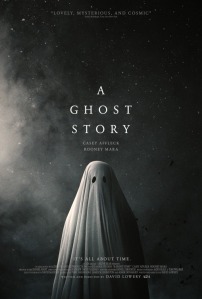 Ever wanted to see Oscar-nominated actress Rooney Mara eat a pie? Odd question, I realize, but apparently one that writer/director David Lowery felt compelled to answer. With the success of last year’s utterly heart-warming Disney remake of Pete’s Dragon, Lowery secretly made a low-budget movie with Casey Affleck and Mara, reuniting two of his actors from Ain’t Them Bodies Saints. The end result, A Ghost Story, literally involves a deceased Affleck stalking the screen in a long white sheet with two eyeholes. Lowery’s tone poem of metaphysical grief will likely alienate just as many people as it dazzles, and I fall squarely in the former camp. This movie is arthouse bluster.
This is a twenty-minute short stretched beyond a breaking point to fit a feature-length running time. It’s an impressionistic movie in the guise of the works of Terrence Malick, small and earnest and far more concerned about mood than story. That’s fine but if you’re going the impressionistic route I need scenes that aren’t self-indulgently laborious and constantly striking the same note. The majority of this movie is beautifully composed shots that eventually reveal the ghost standing in the background. It becomes a game of guessing when the camera will reveal the ghost’s presence. I understand that grief and loneliness is going to naturally deserve a slower pace to get a sense of the melancholic loss, but a slow movie that keeps delivering the same imagery is monotonous. The metaphors get old. The only thing holding the audience together is the time-traveling quest for the ghost to retrieve the note Mara’s character slipped into a door jam. It’s a long mystery that will ultimately prove an unworthy payoff. If Lowery is intending for the audience to feel the same sense of boredom and isolation as the ghost, that’s fine, but the movie dwells in this same emotional space with too little variance or further insight.
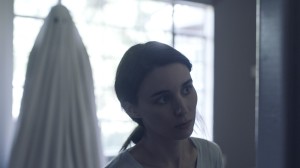 And this is where I have to come back to the pie as a symbol of the film’s self-indulgence. I have felt the urge to walk out of other movies but never acted upon them. I was minutes away from walking out on A Ghost Story, and it was the pie-eating scene that almost pushed me to bail. The idea of binge eating your feelings is a suitable metaphor for grief, and it works on its own initially, as she sniffles and holds back tears with every bite. And then she keeps eating. And then she keeps eating. The scene goes on for like ten minutes, uninterrupted, and with no further commentary. You are literally watching Mara eat a pie in real time and then throw up. After the sixth or so minute of pie consumption, I started laughing out loud, and then other people around me joined in. What can you do? Just as Mara’s character overindulges to the point of sickness, this scene pushes the beleaguered audience to the point of running out of the room gagging.
This would be different if the movie gave Mara anything really to do besides swallow her feelings. She has a few more scenes of the humdrum of moving on, painting the house she shared with her loved one, and then leaving. It seems like an awful waste of Mara’s talents but I would say the same thing for Affleck. I’m sure not having to memorize any lines after the ten-minute mark and getting to emote entirely through physical expression could be fun for an actor. It’s practically a throwback to silent film thespians. However, he’s just kind of there, like living furniture. I understand that part of grief is feeling like you’re a forgotten being and that time is infinite and punishing. I understand that sadness can feel numbing and cut to the bone. I get the mood; I even get the central metaphor of the de-contextualized ghost in a sheet just hanging around old haunts, unable to do much else, disconnected from the world and unable to move on or make sense of things. My issue is that this approach relegates the actors to stand-ins, squeezing the characters into intentionally bland ciphers for audience relatability. They are not allowed to be characters because somehow this would detract from the artistic appeal or message.
 It’s frustrating because A Ghost Story has ideas, images, and moments that intrigue, beguile, and have a poignant power. It’s when the film expands beyond its limited parameters that it becomes its more interesting shape. As the ghost attempts to keep watch over Mara’s character, time moves much faster, to the point that a mere walk from one room to another can be the expanse of months. The triptych sequence of being unmoored through time, as everything speeds by so quickly, accentuates the helplessness of the ghost as well as the isolation. It’s like the world and life itself is outgrowing them, forgetting them, and leaving them further and further behind. There are also other ghosts and our ghost has a subtitled dialogue with them. It sounds silly but it’s actually one of the most sublimely affecting moments in the film, an idea that actually hits its intended mark. Take this exchange: “I’m waiting for someone,” “Who?” “I don’t remember.” Then the other ghost goes back to waiting, forever hopeful, forever clinging onto something that has long since evaporated, where even the memory, the concept of the idea of why has also vanished. Late into the movie the ghost starts going backwards and forwards in time, to a distant future of Bladerunner-like neon high-rises, to the nineteenth century to track a family of westward settlers. The abrupt careening through time says more about the ghost’s existence and it keeps things fresh. If this movie was a total wash, I could write off Lowery’s curio as self-important navel-gazing, but there are kernels of ideas, or moments, that stand out and demand a better presentation for better effect
A Ghost Story will definitely strike different people differently. It’s a deeply personal, poetic, and, if you’re not properly attuned to its metaphysical funeral procession, pretentious and pondersome film that wears out its welcome long before the end credits. I found the substance to be spread too thin over such a longer running time than this execution deserved. If you’re going for an impressionistic evocation, then the scenes need to be paced better. If you’re going for a mood of loneliness, then latch onto the character better and let’s follow Mara’s character as she rebounds and grows old. If you’re going for an existential horror movie, then present more confusion and terror and less of the same visual metaphors on constant repeat. If you’re going for Rooney Mara eating an entire pie in real time, then, well, actually you’ve succeeded. Congratulations. A Ghost Story is going to be one of those movies that critics fawn over that leaves me shrugging.
Nate’s Grade: C
Share this:

Atomic Blonde (2017)
 Atomic Blonde is based on a 2012 graphic novel called The Coldest City (by Antony Johnston and Sam Hart), a title I doubt many were that familiar with. Charlize Theron was. She snapped up the option rights before it was published and saw it as a vehicle for herself to cut loose, have fun, and show off her affinity for fight choreography thanks to her background in dance. If you don’t walk out of this film with an uncontrollable crush on Theron, then I don’t know what movie you saw, my poor friend.
Set in 1989 Berlin, on the eve of the wall going down, Lorraine Broughton (Theron) is working undercover for her Majesty to uncover who is killing British agents in East Germany. Her local contact is David Percival (James McAvoy), a black-market kingpin and popular mover and shaker. One of his contacts (Eddie Marsan) has committed secret spy files to memory and wants an escape to West Germany. He’s even gotten the attention of other spooks, including French intelligence agent Delphine Lassalle (Sofia Boutella), who gets intimately close to Lorraine. The smuggling of the contact goes bad, lives are lost, and Lorraine has to explain to her superiors (Toby Jones, John Goodman) what went wrong and who is secretly the murderous traitor.
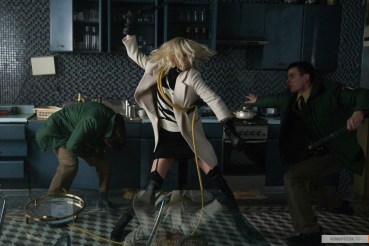 This film could have just as easily been re-titled Sexy Charlize Theron: The Movie. It is a two-hour celebration of the actress and her many formal gifts. Watch her look sexy in this sexy outfit (i.e. every outfit Theron wears or doesn’t wear). Watch her look sexy strutting down a hallway in slow mo. Watch her bathe in ice. Watch her dispatch bad guys with ease, sexily. And then there’s the sapphic romp with Boutella (The Mummy), which is just an explosion of sexy that might be too much for the weaker-hearted audience members to handle. A female friend of mine used to refer to Angelina Jolie in the early 2000s as “walking sex,” a woman that simply oozed sex appeal with her every glance and movement. I think that term deservedly applies to Theron in Atomic Blonde. The surface-level pleasures are rampant, from the 80s chic clothing, to the pumping New Wave soundtrack, to the very stylized way people take long dramatic drags from their cigarettes, the movie exudes a sense of cool with every frame. There is plenty to ogle, and that includes the casual nudity of a 41-year-old Theron, who has plotted this showcase role for years as an unapologetic badass statement and maybe the nonchalant nudity is part of that (“You think women over 40 are unattractive? Well take a good gander at this, Hollywood”).
The film has style to spare but thankfully it also has enough substance to match, and by that, I mean its depiction and development of action. Coming from David Leitch, one of the co-directors of the John Wick franchise, I expected very fluid and well-choreographed action sequences, and Atomic Blonde delivers. I am happy that we have moved away from the Bourne-style docudrama approach of the jangled edits and gone the other direction, treating action sequences like the dance routines they are and allowing an audience to fully take them in and appreciate the skill and artistry. The showstopper everyone will be talking about is an extended fight sequence that closes out the second act. Lorraine ducks into a tenement building and gets into a bruising fight with several goons. This sequence goes down several floors, careens into empty rooms, and eventually ends up in the middle of a speeding car trying to make a desperate escape. It’s filmed to be one long take and the sequence is exhilarating and only becomes more so with every passing minute.
 Admirably, Atomic Blonde also brings a sense of realism to all its action. As the fight continues, Lorraine becomes understandably fatigued, as do the baddies. She is not impervious to their attacks. She’s gutsy but still vulnerable, still human. You feel the blows and the intense duration, which makes me marvel all the more at Theron’s sheer balletic grace when it comes to her ass-kicking capabilities. Having an experienced, accomplished fighter opens up the complexity of the action sequences. The stunt work is a consistent joy in this movie and what will make it stand out amidst the pack.
The only major gripe I have with the film is its rather convoluted spy plot. The Cold War as well as East Berlin is just a backdrop for the cool shenanigans. The movie toys with spy movie pastiches but clearly it only amounts to genre window dressing. It’s almost on par with the music, used to evoke a mood and not much more. It feels like even Atomic Blonde recognizes this and just blurts out more nonsensical “who can you trust?” plot mechanics to get to the next sexy set piece. If you don’t already know who the eventual traitor will be by the end of the first act, you haven’t been doing the math. The communist bad guys are an unremarkable lot but they do make for solid punching bags.
The opening scene sets up the death of a British spy as a personal blow to Lorraine (she kept a photo of the two of them in her dresser drawer) but he’s quickly forgotten and never mentioned. His assassination doesn’t even stir any simple impulses of revenge. The non-linear framing device also seems designed just to skip ahead to the good stuff or provide a break in the action where Lorraine’s superiors can provide disapproving, fuddy-duddy commentary about her blasé behavior. The plot is a bit too needlessly complicated and muddled for what the film needs. It’s as if screenwriter Kurt Johnstad (300) was given the edict to make things obtuse with paranoia and intrigue just long enough. There’s an extended coda that feels like a reshoot; however, it also has several significant plot revelations that completely change your understanding of the characters.
 Atomic Blonde is the kind of movie that knocks you around and overpowers you with its spiky attitude. At its best, the movie pulsates with a buzzy rush of adrenaline, setting up dangerous dilemmas for Lorraine to take out with her fists, feet, and any old thing lying around. Her ingenuity during the fight sequences adds a welcomed degree of unpredictability and satisfaction, and it makes the locations become an integral part of the fight choreography as well. There’s a reason I’ve been expending most of my review on the action sequences and sense of style, because there isn’t much more to Atomic Blonde. It’s all retro fashions, stylish artifice, an overeager soundtrack, and lots of too-cool bravado, but unlike say Suicide Squad, it actually pulls it off. It’s not posturing when it works. Theron is a absurdly convincing as a super sexy super agent, and it feels like they dropped her into a James Bond story (with Sofia Boutella as the Bond girl). The added realism and long takes allow the film to feel even more viscerally kinetic. If this is the start of a Charlize Theron franchise then I say we are living in the sexiest of times.
Nate’s Grade: B
Share this:

Valerian and the City of a Thousand Planets (2017)
 Watching the trailers for French maverick Luc Besson’s latest, the sci-fi opus Valerian and the City of a Thousand Planets, I was wondering where it would fall on a scale between Besson’s own funky, enjoyable Fifth Element and the lackluster and laughable Jupiter Ascending. It looked to tell a big story in a big world and with its director’s quirky visual hallmarks. It should at least be fun, I reasoned, and it is for a while. Unfortunately, Besson’s film (the most expensive European production in history) is a movie that almost needs to be seen to be believed but I wouldn’t actually advise people go see it. Perhaps a better title for this movie would have been Valerian and the City of a Thousand Better Ideas.
Based upon the comic series by Pierre Christin and Jean-Claude Mezieres, we flash forward to the twenty-eight century with agents Valerian (Dane DeHaan) and Sgt. Laureline (Cara Delevingne). Their mission is to retrieve a special alien something-or-other that will relate to a larger conspiracy involving the eradication of an alien home world.
Besson’s face-first dive into the wacky world of sci-fi will frustrate the hell out of you, chiefly because it does such an amazing job of creating a vibrant, weird, wild, and luscious world brimming with alien life only to toy with interesting subjects and then indifferently discard them. The elements are all there, it’s just that Besson doesn’t integrate them in meaningful ways, retreating back to being an overly caffeinated, erratic tour guide. My friend Ben Bailey and I came up with several different revisions that would have instantly improved the movie, and that only took us twenty minutes after leaving the theater (more on that below in full detail). Over the course of 137 self-indulgent, hyperactive yet meandering minutes of story, I am stunned at the level of ineptitude.
 It’s not all bad, and in fact the first 30 minutes are some measure of good to great. The prologue is a thing of beauty and the highlight of the movie (if you walked out immediately after, when the title popped up, you would be better off). Set entirely to David Bowie’s “Space Oddity,” we visually chart the history of man’s habitation of space. Stock footage of 1970s space missions gives rise to the early twenty-first century construction of a working space station. The station’s captain accepts each new national group with a magnanimous handshake. Each scene is a jump forward in time, wordlessly building a stronger sense of community and the accomplishment of man’s dreams. Eventually this greeting also extends to First Contact and different alien species come aboard, and they too are given the same handshake of peace. It’s an earnest sequence that comes across as genuinely moving and uplifting. Finally, we see that the space station has, over the course of hundreds of years, collected into a massive floating home to thousands of alien species that came from far to explore and intermingle.
The next part is also wordless, following the idyllic existence of a planet of Na’vi-like lithe, blue-skinned alien natives who frolic along a beach and collect pearls. It’s another rather sincere visual sequence. This tranquil CGI world comes to a screeching halt when fiery debris begins to rain down from the atmosphere, followed by a gigantic alien spaceship that crashes and causes an extinction-level event. One of our lithe aliens is trapped behind and comes to terms with her fate. She sends out her spirit in one last radiant burst before the pyroclastic cloud engulfs everything. These two sequences engender good will with the audience and show the potential power of Besson’s transporting vision.
Shortly afterwards we get the first major set piece of the opening act, an inter-dimensional bazaar known as Big Market. In one dimension it’s just a large expanse of empty desert, but with the right gloves and glasses visitors can interact with alien vendors and shop to their hearts content. It’s a fantastic setting and Besson takes time to set up the different particulars and rules and then lets it loose. It’s exciting and imaginative and the only sequence where the character of Valerian feels in trouble or at a disadvantage. It’s a wonderfully knotty sci-fi set piece with multiple points of action interweaving into a satisfying spectacle. There’s even a fun alien crime boss voiced by John Goodman. I whispered to my friend that this was already better than Jupiter Ascending. I regrettably spoke too soon.
 Everything afterwards is a cascading mess that assaults your senses and wastes your time. There isn’t a strong narrative drive to the movie, never felt more than during its protracted second act that is nothing but a series of wearisome narrative cul-de-sacs. The movie errs significantly by establishing Clive Owen as an obvious villain so early (he’s torturing a Na’vi-like alien in the friggin’ first act). Owen’s character becomes the supposed MacGuffin that propels the characters forward. They have to retrieve him, but when the audience already knows so early that he’s not worth the effort, the sense of urgency deflates, not that there was much of a sense to begin with. The movie quickly adopts a flippant attitude where it feels like nothing matters, and so nothing does. We jump from one detour to another as if they were single-issue comics that Besson was determined to realize on the big screen. The characters never feel in danger because Besson deploys contrived solutions at every turn. A special jellyfish on the head is a solution to finding a missing Valerian. Simply jumping down a floor grate is a solution to charging aliens. It’s like Besson throws his characters into dilemmas and merely points to the exit door conveniently there the whole time. That’s not satisfying or entertaining. It makes the movie feel episodic, listless, and like it’s just filling up time. What started so promisingly rapidly degenerates into overly exuberant camp nonsense.
Another major issue is that the main characters are awfully boring and miscast. Valerian is supposed to be a charming rogue, a swaggering playboy, a fearsome cop, and none of these attributes work with DeHann. The guy has been excellent in other movies but is entirely unbelievable as the title hero, intimidating nobody and impressing even less. He’s supposed to be a talented expert operative but the results on screen don’t back up the praise. His combat moves require a large suspension of disbelief. DeHann (A Cure for Wellness) speaks in a baffling 90s Keanu Reeves voice for the entire movie, relegating his entire emotional range to a grating monotone. Valerian isn’t charming whatsoever but Besson seems to think an audience will fall for him. He’s an irksome misogynist who sets his sights on his partner, Laureline. Their “romance” is unconvincing and hindered with some laughably clunky dialogue. The movie runs like you have a pre-existing relationship with these characters, but we don’t know them or their back-stories or their shared history. He’s immediately hitting on her and proposing marriage in the first act, though it all seems like a sleazy scheme just to sleep with her. Delevingne (Suicide Squad) has a striking look to her but I can’t tell if she can act yet. Granted the roles I’ve watched ask her to mostly serve as a model. Her character is stiff and unemotive and equally boring, though slightly more convincing as an aloof badass. It’s a shame she gets sidelined as a damsel needing rescue when she seems far more capable than her partner. These two are the living embodiment of prioritizing attitude over characterization.
There’s a very late moment when Besson has his two lead characters just spout transparent exposition at one another to communicate themes and character arcs, and it took everything I had not to laugh out loud. Laureline is about to give an alien something valuable and Valerian pulls her aside and tells her they can’t. “I follow the rules,” he says, and I snapped my head back in alarming whiplash. What? This dolt has been breaking everything and doing whatever he has wanted for hours, and now at the last minute Besson is trying to force him to articulate a paradoxical character description? Being saddled with these two distant, glib, irritating leads is bad enough, but DeHann and Delevinghe have as much chemistry as a batch of dead fish. No danger of sparks flying here.
 Before I got into some spoiler detail with my suggestions on how to improve Valerian and the City of a Thousand Planets, let me appreciate some of its virtues. The movie is often a technical marvel bursting with detail at every edge of the frame. Besson’s quirky sense of humor and playfulness is on display from the imaginative alien designs to the lived-in settings. The movie isn’t afraid to get weird, and some of those details are delightful like a two-barreled gun that can point in different directions. There’s even a small creature that will poop out copies of whatever it eats. Even when the characters and story let you down, the visuals provide a reason to keep going. I enjoyed Rihanna’s shape-shifting alien, a burlesque dancer whose routine feels almost like a medical test to determine which Rihanna fetish works best for you (rollergirl, French maid, naughty nurse, S&M kitten, torch singer, school girl?). Part of her appeal is that she’s the only supporting character in the movie. Her presence changes the character dynamics of Valerian and Laureline and gives us somebody new to hang onto. I liked the dopey aliens that resemble the sloth from the Ice Age movies, and I especially enjoyed a surprise payoff for their insistence that Laureline wear a stupidly large hat. Whether these moments are enough to cancel out the rampant excess will be up to the individual moviegoer.
This next section is going to involve spoilers, though I don’t think this is a movie where knowing the plot is going to really ruin the experience. Still, you have been warned, and if you wish to remain spoiler-free, please skip to the last paragraph (though do come back later).
I was beside myself in frustration because it feels like there are story elements ripe for the plucking that would have instantly improved Valerian and Besson is just too oblivious. Firstly, none of the characters that Valerian and Laureline run into seem to matter in the slightest. That alien mob boss who swore vengeance? Never returns. The aliens that kidnap Laureline and offer her up as a tasty treat to their king? Never return. Besson’s Fifth Element benefited from establishing different groups of characters with conflicting purposes that would continually run into one another and complicate matters. It makes the movie much more fun and it allows characters to have greater meaning than one-off appearances. We should be building a team and gaining a new member from every new location visited, which would make the visits more meaningful and lighten the time spent only with Valerian and Laureline. My first solution would be to bring back these different alien antagonists in comical and bungling ways, especially for Act Three. Another solution is to radically change the angelic, Na’vi-like ethereal aliens. It’s revealed they’ve been hiding on the station for decades (though not in a different dimension, another missed potential payoff). They just want to go home, though whether that’s a replication or a different dimension is unclear. What if these peaceful aliens didn’t forgive humanity for obliterating their planet? What if the key to bringing back their home world was to suck the life force out of the space station or Earth itself? That would flip the script and make you question whether these displaced aliens are morally justified in their actions. It would also set the stage for a rollicking third act that culminates in a frantic chase through all the different levels and communities introduced throughout the film, complete with the various antagonists complicating matters with their own motivations. This would all be infinitely better than the third act we get, which left me flabbergasted at how slack and uninspiring it is (defusing a bomb?). Why build up this strange and wonderful world and do nothing with it by the end?
 Getting back to my original question: is Valerian and the City of a Thousand Planets better or worse than the Wachowski sisters’ misfire, Jupiter Ascending? Besson’s latest certainly looks lovely and is crammed to the rafters with ideas, several of which you desperately wish had garnered more attention and development. This is an overstuffed movie, especially at 137 minutes, and yet it will leave you seriously wanting. The disinterested lead actors slog their way from one uninspired chase scene to another, gallivanting in a world that will have no real significance once we move onto the next expensive set. It all feels like manic decoration meant to stimulate and distract from the glaring deficiencies with characters and story. It starts out great and then degenerates into kitschy futuristic junk. It feels like somebody made a PG-13 Barbarella but mandated that nobody ever smile. DeHann is grossly miscast as a rakish rogue and his onscreen relationship with his leggy costar is painfully realized. I think I respect Jupiter Ascending more because that cinematic world could have sustained something interesting and they took it all seriously enough even when things got absurdly silly. Valerian is so flippant and stuck with sourpuss leads. A better movie was within reach, which makes it all the sadder that Valerian and the City of a Thousand Planets is reluctantly the movie we get, a visual spectacle that bores as it overwhelms. If you put this movie on mute and did some peyote, maybe it would achieve its true artistic value.
Nate’s Grade: C
Share this:

Dunkirk (2017)
 Christopher Nolan is one of the rare filmmakers in the world that can do anything he wants. He’s reached a level of critical and commercial success that he has earned the leeway to tell the stories he wants with a blank check. Apparently he’s been eager to tell the big screen story of Dunkirk, the mass evacuation of 400,000 Allied troops on a French beach in World War II, and it would be the first film of his career to not have a crime or science fiction slant. If this is what he has to turn into in order for mainstream Oscar attention then please go back to making your sci-fi puzzle boxes, Mr. Nolan, and let someone else make the underwhelming WWII epics. Don’t believe the effusive praise from critics saying this is Nolan’s masterpiece or the finest of his career. Dunkirk is Nolan’s least engaging film and maybe even the least ambitious of his otherwise storied Hollywood career.
Dunkirk is less of a cohesive movie and more a series of moments, never eclipsing the next or coalescing into a larger, more meaningful, more satisfying whole. We keep cutting from primarily three perspectives (air, sea, land) but it fails to feel more than a check-in before moving onto the next vantage point. It’s a shame because the opening ten minutes launch you immediately into this world of danger and Nolan sets up the different perspectives with effective visual clarity. I thought it was a great moment having the soldiers collect the fluttering propaganda fliers meant to remind them about how the enemy surround them. The initial burst of violence is visceral and unnerving. The burial of a soldier in the sand is a somber moment. Things were getting good, and then I kept waiting for the movie to escalate, to hit a new gear, and it never came. Instead it repeated the same plotting that just forced the bland characters from one curtailed escape to another. Screenwriting is about setups and payoffs, and that is strangely absent throughout Dunkirk. Bad things just kind of happen, and then they happen again, and then you tune out. That’s even before Nolan throws in needless non-linear elements that I was ignorant about. Dunkirk is Nolan’s first film under two hours since 2002’s Insomnia, and yet it could still stand to lose even more. After a while, your mind drifts when all you’re watching is poorly written characters, many of whom you can’t identify, jump from one crummy situation to another without a stronger storytelling drive. If you want a more personally involving retelling of the heroes of Dunkirk, just watch the film-within-a-film of the underrated 2017 gem, Their Finest.
 The miracle of the Dunkirk evacuation is really lost in this film. Without a more involving story, it’s hard to get a sense about the personal sacrifices and risks of the evacuation. The scope feels mishandled. We’re told that 400,000 men were rescued but I did not get any sense of that scale. We’re stuck to a small corner of a beach, or a small section of the sky and sea, for the far majority of the film, which again traps the film at a lower register. We don’t adequately sense the monumental scale of what is at stake. The embodiment of the threat is condensed down to a single German fighter plane that Tom Hardy has to chase for half the movie. It’s like this guy is the freaking Red Baron. Another aspect that exacerbates this issue is Nolan’s haphazard command of screen geography. When the camera is inside the various ships, your sense of space is uncertain. When things go bad, it just all feels like a mess, with no clear indication of where the characters are, their proximity to others, or even the interior design of the ships. Without a coherent sense of geography, the action and suspense is going to be inherently limited. Nolan locks into a claustrophobic sensation at the expense of audience clarity, and without better-developed action and interesting characters, it’s a decision of diminishing returns.
The characters are so indistinct that most of them in the end credits didn’t even merit names (Irate Soldier, Shivering Soldier, and Furious Soldier are among the lot). This is one of the biggest mistakes of Nolan’s movie. By not providing characters that an audience can engage with he’s handicapped how much an audience can care. We don’t learn about any of the main characters we follow, with the slight exception of Mark Rylance’s even-keeled seafaring father. I challenge audience members to even remember a who’s who of the young men because I don’t think I’d be able to identify them in a lineup. I was still trying to recall which of them may have died. I haven’t had this much trouble keeping people straight in a war film since Terrence Malick’s The Thin Red Line. With Dunkirk, there are faces we follow really more than characters. The most recognizable is Tom Hardy and that’s because he’s Tom Hardy and not because of anything related to his character. Kenneth Branagh’s character just seems to be here to stare off into the distance with awe and say something about “seeing home.” It’s as if Nolan had no interest in telling a war story from a human perspective, which is a vastly strange approach considering the large-scale human cost.
 Nolan is a smart filmmaker. He has to know these characters are thinly sketched ciphers at best, so the question becomes why is Nolan choosing to make Dunkirk this way. If I had to hazard a guess I think Nolan was trying to accomplish a visceral, immersive war experience to echo the hopelessness and confusion of those men in jeopardy. They’re meant to be faceless everymen. This would explain why it feels more like a series of moments, of jumping from one failed escape to another and one fraught encounter to another. Nolan does a fine job of introducing conflict (in a wartime setting this also shouldn’t be too hard) but without more distinction he runs the serious risk of everything feeling like more of the same. At the end, thousands of soldiers are ferried back to England and congratulated. One of them is incredulous, not feeling like retreating is worth the fuss. “We just survived,” he says. “Well that’s good enough,” the other says. It’s like Nolan intended to place the audience into a crucible where just getting out was enough to satisfy demands. I don’t think it is.
From a technical standpoint, Dunkirk is often breathtaking, no more so than in its mesmerizing sound design. Nolan uses brilliant sound tacticians to heighten your senses and build a sense of dread. An oncoming fighter plane tearing through the sky can raise the hair on the back of your neck. The sound does the heavy lifting when it comes to creating tension. The score by Hans Zimmer is very effective in that regard as well. Its central musical element sounds literally like a ticking clock, which instantly heightens any scene. Granted adding a ticking clock sound against anything would make it more fraught (you’ll never fill out boring paperwork the same way again). Visually, the aerial photography is gorgeous with the IMAX cameras able to take in such startling depths. Cinematographer Hoyte Van Hoytema (Interstellar) has some beautiful visual compositions, especially as different boats capsize and the water rushes in at odd angles. This is a film that has commendable technical achievements. It’s Nolan who lets down his team.
War movies often run the risk of being overly reliant upon broad themes of heroism, nationalism, patriotism, sacrifice, and such, which can be in replacement of a strong narrative and well developed, interesting characters. War is a film genre like any other, and there are inherent genre shortcuts that can be abused. However, it’s like any other genre in that, regardless of the setting or situation, you are expected to tell an interesting story with characters the audience cares about. Nolan sacrifices all for the immersion in his war experience machine, providing listless, interchangeable characters and a story that amounts to a collection of harrowing moments but not a movie. My pal Joe Marino chided the movie as akin to visiting a planetarium, sitting back, and taking in the wonderful visual spectacle but walking away unmoved. It’s like Nolan has created the Dunkirk Experience: The Ride instead of an actual worthwhile story.
Nate’s Grade: C+


 nathanzoebl
You must be logged in to post a comment.