Sound of Metal (2020)
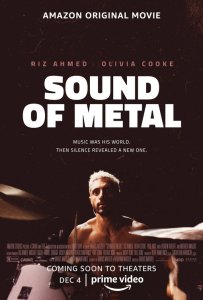
I don’t think I’ve better empathized with hearing loss and deafness than with Sound of Metal, a moving and observant drama about a heavy metal drummer quickly losing his sense of hearing. Riz Ahmed (Nightcrawler) plays Ruben, a former junkie who is four years sober and worried about losing his girlfriend/band mate (Olivia Cooke) with his recent diagnosis. He’s attending a treatment center meant to cater to a deaf community and transition others into this community. Ruben is defiant, depressed, angry, all the stages you can imagine with grief. The movie is at its best during its quiet and contemplative moments where we empathize with the terror and alienation of Ruben. When he first joins the center, we don’t get subtitles for the many signed conversations between members. It’s only after Ruben learns ASL, integrates into the community, and opens himself up to the program that we too get to be knowledgeable. The sound design is exceptionally utilized to illustrate Ruben’s changing perspective, and some later choices with it might make you long for the peacefulness of silence. The movie is exquisitely thoughtful and considerate while maintaining a subtle, character-driven approach that keeps things from wallowing in self-pity. For many of the deaf, hearing loss isn’t seen as a disability but a community with its own culture and quality of life. It’s understandable that Ruben is focused on loss but the movie doesn’t dwell in loss, more so transformation and acceptance. Ahmed is fabulous in the lead role which requires him to rely primarily upon non-verbal expression for extended periods. His eyes are his best vessel for communicating Ruben’s emotional state, and Ahmed is sensational. Paul Raci is also great as the leader of the treatment center and the responsibility and generosity he feels to those in his care. Sound of Metal is an immersive, sensitive, authentic and poignant drama with an Oscar-caliber lead performance and a depth of compassion for the many people of the deaf community.
Nate’s Grade: B+
Share this:

Ma Rainey’s Black Bottom (2020)/ One Night in Miami (2020)
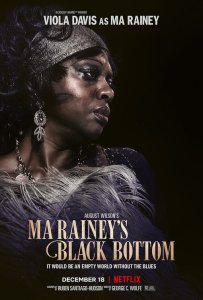 Two new movies are poised for major awards consideration, both based on plays by black authors, and both providing insights into the injustices and experiences of different black Americans from the past. Ma Rainey’s Black Bottom is available on Netflix streaming and One Night in Miami will soon be available through Amazon Prime in January, and both movies are observant, reflective, unsparing, hard-hitting, and provide some of the best acting you’ll see in movies this year.
In 1930s Chicago, Ma Rainey (Viola Davis) is assembling a team of musicians to record her latest blues single “Ma Rainey’s Black Bottom.” Cutler (Colman Domingo) will play trombone, Slow Drag (Michael Potts) will play the bass, old man Toledo (Glynn Turman) will play piano, and Levee (Chadwick Boseman) will play the trumpet. Levee has big ideas about what he can offer, and the rest of the band is happy to simply play their parts. Ma Rainey has her own demands for the record, some of which run counter to Levee and her own manager, and the many personalities will come into direct conflict on one very hot summer day.
 The big reason to see Ma Rainey, beyond the fact that it’s an amazing adaption of a great August Wilson play, is because it’s the final film performance from the late Chadwick Boseman. The world was stunned when the Black Panther actor suddenly died in August in the prime of his career. He had been hiding a years-long battle with colon cancer that only made his work ethic more astonishing. This man knew his life could very likely be cut short, but he wanted to make a difference by using his celebrity status to portray a gallery of historical heroes like Thurgood Marshall and James Brown. Of course, it also raises the question why waste your valuable time on something as mediocre as 21 Bridges. Regardless, with this new knowledge, it’s impossible not to find extra layers of meaning with Boseman’s final remarkable performance. Immediately you notice how thin he is, lanky, and now we know why. The character feels like someone just stringing along on the faintest of threads, a hope for a better tomorrow, and Boseman’s gaunt physical form reinforces that desperate impression. There’s also a moving moment where Levee is monologuing about his disdain for God’s lack of intervention in his life, during his mother’s assault by a team of white men, during the entire experience of every African American. It’s hard not to read the actor’s own personal struggle into this confrontational moment, lashing out at the unfairness of a life denied too early, and it just makes a tragic figure even more wearingly tragic. The final image is so summative of Levee’s tragedy and the music industry profiting off the entrenched exploitation of black musicians, that it feels so dispiriting even without further explanation.
The entire time I was relishing Boseman’s performance like one final meal, and the man makes a feast of it. Another critic compared Boseman’s performance to an athlete “leaving it all on the field,” and I couldn’t agree more. The man gives you everything he has. It’s not a subdued and subtle performance, though Wilson’s plays don’t tend to settle for subdued characters speaking with pronounced subtlety (see: Fences). The playwright’s gift is for crafting big characters with big personalities and big problems, and that’s the way we like it. Levee is a character with more than chip on his shoulder, he has the whole block. He’s bursting with nervous energy, masked as excitement, and eager to finally hit those last few hurdles and get the fame he feels is destined. The other members of the accompaniment are older, settled in their ways and comfortably pessimistic about The Way the World Works. They know the deck is stacked against them and they have accepted this injustice (“Be happy with what you can get,” they argue). Levee is still fighting, still hoping he can break through on the merits of his talents and perseverance, and we can all suspect the hard reality that will come crashing down later. Boseman is captivating from start to finish. It’s his greatest performance of his all-too short career and one I fully expect to sweep come the delayed awards season. It’s the best male acting I’ve seen for all of 2020. As I kept watching, a sadness washed over me, much like watching Heath Ledger during the end of 2008’s The Dark Knight, a melancholy realization that this is it, it’s almost over, and this is all we’ll ever get from an actor who was just beginning to make substantial waves and leave their mark on the industry.
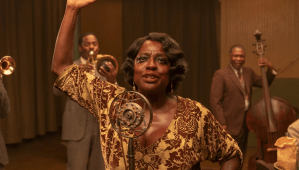 While Boseman’s lead is the biggest draw, Ma Rainey has plenty other aspects deserving of praise. Every character gets time to be fleshed out into feeling like real, complicated people with complicated pasts worth illuminating. Most of the play’s characters are black musicians during a very racist period in American history (you could readily argue that this description applies to all periods). They know they’re being exploited, and they know that these smiling white men with money are only being polite as long as they have something to offer that these men want. Even Ma is aware of her leverage. She’s a successful singer who sells plenty of records, but fame can be fleeting, and her records aren’t selling like they used to, and she knows time is short. She’ll be cast off and replaced by another singer/performer who doesn’t have the wherewithal to push back. Davis (Widows) is a force in this movie, flinty and proud and no-nonsense. She’s great even if she has less screen time than any of the male musicians. It feels like more could be had from exploring her character, her passions, her lesbianism, her sense of self, but Davis still makes quite a presence.
The injustice of the circumstances of the musicians are emblematic of the black experience with America a hundred years hence. Levee has a monologue about his father having to sell his own land to his wife’s attackers. Cutler has a monologue about a preacher who got off on the wrong train stop in Florida and was harassed and threatened by an unruly crowd, his vestments serving him no mercy from a racist mob. Wilson’s wonderful words are brought to sterling life from these seasoned performers and their digressions and reflections better paint a thematic mosaic of shared communal pain. The way the movie holds your attention even when Boseman isn’t on screen is a testament to how engaging and well-realized Wilson’s characters can be no matter how small.
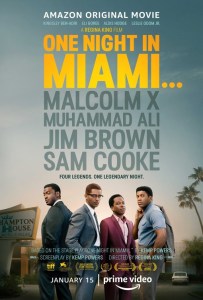 With One Night in Miami, based upon the play by Kemp Powers (co-director of Soul), we follow big names of sports and politics that improbably convened together one night in 1964. Cassius Clay (Eli Goree) has just become heavyweight champion of boxing and is poised to announce his conversion to Islam under the tutelage of Malcolm X (Kingsley Ben-Adir). NFL running back Jim Brown (Aldis Hodge) has crossed over into movies and is starting to think about life after football. Sam Cooke (Leslie Odom Jr.) is riding high off his recording fame but wondering how much more of himself and his artistic voice he should insert. Over the course of this long night, the four men will converse, bond, butt heads, and make changes with their responsibilities.
The movie, adapted by Kemp as well, establishes each participant before bringing them together for that fateful night (inspired by true events, meaning it’s entirely fictionalized). This first act does a fine job of establishing each character but especially a point of insecurity for them that we’ll watch later become raw and, hopefully, reconciled or re-examined. Jim Brown worries that no matter his level of success, he’ll never be legitimate to a section of America. He’s looking at movies as his inroad but even someone of his fame is still the black character killed first. Cassius Clay is hesitant about making his announcement to Mohammad Ali and Islam, second-guessing the commitment he’s signing up for. Sam Cooke is known for his fluffy pop songs and feels like a sellout, needing the credibility of making music that matters. Malcolm X is preparing to break away from the Nation of Islam after his distaste for the hypocrisy of its leadership. He’s positioning Cassius Clay’s announcement as his big pivot point to make a name for his own break-off movement and hopeful that the media attention will translate into new converts.
 The combustibility of this night makes for plenty of compelling drama. Malcolm X is an instigator with the others, spurring them to use their privileged platforms to enact change that can be useful for the Civil Rights movement. He squares his attention on Sam, calling him out for being a tool of white moneymen and even plays him Bob Dylan’s “Blowin’ in the Wind” and asks why this white man is writing more politically active music than Cooke. The singer pushes back, saying he allowed the Rolling Stones to sample his song because it brings more money into his pocket and his songwriters that he can use to profit black businesses. He proclaims he recognizes the system and is playing it to his advantage. They have very different perspectives that clash, making fine drama that spills over. It’s a purity versus pragmatism argument, one that Cooke raises to flout the indulgences he sees in the leadership of the Nation of Islam, a fact we know Malcolm X is aware of and also cannot stomach. It’s also a version of Malcolm X that is more vulnerable than we’re accustomed to seeing. We’re used the strident, righteous Malcolm X, and here he’s much more indecisive and struggling with making some big personal decisions. Leaving his religious organization is verboten, and he’s looking to reform what he views as sinful failings from his peers, and much rests on the publicity of Clay coming forward. This puts Clay in a tough position especially as he feels uncertain about this commitment. The continual push and pull of these four men lead to several interesting discussions, many that become heated, that allow each to open up as a real and complex person, not just a picture in a textbook.
The ensemble is overall quite solid, though the two biggest performers are the ones at the widest ideological divide. Odom Jr. (Hamilton) brings a distinct charisma and has a silky singing voice you wish you got to hear more often, but he’s also hiding a clear disdain. Whether it’s pride or whether it’s shame, it’s there, and Odom harnesses it to make his character feel like a cat ready to strike, wound up from being dismissed by too many others. Ben-Adir (The OA) nails the intonations of Malcolm X but also adds extra layers of doubt and awkwardness. He tries to parry concerns from the other guys that a “party” in this one motel room will be lame by promoting the power of ice cream (only flavor available: vanilla). This is a humbled and scared Malcolm X, one on the precipice of potentially losing his movement and standing to his ethics, and some may argue his ego. Ben-Adir is soulful and presents a fully formed performance more than lazy imitation (he also played President Obama in the recent Comey Rule miniseries for Showtime).
 The biggest question with play adaptations is the challenge of making them feel bigger and more cinematic than contained conversations. Nobody wants to feel trapped in a broom closet. First time film director Regina King (If Beale Street Could Talk) gets the most from her performers and handling of the subject matter, though the various rooms inside and outside the Miami motel provide little in the way of variance. The men go to the roof to watch the fireworks. A couple leave to go get some liquor. The focus is on the men, so the background of the setting isn’t a huge deal to the entertainment. King’s direction is more felt in the performances, as most actors-turned-directors tend to be, and with that she’s aces. With Ma Rainey, director George C. Wolfe (The Immortal Life of Henrietta Lacks) does an excellent job of opening the spaces visually but also making the spaces reflective of mood. The ashy rundown basement where the band practices, the sweat-glistening off the performers with the hot, daub lighting, the peeling paint and broken doors leading to symbolic dead-ends. Wolfe has a stronger command of visuals, not just making his pictures pretty, but also making his play-turned-film feel less confined by its original stage bound limitations.
Ma Rainey’s Black Bottom and One Night in Miami are both deserving of your attention. I found Ma Rainey to be the more engaging movie with the higher artistic peaks, anchored by an amazing and career-defining performance from Chadwick Boseman. One Night in Miami is consistently probing and generous and thoughtful and superbly acted as well. Both movies are great tools for empathy and interesting to take together considering they churn with experiences of black characters fighting for equality from a broken system several decades apart. There have been gains made from the time period of Ma Rainey but Malcolm X’s complaints are extremely valid, and many resonate today in the face of systematic racism and police brutality. Watch both movies when available and welcome more black-penned plays making the big screen leap.
Nate’s Grades:
Ma Rainey’s Black Bottom: A-
One Night in Miami: B+
Share this:

Fatale (2020)
 There were many bad judgements when it came to developing Fatale, the first being that this erotic thriller was worthy of any sustained effort. I’m all for a guilty pleasure genre outing, and we’ve had enough distance from the heyday of erotic thrillers that a re-examination could be due, especially in light of the Me Too era. I was wondering if Fatale was going to present its chief crazy lady, played by two-time Oscar-winner Hilary Swank, as the one who was right all along, and instead of endangering the nervous husband Derrick (Michael Ealy) she was really protecting him. Or maybe the movie was going to posit that Derrick’s perception of events was biased and built upon false assumptions and he was the real villain. Or maybe the Fatal Attraction-esque plot (Swank’s loft even resembles Glenn Close’s abode) would have more commentary on the fact that our resident crazy stalker was a police officer targeting a black man. I was holding out hope there would be something, anything to separate this movie from the glut of junk, but alas, it is merely a better assembled mobile of junk you’ve already seen far too many times in other questionable movies. There is nothing to surprise, to subvert your expectations. It’s depressingly predictable. Amazingly, the writer is David Loughery, who also wrote Obsessed, Lakeview Terrace, and The Intruder, which suggests he’s perhaps copying and pasting and re-arranging familiar story elements at this point. I didn’t care about the plight of Derrick because the movie wants me to see him as a “nice guy” but he’s really a dolt who doesn’t deserve our sympathy. Swank (The Hunt) is badly miscast as a seductress. She comes on so strong so fast that I thought the movie was aiming for self-parody. The fact that Swank is listed as a producer further confounds me. I’m sure she felt playing a sultry villain would be fun, but Swank’s performance needs to go bigger to leave the orbit of an otherwise forgettable and boring genre exercise that wastes everyone’s time. Fatale deserved to be filled with no names and occupy a Cinemax slot between the hours of three and four A.M.
Nate’s Grade: C-
Share this:

The Prom (2020)
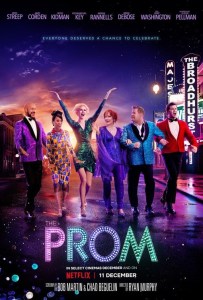 It’s full of big feelings, declarations of self-identity, an unabashed love of the transformative power of theater, and its power of positivity can be a balm to many during this holiday season. The Prom is based on a short-lived Broadway musical about a girl in Indiana who wants to bring her girlfriend to the school prom and the ensuing media controversy that erupts. A team of out-of-work theater actors (Meryl Streep, Anthony Rannels, Nicole Kidman, James Corden) see publicity value in rallying to her cause, so they decamp to Indiana and challenge the homophobic PTA leader (Kerry Washington) who refuses to hold an inclusive prom. Director Ryan Murphy’s style and sensibilities work well within the realm of musical theater; a decade of television curation for FX and now Netflix has made him an expert on camp and flash. The man loves applying slick gloss to trash. His camera is constantly, uncontrollably moving during the numerous musical numbers, attempting to compensate for the generic quality of the majority of them. There are two standouts. The first is when Corden’s character takes our lesbian teen to the mall for a makeover. It’s got a catchy hook and one that becomes a reoccurring theme for the show. The second is when Rannels’ character is pointing out the hypocrisy of local Christians decrying homosexuality but falling short of other Biblical teachings. The story is sweet but un-challenging. The plot exhausts so quickly that I was amazed at one point to discover there was still an hour left in the over two-hour production. Each member of the squad gets a signature number to varying degree of success. The happy ending is affirming and heartfelt but also quite easy and kind of unearned. The amount of catharsis and reconciliation doesn’t gel with the emotional investment and development of these characters. They’re nice but relatively dull, and the industry satire only goes so far to chide the out-of-touch Broadway elites for their own prejudices of Midwest life. The Prom is disposable fluff that will pacify an afternoon.
Nate’s Grade: C+
Share this:

Soul (2020)
 I needed to watch Soul twice before I fully processed how I felt about it. Pixar’s latest animated wonder follows a New York City music teacher named Joe (voiced by Jamie Foxx) who goes into a coma right before his big break playing for a jazz legend. He’s transformed into a cuddly little blue tuft of cloud creature and informed his soul is ready for The Great Beyond. In a nod to Heaven Can Wait, Joe indignantly fights his way back to Earth to reclaim a life he felt was just now getting on track. His ticket back to Earth is through mentoring a surly, pessimistic young soul 22 (Tina Fey) that nobody seems able to reach, even Mother Theresa. Early on, there are two very clear realizations. First, Soul is beautiful to look at and very weird and art deco with its character designs in its spiritual realms. Second, the world building and rules of this special world are quite convoluted. Unlike Inside Out where you were dropped into a new world and all the parts added up with a sense of logic, the spirit world and especially the process of how baby souls become what they are seems hazy and arbitrary and not fully articulated. This confusing world building also includes the idea of people “being in the zone,” lost souls wandering the land as lumbering monsters, and a traveling group of mystics that can meditate their way into this higher plane of existence. That’s even before a second act trip back to Earth that reminded me of Brave and leaned into slapstick and comical misunderstandings. There is a soul guardian on the hunt for Joe to keep things back in order, though the consequences of a soul count being out of whack are never explained. I thought this antagonist character was going to amount to much more but is mostly forgotten. Where Soul succeeds is with its heart about people trying to find their spark, that special something that lifts their spirits and makes them who they are, and I think it’s an important lesson that it’s not the same as a purpose. The comedy banter between Foxx and Fey is solid and there are some funny sequences and a few gags that impressed for going the extra mile. I was interested from the opening moments but I cannot say I was terribly emotionally invested. Part of this is because the movie swiftly runs through so much world building and rule-setting in 90 minutes, partly because the character of Joe is a bit close-minded in how he designates success, and partly because the young character of 22 feels more like a sidekick than a developed supporting role. The musical score by Atticus Ross and Trent Reznor is highly original and evocative. It was providing an emotional resonance and wonder I found missing at other points in the film. It feels very ethereal and propulsive and just new and exciting. The climactic track “Earthbound” feels so stirring and emotional and light. It’s my favorite film score of the year. Soul is a fun and imaginative movie that has some wrinkles with its world building, characterization, and delayed emotional investment, but even a second-tier Pixar movie means it’s still one of the better movies you’ll see for 2020.
Nate’s Grade: B
Share this:

Wonder Woman 1984 (2020)
 Big, colorful, and brimming with optimism easy to scoff at, Wonder Woman 1984 (WW84) is finally here to save Christmas and maybe movie theaters and it’s an escapist treat. It won’t register among the best of superhero cinema but will likely keep a smile on your face.
In 1984, Diana (Gald Gadot) is working at the Smithsonian Museum in Washington D.C. and fighting crime as her costumed alter ego. She’s never quite moved on from the death of Steve Trevor (Chris Pine) back in WWI and she dearly needs some friends. Barbara (Kristen Wiig) is a mousy co-worker who comes across a mystical artifact, a rock that magically grants wishes. Barbara wishes to be strong like her boss/idol Diana and she gains new intoxicating power. Max Lord (Pedro Pascal) is a wannabe TV pitchman and an empty suit, fleecing investors and barely keeping ahead of his own Ponzi scheme. He learns of the magic rock and wishes himself to become the rock itself, turning him into a living genie. From there, Max’s wishes are spinning out of control, placing the world in greater crisis. Diana is torn because, before Max absconded with the wish rock, she wished for her heart’s desire, the return of Steve. Stopping Max and reversing the effect of the wishes means having to say goodbye to Steve all over again.
The original Wonder Woman was a break from the pallid doom and gloom motifs that Zack Snyder established, and the sequel goes even further with its candy-colored recreation of the 1980s. I was wondering if there would be a good reason to set the movie specifically during the 80s, and it’s mostly for the Cold War and Yuppies. I was pleasantly surprised that Jenkins and company don’t overdo the 80s nostalgia or the fish-out-of-water comedy for Steve Trevor. I thought this was going to be the entire reason for the throwback setting, and this time instead of Diana marveling at a modern world she did not understand it would be Steve. If you’ve watched the film’s trailer, then you’ve seen all of those jokes at Steve’s expense. That’s it. WW84 can manage to surprise you, mostly in a pleasant manner. Its sincerity is its biggest virtue. It’s a movie about plenty of goofy things but at its core it’s about relatable desires and struggle.
 WW84 is an improvement over the original in the action department. Returning director Patty Jenkins feels freed of emulating Snyder’s house style and brings a welcomed sense of levity and playfulness to the action. The fight choreography makes significant use of Diana’s lasso, opening up the playing field for her to swing around wildly, at times even literally riding the lightning. At points the lasso seems to have a mind of its own and able to divide into fragments. It’s something that helps separate WW84 from the glut of other superhero movies and it offers pleasing visual variance for the fights. There’s a car chase midway through the film where Diana has to leap from speeding truck to speeding truck, dodging goon gunfire. It’s an exciting and sustained action sequence, yet even across the Middle East, chase clichés will reappear, like dumb kids playing in the street ignorant to any emerging noise like a caravan of speeding vehicles. Jenkins seems even more adept behind the camera for the action, delivering big stunts and memorable spectacle ready to make a splash on a big screen. However, some of the CGI can be shockingly dodgy for a big-budget blockbuster and a final confrontation with a CGI-hybrid creature unfortunately reminded me of the lamentable Cats.
The magic wish rock setup shouldn’t be any harder to believe than, say, a secret island of immortal female warriors or just about anything in the absurd and absurdly entertaining 2018 Aquaman feature film. If I can accept a drumming octopus, I can accept a magic wish rock. WW84 hinges on the concept of the drawbacks of creating your own false reality where every wish comes with a cost and an increasing flood of alarming consequences. It it better to just accept the comfort of lies or accept hard truths? The characters even name-check the classic short story The Monkey’s Paw recognizing the ironic trap. That doesn’t stop characters from struggling with the pull of their burning desires, and it makes for an agreeable return for Steve Trevor. Ever since it was revealed that Pine’s character was returning, I was worried what the possible explanations could have been, pessimistic it would be satisfying. Is he going to be a clone? Reincarnation? The grandson who happens to look identical? The screenplay by Jenkins, Geoff Johns, and Dave Callaham finds a way to make it work by bringing him back through magic but with restrictions. In a very Source Code sort of style, Steve is operating in someone else’s body, but only Diana sees Steve. It’s a decision that frames the return in a personal way that also reminds us what is eating at her. It’s been 70 years and she hasn’t moved on from the man she loved, which can be viewed as sad, romantic, and unquestionably unhealthy. It’s a familiar character arc, having to move on from a loved one and accept grief, but it still works, and it humanizes this mighty Amazon warrior woman. It’s a worthwhile development that opens up these living gods into emotional, vulnerable beings.
 With the wish plot comes some gripes and lingering questions. I kept asking, “Is everyone simply not seeing what’s happening?” or, “Is everyone forgetting what has happened?” The scale of the wish consequences is substantial and very public but it never feels like the world is registering just how fantastic these supernatural shenanigans are. In 1984, Wonder Woman is fighting crime as a hobby but still not a named and identified hero. The world does not seem aware of the presence of super beings and amazing powers living among us. So as Max continues his wish-granting ways there are immediate consequences of huge staggering scale, but nobody seems to register how weird and not normal things are, like a giant 50-foot wall suddenly appearing in Egypt. People should be asking what is going on or what others are doing. Therein lies the lingering problem with setting this movie in the past. Much like the 80s-set X-Men: Apocalypse, the events presented generate questions to why future-set movies seem to be ignorant of these same events. If Wonder Woman comes forward and addresses the world, why is she still hiding her identity in 2016’s Batman vs. Superman? And if she learns more about her own super abilities, why does she not make use of these very helpful skills in 2017’s Justice League? These sound like quibbles, and they mostly are, but the movie would have benefited from being a little more judicious with its rules and applications because I started wondering if everyone was oblivious.
I was genuinely surprised how much screen time and consideration was afforded to the primary villain. No, I’m not talking about Barbara/Cheetah, who could have been completely cut from the film. I’m talking about Max Lord. He’s arguably in the film as much as Diana. He’s a con man trying to be a successful TV pitchman and oil tycoon but really he’s trying to be a “somebody” to make his son proud. The problem is that his goal always seems to be just out of reach no matter what is gained. This part confused me. After successful wishes with power and money, Max seems to desperately continue searching for more. I suppose it could just be a general “power-hungry corruption” explanation but I kept asking when enough was enough, and that’s likely the point. I don’t know if Max Lord is a character deserving of this much consideration, but the approach appeals to the film’s empathetic mentality that no one is beyond reach. Rather than the villain having to be physically defeated, WW84 rests on emotionally appealing to a broken man’s sense of self. It makes for a more intriguing conclusion in a superhero realm than merely out-punching the CGI antagonist, like the clunky, lumbering finale from the prior Wonder Woman movie.
The conclusion of WW84 rests upon millions having to make a personal sacrifice for the greater good, which is a lovely sentiment that we could all use at this point after a dispiriting 2020. However, this year has also proven for me that the conclusion of WW84 is pure escapist fantasy. Throughout a deadly pandemic, the United States has been beset by too many people refusing to endure inconveniences in the name of protecting others and saving lives from COVID-19. The cost-benefit doesn’t add up for many if they can’t see the results, never mind the harsh yet sterile reality of over 300,000 dead Americans and counting aided by this selfish obstinance.
 Gadot might not ever escape the long shadow of playing a famous superhero but she’s settled into the role nicely and even gets to flex some untapped acting muscles. I was skeptical of Gadot early when she was hired but became a believer in 2017. She definitely has an unmistakable presence onscreen. Gadot’s best moments aren’t even the punching and kicking, which she does with gusto, but the moments where she has to make grand appeals and hard decisions. There are a few emotional moments where Gadot’s familiarity with the character blends together and she and the filmmakers are not afraid to show strength in other ways other than brawn. Gadot still has a very enjoyable chemistry with Pine (Hell or High Water) that makes them a winning pair. One of the film’s highlights is a personal flight through fireworks that delivers sheer joy for Steve Trevor. His awe about the future and getting one more spin with life itself is heartwarming. Pascal (The Mandalorian) is going big and hammy with his performance that reminded me of the Richard Donner Superman movies. Wiig (Ghostbusters) is the big miss for me. She’s not convincing as a threatening foe and her early scenes as a klutzy, put-upon dweeb feel overdone and yet insufficient. We needed more establishment of Barbara’s life before her wish to better recognize why she would never want to go back. One reoccurring street harasser doesn’t cut it.
Wonder Woman 1984 is fun, splashy, and doesn’t lose sight of its characters and their emotional states even as it elevates the world-annihilation stakes. It’s a movie that seems more confident in its identity than the first film. It accepts that it can be silly, it can be sincere, it can be exciting, it can be smaller and more personal, it can be hokey, it can appeal to your best self. It’s overly long (the opening flashback of young Dianna in the Amazon Games could have been ditched entirely) and not everything works, but the problems are easier to digest and forgive with what does work. It might be the last blockbuster for some time given the uncertain theatrical landscape so I’ll take it. WW84 isn’t the swaggering solo venture the first film proved to be, but I would say it still makes for a mostly satisfying and fun experience that plays to the strength of the creative team.
Nate’s Grade: B-
Share this:

The Wager (2020)
 The Wager is a gob smacking example about the utmost significance of screenplay structure and a lesson for others to learn and avoid. I was beside myself with frustration from this 90-minute movie available on Amazon streaming, occasionally yelling at my TV screen, but mostly I was dumbfounded by the storytelling choices. The wager of the title, which is also prominently noted in the synopsis attached for the film, doesn’t even occur until 78 minutes in. That’s right, you don’t get the hook of the movie until the very end. This astounds me. The Wager is an Ohio-made faith-based indie that generally bored me and occasionally made me guffaw or scream in bafflement. I’d wager unless you’re already among the faithful flock, you’re going to be unmoved and more than a little mystified by this tone-deaf drama.
Bruce (Ty Shelton) is a young man abandoned as a child and raised in the foster system. He gets into trouble at school and eventually gets plunged into a life of crime against his will. As an adult (Jim Gloyd), he’s strung out on drugs and resorting to petty robbery to find his scores. His childhood friend Suzy (Stephanie Haff) runs into him at a casino and offers spiritual outreach, but Bruce wants nothing to do with God. That is until an angel enters his life with a big bet about reliving Bruce’s tortured past with a new perspective.
 If you’re going to present a Christian spin on the classic It’s a Wonderful Life formula, having a guardian angel intervene in a person’s life to show them a highlight reel of memories and what could have been, why wait until there’s only ten or so minutes left in your entire movie? Once Bruce does review his tortured life, it includes scenes we’ve already seen, including his birth, which begs the question why we needed to see these moments twice. It’s not like what came before this celestial review needed 78 minutes of undivided attention. For the first 15 minutes, all that happens is that an abused woman gives birth, drops the baby on the doorstep of the police, and the officers call social services. Did we need that to take up 15 minutes? From there we witness young Bruce getting in trouble at school and then being kidnapped (oh, there will definitely be more on this later) and living life as a drug dealer. We spend an hour establishing Bruce’s life as being awful, from child to adult, and it’s repetitive and deflating. How many scenes do we need to see of Bruce sleeping on the ground or shooting up drugs or being pushed around? Not only could the far, far majority of this plotting have been condensed considerably, it would have been more impactful to watch Bruce reflect on his experiences by re-living them rather than dwelling in the extended misery that made me wonder if this was going to be a modern-day passion play. Truly, imagine It’s a Wonderful Life but we spent an hour of watching George Bailey haggle over business practices with Mr. Potter. This central screenwriting miscue is just so catastrophic to the entertainment factor.
We could have easily established adult Bruce being a troubled man and the people of his past having difficulty recognizing the man they thought they knew from the movie’s start. This would establish that bad things have happened, and he could hint at more that he doesn’t want to reveal, and then the end of your first act could be him hitting rock bottom and getting his angelic intervention. We don’t need more than 20-25 minutes to establish how crummy this man’s life is. When given an hour, it just becomes too crushing and risks undercutting the message of personal redemption. Learning with the character about his life’s hardships would be more engaging with him having to come face-to-face with the them and his guardian angel partner. It also allows us to not have to be dependent on chronology and jump around to the major events we need to best define Bruce. This obvious structure makes so much sense that I am shocked the filmmakers missed out. Having an angelic guide would also force the character into conversation and confrontation and potential reflection, giving us better insight into the man than simply watching the events on our own without commentary. Simply put, you shouldn’t name your movie after a key plot event that happens in the last 15 minutes unless you’re a disaster movie and the Big One is finally striking.
 The mistakes in plot structure also harm the overall slack pacing. The pacing is practically nonexistent for long portions. The energy level is so subdued that I thought I might just fall asleep. The camera movements will often utilize long takes and slow pans with minimal cuts, which just makes the lack of energy that much more palpable. So many dialogue exchanges sound like people are just reanimated zombies, and so much dialogue feels needlessly expositional. People talk in that phony way where they’re constantly repeating what the other person says but turning it into a question. It’s an inauthentic way of conversing that reminded me of Neil Breen’s silly films. Take these examples of poor onscreen conversations and see what I’m talking about:
“I have no clue what we’re going to do in Science today.”
“Me neither. I guess we’ll find out soon.”
“You’re right. See you there.”
Wow, did we need to be privy for that vital information? Or how about:
“I know you have your troubles, but I know you.”
“No, you don’t. That’s just how I act around you. I don’t think you know.”
“Just stop. I know what you’re trying to do. You’re trying to make excuses rather than accepting yourself for who you really are.”
Isn’t writing better when characters just blurt out another person’s internal dilemma for the audience? Or:
“He asked me for Herb’s Garage.”
“Oh yeah. I remember that place.”
“We all did. So, I didn’t expect a thing.”
We needed less time with scenes like these, where it feels like characters are detached and drifting with excess time to fill. There’s one long hallway exchange between a young Bruce and Suzy that lasts over a minute of chit-chat that feels like they’re just reading off the script. The performances have that rushed feeling, of sentences starting immediately after the next, but lacking an energy level that would justify the delivery. Simply put, when two or more characters are sitting down and talking, you might as well go get a refill or hit the bathroom. The chances will be good they will still be in that same sedate conversation and you will have missed little. This is why the structural choice to spend 78 MINUTES OF MOVIE on establishment scenes is so maddening, because writer/producer/co-star Gloyd did not have the material to cover the time.
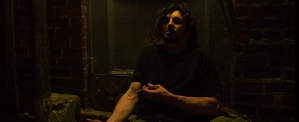 Let’s get into what I think is the most egregious portion of The Wager and that is the lengthy middle where Bruce gets kidnapped and coerced into a life of crime. I thought we were headed for some Oliver Twist territory and we’d watch Bruce’s struggles over the pressure to commit criminal acts he was uncomfortable doing, maybe even while he schemed to escape. First off, the fact that the criminals are stereotypical depictions of black males made me sigh. I also was confounded why they placed so much emphasis on kidnapping teenagers and runaways to serve as drug dealers. When you have access to money and power, you have people that will come to you for opportunities (you’re a job creator). You don’t need to kidnap children and hold them hostage to sell your wares, especially having to worry whether they will run away or whether someone will recognize them as missing. It’s stupid risk. Considering these men just sit in the car and watch young Bruce make his first street corner deal, it’s not like they’re being terribly conspicuous.
And then there’s the undetermined time jump, which is revealed during one of those static camera angle montages. It’s a nice surprise; however, it means that Bruce has been sleeping on this same dirty mattress in the same room for, like, twenty or thirty years (also none of the items on the shelves moved in that same time, meaning Bruce never touched a thing in his living quarters or he is very, very particular about where things should go). The same crime bosses are still alive and in their same position of leadership. Bruce is now played by Gloyd in a horrendous looking ratty wig and I needed to know desperately how much time has passed. Gloyd definitely looks to be in his 40s, and this significant jump in time raises so many irksome questions. The police haven’t found adult Bruce in 30 years but the same officer who found him as a baby, who is still alive and working as a security officer, can recognize him on the spot? How old are these same criminal leaders then, and Bruce hasn’t ascended higher up the organization than street dealer? If we’re jumping that far ahead, wouldn’t it make more sense for Bruce to be the new leader, letting us know he has been molded under the negative influence of his captors? If he’s just going to be a drug-addicted adult then why do we need to jump so far ahead in time? The answer, it seems, is so that the writer/producer can have a starring role. That’s fine, but we could have done more structurally to maximize the drama rather than dwelling in redundant misery.
Let’s analyze the spiritual message at the heart of The Wager. Bruce’s life is pretty bad. He’s in and out of foster homes, gets abducted and held hostage as a criminal lackey, becomes addicted to drugs and desperate, and then homeless and contemplating suicide. He’s had, by all accounts, a hard go of things. He’s understandably resentful about the forces he feels have conspired to lock him into agony, so when other characters raise the notion of a loving God that has his back and watches over him, Bruce scoffs and views his life as refutation. There’s even a nature versus nurture argument to be had. In fact, the first time Bruce went to Suzy’s church was when he was abducted. The cop character tells Bruce he’s been praying for him since the moment they first crossed paths, but considering what Bruce has endured, that’s not exactly a ringing endorsement for the power of prayer. Now obviously Bruce will conclude with accepting the love of God and finding a greater purpose with his life, but why did we need to wait so long? The end is never going to be in doubt with a Christian-themed indie any more than whether or not James Bond will get out of his latest scrape. That’s why refocusing the structure onto Bruce having to confront an angel over his feelings of abandonment from God would be far more dynamic, powerful, and I’ll say it, even Christian than the message as presented. Don’t get me wrong. I’m not questioning the faith and credentials of the filmmakers. I’m saying the way they go about telling their story makes the overall message less believably impactful.
 The acting in The Wager is typically rather flat, given that energy-sapping direction that makes each scene feel twice as long. However, there is one actor I want to single out and that’s Cameron Arnett (Overcomer) as the unfortunately named Gabe Angelus (get it?). Arnett reappears in different roles, my favorite being a batty homeless man that helps out Bruce from time to time. In that moment, Arnett is so believable and arguably natural even while playing a highly mannered character. He immediately drew my attention and I remarked, “Here’s a good actor.” As for the other thespians, it’s hard for me to tell whether they just didn’t get the material to showcase their skills or whether those skills are in need of polishing. I know KateLynn Newberry (Widow’s Point, Dark Iris) as the queen of Ohio indies, and she’s pretty much wasted as a doting wife who lives to ask her husband what he wants for dinner. Fun fact: one of the crime lords is played by former Columbus resident and famous boxer James “Buster” Douglas.
With The Wager, I couldn’t believe what I was watching. Obvious dramatic setups seem to be sorely missed, a structural reformatting was in dire need to maximize the hook, because without that it’s like watching one poor man spiral and suffer for an entire feature-length film. It feels like overwrought overkill. Do we need a half-hour of a guy slinging drugs and sticking needles in his arm, without any supporting characters to interact with, or can this information be conveyed with practiced brevity? I am amazed at so many choices that left me scratching my head. The movie ends with our guardian angel staring into the screen and laughing maniacally for several prolonged seconds, even over the cut to black. What? This is the kind of behavior we associate with evil beings. Why do we need a flashback of a young girl running out the door when the adult version could have just relayed this event in words? I know Christian movie audiences aren’t exactly the most discerning audiences, prioritizing message over storytelling and technical achievement, but the decisions that the filmmakers make impair that faithful message. You don’t make an It’s a Wonderful Life story and just reserve it for the last 15 minutes. I advise select people to watch The Wager simply to learn what not to do with the importance of screenwriting structure. That’s its ultimate cautionary tale.
Nate’s Grade: C-
Share this:

The Midnight Sky (2020)

The Midnight Sky is really two sci-fi survival movies in one. In 2040, the world is experiencing a planet-killing ecological disaster. A team of astronauts, lead by a pregnant Sully (Felicity Jones), is returning from a multi-year mission to check if a moon of Jupiter is habitable. On Earth, Augustine (George Clooney with a Santa beard) is the lone scientist left at an Arctic research station. He has cancer and sees his life as having run its course, that is, until he finds a small girl (Caoilinn Springall) who missed being evacuated. They band together to brave the wintry, poisonous elements to travel to another outpost to better communicate with the returning astronauts and possibly secure an escape from this dying world. It sounds like it should be a very exciting and interesting movie. There are even sinking ice floes, space walks amidst deadly asteroids, and Augustine having to stop at points lest he overtax his frail body. In practice, the movie isn’t so much exciting as it is ponderous, grasping for a larger philosophy and existential meaning that seems entirely elusive. We’re treated to several flashbacks of a young Augustine (different actor but still voiced by Clooney) that seem superfluous until a grand reveal that made me audibly groan so loud I thought my neighbors would complain. I kept waiting for the relevancy between the stories to be demonstrated, and when it happened it was not worth the two-hour wait. The realization was so hokey that it retroactively made me dislike the movie’s moments that had been working earlier. As far as direction, this might be one of Clooney’s strongest turns as a visual storyteller, even if he borrows liberally from other recent sci-fi movies, notably Gravity, The Martian, and Interstellar. There are moments of stark beauty and terror. Ultimately, the whole movie amounts to a sad man taking stock of his life and legacy (is he a metaphor for the Earth? Is the Earth a metaphor for him?), and I’m still wondering how something this glum could also be so maudlin. The pacing is another issue. I was always eager to jump to the other storyline to see what they were doing (a cinematic “grass is greener” mindset). The acting is fine and I wish I could have spent more time getting to know the crew of this space mission (including Kyle Chandler, Demian Bichir, David Oyelowo, and Tiffany Boone) or conversely gotten to feel more of bond between Augustine and his near-mute charge that felt like it was providing insight into this man. Looking back, there’s a reason for some of the stilted characterization, but having an excuse for why your characters aren’t better developed is like preparing an excuse why you did something self-sabotaging. The rest of The Midnight Sky doesn’t better compensate for this storytelling choice, and so the movie feels too dull, frustrating, opaque, and overly manipulative, aided and abetted by Alexandre Desplat’s sappy score. No more than the sum of its parts, you can soon watch The Midnight Sky on Netflix and fall asleep to it on your own couch.
Nate’s Grade: C+
Share this:

Minari (2020)
 Gentle, heartwarming, and deeply authentic, writer/director Lee Issac Chung’s semi-autobiographical movie about growing up in rural Arkansas in the 1980s won the top honors at Sundance and is poised for an Oscar run by its studio into 2021. Each moment in Minari feels plucked, fully realized, from the personal experiences of Chung. There’s an intimacy here that cannot be imitated. It’s a story about immigration, assimilation, hopes and the American dream, as well as struggles, setbacks, economic anxiety, and fitting in and figuring out the world around you. We spend time equally between the parents (Steven Yeun, Jeri Han) and their youngest child, David (Alan S. Kim), as the Korean transplants try their luck as farmers. Their elderly grandmother (Yuh-Jung Youn) moves in with them to provide childcare and assistance where able. At first, the kids declare their grandmother is “not a real grandmother” as she doesn’t bake cookies or do typical grandmother pastimes, but in time, she learns the ways of the new culture and becomes a lover of televised professional wrestling. It’s a small-scale story about a family trying to stake their claim at a better life and beset with challenges; the son has a heart murmur, their property is so far from other Korean immigrants to be part of a community, the land’s sources of water can be fickle for crops, the mounting mortgage payments. It ultimately becomes a push between personal goals and family unity, and then Minari ends in a way that made me feel like I was cheated out of a real ending. I suppose there’s a lesson to be had about life just moving on, resetting after tragic setbacks, and this plays into the real-life rhythms of this gently observational movie with its well of compassion. I also found myself starting and stopping the movie often and stretching out my viewing as I was distracted with other tasks. I never doubted Chung’s love for his story and his characters. Like the similarly themed Nomadland, this is a movie of quiet moments, and your mileage will vary whether they add up to a more complete whole or understanding. There are moments that tugged at my heart, like the grandmother hugging her grandson tight and swearing to protect him from any death coming in his sleep, or the kids folding paper airplanes that declared “Don’t Fight” as their parents argue. It’s a mostly restrained, quiet, slow-moving sort of story that gives you a peak into the lives of others. It’s so specific and finely textured to be genuinely authentic. The family’s very normality as an American immigrant experience is the movie’s big thesis and a reminder that there are thousands more stories to be told about what it means to be an American.
Nate’s Grade: B
Share this:

Freaky (2020)
 A body swap movie set in a slasher universe, Freaky is a fun and gory romp that still feels like it could have been even more entertaining with the possibility of its premise. A masked serial killer (Vince Vaughn) stabs a teenage girl (Kathryn Newton) with a magic Mayan knife and they swap places and must learn to cope in their new bodies and roles. The teen-in-adult body is wonderfully played by Vaughn, who seems to be really enjoying himself with a silly role that pushes him outside his smooth-talking leading man roles. He might be playing up the girlishness and higher-pitched voice but his energy level is high and provides plenty of entertainment with the absurdity. There are a few inspired moments developed from the crazy premise, like when Vaughn has a heart-to-heart with his/her mother at work, able to offer insight into the daughter she feels she is failing, and the mother becomes romantically intrigued by this mysterious man. There is a first kiss sequence in the backseat of a car that is so awkward but owns its outrageous quality. I wish the movie from co-writer/director Christopher Landon (Happy Death Day) made better use of its fruitful premise. There are so many more bizarre scenarios that could be gleaned here, especially if the masked serial killer had more of a personality. Clearly modeled after the silent stalkers like Michael Myers and Jason Voorhees, this makes the film feel too one-sided with ideas. Sure the teenage girl is now to be feared, dresses sharper, and kills her high school annoyances, but it doesn’t make for much of a creative cat-and-mouse game when it comes to outsmarting the original owner of this new body. I will also champion the gory kill scenes as above average in their conception and execution. It’s really over-the-top and memorable and I wish there had been even more wild splatter. Freaky is a decidedly fun movie from the Blumhouse assembly line but I can’t help wishing it was a little bit funnier, a little bit weirder, and little bit more imaginative. The parts were there to make this hilarious and brilliantly creative, and settling for chuckles and disposable entertainment feels like a nagging compromise.
Nate’s Grade: B


 nathanzoebl
You must be logged in to post a comment.