Fall (2022)
 It’s no more, no less than its bald premise, but with the benefit of some nifty aerial photography to heighten viewer veritgo, some seamless special effects, and a streamlined story structure, Fall is serviceable survivor escapsism. The motivation is pretty inconsequential as to why these two young women (Grace Caroline Currey, Virginia Gardner) are climbing an old radio tower, but they do, they reach the top, and then the ladder crumbles below them, trapping them way up high. From there, it becomes a survival thriller that isn’t as dumb as its straightforward title and premise might have you believe. I recall 2010’s Frozen, not the popular Disney musical, but the small indie thriller about a group of characters stranded on an abandoned ski lift. It’s a similar scenario and becomes less of a question over whether they will get down and more how they will endure the elements and simply survive long enough to draw attention to their plight. If you have a fear of heights, there are several deft moments that draw out that anxiety-ridden tension; I even gasped a few times at the movement from teetering positions and leaps. There’s a late twist I wasn’t expecting that I think is handled well, and there’s just enough character introspection to keep things interesting without de-escalating the urgency and tension of the premise. Also, Fall originally had a lot more swearing and 30-some F-bombs and these were eliminated from the use of a Deep Fake A.I. software that swapped the actors’ mouths into contorting new PG-13-approved syllables. I didn’t even notice it, which is a sign of how remarkable the technology has become and how cost-effective (the budget for Fall was only $3 million). There’s little else to this than being a well-developed, well-executed 100-minute thrill ride (you get Jeffrey Dean Morgan for exactly two whole scenes) and when you’re looking for fleeting fun, that’s certainly agreeable disposable entertainment.
Nate’s Grade: B
Share this:

Clerks III (2022)
 I’m at a crossroads with writer/director Kevin Smith. Well, I might actually have already switched sides but don’t want to fully admit it yet even if it’s self-evident. I’ve written about this before but Smith was one of those major cinematic voices that helped shape my sense of indie film and even comedy during my formative teenage years. I became a diehard fan, watched every movie several times and had all their interconnected Easter eggs memorized, and I’ve seen the man in person three times, one time recorded for a college Q&A DVD release. In short, I was most definitely a Kevin Smith super fan. Then over the last five years or so, things began to change, or more accurately my perception of Smith’s movies began to change. The attempts at humor were strained, obvious, and gassed, and it felt like his biting wit and raunch had transformed into mawkish nostalgia. The man in his twenties who made comedies I identified with and loved became a man in his forties with different priorities and a different perspective. He evolved. However, I am no static creature, and I too was evolving, and my fanfare for Smith’s comedy sensibility has transformed into more of a pained grimace. I re-watched Dogma in 2019 and Jay and Silent Bob Strike Back in 2021, as well as its second-banana imitation Jay and Silent Bob Reboot in 2019, and my assessment was only reaffirmed with each movie: I’ve outgrown my old influence. As a big screen storyteller, Smith has become more and more insular, inaccessible, and beholden to eroding fan-service, almost like he too is trying to bid goodbye to his own universe of characters. Maybe that will be the big reveal, Smith putting all his toys back away while he still can.
Clerks III is a return to the old QuickStop convenience store in Red Bank, New Jersey, last seen in 2006 with friends and malcontents Dante Hicks (Brian O’Halloran) and Randall (Jeff Anderson) as the new owners. Clerks II seemingly ended on a moment of triumph, of the guys returning to their roots but also stepping up, assuming ownership responsibilities. However, many can also view the ending as a darker indictment on what the future held for these men. Sixteen years later, what have these men accomplished? That’s the thrust of this third film, following Randal’s brush with death from a heart attack (based upon Smith’s own life-threatening experience). He re-evaluates his life at 50 and yearns to make a movie about his life and his personal experiences, which just happens to be life in service at the QuickStop. He bands together with Dante as producer and they put together a ragtag crew, including old buddies now selling their own state-approved brand of bud, Jay (Jason Mewes) and Silent Bob (Smith), to make their movie.
 In many ways, Clerks III is like a remake of Clerks with the characters of Clerks making their own version of Clerks only thirty years removed from the actual scenes of Clerks. There’s a bit of a snake eating its own tail feeling; many scenes are re-creations of moments from the original Clerks and with the same actors. It’s slightly fun to see even the smaller non-actors come back to recreate these moments, but it also makes the movie feel like an extended high school reunion (“Oh look, that guy lost his hair.”). If you were not a fan of Clerks, well you shouldn’t really be watching the third film in the series, but if you didn’t have an attachment to these characters and this odd world, seeing older versions of former fleeting characters, from the Chewlie’s Gum rep to the angry ruse-baiting video store customer or the woman who manually masturbates caged animals, would feel like flipping through someone else’s photo album, devoid of whatever nostalgic or emotion was intended.
As a lifelong fan of Smith’s filmography, or at least a former lifelong fan now transitioning to accepting a parting of ways, it’s neat to see this reunion of sorts, but it’s also ultimately pointless from a narrative standpoint. Smith is treading the same ground now with irony and distance. Actually, the irony gives way more to sentimentality. It’s not an insult to say that Smith has gotten increasingly softer as he’s gotten older, blunting much of his comedy edge. He comes across as a sincere man who really cares for the people in his life, including these very people that contributed their time and efforts in 1992 to help make a young man’s dream come true. I understand his desire to pay back all the little people, to check back with them one more time, and to have Clerks III serve as a love letter to those who were there from the very beginning. If you’re plugged into this universe, you might smile and you might also feel some of the love.
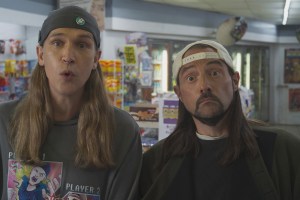 There are famous cameos to balance out the lesser known faces from the original Clerks. You’ll see Ben Affleck hamming it up, Justin Long doing a funny voice, Fred Armisen grasping for something to do, and Sarah Michelle Gellar’s first film role since 2012 and first live-action film role since 2009’s Possession (Gellar was a voice on Smith’s Masters of the Universe animated series on Netflix). The two big additions from Clerks II also return. Trevor Fehrman, returning as the socially awkward coworker Elias, is the funniest part of the movie as his character goes through a spiritual crisis. He feels let down by Jesus and commits himself to Satan, and his runway show’s worth of crazy outfits and cosplays throughout the movie is the funniest joke that never even bears mentioning, which only makes it funnier (he too has his own Silent Bob-esque quiet sidekick played with good spirits by Austin Zajur). Elias was the voice of a younger generation of Internet fandom in Clerks II, allowing Smith his opportunity to criticize modern geek pop-culture, like the Star Wars prequels and Lord of the Rings. That doesn’t really happen in Clerks III despite 16 years of Dante and Randal’s cinematic absence. Smith doesn’t even nibble or good-naturedly rib any pop-culture landscape. Even the jokes about NFTs feel hesitant and wishy-washy and lazy. Smith was defined by his ribald wit and hyper-literate dialogue, and now his comedy has become inane slapstick and pandering nods meant to serve as a replacement for an absent punchline. It’s disappointing how little the comedy registers now.
The biggest addition to the Clerks trilogy was Rosario Dawson, now even more popular as she’s firmly solidified in the Star Wars TV empire. I figured she would have been written out of the franchise as her availability was going to be far more limited. It’s not a spoiler considering it’s revealed within the first minute or so, but Dawson’s character, Becky, who was pregnant with Dante’s child and this presented a new route for his future, is dead. Not only is Becky gone but she died in 2006 from a drunk driver, which means that her unborn child with Dante also died, though this is never touched upon and that seems truly bizarre because much of Dante’s characterization in this movie will be his prison of grief he’s been unable to break from. It’s been 16 years and Dante has not moved on, and I wish more of this was explored thoughtfully. He views himself as a man stuck, now in his 50s, and having missed his off-ramp to another and better life. Without more careful attention, it can come across like a schlub holding onto his grief as a mistaken form of identity. Even that description could be interesting, but you’re not going to get that level of drama in something like Clerks III. Dawson does have a few appearances as a ghostly memory trying to help Dante move on, though if this is the case, I feel like she should be reaching some kind of breaking point after 16 years of effort.
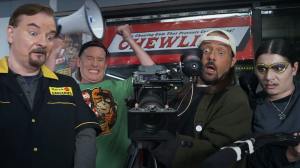 By the end of Clerks III, it’s clear that Smith intends for this to be the concluding chapter, sending off these characters as reflections of his own film history. The focus of the final act is far more dramatic, as the act of retelling one’s life story as a movie becomes its own way of sharing the love and admiration of a decades-long friendship. I don’t quite think Smith gets to the dramatic heights he’s reaching for, even when some pretty significant and surprising events play out. Too much of the movie is like watching a low-budget remake of Clerks thirty years late, and while I’m a sucker for movies about the making of movies, and those fun found families of creatives banding together, the structural vehicle and conceit for Clerks III left much to be desired. If you remember the scenes of 1994’s Clerks, watching Clerks III is like reliving them as a strange Lynchian dream where the edges are smudged and everything isn’t quite as it should be. At this point, a new Kevin Smith movie is made strictly for the most diehard of fans. I can see that ever-shrinking pool of fans warmly smiling and chuckling from the movie but more in nostalgic recognition of time gone by. It’s nice to revisit these characters, as I’ve been eager to see what life has dealt them since Clerks II. You can feel Smith’s affection for these people, the ones who catapulted him into fame, but the movie is too backward-looking and uninterested in its own comedy as Smith winds down.
Nate’s Grade: C
Share this:

Secretary (2002) [Review Re-View]

Originally released September 20, 2002:
Secretary is a new romantic comedy with a few kinks to it. It’s actually the most romantic S&M movie ever. It’s the first S&M romantic comedy since maybe Garry Marshall’s disastrous 1994 Exit to Eden. I’m still trying to get the image of Rosie O’Donnell in a bondage mask out of my ongoing nightmares.
Lee Halloway (Maggie Gyllenhaal) is fresh from a stop at a mental institution for her hazardous habit of cutting herself to feel relief. Her overbearing mother stashes the entire kitchen cutlery in a locked cabinet. The sheltered Lee resorts back to a kiddy make-up box stashed under her home bed. Instead of colorful brushes and arrays of lipstick, she has a selection of sharp objects. Lee goes job hunting to step back from her habit, and is hired as a secretary to E. Edward Gray (James Spader). He is a rigid taskmaster who delights in pointing out typographical errors with his red marker, his weapon of choice. Gray enjoys his dominance and Lee complies, even if it’s routing through garbage. He ticks away Lee’s flaws like a checklist of annoyance but also appears to have genuine concern for her. When he notices her wounds Gray confronts her and convinces Lee to stop cutting herself.
The turning point arrives when Gray orders Lee into his office one afternoon. He commands her to bend over his desk and then delivers a sound spanking. Lee stares at her purple rump with fascination, like something has been awakened inside her. Soon enough Lee purposely makes typos so she can re-assume her spanking position.
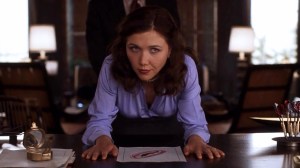 Maggie Gyllenhaal is a cinematic find with a fearless and breathtaking performance that is at once delicate, nervous, self-controlled, seductive and delightful. Gyllenhaal, with her heart-like face and pert lips, radiates star quality. She allows the audience into Lee”s head and we quickly fall in love with this peculiar yet charming heroine. If there is any justice in this world Gyllenhaal should at least get an Oscar nomination (she didn’t). Spader can do this left-of-center creepy character stuff in his sleep.
Secretary on the surface may seem like a fetish flick but it’s no different than boy (sadist) meets girl (masochist) and falls in love. Director Steven Shainberg treads carefully around serious subject matter, like Lee’s self-mutilation, to focus on these two very special characters. Secretary isn’t making any loud statements on sadomasochism or post-feminism, it’s just showing us that S&M is the route these two people take to find true love. It doesn’t judge them for their unconventional tastes and neither should we. This is one of the finest romances in recent memory and it seems to come from one of the most unlikely places.
Sadomasochism has been predominantly shown involving pain or some leather-masked madman evoking torture. Secretary may be the film that shows there can be pleasures with pain. Some people regard what Lee and Edward do as sick, perverted, or downright wrong. Secretary is a foot in the door to get people to understand what willing sadomasochism really is about. We all have fetishes and interests, and S&M is the number one fetish truth be told. This isn’t your everyday romance.
Obviously, this is a movie that will not appeal to everyone. The relationship between our leads is surprisingly complex but gentle and even sweet (if that’s the proper word for an S&M romantic comedy). Secretary shows that it truly takes different strokes and, despite an overly silly ending, is the most pleasing romance of the year. You’ll never look at red felt pens the same.
Nate’s Grade: A
——————————————————
WRITER REFLECTIONS 20 YEARS LATER

I’ll be honest with you, dear reader, because I think you deserve that. I didn’t recently re-watch Secretary. I did re-watch it a year or two ago, and the return experience was so jarring that I didn’t feel that I would greatly benefit from watching it so soon again, but I knew I would have to include it on my 2002 re-watch list when it was time. When I first watched it in 2002, I was smitten with its offbeat charms about an unconventional romance through the BDSM community and a young woman’s self-actualization through accepting her kinks. It was a star-making performance from Maggie Gyllenhaal (originally was going to be Gwyneth Paltrow) and as a sucker for quirky romances, it was one of my favorite films of the year. Nearly two decades later, I took out my DVD copy to share with my now fiancé, who is also a fan of quirky romances and who had never watched Secretary. Surely, I thought, she would be entertained. Dear reader, she was very not entertained. She was horrified. She was shaking with disgust. She was having a literal violent reaction to the movie and its onscreen display of what constituted romance, and I will say it struck me differently too. I understand that not every film will age well, as our sense of what is funny or acceptable or what is even compelling will change over time as our culture inevitably shifts. That’s art. But hoo boy has Secretary aged about as well as milk in the ensuing twenty years.
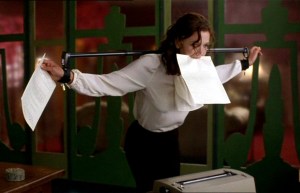 The very nature of the S&M relationship between boss and secretary was already problematic when it was released in 2002, but in a post-Me Too universe it is inexcusable and taints any charms the movie may have had. Mr. Grey (James Spader), the dominant boss and rigid stickler for rules, is the villain of the movie and not its Byronic hero, the brooding and damaged man that a pure-hearted woman just needs to find a magical way to reach and reform. He is not romantic. He is appalling, and the early critical praise, myself included, excused far too much of his behavior. While not condoning his excesses, critics may have given more leeway because the end result was framed as a happy ending, with Lee (Gyllenhaal) being cared for by Mr. Grey. However, he completely uses his position of authority in many inappropriate manners, and while they do develop a mutual relationship, eventually, the power dynamic is not equal at all. This takes away the agency of Lee and makes the romance feel like a false choice. Much of her relationship can be summarized by the awful moment he ejaculates on her back: she just has to take whatever he dishes and like it. That’s not romantic. That’s not cute. That’s toxic. It also hurts the overall movie that the way Lee proves her devotion as the film’s climax is to stay fixed at her boss’ desk for many days, to the detriment of her physical health. Yes, Mr. Grey gets Lee to kick her habit of self-harming but she replaces one need with another. He resembles a predator by most every definition, and to try and say, “Well, he’s just complicated,” is bad man excuse-making.
I tried imagining tweaks and alterations that could make this all work, but anything where he is her boss muddies the issue of consent. Maybe if he was a visiting businessman, but that would also offer a questionable dynamic. The core of Secretary is built upon the secretary/boss interplay and imagery. The tagline is, “Assume the position,” and depending upon the poster, you might only get a woman’s rear in fishnets as the sole imagery. Director Steven Shainberg (Fur) and screenwriter Erin Cressida Wilson (Chloe, The Girl on the Train) are clearly veering into the obvious office power dynamics for provocation. They are very intentional about subverting romantic clichés and looking for something different for our heroine. We have a nice guy, played with squirmy energy by Jeremy Davies, who just won’t cut it. He’s too vanilla for her and afraid to be too forceful in his spanking. It’s like the filmmakers are declaring that Lee demands more, and her specific combination of qualities just so happens to align with this gross man. The movie wants us to hold our judgment, and I could in 2002 in a “love is love” declaration, but what I see on-screen in 2022 is not indicative of love. It’s obsession. It’s codependency. It’s sad.
 The other problem, sadly, is Maggie Gyllenhaal’s fragile performance. The choices she makes collapse Lee, greatly infantilizing her and magnifying all the icky feelings I had. She’s playing Lee less like an adult woman who is struggling to figure out her confusing life, and impulses, and more like a teenager who woke up in the body of an adult woman. Part of this is the screenplay but it’s not helped by the acting choices that Gyllenhaal engages with. I do really enjoy her as an actress, and it’s easy to see why she could captivate so many circa 2002 with this performance, but it plays so differently now. Today, she comes across as another young woman trying to remodel herself to please a man. Her little girl acting choices only make the courtship feel even more abhorrent. I wonder if they were trying to aim for the movie to be its own kinky fable, wherein the infantilization would harken back to older fairy tale tropes and Mr. Grey as the unorthodox knight in shining armor.
This is one of the biggest critical swings I’ve had since re-watching twenty-year-old movies and my initial reviews, and I’d say even one of my biggest changes on any movie I’ve watched. I do think you can make a funny and sexy S&M rom-com; for years I thought Secretary was it. Not so. I wouldn’t even recommend this movie and it used to be in my top of 2002. I suppose people who are curious could give it a chance, but I think the objections outweigh whatever positives can be gained from viewing. Oh well. That’s the nature of art. Not every movie or book or song will have the same power over time. They stay the same but we, the prism upon which art is judged and related, are constantly in flux. That’s just the way it is. This won’t be the last movie where my opinion changes dramatically. I just won’t watch Secretary again, and that’s okay.
And you’ll never be able to convince me that E.L. James didn’t take her BDSM character’s name from this film.
Re-View Grade: D
Share this:

Nope (2022)
 Within two movies, and most likely just with his first in 2017, Jordan Peele catapulted himself as a brand name in the world of horror. At this point, you’ll see a Peele horror movie sight unseen because you know what you’re getting is going to be a unique experience. There are plenty of modern horror directors that have built a rabid fandom, like Ari Aster or James Wan, but nobody seems to be given the same platform as Peele has earned at this juncture. The writer/director has become what M. Night Shyamalan used to exhibit, the director whose creative visions were each highly anticipated event movies. Nope is Peele’s first foray into science fiction territory and the results are messy, disturbing, and, at points, astounding.
The Haywood family ranch has been involved in the motion picture industry since its very beginning. One of the first film images, a black man astride a horse, was the great-great-great grandfather of Emerald (Keke Palmer) and Otis Jr. (Daniel Kaluuya). The brother and sister are trying to save the family ranch after the untimely and strange passing of their father (Keith David) who was felled by debris falling from the sky. Their neighbor, Ricky “Jupe” Park (Steven Yeun), is spinning his notoriety as a child actor into a Western theme park attraction. Ricky’s claim to fame was being one of two survivors of a 1990s sitcom where the trained chimpanzee, who in the context of the show was his adopted sibling, snapped and went on a killing spree. Emerald and Otis Jr. begin to suspect that there is a real unidentified flying object hanging over their land, so they set out to capture living proof and become rich and famous. The alien, hiding in an unmoving cloud over the course of six months, has other plans and intends to assert its claim on the Haywood territory.
 Peele is proving himself more and more as a major director of genre spectacle and vision. Each of his three directorial efforts will hit people differently; I think they’ve incrementally gotten a little sloppier in the writing department, but Peele is only growing stronger as a visual stylist and orchestrator of big screen spookery. There is a grandeur to the visual arrangements, owing as much to the expansive language of Westerns and the awe of early Steven Spielberg. I wish I had seen the movie in IMAX as Peele intended, since he went to all the trouble of planning specific sequences for the grand IMAX cameras. There are several moments that are jaw-dropping and stirring in horror and wonder. A literal rain of blood and viscera and expelled non-organic items is a striking image. Even the unnatural way that helpless people are thrown off the ground can be jolting and primal. There’s a claustrophobic interior sequence of desperate people that really conveys the terror of the doomed. A big addition to the eerie atmosphere is the brilliant sound design. The otherworldly-ness of the alien encounters is heightened by a really in-depth sound design that can make the hairs on the back of your neck stand at attention. Even the sound of rain, and its distance, can be an indicator of the proximity of danger. There are also the distant sounds of horrible screams circling through the clouds high above, and it’s a deeply unsettling design trick that works every time. Even when the movie wasn’t quite as engaging from a narrative or thematic standpoint, Nope is always engaging on a simple delivery system of spectacle. The way Peele distributes his visual clues and keys, sometimes literally, always provides something for an audience to anticipate.
I was also starting to grow impatient from Peele’s coy narrative games. The plot moves in frustrating starts and stops, teasing an intriguing development or proffering a question and then skipping backwards, denying the viewer a sense of gathering momentum. There’s a toying sense of teasing out how far he can go before an audience gets too impatient and quits. Much of the first half also takes place during night or sequences of sustained darkness, which can definitely play into the the fear of what could be in those shadows, but it makes for a fitfully frustrating experience when you’re trying to unravel a science fiction mystery. I kept wondering how all these pieces were going to come together, especially the ongoing subplot about this killer chimpanzee, but I had faith in Peele (mostly). That faith was rewarded but I’ll admit for the first hour I was wondering if Peele was too evasive for his own good.
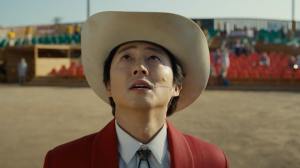 Nope begins as Close Encounters of the Third Kind and then transitions into Jaws and stays there, and it was during the second half that my interest magnified exponentially. It’s around the hour mark that the movie finally puts all its cards on the table and declares what it is and what the remaining movie is going to be about. All the stutter steps and vagaries are cast aside, and the movie finally shifts into its grand entertainment of a group of humans learning about an overwhelming and unusual threat and plotting their unorthodox plan of attack. I’ll still try and play around spoilers without getting too deep into specifics. It’s a great relief when Peele no longer has to tease his threads and mysteries and can at last be open and let the conflicting components come together. The annoyances I felt in the first half melted away, and I was satisfied as the movie picked up a genuine momentum and smartly tied in many prior plot elements for the bigger picture, like the inflatable tube men, old timey picture-taking souvenir machines, and even the very vague almost carwash-esque imagery from the opening credits. The second half of the movie is more fun because it’s a big hunt and it allows our characters to make use of what they have learned to form conclusions and strategic moves and adjustments. It’s characters making smart decisions. It’s a scenario that finally allows Peele to finally play with all the setups he’s spent an hour cheekily hiding around.
While the climax is great, and the movie gets consistently better, I don’t feel like all of its many thematic ties come together. Being a Jordan Peele horror movie, we’re now expecting there to be extra layers of social-political commentary and allegories. The back-story for Ricky as a child actor is given a lot of attention and screen time for a two-hour movie, and I don’t know if what it adds up to is equal to the time it was given. Thematically, you can make some speculative reaching about the exploitation of animals for spectacle, about underestimating and not respecting nature, and even setting up for later tragedy, but it all seems less meaningfully integrated than any other Peele movies’ elevated subplots. With the Ricky back-story, there is even a literal anticipation of a literal shoe to drop, which seems so obvious as a visual metaphor but I cannot link it directly with what follows. I can keep digging and find connections but it requires far more effort than Peele’s other works of horror. The family history of working for Hollywood as horse wranglers feels underdeveloped. There are also rules that it establishes that Peele isn’t fully consistent (just don’t look?) that left me questioning. I figured that colonialism would be an obvious parallel with invading aliens (H.G. Welles even made use of the analogy 120 years ago), but maybe that was too obvious territory for someone like Peele. My friend Ben had a crazy early theory that the aliens themselves would resemble horses and thus they were returning to free their equine brothers and sisters from human exploitation. I guess I’ll go ahead and spoil you, dear reader, that this does not happen in any shape with Nope.
 I’d rank Nope the third best Jordan Peele horror venture, and while it clearly makes use of science fiction concepts and its rich iconography, it’s still very firmly a movie rooted in horror, the horror of the unknown, the horror of being small and helpless, the horror of being left behind. Not all of Nope’s many ambitions quite land, and the themes feel a bit more jumbled or underdeveloped, but I want Jordan Peele to continue making the movies he wants on his terms. Not every one is going to hit exactly the same for me, or for any viewer, but we’re all better when unique artists like Peele are given the latitude and support to bring their personal visions to the big screen. As long as he’s still achieving a baseline of quality, something that befell the middle Shyamalan period, then I say swing away and let’s see where you’ll take us all next, Jordan Peele.
Nate’s Grade: B
Share this:

Orphan: First Kill (2022)
 This is such a strange movie. The original Orphan, released in 2009, was an otherwise forgettable killer kid movie with a memorable twist: little Esther (Isabelle Furhman) wasn’t a child but a 30-something woman with a hormonal disorder (supposedly inspired by a true story). What do you do with a prequel when the young actress is now a grown woman and the audience knows the big twist from the start? The first answer is use a body double, have the other actors wear platform shoes or step on boxes, and forced perspective with some de-aging CGI sprinkled over Furhman’s adult face. That’s a whole lot of effort, albeit practical and less costly, to make a prequel without much going on. We follow young Leena as she escapes from an Estonian mental asylum and poses as a missing child from an American couple (Julia Stiles, Rossif Sutherland) who adopt her and bring her back to the States. It’s here where little “Esther” must keep up the illusion, with the mother already gathering her suspicion but not wanting to trouble her husband. For the first hour of this 100-minute movie, I was quite bored and the movie was relatively listless. There were some kills but it all felt like simply going through the motions, especially already knowing her secret and not being emotionally invested in whether her new identity would be maintained. And then the movie makes a sudden turn, one I’ll spoil right now because I think it makes the film actually watchable, where the mother confesses she knows Esther is not her missing daughter, is an adult woman, and then both of the women in this dysfunctional nuclear family are trying to undermine and kill one another while vying for the favor of the father/husband. It took an hour of sequel/prequel drift, but here First Kill (there are many after her first) finally delivers something new to do after sitting for an hour rehashing the original twist. I wish the screenplay had gotten here even earlier and veered into wicked black comedy. It definitely feels like the movie wants you to laugh at the escalating battle between fake daughter and fake mother. I laughed out loud over a scene with slippery dentures. There’s no real reason for this movie in 2022, especially with all the extra work to make it plausible, but I wish the filmmakers had just embraced all its goofy implausibility.
Nate’s Grade: C
Share this:

Bullet Train (2022)/ The Princess (2022)
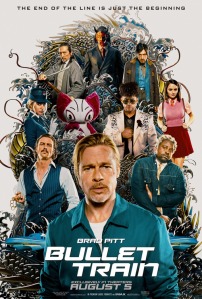
Bullet Train and The Princess are two recent releases that could serve as a double feature for all they have in common. Both movies prioritize fun above all else, both of them feature stylized violence and bloodshed, both of them have a perverse sense of humor, and both of them feature young actress Joey King (The Kissing Booth, Wish Upon), coincidentally playing the listed roles of Prince and The Princess. What more do you need for this combo? If you are a fan of Bullet Train, you’ll likely be a fan of The Princess, and vice versa, because both of them are exactly as advertised. They’re wild, whimsically violent, but succeed with nimble action construction, bizarre and engaging characters, and high energy that sparks fun escapist entertainment.
Bullet Train is set almost entirely on a speeding bullet train in Tokyo, and we follow a group of hired killers, mercenaries, and generally nasty people all sharing one very fast locomotive. “Ladybug” (Brad Pitt) is a reformed hitman who only takes snatch-and-grab gigs as he’s trying to better himself with therapy and meditation. He’s meant to grab a briefcase of money and get off the train. Naturally, things don’t go as smoothly as planned. Onboard the train are “Lemon” (Brian Tyree Hill) and “Tangerine” (Aaron Taylor-Johnson), who have the briefcase in their possession along with the prodigal son (Logan Lerman) of a scary Yakuza boss known as “The White Death.” Also on board is Kimura (Andrew Koji) seeking to find the person responsible for pushing his child off a rooftop, Prince (Joey King) using her diminutive stature to trick unsuspecting men, the Wolf (Bad Bunny) seeking out the person responsible for the death of his bride, and several other masked killers looking to up the ante. Characters will clash, many will die, and “The White Death” will be appeased by the end, coming to collect a blood debt from all. 
Bullet Train was, blissfully, everything I was needing it to be. It’s a universe familiar to fans of Quentin Tarantino and especially Guy Ritchie, with colorful and threatening characters with large personalities and quirks colliding in unexpected and violent ways. I’ve seen so many Tarantino knock-offs, and Tarantino knock-off knock-offs, so I appreciate when someone is able to understand what it takes to succeed on this unique playing field. Screenwriter Zak Olkewicz (Fear Street: 1978) knows how to sharpen the kind of off-the-cuff banter that makes these movies excel, with space given for the characters to make a sizable impression. There needs to be time to get to know them, their quirks and faults, and then send them all running at one another at cross-purposes, interacting in fun ways that lend to one character screwing something up for another. There’s about a dozen characters dropped upon us, and just about everyone gets a flashback or introduction set piece, sometimes more, sometimes extensions of previous flashbacks, sometimes extensions from alternate perspectives. Part of the fun is just seeing how the different characters relate to one another, so there is a period of time where the mask has to eventually drop, and the reveal needs to be worthwhile. It’s a lot, and Bullet Train gleefully trades in excess upon excess all in the name of chasing after a good time, and if you connect on its zany and breezy wavelength of reckless violence and dark humor, then you shall be happy for the ride.
The movie is constantly reshuffling and transforming, allowing it to hyperextend into whatever shape it necessitates before contorting back to its next phase. This malleability makes the movie far more responsive, sometimes overlapping, and it provides an extra level of energy. It’s reminiscent of Snatch, my favorite of the Ricthie cockney crime capers, where the story zigged and zagged through linear time, providing answers to different stacked questions. I won’t say the characters are as distinct as Snatch, but Olkewicz takes his time to introduce each with relish. Pitt may be the marketable star of the movie, at least as far as advertising is concerned, but it’s really much more of an ensemble, and one anchored by Lemon and Tangerine. Their droll, snappy banter really cements their long-term relationship almost like a screwball romance. They end up becoming, strangely, the heart of the movie, if one were to suggest a movie with an entire wedding party vomiting their guts to death had a beating heart. Their exact connection and genuine affection for one another, even when they’re driving one another mad, is one of the film’s many surprises as it zooms ahead. There are fun cameos, and some unexpected abrupt deaths, but Bullet Train works because of the entertainment of the kooky killer characters. I enjoyed that one character’s obsession, namely likening people to Thomas the Tank Engine avatars, has a personal connection but actually leads to some ironic turns. Not every set-up has the best payoff (Chekov’s toilet snake comes to shockingly little) or resolution (why wasn’t the snooping conductor thrown back in or given a revelation?) but with so many characters criss-crossing, so many goofy asides and cul-de-sacs, and so much bloody mayhem, there’s a steady stream of fun, satisfying payoffs and retribution until the mid-credits sequence. 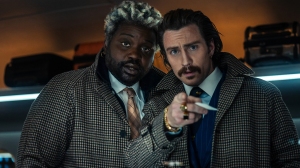
To me, the water bottle symbolizes Bullet Train at its best and worst. After two hours of multiple characters and their out-of-order flashbacks shuffling for dominance, we get an inanimate object with its own flashback. It’s a goofy and superfluous addition, as the water bottle has served as a plot device but has served its ultimate plot purpose already, so seeing its entire history offers no new information that the audience didn’t already have. However, what it does is show the movie from the perspective of this bottle, and many sequences are reframed from the bottle’s rigid point of view. It made me think about how after they got their shot setups, someone on staff would then call out, “Okay, we need the water bottle POV shot now,” and they would film that. I appreciate the effort for something this fleeting and silly. They didn’t need to put in this flashback or this level of attention to an object that ultimately just gets thrown at a guy’s head. However, it’s the misdirect, the ridiculous inclusion on top of the others, and the ramping of energy that made me smile, even as little else came out of it. I appreciated the showmanship. For me, this is emblematic of the movie as a whole, an overload of style and energy just for the fleeting hell of it.
Under the direction of David Leitch (Atomic Blonde, Deadpool 2), the action is as fun and energetic as the colorful characters. Leitch has become one of the best modern directors of action movies. The hand-to-hand combat is refreshing and makes use of close quarter combat demands. I enjoyed that the two participants in a fight are trying to sneak in quick moves without getting caught by an older lady who demands quiet in the quiet train car. I enjoyed the zany flashback where Tangerine and Lemon recount to the camera and dispute the number of men killed on a previous job. With a character cursed with bad luck, it provides opportunities to have fun with accidents and bad timing, which Leitch works into different action set-ups and setbacks. Even when the movie literally goes off the rails and becomes a big cartoon, Leitch finds ways to marry the big tone in such a manner that the ridiculous doesn’t prove off-putting. When characters are swinging samurai swords in slow-mo, while a Japanese version of “Holding Out For a Hero” is pumping on the soundtrack, I just sat back and soaked up the deliciously disposable fun times. 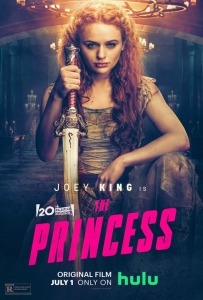
The plot of The Princess is as straightforward as Bullet Train is knotty. The Princess (Joey King) of a fantasy kingdom is chained at the very top of a castle tower. Her captor, Julius (Dominic Cooper), has imprisoned her family and plans to wed the princess and become king. The princess, however, has other plans. Thanks to her martial arts and weapon training, she breaks free and becomes a one-woman wrecking crew as she descends the tower floors to freedom.
I was genuinely surprised at how well developed and exciting the action sequences were. The Princess shares more in common with The Raid than anything by the Grimms. The script by Ben Lustig and Jake Thornton follows the model of a video game; every new floor is a literal new level with a new boss or new objective to be achieved to advance to the next level. The simplicity of the premise is refreshing, and the movie doesn’t waste any time ramping things up. Blood is shed within the first few minutes and it doesn’t let up. What I really appreciated was how well constructed each new action set piece was. There’s variety and specification that challenges our heroine, who is powerful but still not all-powerful and bereft of vulnerability. Each new encounter forces our protagonist to think through a different application of skills. There’s a situation that involves overpowering a larger and stronger man, a situation trying to wound a fully armored man, a situation battling two men, then even more, a situation with men charging into the battle and having to escape to a safer environment, a situation where she has to swing along the outside of the castle to enter a different room, a situation involving stealth, and many others, but each requires something different and thus each proves to flesh out our main character and her capabilities and problem-solving acumen. It’s always a pleasure to watch smart people overcome challenges in fun and smart ways, and The Princess has this formula down. I was worried the movie might get repetitive with its video game level design, but each new challenge is an opportunity to dazzle and enlighten us about our John Wick-esque fighter.
That’s probably the best comparison, the John Wick franchise, because it’s a series of movies that is defined by the thrills of its fight choreography and action set pieces. That’s it. The world has some interesting flourishes but the draw is the fight scenes and the pleasure of watching professionals operating at such a high level and with demonstrations that allow us to better immerse and appreciate the artistry of the fighting. And it’s good here. The impressive choreography has a really nice A-to-B propulsion, with each move connecting to the next to tell its own story of countermoves and adjustment. I really appreciated how the specific geography of each location is incorporated into the action, whether that be as a hindrance or an assistance to the fighting. It makes the sequences more meaningful and better developed. It’s also a movie that understands that if you give your villains specialized weapons, they better use them in fun or nasty ways. If all you’re looking for is imaginative, bloody, and brutal fighting, The Princess delivers it all. Credit also to King for throwing herself completely into the role. She effortlessly executes complicated fight moves and swordplay during long takes. You can tell she’s having a blast being a badass. Think of The Princess like a feminist version of The Raid or an upside-down version of Dredd (“Instead of fighting up, this character fights her way… down.”).
The Princess could have made more social statements but its very conceit is a feminist reworking of outdated fantasy tropes, so I don’t mind that it’s a streamlined action movie with a blunt yet obvious point. The familiar story tells us that these damsels in distress are the maidens in need of rescuing (“Sorry, our princess is in another castle” and the like), so just having the princess be her own champion is a simple yet satisfying subversion. This is an action movie and less one on politics; however, it’s a movie that cannot help from being political because it’s upsetting the expected social norms, that women are docile and weaker and at the whims of men. The Princess isn’t breaking new ground here. There have been plenty of movies that re-contextualized the feminine roles of old legends and folk tales and made them more capable and strong and fierce. That doesn’t mean there’s any less enjoyment watching our princess take down one leering man after another. It’s the appeal of the underdog who makes men pay dearly for underestimating her. These repeated interactions and bloody comeuppance speak about as well as necessary for this kind of movie. I doubt things would have radically improved if one of the characters broke into a treatise on the misapplication of gender roles. It’s a woman beating the stuffing out of creepy and lascivious misogynists. For this movie, that’s more than enough to keep me watching. 
Where The Princess starts to lose itself is once it shifts into its final act and abandons its formula. I can understand wanting to shake things up so the viewer doesn’t get lulled into complacency, but because the sequences were, beforehand, varied, my interest was not lagging. During this final stretch, the titular princess leads a squad to take down the baddies, and the movie becomes any other number of similar fantasy action movies. The enjoyable fight choreography is still present, but it feels like a rush to clear everything in comparison to the methodical floor-by-floor clearing from before. I wish the filmmakers had merely held steady with their plot rather than throwing things out and relying upon a grand team-up revolutionary raid. There’s also a sudden shift that throws out the rationale for keeping the princess alive. The bad guy just shrugs and says, “Forget it, I’ll find a replacement,” and it feels too arbitrary of an escalation. If he could do this, why was he so insistent for the first hour that she not be killed? It’s not a bad ending or one that ruins the movie but it’s definitely a downshift from the action excitement highs from before.
The Princess and Bullet Train are both frantic, over-the-top, cartoonishly violent, while still understanding how to effectively sell their escapist mayhem. We need to be dazzled by the action sequences and have them be meaningful (check), we need weird and interesting characters that we want to root for or watch bumble onscreen (check), we need payoffs that feel rewarding (check), we need an onslaught of style and attitude (check), and we need, above all else, fun and surprises (check). Neither of these movies is going to qualify as one of the best movies of the year. That’s just not the kind of experience either is shooting for. However, they may be some of the best fun you have with movies for 2022, and in a world in short order of fun, that’s plenty.
Nate’s Grade’s:
Bullet Train: B
The Princess: B
Share this:

S1mone (2002) [Review Re-View]
 Originally released August 23, 2002:
Director Viktor Taransky (Al Pacino) needs a hit. His new movie is in the can but his temperamental star (Wynona Ryder in a juicy cameo) pulls out and demands all footage of her be left on the cutting room floor. The studio is close to dropping Taransky’s film deal, and the studio head just happens to be Taransky’s ex-wife (Catherine Keener).
Under this intense pressure Taransky retreats to mourn his failed potential, until an eccentric one-eyed computer engineer gives him the key to his solution. It seems that instead of interacting with actors and their egos and trailer demands, Taransky has found a new movie star — one completely made up of ones and zeroes named Simone. Taransky edits Simone into his film and soon after the nation is in love with the digital blonde. Simone mania sweeps the nation and soon her smiling image graces all sorts of memorabilia. The public can’t get enough of the mysterious Simone who never goes to public functions and only seems to speak or appear for Taransky.
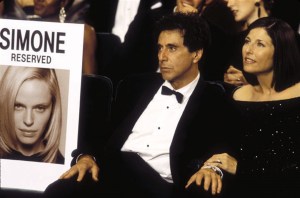 Writer/director Andrew Niccol (Gattaca) has some fun with the premise but tries to have his cake and eat it too when it comes to his satire. S1mone starts out satirizing egotistical stars, then the Hollywood system, then the press, then the public as star worshipers. The movie is all over the map trying to have something witty to say about all these different topics but is too busy to settle down on any one for a while. The satire S1mone embodies feels deflated from all the work it’s trying to do.
Pacino has always been able to do comedy but seems wearier than ever. He indulges in his comic like over-the-top aggression he’s been doing since Dick Tracy. Keener plays another of her icy businesswomen roles although she thaws quite easily and quickly in the film.
There’s a rather funny subplot involving Pruitt Taylor Vince and Jason Schwartzman as tabloid reporters on the prowl of the elusive Simone that deserves much more attention than it gets. The bulk of the movie could have been these two entertaining characters.
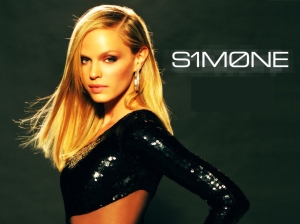 When Taransky finds that his creation has become more than he can handle he tries to discredit her through a series of funny public appearances and avante garde film choices. But then S1mone sadly goes back to its more mediocre roots. Taransky tries to get rid of Simone but it all horribly backfires.
As the film progresses you start to realize all the gaping holes that come up – like how can Taransky, a self-described computer illiterate, handle the most technical computer program of all time? How come no one would find out that Simone lacks a birth certificate, social security number or even tax records for her studio work? And why does the audience have to sit through the disgustingly cute daughter of Taransky and Keener, who just happens to be a computer whiz-kid, besides the fact she’ll have a late fourth quarter save of dad?
It’s not that S1mone is necessarily a bad film; it just has this missing piece to it when you watch it. Some scenes are funny, many drag, and the whole thing needed to be tighter and punchier. And to clear up any confusion, it is indeed an ACTRESS who plays Simone. Her name is Rachel Roberts.
Nate’s Grade: C+
——————————————————
WRITER REFLECTIONS 20 YEARS LATER
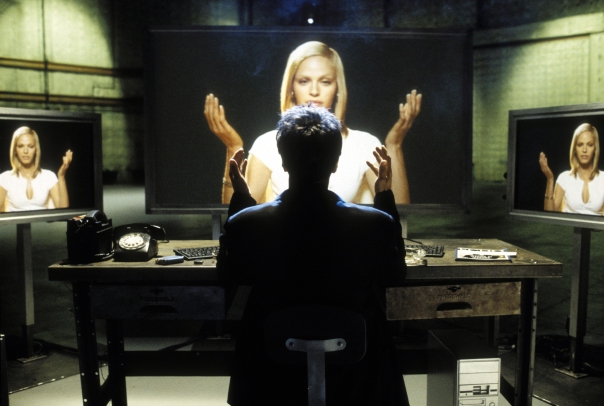
I cannot stand movie titles that try and force numbers into the place of letters. Don’t be Fant4stick, be Fantastic Four. Don’t be Thir13en Ghosts, be Thirteen Ghosts. Don’t be L4yer Cak3, be Layer Cake. Even one of my favorite movies of all time, Se7en, is guilty of this. I hate the implication of how you’re intended to say the new forced titled (Examples: Fant-Four-Stick, L-Four-Yer Cak-Three, Se-Seven-En). I find this all to be annoying, and I refuse to type S1mone as it was originally entitled, with a one replacing the “I” and a zero replacing the “O.” You get one number, that’s it, because it’s all my power to only do that much. End of re-view preface.
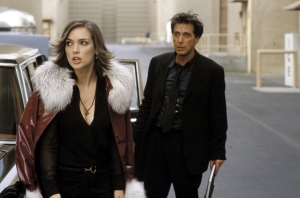 I thought going back to 2002’s S1mone could be interesting considering it was about cutting-edge technology possibly replacing actors and revolutionizing the film industry. Around 2001, with advancing special effects starting to touch the possibility of photo realism, this seemed like a possible turning point. Writer/director Andrew Niccol even considered using an all-digital actress for the title role of his industry satire after viewing footage of 2001’s Final Fantasy movie. He eventually decided against it, and we’re all the better for it because imagine re-watching this movie with twenty-year-old technology that fools the entire world into thinking Simone is real (cue teenage snickering). The character was played by model-turned-actress Rachel Roberts and her identity was kept a big secret around the time of the movie to keep the illusion that S1mone was cutting-edge technology. It’s ultimately proof that the real thing, whether that’s practical in-camera effects or even live actors, will always age better and have a place in moviemaking. As I said revisiting Final Fantasy: “Beyond the complexity that real actors can bring to performances, there’s the ease and cost that cannot be beat by a computer. Maybe in time this will change but for now rest easy Tom Hanks. You’re not going anywhere.” But hey, Roberts and Niccol have been married since 2002 and have two children together, so at least something came out of S1mone besides a title that causes me pain to type.
The big problem I have with S1mone, besides its title spelling, is that its satire with no bite, and its chosen point of view is actually the villain. First, this movie just isn’t funny. I was more charitable when I originally reviewed it back in 2002 but I didn’t laugh once throughout the near two hours. It weirdly feels absent much in the way of social commentary. Simone is an instant star and everyone falls in love with her. There’s a beginning entry into commentary when her creator, Viktor Taransky (Al Pacino), attempts to sully her image but only proves to make her more popular, but then that’s it. There’s a goofy, near-farcical quality to Taransky trying to hide the pretend nature of the world’s most desired actor. He even drives a car while operating a mannequin to provide cover. If Niccol wanted to really push this angle, there would be considerably more challenges for Taransky to maintain his illusion, getting more and more outrageous like steam building to a blowup. It’s not that this doesn’t happen but that Niccol’s screenplay makes it so absurdly easy for Taransky. He dictates that Simone wishes for her privacy and occasionally leaves behind some detritus of human life and that’s all it takes to establish a convincing existence. Nobody challenges him, at least not in a serious manner, which negates the conflicts and possible comedy of keeping the farce. Everything comes so easily and it makes the ensuring comedy barely explored if evident.
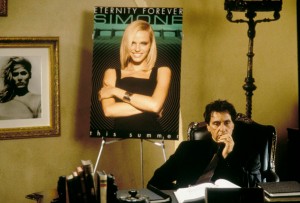 Another major drawback is that Taransky is the villain but the movie thinks otherwise. He’s sick and tired of the demands of actors. He has his complaints about working within the contradictory Hollywood studio system, but his major gripe is with working with actors. When the possibility of a photo-realistic replacement that will do whatever he says is offered, he snatches it. It’s because Viktor doesn’t view actors as people, and he feels the need to control and not to collaborate. He’s an artist with a capital-A but it’s the actors with their unwieldy egos, of course. It’s even more nefarious when you add an icky layer of misogyny to his actions. He wants a young woman who will do anything and everything he demands for his pictures. When the studio boss questions the extensive level of nudity for his next movie, Taransky says Simone will do it without hesitation because that’s what the role requires to accomplish his true vision. All he wants is a living doll to respond to his button-pushing without reserve or complaint. He wants an actor, and especially a woman of conventional attraction, to do his every selfish bidding.
At no point does the movie present our hero’s actions as being questionable or possessive. For him, all actors should just be replaced with ones and zeroes that will do whatever he wants, even nudity, and his perspective is strangely rewarded given Simone’s instant success within the industry. She literally ties with herself for the Best Actress Oscar. There may be a satirical commentary available about how quickly the public falls in love with their oblivious perception of celebrity, and how little they actually know the person behind the headlines, much like all celebrities of old and new, but the thematic work isn’t there. I kept waiting for Viktor to earn his delayed comeuppance, humility, or at least learn something of value, but through this misadventure he’s able to relaunch his career and even get his ex-wife back, so hooray?
This is also a peculiar outlier for Niccol as both a screenwriter and a director. He favors high-concept sci-fi scenarios, like 1997’s genetic have/have nots allegory, Gattaca, or 1998’s reality TV gone to its extremes drama, The Truman Show. 2005’s Lord of War is a powerful and slickly stylish condemnation on the global impact of arms dealers and gun trafficking and the bloody footprint of capitalism. S1mone is the lightest movie of the man’s career. Maybe he wanted a break from working on high-concept studio releases. 2011’s disappointing In Time likely lead him to a safer studio territory of adapting and directing 2013’s The Host based upon the YA novel by Twilight author Stephenie Meyer. I didn’t even know that Niccol has made two other movies since, 2014’s Good Kill and 2018’s Anon on Netflix. He’s listed as being the screenwriter for a 2027 Monopoly adaptation, so that could be a thing. Niccol is the kind of storyteller I want more often, a man with clear visions and ideas, but S1mone proves that he’s best suited for headier realms. Comedy is not the best fit for this man’s talents (I think we’re supposed to laugh at the very image of Pacino applying lipstick to kiss autograph photos).
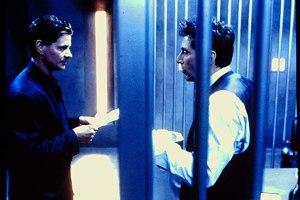 Is there anything of entertainment value here? There are ideas that could work with more attention and development. I liked the team of Pruitt Taylor Vince and Jason Schwartzman as investigators tracking down the pieces that don’t quite add up about Simone. I think there was a real opportunity to deconstruct the star-system of Hollywood and have Taransky finally able to launch his true artistic pursuits that had previously been denied without Simone’s attachment. Perhaps the movie just narrows completely to the window of Taransky making his dream project while maintaining his deep secret. Perhaps even make the movie a mockumentary, like the documentary camera crew has discovered this amazing fact and are promised continued access as long as they can help keep the secret for like two years, enough for the director to see his vision through and then use this as his swan song. Then the movie becomes focused on the mishaps and chaotic complications of getting one project off the ground while having asides that can tweak the egos of actors and producers and studio suits eager to work with the next big thing. I think that would have been an improvement over a movie where an aging director gets his groove back by fooling the world and suffers next to nothing in the process. The climax is low stakes just like the rest of the movie because the protagonist gets everything he desires with minimal effort. S1mone is an intriguing idea of movie that suffers from misapplication, under development, and a bad protagonist to celebrate and reward.
My initial review in 2002 was too kind. There’s too little below these ones and zeroes to count.
Re-View Grade: C-
Share this:

Licorice Pizza (2021)
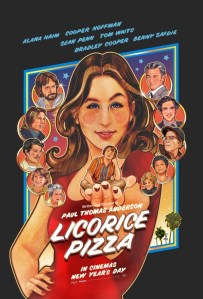
It took me many months but I’ve finally watched the last of the 2021 Best Picture nominees, and now I can safely say, I just don’t understand all the love for Licorice Pizza. It’s writer/director Paul Thomas Anderson’s (Phantom Thread, Boogie Nights) nostalgic L.A. hangout movie, but the axiom of hangout movies is that they only really work if you actually want to hang out with the participants. I’m not certain I needed or wanted to watch either of our lead characters navigate the curious bounds of their possible romantic entanglement. Alana Haim plays Alana, an under-achieving 25-year-old looking to better define herself, and Cooper Hoffman, son of the late Phillip Seymour Hoffman, who appeared in five prior PTA movies, plays an over-achieving 15-year-old that is in a hurry to grow up and conquer the adult world. He’s crushing on her, she’s flattered but says it’s not appropriate, and over two hours we watch a series of meandering episodic adventures that test their will-they-won’t-they determination. I found Haim’s character to be generally unlikable and, worse, uninteresting. She’s petulant, needling, prone to jealousy but also clearly likes the attention but doesn’t know how far to test it. Hoffman’s character, based in part on Tom Hanks’ childhood friend and producing partner Gary Goetzman, is like a human puppy dog, so overwhelming and sunny and anxious to be liked, but I can’t see any more depth to him or her. They’re just kind of annoying and maybe that’s the point about looking back. I don’t see the larger thesis or theme in many of Anderson’s small and unfunny asides. He’s trying so delicately to recreate a feeling of time and place of early 1970s Los Angeles, but the movie doesn’t succeed in answering why anyone else should really care about this personal PTA slice of nostalgia. The best part of the movie, by far, is the segment where Bradley Cooper plays the lascivious and self-absorbed hairdresser-turned-producer John Peters. Too many of the other misadventures feel like table anecdotes brought to overextended life with technical pizazz and minimal emotional accessibility. Licorice Pizza left me cold and unfulfilled.
Nate’s Grade: C+
Share this:

Prey (2022)
 Prey is the kind of Predator movie I have been clamoring for years to make. The franchise was in some major need of a mojo rejuvenation, and instead of constantly repeating the same stories to lesser and lesser effect (see: 2018’s sloppy release), the filmmakers finally saw the obvious and exciting answer. By placing the Predator into different points and places in world history, the producers have finally tapped into the creative potential of the equation of [cultural warriors] vs. alien bounty hunter. Each new movie allows a new selling point jumping from famous warrior to famous warrior. Imagine samurai versus the Predator, or Crusaders versus the Predator, or Vikings versus the Predator, or a Wild West showdown against the Predator. It would be like an intergalactic Deadliest Warrior franchise. It’s a super advanced alien species, so why can’t we establish that they’ve been flying to Earth for centuries for their recreational sport? Each movie can establish a larger mythology, but it also just supplies the fun of seeing history’s greatest warriors and different settings and cultures versus a powerful alien monster. Prey is the best Predator sequel, by far, and arguably as entertaining and engaging as the 1987 original.
In 1719, we follow a tribe of Comanche in the Northern Great Plains. Naru (Amber Midthunder) wants to be a respected warrior like her big brother, Taabe (Dakota Beavers), who cautions her about the weight of responsibility. She discovers strange tracks and is convinced that their tribe is not safe from a new predator. How little does she know how right she is.
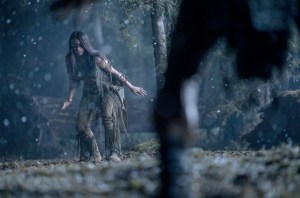 Within minutes, Prey had me. I’ve seen complaints that the first half is slow, but I think people are discounting the time needed to establish the ordinary baseline life of this community, their relationships and conflicts and goals and hopes, before introducing the change agent. That takes time if you want to be able to understand this different life but also if you want to really connect with the characters. The first half provides the foundation for the second half to run with and have bloody mayhem that counts as more than surface-level entertainment. The best compliment I could provide for screenwriter Patrick Aison (plus director Dan Trachtenberg) is that had the Predator never beamed down, I still would have found the story to be interesting. The details are rich and build an authentic picture of life 300 years ago before European colonists would completely upend indigenous life. The Predator series, at its core, has been a nativist underdog tale, where the primitive people of Earth have battled against the technologically superior alien warrior. The dynamic makes it easy to root for the Earthly heroes, but it’s even easier when you have a protagonist like Naru, fighting for respect as a woman already. The character is shown as headstrong but capable, and her mistakes provide opportunities for her to learn and better strategize later. I genuinely gasped when certain indigenous characters died. I’ve never had an emotional response to any Predator film.
The reveal of the Predator is cautiously handled, with the big guy taking time to explore his own surroundings. I enjoyed that this Predator also isn’t as advanced as his more modern ilk. He wears an intimidating alien skull mask and has more limited, though still high-tech, weaponry. I also enjoyed that this Predator feels like he has more of a personality. It’s not just a mirthless tall guy in a thick suit. The actor, Dane DiLiegro, is still providing a tactile, physical performance, and he has moments that reveal the cruelty of this alien but also its volatile temper, which is kind of hilarious. He encounters the wildlife and goes from snake to bear to man, right up the food chain, but some of his more violent kills demonstrate an almost petulant attitude. This is a Predator that doesn’t quite have it all together, and it makes the eventual battle with the Comanche feel like a conflict that has two sides that are worthy but also with their vulnerabilities. It makes the final showdown more interesting. It also allows us to take perverse pleasure in the big guy mowing down a team of predatory French fur trappers that imprison Naru and use her as bait. Oh boy, the gory comeuppance is fun.
 The action sequences are smoothly handled by Trachtenberg (10 Cloverfield Lane) who favors verisimilitude without sacrificing the visual artifice. The photography is gorgeous, and the emphasis on natural light and environments add so much the overall authenticity. Trachtenberg also knows what visual style will work best with which moments. There’s one scene where Naru sneaks back into the trapper camp and her vengeful fury is portrayed in a breathless long take to make the moment even more intense and enjoyable to appreciate the beat-by-beat fight choreography. The scenes with the Predator stalking in the fog play with claustrophobic suspense. The action has a very pleasing sense of construction that clearly presents the pieces that are needed for the scene-to-scene goals, and then the characters will adapt as necessary through organic complications. This is just good action construction, and Trachtenberg fields each like an expert.
Another fun addition with Prey is that they filmed it with two audio tracks, an English-language track and one fully in the Comanche language. It’s not the most necessary option since most viewers will likely simply watch it in English, or not know about the alternative until after watching, such as myself, but it’s an impressive addition that can make the movie even more immersive and authentic and generally considerate of another culture and language.
 Now, with all my points of praise for Prey, why oh why did Disney shunt this movie straight to its secondary streaming arm with Hulu? After the Fox merger, I understand that the Mouse House doesn’t quite see the same level of value in every Fox property not named X-Men or Avatar. This was restarting a franchise that still has some life in it, but even more than that, this is a good movie with plenty of artistic acumen that would have played splendidly on a big screen and an excellent sound system to really sell every fleshy slice and alien gurgle. It seems preposterous to me that a new Predator movie, let alone an actually great one, is denied theatrical release. I know the domestic box-office is still not what it was before the COVID-19 pandemic. I understand that Fox’s leftovers don’t have the same sexy appeal to the new bosses. It just puzzles me that nobody thought that they would make money off of Prey, which has proven to be a big hit on Hulu with critics and fans (ignoring cranky misogynists questioning the physical ability of women). Prey is a great action movie built upon solid characters and patient, clear plot and action development. When it comes to gore, I wish it wasn’t as heavily CGI and a more memorably gruesome, but that’s my only real criticism of what is fundamentally a fun and exciting movie. Give me more like Prey.
Nate’s Grade: B+
Share this:

Lightyear (2022)/ Luck (2022)
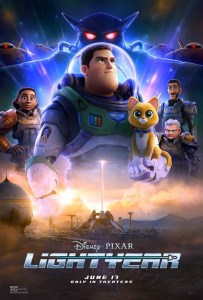 After two years and three movies sent straight to Disney’s burgeoning streaming service, Pixar returns with a theatrical movie that taps back to the very beginnings of this storied storytelling company. We’re told, via opening text, that Lightyear was Andy’s favorite movie and thus the reason he was so excited to bring home a Buzz Lightyear action figure in the first Toy Story. However, if this is Andy’s “favorite movie,” then this kid needs to be exposed to more movies. It’s an acceptable sci-fi story about Buzz (voiced by Chris Evans) learning the value of others and that being vulnerable is not the same as being weak. He’s a space ranger stranded on an alien world. Every time he attempts to restart their fuel system, it jumps him forward in time four years, and soon enough he’s a man out of time and those stranded have built a colony civilization over 100 years. There’s a band of misfits, who aren’t terribly funny, and some laser fights and action sequences, which aren’t terribly exciting, and the third act twist is predictable. The animation is top-notch, but the storytelling is definitely a few notches below infinity and beyond. What astounds me is that Andy could watch this movie and want a Buzz toy instead of the real breakout, the robotic cat Sox (voiced by Peter Sohn) who is wonderfully droll. I cannot fathom anyone watching this movie and desiring owning another character above this delightful supporting character. This movie makes me think a little less of Andy as a discerning arbiter of pop-culture zeitgeist. Lightyear is fine as escapist entertainment but too facile and inessential to the Toy Story universe.
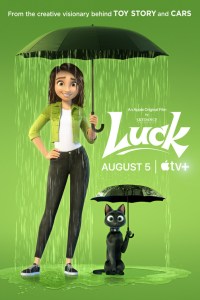 Luck is the first animated feature from Skydance, a production company that entered the animated realm by hiring former Pixar head John Lasseter as their chief creative executive. In some ways, Luck feels reminiscent of early Pixar movies, exploring the “secret life of” those in charge of dictating the forces of luck. The problem with Luck is that it is overwritten and overburdened with world building that crushes the emotional core. We follow a young woman aging out of the foster system and she’s been besieged with bad luck all her life. She follows a talking cat and discovers a hidden world where workers mine luck crystals and have lucky pennies as portal generators and there’s a dragon, for some reason, as the CEO of Good Luck, and to get back home she needs to team up with the cat to find a thing, but to find that thing they need to go to a place, but to go to that place they need to – and you get it. The plot is overworked with a chain of tasks that explain more of this world’s mechanics without connecting to the emotional journey of the character, like in 2015’s Inside Out. I was amazed that this woman lacks even a shred of bitterness about her own trenchant bad luck. There’s a nice message about accepting the bad with the good in life, and how both are opportunities for growth, but I kept wondering why our hero didn’t once lash out at those responsible. I’m also a little hesitant about using whether a little girl will be stood up by her potential new foster family as the stakes of completing the good luck reset goal. That seems pretty heavy for wackiness. The animation isn’t quite at the level of Pixar, or the best of Dreamworks, but it’s colorful and bright even if lacking more advanced lighting and texture. Luck lacks enough gravitas and development to really appeal to adults but it’s also probably too busy and convoluted to entertain small kids.
Nate’s Grades:
Lightyear: B-
Luck: C+


 nathanzoebl
You must be logged in to post a comment.