Winnie the Pooh: Blood and Honey (2023)
 The surprise horror movie Winnie the Pooh: Blood and Honey is likely a preview of what’s to come when well-known stories and characters fall under the public domain. However, the cheerful Pooh that most people recall is from the Disney animated shorts and films which began in 1966 and still fall under current copyright laws. So if you were gonna make a killer Pooh bear, he better resemble author A.A. Milne’s original creation and not the Disney version or else you’ll incur the wrath of the many lawyers of the Mouse House. In writer/director Rhys Frake-Waterfield’s version, Pooh and Piglet are on a killing spree after their dear Christopher Robin (Nikolai Leon) grows up and abandons them (they ate poor Eeyore). However, most of the movie is about thick-bodied malevolent men in masks preying upon young British women who are regularly in their underwear or bathing suits. To say this movie is creatively lacking is an understatement. Blood and Honey isn’t just a bad B-movie, it gives a bad name to enjoyably bad B-movies.
The only reason this movie exists is for the novelty of its existence, so that younger horror fans, and those with a healthy appreciation of irony and bad movies, can say, “I watched a killer Winnie the Pooh movie.” No other thought was given to this entire enterprise after that first one. The intellectual property fell into the public domain and now the filmmakers are scooping it up for a cheap and easy, “Well, I haven’t ever seen [wholesome or kid-friendly character] behave like that,” and “that” being blood-thirsty and cannibalistic. I am not against the very idea of this movie, but Frake-Waterfield puts no subversive connections to anything happening. It’s just a low-rent slasher movie with British coeds being knocked off by a guy in a bear mask and a guy in a pig mask. The characters could have been renamed as anything and the movie would have had the same impact. For that matter, the masks could have been swapped with, oh let’s say, a mask of Presidents Richard Nixon and Gerald Ford. Then we could come up with some half-baked explanation of Nixon and Ford reawakening from the dead and seeking to kill the youth vote to better ensure Republican candidates win elections. It would make just as much sense as anything else. The characters of Pooh and Piglet are not in any way reflected upon or given distinct personality or any connections to their non-killer interpretations. In the opening narration, we’re told that the vengeful animals of the 100 Acre Wood swore to conveniently never speak again and to revert back to their base nature. Fine, but then why is Winnie the Pooh still wearing human clothes? Why are they using tools? Why are they walking on two legs (four legs good, two legs bad)? And, most inexplicably, when did Pooh learn how to drive a car? There’s an onscreen kill where Piglet positions a captured woman in the path of a car tire, and it seems torturously convoluted for “killer animals reverted to being animals.” The entire enterprise lacks any subversive connection to the characters and story it’s intending to upend, and the whole movie feels creatively void.
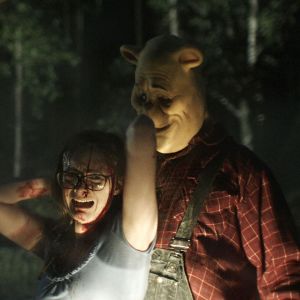 Here’s another example of how little thought was put into this movie beyond getting it to completion. The main character has a past trauma of being molested by a man who was stalking her and broke into her home. For our own edification, this scene is played visually for us, with the intruder taking their time to slowly pull down the strap of our sleeping protagonist’s shirt. So we have a past trauma and the character is now experiencing a new trauma, so from a writing standpoint, you would expect this horrible situation would be a way for the character to exorcise her trauma in a very extreme circumstance and there would even be a parallel for her to triumph over as a rudimentary character arc. It would, at the very least, provide a story justification for why our main character has endured her suffering, so as to work through that as her arc. Well, none of that seems to matter, nor are there any pertinent parallels, and so her past of having a creep break into her home, hover over her asleep, and touch her body was just prurient exploitation. Look, I understand the horror genre is built upon its tried-and-true exploitation elements, boobs and blood and the like. That’s what the audience for a killer Pooh movie comes to expect. I understand why Pooh is ripping the top off one woman before slamming her head into a meat grinder, though it still made me feel icky and sad, but that’s my central response. I did a lot of exasperated sighing and shaking of my head throughout the bloated 80 minutes of movie. After a slightly eerie and decently animated opening, this movie is creatively bankrupt on all fronts.
Winnie the Pooh and Piglet and the rest of the population of the 100 Acre Wood are products of Christopher Robin’s imagination, so him leaving them is more him moving on from his childhood enchantments rather than abandoning his friends. I guess this movie’s version chooses for them to have really existed, which raises some questions over what these creatures were doing before they ever met Christopher Robin. Were they animals and then Christopher Robin’s love and attention magically transformed them into anthropomorphic creatures? If so, then this little boy’s imagination has an amazing power to tap into. Although, to be fair, Disney itself made a 2018 movie with an adult Christopher Robin (Ewen McGregor) who was being followed by the stubborn animals of the 100 Acre Wood who sought him out to remind him about the power of friendships and belief that, I assume, he seemed to have lost track of as a jaded adult.
 Taking a look at the larger filmography of Frake-Waterfield, a devious pattern starts to emerge. The movies are built on title and concept, and there sure are a lot to choose from. As a producer, he has 21 movies released all since 2021 and another 14 in the works, including a sequel to Blood and Honey. Here, dear reader, are some of the titles of the past and future Frake-Waterfield productions: Dinosaur Hotel, The Legend of Jack and Jill, Spider in the Attic, Easter Killing, Wrath of Van Helsing, Croc!, Kingdom of the Dinosaurs, Curse of Jack Frost, The Killing Tree (about a murderous Christmas tree), Firenado, Monsternado, Bambi: The Reckoning, Mary Had a Little Lamb, Peter Pan’s Neverland Nightmare, Crocodile Swarm, Dinosaur Prison, and Snake Hotel. It almost plays out like a B-movie Mad Libs exercise. Take an animal people fear (snakes, crocodiles, dinosaurs) add a place (hotels especially, though is Snake Hotel a lodging intended for people who love snakes or for the snakes themselves?) and, when in doubt, swipe some public domain IP that has an innocent or more wholesome reputation and switch it up (Steamboat Willie but as a sex trafficker?). I’m not against schlocky low-budget horror movies that are acutely aware of their schlock. The killer Christmas tree movie actually seems ridiculous enough to be fun. Except, having seen Blood and Honey, I’m dubious that any of these will actually take advantage of their goofy concepts.
Even if you were turning into Blood and Honey for the ironic yuks, there’s nothing to really laugh at here. This is a bad movie rather than an enjoyably bad movie. It’s a movie that only exists because somebody thought enough people would be curious to watch a killer Winnie the Pooh movie. That’s the reason I tuned in, but from the second minute onward, there’s no reason to bother watching the remaining mess. Just imagine a low-rent slasher film with unimaginative kills, boring characters, a lack of any subversive connections or reframing of its source material, and an ending that doesn’t so much conclude but simply give up for a sequel, and you’ll have replicated Blood and Honey. As one saving grace, I will say that the movie has more polished cinematography than most of its low-budget ilk. The startling lack of imagination of everything else is depressing, as is the fact that this movie has earned over four million at the global box-office, hoodwinking enough rubberneckers looking for a good bad time. The problem is that Winnie the Pooh: Blood and Honey is only a bad bad time.
Nate’s Grade: D-
Share this:

The Core (2003) [Review Re-View]
 Originally released March 28, 2003:
I knew about 15 minutes in that The Core was not going to take its science too seriously. Aaron Eckhart, as a hunky science professor, is addressing military generals and essentially says, “We broke the Earth.” He tells them that because the Earth no longer spins (don’t think about it, you’ll only hurt yourself) the electromagnetic shield will dissipate and the sun will cook our planet. And just to make sure people understand the term “cook” he sets a peach on fire as an example. At this point I knew The Core was going to be a ridiculous disaster flick with its tongue firmly planted in its cheek.
Earth’s core has stopped spinning and horrific disasters are starting to be unleashed with anything from drunken bird attacks to lightening strikes in Rome. I always love how in disaster films Mother Nature always instinctively goes after the monuments, the landmarks, the things of cultural importance. The United States government hires a ragtag group of scientists and NASA pilots to journey to the center of the Earth and jump-start our planet. Of course everything that can go wrong on this fantastic journey will eventually go wrong.
The Core is so improbable, so silly, that it ends up being guilty fun. If you let go, ignore the incredible amounts of birth imagery (the sperm-like ship tunneling through to get to the egg-like core), then the very game cast will take you for a fun ride.
There’s a scene where the government approaches kooky scientist Delroy Lindo to build the super-ship that will take them to said core. When asked how much he thinks it’ll cost Lindo laughs and says, ”Try fifty billion dollars.” The government responds, ”Can you take a check?” I was pleasantly reminded of an episode of Futurama where the space-time continuum is disrupted and time keeps skipping forward. The old scientist and a Harlem Globetrotter (it was a very funny episode) theorize that to create a machine to stop this problem they would need all the money on the Earth. Flash immediately to the two of them being handed a check that says, “All the money of the Earth.” Richard Nixon’s head, in its glass jar, then says, “Get going, you know we cant spend All the Money on the Earth every day.”
 The assembled cast is quite nice. Hilary Swank assumes a leadership role quite nicely. Eckhart is suitably hunky and dashing. Stanley Tucci is very funny as an arrogant science snob. Tcheky Karyo (the poor man’s Jean Reno) is … uh, French. I don’t think anyone would believe that these people were the best in their fields (only in movies are scientists not old white men but hunky and sexy fun-lovin folk).
Director Jon Amiel (Entrapment) seems to know the preposterous nature of his films proceedings and amps up the campy thrills. An impromptu landing of the space shuttle in an L.A. reservoir is a fantastic action set piece, yet is likely the reason the film was delayed after the Columbia crash. The cornball science and steady pacing make The Core an enjoyable if goofy ride. The film does run out of steam and goes on for 20 minutes longer than it should.
The Core is pure escapist entertainment without a thought in its head. And in dire times of war and harsh realism blaring at us every evening, there’s nothing wrong with a little juicy escapist fair. Buy a big tub of popcorn and enjoy. Does anyone else wonder if we broke the Earth just after its 5 billion-year warranty was up?
Nate’s Grade: C+
——————————————————
WRITER REFLECTIONS 20 YEARS LATER

I never knew just how influential the 2003 disaster movie The Core has been. It’s a schlocky Hollywood sci-fi thriller built upon junk science but still enjoyable junk food entertainment. However, the science was so unrepentantly bad, that the science community as a whole decided to do something about it, and in 2008 the Science & Entertainment Exchange was launched. Founded by the National Academy of Sciences (NAS), its director Rick Loverd told Salon magazine how influential pop culture can be in its depiction of science, citing Star Trek inspiring scientists, Top Gun inspiring pilots, and CSI inspiring young forensic students. He also cites the power of seeing positive representation, like 2016’s Hidden Figures. The Science & Entertainment Exchange is an organization that is intended to consult on the application and depictions of science in cinema, hoping to make things more realistic. Apparently, The Core’s director, Jon Amiel (Entrapment), was so taken back when a science advisor was bad-mouthing the movie to Scientific American because he was under the impression that his movie, including restarting the Earth’s iron core with atomic bombs, had been scientifically accurate. Among the scientific community, they regard The Core as the nadir of big screen accuracy (as an example of a movie that got the science fairly accurate, they cite 2014’s Interstellar). I bet you never knew how truly influential and world-changing The Core was, albeit for being a junk movie. However, as it was in 2003, and even twenty years later, this is exactly my kind of junk.
I recognized the campy appeal of The Core right away. It’s a goofy movie from the premise to the science to the action set pieces but it’s all played one hundred percent straight, which makes it that much more entertaining and amusing. The opening sequence involves people with pacemakers dropping dead (approximately 1.5 million people worldwide). Then the birds start acting funny and crashing into buildings and cars and panicked outdoor crowds. For a disaster movie literally about the possible demise of the planet, this is such a strange and minimalist start to the looming threat at hand. The movie feels like it’s a throwback to the science fiction mission movies of the 1950s with a touch of the worldwide disaster movies of the 1970s. Even with the modern special effects, which are as delightfully cheesy as the rest of the movie, it doesn’t feel akin to the disaster epics of Roman Emmerich. The movie feels cornier and more dated and less interested in large-scale disaster spectacle. The surface-level disaster carnage is marginal, mostly an out-of-control lightening storm in Rome that knows to always steer for the monuments and cultural artifacts. The Core, at its core, is about the fantastic journey of its brave scientists. Take for instance a scene where the Serge is locked behind and being crushed to death by extreme pressure. I don’t know how anyone could keep a straight face while Aaron Eckhart, our handsome lead scientist, shouts, “Serge!” over and over while Tcheky Karyo (The Patriot) pretends he’s being squished to death while the walls get closer and closer to his face. That’s the kind of stuff I want, not CGI waves killing thousands in large-scale yet antiseptic spectacle.
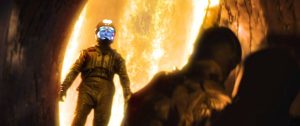 The movie takes about an hour before it really gets going, which is also admirably silly. Why devote so much time to setting up the reality of this dilemma for the complications and solutions to seem so throwaway? Seriously, the government uses one hacker (DJ Qualls) to control the entire Internet so that they can cover up the news about the possible impending apocalypse. It reminds me of an episode of The X-Files from the early 1990s where the government sends out an “all-Internet alert.” Perhaps the screenwriters felt we needed more time to accept the outlandish premise, which is strange because most disaster movies get a significant benefit of the doubt from audiences. Just having a person in glasses, and maybe a lab coat, or sweater if you want it to be more casual, explaining in a grave tone while removing their glasses dramatically, is likely all we need to accept the craziness to come. However, we do spend more time with our characters so that, when they depart one-by-one through sacrifice and accident, I actually cared enough because I was enjoying their comradery. I enjoyed Stanley Tucci being a blowhard who would even record his own narration as they travel through the Earth. I enjoyed Bruce Greenwood as the stern father figure that of course has to die first. I enjoyed Delroy Lindo as our excited but exasperated drill scientist. I enjoyed Hilary Swank as, essentially, the “best damn pilot I’ve ever seen.” I liked simply watching them all banter and bond together. It had enough development that their losses actually felt like losses and/or the accumulation of a character arc.
The question arises how do you keep things interesting when you’re burrowing through layer after layer of rock, and the answer is to just make things up. How about a layer of air? Could the Earth, compact as it is through billions of years of gravitational forces, have a layer of air like it was an English muffin? I did enjoy how the team had to restart their vessel before the magma poured into the vacant and awaiting space from their entry point. Of course, that raises the question now that magma is filling this vacant layer, have these scientists unintentionally ruined this unknown layer of the Earth? How about a layer with diamonds the size of states? These internal layers might as well be alien planets for as little they connect to reality.
 The movie is overlong and too uneven, but for fans of schlocky science fiction, it’s a delicious combination of campy entertainment. The silliness, played completely straight, even down to the part where Richard Jenkins explains man’ hubris is at fault for destroying the rotation of the Earth, is the grand appeal. I’m not going to call The Core a good movie but it sure feels like it knows exactly what kind of movie it is, and boy does it lean into that. My original review in 2003 caught on right away and I still recognized that same knowing vibe (why do we need a visual demonstration for the obvious concept of the sun cooking the Earth?). There really is a lot of birthing imagery too with the shape of the vessel burrowing to that egg at the center, so there’s that as well. The special effects are pretty murky and hokey for this kind of budget, but in 2023, that even works to the bountiful charms of the movie. I won’t pretend that most people will watch The Core with derision regardless of whether or not you’re an actual scientist. It inspired a generation of movies to be more scientifically sound, and it also inspired one of the biggest filmmakers on the planet. The metal that encases the spaceship? Unobtanium. You cannot tell me James Cameron wasn’t watching and taking notes.
Re-View Grade: B
Share this:

Cocaine Bear (2023)
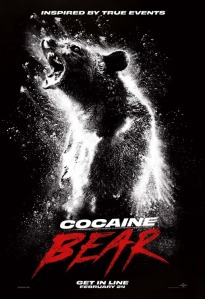 If you’re going to watch one movie with a cocaine-addled ursine killing-machine, it might as well be Cocaine Bear. In a lot of ways, this movie reminds me of Snakes on a Plane, a similarly deadly animal thriller sold on its bizarre concept and the promise of ironic entertainment, and both of the movies creatively peaked before anyone saw the movie. The true story is that in the 1980s, a drug-running plane dropped shipments of cocaine in Tennessee wilderness and a bear came across some cocaine, ate it, and died. The movie asks, “What if it became a coked-out slasher killer?” I wanted this movie to be more fun than it is, and I think the crux of my disappointment stems from the movie working one obvious joke into utter oblivion. The absurdity of a bear being high on drugs is about all you’ll get through 90 minutes. There are characters and subplots that you won’t care about, nor find terribly funny despite having Keri Russell, Alden Ehreneich, Brooklynn Prince, Kristofer Hivju, Isiah Whitlock Jr., Margo Martindale, and the final performance from the late Ray Liotta. It’s a lot of people, staring agog and saying, “A bear can’t do that,” and then we watch the bear do exactly that. There’s some impressive gore at turns and the CGI bear is workable for this kind of budget. The shame of it is too much just isn’t that funny. The movie is too content to rest upon its arch premise without adding enough additional comedy development to actively engage. If you’ve seen the trailer, you’ve seen the movie. This movie needed to be funnier, darker, weirder, or just anything in addition to the simple premise of a bear high on drugs and running a rampage. Is the joke ultimately on me for expecting more from a movie called Cocaine Bear?
Nate’s Grade: C
Share this:

Free to a Bad Home (2023)
 Last year, I was approached by HaleHouse Productions, a company led by the Ohio filmmaking and brotherly duo of Kameron and Scott Hale, to review their first feature, Entropy. It was a small indie shot with a bunch of friends over the course of the COVID-19 lockdown, and I appreciated the artistic aptitude of ganging together during such trying times, but ultimately I found the movie’s flaws to be too overwhelming. I was slightly surprised when HaleHouse reached out to me a year later and solicited another review for their next horror movie, Free to a Bad Home. After all, I had been critical about their earlier film, but they said they appreciate reading the reviews, and this has always been my aim when I write these critiques for Ohio-made indies, to try and provide a professional review with clear and coherent constructive criticism and earned praise. So I figured why not, and I watched Free to a Bad Home, and now I’m wondering if HaleHouse is still going to seek out my opinion when it comes time for movie number three.
I was happy that the Hale brothers (credited as both writers and directors) took the anthology route because, greedily, it means more stories to be told, and it also conveniently allows the audience to leap to another story if the current one wasn’t exactly firing. It’s a numbers game: rather than hoping for one story to entertain, now we have three shorter stories to hopefully engage and entertain. However, the needs of telling a short are still very similar to that of a feature-length screenplay; you still need interesting characters, you still need a story with a beginning, middle, and end, and you still need to use your time wisely, whether it’s a five-minute story or a two-hour one. While Free to a Bad Home divides its time between three smaller tales, and one perfunctory wraparound, I can’t say the movie still knows what to do with its 80 minutes (divided by three). Any horror movie needs adequate time to establish mood. There are plenty of movies that are nothing but a mood piece, like David Lynch or the recent indie breakout Skinamarink, where the intent to present an experience that detaches the audience from the known and places them into a limbic middle zone of uncertainty and dread. Storytellers are going to need some time to establish the main characters, their dilemmas, the setting, and where and when things are going peculiar or wrong. Watching Free to a Bad Home, it felt like each segment had an idea but left it frustratingly vague and with regrettably little development to carry it.
 Ignoring the wraparound, the first segment is about Amy (Miranda Neiman) overcoming loss while visiting her old home. She spends a lot of time walking around, hearing strange noises, and getting lost through drinking. Her sister comes around too. It lasts around twenty minutes and much of it hinges upon the very ending twist, which explains what happened to her husband and why it is weighing so heavily on Amy. Except the preceding twenty minutes doesn’t feel like we’re getting more intrigue or insights into Amy or even her fraying psychology. She’s seeing weird visions of a guy in bed sheets and a strange sinkhole in the woods, but a lot of the running time is sitting and waiting. We understand she’s in some stage of mourning. This isn’t really further developed after being established, and that’s the issue with many of the segments. It’s an idea, and there’s a conclusion that is generally predictable, but we’re missing the middle. You could include the first three minutes, the last three minutes, and cut out the in-between, and the “Amy” segment would play out the exact same way. The problem is that the end is too obvious to simply keep the character in a holding pattern for so long with only minimal action. The character is very much sitting around and waiting, and so are we for too long. It’s structured like a haunted house story where a woman is coming undone. Except we don’t get better insights into this person over time, nor do we get increasingly scary haunting or her unraveling mental stability.
The second segment follows Ryan (Jake C. Young) breaking into a home and taking just the most absolutely leisurely time looking for anything of value. We spend nearly ten minutes just watching this guy walk into a room, look around, and then leave to go search in another room. I think the drawn out time is meant to heighten the vulnerability of our thief, making the audience worry that he’s spending too long and is more likely to get caught. First of all, that requires me to find this character likable or interesting to care if he avoids exposure and arrest. This could happen if somehow during these ten minutes we’re learning about dear old Ryan. Maybe we see his problem-solving skills, maybe he gets an inopportune call that he tries to get out of but reveals his own status of financial insecurity, and maybe he even encounters evidence of the family that lives here and makes comment, like he’s a disgruntled employee trying to take what he feels is deserved from a wealthy executive. Anything other than watching one guy walk into several rooms and look around for valuables. At long last he finds something unexpected, a woman named Camilla (Roni Locke) chained to a mattress. Rather than pretend to be a traumatized victim of trafficking, which would be the easy assumption, this woman declares herself a demon who will help Ryan open the family’s expensive safe. However, if he were to release her, she promises to kill the family next door. Do we know anything about them? No, not really, but the devil’s bargain is established: personal gain for the death of strangers. Once again, the ending seems obvious given the lack of substantial character development. The hook is the offer from the evil entity and the cost of his own selfishness, but this hook is diminished when we don’t exactly get any personal struggle wrestling with the decision or its horrific outcome.
 The final segment is the longest, nearly half the total running time, and we follow Julia (Olivia Denis) who is going with her older sister and her friends to a Halloween party. There’s the start of something here with a younger sibling eager to grow up and hang out with older peers, with the drawback of getting into trouble in the pursuit of being seen as cool. Except none of the four characters we follow to the party really distinguish themselves as people. We spend more time watching them do acid in the car, slowly, than we do anything else. It’s a full ten minutes of watching ladies drop drugs into their eyes while moody neon lighting bathes their skin and the synth score rings. We’re clearly going for an immersive mood here but the drug usage, so heavily covered, isn’t ever conveyed in plot or perspective. When the characters arrive at their party, we don’t see any hallucinations or hear anything amiss, which could have been more visually interesting as well as ratchet up tension that things are unwell. Instead, the ladies attend a very sparsely attended gathering where they unveil a smiling corpse and then take turns projectile vomiting onto the body. Then the women are chased and easily dispatched. The end.
So what do all the story segments have in common? There’s plenty of idle waiting. There’s a real dearth of characterization outside whatever the initial premise might afford. There are specific stylistic fixations that are often to the detriment of pacing and story, like the low-light investigation of Ryan and the trance-like neon dream of the ladies tripping on eye drops. There are also obvious endings that don’t feel any better realized or subverted or better set up. Every anthology collection is going to be a mixed bag depending upon your personal tastes, but there’s a certain safety in numbers. I didn’t love all 26 segments on 2012’s The ABCs of Death but there were enough that tickled my fancy, likewise with the many V/H/S collections. However, each of the three anthology tales in Free to a Bad Home suffers from simply not having enough to do.
There are concepts here that can work. The idea of an anthology movie following a cursed object is a fine starting point, almost like the horror equivalent of 1999’s The Red Violin, an underrated indie that traced the adventures of a special violin through centuries of owners. The idea of a criminal coming across a caged demon who tempts them with a Faustian bargain is good. The setup of a younger sibling wanting validation and tagging along for something they are unprepared for, that’s a strong starting point for a night of unexpected terror. A woman alone in her old home and haunted by her memories is a familiar but potent starting point for horror. These core ideas can work but not one is given substantial development to make them matter.
 If you wanted to trace the lineage of a cursed object, I think it would have been more creatively fulfilling to tell your stories in distinctly different time periods, highlighting shifting values but also the different appeals this haunted object might have had depending upon the times. Imagine a woman coming across a cursed piece of jewelry in 1890 or 1950 versus modern-day. There’s nothing in any of the three stories that ties them to a specific time period, so why not venture into other times to give a larger sense of history and the ramifications of this curse? As a low-budget indie, I understand the production reasons why the three stories are all contemporary, though the movie opens with a quick succession of suicide and murder in two earlier time periods. Creatively, the movie feels too easily satisfied and needed to push its ideas and horror further. As it stands, Free to a Bad Home feels like a collection of disappointing shorts rather than one single story disappointment, which oddly enough makes the movie feel even more disappointing.
For being a small indie Ohio production, there are some impressive artistic values. The cinematography by William E. Newton (Black Wolf) can be occasionally entrancing, like during the drug-addled driving sequence that is a little too in love with its protracted mood. The practical makeup effects are sparing but can be unsettling and effective, most notably during a coda where a woman picks at a very open wound on her face and works it to disgusting lengths.
Free to a Bad Home doesn’t separate itself from the glut of cheap horror movies with half-formed stories. Rather than squandering one story over the course of 80 padded minutes, now it’s squandering three-ish stories over the course of 80 padded minutes. I’m a little surprised there isn’t more horror as well, whether that’s conventional exploitation elements like gore and sex, or simply just constructed and sustained sequences of terror and dread. For genre fans with a love for DIY indie spirit, there may be some entertainment to be had with Free to a Bad Home. You can tell the Hale brothers and their small crew have their passions for the material. I only wish more scrutiny and perhaps outside assistance in the writing and development of future tales to make the most of the potential. Free to a Bad Home is available on Tubi and other streaming services, making the title even more apt. For me, there was just too little going on creatively to maintain my ongoing interest and waning attention.
Nate’s Grade: D+
Share this:

Missing (2023)
 If you were a fan of 2018’s Searching, the missing persons thriller told entirely from the point of view of a computer screen, then chances are you’ll fine enough to like about Missing, its found footage spiritual sequel. The co-editors from the first movie are now taking the reigns directing, and screenwriting, as we follow an 18-year-old June (Storm Reid) trying to track her mom’s (Nia Long) whereabouts after going overseas with her new boyfriend. It’s a reverse of the setup from Searching, the father desperate to locate his daughter, but under both scenarios the person doing the investigation comes to discover how little about their loved one they may have fully known, or at least how much they were keeping hidden. The creative constraints of keeping everything to a computer screen aren’t as limiting as you might think, especially with smart tech creeping into different aspects of home life and surveillance. The movie is well paced and still has a satisfying structure to its assembly of evidence and clues literally being in your face. The third act goes more than a bit overboard with outlandish twists upon outlandish twists, threatening to rip away whatever credibility the movie has earned to that point. It’s a bit much, but by that point most audience members will be onboard for the soap opera revelations. It’s not as fresh as Searching, nor does it have a lead performance as gripping as John Cho was as the frantic father, but Missing may be more of the same but that’s still enough to be a small-scale, fun, twisty little thriller to pass the time smoothly.
Nate’s Grade: B-
Share this:

Empire of Light (2022)
 I was recovering from the flu while watching Empire of Light, which probably hindered my entertainment experience somewhat, but I was astounded at how a movie with this pedigree could be this boring and adrift. It’s directed by Sam Mendes, photographed by Roger Deakins, starring Olivia Colman and Colin Firth, and it’s all about running a movie theater in England in the early 1980s, so you would expect it to be nostalgic catnip for any cinephile. Not so. For the first hour, it feels more like a series of moments that feel pressed under glass, all the air and life removed in the presentation. It doesn’t work as a celebration of art and the power of movies, though it tries at points. It doesn’t work as a character examination because so many of the characters are kept surface-level, shallow, or boring. Colman is our main character and having an unfulfilling affair with her boss (Firth) and then she starts a friendship with a new, younger co-worker that transforms into its own romance. Given that setup, you would think you would care about their burgeoning relationship, but I didn’t (I was more amused at all the places beside an actual bed that people are seen having sex). That’s because this movie feels so poorly paced and passionless. Colman gets her showdown with her bad boss and I thought, “Well, we’re wrapping things up,” and then I discovered that, amazingly, there was still 50 minutes left. “How?!” I shouted at my TV screen. Ah, you see that’s when the movie throws out a mental illness subplot that feels entirely too late and awkwardly handled to count for much else than a delay tactic. I wish Empire of Light had just been one of those adorable British small-town comedies with oddballs running a movie theater in the past, either leaning into it as a workplace comedy or a romantic ode to cinema. It’s a lot of missed potential and middling artistic elements without a clear vision to steer them. There are moments that stand out, especially the racist ones, but it’s a too-long movie missing interesting characters and an accessible and engaging story that exists beyond the (assumed) ephemeral memory of Mendes.
Nate’s Grade: C
Share this:

Knock at the Cabin (2023)
 Knock at the Cabin continues M. Night Shyamalan’s more streamlined, single-location focus of late, and while it still has some of his trademark miscues, it’s surprisingly intense throughout and Shyamalan continues improving as a director. The premise, based off the novel by Paul Tremblay, is about four strangers (Dave Bautista, Nikki Amuka-Bird, Rupert Grint, Abby Quinn) knocking on the door of a gay couple’s (Jonathan Groff, Ben Aldridge) cabin. These strangers, which couldn’t be any more different from one another, say they have come with a dire mission to see through. Each of them has a prophetic vision of an apocalypse that can only be avoided if one of the family members within the cabin is chosen to be sacrificed. Given this scenario, you would imagine there is only two ways this can go, either 1) the crazy people are just crazy, or 2) the crazy people are right (if you’ve unfortunately watched the trailers for the movie, this will already have been spoiled for you). I figured with only two real story options, though I guess crazy people can be independently crazy and also wrong, that tension would be minimal. I was pleasantly surprised how fraught with suspense the movie comes across, with Shyamalan really making the most of his limited spaces in consistently visually engaging ways. His writing still has issues. Characters will still talk in flat, declarative statements that feel phony (“disquietude”?), the news footage-as-exposition device opens plenty of plot hole questions, and his instincts to over-explain plot or metaphor are still here though thankfully not as bad as the finale of Old, and yet the movie’s simplicity also allows the sinister thought exercise to always stay in the forefront. Even though it’s Shyamalan’s second career R-rating, there’s little emphasis on gore and the violence is more implied and restrained. I don’t think Shyamalan knows what to do with the extra allowance of an R-rating. The chosen couple, and their adopted daughter, are told that if they do not choose a sacrifice, they will all live but walk the Earth as the only survivors. It’s an intriguing alternative, reminding me a bit of The Rapture, an apocalyptic movie where our protagonist refuses to forgive God and literally sits out of heaven (sill worth watching). The stabs at social commentary are a bit weaker here, struggling to make connections with mass delusions and confirmation bias bubbles. I really thought more was going to be made about one of the couple being a reformed believer himself, with the apocalyptic setup tapping into old religious programming. It’s a bit of an over-extended Twilight Zone episode but I found myself nodding along for most of it, excusing the missteps chiefly because of the power of Bautista. This is a very different kind of role for the man, and he brings a quiet intensity to his performance that is unnerving without going into campy self-parody. He can genuinely be great as an actor, and Knock at the Cabin is the best example yet of the man’s range. For me, it’s a ramshackle moral quandary thriller that overcomes Shyamalan’s bad writing impulses and made me actually feel some earned emotion by the end, which is more than I was expecting for an apocalyptic thriller under 100 minutes. What a twist.
Nate’s Grade: B-
Share this:

Daredevil (2003) [Review Re-View]
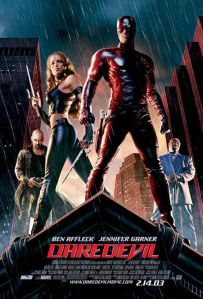 Originally released February 14, 2003:
Not as bad as it could have been. That’s the best way to sum up Ben Affleck in tights.
Nate’s Grade: B-
——————————————————
WRITER REFLECTIONS 20 YEARS LATER

For many years, 2003’s Daredevil has become my handy threshold for assessing superhero cinema: if I liked the movie better than Daredevil, it was likely a good movie, and if I liked it worse than Daredevil, then it was a bad movie. It’s also fascinating to think back to a time after X-Men but before the behemoth of the Marvel Cinematic Universe, where superheroes could be cheesy while trying to be edgy and cool. This is a time before Ben Affleck was Batman, before Jon Favreau kickstarted the MCU by directing 2008’s Iron Man, before the gritty Netflix TV series of the same character, and before Colin Farrell became a widely respected actor. Behold the cheesefest that is the big screen Daredevil, written and directed by Mark Steven Johnson, previously best known as the writer of Simon Birch and Grumpy Old Men. Johnson is an avowed superfan of the comics and blind crime-fighter from Hell’s Kitchen, but in a recent 2023 interview on Yahoo, even Johnson admits his fandom sank the movie. The director admits to trying to cram in too much to appease fans and hook new audiences, and then there’s the obvious studio notes trying to make Daredevil into more popular and well-known super folk.
In the age of dour, gloomy superheroes that are held to unreasonable standards of gritty realism, or the creative control of the MCU, it’s fun to look back and see something stand out, even for some of the wrong reasons. Daredevil is still, to this day, a cheesy delight that you can have fun with or you can laugh yourself silly. Early into my re-watch, I settled into the kind of movie I was in for, with a smile on my face and the knowledge that things were going to be goofy. Young Matt Murdock is looking for his dad when he comes across him shaking down someone for money. Oh no, his dad really is a mob goon, and after he swore to his son it wasn’t so. Matt runs away from this traumatic realization only to get magic toxic waste sprayed into his eyes, but before he does so, he drops a paper in the alleyway, and it just so happens to be his report card with straight As that he couldn’t wait to show his not-a-goon dad. I laughed out loud. Daredevil cannot be taken seriously and that’s okay. He leaves a calling card of two criss-crossed D’s written in flammable liquid on the ground, which is a mystery how someone would discover this and even funnier thinking of Daredevil writing this signature after his work. Another fine example is the entire introduction to Elektra (Jennifer Garner) where adult Matt smells her before she arrives, becomes infatuated with her enough to use his blind status as an excuse to hit on her, then grabs her hand and refuses to let her go, which corresponds to the two of them flirt-fighting on a playground. It is an absurd, and occasionally creepy, sequence from start to finish, and that’s not even accounting for the blood-thirsty children chanting against the fences for the adults to fight. I was smirking or chuckling throughout Daredevil, and while I doubt that was Johnson’s artistic intention, it’s his movie’s best selling point from an entertainment standpoint.
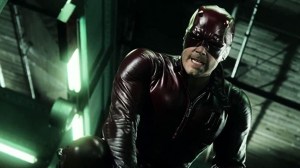 There is too much going on here, which makes all the storylines feel clipped, underdeveloped, and ultimately also worthy of derisive entertainment. We get two scenes with Elektra before she’s fallen in love with her blind man in shining leather, and then the next moment she blames Daredevil for her father’s death, and then the next moment she’s seeking vengeance, and then she’s dead, but she’s not really dead because she’s been resurrected… somehow… and spun off into her own solo movie that will be released in 2005. In this regard, being over crammed with side characters and storylines with the intent on setting up later movies, conflicts, and commercial chains of characters is very in-keeping with today’s overburdened, interconnected IP universe. It’s the same with the villains. We have two; Kingpin, the hulking crime boss played by Michael Clarke Duncan, and Bullseye, a hired killer with killer aim played with gusto by Farrell. It’s not enough to make the Kingpin the big boss of crime, the movie has to also make him literally the one responsible for the death of Matt’s father in Act One. Jack Murdock (David Keith, not to be confused with Keith David) is a washed-up boxer who wants to try again but be legit, so he ignores the warning to take a dive and is murdered for his pride. Seriously, I know his kid wanted him to win, but I think Matt would rather have an alive father with wounded pride. Bullseye is a contract killer from Ireland but why would Kingpin hire him and fly him across the Atlantic to just bump off one of the man’s subordinates? Surely there are any number of more efficient and less time-wasting manners to eliminate an underling. I guess he’s another of those comic book villains that just gets so involved in their overly complex schemes. Maybe it’s really the schemes that bring him to life (Evanescence nod) and keep the big guy from getting bored.
The action vacillates greatly from decent to ridiculous. I am absolutely positive that the Fox executives saw those 2002 Spider-Man box-office records and said, “Hey, put some of that building jumping stuff in there too.” This is a Daredevil where he just dives face-first off of buildings and plummets to the ground. Remember, he has advanced hearing and other senses, but he’s still supposed to be a human being, not a mutant, not a meta human, not a god. Diving face-first off of high buildings seems like a sound way to practice your eventual suicide. He also leaps and kicks like he’s in The Matrix, including dodging bullets too, which seems like his skills are pushing the “faster than a speeding bullet” realm of other heroes. In fact, Daredevil’s abilities seem to rival that of Superman with his intense hearing. Apparently, the man can lock in on a specific conversation blocks away. It’s these heightened moments of super impunity that make him less vulnerable even though the movie also wants to highlight his scars and bruises. This is the guy that needs to sleep in a water-filled sensory deprivation chamber (so pruny) but will throw himself into battles with multiple points of competing gunfire. The fight choreography has some slick moves but is also fairly mediocre, and it’s worse when the rubbery CGI Affleck is slotted into action to make even more preposterous moves (never dodge when a glorious backflip could do). I was beside myself when Bullseye collected broken stained glass, that he plucked from the air like snowflakes, and then piled into his hands like a server balancing stacks of plates, and then he started hurling them at Daredevil. For a guy whose notoriety is not missing, you think he would readjust or figure out that a guy flipping backwards is always going to have a turning middle of mass.
 The movie is struggling to juggle all these characters, all these storylines, and all of its would-be brooding themes and Catholic imagery of sacrificial bloodshed. It makes the movie feel like you’ve accidentally sat on the remote, speeding up the process of its 105 minutes. Johnson had a longer cut of the movie with a whole subplot of lawyer Matt Murdock, but that’s not what the people come to see. The character arc of Matt finding love and losing love is rushed and feels insufficient, more of a checkbox for the studio. Given the material, it’s surprising that Affleck and Garner would fall in love in real life and get married in 2005 (and then divorced in 2018). The arc of him learning restraint, to not be “the bad guy,” is laughably simplified to the point where just not killing the big crime lord is supposed to qualify as applause-worthy character growth. It’s enough that the crusading journalist (Joe Pantoliano) trying to bring light to this case decides to become part of the conspiracy and withhold information, enough so that he stares out of his home, jacket slung over his shoulder, and sees Daredevil watching from atop the street (how would he know?) and says, “Go get ‘em,” like he’s Mary Jane Watson cheering on her web-slinging beaux. It’s moments like this that you can’t take seriously but can appreciate as goofy mid-level supes entertainment. Daredevil is not great but it could have been much worse.
After the reception of this movie, it’s surprising that Affleck would want a second chance to suit up as a superhero, but then again being Batman is like playing Hamlet in our modern society. With Daredevil, he does seem uniquely qualified as a handsome man staring blankly. Garner was ascending thanks to her breakout role in J.J. Abrams’ Alias, and Farrell was becoming a Hollywood It boy in 2003 before finding a higher artistic ceiling with 2008’s In Bruges. He’s a hoot in the movie but he might have twenty total spoken words. It’s more a performance of grunts and scornful growling. Duncan was a controversial casting but an early example of race-blind casting traditionally white comics characters. It’s rare to find an actor of imposing size and stature that can still, you know, act well. With respect to Vincent D’Onofrio, who was my favorite part of the Netflix Daredevil series, but if the Kingpin were cast today, it would be Dave Bautista (Knock at the Cabin) hands down. Johnson was given another chance at superhero franchise-making with 2007’s Ghost Rider, which was also enjoyably goofy but also bad. I feel for the guy because he was fighting battles for genre credibility and superhero universe logic that most of the filmmakers in the MCU today take for granted. He walked so that James Gunn could run.
Twenty years later, Daredevil still kind of works as my superhero movie grading threshold. It’s not traditionally good but it has a nostalgic charm, an artifact of a time before the eventual boom. It’s so goofy and so early 2000s-edgy (the hard rock soundtrack is its own contribution of hilarity). With the right mindset, I think Daredevil can be fine albeit dated and cheesy passing enjoyment.
Re-View Grade: C+
Share this:

Babylon (2022)
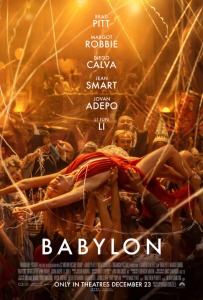 I completely understand how Babylon is such a divisive movie, and this seems entirely the point of writer/director Damien Chazelle (Whiplash, La La Land). It’s over three hours long, it’s got a budget of around $100 million dollars, and the entire enterprise just shouts artistic hubris, at best, and petulantly self-indulgent miasma at worst. Any movie that literally opens with a sequence that includes shots of an elephant defecating and a prostitute urinating on her giggling john is clearly trying to provoke a very strong response, and Chazelle’s expose on the early romanticized days of Old Hollywood is, chiefly, intended to revile and disgust. Chazelle’s mission is to rip apart the cozy nostalgia and hazy romance of the dawning of the film industry, to proclaim that Hollywood has always been a cesspool of exploitation and misogyny and racism and greed. The movie wallows in giddy exploitation but also hijacks the illusion of achieving stardom and asks whether or not the lasting art is worth all of the horror and ugliness of the systems that produce it. Babylon is a wild party of a movie with multiple sequences brimming with pure brilliant filmmaking bravura, and it also ends in a way that just might collapse Chazelle’s righteous fury and contempt.
Within the first half-hour, we are introduced to the three main characters we’ll be charting over many years. Nellie LaRoy (Margot Robbie) crashes a big house party that would make Gatsby jealous. She’s come to California to follow her acting dreams, which her family and small-town peers would sneer at, and she is faking it until she makes it with her boisterous personality. Manny Torres (Diego Calva) is a Mexican-American just trying to get his big break in Hollywood and willing to do whatever it takes to pal around with those in the movies (he is one of our primary elephant wranglers). Jack Conrad (Brad Pitt) is the highest-paid silent movie star famous for his sweeping epics as well as his drinking and multiple broken marriages. Over the next few years, as the industry transitions into the precarious era of sound, each of these three will experience their own rise and fall as they struggle to hold onto their dreams despite the many personal compromises and risks they have to endure to cling to that glitz and glamor.
 If Baz Luhrrman’s Great Gatsby and The Wolf of Wall Street had an illicit baby, and then it was raised by Boogie Nights-era Paul Thomas Anderson, you might get Babylon. It is a big movie founded on the principle of grandiose excess in all capacities. First off, it’s three hours long though this might be some of the fastest-paced three hours, albeit twenty minutes could have been trimmed here and there. I was never bored once, partly because the structure of the movie is episodic in nature, boasting varied sequences that run the gamut from brilliant to ridiculous to brilliantly ridiculous. From an overall thematic standpoint, there isn’t really any subtlety or nuance. The movie is like having the director screaming in your face. Chazelle’s depiction of Old Hollywood is one of direct shame and wanton hedonism, and beyond the obvious “It was always this bad” moralizing there isn’t much more that Chazelle has to articulate, except for a strangely misguided and arguably antithetical coda (more on this later). For almost three hours, Chazelle holds the industry accountable on their buzzy, boozy wavelength of high energy and thrills.
Babylon is presented as a big raucous party where you’re happy to be a guest but also glad you can go home to your own bed. This isn’t a movie that excuses the misdeeds of its degenerates and hangers-on and the systems of power that enshrined the horrible to be even more horrible. Babylon pushes its many characters into uncomfortable questions of what they’re willing to compromise for fame. It’s a process of assimilation and people cutting free their identity, which can be liberating for some and lacerating for others. A significant supporting character is a black jazz musician who begins to find success in the pictures. Then the producers want the man to blacken his face even further, and the ensuing anguish and rage is so palpable that it’s hard to think Chazelle has anything but seething contempt for the sordid history of his own industry. Babylon yearns to be shocking, to be provocative, and it does so easily, sometimes too easily. It’s exceptionally gratuitous to a fault, cavorting with topless women, drug binges, abrupt and callous violence, and all sorts of lewd bacchanalia. Chazelle is demystifying Hollywood’s self-serious fable, and he’s doing so by boldly leaving no bodily fluid untapped and un-splattered.
 This movie is a lot, and it’s also offering very little on a thematic level, so I can understand why plenty of people would hold their repulsed noses and say, “Not for me.” I get it. Not everyone is going to want to watch Nellie projectile vomit onto a hoity-toity snob during a party where she’s trying to re-frame her coarse, lower class identity to be accepted by the brain-dead social elites. Hollywood is presented as a vehicle for self-actualization, but the system is relentless and unforgiving, and even those who achieve success are never afforded a secure perch. The careless regard for safety in Old Hollywood is highlighted by memorable moments, like when a Medieval war epic is halted as a dead extra has a spear sticking straight up in his gut. The crew argue that the man was known as a drinker and therefore it must have been an accident of his own doing. And then the movie skips back to filming, this man’s passing given no more passing thought. And yet there are thousands arriving every year to work themselves senselessly to be the next awaiting sacrifice for this town. It’s an industry built upon human suffering and I can see how many viewers would view the many examples as wallowing in the muck for titillation. The difference for me is that I don’t feel like Chazelle is glorifying any of these antics…
…With the exception of the ending, of which I will discuss more in depth because I find it to be wholly curious and in conflict with every fiber of the movie up until this very final point. I don’t think much of this would spoil the movie for you, but if you wish to avoid my discussion of the conclusion, then skip to the next paragraph, dear reader. The film has a very definitive perspective on the movie industry’s sadistic history and yet in the last five minutes, Manny is subjected to a montage of cinematic high points, zooming ahead into history to include such movies as Terminator 2, Titanic, The Matrix, and Avatar, and he weeps. For 170 minutes, Chazelle has taken us along the road of perdition of Hollywood exploitation and degradation, complete with a skin-crawling trip through hell with Tobey Maguire. And then in the final ten minutes, Chazelle says, yeah, but maybe all of that exploitation and death and disaster was all worth it because we now have movies like… Avatar. It’s the conclusion where Chazelle, as my pal Ben Bailey would say, reveals himself as an art maximalist, that only the art remains and only the art shall matter, arguing that all the vile behavior we’ve endured has meant nothing. It’s the opposite of what the rest of the movie has been purporting, and it’s strangely sentimental for an unsentimental film. It feels like a misguided misstep that concludes with excuse-making and moral relativism, which is far queasier than any of the gratuitous sequences of nudity, drugs, vomit, piss, and rat-eating.
 The technical qualities of Babylon are outstanding, and when working in such symbiotic symphony, they can be absolutely thrilling to exhibit. The sterling production design, extravagant costuming, and swinging cinematography work with the fevered editing and pumping score, and expertly recreate this era with amazing scope and lived-in period detail. I’m still humming the score’s memorable, jazzy, percussive leitmotifs days later. There are sequences that are simply stunning, such as the first day on a movie set for Nelly and Manny, both of them making names for themselves through problem-solving and scene-stealing, and the revelations and race-against-time brinkmanship are electric. The introduction of sound also creates many complications, brilliantly encapsulated in a comedic sequence where Nellie is trying to adjust to this new reality on a soundstage. It’s a comedy of errors cracked up to a hallucinatory madness by the end. Chazelle also delivers one of the best fart jokes in film history, where Conrad is in a bathroom questioning the appeal of sound and why audiences would want to hear, and as punchline, a giant fart erupts from one of the bathroom stalls. The parties are ribald, with the opening making use of an elephant as a literal distraction stomping through a mansion, and a latter one that ends in a frenzied man-to-snake fight. The entire sequence with Maguire is best left as a stupefying surprise, a sequence that reminded me of the dread-fueled Wonderland scene in Boogie Nights. In my view, even if you found the movie was thematically shallow, the individual sequences are so entertaining and so technically executed that the movie demands to be seen.
I’ve noticed some complaints that Chazelle’s messy opus could have pulled from actual Hollywood scandals, that he didn’t need to make up characters and fictional scenarios. That’s fair, but Chazelle wants to impart an impression rather than a case-by-case history of literal bad men. There are characters meant to resemble clear inspirations, like Fatty Arbuckle (who was innocent, by the way) and the affair of Greta Garbo and Marlene Dietrich or Errol Fylnn’s penchant for underage girls, but I don’t think the movie loses its spirit or bite because it’s not strictly recreating existing historical scandals. It’s still an expose on Old Hollywood without the names.
 Babylon is a rip-roaring experience that condemns the history of cinema through the expansive art of cinema, and it’s a wild party populated by sleazy provocateurs and capitalists. Even some of the criticisms of Babylon I can find artistic explanations for, from its gratuitous nature to even the sidelining of its minority and queer stories, perspectives themselves cruelly sidelined and erased from the studio system of Hollywood. Even its overwhelming explicit nature is partly the point, as characters spin round and round, indulging in every debauchery to avoid the march of mortality. Robbie’s high-energy performance is like if a bag of cocaine became a sentient human being. It’s all about sensation and distraction and the many willing to give everything to be part of that, and for almost three hours, Chazelle makes the manic chaos absorbing and horrifying before going soft in the end and arguing that maybe it’s all worth it. Babylon is dazzling filmmaking that will exhaust and nauseate as many as it potentially thrills. I’m glad Chazelle decided to use much of his carefully built artistic cache to make something this extravagantly divisive and ambitious.
Nate’s Grade: A
Share this:

The Whale (2022)
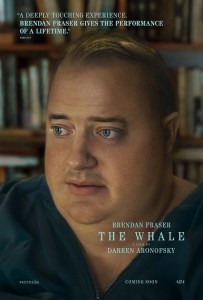 Much has been written about Brendan Fraser’s comeback role and the mountain of prosthetics he was buried under to portray a self-loathing 600-pound man in director Darren Aronofsky’s The Whale. The concern was that the movie would stigmatize overweight people as disgusting and treat fatness like a moral indictment, condemning their lifestyles as slovenly and doomed to misery. I watched the film ready to cringe at a moment’s notice with the hyped portrayal that earned such livid and divisive reactions. I found The Whale to be deeply empathetic but I’m uncertain about whether or not it was fully compassionate, and it’s that artistic distinction that I’m trying to square as I analyze Aronofsky’s melodramatic yet flawed character study.
Charlie (Fraser) is a morbidly obese English teacher who keeps his camera off during his online classes. The closest relationships he has is with his nurse, Liz (Hong Chau), who checks on him regularly with alarm and concern, as she’s also the sister of Charlie’s deceased partner. The movie chronicles one eventful week in Charlie’s life as he tries to make the most of his dwindling time and reconnect with his estranged teenage daughter, Ellie (Sadie Sink).
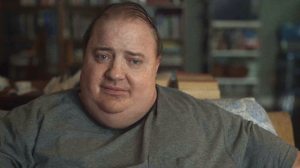 For me, Charlie is less a clinical case of what being morbidly obese can do to a person and he’s more a case study of self-destruction. In 1995’s Leaving Las Vegas, Nicholas Cage won an Oscar playing a man determined to drink himself to death over the course of one eventful weekend in Vegas, and I saw more parallels with his character and Charlie, a man who turned to eating as his source of grief that then became his vehicle for self-destruction. The movie is not casting judgment that all fat people, even those approaching the size of Charlie, are destined for eternal loneliness or crying out for help. However, this specific man is using his increasing weight as a form of suicide. This facet makes Charlie interesting but also increasingly confounding as well. He seems genuinely remorseful about the time he’s missed from his now-teen daughter’s life. He’s saved up his life’s money and plans to give it to her, but I kept wondering why, exactly, he had to die for this? He won’t take care of himself because any medical cost could take away from the handsome sum he plans to leave, in full, to Ellie. He apologizes for being absent but seems unable to see an alternative where he can be present. After so many years apart, maybe she would actually prefer having her dad back in her life? Charlie stubbornly holds to an all-or-nothing ideal, like some kind of fumbling romantic gesture, but he doesn’t have to die for his daughter to live her best life. She doesn’t even get a say. It’s his inability to see through this false choice he’s determined is the best outcome that makes the character frustrating. He only views his death, and I’m sure the insurance to go with it, as his biggest reward that he can offer his estranged daughter, and that makes it even more frustrating at the very end, where he’s trying to prove something to her but is also likely traumatizing her for life. That love he proclaims so readily for his daughter seems questionable when he prefers a misguidedly noble demise to getting to know her and allowing her to choose for herself. The character seems so frustratingly myopic about his own life and its value only being its end.
Complicating this matter is the reality that Ellie is, quite clearly, a horrible person. She’s angry at the world and trained her ire on her absentee father, who she believes left her and her mom to pursue an illicit affair with one of his male students (the reality is a bit more complicated). She is well and truly awful. Ellie insults her father repeatedly. She yells that she wants him to die and that she would be better off. She agrees to spend time with him for a hefty price. She even takes pictures of him and posts them online for social media derision. She’s detestable, and yet the screenplay by Samuel D. Hunter (Baskets), adapted from his play, wants me to yearn for a hopeful father/daughter reconciliation. There isn’t a hidden pool of depth with this character, a brilliance that we know just needs to be nurtured and that Ellie can tap back into. She’s just the unrepentant worst. I think The Whale errs by placing so much of its dramatic foundation on this pairing. It made me question why this man is literally killing himself for this bratty teen. The late reveal for Charlie’s essay that he often quotes like a religious mantra is obvious and still doesn’t open up Ellie as a character. There’s a brief tear-stricken moment at the end that I guess is meant to represent Ellie with her guard down, but I didn’t buy it, and I found her to be a thinly written archetype that is unwinnable. She’s more of a plot device to motivate a redemption arc. Maybe the point is she’s undeserving of her father’s graceful overtures but I guess that’s parenting, folks.
 Charlie says he’s always been a bigger guy but his weight got away from him after the loss of his partner, and it’s this unfathomable grief that caused Charlie to go on feeding binges. He sought comfort in the immediate appeal of food, and plenty of people can relate to stress eating or eating their feelings when times are turbulent. I don’t think the movie is setting Charlie up as a cautionary tale to avoid. Charlie’s grief is tied to religious intolerance and its own trauma. He opened himself to another person and then had his new sliver of happiness dashed away directly related to a religious intolerant mindset that his partner was unable to break free from. He’s a victim who saw no way out including a heavenly reward supposedly denied to him. It’s not this dead man’s fault that he was raised in a diseased environment that viewed his own identity as an illness, and it’s not worth blaming this man for being unable to break free from this mentality. It’s the intolerance that has contributed to Charlie’s weight gain and his fatalistic sense of self. Heartbroken, Charlie has retreated from the world, and it’s the guise of spiritual salvation that proves alluring to the determined young missionary, Thomas (Ty Simpkins, Jurassic World). He sees the flesh as the prison for the soul, and he tries to sell Charlie on a salvation that asserts itself as liberation from his body, which the young man views with horror. Charlie doesn’t want the spiritual guidance, especially from the same community that poisoned the mind of his late partner. Like the Ellie character, I don’t think we gain much with this storyline and the amount of time that the screenplay gives Thomas. I guess we’re meant to see him as another wayward soul trying to live authentically, but he’s another underwritten archetype given misplaced emphasis.
The best reason to sit through The Whale are the performances from Fraser and Chau. We’ve never seen Fraser in a movie quite like this, a man best known for broad slapstick comedies (George of the Jungle, Furry Vengeance) or dashing action-adventure movies (The Mummy films), and he’s great. His performance is less mannered than you would assume for an actor undergoing such a physical transformation. In fact, his vocal range makes Charlie often sound anesthetized, like he’s already given up moving out of a comfortable yet limited range of emotional output. It’s kind of heartbreaking but he’s also got a gentle heart that chooses to see the best in people, even when they might not be there. Fraser is compelling in every moment and disappears into the role of Charlie. His best scene partner is Chau (The Menu), and the movie is at its best when they’re sharing the screen. Liz is the closest friend Charlie has, and they have a shared special kind of pain relating to the loss of Liz’s brother. She’s also enabling his self-destructive impulses and is devastated that Charlie is accepting a doomed fate rather than letting her take him to a costly hospital. Chau is heartbreaking as you feel her fear and guilt, afraid of losing another person so dear to her but also severing another connection to her brother.
 The Whale is an experience that makes me wonder about its best artistic intentions. Even the title of the movie feels like a glancing blow; what other analogy are you supposed to make other than Charlie as our very own Moby Dick? The critical essay he keeps reciting takes a sympathetic view of the marine animal and posits the fruitless efforts of those who wish to cruelly hunt it down and how this will not provide personal fulfillment (it shouldn’t be too hard to figure out who represents who in this dramatic dynamic). It’s also the least distinguishable Aronofsky film of his provocative career, confined to a single location and devoid of the director’s usual vision and verve. It feels like a challenge in restraint for Aronofsky, almost like he’s approaching theater and just wanting to get transfixed by the dramatic surges of the actor’s interactions. I found the central character to be interesting but confounding, not that human beings are ever so clearly understandable in every facet of their being. I don’t think the supporting characters really added much, with the exception of Hong Chau, and I wish the daughter plot had been scrapped. But if you’re sitting down to watch The Whale, you’re doing so to experience Fraser’s career-best performance where he reveals layers to his acting that you never knew were possible. He can still lean into his innate generous spirit and charm to get you to root for Charlie to find some peace. For Fraser alone, The Whale is worth watching and might open some hearts.
Nate’s Grade: B-


 nathanzoebl
You must be logged in to post a comment.