A Dangerous Method (2011)
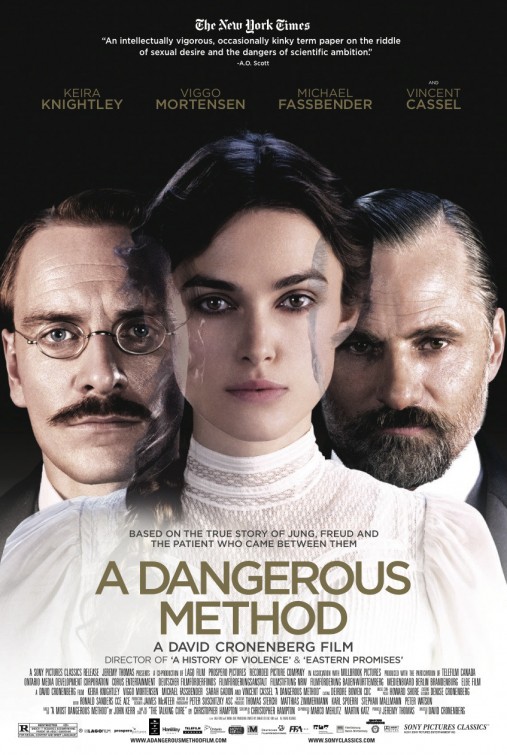 At first glance, the movie seems like an odd fit for director David Cronenberg, that is until you realize that, as Freud himself might approve, the entire movie is bubbling with sexual repression and kink. The movie showcases the friendship between the two titans of psychoanalysis, Sigmund Freud (Viggo Mortensen) and Carl Jung (Michael Fassbender), and the strange patient (Keira Knightley) who brought them together and tore them apart. This is a very intimate chamber drama, confined to lots of men in suits talking in great detail about psychology and philosophy and desire (there are three separate scenes of dream decoding and lots of letter correspondence voice over). Knightley is superb as a hysterical patient torn apart by her socially inappropriate desires. It may be a tic-heavy performance but my God can the woman act. She’s like a feral beast at points. The majority of the film follows Jung’s affair with Knightley and his friction with the single-minded Freud, who incidentally is never without a cigar clenched between his teeth. Jung wants to expand their field of study to include paranormal activities; Freud wanted to stay within the realms of science to give their movement credibility. Cronenberg’s period drama can be a bit too sedate at times given its aberrant sexuality. You don’t really empathize with either Freud or Jung, and thus the drama is a robust and intellectually stimulating exercise but only an exercise. For people who do not share an interest in psychoanalysis, they’re in for a long slog. A Dangerous Method is a rather short film, only 99 minutes, and would have benefited from being a bit more dangerous with its subdued subject matter.
Nate’s Grade: B+
Share this:

Safe House (2012)
 Safe House is an an action movie that has some nice above-average action sequences strung together by a very sub-average plot. Tobin (Denzel Washington) is a rogue CIA agent being hunted down by shadowy forces. Or is he? A young agent (Ryan Reynolds) was responsible for the safe house in Cape Town that was breached and now takes it upon himself to bring Tobin in for the agency. Or does he? If you’ve seen any spy thriller in the last few years then you’ll recognize the glut of clichés and be able to ably predict the traitorous higher-ups using the economy of characters. Here’s a clue to the villains of the picture: don’t keep all your villainous deeds together on one computer file (and don’t label it “All Our Evil Deeds,” try instead, “Vacation Photos.”). Washington and Reynolds are appealing actors even in ho-hum parts. Washington never seems as devilish or as clever as his character is billed to be. While the plot is bland, director Daniel Espinosa (Easy Money) knows how to shoot some thrilling action sequences. The style is a bit of a Bourne rehash, what with the jangly camera angles, but the movie has a surprising level of verisimilitude; when two guys fight it really feels like a couple guys beating the crap out of each other. The chase sequences are well staged and find smart ways to make use of its South Africa location, like a chase through the levels of a soccer arena or a race atop the rooftops of shanty homes. It’s when the movie stops to catch its breath and the plot reemerges that Safe House becomes a snoozer.
Nate’s Grade: C+
Share this:

In the Name of the King 2: Two Worlds (2011)
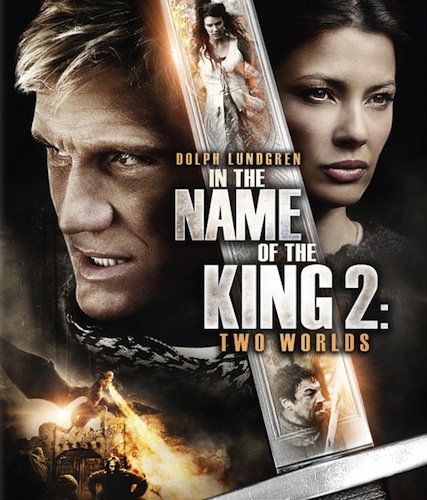 In the Name of the King 2: Two Worlds has a tenuous at best connection to the original 2008 In the Name of the King, noted as the most star-studded Uwe Boll film and the last Boll film to get a theatrical release. I think that highest-profile belly flop, and the revision of the German tax code loopholes, is what banished Boll to the little league of direct-to-DVD movies. I suppose the movie does involve things happening in the name of a king, but that’s being overly generous. There’s barely a mention of Jason Statham’s (The Transporter) character from the first flick, a commoner who arose to become king and who was slain by an enemy that is pathetic and embarrassing. The only meaningful connection lies in the title and the prospect of Boll trying to draft attention to his sequel off the momentum of his pitiful predecessor.
Granger (Dolph Lungren) is a former Special Forces soldier who has retired and runs a karate studio for kids now. Then one day he stumbles upon a mysterious woman being chased by ninjas (Vancouver’s ninja crime rate has skyrocketed since 2008). A portal to another world is opened and Granger gets sucked back to a feudal kingdom. The King (Lochlyn Munro) has awaited for a special visitor who would restore balance to the kingdom, drive away the Dark Lords. The prophecy says that Granger is their man. He’s a little skeptical and even turns down the services of a concubine, though still accepts a little cuddling. Manhatten (Natassia Malthe) is the king’s medic of sorts and accompanies Granger on his journey to defeat the evil sorceress and save the Kingdom of Whatever.
 After having viewed 19 different Boll movies, all to certain degrees of willingness, I can safely say that this is the most boring of the bunch, and hopefully those words will still have meaning. The plot never really evolves further than its premise, another rehash of A Connecticut Yankee in King Arthur’s Court, or to genre fans, a rip-off of Army of Darkness, or to idiots, a rip-off of Black Knight. Granger goes back in time, bumps around some rather stock characters, gets told about prophecies and destiny, and then there’s a fight and a dragon and a jump back to Earth and we’re done. In between is very little to care about. This is the first movie I’ve seen that feels completely constructed as one long saggy middle. Just about every scene takes place in the forests of Vancouver (I mean… whatever the hell the other world is called). It gets repetitious very quickly, never seizing on the fish-out-of-water comedic possibilities or just giving in completely to the genre elements of a medieval sword and sorcery flick. It’s all just irritating blather; a “chosen one” here, a “dark one” there, something something “prophecy.” When people badmouth fantasy, they think of this kind of stuff. I kid you not at one point Malthe’s character says, “You are the villain of this tale” to the said villain. Thanks for clarification, but the third act betrayal was telegraphed well over an hour ago.
The writer, Michael Nachoff, has written exactly one other movie, Bloodrayne 3, and served previously as an office coordinator, post-production assistant, and in material serving. That last one sounds like a made-up job or some kind of finessing that a prostitute would put to make her resume sound more professional. Whatever the case, Nachoff has shown that after two movies he cannot be counted on to deliver anything resembling a competent plot. This is the laziest more yawn-inducing hero’s journey I’ve ever witnessed. The movie literally put me to sleep. There are all sorts of dropped setups and subplots, including the notion that Granger must complete three trials, though we only ever get one. That’s bad sooth-saying, but then again the seer gets murdered so I can’t imagine she was first in her class at prescience. Nachoff keeps using the phrase “time travel,” and so do I, but I think what they really mean is dimensional travel. I’m fairly certain that Granger is not just from the future but an altogether different world. Yet at one point a character says, “Your fear will carry you to the pits of hell.” Ah, I see that Christian missionaries must have visited this alternate dimension. Oh well, the character also seem to keep erroneously saying “biological weapon” when clearly the bad guy assembled it out of various powders and chemicals. They even refer to his skill as alchemy, which of course is all about biology, right?
The action is mirthless and hastily thrown together, often becoming incomprehensible because the villains, the Dark Lords, wear dark cloaks and our heroes too wear dark clothes. Good luck deciphering who’s who on the battlefield. Maybe you’ll be like me and just become crippled by apathy. Granger isn’t a very compelling hero either. Under Nachoff’s compliant attention, he is strictly stock: 1) he is retired, 2) he helps kids, 3) he has a past that haunts him, 4) he drinks to cope, 5) he is entirely boring. If you’re going to go fish-out-of-water, at least have your guy be funny. Granger’s quips just seem too surreal even given the nature of the movie. After killing a baddie and sampling his stew: “Underdone.” On entering the Black Forest: “Given the name, bigger is probably better,” and brings a larger broad sword. Oh boy. Nobody’s gonna miss you, are they?
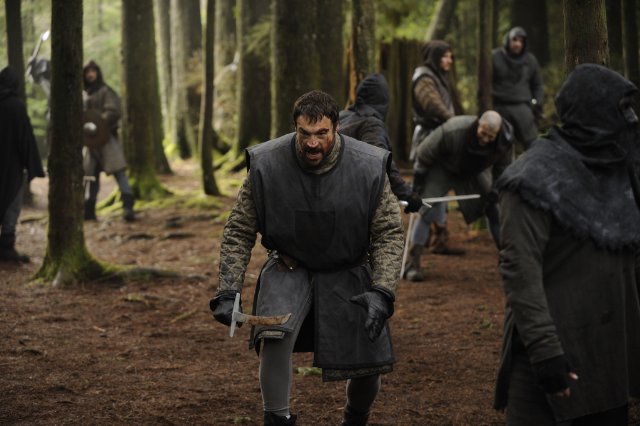 The production seems to be taking a cue from Lungren (The Expendables), who is unfazed from beginning to end despite some strange goings-ons. The man just sleepwalks through the whole film, cracking wise in the same somnambulant tone. It’s like Lungren swallowed an entire bottle of Quaaludes. Lungren isn’t exactly the most charismatic or expressive actor on the planet given that he’s made a living being tall and beating up smaller men, but I would have hoped for some life in the guy. He’s so straight-laced that it’s absurd. It drains any potential interest from the character, sapping our time-traveling hero of empathy. Who cares if he can’t be bothered to care? Malthe (Bloodrayne: The Third Reich) is just as uninspiring as his sidekick. She’s just so impassive, probably because she doesn’t get to wear a corset in this Boll movie to highlight her assets. Letting her speak medieval vernacular and syntax was a mistake. Usually actors can at least adequately hide their displeasure about their participation in a lousy movie. Either these actors aren’t even good at that or they just don’t care, take your pick.
And now it’s time for my regular reoccurring segment in a Boll film review – who got ripped off this time? Allow me room to pontificate. The concept of a fantasy world mixed with some adult themes, like strong bloody violence, nudity, sex, profanity, and darker themes, would lead me to believe that Boll was inspired by HBO’s hit fantasy reinvention series, Game of Thrones. Then again Boll shot this movie in December 2010, a full four months before Thrones’ aired its excellent pilot episode. Then again who’s to say that Thrones didn’t influence Boll during the editing stage or at least make him itchy for some reshoots to tart up this tedious movie. At least that would give the viewer something worthwhile to look at besides an oft-used castle exterior that LARP-ers would howl at.
In the Name of the King 2: Two Worlds just reeks of lethargy and indifference. Devoid of interesting characters, an engaging story, even tasty genre elements, this low-budget fantasy flick would falter in comparison to the cheesiest Sci-Fi Channel original movie. I cannot overstate how boring this movie is. I’m struggling even to effectively communicate how monotonous this movie is; I’m tempted to just write “boring” a thousand times but you, dear reader, deserve better. And so I rack my brain to come up with more specific and sarcastic criticism of what is execrably an awful movie. Boll’s no stranger to awful movies, but In the Name of the King 2 is the first time where I felt like even he didn’t give a damn about his final product in any shape. And it shows.
Nate’s Grade: C-
Share this:

Blubberella (2011)
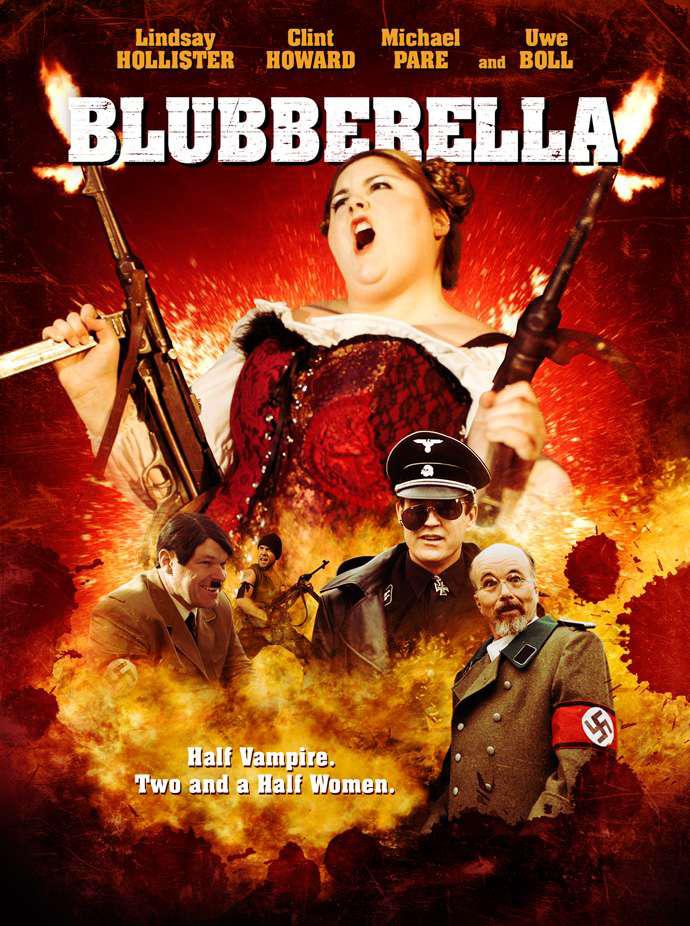 The action/horror spoof Blubberella is Uwe Boll’s second attempt at (intentional) comedy. He did re-release a “funny” version of his 2003 disaster, House of the Dead. That seems like the same opportunistic rebranding and dubious retconning that Tommy Wiseau pulled when he tried to claim that his magnus opus of suck, The Room, was always intended as a “quirky black comedy.” Sure, Tommy. Boll’s first attempt at comedy, 2007’s Postal, almost worked despite itself; the taboo-smashing genre of wacky comedy seems like a better fit for Boll’s cinematic tendencies. Blubberella is proof that Boll should stick to schlock and leave comedy to the professionals.
Blubberella (Lindsay Hollister) is a dhamphir, half-vampire/half-human, but really she’s just looking for a good man and a good meal. It’s 1944 Germany, and Blubby has joined forces with a resistance group lead by Nathaniel Gregor (Brendan Fletcher). Together, the group, along with the sassy gay soldier Vadge (William Belli), must battle a mad scientist (Clint Howard), a vampire Nazi general (Michael Pare), and the prospect of an immortal Adolf Hitler (Uwe Boll himself!).
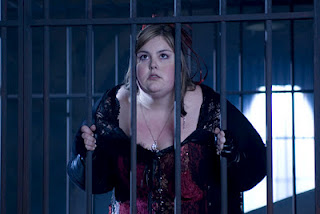 Leaden puns, obvious jokes, clueless pacing and comedic construction, tiresome one-liners, incessant yet flaccid sex jokes, a desperation to be shocking, Blubberella is a bizarre and staggering failure even by Boll standards. Rarely does the movie actually land a funny line (you want to know the best line? Here it is: “My friend says I replace sex with food… but then he raped me, so that kinda shot that theory.” Yes, that is the best one). The jokes aren’t textured in the slightest and can’t be bothered with basic constructive issues like setup, context, and payoffs. Instead, the movie is rife with random sexual and scatological references. It’s like the film is the living embodiment of a Tourette’s child. Belli (TV’s Nip/Tuck) is a braying gay stereotype that wears out his abrasive welcome in no time flat. At one point Pare just goes into a garbled Marlon Brando impersonation for no clear reason, and then it’s done. This would-be comedy, in name only, confuses randomness for clever. Here’s an example: a group of characters are crouched waiting for an all clear signal, and Vadge blurt out, “If you’re going through the drive-thru get me a Frosty.” Just because it’s a random line and anachronistic does not cover up the fact that it’s simply not funny in any context. There is no joke there. Everything in the movie just seems like a meaningless throwaway gag, never accumulating or having any connection to situation. Randomness does not excuse sheer ineptness. Given the understated title, I’d expect there to be a plethora of fat jokes that the movie would routinely fall back on for easy punchlines. I actually counted: there are approximately 35 fat-related jokes; at barely 75 minutes, that comes to about one fate joke every 45 seconds. I’m shocked they had that much restraint considering the opening minute of the movie featured Blubby walking into a giant walk-in freezer filled with enough blunt Flintstones-style sight gags.
Even worse, Blubberella relies on pitiful attempts to be “shocking” to rouse the audience into laughter. And so we endure scenes like the resistance fighters relocking a boxcar full of concentration camp victims (“No wonder they took you. That hat does nothing.”), Blubby killing a man by farting on his face, playing RISK with Hitler and then there’s the blackface. In the movie’s most obscene, whiplash-inducing moment, Blubby suddenly morphs into a Caucasian version of Precious being berated by her abusive and spiteful mother. Belli portrays the monstrous mother in drag and blackface. Amazingly, this is not the only character Belli plays in blackface. There’s another regrettable moment during that Hitler RISK sequence where Belli plays Hitler’s black assistant (“One of our new allies from Africa,” Hitler explains), and the guy can’t go a single sentence without referring to people as MF-ers. Whoo boy. Here’s the thing about the attempted Precious parody: just taking a situation and copying and pasting it to a new location doesn’t make it a parody. The blackface moments, in particular the Precious aside, feel completely out of place and tacky at best. Just because something is supposedly shocking or in bad taste does not mean it is funny without due context and setup. Blubberella does not understand this comedy truism, and so we get more of the same wearisome crass crap.
Blubberella was shot simultaneously with Bloodrayne: The Third Reich, utilizing the same sets, costumes, actors (literally everybody does double duty), recycled action footage, and more or less the same script. It’s not like the script for Bloodrayne 3 was that strong to begin with to warrant a copycat. It’s like Boll’s version of Rosencrantz and Guildenstern are Dead, though with more Nazis. Actually, just that very description is giving the movie far more credit than it could possibly ever hope for. There’s nothing clever about Boll’s alternative spin on his third Bloodrayne vehicle; just replacing Rayne with a 300-pound actress and making her go through the same motions doesn’t mean it’s a comedy. The laziness on display is powerfully lulling. I don’t think anyone on the entire planet was praying for a wackier retread of Bloodrayne 3. The funny thing is I don’t think the change of tone makes that much difference to Clint Howard.
 Blubberella plays out like a tired improv game that has gone on for an eternity. The film is stuffed with scenes that just seem to spin on and on, lacking momentum and any discernable direction. Scenes will just wander aimlessly like Boll is just waiting for his actors to somehow produce quality jokes spontaneously. Newsflash: this isn’t a Judd Apatow movie. Hollister and company will just spout random lines and riff off one another, acting like a troupe of lobotomized circus acts that have stumbled into a war zone. The results are pitiful, though occasionally they will hit a somewhat amusing idea that will be aborted in the next breath/stab at improv. It’s merely a numbers game and if they fire 100 jokes maybe 2 find some footing. Such shrug-worthy moments include Blubby holding a soldier’s hand to her stomach and saying, “If there wasn’t a baby in there, would that be okay?” Huh? At one point, Boll’s narration pops up to declare the following scene “boring,” and yet the entire scene from Bloodrayne 3 plays out uninterrupted or unedited. What was the point of that? If you’ve already made an attempt to side with your audience by declaring your scene boring, then why leave it unabridged? Why is keeping this scene vital from a plot standpoint for what is intended to be a silly spoof? Why does plot continuity even matter?
I noted with Bloodrayne: The Third Reich a theory that Boll, a notorious cinematic pick-pocket, was trying his hand at recreating Quentin Tarantino’s Oscar-winning WWII drama, Inglourious Basterds. Well after sitting through this movie, I can confirm without a doubt that Boll has a raging hard-on when it comes to Tarantino homage. The movie is broken up into chapters, including such delightful titles as “Titty Titty Fang Bang,” the score will resort to periods of long whistling, Hitler screams “nein nein nein,” and for older references, one character says, “Wakey wakey, eggs and bakey,” and another, “I’ll kill every last mother fuckin’ last one of you.” Are you going to tell me that is all a coincidence?
The lingering problem with Blubberella, besides its overwhelming incompetence and inexplicable existence, is that it feels more like a gag reel accrued for the cast and crew of Bloodrayne 3. This doesn’t feel at all like a movie or even an attempt at a movie. I’m of a mixed mind when it comes to Hollister. The central Ohio native (represent, girlfriend!) is probably not going to get many starring roles, though she has shined in guest roles on numerous TV shows like My Name is Earl, Big Love, Law and Order: SVU, and Scrubs, so I can’t blame her for jumping at the chance to be the lead star, the headliner (she and Belli are also listed as co-writers). Hollister is actually a pretty nice actress and has strong comedic instincts; however, that doesn’t mean she will rise to the occasion if left to her own devices by Boll’s paucity for scripted jokes. Boll isn’t exactly the most creatively nurturing collaborator. It’s all one big fat mess. You want the most telling moment? It occurs during the dull outtakes peppered throughout the end credits. One of the actresses, little seen in the flick, remarks astutely, “It’s not working. It’s not funny.” In six short words, she has summarized Blubberella better than I could ever hope to.
Nate’s Grade: D
Share this:

Extremely Loud & Incredibly Close (2011)
 The biggest surprise on the morning of the Academy Award nominations was the inclusion of Extremely Loud & Incredibly Close in the nine nominees for Best Picture. Critics have universally derided the 9/11 drama, becoming the lowest critically rated Best Picture nominee in the last 30 years, according to some awards pundits. The second lowest rated Best Picture nominee in that same span of time? The Reader, also directed by Stephen Daldry. Under new Academy voting rules, a nominee has to garner at least five percent of first place votes on members’ ballots. That means that at least 250 Academy members voted this crass, manipulative, off-putting, wrongheaded, exploitative movie as the best film of the year, thereby voluntarily divulging they must not have seen a single other movie for 2011.
Oskar Schell (Thomas Horn) was nine years old when his father, Thomas Schell (Tom Hanks), was killed on September 11, 2001. He was in one of the World Trade Center buildings and left six frantic phone messages before perishing. In the ensuing months after the disaster, Oskar is lashing out against his mother (Sandra Bullock) who spends all day in bed. Then one day he discovers a mysterious key in his father’s closet inside an envelope labeled “Black.” Oskar’s father used to send his son on a series of adventures around New York, looking for a fabled “sixth borough,” forcing Oskar to confront his numerous fears and insecurities. Oskar looks through the New York phone book and catalogs over 400 separate people with the last name of Black in the five boroughs. He’s convinced that his father has left one last hidden message somewhere in the city.
 My main sticking point was that I found Oskar to be an insufferable, bratty, little jerk. I understand he’s hurting and he’s trying to work through his pain. I understand he is gripped by irrational fears and has a hard time relating to others. I understand that Oskar’s father even tested him for Asperger’s, though the results were negative. Some people will try and explain away Oskar’s callous behavior in sweeping generalizations having to do with the ignorance of children or some undiagnosed medical problem. I’ve known people with Asperger’s syndrome and while Oskar fits a few of the superficial tics, being a jerk is not a symptom, sorry. He’s so mean to his grieving mother and indifferent about other people that I wanted to slap him. I found him to be unsympathetic and wholly irritating. I found his unsupervised journeys for cutesy quests throughout New York City to be dubious. His parents just let their ten-year-old socially awkward kid run around New York City by himself at all hours? The movie goes in a bad direction when it partners this talky nuisance up with a silent old man, played by the wonderful Max von Sydow (the movie’s only other Oscar nomination; another stretch I’d say).
Here’s a breakdown of my thought process: Oskar comes home on 9/11 to find the last recorded messages of his father, including an admission of love for his family. Oskar runs out and buys an identical answering machine and sneakily hides the original, denying his mother, a grieving widow, the chance to hear her husband’s voice one last time. Screw that kid. I’m sorry but that’s what went through my mind and to me he never recovered. His actions are inexcusable. Then he gets mad because his mom sleeps all day. She’s grieving you little snot! And then he has the gall to tell her, “I wish it was you instead!” It’s a moment intended to draw gasps, ripping the scab clear off whatever pretensions mother and son have with one another. But it just made me dislike the kid even more. The fact that even by the film’s ending emotional catharsis Oskar still hasn’t shared the answering machine messages with his mother is reprehensible.
The other factor that caused me to despise the main character was how Horn proves to be a dreadful actor. This is the first acting role for the former teen Jeopardy champ. He’s able to spit the rapid-fire, idiosyncratic dialogue burdened with cumbersome detail. However, Horn gives a terribly mannered performance. He has this annoying manner of over enunciating every single word, getting lost in a character affectation, always stagy and artificial. You combine a bad actor with an aggravating character and make them the lead of the story, and I’m already daydreaming possible murder scenarios (I don’t condone child murder mind you — I’d make it look like an accident). As for Oskar’s parents, Hanks is hardly in the movie and Bullock does shockingly well, nailing her most emotional moments. I’d rather see this movie from her point of view, trying to make sense of the insensible to her challenging son who hates her.
 Daldry wishes to use the backdrop of 9/11 to talk about important items. It’s too bad that his movie has nothing legitimate to say about healing. I was assuming that over the course of the film Oskar was going to run into a diverse collection of people, all healing, all with their own stories of pain, and then he would learn that the real treasure was the community of strangers he had brought together. Nope! Oskar runs into a gamut of fine actors, including Viola Davis, John Goodman, and Jeffrey Wright, but they all become mere baton-passers to a self-involved kid. They and their stories don’t matter. The lock to our missing key doesn’t matter. There’s a final revelation concerning Oskar’s mother and her activities to benefit her son that seems entirely implausible. Daldry and screenwriter Eric Roth (Forrest Gump, Curious Case of Benjamin Button) have transformed Jonathan Safran Foer’s novel about collective grief into a strangely myopic narrative given the scale of the suffering.
The movie is so transparently manipulative, shamelessly exploiting 9/11 anxieties and trauma to tell its intolerable little quest. In no way is 9/11 meaningfully connected with the overall story of loss. Oskar’s father could just have readily died in a war or had a brain aneurism. What 9/11 is used for, however, is an easy device to stir the audience’s emotions. Daldry will flash back to it at seemingly random moments in the narrative, to goose the audience into feeling gloomy. I’m sure many people will sit through this movie and feel moments of genuine sadness, but that’s because the filmmakers are shamelessly manipulating the raw feelings we have over a national tragedy. It’s hard not to feel a lump in your throat seeing the towers smoking, frantic calls to missing or doomed loved ones, and final recordings bearing the weight of compounded dread. It’s not too soon to talk about the psychic wounds of that terrible day but I strongly resent people who exploit those memories. There are moments that are so misguided and yet given the Hollywood gloss of an awards-bait picture. The very opening image is of Tom Hanks free-falling to his death. Oskar’s little picture book he constructs at the end of his journey includes a final page with the World Trade Center. And there’s a little slip that when pulled creates a picture of a man falling up back into the tower. What? Is that supposed to be a good thing?
Extremely Loud & Incredibly Close is such a misguided, crass venture that’s also extremely shameless and incredibly cloying. The main character is unlikable, exasperating, and portrayed by a rather amateurish child actor. Daldry’s hackneyed direction will settle on treacle and contrived sentiment whenever possible, but the emotions never feel properly earned. He’s pressing buttons and forcing tears, and several viewers will be unaware of how efficiently they were manipulated into having a moving experience at the theater. I know I can’t be alone is seeing through the manipulation and feeling indignant about the ordeal. I’m not against tackling the difficult subject of 9/11 in movies (I declared United 93 the best film of 2006). Here’s a good question for you filmgoers out there: is there that big of a difference between this movie and 2010’s unpleasant teen drama, Remember Me? Both use the 9/11 attacks to cover narrative and characterization deficiencies, vulgarly exploiting our feelings of the events to engender feeling, and both don’t belong anywhere near an awards stage.
Nate’s Grade: C-
Share this:

The Grey (2012)
 I’ve always been fascinated with survival thriller/horror, where we think step-by-step with the characters through an unlikely scenario. I greatly enjoyed Frozen, a horror movie about three teens stranded on a ski lift, and Buried was in my top ten list for 2010. I enjoy the thought exercise and find the scenarios easily empathetic as long as people don’t make boneheaded decisions. Director Joe Carnahan has been paying his bills as of late with stylized, overdone, and generally overblown action movies like Smokin’ Aces and The A-Team. I would not have expected Carnahan to deliver anything that could be described as nuanced or meditative, but lo and behold The Grey is a survival thriller that’s as thoughtful and emotional as it is viscerally exhilarating. The Grey is the first great movie of 2012 and I’m astounded that it was released in January, the dumping ground for cinematic dreck.
We follow a group of grunts working on an oil pipeline way out in the northern Alaskan territory. They’re heading south for some R&R when their plane crashes due to electrical issues. Ottway (Liam Neeson) and seven other men are the lone survivors. While checking for supplies, they discover a pack of wolves feasting on some of the choicer corpses. Ottway is a wolf expert, hired by the oil company to patrol the grounds and hunt antagonistic wolves. He explains that wolves have a hunting radius of 300 miles and a kill radius of 30 within the den. It is uncertain where these men find themselves, so they bundle up and head south, hoping to escape the predators, find food and water, and discover a way to help.
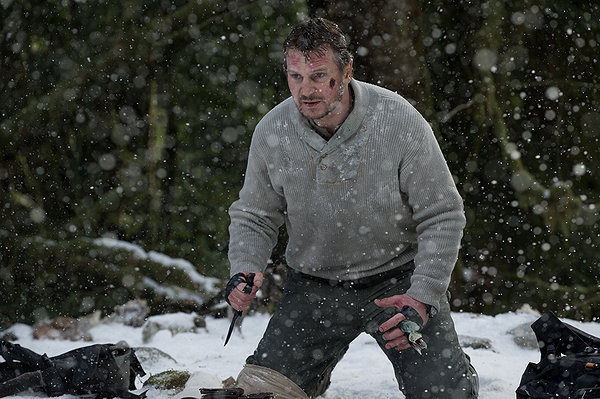 The Grey is a harrowing, haunting, and intense thriller, masterfully played by Carnahan. The threat is real and brutal, enough that it convinces the men to leave the safety of the plane wreckage to possibly escape the wolf kill radius. We’re told that wolves are the only animal that will kill out of vengeance (look out Sarah Palin). The attacks are vicious and the violence is bloody and occasionally shocking, though it never seems gratuitous. The special effects and canine animatronics are seamlessly integrated. The sound design for this movie is exceptional, probably the best use of sound to fashion anxiety since 2007’s No Country for Old Men or even Spielberg’s War of the Worlds. The sounds of the wolf pack echo around the theater, completely keeping you off guard, disorienting the audience. Carnahan creates such a vivid picture of dread that we’re convinced that the wolves could sic at any moment. And when they do the editing becomes chaotic, mimicking the ferocity of the animals and depicting the frenzied fear of the attacked.
I was a terrible bundle of nerves throughout most of this movie. The plane crash is an exemplary sequence of terror, capturing the terrifying moments from Ottway’s limited point of view. The rest of the movie doesn’t get any less tense just because they’re on stable footing. There’s one scene where the wolves attack a guy who has fallen back from the group. Carnahan brilliantly captures the helpless reality by showing the men trying to race back in knee-high snow. They can only stomp so far while the man is ripped apart in the background. The action sequences, though to be fair they’re really more suspense pieces, are the most nerve-wracking I’ve endured since the brilliant Best Picture winner, The Hurt Locker. Of course these being life and death stakes, there is plenty of death, as the men are generally picked off one by one, though not all by the pack of wolves. The frigid elements are just as dangerous as the killer wolves. The men could just as easily freeze to death. The need for shelter and food is dire (the men even joke about the famous cannibalism from Alive). One of them is suffering just from his brain being unable to acclimate to the elevated attitude. That’s almost enviable considering the doom that constantly hangs over the other survivors.
Naturally there’s some friction between the survivors as far as the best course of action. Ottway has assumed Alpha dog status thanks to his expertise on wolves and the Arctic climate, but that does not mean that the rest of the men follow lockstep. Give the alarming situation, it will be in these men’s best interest to work together for survival. Some of the men chafe at being what to do but the movie doesn’t drags out this conflict, thankfully, because jockeying for power positions seems like an absurd waste of time. There are heavier issues at play. The impact of the movie would be blunted if the characters came across as one-dimensional; then we wouldn’t care about their fate. Carnahan and co-writer Ian Mackenzie Jeffers, based on Jeffers’ short story “Ghost Walker,” find creative ways to enrich and reveal the character of these lone men. They feel believable and their reactions to the implausible dangers seem plausible, keeping us invested. Ottway keeps flashing back to an image of his wife (Anne Openshaw) for strength, this angelic brunette telling him not to worry. It’s what he has to hold onto, though when we learn more about the context of this image it becomes even more meaningful. One character has had enough struggling and has no will power to continue. He argues that whatever life he may return to is no reward.
 The thrills and scares are what are to be expected, but The Grey is also a much more thoughtful and intellectually stimulating picture than you may have hoped. Carnahan’s script covers a wide array of survival tactics without breaking from the reality of its premise. It’s just interesting to watch a group of men use their wits to make best use of their dwindling supplies and dire situation. It becomes a game that the audience plays, systematically judging every choice and assessing if we would follow suit. Beforehand, the men engage in a theological discussion regarding the existence of God, faith, the belief that there is a divine plan. The men are fighting for their survival but having an existential crisis all the same, trying to supply meaning to the horrific, find reasons to keep fighting. “We crashed going 400 miles per hour and we survived. That has to mean something,” one of them reasons. Or it all could just be very bad luck. Ottway at one point, an admitted non-believer in a higher power, bellows to the sky for something, anything. His desperation is effective and turns what could have been trite into a nice character moment. One of the men shares a memory of his daughter, who would wake him up by gently dangling her hair in his face. It’s a touching moment and when that same character meets an untimely end and is helped to the other side by a vision of that same daughter, it becomes profoundly moving (the quick snap to reality is a jarring point for grisly comparison). The Grey has plenty more on its mind than making an audience jump. It also wants to make the audience think and, in the end, feel genuine emotion.
The ending may rankle some who felt, especially with the advertising, that the film was going to be a two-hour Neeson ass-kicking vehicle, but for me it was fitting and the only way this story could have ended. Though let me advise all potential ticket-buyers to stay during the end credits for a small bit that offers a tad more resolution, though still leaves as much to be determined by the viewer. It’s not exactly ambiguous considering how things are left.
Neeson (Unknown, Clash of the Titans) has settled nicely into his newest incarnation as middle-aged ass-kicker, such an odd path for the man who famously portrayed Oskar Schindler. At some level, it’s below an actor of Neeson’s standards to be running through such genre frills, but it’s also a joy to see someone who can really, truly act give gravitas to his men of action. After he delivered his warning in Taken, I was completely on board and ready to watch this man bust some skulls. Beyond the physical challenges, the role really puts Neeson through an emotional wringer and the man gives a strong, stirring performance. You’d be glad to have this man in any predicament. The rest of the cast fill out their parts well, with Dermot Mulroney (The Family Stone) making the best use of his time onscreen to create a character.
The Grey is a startling movie; horrific, jolting, thrilling, moving, beautiful, philosophical, and extremely captivating. Carnahan has crafted an exciting movie that transcends genre. There were moments so tense that I was chewing on my knuckles. There were moments so intense I felt like I had to look away. And there were moments so poignant that tears welled up in my eyes. I look forward to watching this movie again and finding even more at work. No grey area here, this is one truly excellent movie.
Nate’s Grade: A
Share this:

Final Destination 5 (2011)
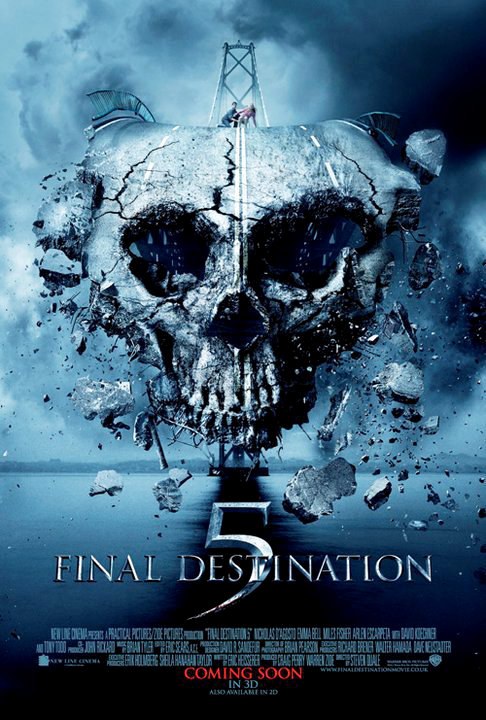 If there was any cosmic justice the Final Destination franchise would have been KO’d by death a long time ago. The initial interest of bizarre, fiendishly clever deaths and the constant macabre misdirection was fun, but now, after five movies, feels creatively exhausted. Once again a group of unremarkable characters survive a remarkable disaster, this time a collapsing bridge. And once again we have to follow them figuring out the rules of the movie series and that they’re all marked for death. The in-between stuff is some of the worst drama ever captured on screen. It makes you impatient for death to get off its duff and kill more teenagers so I don’t have to listen to their whiny, unrealistic problems. Coming off a limp fourth installment that was the highest-grossing one yet, the filmmakers once again turn to 3-D as their savior, which does not play well at all on your TV (a sailboat mast becoming an instrument for impaling?). It’s more annoying than anything. But the real draw of this movie is the gruesomely elaborate deaths, and they’re probably the weakest of the series (a gymnast’s body practically exploding once she hit a padded mat seems absurd even for this movie). There is one sequence that freaked me out but that’s because I’m quite squeamish when it comes to eye trauma. What ends up slightly redeeming Final Destination 5, as far as cheap horror movies go, is a surprising third act that breaks from the doldrums of the franchise formula. For once, the people decide to take life to save themselves when death comes calling, and they set their sights on each other, resentful that one of their own survived in the premonition staple. I think this horror franchise took a turn for the worst when it gave into its target audience’s cynical bloodlust, and I doubt there’s anything “final” about this series. At least the Saw franchise had the merit to die.
Nate’s Grade: C
Share this:

My Week with Marilyn (2011)
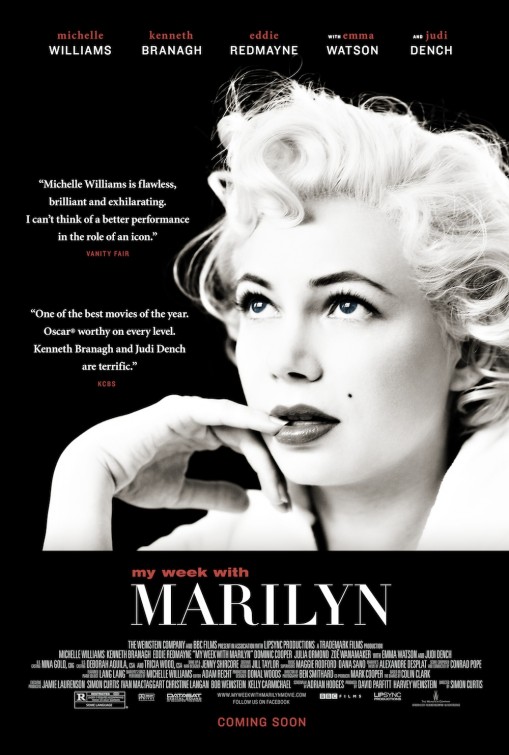 In 1957, Marilyn Monroe (Michelle Williams) was the biggest star in the world but she wanted to be taken seriously as an actress. Laurence Olivier (Kenneth Branagh) was an award-winning thespian considered to be acting royalty, but he was looking to siphon some of Monroe’s fame and vigor. Monroe flew over to England to shoot the light comedy The Prince and the Showgirl, directed by and starring Olivier, and it was here that she changed the life of Colin Clark (Eddie Redmayne). Clark was an ambitious young chap who served as the third assistant director and Oliver’s personal assistant as well. He was mainly a glorified go-fer but the position allowed him to glimpse the world of Marilyn Monroe and her various handlers, Paula Strasberg (Zoe Wanamaker) and Milton Greene (Dominic Cooper). Monroe’s flighty behavior and struggles with acting drive the more professional Oliver stark raving mad. Monroe’s rocky marriage to playwright Arthur Miller (Dougray Scott) is causing her fits of depression. Who better to cheer her up than young Colin Clark? Over the course of nine days, the two become inseparable and Clark falls head over heels for the world’s most glamorous woman.
The character of Colin Clark seems to be stripped of all defining personality traits. He’s this bland kid caught in continual awe. He just seems to be smiling and twinkling those big, compassionate eyes of his, typifying the earnestness of young love. I think he’s been rendered into a cipher for the audience to put themselves in his shoes, becoming star struck with Monroe’s attention. The screenplay takes far too much time on showing Clark coming to the repetitive rescue. His romance with a costume girl (Emma Watson) is a nonstarter and the movie doesn’t even try and hide the fact. She’s the backup romantic option, so the fact that he goes back to her after being spurned by Monroe and we’re supposed to feel that this is growth seems disingenuous and a bit caddish. Perhaps she didn’t take it too hard; if you’re going to be dumped for anyone else, there’s no shame if it’s Marilyn Monroe. Judging by the movie’s depiction, Clark is a rather boring young man, and I didn’t buy for a second that Monroe would cling to him as her hero.
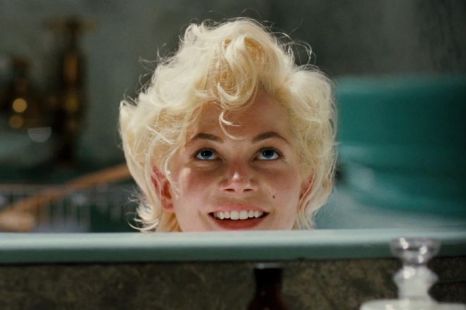 My Week with Marilyn is really focused on the titular star. Clark is just out path to the real star. I doubt there’s anything particularly revelatory about Monroe here. She was plagued with insecurities, a need to be loved, and the fatigue of “playing” herself all the time, all hips swivels and winks. At one point Clark and Monroe are taking a walk and met with a group of fans. “Shall I be her?” she coyly asks Clark and then turns into the vampy goddess the public loved, striking poses and smiling wide. By the very constricted nature of the timeline, we’re not going to learn too much about the famous beauty. She flubbed her lines, she and Olivier didn’t get along, and a mini-entourage of sycophants who were meant to be a surrogate family for the troubled gal surrounded her. Was she a lonely gal crushed by the weight of stardom or a manipulative lady who knew how to get what she wanted? The movie doesn’t take a side, instead serving up all sides of Marilyn Monroe, including a few in the buff. The film has some enjoyable juicy bits, particularly the friction between Monroe and Olivier, but the movie ultimately becomes another fawning admirer of its star. There are a couple musical numbers with Monroe that feel clumsily reproduced and the tone seems too light too often for the dramatic moments to have any real bearing. It becomes another fan that celebrating her image and sponging off her fame and legacy.
While the film may not be revelatory, Williams (Blue Valentine) herself is the revelation. She’s not exactly a dead ringer for the curvaceous, buxom blonde beauty, but she inhabits the spirit of the woman rather than sticking to a breathy imitation. She doesn’t capture the baby-doll voice but the demeanor she has down pat; when she turns it on you can feel the screen light up with the luminescence of star power. There’s quite a difference between the sad, depressed, codependent Marilyn and the sexy pinup fantasy. It’s an incredible performance in an otherwise so-so movie, though I wish the screenplay had given her more complexity to work with. Branagh (Valkyrie) is great fun as the stuffy, overbearing Olivier who gets plenty of snappy lines to vent his frustration over Monroe’s antics (“Teaching Marilyn how to act is as useful as teaching Urdu to a badger!”). Both actors are so good, and so good together, that I wish we could just remove the “my week with” from the title and focus on the relationship between Monroe and Olivier.
Allow me to question the voracity of Clark’s account. He waited until 1995 to publish his film set diaries, and then after his first memoir of his time with Monroe sold well he published another one in 2000, this one filling in a nine-day gap he says was that fateful week with the sex icon of the twentieth century (eat it, Clara Bow!). The second memoir was written fifty years after the fact and from the nostalgic perspective of an old man looking back to his youth. I feel that the particulars have been smoothed over and romanticized. The fact that surviving actors from The Prince and the Showgirl cannot verify any sort of relationship, and that several sources say that Monroe and her new husband Miller were inseparable at the time, cause me to doubt the validity of this personal account. In his first memoir, Clark even criticizes Monroe’s physical appearance (“Nasty complexion, a lot of facial hair, shapeless figure and, when the glasses came off, a very vague look in her eye. No wonder she is so insecure.“). Yet in the second book he becomes her defender. So which is it? Who wouldn’t, with sixty years of hindsight and a best-selling first memoir, embellish their one-time dalliance with a star like Monroe? The most desired woman in the world and he, a 23-year-old nobody, was the one to become her confidant? Aren’t we full of ourselves? And he crawled into her bedroom and was asked to stay the night and didn’t consummate that relationship? In the book she offers and he declines. Talk about the biggest mistake of your life.
 If you’re going to embellish, then you might as well get some action out of it. Then again, maybe in the books Clark says that Monroe gave him a pity handjob and the filmmakers deleted this (I can hear him screaming from beyond the grave, “You fools! The handjob was a metaphor. The whole tale falls apart without it!”). If I ever had even a fighting chance of getting lucky with Marilyn Monroe, you’d best believe I would be telling that story so often that my grandkids would roll their eyes in disgust (“Geez, we get it grandpa. Marilyn gave you a handy once.”). The post-script tells us that after The Prince and the Showgirl, Monroe went on to Some Like it Hot and Olivier went back to the theater for some of his best-reviewed runs of his career. So clearly, these two stars owe all their good success to the heroics of Colin Clark, who nudged them from greatness to legendary. We have only Clark’s take since Monroe cannot dispute Clark’s claims so I feel like the memoir, and the film adaptation, is an exercise in serving Clark’s ego.
My Week with Marilyn is a light, weightless movie that retells the shooting of a light, weightless movie. Well done, everyone. The emphasis on this bland kid and his fairly unbelievable whirlwind romance of the twentieth century’s most iconic sex symbol makes the movie feel self-serving. Does anyone honestly believe the events of this story? Whatever the validity of the events, a movie should be entertaining on its own rights. My Week with Marilyn has its bouncier moments and is saved by stellar acting from Branagh and the radiant Williams. But even the best acting in the world can’t save a movie that feels like it’s completely some old man’s exaggerated, embellished, and somewhat boring fantasy. If this is the relaxed standard for getting a movie made, then I look forward to the eventual film adaptation of my soon-to-be-released novel titled, My 28 Hours of Incredible Sex with Angelina Jolie.
Nate’s Grade: B-
Share this:

Red Tails (2012)
 You’d think a big name like George Lucas would not have a problem getting a movie made. Lucas has been trying to get a movie about the Tuskegee Airmen made since the 1980s, but he says no studio would bite, concerned that American audiences would not be interested in a movie with an all-black cast. So Lucas just paid for the movie himself, forking over $50 million of his own money a.k.a. July’s paycheck from Star Wars toys, a.k.a. what Lucas just had in his pockets at the time. Even though only credited as an executive producer, it’s hard not to feel the Lucas imprint all over Red Tails. The emphasis is on the high-flying aerial combat, ladled heavily with CGI special effects work, rather than on a credible story and characters that we care about. Simply out, the Tuskegee Airmen deserve a better movie than this.
In 1944, the Tuskegee Airmen have been kept on the ground for most of the war. However, the bomber pilots need more protection. It seems that white pilots meant to provide protection of the bombers will easily get distracted, chasing after German fighter planes for a taste of glory. Colonel Bullard (Terrence Howard) and Major Stance (Cuba Gooding Jr.) have been notified that their unit of black pilots will finally get their shot. Marty “Easy” Julian (Nate Parker) leads the squad, followed by Joe “Lightening” Little (David Oyelowo) and Ray “Junior” Gannon (Tristan Wilds). They are to escort the bombers and stick to the bombers; the mission is paramount. The unit paints the tails of their planes a bright crimson to stand out from the pack. The Tuskegee Airmen keep to their creed, ensuring the bombers carry out their missions, and proving themselves every bit as courageous as capable as white servicemen.
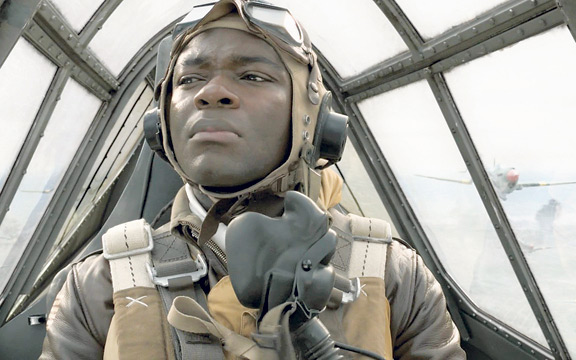 It’s like somebody transplanted a 1950s war film to present day but left every single hoary cliché imaginable. Just because African-American actors get to play the clichés doesn’t mean we’ve made progress. The Tuskegee Airmen are a historical account with enough real-life intrigue; Lucas and company didn’t need to create a fictional tale to illustrate their heroic deeds. The characters are all resoundingly one-note; the troubled leader with a drinking problem, the hotshot who doesn’t follow orders, the wisecracking pilot with a firm religious belief in “black Jesus,” the young guy trying to prove himself, and the guy who gets married and just wants to get back to his girl (guess what happens to him?). Let’s stop and analyze that plot point. Lightening first discovers his Italian beauty (NCIS: LA’s Daniela Ruah) waving while he’s zooming by in an airplane. Naturally he can find her home. After a series of strolls, Lightening asks her to be his wife, and eventually she accepts after some deliberation. Neither of them seems to find this interracial marriage concept a big deal, but in the 1940s, when the Army was still segregated and miscegenation was still illegal in certain states until 1967, you better believe it would be a big deal. Italy was no prejudice-free haven of tolerance, especially under Mussolini’s rule. And by the way, the portrayal of Italy in this movie looks like the war hasn’t even touched the land, physically and mentally. All those happy Italians just walking around smiling. And then there’s the white officers club where one of the black pilots visits and punches a guy after he calls him the N-word. In reality, this guy would have been beaten to an inch of his life. It’s even more bizarre then that, just after a month of flying missions, this say officer’s club greets the black pilots with open arms, fighting to by the guys rounds of drinks. Red Tails, at times, seems to exist in a different universe.
This has got to be the most boring part of a story you could tell about the Tuskegee Airmen. We watch the pilots escort the bombers and stick with the mission. While an interesting historical footnote, that’s about it. The story before the missions and after the missions is infinitely more interesting. I’d much rather see these brave heroes have to go back to a bitterly racist country, be declared honored men of valor by the government and then told they don’t deserve equal rights in the same breath. There’s so much more inherent drama in the conflict of going home to a segregationist country. Likewise, the Army was only integrated late into the war, meaning that African-American soldiers could not enter combat until 1944. Surely the journey these men took to enter the armed services is more compelling, and their experiences must have been even harder, battling the prejudices of their fellow brothers in arms. The early scenes in the film where Col. Bullard is fighting for respect and to get his men an actual mission, butting heads with brass who feel African-American soldiers are inferior, is far more gripping than anything that goes on in the air. The actual war part of this story is the least interesting part. If Lucas and company were so hell-bent on framing their story this way, they should have taken a cue from 1990’s Memphis Belle and stuck to a single mission being the majority of the plot. That would have kept the realism of the situation, ratcheted up suspense, and been a more natural way to get to know our characters.
While only thoroughly mediocre, Red Tails can have some pretty awful moments. The white bomber pilots provide, for lack of a better phrase, color commentary on the plot. Their dialogue is so on-the-nose and transparent, meant to lead an audience into some stilted realization that African-Americans are, gosh, not that different. The dialogue starts off with stuff like, “What? A colored man?! We’re done for,” then goes to, “Hey, these boys might actually be okay. I hope them Red Tails fly with us next time,” and then the movie might as well end on, “Wow, my altogether uninformed prejudices have been completely upended. I’m sorry I ever relied on such outdated notions of race that were completely ignorant. My paradigm has shifted and I’m going to look at people not as black or white anymore, but as people.” It’s so annoying and artificial. The dialogue is mostly cornball but the line that takes the cornball cake is after Lightening attacks a German munitions train, he shouts, “How you like that, Mr. Hitler?!” Really? “Mr. Hitler?” You’d think two African-American screenwriters (John Ridley and Boondocks creator Aaron McGruder) would have eschewed any phrases that could be racially loaded. Speaking of Germans, the movie has one German ace that keep reappearing again and again. Just so we understand that all those cockpit shots of ONE GERMAN are the same guy, the movie gives him a hideous scar along the side of his face. Being a scary scarred German fighter isn’t enough to convince us this man is a villain, so the movie also has him spout some pretty ludicrous racist dialogue, even for someone who may have believed wholeheartedly in the principles of an Aryan race. “Die you foolish, African,” he shouts at one point. Maybe he’s still steamed over that whole Jesse Owens thing.
 But the dumbest moment in a movie that will tax a minimal amount of brain cells is what happens to Junior after his plane goes down. He’s caught behind enemy lines and is thrown into a prisoner of war camp. But what luck, because it just so happens that these prisoners are planning an escape that very night (“At least they won’t see you at night,” one of the guys tells Junior). They’ve dug a tunnel beneath their barracks and Junior agrees to go first to be the lookout. He climbs out of the exit hole right in front of a forest clearing. When the next one in line pops out, however, a German guard has spotted them and turned his weapon on the American. Junior hops from behind a tree, waves his arms wildly to distract, and then runs off into the woods. Inexplicably, this is where the storyline concludes. You’re telling me that a German soldier with a gun isn’t going to give chase into the woods? These guys have the upper hand, plenty of armed men and dogs to track escaped prisoners. The rest of the American prisoners make it out to alive miraculously and one of the guys gives Junior’s dog tags to his unit. How did these prisoners, all escaping after the jig was up, get past everyone? And yet Junior does indeed live too and shows up just in time, in literally the last thirty seconds of the movie, to cut short everyone feeling sad about fallen soldiers. It’s like an angel just dropped him out of the sky. Junior’s escape and perilous journey back to American forces seems like a pretty good story worth telling. It has to be fraught with danger and thrills, but to just hastily end his storyline and magically zap him back to base isn’t just criminally lazy, it’s insulting.
The saving grace of Red Tails is its coterie of talented actors, doing the best they can with the wobbly material. This is a movie designed for the most mainstream of audiences, not for anybody who knows a whiff of history. The characters are one-note, the story is driven by every cliché imaginable, and the reality of the time period feels oddly glossed over at too many points, settling for safe rah-rah movie heroics. The aerial combat sequences can be exciting but they come across as weightless, with all the emotional investment of watching a video game. Credit Lucas giving this movie a decent-sized budget to pull off the special effects and involved combat sequences, but that money would have been better spent on a good script, not one just dusted off from the World War II era and the race of the characters altered. I find this kind of pandering mush to be insulting, especially the fact that the audience is supposed to feel grateful that black soldiers are finally getting the spotlight no matter the quality of film. The choice of “pandering mush” or nothing is a false choice. If giving black characters the chance to run through all the tired, hoary war clichés that went out of style decades ago is progress, then I shed a tear for this country.
Nate’s Grade: C
Share this:

Contraband (2012)
 January at the movies has long been a time for two kinds of releases: 1) award-worthy films expanding into wider release, and, 2) crap. That’s about it. I’ll let you figure out which category the action thriller Contraband belongs in.
Paul (Mark Wahlberg) was once the best smuggler in the business. He’s since gone legit, starting a family and his own private security business. His brother-in-law (Caleb Landry Jones) gets into trouble with some bad men. He tosses a load of smuggled drugs to elude Customs ships, but now Briggs (Giovanni Ribisi) wants the value of the drugs or else. Paul knows he has no choice but to put together one last job to save Kate’s (Kate Beckinsale) brother. Paul leaves his family in the hands of Sebastian (Ben Foster), a trusted accomplish on many missions. John puts together a team and plans to board a ship headed for Panama City. While there, the team will load large sums of confederate money. The sale of the fake currency should square things between John and Briggs. However, little goes according to plan.
 Contraband is a lousy heist picture that feels like it’s making it up as it goes. First off, the premise of John having to go back into his art of smuggling to settle a debt has been overdone, and the fact that John’s idiotic brother-in-law is as fault makes it hard to care that something might happen to the idiot. But why God do they bring this screw-up, the brother-in-law, along with them? He’s already proven to be a poor decision maker and a moron, and, surprise surprise, when in Panama the guy gets them into more danger. So irritating is this character, always foolishly making things worse for John, that you wish they had thrown this dolt overboard. This is a movie structured with a small beginning, a small end, and a great big fat middle, and it’s that middle that involves our destination to Panama. With heist movies, as well as most thrillers, we don’t want things to go according to plan. We want to see organic complications and watch our team of characters adjust. With Contraband, the complications don’t feel natural so much as like careening plot elements from other movies. John’s quick visit goes out of control, with the team losing their payment money for the confederate loot (guess who’s responsible for that? Guess?), and they have to go find a budding crime lord, Gonzalo (Milk’s Diego Luna), and then this crime lord just happens to be plotting a heist at THAT EXACT MOMENT and John and his team should come along and then the heist goes bad, as always, and the team ahs to get away, but Gonzalo demands to be taken to a hospital by gunpoint, and then the cargo ship is going to leave port, and, and, and, and, etc. There are so many breakneck plot turns thrown in that it feels like a broken blender spewing half-formed plot residue everywhere. It’s the film equivalent of the If You Give a Mouse a Cookie story (“If you give a smuggler a deadline, he’ll need a contact. If you give him a contact, he’ll need to do the contact a favor. If he does the contact a favor, he’ll have to do this one job for him. If he does this one job for him, he’ll need a crew. If he needs a crew, he’ll need… etc.).
Let’s take a moment to analyze the peculiar masks Gonzalo and his team choose to utilize. They literally wrap duct tape around their faces. That’s got to be the dumbest mask in the history of cinema, and there have been some stinkers. They couldn’t afford pantyhose? Anything? They had to use tape? First off, you can’t conceal key features, like your eyes and mouth, and lastly, isn’t it going to be something of a bitch to rip those things off? The only person who could properly wear a duct tape mask would be someone suffering from alopecia (condition that leaves a person hairless). Otherwise you’re sacrificing your eyebrows. Maybe this is just how things are done in Panama.
So much of this movie feels like it’s on autopilot, just drifting like that cargo ship. At this point, I don’t even think Wahlberg is trying to hide his indifference to the material. He’s a man with a shady past who went legit and has a family now, but in order to protect that family he is drawn back to his shady past. How many times has this plot device just been used in the last few years? The rest of the characters fill out the crime thriller cheat sheet: young screw-up who serves as plot catalyst, parent in prison to provide cautionary tale, best trusted pal that ultimately proves to be untrustworthy, and the harried, often victimized wife. Poor Beckinsale (Underworld) who gets beaten, threatened with a gun in her face, and victimized to a degree that it feels like exploitation. This woman can never catch a break. She gets few moments in the film where she is free from being terrorized with violence. I have no idea what would attract an actress like Beckinsale to this part other than the allure of a paycheck. Contraband stalls when it comes to thrills, and part of this is because the villains seem so lame. Briggs just comes across as an inept criminal, like somebody’s own screw-up brother-in-law that tagged along to play with the big boys. He’s routinely beaten and bossed around. It’s hard to take his threats seriously, so the movie cuts its losses and just has him threaten Kate some more. It becomes old quick. The only thing that keeps Contraband going is the great distance between Paula and his family, a divide that keeps Paul vulnerable. Too bad that the movie can’t think of anything thrilling to do with this scenario and settles, all too frequently, on scaring the wife. Wouldn’t the film have been more engrossing if Paul’s wife had been kidnapped this whole time? Would that not cause a better sense of urgency than the vague threat that a character we don’t care about might get offed for being stupid?
 From an action standpoint, the thrills rarely materialize, relying on a contingent of blunders and coincidences to provide the thrills. There wasn’t a moment where I worried for a character on screen. This may be because I didn’t care for a person on screen, thanks to workmanlike characterization, but it’s also got to fall on the feet of Icelandic director Baltasar Kormakur (who starred in Wahlberg’s role in the original Icleandic version of this flick) and his nascent camerawork. There will be moments where his camera does stutter-step zooms, mimicking the docu-drama camerawork that’s been en vogue with action cinema. And then he’ll never repeat it. There’s a shot of Gonzalo blowing the armored car up and it’s filmed in a high-speed, stylized shot to distill the strange beauty of the force, and then this never happens again. It’s like Kormakur is sampling all 31 flavors of action movie styles and can’t decide on a visual tone. The action is too dependent on arbitrary coincidences for it to be satisfying of thrilling; we’re just waiting for the next out-of-nowhere plot turn to move things along. The ending attempts to tie up things nicely but feels asinine and laughable in how John can take out three villains in one well-orchestrated, tidy swoop. Don’t even get me started on the impracticalities of John hearing a lone cell phone ringing to be able to trace his wife in an entire construction site. The resolution feels ludicrous and a stroke of dumb luck.
Contraband is a convoluted, knuckleheaded thriller that drags because of arbitrary maneuverings, poor characterization, a fat middle section plot-wise, and pedestrian action. The movie feels like it’s being made up on the spot. As a result of all this tiresome lateral plotting, Contraband feels like it’s going nowhere and spinning into oblivion. I found myself nodding off at various points, my brain bored by all the generic goings-on. The constant victimization of Paul’s wife is a rather ugly development for a movie that confuses salty language and furrowed brows for toughness. The movie is devoid of any sense of fun. It just becomes an empty enterprise of actors going through the motions to work of genre pap. Even by the dirt-low standards of January cinematic offerings, Contraband isn’t worth a cent of your hard-earned money.
Nate’s Grade: C-


 nathanzoebl
You must be logged in to post a comment.