Edge of Tomorrow (2014)
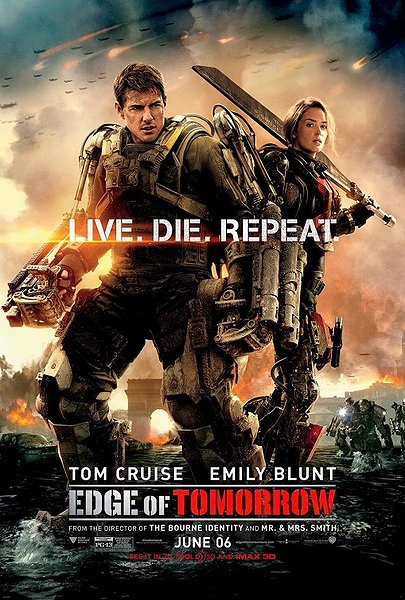 I’ve always been one able to separate the art from the artist, so while Tom Cruise may annoy people in real life because he jumped on a couch one summer, that doesn’t halt my enjoyment of the man’s movies. It seems with every new Cruise vehicle that under-performs at the box-office that I must be in the minority. Cruise hasn’t had a hit to his name since 2011’s suitably awesome Mission Impossible: Ghost Protocol. Both Oblivion and Jack Reacher, perfectly solid action movies, failed to make over $100 million domestically, further calling into question the drawing power of Tom Terrific. It seems that his latest, Edge of Tomorrow, is going to suffer a similar fate. This is a shame. As my critical colleague Ben Bailey said in his own review for the film: “Edge of Tomorrow might just be the most critically acclaimed box-office bomb of 2014.”
William Cage (Cruise) is chiefly an Armed Forces PR flak. He goes on TV to push the talking points of the United States military, which is in a heap of trouble. Aliens have landed in central Europe and spread quickly, proving to be nearly unstoppable. There was one soldier who was able to lead a successful counter attack. The “Angel of Verdun” is Rita (Emily Blunt), a soldier Cage proudly chirps only spent a day in her mechanical fighting suit beforehand yet proved to be so deadly. After vaguely threatening a high-ranking official rather than report for a doomed counter assault, Cage is shipped to the frontlines as a deserter. In hours he and a motley crew of ground forces are flown to the beaches of France, where the aliens will slaughter them. In the firefight, Cage is covered with alien blood and gains their special power. The reason the aliens have won every battle, save one, is because they have the power to reset time. They learn from their errors, which is why they always anticipate humanity’s attacks. Now Cage has this power. Every time he dies, the day resets and he starts over, trying once again to survive. The only person who understands him is Rita, who once had the same power. Together, with some extensive training, they may be able to thwart the alien invaders for good.
 Edge of Tomorrow is the ultimate video game movie, and while I would normally mean this in a pejorative sense, it is actually a compliment. With every death, Cage gets to start over, looking for a way to complete the next stage of the next level, learning from his costly mistakes and hoping to get to the boss battle that usually closes the level. From a structure standpoint, it’s a pure video game, albeit an older sidescroller (remember those, kids?). The visuals and mechanical battle suits also further support the video game comparisons. But really, Edge of Tomorrow is Groundhog Day meets Starship Troopers but brilliantly executed. There is something deeply satisfying about the Groundhog Day formula, namely getting seemingly endless chances to fix one’s mistakes, to try out new paths. It’s also inherently satisfying as an audience member because you watch your hero fail time and after time but they’re still active, they’re still trying to achieve a goal, or a new goal, and thus when they do succeed it’s even more triumphant and gratifying. We get to learn alongside our protagonist. Also, it allows the narrative to explore new material without going stale. In most stories we have one set path, but in films like this one with a time loop, it’s like we get to see all the wheels-within-wheels, the stories just offscreen happening simultaneously. It opens up the world in more interesting and playful ways, providing more payoffs than just one set narrative destination. We get assorted answers to our “what if”’s. Plus we get more screen time with Bill Paxton (2 Guns) as a comically hardass master sergeant. Edge of Tomorrow mines all these areas expertly. This is a movie that embraces the possibility of its sci-fi premise. It’s constantly clever, fast-paced, lively, and expects its audience to keep up with the pace.
It’s great to see director Doug Liman flex his action-thriller abilities again, ineffective or dormant since 2005’s Mr. and Mrs. Smith. The man has an innate ability to orchestrate action without losing sight of character. The beach invasion sequences have plenty going on, enough so that you won’t be bored after multiple trips, and unlike last summer’s disappointing Elysium, this is one movie that knows how to make proper use of a mech suit. These suits don’t look that impressive but they pack some mighty firepower. It’s rather cool when Cage, after a litany of failed trips, has the beats of combat to memory, knowing to shoot in this direction at the right second. It’s like watching a man harness the omniscient power of God (“I said I was a god. Not THE God.”). Under Liman’s guidance, the action is big and exciting and fun, more so than any other Hollywood action movie I’ve seen this year (The Raid 2 is still in a class its own).
The action sequences and special effects are all relatively good, but it’s just the sheer fun of the movie that makes it special for a summer would-be blockbuster. It’s like you get multiple movies smattered together but the eye is always forward to the goal, taking out the alien brain/host. The structure is almost foolproof: by the end of Act 1 he gets the time-tripping powers, and by the end of Act 2, he loses them and the heroics to close the movie have to count for real. I wish the final boss battle didn’t happen to take place in the bowels of a famous landmark/destination, but I suppose Liman and company needed a change of pace from all the beach activity. While the movie covers plenty of ground repeatedly it never feels old or directionless; while it has its share of sticky exposition and silly plot mechanics, it never overwhelms the story or the entertainment factor. The basics of who the aliens are, how they attack, what their magic blood does, what the rules are for utilizing said alien time-repeating power, you would imagine that they would be too silly or bog things down, but they don’t. Except for the very end (the concluding two minutes), the movie plays within its own system of rules. That also means no unrealistic romantic entanglement. Sure we expect movie stars to fall for one another, especially in peril, but for Rita, every day is the first day she’s ever met Cage. He develops feelings for her but she credibly keeps thoughts of romance at bay.
 It’s also a mordantly mirthful movie. Cage can only reset when he dies; if he is just wounded and passes out, he’ll lose his special reset power. So every insurmountable roadblock, wrong choice, or crippling injury must be met with one conclusion, namely Cage being snuffed out. Rita carries out most of the executions in the second half, with a blasé sense of routine duty, like a plumber fixing a clog. It doesn’t really get old and Liman utilizes montage well to give the comedy an extra punch. It lightens a movie more or less centered on human annihilation and mortality. And for the legions of Tom Cruise haters, there’s got to be some degree of entertainment value in watching the man die again and again and again and, well you get the point.
Cruise ably shows again that he is more than capable of carrying an action film (he’s over 50 now too). The man still has enough energy and physical stamina of an action hero in his 30s, and his charisma is still there in spades. It’s also interesting to watch Cruise play a cowardly character. I should have expected it considering that Cage’s arc has to start somewhere before he becomes the super soldier. However, the movie would never have been as good if Cruise didn’t have a strong leading lady, and the surprisingly buff Blunt (Looper) is an excellent match for her costar. She’s tough and can beat the snot out of you. Just her very walk exudes confidence and determination (is it too late for her to be Wonder Woman in the next Superman film?). Having walked in Cage’s shoes before with the time-replay power, she has an extra weariness to her, a certain devil-may-care attitude, especially in battle. The two actors make a winning team and Cage’s recruitment of Rita is another mission with another worthy payoff.
The original title was All You Need is Kill, based on a Japanese graphic novel, and I can’t help but think how much of a better, striking title that is to describe this movie. It’s a wonderfully entertaining movie, with its action spectacle tempered with an intelligence rare for a summer blockbuster that doesn’t have Christopher Nolan’s name attached as director. Here is a playful sci-fi movie that doesn’t downplay its sci-fi, doesn’t dumb down its plot, and explores the richness of its world one dead Cruise at a time. It’s clever and satisfying and brings all the visual fireworks you’d demand. It’s a rotten shame that Edge of Tomorrow appears destined for the cinematic scrapheap. We need more movies like this one. Reverse the tide people and see this movie on the big screen while you can. It’s everything we want in a summer blockbuster fully realized.
Nate’s Grade: A-
Share this:

Suddenly (2013)
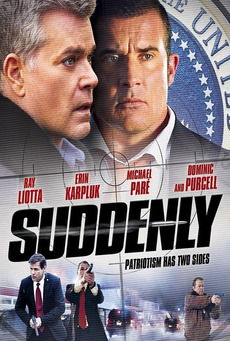 I can genuinely say that director Uwe Boll pleasantly surprised me with the last film I watched that had his imprint, Attack on Wall Street. It almost worked. It felt like Boll had maybe gotten over the hump of mediocrity, and sub-sub-mediocrity, that has become synonymous with his career writing and directing movies. Then one day, Suddenly suddenly popped up on Netflix, available for consumption, and 90 very tepid minutes later, my renewed hopes for a turnaround had been dashed and trashed once more.
The President of the United States of America is stopping by the sleepy mountain town of Suddenly. The secret service is canvassing the neighborhood to secure locations. Officer Todd Shaw (Ray Liotta) is working off another bender and may just get suspended. Ellen (Erin Karpluk) and her teenage son Pidge (Cole Corker) are living up on the mountain with a great view of the town. Agents Baron (Dominic Purcell), Conklin (Michael Pare), and Wheeler (Tyron Leitso, though he’s referred to as “Agent Young” several times) come knocking on her door to inspect. Except they aren’t real secret service agents. They’re posing to coordinate an assassination on the president, a hit ordered by the “Committee” that they work for. The assassins in suits lock Ellen, her son, and her elderly father (Don MacKay) in the basement, and wait for the president to arrive. There’s just the problem of keeping their cover and making sure Todd doesn’t intervene. Oh, and the town has a shop that advertises “fetish” in its name. So there’s that.
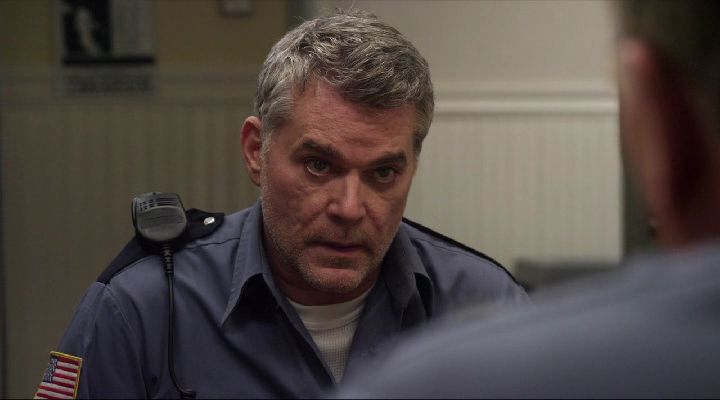 Given the assassination premise, Suddenly is shocking in just how overwhelmingly boring it is. There’s a noticeable lack of urgency in just about every scene despite the stakes of men with guns threatening people’s lives. A solid majority of the movie is an almost comically low-key hostage situation where we watch Ellen’s family bumble around the basement as captives and try to outsmart the relatively dimwitted assassins. It’s nothing quite along the lines of, say, Home Alone, but it feels comically off in tone, aided by an inappropriate musical score. These people don’t ever feel scared or panicked, and their conversations show it. The stupid grandfather character in this feels like he was plucked from a different, more broadly comical movie. Oh look, he’s fussing about with things; oh look, now he’s going to tell one of his old stories. In the context of a hostage thriller, it doesn’t work. Grandpa half-heartedly relates a tale about being snowed in with grandma where, surprise, they got out (the man is standing there after all). “See, it all works out in the end,” he reasons with no convincing evidence. And then (spoilers) he dies in the most idiotic way possible. During a light scuffle, he gets shoved and falls over. “He has a heart condition,” Ellen screams, informing us for the first time of this malady. I’m thinking he’s faking, so as to strike when the attacker draws near. Nope, he just lies there and dies in the most pathetic way possible, as if the plot had just decided it didn’t need him after all. One of the armed men actually tries to revive him, how nice.
Suddenly literally takes its sweet time getting to that presidential moment, saving that for the last few minutes of the film. Almost all of Raul Inglis’ (The Killing Machine) screenplay revolves around one scenario: will the bad guys’ cover be blown as different people keep finding their way back to Ellen’s secluded home. Oh no, the deputy will spoil things! Oh wait, he’s easily fooled. Well thank goodness that problem was solved in a not interesting manner. This takes up an hour of the movie, and it’s rather repetitious without any escalation. The entire setup feels like a series of lame stalling techniques to save the good stuff for the very end, rather than dealing with reversals and rising action. Then there’s the nature of the ending, which is so abrupt and without a single trace of resolution. As soon as that shot’s fired, the film ends a minute later. We learn via the news that the gunman shot himself… in the chest? At a distance? None of this holds together and the ending does not justify the time it took, and wasted, to get to that point.
There is exactly one point where this movie flashes the kind of quality story it could have been and it happens 70 minutes into the picture. Baron miraculously deduces how Ellen’s husband was killed: friendly fire, and Todd was the culprit. It was naturally an accident, one that haunted Todd deeply, but he returned home and everyone started throwing around the word “hero.” So he kept the truth to himself. Now, right there is an interesting premise that could produce a flurry of intriguing and complicated drama. Todd would live his day feeling like a fraud but also not wanting to disappoint his loved ones, the people he cares about, and so hiding the truth could be a justifiable evil, or could it? This little reveal of character backstory is only intended to explain Todd’s penchant for drinking, and the movie just skirts along a few minutes later, already over this revelation. Suddenly should have dropped all of the cheesy and half-baked thriller aspects and gone in this other direction.
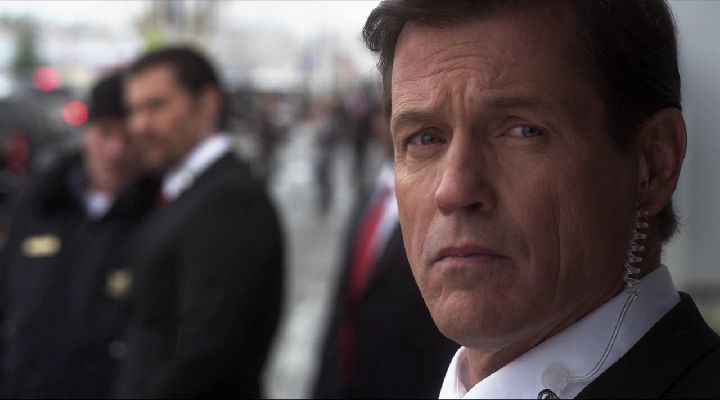 The villains in this movie lack conviction and competency. First of all, they just leave Ellen and her son and father unattended in the basement rather than tying them up. Then there’s just their general unconvincing nature when speaking with locals. They pose as secret service agents but there are actual secret service agents still in their midst. These turncoats are plotting to murder the president because the “Committee” they work for has demanded such. This phantom “Committee” is only known through one agent, Baron, and each man is selected for duty. They have a cause, though none of them can articulate exactly what that would be. At one point Conklin insists not killing the hostages because it would be bad PR and dissuade the public to the merits of their unexplained cause. Are these guys thick enough to think that killing the United States president will win over the public, just as long as they have good reasons for killing the president? It seemed obvious that Baron was going to be the lone person of this “Committee,” and yet the film doesn’t even tie up this loose end. We never know whether Baron was making it all up or whether there is a clandestine organization that has its sights set on the president.
Boll’s diffident direction mirrors the lack of enthusiasm throughout the production. This just doesn’t come across as a story that separates itself from your bargain basement, straight-to-DVD action flick. In fact there isn’t any action in the movie short of a few tidy scenes. And as far as thrills and suspense, they’re undercut at just about every turn, thanks to the lack of urgency and the comical misuses of Ellen and her family. At no point will you be watching Suddenly and get the sensation that anybody really cared about making this movie as best it could be. Usually Boll’s movies feel pasted together and derivative of other, better movies and visual influences; this movie is too dull to even be derivative. The movie even has the temerity to reuse that trite cliché, having the villain remark, “Under other circumstances you and I could have been friends.” The dumb villains, the dumb characters, the lackluster pacing and suspense, the lack of resolution, it all contributes to making what is easily the most boring movie in Boll’s filmography.
Usually these kinds of thrillers are churned out into the straight-to-DVD market, a glut of recycled plots and tortured/reluctant action heroes. There’s a formula that works and there’s been a proven audience that enjoys something cheesy, thoughtless, and familiar. And that’s what puzzles me even more about Suddenly because every somnambulist second of the film leaves you with the stark impression that nobody cared. The tale of a hostage thriller mixed with a presidential assassination, with some war drama thrown in, could work as far as the genre goes. All you need is a solid premise and some gung-ho execution, which explains why we had two Die–Hard-in-a-White-House films last year. Suddenly is nothing special, which we all suspected from the particulars involved, but it’s not even worthwhile or workable genre pap, which is even more insulting. From the wacky grandfather to the idiot villains who blindly trust their leader to the abrupt ending, or how about the fact that a kid is named Pidge, this is just one bad movie.
Nate’s Grade: D
Share this:

Chef (2014)
 Chef must have been something of a needed break for its star, writer, and director, Jon Favreau. He’s directed three large-scale Hollywood sci-fi mega movies in a row, a long way from Favrieau’s first big break, Swingers, which he wrote for himself. It was time for something a little smaller, quieter, and more personal, and Chef is just the ticket, a familiar but still greatly satisfying slice-of-life movie about a frustrated chef finding his mojo. Favreau plays a famous chef who cracks under the pressure of delivering the same safe food day in and day out. He loses his job after an increasingly hostile Twitter war with a food critic who calls him out for his safety in blandness. This pushes Favreau out of his comfort zone; he starts an independent food truck, bonds with his son, and generally begins to embrace his new invigorating freedom. Don’t see this movie on an empty stomach because it will be torture. The food preparation shots are tantalizing as are the general discussions over the adoration of food, the heavenly feel of a good meal (an aspect that’s even utilized as foreplay in the film). The entire film is stoked by a laid back charm, an amiable camaraderie between Favreau and his cast, so much so that we don’t care when the film sort of stalls. It’s a far lengthier period between Favreau losing job and getting the food truck than necessary, and the ending is abrupt with an almost absurd amount of resolution tie-ups crammed together without additional progression. The characters are likeable enough, funny, and their passions have a way of enveloping the audience, so much so that a fairly predictable plot is excusable. Chef is a lovely little palate cleanser at the start of the summer movie season and an enjoyable excursion. Just fill up before seeing it or else.
Nate’s Grade: B+
Share this:

X-Men: Days of Future Past (2014)
 Ever since Marvel’s Avengers destroyed the box-office in 2012, every studio with super hero franchises has been looking to follow suit. It’s not just about comic book franchises; it’s about building a comic book universe. It’s been a long dark period for the X-Men ever since the regrettable 2006 debacle The Last Stand, which callously killed characters, butchered others, and botched the most famous storyline in the history of the comic. In 2011, Matthew Vaughn proved there was still life to be found in the franchise with his terrific 60s-era prequel, X-Men: First Class. Now, post-Avengers, Fox is salivating at combining the past X-Men and the present X-Men into one colossal movie with a colossal budget. Back on board is director Bryan Singer, the director of the first two X-Men films and the man who helped kickstart the modern superhero era. If that wasn’t enough riding on the film, X-Men: Days of Future Past also follows the second most famous storyline in the history of the comic.
In the horrible future, killer robots known as Sentinels hunt down mutants. These are the invention of Dr. Boliver Trask (Peter Dinklage), a military scientist who was killed back in 1973 by the vengeful shape-shifting mutant, Mystique (Jennifer Lawrence). The murder convinced humans to subsidize Trask’s killer robot plan of defense. Thanks to experiments replicating Mystique’s mutant ability, the Sentinels have the ability to adapt to any power, turning them practically indestructible. In the future, the Sentinels are eradicating all mutants, mutant sympathizers, and eventually human beings. Magneto (Ian McKellen) and Professor Xavier (Patrick Stewart) have teamed up with a small band of surviving mutants, including Wolverine (Hugh Jackman). Thanks to the phasing powers of Kitty Pryde (Ellen Page), they can send Wolverine’s consciousness back to 1973 so that he can prevent the Trask assassination. The only ones who can help Wolverine is the younger Xavier (James McAvoy) and Magneto (Michael Fassbender), former mentors to Mystique. Except Xavier is a recluse and strung-out on drugs to dull his powers and Magneto is locked away underneath the Pentagon.
 The X-Men films have always had a topical advantage to them that provided a weightier sense of drama than your typical story about a reluctant soul blessed with amazing powers. The mutant allegory automatically applies to any sub-group facing oppression mostly through fear and ignorance. What other superhero franchise has two opening scenes in a German concentration camp? The stakes are even larger with this movie because of the Horrible Nightmare Future that must be prevented. Now we all assume said Nightmare Future will be avoided by film’s end, so the movie provides a proverbial reset button that the filmmakers can have fun with, and they do (look out future mutants). Excluding the Nightmare Future framing device that becomes an unnecessary parallel storyline, the majority of the film takes place in 1973. If X-Men: First Class tapped into the groovy optimism and “take me for what I am” sense of social justice of the time, then this film certainly taps into the disillusionment of the 1970s, where the promise of reform and hope morphed into anger and cynicism (hey, that’s like us today!). This loss of innocence is typified in Mystique, who becomes the central figure of the movie in many ways. Her seething desire for vengeance is what animates her, as well as the pain of betrayal from the men closest in her life, as well as the world who once held such promise. Also, Jennifer Lawrence (The Hunger Games) has become one of the biggest female stars on the planet, so it makes sense to bolster her role. The central conflict is stopping an assassination, one domino that leads to many others, but it’s emotionally about Mystique having to confront her feelings of hate. It’s another platform for the ongoing conflict of perspectives between Xavier (restraint, tolerance) and Magneto (strong defense, eye for an eye). But as I found in First Class, it’s hard not to agree with Magneto as human overreaction leads to rash and thoughtless actions, like Horrible Nightmare Future.
That’s not to say that X-Men: Days of Future Past fails to deliver when it comes to the popcorn thrills and action highs we crave in our finest summer blockbusters. The action set pieces are large without dwarfing the characters, playful and imaginative without losing a sense of edge and danger. I loved how the character Blink (Bingbing Fan) would utilize her mutant power of opening portals as a fighting strategy. It makes action sequences so much more inventive and visually exciting to throw a series of portals. The pacing is swift short of the second half of Act Two, gearing up for the climactic showdown in D.C. that dominates Act Three. The time travel story starts with a lot of exposition but it gets smoothed out as it goes, the rules of the story fall into place. Every action sequence hits, some admittedly better than others, but it’s the small touches that Singer injects that made me smile most. I enjoyed Magneto pointing a gun, being toppled, but still using his power to have the gun fire in midair. I enjoyed the animalistic nature of the Beast/Wolverine brawl. Jackman is looking even veinier than usual in his bulked out form. Thankfully the fish-out of-water timeline jokes are kept to a minimum. Wolverine is the perfect glue to hold both timelines together. And then there’s that standout Pentagon prison break sequence (more on that later). Singer might not have the most natural instincts developing and staging action, but the man is a surefire talent when it comes to staging eye-catching visuals (I would say the same about Christopher Nolan). Even his unfairly maligned Superman Returns is proof of the man’s cinematic gifts. As far as entertainment value, this is right up there with X-Men 2. I still view Vaughn’s savvy First Class as the best X-film of the bunch, which has only gotten better the more I’ve watched it.
 And if that wasn’t enough, Singer’s new film does what every fan has been hoping for: (spoilers) it erases all the crummy X-Men movies, namely 2006’s Last Stand and the first Wolverine solo effort, from the official timeline. It’s time to start anew, toss out the old stuff nobody liked, and forge ahead with a new unified timeline. There can be two parallel X-Men franchises, one present/future and one with the prequel casts, and they can go on forever as desired, or until the prequel cast prices itself out. In one fell swoop, Singer and company have reset the mother franchise and given fans new hope about the possibilities. Make sure to stick around to the very end of the credits for a scene that indicates directly who the next major villain will be in the 2016 sequel.
Let me take time to single out just how expertly Evan Peters (TV’s American Horror Story) steals the entire mutant-heavy movie. First, he’s the most comically attuned character, which is a nice break from how serious, and rightly so, every character is so often. Quicksilver provides a whole new jolt of entertainment, and when he checks out after the prison break sequence you’ll dearly miss him. The character is a rapscallion (as my late grandmother might have termed) that enjoys using his super speed powers to mess with people, to test his limits, to see what he can get away with, and a Pentagon jailbreak is right up his alley. Ignore the silly yet period appropriate outfit and ignore what initially seems like Peters’ smirking self-involvement from trailers and ads. When this character is onscreen the movie has a joyful sense of irreverence. He is instrumental to freeing Magneto and the onscreen depiction of his super speed is the best illustration of the power ever conceived in film and TV. There is a segment sent to Jim Croce’s “Time in a Bottle,” and some wonderful special effects, which is just so playful, so giddy, and so cool that it very well might be my favorite moment in any superhero movie… ever. It is definitely an applause-worthy moment and my audience responded in kind. Quicksilver is a perfectly utilized supporting player in a movie stuffed to the gills with characters.
The time travel geek in me has a few quibbles with the parallel lines of action from past and present. Wolverine’s consciousness is sent back in time but he film plays out like it’s happening simultaneously to the events of the future. So if Wolverine is pulled out in the middle of the movie, he’ll have failed his mission to change the future, even though by going back in time he’s already, blah blah blah butterfly effect. Anyway, I understand how they want to make the future story have a sense of urgency but it’s not like waking Wolverine from a dream; the times are not happening concurrently. He’s in the past, meaning that the moment he goes back there, the future will already be altered due to the consequences of his actions, for better or worse. There is no race against time to keep his consciousness back in time until he complete his mission. I can see why they went this route for a summer blockbuster, but that doesn’t quell the quibbles.
 X-Men: Days of Future Past is a time-hopping, unabashedly fun time at the movies; well as fun as preventing nightmarish futures built from the consequences of oppression and prejudice can be. With Singer back in the saddle and the bridging of the two X-Men universes, the series is back on track and once again the promising font of stories and characters. The newest X-film is one of the most entertaining, funny while still being dramatic, and while burdened with the largest cast of any super franchise, finds notable moments for its characters big and small to remind us that these people matter. While less philosophical and funky than First Class, this is one of the best films in the franchise, on par with X2. The action sequences and visual eye-candy are great fun with some inventive and memorable touches. It’s also nerdy fun getting to watch the past and present interact, and for many this is their first return since 2006’s crappy Last Stand. It’s not a perfect movie; I wish there was more early Sentinel action, I wish Dinklage had much more to do, and I wish that the plot didn’t so transparently hinge on Xavier not having his powers. The slate is clean and all X-Men fans can breathe a sigh of relief. The future is once again rosy. The X-Men, and not just Wolverine, are relevant once again.
Nate’s Grade: B+
Share this:

Labor Day (2013)
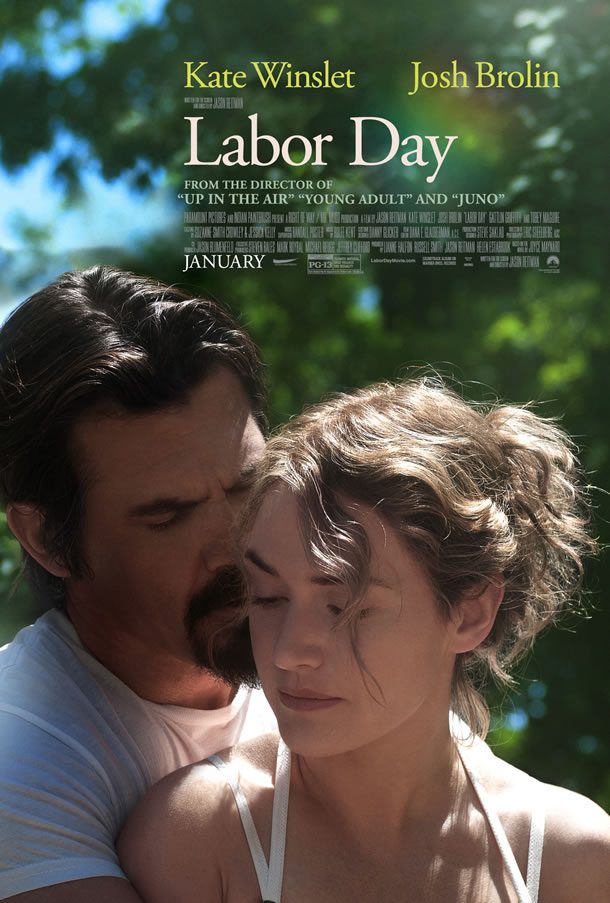 Labor Day, based upon the novel by Joyce Maynard, is the kind of sappy material that you never would have expected director Jason Reitman to attach his name to. Reitman has been accumulating an enviable career of top-shelf dark comedies (Thank You for Smoking, Up in the Air, Young Adult), yet his touch with characters and actors, as well as his delicacy with tone, reminded several of a young Billy Wilder. The stuff of Labor Day felt more like a Lifetime channel original movie. This is just one artistic miscalculation from the start and it doesn’t get better as it goes.
Back over Labor Day weekend in 1987, young Henry (Gattlin Griffith) is living with his grieving mother Adele (Kate Winslet) and performing many of the duties of a husband (don’t get gross). It’s been some time since Henry’s parents divorced but Adele has become a shell-shocked recluse who can barely talk or look others in the eye. While visiting a grocery store, Henry runs into a dangerous man named Frank (Josh Brolin). He’s bleeding from the abdomen and intimidates Adele to give him a ride. Frank is an escaped prisoner and he takes to hiding at Adele’s home. After the initial hostage period, Frank allows Henry and Adele to walk around freely, as long as they don’t tell anyone where he is. As the days pass, Frank helps out around the house, helps Adele get out of her funk, and becomes a surrogate father figure for Henry. The unconventional family must evade the police and skeptical townsfolk to make a run for it.
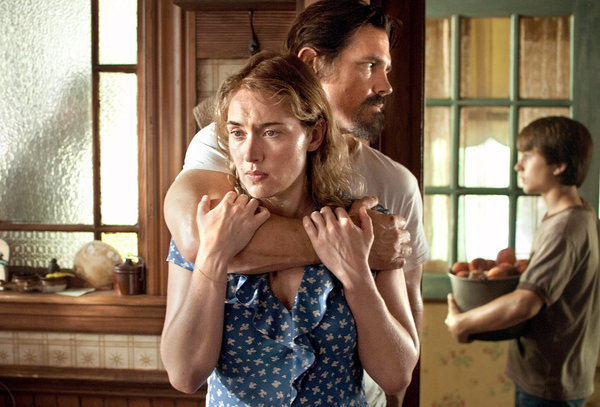 The very premise and its tone are just not a good fit for Reitman. First off, the movie plays out far more like a hostage thriller than any sort of romance. If you were to look deep inside, the romance can be explained as one very emotionally needy woman and her child going through Stockholm syndrome. The entire movie takes place over the titular Labor Day holiday, which means that all these changing feelings have to morph over the time period of three days. I don’t know if I’d call that love, even in Movie Land. Hey, Frank didn’t kill everyone and he helps around the house, isn’t he great? These people should be far more afraid for far longer. It is almost comical how saintly Frank becomes and how many surrogate father activities he squeezes into the abbreviated window of time. He performs handyman jobs all around the house, teaches young Henry how to change a tire, tosses a baseball with the kid, teaches everyone the finer points on pie making, and other such helpful activities. I understand that these two lonely people finally see a replacement man; for Henry a father, for Adele a lover. Again, the three-day time window makes everything appear like the manifestation of Stockholm syndrome. How many of those abducted have uttered, “He’s not that bad. You just don’t know him like I do”? Frank’s back-story is tragic but he is a wanted felon and he has no problem threatening both of these people’s lives in the beginning. Yeah he doesn’t resort to violence or yell in their faces, but why would he against an adolescent boy and his easily cajoled mother? No matter how long Reitman spends showing us the softer side of Frank, especially while preparing delectable dishes of food, he’s no more developed than the common Misunderstood Bad Boy.
Then there are the dawdling coming-of-age moments clinging to young Henry, a boy growing up quickly in a tumultuous holiday weekend. It strikes me as tonally odd to already take a tricky balancing act with the film’s plot and then tossing on a coming-of-age addition. The story is told from Henry’s perspective, and that’s a major problem as well. He’s the least interesting person in this dramatic setup. Being confined to his viewpoint often keeps us distant from the deeper drama going on. I’d rather spend time with Adele and Frank bonding so that the romance can find some traction, but no. Al we hear are the thumps from the other side of the wall and the gentle whisperings between them in stolen glances. It’s a frustrating perspective because quite frankly nobody really cares about this kid’s sexual awakening and his daydreams about the cute girl’s bra. His dad (Clark Gregg) wants to talk to him about the birds and the bees. His mom talks about the same. It’s a somewhat uncomfortable position for the audience with both parents wanting to cover the sex talk. There’s a wanted man hiding in his home! Henry’s personal growing up drama has no equivalency to this. Of the three main characters, doesn’t Henry seem like the worst participant to tell the story? It doesn’t help that Tobey Maguire narrates as older Henry. Have we not learned from The Great Gatsby: Maguire’s voice does not suit narration.
It’s the film’s more tense moments where you get glimpses of the real movie here, the thriller that’s been gussied up and disguised as some strange romance. Whenever someone gets close to discovering what’s really going on in that house, the movie picks up and grabs your interest once more, albeit fleeting. The fear of getting caught is potent but it should have been more omnipresent. The film, through Henry’s perspective, is treated like this nostalgic chestnut of that one summer a convicted killer held us hostage. The police are canvassing for an escaped prisoner but the neighborhood doesn’t seem to be that alarmed, still going about their business bringing desserts and fresh produce to one another’s doorstep. Too much of the film implies the threat, like with a short glimpse of a police checkpoint, but places it on the back-burner so that the romance can take shape. Again, this is a byproduct of being stuck in Henry’s perspective whereas the kid might not have the best understanding of how serious everything is (he’s worried his mom will abandon him and run off with Frank). But in those brief moments of dread and tension, this is where Labor Day works, and Reitman does a great job of turning the screws and building that suspense. It makes you wish the whole thing were a thriller.
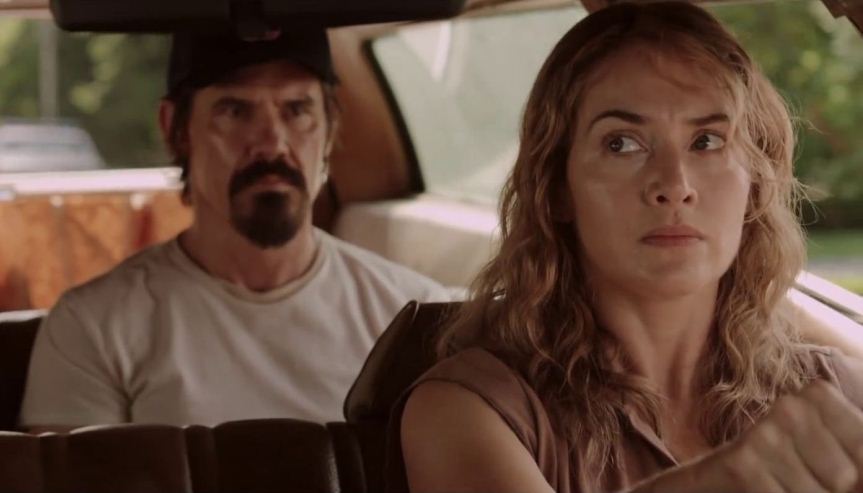 No one is going to question that Winslet (Divergent) and Brolin (Gangster Squad) are great actors, but boy do these characters underachieve. There is one very effective and moving monologue Winslet has about her pregnancy problems that have turned her away from the world, but it’s not enough. For much of the movie, she plays such an anxious and internalized character, so it’s hard to really follow her emotional development. That monologue does the most heavy lifting but it’s pretty wan before and after. Winslet is too good an actress to play essentially a catatonic woman that’s fairly mute. Brolin can play a soulful brute in his sleep. There’s so little to challenge him and so he seems on autopilot. It also hurts that both Frank and Adele have very limited conversations. It’s a romance told in gestures and handclasps (and the rhythmic thumping of walls at night). It’s not their fault that their characters are underwritten and unsatisfying. Griffith (Green Lantern) is a nice young actor but he too is forced to communicate much with little and comes up short. James Van Der Beek (TV’s Dawson’s Creek) is a local cop who appears for one scene, and afterwards you wish he would stick around longer. Look for Reitman good luck charm J.K. Simmons (Dark Skies) as a helpful neighbor.
Reitman is such a talented director that he can almost pull off sequences in Labor Day despite all of its inherent structural, tonal, and perspective flaws. From a technical standpoint, the movie is a gauzy, amber-accented tale with plenty of strong alluring visuals to set you at ease. There are these trembling moments where you almost see what attracted Reitman to the film, but the finished product is just a mushy misfire. It’s earnest without having earned our emotions, and the thriller elements and the romance elements are in constant conflict. We all remember our grandparents telling us that magical moment they knew they had met the one when he tied her up and held her hostage. Much of the drama that comes from the premise is handicapped from the mistake of having Henry as the chief storyteller and point of view. His limited involvement means we’re kept at the peripheral for too many important moments. I have no doubt Reitman will rebound and quickly (he’s already filming his next movie and has optioned a book for his next next movie). Get ready to have Labor Day play every subsequent Labor Day weekend on the Lifetime channel, its true home.
Nate’s Grade: C
Share this:

Godzilla (2014)
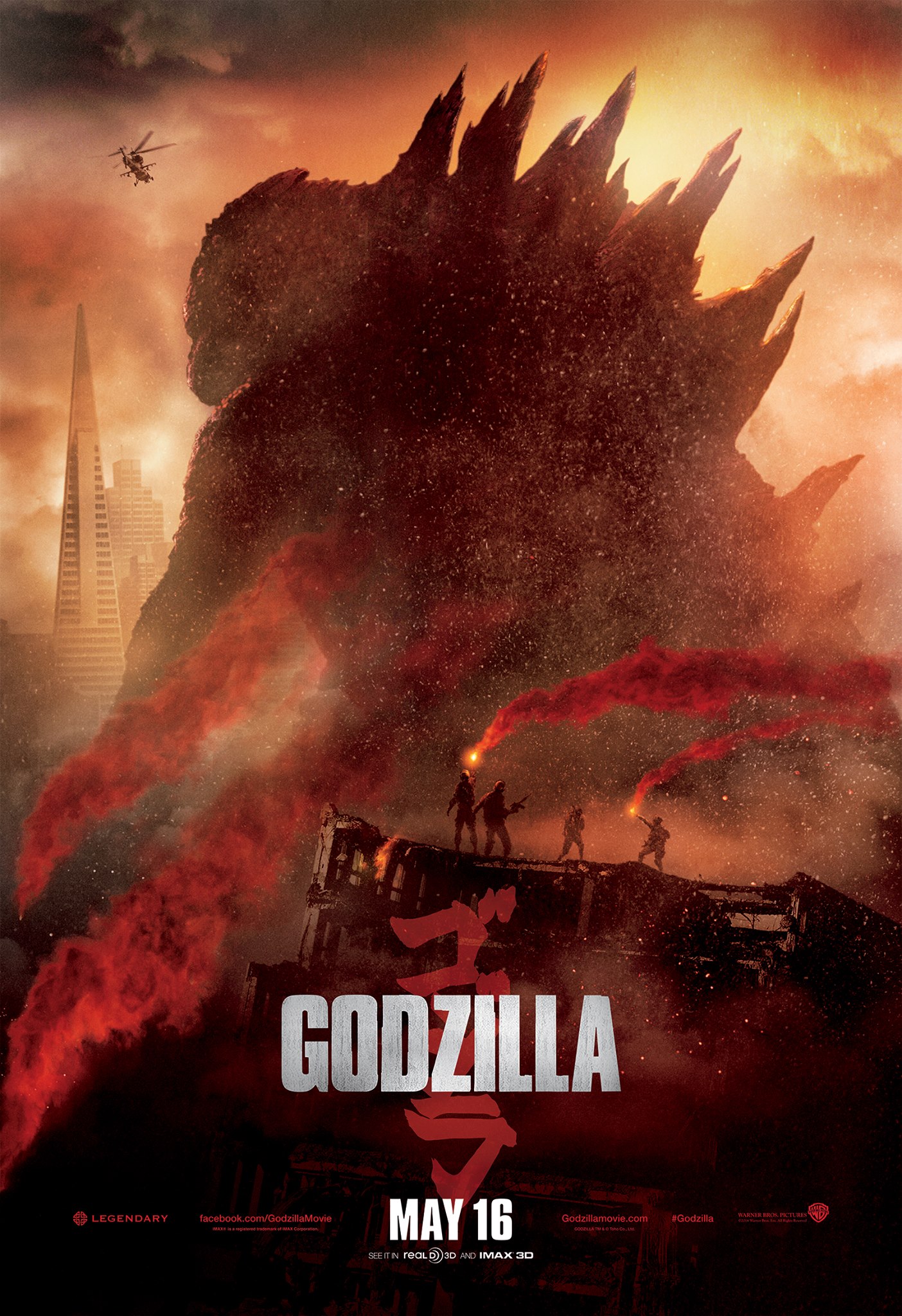 When it comes to the monsters of cinema, it’s hard to beat out Godzilla, and not just because, you know, he’s hundreds of feet high and can breath fire. The famous monster began as a cautionary tale about nuclear weapons, destroying man’s hubris and often the good people of Tokyo. The legendary beast has been hibernating as such since 1998’s not-so-spectacular big-budget return, a film that the Japanese loathed. But like all ancient being, Godzilla has been resurrected again and given a splashy new coating of CGI devastation. If only the filmmakers had decided to leave out the humans and make Godzilla the rightful star.
A scientist (Bryan Cranston) warns the Japanese government of a massive impending danger. The offspring of a giant creature, a Massive Unidentified Terrestrial Organism (MUTO), has hatched and heading straight for the United States coastline. Attracted by nuclear power, the U.S. military tries to lure it away from populated centers. Ford Brody (Aaron Taylor-Johnson) is witness to the monstrous destruction and just wants to get back home to his wife (Elizabeth Olsen) and child in San Francisco, exactly where the creature is headed. There’s also the emergence of an older creature, one that has taken to combating the MUTOs to the death. This is the legendary Godzilla.
The big guy is back in a very different approach from 1998’s Godzilla (i.e. “better” approach). Director Gareth Edwards (Monsters), an avowed Godzilla fan, has made a reverent big-budget ode to the king of all monsters; however, the resulting film is more of a disaster epic than a monster brawl. The perspective is often framed at the human-level, which grounds the film from going too overboard into disaster porn territory like, say, Man of Steel. The effect is thrilling and adds a greater sense of verisimilitude to the mass chaos and destruction. It reminded me in some ways to 2008’s Cloverfield, where a group of characters is just trying to survive the periphery of all the collateral damage of a giant monster. There are sequences that directly relate to Fukushima as well as the tsunami from 2004. It’s almost like somebody watched the stirring movie The Impossible and said, “Yeah, give us some of that in our giant monster movie.” I don’t know if these sequences are entirely necessary. Watching Ford carry around a little Japanese tyke, wondering where his parents might be amidst the confusion post-monster attack, it relates to our modern response to tragedy and worldwide disaster, but do you really want to watch Ford have to find this kid’s parents? If there is a commentary to be found in the movie, it’s the uncontrollable and destructive power of nature pushed to the brink by mankind’s own energy crises. After all, the MUTOs are attracted to and strengthened by consuming nuclear energy. Godzilla is argued to be an “alpha predator” but also a figure to bring balance back to nature. I think it means that there can be only one giant monster and Godzilla is going to eliminate the competition.
 But the real question of any giant monster movie is the degree of satisfying, smash-em-up fun it provides, and the new Godzilla is a mostly agreeable venture. The action sequences, mostly saved for the climax, are cool and well thought out, but Edwards proves to be a brilliant visual stylist than a composer of action. This is a movie where the moments stand out better than the action. Edwards’ command of cinematic visual arrangements is at Spielberg levels of being a natural showman. I can easily think back on small moments, images that pop, visual reveals that are executed with aplomb, far more so than a central example of an action piece. I loved the horror-esque reveal of the elevated train being on track to head right for the MUTO. I loved the hide-and-seek nature of Ford waiting for the MUTO to pass. I loved when Ken Watanabe’s advice was literally just, “Let them fight” (I started chanting it in my seat). My favorite part of the movie is actually what was previously shown as a teaser trailer, namely Ford and several other paratroopers diving into the destructive city scene. The eerie hum of the 2001: A Space Odyssey monolith plays over, each man has a red flare streaking from their leg, and we watch them quickly descend through the sky, nervously awaiting what is on the other side of those heavy clouds, only to discover a city on fire, glowing like a hearth, and through the goggles, a monster fight taking place. The entire sequence is a visual standout, a thrilling set piece, and a reminder that Edwards has more on his mind.
Edwards does a lot of intentional teasing of Godzilla, so much so that it can get frustrating for an audience. I understand he’s building to a payoff reminiscent of Jaws; we’ve been teased for so long that we will go nuts when we finally see Godzilla in full glory, and it works. However, it also works as a detriment. There are several points in the film where it looks like we’re about to get some exciting Godzilla/MUTO action, or even just a MUTO wrecking havoc, and then the film cuts away, often to news footage. It’s a choice that begins as artistically clever but can become maddening in time. There is a lot of visual obfuscation throughout the film, far more so than the same compliant I had with last year’s Pacific Rim. Edwards will show Godzilla’s tail just swinging behind a building, or his colossal foot coming down with authority, or the wispy shadow of giants in billowing clouds of smoke. All those near misses can add up to cinematic blue balls. And so much of the action and destruction happens at nighttime, leading to a dour color palette heavy in grey and dark blacks, making the good stuff all the harder to see. I cannot even fathom why someone would want to see this film in 3D with those darkened glasses. It’s 90 minutes of foreplay that you may start to grow restless that we’re getting a Godzilla movie that will never show the goods (shouldn’t Godzilla be in a Godzilla film?)
 The problem with a disaster movie on a human-scale is when you don’t give a damn about any of the human characters. Now, Godzilla should be the star of any Godzilla movie but I understand execs fearing that their monster movie needs some relatable human drama. The problem is that the writing doesn’t do anything with these characters, forcing them into tidy and token roles that we’ve come to expect from large-scale disaster movies. Did anyone really feel anything about whether Ford would get back to his wife and child? Did anyone feel anything for anyone in this movie, beyond a slight reservation whether they would be squished, if even that? I’m not expecting three-dimensional characters here but even Roland Emmerich films do a decent job of establishing a milieu of people at various points of the globe we know will somehow coalesce together. There is so little effort to mask the character’s grand design: exposition mouthpieces, symbols of military threats, the noble family man, the beleaguered and crying wife. Seriously, there is a great cast of actors in this movie and they are given nothing to work with. Olsen (Oldboy) gets to look realistically scared and cry but she deserves so much better. Cranston (TV’s Breaking Bad) gets all the best yell-worthy lines. But it’s really Taylor-Johnson (Kick-Ass 2) who suffers the most since he’s placed as our impassive stand-in for a human protagonist. He’s so blank throughout the film and there’s little charisma to pull you in. His character, and the performance, feels no better than an elevated extra, Grunt #13. When we have to spend 90 minutes with these lackluster characters rather than some awesome monster fights, that’s when the film flounders.
I’m conflicted about the end results of Godzilla, an entertaining, surprisingly artistic film that can nail small moments of cinematic grandeur but has trouble matching its vision. The human-scale approach grounds the action, but do we want a giant monster movie grounded from a limited vantage point? The constant teasing builds a payoff for finally seeing Godzilla, but don’t we want more actual Godzilla in a film bearing his name? The human-scale, as well as the slow dodging of showing Godzilla, mean the storytelling emphasis is on an array of human characters, but what happens when they are poorly written, poorly developed, and lacking in charisma? The movie does more right than wrong but I’m left with the unmistakable feeling that, while a step in the right direction, there is too much self-sabotage holding back the movie. It actually made me re-evaluate and appreciate Pacific Rim even more. I can’t say this movie is nearly half the fun as Rim was. The monster design of the MUTOs is rather lacking, resembling a cross between the monster from Cloverfield and more patently the arachnid aliens of Starship Troopers, down to the heads that look like staple removers. Edwards has proven himself a big screen talent with a terrific feel for grandiose visual spectacle. I just hope if there is a sequel that we can skip all the slow buildup and just get to the main event – Godzilla beating the crap out of some other lesser yet still giant monster.
Nate’s Grade: B
Share this:

Neighbors (2014)
 The first side-splitter of the summer, Neighbors is a bawdy comedy that has enough big laughs that you may miss how well it draws its characters, punctuating preconceptions. The premise is boiled down to family versus frat, as a pair of new parents (Seth Rogen, Rose Byrne) has a college fraternity, lead by Zac Efron, move next door. You expect the raucous humor, and there are plenty of well-conceived visual gags and payoffs. I did not expect to like the characters as much or see different shades of them. Rogen and Byrne are not yet ready to be official grown-ups, and their attempts to hang with the frat parties are hilarious as well as cringe-inducing. I especially appreciated that Byrne is given the chance to be just as careless and selfish as the men; there’s even a fight between husband and wife who is the Kevin James in their relationship. Byrne is terrific and deserves even more work that lets her cut loose and be in on the joke. Then there are the frat brothers who could easily come across as brainless hedonists, and many do, but Efron and his co-bro Dave Franco have an engaging relationship where they fear what happens next after school. The movie’s theme isn’t subtle (fear of growing up) but provides enough extra substance to make the film more than the sum of its jokes. And it’s quite funny. Rogen and Byrne have great chemistry, their angry riffs are often amusing, and the escalating tit-for-tat prank war is memorable and entertaining. Neighbors works on a cross-generational level; as a man in my 30s, I related to Rogen and Byrne’s plight but also their shifting concepts of what they consider fun that they once may have mocked in their younger years (“I love brunch”). Neighbors builds to a nice climax, the cast is uniformly funny, and with enough surprising shades with the characters, it satisfies the R-rated funny bone.
Nate’s Grade: B
Share this:

Devil’s Knot (2014)
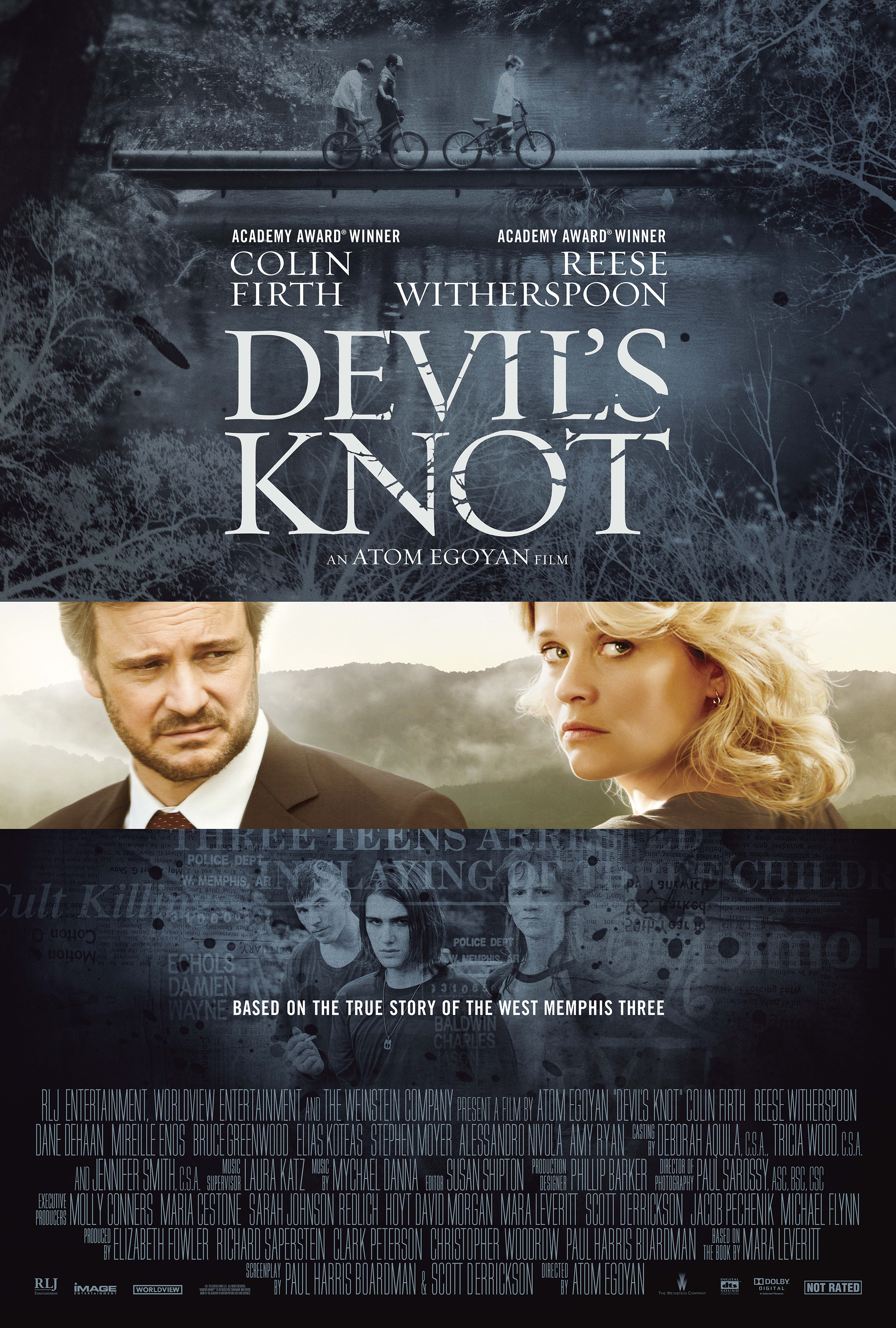 In 1993 in West Memphis, Arkansas, three eight-year-old boys went out late one night to ride their bikes. They were never seen alive again. The ensuing media circus that erupted lead to the conviction of three teenagers (The West Memphis Three) who many believed were innocent of these heinous crimes. Stop me if you’ve heard this story before. It was the basis of three stirring, powerful, galvanizing documentaries by Joe Berlinger and Bruce Sinofsky, two men credited with saving the West Memphis Three. Now after their release from prison, here comes Devil’s Knot, the first fictional film about the notorious case, Hollywood’s first crack at well-tread material. Is there anything new to be found?
Director Atom Egoyan (The Sweet Hereafter, Chloe) and his screenwriters do a credible job of distilling the complicated case against the West Memphis Three to its basics, relying on a modulated tone that shies away from the sensationalism that dominated the case back in 1993. With the benefit of time and hindsight, it’s easy for the movie to point out the erroneous thinking of the prosecution, the jump to conclusions, and the Satanic panic engulfing the community of Arkansas. We’re told by a police officer that they knew this “Satanic cult stuff” would hit town; they’ve just been waiting for the day. To its credit, the movie does a fine job of calmly and objectively pointing out the deficiencies in the police and prosecution’s case against the West Memphis Three. We’re told that from the twelve hours of interrogation with Jessie Misskelley, only 40-some minutes was recorded. The obvious mistakes in his confession, as well as the police coaching and coaxing him to their desired response, is made readily apparent. There’s “witness” Vicki Hutchernson (Mireille Enos of the oft-canceled The Killing) who says she say chief suspect Damien in a Satanic ritual, but the film cuts back from the imaginary to Vicki watching a movie on TV, the real source of her descriptive flourishes. Egoyan’s direction has a calm, objective overview that is reverent and respectful of the dead and the bereaved. It’s rarely boring and the facts of this case are such that any retelling would be somewhat compelling.
 So that brings me to the ultimate question: why even make a fictional movie about this subject? Four lengthy documentaries have covered the intricacies of the legal story, the breakdown in justice, and the personal toll on all sides of the crime. The only thing a fictional movie provides is: 1) the fun/distracting game of seeing relatively famous actors play the real-life people we’ve previously seen, and, 2) as an option for people who hate documentaries. If you’re one of those people who dislikes documentaries and doesn’t view them as “real movies,” then Devil’s Knot is for you, you dismissive filmgoer. Otherwise, literally everything was handled better in the Paradise Lost films. With the West Memphis Three thankfully out of prison, the omnipresent sense of urgency from the documentaries is now absent, replaced with a Monday morning quarterback sensibility pointing out all the obvious bias, judicial hypocrisy, and flaws of the case. And as anyone who has plowed through the powerful and addicting documentaries knows, there are plenty of flaws to point out for harsh scrutiny and incredulity. Movies have a long history of showing us an example of judicial injustice, and this is a prime example. However, Egoyan has put the emphasis of his movie on two outsiders rather than people in the center of this case. The West Memphis Three themselves are barely supporting actors in their own movie. I suppose the filmmakers may have wanted to present a different angle to the case since the Paradise Lost films showed the accused up close and personal. The construction of this plot just doesn’t work under the perspectives of Pam (Reese Witherspoon) and Ron (Colin Firth).
Ron serves as a pro-bono adviser to the defense, but that doesn’t mean he has the same access inside and outside the court. He can gather evidence on his own but really this guy is meant to be a fly-on-the-wall for the planning and frustration of all the legal roadblocks thrown at the defense. Is an added body in the room necessary? Could not one of the defense attorneys have provided the same purpose? Instead, he gets to grumble in the court and out about all the legal shenanigans going on to railroad innocent boys. He is essentially spelling it out to an audience. Pam has even less narrative purpose in the film. Her perspective makes sense early on as the mother of one of the murdered young children. Her panic, her worst nightmare come to life, it all makes for the stuff of major drama, which is why you’d imagine Witherspoon was drawn to the part. But once the case against the West Memphis Three gets going, Pam transforms into our Chief Reaction Shot Provider. Whenever a curious moment happens in court, we cut back to Pam and Witherspoon cocking her head in dawning curiosity and uncertainty. It’s as if she is meant to symbolically represent the entire community that was so fervent in their beliefs that these boys were guilty… until they heard the shaky case and the questionable experts put on the stand. So Pam and Ron end up becoming signals to the audience on how to feel and what to think. The movie doesn’t have enough faith in its audience to keep up with the minutia of the trail, or even the lawyers’ arguments, reducing a complex legal trial down to two nonessential characters nodding or shaking their heads.
 I’ll admit that I had some interest watching the actors inhabit the roles, and there are scads of people involved in this story. Bruce Greenwood (Star Trek) does a valiant job showcasing the head-scratching decisions of the trail judge, David Burnett, and his slimy dismissive nature. Stephen Moyer (TV’s True Blood) is particularly infuriating as John Fogleman, chief prosecuting attorney. Seth Meriwether (Trouble with the Curve) looks eerily like his character, the young and accused Jason Baldwin, and he nails his moral convictions and gentle nature. Dane DeHaan (The Amazing Spider-Man 2) gets to do his troubled youth thing he does so well. Kevin Durand is an actor I normally enjoy but even he can’t do justice to John Mark Byers, step-father to one of the slain boys, and easily the most memorable figure in the Paradise Lost films; the man is so theatrical and larger-than-life, and yet Devil’s Knot treats him like a featured extra, with many of his speaking scenes off camera. There isn’t a bad actor in the extremely large cast, though Firth’s Southern accent isn’t the most refined. If the movie lacks much reason for existing, at least the bevy of good actors respectfully bringing new life to these people, good, bad, and many somewhere in between, is the one credible quality to this movie.
What to make of Devil’s Knot, an example of a decent, modulated, and well acted movie that ultimately has no reason to exist in the wake of three excellent documentaries (Paradise Lost) and one other pretty good one (West of Memphis). The ground has been covered. However, that doesn’t mean that a well-told story can’t be told again, with a different angle, with a different approach, but Devil’s Knot hinges on two characters serving as metaphorical barometers to teach the audience what to think and how to feel. Then there’s the matter that the trail covers the entire 114-minute running time. There’s so much more that happens after the initial trial, so much that the last two minutes of this movie are almost a nonstop barrage of text updating the audience on many of the post-trial developments, including the West Memphis Three being released from prison in 2011. The movie feels too limited; there is so much more depth here, to the details of the case, to the personalities and human drama, to the story after the trial. Egoyan and his cast and crew have made a respectful fictional version of these sensational events, but the problem is that they don’t do enough to justify their own film’s existence. Unless you have an irrational hatred for documentaries, just watch those instead.
Nate’s Grade: C+
Share this:

Heaven is For Real (2014)
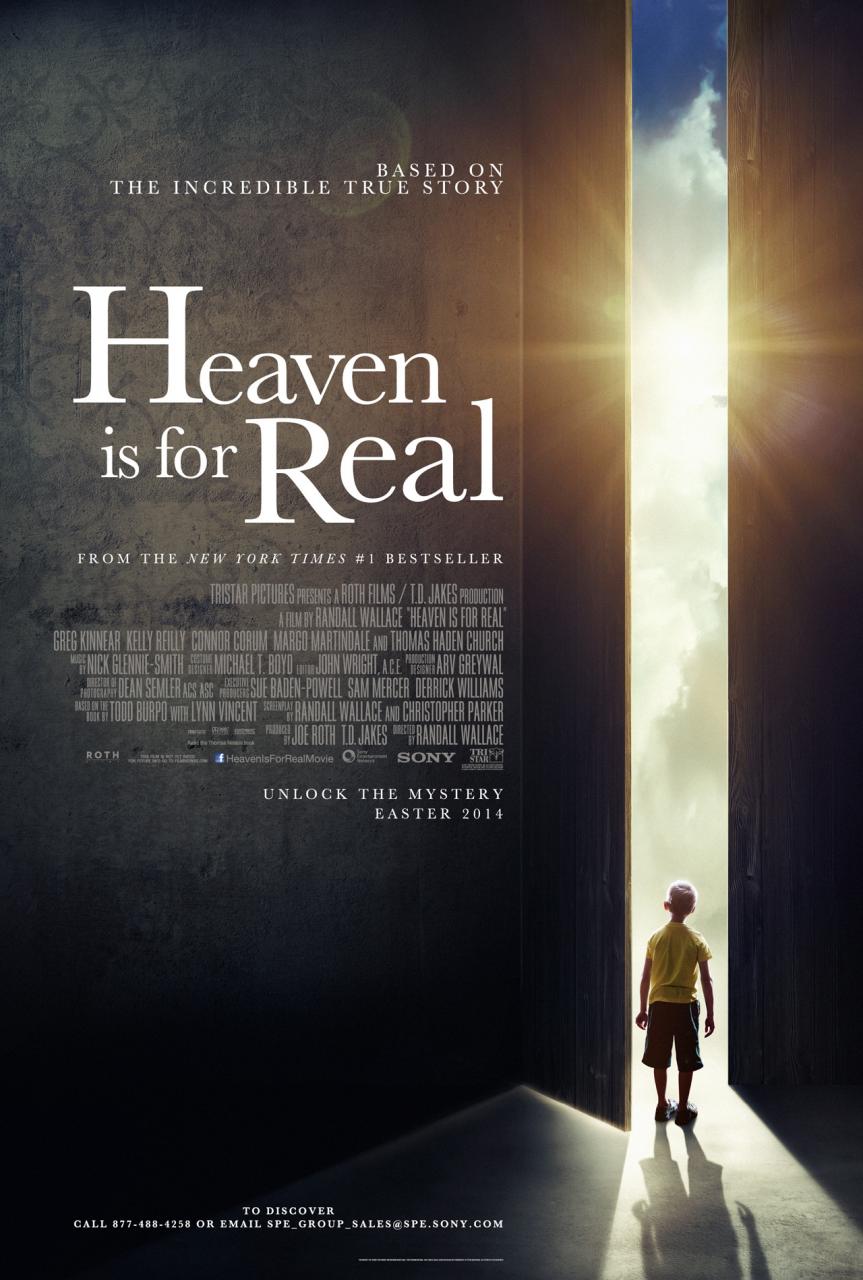 Christian movies have been lighting up the U.S. box-office this year. First there was Son of God, which opened at over $30 million dollars for what is essentially a retread of what people could see for free on TV. Then there was Noah, the Biblical epic given a new life with modern special effects magic. Then the little indie that could, God’s Not Dead, which continues to hang around the box-office, collecting astonishing sums. Now in time for Easter is Heaven is For Real based upon the best-selling book of the same name. Adapted and directed by Randall Wallace (Secretariat, Braveheart), the film manages to be emotional, earnest, and efficient, even despite not really having the elements needed to be called a film.
Todd Burpo (Greg Kinnear) is the pastor for a small town in rural Nebraska. He and his wife Sonja (Kelly Reilly) are struggling to pay the bills and care for their two children, Cassie (Lane Styles) and Colton (Connor Corum). One fateful day, Colton is rushed to the hospital with a burst appendix. He makes it through the operation. Afterwards, he tells his family the amazing news that while unconscious he visited heaven. The Burpos are ready to dismiss their son’s experience as a response common to those who went through near-death experiences, except little Colton never died on the operating table. Todd is unsure what to do with his son’s information, including key knowledge that he has no Earthly way of knowing. The members of Todd’s church worry about trusting the child’s account, and are wary of the media circus, and may just hire a new pastor for all the trouble caused by Colton’s confession.
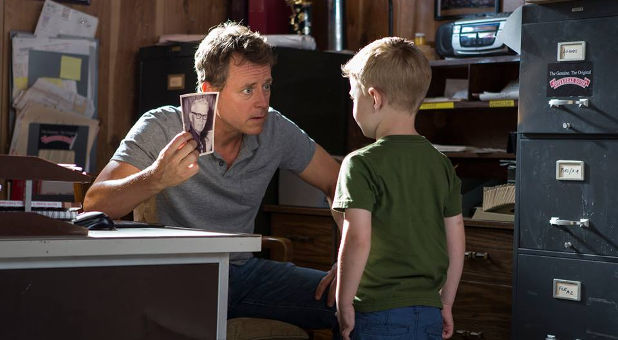 Kinder and gentler, here is a movie that has an inclusive, positive message executed with earnest conviction. The drama isn’t subtle but it can be effective. The music rises, the actors crinkle their faces and get tears in their eyes, and you’re left feeling like there’s something in your own eye. It may be manipulative in some sense but it’s so well executed, and without any hint of pretension or agenda, that I really didn’t mind. It’s a heartfelt movie that could fervently inspire the masses that pack the theater. I’d much rather have any Christian consumers, or the curious, check out this well-meaning movie than the mean-spirited and spurious God’s Not Dead. This movie actually allows its characters to feel like regular people who exist in our world. Todd and Sonja have a sex life, and the Burpo family doesn’t just sing famous Christian tunes in the car, they’ll shout Queen at the top of their lungs. In other words, they’re a fairly normal Midwestern family, and I appreciated that the movie didn’t feel the need to sanctify them. The supporting characters also have dollops of depth to them, at least in the hands of actors like Thomas Haden Church (so wonderfully deadpan) and Margo Martindale (her sorrow fermenting into bitterness). Heaven is for Real is anchored by two strong performances by Kinnear (The Last Song) and Reilly (Flight) as the parents. Both of these actors get a wealth of emotions to play, a few crying scenes, one angry outburst, and they sell it all, never overplaying the emotions of the scene, gently grounding the film with compassion.
I suppose in some capacity this film could be the more religious version of The Sixth Sense. It’s about a gifted child who sees things others cannot and who battles with being taken seriously by the scolding adults. We know that he’s going to say something he should not know, the adults would gasp and say, “How did you know that? There’s no possible way,” and then we’ll repeat this process. It reminded me of when young Haley Joel Osment finally gets through to his mother when he tells her that grandma saw her dance and is proud of her. Just add a dash of non-denominational Christianity.
The problem is that there really isn’t a movie here. Heaven is For Real is comforting and earnest, but there just isn’t a story here that translates into the structure and form of a film, and it shows. First off, there really isn’t much in the way of authentic conflict here. After Colton is saved, the only real conflict is whether to believe what he experienced. This setup could work in the scheme of a movie if his parents were not believers; thus their arc is one that goes from disbelief to belief. However, the movie already begins with the Burpos as good Christian folk. Todd is the town’s pastor for crying out loud, so you’d think he wouldn’t be troubled with his own set of doubts. These are also rather good people. In the opening scenes, despite being behind on bills, Todd refuses to charge someone for his garage-repair services and accepts free carpet instead. In the end, when Todd is preaching and talking about his own journey and how prideful he was back at the start, I’m left wondering what he’s talking about. I suppose he didn’t have to try and run to third base in that church softball game, but is that really all we have to go on? Would staying on second symbolize his lack of faith? What I’m saying is that the Burpos don’t really travel on a character arc, so their squabbles over their son feel forced. More so, the struggles with Todd’s church feel the most inauthentic. I just don’t get it. The pastor’s kid says he went to heaven, and the congregation has members that are mad, but mad at what? Should the pastor, who preaches about heaven for a living, dispute his son, especially when the boy possesses extraordinary knowledge? I don’t understand what the conflict is here and neither does the movie, which doesn’t really adhere to a three-act structure, and just sort of ends without much preparation. People just believe. End. Why did it take this long? It’s not like these people are stone-cold atheists.
 It’s that lacking sense of urgency, let alone goals or a central through line, which makes me question how Heaven is For Real spends its time. Why does the movie choose to spend as much time on scenes that don’t seem to matter? The first act is spent with such dramatic moments as… Todd playing softball and breaking his leg (the one thing that pushes the film into PG material). And from that… a completely unrelated kidney stone infection. Then from there… the family takes a trip to the Denver zoo. I was getting restless myself that this kid was never going to get to heaven. I kept waiting for these moments to have consequence, like how the Burpo kids fall ill after visiting the zoo. Aha, it must be connected to the zoo (monkey pox!). Nope, it’s his appendix rupturing. Very little of the pre-heavenly visit looks to have any bearing on the overall plot, instead providing texture to the family life. I suppose Todd passing the kidney stones was meant to be a comedic excursion (Church says the average is passing 15 stones – that is too insane for me to believe at face value). Why kind of hours does Todd have for his family when he’s a minister, a full-time job, repairs garage doors as a second job, then volunteers as a firefighter AND coaches a high school wrestling team? He’s got way too much on his plate but objects to the idea of his wife getting a job. What purpose does Todd seeing a psychiatrist on short notice serve other than allowing an externalization of his internal doubts? I’ll let that one slide, but they never come back to the psychiatrist. Too much of the movie feels like padding and stalling until the non-conflict reaches its end.
Wallace also shows a lack of faith in his own audience. By choosing to visualize the heavenly sequences, though brief they are, the movie risks being goofy, as whatever man can derive will never be comparable. If the whole movie is about whether or not to accept Colton’s story on faith, why do we have to have dramatizations of his story? Isn’t that cheating? The heavenly sequences don’t really add much oomph to the story any way. Colton goes to church, watches vaguely humanoid angels bathed in light hover and sing. He asks them to play “We Will Rock You.” The angels laugh but they don’t play the classic Queen rock song/universal sports anthem. Is it a matter of taste, angels? Who doesn’t like Queen? Then Jesus shows up and walks Colton outside. Other than a visual glimpse of Colton hugging his dead sister, that’s it. The other issue with depicting heaven onscreen, or something close to it, is that we can start picking it apart. Just ask Peter Jackson and his miscalculated Lovely Bones. If everyone is young in heaven, as Colton observes, then do we get a say in what our prime age is? I personally think George Clooney is a more handsome man as he ages than back in his E.R. days. And why does Jesus have to dress in the standard robes and sandals of 2000 years ago? Couldn’t he wear something more casual? Just imagine: Jesus relaxing in the pajama jeans. Then there’s Colton coming across his departed sister, who died at eight months, but is represented by a 6-8-year-old girl. Does this mean she’s going to be like that for eternity? Does she not get to choose to be an adult? See what I mean about picking it apart?
Its heart is in the right place, its message is inclusive and positive, and ultimately Heaven is For Real preaches about making life on Earth just as significant as the one after, and so I can say that the film is a relatively inoffensive and effective drama. It isn’t enough to say heaven is for real; the movie challenges the audience to do more. It doesn’t go overboard into maudlin territory, though it comes close enough with some of the wistful child acting. There really isn’t much of a movie here, and some of the choices seem to backfire, but it’s saved by its sense of earnestness, compassion, and some above average acting. Amidst the glut of evangelical movies this spring, I’d recommend Heaven is For Real above the rest (I’m excluding Noah from this list). It’s a thoroughly nice movie, and a film that should inspire its core audience, but in a good way, unlike God’s Not Dead. I can’t exactly say that this is a movie that needed to be made, especially from the cut-and-dry source material, but there’s a level of skepticism and reality imposed on what could easily be transformed into a blunt outreach piece. Even though the outcome is never in doubt, there’s an intelligence to the craft here that is much appreciated. Heaven is For Real may not be a great movie, but it works well enough as a movie when it shouldn’t, and that’s enough of a success in my book.
Nate’s Grade: B-
Share this:

The Raid 2 (2014)
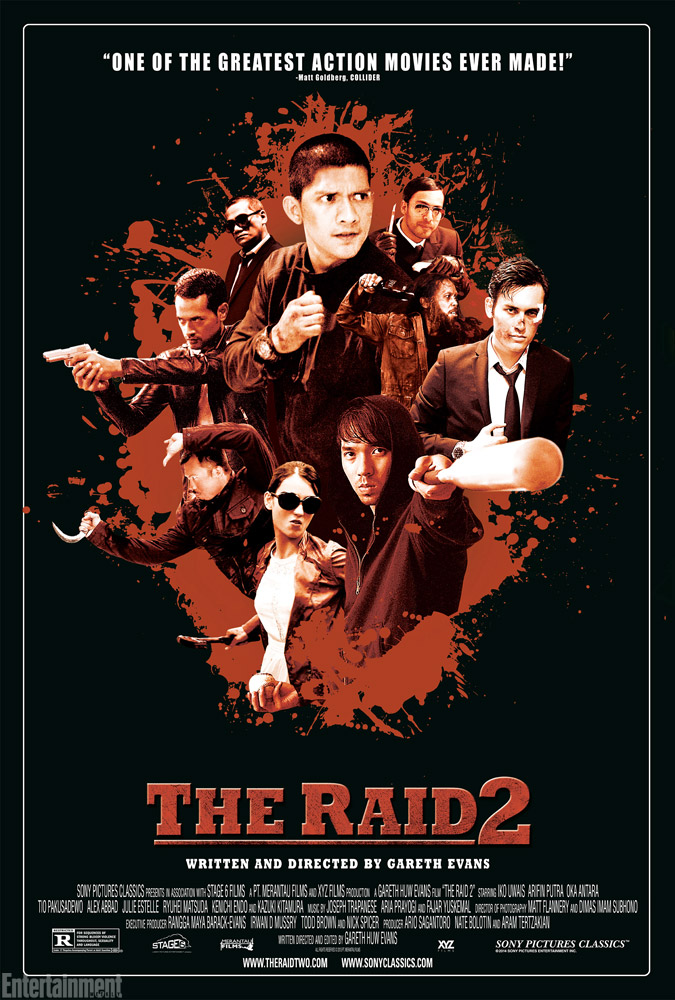 Rare is the movie that I feel I don’t even need to go into great detail rather than just scream, in a fashion suiting madness, “See this! See it!” Such is the case for The Raid 2, the sequel to the 2012 Indonesian action film that melted faces with its inventive and brutal action. The original movie had a confined location, a gang-run tenement building, and a simple premise of reaching the top and nabbing the bad guy. When people weren’t punching or shooting each other, the original Raid lagged, but director/writer Gareth Evans has solved the problem with his action-packed sequel. The world expands greatly, establishing the uneasy peace kept by powerful and warring criminal organizations. The plot ends up becoming something akin to The Departed meets A Prophet, following our hero cop from the first movie now placed undercover to gain the trust of the criminal overlords and work his way up the food chain. When the action isn’t cooking, you’re still engaged with the story and the suspense simmers in clever ways. But getting back to the film’s calling card, the action sequences are impeccably choreographed and edited, have a wide variety of locations for fun, and are bloody intoxicating. This is a movie soaked in adrenaline, and the action sequences will be hard to beat for the rest of the year. Evans finds ways to provide flair for his supporting characters, including a family duo that involves a deaf woman whose weapon of choice is hammers and a guy who prefers a baseball and a bat. The Raid 2 fires on all cylinders so well, so brilliantly filmed, that it puts just about every American action thriller to shame. It doesn’t need to be as long as it is (pushing two and a half hours), and it takes a little while to set up the players, but this is even more of an entertaining rush than the original, because now we get a sense of what Evans and his team can do with fewer restrictions. When Evans gets to Hollywood, and he will, just make sure you give him all the money to do whatever he wants.
Nate’s Grade: A-


 nathanzoebl
You must be logged in to post a comment.