The Boy (2016)
 The scariest thing about The Boy is how much potential it wastes, foolishly abandoning a horror direction that was eerie, supernatural, and with one leg rooted in a psychological breakdown, and instead cheerfully dives headfirst into an unwanted new direction of cheap campy thrills. I haven’t seen a decent movie unravel with this high-speed velocity and tone-shift since Danny Boyle’s Sunshine, an intelligent sci-fi vision that decided, hey, let’s just make the entire final act a slasher movie in space. The Boy is about an American nanny who travels abroad to care for an elderly couple’s young son Brahms, a son who happens to be a porcelain doll. There are rules to be followed and consequences if they are disobeyed. I liked that our heroine (Lauren Cohan, The Walking Dead) doesn’t try and ignore what she’s seeing for a majority of the movie and instead embraces the unusual circumstances, testing Brahms and discovering more. It kept the film moving in more engaging directions rather than denying the obvious and padding out its run time. I wish that the script opened up more about the domestic violence that haunts our heroine, literally and figuratively, but for a solid hour I was fairly entertained by the supernatural parlor games and lead performance by Cohan. Then the last act occurred, which just swiped away all the good will. I groaned aloud when the shift happened. I won’t go into detail but suffice to say it feels distinctly like two different movies clumsily grafted onto one another at the behest of exec. What once could be excused or forgiven in a supernatural realm cannot when trying to ground the story in reality, and it only unleashes a horde of nagging questions that don’t add up, especially concerning Brahm’s parents and the implications of its ending. The Boy is a cautionary tale about leaving well enough alone, understanding the strengths of your spooky story and tone, and committing to the best idea rather than one that “surprises” while laying waste to your larger story.
Nate’s Grade: C
Share this:

13 Hours: The Secret Soldiers of Benghazi (2016)
 Michael Bay is the kind of filmmaker that naturally attracts negative attention and derision, so when he fast-tracked a movie about the Benghazi embassy attacks, and in a presidential election year too, there were plenty that cried foul. Bay’s not exactly known as the subtlest filmmaker, and many feared a Benghazi movie under his guidance would only reaffirm the worst. 13 Hours: the Secret Soldiers of Benghazi (a subtitle that never appears in the movie, by the way) is a surprisingly serious and generally apolitical action movie that reaffirms the strengths and weaknesses of Bay as a filmmaker.
On September 11, 2012, an armed mob stormed an American outpost in Benghazi, an attack that left four Americans dead. After Libya had toppled its decades-long autocrat, a power vacuum emerged and militants filled its place. An unclassified CIA annex in Benghazi was established to track the possible sale of munitions from the old regime. The CIA chief, Bob (David Constabile), has been forced to hire a security team of former Army Rangers and Navy Seals to protect his agents. Jack Silva (John Krasinski) is a family man reuniting with his old pal Tyrone “Rone” Woods (James Badge Dale), the head of the hired security team. The other guys (Pablo Schreiber, David Denman, Dominic Fumusa, Max Martini) welcome Jack, explaining the rising tensions in Benghazi and how they’re generally frustrated by the CIA know-it-all attitudes. They’re wary of the State department outpost for Ambassador Chris Stevens (Matt Letscher), wary of the security detail watching him, and wary of the Libyan local forces providing assistance. Flash forward to the night of the attack and Rone and his team are stymied in their early attempts to rescue the ambassador. Afterwards, the focal point of the fight shifts to that very CIA annex and one hellish night of intense combat.
 This is Bay’s return to the realm of more “serious filmmaking,” a world he hasn’t considered since 2001’s lackluster Pearl Harbor, and while the standard Bay elements of boom are present and accounted for, the drama doesn’t stack up to the action. First, the good news is that the action in 13 Hours is often thrilling, beautifully staged and photographed by Dion Beebe (Collateral), and unlike Bay’s Transformers films, easy enough to follow along. It’s a chaotic incident where plans and communication are broken down, but Bay is able to keep the geography and the immediate and secondary goals of each action sequence clear. While the storming of the embassy isn’t quite as nerve-racking as Argo, it’s still plenty thrilling and communicates the fog of war and dawning horror of those trapped on the inside. The centerpiece is the attack on the CIA annex, which both sides anticipate and prepare for. It establishes the geography of the field of combat, the different access points, and the most likely ambushes. From there, it’s our outnumbered professionals versus a horde of armed Libyans, a standoff reminiscent in classic Hollywood action cinema. Over the course of those titular 13 hours, our security force faces wave after wave of attacks, each once becoming more sophisticated and bringing heavier firepower. Bay’s camera captures the explosions and gunfire in his usual balletic decadence. Say what you will about the man and his jingoistic tendencies, but he’s an ace visual stylist who bathes a sheen of popcorn entertainment to visceral struggle. When the action is heated, that’s when 13 Hours packs its most powerful punch.
Unfortunately, there are lulls in between the fighting, and it’s during these moments that we realize how poorly written our characters are. With the battle looming ahead, the mitigated character development emphasizes easy clichés we’ve come to expect, like the family man who needs to realize his family should come first, etc. These six guys are little more than stock characters on the screen, differentiated more by appearance and the occasional reading material than any significant personality differences. The dialogue is also rather clunky, falling too often upon tough guy speak to make up the difference. The way I was able to separate them in my head was through the actors’ previous roles (“There’s Pornstash, there’s Roy from The Office, there’s the guy from The Pacific who was the bad guy in Iron Man 3, and boy did Jim from The Office get buff”). Krasinski (Aloha) is the audience’s entry point into this world and given the most attention, so he’s ostensibly our main protagonist. He’s a strong presence to anchor the film despite the character’s shortcomings. I enjoyed watching Krasinski in such a different sort or role and started thinking about he and his wife, Emily Blunt, must have traded workout regiment advice. “Jim from The Office” with a six-pack is a surprising sight.
There’s a strange defining conflict for the first hour of the movie, namely Bay and Hogan narrowing personal clashes down to a slobs vs. snobs mentality of war. Bay has a history of fetishizing machismo and military hardware, so it should be no surprise that his movie lionizes the beefy, strapping military men serving as security. They’re placed against the eggheads of the CIA, who take every moment to remind our burly, bearded security guys that they were educated at Ivy League schools and know so much more about the Middle East. They often sound haughty when they’re scolding the security force for interfering even when it’s clear they’re saving their lives. The perspective aligns with the idea that the military-experienced, no-nonsense men of action are being ignored and looked down upon by the CIA ninnies who look at them as unnecessary babysitters. Naturally, with the hindsight of history, we know the concerns of Rone and his guys will be vindicated and the CIA snobs will be grateful they had these blue-collar American heroes. The entire role of Bob is to condescend and ignore our guys and their warnings. Bob even says early in his introduction that he’s on the brink of retirement and they won’t ruin it for him. Until the attack on September 11, we’re stuck with this reductive class warfare clash.
Another interesting aspect is that the movie makes use of its audience’s relative ignorance when it comes to the specific people involved in the Benghazi firefight. I doubt that many people know the names of the four victims excluding Ambassador Stevens. Because of that uncertainty we don’t know which of our six security characters will live, and the screenplay seems to know this, which is why it takes time to present each of the six with some sort of looming tragic back-story. We have multiple characters sending loving messages to their young children, learning they’re wife is pregnant, and making all sorts of “final” decisions, the kind that set up these characters in most movies for an early demise (if you write your girl during war or talk about your post-retirement plans, you’re guaranteed to die). I was slightly amused that the movie established each character to have a moment where it potentially sets up this tragic outcome.
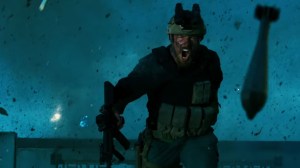 One of my big questions walking into Bay’s Benghazi movie was exactly whose version of events was the story going to follow. After eight congressional investigations, and a prominent Republican slipping by admitting one of the guiding purposes is to tarnish Hilary Clinton as a presidential candidate, I was worried that the movie was going to be a hacky, manipulative promotion of propaganda. There’s a reason that eight congressional investigations, including one that has lasted longer than Watergate, don’t seem to satisfy those calling for blood: they keep coming to the same inconvenient conclusions, namely that there was no stand down order, no conspiracy, no cover-up. There’s been a flurry of rightwing fury brewed over stoking unfounded rumors of conspiracy with Benghazi; it’s a fundraising industry unto itself for politicians. Therefore, I was initially worried that the movie was going to reinforce a version of events that eight (and counting?) congressional committees have refuted. I was relieved then that Bay’s movie keeps its focus pretty much squared on the heroism of the security team. In a way it reminded me of Black Hawk Down as it strived to recreate a series of harrowing life-and-death events with its focus more on the brotherhood and bravery of the ones in harm’s way rather than the broader political context. There is the infamous “stand down” order; however, it’s played almost incidentally, as Bob is trying to process all the chaos unfolding and the best recourse. As presented, it doesn’t sound like “stand down and let them die,” and more, “wait and let me think for a minute.” The fight to get air support from Italy doesn’t mention the fact that those Italian fighter jets sitting on the runway were not combat ready and were for flight training. There’s only one other passing dialogue exchange that touches the political, when the guys recount that the news is telling them it was a protest, which they scoff at and then let it go. That’s it. I imagine the audience that would be most excited for a Benghazi movie will be deflated. For everyone else, the sidestepping of politics lets the movie stand on its own better.
An article from Vox.com raises the issue of whether any movie about Benghazi can possibly be apolitical. It appears like the topic of Benghazi has been so cravenly politicized that any rendition of the events of that fateful day will reinforce or contradict some narrative, be it the security contractors, the CIA, the politicians on both sides of the aisle. And the absence of what others declare with certainty will only make those same people cry “cover-up.” It’s a shame that this topic is so radioactive that an objective approach celebrating the courage of those involved, mourning the loss of life, and asking for better from those in power seems impossible given the current divisive political environment. Did it have to come to this? Bay’s Benghazi is easily his most restrained movie in his bombastic career, paying reverence to the people who paid the ultimate sacrifice. The action is well staged and often visually striking, but Bay wants this movie to be more than a series of escalating action sequences. You feel he wants this to be his version of a Zero Dark Thirty-style thriller. Except it’s not. You watch the movie and sense there’s a more intelligent, nuanced, and ambiguous movie here that can make cogent points about foreign policy and the state of the Middle East. This is an action movie where the good guys shoot the relatively faceless bad guys. 13 Hours is an acceptable action movie but that’s all it ever asserts to be. Is that enough after all?
Nate’s Grade: B-
Share this:

Carol (2015)
 Have you ever watched a movie that was so understated you wanted to jump into the onscreen world and push the characters around? That’s exactly how I felt with Carol, an unrequited lesbian romance set against the closeted and intolerant era of 1950s America. Carol (Cate Blanchett) is a rich wife who meets Therese (Rooney Mara), a department store employee who assists with her Christmas shopping. They are both drawn to one another in the strange way that love works, and their possible relationship could jeopardize Carol’s custody of her young child. Because of the time period, so much of this romantic liaison is internalized and thus we get longing looks, small gestures that are meant to speak volumes, and plenty of starting and stopping, leaving the audience to fill in the blanks. I don’t have an issue with unrequited romances but Carol is one that feels like its entire world, painstakingly recreated, has been placed under glass for study. There’s no passion evident throughout the movie and I was left wondering what exactly Therese saw in Carol and vice versa. Neither woman has a particularly strong personality, though that could be a side effect of having to live publicly as a different person. I couldn’t get into them as characters and so felt little interest in seeing them together, which made the constant circling and nervous indecision even more belabored. Blanchett and Mara are quite good and director Todd Haynes (I’m Not There) handles the material with respectful subtlety, I just wish that Carol could have shaken off some of that subtlety and given me a better reason to care about these women. It’s understated to death.
Nate’s Grade: C+
Share this:

The Forest (2016)
 The Forrest is an initially promising horror-thriller that abandons every interesting possibility with every turn, becoming another interchangeably shortsighted and mediocre movie that only manages to scare an audience with how bad it becomes.
Sara (Natalie Dormer) is investigating the disappearance of her twin sister, Jess (also Dormer). Jess was working as a teacher in Tokyo when she visited the Aokigahara forest at the base of Mt. Fuji. This forest is nicknamed the “suicide forest” because of its reputation for being a favored location for Japanese citizens to kill themselves. Sara tracks down her sister to her campsite in the forest, with the help of a guide (Yukiyoshi Ozawa) and Aiden (Taylor Kinney), a journalist interested in writing her story. The guide stresses they must stay on the path at all costs and not trust the sounds they hear. There are plenty of unhappy spirits inside and they’re looking for permanent company.
The problem with dumb characters behaving stupidly is that it obliterates any investment the audience has in them, which is highly important in the horror and thriller genre. If you don’t care about the characters then you don’t care what happens next to them. With The Forest, we have characters that are wildly veering in the logistics of their decision-making that it becomes nigh impossible to care about what befalls them. They break the rules fairly early about staying on the path but the knowledge that everything they see is only a ghostly manifestation should register more. I understand that when you’re in the middle of a fraught experience that perhaps fear can cloud the mind, but perhaps you should start second-guessing things like lost Japanese schoolgirls miraculously finding you in the woods, or the fact that your childhood home is recreated in Japan. It’s scary, sure, but shouldn’t these characters no better? Also, the second-guessing of what is real causes Sara to view Aiden with great suspicion, except when she remarkable forgets. We’ll have a scene where she runs away from him out of paranoid fear, and then the next scene they’re back hiking through the woods together. It starts to feel like no two scenes connect or build off one another and The Forest is just an aimless sprint through random spooky genre grist that keep scaring our dimwitted characters.
 There’s so much that is left unexplained, but not in some tantalizing way meant to provoke a greater sense of realism through ambiguity, but because the screenplay just can’t be bothered. The premise of The Forest is great and the setting should be mined for all the unsettling dread that it could manage. The little details of this unique place sink in, like the lines of rope and string that lead off to, presumably, suicide victims hoping to lead others to their fateful resting places. There’s something so brilliantly creepy about this place, and every length of rope that ventures deep into the woods has its own story and its own larger significance, symbolizing a life taken. Why does The Forest so rarely make use of the unique details of its setting? This location could have been any patch of woods with your standard unhappy ghosts to roam. That’s the biggest failure of the movie, wasting the potential of its special location and making it indistinguishable from hundreds of other cheap horror settings.
Let’s talk about some of those scares as well. The Forest abandons the unsettling atmosphere of its setting and the possibility of the fraying psychology of its character (coherent unraveling, I should say) for what amount to a relentless assault of cheap jump scares. The jump scare is the bottom of the barrel, utilizing sudden appearance to startle. It is ultimately empty and any movie that relies on a diet heavy on jump scares is essentially admitting that it could not build a tense environment on its own. It is admitting defeat, and that is what The Forest admits when it relies on a jump scare, I kid you not, like every five minutes. Oh no, something suddenly popped up and Sara jolted out of a dream. Oh no, something suddenly popped up and flew at the camera and Sara jolted out of a dream. Repeat as needed to pad the running time. It’s tiresome and leads to diminishing returns. The only way jump scares work is when they are unexpected. If you start to anticipate them then they lose all of their power and relevance.
 As the movie continued running in one direction and then suddenly running in another, I was reminded of 2014’s Occulus. I wasn’t completely taken with that horror movie but it is far better than The Forest. The premise of Occulus involves a brother and sister trying to prove a cursed mirror is responsible for a history of murder. The mirror would play with the minds of its victims by putting them in false settings and scenarios, thus creating illusions to trick them into deadly behavior. The difficult part of Occulus was that you couldn’t trust what you were watching, which either forced the audience to pay more attention or to just give up and wait for the eventual reveals. The Forest is similar in that a good portion of its running time is a series of hallucinogenic tangents. Are there really maggots crawling under Sara’s skin? Is that water in the creek running the wrong way? It becomes frustrating when the characters don’t respond with nearly enough skepticism, especially when they’re fooled again and again. Occulus, while purposely hard to follow, was worth watching and ultimately felt well developed. The Forest feels lost in the woods.
Unless you’re a sucker for the kind of genre, there’s nothing that The Forest does well enough to warrant a theatrical viewing. It’s so frustrating because there are elements and potential there and the movie just continues to not care, falling back on the same-old same-old cheap jump scares and indistinguishable hackneyed genre tropes, losing sight of the inherent awe and fright of its special location. Dormer (HBO’s Game of Thrones) gives a suitably spooked performance but does little to stand out among the scenery. If you’re contemplating watching The Forest, just watch Occulus instead and be grateful.
Nate’s Grade: C-
Share this:

The Human Centipede 3 (2015)
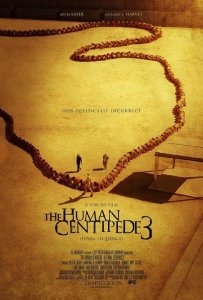 Sometimes as a critic I seek out the worst of the worst so you don’t have to, America. And you really owe me big time for sitting through all 100 torturous minutes of the regretful-in-every-aspect horror… “comedy,” Human Centipede 3: Final Sequence. I’ll confess that horror is a genre I’ve grown to enjoy and I genuinely liked the first Centipede film, finding its premise near ingenious and that writer/director Tom Six developed his horror grotesquerie in a way that turned it into an accessible survival thriller with some gonzo edges. The sequel was pretty repulsive and the third film, with the hopeful promise of being the “final sequence,” is even worse. This is a horrifying endurance test not unlike Tom Green’s abysmal lone directorial affront, Freddy Got Fingered. It is that bad. Scenes just seem to go on and on and exist for no purpose. It’s like Dieter Laser was just told to do whatever he wanted as long as he yelled as loud as he could and based his performance after the Looney Tunes cast. It’s cheap vulgarity masquerading as edgy provocation; it’s transparently lazy and insufferable. It’s not funny no matter how weird or loud or garish or bloody or dumb it gets. The premise is basically an insane prison warden (Laser) is going to create his own human centipede, the biggest ever, linking over 100 inmates. Ignoring the escalation of all the Centipede sequels, it’s a facile plot device and it doesn’t even happen until the very end. Until that awful reveal, you will have to endure, no a better word is survive, extended “comedy” bits like Laser sticking his tongue out and roaring in orgasm while his secretary (Bree Olsen) is forced to felate him while others are in the room. The movie is trying so hard to be shocking and irreverent that you can see all the pained efforts. It’s tedious and boring. Human Centipede 3 is 100 minutes of pathetic flop sweat that could more or less end with the throwaway punchline, “The Aristocrats!”
Nate’s Grade: F
Share this:

The Big Short (2015)
 Adam McKay is not exactly the kind of name you associate with a prestige picture that’s building serious Oscar heat. McKay is best known as the director and co-writer of Will Ferrell’s best movies, from Anchorman and its sequel to Talladega Nights and the underrated 2010 buddy cop movie, The Other Guys. If you stuck through the closing credits for Guys, you were treated to an animated education lesson on the size of Wall Street’s greed and accountability in regards to the 2008 financial crisis. It was impassioned, angry, and an interesting note to end an otherwise goofy comedy. The Big Short is based upon Michael Lewis’ (Moneyball) best-selling book and it’s a disaster movie where the biggest disaster is the world economy. The movie McKay co-adapted and directed is bristling with intelligence, indignation, and a clear purpose. He wants to make you very angry, and by the end if you’re not, you haven’t been paying enough attention.
In the wake of the financial collapse in 2008, the fallout was so tremendous that many people felt nobody could have seen this coming. There were a few and they made out like bandits while trying to warn others about the impending doom. In the early 2000s, Michael Burry (Christian Bale) is a hedgefund manager who sees warning signs that the housing market is a bubble ready to burst. He sees the toxicity of the majority sub-prime mortgages wrapped together and sold as a seemingly safe security, a CDO (collateralized debt obligation). His bosses think he’s mad and they’re furious when they discover Burry has gone from bank to bank making big bets against the housing market. The banks are eager to take what they believe to be easy money from a sucker. How could the housing market burst? Other Wall Street investors take notice of Burry, notably Jared Vennett (Ryan Gosling) who pitches the plan to “short” the housing market. Nobody takes him seriously except Mark Baum (Steve Carell) and his small team who works for Goldman Sachs. Baum is curious how something so large could go unnoticed, so he and his team fly to Florida and Vegas to investigate the realities of the market and what they find does not match the rosy cheerleading from Wall Street. A pair of wannabe traders (Finn Witrock, John Magaro) stumbles across Burry’s analysis and try to make their own bets, except they need a bigger name to make the trades. They reach out to an ex-Wall Street trader (Brad Pitt) who agrees to shepherd them on this quixotic quest. Are these men righteous defenders of fraud or just people trying to get their own cut of the pie?
 The brilliance of The Big Short lies in its accessibility and the virulent passion that McKay has for the subject matter. The movie is structured like a heist and an underdog story, suckering in the audience to root for the upstarts trying to fleece the big banks and profit off their greed and stupidity. For the first 90 minutes or so, the film comes across like a caper and we follow our group of misfits as they fight against the conventional wisdom that the housing market could never topple. These guys see the signs and the risks that others could not or would not see, especially since the flow of money was rich and the good times could be shared, which lead to collusion from the very same agencies designed to regulate and enforce the financial laws. For those 90 minutes the movie flies by on its sense of whimsy and are-we-getting-away-with-this good fortune, putting our band of misfits in position to win big on the losses of the ignorant and fraudulent. And then, in one swift move, it all comes down and you’re reminded, rather indignantly by Pitt’s character, that what they are benefiting from is the meltdown of the U.S. housing market and by extension the American economy. What once felt like a celebratory caper now starts to feel queasy, and it’s in the last act that The Big Short reminds you just how awful the events of the 2008 financial crisis were and how these guys did nothing more than benefit from mass misery. These are not heroes, though Mark Baum is given plenty of moral grandstanding moments that present him as the closest thing we have in the picture. These were a bunch of guys who got rich betting on a lot of other people’s bad bets, bets that almost destroyed the world’s economic systems. The concluding half hour feels like a sudden stop after a sugar rush, where you’re left to question your decision-making but also come to terms with the reality of what seemed like a fun time. McKay lures his audience in with the guise of a heist/underdog story, appealing and accessible avenues of cinema, and then serves the cold hard medicine in the concluding moments.
McKay is admirably trying to educate and advocate while he entertains, but he truly wants the audience to understand why they should be sharpening their pitchforks. At several points, characters will break the fourth wall and talk directly into the camera, admitting that certain events didn’t happen exactly as we saw, or occasionally they’ll remind us that what we watched was exactly how it happened. It’s a measure that isn’t overplayed and helps juice the spirits of the movie, becoming something of a confidant in the schemes with the onscreen participants. When things gets a little hard to understand with the mountain of Wall Street lingo, McKay will cut to celebrity cameos to help explain the more arcane instruments of the financial system. Margot Robbie luxuriates in a bubble bath and explains sub-prime mortgages, Anthony Bourdain explains CDOs, and Selena Gomez, in a rather cogent analogy, explains synthetic CDOs as an endless chain of side bets being made off one hand of blackjack. The movie goes pretty fast and a viewer might experience information overload but McKay knows when to slow things down and provide a well-timed assist so that his learned audience will see the true extent of the corruption and greed rampant in how Wall Street handled its business.
 Of the three storylines, I found Mark Baum and his team easily the most interesting and I think McKay and co-screenwriter Charles Randolph (The Interpreter) agreed, which is why he’s the biggest part of the movie. Burry gets things started but he recedes into the background after the first act, and that’s where Baum and his financial team step into the spotlight to further explore how unstable the housing market just might be. I think this is Carell’s best dramatic performance to date (I wasn’t wowed by Foxcatcher). He’s playing perhaps one of the angriest people seen on screen but that’s because he has a moral center and the bad business practices, let alone the sociopathic greed of his “peers,” constantly enrage him. He’s something like a flabbergasted crusading journalist who keeps shaking his head in stupefying revulsion at just how deep this whole thing goes. Having Baum as our entry into the moral morass of Wall Street allows the audience to feel a sense of ethical superiority, and then like Pitt’s character, it can all go away with one perfectly articulated retort. There’s a moment where Baum is lambasting a mortgage ratings officer (Melissa Leo, her only scene too) after she admits that if they don’t rate bad mortgages as good, the banks will just go to their competitor, and then she accuses Baum of being a hypocrite. His reason for the office visit is not his outrage at the fraud but the fact that this fraud is holding up his winnings. He’s not the crusader he may wish to be. Bale (American Hustle) and Gosling (Only God Forgives) are perfectly cast and provide strong supporting work in small doses spread throughout. Pitt is in 12 Years a Slave producer mode where he knows he needs to appear in the movie to better sell it to audiences, and so he’s here and rather unremarkable. There is a bevy of familiar faces (Marisa Tomei, Rafe Spall, Max Greenfield, Karen Gillan) appearing in small moments as if everybody in Hollywood wanted to get in on McKay’s party.
There is one annoying misstep in the movie and it occurs about halfway and it’s made to stretch out the stakes in a haphazard manner. The Big Short is a disaster movie where the audience knows exactly when the disaster is coming, and yet there’s a section in the middle where the characters are all left in doubt whether their big bets will pay off because of the ratings fraud. Burry is threatened with losing his job. It’s silly because we know the economy is going to crash in 2008, but the movie throws out a weak obstacle that, hey, maybe it won’t crash. It reminds me of the Hinderberg movie from the 1970s. There were several moments where it looked like that zeppelin full of hydrogen was going to go up in flames… except students of history know that moment is fated in New Jersey, so all the close calls were foolish fake-outs for a major event that was well anticipated. We all know the economy is going down so there’s no need for the manufactured doubts.
McKay and company want to wake up a fairly apathetic general public about the crimes and negligence of the Wall Street robber barons that risked the world’s economy and then managed to skip out on the tab. The tones can juggle wildly, and I’d credit McKay’s background in comedy for his ability to maintain a reliable and firm comic footing for the film without losing the significance of his message. It’s hard to nail down a genre for the movie; it’s a dark comedy, a drama, a true crime picture, and a wake-up call. You have moments that feel like a heist flick and moments that feel like a sickening journalistic expose. It’s got highs, lows, laughs, groans, and plenty of human emotions, though the most prominent would be disgust and disbelief. The Big Short is advocacy populism as pop-entertainment, and it succeeds ably. It’s an economics lesson for the public. At the end of the movie, the closing text informs us about “bespoke tranches,” which are investment opportunities that banks are flocking to ($5 billion in 2013 to $20 billion in 2014). It’s just another name for CDOs. Unless an informed public demands action from the system, it seems that Wall Street is doomed to repeat its same high-risk mistakes and that same vulnerable public is doomed to clean up the mess.
Nate’s Grade: A-
Share this:

The Revenant (2015)
 Which do you value more, verisimilitude or narrative? If you’re looking for an intense, immersive filmgoing experience that’s just as harrowing as it is beautiful, then perhaps The Revenant is your movie. If you are looking for characters and a story to engage with, then maybe it won’t be. Leonardo DiCaprio plays the real-life frontiersman Hugh Glass who was mauled by a bear and left for dead by his companions. He miraculously survives and tracks down those who betrayed him for some frontier justice Under the unyielding vision of director Alejandro Gonzalez Innarito (Birdman), the movie opens up its scary world with an exhilarating sense of detail. Inarritu favors lots of natural light and long, gorgeous tracking shots, which creates a spellbinding sense of realism. The attacks and escapes and moment-to-moment survival communicate the remarkable dangers of this natural world. The cinematography by Emmanuel Lubezki is flawless, using light and camera placement to stunning effect. However, The Revenant (meaning a person who has come back from the dead) is a series of beautifully rendered moments delicately stretched over a ponderous running time of 157 minutes. There’s just not enough plot events to fill that running time, so to compensate Inarritu gives way to some Terrence Malick (Tree of Life) impulses that try for philosophical poetry but miss. DiCaprio is getting plenty of plaudits for his demanding role, and he’s quite good and visceral (and no, he does not get raped by a bear). I was more impressed with Tom Hardy, who plays the target of Glass’ fury. Hardy imbues depth into his antagonist, and while you won’t exactly be rooting for him to get away you can see the guy as more pragmatist than mustache-twirling rogue. He even has an interesting back-story surviving being scalped that informs his decision-making. Much of the film is watching Glass endure physical hardship after physical hardship, which may grow wearying for many audience members, especially those most squeamish. When it’s firing, The Revenant is a magnificent and stunningly realized survival thriller with sprinkles of engaging human drama. The problem is that there isn’t enough to go around for its running time.
Nate’s Grade: B
Share this:

Concussion (2015)
 Concussion wants to be a hard-hitting drama exposing the dangers of repetitive head trauma in football and the lengths of the cover-ups and collusion within the NFL, except that movie already exists and is the Frontline documentary League of Denial that was too controversial to air on ESPN. Concussion, in comparison, is an adequate but hopelessly underwhelming film on the Nigerian-born Dr. Omalu (Will Smith) who discovered chronic traumatic encephalopathy (CTE) in the brains of deceased NFL players. The resistance and denials are soft-pedaled, though the movie treats them with heightened dramatic stakes that are unearned. There’s one threatening anonymous phone call but for the most part it feels like Dr. Omalu is just being ignored, and “being ignored” is a hard thing to turn into outstanding dramatic stakes at the movies. The movie doesn’t let the NFL completely off the hook but its critiques have been softened by studio interference (as revealed through the Sony email hack). As a straightforward drama, Concussion is easy to watch and Smith gives an authentic performance that doesn’t have to go to histrionic lengths to communicate his internal struggle. There’s a nice subplot with Omalu courting his eventual wife played by Gugu Mbatha-Raw. Albert Brooks and Alec Baldwin are strong supporting players. David Morse gets a show-stopping part to show off his acting skills. By the end, it all feels just a little too nice, a little too polished, and a little too easy, both in how it presents a complicated medical discovery and its implications but also the NFL’s response. For an awards-season drama that’s meant to shock and inform, being “easy” is the wrong call.
Nate’s Grade: B-
Note: “League of Denial” is currently available on Netflix streaming and I encourage people to check it out.
Share this:

Where to Invade Next (2015)
 With agitator-in-chief Michael Moore at the helm and that provocative title, you’d think this was Moore’s critique of the United States’ foreign policy in the Middle East. That’s what I thought too. I was surprised to find that Moore’s doc is really a rather gentle and optimistic examination of policies abroad that America should consider appropriating. Moore travels from country to country under the guise of “invading” them and taking their best ideas back to the mainland. It’s really a travelogue of the world and various ideas that give exception to the belief of American exceptionalism. In Italy workers get eight weeks paid vacation. In France, students get gourmet lunches. In Slovenia, there is free college tuition even to foreign students. In Portugal, they’ve decriminalized drugs and watched their crime rates drop thanks to an emphasis on treatment over punishment. Moore is still cherry-picking his facts (Italy’s high unemployment rate, Slovenia’s small population, etc.) and ignoring the multitude of cultural and government variables that allow these good ideas to flourish in their native lands, but he raises enough good points worth consideration. The humor of the enterprise is often forced and eye roll-inducing, with Moore playing baffled interviewer who just can’t fathom how these people live. The best segment is strangely slotted in the middle of the film where Moore travels to Germany. The sins of the past, namely the Third Reich and the Holocaust, are purposely remembered in monuments and education policy. It’s important not to forget the mistakes of the past. Moore then wonders what the U.S. would be like if we acknowledged the darker moments of the past instead of finding ways to excuse them (see: D’Souza’s doc and the worst film of 2014, America: Imagine a World Without Her). Ignoring uncomfortable realities is counter-productive, and Moore’s doc is all about accepting and implementing the good ideas of others to better our own country. The extra irony is that Moore himself is ignoring realities that conflict with his rosy message. Where to Invade Next feels like an extended segment of one of Moore’s old TV shows. It’s a bit rambling and dull and the whole framing device is too facile, but its simple mission of trying new things is laudable.
Nate’s Grade: C+
Share this:

The Hateful Eight (2015)
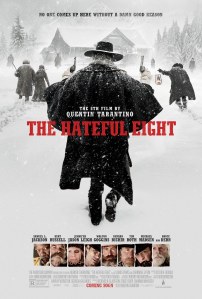 The Hateful Eight almost didn’t happen thanks to our modern-day views on copyright and privacy. Writer/director Quentin Tarantino sent the first draft of his newest script to three trusted actors, and within days it had spread to the outer reaches of the Internet. Tarantino was so incensed that he swore to shelve Hateful Eight and never film it. After a staged reading in L.A. with many of the eventual actors for the film, he changed his mind, to the relief of his sizable fanbase and actors everywhere. The Hateful Eight is a drawing room mystery with plenty of Tarantino’s signature propulsive language and bloody violence, but it’s also the director’s least substantial film to date.
In post-Civil War Wyoming, famous bounty hunter John “The Hangman” Ruth (Kurt Russell) is taking the outlaw Daisy Domergue (Jennifer Jason Leigh) to hang for her crimes. Along the way, he meets up with Major Marquis Warren (Samuel L. Jackson), a bounty hunter who served in the North and carries a letter written to him from none other than Abraham Lincoln. They’re both heading to Red Rock to extract their bounty earnings. Due to an oncoming blizzard, they’re forced to make a stay at Minnie’s haberdashery, except Minnie isn’t anywhere to be found. There’s Bob the Mexican (Demian Bichir) who says Minnie left him in charge, a foppish hangman Oswaldo Moblay (Tim Roth), a quiet cattle driver Joe Gage (Michael Madsen), a Confederate general, Sandy Smithers (Bruce Dern), and Chris Mannix (Walton Goggins), the son of a Confederate rebel who claims to be the newly designated sheriff of Red Rock. Over the course of one long night, everyone’s true identity will be learned, because someone is not who they seem to be and is secretly waiting to free Daisy and kill the rest.
 Even as lesser Tarantino, The Hateful Eight is still an entertaining and talky stage play put to film. The setup is strong and invites the audience to play along, to scrutinize the assorted characters and determine who is telling the truth. There are plenty of twists and turns and some violent surprises to keep things interesting. The conversations of the characters are such a pleasure to listen to; I want to luxuriate in Tarantino’s language. His wordsmith abilities are unparalleled in Hollywood. There’s a reason every star is dying to snag a part in a Tarantino movie, especially now that they’ve caught Oscar fire as of late. That’s somewhat crazy to think about. Cinema’s ultimate indie voice with his encyclopedic knowledge of the medium, high and low art, has become an institution within the system and his violent period films are now looked at as year-end prestige pictures. Tarantino’s M.O. has been to take B-movies and to transform them into A-movie level talent and intelligence. Never has a Tarantino flick felt more B-movie than The Hateful Eight. It was inspired from episodes of TV and it’s easy to see that genesis in its execution. It’s a self-contained mystery that comes to a head. It’s a limited story that’s likely taken as far as it could possible go, pushing three hours. I’m a tad befuddled why this was the movie Tarantino insisted on filming in “glorious Panavision 70 millimeter.” It’s almost entirely set in that one-room interior location. The extra depth that 70 millimeter affords would appear to be wasted, unless you enjoy looking at general store items on shelves in the background. Still, The Hateful Eight is a movie that doesn’t feel like three hours and harbors enough intrigue and payoffs to hook.
I tried to diagnose why this felt like lesser Tarantino, and it’s because over the course of almost three hours we don’t have much at stake because the people inhabiting the movie aren’t really characters but tough-talking facades. Tarantino is often cited for his uniquely florid dialogue, and nobody writes dialogue like Tarantino and his naturally stylized cadences, but another of the man’s skills is how great he can write a coterie of colorful characters that pop from the big screen. You might not be able to remember many lines from Hans Landa or Vincent Vega or Django, but you remember the vivid characters. Tarantino is preternaturally skilled at building characters that feel fully realized with their own viewpoints and flaws and prior experiences. He can make characters stand out but he also has the great ability to make the larger-than-life characters feel real, which is truly genius screenwriting for characters so flamboyant. The older romance in Jackie Brown is perfectly captured and felt. It’s downright mature. This is the first time I would say Tarantino has disappointed when it comes to his characters.
There are broadly drawn folk aplenty onscreen and they still talk in that wonderfully florid language of Tarantino’s that actors must savor like a fine steak, something they can sink themselves in for and enjoy every morsel. However, the characters onscreen have never felt this empty before. They are what they are and the only real change that occurs is that many will be dead before the end credits. They don’t have arcs per se but end points. It’s all about unmasking and identifying the rogues in a room full of rogues. Beyond Warren and Mannix, we’re left with precious little for characterization beyond bravado and nihilism. The effect of how empty they are would be felt less if we weren’t stranded with them for near three hours. Trapped in a room with a group of suspicious characters can only go so far, and ultimately it’s a parlor game that cannot sustain longer staying power. I doubt I’ll ever watch this with the frequency of other Tarantino flicks.
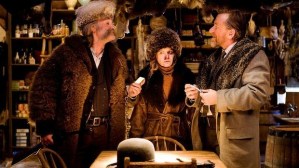 “You keep talkin’. You’re gonna talk yourself to death,” says one of those hateful numbers to another member. I’d pay to listen to Tarantino rewrite the phone book, that’s how excellent the man is with his dialogue. The man likes to hear his words and I like listening to them too. The problem is that The Hateful Eight has no reason for its gargantuan running time. As stated above, the characters we’re getting are nowhere near as complex or interesting as previous Tarantino escapades, so the talking can grow weary. Tarantino has patented a new formula from 2009’s Inglorious Basterds that involves characters playing a game of I-know-you-know-I-know while they suss out the truth, all the while the tension finely simmers until it blows. It’s a long fuse of suspense that can pay off rich rewards, like the near-perfect tavern scene in Basterds. The dinner table scene with Candie and the skull of his favorite house slave is another good example. Once our titular eight have gathered at Minnie’s, the entire movie is this sort of scene. It may be broken up into chapters and flashbacks but it feels like one long scene.
There’s also far less at stake than there was with Basterds or Django Unchained, even Reservoir Dogs, and that’s because the protagonists had goals and we had built up far more allegiance and time with them. When they were in danger, it mattered. The danger doesn’t feel as immediate because so little else is happening. There are plenty of comparisons to Dogs, which also utilized a hidden identity and a confined location. I think the difference was that, besides it being Tarantino’s first foray as a director, the tension was felt more because the danger was immediate from the start and we cared about character relationships. I cared about Mr. Orange and Mr. White and their bond. I can’t say I cared about any of the characters in Hateful Eight. I found them interesting at points, sure, but they were all a bunch of rotten bastards with little variation short of a burgeoning understanding between Mannix and Warren. The wait at Minnie’s feels like the Basterds tavern scene on steroids, pushed to the breaking point, and yet absent the urgency.
The acting is yet another tasty dish served up by Tarantino, and it feels like the actors are having the time of their lives playing their lively scoundrels. Jackson (Kingsmen: the Secret Service) settles in nicely and always seems to elevate his game when he’s reciting Tarantino’s words. He’s icy cool in scenes where the other characters are trying to do whatever they can to fire him up. He’s less bombastic than we’ve come to expect from Jackson. For bombast, there’s Russell (Furious 7) who cranks his performance to the broad heights of his bellicose lawman. Goggins gives a sly and extra caffeinated performance that answered the question of what it would sound like if you dropped his character from TV’s Justified into a Tarantino movie. Roth (Selma) feels like he’s doing his best manic Christoph Waltz impression. Dern (Nebraska) is a racist codger with a soft spot for his kin. Madsen (Kill Bill vol. 2) seems somewhat wasted as a taciturn “cow puncher.” Bichir (The Heat) gets some laughs as a seemingly aloof caretaker. It’s Leigh (Anomalisa) who steals the show, especially in the film’s second half. Daisy is a character that relishes being bad, and Leigh takes every opportunity to enjoy the fun. Her character plays a bit of possum during the first half but it’s the second half where she lets loose and becomes unhinged, and her exasperated and grotesque responses are often played for great sputtering comic effect. It’s a boys movie but it’s the lone woman who will prove most memorable. Tarantino’s last two movies have won acting awards and Leigh just might make it three-in-a-row.
 There are also some uncomfortable elements that can deter your viewing enjoyment, which isn’t exactly a foreign charge against Tarantino’s career. At this point you can probably repeat the oft-cited accusations: flagrant use of the N-word and exploitative violence. At least the historical background provides a context for the other characters unleashing the N-word, and I’d argue it tells us something about the characters as well. The characters that use the N-word when referring to Warren are the ones with allegiances to the Confederacy and those viewpoints don’t vanish even after you lost a war. They’re dismissive and intolerant and view Warren as sub-human. It also doesn’t approach Django Unchained-levels of excess, so I let it slide (I know my perspective as a white male makes my opinion on this effectively meaningless). It was the violence that got to me, specifically the violence directed at Daisy. Tarantino’s penchant for violence goes all the way back to his ear-slicing debut, so it’s nothing unexpected. He often tells stories about violent men and women fighting their way in a world governed by violence. I accept that these characters are bad to their core. That doesn’t excuse behavior. Violence on screen can be tempered with authorial commentary, but it’s the association that bothered me with Hateful Eight. For the entire movie, Daisy is put through the physical wringer. Our very first image of her is with a black eye. She’s a nasty woman and Ruth often expresses his distaste of her by punching her in the face, which is played as dark comedy. This happens repeatedly. We’re meant to recoil from much of the bloody violence on screen but repeatedly we’re meant to laugh at the violent suffering of Daisy. Tarantino has often used over-the-top violence as dark humor, and I’ve laughed along with it. This was one instance though where I stopped laughing and starting shifting uncomfortably in my seat.
Even lesser Tarantino can still be plenty entertaining and superior to most of what Hollywood usually cranks out as product. The Hateful Eight can be exciting, funny, surprising, and plenty of things, but what it can’t be is more than a lark. Tarantino has taken stories that would seem like larks, particularly the Kill Bill series, and infused them with pathos and meditation and soul to go along with all that snazzy genre stuff. It’s disappointing that Hateful Eight isn’t more than what’s on screen, but what’s on screen is still worth watching, though I don’t know whether it’s worth watching a second time.
Nate’s Grade: B


 nathanzoebl
You must be logged in to post a comment.