Category Archives: 2024 Movies
Snack Shack (2024)
 The coming-of-age sub-genre is a familiar and well-worn formula, but with the right filmmaker and voice, it can become refreshingly alive once again, like hearing your favorite song covered by an exciting different artist. Snack Shack is an exuberantly charming movie about one summer with 14-year-old best friends who are constantly running money making schemes and hustles. They overbid to run the concession stand at their community pool, but the best buds are entrepreneurial whizzes and turn the snack shack into a smashing success. There’s plenty of familiar genre elements, from bullies, parents they’ll have more appreciation and understanding from at summer’s end, parties and self-discovery, crushes and jealousies that will test their limits of loyalty; there might not be anything new during these 110 minutes, but it’s the nostalgic authenticity and verve from writer/director Adam Carter Rehmeier (Dinner in America) that makes the movie shine. The movie is practically bristling with details that feel so well-realized and genuine. You’ll enjoy spending time in this world and with these characters, reliving the summer of 1991 in Nebraska. Gabriel LaBelle (The Fabelmans) is fantastic as Moose, more the live-wire, always-smiling, charismatic smooth-talker of the two friends. Every second he’s onscreen makes you inch closer to the screen. I don’t think some of the downer plot turns late in the movie feel like a fit and are there to form the Hard Truths experiences meant to shake the innocence of youth. For a movie this jubilant and sunny, it feels like an abrupt tonal swerve that’s more deferential to genre expectations than the previous vibe of the movie. Despite some minor missteps, the good times cannot be thwarted and Snack Shack is a funny and refreshingly retro peon to being young.
Nate’s Grade: B+
Share this:

Hundreds of Beavers (2024)
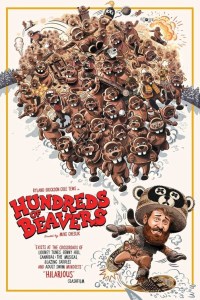 It’s become a cliche for film critics to say, “you’ve never seen a movie like this,” and that’s only partially true with the DIY indie comedy sensation, Hundreds of Beavers. You may have seen this before though decades ago in classic Looney Tunes cartoons, a clear inspiration for the inventive visual slapstick and antic comedy imagination on full display. The commitment of the cast and crew to make a modern-day Looney Tunes is so rare and the results so amazingly executed that when I questioned whether we needed a full movie of this rather than a short film, I cast aside the question and chose to simply enjoy the fullness of the movie. Why scrimp on imagination and ingenuity and divine wackiness for only fifteen minutes when we can have one hundred? If you’re a fan of inspired slapstick comedy, and especially the Golden Era of classic cartoons (1944-1964), then Hundreds of Beavers will be a celebratory experience that could boast hundreds of laughs.
Set amid the early 1800s in the Wisconsin winter, Jean Kayak (Ryland Brickson Cole Tews) is a frontiersman trying to make a name for himself. He wants to be the best fur trapper in the land, and if he nets enough furs, he’ll be granted the chance to marry the pretty daughter (Olivia Graves) of the local Merchant (Doug Mancheski). And with that, the rest of the movie is watching Jean try to outsmart the wildlife (portrayed as people in giant mascot costumes) and collect enough pelts.
 By the nature of its premise and intention, this is not going to be a movie for everyone, or even many, but if it’s for you, it will feel like comedy manna from heaven. The grand appeal of Hundreds of Beavers is the sheer surprise of it all, with the jokes coming fast. The pacing of this movie is at spoof-movie levels, with jokes hitting in weaves and often, complete setups and punchlines taken care of in under ten seconds. The joke-per-second ratio of this movie is off the charts, especially when the movie also begins building its own internal logic and foundation for running gags. That creates an even deeper and richer tableau for comedy, with jokes piling on top of one another and building escalations and extensions. I’m genuinely amazed at the creativity on display in every minute of this movie. The fantastical imagination of this movie could power an entire Hollywood studio slate of movies. I was in sheer awe of how many different joke scenarios it could devise with this scant premise, and I was happily surprised, no, elated, when the filmmakers kept this level of silliness and invention going until the very end of the movie. I was chuckling and guffawing throughout, and I strongly feel like this is the kind of movie that, if you watch it with a group of like-minded friends, can produce peals of infectious laughter.
I really want to celebrate just how whimsically silly this movie can be, with humor that ranges from clever to stupid to stupidly clever. Much of the humor resides around the death and mutilation of animals, which isn’t surprising considering our hero’s goal is to gain hundreds of pelts. It never stops being funny seeing people dressed in giant animal mascot costumes to represent the wildlife, and when they’re killed through the assortment of different means and accidents, the movie adopts classic cartoon visual communication and logic by giving them large X’s covering their eyes. Even when the creatures are losing heads and limbs and getting impaled or giant holes blown through them, the lightness of approach keeps the violence from feeling upsetting or realistic. It’s all just so silly, but that doesn’t mean that it’s not sneaky-smart from a comedy standpoint. There’s one scene where Jean is riding a log down a flume inside a giant wood-harvesting plant the beavers have constructed. A rival log with angry beavers chases him in parallel, and it looks like they’re just about to jump onto his log and grab him. However, they jump but seemingly stay in place, and that’s where the movie cuts to a different shot from a wide angle, to reveal that there are four or five of these flumes running parallel and not merely two. The joke itself is only a few careful seconds, like most of the jokes in Hundreds of Beavers, but it demonstrates the level of thought and ingenuity in the comedy construction, and that’s even before spaceships and beaver kaiju.
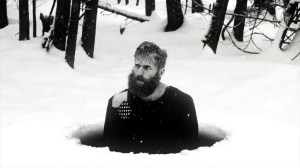 The acting is fully committed to the exaggerated and cartoonish tone of the proceedings. These actors are selling the jokes tremendously well, and since the movie is practically wordless, most of it comes from physicality and expression. It hearkens back to the early silent era of moviemaking by the likes of Buster Keaton and Charlie Chaplain making millions laugh. Even the smallest roles are filled with committed actors helping to make the jokes even funnier. The people in those mascot costumes can be riotous simply in how they slump their body, cock their head, choose their pauses and gesticulations. Watching the movie is a reminder at how universal comedy can be when you have the right people who understand the fundamentals of finding the funny. Tews, also serving as co-writer with director Mike Cheslike (L.I.P.S., The Get Down), is our human face for much of the mayhem, and he can play bedeviled and befuddled with flair. His facial expressions and exaggerations are a consistent key to framing and anchoring the tone of every moment.
While the budget is a relatively modest $150,000, it doesn’t mean the movie looks pedestrian. Choosing to film in black and white helps mask some possible limitations, and the creative choice to go with people in giant mascot costumes helps too, but much of the movie is elevated by its clever green screen effects work. Whether it’s augmenting the snowy outdoor wilderness with exaggerated elements, like traps and contraptions and holes in ice, or segments filmed entirely on green screen and utilizing heavy composites to magnify the number of animals on screen, it all better fulfills the vision and tone. The finale inside the beaver complex is a wild sequence reminiscent of Marvin the Martian landscapes and interior design. The look of the movie, while rough around the edges at points, leans into its lo-fi aesthetics to make it part of its charm, much like the goofy mascot costumes. The continued goofiness doesn’t cancel out the visual audaciousness, even when that audacity is in the guise of creating something so stupid for words.
 I would advise anyone to give Hundreds of Beavers a try, even if for only ten minutes. If you don’t connect with the film’s comedic wavelength or appreciate the ingenuity of the players, then so be it. But I think more than enough will be charmed and impressed by its energy and creativity. I said before that there was once or twice, during the first half, that I questioned whether we needed a feature-length version of this kind of movie. Then it occurred to me how rare such a movie like this is, how singular its vision can be, and how instead of questioning its duration, I then chose to celebrate its cheerful existence, and every new joke was a new opportunity to produce smiles and laughter, and I anxiously waited for the next and the next, my smile only broadening. Hundreds of Beavers is one of the craziest movies you will see but it’s also, at its core, a celebration of comedy and collaboration and the special appeal of moviemaking and those with a passion for being silly. In these trying times of uncertainty, I’ll take a feature-length dose of that, please and thank you.
Nate’s Grade: A
Share this:

The Bikeriders (2024)
 For a four-year period, writer/director Jeff Nichols is a filmmaker who appeared on my Best of the Year list three years, including making my top movie of 2011, Take Shelter. He’s a filmmaker I highly prize, so an eight-year gap from Nichols is an extended leave that makes me personally sad, though his latest movie, The Bikeriders, was delayed by a year after Disney decided to sell it rather than release it for the 2023 awards season. It’s a pretty straightforward drama about a Chicago motorcycle club in the 1960s. It’s all about a group of men that really don’t know how to express their feelings, so it comes out as drinking and fighting and general rebellion against outside authority. These social outsiders find kinship under the leadership of Johnny (Tom Hardy), an unstable man with his own code of honor and retribution. Our narrator is Kathy (Jodie Comer), a plucky woman who falls for a reckless biker, Benny (Austin Butler). There are plenty of interesting moments and sequences, like the rejection of wannabe new members too eager for approval for institutional violence. The changes the club undergoes through the mid 1970s are interesting, especially as the rules of the club begin to fray with the influx of new members and drug addictions, and the challenges to leadership we know will eventually end in tragedy and a betrayal of what the club was intended to be. Regardless, it feels like the movie has all the authentic texture and period details right but is missing a stronger sense of story. It’s more a collage of moments that doesn’t add up to a much better understanding of the three main characters. It’s more like a mood mosaic than engrossing drama, so if you have a general interest in retro motorcycle culture or the time periods, then maybe it will cover the absences in character. I found The Bikeriders to be a good-looking coffee-table book of a movie, more recreation than investment.
Nate’s Grade: B-
Share this:

Nightbitch (2024)
 Motherhood can be a real bitch, right? That’s the lessons for Nightbitch, a bizarre movie that juggles high-concepts and tones like a struggling new mother juggling time. Based on the novel by Rachel Yoder, Amy Adams plays Mother (yes, that’s how she’s credited), an artist who chose to become a stay-at-home mother to her two-year-old son, and her life has become an endless stream of days appeasing a small tyrant who she also unconditionally loves. Early on, Adams uncorks an imaginary monologue about demystifying the glamour of motherhood and the guilt she feels about not finding every tantrum and bowel movement a thing of bronze-worthy beauty. She’s grappling with significant changes, and that’s even before she thinks she’s turning into a dog. I can find thematic connection with motherhood and body horror, as our protagonist feels that she no longer recognizes her body, that she feels a lack of direction and agency in a life that no longer feels hers. The added body horror of transformation makes sense, but this element seems so extraneous that I wished the movie had exorcised it and simply stuck with its unsparing examination of parenthood. You would think a woman believing she is becoming a dog would dominate her life. The ultimate life lessons of the movie are rather trite: assert yourself, establish a balance to have it all, and fellas, did you know that being a stay-at-home parent is actually hard work? There are too many half-formed elements and plot turns that don’t feel better integrated, like flashbacks interwoven with Mother’s mother, not credited as “Grandmother,” as a repressed Mennonite in a closed community who disappeared for stretches. There’s also a few curious reveals relating to Mother’s perception of others that are unnecessary and obtusely mysterious for no real added value (“Why that library book died forty years ago….”). Adams is blameless and impressively throws herself into the demanding roll, going full canine with gusto as she trots on all fours and eats out of bowls. The problem is that all the dog material feels a little too silly when realized in a visual medium rather than a symbol of freedom and rebellion. Nightbitch is more bark than bite, and I’d advise viewers looking for an unflinching portrayal of motherhood to watch Tully instead and, if desired, pet your household dog at home to replicate Nightbbitch but better.
Nate’s Grade: C
Share this:

Nickel Boys (2024)
 This might be the most immersive and biggest directorial swing of the year. Director/co-writer RaMell Ross adapts the Pulitzer Prize-winning novel by Colson Whitehead about a reform school for juveniles more like a prison during the Civil Rights era. Ostensibly, the Nickel Academy is an institution that is meant to teach moral lessons and responsibility through outdoor labor. In reality, it’s a school that benefits from labor exploitation and has no intention of fulfilling its promise that students can possibly leave before they turn eighteen. This is even worse for African-Americans, as the school is also segregated and the students have to endure the racism of the administrators and other white juvenile delinquents who still want to feel superior to somebody. It’s a cruel setting destined to spark risable outrage, especially knowing that our main character, Elwood Curtis, is a victim of profiling and being in the wrong place at the wrong time, a star student selected to take college classes at an HBCU. The big artistic swing of Nickel Boys is the choice to tell the entire movie through first-person perspective, with the camera functioning as our protagonist’s eyes and ears. As the camera moves, it is us moving. It makes the movie intensively immersive, but I had some misgivings about this storytelling gimmick. It limits the resonance of the central performance as we can’t see the actor and his expressions and emotions, which I found frustrating. Ross also decides to do this same trick twice with a second character who befriends Elwood. Now we can see more of our main character, through this other person’s eyes occasionally, but it’s also like having to re-learn the visual vocabulary, and switching from viewpoints was distracting for the immersion and to recall whose eyes were whose at any moment. There’s also flash-forwards to adult Elwood that only served to muddle the tension. There’s enough genuine drama in this setting that I wish Nickel Boys might have been a more traditionally-made drama. Still, it’s a fine movie, but the aspect that will make it stand out the most is also what I feel that holds it back for me from being more profoundly affecting.
Nate’s Grade: B
Share this:

The Brutalist (2024)

The indie sensation of the season is an ambitious throwback to meaty movie-going of the auteur 1970s, telling an immigrant’s expansive tale, and at an epic length of 3 hours and 30 minutes, and an attempt to tell The Immigrant Story, and by that we mean The American Story. It’s a lot for any movie to do, and while The Brutalist didn’t quite rise to the capital-M “masterpiece” experience so many of my critical brethren have been singing, it’s still a very handsomely made, thoughtfully reflective, and extremely well-acted movie following one man trying to start his life over. Adrien Brody plays Laszlo Toth, A Jewish-Hungarian survivor of the Holocaust who relocates to Pennsylvania in 1947. He starts work delivering furniture before getting a big break redesigning a rich man’s library as a surprise birthday gift that doesn’t go over well. Years later, that same rich man, Harrison Lee (Guy Pearce), wants to seek out Laszlo because his library has become a celebrated example of modern architecture. He proposes Laszlo design a grandiose assembly that will serve as a community center, chapel, library, gymnasium, and everything to everyone, standing atop a hill like a beacon of twentieth-century civilization. Everything I’ve just written is merely the first half of this massive movie, complete with an old-fashioned fifteen-minute intermission.
The second half is about crises professional and personal for Laszlo; the meddling and compromises and shortfalls of his big architectural project under the thumb of Harrison, and finding and bringing his estranged wife (Felicity Jones) to America and dealing with the aftermath of their mutual trauma. I was never bored with writer/director Brady Crobett’s (Vox Lux) movie, which is saying something considering its significant length. The scenes just breathe at a relaxed pace that feels more like real life captured on film. The confidence and vision of the movie becomes very clear, as Corbett painstakingly takes his time to tell his sprawling story on his terms. I can appreciate that go-for-broke spirit, and The Brutalist has an equal number of moments that are despairing as they are enlightening. I was more interested in Laszlo’s relationship with his wife, now confined to a wheelchair. There are clear emotional chasms between them to work through, having been separated at a concentration camp, but there is a real desire to reconnect, to heal, and to confront one another’s challenges. It’s touching and the real heart of the movie, and it easily could have been the whole movie. The rest, with Laszlo butting heads against moneymen to secure the integrity of his vision, is an obvious allegory for filmmaking or really any artist attempt to realize a dream amidst the naysayers. The acting is terrific across the board, with Brody returning to a form he hasn’t met in decades. Maybe his career struggles since winning the Best Actor Oscar in 2003 have only helped imbue this performance with a lived-in quality of a soul-searching artist. Pearce is commanding and infuriating as the symbol of America’s ego and sense of superiority. The musical score is unorthodox but picks up a real sense of momentum like a locomotive, thrumming along at a building pace of progress. The only real misstep is an unnecessary epilogue that spells out exactly how you should feel about the movie rather than continuing the same respect and trust for its patient audience. The Brutalist is an intimidating movie and one best to chew over or debate its portrayal of the American Dream, and while not all of its artistic swings connect, the sheer ambition, fortitude, and confident execution of the personal and the grandiose is worth celebrating and elevating.
Nate’s Grade: B
Share this:

Sing Sing (2024)
 An uplifting ode to the power of the arts, Sing Sing follows the men of a prison arts program and it’s easily one of the finest films of 2024. We follow the men of the New York prison of the title, lead by Divine G Whitfield (Colman Domingo), a thespian that relishes the dramatic spotlight and the deserved lead of every production. When the next show is suggested as a comedy, Divine G has to accept ceding the spotlight and mentoring a promising but struggling new member (Clarence Maclin) with talent and potential. It’s effectively a “let’s put on a show” formula of old, however, the setting and the weary reflections are what provide the movie its power. All of these men have made mistakes in their respective lives to wind up here, though Divine G maintains his innocence and is preparing his case for a parole board hearing. This program allows them an escape, an opportunity as one puts it to “become human again” While some may scoff at the acting games and costumes, this is sacred ground, a precious oasis for them to discover more about themselves. The sincerity of Sing Sing is wince-inducing. It is beautiful, tender, compassionate, and deeply personal while being very universal. The lived-in details are fantastic and give great authenticity to these men and their stories, wonderfully portrayed by several non-actors making the most of their own spotlights. Domingo (Rustin) is amazing as the proud and generous leader who is ably trying to lift his fellow men up even higher. The film concludes with real footage from the Rehabilitation Through the Arts (RTA) program, and it’s the fitting culmination for a movie that readily reminds us how restorative and needed the arts are for a fuller sense of who we are.
Nate’s Grade: A
Share this:

Blink Twice (2024)
 Zoe Kravitz’s directorial debut Blink Twice has stayed with me for weeks after I watched it, and with further harrowing revelations coming from the fallout of P. Diddy’s empire of exploitation, it has even more relevance. Think of it as a feminist revenge thriller set on Jeffrey Epstein’s island or a Diddy party. Channing Tatum plays a successful tech bro who hosts lavish getaways for the Wall Street and Silicon Valley elite, where the week is an orgy of food, drink, drugs, and of course sex. We follow Frida (Naomi Ackie), a waitress yearning for the finer things in life, so when Tatum’s rich and famous CEO invites her and her friend to his private island, she’s ecstatic. But everything is not what it seems, and Frida and the other women begin to notice weird clues, that is, when they can remember as time frequently seems to be lost for them. Blink Twice is a twisty, eerie mystery and Kravitz shows real skill at developing tension and suspense, with sequences that had me girding great waves of anxiety. There’s also an eye for style and mood here that makes me feel Kravitz has a real career as a genre director. I don’t think it’s spoilers to say that eventually the surviving women team up together to fight back against their oppressors, and it’s gloriously entertaining, bloody, and table-turning satisfying. The ending is designed to spark debate and controversy, and I enjoy that Kravitz and co-writer E.T. Feigenbaum do not want to make things too tidy, even with their protagonists. The themes here are broad but the execution is exact. There are several moments that stand out to me, from unexpected moments of levity to bold artistic choices that are mesmerizing, like an “I’m sorry” apology that goes through every level. If you’re looking for slickly executed genre thrills with great comeuppance, don’t blink when it comes to with Blink Twice.
Nate’s Grade: B+
Share this:

Juror #2 (2024)
 Clint Eastwood’s possible last movie as a director (the man is 94 years old, people) was buried at the theater through a limited release by its studio, which is a shame because Juror #2 is a fairly solid adult drama with some grueling tension built right in. I was wondering how screenwriter Jonathan Abrams was going to make this premise work, where a recovering alcoholic and expectant father, Justin Kemp (Nicholas Hoult), is impaneled on a jury for a murder case and discovers, over the presentation of evidence, that he might actually be the culprit. That same night, at the same location of where the supposed murder took place, is where Justin thought he hit a deer. What follows is a soul-searching account of one man being torn apart as far as what he should do. Does he let this other man take the blame so Justin can live out his life with his new baby and wife? Or does he come forward and admit his own firsthand knowledge of the events would present a very reasonable doubt for this trial? The movie becomes an extended balancing act of how long Justin can keep this secret and what angles he will work, trying to push the jury one direction or another through persuasive appeals. It’s familiar dramatic territory to anyone who grew up on 12 Angry Men, though with an extra high-concept twist. It’s a fairly straightforward drama that allows the story to take center stage and puts the focus on one man’s personal crisis. The acting is strong all around with Hoult (Nosferatu) being the predicted standout, showing the heavy weight of his guilt wirh every pained expeession. I think the ending does a disservice to the kind of movie that came before it, namely that it should be more definitive in its conclusion and provide a fitting resolution. This isn’t exactly the kind of movie that benefits from prolonged ambiguity, so the abrupt ending feels like a miscalculation and hampers a bit of the ending’s impact. However, Juror #2 is a good squirm session.
Nate’s Grade: B
Share this:

Heretic (2024)/ Conclave (2024)
Recently, two religious-based, single-location thrillers have emerged from the confines of indie cinema, and this combination is so rare that I felt a unique opportunity to review them both.
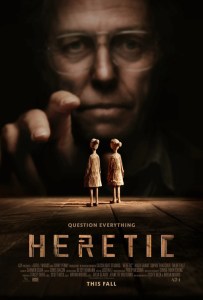 Heretic is a chamber movie about two teen Mormons (Sophie Thatcher, Chloe East) proselytizing to a middle-aged man (Hugh Grant) one dark and stormy night. He invites them in and seems kind and welcoming, but looks can be very deceiving. He has some very strong opinions when it comes to the nature of belief, and he will test both of these young Mormons on the faith of their convictions as he puts them through a series of trials and lectures. That last part might stun people, but Heretic is actually at its best during its lengthy lecture sequences. It might remind people of a nattering Reddit atheist being unleashed, but the movie really comes alive when Grant is challenging the roots of their belief systems as well as the historical contexts of religions. The Mormon ladies push back as well, countering some of the arguments so it’s not so one-sided. There’s a clear point of view to the movie but I wouldn’t say it’s didactic. The thrills ratchet as the two women start to fret about what this man has in store for them, how they might escape from his labyrinthine house, and how to signal for help. Unfortunately, the revelations can never quite match the fun of the mystery of motivations, and once it gets into a really convoluted place of switcheroos, then I think it loses momentum. The performances are all outstanding, led by Grant’s magnetic about-face turn as a snide villain. The same self-effacing charms he worked so well in the realm of rom-coms have a new eerie manipulative quality, luring his prey into his fiendish trap. The end attempts to go a bloodier and more ambiguous route that I don’t know it earns, but by that time, even after stalling out for the last act, Heretic won me over by virtue of its creepy convictions.
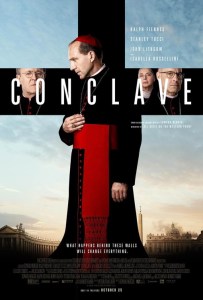 Conclave is an electioneering movie that places the viewer in the middle of the fraught voting process to determine the next pope of the Catholic Church. Ralph Fiennes plays a cardinal tasked with leading the conclave, the gathering of Catholic cardinals who will stay until a nominee has won a majority of their secret votes. Except it’s all not so secret as multiple candidates are openly campaigning for votes, trying to persuade different factions to support their candidacy. Each round of voting without a winner resets the field of play and leaves sides scrambling to reclaim footing. The movie is surprisingly very easy to get into, a crackling political thriller about the behind-the-scenes machinations and politicking for the highest office in the Catholic Church. There is a bevy of twists and turns and plenty of juicy revelations and betrayals, as these holy men start acting a little less holy to eliminate their competition or sully their chances. The constant churning is enough to keep things unsettled and intriguing, but there’s also a larger question for our protagonist, a man of faith who told the prior pope that he wished to leave his faith only to be denied by the pontiff for reasons we aren’t quite sure. Why did this pope specifically pick him for this position? The movie also asks deeper questions about the nature of power and leadership, namely are the people actively seeking it the right candidates for the right reasons? The very end of the movie knocked me out with a twist that I dare say nobody will rightly see coming, but it made me want to applaud. Conclave is an intelligently crafted thriller with weighty ideas and engaging performances.
Nate’s Grades:
Heretic: B
Conclave: B+


 nathanzoebl
You must be logged in to post a comment.