Category Archives: 2024 Movies
Flow (2024)
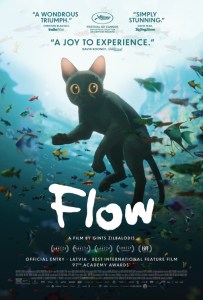 The international animation sensation from Latvia surprised the world by besting big movies from big studios to win the Academy Award for the Best Animated Movie of 2024. Flow is a wordless fable about a group of animals trying to survive in a flood-ravaged world bereft of humans. The presumptive main character is a small black cat who befriends an alliance of a Labrador, a lemur, a large bird, and even a capybara. They float around on a sailboat and take turns relying upon one another. The animation style is dream-like and painterly from Blender, a free open-source 3D software tool. There’s a sweetness to the movie that doesn’t dip into maudlin territory; it’s like Homeward Bound minus celebrity voices. However, the movie is also a bit airy and lackadaisical in its pacing. There are many sequences of the cat just observing the view underwater, and there are segments that get very abstract and metaphorical that can be confusing. The movie also ends in a very, “Oh, that’s it?” kind of fashion. Without broader characterization, we’re watching animals essentially be animals. While this doesn’t mean they are undeserving of empathy, I kept wondering if maybe we were headed for a Life of Pi-style allegory. It’s quite often a beautiful movie to watch, and I celebrate this little underdog animated movie getting the kind of platform and acclaim that larger animation houses take for granted, but it left me a bit cold. It’s an easy movie to appreciate with its mature themes and surreal imagery, but I wanted more to engage with.
Nate’s Grade: B-
Share this:

A Complete Unknown (2024)

I’m not really a Bob Dylan fan. While I can appreciate several of his songs, it’s his voice that has always put me off. An entire movie about the mystique of Dylan and his rise through the 1960s folk scene was never going to be too appealing for me. So keep all of that in mind as I tell you that A Complete Unknown is a thoroughly fine movie with the not-so grand insight that this famous troubadour might just be a talented prick. The end. Director/co-writer James Mangold returns to the musical biopic sub-genre almost twenty years after his Walk the Line (a non-Joaquin Phoenix Johnny Cash has a cameo in this movie too, securing the Boomer Music Cinematic Universe). It all feels very stately and staid and reverent and, especially during its climax, hopelessly quaint. The conclusion is over whether or not Dylan will play music at the Newport Folk Festival that the fuddy-duddy programmers demand. Will he go electric? Will he play traditional folk? Will you care? I suppose it’s about people trying to control and define this idiosyncratic artist who wants to be himself, whatever that may be, whatever feathers may be ruffled by the traditionalist gatekeepers of the folk music scene. This celebration of artistic integrity and creative revolution would mean a little more if I got a better understanding of Dylan as a person. Blessed with audience foreknowledge, we already know he’s going to be successful and that his creative impulses will be rewarded. Timothee Chalamet does a fine Dylan impression and recreates the famous songs with an impeccable nasally impersonation. For my money, I’d rather this have been a Pete Seger (Edward Norton) movie about his passing of the torch from one generation of folk artists to another and recognizing that the culture and peace movement were moving beyond him. Regardless, if you’re a Bob Dylan fan, there’s plenty to like, especially many extended jam sessions. If you’re looking for more than a handsomely recreated Best Of album, you might need to read a book instead.
Nate’s Grade: C+
Share this:

Y2K (2024)
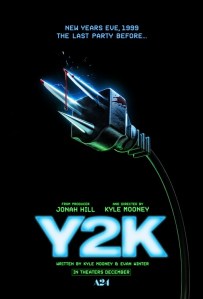
The premise for Y2K is ripe for fun. It’s a nostalgic retelling of that turn-of-the-millenium anxiety over computers getting confused, and the movie says what if technology had turned on humans at the stroke of midnight that fateful New Year? Add the lo-fi chintzy, quirky style of co-writer/director Kyle Mooney (Brigsby Bear) and it’s a setup for some strange and amusing techno-horror. It’s structured like a teen party movie with our group of high schoolers (Jaeden Martell, Julien Dennison, Rachel Zegler) trying to step out of their comfort zones and live their best lives… around machines trying to eviscerate them. The tonally messy movie lacks the heart and specific world-building weirdness of Brigsby Bear, instead relying upon the genre cliches of the high school movie, including the unrequited nerd crush and the pretty popular girl who’s more than what she seems. While watching Y2K, I kept getting the nagging feeling that this movie should be more: more funny, more imaginative, more weird. It’s quite uneven and veers wildly from set piece to set piece for fleeting entertainment. I chuckled occasionally but that was it. I enjoyed the villainous robot assembling itself with assorted junk available, and it’s hard not to see this as a general statement about the movie as a whole. It’s a bit lumbering, a bit underdeveloped, a bit formless, blindly swiping nostalgia and junk to build some form of an identity that never materializes beyond its parts. Y2K won’t make me bail on Mooney as a filmmaker but it’s a party worth missing.
Nate’s Grade: C
Share this:

Moana 2 (2024)
 It’s hard not to see the DNA of its original incarnations as a TV series for Disney Plus, as well as the awkward adjustments to slap this together into a feature film. Unless you’re a super fan of the original Moana who needs any additional content, you’ll likely have a less than impressive response to Moana 2. It feels quite episodic from villains and storylines popping up for small increments of time only to go away and be replaced by a new storyline, to a new batch of characters meant to hold our attention while other main characters, in particular Maui (Dwayne Johnson), sit out for long stretches. The animation is a notable step down as well, and while it’s still pleasing to watch and far from bad, it’s lacking the detail and refinement of the feature team, especially with lighting, as everything in this world lacks shadows with such high key lighting washing everything out. Without Lin-Manuel Miranda returning, it’s obvious the songs will not be nearly as catchy and enchanting, and the tunes for Moana 2 are pretty instantly forgettable. I’m struggling to rethink any melody right now as I write this. It’s hard not to feel like everything is so slight, from the storytelling to the visuals to the songs to the inclusion of the beloved characters from the original. I loved Moana and consider it the best of modern-day Disney, and I’m clearly not alone from the box-office dominance that the sequel was able to achieve. I actually think I would have preferred future Moana adventures as a TV series because the mythology and world has more to explore. But that version of new Moana has been transformed, Frankenstein-style, into a releasable feature film, one that suffers in the transformation into something it’s not suited for. Disney made a billion dollars from this gamut, but the rest of us are left with a Moana 2 that had much further to go.
Nate’s Grade: C
Share this:

Saturday Night (2024)/ September 5 (2024)
Recently two ensemble dramas were thought to have awards potential that never materialized, and I think I might know at least one reason why: they are both undone by decisions of scope to focus on either a single day or a 90-minute period to encapsulate their drama.
 With Saturday Night, we follow show creator Loren Michaels (Gabriel LaBelle) the night before the premiere episode of the iconic sketch TV series, Saturday Night Live. The story is told in relative real time covering the last 90 minutes before its initial 11:30 PM EST debut in 1975. We watch Michaels try and deal with squabbling cast members, striking union members, failing technology, his ex-wife (Rachel Sennot) who also happens to be a primary producer of the show, muppets, and studio bosses that are doubtful whether this project will ever make it to air. I understand in essence why the real-time setting is here to provide more pressure and urgency as Michaels is literally running out of time. The problem is that we know the show will be a success, so inventing doubtful older TV execs to add extra antagonists feels like maybe the framing by itself was lacking. Think about Air but you added a fictional exec whose only purpose was to say, “I don’t think this Michael Jordan guy will ever succeed.” There are interesting conflicts and subplots, especially with the different groups that Michaels has to manage, but when it’s all stuffed in such a tight time frame, rather than making the movie feel more chaotic and anxious, it makes those problems and subplots feel underdeveloped or arbitrary. I would relish a behind-the-scenes movie about SNL history but the best version of that would be season 11, the “lost season,” when Michaels came back to save the show and there were legitimate discussions over whether to cancel the show. Admittedly, we would already know the show survives, but does the public know what happened to people like Terry Sweeney and Danitra Vance? Does the public know what kind of sacrifices Michaels had to make? That’s the SNL movie we deserve. Alas, Saturday Night is an amiable movie with fun actors playing famous faces, but even the cast conflicts have to be consolidated to the confined time frame. This is a clear-cut example where the setting sabotages much of what this SNL movie could have offered for its fans.
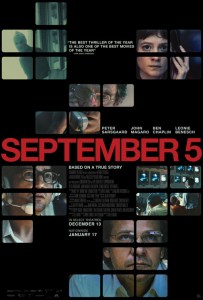 With September 5, we remain almost entirely in the control room of ABC Sports as they cover the fateful 1972 Munich Olympics after the Israeli athletes are taken hostage by terrorists. It’s a subject covered in plenty of other movies, including Steven Spielberg’s Munich and the 1999 Oscar-winning documentary One Day in September, but now we’re watching it from the perspective of the journalists thrust into the spotlight to try and cover an important and tragic incident as it plays out by the hour. It’s an interesting perspective and gives voice to several thorny ethical issues, like when the news team is live broadcasting an oncoming police assault, which the terrorists can watch and prepare for as well. The movie is filmed in a suitable docu-drama style and the pacing is as swift as the editing, and that’s ultimately what holds me back from celebrating the movie more. It’s an interesting anecdote about media history, but September 5 fails to feel like a truly insightful addition to the history and understanding of this tragedy. It’s so focused on the people in the studio and restrained to this one day that it doesn’t allow for us to really dwell or develop in the consequences of this day as well as the consequences of their choices on this fateful day. The movie feels like a dramatization of a select batch of interviews from a larger, more informative documentary on the same subject. It’s well-acted and generally well-written, though I challenge people to recall any significant detail of characters besides things like “German translator” and “Jewish guy.” It’s a worthy story but one that made me wish I could get a fuller picture of its impact and meaning. Instead, we get a procedural about a ragtag group of sports journalists thrust into a global political spotlight. There’s just larger things at stake, including the inherent drama of the lives at risk, than if they’ll get the shot.
Nate’s Grades:
Saturday Night: C+
September 5: B
Share this:

The Crow (2024)
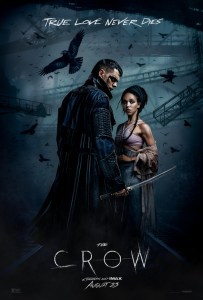 It’s been over twenty years since there’s been a movie based upon James O’Barr’s iconic graphic novel The Crow, and it’s been almost thirty years since there was a theatrically released movie. It’s a franchise that seems easy enough to make into a movie: a victim of violence comes back from the dead with some supernatural guidance to seek vengeance on those who killed them. Slather it in a moody atmosphere and some nice character beats, and you have yourself a born winner, like the 1994 movie that became a staple for a generation of disaffected teenagers. So why has it been so hard to bring this franchise back to life? There have been many starts and stops, with different directors and actors becoming attached and leaving over time, including Bradley Cooper, Luke Evans, Jason Momoah, and Alexander Skarsgard. Apparently, the producers finally found a story they felt could support a Crow reboot, or so they hoped. It crashed pretty hard at the box-office upon release. Despite its omnipresent placement on many worst of 2024 lists, I didn’t hate The Crow 2024. It has some serious problems but it also has some intriguing ideas that could have worked in a better version. It’s far less egregious than the 2005 Wicked Prayer where a literal plot point is stopping a climactic consummation between a villainous Tara Reid and David Boreanaz. It couldn’t be that bad, could it? It’s not, but it needed a lot of work.
Eric Draven (Bill Skarsgard) meets the love of his life, Shelly (FKA Twigs), where one meets all the hot and available singles these days – in drug rehab. She’s on the run from a criminal enterprise after she kept an incriminating video, so once she and Eric escape from their rehab center and try and make a go at a new life on the outside, the goons find them and kill them both. Except Eric’s spirit is sent to a purgatory netherworld and tge mysterious man Kronos offers to send him back to get vengeance. It seems this crime syndicate is led by Vincent Roeng (Danny Huston), who happens to be perpetuating his lifespan by offering fresh innocent souls to Hell. With the supernatural power of a guardian crow providing him invulnerability, Eric seeks to stop these bad people from dooming any other souls and maybe he can save Shelly’s soul in the process.
 Let’s tackle some of the more noteworthy mistakes of the reboot before I begin providing the compliments and where I think the movie actually has some worthy ideas. The biggest creative mistake is delaying the tragically fateful murder that spurs the entire movie until 45 minutes in. For contrast, the original movie has its Eric and Shelly getting killed through an opening montage. It doesn’t waste any time getting to the real premise of the material, the supernatural revenge tale. If you’re going to delay that key turn by so long, then that relationship better pop off the screen, or the chemistry has to be amazing, or the characters are so in depth and charming that with the considerably increased time we will feel a deep pain at the loss. If you’re putting more weight on the love story and their connection then you have to back it up, and this movie cannot. Therefore, it’s drawing out its necessary supernatural transformation to a point that there is only a measly hour left for all that superhuman stalking and avenging.
In the original, Eric (Brandon Lee) tracked down the gang responsible for his and his wife’s murder and each member got their own section where they established their character. Each section allowed us to learn more about the powers Eric now had at his disposal as well as how they might change him. The structure allows the bad guys to learn about their predicament and plan a defense. It allows the exciting elements from the premise to develop and adapt. With The Crow 2024, there’s one initial attack where Eric discovers he can bounce back from bullets, then there’s one ambush on a car carrying our bad guys, and finally there’s an extended assault at an opera that gruesomely kills every disposable henchman money can buy. That’s it. Eric isn’t picking them off one-by-one or even working up the food chain to the really bad guys. The bad guys don’t even seem that threatened, as Vincent is still going about his routines, albeit with more armored guards. It makes the whole Crow parts of The Crow feel small and underdeveloped. This is the first Crow movie where the titular bird, the symbolic partner from the underworld, doesn’t even connect in any meaningful way. It’s just a background “caw.”
 The entire inclusion of a villain who traffics innocent souls begs for further examination and probably a more formidable opponent. Vincent confesses he’s hundreds of years old and his agreement is with the Devil himself, so you would think this man would have learned some tricks in the ensuing hundreds of years. He has some vague super power where he can whisper suggestions into the ears of his victims and they’ll do what he commands, but does he use this power when he’s battling Eric or trying to flee from Eric? No. The demonstration of this super power basically resorts to being a more personal form of torture. Vincent doesn’t even seem worried about an undead warrior coming for him. Maybe that’s centuries of accrued over confidence, but if that’s the case, then make us love to hate this arrogant bastard. Also, if he’s had a successful transactional arrangement with the Devil for literal centuries, shouldn’t Ole Scratch have a thing or two to say about his soul supplier being brought to cosmic justice? If innocent souls are so much more delicious to the Prince of Darkness, there’s more to lose, and maybe that even brings the horned one into the fray, or he designates a promising underling or nepo baby demon, and then Eric has to fight the literal powers of Hell as well protecting his target, which raises the question how far is he willing to go to seek the vengeance that he craves.
That question is actually one of the more interesting points because this version of The Crow directly connects the hero’s strength to the power of love. This is where putting more emphasis and time with the love story could have worked… had the love story been compelling. I like that it’s not his hatred that gives him his powers but his love for Shelly. The movie also provides a more urgent reason for Eric to make these bad men feel his crow-y wrath: he can retrieve her from Hell if he thwarts Vincent and his soul-trafficking gang. Even though she’s dead, he can still save her, and that is meaningful and provides a better motivation for our protagonist. I don’t know why, and it seems like this Kronos guy could be far more active and helpful as an otherworldly guide, but it’s an effective goal to drive our hero to slay his targets. I liked that late in the movie, after he receives some upsetting news about Shelly, his conflicted feelings are detracting from his super powers. There’s a direct and personal sense of causality. His doubts in whether he loved Shelly are manifesting as physical vulnerability. This approach could have worked had the filmmakers given the audience an engaging love story. The movie also feels built around hiding the acting limitations of Twigs (Honeyboy). She tries but this performance feels so listless and lacking a spark or charisma that could convince why Eric would risk it all for her.
 There’s one notable action sequence and it deserves some kudos for its morbid invention. When you have a hero that can take all the slings and arrows of outrageous fortune, it can lessen the stakes when it seems like they lack a credible weakness (call it the “Superman problem”). However, what I liked about the 2024 Crow is that even though he’s an undead warrior, that doesn’t mean Eric is somehow superior at fighting. He can take more punishment but that doesn’t mean he’s become an exemplary martial arts fighter, agile gymnast, or trained marksman. He’s still just a lanky guy, albeit one with washboard abs, the sculpted physique one naturally develops while recovering from substance abuse, of course. I enjoyed that this version of Eric was still struggling in his fights and could fall down and be bested. For his big assault scene at the opera house, he prioritizes a sword as his weapon of choice. At least that necessitates proximity to take out his opponents. The extended and very bloody fight scene is inventively gruesome; at one point, Eric uses the sword sticking out of his chest to lean forward and impale a henchman pinned on the floor. He even shoots through holes in his body to take out henchmen grappling him from behind. It’s the most thought put into utilizing the possibility of its premise. I don’t know why the rest of the movie couldn’t exhibit that same level of thought and creativity.
If you’re a fan of the comic or the 1994 movie, you’ll more than likely walk away from this newest Crow with some degree of disappointment. It wasn’t worthy of a placement on my own worst of the year list. Rather, it appears as a middling dark thriller that has some interesting creative choices that fail to pan out because the follow-through wasn’t as good as the idea. With a few more revisions, I think this basic approach could work, emphasizing the love story and devoting precious time to make it more impactful than just an innocent woman being avenged. However, by not fulfilling the possibility of these choices, instead we’re stuck with a lackluster romance eating up 45 minutes of screen time that could have been used for more satisfying supernatural action. By its sloppy end, I was just left shrugging. If this is what twenty-plus years of development wrought, maybe we needed a little longer for better results.
Nate’s Grade: C
Share this:

Megalopolis (2024)

Trying to make sense of Megalopolis is something of a fool’s errand. It clearly means something significant to its creator, legendary director Francis Ford Coppola. He’s been wanting to make this movie for decades and finally the urge just became too strong to ignore, so he sold his successful Zoetrope winery and put over $100 million of his own fortune into this movie to ensure his vision would be unclouded by meddling studio execs and moneymen. It’s the kind of bracing act of artistic hubris and ambition that is worth celebrating. It’s a big swing from a legendary filmmaker who has quite often gone overboard only to return from the brink with cinematic classics, like Apocalypse Now and Bram Stoker’s Dracula. Given his filmography, you would think that Coppola has more than earned the benefit of the doubt. Except… the Coppola of today isn’t exactly in his prime. He hasn’t had a great movie since 1992’s Dracula, and in those ensuing 30 years, he’s made inexplicable movies like Jack, where Robin Williams plays a kid who ages rapidly, and Twixt, a bizarre misfire with Edgar Allan Poe and vampires that was reportedly inspired by a dream he had. I would expect any new Coppola project to lean more towards these kinds of artistic follies than his generation-defining classics. The man is 85 years old and put all his remaining artistic cache and wealth into guaranteeing that we live in a world with Megalopolis. After seeing his long-gestating opus, I cannot say we are better for the trouble.
It’s hard to condense the plot of Megalopolis because so much is happening while nothing seems that important. For example, brilliant architect Caesar Catilina (Adam Driver) wants to build a new wondrous city he calls Megalopolis, a utopia for the masses. The power brokers of New Rome, including Mayor Cicero (Giancarlo Esposito) and CEO of the largest bank Hamilton Crassu III (Jon Voight), are against such radical changes and see Caesar as an upstart. It also so happens that Caesar can stop time at will, until he cannot. He also has discovered a miracle material to build his futuristic city, but nobody seems to care. The masses of New Rome are more interested in whether or not a pop star is still really a virgin. Julia (Nathalie Emmanuel), the mayor’s party girl daughter, witnesses Caesar stopping time, which is a big deal, or maybe it’s not, but she’s intrigued by the mercurial artist seeking to bring to life his unique vision. But Caesar only likes people interested in art and philosophy and books. Could he fall for her, and will it possibly cost his artistic vision from becoming a shimmering reality of hope?

This is a $100-million-dollar movie created entirely for one person, and if you happen to be Francis Ford Corolla, then congratulations, you will understand and properly appreciate the artistic messages and bravado of Megalopolis. For the rest of us poor souls, we’ll be struggling for meaning and insight. The movie almost exists on a purely allegorical level, or at least it must considering that so much of the scene-to-scene plotting is haphazard and underdeveloped.
Let’s start with the central conflict: why are these forces so immovably against one another? If you were the mayor of a city with a raft of problems, it would sure seem like a great move for a utopian addition. I suppose he and the other men in power are afraid of ceding some of their influence and status to this newcomer, and that is something that could have been explored stronger through generational conflict, the old having a stranglehold on power and losing sight of relevance but still clinging to their storied perches. Caesar should be a threat, an appeal to the people that they no longer truly serve. However, in this story, Caesar is so brilliant and any person standing in his way is meant to look foolish or evil. It reminded me a lot of Ayn Rand’s terrible book Atlas Shrugged that was turned into a terrible trilogy of ideologically rotten movies where the brilliant billionaires are tired of their genius being wasted by government regulation. Obviously Caesar is meant to represent The Artist who is being doubted or interfered with, which is how Coppola views himself, or at least filmmakers in general. Therefore this character can have no flaws and must always be right because the message is to give the great artists their space to be great, to challenge our preconceptions of what art can be. He must be vindicated, so it makes him a rather boring and simplistic character who wants a glorious future for the people.
But what exactly is Megalopolis as a utopia? All we know is that it has moving sidewalks and gyroscope orbs for traveling and it’s very glowy. Visually it reminds me of another Adam Driver movie, 2016’s Midnight Special, when the alien world began co-existing with our world. This magic future city is made of a magic future element that also has the magic ability to heal Caesar after he gets critically injured. All of those details beg for more clarity or development, along with Caesar’s ability to stop time, which I guess is hereditary. These elements should be more impactful, but like the utopian city of Megalopolis, they’re just convenient devices, to simply provide the protagonist with a means of solution whatever his dilemma may be. There’s another conflict in the middle where Caesar is framed with an altered video of him having sex with that virginal pop star, but this too is resolved ludicrously fast. Even this scandal cannot last longer than a few minutes before once again dear Caesar is proven virtuous and unassailable. When he has a magic solution for every problem, including reconstructing a hole in his face, and he can never be wrong, and he has no complexity except for his supposed genius, but his genius is also vaguely defined as far as the actual outcome of his supposed utopia, it makes for an extremely uninteresting main character that gets tiresome as we never flesh out his important attributes.

Likewise, the satire of Megalopolis is fleeting and broad and hard to really engage with. There’s the rich and powerful living in excess and with a sense of depraved callousness toward those they feel are lesser. This is best epitomized by Aubrey Plaza’s tabloid journalist character with the exceptionally bad name of Wow Platinum. She’s a gold digger and flippantly shallow as well as super horny, starting as a fling with Caesar before moving onto Clodio (Shia LeBeouf), the grandson to the CEO of the big bank. This woman has no guile to her and is transparently voracious for all she covets, whether it be sexual or material. With Plaza giving a delightfully campy performance, really digging into the scenery-chewing villainy of her character, it makes her the most entertaining person on screen, and a welcomed respite from all the other actors being so self-serious and stodgy and haughty. This tempers the satiric effect because now I’m looking at Wow Platinum as a godsend. Obviously New Rome is meant to represent the United States, so all of its foreboding narration about the death of empires is meant to make the audience compare the end of Rome to the internal fissures of America. Like everything else in the movie, the comparison is only skin deep, and it’s merely asking you to juxtapose rather than critically compare modern-day to the collapse of Rome. By the end, there’s some definite unsubtle swipes at topical political culture, like when Clodio adopts himself as a humble man of the people to “Make New Rome Great Again” and foments an army of red-hatted rabble. But what exactly is Coppola saying with this? That the people in power will pose as populists to manipulate the lower classes into action that benefits them? Not exactly breaking news, nor is it explored on a deeper or more complex or at least more interesting development. Much like the plotting of Megalopolis, the satirical elements are a cacophonous mess of dispirit ideas and directions.
It’s staggering to believe that the man who wrote Patton and The Godfather is the same man who wrote such lines like, “You’re anal as hell whereas I am oral as hell,” as Plaza looks face-first at Driver’s crotch. The dialogue in this movie is tortured and feels like it was written by A.I., or by aliens who were trying to recreate human social interactions but whose only archive of study was the amazing catalogue of movies by Neil Breen and Tommy Wiseau. The “Entitles me?” conversation that repeats itself four times, the “riches of my Emersonian mind,” to “when we ask questions, that’s basically a utopia,” to what might be the most eye-rolling line of 2024, where a vindictive Voight hides a tiny bow and arrow under a sheet by his waist and literally says, “What do you think of this boner I’ve got here?” Yes, the man who gave us The Godfather has also now given us, “What do you think of this boner I’ve got here?” The movie is so preoccupied with the fall of empires and yet a line of dialogue like that is a sign of the decline of an empire.

Ultimately, Megalopolis reminded me of Richard Kelly’s 2007 flop, Southland Tales, a connection I also felt while watching 2023’s Beau is Afraid as well. I wrote, “It’s because both movies are stuffed to the brim with their director’s assorted odd ideas and concepts, as if either man was afraid they were never going to make another movie again and had to awkwardly squeeze in everything they ever wanted into one overburdened project.” It’s an ungainly mess, a protracted and self-indulgent litany of Coppola’s foibles and follies, and it’s practically impenetrable for an audience. I challenge anyone to seriously engage with this movie beyond rubbernecking. I cannot believe this movie cost $100 million dollars and for a passion project there’s so little that makes me wonder how someone would be so passionate about this. It’s not a good movie but it has its own ongoing fascination for cinephiles morbidly curious what Coppola had to make. These are the kinds of bold artistic swings we should cherish, where filmmakers with storied careers are willing to burn it all down for one more project that must be just so, like Kevin Costner’s four-part Horizon Western that we’ll probably never see completed. I wanted artists to test the waters, to chase their visions, to be ambitious. But that doesn’t mean the art is always worth it.
Nate’s Grade: D
Share this:

A Real Pain (2024)
 A funny, poignant, and surprisingly gentle movie about two cousins going on a journey to retrace their family history and honor that legacy while trying to reconcile their privileged connection to that past. Written and directed by Jesse Eisenberg, who also stars as David, a generally normal family man traveling with his much more jubilant and troubled cousin, Benji (Kieran Culkin). They’re on a tour through Poland and visiting infamous Holocaust historical sites, ultimately finding their grandmother’s home she fled so many decades ago. The cousins are dramatically different; David is timid and anxiety-ridden, and Benji is the life of any party, an impulsive yet charming people-person. The tour is meant to draw them closer together, to each other, to their shared historical roots, but it might also make them realize what cannot be reconciled. This is an unassuming little movie about a couple characters chafing and growing through their interactions, getting a better understanding of one another and what makes them tick. It’s really the Benji show, and Culkin is terrific, effortlessly charming and funny but with a real tinge of sadness underlying his garrulous energy. There’s real pain behind the surface of this character that he’s trying so hard to mask, though it appears in fleeting moments of vulnerability. Benji causes the various characters along the tour to think differently about their own situations, their own connections to the past, including his cousin, and ultimately makes the journey feel worthwhile. At a tight 90 minutes, A Real Pain is a small movie about big things, and Eisenberg has a nimble touch as writer/director to make he time spent with strangers feel insightful and rewarding.
Nate’s Grade: B+
Share this:

Queer (2024)
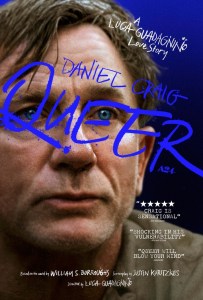
Based upon Beat writer William S. Burroughs, and by the creative team behind this year’s Challengers, Queer is a gay romantic drama equal parts desire and desperation. It also happens to be a confounding artistic misfire and one of the more head-scratching Oscar-bait entries of late.
Set in the 1950s, William Lee (Daniel Craig) is a middle-aged writer living in Mexico City and looking for companionship. One day he meets Eugene Allerton (Drew Starkey, Outer Banks), a young Army expat who he can’t stop thinking about. Lee circles the man, flattering him and throwing affection his way, and eventually the two of them get involved in a relationship, though Allerton is quick to proclaim he is “not queer.” Can they find something lasting or meaningful and work through their own doubts and personal hang-ups?
What really hinders this doomed romance is that it never feels special for either of the participants, at least something to remember through the ages. Unrequited romances in an era where people could never act out their passions because they were considered inappropriate or obscene are their own sub-genre of movies, the Romance That Could Not Be. I initially thought that Queer was going to be a gender flip of 2015’s Carol, Todd Haynes’ film about two gay women trying to carry on a covert relationship through glances and finger touches. Queer is not Carol, and I wasn’t even a big fan of Carol. For starters, even though the setting is in 1950s Mexico City, it doesn’t at all feel like any of the characters are being forced to repress their authentic selves. I’m unfamiliar with whether or not Mexico was so accommodating to gay foreigners, but from a narrative standpoint, it saps the story of conflict on a social scale. If society accepts these men carousing around the neighborhood for homosexual hookups, then what’s halting our gay couple for achieving happiness cannot be external, it must be internal. That means we need to know much more about these characters because we can’t just blame the pressures of society keeping these men apart and/or repressed. The problem with this approach is that the story keeps both of these characters too far at a distance to fully understand them, including any faults that might ultimately lead to their falling out or parting ways.

The burden of romances that are meant to be so powerful they leave a mark, good or bad, is that you need to feel that ache and power so that it feels tragic they could not work out, that they will be haunted by the memory of what they had and what could have been. With Queer, I can’t understand what drew either of these men together beyond lust and inertia. Eugene is an enigmatic blank of a character, a young G.I. who doesn’t consider himself queer. That’s as much as you’re going to get about this man as he’s mostly held as a desirous placeholder, something for our older character to yearn over, but he already feels like a half-remembered, overly-gauzy nostalgic memory of a person even in the present. He’s just kind of there. He doesn’t say much, he doesn’t do much, but he’s reciprocal, and I guess that’s something. The character of William Lee is a writer living abroad, ostensibly writing and publishing with financial freedom. His life abroad is essentially an ongoing vacation where he gets to casually drink, stroll about, and find younger men to warm his bed. Now if Lee had all these things but, because of his middle age, he was seen as less desirable, that these young men only used him for their own gratification and then abandoned him, then we have a scenario where he might find someone who can fulfill what he is missing, who can be different from the others. I don’t know what either of these men see in one another because they’re both so terribly underwritten. It makes it hard to care or become emotionally invested in these men and their connection.
Then the movie just collapses entirely in its meandering, abstract, and generally mystifying second half. I figured the movie would be these two men leaning into their feelings and daring to act them out, becoming infatuated with one another, and that’s really only the first half. Then Lee gets the idea to travel to South America to look for a rare plant believed to offer telepathic powers. Now clearly there’s some metaphors here about the desire for connection and understanding, and you would think the motivation would be spurred by being denied these aspects. Instead, Lee and Eugene seem to lack any real challenge to being together, nor is there any pertinent threat that Eugene will leave him or that there is any competition for his affections. There’s not really a conflict present that can keep them apart; even Lee’s drug addiction plays such a minimal part. I suppose it’s meant to convey the character’s dependency issues, but then present a parallel where Eugene is his new drug, his new obsession, and chasing it leads to his self-destruction. That’s not what we get. We get a boring couple going on a weird vacation. This journey south becomes one very tedious expedition into extended trippy visuals and sketchy symbolism like vomiting out one’s heart. It was at this point that my wife had lost all patience with the movie and just wanted it to end. I couldn’t blame her. Even if the story and characters were lacking for the first half, they’re just abandoned completely in that second half. The movie is actively challenging you to disengage with it when it already gave me little to hold onto.

The main headline for Queer was that this is Craig’s big awards gamble, and he is good, but absent the material to really explore the complexity of his character, the performance is limited because Lee is so archetypal. He’s the middle-aged lush, the sad gay man looking for love and connection in an era that was not kind to said pursuit, and yet in Queer he’s not really persecuted, he’s not really challenged, and he’s not really explored in any meaningful manner. Craig has a few moments where he showcases the vulnerable heartache at the edges of this man, giving you a glimpse of a tortured soul that would have been worthy of being explored with more development. Alas, as the movie descends into its second half abstract, Lynchian morass, I gave up my attempts to find meaning and depth and just became morbidly curious where this all could possibly lead. The conclusion is meant to evoke some sense of tragedy and regret, but Queer failed to make me interested in these two men being together and it failed in making me interested in them at all. At two hours, the biggest struggle of Queer is the patience of the audience to keep watching.
Nate’s Grade: C-
Share this:

Kraven the Hunter (2024)
 Kraven the Hunter feels like a movie that was never meant to be seen. That seems paradoxical considering the efforts of many talented people over years took place to bring the Spider-Man villain solo movie to some form of creaking, wheezing life. Since 2017, Sony has decided to create their own Spider-Man universes minus, of course, Spider-Man. They’ve been making solo movies about Spider-Man villains and while the Venom movies have been inexplicably popular, the rest have been regarded as unmitigated disasters. In 2022, Morbius was bad enough that Sony thought they could re-release it to capitalize on the memes and derisive entertainment factor. To no avail and a total lack of morbin’ time. In 2024, Sony released three Spider-Man villain movies, though Madame Web was never really a villain per se, but then again nobody really wanted a Madame Web movie anyhow, though it once again gave us some memorable memes. Now Kraven is reportedly closing out this shared cinematic universe experiment, and the president of Sony is blaming those mean ole film critics for the failures of these would-be superhero classics (always a smart movie, assuming audiences are incapable of making up their own minds). Delayed almost two years from its original January 2023 release date, Kraven the Hunter is the death knell of this enterprise and it comes to a thoroughly mediocre conclusion, feeling even more disposable, poorly developed, and mechanical, and ultimately a footnote to a footnote of superhero cinema.
Kraven, nee Sergei Kravinoff (Aaron Taylor-Johnson, portraying his third superhero) is the son of a notorious Russian crime boss, Nikolai (Russell Crowe). One day on a hunting trip in Ghana, Sergei rescues his brother Dimitri (Fred Hechinger) from a lion. The lion injures Sergei and takes him for food, but thanks to a magic elixir from a tourist, Calypso (Ariana DeBose), who saves him. Now he has animal-like senses and speed and strength. As an adult, Kraven seeks out villains to bring to justice, but he’s also trying to square the legacy of his father and whether he is like dad. 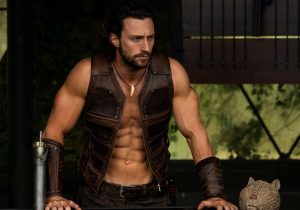
The problem with these Spider-Man-Minus-Spider-Man movies is making people get interested in the famous web-slinger’s rogues gallery. This usually means treating the character’s best known for trading punches with another hero as their own individual anti-hero, complete with a more villainous villain for our future villains to have to topple. Usually these villains (the actual individual movie antagonists, not the protagonists) are an imitation of our heroes (still referencing the future villains), the mirror version of them. So if your protagonist is going to be a vampire, then your antagonist is going to be a slightly more evil vampire. If your protagonist is an alien goo monster who likes to eat heads, then your antagonist is going to be a slightly more evil alien goo monster that likes to eat heads. You get the idea. However, you digest enough of these, and it all seems a bit too perfunctory, the main character having to defeat a version of themself. The main challenge is finding a way to make an audience care about these characters, and having them rescue a love interest or defeat a new-but-same villain with the implicit promise that maybe, if you’re patient enough, you might see them eventually try to murder Spider-Man, is not it. I’m not against the idea of giving these villains their origin tales, but it feels like in order to make them more palatable to a mass audience means they’re neutering the nature of these characters. The hypothetical future Sinister Six movie can’t all be six misunderstandings against Spider-Man.
Alas, Kraven is a real bore of an action movie even with its R-rating, the first for these Spider-Man villain movies. The added bloodshed and curse words don’t exactly make the movie feel more adult when we’re still dealing with plotlines like a super lion biting our hero and giving him super lion powers, much like the origin story of Spider-Man, or another villain suffering from a very silly and similar Amazing Spider-Man 2 Goblin-itus medical malady. This is not a serious movie in the slightest but that doesn’t mean it can’t be passably fun, but everyone is just so dour and passionless that it drains all entertainment. At least Madame Web was perplexingly interesting with its bad decisions. There’s such little energy to be had through the middling two hours. Kraven is gifted superhuman powers and he uses them to hunt down bad men and big game poachers, becoming let’s say Captain Planet if he watched nothing but Charles Bronson movies. There’s got to be an exciting movie there, or at least a more interesting one than what we eventually got here. It’s hijacked by some pretty rote family drama of a bad dad who was too hard on his kids and rescuing a kidnapped little brother who he feels guilty about leaving with the bad dad after Kraven got his new powers. The family drama is pretty rote and uninspired, with both of the other characters kept to the sidelines for most of the movie, which makes it hard to care that much about either of their impacts. The haphazard integration of a romantic subplot with Calypso is even more perfunctory when I would much rather see Kraven fall in love with a lion instead.
 I like J.C. Chandor as a director, and he’s someone who leaps at new challenges. His debut movie, 2011’s Margin Call, was an engrossing character piece about Wall Street traders and execs on the verge of the 2008 financial meltdown. It was so bare-bones that it was practically a play. His next film, 2013’s All is Lost, was the exact opposite: a movie completely told through visual storytelling and with a minimum of spoken words as Robert Redford tries to patch up his sinking boat. 2014’s A Most Violent Year was a slow-burn crime drama about the lengths people will go to escape their past and their nature. From there, Chandor has been circling larger studio projects, leaving 2016’s Deepwater Horizon and then replacing Kathryn Bigelow for Netflix’s action thriller, 2019 Triple Frontier. He’s a chameleon of a director and the only real point of interest I had with Kraven. What would he do in the superhero space? Well, the answer is not much. The visual flourishes we’ve seen before in other movies but without a sense of humor. Watching Kraven periodically run on all fours may make him more animal-like but it doesn’t look good. The movie gets lost in the convoluted mythology and rules of its characters and what they’re capable of, and so the action sequences feel cobbled together and short on imagination. The climax is during a stampede of buffalo but there’s no real danger here like dodging around the animals. They very conveniently allow space for our hero to fight his battle, thus becoming a thundering backdrop. Even if you’re overly generous, there’s not much here to excite the senses or even your morbid curiosity.
There is one line of dialogue that needs to be singled out for its absurdity. While Madame Web was ridiculed for its “researching spiders in the Amazon with my mother before she died” line, the filmmakers had the good sense to eliminate it from the final film, though not the good sense not to include it in their initial marketing. With Kraven the Hunter, there’s a character who talks about her mother and literally says, “She died and I never saw her again.” That’s usually how that works.
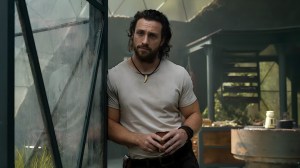 As the final piece of Sony’s Spider-Man villain spinoff universe, Kraven the Hunter brings this diversionary superhero franchise to a merciful end. The frustrating thing is that Kraven as a character can work, as recently demonstrated in the popular Spider-Man PlayStation video game sequel. He’s supposed to be the ultimate hunter, a force of nature, but that doesn’t mean he needs to carry his own movie, just like Morbius or Madame Web or any other Spidey villain. Launching these characters could have worked but needed much more imagination and care. Instead, it was Spider-Man movies without Spider-Man and, with the exception of the Venom movies with their goofy buddy movie appeal, audiences have responded with the indifference you would assume. It’s not enough for these movies to merely be adjacent to Spider-Man to be appealing. They need to be good, to be able to stand on their own, and to support an extended time with this character. It’s hard not to see the larger machinations for eager franchise-extension as the primary motivation. But if these are the impressions of the characters we’re getting, who would want any more? Turns out nobody was actively cravin’ another underdeveloped and mediocre superhero movie.
Nate’s Grade: C-


 nathanzoebl
You must be logged in to post a comment.