Category Archives: 2023 Movies
Guardians of the Galaxy vol. 3 (2023)
 It’s taken me longer to review the third, and reportedly final, installment of the Guardians of the Galaxy trilogy because I didn’t think that I nor my family had the emotional bandwidth when the movie was originally released to herald the summer. I’ve been a big fan of writer/director James Gunn’s comic book escapade efforts with the Marvel Cinematic Universe (MCU), as well as his first DC entry, 2021’s The Suicide Squad, the best DC film of the new era, so I’ve been highly anticipating a third Gaurdians ever since the second ended six years ago. Of course all fans have had to wait a little longer after Disney fired Gunn in 2019 for offensive social media posts they already knew about before the first Guardians film in 2014, and then they came to their senses and re-hired one of the most unique voices working within their giant sandbox of superheroes. The reason I decided to wait even longer is because I had been warned by many of my critical colleagues about the heavy thematic nature of the third entry, namely the frequent sequences of animal abuse. My family had to put down their household dog of over ten years in late April, and having to re-open that wound by watching pretend animals get abused was not the best for any of our emotional states. And so I waited until it was available on digital and in the comfortable sanctity of my home, and I alone in my family watched Volume Three, partly as a harbinger of future warning over what scenes to skip over for them. It’s a fitting end to a strange and funky series of movies that taught us to feel real emotions over racoons and trees, and even though I’d rate this as last in its respective Guardians standing, it’s still a winner and a topical reminder that these big-budget blockbusters are only ever as good as when the passion is evident.
The Guardians are on a mission to save their friend, Rocket (voiced by Bradley Cooper). He’s been incapacitated and is sought after by his creator, The High Evolutionary (Chukwudi Iwuji), a maniacal man with a god complex who is trying to create a perfect life form. This forces the Guardians to learn more about Rocket’s tragic past as a cruel science experiment, and it brings back Gomorrah (Zoe Saldana), though she’s not the same woman who fell in love with Peter Quill (Christ Pratt), and he’s having a hard time reconciling the different green girls. They’ll have to work together to rescue Rocket and stop the High Evolutionary from further harm.
 This is a movie built around the back-story and emotional connections of Rocket, a character that, prior to Gunn’s first film, had fewer than a dozen comic appearances but has had an outsized influence over the movies. If the first movie was about the formation of our team, and the second was deepening the supporting characters, as well as exploring Quill’s daddy issues, then the last movie is all about how we say goodbye to the ones we love. Volume Three is clearly structured like Gunn’s fond farewell for these characters rather than merely a pause in their contractually obligated appearances (whether Marvel overrules Gunn is another matter). It makes the interaction more meaningful and also more emotionally rich, not just because certain characters might perish, but because of the journey we’ve been privileged to hop along for, how far they’ve come and how much they matter to others, and by extension us, the audience.
Case in point: the emotional evolution of Rocket Racoon. He began as a surly visual joke, a teeny mammal with a big gun and a big attitude. It wasn’t until a drunken outburst in Volume One that you got a glimpse of the trauma and pain beneath that antisocial demeanor. With Volume Three, he gets sidelined pretty early, which means the majority of the time we spend with Rocket is through a series of flashbacks with baby Rocket and his cute pals, all ongoing science experiments (one needs only to recognize the absence of these childhood friends as grown-ups to anticipate where this is inevitably heading). In some ways, it is cheap and manipulative. It’s not hard to make an audience feel extreme emotions by introducing a slew of adorable animals as well as a villain who hurts them and sees them as expendable experiments undeserving of sympathy. I wish Gunn hadn’t gone so hard in this direction because it feels excessive in the ideas that the film bluntly communicates. Yes, a storyteller will need time to establish a baseline of relationships, conflicts, and looming change, but do we need six or seven flashbacks to settle the concept of animal testing and animal cruelty being a bad thing? I credit Gunn with making his thematic intent unambiguous; this is wrong, and you will feel it explicitly. However, sidelining Rocket for a majority of the movie and having characters project onto his unconscious body, while providing more insight through a system of excessive and heavy-handed flashbacks, might not be the best model for ensuring this character gets his due when it comes to this showcase. Quill keeps calling Rocket his “best friend” and I’m trying to remember when this happened. I re-watched Volume Two this summer, and now consider it the best of the trilogy, and I cannot recall the specific events that bonded these two bickering alphas into inter-species BFFs.
 Another facet of Gunn’s relevant themes is personified in the romantic realizations of Quill. Not to get too complicated, the current Gomorrah is a past version of herself and not the one who joined the Guardians, fell in love with Quill, and died in Infinity War. She’s back, but from her perspective she never left, and this moon-eyed dolt keeps projecting his feelings onto her. I respect that Gunn doesn’t try and wave away this complication, nor does he mitigate the agency and importance of this Gomorrah not having to follow the same path as her predecessor. The easy thing would have been for Quill to wait and for this new/old Gamorrah to see the same qualities that made the old/dead Gomorrah fall in love. It would be like one of those soapy romances where a person suffers amnesia and gets to fall in love with their spouse all over again. Gunn doesn’t do that. These are different people, and despite the aching desire of Quill to rekindle what he had, it has been lost, and this needs to be acknowledged and accepted. “I bet we were fun,” she says, and it’s a bittersweet summation that extends beyond the Guardians.
There is still Gunn’s signature sense of style and humor while checking the boxes of a big-screen action blockbuster. There’s an infiltration set piece that plays like a goofier Mission: Impossible setup but in a squishy bio-mechanical facility that reminded me of the eccentric and schlocky sci-fi diversions personified in the Lexx movies and TV series. There’s an entire planet of animal-human hybrids that feels wasted as further proof of the High Evolutionary’s already established evil. The entire character of Adam Warlock (a beefed up Will Poulter) is a himbo that definitely feels lacking in larger purpose now that the Infinity Era is over. There is one signature action scene involving a protracted fight through a crowded hallway, and it’s exciting and fun. The jokes are mostly contained to sardonic banter, which can be hilarious depending upon the combination of characters, though it also can be grating when it feels forced, like Mantis (Pom Klementieff) and Nebula (Karen Gillan) butting heads. The celebrated dad rock soundtrack has moved onto 90s and early 2000s music, and as a 90s kid, it gave me a personal nostalgic lift watching scenes jamming to dreamy whoo-hoo alt-rock acts like Radiohead and Spacehog and The Flaming Lips.
 This also might be the grossest MCU movie yet, and not just from the animal abuse but a face-peeling scene that will startle most. I had to pause the screen and drag my 12-year-old stepdaughter into the room with the promise, “Want to see the grossest thing ever in a Marvel movie?” She agreed that it was indeed that. It’s reassuring that no matter the budget, Gunn’s sensibilities that make him the unique storyteller he is, the same man who began with Troma, will be there. Though this point also concerns several of my friends wondering if Gunn can abandon these silly and schlocky tendencies to tell an earnest and tonally appropriate tale for his 2025 Superman reboot.
Guardians of the Galaxy volume 3 is the end of an era for Gunn and for the MCU. As the new head of the DC film and TV universe, it’s unlikely he’ll be lending his talents to Marvel any time soon, although the characters he made us fall in love with could carry on. Gunn clearly loves these characters, and especially identifies with Rocket, the angry malcontent lashing out in pain, so it’s fitting to give this character the big stage for a final outing, and if he can throw in some animal cruelty messaging along with silly humor and pathos, then so be it. This practically feels like Marvel is giving Gunn even more leeway as an apology for firing him. The Guardians trilogy stands out from the prolific MCU assembly because of how much Gunn has personalized these movies to make them special. They have permission to be weird, to be heartfelt, and to be reflections of their idiosyncratic creator, a much more benevolent force than the High Evolutionary. Perhaps there’s even a parallel to be drawn there, a filmmaker trying to endlessly tinker with their creation in the futile pursuit of perfecting it whereas the imperfections and rough edges are often the lasting appeal of a movie. I don’t know if the MCU will contain a series quite like this again, and that adds to the feeling of this serving as a farewell. It was a fun, messy, ridiculous ride, and it was all Gunn.
Nate’s Grade: B
Share this:

Asteroid City (2023)
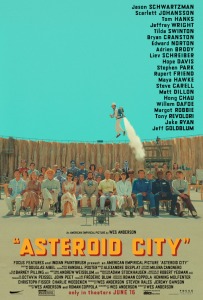 It’s not a good sign that a week after watching a movie I was racking my brain to try and remember what I had watched, and it’s even worse when it’s a movie by Wes Anderson, a filmmaker with such a distinct sense of intricate style it’s now become a go-to A.I. test for untalented people. Asteroid City has the makings of an appealing comic escapade set in a Southwest small town known for its tiny asteroid, and once aliens make their presence known, the entire town and its tourists and wanderers and scientists are quarantined. The problem comes almost immediately, as the movie is presented through several added layers of obfuscating framing devices. The story itself is a play, and we’re watching a movie version, but then also the play of the movie, and the behind the scenes of its now-deceased playwright toiling with his authorial messages and stubborn actors, and it feels like two different movies at odds with one another. The Asteroid City sequence is the more engaging, with some sweet storylines like Jason Schwartzman as a widower processing loss with his family, including his father-in-law (Tom Hanks) who never liked him, while beginning to find a possible romantic kinship with a struggling actress and single mom (Scarlett Johansson). I enjoyed weird little asides about the history of this little town, like a vending machine for land ownership, and s science fair with brainy whiz kids finding their own comradery. There’s even a nice moment in the meta-textual framing where the Schwartzman actor recites an exorcised dialogue scene with the actress who played his deceased wife in the play. It’s elegantly heartfelt. However, the added layers don’t really add extra insight or intrigue but serve as muddy trappings, making meaning less likely rather than more. It feels like Anderson didn’t have enough material with the central story so he added on the meta to make up the difference. There are too many moving pieces and too many characters, and versions of characters, here to settle into something grander. The whimsy and visual style of Anderson is still evident throughout every highly-crafted and pristine arrangement in the movie, so if you’re an Anderson diehard, he still has his charms. This is two Anderson movies in a row that felt disorganized, distracted, and chiefly under-developed, and I’m starting to worry that the form has taken over the function as storyteller.
Nate’s Grade: C+
Share this:

Gray Matter (2023)

As a lifelong film fan, I’ve always been fascinated with the trials and tribulations of the many seasons of Project Greenlight. It began in 2001 as a contest shepherded by Matt Damon, Ben Affleck, and irritable producer Chris Moore to select the best submitted script and turn it into a movie. The process would also be documented at every stage by TV cameras for an HBO documentary series, but this is an organization defined by its chaos and mistakes, which make for spellbinding schadenfreude television and rather disappointing movies. Each season tried to retool. Season one winner Peter Jones was more a writer than a director and not fully ready when he was thrust to also direct his winning script, so season two had separate submissions to select a winning writer and a winning director to pair. Season three realized that the coming-of-age indies of the first two seasons (Stolen Summer, The Battle of Shaker Heights) didn’t exactly ignite the box-office, so the intent was a more commercial genre script, which ended up becoming the monster siege thriller, Feast. Season four, coming nearly ten years later, decided that the commercial script needed to come from a more trusted and studio-backed source rather than amateurs. That source: Pete Jones, now having become a co-writer to some Farrelly Brothers comedies. That season only sought to select a director, having now completely ditched the screenwriting aspect from the start of the contest, but the winning director ditched the approved script to make a middling comedy feature of his own short film (The Leisure Class). Now, many years later, HBO Max (or now just… Max, because somebody thinks “HBO” lacks brand value) has rebooted Project Greenlight, again, and has another more commercially-minded script to serve the eventual directing winner, this time among a team of ten female finalists. So after twenty years and five movies, what has Project Greenlight proven? Good TV doesn’t mean good movies.
Gray Matter will forever be known as “the Project Greenlight movie,” and if it wasn’t for that series, we wouldn’t be seeing this movie because it’s so generic and underwritten, which, having spent the day binging through the new Greenlight season, are the same problems that all the many producers were complaining about with the script. Well, you folks picked this script, right?

Aurora (Mia Isaac) is a 16-year-old who just wants to feel like a normal teenager. Her mom, Ayla (Jessica Frances Dukes), is afraid she won’t be able to defend herself in this scary world. They’re a mother-daughter psionic duo, exhibiting mind powers. After a tragedy away from home, Aurora finds herself in a weird complex run by Derek (Garret Dillahunt), a mysterious authority figure who says he’s trying to find all the psionics he can to help them better understand their unique abilities. Aurora suspects her captors don’t really have her best interest at heart.
That plot description above sounds like a hundred other YA-tinged stories, from The Darkest Minds to Firestarter to the X-Men TV show The Gifted, which also co-starred Dillahunt. It’s a fine starting point but the story and characters need to find ways to better personalize this formula, and that’s where Gray Matter falters. It’s all too surface-level, from the mother-daughter relationship, to the determination of Ayla, to the self-actualization of our teen. It’s not that you’ve seen it before, it’s that you’ve seen it before much better in so many other stories.
The story pieces are present that can be developed for a more engaging and character-centric sci-fi drama. There is potential here. I think more could be made about Ayla’s past connections to this psionic complex, but instead of being offered to co-chair it as an administrator, it would have been more interesting if she had been younger, a pregnant teen, and her unborn baby was the course of great speculation for the facility, especially being the child of two psionics. This would add an extra layer of urgency why Ayla felt she had to leave as well as why Aurora would be more coveted than other psionics. It could also easily explain why Aurora would be more powerful than any other psionic. It would also personalize the sacrifice of Ayla as well as her paranoia about the lengths they will be hunted. We needed more time with Ayla as a character because once the daughter gets kidnapped around the Act One break, she’s seen more in flashback and fantasy sequences than reality. If this is going to be the emotional core of the movie, then we need to flesh out the mother and the scenes between them. As demonstrated in the movie, Aurora is here to push her daughter, tell her she isn’t ready, then restrict her but also not really restrict her, as Aurora seems to sneak out every night to meet boys. If this woman is so paranoid, why is she alternating between being a strict gatekeeper and a free-range parent? It didn’t make sense. She’s keeping her child out of school and the public and constantly moving, but hey, go ahead and fraternize with these teenagers supposedly behind my back?
It’s also a shame that our protagonist is such a boring blank. The puberty/super power allegory has been prevalent for decades, but for a movie that literally spends so much of its time inside the mind of its main character, she’s unfortunately too underdeveloped and unexplored. She’s just kind of present for too many of her scenes rather than an active participant. This is partly from the nature of the script, where Aurora has to learn about her powers and the history of psionics, but why does the first act of the movie resort to repeating this exposition? We have one scene where mom is explaining powers and what’s at stake, and then twenty minutes later we have another scene of Derek explaining powers and what’s at stake. The biggest problem with Gray Matter is that its central character feels like an afterthought of a simple yet empty empowerment message. It’s about a young woman coming into her own power, externally and internally, but it’s also expressed under such generic terms. What do we know about Aurora? She wants a “normal life” but what does this constitute? Does she resent her mother’s rules? Has she rebelled in the past? What really animates her? What is her sense of purpose? I don’t know, which diminishes all the sequences of her running in terror, and that dominates the middle hour. I wish the script had started with her sneaking out, hanging out with these kids who consider her “that weird homeschool girl,” and then when things go wrong we have to learn with what we see rather than sitting through multiple people trying to explain the world and rules. It would be a better shock when things go wrong, and the added time would allow more breathing room to try and flesh out Aurora before she’s defined by her powers.

Another aspect that needed further re-examination was the nature of the psionic powers. The plot needed to better define the rules of these powers, which are quite varied. We begin with the powers mostly being telekinetic, the ability to move things with one’s mind. Then it jumps into telepathy, the ability to speak through one’s mind, then read the minds of others, then project mental structures, then working all the way to teleportation. There is a good scene where Derek is impressed by Aurora’s ability to hide her thoughts with a false setting construct, and I enjoyed him pointing out the giveaway details, like a character reading a book that is only ever the same page. That was a smart scene that better visualized the powers. However, the characters talk too broadly about the powers in sweeping proclamations. I think the movie could have improved had the story ditched more of the powers and settled down on one, with Aurora having the ability to manifest more than one power being a sign of her extraordinary identity.
As a low-budget genre movie, Gray Matter looks like a professional movie and has good actors doing their best. Debut director Meko Winbush has made a genre movie that looks practically indistinguishable from other disposable Hollywood genre thrillers, and maybe on a sliding scale, feeling and looking like a generic sci-fi thriller might be a success in the history of Project Greenlight. But I doubt all the many people who lent their labor and names to this project were hoping for it to be on par with a forgettable streaming entity eventually crushed by a library of content. Winbush presents enough visual polish that could lead her to future work, something that has also plagued many of the director winners from seasons past (Jason Mann, the season four winner, has one feature credit after The Leisure Class, serving as DP to a 2019 Slovenian movie). It’s hard to feel what exactly people could get passionate about with Gray Matter, and they just waited for a rewrite to supply all the missing emotional engagement and introspection and fun that was absent. Once again, the finished film ends up being a disappointing season finale to a train wreck of reality TV.
Nate’s Grade: C
Share this:

Sound of Freedom (2023)
 The surprise of an otherwise underwhelming summer at the box-office, so far, has been an indie movie made for only a fraction of the bigger studio fare. Sound of Freedom is an action drama originally filmed in 2018 and even resorted to crowdfunding for post-production assistance, so you’d be curious as to what about this movie is making it the hot commodity in 2023? Well, the answer is both uplifting and also dispiriting, with good intentions running against possible bad faith. However, as an action drama chronicling the ills of human trafficking, it’s pretty mediocre genre stuff and indulges too often in wallowing in the danger of these innocent children under the guise of raising awareness of a pertinent problem that too many may unfortunately misconstrue.
Reportedly based on the experiences of Tim Ballard (Jim Caviezel), a former Homeland Security agent who was tasked with breaking up child-trafficking rings. He even goes undercover to bust skeevy mustachioed pedophiles looking to meet up with buyers, which causes obvious physiological distress and a strain on his marriage, although his wife seems saintly (played by Mira Sorvino, who is only here briefly to urge her man on). A Honduran brother and sister are sold through the front of a child beauty pageant into sex slavery, and after rescuing the brother, he’s determined to reunite the siblings. His efforts lead to Ballard quitting his government job and going to Columbia to try and rescue the children being held as commodities by gangs.
 Allow me to be a little glib, dear reader, as I summarize what the plot of Sound of Freedom boils down to. Here goes: the movie quickly establishes sex trafficking as bad. Not hard. Got it. Our hero sees this and says, “This is very bad. I should do something.” The government says, “This is very bad. But what are you gonna do, you know?” Then our hero proclaims, “I can do something,” and the government brass says, “Well, we don’t know if you should,” and then our hero declares, “Well, I’m gonna!” Then he infiltrates the trafficking ring and reunites a little girl with her brother, and by the end we all learned a valuable lesson that human trafficking is very bad. The end. Now, yes, when you reduce any movie to its most essential plot points, it can feel reductive and like you’re missing something (Star Wars: farm boy leaves home, has adventure with hermit, saves princess), but there isn’t anything more to this Sound of Freedom than any of the Taken movies. It’s not exactly illuminating though it feels very sincere in its convictions.
As an action movie, there sure is a deficit of action to go on for a movie pushing two hours. There’s a climactic rescue but the majority of this movie is the overly simplified journey of trying to find one missing girl. Criminal procedures can be intriguing when there’s a real sense of continuity and progression, chasing down leads, connecting the dots, building the case. It can be invigorating when done well by smart people, like in 2012’s Zero Dark Thirty or the more recent true-life tale of exposing the murderous subject of 2022’s The Good Nurse. With Sound of Freedom, the problems are too easily overcome and the details are minimal. A lot of the breakthroughs are reliant upon chance.
Sound of Freedom feels like a professional action movie, with grimy cinematography and a mournful score, but there’s too little else going on here that is unknown to a general audience. It’s all pretty straightforward and yet sludgy with its overwrought pacing. This is a slow burn of a movie with an obvious end point manufactured for audience uplift, with Caviezel appearing as himself during the end credits to plead for others to donate to the cause and buy tickets for others for the “Uncle Tom’s Cabin of the twenty-first century,” which is what many are doing and donating them to others or passing them off to strangers.
 There is one moment that I thought was unexpected, where reliable character actor Bill Camp (The Queen’s Gambit) plays an ally to assist Ballard in putting together a fake sex trafficking palace for pedophiles (this is much of the last act). Camp plays a businessman who indulged in the illicit excess of power until one fateful sexual encounter with a prostitute that he believed to be in her mid twenties. He’s sickened by the revelation that she was only fifteen years old, and this causes him to have a moral shakeup of his behavior, his complicity, and the entire system of wealthy and powerful people indulging in vices that leave others trapped in cycles of violence and degradation. It’s a potent moment that I wished that Camp’s character was the actual protagonist, a character with flaws trying to overcome a shameful past and do some measures to rectify change. That’s a more interesting starting point than a stoic yet familiar action hero who is defined by his dedicated calling to save the lives of children.
Nobody needs much persuasion to believe that sex trafficking is a definite bad thing, and yet the movie spends so much time wallowing in the grotesque terror of its captive children. It’s one thing to highlight the harsh reality of real-world trauma, but it’s another thing to keep going back for dramatic weight not provided through the rest of the movie. It’s hard to watch young children, gasping and crying, knowing they are likely minutes away from being abused, but why go back to this repeatedly? Did they think the audiences forgot what was happening? Because there is so little else to this movie, plot and character-wise, the frequent stops to watch kids in horror right before being abused are galling, and not just for the intended artistic purpose. Too much of Sound of Freedom is watching a grief-stricken dead-eyed Caviezel gravely intoning, “How can we let this happen?” intermingled with prolonged scenes of terrorized children. It feels too exploitative and gross. I recognized it as a cheap emotional cudgel, and one I didn’t appreciate considering the film’s intended message about the well-being of children.
Here’s where I think the movie’s good intentions run up against the reality of trafficking. The far majority of people who are victims of sex trafficking are not being abducted in public by foreign strangers, they’re not being grabbed at Target stores or somehow hidden in Wayfair furniture (this specific and moronic conspiracy theory was propagated by Ballard as well, sigh); instead, the common perpetrators are friends and family. Often it’s low-income parents with significant substance abuse issues who, in desperation, resort to the most cruel outcome to resolve their addiction. The far majority of trafficking victims are in their teens, seventy percent between 15-17. Victims are also often members of the LGBTQ community who have been kicked out of their homes, and some of these victims resort to trading sex for their own survival. Victims are often those seeking out relationships because of abuse and neglect at home and those coercive relationships then transforming into trafficking. The reality of human trafficking is a lot more complex. It is a worthy topic of imminent concern, but it’s not scary brown-skinned foreigners coming to steal your unsupervised babies. It’s not a cabal of Democrats wanting to drink the blood of children for its power (this specific and moronic conspiracy theory was propagated by Caviezel as well, sigh). The problem with crusading against sex trafficking is when your concept of the topic does not match the reality of the problem. It’s this sensationalized boogeyman, and not knowing the actual reality of the problem will only lead to misapplied solutions for a different reality. Also, the far majority of human trafficking is with labor trafficking, which will be much easier to succeed by lowering the age of child labor in certain states, so there’s that too.
 By every objective measure, Sound of Freedom is a hit. The movie cost $14 million and has already grossed over $50 million at the U.S. box-office. While part of this is a campaign for people to buy tickets to then give away to others, the tickets are still purchased regardless of whether the seats are filled in their entirety. Many people have been inspired by the movie and its heroics, and far be it from me to deny them their uplift. I was let down by the deficiency of the find-and-rescue plot details and the sludgy pacing. I was especially put off by the excessive time spent exploiting the terror of abused children for unnecessary drama. Obviously the subject should make anyone feel uncomfortable, and sex trafficking is a very real evil that everyone should be able to condemn, but there needs to be more to this movie than reminding you that sex trafficking is very bad. I will credit Sound of Freedom with not depicting any specific pernicious QAnon conspiracies, but there’s significant overlap between that community and the audience for this. As a genre exercise, it’s kind of dull. As an expose on human trafficking, it has potential but skirts complexity for the finality of a feel-good mission with clear cut heroes and villains. There are obvious good intentions here wanting to highlight a worthy cause, and that might be enough for many viewers who can coast on the slick production values and overall stoicism.
Nate’s Grade: C
Share this:

Robots (2023)
 Robots takes the romantic comedy genre and adds a dash of science fiction satire. Charles (Jack Whitehall) is a sleazy womanizer who likes to use his robot double, named C2, to put in all the getting-to-know-you effort with dates so then Charles can jump in for any later physical intimacy. Elaine (Shailene Woodley) uses her robot double, named E2, to bilk dumb men out of money and gifts. Then one day Charles and Elaine meet cute at an ice skating rink and begin a relationship. She doesn’t know Charles is really C2, and he doesn’t know Elaine is really E2. This confusion is cleared up when E2 and C2 run away together and abandon their human selves. The real Elaine and Charles must work together as they cross the country to find and regain their robots before they cause trouble.
Where Robots goes wrong is with its clunky execution, as its promising premise succumbs to gassed rom-com cliches and some tonally confounding comedy, when it does remember to be a comedy. It’s a given that our two human characters, or at least the flesh-and-blood versions, will grow closer together over the course of their road trip to find their runaway mechanical selves. This unique situation pushes them out of their comfort zones and allows them to better open up. The possibility is there to even follow a strict rom-com formula and still be satisfying, if the romance felt organic and charming. It does not. If anything, the movie uses your knowledge that these two will likely fall in love against you, speeding through the process with haste. The movie’s idea of romance consists of a montage sequence where our two characters laugh, get drunk, and hang out in a hotel room. It’s like the screenplay zapped over the actual development of the romance, the moments where one character saw another differently, where the initial conflict began to thaw, so what we’re left with feels hollow and artificial. The actual robot versions have a stronger bond than their human counterparts (I’m sure this is part of the joke). I didn’t care about our romantic couple because the movie itself didn’t seem to care enough about them to develop their romance beyond the basic framework of convention.
 The comedy and commentary can also be very off-putting and incongruous. The premise deserves more scrutiny, either by the characters or the script itself. These two people are duping their prospective dates, one for money and the other for sex, and the movie just kind of shrugs about using robotic slaves for manipulative gain. I assume the filmmakers wanted to keep things light, but there’s at least more comedy to be had from the bad things these bad people made their innocent robots do for them, even a point of arguing who is the worst person. If they’re bad people, then dig into it. The movie also dispels with the contrasts between the couples too quickly. The screwball romance ramifications are ditched too early to send Charles and Elaine on their mission. When your premise has mistaken identity programmed front and center, you would think the comedy would take full advantage of this and escalate to farcical levels. Nope. There isn’t even anything approaching the cringe comedy co-director/co-writer Casper Christensen (Klown) is better known for. The humor is stuck on broad slapstick and easy jokes that confuse vulgarity with instant comedy. Robots includes a video of C2 and E2 committing a mass shooting. The plot purpose of this is for the robots to vilify their human identities and to force them to hide from the public out of fear of being caught, but why an implied mass shooting, especially in this day and age? Why not have them rob a bank? The purpose is to commit a crime and publicize themselves to make life harder for their humans. It’s too blunt a choice to work.
Likewise, the political commentary that pervades the opening is completely absent throughout the rest of the movie. We open with a buffoonish U.S. president celebrating the construction of a border wall with Mexico, never mind that it’s easy to slip through. Unexpectedly, the cry of “them Mexicans took our jobs” has now been replaced by “them robots took our jobs.” You would think there would be ample room here for satire on the economic struggles of Americans, the salivating exploitation of big business, or even the xenophobia that often coincides with economic distress. Any political commentary is done away with after this opening. If offices can just have robot doubles doing all the boring drudgery, then what does that do for human interaction? Surely businesses would prefer workers who technically lack human rights and never need to eat or sleep. The screenplay gives us one character to discuss any of these topics, an obnoxious best friend (Paul Jurewicz) to air out his hatred of robots. There’s also another character that serves as a plot convenience for how our two leads got their doubles. Other than that, the world seems oddly absent from any significant cultural shifts from robot inclusion. Part of this is the convenient plot point that “personal use” robots are outlawed, which again you would think would produce more conflict with our pair having to hide their ownership. Mostly though, it feels like the writers just didn’t think through how their world would be different in a meaningful way, which robs the movie of better satire, comedy, and simply ideas.
 What makes the movie mildly worth watching are the talents of its two leads. I wouldn’t exactly say Woodley and Whitehall have a spark-worthy chemistry, but both actors are professionals who have no qualms about getting silly in the name of comedy. Whitehall (Jungle Cruise) is amusingly droll, and while his deadpan can be hilarious, it can also sap the energy of certain scenes. Still, he’s an enjoyable performer who has fun playing a louse. Woodley (Divergent) isn’t exactly the actress you’d think of for broad comedy but she has great fun playing the different versions of her character and tweaking sexist male fantasies. Both of these actors are good with the material that they’re given, so it makes you even more wistful about what could have been with even better material for them to really shine.
Robots is a comedy that could use more comedy, a romance that could use better romance, and a social satire that seems to forget pretty suddenly what it’s satirizing. That’s quite a surprise considering one of the co-writers/co-directors has both Borat films on his resume. It feels like a poorly developed episode of Black Mirror; however, I know I’m in the minority on this one, I find the majority of Black Mirror episodes to have intriguing premises that go nowhere. So, by that assessment, it is a Black Mirror episode. The actors are enjoyable and some of the jokes land, but you’re mostly left wondering what could have been from this wasted premise. The whole enterprise just seems to run out of ideas and energy and inspiration halfway through, stranding good actors and a fun premise in a movie that needed more beta testing to be its best version.
Nate’s Grade: C
Share this:

Nimona (2023)
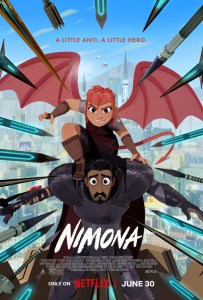
Based on the graphic novel by ND Stevenson (She-Ra), itself a web comic from 2012-2014, Nimona was developed by Blue Sky Animation Studios and originally scheduled to be released in 2020, and then Disney bought Fox, shut down Blue Sky, and pushed back against the gay content of Nimona before just canceling it altogether in 2021, and then Netflix came in and saved the project and released it, gay and all, during the last day of Pride Month. It’s been a long, protracted journey for Nimona to get to your screen and, reader, it was worth it. The movie is a rambunctious and revisionist fairy tale that is both subversive and deeply sincere, enough so that an emotional confrontation of accepting someone on their own terms elicited genuine tears on my part (for those keeping record, that’s three straight animated movies in the month of June that caused me to cry). Nimona (voiced superbly by Chloe Grace Moretz) is a high-energy prankster in a fantasy world melding Medieval culture with future technology. She befriends a fellow outsider, Ballister (voiced by Riz Ahmed), after the kingdom views him as a wanted villain. Together, they try and clear Ballister’s name by finding the real killer, and maybe they can wreck some stuff too just for fun. The cell-shaded style, a familiar aesthetic in the realm of video games, adds a bright and slickly appealing quality to the animation, and the frenetic pace and anarchic humor keep the movie bristling with entertainment, while the emotional core (vulnerable outcasts finding community) sneaks up on you and delivers a more resonating climactic finish than simply vanquishing a baddie. The ending even has rich thematic notes of The Iron Giant, which is never a bad influence. The queer content is also treated without sensationalism and treated as any other aspect of human compassion. The heart and message are just as impressive as the visuals and the humor. Nimona is a funny all-ages adventure that deserves its big screen moment after its long gestation.
Nate’s Grade: B
Share this:

No Hard Feelings (2023)
 If you can get past the icky premise, No Hard Feelings might surprise you. It’s a raunchy, R-rated sex comedy with a very game Jennifer Lawrence, also a producer, giving it her all. The premise involves Lawrence playing a down-on-her-luck 32-year-old who accepts a wanted ad to help a rich couple who are concerned that their 18-year-old son Percy (Andrew Barth Feldman) is too inexperienced in the matters of women and romance. This leads to Lawrence broadly trying to seduce the awkward, introverted young man. The comedy is less related to set pieces and more on the changing relationship of the two leads, which leads to fewer highs but at least consistent, albeit mild, amusement. Lawrence is the headlining name but the real star is Feldman. His comedic awkwardness reminded me of Michael Cera, and his reactions and sputtering from the brassy, larger-than-life vamping from Lawrence were even funnier than the broad punchlines. There’s one scene where Feldman sits at a piano and plays a ballad version of “Maneater” by Hall and Oates, and it’s a terrific and sincere moment that further made me appreciate the range this actor’s range. He’s appeared in several Internet musical short videos, and with how big he can get, to watch him hold back with this character and find even more subtle laughs, it’s just allthe more impressive. No Hard Feelings is an adequate sex comedy that doesn’t break any new raunchy ground. I appreciated its conclusion that doesn’t feel the need to tie everything into tidy endings, and the age-gap is addressed throughout, with Lawrence feeling particularly out of touch with today’s teenagers. It’s a possible good time but with some reservations.
Nate’s Grade: B-
Share this:

The Flash (2023)/ Spider-Man: Across the Spider-Verse (2023)
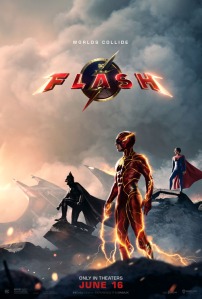
Released within two weeks of one another, two big summer movies take the concept of a multiverse, now becoming the norm in comic book cinema, and explore the imaginative possibilities and wish-fulfillment that it proposes, but only one of them does it well. Spider-Man: Across the Spider-Verse is the sequel to the Oscar-winning 2018 revolutionary animated film, and it’s a glorious and thrilling and visually sumptuous experience, whereas DC’s much-hyped and much-troubled movie The Flash feels like a deflated project running in place and coming apart. Let this be a lesson to any studio executive, that multiverses are harder than they look.
Barry Allen (Ezra Miller) has the ability to travel at fantastic speeds as his superhero alter ego, The Flash. He’s tired of being the Justice League’s errand boy and still fighting to prove his father is innocent of the crime of killing Barry’s mother. Then Barry discovers he can run fast enough to actually travel back in time, so he returns with the intention of trying to save his mother. Except now he’s an extra Flash and has to train his alternate self (also Miller) how to control his powers. In this different timeline, there is no Justice League to combat General Zod (Michael Shannon, so thoroughly bored) from destroying the planet for Kryptonians.

This is the first big screen solo outing for The Flash, and after none other than Tom Cruise, Stephen King, and James Gunn calling it one of the best superhero movies of all time, it’s hard to square how trifling and mediocre so much plays out as an example of a creative enterprise being pulled in too many directions. Miller was cast as the speedster almost ten years ago, and this tale has gone through so much tortured development, leaping through numerous filmmakers and writers, that its purpose has now gone from being a pillar of the expanding DC cinematic universe began with Zack Snyder’s Man of Steel in 2013 to becoming the Snyderverse’s death knell. The premise of traveling back in time is meant for Barry to learn important lessons about grief and responsibility and the limits of his powers, but it’s also intended as the reboot option for the future of these cross-connected comic franchises. It allows Gunn, now the co-head of the new way forward for DC movies and TV, to keep what they want (presumably Margot Robbie and Jason Momoa) and ditch the rest (Henry Cavill, Ben Affleck, Black Adam, Shazam, and Zack Snyder’s overall creative influence). So reviewing The Flash as only a movie is inadequate; it’s also a larger ploy by its corporate overlords to reset their comic book universe. In that regard, the quality level of the movie is secondary to its mission of wiping the creative slate clean.
Where the movie works best is with its personal stakes and the strange but appealing chemistry between the two Millers. It’s an easy starting point to understand why Barry does what he does, to save his mother. This provides a sturdy foundation to build a character arc, with Barry coming to terms with accepting his grief rather than trying to eradicate it. That stuff works, and the final talk he has to wrap up this storyline has an emotional pull that none of the other DCU movies have exhibited. Who wouldn’t want one last conversation with a departed loved one, one last opportunity to say how you feel or to even tell them goodbye? This search for closure is a relatable and an effective vehicle for Barry to learn, and it’s through his tutelage of the other Barry that he gets to see beyond himself. The movie is at its best not with all its assorted cameos and goofy action (more on both later) but when it’s a buddy comedy between the two Barrys. The older Barry becomes a mentor to himself and has to teach this inexperienced version how to hone and control his powers as well as their limits. It puts the hyper-charged character into a teaching position where he has to deal with a student just like him (or just him). It serves as a soft re-education for the audience alongside the other Barry without being a full origin story. The impetuous young Barry wanting to have everything, and the elation he feels about his powers, can be fun, but it’s even more fun with the older Barry having to corral his pupil. It also allows the character an interactive checkpoint for his own maturity and mental growth. Miller’s exuberant performances are quite entertaining and never fail to hit the comedy beats.

The problem is that the movie puts so much emphasis on too many things outside of its titular hero. Much was made of bringing back Keaton to reprise his Batman after 30 years. I just wish he came back for a better reason and had legitimate things to add. His role is that of the retired gunslinger being called back into action, and there’s an innate understanding with Barry wanting to go back in time and save his family, but too much of this character’s inclusion feels like a stab at stoking audience nostalgia (the callback lines all made me groan). I highly enjoyed Keaton as Batman and appreciated how weird he could make the billionaire-turned-vigilante, but he’s no more formed here than a hologram. The same thing happens with the inclusion of Super Girl a.k.a. Kara Zor-El (Sasha Callie). In this universe, there is no Superman, so she’s our requisite super-powered alien that Zod is hunting to complete his plans for terraforming Earth. She’s an intriguing character as a tortured refugee who has lingering doubts about whether humanity is worth the sacrifice, but much of her usage is meant only to make us think about Superman. She’s not given material to make her own impression, so she simply becomes the imitation of the familiar, the shadow to the archetype already being left behind. But these character additions aren’t even the worst of the nostalgia nods, as the final climactic sequence involves a collision of worlds that harkens to just about every iteration of the famous DC heroes, resurrecting several with dodgy CGI and uncomfortable implications (spoilers… the inclusion of George Reeves, when he felt so typecast as TV’s Superman that he supposedly killed himself because he thought his acting career was over, can be galling).
The action of The Flash is mostly fine but with one exceptional example that boggles my mind. In the opening sequence, no less, Barry is trying to help clean up a crumbling hospital when it collapses and literally sends a reign of babies falling through the air. I was beside myself when this happened, horrified and then stupefied that this absurd action sequence was actually happening. Barry goes into super speed to save the day, which more or less reverts the world into super slow-mo, though he needs to power up first, so we get a quick edit of him stuffing food into his face to load up on calories. We go from Barry breaking into a falling vending machine, stuffing himself in the face with snacks, getting the green light from his suit which I guess measures his caloric intake, and then grab a baby and literally put it in a microwave to shield it from danger. Just describing this event makes me feel insane. I figure the filmmakers were going for an over-the-top approach that also provides light-hearted goofiness to separate the movie from the oppressively dark grist of Snyder’s movies. However, this goes so far into the direction of absurdity that it destroys its credibility. It’s hard for me to fathom many watching this misguided and horrifying CGI baby-juggling sequence and say, “Yes, more please,” rather than scoff and shake their head. It’s not like the rest of the movie keeps to this tone either, which makes the sequence all the more baffling. There are Flash rules that are inconsistently applied to the action; Barry’s caloric intake is never a worry again, and the effects of moving a person during super speed don’t ever seem to be a problem except for one spewing gross-out gag.
While not being an unmitigated disaster, it’s hard for me to see the movie that got so many figures in the entertainment industry raving. The Flash has some notable emotional stakes, some amusing buddy comedy, and some goofy special effects sequences that run the gamut from amusing to confounding, but it’s also quite a mess of a movie, and too many of its nods to the fandom feel like empty gestures of nostalgia compensating for imagination. For all it gets right, or at least keeps interesting, it seems like another cog in a multi-billion-dollar machine, a stopping point also intended to be a reset and starting point. It feels like the character wasn’t trusted enough by the studio to lead his own solo movie even after years of buildup with Miller, nine seasons of the popular TV series, and 80-plus years of prominent placement in DC comics.
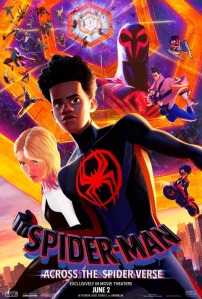
Conversely, Across the Spider-Verse is a sequel that expands an already stuffed story but knows what stories and themes to elevate so they don’t get lost amidst the fast-paced lunacy. Taking place a year later, Miles Morales (voiced by Shameik Moore) has grown into his role as the new Spider-Man for his world. He strains to meet the expectations of his parents, and keep up his grades, while fulfilling the duties of a superhero jumping into danger. When Gwen Stacey (voiced by Hailee Steinfeld) reappears to discuss joining the multiverse police, Miles jumps at the chance, having genuinely missed his other Spider friends, especially Gwen. There are countless Spider people in countless worlds, even including a Spider-T. Rex and a Spider-Car (Peter Parked Car, I believe the name was). Miguel O’Hara (voiced by Oscar Isaac) is the Spider-Man tasked with keeping order across the many interconnected multiverses, and he insists that sacrifice is essential to maintain balance, one that hits too close to home for Miles to abide.
The 2018 original is a hard act to follow, and while Across the Spider-Verse doesn’t quite overrule its predecessor it is a more than worthy sequel that has everything fans loved about the first trip. The visual inventiveness has been taken even higher, with the mixture of even more different animation and art styles. I loved seeing each Spider person and how they fit into their unique art style of their world, like the living water colors of Gwen’s world and the punky paper collage style of Spider-Punk (voiced by Daniel Kaluuya). There’s a villain that comes from a paper universe, so he resembles a three-dimensional paper construction with hand-scribbled notes appearing around him like Da Vinci’s commentary. There is something to dazzle your senses in every second of this movie. The visuals are colorful, creative, and groundbreaking with the level of detail and development. There’s probably even too much to fully take in with just one viewing. I want to see the movie again not just because it’s outstanding but so I can catch the split-second vernacular asterisk boxes that pop up throughout the movie. Going further into living comic book aesthetics, new characters will be introduced with boxes citing their comics issue reference point, and certain names and vocab will get their own citations as well. These are split-second additions, nothing meant to distract from the larger narrative. Simply put, this is one of the most gorgeous looking movies of all time, animated or live action. It’s bursting, thrumming, nearly vibrating with life and love stuffed into every nook and cranny, and it’s exhilarating to just experience a vivid, thriving world with animators operating at peak talent.

However, the movie has an engrossing story to better position all those eye-popping visuals. The worry with any modern multiverse story is that the unlimited possibilities of variations and opportunities for characters to do just about anything will overwhelm a narrative, or like The Flash, become a checklist of overburdened and empty fan service. The screenplay by Phil Lord, Christopher Miller, and Dave Callaham is all about relationships. If Miles’ relationship with his stern police lieutenant father (voiced by Brian Tyree Henry) wasn’t such an important focal point, then the emotional stakes of the movie would be meaningless. We see a relatable struggle from both sides, the parents trying to connect with their growing child and give him enough space to find himself, and the child who clearly loves his parents but doesn’t fully appreciate or understand their concerns. They worry about Miles leaving them and whether others will love and support him like his parents. Miles has to experience a wider world of possibility, but these experiences make him appreciate what he has at home, and what could be permanently lost. I don’t mind saying there were more than a few moments that caused me to tear up. I found Gwen’s storyline equally compelling, and her turmoil over keeping her secret identity and then coming out to her father was rather moving. The family bond resurfacing will get me every time, and the simple action of a hug can be as heartwarming and fulfilling as any romantic ode. Across the Spider-Verse makes sure we care about the characters and their personal journeys.

At a towering 140 minutes, this is the longest (American) animated movie ever, and it’s still only one half of a larger story. I knew ahead of time this was only the first part so as soon as we entered Act Three I kept gearing up for the cliffhanger ending. Every five or so minutes I thought, “Okay, this is going to be the end,” and then it kept going, and I was relieved. Not just because I got to spend more time in this unique universe but each new moment added even more to raise the stakes, twist the intrigue, and make me excited for what could happen next. I was shaking in my seat at different points, from the excitement of different sequences to the emotional catharsis of other moments. I cannot wait to experience this same feeling when the story picks back up reportedly in March 2024, though I fear it will get delayed to late 2024.
Even with the unlimited possibility of jokes and silly mayhem, the filmmakers keenly understand that it doesn’t matter unless we care about the characters and their fates. I am shocked that a goofy character I thought was going to be a one-scene joke, The Spot (voiced by Jason Schwartzman), could end up becoming the ultimate destroyer of worlds. I think this reflection nicely summarizes the impeccable artistry of Across the Spider-Verse, where even the moments or characters misjudged as fleeting or inconsequential can be of great power. It’s a movie that is full of surprises and thrills and laughs, all in equal measure, and a blessed experience for a movie fan. In the crush of comic book multiverse madness, Across the Spider-Verse is a refreshing and rejuvenating creative enterprise, one that builds off the formidable talent of its predecessor and carries it even further into artistic excellence that reminds us how transporting movies can be. If you see one superhero multiverse movie this summer, the choice should be as obvious as an inter-dimensional spider bite.
Nate’s Grades:
The Flash: C
Across the Spider-Verse: A
Share this:

Elemental (2023)
 The joke is how Pixar has taken its storytelling motif of examining The Secret Life Of [Blank] and showing what happens in our world when we just aren’t paying attention. We’ve had toys with emotions, bugs with emotions, fish with emotion, cars with emotion, robots with emotion, rats with emotion, and even emotions with emotions, so why not break things down to their basics and give the elements of carbon-based life their own emotions too?
In Element City, Ember (voiced by Leah Lewis) belongs to the fire community living on the outskirts of town, as the big city wasn’t built for their kind. The earth people, and water people, and air people go about their business while the fire people form their own thriving offshoot. Her father and mother came across the sea to give their baby a new life, and the family shop will pass over to Ember’s management when her traditionalist father thinks she’s ready. Her whole life has been about serving her family and trying to live up to their hopes and dreams. This gets more complicated when Wade (voiced by Mamoudou Athie), a water person and a health inspector, has to report her family’s shop for code violations. They work together to save the shop and also learn from one another’s cultures and differing perspectives, and then this unexpected friendship becomes an even more unexpected romance, but can elements so different stay together?
 I was pleasantly surprised at how enjoyable Elemental is to experience and how wondrous its visual presentation is to watch. It is a certifiable treat for the eyes, with so many dazzling colors and quirky but easily readable character designs. There’s a mixture of hand-drawn animation used as Spider-Verse-style accents that provides a pleasing element that allows the images to pop even more. I was never bored looking at a single second of this movie, and even with my theater’s 3-D presentation, the glasses didn’t darken the screen and lessen my overall enjoyment. By existing within a fantasy universe, it allows for every scene and every location to better inform you about this new world and its rules and highlights (fire baby carriages that are barbecue grills). This is a bright, colorful, and supremely enchanting movie to watch because, at least visually, it feels very well developed as far as its world building and atmosphere. What would a community of fire people tend to look like? What would their jobs be? What would their celebrations be like? Their heritage from the Old Country? Naturally, with any fantasy universe, you can nit-pick it to death with questions, such as why do people even bother wearing clothes in this world? What part of the exposed fire or water is observed as obscene? How exactly do these different communities have their offspring? What does air exactly eat for food?
Where Elemental really takes off is with its charming and affecting romance. It’s been a while since romance was at the forefront for a Pixar movie, since 2008’s WALL-E (a.k.a. the greatest Pixar movie). Now there are themes and resonance that go beyond the romance and also enrich it, like Ember’s personal conflict of being a first-generation immigrant daughter and upholding the traditions and wishes of her family at the expense of her personal desires, but the core of this movie is on the burgeoning feelings between Ember and Wade. The movie begins with them butting heads as two elements seemingly in conflict but it doesn’t exactly follow an enemies-to-lovers path. She runs hot and explosive with trying to keep things under control whereas he is deeply empathetic of others and wants to help them become their best selves. He accepts who he is, and the movie doesn’t equate his full-bodied embrace of big feelings as some point of weakness. It brings about laughs from exaggeration, the streaming rivers that burst forth from his eyes upon crying, but it’s his compassion and acceptance that challenges Ember for the better and helps her assert her sense of self. They’re good together, and Wade helps serve as a guide to the wider world for Ember as she’s been isolated her whole life. Their interactions are cute and heartwarming and elevated by pleasant vocal performances. I was drawn into their story and cared about their well-being, enough that I don’t mind sharing that I shed some water myself by the end (I guess this could also make some people mistake that I peed my pants, and I assure you that was not the case, dear reader).
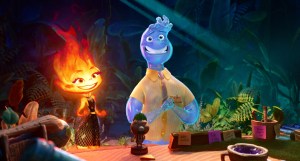 While the core relationships are poignant and winning, the world building and metaphorical allegories feel half-finished and a tad confusing. The movie also goes surprisingly soft exploring its miscegenation metaphor of two elements being forbidden to mix romantically. This universe has four communities of living elements, though air is represented as clouds and those are, literally, water vapor, and the xenophobia and discrimination that the fire people endure feels like a direct parallel to a disadvantaged minority group. However, this isn’t explored in any satisfying depth. We’re told that fire people aren’t really wanted in the city, and the city isn’t really built for them, which is typified by a rail line that splashes water discharge. There’s a lot more that could have gone into this including a more elaborate examination of the harm of red-lining and restricting the economic mobility of one group for bigoted reasons (I know, I can already hear people scolding me for even asking for such socio-political commentary in a family film). However, this metaphor gets a little murky when you take into account the literal danger that living fire exudes. Yes, you can drown, and you can get crushed under earth, but these creatures aren’t walking incendiary devices. This doesn’t translate directly to people, and thus applying class metaphors to actual races can be circumspect. Ember’s worry is that she’ll explode if she gets too angry, and this causes literal physical destruction around her. You can say it’s meant to represent when hurt, angry people lash out that they can inadvertently harm others, but not everyone can incinerate a block because they lose their temper. This kind of undercuts the lesson on misplaced fear.
Also, so much of the external story consists of bad public planning and everyone’s lackadaisical attitude toward fixing this infrastructure miscue. Again, if the larger point was a society that is actively hostile to the fire people, then the ignorant city planning that actively harms a disenfranchised group of people makes sense, but without that larger underlying conflict, it all seems so strangely forgotten. Much of this conflict is on the structure of a wall against a coming buildup of water, something possibly deadly to the fire community, so you would think this community would be a lot more concerned about this looming conflict. You might think that others would organize to provide better safeguards or maybe they would get the city’s attention. That this threat goes unreported and is played at such low stakes makes it all feel forced and manufactured. If the characters don’t seem to think it’s a big deal, then who are we to worry as well? And I can hear some of you trying to branch this out into, say, a metaphor for larger problems that go ignored, like climate change or societal inequalities, but that’s giving Elemental too much credit.
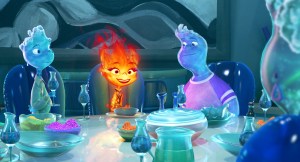 Elemental reminds me of 2020’s Onward, coincidentally one of the last movies I saw in theaters before the pandemic shutdown. I was worried that the core story looked weak but it was actually the world-building that was a bit hazy and under-developed and the emotional core was strong and authentic. It’s the same with Elemental, and while I can quibble about its dropped potential and misshapen world, it has a strong foundation that matters more. The relationships between Wade and Ember and Ember and her family are what makes the movie work and ultimately what made me smile and tear up. It’s an emotional nourishment that makes the movie feel satisfying and worthwhile no matter the lingering questions for this bizarre world. It’s also one of Pixar’s best looking movies, fully deserving of being seen on a large screen for added impact. Elemental has the right DNA for a charming and enjoyable family film for everyone.
Nate’s Grade: B
Share this:

Reality (2023)
 Reality is a film experience where the devotion to verisimilitude is at the sacrifice of drama. The dialogue is reportedly taken one hundred percent from the FBI recordings of their questioning of the preposterously named Reality Winner, played by Sydney Sweeney (Euphoria). She works for a branch of U.S. national security and smuggled a classified document and submitted it to journalists to expose Russia’s intent to hack U.S. voting systems in the 2016 presidential election. The movie takes place more or less in real time as two FBI agents (Josh Hamilton, Marchant Davis) come to Reality’s small home in Augusta, Georgia, begin a search, and question her duties, behavior, and security clearances at her work. We’re inundated early with mundane details of asking about dogs and yoga class coverage while FBI agents are raiding Reality’s home, and the movie doesn’t allude to what everything is about until halfway through. Again, strictly sticking to the script of the government encounter limits creatively where and what the actors can do, so the overall inert feeling is, I suppose, part of the appeal for writer/director Tina Setter’s movie, based on her stage play. I think some people will read the protracted build-up as unsettling in its stubborn ordinariness, or that withholding the juicy drama only makes the collateral mystery and suspicions stronger. Reality is an interesting story told in a frustrating and gimmicky fashion that lessens its dramatic impact. If I just wanted to watch actors re-enact the transcripts, I’d seek out a documentary. I’m thinking of something like 2012’s Compliance, based on a true story and told over the course of one day, but it was harrowing and made me have to watch with my fingers covering my eyes because of the grueling drama that would not look away. There are a few interesting visual quirks here, like actors blinking out of a scene when they say words redacted from the transcript, but mostly it feels too stage bound. Sweeney comes unglued in pretty convincing manner as her different defenses and obfuscations crumble through the interrogation. Reality is a well-meaning movie meant to better frame one young woman’s extraordinary actions through an ordinary lens, but I kept getting antsy for the movie to drop its gimmick and accept that there was more inherent drama in this story than what was going unsaid while we discussed yoga and dogs.
Nate’s Grade: C+


 nathanzoebl
You must be logged in to post a comment.