Category Archives: 2022 Movies
Purple Hearts (2022)
 When Netflix’s small-scale romantic drama Purple Hearts debuted during the summer of 2022, it over-performed and proved more popular than other much more high-profile Netflix releases at that same time, namely the headline-grabbing, and very bad, 365 Days franchise. Purple Hearts styles itself as a would-be Nicholas Sparks novel dripping with sudsy sentimentality and enemies-to-lovers swoon, but it’s really more an indictment of the “both sides” false equivalency befalling our modern political discourse, and in trying to find a safe middle, the movie ends up failing to hold one character accountable at all while forcing the other to completely bend over backwards for a moral and ethical re-education.
Cassie (Sofia Carson) works at a California dive bar and dreams about being a singer. She also suffers from diabetes and cannot afford her life-saving medicine. Luke (Nicholas Galtizine) is an enlisted soldier about to leave for his first tour of duty in Iraq. They can’t stand each other and yet both agree to enter into a fraudulent relationship and get married for the military benefits. Then Luke comes home early to recover from an injury, and he and his phony wife have to play pretend to keep their benefits and keep Luke out of the cross-hairs of being dishonorably discharged. Can these two crazy kids with opposing political views actually fall in love for real?
 The title isn’t just a reference to the military award given to the wounded, it’s also an indication of the movie’s attempted ideology, that this red conservative boy and this blue city gal can come together and find harmony. For the first hour, this idea is drilled into the viewer’s head, that these two are an example of the polarization of modern American politics and neither is willing to cede an inch. Except that’s not true at all, especially as the movie plays out. The premise almost sounds like a comedic farce that probably would have been more entertaining. This isn’t a story about two people butting heads and then finding common ground and learning the error of misconception. Let me give you some examples, dear reader, how Purple Hearts is not a “meet in the middle” romance and more of an unhealthy erasure of a vocal woman’s ideals.
Each person has an impetus for getting into this sham marriage. Cassie cannot afford her insulin with no health care. Luke has little money and owes an old friend/drug dealer he’s trying to leave behind. First off, these scenarios are not equal. Cassie’s is an indictment on our broken health-care system that pushes so many to the margins of desperation. It’s also an indictment on the price-gouging of insulin, which according to the Mayo Clinic costs ten times more in the United States than “any other developed nation,” and on unchecked corporate greed. Cassie’s dilemma speaks to the vulnerable underclass being ignored. Now take Luke, who vaguely owes some money for vague reasons to his former dealer. It’s a reminder of Luke’s past as an addict. However, this threatening dealer is the only reminder of his past addiction; Luke doesn’t struggle with temptation or relapsing, even after he gets seriously injured in the line of duty. His struggles are not on the same level as Cassie, and maybe that’s because the military has saved Luke. His own father was ready to disown his rebellious boy but when Cassie informs dear angry dad about his son’s enlistment, he softens and invites her inside his home to speak. By this standard, it’s even more curious why Luke is still in debt to his former friend. He’s already gone through his basic training, he’s already heading overseas, so surely he would already have some benefits of being in the military and possibly pay off his dealer (I looked up boot camp pay and it varies but it’s also pretty minimal). Also, his problem is a one-time payment away from resolve whereas hers is a lifetime of need. I’m admittedly coming at this from an outsider, but one of these people seems to have problems that are social ails, and currently dealing with a medical crisis, and the other is past his crisis and would likely be well suited to resolve his scenario.
 Now let’s speak about what each of them gives up through this relationship. They take turns trading insults, Luke calling her a “snowflake” and denigrating her mother being an “illegal,” while Cassie insults Luke for being “blindly obedient,” which is kind of expected in the military. After they are sham married and go out with Luke’s squad, one of his peers makes a toast about going over to Iraq and “hunt me some Arabs.” Cassie looks appalled but says nothing. This friend of Luke’s then pointedly asks if Cassie has a problem with him, and she very reasonably says she has a problem with his racism and conflating all Arabs as one monolithic group to target, and this guy sneers and mocks her about using pronouns. After a couple more heated misogynistic comments, Luke intervenes… by asking Cassie to sit down and shut up. Excuse me? She was uncomfortable from an outburst of racism, was mocked for this, while also bearing the insult the idea of simply empathy with pronouns, and then she’s the problem? This scene is indicative of the movie’s entire approach to the political divide. It serves up easy points by playing upon stereotypes of how liberals are perceived (Cassie didn’t even know the U.S. was still in Iraq), and its lazy insults against liberals are even weaker and more strained (pronouns… really?). It all lays the foundation for what is Cassie’s transformation, for her to realize the error of her ways, and accept Luke on his own terms. Except this admission is never given to her as well. He doesn’t accept her until she starts to adopt his way of thinking, and writes songs about the brave sacrifices of those serving, a perspective I guess she never could have come to on her ignorant own.
As I was watching Purple Hearts, I kept thinking how disposable the entire first hour was, which sets up our couple, their warring viewpoints, and their marriage of convenience. It’s at the hour mark where the real movie begins, with Luke coming home injured and forcing the couple to see one another in a new light. I thought about how the movie could have opened with Cassie getting a phone call about her husband and his injury, then meeting him at the hospital and the great ironic turn that could have registered as we find out for the first time that this happy union is only transactional. This is where the drama really starts, and the proceeding hour is just back-story that could have been supplied throughout in small scenes or dialogue. The crux of the movie is how these characters are meant to change the more time they spend with one another. The first hour is about them meeting and then Luke going overseas into combat. It’s easy to keep up a ruse when the other person is half a world away. When he returns, that’s where the real challenge begins, and that’s where I feel the movie should have begun. I’m also a bit shocked how unimportant Luke’s injury is in the grand scheme of things. He recuperates fairly fast and it shockingly doesn’t force him to reconsider himself through the new physical challenge. It’s as if the injury is merely a plot device to excuse him from active combat. It’s quite disappointing that being physically disabled doesn’t allow Luke needed personal reflection, rethinking his prioritization on his strength and value as a warrior, the version of himself he remodeled to escape a life of addiction. The final hour needed to be expanded for better character development, and both sides of this romance needed introspection for it to be rewarding.
 The other miss of the movie is with the absent chemistry of its leads. Carson is best known as the “other girl” from the Disney Channel tween Descendants franchise, and she ably sings throughout the movie, which feels positioned as her re-introduction to older audiences and perhaps a platform for her own songwriting. The songs that Cassie finds viral success are genuinely… fine. They all sound a bit like the same, though even when the song plays as a ballad, Carson is jumping around the stage, kicking her legs, and swinging her arms in wild whirlwinds like it’s a rocker. The tonal dissonance is unintentionally funny. Galitzine (Cinderella) really gets the short end. I’ve seen him sing convincingly, be charming, and in Purple Hearts he’s just six feet of condescension. His character is an angry glare as a person. Even when he’s re-learning to use his legs, the character doesn’t come across as humbled, only more irritated by the inconvenience. These two never develop a palpable spark, so given the insufficient characterization and lack of romantic grounding, the disinterest is instead palpable.
If you’re an easy sucker for pretty people falling in love under sunset-dabbled skies and set to gentle music, I’m sure Purple Hearts will work its would-be charms. I found the characters to be annoying, the structure to be lopsided and in need of jettisoning the first half, and the overall treatment of an outspoken woman calling out racism and misogyny as a problem needing fixing as disappointing and unfair. There are so many plot elements here that could have made this a more compelling drama, like Luke’s past with drug addiction, surely something that could have been a dangerous return with his recovery from injury necessitating pain killers. It’s a movie reportedly about sacrifice but the way I saw it only one character undergoes change to satisfy their romantic partner, and in turn the audience. Purple Hearts is a misguided romance that never goes beyond its thin stereotypes and one-sided demands.
Nate’s Grade: C-
Share this:

Decision to Leave (2022)
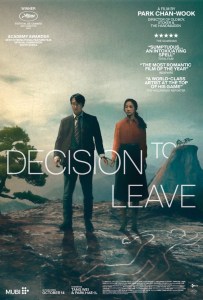 Imagine crossing a classic film noir detective story with some unrequited romance heavy with yearning, like In the Mood for Love, and that’s the combo you get with director Park Chan-wook’s newest, Decision to Leave. In Busan, a straight-laced detective (Park Hae-il, The Host) is investigating an older government official who fell to death from a mountain peak. He suspects that the man’s wife, Song Seo-rae (Tang Wei, Lust, Caution), a much younger Chinese immigrant, might have something to do with the death, and so the detective gets closer and closer to his suspect, blurring the lines of the investigation and his own personal desires. It sounds like familiar genre territory, and it can be, but director Park Chan-wook (The Handmaiden, Oldboy) is the X-factor, and quite simply, he shoots the hell out of this movie. There are some jaw-dropping shot selections and camera arrangements here to cherish. The movie is less interested in its sordid murder mystery details and more the possible relationship between its two magnetic poles, made even more complicated by the detective already being married, though only spending the weekends at home. There is a stormy swell of will-they-won’t-they sexual tension in constant churn, and it adds a dour sense of melancholy to the entire movie. There’s a time jump two-thirds of the way through the movie that is slightly aggravating, because it’s like starting over and repeating the mystery catch-up but with less time, making the details of this new case even less meaningful than earlier. Decision to Leave ends on a strong downbeat that feels appropriate given the mood of the preceding two-plus hours. I don’t think the characters are as textured as they could be, part of this is being jostled around by the non-linear storytelling and artistic tricks of Chan-wook. I think the movie generally favors mood and flirts with wanting to be seen a tragic romance worthy of Hitchcock, though I don’t think it fully gets there. So much of the movie is about probing whether or not the feelings are real between these two, whether she’s toying with him or he just wants to complete the unfinished assignment (the dynamic reminded me of Luther and Alice in the BBC series Luther). Decision to Leave feels like a solid film noir mystery, elevated by A-level directing talent, and then missing its ambitious grasp with its lilting love story that feels a little too subdued and understated to really smolder.
Nate’s Grade: B
Share this:

The King’s Daughter (2022)

Originally filmed in 2014, The King’s Daughter is a curiosity as it’s been on the shelf for almost eight years. As another critic quipped, in the ensuring years, star Kaya Scodelario has been in an entire trilogy of Maze Runner movies. I don’t know what this Chinese-by-way-of-French production was going for as we follow the court of King Louis XIV, played by Pierce Brosnan in an astounding array of outlandishly bad costumes and terrible wigs. He resembles a Vegas magician set back in time. Anyway, he calls to court the young Marie-Josephine (Scodelario) who has been raised by nuns since she was dropped off as a baby. If you can’t already see where this is going, then I can’t help you. But wait because there’s also a mermaid (Bingbing Fan, who in the years since this movie possibly served time in China’s prison for tax evasion) in the basement being held captive because Louis thinks eating her heart will be the key to him becoming immortal. So, yeah, what is this? It’s striving for a fairy tale/storybook sort of feeling but it’s a plot that will only work with the youngest of children. The characters are simplistic and boring, and once the mermaid is introduced it becomes like a costume drama version of Free Willy. Even with being on the shelf for eight years, the finished film still feels rushed, and the special effects for the mute mermaid are a colorful mess. Fun fact #1: the director is responsible for 4 Baby Genius sequels. Fun fact #2: this will be the late William Hurt’s last movie to his career. The King’s Daughter is a movie that makes you ask, “What were they thinking?” quite a lot, and the best decision was to withhold it from mass viewing for eight years.
Nate’s Grade: D+
Share this:

Thirteen Lives (2022)
 The true tale of rescuing the trapped 13 Thai boys in the summer of 2018 is turned into an engrossing and often thrilling if overly long 2022 movie experience thanks to director Ron Howard and a dedicated crew bringing to vivid life the harrowing drama. I was vaguely aware of this story as it played out originally, though missed the critically acclaimed documentary The Rescue from last year that covered the same material, but watching the movie I realize I knew very little of the actual horror. The movie centers around a pair of English divers (Colin Farrell, Viggo Mortensen), both with over 30 years of specific cave diving experience, helping the Thai Navy Seals and government officials to find and save the missing children and their coach. The submerged path is one that lasts about seven hours, and it’s narrow, dark, and treacherous, easy to lose your way. when you only have a tank of air, navigation is the difference between life and death. It’s also a race against time as the monsoon waters are flooding the cave further. The cave traversal sequences are nerve-wracking and deeply immersive, enough so that even I, while watching, started sitting on the edge of my couch in the safety of my own home. The story isn’t entirely centered on our two heroic white guys, as the screenplay by William Nicholson (Gladiator) widens the focus onto many who contributed to the boys eventual rescue, from an engineer who realized they needed to dam water drainage at the top of a mountain, to the locals who agreed to have their crops flooded for the possibility of saving the kids, to the bravery of the Thai Seals, to the hope and burdens of the parents. I never knew the boys had to literally be anesthetized to be removed, and the ensuring climax as the rescue team keeps tabs on how their precious cargo is responding during the multi-hour journey underwater. Howard keeps things pretty straightforward and helpfully provides onscreen graphics to better provide a sense of distance within the cave, which just makes the heroics even more dizzying. Thirteen Lives is an inspiring story about the world coming together for common cause (except Elon Musk, who baselessly accused one of the divers as being a “pedo”) and it’s also genuinely exciting even when you know they all make it out alive, which is its own credit. It might have used some tightening up for pacing, but it’s a well-made dramatization that pays real homage to the many heroes without overplaying its drama.
Nate’s Grade: B+
Share this:

She Said (2022)
 The fall of Harvey Weinstein was a long, long time coming, and the journalistic procedural drama She Said demonstrates just how hard it is to hold bad men accountable. This is a very similar movie to 2015’s Best Picture-winning Spotlight, following hard-nosed professionals as they go through beat-after-beat of assembling their case, following the leads, and convincing those who have been wronged to come forward and share their personal stories. The star is the details, the main crusading New York Times journalists (Carey Mulligan, Zoe Kazan) being defined by their tenacity and determination. As should be obvious, it’s galling how many people protected this awful man, including the police, because of how influential he was as a movie producer. Peeling back the layers of protection revolves around working on the niggling moral concerns of many who looked the other way, out of financial incentive or fear or disregard for rocking the “way things were.” When the expose picks up actual momentum, you can feel the same excitement of holding the powerful to account, even already knowing the end results that would land Weinstein in jail for the remainder of his life. It’s a simple yet effective approach. She Said is little more than a dramatized in-depth news article on its relevant subject, but the ensemble of actors give it a fire that simply scanning the written word can miss. The direction is very matter-of-fact, the writing is thoughtful though a bit heavy with data dumps, and outside of the victims narrating their experiences, or relatives discovering the extent of those experiences that have been kept hidden from them, there isn’t much sustainable tension. Much has been made of Samantha Morton’s one-scene wonder but I think Jennifer Ehle (Braveheart) does even more with her scenes as a victim choosing to speak during a health scare that reassess her thinking. I wish the movie had extrapolated about the entire film industry protecting abusers, but it keeps its focus squarely narrowed on taking down Weinstein. She Said is a worthy movie with a worthy subject and heavy in the details but maybe light on its own drama.
Nate’s Grade: B
Share this:

Aftersun (2022)

I feel slightly like a movie philistine for my opinion concerning Aftersun. This indie drama has become one of the critical darlings of 2022, enough so that there may even be some serious Oscar buzz starting to foment. It’s a movie with a strong beating heart and rich in authentic details and naturalistic performances, a movie that feels practically like a home video ripped from the past. However, while I appreciated the artistry on display, I kept waiting for the actual “movie” to form, the reason this story was given its big screen status. Aftersun is a lyrically felt movie but also one I wish had a more sustained plot to better develop its dramatic potential.
It’s the mid 1990s and Sophie (Frankie Corio) is staying at a seaside Turkish resort with her father, Calum (Paul Mescal). Her parents are separated and she has a complicated relationship with her father, who covers up his own spiraling sadness by trying to be the “fun dad.” At eleven years of age, Sophie is feeling that awkward middle-ground of not being a child but still not being fully grown, and over her vacation, she observes her world and father with new eyes.

The strength of the movie is the richness of its characters and world, with each moment feeling like it was plucked straight from the memory of debut writer/director Charlotte Wells. The movie is framed as a home video of Sophie’s and makes clever use of her narrating footage, allowing the perspective to be directed literally by its source. It’s also interesting because there’s a degree of performance for Sophie, as the presence of a camera usually goads people into acting differently, to play up to the camera, and this channels Sophie into being a goofy performer. Off camera, she’s less prone to making jokes and being broad and silly. She jokes with her father, chiding him for his “advanced age” and other such topics, but there’s more hesitancy and relatable awkwardness with Sophie in real life. Her dad says she should go introduce herself to other children at the resort, to make friends and have partners in play, and she scoffs that at eleven she’s “not a little kid anymore.” She wants to hang out with the older teens and eavesdrop on their conversations, not fully aware of their meaning and context, as that hurried desire that young children have to cast aside their childhoods in favor of immediate maturity. There isn’t any defining experience at this resort, no direct humiliation or formative wisdom to point to. It’s more the small moments of a young girl between the different phases of her life. Sophie comes across as an achingly realistic portrayal of adolescence and the yearning for real connections.
The majority of the movie is about the relationship between father and daughter, and I was waiting for the movie to hit me hard, especially as I’ve recently become the stepfather to an eleven-year-old daughter. The relationship is there but there’s nothing too demonstrative of what is going on between these two people. It’s unclear whether this might be the last time Sophie will see her father for some time, or whether the divorce was recent and still a sore subject, or anything of extra significance. It just feels like a vacation, and that’s as it’s presented, and maybe that’s the larger unspoken point of Wells, that the mundane moments only become more cherished in hindsight or when we realize they were the last moments before whatever happened.

I think Wells might suspect the narrative on its own is missing that larger significance, so distributed throughout the movie are flashes from a rave with an older woman, and it’s revealed later that this thirty-something woman is actually Sophie as an adult, and a new parent herself. This juxtaposition then serves as an ongoing film-length Kuleshov Effect. This cinematic effect, named after the Soviet filmmaker from one hundred years ago, reasons that placing two objects together forms an implicit connection or reaction, so seeing a picture of soup and then a man looking forward might convey hunger or a picture of a coffin and then a man looking forward might convey grief. By this juxtaposition, we’re left to infer larger meaning and processing, as older Sophie is looking back on these scenes as distant memories. We’re left to deduce what that means to her, what new insights she has as an adult looking back, and what has happened since, and I’m sure some viewers will find this a tantalizing human puzzle to unpack. For me, it felt like extra homework without the key elements to make the depictions dramatically involved.
The acting is another laudible element that adds to the overall authenticity of the movie. Corio is a star in the making and has a natural screen presence. Mescal (God’s Creatures, Normal People) carries much of the film’s larger thematic weight, and I kept waiting for some small moment that would provide more meaning behind the surface level. Mescal is very good and his dynamic with his young co-star feels heartwarming and genuine. I enjoyed spending time with both of these actors, and while they charmed me, I kept wishing that they had a little more material to flex.
Aftersun is an easy movie to admire and see what Wells was going for, reflecting perhaps some biographical experience and something that every adult can insert themself and think about their own parental relationships, wondering what sort of things they took for granted during those innocent days of childhood and the acknowledgement of the quiet struggles of parents. It’s filmed beautifully and acted with sensitivity and plenty of understatement, the kind of thing that indie film fans and critics vaunt as revelatory filmmaking. It’s a solid movie that only comes to 90 minutes, but it also felt like I was watching a stranger’s home movies without context.
Nate’s Grade: B
Share this:

Causeway (2022)
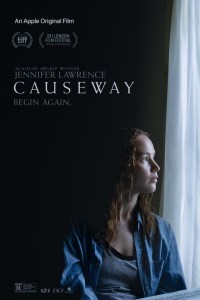 Jennifer Lawrence has been in four movies since 2017, so the once ubiquitous Oscar-nominated actress is getting more selective with her film roles, so now with each role the question becomes what made this project the one. Causeway is a fairly straightforward drama following Lynsey (Lawrence), a soldier who is recovering from her traumatic brain injury and ensuing memory loss. She’s stateside and living back in her hometown and trying to speed through physical therapy to re-enlist back to the life she knows but may not be equipped to handle. This is definitely a character piece but I don’t know if there’s enough interesting material here with these characters. Causeway is one of those indie dramas that lean into a lot of contemplative staring, which could be very meaningful if I felt like I had been given access to the characters internal dilemmas beyond a general assessment. Much of the movie follows Lynsey’s friendship with a local mechanic, James (Brian Tyree Henry), who has his own tragic past that he’s trying to come to terms with. The movie is at its best when they’re sharing time together and it begins to feel like an introspective hangout movie that will allow both of these people to let down their guards and develop. It moves in starts and stops but Causeway never feels like it gets anywhere fast or that transcendent. By the end, the journey doesn’t feel earned. Lawrence is good, though rather restrained, as the movie fills much of its time with her long pensive stares. There’s a movie here, for sure, but nobody feels in a hurry to uncover it. It’s a perfectly “nice movie” but one that underwhelms because it feels too afraid of pushing too hard or delving too far, for that would betray some artistic ode of “realism.” Causeway is a minimal, plaintive drama with much left unsaid, but what is said and honestly dealt with is compelling enough to make me wish I could trade in the many stares for more words spoken by these talented thespians.
Nate’s Grade: B-
Share this:

Emily the Criminal (2022)
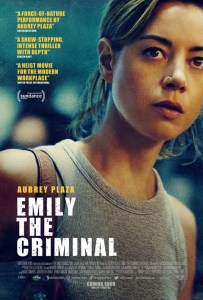
This Sundance indie thriller packs more anxiety into 90 minutes than most Hollywood thrillers combined. It’s a starring vehicle for Aubrey Plaza as the titular Emily, a woman with a prior criminal record who finds herself in debt and struggling to find a better paying job. In desperation, she joins a small-time credit card fraud squad, using stolen identities to purchase expensive electronics and pass along to her employer to resell. At first, it’s a quick and easy fix and she can walk away at any time, but the money is good and Emily begins to take on bigger and riskier jobs. It’s here where I really started sweating as Emily gets into some very serious jams, but she comes back swinging, and it’s a thrill. At the same time, you worry that she’s going too far and there may be no turning back. The movie reminded me a lot of 2016’s Good Time, an electric indie thriller that vibrated with anxiety as well as a surprising but thoughtful cause-effect story flow. Emily the Criminal begins as an indictment on the social mechanisms that trap the poor into poverty but then in its second half escalates urgently, spiraling into a tragic confluence of violence and vengeance. Plaza is outstanding from the first scene onward. Even her posture speaks volumes about her character. It’s a performance where you can see the gears of her decision-making, whether it’s fight-or-flight impulses, swallowing her pride, holding to a façade, or regaining what has been taken from her. The very ending of the movie is perfect and a fitting end of Emily’s character arc. It’s the American Dream turned into a modern nightmare of perfectly perpetual desperation.
Nate’s Grade: A-
Share this:

Violent Night (2022)

The movie might feel like a late night joke, but Violent Night is everything you could ask for with its Santa-meets-Die Hard concept as a bloody, junky fun bit of Christmas good tidings. I’ve noticed that 2022 is a year marked by highly violent, pulpy, well choreographed action-comedies such as The Princess and Bullet Train, and I think if you like any one of them, then you’d happily enjoy the others. For Violent Night, the movie smartly lays out its rules and limits and obstacles, and then allows the mayhem. Santa (David Harbour) is an alcoholic nihilist losing faith in the meaning of Christmas, and then through the events of one Christmas night, he’ll re-emerge as the Santa we deserve and need. The movie isn’t overly winky about its outlandish premise with the exception of some ironic catch-phrases that Santa has to drop for maximum attitude. The fights between Santa and the criminal crew are entertaining, well shot and choreographed, and make clever use of supernatural touches, like Santa’s magic portal presents bag and his list that can supply key details on any human. There is a sweet dynamic between Santa and a little girl named Trudy, who chats with Santa through a walkie talkie thanks to the power of belief. She’s the heart of the movie and helps motivate Santa to do better and save her family. The supporting characters are pretty stock and unremarkable but the draw of this movie is Harbour (Stranger Things) and the silly pomposity of its violence. It’s a gory, glory good time.
Nate’s Grade: B
Share this:

Glass Onion (2022)
 When writer/director Rian Johnson wanted to take a breather after his polarizing Star Wars movie, he tried his hand at updating the dusty-old Agatha Christie mystery genre, and in doing so created a highly-acclaimed and high-grossing film franchise. The man was just trying to do something different and at a smaller-scale with 2019’s Knives Out, and then it hit big and Netflix agreed to pay $400 million dollars for exclusive rights to two sequels. Now as Johnson has reinvented his career as a mystery writer the big question is: can he pull it all off again?
Renowned detective Benoit Blanc (Daniel Craig) has been invited to the world’s most exclusive dinner party. Miles Bron (Edward Norton) has invited all his closest friends to his Greek island soiree, setting up a murder mystery game his friends must spend the weekend solving. Except there are two interlopers: Andi Brand (Janelle Monae), the former partner of Miles who was betrayed by Miles and his cronies and… Benoit Blanc himself. Why was the detective invited to the murder dinner party unless someone planned on using it as an excuse to actually kill Miles?
 Knives Out was a clever deconstruction of drawing room mysteries and did something remarkable, it told you who the murderer was early and changed the entire audience participation. Instead of intellectually trying to parse clues and narrow down the gallery of suspects, Johnson cast that aside and said it didn’t matter as much as your emotional investment for this character now trying to cover up her tracks while working alongside the “world’s greatest detective.” It made the movie so much more engaging and fun, and for his twisty efforts, Johnson was nominated for a Best Original Screenplay Oscar. Now, every viewer vested in this growing franchise is coming into Glass Onion with a level of expectations, looking for the twists, looking for the clever deconstruction, and this time It feels like Johnson is deconstructing the very concept of the genius iconoclast and including himself in the mix. The movie takes square aim at the wealthy and famous who subscribe to the idea of their deserved privilege, in particular quirky billionaires whose branding involves their innate genius (many have made quick connections to Elon Musk in particular). The movie’s first half is taken with whether or not Miles Bron’s murder mystery retreat will become a legitimate murder mystery, but by the midpoint realignment, Glass Onion switches into pinning down the bastard. It makes for a greatly satisfying conclusion as Blanc exposes the empty center of Miles’ calculated genius mystique.
 As Blanc repeatedly says, the answers are hiding in plain sight, and this also speaks to Johnson’s meta-commentary of his own clever screenwriting. This is Johnson speaking to the audience that he cannot simply copy the formula of Knives Out. This is a bigger movie with more broadly written characters, but each one of them feels more integrated in the central mystery and given flamboyant distinction; it’s more like Clue than Christie. Through Miles’ influence, we have a neurotic politician (Kathryn Hahn), a block-headed streamer (Dave Bautista) pandering to fragile men on the Internet, a fashionista (Kate Hudson) who built an empire on sweatpants and has a habit of insensitive remarks, and a business exec (Leslie Odom Jr.) who admits to sitting on his hands until given orders from on high by Miles. All of these so-called friends are really bottom-feeders propped up by Miles’ money. It would have been easy to simply replay his old tricks, but Johnson takes the heightened atmosphere of the characters and plays with wilder plot elements of the mystery genre, such as identical twins and secret missions and celebrity cameos (R.I.P. two of them) and corporate espionage. The very Mona Lisa itself plays significantly into the plot (fun fact: Ms. Mona was not the universally revered epitome of art we know it to be until its 1911 theft). This is a bigger, broader movie but the larger stage suits Johnson just fine. He adjusts to his new setting, veers into wackier comedy bits with aplomb, and has fun with all the false leads and many payoffs. You never know when something will just be a throwaway idea, like the hourly chime on the island, or have an unexpected development, like Jeremy Renner’s hot sauce. Glass Onion is about puncturing the mirage of cleverness, and by the end, it felt like Johnson was also playfully commenting on his own meta-clever storytelling needs as well.
It’s so nice to watch Craig have the time of his life. You can clearly feel the passion he has for the character and how freeing this role is for an actor best remembered for his grimaced mug drifting through the James Bond movies. Craig makes a feast of this outsized character, luxuriating in the Southern drawl, the loquaciousness, and his befuddled mannerisms. After Knives Out, I begged for more Benoit Blanc adventures, and now with a successful sequel, that urge has only become more rapacious. Johnson has proven he can port his detective into any new mystery. Netflix has already paid for a third Knives Out mystery movie, and I’d be happy for another Blanc mystery every so many years as long as Craig and Johnson are willing. These are fabulous ensemble showcases as well with eclectic casts cutting loose and having fun. Norton (Motherless Brooklyn) is hilariously pompous, especially as Blanc deflates his overgrown ego. Bautista (Dune) is the exact right kind of blowhard. Hudson (Music) is the right kind of ditzy princess with a persecution complex. Her joke about sweatshops is gold. Jessica Henwick (The Gray Man) has a small role as the beleaguered assistant to Hudson’s socialite, but she delivers a masterclass in making the most of reaction shots. She made me laugh out loud just from her pained or bewildered reactions, adding history to her boss’ routine foot-in-mouth PR blunders.
 There is one big thing missing from Glass Onion that holds it back from replicating the surprise success of its predecessor, and that’s the emotional lead supplied by Ana de Armas. She unexpectedly became the center of the 2019 movie and it was better for it. Glass Onion tries something similar with Andi Brand, and while she’s the easiest new character to root for among a den of phonies and sycophants, it’s not the same immediate level of emotional engagement. That’s the biggest missing piece for Glass Onion; it’s unable to replicate that same emotional engagement because the crusade of Andi Brand isn’t as compelling alone.
Glass Onion is a grand time at the movies, or as Netflix insisted, a grand time at home on your streaming device. It’s proof that Johnson can handle the rigors of living up to increased expectations, making a sequel that can stand on its own but has the strong, recognizable DNA of its potent predecessor. It’s not quite as immediate and layered and emotionally engaging, but the results are still colorful, twisty, and above all else, immensely fun and satisfying. I’m sure I’ll only think better of Glass Onion upon further re-watching as I did with Knives Out. Johnson once again artfully plays around with misdirects and whodunnit elements like a seasoned professional, and Glass Onion is confirmation that Benoit Blanc can be the greatest film detective of our modern age.
Nate’s Grade: A-


 nathanzoebl
You must be logged in to post a comment.