Category Archives: 2021 Movies
Pig (2021)
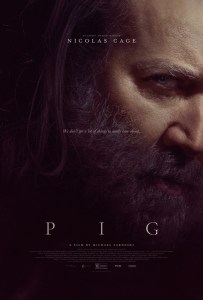
Whatever you may think Pig will be, chances are that you will be wrong. On the surface, it appears like it’s going to be another John Wick clone, with criminals stealing the beloved animal of a loner who happens to be a dangerous man who unleashes a path of vengeance. There is no real action in the movie at all. The missing pig is the catalyst to bring Rob (Nicolas Cage) back from the outskirts of Oregon and to retrace the old haunts of his old life, but the pig is more a symbol of companionship and traces back to his time with his deceased wife (another John Wick nod?). Pig is really more a meditative and reflective character study to unpack slowly. There are deeper themes and messages here, and the fact that they’re attached to a movie starring Nicolas Cage where he must find his stolen pig is all the more bizarre and exciting. This is unlike any Cage movie and, in its own way, feeds on the culmination of his own career of movies great and far from great.

This movie feels deeply personal for Cage. There is an elegiac tenderness that permeates the whole experience. It’s about loss but ultimately it’s a movie about chasing your dreams. There’s a reason the tagline for the film is, “We don’t get a lot of things to really care about.” If you’re expecting a gonzo Cage irony fest, this sincere summation will seem completely mismatched. But this movie isn’t a gonzo Cage irony fest. It’s very much about different people dealing with pain and sorting through heartbreak, disappointment, disconnection, and taking stock of one’s delayed pursuit of happiness. There is no irony to be found here, folks. This movie, called Pig, is bracingly sincere. There’s a standout scene where Rob and Amir are dining at a fancy restaurant and Rob asks to meet the chef. It takes a moment but the chef recognizes Rob and is starstruck and asks if Rob remembers him working in Rob’s own restaurant. He does, and Rob asks this man about his old dream, which was to open a pub-style restaurant, and why he capitulated. The man is initially defensive, citing the local market, but then he has to sit and think it over. It was his dream. It still is, and the fact that this man not only remembers him but also remembers his exact dream and calls him out, it’s like having an intervention from someone who you never knew cared as much as they did. Maybe this man will proceed with his dream of opening a pub. Maybe he won’t, but Rob reminds him and us how little time we have and to really spend it on the passions that positively consume us.
To that end, you can see the parallels with the main character and Cage’s own career. Nicolas Cage has long been an actor defined by excess to the point that he has a catalogue of outsized performances with ironic air quotes attached to them. The man owned his own island and named his son after Superman’s birth name. He has been starring in more and more direct-to-DVD low-budget thrillers, as have John Travolta and Bruce Willis, who both rarely seem to attach themselves to theatrical releases at this stage of their careers. Some might term this the decline of his career, that he is slumming it, but to Cage it’s just another gig. Unlike Willis, famous for shooting his part in a weekend while his stand-in works the rest, Cage is still putting forth quality effort. This might be a little psychological projection on my part, but Cage strikes me as a professional who enjoys his craft even if he makes some unorthodox choices. He has a passion for movies and he’s going to seek that out because it’s what defines him. We might not appreciate the projects he selects, we might not understand them, and they might even be bad, but Cage is taking the roles offered because making movies and acting is the thing he really cares about. His performance here is somber, touching, and suffused with ache. It’s one of, if not the, most restrained performances of Cage’s career and a reminder that the man can be a world-class actor.

Structurally, Pig seems to reinvent itself with every scene, providing new answers and insights as we unravel Rob’s past. It allows you to consistently re-evaluate the movie and characters and makes for a genuinely engrossing viewing because you know there will be something worth paying attention to with every scene change. There are people in the city who revere Rob, who despise him, who seem to be jealous of him, and we’re discovering more and more what that life was like and what drove Rob to being a recluse. The movie rides a line of nuance and ambiguity where not every character detail and connection is spelled out; it’s up to the individual to process meaning. Is this character grateful to Rob because his wife, who battled depression for years, had one significant happy moment she would reminisce over, Rob’s delicious dinner? Is he jealous that a meal could make her happy when he seemingly couldn’t? What emotional response does this man have? It’s up to the viewer to determine the human response to passion and the evaluation of what passions are prioritized. The character writing finds that artistic middle ground of being nuanced but also being accessible. For a movie about a man searching for his missing pig, it’s much more concerned with the man and his demons and dreams.
It’s a beguiling realization that a movie where Nicolas Cage searches for his prized pig might be one of the better films of 2021 and one of the actor’s finest performances. The movie appears like it will be dark, scuzzy, and depressing but it’s actually quite compassionate, humane, and encouraging. It’s not a story about a man cracking skulls and crossing names off a list to retrieve his stolen pet. It’s a movie about a man who left his suffering and who comes back and re-examines his life’s choices and the choices of others. He may look like a bleeding hobo for the majority of the movie, but Rob is a force for good, reminding others of their passions, the urgency of time to chase them, and the importance of spending time with the people, and pets, that matter to them, our own selective families. Pig is an absorbing, poetic, and eminently kind movie and one that doesn’t feel like it could have worked the same without Cage’s professional legacy to build from. It’s a small movie that will surprise many and reaffirms that Cage is always an actor worth watching.
Nate’s Grade: B+
Share this:

Space Jam: A New Legacy (2021)
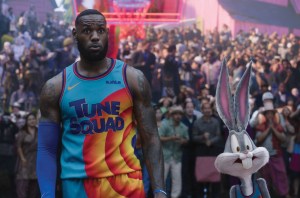
 For a generation of millennials, those of us who came of age in the 1990s, Space Jam has miraculously accrued a nostalgic fixation. Michael Jordan starred alongside cartoon favorites and we all learned valuable lessons about teamwork. The soundtrack also, as the kids say, slapped, with that titular banger welcoming us to the jam and the R. Kelly eponymous ballad, “I Believe I Can Fly.” Flash forward 25 years, and a new basketball superstar is looking to relaunch the franchise and reinvigorate the Looney Tunes pals for a new generation. Lebron James plays a fictionalized version of himself struggling to connect with one of his sons. He wants the boy to take basketball seriously but worries about his commitment and thinks video games, the child’s true passion, are a distraction for him. He and his son get sucked into the “server-verse” of Warner Bros. studios thanks to an angry A.I. (Don Cheadle) who just wants respect. The scornful A.I. challenges Lebron to a basketball game while tempting Lebron’s son to the dark side. Lebron teams up with Bugs Bunny to reunite the classic Tunes to put together a winning team.
 This movie is clearly not intended for adults but at the same time it feels engineered from their references. Are children going to understand William Shatner impressions? Parodies of The Matrix, or Mad Max: Fury Road, or Casablanca? To that end, I question if we’ve come to a point in popular entertainment where the Looney Tunes characters have been eclipsed. When I grew up, cable television, let alone channels devoted to entertaining children, were just beginning in the 1980s, so I did grow up with classic cartoons from decades prior. I knew about Bugs and Daffy and Tom and Jerry and Hannah Barbara and the old guard. Modern American children have grown up with a generation of original cartoons and programming and I would argue they have more nostalgic reverence for shows like The Fairly Odd Parents, Gumball, and other popular Cartoon Network originals. I strongly doubt that the majority of the movie’s stated target audience, children, have any emotional investment or recognition for the old Looney Tunes characters. Perhaps the entire Space Jam sequel is designed to reignite interest in a certain younger demographic, and this wouldn’t surprise me as its real source for existence. To be fair, the original 1996 Space Jam was created to sell sneakers, so it’s not like this is out of step for the franchise’s integrity.
The conception of this movie is less about Lebron James interacting with the classic Looney Tunes characters than Lebron James being the spokesman for a catalogue of Warner Bros. intellectual property (IP). What children are sitting around saying, “I can’t wait to interact with all my favorite Warner properties?” Children do not think like this, they don’t segregate into tribes for different corporate masters. They like what they like and don’t think about whether its corporate parentage is with Disney or Viacom or whatever. Space Jam: A New Legacy feels less like a story or even a movie and more like a catalogue launch for the Warner Bros. gift shop (get your Grandma Matrix sweaters just in time for the fourth movie coming out these holidays!).
 The intermingling of different worlds and properties can be done, see The Lego Movie, but more needs to be done other than transporting characters into a world they do not belong. Watching Granny perform moves from The Matrix isn’t funny because what is even being set up for comedy? It’s not a tweaking or commentary on the original, nor is there any recognizable comedy angle; it’s what Family Guy typically does – repeating the scenarios but with different faces. There is a key difference between reference and parody (a point I have discussed at EXTENSIVE LENGTH in my reviews of the very bad Friedberg and Seltzer spoofs). Nobody cares that much about these characters that just seeing them in a different environment is enough. Watching Wile E. Cayote as one of the War Boys in Fury Road is not enough, and I absolutely adore that movie and consider it an instant classic, but if I wanted to just watch Fury Road, I would gladly just watch Fury Road (they do not even call it “Furry Road,” come on!).
By far, the most confounding part of this new Space Jam is the decision-making process over what IP should be included and what should be excluded. I would be fascinated to watch a documentary series just on the creative clashes with studio execs. There are some bizarre choices selected to attend the culminating basketball game as rowdy spectators. I can understand memorable figures like King Kong, Dorothy from the Wizard of Oz, the Iron Giant, and the Scooby Doo van. Those are immediately recognizable for modern-day children. However, why is Jim Carey’s Mask character there? Why is the grotesque Danny DeVito version of the Penguin there? Why is the Night King from Game of Thrones there? Why is Pennywise the Clown, a vicious and frightening character, there? Why are the droogs from A Clockwork Orange there? Who is that supposed to appeal to? Why would anyone in their right mind include a gang best known for wanton violence and rape to be faces in the crowd to cheer on a basketball game? It would be akin to taking the hillbillies who rape Ned Beatty in Deliverance and placing them side-by-side with cartoons for a movie intended for children. If the droogs and Pennywise made the cut, what inappropriate characters from the vaults of Warner Bros. were denied? This fascinates me.
 I also have problems when Bugs and the other Tunes step into the third dimension. Characters that were intended for two-dimensions always look awkward when transported into a three-dimensional realm. It was a smart move keeping the cartoons as their standard hand-drawn selves in the original Space Jam. When the big basketball game commences, the Tunes and James are pulled into three dimensions and the characters do not look good. The circumference of their heads and how it relates to their mouths moving looks all wrong. Bugs looks like a Mylar birthday balloon that has somehow gained sentience. This extra step is likely meant to appeal to modern-day audiences who have turned their noses on more traditional hand-drawn animation in feature films (Tangled and Frozen began as 2-D animated films before going to 3-D). It’s another curious case meant to modernize the Looney Tunes and appeal to a younger demo, and yet it runs counter to so much more of the programming choices and contradictory decision-making.
Is Space Jam: A New Legacy a good movie? Quite simply, no, but then by objective standards neither was the original Space Jam. Lebron James may still be trailing his Airness in a few more NBA records but King James has more natural charisma and acting ability than Jordan who settled as straight man/pitch man. There is an occasional joke that earned a laugh from me, the best being the bait-and-switch reveal of Michael Jordan returning to the Tune Squad, which also seems to imply that Sylvester the cat is kind of racist. I liked Lil’ Rel. Congrats also to the filmmakers for bringing back Lola Bunny, having her voiced by Zendaya, and realizing she can just be a lady bunny good at playing basketball. The original Lola Bunny was hyper sexualized and I’ve already read too many comments from dregs on the Internet upset this new rabbit doesn’t make them feel funny in their pants (“IF I CANNOT OBJECTIFY THIS CARTOON RABBIT, THEN WHY AM I EVEN WATCHING A MOVIE INTENDED FOR CHILDREN?”). The moral or message is pretty simple about accepting others for who they are and not how you demand, which is weirdly exemplified in a cross-generational conflict where Lebron will not allow his son to play video games because his coach growing up thought they were a waste of time. As if he’s only allowed to play basketball with every waking and sleeping second of his existence. Lebron grew up in the late 90s when video games were mainstream and great. His son is an obvious game design prodigy, but it will take him the whole movie to see.
 Feeling like the unholy IP orgies that were Ready Player One and The Emoji Movie, the Space Jam sequel (or reboot) feels more like a catalogue launch or a streaming channel opening its vast archives for ready-made consumer consumption. There are several moments where I just shrugged and said to myself, “Well, that happened,” like Granny doing her fancy Matrix moves or Porky Pig battle rapping. I think the idea of Lebron helping the classic Looney Tunes characters in another wacky edition of basketball would have made for a suitable children’s movie. The original only focuses on the Looney Tunes and gets by. For whatever reason, the studio execs insisted to the six credited screenwriters (pity them all, and the sixty un-credited) that this serve not as a franchise relaunch but as a corporate portfolio branding showcase. The movie gets lost in the shuffle from all the haphazard and contradictory impulses to see this through, turning from the game of basketball into decades-past-their-prime Austin Powers jokes. Regardless, Space Jam: A New Legacy is less new and more everything Warner Bros. owns the rights to in the past that they would like to remind you about. Watch it all now on HBO MAX, folks!
Nate’s Grade: C-
Share this:

Gunpowder Milkshake (2021)
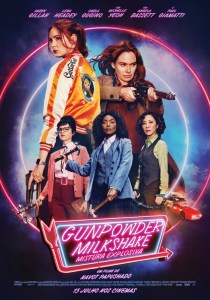 The reason we typically watch crime/action movies is for the slick style, the gonzo action, and the over-the-top characters cutting loose in the most violent of manners. We watch these movies to capture that whiff of cool, something flashy and entertaining with its eye-popping combo of sight and sound. Think Snatch, and Drive, and Atomic Blonde, and what appears to be the upcoming James Gunn Suicide Squad sequel. By these standards of stylized violence and colorful anti-heroes, Netflix’s Gunpowder Milkshake falls too flat to be duly satisfying.
Sam (Karen Gillan) is a hired killer working for the secretive order, The Firm. Her handler (Paul Giamatti) has accidentally assigned her the son of a commanding mobster who now demands vengeance. Her lone way to keep the protection of her employers is to kill a man who robbed them, which she does, but then regrets her actions. The troubled man had stolen the money to pay the kidnappers ransoming his daughter, Emily (Chloe Coleman). Sam decides to get involved and save this girl, and in doing so loses protection. The scornful mobster sends teams of goons to track Sam and kill her, forcing her to find refuge with her absentee mother (Lena Headey).
 The problem with playing in this stylized sandbox is having little to back up the attitude and style. Admittedly, those two aspects go far in a sub-genre dominated by appearances, but if you just have tough-looking shells of characters posturing and acting tough, it doesn’t matter how much style you dump onto the screen, it will only distract for only so long. The characters in Gunpowder Milkshake are so powerfully bland and all adhere to the same lone character trait. They’re all glib and badass and brusque and smug and fairly boring. It’s like somebody took the John Wick universe of clandestine killers and copied and pasted the same default personality.
If everyone is super cool, and super deadly, and super nonchalant, then you need to put even more work into making the characters stand apart. They’ll need specific quirks, competing goals, faults and obsessions, some key nub of characterization even if its superficial (a guy with one eye he’s insecure about it, etc.). With Gunpowder Milkshake, there’s nothing to work with. The screenwriters made this so much harder on themselves. I guess we’re merely supposed to be won over by the casting and the imagery of these bad ladies holding powerful weaponry. The protagonist is boring. She is the familiar hired killer who grows an inconvenient conscience. That’s an acceptable starting point but the moral growth is hindered when her young charge, the little girl that forces her paradigm shift, wants to be her apprentice to learn to kill people. The fraught mother/daughter relationship resorts to a lot of “I didn’t want this life for you,” “It’s the only life I’ve known” roundabout conversations, and neither furthers our understanding of either side.
With all that being said, there are moments of bloody fun that can be enjoyed. There’s a middle portion of the movie that gave me hope the film had transformed. At one point, Sam is indisposed and unable to use her arms, which dangle without any muscle control. She’s about to be beset by angry if bruised bad guys and must plan what to do. The resulting clash is a burst of creative choreography and an excellent demonstration of Sam’s resourcefulness and drive. Watching her dispatch a dozen armed men so indifferently, always knowing where and when to turn and dodge is not nearly as entertaining or engaging as watching her struggle and solve a problem. This sequence is extended and makes clever use of its location and the elements that would be available. Then we go a step further, as Sam and her youngster must drive a car to flee except the uncontrollable arm problem persists. Sam will pump the pedals and give directions while Emily sits on her lap and turns the steering wheel. This made me excited. We had organic complications and potential solutions that involved both characters having to rely upon one another. That is solid screenwriting and finding a way to spice up an ordinary parking garage chase sequence. By the end of this sequence, my hopes started to dwindle because Sam reverted to her earlier super cool, impervious version. She knew every exact move to make, and the small-scale car chase started losing my interest even with the extra driving dynamic. I wish the filmmakers could analyze how these sequences differed to better harness that creative surge.
 The concluding act of Gunpowder Milkshake is a deluge of false climaxes and waves of bad guys that never pose any discernible threat. It all feels too repetitive and like a video game. This group of people need to be killed, and then this next group of people need to be killed, and then this next next group of people need to be killed, and I just started getting bored. There is the occasional fun burst of violence and style, but the enemies are stock and dispensable, so it doesn’t feel like it matters what the numbers are. Whether it’s a dozen or a thousand, nothing really seems to matter because our super team of badass women will never be stopped. If you’re going to establish the protagonists as so far ahead of their competition, then work needs to be done to provide another outlet for audience interest. Use that time to explore the peculiarities of the cracked-universe world, like in the John Wick franchise. Use that time to meaningfully push the characters toward personal confrontations with one another. Alas, it’s all slapdash style with the same dead-eyed cool stare from start to finish (with the noted exception above). The entire final act could have been five minutes or fifty. It’s filler violence until the director tires out.
The cast is blameless and eminently watchable. I’ve been a fan of Gillan’s since her early Doctor Who days, and it’s been fun to watch her come into her own with the major spotlight afforded from franchises like Guardians of the Galaxy and Jumanji. She’s more than capable of kicking ass and looking cool doing so but this is the thinnest of characters. Once Sam chooses to put her safety at risk to save an innocent girl, it’s the end of her character growth. I suppose you can argue everything she does from there further proves the lengths she will go to solidify this important choice. Gillan deserves a worthy star vehicle. It’s fun to watch Angela Bassett, Michell Yeoh, Carla Gugino, and Headey push back with a grin against the misogyny of the overconfident wicked men who wish to do them harm. I wish they were better integrated into the world to have more significance other than as old allies who double as a weapons depot. There’s only so many guns-in-books jokes you can have before it too feels overdone.
 For fans of stylized violence, there may be enough cooking with Gunpowder Milkshake to meet out its near two-hour investment. The neon-infused, candy-colored production design and cinematography can enliven moments. The actors are fun to watch. Some of the fighting is brutally choreographed and cleverly executed, like the sequence where Gillan has no control over her arms. It’s got slow-mo violence set to wailing pop music tracks. If you’re looking for a pretty movie with some style, then it might be enough. If, however, you’re looking for a movie with interesting characters with memorable personalities, well-developed action with variance, and a story with a nice array of twists and turns and payoffs, then maybe look elsewhere.
Nate’s Grade: C+
Share this:

Black Widow (2021)
 If you ask anyone who their least favorite Avenger is, every one of those participants will have the same exact answer: Hawkeye. If you ask that same group who is their second least favorite Avenger, chances are that a clear majority are going to next say Black Widow. The character has been part of the Marvel Cinematic Universe (MCU) since 2010 in Iron Man 2, a full decade of idling to gain her solo movie to the point it became a long-running question in the fanbase. Then they killed the character in 2019’s Avengers: Endgame and then also announced she would be getting her solo movie, and the fanbase said, “Wait, now?” Delayed a full year thanks to COVID-19, Black Widow is Marvel’s first theatrical release in almost two years and will likely benefit from some low expectations and eagerness to get back to the big screen spectacle of summer movies.
It’s not Black Widow’s fault that she’s paired with a super soldier, essentially Batman in a flying suit, a nigh indestructible god, and a giant raging id monster. There’s a significant gap between that upper tier of the super powered Avengers and the two non-powered members, Lady with Guns and Guy with Bow and Arrow. It’s hard to compete with all of that, and the glimpses we’ve been given with previous MCU movies haven’t exactly been the most nuanced or dimensional for Black Widow (remember her dubbing herself a “monster” because the state took away her ability to bear children?). We’ve had hints about past troubles and regrets, but it’s never been explored with any significance… until now.
 Taking place shortly after the events of 2016’s Civil War, Natasha Romanoff (Scarlett Johansson) is on the run from American authorities. She reunites abroad with her estranged sister, Yelena (Florence Pugh), who has recently broken free of the chemical mind control of the sinister Widows program. Yelena and Natasha were living as sisters for three years as a cover family of Russian agents, with Alexei (David Harbour) and Melina (Rachel Weisz) as their parents. They were whisked back to Russia, separated, and thrown back into the Widow program where they were trained to be elite assassins by Dreykov (Ray Winstone, barely flirting with a Russian accent). The combative sisters are being chased by S.H.I.E.L.D. agents, other killer Widows still under the chemical-induced mind control, and Dreykov’s best hunter, the ruthless Taskmaster, a masked warrior who can learn and mimic the moves from other fighters. Natasha and Yelena decide the only way to stop Dreykov is to reunite their old family once again.
I’m a little confused by the general indifference Black Widow seems to have generated from critics and fans because I thought, while with some flaws, that this is still a good movie that I would say is on the cusp of being above average for the MCU’s already high bar. Perhaps, again, this movie is benefiting from lowered expectations. I wasn’t going in with too many demands considering my personal investment with the Black Widow character was minimal prior to her sacrificial death. I wanted a fun movie that provided further insight into her character, considering this would likely be the last time we see Natasha in the MCU. I was surprised how emotionally engaged I became with her movie. While the action is fine, it was the dramatic parts that really grabbed me. This is the first MCU movie where I was looking forward to the breaks in action more than the actual action. The pre-credits flashback (to mid-90s Ohio no less) sets up this fractured family dynamic that serves as the core of the movie, the question over whether these relationships ever really mattered on a deeper level or whether each person was simply playing their assignment. It makes for intriguing drama about vulnerable characters sifting through the small measures of happiness they’ve had and the difficulty of reaching out to people that are important to you. Natasha is in a delicate yet reflective place considering her isolation. The movie is structured like a Jason Bourne-style spy caper, jumping from one locale to the next, but it’s more of a family drama about hurt people reconciling and reconnecting. On its own terms, it’s a real family movie.
 There are some major themes and some serious subjects with Black Widow and they are well handled and tied to the character journeys. The opening titles, set to a melancholy cover of Nirvana’s “Smells Like Teen Spirit,” covers human trafficking. This is a story about the systems of abuse, primarily abusive men demanding control from throngs of women, and it’s about overcoming abuse and establishing support systems. For Natasha, she made some hard choices to defect to S.H.I.E.L.D., and many others have suffered because of her decision to escape. Many women could not escape their tormentors, and the level of control only became more methodical. Yelena talks about being conscious of everything but unsure what parts of you are really your own doing, and this seems eminently relatable about victimhood. The movie is about breaking free of unhealthy relationships, coming into your own control, and finding healthy families even if they are troubled and a work in progress. That’s why the family moments resonated as much for me. Real attention was given to the supporting characters in Natasha’s orbit.
To that end, the villains exemplify the themes by design, especially Taskmaster serving as a literalization of Natasha facing off against the sins of her past, much like in 2017’s Logan where Old Logan fought young Logan. Fans of Taskmaster from the comics may well be disappointed by the adaptation because the character was very sardonic and, in here, never utters a word (there is a certain Deadpool-in-X-Men Origins: Wolverine reminiscence). More could have been done but the villain represents the consequences of abandonment. I appreciated that even until the final moment, the villain could be redeemed and meant something more than simply another masked heavy to be blown apart. Dreykov, on the other hand, is just a typically awful abuser and his lack of definition fits. He’s a general stand-in for the toxic control of men accustomed to power and the dismissal of female agency. He’s dull but more a designated symbol.
The traveling Black Widow family van is the real draw of this movie. I have been a Florence Pugh fan since her star making turn in 2017’s emotionally disquieting Lady Macbeth, and I welcome her and Yelena into the MCU with open arms. Pugh (Midsommar) is terrific and full of sarcastic wit, at one point criticizing Natasha’s familiar three-point “superhero landing.” She’s also convincing in all the action and gunplay. Even better, there are several dramatic scenes that allow the talented actress to tap into her prowess. She could make me cackle, then the next minute impress me with the finesse of her leg-swinging attack movements, and then the next make me feel something as she tearfully reflects that her cover family was the best years of her life (as the youngest, Yelena had no idea until they ran off that they were all Russian agents). Her combustible yet affectionate relationship with Johansson imbued so much more emotional investment into the Black Widow character for me. Harbour (Hellboy, Stranger Things) is inhaling any available scenery as a past-his-prime Russian super soldier still holding onto his glory days as a communist answer to Captain America (he eagerly asks Natasha if Cap ever mentions him, so hopeful it’s adorable). He’s a regular source of comedy but also has a credible paternal warmth to him as he tries to don the mantle of fatherhood like a costume that no longer fits quite as well. Unfortunately, Weisz (The Favourite) isn’t on screen as much as the other members of the family unit but I still greatly enjoyed watching her finely attuned deadpan delivery.
 From an action standpoint, Black Widow will mostly suffice but there is little to really get the blood pumping. The chases and fights are entertaining without delivering anything new. The third act involves an extended set piece with characters plummeting from the sky amid fiery debris. It’s at least visually interesting and the action high-point of the movie. Under director Cate Shortland (Lore, Berlin Syndrome), the action is easy to follow even as it escalates into big video game carnage and explosions. The lack of development in the action would be more of an issue for me if the non-action elements, the story and acting, weren’t as involving. I feel like Shortland was hired for the dramatics and performances and character moments, less so the explosions.
It took eleven years, one more thanks to COVID, but Black Widow finally has her starring vehicle and the MCU is finally back on the big screen (or your home screen via Disney Plus and thirty additional dollars). I watched the movie with my girlfriend and cheerfully noted it would be the first theatrical Marvel movie we watched during our year-plus courtship, thus a real milestone in modern geek dating (we’ll have many opportunities ahead as there are six more Marvel movies scheduled between now and summer 2022). I was surprised how much I enjoyed Black Widow once it had reassembled its family dynamic and I hope to see the extended Romanoff family members in future MCU editions. It’s a late but welcomed swan song for Natasha Romanoff and her checkered past. For the first time, I felt for her character, and part of that was the result of enjoying her family nucleus and the pathos they brought. Black Widow is a serviceable action movie with fun characters and potent dramatic interactions with heavy, well-realized themes. I’m baffled by the general critical indifference (I have a lot fewer qualms than I did with 2019’s Captain Marvel). It’s the rare big movie where the quiet moments are the high-points, and twenty-plus movies in, that’s at least something new from the juggernaut that is the MCU.
Nate’s Grade: B+
Share this:

No Sudden Move (2021)
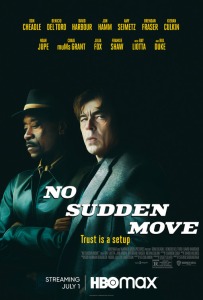 A star-studded collaboration between director Steven Soderbergh (Logan Lucky) and screenwriter Ed Solomon (Bill and Ted Face the Music), No Sudden Move is a class in how to effectively use tension and confusion to a movie’s benefit. Don Cheadle and Benicio del Toro play a pair of low-level criminals struggling to make ends meet. They accept a quick job “babysitting” a family while the husband (David Harbour) retrieves a very valuable document that certain higher-ups are after. Very early on, you feel like something is wrong and something will quickly go wrong, and this feeling persists throughout the film’s two hours. Our two protagonists sense they’re being set up, take action, and from there the movie becomes them trying to cash out with this valuable document while constantly looking over their shoulders. There are many different parties that are willing to do whatever it takes to obtain this document. In all honesty, the screenplay by Solomon is a little too over-plotted. There are several betrayals and schemers and acrimonious relationships built upon past betrayals and mistakes that it can all be a little hard to follow at times. The dread I felt was palpable. You don’t expect these guys to get away with this, not against the forces they’re going against, and so it becomes a nerve-wracking game of assessing every moment and whether this is when disaster will strike. Soderbergh’s dashes of style don’t always jibe with the 1954 Detroit setting, like his penchant for fish-eyed lenses communicating the distortion of this murky world of shadow brokers. It feels like Soderbergh has to resort to some new gimmick to get himself excited about movie projects (at least is wasn’t filmed on an iPhone). The acting is strong throughout, though Cheadle can be hard to hear at times from his guttural, frog-in-throat speaking voice. The movie kept me guessing, with some surprise cameos, and it left me dreading what would happen next. A modest success for glamorous discomfort.
Nate’s Grade: B
Share this:

Werewolves Within (2021)
 Surprisingly based upon a PlayStation VR video game by Ubisoft, Werewolves Within is a fun horror comedy that plays out like a demented Agatha Christie drawing room mystery. Sam Richardson (The Tomorrow War) is a new park ranger assigned to a small snowy town that may or may not be threatened by a werewolf hiding among the townspeople. A series of bloody murders and mangled gas generators points toward some monstrous beast, and over the course of one long night, characters will accuse one another of being the hidden werewolf, and tensions and paranoia mount as the body count rises. Part of the fun comes from the wild whodunit speculation that the filmmakers are aware of. Early on, I started accumulating my band of suspects, and then my red herring suspects, and the movie seems to be fully knowledgeable of this as well, so there’s plenty of little details spilled that, in an ordinary movie would prove conclusive to the detail-oriented viewer; however, Werewolves Within is full of motivations and clever fleeting details to throw you off. Richardson is wonderfully nonplussed as the supremely nice and easy-going ranger who finds himself frantically trying to be the voice of calm and security as the town breaks down. The supporting characters are rather one-note nutjobs but each has a different personality to sprinkle into the chaotic mix. The eventual reveal of the culprit involves a lot of explaining to cover hidden character deception that could have used more setup to feel less forced. I also wished the humor and the horror was a bit crazier. I knew the horror wasn’t going to be pronounced, as most horror-comedies typically favor one more than the other, but I wished the comedy had escalated as the characters further gave in to the insanity of the ridiculous situation. It’s a movie that’s easy going in charm and finely punctuated with some sharp one-liners and silly visual gags. It’s agreeable to its core and a lighthearted yet gory way to spend 90 minutes. By default, it’s also one of the best video game adaptations made into a movie. That’s primarily because it’s a recognizable murder mystery structure just with a genre kick. I wish everything had been given an extra dose of elevation and hijinks, comedy and horror, but that might detract from the overall droll charm, lead by Richardson. Werewolves Within makes me wish for an anthology franchise just transplanting its premise across new settings. Imagine The Hangover but having to also figure out which of your recovering blackout drunk friends was a werewolf. It just works.
Nate’s Grade: B
Share this:

The Tomorrow War (2021)
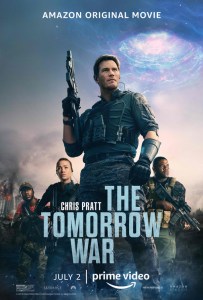 Amazon’s new movie, The Tomorrow War, is the costliest original blockbuster of the summer, and it’s skipping theaters entirely. The $200 million-dollar sci-fi movie was originally slated for theatrical release in December 2020, then pushed to summer 2021, then sold to Amazon streaming for the cost of its production budget. It’s easy to grasp the excitement of its premise and how it could translate into engrossing escapism. At the 2022 World Cup, a flash of light transports a team of future soldiers who need enlistments. In a matter of months, the world will be facing a war between alien monsters, and by 2050 we will be on the verge of losing for good. Dan Forrester (Chris Pratt) is a science teacher/ex-veteran who is conscripted into the future war, along with some other unlikely soldiers, and thrown into the future. His tour will last one week and then he’ll be sent back to 2022, if he survives, and only twenty percent come back.
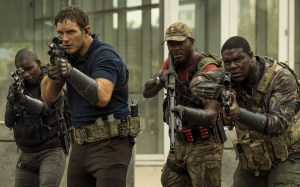 Perhaps it was the allusions or homages to Starship Troopers, but I found the first act and the action before the action to be the most interesting part of The Tomorrow War. I was hoping with its time travel premise of a future war fought by the past that there would be some attention paid to the world building and implications of its premise, at least before it became hunting down monsters and shooting in corridors, and thankfully the movie actually takes some sweet time to lay its foundations before being conscripted itself into action movie spectacle. Much like Starship Troopers, we have people unprepared for a war against an alien species and essentially being tossed into basic training as cannon fodder for the military industrial complex. I enjoyed that the screenplay by Zach Dean (Deadfall) actually plays out some of the larger effects that its future confirmation would stir. Effectively, humanity knows that in thirty years it’s all over. There is a definitive end date. Knowing that thirty years is all civilization has remaining would cause all sorts of global, social, and psychological upheavals. Why bother going to school if it’s all over in thirty years? Why try and start that business if it’s all over in thirty years? Why start a family if your children will be doomed in thirty years or less? Society would be irrevocably changed, and sectors and populations would refuse to go back to the way things were, and instability would flare up with generations sore over their lack of Earthly inheritance.
That’s just one factor that gets attention during this first 45-minute section. The nature of the future conscripting people of the past to fight their war has plenty of political commentary about generational conflict, proxy wars, and how the poor are disproportionately affected with less choice. The soldiers being taken from the past are older and an unorthodox pool of candidates that wouldn’t meet contemporary military recruitment standards. This is because the people being sent to fight are already dead by the time 2050 rolls around to avoid any time paradox concerns. There are interesting implications here. It’s like their own governments are saying, “Well, you’ll be dead anyway, so you might as well die now rather than much later and maybe you’ll provide a more immediate need other than taxes. Thank you for your service, now die.” Again, the psychology and ripples of that can be fascinating. I’m skeptical why more 2022 Americans are not disputing why they should fight 2050’s war with their own flesh and blood. I suppose I wanted this intriguing premise to be played out more in the span of an ongoing TV series, something along the lines of the elegant existential bummer of HBO’s The Leftovers. As a feature, The Tomorrow War gets beaten into blockbuster shape to become another noisy sci-fi spectacle, but the potential of its premise and the bombshells of its world-building deserved even more deliberate consideration.
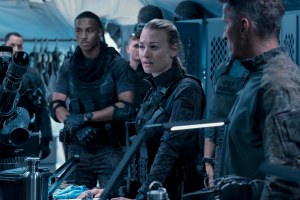 When the action picks up, The Tomorrow War follows a predictable path of alien invasion military thrillers. Dan’s unit must go into enemy territory and retrieve an important thing before the aliens overrun the facility as well as before the Army firebombs the block. There are many ticking clocks built into the plot mechanisms, from Dan’s week-long sojourn into the future ticking clock, the overall “humanity’s last stand” ticking clock, the ticking clock of getting needed lab components before destruction, the ticking clock of synthesizing a magic alien cure, and there’s likely others I haven’t even noticed. That cluttering of urgency extends also to its personal exploration of two sets of frayed familial relationships, father/daughter and father/son across three generations. It’s simply too much and detracts from more time and attention being given to the elements that demand the most development. The father/daughter relationship has the most meaningful drama considering it covers multiple periods of time and pushes Dan into thinking more critically about sacrifice and legacy. The broken father/son relationship between Dan and his absentee dad (a buff J.K. Simmons) is unnecessary and put on hold for too long and then hastily tied together. The Tomorrow War is an unlikely candidate of having too many conflict elements and points of urgency that they can dilute one another.
This also gets into an extended third act that feels entirely tacked on. After a critical climax, I grabbed my remote to pause the movie with the belief that things were wrapping up shortly. I was shocked to see I still had another 30 minutes left to go. The mountain-set final action set piece feels like a late studio addition rather than an outgrowth of what was established in the screenplay. Strangely, the characters don’t seem to be acknowledging the reality of cancelling out the alien-invasion nightmare future with their actions. If Dan has the magic elixir to thwart aliens, and goes back to 2022, then he can prevent the billions of eventual deaths. I suppose that does nothing for those in 2022 that got zapped into 2050 and died in the line of duty, but it spares everyone else from 2023 onward. I started yelling at the screen that preventing the terrible future meant good things.
 As far as the quality of action, it’s a cut above thanks to director Chris McKay (The Lego Batman Movie), making his live-action film debut. I’ve noticed with other directors who primarily got their start in the realm of animation that they have such a great command of filling up the screen. Brad Bird, Travis Knight, Phil Lord and Christopher Miller, and Tim Burton, all of them have an extra artistic sense of how to use the space of the frame to immerse the viewer. I greatly appreciated that many of the sequences where the soldiers fight the alien monsters use long takes and clear editing. There’s one scene where soldiers are trying to wrangle a monster as a hostage and all the fighting and buckling is impressively presented with sufficient distance so we can see the soldiers react and go flying. The introduction of the alien monsters is drawn out of the shadows, but from that moment onward the movie presents the monsters clearly, and I enjoyed the squid-meets-feline creature design enough that I welcomed more closeups. There’s also a horrifying and darkly comic tech mishap where the future accidentally zaps its new recruits into 2050, but instead of re-materializing five feet above the ground it’s 100-plus feet high, so we watch people hurtle to their awful deaths. McKay can replicate standard studio action movie grist seen in plenty of other big-budget blowouts (there are multiple examples of characters slow-motion jumping out of the way of explosions), but more often McKay has a natural eye for visual compositions and how to bring out more with his sci-fi spectacle.
One of the bigger miscues of the movie was the hiring and prominence of Pratt (Jurassic World) as the lead. He’s got the presence and build to be convincingly ex-military, but he’s not a good fit for an everyman, let alone a family man everyman scientist. He’s a high school science teacher going through personal malaise because he feels like he’s meant for something bigger (what’s bigger than saving humanity, guy?) and this ordinary life just ain’t cutting it. Except Pratt can do charming and affable, he can even do heroic, but this part does not play to the actor’s strengths, so Dan often comes across as plain and bland. He’s stuck as the square-jawed straight man for the movie and is boring once he goes into action or thinking mode.
 I wished the movie had been retold from the point of view of Charlie, played by reliable comic Sam Richardson (Veep, Werewolves Within). He’s a welcomed voice of panic and reason among the avalanche of sci-fi, science, and military jargon. He’s a widower, losing his wife on her own tour of duty, and he feels greatly out of place. The actor is so amusing and the character so unexpectedly entertaining that I wish Pratt’s hero had bit the dust early as a meta head-fake (think of Seagal getting killed off early in 1996’s Executive Decision) and we were left to follow Charlie as humanity’s unexpected savior. Along the conversation of waste, Betty Gilpin (The Hunt) is shortchanged as Dan’s wife in 2022 world. They introduce a plot point that family members can be conscripted in place, and then there’s the transport glitch that kills all but a few, so I assumed that an actress of Gilpin’s kick-ass capability would find herself in the future fighting too. Alas, dear reader, Gilpin is just here to be the concerned wife at home waiting for her man to return.
The Tomorrow War is an original story though it’s built from older, recognizable parts, a little Independence Day here, a little Alien there, and a dash of Edge of Tomorrow. It’s derivative but it still has its own points of interest, chief for me is the world building and premise. The action is solid and filmed well. The scope of the special effects fits comfortably in the blockbuster studio range. It’s a good-looking movie with plenty of action and enough time travel quirks, though your attention may also flag as the movie lurches to a protracted close with its extended third act. It does more right than wrong as blockbuster spectacle. I think it had offshoots of better potential that could have been tapped, but as a big screen entertainment ported to your smaller home screen, The Tomorrow War is destined to win fans with lowered expectations and 140 minutes of free time.
Nate’s Grade: B-
Share this:

Good on Paper (2021)
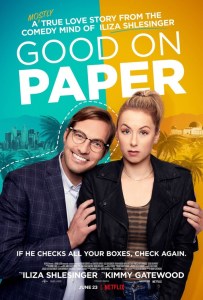 Famed standup comic Iliza Shlesinger had money, a rabid following from several popular Netflix specials, and a boyfriend who went to Yale, was a successful hedge fund manager, and a sweet guy, or so she believed. In real life, Shlesinger was victim to a man who wormed his way into her life and lied about every significant facet of his own life in order to impress. The true-life experience of Schlesinger was her inspiration to write her first screenplay, the “mostly true” Good on Paper. In the Netflix original comedy, Shlesinger plays a fictionalized version of herself, Andrea, a standup comedian who meets Dennis (Ryan Hansen) on an airplane. They form a friendship and he clearly wants more but she’s just not that into him. That doesn’t deter Dennis, who keeps nipping at her heels, and after he tearfully reveals his mother diagnosed with cancer, Andrea decides to give the “nice guy” a chance as a boyfriend. However, his fibs and excuses add up and test the resolve of Andrea, who questions who Dennis really is.
 Where Good on Paper gets good is blowing up the manipulations of the “nice guy” persona that certain men cling to as a shield. There is a contingent of men out there in the dating world that dismissively view the disinterest of select women as a failing not on them but with the women, who just cannot grasp what how much these “nice guys” have to offer. They hold to the adage that “nice guys finish last” as a resentment builder, but it really comes down to this persona being one more version of toxic masculinity. The so-called “nice guys” will never view themselves by those terms, but they’re just as toxic because they proliferate an unhealthy sense of entitlement with their obsessions. Being the nice guy friend to a woman isn’t good enough, and her friendship seemingly isn’t reward enough, no, she must also give of her body if the “nice guy” requests, or so the expectation prevails. The phony “nice guy” accumulates emotional leverage to manipulate and guilt his object of desire and waits. This is gross behavior and I haven’t really seen this blown up before in a romantic comedy setting, so it was a welcomed source of comedy and commentary from Good on Paper. Dennis is a slimeball who uses points of sympathy and charm as pressure points with his targets. For him, it’s about living up to an imaginary standard, a version of himself he thinks others would better respect, and yet had he put in actual effort in self-improvement, chances are somebody out there could have accepted and even been attracted to him on his own terms. But he doesn’t want to put in that level of effort.
The casting of Hansen is also quite helpful because the audience is trying to see the natural charm hidden under the bad greasy haircut, bad fake teeth, and dad bod. Early on, Andrea says she was not physically attracted to Dennis, and this is emphasized by him slipping into a hot tub with his shirtless, untoned body right in her disinterested face. Hansen hasn’t gone full Method and gained weight; his face is cut off for the only shirtless scene, meaning it’s a literal dad bod body double for the actor. Hansen is best known in lunkheaded comic relief roles from TV’s Veronica Mars and Party Down. He has a natural goofy appeal and the casting utilizes this as a weapon. Dennis himself isn’t super charming or super funny, but he’s just funny or charming enough to draft off the actor’s own natural assets that you could understand why a woman like Andrea might find his company interesting. Hansen is great as an oily salesman constantly in flux, and when his elaborate cover stories are jeopardized is when the actor is at his funniest. His pathetic flailing and side-stepping of inconvenient facts pushes the actor to squirm, and since we know he’s the source of such discomfort for our heroine, watching him contort and squirm is gratifying.
 The movie picks up once the lies from Dennis start to converge and multiple, or at least once Andrea begins her personal investigation. The movie’s best scenes are those shared between Shlesinger and her freidn played by Margaret Cho (Drop Dead Diva) as they feed on one another’s nervous energy and wild flights of imagination. The comradery between them has a lively and familial energy and it’s at these moments where the movie really embraces its own chaotic energy. Uncovering the truth about Dennis, and the depths of his deceptions, allows for a steady stream of reveals and payoffs. It’s enough to make me wish the movie spent less time on Dennis’ kooky roommates and a subplot with a rival actress whose seemingly blessed career infuriates and frustrates Andrea and more as a buddy movie between Shlesinger and Cho as bumbling detectives.
I do wish that Shlesinger had pushed further into the realm of farce. The mistaken identity/cover story routine is ready made for extra laughs from going bigger and broader. The movie is at its funniest when it embraces its sitcom setup and rides it for absurdity, like when Dennis is forced to keep adjusting his lies in the presence of Andrea’s friends, some of whom actually went to Yale and know enough to contradict his cover. There are points where it feels like the central premise is being stretched thin because it’s not fully going into the extra machinations and complications of farce. This is evident with a third act that feels misplaced and suddenly too serious, with some gross-out injuries that the proceeding comedy had not prepared us for tonally. There is even a courtroom battle that concludes with a cutaway from the verdict being read to a character explaining what happened. If this was going to be the way of resolving the big climax, why include it? And why include characters literally explaining things offhand in catch-up mode when Shlesinger has already written her stand-up interludes AND her voice over as direct devices? I think perhaps this story was so personal for Shlesinger that she didn’t want to depart too far from the facts of her experiences. As is, it’s definitely an intriguing story and has been featured in her stand-up routines, but as a feature film, Good on Paper could have benefited from some additional jolts of ridiculous comedy.
 Good on Paper is good for 90 minutes of amusement and some decent chuckles. Shlesinger’s character is in her mid-30s and trying to stake out a successful career as a credible actress, and the real-life Shlesinger is trying to do the same so she wrote herself an acting showcase denied to her by other projects. Shlesinger feels like a ready replacement for the kinds of roles I would have associated with Katherine Heigl at the height of her rom-com run, if she wants it. She has a down-to-earth quality that makes her engaging and obvious comic timing. Her dramatic turns also relatively stick, though this might be the fortuitous alignment of her personal experiences directly translating into the role. I do wish Good on Paper had given a little more attention to filling out its story, punching up its comedy, and maybe pushing everything deeper as at times it can feel like an over-extended anecdote. It’s good enough for a light comedy and serves as a cautionary tale about dating in the digital age.
Nate’s Grade: B-
Share this:

Awake (2021)
 Every so often I’ll watch a movie and be really intrigued or hopeful with the premise, something that really grabs my imagination, and then that hope crashes and burns in disappointment of a story that never fully takes advantage of all the tantalizing possibilities of its start. In short, I say, “That movie didn’t deserve its premise.” That’s the first thing I thought about after watching Netflix’s new apocalyptic thriller, Awake, where humanity is suddenly incapable of going to sleep. There’s an engrossing drama about the psychological descent and a potent political thriller about the destabilizing of civilization once people are unable to get their forty winks. The premise peculates with such promise, and for it to become yet another end times road trip, hewing so closely to a solidifying formula, is like trapping everyone in a (bird) box.
Jill (Gina Rodriguez) is a former soldier, recovering addict, and current security guard who is also selling opioids on the side to make ends meet. One day, people are no longer able to sleep, everyone except her young daughter. Jill rescues her two children, gets into a car, and drives off for a far off scientific research base where a scientist (Jennifer Jason-Leigh) studying sleep might have the knowledge of how to solve this worldwide mystery.
 I think most people have dealt with the effects of sleep deprivation at some point in their life, especially if they have ever had a newborn child. The subject matter is very relatable. I had a bout of insomnia years ago where I was averaging less than two hours of sleep for weeks, and it was the worst physical endurance I’ve gone through in my, admittedly privileged, existence. I felt like a zombie, barely able to function, my head forever fuzzy, and I lost all desire to eat and had to compel my body to consume food I knew it needed for fuel. I even purchased the Ensure nutritional drinks. It was a miserable time and I was even getting a minimal amount of sleep rather than none whatsoever. I’ve had rough sleep certain nights and feel like I’m running on fumes for the rest of my workday. It takes far more time to bounce back from bad sleep, and I’m wondering if I’ll ever actually get consistently restful sleep again for the rest of my life. With all of that stated, Awake should be an easy movie to plug right into and relate to the deterioration. However, it’s so unclear and clumsy in its depictions of the world. It’s unclear until the very very end how long the world has gone without sleep, and so we run into examples that seem to paint two different pictures of our apocalyptic environment: overplaying and underplaying.
At times, Awake is overplaying the effects of the mental breakdown of society. At points, it feels like society has broken down so completely and over a confusing timeline. There are run-ins with a group of elderly naked people just standing around and acting serene, a prison where the inmates walk out for unspecified reasons involving the guards, and a church that has already gone full-borne cult crazy by thinking that sacrificing the little girl who can sleep means they’ll be able to share in her slumber. The movie didn’t establish these people as crazy religious fundamentalists, so this sudden bloodthirsty turn feels like a leap. Even in 2007’s The Mist, the trapped townspeople gave into the corrupting influence of the religious bigot over time and distress. It reminded me of another Netflix apocalyptic, parental road movie, 2019’s The Silence, where it seemed like it was mere hours before a select group of people started cutting their tongues out and declaring they needed to kidnap women for the purpose of re-population. I suppose some people are just looking for the first good excuse to indulge their baser impulses, but then explore more of this feature with meaningful characters that will matter when they break bad. I think the movie would have greatly benefited from a clear timeline, some helpful titles keeping up with the clock, things like “50 Hours In,” and the premise could have been revised to be a slow evaporation of sleep rather than a strict cut-off. Maybe people are only able to get two hours a night, then one hour, then 30 minutes, and people are freaking out because they know it’s getting less. Let society have some measure of reconciling with the totality of what is to come.
 At times, Awake is also paradoxically underplaying the effects of the mental breakdown of society. For the majority of the movie, our characters aren’t really acting differently even though they have been awake for multiple days. This is what also made me so confused. How much time has passed if nobody seems to be making a big deal about it? The slips in reaction time and awareness don’t really feel integrated until the chaotic conclusion. The family comes across the wreckage of an airplane and make no big deal of it. For that matter, if we’re establishing that sleep deprivation is causing planes to fall from the sky, I think there should be thousands of these crash sites dotting the landscape, unless the airlines have wised up and decided to ground their pilots because they’re afraid of potential post-post-apocalyptic class action lawsuits. Travels with Jill become too leisurely for everything that is going on (note to self: pitch an Anthony Bourdain-style travelogue during an apocalyptic social breakdown and tasting the new culinary delicacies). She senses that she will die and needs to train her children to survive in this new world without her. However, if only her daughter can sleep, then presumably only she will be left alive in due time and it’s less about fending for herself against other people and more how to live off the land. There’s an existential and more poetic, prosaic version of Awake where Jill is trying to cram years and years of parenting into a precious couple of days, where she also tries to secure a fortified hiding place for her daughter to wait out the rest of humanity dying off before she can come out like a hibernating animal. For Jill, its about securing her child’s survival rather than reversing this plague that is dooming humanity. There’s a stronger movie that could have been made had Awake been more personal and more serious rather than schlocky and muddled.
The movie does have a few moments of bizarre effect or risible tension, but these moments are few and far between and director/co-writer Mark Raso (Kodachrome) is very transparent about his genre influences. There’s a roadside checkpoint where a group of armed people try and break inside Jill’s vehicle and pull her and anyone else out the windows. The car is still driving as the assault goes on and the camera remains inside the vehicle while rotating around the interior as the attack plays out in a real-time long take. If you’ve seen the sci-fi masterpiece Children of Men, then this description should already be ringing a few bells of recognition. It’s not that Raso cannot pay homage to the sci-fi inspirations of his tale, but when you draw direct comparisons by emulating very specific artistic choices done by superior filmmakers, you’re inviting a negative impression. A standoff between Jill and an increasing exodus of prisoners had a queasy anxiousness to it because the movie lets the scene build with direct, immediate stakes. There’s a similar scene where Jill is hiding in a garage from voices, but the stakes don’t translate as well because our knowledge of who the other men are is limited. She could just sit in a corner and wait. The plane wreckage scene is impressively designed, and there are a few genuinely surprising moments, like the crowd of naked old people, to keep things curious, but Awake too often settles again and again for the most formulaic and least interesting creative path.
 If this all sounds a lot like Netflix’s Bird Box, then congrats, because you’ve likely caught onto the reason this movie exists. Both movies feature an unexplained worldwide phenomenon that results in the breakdown of society where mobs and cults have formed, and both movies feature a single mother trying to lead her two children, one boy and one girl, through the hazards of the road so they can reach a supposed secure place where authority figures will have answers, and both movies feature a normal facet of human existence that, once removed, is making people go crazy and mess with their perception. Both of the movies also provide plum roles for high-profile actresses. Rodriguez (Miss Bala) is a compelling actress who has shined in lighter, rom-com material (Jane the Virgin), in quirky character-driven indies (Kajillionaire), and in somber existential horror (Annihilation). She has the tools to be great. Awake did not give her enough. There are a couple of scenes, late, of her starting to lose her bearings, and it’s here that I wished the filmmakers had realized that showing the effects of this cataclysm would be best than underplaying or overplaying the deprivation. Awake is an apocalyptic road trip that will bore more than excite and frustrate more than engage. Who knew sleeplessness was such a snooze?
Nate’s Grade: C-
Share this:

Luca (2021)
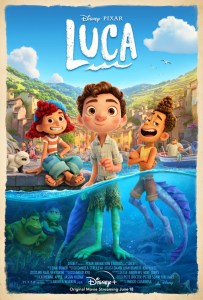 Pixar’s second straight direct-to-Disney-plus outing, Luca, is a decidedly lesser movie from the creative powerhouse. It’s more in keeping with the low stakes and minimal characterization of something like the Cars franchise or Monster’s University. It has its gentle charms and important themes about acceptance, accessibility, and identity, but Luca feels a bit too shallow and lacking in magic. Two sea monster boys want to feel the thrill and freedom of living on land, and it just so happens they transform into looking like humans as long as they don’t get wet. They must learn the ways of blending in, keep their secret, and win the local triathlon to achieve their dream of owning a Vespa scooter. Yes, ostensibly it’s about two kids, and a third once they become friends with a rambunctious redheaded girl in town, wanting to win a race to get a scooter, and you can see the larger theme about friendship and self-acceptance in the name of intolerance, but the movie feels like Ponyo meets The Little Mermaid with the setting of Call Me By Your Name (with maybe some of its coming-of-age queer coding?). The movie barely gets to 84 minutes long, pre-credits, and even that feels very lackadaisical and padded, stretching a thin storyline with minimal development. The animation is expectantly gorgeous and colorful, the lovely daubs of light are so soothing to watch, though I didn’t care for the Gravity Falls-style character designs. The stakes are low and personal but I didn’t really care about the broad characters. There are some fun farcical hijinks trying to hide their monster selves from being seen, and the conclusion has a sweet message without being overtly sentimental, but Luca is little more than a fitfully amusing yet slight seaside vacation for your hungry eyes.
Nate’s Grade: B-


 nathanzoebl
You must be logged in to post a comment.