Category Archives: 2020 Movies
Trump Card (2020)

After a long and bittersweet relationship, I think it’s finally time for me to part ways with Dinesh D’Souza. The conservative author, pundit, and director of intellectually dishonest and slimy documentaries has given me so much to unpack over the years. D’Souza reigns unopposed as one of the worst filmmakers, let alone an incompetent propagandist, and has ruled my annual Worst Films of the Year lists (2012, 2014, 2016, 2018). Seriously, if it was an even year, you could expect a D’Souza doc to have a slot already in preparation on my list. Not even Friedberg and Seltzer have that many dishonorable mentions. He rose to fame as the “reasonable critic” of President Obama but if you watched his films, you’d know D’Souza’s assertions were anything but reasonable. As I concluded with 2018’s Death of a Nation: “He is not a man who tells truth to power but a man who willfully distorts the historical record in order to make people feel better about unhinged political takes that have no bearing in reality. It is people like D’Souza that have led the way for the coronation of Donald Trump, and it should be people like D’Souza who are put to blame when that experiment crumbles.” That is why, dear reader, I think it is finally time for me to step away from the trough of righteous outrage and be done with the disingenuous D’Souza as a filmmaker deserving of even one iota of passing thought. I can only hope with the 2020 election on the near horizon, that America will likewise put to bed the man in the Oval Office and, by extension, D’Souza’s relevancy. But let’s dive in, one last time America, into the bad faith arguments, armchair psychology, racist projection, historical revisionism, crippling persecution complex, fear mongering, and endless shots of D’Souza wandering the sights while looking so contemplative with pursed-lipped, faux concern. It’s Trump Card, one of the worst films of 2020, and hopefully the last D’Souza film for me for the remainder of my days.

I think the opening scene is fittingly indicative of D’Souza’s blatantly fraudulent arguments and willful ignorance. It’s a recreation of an interrogation from George Orwell’s famous dystopian novel Nineteen Eighty-Four. Orwell is an interesting choice here considering he was a journalist (strike one), liberal author (strike two) and anti-fascist (strike three), but the general associations of the novel are so ingrained that it becomes a stand-in for any sort of Big Brother state critique. Orwell’s classic story follows an authoritarian government that tells people what to think, to not trust their eyes and ears but simply the proclamations of the State. Where D’Souza goes amazingly off the rails is when he tries to purport that it’s the Democrats who are the evil Big Brother at work trying to brainwash good, honest, God-loving Trump voters into turning against objective reality and swallowing the lies of Dear Leader. Just contemplate that appraisal. In the face of Donald Trump, a man who LITERALLY told his supporters not to listen to their eyes and ears and only to him, a man who has been documented lying over 20,000 times since coming into office, including such obvious and absurd statements like having the biggest inaugural crowd in 2017 or whether it was raining, a man who constantly distorts reality to his petty whims, and D’Souza says it’s really the Democrats who are the dangerous brainwashers. This staggering misreading of Orwell’s political commentary would be hilarious if it weren’t so pathetic and facetious. This telling anecdote perfectly sums up the lazy rhetoric of D’Souza.
It’s hard not to wonder what the larger thesis is here. D’Souza has never exactly been a filmmaker of scholarly heft but his prior films at least presented a through line to hold onto. I thought Trump Card was going to be a conservative case against socialism but D’Souza can’t fully commit 90 minutes to that cause, and so the movie becomes yet another slipshod attack on any and all familiar targets of conservative agita. We’re told socialism is bad, capitalism is good, and through selective examples it’s reconfirmed. Never mind the socialism of Scandinavia, let’s focus on the failed state of Venezuela while ignoring its history of colonialism. We’re told Democrats hate all capitalism, but D’Souza once again conflates free market capitalism and crony capitalism, a sociopathic system unchecked by regulation and rampant with corruption and abuse. We’re told that China is bad, though they’ve introduced features of capitalism so now they’re maybe not as bad, but they gave us COVID19, so they’re still bad, I guess. We’re told the protesters of Hong Kong who want transparency, reforms, and democracy are good, but Black Lives Matters is a cesspool of “thugs” and anarchists without a just cause of reform. We’re told “antifa” didn’t oppose Nazis in Germany but the “center-left,” which makes no sense whatsoever. We’re told Democrats can’t get enough of late-term abortion, when that’s not even a thing. We’re told climate change can’t be that big of a deal because Joe Biden has a beach house so, ergo, he must not worry about rising coastlines. We’re told that the early response to COVID19 was a failure of socialism, when it was the federal government’s cowardly and calculated hands-off approach that turned the purchase and distribution of life-saving medical supplies into a feeding frenzy of capitalistic excess, pitting state against state for scraps.
Amazingly, D’Souza praises Donald Trump as a symbol of capitalism, a man born into wealth, who inflated his assets to get out of taxes, who went bankrupt four times, whose own charity was shut down and declared an illegal racket to line his family’s pockets, who regularly stiffed his contractors, who has been hounded by lawsuits, and who slapped his name on any rickety scheme he could profit. Again, D’Souza has stupendously rear-ended into an insight that he intended to disregard. Donald Trump is a neon orange symbol for the farcical excess of crony capitalism.

One of the weirder detours is when D’Souza decries “identity politics” when he’s been steeped in this stuff since his first movie. He lambastes Democrats for, essentially, having an inclusive voting base with diverse interests. Republicans like to still cling to the idea of their party being a “big tent,” but from a demographic standpoint, they are shrinking and only gotten whiter, older, and more male. It’s more the party of one very specific kind of America. Some of D’Souza’s taunts are simply snide and juvenile, like deriding young people for “their pronouns” and the idea of being gay now becoming “an ideology” (you know, like being heterosexual is an “ideology”). In one breath D’Souza doesn’t want “identity to define anyone” but ignores that the Republican Party has become a cult of personality rejecting any contrary thinking. Their 2020 party platform was merely one page and amounted to: “Whatever Trump says.” Choosing not to recognize our natural differences is dishonest. As a white man, my experiences are going to be markedly different than a black woman, and acknowledging this isn’t some sign of weakness or pandering, it’s merely a recognition that our differences are not trivial. It’s similar when people say “I don’t see color” as a misplaced virtuous sign of how liberal-minded they are.
The spurious interview subjects are prone to making wild accusations, aided by D’Souza’s famous leading style where he practically recites the words he wants to hear. A former radical Muslim says he challenges anyone to find a jihadist that would vote for Donald Trump (counterpoint: The Taliban has actually endorsed Trump for 2020). This same man calls Rep. Ilhan Omar as “ISIS in lipstick” without any supporting evidence. The interview subjects are not exactly compelling experts. Why is Isaiah Washington, the man infamously fired from Grey’s Anatomy for using homophobic slurs, an expert on Hollywood oppression? Why is D’Souza’s own daughter and wife, each with a book ready to be peddled, experts on anything? Did D’Souza not have any other relatives he could call on to become instant world affairs experts? Some of these people are well-meaning and with a perspective that merits consideration like a grieving father from the Parkland school shooting, but others are laughable on their face for being included. Larry Sinclair swears he smoked crack and performed oral sex on Obama (“He came back for seconds”), and D’Souza intones that this “allegation” (repeatedly disproven with no evidence) deserves the same level of attention as Stormy Daniels with Trump. Never mind that Trump’s affair wasn’t a scandal because of his moral failing (a thrice-married man known for womanizing) but because of the financial fraud of covering it up before the 2016 election, which sent Trump’s own attorney and personal fixer, Michael Cohen, to jail. Even if the crack-smoking Obama BJ guy is right, and he’s definitely definitely not, who cares if Obama had a gay experience before he was elected president? I guess the association itself is supposed to be unseemly, but it’s D’Souza’s inclusion of such a baseless smear, the unchallenged details of which garners the film its PG-13 rating, as a means to revile this audience and stoke confirmation bias about the mainstream media that’s really unseemly.

D’Souza is all-in on the big kooky Deep State conspiracy to entangle Donald Trump’s presidency, never mind that an impulsive businessman who prefers chaos needs help to falter. I could barely keep up with the barrage of names and dates and accusations, trying to connect the dots with a messy conspiratorial plate of spaghetti. Once they reach the silly Ukraine accusations of impropriety with Joe Biden, the same talking points that the Kremlin parrots, the same groundless stuff that Trump got impeached over in 2019, I started zoning out. D’Souza champions Michael Flynn and George Papadopoulos (both pleaded guilty) and Roger Stone (convicted by a jury) as victims of an abusive surveillance state. He lets Papadopoulos and his wife dramatically revise his criminal history, re-imaging himself as a martyr who was forced to speak against Trump by a vindictive FBI. And yet multiple Justice Department and Congressional investigations over the origins of the Russia probe have reaffirmed, repeatedly, conclusively, even when run by Republican Senators, that the FBI investigation was warranted and correct in its conclusions. Donald Trump doesn’t need anyone but himself to get into trouble. No conspiracy is necessary for a perennial screw-up.
I’m all but certain that D’Souza had to radically retool Trump Card as the year progressed. This is the latest any of his election-timed documentaries has ever come out; he usually prefers the cushy position of mid-to-late summer releases. My working theory is that he was heavily planning a documentary about the evils of socialism with a Bernie Sanders as the Democratic nominee for 2020 as its focus on where the Democrats are taking the country. It’s much harder to paint lifelong centrist Joe Biden as a dangerous radical, and it’s equally hard to say the crazy leftwing radicals are taking over the country when they couldn’t even win the party nomination. Then an early trailer for Trump Card over the summer was constituted entirely by footage of rioters, burning buildings, broken windows, and the presumption that D’Souza’s film would focus on the dangers of a growing protest movement that summer. He still gets some hits in but the widespread protests for police reform and racial justice in the wake of George Floyd’s murder have not been the source for civilization being upended. I’m genuinely surprised D’Souza didn’t feature more of the ongoing battles with the unmarked private army sent to harass and beat Portland protesters but that might have harmed his message that Biden will lead to civil unrest when the images of civil unrest are happening live in Donald Trump’s America. Trump Card feels overwhelmingly like it’s coasting and that D’Souza is falling back on old arguments, old foes, and old tricks. D’Souza can never get enough of Abraham Lincoln re-enactors, gauzy stock footage of sunsets and wheat fields, and his wife singing renditions of public domain patriotic songs. After five movies, it just all feels so stale, so tired, and so inept and lazy, even for its own select audience. “President Trump reminds me why I first came to America,” says D’Souza early in the film, drawing a deep belly laugh from me. I feel about D’Souza’s oeuvre of terrible, shameless documentaries the same I feel about Trump as a president: exhausted by it all. I’m ready for both to go away for good.
Nate’s Grade: F
Share this:

Spontaneous (2020)
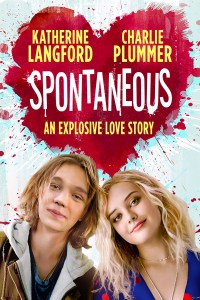 Spontaneous is a movie that grabbed my attention immediately, made me laugh quickly, and then made me fall in love over the course of its explosive 100 minutes. The more I think back about this bizarre little movie, based on the YA novel by Aaron Starmer, the more affection I have for it and its messy accomplishments. Writer/director Brian Duffield has been one of the most exciting screenwriters for years, penning highly inventive stories that have a distinct, vivacious comedic voice that leaps off the page and smacks you across the face with how good it is, and then you ask for more (check out The Babysitter for the closest representation of what a Duffield screenplay delivers; skip the sequel though). This is Duffield’s debut as a director and I feel like he’s a natural fit for the quirky, blood-soaked material. Spontaneous is a dark comedy that can also make you feel something because it doesn’t simply treat its characters as disposable punchlines.
So the senior class of Covington High School has a serious problem. They’re spontaneously exploding. Nobody knows why, nobody knows who will be next, and even after a government quarantine, the answers aren’t any clearer. Mara (Katherine Langford) just wants to live to grow into a badass older lady who lives on the beach with her best friend Tess (Hayley Law). Her dreams of a life after graduation might never come true. Dylan (Charlie Plummer) introduces himself to Mara and they begin a tender courtship, falling in love during a precarious time where either of them could explode and soak the other in gore and viscera. Can these two crazy kids make it and grow up when their own bodies might betray their fleeting happiness?
 Almost instantaneously I was drawn into the romance between Mara and Dylan, and I enjoyed deeply how each helps to shape the other, finding a sincere connection in the most extreme and unexpected of circumstances. Their budding romance dances with tragedy and dread as we worry over the fate of our lovers; surely, with this horrific premise, they won’t end happily ever after, or could they? Every time another student exploded, I winced. I laughed a few times, I’ll admit, because the context can become darkly hilarious and absurd, but it’s also a natural human reflex to relieve tension. Each one of these kids is a potential suicide bomber and they don’t know it. It’s sudden and something that you, even as a viewer, will never get used to. What you will do is start to dread who is next and whether that explosion sound was someone you liked. With an omnipresence of tragedy, it pushes the characters to make the most of their potentially short lives and that brings a greater significance to their next steps, the little attempts to “feel like an adult,” to reach for their desires, and to declare who they are while they are still standing to do so. It takes the coming-of-age setup and deftly dials up the emotional stakes.
Make no mistake though, Spontaneous is an uproariously funny movie. We’re primarily seeing the world from the perspective of Mara and her narration and occasional fourth-wall breaks. There are some fun asides where other characters take over narration duties, but this is chiefly her movie and she’s delightfully odd, prickly, and worthy of our attention. Duffield’s screenplay is brimming with wit and the conversational banter flows with such a confident cadence, all while not being overly mellifluous and self-satisfied. I adored just spending time with the characters because I was anticipating what they would say and do next. The social satire is present but not as substantial as I would have thought. The film trades in familiar stereotypes we’ve come to associate with high school movies, yet it can take some interesting detours, like when the football team cheers in support about their fellow player for coming out as gay. This is a high school movie mixed with a horror movie, where a big party to cut loose could become the latest crime scene. Most of the adults are simply scared and don’t know what to do, and that helpless vulnerability extends outward and keeps going. Just because you may be older doesn’t mean you know what you’re doing. I cackled plenty from the physical humor, slapstick gross-out gags, but when Duffield wanted to be serious, you better believe I shut my trap and pulled up the blanket.
 I think it’s worth acknowledging, and I don’t consider this a real spoiler, that the cause of the spontaneous combustion is never resolved. There is no explanation, and if that’s a deal-breaker for you then I think you’re prioritizing the wrong parts of what Spontaneous is offering. It doesn’t really matter why it’s happening because the movie isn’t a scientific mystery. As much as it might seem bizarre to declare, this is far more than the “kids blown into bloody bits” movie. It’s not about what is happening per se but how it emotionally affects the characters. The unknown bodily explosions could serve as a gory metaphor for modern-day threats of school shooters, terrorism, or even our current pandemic (pick your metaphor, anything really works). Students don’t know who will be next, when their time will be up, and an anxious pall hangs over their day-to-day lives as they trudge onward trying to regain a sense of normalcy during a troubling and uncertain time of numbing trauma. That’s really the core of the movie, the response to inexplicable trauma. Some characters maintain a blasé, nihilistic attitude, questioning whether their minute remaining time has value. Others look at the random threat of exploding as a motivator to overcome the obstacles that kept them from achieving their goals, ignoring social hang-ups and personal misgivings. It’s the proverbial kick that Dylan needs to finally talk to the girl he’s been crushing on. He elects to live with his remaining time on this planet, no matter how brief, and elects to be happy, which is about one of the bravest things a person can do. That’s why the combustible student body doesn’t need an explanation, and to be fair what possible explanation would ever have been truly satisfying (“Oh, we all just ate too many carbs. Huh.”)?
If she hadn’t already established herself from Netflix’s somber soap 13 Reasons Why, this would have been a star-making role for Langford (Knives Out). She’s captivating from her first moment onscreen when she discusses the mundane details of her day at school right before the girl in front of her explodes. Her sardonic and spiky attitude permeates the movie and gives the film an energetic jolt, amplified by Duffield’s stylish flourishes that reminded me at points of Edgar Wright with how playful and involved the visual transitions could get. Our leading lady is a force of nature, and after enough time, you can understand why Tess wants to be her bestie, why Dylan would fall in love with her, and why other students would be afraid of Mara. There are moments where Langford can be silly and diverting, like dressing in mourning over the 2016 election, and others where she feels like she’s harnessing the totality of youthful feminine rage (I loved a late declarative statement directed at our current president) to be a symbol. The “same old” just isn’t going to cut it when the stakes are this high. Langford isn’t just the too-cool gal spitting pithy insults from a safe distance. There’s some heavy-duty existential drama here that she carries while through the prism of her eccentric teenager’s attitude. Her romance with Plummer (All the Money in the World) is sweet and affecting and feels entirely genuine.
 Sticky, sweet, and wickedly funny, Spontaneous is obsessed with death, the uncertainty of knowing when your time is up, and yet I came away feeling ultimately uplifted and moved. There are some jolting moments, both funny and heart-breaking, and Duffield wants you to take the time to feel the full experience of being young and angry and hopeful and anxious and in love and feeling weird. In a disastrous year of worldwide calamities, Spontaneous is a bright spot, and given the bloody premise, that should tell you everything you need to know about the year 2020. This is a delightful, heartfelt, and surprisingly mature teen drama that also happens to have people bursting like balloons. Duffield even touches upon the profound at points, which is hard to do with any filmmaker, let alone one playing with these crazy genre elements. Spontaneous is a coming-of-age drama with equal parts ache and warmth, gallows humor and personal insight. Find this movie, devote 100 minutes of your time, and wear a poncho if necessary.
Nate’s Grade: A
Share this:

Vampires vs. The Bronx (2020)
 Take Attack the Block and mix with The Lost Boys and you get a perfectly enjoyable B- kind of fun B-movie about a group of Bronx tweens combating blood-suckers gentrifying their neighborhood, and vampires too. It’s a pleasant experience that hankers back to enjoyable 80s ensembles and it maintains a sweetness without being sappy and an edge that feels appropriate for its age-range without getting too heavy or too simplistic. We follow our core characters as they investigate the would-be vampires, uncover their real estate schemes for the neighborhood, and then plan how best to thwart them. It’s a reliable formula but it works. I enjoyed Shea Whigham (Kong: Skull Island) as the vampire middleman, and I enjoyed how his own character arc as a subservient villain is tied into another teen’s arc about not following in the steps of his criminal older brother and rejecting people who only want to use you. That’s smart writing, finding room to draw parallels and connect the personal to the thematic. The lead kids all have their own personalities and problems and I enjoyed spending time with them as they bonded, bickered, and bandied together as a team. Their chemistry made them feel like real friends. The horror doesn’t really ever approach being scary or intense; when the vampires are in full teeth-baring mode, they seem more like the goofy, cheesy, cloaked figures from the TV soap Dark Shadows. It also feels like the movie runs a bit out of steam as it carries on into its final attack/assault on the vampire’s nest. Still, Vampires vs. The Bronx is a funny and light-hearted 90 minutes with likeable characters and an enjoyably relaxed supernatural caper. It’s not going to be too deep but you can tell the filmmakers care about these characters, the film’s genre influences, and telling an accessible adventure to kids.
Nate’s Grade: B-
Share this:

Evil Takes Root (2020)
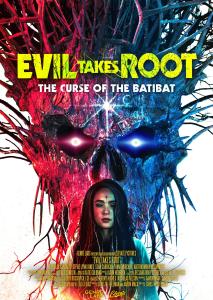 A new horror movie was filmed around Columbus, Ohio by a fledgling studio, Genre Labs, and a group of filmmakers who have made other successful Ohio thrillers and is now available for digital viewing on multiple platforms. Evil Takes Root is the most impressive looking and sounding Ohio indie I have seen yet. I mean this in all sincerity when I say it “looks like a real movie.” Even the poster art looks snazzy.
Dr. Thane Noles (Sean Carrigan) is still mourning the loss of his wife Mandy (Constance Brenneman) from mysterious circumstances (vague voice mail, hanging from a tree, black eyes, etc.). His daughter Sarah (Stevie Lynn Jones) is struggling with her grief and befriends a girl, Christina (Reagan Belhorn), going through a similar loss. Christina is desperate to bring her mother back and is doing the bidding of a supernatural presence to make this wish come true. The result is that Sarah becomes the vessel for this evil spirit, a Baitbat, a mythological figure from Philippines’ culture. Felix Fojas (Nicholas Gonzalez) is back in town to investigate the death of Mandy, the woman he still loves after an affair many years ago. Felix is a professor and a big believer in the supernatural, and he strongly believes evil is present and busy in Ohio.
 The production is glowing with professionalism that we associate with larger-budget studio ventures. Sure, you still slightly sense its lower budget in how much bang for your buck we get onscreen, but there are more than enough moments that impressed me from the technical aspects of moviemaking. The sound design is sensational. This has often been the biggest hindrance with local indies, and wow what a difference a professional sound design team can have on a horror movie. The creeping and scratchy noises of the Baitbat and its demonic intonations are unsettling and worthy of a few jumps. A great sound design team can goose any moment into being scarier. The spooky set pieces on their own weren’t imaginative or innovative but the sound design and photography elevated them. On the other side, this is a great looking movie, even with the drained color wash I usually dislike. Director and co-writer Chris W. Freeman (Sorority Party Massacre) knows how to make a horror movie with plenty of pleasing visual compositions by cinematographer Roy Rossovich (Union Furnace). Freeman is ready for a bigger stage, folks. There are a few instances of sweeping camera movements that made me go, “Whoa.” One involves a chase scene in the woods where naked witches run from their bonfire into the dark of the woods to kill an interloper, and the camera moves over the terrain with smooth velocity, and the way the fire illuminated the bodies as they went from one light source to another is simply stunning to watch. If it wasn’t for the topless women, I would expect a shot like that to be in the trailer. The focus levels, the way the camera movements enhance the frame and tension, even the use of a rain machine for mood, it’s all superbly impressive. The editing by Jason Heinrich and Jamie Marsh is great as well and makes the movie feel even more indistinguishable from Hollywood genre fare.
That impressive level of professionalism doesn’t extend to the story, sadly. Evil Takes Root is a very generic story told with very generic characters. I kept waiting for little moments to round them out, little moments to make me think differently about a character, to bring their conflicts into a new focus or coalesce their themes into the obstacles they’re confronting. I was simply looking for more personality than the five stages of grief at work. I can tell you what the characters do, as well as their larger plot designations, but I can’t tell you about who they are as people. There really isn’t one thing terribly interesting that any character does onscreen. They go about the discovery of the supernatural haunting, and then it’s concluded in a way that is anticlimactic in how easy it seems to be resolved. I read on another review that, according to the director’s commentary, that the movie underwent a troubled production and worked to fit footage that was shot many years apart. In that regard, it feels like a consistent product. I can’t see any obvious seams that show I’m watching a movie with significant scheduling gaps. Congratulations. But it also feels like any other small-scale Hollywood genre horror thriller, something like 2009’s The Unborn. Do you remember The Unborn? Do you remember it actually co-starred Gary Oldman? All that technical acumen put toward a mediocre story overstuffed with redundant characters (more on that below) and it’s a shame. The spooky set pieces are too short-lived and lack anything particularly memorable as well. Too much about this movie makes it burdensome to attempt to remember because it’s skating on generic and familiar tropes without leaving its stamp.
 This is disappointing considering I haven’t really seen too many American horror movies tackle the mythology of the Philippines. There must be plenty of fun choices to select for a big screen fright fest and for a majority of Western viewers, it would be a new kind of monster. I desperately wanted to learn more about the Baitbat and what made this creature unique. However, we don’t even know what this malevolent creature is until literally the last ten minutes, and I have no idea why the filmmakers held that from the audience for so long. The Baitbat is the lone thing to better help separate this movie from the glut of other possession/demon movies, so I don’t know why you wouldn’t make it more of a feature and try and tap into that potential and history. The viewer needs to know specific rules related to this spirit and it’s only a hasty exposition drop at the very end where we learn what the spirit is and what it wants. Imagine The Exorcist if you never knew what was going on with Regan until the last ten minutes. The Baitbat is our chief antagonist. We need to know more and earlier in order to make the movie more interesting. The tree root-tenatcle design of the creature is creepy and lends itself well to low-light silhouettes, which makes sense why it was chosen for a cost-conscious production. Other wicked cool Philippines monsters deserving of horror spotlights include a manananggal, a creature that separates its torso to fly, and a tikbalang, a creature with the head of a horse, the body of a man, and the feet of a horse.
There is a shocking amount of redundancy in this story best exemplified by the glut of characters. We have two grieving fathers raising teenage girls, we have two men who loved the same woman who was killed in the opening scene, we have two spiritual figures trying to combat evil possession, we have two teenage girls struggling with their loss of their mothers, we even have three authority figures (doctor, cop, pastor) all inserting themselves into this strange case. There’s so much crossover with these characters and their comparative stories that I’m quite surprised the filmmakers didn’t do some serious collapsing to better prune their narrative. If you’re going to have such character redundancy, you would think you’d highlight their parallel journeys as well as whatever can separate them. This is done to some extent but the differences are usually superficially one-note and never really affect the plot. Take for instance the commonality between Felix and Dr. Thane Noles. Felix was the “other man” in an affair and never lost his feelings for Mandy, though she lost hers for him. Felix blames himself for Mandy’s death but he’s still hung up on her after nine years since their tryst. A smart screenplay would really dive into this character dynamic, two men who shared the love of the same woman, but each should be able to provide insight into creating a bigger picture of this woman. The kind of woman she was with Felix should be different than who she was with her husband, not necessarily better but different. This would then provide a bridge for both men to find a level of understanding through these trying circumstances, not bonding per se but each discovering a little more about the woman they loved, getting to learn something new in her absence. Unfortunately, the film leaves all this drama unfulfilled, using the shared love as merely an excuse why Felix sticks around and why Dr. Noles doesn’t quite like him. Why do we need two spiritual warriors too except for maybe some sort of Exorcist homage? Make these character points matter more.
 The same scrutiny could be applied to both daughters as well. Why do we need both girls vying for screen time and going through the paces of the same story? Because of the juggling, they drop out for long stretches of the movie’s 95 minutes, like right after Sarah gets possessed. You would think that lost time experience, as well as her involvement in a murder, would be an enticing thing to further explore. You would think a spirit taking over her body and getting more oppressive would be a natural escalation with urgency to watch. We’d witness Sarah freak out as she wakes up from more and more shocking behavior. It’s an easy story because it makes sense, watching our possessed schoolgirl lose her mind and body. However, Evil Takes Root only tags in Sarah when it wants to, and this means her ongoing development as a demon vessel is curiously left underdeveloped. In contrast, Christina is immediately the more interesting character because she has a hearing disability and a lingering resentment over her father. Christina is even willing to explore with dark arts to bring her mother back from the dead. Dear reader, I ask you why can these two characters not simply be combined? If one girl is stepping into the supernatural, why not have her as the own affected? Why do her actions need to be carried out on a different character who has a similar back-story but who happens to not personally involve the supernatural to try and bring her dead mom back? Why have Sarah volunteer at a hearing-impaired school when we could just follow Christina at that same school from the point of view of someone who is already hearing impaired? These are the central relationships and characters and yet they could have been streamlined or retooled for more concise and developed drama.
Evil Takes Root is a horror movie that makes me feel stuck in the middle of praise and shrugging. It looks and sounds like a professional movie with real technical acumen, but it’s also a lot of effort to tell a deeply generic story with deeply generic characters and no standout set pieces. The sound design, editing, cinematography, and spindly special effects are impressive and seamlessly blended together. The monster needed more screen time. Nobody should be ashamed to have this movie on their resume, though the screenwriters (the director and the producer) might not feel that same degree of pride. Perhaps the mediocre story is a result of the production problems trying to make dispirit pieces come together into a meaningful and cogent whole. I cannot say. Whatever the reasons, Evil Takes Root is a very good-looking yet methodically generic horror movie.
Nate’s Grade: C+
Share this:

Enola Holmes (2020)
 I’m shocked this isn’t the pilot for a new series, and maybe it one day will serve as such, because Enola Holmes is such a sprightly, effervescent, enjoyable rehash of the classic sleuth but this time from the girl power point of view of a younger sister. Millie Bobby Brown (Stranger Things) shines as the headstrong, quirky, loquacious Enola Holmes setting off on her own adventure to find her missing mother (Helena Bonham Carter) and to push against her older brothers Mycroft (Sam Claflin) and Sherlock (Henry Cavill) and their perceptions of what is appropriate for a lady. The best moments are when Brown gets to showcase her pluck and grit, proving presumptions wrong, and winning fans along the way. There is nothing new about this kind of movie where a young woman fights against sexism and proves herself capable and heroic. It’s a tried-and-true formula that works because, with enough polish, an underdog is always going to draw in the audience to watch them triumph over their doubters. Add a dash of feminism to boot and bake as necessary (not a joke on feminism, mind you). The actual plot is secondary to the situational mishaps and character bickering, which is good because there isn’t really a mystery to uncover. Enola gets pulled into protecting a young royal on the run from a wealthy family benefactor that wants to make sure he doesn’t live to collect his inheritance. Their interaction adopts a screwball romance sort of tone, which provides Brown ample opportunity to be sunny, exuberant, and overall delightful, a side rarely seen as the somber, alienated Eleven. I enjoyed the stylistic asides and visual inserts to better showcase Enola’s hyperactive thinking and sleuthing, borrowing a page from the new Benedict Cumberbatch Sherlock TV series to visualize the processes of rapid-fire thought in a pleasing and amusing manner. Cavill is perhaps the most dashing Sherlock put to screen and provides a suitable establishment stand-in of accepted masculinity and intelligence that serves as contrast for what Enola is pushing against. Given that almost all the main players are attached to ongoing Netflix series (The Witcher, The Crown) I feel like we should expect more adventures down the line with the irascible Enola Holmes, and with a bubbly Brown seizing the mantle, that’s fine by me.
Nate’s Grade: B
Share this:

#Alive (2020)
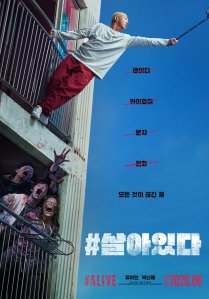 It’s a Korean zombie movie but the lean survival storytelling of #Alive could be universal. We follow one man during the outbreak of a zombie plague. He’s stuck in his apartment several floors above the ground and watches from on high, safe but trapped and on his own for food and other life-saving necessities. The movie is very easy to follow and is practically wordless for long stretches, relying upon clear and concise visual storytelling to be able to follow one man’s plight under the worst of circumstances. There is an easy pleasure about watching a character in a tough spot think their way through step-by-step. It worked with that beautiful middle hour of Cast Away and it works here with #Alive. Eventually, he befriends a woman across the courtyard and they rely upon one another from afar as partners in survival. The last third of the movie is much less interesting as characters make a big decision and it feels like a mundane episode of The Walking Dead, one of those middle of the season episodes. It’s not a bad sequence of events but it’s just not as interesting as the survival story beforehand. It becomes more like any other zombie movie. There isn’t anything terribly unique about #Alive except for its contained thriller perspective, so when the movie jettisons that, it can’t help but feel like it’s losing whatever helped make it compelling for so long. I went in thinking it was going to be more satirical, especially from its poster of our protagonist leaning off his balcony to hold a selfie stick, but any social satire is so slight too be fairly non-existent. If you’re a zombie fan or a fan of contained thrillers with high-concepts, then #Alive is a thrilling, enjoyable, and relatively satisfying 90 minutes. It may be derivative but that doesn’t mean that filmmakers with a specific vision and the creative ingenuity to see it through can’t make old stories worthwhile again.
Nate’s Grade: B
Share this:

Antebellum (2020)

Antebellum was originally supposed to come out in the spring and yet it only feels even more relevant today in the wake of months of protests over police brutality, the removal of Confederate monuments, and whether or not black Americans can attain justice in an imperfect system. Antebellum has also been flagged with overly negative reviews and accusations of being just another movie that exploits the horror of slavery for cheap thrills. After having seen the movie, I feel perplexed that so many of my critical brethren could not connect with the film and its finer points on the world we lived in and the world we live in today, inextricably linked.
Eden (Janelle Monae) is an enslaved woman surviving on an eighteenth-century Southern plantation run by Captain Jasper (Jack Huston) and the mistress of the land, Elizabeth (Jena Malone). Then there’s Veronica (Monae) who looks identical to Eden and lives in modern-day. She’s an author and academic speaker on social oppression and politics. How these two women are related, as well as past and present, will be revealed over the course of 100 minutes.

Antebellum is divided almost equally into 30-minute thirds, and it’s the structure that helps to aid in its mystery while also stiffling its larger implications. The first third is watching a plantation and the horrors of slavery; however, there are clues that something strange is happening. Little touches, character responses, a tattoo that seems too eerily modern. From there, we jump forward to the next third with what appears to be the same Eden, this time as a featured academic author. From here, if your mind is similar to mine, you’re attempting to bridge this connection and uncover how the past and present have become entwined. Is Veronica experiencing a deeply felt dream? Is it time travel? That was my guess before starting the film based upon the advertisement. I thought it was going to be a story about horrible racists from America’s past kidnapping black Americans to enslave. It’s a sci-fi angle that can make the material feel fresh, as there are more things to say other than the obvious and profound statements that “Slavery was terrible,” and, “It should never be forgotten or mitigated of its horror.” I also think it would serve as a rebuttal to those who ignorantly argue, “It was so long ago, why does it still matter? Get over it.” The past, in that instance, is literally ensnaring the present and forcing citizens to relive generational trauma. It’s that final third where Antebellum reveals what it really has been all along, and it’s a surprise but it also makes sense in the world that its meant to represent, leaning into a contemptible degree of human avarice that reminded me of HBO’s Westworld. It’s a fitting revelation and, as one would expect, the final third charges into an emotional catharsis as we watch Eden/Veronica fight for her freedom at last.
However, and this is a word I can already tell I’m going back to repeatedly to qualify my reservations, once the Big Reveal is known I wish we could have spent far more time dwelling in the implications of what exactly it means. I won’t spoil what exactly that reveal is but it’s definitely something that has plenty of social and political commentary and a reflection of our modern times and the injustices that have only been further highlighted this year. It’s such an interesting angle that I almost wish the filmmakers had re-prioritized their movie. Rather than structuring to best serve a mystery with a Shyamalan-style twist, it could have had its Act Two break be its inciting incident, revealing its twist as the starting point for the real terror. As a viewer, while I enjoyed the mystery and portentous mood of the movie, it presents a potent storytelling avenue that is far more compelling than the first two-thirds, but by then it’s too late. It works as context for the behavior and setting we’ve seen, both past and present, but Antebellum strangely suffers from trying to be too clever when a more straightforward version could have better tapped into its full dramatic and political commentary potential.
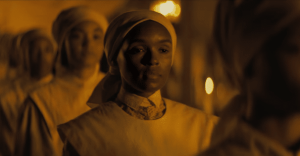
I was intrigued early on and came away genuinely impressed with the technical skills of debut writer/directors Gerard Bush and Christopher Renz. The photography is often stunning and that goes for their visual compositions as well as their specific camera movements. The opening scene involves a tracking shot that starts from the front of the plantation facade, and that’s the best word, all prim and proper and beatific in appearance, before swooping behind and into the slave quarters to see the ugly reality behind that illusion. I didn’t feel like the filmmakers were simply using the backdrop of slavery as cheap genre exploitation. I felt their intentions were good. The horror of slavery isn’t downplayed but it’s also not overtly recreated just to add an easy splash of violence or terror. The movie relies more on implications, like Eden sleeping next to the plantation owner every night or an enslaved man finding his wife’s necklace in a charnel house among a scattering of ashes. The implication of the larger horror is there without having to be explicit. I’m reminded of the abrasively negative condemnations of Netflix’s Cuties insofar as people seemed to be missing obvious artistic intent. These are challenging and uncomfortable movies but movies with something to say, and Antebellum is not just a simple rehash of slavery tropes to turn black people’s historical suffering into slapdash slasher pulp.
Monae (Hidden Figures) is strong throughout and continues to build her case as a leading lady. She must register her fear in subtle ways without going into larger histrionics, but she maintains a quiet strength that keeps your eyes glued to the screen. Her time spent in the present, as the author calling out aging racist ideology, is bold and confidant and serves as a counterpoint to the woman we’ve experienced on the plantation. We know that woman is still inside Eden. Monae has a late scene set in slow-motion, with the music swelling, that simultaneously feels badass, uplifting, and like an American Valkyrie blazing against unchecked Confederate revisionism.

Antebellum is better than its reputation and offers more from an artistic standpoint than hitting the same points and rehashing the same traumas of the past. It’s a movie built around its mystery when I feel like it had much more it could have said with restructuring and more time spent after its final explanations. As a mysterious thriller, it’s tasteful, thematically involving, and technically impressive. It doesn’t even use the N-word once, which could be decried by some as unrealistic but also a sign of the filmmakers’ good faith to not merely use a shameful historical legacy for base titillation. It works as a thriller with more on its mind. However, and this is my last usage of that word, it’s that mind I was more intrigued by. Antebellum is a B-movie with A-level ambitions but a story structure that keeps it stuck as a well-polished B-movie.
Nate’s Grade: B
Share this:

The Babysitter: Killer Queen (2020)
 I very much enjoyed 2017’s The Babysitter from the very start. The characters had such vitality to them, Samara Weaving (Ready or Not) gave a star-making performance, and it was a wild ride while also having an emotional core with the relationship between the babysitter and her charge, a designated Satanic sacrifice. It was silly, clever, but also satisfying with its character dynamics, and it proved successful for Netflix so they felt, well, why not do it all again? The Babysitter sequel, subtitled Killer Queen, has a strong whiff of desperation trying to awkwardly rekindle the good times. The original writer, Brian Duffield, is not here as a writer but returning director McG is one of the credited writers, which made me wary. Sequel-itis plagues the story as our surviving teen Cole (Judah Lewis) gets into ANOTHER tight spot with ANOTHER group of Satanists looking to sacrifice him to make their dreams come true, and it also happens to also include the SAME supporting villains from the first movie. Even the cheeky onscreen titles go, “Again?!” Why must these killer Satanists only obsessed with this one specific kid as a sacrifice? Diversify your options, folks. It all feels more of the same but just not as good, not as memorable, and not as entertaining. It’s a low-investment movie, something where your ceiling of demands is already pretty generous, so if you enjoy comically over-the-top gore then there are a few moments that might make this sequel palatable. It’s a movie with a “so what?” attitude, adopting a flippant nihilism that makes the attempts at drama a little more forced and inauthentic when they occur, not that the comedy is much better outside the splatterhouse violence. The ending is also rather anticlimactic because it simultaneously involves a deus ex machina while also finding a way to be derivative of another very memorable ending of another Samara Weaving movie. I didn’t think a sequel was needed, and I wasn’t expecting much from a sequel, and I got about what I was expecting. The Babysitter: Killer Queen is a fast-paced and amenable work of cinematic junk food, a genre movie that might have enough genre elements to prove tasty, but by hewing so close to the original, Killer Queen feels more imitation than imagination, and it’s clearly inferior to the original.
Nate’s Grade: C+
Share this:

Cuties (2020)
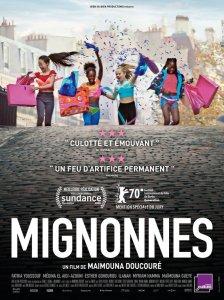 A new Netflix movie is tearing through the Internet, igniting accusations of glorifying child porn, accusing Netflix employees of pedophilia, and triggering some to even cancel their subscriptions. Even if you’ve never watched Cuties you have probably heard something about it through the controversy that has inflamed innumerable conversations and condemnation. Cuties is a French drama that follows a young 11-year-old Amy (Falthia Toussouf) as she embarks on a new school. Her religious Muslim family has set her up for one way of life, but the popular girls at her school look so much more free, fun, and wild. The “Cuties” dance team dreams of stardom, envies the older teen dance team, and emulates salacious dance moves from videos. It’s easy to see why the movie has generated its controversy and it’s understandable why many people would ever refuse to watch it based on subject matter alone. No matter the artistic merit, watching kids behaving this way, and the natural discomfort it produces, can be too much to endure. However, for those willing to give Cuties a chance, I do think it has some artistic merit as it tells, what is essentially, a familiar story of a youth going down a wayward path of temptation and rebellion.
There are three standout moments to me in Cuties that exemplify what writer/director Maïmouna Doucouré was going for as well as the commentary attached to the controversy. I’ll be going into spoilers to discuss these scenes and why I think it adds up to a whole that has more thoughtful intentions than exploiting children for cheap buzz and leering perversion.
 1) Early on, like around the ten-minute mark, Amy is dancing and hides under her mother’s bed to not get in trouble. Her mother walks around with the Great Aunt and she overhears their conversation and learns some upsetting news. Her father, who is away and yet to move back with the family, will be marrying a second wife and bringing her home. The mother is trying to put on a brave face and play her part, calling relatives to dutifully inform them about the development, but she is clearly devastated and wracked with emotion. She feels replaced and inadequate and harmed by the man she loves, and Amy registers the pain and degradation her mother is going through on a deeply personal level, and this is what serves as motivation for her later actions. When she’s making new friends and wearing crop tops and pushing her boundaries, it’s not just a young Muslim girl who wants to escape the conservative trappings of her culture; it’s a young girl who is looking to rebel and stick it to her father. Her sense of a woman’s place in this family is to be subservient to the man and his authority, and she’s angry with him, angry at causing her mother pain, angry at viewing her as a collectible, and angry at what she views is a culture that restricts her to a life she does not want for herself but worries may not have a choice. Again, this isn’t a judgment on all Muslim families but merely the relationships within this one. This overheard phone call is such an immediately powerful scene with such an emotional wallop that I was tearing up. Amy’s motivation is more complex than simply wanting to dress provocatively. She’s rejecting a fate that could as easily befall her, and in doing so, a viewpoint on women.
2) There is a moment where the girl gang is just hanging out in the woods and laughing. One girl, Coumba (Esther Gohourou), finds a deflated condom on the ground. Not thinking anything of it, she blows it up like a balloon and the other girls freak out. They declare that their friend is now tainted, gross, and possibly exposed to AIDS. Coumba, who was the loudest and most outspoken joker among the group, is frozen in embarrassment. She didn’t know what it really was because she’s simply a child. She had no real conception, and now that reminder and the embarrassment and the hysteria from her friends is making her feel so small and humiliated. She’s desperate for her friends to excuse this misstep, to be accepted by her peer circle once again, and she meekly defends her ignorance. A single tear rolls down her cheek and this scene was a fitting reminder for me that the filmmakers have never forgotten that these girls, no matter how they dress and how they act, are still very much children. They talk about sex and porn but through an uninformed understanding of the larger meaning and context let alone sense of anatomical accuracy. It’s because they’re still children! This moment was further confirmation for me that the filmmakers had not forgotten that their subjects were to be presented thoughtfully. These 11-year-olds aren’t to be sexualized, just like teenagers shouldn’t be either, no matter how eager these young people are to jump ahead in maturity and be seen as desirous and incendiary.
 3) The last scene of the movie involves the father’s wedding, a moment that mother and daughter have been dreading. Amy has run away from her dance team’s big show and made her choice, choosing to return to her family and as a support for her mother. She reminds Amy that she does not have to attend the wedding but Amy is determined to be there, knowing fully what it means for her mother and the larger implications for her family. Amy must decide what to wear for the festivity and stares down the traditional dress her Great Aunt had brought. Amy looks at her skimpy dance outfit, a guaranteed attention-seeking statement if she were to wear it to her father’s wedding ceremony. Instead, she chooses a middle path and simply wears a comfortable sweatshirt and some blue jeans. She rejects the restrictions of her family’s conservative culture, she rejects the extremes of the dance troupe, and she starts to form her own sense of self. She sidles into a game of jump rope and the camera pans up, and as the camera moves so too does Amy, locked into the camera shot, rising above the world, and she’s smiling so broad that her face seems to glow with happiness, a relief and joy she hasn’t felt in some time. By the end of this tale, our heroine has rebelled, overstepped, learned something about herself, and now seems a little surer of who she wants to be as a young woman charting her life in France. For me, this conclusion reaffirms the intentions of the filmmakers and commentary that those feelings of discomfort were on purpose.
With that being said, there were of course scenes that made me feel deeply uncomfortable, and I would question anyone who didn’t feel the same. The Cuties’ final dance is shockingly adult. Children should not be behaving in this manner but, and I again I stress this, that is the point of the movie. The audience at the dance competition does not approve of the tween twerking; they boo, they make disgusted faces, and one mother attempts to cover her baby’s eyes. “THIS IS TOTALLY NOT A GOOD THING,” Doucouré’s film is vociferously pronouncing. When the girls are simply dancing, her camera favors wide angles or framing that doesn’t ogle their bodies. Often dances will be seen as a whole or with shoulders-and-up framing. Whenever the girls film their dances, the camera adopts the intended lascivious emulation they seek, lingering more on butts in shorts and their attempt at sensual gazes they’ve adopted from Instagram influencers and aspiring models. It’s icky but it’s only a sampling compared to the in-your-face final dance performance. What I’m trying to articulate is that the portrayal of these young girls letting loose is more tasteful than the detractors have given Cuties credit for. I’ve seen scuzzy teen-centric movies (notably by Larry Clark) where the camera was continuously fetishizing its teenage subjects as a default setting. Cuties isn’t that until it really wants to grind its cautionary message into your horrified face as you try to shield your eyes.
 I had a student ask why did it have to be 11-year-olds, why couldn’t the same message have been told through slightly older figures, maybe 15 or 16-year-olds, and I didn’t have an answer. Maybe because we’ve already seen “teens go bad” movies with 16 years-olds (Kids), or even presumably 13-year-olds (Thirteen), and maybe Doucouré felt she needed to go younger to be different, or push the envelope, or to grab attention from an increasingly blasé public. Maybe the filmmaker felt we needed to go to an age before puberty so it’s less a “becoming a woman” transition and more a constant of being acknowledged as a child. I cannot say. At its core, Cuties doesn’t have to be a story that is told from a particular age because it’s a formula that we’re familiar with and it embodies universal themes of acceptance, isolation, rebellion, and belonging. It’s a better movie than the alarmist defenders of childhood virtue claim (funny how these same defenders seem so quiet in supporting a president who literally bragged about spying on tween girls while they changed clothes, but that’s another discussion). I would also advise these same critics to look up how many season Toddlers and Tiaras ran for on TV. This is not the best movie. If you’ve seen enough teen movies you’ve likely seen this story already, but Cuties is a perfectly fine movie with enough artistic merit and social commentary to potentially make it worth sitting through the obvious discomfort. I can completely understand if any person would choose to pass on this movie but it would be better if more people actually gave it a chance before sharpening those pitchforks.
Nate’s Grade: B
Share this:

Darkest Edge (2020)
 My pal Ben Bailey hates me reviewing Ohio-produced indie films. To be fair, he doesn’t have anything against the idea of providing critical and professional analysis to local filmmakers on their cinematic offerings. What he laments is how mediocre many of the finished projects end up being and how, in his view, it’s establishing a negative impression that Ohio movies suck. Truth be told, I haven’t found that one Ohio-made indie that has completely floored me. I’ve found several that I enjoyed and others that had elements to be proud about. The thriller Darkest Edge was filmed throughout Ohio and Kentucky and features Ohio talent in front and behind the camera. It’s the feature debut for director Naim David and screenwriter Joe Gribble. It’s a movie that aims beyond its own restricted reach but proves one of the less successful thrillers I’ve seen.
Mark (Christopher Rowley) is a Chicago journalist who is still reeling from his sister’s suicide. He’s on the verge of divorce and never seeing his daughter again, never mind his obsessive drinking. He’s given one final assignment, the closing of a notorious mental asylum in Dayton, Ohio, the very place that his departed sister spent time within. Ellen (Jocelyn Jae Tanis) is his assistant who insists upon being his camera operator. The two travel to Dayton and investigate the asylum, interview wary doctors, and Mark unlocks memories and secrets of his past.

Why is this thing in the middle of the screen?
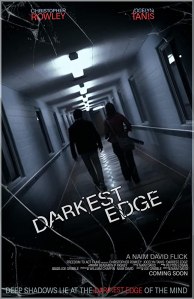
Where this movie runs most adrift is with mood and execution. Look at that poster at the top of the review, check out the description of the plot setup, even judging by the spooky yet unmemorable title (I kept thinking “Dark Edge,” “Dark Corners,” “Darkest Corner” in my head). Even the tagline says, “Deep shadows lie at the darkest edge of the mind.” All of this is setting you, the viewer, to expect a creepy psychological thriller in a creepy asylum and for creepy things to happen. There have been horror movies that have been little more than watching wayward characters haplessly explore a haunted old locale, uncovering its secrets and perhaps its residents, living or dead. This simple plot setup can work as long as the filmmakers can execute their intended mood with aplomb. Unfortunately, Darkest Edge makes a critically fatal error in choosing its creepy locations. To put it simply, this soon-to-be-closing sanitarium is not scary looking in the slightest. The outside looks like a high school building from the 1960s. The inside looks very non-intimidating. There are doors labeled with pieces of paper and an accessible exit door literally within feet of “patient rooms.” While watching, my girlfriend pointed out this very problematic design flaw for a mental institution and I was aghast with that slip-up. The inside of this asylum is also practically abandoned. It’s supposed to be closing soon but there’s still supposed to be patients, evidenced by our characters randomly walking around the facility and finding doors obviously locked. This sense of emptiness will be a prolific problem with the movie (more on that later), but the asylum could have always been closed down and emptied already upon investigation. Another killer error is that almost the entire movie takes place during the day, which only further hampers the scare factor of this already ordinary looking building. It’s like watching people explore an office park and finding nothing. If Darkest Edge was going to hinge so much over a singular creepy location, oh is this place a big miss.
 With the location not exactly hitting the intended mood, I held hope that the central mystery tying to the protagonist’s memory, his occasional alcohol-induced blackouts, and hazy memories of this particular asylum could generate the intrigue that the setting was not. Mark is torn over the suicide of his sister, he’s been drinking so heavily he reeks at work, and this asylum might be the very same one that his sister was held at during both of their youths. Surely there has to be a dark secret afoot, or we’re being set up for some last-minute twist. I started guessing what the twist would be within ten minutes, because Darkest Edge seemed overwhelmingly like the kind of thriller that would roll out a last-minute twist. I thought maybe Mark’s daughter was really dead. My most outlandish, hacky guess was that Mark was really still in the asylum and that everything outside was a figment of his fevered imagination. Admittedly, that would have been an awful ending but it would have tapped into the psychological thriller context of its genre. There isn’t really any sort of mind-bending twist here. There is a revelation but, shockingly, the movie goes down a sentimental route that feels unearned and tonally ill-suited for the prior 75 minutes. It’s such a curious ending and goes against the very setup of this kind of movie. You’re expecting the story to end in a dark, desolate, traumatic place. If you want catharsis, you got to put in the work as a storyteller.
Unfortunately, a word I seem to find myself using often here, Darkest Edge doesn’t provide a compelling personal mystery for the audience. Mark is a boring character. He’s troubled and haunted in a general sense but the screenplay doesn’t give us anything too specific. Yes, his sister kills herself and he feels some guilt over this, but the entire movie doesn’t provide insight into the sister character or their relationship. If he’s so hard up over her death, you don’t feel why. He’s a sloppy drunk, and if you made a drinking game where you took a drink every time you saw Mark drinking, or holding a bottle, then you would black out just like Mark. It’s his lone defining characteristic and it is given again and again and again. Strangely, Mark will black out and find himself transported to distant locations, like thirty miles away from where he was (the movie, weirdly, makes sure we know the mile distances between specific Ohio cities). You would expect this would be a clue about some larger context, a deeper meaning for the torment plaguing our protagonist. Well your guess is as good as mine because ultimately those blackout long-distance travels don’t get clarified at all. For Mark to function as a character, he needs more specifics, especially when it comes to a trauma. He needs a specific fear or tragedy that haunts him and resurfaces with his trip to the asylum. We get what appear to be flashback snippets of a little boy exploring the interior of the asylum (apparently it was also just as easy to wander back then too). It’s all too vague and poorly explained, forcing the viewer to extrapolate connections and meaning. By providing a specific trigger and goal at the start, a viewer could watch Mark journey through his trauma rather than having to guess at it and its implications. I assume this was designed to make Mark’s personal history more enigmatic, but mystery only really works when you’re invested; otherwise it’s just obtuse, and that’s what we have here with Mark and Darkest Edge.
 The reality of Darkest Edge is hard to take seriously, and part of this is affected by the limitations of the low budget and certain filmmaking choices that accentuate those. Just because a movie has a low budget doesn’t mean it can’t succeed or utilize a clever creative ingenuity to tell its story and entertain. If you want to tell a creepy story about exploring a creepy location, choose a genuinely creepy location, and shoot it during night time to build an effective atmosphere. Use shadows to your advantage and play up the worry of what may be around the corner next. Build that sense of compounding dread. Walking ordinary hallways during daylight hours is not making your movie scary unless people are encountering weird events or threatening folk, neither of which happens here. There are some doctors hiding extreme methods but these methods are questionably vindicated by the end. There needs to be a clear threat and for the far, far majority of Darkest Edge there isn’t and this results in the movie feeling meandering.
The technical elements can be distracting and disappointing. The fuzzy sound design is a noticeable shortcoming, often dampening from shot-to-shot. The extreme lack of background noise is unmistakable and makes the movie feel like it was filmed in a space capsule. This, coupled with the lack of background activity and extras, makes the movie feel borderline like a Twilight Zone episode where there are only five or six people left on Earth. The limits of the reported $7500 budget are also felt with the shot selections; frequently a scene will just bounce between two set shots, locked into a plodding shot-reverse shot rhythm. There are dramatic moments that are kept at a distance when a closer shot was begging to showcase the actor’s emotive powers. It leaves an impression that the production was pressed for time to get editorial coverage, and it feels like actors were often filmed at different times and cut together for conversations. There is very limited lighting overall and the photography quality is also a step removed, so why not make this entirely a found footage film? That would have allowed the limitations of the production to be an acceptable part of the presentation. The music is also far too loud at points, drowning out the dialogue, and far too generic without establishing a sense of foreboding. I kept scratching my head at the artistic choices, which routinely magnified the budget shortfalls rather than making decisions that would better compensate instead.
 The acting is mostly fine especially since the actors haven’t been given much to work with. The characters are boring and have one trait they get to rub down to its nub. Rowley (Primordial) has a beaten down, hangdog expression that works well. Most of the times he’s either playing hungover or short-tempered, and without a stronger personality, it’s easy to start mentally checking out with his character. Tanis (Lilith, Cinestudy) delivers a performance that manages to mingle ambition, naivete, and a barely concealed contempt for her colleague. She had so much more potential to explore and I wish we spent more time with Ellen rather than watching Mark get drunk for the twentieth time. Anthony Panzeca (Dodging the Bullet) plays an orderly at the asylum and makes a warm impression. His performance is the closest to unveiling charm in a cast regularly acting confounded or irritable. There’s a Dayton journalist that is such a confusing character for me. She buddies up with Mark by opening up her archives of news collections on the asylum. She then asks Mark what he’s found… in her own news archives? Shouldn’t she already be familiar with what she has?
Darkest Edge is not the movie the poster, tagline, or even setup proclaim it to be. It’s not really a thriller, let alone an accessible psychological thriller, and it’s not really a horror movie. It should be creepy given the setting and its supposedly sordid history, but too much of this movie is kept vague and obtuse, failing to give the audience a reason for watching. The characters aren’t that interesting or complex or compelling and their traumas are kept too unspecified to engage. If it was going to focus on the mental torment and troubled history of a troubled man, the script needed to make him more dimensional and his issues more central to the events unfurling. Tone-wise the movie doesn’t work or build a sense of momentum. It’s hard to make a scary thriller/horror movie when nobody looks like they’re scared, and that’s for good reason considering the settings are more mundane and plainer than skin-crawling and disturbing. I feel bad saying so but Darkest Edge is really a boring jaunt along empty hallways. Even if you’re an overly generous fan of this sub-genre, there is little to engage with during the padded 80 minutes. The most frightening aspect isn’t the haunted asylum but botching a go-to scary setting.
Nate’s Grade: D+


 nathanzoebl
You must be logged in to post a comment.