Category Archives: 2019 Movies
Star Wars: The Rise of Skywalker (2019)
 In 2017, there was a great disturbance in the Force when Star Wars Episode 9 director Colin Trevorrow (Jurassic World) was unceremoniously jettisoned. He had spent over a year developing a script for the concluding film in this new Star Wars trilogy (he’s still listed in the credits for story) and I guess the producers must have had some strong feelings. Trevorrow was out and J.J. Abrams returned to close out the saga he had kicked off with 2015’s The Force Awakens. It felt like a safe choice, the return of an artist best known for dabbling in other people’s established worlds. 2017’s The Last Jedi, written and directed by Rian Johnson (Knives Out), was, to say the least, divisive with the fanbase. It made sense to jump back in with Abrams who had delivered a fun, lively kickstart that made box-office records. Surely Abrams and his army of magicians would steer the franchise into safe territory and provide a satisfying ending to the character he created?
Note: I promise to keep this review free of significant spoilers beyond some minor plot points. If you want to avoid reading anything further until after having seen the film, I understand.
The Emperor (Ian McDiarmid) is alive and well and offering a fleet of planet-destroying starships if Kylo Ren (Adam Driver) will kill Rey (Daisy Ridley). She’s trying to uncover hidden clues about her parentage and still believes she can reform Kylo from the dark side. Finn (John Boyega) and Poe (Oscar Isaac) are chasing after a series of artifacts to find the secret location for the Emperor’s secret planet and rebuild the fledgling resistance. Kylo and Rey are headed for a final confrontation to determine whether they turn to the light side or the dark side.
 It is with a heavy heart that I feel like I have to admit that there wasn’t a single storytelling choice that I enjoyed in The Rise of Skywalker. It feels like Abrams and company were in a mad panic after the divisiveness of The Last Jedi and retreated to the safety of nostalgia and fan expectations. This feels like the producers made a list of fan demands and then acceded to them. It certainly feels like an overblown course correction, let alone discarding major changes and characters from Episode 8. Now fan service in itself is not a negative; there is such a thing as good fan service and bad service. The difference is that bad fan service relies heavily on pandering and reference points, leaving an audience unchallenged, and that certainly feels like Episode 9, a movie ever beholden to its calcifying past. My anecdotal evidence already tells me that many fans will love this movie, more than likely the same contingent that found such stinging fault in Episode 8, and I don’t wish them ill. I’m happy for them. For me, Episode 9 is a mess of bad plotting, rushed pacing, truncated character arcs, useless cameos, and a reheated Return of the Jedi climax that was as boring as it was exhausting and dispiriting. It’s supposed to be an end to this new trilogy, and a trilogy of trilogies, but the backwards-looking franchise will never be done paying homage to its cherished past while it eats its own tail until it vomits. This movie is so eager to please as many fans as possible that it feels like an anxious hostage.
I think it was a major mistake for The Emperor to come back into play this late. The very reappearance already cheapens the sacrifice Darth Vader made in Return of the Jedi, and it begs the question what has this evil old man been doing for three decades? Has he just been hanging around his completely empty rock planet sitting on his uncomfortable rock throne? Abrams throws some haphazard lip service that Palpatine was really behind everything, we just never knew it, but that feels cheap. It’s like in 2015’s Spectre when Christoph Waltz emerges and says, “Hey James Bond, while you’ve never met me until this moment, I’m responsible for every bad thing that happened in your life, not those other bad guys, and I just didn’t feel like saying anything.” It wasn’t a satisfying plot development then and it isn’t now. The “boss’ boss” manipulating in the shadows is simply an aggravating shell game. If Palpatine lived even after the second Death Star exploded, then what’s to say if he can ever be defeated? Even if he is toppled in Episode 9, what’s stopping him from being resurrected in Episode 12 to serve as another quick excuse for a major villain? This decision to bring him back to life also taps into a further reverence for bloodlines that The Last Jedi was valiantly fighting against. Star Wars may take place in a different galaxy but it frustratingly feels like only three families populate it. The Last Jedi proposed that you didn’t have to come from select magic bloodlines to be somebody important, that your past was irrelevant, and now Abrams and company sharply reverse course, hugging the concept of the Chosen One until it bursts. It feels creatively starved.
 Too much of the movie’s 142-minute run time was devoted to hasty, convoluted plotting that served little else than to fill time. By the concluding movie in a trilogy, there should be no moments left to fill time, nor should we really be introducing new worthless side characters rather than using the people we’ve already established. The first 90 minutes of this movie could be condensed to “get a thing to get a thing.” It’s one superfluous obstacle after another, one item to gain another, that reminded me of video game fetch quests. Even worse, none of it felt like setbacks or difficulties because the movie was rushing through every sequence. If we have to rush through to cover four abbreviated action set pieces, why can’t we consolidate to two really good and developed action set pieces instead? A great way to make your movie forgettable is to cram it full of disposable plotting and short action sequences that never take off. I kind of liked one lightsaber battle along the surf of the ruins of a Death Star (of course there has to be another Death Star!) but that was it for the action. There wasn’t anything onscreen that even came close to replicating the thrills or suspense from Episodes 7 and 8. I felt more suspense in The Last Jedi for Rose’s doomed sister than I did for anyone in Rise of Skywalker. There was space where Abrams and company could have expanded and developed important themes and given characters room to grow, but the pacing feels so breathless in order to distract from the hasty plot retreats.
Characters feel like they zapped to the end of their character arcs because that was what was expected, but why they reached these milestones feels arbitrary from a plotting standpoint. It reminded me of, I’m heartbroken to even say, the final season of Game of Thrones; fans didn’t object on their face to character destinations but the journey to reach these points felt like it was missing key moments to serve as connection. Why redemption now? Why tempted by the dark side now? It plays more like Abrams said, “Well, we ran out of time folks, so let’s skip to the end.” Looking back on the trilogy, it was clearly Rey and Kylo’s story first and foremost, but the supporting characters ultimately feel abandoned and wasted. Finn had a great perspective, a Stormtrooper who defects, but that unique position is cast aside by introducing a new side character that serves no purpose other than to remind you that Abrams must have really not liked Rose (Kelly Marie-Tran). Seriously, Rose is sidelined to study monitors. Abrams tapped an old Lost alum, Dominic Monaghan, for this thankless duty, so why can’t Rose at least be the sidekick? We don’t need another new sidekick this late. Poe is another wasted character. He learns greater responsibility and teamwork in Last Jedi, but he’s really just a Han Solo stand-in, the rakish rogue quick with a quip. Episode 9 gives him an old flame but not much in the way of additional characterization. He feels the same from his first scene in Episode 7. Oh, and all the forced cameos Episode 9 makes time for feels almost like a Star Wars reunion special. That’s including the awkward use of existing General Leia footage to cobble together something for her. I’m wishing more and more that it was Leia that went badass kamikaze in Episode 8 as her exit.
 At every point, the movie seemed determined to undercut itself when it came to themes, when it came to character growth, and when it especially came to sacrifices and stakes. There are four fake outs when it comes to deaths. What’s the point of sacrifices when it can just be reversed with little explanation? What’s the point of learning when the Force can just serve as a magic hand-wave solution for anything you need? There are some pretty remarkable leaps in what exactly the Force can do in Episode 9. The Rise of Skywalker even resets some pretty inane things, like Kylo Ren gluing his smashed helmet back together or a certain character getting a long-overdue medal for valor. The themes Abrams works with are extremely broad and lack the questioning of the inerrancy of the Jedi order from Episode 8. It’s also confusing when the theme is that your destiny is not written by your station when the movie repeatedly elevates the mythic at the expense of the nuance and human. It’s like saying your past doesn’t dictate your future while slavishly venerating the past at the expense of the present story.
Given the budget, talent involved, and Abrams’ natural pedigree for blockbuster filmmaking, Rise of Skywalker still has moments of grand spectacle and fun. The actors are still enjoyable to watch and Adam Driver (Marriage Story) is the definite MVP of this new trilogy. His character is, by far, the most interesting and the one that goes on the biggest emotional roller coaster. Abrams slides in some rather pleasing visual compositions. The score by John Williams serves as kind of a greatest hit collection of his many themes over the course of the 40-year saga. The denouement feels right, even if I quibble with the final line spoken. There are things to like, plenty, and I know many fans will find even more, but the good is trounced by the mistakes and miscalculations which just happen to be the really big stuff (plot, resolutions, characterization, action development, structure, payoffs, etc). Abrams himself has joked that he’s really good at starting stories and not so great at finishing them, so maybe choosing to have Episode 9 function as a conclusion not just to three movies but to three times three was overburdening.
 I’ve seen it twice now and given some time to think it over, and I think I’ll declare Star Wars: The Rise of Skywalker as my least favorite of the nine core movies. I know these are inflammatory words, and for an easily-inflamed fanbase, but my level of disappointment is immense. I’ve enjoyed both of the previous Star Wars saga installments but I wasn’t quite expecting this. I groaned throughout the movie more than I laughed. Even the much-derided Phantom Menace had less at stake, and that’s why I hold the disappointment of Rise of Skywalker as the more grievous of the two. It had much to accomplish and much to payoff and its missteps cast a shadow over the previous movies. It also reconfirms for me my worry that there will only be a small world for Star Wars, a set of pre-approved parameters that creatives must adhere within, taking the same pieces and delivering variations of the same story. There are definite ideas that could work here with Episode 9, but the rushed pacing, inconsequential plot filler and side characters, and its use of nostalgia as a heat shield (look at that cameo please!) doom its execution. As much as Abrams wants to reject destiny, his Star Wars are still driven by a devotion to destiny. We won’t be getting another Star Wars for several years until 2022 and I think that’s a good thing (also without the Thrones writing team now too). The producers need some distance to determine where to go next. I just hope they understand they have an awfully big universe of untapped stories at their disposal and a wealth of eager storytellers with fresh ideas. Star Wars will always be Star Wars but it can also be much more if it wanted to be.
Nate’s Grade: C
Share this:

Cats (2019)
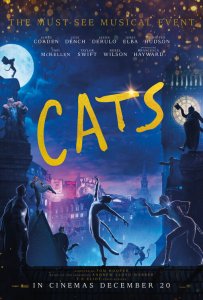 Cats, beyond all reason, is a musical sensation. Andrew Lloyd Webber based the show on the poems of T.S. Eliot. The original production played on Broadway for eighteen years from 1982 to 2000 and I don’t know a single person that likes it. It was only a matter of time before these jellicle cats were headed for the big screen in a big-budget folly. The first look the public got of a Cats movie musical trailer was met with revulsion and horror. I was anticipating the worst and yet I still wasn’t fully prepared for the jellicle disaster strutting around with undue confidence.
Director Tom Hooper (Les Miserables, The Danish Girl) made the colossal misfire to film his action in motion capture bodysuits and provide CGI hair and cat features to them later. This choice dooms whatever meager chance a big screen Cats might have had. There’s a reason the Internet erupted in collective horror when the first trailer was released, and Hooper and his producers tried assuring the public that those were early renditions of the technology and it would be improved upon its holiday release. Dear reader, I am here to tell you that the horror of that first trailer is alive and well in every unnatural moment of this nightmare. The uncanny valley has been a busy transit stop this year with the unsettling live-action (?) Lion King and now Cats serves as a dire warning about the perils of modern technology. Just because you can try and give human beings CGI fur and ears and tails doesn’t mean you should. The look is never fully transporting and often it appears like human features have been slapped onto a furry background composite, like a snowman’s facial features while it might be melting. Then there’s the additional levels of scary anthropomorphism, with mice and marching cockroaches. Why not just use prosthetics and makeup like every stage production? I think the Cats producers wanted to do something to distinguish it and in doing so they unleashed one of apocalyptic seals.
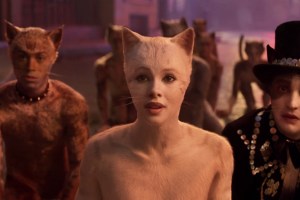 Whatever film version of Cats was destined to be disappointing because the source material is so lackluster. The Broadway musical was so popular for so long, I assume, primarily from its creative use of costumes, makeup, and staging to bring to life a fanciful world of felines. The CGI decision takes away whatever admirable craftsmanship and charm the stage show might have conveyed and replaced with nightmare fuel for the eyes. Absent the initial appeal, we’re left with a truly underwhelming story populated with underwritten characters that only really exist when they’re singing and otherwise just operate in background space. It’s a show that feels powerfully redundant with a plot structure that amounts to cats being tapped to deliver an explanatory song about themselves and then to move onto the next. It’s very much, “I’m a cat. Here’s my cat song,” followed by, “I’m a different cat. Here’s my different cat song.” Without further plot advancement, it feels like the silliest job interview with the worst candidates seeking the position of Cat Who Gets the Honor of Being Reborn in the Sky. By the end of the movie, I was convinced that I was watching an even scarier version of Midsommar and that this cat gang was really a religious cult that was selecting a ritual sacrifice to their blood-thirsty Egyptian Gods.
It’s a storytelling experience that never connects because this is designed entirely for children. Much of the show feels like a children’s television series that was hijacked by a sexual deviant. The film is replete with simplistic moral messages that you would find in children’s television, things like “Believe in yourself,” and, “Invite others into your play,” and, “Wait your turn,” and, “Treat others with respect,” and other easily digestible platitudes. This isn’t a complicated show and children would not be tasked with remembering the many characters and their stupid names because most of them are meaningless to the larger story. There is nothing complex about this story, which was compensated by the production values of the original stage show. The large stages the actors frolic around are fun to watch because they’re built to scale, meaning the tables are gigantic to present the world from a cat’s perspective. However, the proportions vary wildly and at whim. The cats will seem much larger than their world and much smaller; dining cutlery will appear far larger than a cat’s whole body, or they’ll strut on a railway and look like they’re three inches tall. Couple that with inconsistent world building and ill-defined magic powers (teleportation works except when it doesn’t) and it becomes very hard to hold onto anything as a baseline. The attempts at whimsy through the exaggerated scale become another point of confusion and unease as this world continually feels like a simulation that doesn’t quite add up.
 I really want to examine just how ridiculous so many of these character names are. Apparently, a cat chooses their name (sorry, pet owners, but you’ve been giving them slave names?) and they’re selecting some pretty insane identities. Without further ado, we have Bombalurina, Bustopher Jones, Grizabela, Macavity, Jennyanydots, Rum Tum Tugger, Rumpleteazer, Mungojerrie, Mr. Mistoffelees, Munustrap, Griddlebone, Tantomile, Jellylorum, Growltiger, and without a doubt, my favorite, Skimbleshanks. You could play a game guessing whether the names were cat names, pirate names, or something an elderly human said during a stroke.
The songs are also another source of disappointment. There’s the lone exception of “Memory” and Jennifer Hudson kills it with the kind of emotion the rest of the movie was missing, but everything else feels like it’s droning on and absent a strong sense of melody. The synth score also feels very dated and hard on the ears. The only saving grace for a movie that puts this concerted emphasis on the performances would be the song and dance numbers, and the dance choreography is bland and undercut by the editing, and the songs are forgettable. The Skimbleshanks number is a slight variation because of the force of personality from the character, being introduced like a fancy feline member of the Village People, suspenders and literal handlebar mustache and all. He also has an impressive tap number that leads into the exciting world of… sleeping cars on a train. It’s hard for me to impart any emotional impact from the songs because they’re so plainly expository, explaining a different cat’s life from being mischievous to being fat and lazy. These are not interesting characters in the slightest (sorry, Skimbleshanks) and their songs are like boring third grade essays about their home lives.
 Nobody walks away completely clean from this movie but the actors with singing experience come closest. James Corden (Into the Woods) is a real highlight from his comic asides that feel like he’s puncturing the bizarre self-serious nature of this silly movie. Jason Derulo has a slick amount of charm to be a commitment-challenged alley cat. Hudson (All Rise) is a strong singer and made me think of her character from Dreamgirls being a cat and singing her big number. The lead heroine, Francesca Hayward, has a genuine grace to her presence and a nice face to stand out amid a world of scary human-looking cat deformities. I wish she had more moments to showcase her balletic talents. The older actors fare the worst, unfortunately. Judi Dench (Murder on the Orient Express) looks pained and sounds it too. Her fourth-wall breaking song that concludes the film, instructing the audience on how to address and treat their kitties, is inherently awkward. Elba (Hobbes & Shaw) provides a palpable sense of menace to his devil figure, until he appears without clothes and I audible gasped and groaned. In one instant, any sense of menace vanished as I watched a naked black cat version of Idris Elba dance a jolly jig. I know these actors signed up for this but that didn’t stop me from feeling a resigned sense of embarrassment for them.
And now is the time to talk about the unspoken audience for a live-action Cats, and that’s the contingent of furries or soon-to-be discovered furries. I was wondering before if the filmmakers would be cognizant of the unorthodox appeal of their film production to a certain select group of audience members, and I am here to say they are completely aware and play into this. There’s a musical number where Taylor Swift sprays catnip (a.k.a. magic horny dust) that drives the cats crazy and they writhe and purr with wild abandon, striking evocative poses with legs raised. There may not be any visible genitals but that doesn’t stop Rebel Wilson’s character from a joke about neutering. In news reports, Derula has been upset by his phantom phallus in the movie, which is slightly hilarious considering he signed up for this, but it’s also indicative of the weirdly sexual vibes the movie is playing around with but at an infantile level of wonder. There is going to be a generation of moviegoers who watch Cats and discover that they are turned on by sexy human versions of animals slinking around, lifting their legs, and rubbing their fuzzy little butts.
 I was waiting for Cats to end long before it did because so much felt so pointless. The false whimsy was covering ineffective and repetitive storytelling, malnourished and unimportant characters, confusing world building and powers, middling songs (with one sterling exception), and direction that seems to make the whole enterprise feel like a children’s cartoon. It’s too simple to be intellectually stimulating, too weird and confounding to be whimsical, too sporadic and repetitive to be emotionally involving, and vacillating between complete seriousness and wanton silliness. I’m not even a hater of Hooper when it comes to his idiosyncratic direction of big Broadway musicals. I enjoyed his rendition of Les Miserables and thought several of the artistic choices made the movie better, especially the live singing. With Cats, I don’t think there was a possibility of this ever being a good movie as long as it was a faithful adaptation of a not great stage show. However, there were decisions that made this movie much much worse, namely the scary marriage of technology and flesh. If somehow you were a fan of Cats, or somehow consider yourself one as an adult, or a furry, you might find some degree of enchantment. For everyone else, Cats is a cat-astrophe. Sorry.
Nate’s Grade: D
Here are some pun-laden blurbs offered by a colleague, Steven Gammeter, in preparation for writing this review:
1) “You’ll need to change the litter box after this movie.”
2) “Follow Bob Barker’s lead and spay and neuter these Cats.”
3) “It feels like you’re living all nine of your lives while sitting through this movie.”
4) “There’s more than one way to skin a cat.”
Share this:

The Haunting of Sharon Tate (2019)
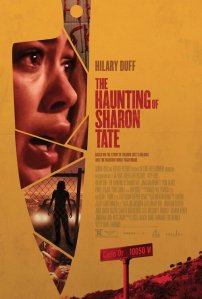 I knew going in about the film’s sour reputation and cries of it being exploitative and offensive, but I was questioning whether any film the purports to show the personal history of a real-life person who ended in tragedy could be considered exploitative. Someone is using a person’s real tragedies as a form of entertainment, and even in good taste there’s a profit to that design. Is featuring a story of Sharon Tate any less exploitative than, say, a serial killer drama, or maybe a slavery narrative, both of which will feature dramatizations of very real suffering? I knew I was destined to watch The Haunting of Sharon Tate and determine for myself, and about halfway through I had a very drastic change of opinion. The movie went from being bad to being legitimately offensive. It was already destined to be one of the worst films of 2019, but now it also serves as one of the movies that made me the angriest for the entire year.
Before diving into the exact reasons for my ire, I’m going to warn all readers that the only way to fully express just how rotten this movie is at its core requires significant spoilers. I’d say you’ve been warned but you know why you’re reading this. You want to know the horror.
 Sharon Tate (Hilary Duff) is pregnant, anxious, and awaiting the return of her husband, Roman Polanski. In the meantime, the Hollywood star is relaxing in her home with her former beau Jay Sebring (Jonathan Bennett), and house guests Wojciech Frykowski (Pawel Szajda) and Abigail Folgers (Lydia Hearst), heir to the coffee dynasty (in nepotism news: Hearst is the daughter of Patty Hearst and great granddaughter of the powerful publishing magnate). One fateful summer night in 1969, all four will perish at the hands of Charles Manson’s cult. Tate is plagued with disturbing visions of her demise that nobody seems to take seriously.
I was worried early that this was going to be an E! True Hollywood Story version of The Strangers, and I found that drawn out home invasion scenario to be very depressing. It’s true that the Manson family murders don’t officially come in until an hour, which means we have a long time until the movie justifies its existence, because this sure isn’t a character study. It’s a sleazy slasher movie at heart with little respect for its real-life figures, and you better believe I’ll go into more detail on that front later. Because of this back-loaded structure, we spend a lot of time with Tate magically fearing a future she should really have no way of anticipating. The very opening seconds of the film are a recorded interview where Tate talks about a dream where men broke into her home and murdered her and her friends. In case you didn’t understand, the movie then cuts to “one year later” and the camera slowly swoops over the bloody crime scene. Then the movie cuts to “three days earlier,” which was the first moment of distaste for me. Every single person watching a horror movie about Sharon Tate knows what happened, so why did we need a time jump to the murders when the whole reason the interview is included is for irony? We don’t need the example of irony to be followed by an immediate, “Here’s WHY it was ironic, guys!” It’s tacky and unnecessary, but that tart summation could apply to the entire film project.
The filmmakers think Tate running around and having wildly specific premonitions of her own demise is meant to up the tragedy, when instead it seems to portray Tate as being schizophrenic. She’s seeing glimpses of the murders but her mind is also doing Dumb Ghost Movie scares. There’s literally a jump scare tied to an ice machine making noise in the night. First, it’s an ice machine, but second, shouldn’t Tate know what her ice machine sounds like by now? There’s a moment where Charles Manson’s reel-to-reel recording turns on by itself. This is accompanied by audio distortion and quick cuts, along with a pounding musical score, that made me think of the overkill of the Saw movies when they were trying to be edgy. Then there’s Tate hallucinating that the bathtub is overflowing with blood. There’s one scene that made me burst out laughing. It involves Tate and Abigail Folger walking along the Hollywood hills and two people pass them on a walk, and it cuts to absurdly dramatic slow-motion and close-ups of these strangers, as if this portentous moment is meant to mean something so spine-tingling. Of course, with this movie being what it is, they do end up turning out to be two of the Manson family killers. We know what befalls Tate and the others but they don’t, so they view Tate’s hyper specific warnings as some form of mental breakdown. At one point, Abigail says they’re here to keep Sharon’s baby safe. “Safe from who?” she asks. “Safe from you,” Abigail responds. Allow me to clarify exactly why this storytelling decision is so off-putting: it’s trying to squeeze extra perceived tragedy from the events by providing early warnings that nobody believed, but in doing so it makes Tate look mentally ill to fit this aim. It feels like further insult to someone who already suffered plenty.
 And that brings me to the biggest point of contention I have with The Haunting of Sharon Tate and that’s its gross game of watching Tate and her friends die repeatedly in a misguided attempt to surprise the jaded audience. As stated, we know ahead of time what fate awaits Tate (oh man, it’s bad taste, but I want to appreciate that use of rhyme right there) so it becomes a waiting game of when the Manson family shows up and slays our characters. I was shocked it was happening so soon, around the 45-minute mark, and then settled into a depressed realization that meant the remaining half of the movie would be a tiresome Funny Games-style torture sequence. I didn’t have to wait long because the Manson family killers get to business quickly, but you see, dear reader – IT WAS ALL A DREAM. That’s right, Sharon Tate wakes up screaming having dreamed a prophetic nightmare. This was a breaking point for me with the film. It was using fake-out murder sequences to keep an audience guessing. Is THIS the time Sharon Tate gets murdered? Nope, maybe it’s THIS time? Nope, I guess we’ll just have to endure many sequences of Tate and her friends being killed to learn which is the legit murders. That’s so gross. It’s using her victimization as a reset button for exploitation thrills. It’s bringing Tate and company back to life again and again only to torment and defile them anew, and that I found righteously offensive.
Then the movie does something very different, borrowing a page from Quentin Tarantino, and rewrites history. The fateful night when the Manson clan has tied them up, Tate and the other captives fight back, killing their attackers. This caused me to pay more attention to the movie, especially with what seemed like a science fiction detour. The voice over of a very mundane philosophical conversation comes back, and we hear, “I don’t believe in one fate,” as well as, “I believe in infinite realities, and we’re trying to make things better.” Was The Haunting of Sharon Tate presenting a bizarre scenario where Tate was tapping into the future memories of a parallel reality version of herself in order to avoid that same deadly fate? If this was the case, well the movie would still be bad, but at least it was trying something insanely different. I would not have expected a multi-verse to make an appearance in The Haunting of Sharon Tate. However, I knew there was no way this movie would avoid undercutting this revelation, and in the closing minutes it manages to potentially erase all of this. We see the next morning and dead bodies lying on the grass with sheets over them. Sharon Tate hovers over one body, pulls the sheet down, and it’s revealed to be – HER! Does that mean the previous sequence of their survival was another fake-out? But if so then whose memories were we watching? Is it another Sharon Tate from a different parallel reality but in ours it didn’t work out so well? I have no clue. It’s a cheap twist ending already following a cheap gimmick, which makes me question which was worse.
 There is little redeeming value to the schlocky, offensively bad Haunting of Sharon Tate. It purports to be a sympathetic portrayal to a victim, yet it plays upon her death for fake out thrills and makes her seem crazy in order to project some added sense of tragedy because I guess what happened to her wasn’t tragic enough. If you needed any further proof to suggest the bad faith of writer/director Daniel Farrands he has another movie slated for release in early January 2020. The title: The Murder of Nicole Brown Simpson. Oh, but dear reader it gets even worse from there. According to the one available film review published, it turns out that Farrands is theorizing that Nicole Brown wasn’t murdered by her husband, O.J. Simpson, a jealous, wife-beating, controlling liar who had all that DNA evidence linking him to the crime. Instead it’s some drifter played by Nick Stahl who turns out to be a serial killer on the loose. Please just let the audacious offensiveness of these last few sentences just sink in and remember that this man is using this grievous shock value to make a name for himself. I feel confident with one New Year’s prediction: I will have a slot already reserved for The Murder of Nicole Brown Simpson on my Worst of 2020 List. In the meantime, do yourself a favor and don’t go near these sinkholes.
Nate’s Grade: D-
Share this:

The Aeronauts (2019)
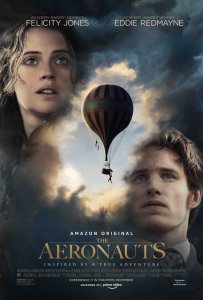 It’s been deemed “Gravity in a hot air balloon” and that succinct blurb is both unfair and also entirely accurate. Based on true events, we follow a pair of nineteenth century scientists pushing the bounds of understanding when it comes to weather atmospherics. When it’s up in the clouds, The Aeronauts can be a thrilling, visually gorgeous, and viscerally compelling movie about survival. Director Tom Harper (Wild Rose) uses modern camera techniques and lenses to make this old timey survival story feel immersive and alive. The film does an agreeable job of letting an audience understand the dangers that await and the mini-goals needed to avoid those dangers as well as the rising stakes or their limited options. The special effects team on this movie perform a minor miracle with how they’re able to translate what I assume was just a balloon basket and a giant green screen stage into a soaring, visually rich landscape of awe and terror. Felicity Jones is our protagonist, a woman who yearns to be accepted as a scientist as well as recovering from a personal tragedy, and she performs some impressive feats of physical acting when the film requires her to be very limited. Her co-star Eddie Redmayne does his usual Redmayne bashful, mumbly, soft-spoken, head-tilting stuff. Where The Aeronauts suffers is that half of the movie is derived of flashbacks for both of the characters to provide motivations why they ended up in that balloon basket. Imagine if half of Gravity was watching Sanda Bullock on Earth mourning the death of her daughter and deciding whether or not to go into space. It’s filler, plain and simple, and there’s too much of it. The motivations are pretty standard (wishing to prove one’s self, earn the respect of disapproving parental figures) and the information doesn’t add to the balloon sequences, like they learned some crucial detail that ends up saving their lives. The Aeronauts is legitimately a movie I would recommend seeing on the biggest screen possible to really enjoy the arresting and nerve-wracking visuals. Also, feel free to duck out for bathroom breaks every time the movies disappointingly decides to come back to Earth.
Nate’s Grade: B
Share this:

Jumanji: The Next Level (2019)
 Think of this action-comedy sequel as the enjoyable DLC to 2017’s main campaign. The Next Level feels rather familiar as it dishes up slight variations on what made the 2017 Jumanji reboot so enjoyable, namely a game cast ready to be silly and physical, fun and flourishing action set pieces, and a clever satire of video game mechanics. The excuse to get the gang back together one year after events from the first film is flimsy, but I didn’t care because I enjoyed these characters and especially the actors playing their in-video game avatars. The twist this time is a body swap that involves two elderly men (Danny DeVito, Danny Glover) joining the mix, allowing The Rock to do his best… old Jewish man impression? It certainly doesn’t come across like DeVito, as funny voices isn’t exactly a specialty for The Rock, but it hardly matters. There’s still more worlds to explore, new obstacles/levels to be tackled, and with the body-swap mechanic, a fun switch-up for the main actors to portray a variety of characters inhabiting their bodies. I was extremely happy that the film rejected recycling jokes from its predecessor. It would have been very lazy (a.k.a. lazy) to simply go back to a few funny wells that worked the first time, but every time the film brings back an element from the first adventure it builds off of it rather than rehash a reference point. Once again Karen Gillan (Avengers: Endgame) steals the show. The humor isn’t as gut-busting or satisfying as the previous incarnation but part of that is because we now know what to expect from this renewed franchise, and The Next Level manages to deliver what a fan would request while finding enough variations and tweaks to make it feel like its own movie, even if it won’t live up to the high standard of entertainment that came before it. If you were a fan of 2017’s Welcome to the Jungle, I’m confident you’ll walk away relatively satisfied and smiling from The Next Level. However, chart this as another movie that ends with a preview of a sequel that I wish I had seen instead of the movie I got (stay tuned through the immediate end credits). Jumanji: The Next Level is a worthy sequel to one of the more fun, clever, and visually inventive action-comedy franchises. As long as they can maintain this level of quality, I’ll happily pre-order the next edition.
Nate’s Grade: B
Share this:

Honey Boy (2019)
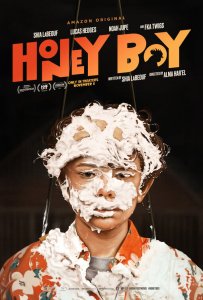 Honey Boy may be one of the most fascinating movies before you even watch a single second. It’s begging for an intensely ambitious psychological analysis as Shia LaBeouf lays bare his soul in an act of art as therapeutic device. He wrote the screenplay of a very autobiographical tale of a young child actor (nick-named “Honey Boy” by his father) hitting new levels of fame and his abrasive, abusive, and very controlling father, an alcoholic entertainer that relishes his son’s growing success and also resents his accomplishments. That alone would have made Honey Boy an interesting film experience, but LaBeouf goes the extra mile, as he does, and he literally plays the father character, putting him in the position of bringing to life the hurtful authority figure and thinking from his skewed perspective. It makes every moment LaBeouf is onscreen deeply fascinating and deserving of a deep dive to unpack the layers of personal meaning for the man. LaBeouf is also startling and terrific as the self-destructive and self-determined father, a man who finds slights in the slightest but can also be very encouraging of his son’s dreams. Seriously, every moment he is onscreen is suffused with layers of artistic meaning for what it represents in the story, its relationship to LaBeouf the person, and what LaBeouf the son is discovering while playing his father. It becomes a cathartic exercise that also could prove to be literal empathy. The problem with Honey Boy is that it feels more like that dramatic exercise than an actual story; the secondary storyline with the adult protagonist, played by Lucas Hedges (Manchester by the Sea), hardly provides much significance. He’s going through rehab and dealing with his unresolved feelings and addictions, but it’s more a framing device than a story itself or a worthwhile contrast to provide helpful details. The movie would just have been fine without it. However, there isn’t really a development of a plot as there is a general repetition of the relationship, namely the complicated and fractious father/son relationship. We spend a lot of time at this motel. We spend a lot of time with father speaking to son. I think a clear majority of the lines are spoken by LaBeouf. It’s always fascinating, with the exception of a misfire of a young romance that seems to float by more on yearning, but after a while I started to notice it felt like we were getting more of the same. We weren’t generating new insights into the characters and how they might change. Is this movie an act of forgiving his father or understanding him? I don’t know, but I’d happily debate Honey Boy with a pal over a beer for the next hour. It’s an inherently intriguing movie loaded with subtext that has its own subtext, a touch of the surreal from documentary filmmaker Alma Har’el, and powerful acting from LaBeouf. It can also feel like more of the same after the first hour. It’s a movie you need to see but it’s ultimately more LaBeouf opening up his intensive therapy role-play than it is a fully-formed movie. James Franco must watch this movie and weep.
Nate’s Grade: B
Share this:

Richard Jewell (2019)
 As I was watching Richard Jewell, a shocking realization began to form in my mind, something I had not anticipated from an awards-friendly venture from the likes of director Clint Eastwood – I was watching a strange secular version of a Kirk Cameron movie. Suddenly it all made sense where I had experienced this exact feeling before while watching a movie I knew wasn’t working. For those who have never watched the low-budget Christian indie dramas starring Cameron, such as Fireproof or the hilariously titled Kirk Cameron Saves Christmas (spoiler: he encourages materialism), they aren’t so much movies as they are filmed sermons, morals that have been given lackluster attention to turn into actual stories with actual characters. They don’t quite exist in a recognizably human reality, so they are often heavy-handed, tone deaf, and very very clunky, and sadly I can ascribe those very same qualities to the movie Richard Jewell.
Jewell (Paul Walter Hauser) is an eager, kind, awkward man who desperately wants to become a police officer and serve the public. His experience with law enforcement hasn’t quite worked out, so he’s currently serving as a security guard during the time of the 1996 Atlanta summer Olympics. He spots a suspicious bag during a concert in Centennial Park, follows protocol alerting others, and in doing so saves lives as it turns out to be a homemade bomb. At first Jewell is a national hero, and the everyman is on talk shows, thanked by strangers, and has a potential book deal in the works. Then the FBI, led by Agent Tom Shaw (Jon Hamm), and the media, represented by Atlanta journalist Kathy Scruggs (Olivia Wilde), turn the scrutiny onto Jewell himself. Suddenly the narrative twists and Jewell is believed to have planted the bomb to become the hero. Jewell is harassed by law enforcement, media speculation, and the pressure of trying to clear his name. He reaches out to an old colleague, rascally lawyer Watson Bryant (Sam Rockwell), to launch a defense and fight back against the Powers That Be.
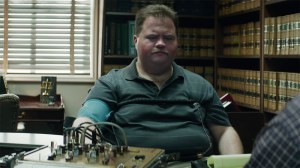 This is the passion play of Richard Jewell but nobody actually feels like a human being, let alone the person at the center of attention. There isn’t a single person onscreen that feels like a person, though the closest is the lawyer, Bryant. Jewell’s mother, Bobi (Kathy Bates), serves no other purpose but to act as her son’s cheerleader through good times and bad. When she has her teary media speech late in the film, I was relatively unmoved, because she was a figurehead. Everyone in the movie represents an idea or an organization, thus serving them up for double duty. Much like a passion play, we’re just here to watch the suffering and scold the abusers. It’s a movie meant to get our blood boiling, but other movies have been made to provoke outrage, especially highlighting past injustices under-reported through history. There’s nothing wrong with a movie that is made with the direct purpose of provoking anger at the mistreatment of others. The key is to make that central story relatable, otherwise the main figure is simply a one-dimensional martyr who only has the emotion of suffering. Without careful plotting and characterization, it can become an empty spectacle. With Richard Jewell, the main character is simply too boring as presented to be the lead. He’s an ordinary guy, but rarely do we see him in moments that provide layers or depth to him. And maybe that’s who he was, a transparent, average man who was too trusting of authority figures and a fair system of justice. Still, it’s the filmmakers’ responsibilities to make Richard Jewell feel like a compelling and multi-dimensional character in a movie literally called Richard Jewell. Even if the character arc is this poor sap starts to stand up for himself, this is severely underplayed. I sympathized with him but he felt more like a Saturday morning children’s mascot. He doesn’t feel like a person, let alone an interesting person, and that’s a big problem when he’s the closest thing the movie offers as a character and not a figurehead.
By far the worst character is Wilde’s media stand-in, a character so abrasively tone deaf and odious that when the bombing happens, she prays that she will be the one to get a scoop. The Evil Media Lady, which is what I’m renaming her because that’s all she serves in the story, is an awful amalgamation of the worst critiques people have with the media: rushing to judgment, callous indifference, and naked self-serving greed. The fact that she’s an invented character means she’s meant to represent the whole of the media, and yes, the media is one of the bad guys in the Richard Jewell story. They deserve ample criticism and condemnation, but when you serve them up in this careless, over-the-top manner, the vilification becomes more apparent than their culpability. Evil Media Lady literally sleeps with an FBI agent to get her scoops, scoops that end up being wrong, because she’s so devious and doesn’t care about The Truth. There is literally a dialogue exchange where she says, “I print the facts,” and another character retorts, “What about the truth, huh?” And wouldn’t you know, by the end, when Jewell’s mother gives her speech, who is listening and having a completely out-of-character turnaround but Evil Media Lady. I texted my friend Joe Marino as this was happening: “The power of her old white lady sad is making EVIL MEDIA LADY sad too, which means old white lady sad is the most powerful sad on Earth.”
 The FBI are also portrayed as a group of conniving snakes who must have thought Jewell was the dumbest human being on the planet the way they interacted with him. When the FBI sets its sights on Jewell as the prime suspect, they bring him in under the guise that they’re filming a training video and he needs help them with some role-playing scenarios. It’s so obvious that it feels fake, and yet my pal Joe Marino replied that this was a real moment, that the FBI had such a low opinion of Jewell that they could get him to sign away his confession through trickery: “We’re going to… pretend… see, that we brought you in as a suspect… and pretend we read you your rights… and you’re going to… pretend… you’re the bomber. Now please actually sign this… pretend form and do not ask for a real lawyer.” I almost need a Big Short-style fourth-wall break where somebody turns to the camera and says, “This really happened.” In fact, a Big Short mixture of documentary, drama, and education would have served this movie well. Here’s the problem with serving up the media and FBI in this manner. They deserve scorn and scrutiny, but when you turn them into exaggerated cartoons of villainy, then it colors the moments onscreen when they’re actually doing the things that they did in real life. This is mitigating the movie’s level of realism as well as the emotional impact. It’s not a person versus a system but rather a martyr versus a series of cartoonish cretins all trying to punish this good Christian man.
The shame of the matter is that Jewell was done great harm for acting courageously, and there is definitely a movie in his tale, but I think the way to go would have been making his lawyer the main focal point. That way there’s more of a dynamic character arc of a man putting it all on the line to defend a media pariah, it could open up to the doubts the lawyer has early on, especially as Jewell is aloof or cagey about certain damaging info (he didn’t pay taxes for years?), eventually coming to realize the quality of man he was defending. Jewell, as a character, is static and stays the same throughout despite his great emotional upheaval. A story benefits from its protagonist changing through the story’s circumstances, and that’s where Rockwell’s character could come into view. He’s also by far the most engaging person and he has enough savvy to be able to fight back in the courts and court of public opinion, becoming an effective ally for a desperate man. That way it’s a story of trust and friendship and righting a wrong rather than a good-if-misunderstood man being martyred.
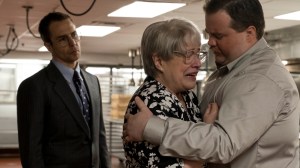 Throughout the two hours, Richard Jewell kept adding more and more examples of being a clunky and heavy-handed exercise. It would have been better for the bombing to be the inciting incident rather than the Act One break, sparing us so many scenes that do little and could be referenced rather than witnessed. Do we need to actually see Jewell getting fired from jobs to feel for him? There’s a reoccurring motif of Jewell bringing Snickers candy bars to Bryant as a friendly gift, and it’s so clumsy and weird. I started wondering if maybe Mars, Incorporated had paid for the bizarre product placement (“When you definitely did not plant a bomb in Centennial Park, break into a Snickers!”). There’s a dramatic beat where Jewell is trying to coax his distraught mother on the other side of a closed door. He just keeps repeatedly saying, “Momma please,” over and over while the music builds, and I guess the magic number was 17, and after that iteration she opens the door and they hug. It’s such an amazingly awkward scene. The dialogue has that same unreality as the rest of the movie, trying too hard to be declarative or leading, giving us lines like, “I’d rather be crazy than wrong,” and, “A little power can make a man into a monster.” It’s the kind of portentous, inauthentic dialogue exchanges I see in those Kirk Cameron movies. I wouldn’t have been that shocked if, by the end, the patriarch of Duck Dynasty showed up, running over the Evil Media Lady, and then they held a benefit concert for the persecution of white Christian males. I’m being a bit facetious here but Richard Jewell shouldn’t remind me of the derelict storytelling and characterization in hammy message-driven religious panoplies.
I was honestly shocked by Richard Jewell. I was expecting far more given the caliber of talent involved in the project as well as the inherent injustice in Jewell’s plight. Eastwood’s modern passion play feels too insufficient in passion. It’s an awkward movie that doesn’t give us a real character at its center, and it plays like every other human being in the universe is a representative of some storytelling function to service that empty center. There were lines of dialogue I just had to scoff over. There were moments that made me roll my eyes. I just couldn’t believe something this clunky could be designed for a late run for awards. The acting is all suitable, and Hauser does fine work as a mild-mannered everyman in a crucible, though I think he showed more adept skill in the enormously compelling I, Tonya. In fact, that 2017 movie could have been a lesson in how to tackle the filmic story of Richard Jewell, mixing in non-fiction elements to retell a story from multiple, fractured, contentious points of view that leapt off the pages. It feels there are many steps that should have been taken instead. Richard Jewell isn’t an awful or irredeemable movie, even though Eastwood’s typically plain shooting style feels even more strained and bland. It’s a movie I could see a contingent of the public genuinely enjoying, especially those already with a healthy mistrust of the FBI and media (you know who you are). But for me, it felt like I was watching the awards-friendly version of Kirk Cameron’s Christians are People Too. And again, Jewell deserves a major expose to chronicle his real injustices. He also deserves better than this.
Nate’s Grade: C
Share this:

Uncut Gems (2019)
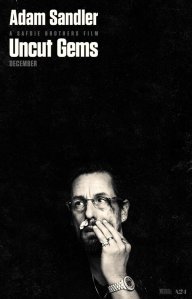 Uncut Gems is like having a panic attack. It’s frantic, unpredictable, exhausting, anxious, paranoid, visceral, and I still don’t know if I can say I actually enjoyed the actual movie. I can admire it and its effectiveness at putting the viewer in the world of Howard Ratner (Adam Sandler), a middle-aged jeweler that owes money to every shady human in New York City, though I don’t know if I want to step back into this mucky world of crime, losers, and lowlifes. It’s 2012, and Howard has procured a rare gemstone from Ethiopia and considers this his big score, which is important considering he keeps taking on more debts to pay off the last debts to angry, violent men. Basketball star Kevin Garnett, playing himself surprisingly well, visits the shop and is obsessed with the gem and the mythic power he feels it offers him. Howard agrees to allow the NBA star to borrow the gem, and from there Uncut Gems is a nonstop descent into chaos, with creditors, auction houses, family members, mistresses, and every goon in the tri-state area colliding with Howard as he spins desperate deals, escapes, and anything he can to attain that big score. The Safdie brothers, a writing/directing pair, made a big splash with 2017’s gloriously thrilling Good Time, a movie that was as brilliantly streamlined and direct as this new one is deliberately sloppy. It feels like one plot event crashing into another, with characters speaking over one another, a throbbing score constantly in your ear, and with claustrophobic camerawork and grimy lighting. You feel like you’re experiencing the constant rush of anxiety of Howard, and it’s very potent, but the movie can also feel repetitive. There’s so much happening all the time that it can feel less like things are escalating worse than things are just still happening. There are stellar sequences, in particular the later act with an auction and pulling off an escape leading to a very complicated high-risk-high-reward bet, but the movie’s sloppiness and overlapping nature also makes it feel smothering. Sandler is superb as an adrenaline junkie seeking his next fix, a self-destructive gambler who knows he can never be satisfied. With Sandler’s able assist, Howard has an offbeat charm that makes you listen when you should be punching him in the nose. Without Sandler and his live-wire performance, you probably wouldn’t care what happens to this mess of a man. Julia Fox plays Howard’s mistress and she’s a real discovery. This is her film debut and it certainly won’t be her last. She’s more than a pretty face and finds a screwball sweetness to her relationship with her boss, enough so that you think she may actually love Howard for real, in her own way. Uncut Gems is also shockingly unsentimental about its characters and what befalls them. You may laugh, you may gasp, but you’ll be surprised one way or another. The Safdie brothers continue to solidify themselves as some of the most exciting filmmakers working in the thriller genre. I’ll still prefer Good Time and a scuzzy Robert Pattinson to a scuzzy, bruised, beaten, and always-smiling Sandler, but Uncut Gems is two hours of collective adrenaline spikes.
Nate’s Grade: B
Share this:

Marriage Story (2019)
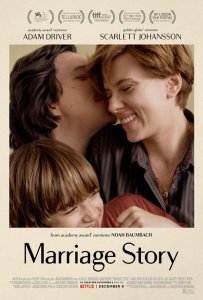 Noah Baumbach is a writer and director most known for acerbic dramas with a very dark, pessimistic viewpoint. That changed somewhat once he began a filmmaking partnership with actress Greta Gerwig that began with 2013’s Frances Ha. Gerwig has since gone on to become an accomplished filmmaker in her own right with 2017’s Lady Bird, which earned her Oscar nominations for writing and directing. The partnership seemed to bring out a softer side for Baumbach and they became a romantic couple who had a child earlier in 2019. Hell, Gerwig and Baumbach are even circling writing a Barbie movie together. This is a changed filmmaker and he brings that changed perspective to Marriage Story. It’s very different from Baumbach’s other movie about divorce, 2005’s The Squid and the Whale. I found that movie difficult, detached, and hard to emotionally engage with. Marriage Story, on the other hand, is a deeply felt, deeply observed, and deeply moving film experience that counts as one of the finest films of 2019.
Charlie (Adam Driver) and Nicole (Scarlett Johansson) are heading for divorce. He’s a successful theater director. She was a successful movie actress who relocated to New York City and has gotten an offer to shoot a pilot in L.A. Both say they want what’s best for their young son Henry (Azhy Robertson) but this will be tested as Charlie and Nicole push one another for what they feel is their best version of their family.
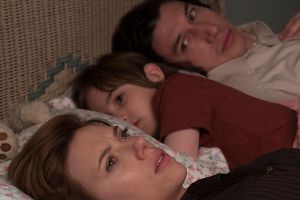 The observational detail in Marriage Story is awe inspiring. I was floored by how involved I got and how quickly, and that’s because Baumbach has achieved what few filmmakers are able to, namely present a world of startling authenticity. There is a richness in the details, small and large, that makes the entire story feel like you’ve captured real life and thrown it onscreen. I wouldn’t pry but Baumbach himself went through divorce around the time he was writing this, and I have to think some of those feelings and details seeped into this screenplay. Baumbach’s direction favors clarity and giving his actors wide berths to unleash meaty monologues or dynamic dialogue exchanges. The writing is sensational and every character is given a point of view that feels well realized. Even the combative lawyers (Laura Dern, Ray Liotta) have perspectives you can see why they’re fighting for what they believe is right. But it’s watching Charlie and Nicole together that brings the most excitement. Watching the both of them onscreen allows for so much study of the little histories behind their words, their gestures, their impulses, and they feel like a great mystery to unpack. It feels like a real relationship you’ve been dropped into and left to pick up the histories and contradictions and all the rest that make people who they are.
It’s very easy and understandable for divorce dramas to essentially pick sides, to present a clearly defined protagonist and antagonist, like 1979’s Kramer vs. Kramer. It’s easier for an audience to have a clear side to root for and a clear villain to root against, someone who they can see is more responsible for this breakdown of the family unit or for the infliction of emotional pain. What Baumbach does is something rare and exceedingly compassionate; he makes us like these two people as a couple in the opening ten minutes so that we can see how they could have shared a loving relationship for so long. The opening is mirrored voice over where each spouse narrates what they love or admire about the other person, and by doing this it’s like we too get to see these people in this adoring light. It’s like a ten-minute love letter and then it gets ripped away. However, by starting with this foundation, Baumbach has invested the audience immediately. We care about both of these people because we’ve seen them at their best, and now as things get more acrimonious and harder, it hurts us too because of that emotional investment. Marriage Story does not adopt a side or ask its audience to choose. It presents both parties as essentially good people but with their flaws and combustibility that point to them being likely better apart. That doesn’t mean they don’t still care for one another or have essential elements of friendship. A simple shoelace tying at the very end of the movie nearly had me in tears because of its everyday act of kindness. These are complex human beings with needs, desires, egos, pressure points, and we watch both of them struggle through a stressful process where they’re trying to do right but that definition keeps morphing with every next step. If there are villains, it’s the lawyers, but even they are given degrees of explanation and perspectives to explain why they fight as hard as they do.
 I have read several reviews that disagree with my “no sides” assessment, citing how the movie presents more of Charlie’s perspective during Act Two, and this is true. The extra time onscreen, however, doesn’t erase his faults as a husband. The transition to this handover is Nicole unburdening herself to her lawyer (Dern) in a gorgeous seven-minute monologue. It’s a thrilling moment for Johansson as the character begins guarded and afraid of saying anything too harsh, and then as she starts talking it’s like you watch layer after layer get pulled free, allowing this woman to open up about her untended wants and desires and to legitimately be heard in perhaps the first time in a decade, and it’s so powerful and sympathetic and natural. To then think that Baumbach intends to portray this same woman as a villain seems like a misreading. The second act does involve Charlie being more reactive to the new obstacles of divorce, like being forced to hire a lawyer to officially respond, to start a residence in L.A., and to eventually be observed by an evaluator of the court. He holds to the belief that he and Nicole don’t need the acrimony, don’t need the pain, and that they can be adults when it comes to deciding their end. Whether this is naivety will depend on your own worldview, but holding to this belief gets Charlie playing catch-up a lot and having to roll with changes for fear of being seen as an uncooperative parent, like when Nicole’s friends don’t want to go trick-or-treating with Charlie present so he’s forced into a second later more pathetic outing. We do get to see Charlie beset with challenges but that doesn’t erase Nicole’s challenges too.
For a movie as deeply human as this one, it’s also disarming just how funny it can be. The humor is never cheap or distracting but just another element that makes Marriage Story so adept. While the movie has its lows, it can also find delicate and absurd humor in the moment, reminding the audience that life isn’t always doom and gloom even when things are going poorly. The sequence where Nicole and her sister (Merritt Weaver, wonderful) are bickering over the exact steps to legally serve Charlie divorce papers reminded me of a screwball comedy, how the nerves and fumbles of the characters were elevating the experience into touching the absurd. Nicole’s entire family is a great comedic array of characters including her mother (Julie Hagerty) who says she has her own personal relationship with her daughter’s ex-husband that she wishes to maintain. They even have pet names for one another (this brought back memories for me as I’ve had mothers of ex-girlfriends still want to talk with me weeks after their daughter dumped me). The legal asides are also filled with absurdist moments of comedy about double-speak and the arcane or idiosyncratic rules of divorce and representation in the courts. The sequence of Charlie being watched by the deadpanned court evaluator (Martha Kelley, TV’s Baskets) is a terrific example of cringe comedy. He’s trying to impress her but she’s generally unflappable, to hilarious degree, and it only leads to more miscues that Charlie tries to ignore or downplay to win her favor.
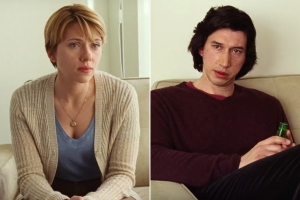 Make no mistake, Marriage Story is also one of the hardest hitting dramas of the year. Because we like both participants, because there is something at stake, watching them tear each other apart is a painful and revelatory experience. There is one gigantic confrontation that, like Nicole’s first confession, begins small and cordial and builds and builds in intensity, to the point where walls are punched, threats are unleashed, and both parties end in tears. It’s a thrilling sequence that feels akin to watching the defusing of a bomb ready to explode. Baumbach never feels the need to artificially inflate his drama, so we stick with that observational and compassionate ethos that has guided the entire film, even during the ugly moments. These are two people with pain and frustrations who both feel they have been wronged and are in the right. They’re both entitled to their pain, they’re both at fault for letting things get to this precipice, and they can both acknowledge that as well. Because even at their worst, Nicole and Charlie are still portrayed as human beings and human beings worthy of our empathy. They aren’t heroes or villains, they’re simply real people trying to navigate a hard time with conflicting feelings and needs.
The acting is outstanding. Driver (BlackkKlansman) is sensational and goes through an emotional wringer to portray Charlie, trying to stay above it all for so long and losing parts of himself along the way. His outbursts are raw and cut right through, but it’s also his smaller moments of ignorance, dismissiveness, or tenderness that linger, providing a fuller picture of who Charlie is, why one could fall in love with him and why one could fall out of love. I fully expect Driver to be the front-runner for the Best Actor Oscar. He even gets to sing a Sondheim tune and uses it as a reflection point. A late moment, when he’s reading a particular letter, drew tears and got me choked up. He’s always been such a visceral actor, a man with a magnetic charisma and animalistic sense of energy that draws your attention. He’s finally found a role that showcases how brilliant an actor Driver can be. This is also easily the best work of Johansson’s (Avengers: Endgame) career. Let there be no doubt – this woman can be a tremendous actress with the right material. She’s struggling with her sense of identity, being tied to Charlie for so long, and “wanting my own Earth” for so long that the dissolution process is both tumultuous but also exciting for what it promises. Nicole can take those chances, her Hollywood viability still alive, and strike out doing the things she’s wanted to do, like direct. Her character has felt like a supportive prisoner for so long and now she gets to make a jailbreak. Johansson is an equal partner onscreen to Driver, trading the tenderness and hostility moment-for-moment.
 This is Noah Baumbach’s finest film to date, and I adored Frances Ha. I was expecting a degree of bitterness from the normally prickly filmmaker, and that’s to be had considering the subject matter of divorce. What I wasn’t expecting was the depth of feeling and compassion that flows from this movie’s very steady beating heart. It feels real and honest in a way that a movie simply about the horrors of divorce and breakups and custody battles could not. Baumbach’s characters aren’t just meant to suffer and inflict pain, they’re meant to come through the other side with something still intact. I’d argue that Marriage Story, even with its suffering, is ultimately a hopeful movie. It shows how two people can navigate the pain they’ve caused one another and still find an understanding on the other side. Driver and Johansson are fantastic and deliver two of the finest acting performances of this year. Baumbach’s incredible level of detail makes the movie feel instantly authentic, lived-in, and resonant. I was hooked early, pulling for both characters, and spellbound by the complexity and development. There isn’t a false note in the entire two-plus hours onscreen. It feels like you’re watching real people. Marriage Story is a wonderful movie and I hope people won’t be scared off by its subject matter. It’s funny, empathetic, and resoundingly humane, gifting audiences with a rich portrait. It should be arriving to Netflix streaming by December 6, so fire up your queue and have the tissues at the ready.
Nate’s Grade: A
Share this:

Motherless Brooklyn (2019)
 I remember reading this novel back in college, so it’s been a long road for Jonathan Lethem’s crime story to find its way to the big screen. Motherless Brooklyn is a decade-plus passion project for star/adapter/director Edward Norton, and it’s easy to see why an actor would want to latch onto the lead role. Lionel Essrog (Norton) suffers from Tourette’s syndrome and is given to verbal and physical tics he needs to indulge or else his brain feels like it will explode. He’s our eyes and ears into a criminal world that views him as a freak. It’s an intriguing vulnerability given sympathy, forethought, and it’s an intriguing way to make something old new again through a disadvantaged lens. Norton is great in the lead and Lionel feels like a companion portrait to Joaquin Phoenix’s Joker, another struggling man given to unconformable physical outbursts that make him feel isolated from society. The book was fascinating from being inside this unique headspace and understanding how Lionel’s brain operated with obsessions and various pressure valves. The movie, which Norton rewrote completely and set in the 1950s, is an acceptable film noir, but without that specific perspective it would get lost. It’s handsomely made and has plenty of enjoyable actors in supporting roles. There’s an intelligence to the storytelling and power dynamics, but the movie is also a bit too smart for its own good, losing its way in a convoluted mystery where the pieces don’t so much add up as they’re just given to you after a long enough wait. And the wait is long. This is 144 minutes and takes its sweet time, applying more and more layers of intrigue and period settings like Norton is checking a list of Noir Elements to include in his first directing work in 19 years (Keeping the Faith, anyone?). The world itself is surface-level interesting but the main character is the real hook, so getting more of the world without going deeper on the character, or expressly placing him in different predicaments where he can utilize his unheralded abilities, feels like wheel spinning. Motherless Brooklyn is strictly for genre fans or those who don’t need much more from their movies than a high-concept quirk.
Nate’s Grade: B


 nathanzoebl
You must be logged in to post a comment.