Category Archives: 2019 Movies
Shazam! (2019)
 It seems like the secret to the success of the DC movie universe is making fun, lower stakes adventures with the characters the public has the least knowledge about. Shazam actually begun as a “Captain Marvel,” and now comes on the heels of the MCU’s Captain Marvel. We follow Billy Batson (Asher Angel), a teenage orphan trying to find his missing mother. He stumbles into a wizard’s realm and is given a special power whereupon he turns into a square-jawed, broad-shouldered superhero (Zachary Levi) by saying “Shazam.” What follows is like a superhero version of Big and it’s goofy, charming, and reminiscent of an 80s Amblin movie, where children’s movies were allowed to be a little creepy and weird. The movie is light, cheerful, and heartfelt with its doling out of family messages to go along with the slapstick and personal growth. It’s very much envisioned from a young boy’s fantasy perspective of being a super-powered adult, where the first things to be done include buying beer, going to a “gentleman’s club,” in between testing out bullet invulnerability and flight. Levi (TV’s Chuck) is excellent at playing an adult version of a kid. I was initially dismissive of his casting but he’s perfect for this part. There’s a satisfying sense of discovery for Shazam and his excitable foster brother (Jack Dylan Grazer) that doesn’t get old. The movie is more concerned with how the superpowers are affecting Billy’s relationships and sense of self than any larger, planet-destroying danger. The film even sets up its villain (Mark Strong) by giving him a decent back-story and opening the movie to explain his crummy family. It’s not a three-dimensional villain by any means but the attention given to make him something more is appreciated. The other foster kids in Billy’s new family are more archetypes but amusing, and their involvement in the final act raises the joy level of the finale. Shazam! is a movie where people are genuinely excited to be superheroes or associated with them, and that gleeful, buoyant revelry is downright infectious.
Nate’s Grade: B+
Share this:

Pet Sematary (2019)
 I already know my computer’s spell check is going to hate this review. In the wake of the box-office bonanza of It, prolific author Stephen King is a hot property once again for studios and everything old is new again. Pet Sematary (yes it’s intentionally misspelled) is a remake of a 1989 that was a hit back in the day. It was never regarded as a good movie but had its campy entertainment, so there was some room for improvement. Early reviews were positive and I raised my hopes for the 2019 edition, but after having seen the finished product, maybe some movies too are better off left dead.
Louis (Jason Clarke) and Rachel (Amy Seimetz) have moved to small-town Maine for a little peace and quiet and to spend more time with their children, nine-year-old Ellie (Jete Laurence) and their toddler, Gage. They happen to live next to a busy road with dangerous drivers speeding at all hours. An accident claims the life of their beloved family cat, but the kindly old neighbor Jud (John Lithgow) has a piece of advice. Beyond the “pet sematary” in the woods is a place where the buried dead come back to life. The cat comes back, though is mean and different. Later, another accident takes the life of Ellie, and Louis cannot let her go. He buries her in the hallowed grounds, she comes back, but she’s not daddy’s little girl any longer, and people will pay a high price.
 Eschewing a sense of camp, the film risks being overrun by its own sense of seriousness, which only works if there is room given to explore the ramifications of grief, the choices people make when they’re hurting, and the irony of good intentions. If you’re going to go in a serious direction then you need the confidence and dedication to play to that decision, and that’s not the case with the 2019 Pet Sematary. It’s lacking those important moments of contemplation or even dwelling with the horror of bringing back a loved one from the dead. There’s only so much evil hissing cat you can have before you hit a limit and start saying, “What else you got?” There’s going to be an escalation, I don’t think it’s much of a spoiler, considering the nature of the premise but also its predecessor being 30 years old, that one of the children will die only to be brought back. It’s also an easy speculation that they will “come back wrong” but the drama is processing this decision and trying to mitigate the mounting consequences. How far will a parent go to protect their child even if that child is an undead murderer? The trials should strain the moral resolve or our protagonist while reveling in the grotesque.
Because every viewer is going to already expect this much, it’s the film’s job to develop this premise in a satisfying manner and/or provide surprises from our expectations. Pet Sematary 2019 unfortunately does neither, barreling through the dramatic downtime when it could be developing its horror and unleashing standard slasher jump scares. When Louis is brushing his daughter’s tangled hair he runs his fingers over the metal staples in the back of her skull holding her head together. It’s a stark reminder that she is not the same, and it goes beyond her scraggly voice and unyielding stares meant to convey the same information. The film needed more moments like this, small details to unnerve and remind, rather than making her essentially The Ring girl from the start. The movie voluntarily eliminates its own storytelling runway, giving it little room to ramp things up and being forced to simply jump to the big bad killer demon girl. The filmmakers try and compensate somewhat by giving Rachel her own independent haunting, seeing hallucinations of her dead, twisted deformed sister. Those sequences reminded me of the slow stirring sequences in 2017’s It, drawing in the audience to dread what will happen next. It’s a side plot that could be eliminated entirely and I enjoyed these sequences the most because it was at least something pregnant with possibility.
 Many of the new additions feel like the filmmakers are fumbling for something else to be scary because they’ve consciously or unconsciously admitted defeat with their zombie. She’s creepy, sure, but she starts at full creepy and stays there. We get things like animal masks reminiscent of 2013’s home invasion thriller You’re Next. We get the spooky visions of ghosts that the child can see. We get Rachel’s taunting visions that never feel fully integrated into the larger whole with any thematic value. It could have tapped into her guilt praying for the demise of her sister for a well-earned sense of relief, and this same feeling coming ahead anew with her reanimated child, challenging her to reconcile her past actions and personal culpability and goad her into action. But like most aspects of the supernatural be-careful-what-you-wish-for parable, it’s given precious little deliberation and instead it’s more standard thriller moments to goose scares. I do appreciate that the film takes its sense of bleakness to the very bitter end, departing from the 1989 original for an even darker conclusion. The only problem is that it left me wanting the sequel. By the end, I think many viewers will agree that they wish a Pet Sematary movie, at least one under this oh-so-serious-slasher direction, had started at this end point instead and gone forward, exploring the full ramifications of the larger world.
As is wont for the Internet, there has been some gnashing of teeth over the fact that the remake kills a different child, but I think this is the smart move. It allows the remake to stand apart from the original and chart a path of its own, not that it’s very far. It also boosts the practicality of what it can do for horror. As any parent may attest, there’s more to worry about what a nine-year-old can do than a two-year-old. Even reanimated and filled with supernatural power, it’s still a small child that can be overwhelmed. An evil pre-schooler has a bit more limited mobility for their murder rampages.
For fans of King, or fans of genre horror, there may be enough standard thrills and chills to enjoy the new Pet Sematary. In the extremely spotty spectrum of King movie adaptations, it’s definitely somewhere in the middle, not bad per se but nothing special.
Nate’s Grade: C+
Share this:

Serenity (2019)
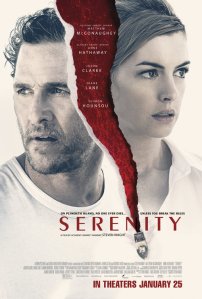 Serenity might have the most bizarre plot twist of any film this year, or maybe even the last few years. For the sake of you, dear reader, I’ll not spoil it, but it’s hard to talk about this neo-noir crime thriller without revealing its larger grand design. I have no real idea what writer/director Steven Knight, a talented wordsmith who has written Eastern Promises, Locke, and Peaky Blinders, was going for with this murky genre mishmash. Matthew McConaughey plays Dill, a local fisherman who for the first 18 minutes of the movie is obsessed with a hard-to-catch tuna like it’s Moby Dick. Literally, this is the key plot for 18 minutes. Then his old flame (Anne Hathaway) comes to town and looking for Dill to help her kill her abusive husband, Frank (Jason Clarke). Now we’re on fertile noir ground, and then one hour in the film throws a curve ball that nobody will see coming, and it spends another 45 minutes dealing with those repercussions. Some of this added knowledge leads to creepy exchanges where Dill is peeling back the veneer of his sleepy island town residents, but really it’s a confusing and unnecessary twist that leads to strange thematic implications and tonal oddities that may lead to unintentional laughter. The sentimental ending conclusion, born out of murder both real and imaginary, feels like it was ripped out of Field of Dreams and forcibly grafted on. So much of the drama is about following what is expected of us, and there are more than a few passing, though intriguing, Truman Show-esque moments that reward further examination, but these are put on hold to slay the abusive husband/step dad through the power of an elusive fish. I don’t know what to make out of Serenity. The acting is fairly solid, the photography is stylish, and Knight knows how to spin a mystery, but to what end exactly? It feels like a passionate albeit misguided student film trying to say New Things about old tropes. In the end, it’s a fish tale that is better off being thrown back. See, I can do fish things too.
Nate’s Grade: C
Share this:

Dumbo (2019)
 Director Tim Burton has always been attracted to the weirdos, the outsiders, the freaks, so it seems fitting that he attached his name to a big-budget, live-action remake of Disney’s 1941 animated film of the flying pachyderm, Dumbo.
Shortly after World War I, Holt Farrier (Colin Farrell) is returning home and reuniting with his two children, Milly (Nico Parker) and Joe (Finley Hobbins). They’re rebuilding in the wake of their mother’s loss and Holt’s war amputation. He and his horse-wrangling wife used to be the star attraction for their traveling circus run by Max Medici (Danny DeVito). The circus is on hard times until Max purchases a pregnant elephant that gives birth to a big-eared baby with a special ability to fly. Suddenly the crowds come pouring back and a bigwig like V.A. Vandevere (Michael Keaton) sees a big opportunity. He offers the circus to move to his state-of-the-art theme park, Dreamland, and for Dumbo to perform with his famed trapeze artist, Colette (Eva Green, seeming to take the mantle of Burton’s Raven-Haired Muse, after Helena Bonham Carter, and before her Lisa Marie, and before her Wynona Rider — seriously, look it up, there are only four movies in his whole career that don’t feature these actresses). The big new stage only serves as a reminder of how lonely Dumbo is and the family plots to reunite him with his mother.
 As we enter a precipitous new age of Disney live-action over saturation, each new remake must be asked the question, why does this film need to exist? I feel like we can classify the glut of live-action remakes into two categories, namely the older, less revered films and the newer, more revered. Take for instance two 2016 remakes, The Jungle Book and Pete’s Dragon, as both films felt enough distance from their sources’ release that they had the comfort to be different. In the case of both movies, especially the beautifully lyrical Pete’s Dragon, I’d say they are improvements. But those movies are old and the nostalgia for them is minimal. That’s the not the case for films like Beauty and the Beast and Aladdin and The Lion King, where the originals are beloved by an audience that still remembers them fondly and vividly, now slightly older, and looking for fidelity rather than artistic invention. When the live-action 2017 Beauty and the Beast, an otherwise dreary and pointless remake of a new classic, makes a billion dollars, Disney has a pretty clear indication of what the wider audience wants with their remakes. Dumbo is a movie that actually has some room for new artistic life, especially with a talent like Burton adding his own signature dash of razzle-dazzle. There are some things from the source material that could use further examination, like animal abuse, and some things from the 1941 original that could deservedly be eliminated, like the racist “Jim Crows.” It may be early but I think Dumbo will be my favorite of the 2019 Disney remakes.
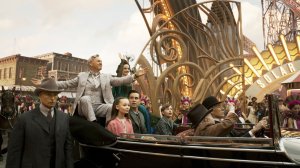
There’s an enjoyable sense of whimsy and wonder to the film that also belies a darker underbelly, something that Burton has featured since Beetlejuice and Edward Scissorhands. Early on, Burton and screenwriter Ehren Kruger (Ghost in the Shell, The Ring) establish the world by returning dear old dad back but with one less arm. It undercuts the reunion and also leads to a crossroads of mounting questions about his viability as a performer and adaptability. The children and the father are the real stars of the film, a family trying to reconfigure their new identity in the absence of their mother and the readjustment of their father after he can no longer be a headliner. It’s enough to ground the movie emotionally and provide a sense of stakes. The motley crew of circus performers and sideshow acts serves as a non-traditional family unit, a found family, and one fighting for their own slice of dignity. I’m likely reading more into this than intended but the fact that I can shows that Burton and company at least put in solid efforts to stake a foundation. The wonderfully macabre, askew Burton elements are present as well, especially in the production design for Dreamland, which looks like another fantasy neighborhood straight out of Halloweentown in Nightmare Before Christmas. The presence of Eva Green is another enjoyable highlight as a French acrobat that becomes close to Dumbo and the Farrier family as a whole. It’s sweet with a little touch of the eccentric, which is another fine way of describing Max Medici and DeVito’s affectionate performance. There is an offbeat sense of humor to and visual whimsy to the film that works with the standard heartwarming family elements rather than against it. It’s a movie that can hit you in the gut and then make you smile the next minute.
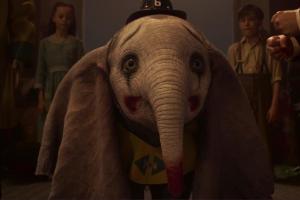
 Dumbo is less a character than he is a symbol, but it works for the most part even if it hampers the larger storytelling prowess of the film. He’s a symbol for every person to import their own feelings, an outsider who feels like they do not belong. He’s also a symbol of innocence as a gentle animal, something to tug at the heartstrings when he’s mistreated or separated from his mother. It’s hard not to feel something when the camera gets the special close-up for his big, soulful eyes. He’s even more sad looking in garish clown makeup. The animal rights angle isn’t heavy-handed but enough to get you feeling sympathy for poor creature. It sets up a big escape to reunite mother and son and free them from captivity that reminded me of a 90s kids movies, but not necessarily in a negative way. I think that’s one of the achievements of Burton’s movie is that he has reshaped an older children’s movie model with his unique touches. It’s a far more successful alchemy than 2010’s dull Alice in Wonderland.
I also have to call special attention to Michael Keaton’s villainous character specifically because it is an obvious stand-in for Walt Disney. Not only does he own a theme park, where the customers come to him rather than the other way around, but also he’s a showman who’s underhanded, greedy, and backbiting, ready to cut anyone loose. There’s even a scene that shows him comically inept when it comes to actually performing any actual practical skill, like controlling an electrical panel (Keaton’s exaggerated movements made me think of a child pretending to be an adult at work). Keaton is also wonderfully daft as the blowhard. He feels like he’s in a very different movie that only he knows about, and while it didn’t exactly fit it made every one of his scenes more entertaining. Burton and his team were biting the hand that feeds them, calling into question the intentions and actions of the man that gave birth to the empire, and Disney miraculously approved of this. Maybe they felt they had gotten so big (sayonara, 20th Century Fox) that criticism didn’t matter, or maybe it somehow slipped under their collective radar, I cannot say, but its inclusion is both welcome and fascinatingly bizarre for a 2019 Disney release.
At its core, Dumbo is an enjoyable if limited remake, a movie that sets its ambitions low but sets out to try a few different things with modest success. There are some scenes that go too far, whether it’s the extended reaction shots of crowds vocally heckling… an elephant, or a pretty lazy message that we can all be special because of what we have inside, that reminded me what the finished film could have been, namely far worse. It doesn’t quite soar but it does rise above my expectations and kept me pleasantly entertained.
Nate’s Grade: B
Share this:

Us (2019)
 I think it’s important to state that Us is not Get Out and that’s perfectly okay. Not every movie can be a Get Out, an experience that was so refreshing, socially relevant, wickedly fun and dynamic that I immediately wanted to see it again and tell everyone I know to join in. Writer/director Jordan Peele shed his funnyman past and flexed his impressive genre know-how to make a knockout of a movie with an amazingly structured story, allowing all of the pieces to snap together with clever precision. It was my own second favorite film of 2017 and I was highly looking forward to Peele’s follow-up in the realm of what goes bump in the night. Don’t go into Us expecting Get Out. It’s not quite the sum of its parts and has some storytelling shortcomings that limit the impact of its visceral thrills. It’s an engaging horror movie, but it’s far more allegorical and far less tidy and satisfying.
The Wilson family is spending their summer vacation at a rental home in Santa Cruz, California. Adelaide (Lupita Nyong’o) and her husband Gabe (Winston Duke) are trying to enjoy a getaway with their children, teenage daughter Zora (Shahadi Wright Joseph) and young son Jason (Evan Alex), when strange coincidences keep occurring. This is the same beach town where many years ago Adelaide had a traumatic childhood experience getting lost from her bickering parents. Then one night Jason informs his family that there’s another family standing in their driveway. The Wilson family is hounded by mysterious doppelgangers, each a cracked mirror version of themselves. This new family wants what the Wilsons have and will use any bloody means to see that they get it.
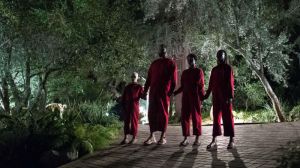 Us is more a straight horror film and has plenty of excellent, terrifying, and smartly directed scenes to make an audience squirm in their seat. Peele has established in two movies a strong instinct for horror and how to expertly stage a scene. His camera is judicious in what it does and does not show the audience, holding onto moments to escalate tension and providing no escape for an eager audience. The majority of the second act is a home invasion thriller and these scenes and subsequent chases and escapes can be nerve-wracking. Each character has their own opponent and each has their own method of trying to outsmart or out maneuver their downtrodden doppelganger. I was getting plenty of Funny Games vibes, a movie I downright despise, but what it could have been if the creator actually cared about the inhabitants. The family and their bonding is a strong empathetic anchor for the audience, so we watch each member of the family battle a literal incarnation of their inner demons. Peele also assembles an effective collection of spooky imagery, from caged rabbits, to the slice of golden scissors, to a carnival funhouse, to even the nature of that 80s social event, Hands Across America. You can sense Peele’s love of horror and the entertainment value horror movies afford. There’s a strong central mystery to guide the narrative and the sense of discovery from Act Two onward keeps things fresh as we learn more and more about these doubles.
From a technical craft standpoint, Us has the upper hand over Get Out. This is a movie that wants to scare you and Peele has devoted great consideration into his artistic elements to achieve that key principle. Peele knows exactly how to craft a particular mood and what genre elements to pepper in and to what amount for the right response. The photography by Mike Gioulakis (It Follows) is evocative and makes great use of limited light to capture an eerie and unsettling feeling. The musical score by Michael Abels is also exceptional, making the most of each heightened scene and doing wonders with a dark, operatic version of the chill 90s song “I Got 5 On It” by Luniz. It makes for a fun, frightening, and favorable film experience in the moment-to-moment sequences of build and release.
The performances are another strength, with each member of the family getting extra range thanks to their dual roles. Nyong’o (Black Panther, 12 Years a Slave) is the standout and emotional center of the movie. Her double is the leader of her clan and the only one that has the ability to speak, except speaking isn’t quite the right word. It’s more like the words escape her throat, raspy and without intonation. It’s a remarkable commitment on her part and she tries a lot of weird character tics, most of them work, from her herky-jerky to robotically possessed physical movements, unblinking eyes, and then there’s that startling voice. Duke (Black Panther) finds his footing as a comedic foil, starting as a corny but loving dad and thrust into a family defender that gets more and more tired of the horror movie nonsense he endures. The kids all do solid, effective work with what they’re given, seizing their moments. Elizabeth Moss (The Handmaid’s Tale) plays a bourgeoisie friend and has a fantastic moment with lip gloss that made me horrified and entranced all at once.
 This is where the merits of the film start running into conflict with Peele’s muddled intentions and messy execution toward the finish. As I said, it’s far more allegorical in approach; meaning for the longest time it seems to be a film outside the bounds of literal interpretation. That’s fine since many horror films rely upon a heaping helping of metaphor for larger implications. I was prepared for Us to stay in this creative territory. Except Peele makes a late decision to squeeze his movie into a bizarre and distracting middle ground, where it feels like the metaphor is the real message, if you can decode it. Once you stand back and assess the full Us, it doesn’t hold together in allegory or explanation.
Even hours after seeing the movie, I cannot say whatsoever what the intended theme is for Us, and this really befuddles me since Get Out was laser-focused in this regard. Peele isn’t just cranking out fun, throwaway genre movies, he’s trying to make statements through horror and elevating the genre in artistic ways. Get Out postulated how being a black man in America was like living in a horror movie and a Stepford Wives-meets-Being John Malkovich commentary on the usurpation of minority agency and the commodification of black bodies. It’s not every day that a horror movie wins an Oscar for Best Original Screenplay, let alone deserves it, and Peele’s treatise on race relations was perfectly structured, each piece snapping together and better informing the whole, with setups and payoffs galore, and at its heart was its relevant message. With Us, I don’t really know what Peele is trying to say here. There’s a simple duality theme but that seems pretty weak and underdeveloped. There may be a have/have not inequality discussion but this gets into trouble in the final act (more on that below). I don’t think race even factors into the overall message, as a late turn reveals that the doppelgangers extend beyond our central African-American family. What is Peele trying to say with Us? I’m at a real loss and I’m trying to process that confusion and my own expectations.
This might have worked better had Peele not elected to supply a hasty sci-fi explanation for why things are the way they are, and in the process he strands his film in a contentious middle zone that tries to find a logical context to plant his allegory. I won’t get into what exactly the details of this explanation are but suffice to say it doesn’t really hold together and invites far more questions, each one picking apart the reality of the film, which disintegrates at an ever-increasing speed. How far-reaching is this conspiracy? What is the ultimate goal? How do these people think they will win? Why now? There’s also a big twist ending that should be obvious for anyone paying attention, but what makes this decision worse is not that it’s predictable but that it hardly sheds any new dimension to what came before. It doesn’t really change our reading of certain people because of the time it happened and so the big meaning is its existence as a twist. It doesn’t redefine the narrative in the way that great twists should. It might play into a larger thematic point except, as described above, that area is hard to ascertain. The last third of Us gives a sense of scope and rationale but the movie also loses its form, trading in dream logic and then trying to provide a new real world context that cannot hold.
 Friends have already asked me whether Us is a good movie, and I’ve found myself saying, “Yes, but…” Peele’s follow-up left me with more questions than answers and a nagging sense of dissatisfaction that began to eat away at my otherwise good time in the theater. Us has some fantastic moments and tense scares but I cannot say what its muddled theme is, the hazy explanation doesn’t really work, and the overall intent left me perplexed. It’s an evocative horror movie with solid to great performances from a very game cast of characters. Given its more free-floating plot, it feels like the kind of movie that would hold together by a strong thematic core. I think most people will leave Us somewhat scratching their heads and wondering what it was all about, but not as an accessible puzzle to decode. It’s more a puzzle that doesn’t resemble the picture on the box and is frustratingly missing a few too many pieces to come together.
Nate’s Grade: B
Share this:

Captive State (2019)
 The fraught world of Captive State is interesting, a political landscape ten years into an alien occupation. We follow a small band of human resistance fighters working to get past a security stopgap to strike back at the alien overlords who resemble human-sized pine trees. John Goodman plays a police security chief trying to unravel the insurgent conspiracy while working with the collaborative government. It has a slight cat-and-mouse feel of a good conspiracy thriller and there are asides that broaden the world, giving an interesting peak at the realities of this strange new world. The problem is that it feels like a whole mini-series stripped into a two-hour movie. The characters feel less like people and more like impressions of people, and the story is plowing through so many incidents that there isn’t much time to flesh them out except for the occasional trope. As a result, the movie feels like it has a lot of things happening but my interest level flagged because I felt little for the characters. The limitations of the budget are felt here and there as far as the sense of scale. Director/co-writer Rupert Wyatt (Rise of the Planet of the Apes) takes a docu-drama approach and favors nighttime chases and sneaking, which also conceals special effects restrictions. The visual grittiness adds a visceral level of realism but can lend itself to additional logic questions. I kept waiting for the world to feel more lived-in and offer important slivers to add layers of context to this conspiracy. Captive State is frustrating with how much it leaves unspoken and unclear. It’s ten years in to this occupation and what exactly have the aliens offered the world? What has changed? Why are these freedom fighters fighting back? What are the goals of the aliens? I can handle ambiguity and nuance but with too much the world building can feel unsatisfying and incomplete. It comes together well but by the climactic end I felt the universe it established was more intriguing with potential than the story it delivered.
Nate’s Grade: C+
Share this:

Captain Marvel (2019)
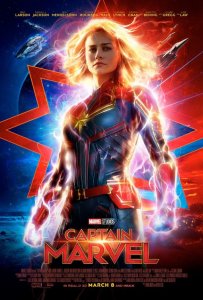 Wonder Woman may have beaten her to the punch but Carol Danvers, a.k.a. Captain Marvel, deserves her own share of headlines as the first woman to have her own starring vehicle in the highly successful Marvel Cinematic Universe (MCU). Her presence was first teased in the post-credit scene of Infinity War. After twenty-one films, Captain Marvel gets squeezed into the penultimate chapter before closing the book on the MCU as we know it for a decade, and it feels like a throwback in both good and bad ways.
Carol Danvers (Brie Larson), or “Vers” as she’s known on the Kree home planet, is part of an elite alien squad of “noble warrior heroes” fighting in a long-running war against another alien race, the shape-shifting Skrulls. Carol Danvers goes back to her home planet of Earth (a.k.a. Planet C-53) in the 1990s to look for a hidden weapon linked to a mentor she can’t quite remember, a woman (Annette Bening) from her past life on Earth as an Air Force pilot. Carol Danvers must try and recall who she is with the help of Agent Nick Fury (Samuel L. Jackson) and stay one step ahead from the invading Skrulls.
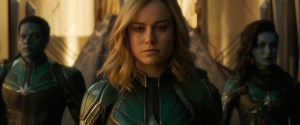 This definitely feels like a lower-to-mid tier Marvel entry, something more akin to the Phase One years (2008-2012) where the initial franchises were just starting to get a sense of direction and personality. They were also lacking the larger depth of character development, social and political messaging, as well as judicious independence from the overall studio formula that has come to define dozens of superhero blockbusters. It’s not a bad movie, and is fairly entertaining throughout its 124-minute run time, but it’s hard not to notice the shortcomings that, frankly, haven’t been this transparent in an MCU movie for some years now. I had to think back on a comparable MCU experience and I had to go back to 2015 with Avengers: Age of Ultron or maybe even 2013’s Thor: The Dark World. In short, Captain Marvel just feels a little less super in many important areas.
This is the first female-lead superhero film in the MCU (sorry Black Widow) and Carol Danvers has been a character in Marvel comics since 1968, and yet the film doesn’t put together a compelling case why she is the one getting her big screen moment. The character suffers that wonderfully tired movie trope of the foggy memory, so we have a protagonist trying to discover who she is alongside the audience. This would be a fine starting point for her to essentially reclaim her humanity and her agency as she travels back to good ole C-53 and learns more about her past. There’s a core of a beginning theme already present there, the nature of what it means to be human, and how it can be viewed as a weakness by n alien species and how it comes to be a strength for her. Maybe that’s too pat but it’s a start. The problem is that Carol Danvers isn’t seen to be that interesting. She’s somewhat boring and the presentation feels a tad inauthentic; when she’s quippy it feels forced, and when she’s badass it feels lethargic. There’s a personal journey that challenges her to assess her preconceived notions of good and evil in an ongoing intergalactic conflict, but it’s so impersonal. Even when she’s revisiting with friends and reminiscing (what she can) it doesn’t feel like we’re getting that much more insight than we had before. She’s a warrior. She’s upstanding. She definitely doesn’t like men telling her what she can and cannot do. But what else do we know besides her increasingly invincible super powers? What is most important to her that drives her? What are her flaws other than a faulty memory? When she goes full super saiyan it should be celebratory and joyous and instead it feels more weirdly perfunctory.
 I love Larson as an actress and have been singing her praises for dramas (Room, Short Term 12) and comedies (21 Jump Street, Scott Pilgrim) for years, and I kept waiting and waiting to be wowed by her in this role. I was left unfulfilled. Larson is a terrific actress and can be so expressive, resolute, heartbreaking, and inspiring, and I grew frustrated as the movie kept her talents buttoned up for too long. She seems too removed from the action even as it’s happening in the moment. It’s not that she’s too serious (“smile more” chime the denizens of cretinous “men’s rights activists”) because her character should be serious. It’s that she hasn’t been given enough depth and interest a hero deserves.
Jackson (Glass) and Mendelsohn (Ready Player One) were my favorite parts of the movie. Watching a 40-something Jackson front and center looking like he was ripped out from 90s cinema is remarkable. The movie is at its best when Jackson and Larson are working their 90s buddy cop chemistry together. There’s a fun running joke about how Fury loses his eye with some near-misses played for comedy (reminiscent of Crispin Glover’s eventual armless bellhop in Hot Tub Time Machine) and while the film does a disservice to Carol Danvers’ character it opens up Fury even more as a person. Mendelsohn has become a go-to villain for Hollywood and the filmmakers use this to their advantage. He slinks around having a good time being bad, but there’s also a surprising turn that provides unexpected pathos and depth to what could have been a one-note scary-looking bad guy. In a movie that deserves headlines for being the first female-lead MCU entry, the supporting dudes end up having the most depth and success, which is rather odd.
Captain Marvel is missing a larger sense of vision and purpose, which is why it feels more like a throwback to those early days. Directing/co-witting husband-and-wife team Anna Bodin and Ryan Fleck (Half Nelson, Mississippi Grind) don’t manage to have a feel for the material and for action as a whole. There are some pretty-looking sequences and some moments that strike their intended effect well, but the structure of their movie could use a bit of an overhaul. The first act, the pre-Earth return, is a bit convoluted and could be condensed. This even goes for the Kree Special Forces team (Kree Team Six?), which comprise many differentiated soldiers when really three non-Jude Law members would suffice. The Kree characters are stranded for the middle act and when they come back it’s hard not to feel disinterest. The concluding act brings the various plotlines together better with some good twists I did not see coming and appreciated. However, the climax is missing out on its triumphant jubilation because of the spotty characterization and the haphazard action direction. From the start, the action is unimpressive and poorly choreographed and edited. The chases are humdrum and the special effects are surprisingly substandard at too many turns. It’s hard to tell what’s happening in many fight scenes, and once Carol Danvers gets her full super laser-blasting powers, the screen becomes even more obstructed and even harder to decipher. Bodin and Fleck have showcased a natural feel for visual storytelling but action appears beyond their grasp for now.
 Captain Marvel suffers from being asked to do too much, slap together an origin tale for the last essential character for the conclusion to a larger multi-movie storyline, also forging the beginning of the MCU timeline as a prequel for Fury and S.H.I.E.L.D, as well as some connective back-story with the Guardians universe. It has to do a lot of heavy lifting in two hours that the screenplay and characterization do not seem best equipped to handle. The humor is a bit dull and unsure of itself, relying upon certain beats one too may times, notably a cute orange cat tagging along. Even the 90s setting feels like something tacked on for easy jokes about dial-up Internet and references to Radio Shack. It feels like simple nostalgia and that goes to the soundtrack selections as well. This must have been the easiest job the music supervisor ever had for a film, having to do a mere cursory scan of 90s alternative rock for the hits. An action sequence set to No Doubt’s “Just a Girl” should have more attitude than it does. A dream/trance sequence set to Nirvana’s “Come As You Are” should be creepier and more unsettling. By the end, as the credits flash onscreen set to the guitar chords of Hole’s “Celebrity Skin,” I felt certifiable 90s fatigue.
I feel like I’m piling on Captain Marvel with complaints and quibbles and presenting the impression that it’s a bad or dimly entertaining film. It’s not a bad experience but it definitely has its share of flaws that hinder the enjoyment factor. As a white guy in his thirties, Hollywood has been making movies tailor-made for me as their default setting. I cannot underestimate the cultural and personal impact this will have for millions of women and young girls who have been eagerly waiting for a big-budget movie with a strong female protagonist front and center. Wonder Woman was a cultural and commercial touchstone that might diminish the luster of Captain Marvel for some, but the MCU is its own unparalleled zeitgeist. Having a woman carry a movie in this special high-profile film universe will mean considerably much to many. I wish it was a better movie, but even lower-tier Marvel is still better than plenty, and that may be enough. I’ll look forward to see how other screenwriters and filmmakers make use of the character in the ensuing Avengers sequel coming out next month. I’ll reserve my final judgment on the character after I see how she fits into the larger picture and with storytelling talents that have shown more aptitude toward the super stuff.
Nate’s Grade: B-
Share this:

Arctic (2019)
 Mads Mikkelsen is stranded in the Arctic and that’s about all you need to know plot-wise about the film, a thrilling and immersive survival thriller. Right away the film lets us in on the routine of this survivor of a plane crash and how resilient and resourceful he had become. Then it introduces a new sense of urgency, a critically injured pilot in another aircraft, that pushes him into leaving the safety of his homemade confines. The movie relies so heavily on elemental, visual storytelling that I think any person on the planet could easily understand and appreciate the pared-down storytelling. The visuals are so immersive and accessible that every item bears import or sets up critical information to be relied upon later. The harsh Arctic landscape and unique dangers push our hero to the extreme in order to save another life. It’s enough to inure us to this relatively silent man. Mikkelsen (Polar) uses every physical muscle of acting to communicate the struggle his character is undergoing. You believe every moment. There’s not much in the way of story beyond stubborn survival against brutal conditions. We don’t get any flashbacks. We don’t get any monologues. It’s one man against the full force of nature and it’s enough for a brisk, simple, straightforward focused 97-minute survival story with Mads persevering amongst the beautiful and terrifying wasteland.
Nate’s Grade: B
Share this:

How to Train Your Dragon 3: The Hidden World (2019)
 How to train your expectations for the concluding chapter in the How to Train Your Dragon franchise: step one, lower them. I was dispirited to discover what a disappointing final chapter The Hidden World comes across, especially considering the previous movies, including the 2014 sequel, are good to great. At its core it’s always been a tale of prejudice and family, dressing up a simple boy-and-his-dog story with fantasy elements. It also presents a world with danger and cost; even the fist film ended with the main character, Hiccup, losing a freaking foot. He loses his father in the second film. It’s a series that has grown naturally with heart, imagination, and a real sense of stakes. This is why I’m sad to report that the third film feels like a different creative team made it. The villain is a repeat of the second film, a dragon hunter with little to be memorable over. The plot is very redundant, stuck in an endless loop of capture, escape, capture, escape, etc. The addition of the new lady dragon is a perfunctory means to drive a wedge between Hiccup and toothless, his dragon. The lady dragon has no personality and needs rescuing too often. Her inclusion relates to a rather regressive emphasis on the need for coupling and marriage. The titular Hidden World amounts to a grand total of five minutes of screen time. The action starts off well involving the various colorful side characters but misses out on that sense of danger that defined the other movies. It feels goofy and safe and listless. How to Train Your Dragon: The Hidden World is a sizeable disappointment and coasts on the emotional investment of the first two movies. You’ll feel something by the end, sure, but it’s because of the hard work of others and not this movie.
Nate’s Grade: C
Share this:

Alita: Battle Angel (2019)
 James Cameron has been dreaming about making Alita: Battle Angel for decades. He bought the rights to the 90s manga and has been sitting on the property, having to continuously push it back because of technological demands and the demands of, at last count, a thousand Avatar sequels. Cameron co-wrote the screenplay and handed the directorial duties over to Robert Rodriguez (Sin City), a talented visual stylist who has been struggling of late. The marriage looks good and the final 122-minute feature is the closest a live-action film has ever gotten into replicating the look and feel of an anime, for better and worse.
Hundreds of years after the fall of civilization, a lonely scrapper and doctor, Dr. Ido (Christoph Waltz) discovers the remains of a cyborg with a still beating heart. He puts her back together with a new body and names her Alita (Rosa Salazar). She’s special and learning about the big new world, trying to unlock her memories of the past, and we’re talking way way back into the past. She’s old technology, something that’s quite valuable for the street gangs that strip amputees for parts and for the global corporation whose emissary (Mahershala Ali) needs to reclaim the powerful tech. Alita falls in love, learns about her sense of humanity, and fights lots and lots of robotic villains.
This visual decadence of Battle Angel is the greatest reason to see it, especially on the big screen if able. The future setting is immediately visually engaging, with people walking around with mechanical limbs that look like they were literally cobbled together with whatever junk was lying around. There is a have/have not dichotomy between the huddled masses trying to eek out a living in a garbage city and the floating metropolis above that regularly dumps its trash onto the people below. It’s easy to see the influences of Battle Angel in other media, like Elysium, as well as its own cyberpunk influences, from the likes of Blade Runner to recycling the chief sport of Rollerball. The character design is to die for in this movie, with exceptionally assembled figures that stand out in memorable, dangerous, sometimes junky ways. There are a number of different robotic killers with colorful and unique weapons and personalities, and the larger world invites further scrutiny. There is a bustling post-apocalyptic life here and it’s plastered on a splashy, broad visual canvas with some spectacular special effects. Not all of the effects are at the highest level, from some compositing issues with faces to the big anime eyes (more on that later), but Battle Angel is an expensive movie that puts it all onscreen. The world is fun to watch and the action sequences feel ripped directly from the manga, with larger-than-life creatures fighting in vicious and frenetic ways. Even when the movie feels like it’s losing its momentum there’s always the visuals to enjoy.
 The central idea of this post-apocalyptic junk town being populated with deadly bounty hunters who work for a mysterious conspiracy is a great starting point. There is a bevy of killers with different allegiances and different codes, and then you throw in a powerful new addition who doesn’t remember her hidden past and you’ve got a recipe for drama and conflict with some crazy characters. There are even little dark touches that I would have thought would have been clipped in the adaptation process. Battle Angel has so much going for it that it can get a little frustrating when it feels like it’s spending so long to stay in the same place. The plot revelations are fairly predictable but still effective, but the long delays between them are filled with numerous action set pieces that diminish a sense of progression. I liked the Alita character and her relationship with her surrogate human father, but I didn’t think enough of any other relationship she had in the film. I wasn’t that invested in uncovering her past, which was still a bit too vague for me as a non-reader of the source material. At the end of the story, Rodriguez has set up his audience for a continuing saga of strife that feels too incomplete. Alita has learned more about herself (though I’m still confused) and has a goal of vengeance (against a force that is left too vague) and a renewed sense of purpose (built upon a relationship that doesn’t feel that affecting). It’s a curious end point and a questionable decision for a movie this expensive to assume it would secure demand for a presumptive sequel.
Where Battle Angel began losing me was because its title character, Alita, became too overpowered for her own good, eliminating a sense of stakes early on. The battle calculus skewed far too quickly. After the first act, actually from her first fight onward, there is never any doubt whether Alita will triumph. She doesn’t undergo any training or any real learning curve when it comes to her superhuman defense. Right from the get-go she’s doing amazing acts of fight choreography and making it all look easy. She even defeats an enemy when she’s only a one-armed torso. That’s admittedly impressive but another indicator that there is no real threat that can be posed against her. No matter how huge the cyborg, or how many pointy appendages at their disposal, it’s only a matter of time before our little pint-sized warrior is eventually triumphant. There is really only one fight where she’s presented with any slight disadvantage, the aforementioned one-armed torso sequence, but this too is shortly rectified. She goes from having a nigh-invincible body to an even more nigh-invincible body, making her, you guessed it, even more powerful. This reality takes something away from the numerous cyborg-on-cyborg battles, and without greater variance on the scene-to-scene needs, the fights become somewhat stale. Visually they are still impressive with a sense of fun watching the manga pages come to startling life, but without stakes and variance, it’s all the same punches with less power.
 Now Battle Angel isn’t the only story to deal with an overwhelmingly powerful protagonist (see: Neo, Superman, just about every character on Dragonball). The solution is usually a specifically applied weakness or, most often, the vulnerability of those closest to the hero. It’s the regular people that can be gotten to, that can be endangered, that approximate the “weakness” for the overpowered protagonist. However, for this to work, you need an emotional connection to the characters in order to feel their potential loss. This cannot work if the characters are stuck in archetypal mode and add little help. That’s the problem with Battle Angel; I didn’t really care about any of the other characters. They had points of interest, a tragic shared back-story, a dream to escape their earthbound poverty, some secrets they don’t want getting out, but it’s never enough to make them feel that much more refined than the secondary background players. The film doesn’t even go the route of really threatening the more vulnerable people in Alita’s life, which is a strange miscalculation. What we’re left with is a very kickass robot woman doing her thing and taking down the big bad cyborgs. It’s entertaining and there’s enough of an interest in bullies being beaten by the underdog, but Alita isn’t really the underdog and so the many action sequences become a tad tedious.
Salazar (The Maze Runner: The Death Cure) gives an expressive performance and enables her superhuman cyborg to find a semblance of her humanity. Because of the character design the degree of performance capture relies much on the micro expressions of Salazar, so if she overdoes it then Alita can lose that tenuous sense of reality. She finds a balance that makes her feel real, at least real enough to exist in this world. Waltz (Downsizing) is enjoyably paternal with a few dark secrets of his own. His rocket-powered pickax thingy falls under my category of something that’s futuristic but not exactly practical. This wouldn’t present much of a problem except his character is an expert at using the parts he can scrounge up to get the job done. Skrein (Deadpool) has found a real career for being sneering villains with oh-so punchable faces, and he succeeds yet again. Ali (Green Book) and Jennifer Connelly (Only the Brave) deliver enough with so little that you wish the screenplay asked more of them than the occasional in-shadows skulking. It’s interesting to look at this cast, which has four Oscars to their names (possibly another one for Ali), and an additional nominee with Jackie Earl Haley.
 Let’s talk about those eyes. The film is based upon a popular manga and anime and James Cameron was determined, from the earliest point, to recreate that stylized big-eyed look famous to Japanese art. It’s one thing on the page and another brought into real life, and the response has been all over the place. Some cite the uncanny valley and cringe while others argue it makes Alita more vulnerable, the eyes being the window to the soul and all. It does set her apart from the crowd, which is supposed to befit her character and where she came from, so to that end it works. It’s not as distracting as I feared and you do grow accustomed to them. However, was any of it necessary? Would we feel any different for Alita if she had more human-sized eyes? I doubt it. The costly effect of a very costly movie ($200 million reported) made me think of a similar quirk with the 2011 Green Lantern film where Ryan Reynolds’ suit was a CGI effect. Rather than simply wearing a costume the filmmakers spent millions applying one in post-production, and in the end what of value did it offer to the experience?
It’s hard for me to watch Alita: Battle Angel and understand why this was a property that James Cameron set aside for almost two decades. What about this makes it special or at least separates it from the pack of imitators? It’s a world with points of interest and characters that could be interesting, though many stop short at the design phase. The live-action version is entertaining and visually sumptuous, but I was finding myself grow tired of the film’s loose stakes, predictable plotting, simplistic themes, and archetypal characterization. The action can be pretty fun but even as Alita lines up more obstacles and more enemies we never feel threatened or concerned. Without a larger sense of danger and plot development the many fights start to grow monotonous. The special effects are wild but they service a story that seems ordinary genre. Alita: Battle Angel ought to please fans of the source material but it short-circuited for my attention.
Nate’s Grade: C+


 nathanzoebl
You must be logged in to post a comment.