Category Archives: 2018 Movies
Ralph Breaks the Internet (2018)
 Ralph (voiced by John C. Reilly) and his best pal Vanellope (voiced by Sarah Silverman) must venture out of their arcade home once Vanellope’s game gets broken. She’s in danger of having her racing game shelved for good unless they can find a new steering wheel controller. Thanks to the installation of wi-fi, Ralph and Vanellope hop along the information super highway and visit an online metropolis bursting with life and possibility. It’s a world of advanced games, races, and interactivity and Vanellope might not want to go back to her old world, much to the chagrin of Ralph.
Fear not, this is not Disney’s rehash of The Emoji Movie, a slapdash gallivant through Internet culture, apps, and the most famous online brands. The first forty minutes or so of Ralph Breaks the Internet are silly and visually appealing as our familiar characters expand their horizons to the world of online gaming. Much like the first film, there are a lot of rules and mechanics to establish as a foundation before things can get too complicated. The first Wreck-It Ralph was a bit more structured and clean in this aspect whereas the sequel gets to feel a tad episodic. The Grand Theft Auto/Twisted Metal world of street racing provides a splendid contrast and plenty of satirical touches. It’s still amusing as Ralph and Vanellope discover the new worlds and we see how the filmmakers choose to depict their inner workings, like a concierge working a search bar or spammers as pushy street promoters. Although it also leads to some questions, like this world has Google but no YouTube, instead combining YouTube and Buzzfeed into one entity where hearts count as upvotes/likes. Is there a reason Disney might not want to have steered children to YouTube? Or is there something more corporate about promoting a rival media company when Disney is planning their own online streaming magical kingdom? It’s an entertaining beginning but I started to get worried about whether or not this was the extent of what we were going to get with a Ralph sequel. Is this really all going to be about raising money to buy an arcade controller wheel?
 It’s about the forty-five minute mark where the film takes a welcomed turn, where it focuses far more on the character relationships between Ralph and Vanellope, and that’s when the film deepens into something much more special. The antics beforehand were colorful and amusing but too episodic, but once Ralph and Vanellope are split apart, now those same imaginative antics are used in the service of developing characters and exploring their inner conflicts. It’s like the movie went next level with its potential. Vannelope’s excursion into the Disney Corporate Realm leads to fun cameos (Groot), and newly sad cameos (Stan Lee, R.I.P.), but the meta interaction with the Disney princesses is a hoot. The film cleverly ribs the Disney traditions of old but, and this is the key part, finds ways to relate it back to character conflicts and assumptions. The Disney princesses lead Vanellope into a new soul-searching direction, which leads to an inspired musical number that’s filled with silly, ironic non-sequitors and a declaration of purpose, a wonderful melding of the Disney storytelling of old and new. From here, the movie gets better and better as Ralph goes to greater lengths to sabotage Vanellope’s plans to leave him for a new game. The final act grows from this misguided attempt to hold onto selfish needs and rebuke change, and it culminates in a climax that is built around the characters and what they’re willing to give up for one another. For a movie that starts with silly gags about eBay and Twitter, it grows into something that genuinely could bring some tears.
The overall message, that growing apart is okay and can be healthy, that friendships will inevitably change over time and to not stand in the way of change, is a lesson I was not anticipating from a “family film.” I was expecting Ralph Breaks the Internet to mostly cover the dark side of the Internet, in an albeit family-friendly manner, about the casual cruelty and lack of empathy that is magnified from the perceived anonymity. The movie does cover some of this material briefly when Ralph stumbles into a hall of mean-spirited comments (“First rule of the Internet: never read the comments”). I was expecting a more simplified and pat lesson about the evils of the Internet, but instead the filmmakers deliver something far more applicable and important for young people. They could have gone for easy life lessons about online behavior, and instead Ralph Breaks the Internet goes above and beyond to make its message more personal and sympathetic.
 Reilly (Kong: Skull Island) provides a lot of heart to his doofus; enough to keep him grounded even when his character starts making bad decisions to keep the status quo. Silverman (Battle of the Sexes) has a harder time just because she’s asked to keep her voice at a childlike level, which can be grating at certain points. She is still able to convey an array of emotions. The relationship between Ralph and Vanellope is key to the series being more than the sum of its parts, and both actors help this through their sometimes warm, sometimes bickering interactions. The biggest new addition is Gal Gadot (Wonder Woman) as Shank, the leader of a gang of car thieves. She’s a tough lady that takes an immediate shine to the attitude and gusto of Vanellope. The character and her world are more welcomed than Gadot as a vocal actor. She’s fairly limited in range. I did enjoy that they specifically animated Jason Mantzoukas (Netflix’s Big Mouth) as a nerdy question-asker and Oscar-nominee June Squibb (Nebraska) for five seconds each.
The Wreck-It Ralph franchise is another stellar plank in a growing armada of Disney animated franchises that could challenge Pixar for supremacy. Walking away from Ralph Breaks the Internet, I had to think it over but I concluded that I was more emotionally fulfilled and pleased than with Pixar’s Incredibles 2. I’m not going to argue that Ralph is the better of the two movies when it comes to storytelling, visual inventiveness, or action, but I was happier and more satisfied leaving Ralph. This is an imaginative, colorful, cheerful, and heartfelt movie with a valuable message and the understanding of narrative structure to see it through. I’m now thinking about a potential third Ralph movie (the director says there won’t be another, but let’s see what Disney says after those box-office grosses come in). We’ve gone to the realm of online gaming, so what’s next? Maybe Ralph’s game gets transferred to a collector’s home out of the country, like in Japan, and then it’s about Japanese gaming culture. Or my pal Ben Bailey suggested Ralph’s game gets relocated into a movie theater, one of the few places arcade machines are still present, and it’s Ralph in the world of the movies. The fact that I’m pitching sequels says something about the franchise’s potential and its accomplishment. Ralph Breaks the Internet is a worthy sequel with of equal parts compassion and wit.
Nate’s Grade: A-
Share this:

The Ballad of Buster Scruggs (2018)
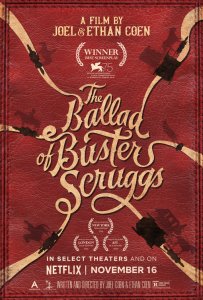 Netflix might just be the best pasture yet for brothers Joel and Ethan Coen. The Oscar-winning filmmakers were reportedly creating a Western series for the online streaming giant but that has turned into an anthology film, The Ballad of Buster Scruggs. The Coens’ love of the beautiful, the bizarre, the bucolic and the brazen are on full display with their six-part anthology movie that serves as reminder of what wonderfully unique cinematic voices they are. The Ballad of Buster Scruggs is uneven, as most anthology films tend to by design, but it reaches that vintage Coen sweet spot of absurdity and profundity.
The best segment is also the one that kicks things off, the titular adventures of Buster Scruggs, a singing Gene Autry-style cowboy who manages to get into all sorts of scrapes. The tonal balancing act on this one is pure Coen, at once inviting an audience to nostalgically recall the Westerns of old while kicking you in the teeth with dark, hilariously violent turns that veer into inspired slapstick. There is a delightful absurdity to the segment thanks to the cheerful sociopath nature of Buster Scruggs, the fastest gun in the West that’s eager to show off at a moment’s notice. He’s a typical Coen creation, a wicked wordsmith finding himself into heaps of trouble, but through his quick wits and sudden bursts of violence, he’s able to rouse an entire saloon full of witnesses to his murder into a swinging, carousing group following him in song. I laughed long and hard throughout much of this segment. I was hooked and wanted to see where it would go next and how depraved it might get. Tim Blake Nelson (O Bother Where Art Thou) is wonderful as Buster Scruggs and perfectly finds the exact wavelength needed for the Coen’s brand of funny and peculiar. He’s like a combo Daffy Duck and Bugs Bunny breaking the fourth wall to let the audience in on his merry bravado. The segment ends in a fitting fashion, another song that manages to be hilarious and strangely poignant at the same time. The Coens allow the scene to linger into a full-on duet of metaphysical proportions. I could have watched an entire series following Buster Scruggs but it may have been wise to cut things short and not to overstay its novelty.
 The other best segments take very different tonal destinations. “All Gold Canyon” is a slower and more leisurely segment, following Tom Waits as a prospector who systematically works the land in search of a hidden trove of gold he nicknames “Mr. Pocket.” The step-by-step process has a lyrical nature to it, and it reminded me of the opening of There Will Be Blood where we follow Daniel Plainview’s initial success at unearthing the beginning of his fortune. Waits is fantastic and truly deserving of Oscar consideration as the prospector. He’s hardscrabble and resilient, and there’s a late moment where he’s narrating a near escape from death where he’s tearfully thankful, possibly losing himself in the moment, and so grateful that it made me tear up myself. The segment ebbs and flows on the strength of the visual storytelling and Waits. It’s a lovely short with a few hidden punches, which is also another fine way to describe the other best segment, “The Gal Who Got Rattled.” It stars Zoe Kazan (The Big Sick) as a woman making her way to Oregon with a wagon train. She’s heading west for a new life, one she was not prepared for and only doing so at the urging of her pushy brother who dies shortly into the journey. Now she’s on her own and struggling to find her own place in the larger world. There’s a very sweet and hopeful romance between her and Billy Knapp (Bill Heck), one of the wagon train leaders who is thinking of settling down. It’s also a segment that slows down, accounting for the longest running time of the six. It goes to great care to establish the rhythms of life on the road, where many people walked the thousands of miles across the plains. The budding courtship is at a realistic simmer, something with more promise than heat. It’s such an involving story that its downturn of an ending almost feels criminal, albeit even if the tragic setups were well placed. Both of these segments take a break from the signature irony of the Coens and sincerely round out their characters and personal journeys and the dangers that await them.
 The remaining three segments aren’t bad by any stretch (I’d rate each from fine to mostly good) but they don’t get close to the entertainment and artistic majesty of the others. The second segment, “Near Algodones,” has some fun moments as James Franco is an inept bank robber who seems to go from bad situation to new bad situation, getting out through miraculous means until his luck runs out. The interaction with a kooky Stephen Root is a highlight but the segment feels more like a series of ideas than any sort of story. Even for an anthology movie, the segment feels too episodic for its own good. The third segment, “Meal Ticket,” is about a traveling sideshow in small dusty towns in the middle of winter. Liam Neeson plays the owner and the main act is a thespian (Henry Melling, best known as Dudley Dursely in the Harry Potter films) with no arms and no legs. The thespian character says nothing else but his prepared oratory. It makes him a bit harder to try and understand internally. I was also confused by their relationship. Are they father/son? Business partners? It’s also the most repetitious short, by nature, with the monologues and stops bleeding into one another, giving the impression of the thankless and hard life of a performer trying to eek out a living. It’s a bit too oblique. The final segment, “The Mortal Remains,” is like an Agatha Christie chamber play. We listen to five characters engage in a philosophical and contentious debate inside a speeding stagecoach that will not slow down. It’s an actors showcase with very specifically written characters, the Coens sharp ear for local color coming through. The conversation takes on a symbolism of passing over to judgment in the afterlife, or maybe it doesn’t and I’m trying to read more into things. You may start to tune out the incessant chatter as I did. It’s a perfunctory finish for the movie.
 Being a Coen brothers’ film, the technical merits are mesmerizing. The cinematography by Bruno Delbonnel (Amelie, Inside Llewyn Davis) is sumptuous and often stunning. The use of light and color is a gorgeous tapestry, and some of the visual arrangements could be copied into ready-made scenic postcards, in particular “Meal Ticket” and “All Gold Canyon.” The isolation, hostility, warmth, majesty of the setting is expertly communicated to the viewer. The production design and costuming are consummate as well. The musical score by longtime collaborator Carter Burwell is classic in its use of melancholy strings and motifs. It’s a glorious looking movie made with master craft care.
Before its release, the Coens had talked about how hard it was to make their kind of movies within the traditional studio system, even with their 30 years of hits and classics. Netflix is desperately hungry for prestige content, so it looks like a suitable match. I’d happily welcome more Coen brothers’ movies like The Ballad of Buster Scruggs, a goofy Western that’s equally heart wrenching as it is heart-warming, neither shying away from the cruelty and indifference of the harsh setting nor neglecting to take in its splendor. Just give them whatever money they need Netflix to keep these sort of movies a comin’.
Nate’s Grade: B+
Share this:

Fantastic Beasts: The Crimes of Grindelwald (2018)
 When they adjusted the Hobbit movies so there was going to be three instead of two, it required some very noticeable padding and filler material to meet out that requirement. The second Fantastic Beasts film (of a planned five film series, expanded from a trilogy) feels exactly that way, a mostly table-setting movie with more incidents than plot, a few pertinent revelations, and not much in the manner of resolution. The second Fantastic Beasts does improve on its predecessor in several regards. It introduces a formidable villain that’s well played by Johnny Depp. It introduces a compelling younger version of Albus Dumbledore that’s played by the dashing Jude Law. It also finds more purpose for its hero, the shy magical zookeeper Newt (Eddie Redmayne), as the series inches closer to a wizards-vs-wizards world war. Things take a turn for the darker; within the First Act, a baby is murdered. They didn’t even do that in the new Halloween. The larger world building of Beasts, written by author J.K. Rowling for the screen and directed by longtime stalwart David Yates, has been its biggest draw. The supporting characters are back, though not everyone has much to do. Rowling is improving as a screenwriter but she still has trouble executing exposition-heavy scenes, resorting to sequence after sequence of characters prattling on. Ultimately, it doesn’t feel like there’s much of consequence until the very end, so we endure characters running through underdeveloped and contrived storylines. One of these involves Katherine Waterston mistakenly believing Newt is engaged (his brother is) and somehow, despite having access to magic let alone other forms of media, never findings out the easy truth. It’s stuff like that that show me Rowling was struggling to find material for every character to push them forward on this now extended journey. Crimes of Gindelwald is an overall step in the right direction for the prequel series even if this individual movie has trouble standing on its own magical merits.
Nate’s Grade: B-
Share this:

Widows (2018)
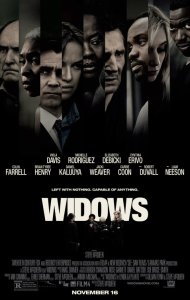 Widows has an all-star cast, an Oscar-nominated director, and a best-selling novelist-turned screenwriter, so my expectations might have been turned up a bit too high. It follows a team of titular widows (Viola Davis, Michelle Rodriguez, Elizabeth Dibecki) picking up the pieces in the wake of their husbands’ deaths. It seems their dearly departed spouses stole money from a local criminal who very much demands the sum returned. The women must enter into a criminal heist, using notes left behind by a dead hubby, to settle the debt and spare their lives. Widows is a higher caliber crime movie with notable texture given to a wide assortment of characters; even the villains are given small character touches to better flesh them out and feel more realized. There’s a concurrent election tying together different corrupt and criminal enterprises that widens the scope of the film into a grander scale. The characters and performances are the selling point of the movie and provide consistent entertainment. Davis (Fences) is the strong-willed linchpin of the group and I could watch her boss around people for hours. Dibecki (The Great Gatsby) has a nice turn as a trophy wife accustomed to being abused. The problem is that there might be too many characters. Rodriguez has far more significance in the first thirty minutes and then is put on ice. Likewise, Carrie Coon and Cynthia Erivo are hastily added when the plot requires something of them. That plot, adapted by Gillian Flynn (Gone Girl) and director Steve McQueen (12 Years a Slave), proves to be the film’s biggest hindrance by the end. The second half plot turns seem to come from a schlockier version of this story, not the classier version we had been treated to beforehand. There are character decisions that baffle credulity and personal safety. The quality of the characters deserved a movie that could refrain from the hacky genre twists. McQueen’s precise camerawork is still alive and well and highlights tension and also moments of social commentary, like when we watch a car travel mere blocks from a rundown inner city neighborhood to a fancy gated residence. There’s a lot to like with Widows, and plenty to get excited about, but I wanted to like even more.
Nate’s Grade: B
Share this:

Blue My Mind (2018)
 I cannot overstate how much I simply hate this movie’s title, Blue My Mind. It bothers me so much. I have an antipathy toward puns as humor in general, but to name your movie a pun is a startlingly bad decision. Who let this happen? Who let a horror movie, without any sense of humor, have a pun-laden title? Whoever did this should be fired, and if it’s writer/director Lisa Bruhlmann, then she should have her final grade revoked (the finished film served as her thesis work for her film school). Blue My Mind is another in the burgeoning sub-genre of pubescent transformative features. The Canadians struck rich gory glory with the Ginger Snaps series where young women turned into werewolves. This Swiss movie replaces the werewolf story with a mermaid, which brings to mind an unsettling re-creation of Splash as bizarre body horror. It’s too bad that Blue My Mind feels like the first draft of its freaky concept and proves ultimately unsatisfying.
Mia (Luna Wedler) is 15 years old, the new girl at a new school, and anxious to fit in with the cool kids, chiefly the mean queen Gianna (Zoe Pastelle Holthuizen). Mia is also undergoing some very radical changes. She’s craving salt water, eating the fish out of her parent’s fish tank, and noticing that her toes are starting to merge together with webbing. She’s confused and angry and desperate to hide her secret from her friends and family.
 In a movie built upon the concept of girl-turns-into-mermaid, you would think there would be a lot of creepy and fascinating body horror episodes. It would be the primary conflict and primary secret. For far too long with Blue My Mind, the mermaid transformation is kept as an afterthought to a docu-drama approach to rebellious adolescence more akin to a Thirteen than David Cronenberg. Horror has long been parlayed as a metaphor for the strange and confusing time of puberty, having one’s body morph and change against your will, feeling like an outsider, a freak. The coming-of-age model also works as a vehicle for some unconventional urges, as demonstrated as recently as last year in the visceral French horror film Raw, about a young woman finding her sense of self awaken with cannibalistic desires. Both Raw and Blue My Mind (the title still makes me hurt on the inside) function as sexual awakenings linked to monstrous appetites, both literal and figurative, that the women don’t know how to control or if they should even attempt to. The genre dabbing is what separates both movies from their ilk. This is what makes Blue My Mind all the more frustrating because the mermaid aspects are poorly integrated until the final 20 minutes, and even then it’s sadly too late. It’s like the filmmakers decided that their one unique element wasn’t so special after all.
The majority of this movie is Mia acting out to try and fit in with her new pals. They smoke, they skip school, they shoplift; they’re your classic bad influences that a typical bourgeois family would disapprove. Mia’s parents don’t understand why she’s acting out and what has happened to their little girl. There’s some tension over whether Mia is their biological child considering what she’s undergoing. This curiosity pushes Mia to investigate her family’s history but it too is left incomplete, another dangling interesting idea unattended. A solid hour of this movie is simply Mia sneaking behind her parents back, experimenting with her new friends, and testing her boundaries. It’s effective, though there are moments that hint at something more that’s never developed, like her sexual predilections that take on an extreme variety. There’s a scene where the girls trade choking each other out for an oxygen-deprived euphoric high. If I was being generous, I’d say it was connected to Mia learning to enjoy not breathing through her lungs and setting up a transformation for gills. But I’m not that generous. It comes across as a dangerous kink that tempts Mia but then is forgotten. Much of this hour hinges on the audience caring about the relationship forming between Mia and Gianna, and I couldn’t because I think the film was too indecisive on what Gianna represented. She’s not a terribly complex character but what does she mean to Mia? Is she a genuine friend, a figure of sexual desire, a cautionary tale, a rival? Blue My Mind seems to emphasize a sexual awakening for Mia and attaches Gianna as the recipient of those confused feelings. If these two were meant to serve as the key for audience empathy, we needed more scenes with them developing as characters rather than repeating rote rebellious teen hijinks.
 When Bruhlmann does focus on the mermaid transformation, the film is inherently fascinating and consequently aggravating, as you imagine what a better version of this premise could have afforded. There is some wonderful makeup prosthetics to reveal Mia’s skin peeling from her legs, leaving behind shiny black gamines that reminded me of Under the Skin. When the boys catch a glimpse of her hidden physical afflictions, they assume she has some STD and slut shame her. She takes scissors and personally slices the membranes fusing her toes together, and I had to cover my eyes it was so squirm inducing. The final transformation is a bit underwhelming until you remember that this was a student film that managed to get an international release. The technical specs are very professional, especially the sun-dappled cinematography by Gabriel Lobos. Bruhlmann captures the internal feelings of her characters very well in a visual medium, relying upon Wedler to do a lot of heavy lifting that the screenplay refuses to perform. You feel her revulsion with herself and yearning for connectivity, something universal for every teenager struggling to claim their sense of self in an indifferent world. Fortunately Wedler is an impressive young actress that might break your heart, if only her character was allowed to open up to the audience better. It’s a movie that toys with ideas, moods, and purpose.
Blue My Mind is a story about a young girl turning into a mermaid against her will and the movie decides that this is a secondary story element. The implementation of metaphor in horror is a common storytelling device to communicate the horrors of the everyday. Throw in the coming-of-age self-discovery angle, as well as a sexual awakening, and it’s tailor-made for some strange transformations that excite and terrify the protagonist. It’s just that Blue My Mind takes its metaphor a little too absentmindedly. By putting the mermaid body horror in the background rather than the driving force, the film mistakes our interest and pushes forward a group of characters not ready to handle that level of scrutiny. I feel like Blue My Mind wastes the potential of its premise and the acumen of its actors. This movie could have been better and instead it settles for the familiar even amidst the weird and fantastic. Blue My Mind isn’t as bad as its painful title but it certainly won’t blue you away.
Nate’s Grade: C+
Share this:

The Girl in the Spider’s Web (2018)
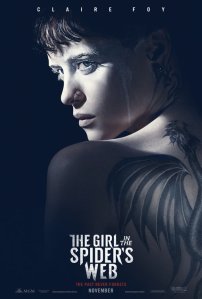
The Girl with the Dragon Tattoo was an international best-selling trilogy that gave way to three hit Swedish movies, one Hollywood remake that netted a Best Actress nomination, and millions in worldwide revenue. The problem was that its author, Stieg Larsson, died of a heart attack in 2004, before the publication of any of the original novels. The property was too valuable to simply collect dust and thus a new author came aboard to tell further adventures of Lisbeth Salander, the pint-sized Gothic avenger. A new set of novels began being published in 2015, and after David Fincher’s 2011 version underperformed at the box-office, it seemed expected to reboot the franchise with a new big screen story that had yet to be adapted. In steps a new director, a new dragon-tattooed lady for The Girl in the Spider’s Web. Unfortunately, my fears have come true and the eventual reckoning has happened: they have made Lisbeth Salander boring.
Lisbeth (Claire Foy) is thrown into another criminal conspiracy with shadowy forces at play. A network of high-powered assassins, known as “spiders,” has stolen a dangerous technology that will allow the user control of nuclear arsenals. Lisbeth is hired to retrieve this tech, betrayed, and then on the run from Swedish authorities, professional killers, a dogged NSA operative (Laketih Stanfield), and the head of this cabal, Camilla Salander (Sylvia Hoeks, Blade Runner 2049), her long lost sister Lisbeth left behind years ago.
In her first 2010 outing, Salander was presented as a complex, emotionally withdrawn figure, eminently capable but flawed, hurt, and looking to punish others from her fraught history with terrible men. Strip away all the Gothic trinkets and camouflage, her assertions of identity, and she’s still a deeply intriguing human being. However, even the latter Swedish films started veering in this more derivative direction. As I wrote presciently with the second Swedish Dragon Tattoo movie back in 2010: “We project the interest we felt for her from the first film to the Salander stand-in represented in the second film. She’s still a resourceful, loyal, and cavalier presence, but the plot corners her into being a creature of action. She becomes the fantasy bisexual ass-kicking protagonist that was merely hinted at previously. That sounds like a good thing, but trust me, it does the audience a disservice to box in such a fascinating character.” With Spider’s Web, Lisbeth Salander has become a Gothic Jason Bourne spy figure, and as anyone who has seen the Bourne movies can attest, he’s the most boring character in his own movies, which is why he needs to be kept constantly on the move and hunted. He’s only interesting when he’s getting out of jams, and Lisbeth is now sadly in that realm.
Lisbeth has been reduced to her most essential, and most superficial, characteristics, which also go for the film as a whole. The Dragon Tattoo series began as a twisty investigative procedural with a litany of suspects and dark secrets worth killing over. From there, the Swedish films turned Lisbeth into an indestructible Terminator capable of getting the drop on anyone and axe-fighting oversized men. The Swedish series began more grounded as a mystery/thriller and suddenly, and regrettably, transformed into a preposterous Hollywood-style action-thriller, following the edict of bigger being better. That same mentality has carried over past Larsson’s contributions, and now Lisbeth has become an action superhero and the series has become trashy fun, high-calorie junk food, a safe excursion to a seedy underbelly. The Girl in the Spider’s Web still provides a consistent degree of entertainment, but it’s not playing at a higher level, content to hand-wave away its story for cool chases and fights. It’s the kind of movie where, to escape an encroaching fireball, Lisbeth dives into a bathtub of water. It makes for a visually interesting shot but it’s pretty cliché 90s action movie stuff. Director Fede Alvarez has a slick handle with visuals and evidenced real talent at sustaining and developing tension with 2016’s Don’t Breathe. He has obvious visual talent. There are some engaging fights, like a close-quarter struggle in a bathroom, and some nifty chase scenes, like a motorcycle chase over a frozen lake. I would have liked even more action if Spider’s Web was going to brush aside narrative and moral complexity for stylish set pieces.

The story of The Girl in the Spider’s Web feels like a lukewarm repackaging of spy clichés, and the film does little to make any of it feel important or relevant. There’s a super powerful technology that everyone wants, which falls into the wrong hands, and now it’s about retrieving this device and saving the world. That’s like the plot of just about every James Bond movie. It’s a formula, but where Spider’s Web missteps are that it doesn’t add anything else to this staid foundation. There are scenes but it’s usually about this group going after this group, or this group now going after this group, and without wider relevance it becomes redundant plot placeholders, something meant to distract long enough to get our characters from Point A to Point B. With a mystery, there’s a natural momentum that builds as the case builds coherency and the investigation focuses the direction. With action thriller mode, Spider’s Web just has a bunch of guys that occasionally interact until the movie needs some of them dead. This model by itself can work but it requires concerted effort, and that just isn’t present here.
The most interesting aspect of Spider’s Web is the further examination on Salander’s troubled upbringing, this time introducing a sister that has been plotting vengeance. Salander is, first and foremost, the selling point of this franchise; she is, after all, the titular girl with that particular tattoo. She is what separates this from any other paperback thriller. The Swedish sequels opened up her past traumas with her Soviet-defected father. He was the Big Bad Man behind the scenes trying to institutionalize and neutralize her. While skirting into the above-stated dangerous territory, the Swedish sequels still knew that Lisbeth Salander’s complicated history was the real mystery the audience craved, and it set up a series of antagonists ready to be foiled for years-in-the-making payback. I don’t really know how the events of Spider’s Web gibe with the overall series. I had to look up whether the evil father in the opening was the same evil father in the other films (both are listed as Alexander Zalachenko, so I think so). But the established history has Lisbeth committed after trying to set dear old dad on fire to save her abused mother. I don’t see how any of that is likely if she escapes her father’s clutches as a pre-teen and is supposedly on the run. The secret Salander sister revelation also impacts little. She was the one left behind, whose continued abuse and degradation are strongly referenced. It doesn’t feel like Lisbeth harbors great guilt over leaving her sister behind. During their final face-to-face, Camilla actually poses a worthy question: “Why did the woman who hurts men who hurt women never come back and save her own abused sister?” Because this storyline is flagrantly underdeveloped, the evil sister angle is a cheap twist. There’s nothing to the Camilla character, so she serves as a symbol of shame, and yet the movie doesn’t seem to capitalize on this in the slightest, which is a puzzling disservice.

Foy (Netflix’s The Crown, First Man) is having a big year for herself but feels slightly miscast. She never really gets an opportunity to show off her range, which is a byproduct of the streamlined, reductionist screenplay emphasizing bare plot mechanics. She is missing the intensity or fire that we’ve seen in prior Salanders, breakout-star Noomi Rapace and the Oscar-nominated Rooney Mara. When Foy tries for glower you see the effort. She’s more grumpy than tortured, like maybe she skipped a meal. Even with the requisite piercings, tattoos, and black leather wardrobe, Foy seems a bit too clean-cut for the part. Personal admission: Foy with her sharp bangs, saucer-eyes, facial shape, and Gothic accessories, looks remarkably like an ex-girlfriend of mine from the early 2000s. That was something that kept sneaking into my mind throughout the film, which made the experience a tad stranger as if I was imagining an ex engaged in action heroics. Even excusing that personal connection, Foy ranks a distant third place for the Girls With.
The new Dragon Tattoo movie will likely also be its last. I can’t imagine fans getting too much pleasure out of a streamlined, underdeveloped spy thriller that sands away the edge and complexity of its characters for rote action movie chases. It’s not a bad movie and it does carry moments of excitement and entertainment, but it’s also become a standard Hollywood thriller, no different than a dozen other high-tech, junky hacker thrillers. The Girl in the Spider’s Web gets caught in its own formulaic web. If Lisbeth Salander has been transformed into a standard action hero, then we don’t deserve more adventures.
Nate’s Grade: C
Share this:

The Grinch (2018)
 The second go at a twenty-first century feature-length Grinch movie is a thoroughly, spectacularly bland movie. This mediocre enterprise barely stretches to feature length at 86 minutes and it lacks the charm of the original Dr. Seuss cartoon. Benedict Cumberbatch voices the green recluse with his three-sizes-too-small heart set on stealing the Christmas celebration of others. That’s great casting, but why is he settling for his Doctor Strange-style American voice? The man has such a natural, rich, velvety voice. Another miscue is the fact that this Grinch isn’t really feared by the people of Whoville. He lives just outside of ton and isn’t really that mean. He’s less a villain and more just a grumpy sad guy who has to over explain everything for the audience to understand (“I thought stealing Christmas would make me feel better, but really I was running from myself…”). This movie is brightly colored and nicely animated but it’s strictly just for little kids. The lessons are pretty simplistic. The characters are mostly annoying, precocious, or mute. The humor is mostly slapstick. There is nothing to engage bigger thinkers. This Grinch movie actually made me start re-evaluating the 2000 Ron Howard version, which at least tried something and had an enjoyably hammy Jim Carrey performance with some creepy good makeup prosthetics, and I didn’t even like that movie. The new animated Grinch film is inoffensively lackluster. At best it’s a disposable 90 minutes to distract easily distractible children and give mom and dad time for a nap.
Nate’s Grade: C
Share this:

Suspiria (2018)
 The idea of remaking Dario Argento’s horror classic Suspiria seems like movie heresy. How could any filmmaker attempt to come close to the Italian master’s original? Though that has not stopped Hollywood from remaking other horror classics of yore. Italian director Luca Guadagnino (Call Me By Your Name, A Bigger Splash) tempts the unwise with a new version of Suspiria, this time following the exploits of Susie (Dakota Johnson) in Cold War Germany as she is seduced by a private dance company lead by Madame Blanc (Tilda Swinton) that’s really a front for the occult. The new Suspiria is a worthy, splashy artistic endeavor but it suffers from too much airy meandering in the name of redundant atmosphere, vague and arbitrary plotting, and poor characters.
We’re told up front this is a story in six acts and a resolution but frankly the first two acts could have been completely eliminated. Their bearing on the overall story is minimal, but then I could say the same thing about much of the characters. Chloe Grace Moritz’s role could have been entirely cut. The majority of the story is strange things happening very slowly in the background of a dance school. The characters that do investigate aren’t our protagonists, which then traps us with people who know too much and won’t share, people who don’t know anything, and people who don’t want to know anything. It gets frustrating spending that much time with them, especially when the end destination (coven conspiracy sacrifice) is obvious even if you haven’t watched the 1977 original. I was told that Guadagnino edited an hour out of the final movie. How? What in the world was left out? It feels like everything they could have shot found its way into the finished film, whether it needed to be there or not. There’s an ongoing subplot about the Red Army Faction (a.k.a. Baader-Meinhof Gang) that we keep returning to as if there’s supposed to be larger relevancy. It’s a left-wing conspiracy that translated post-war anger into violence against the government. If I work really hard I can make a larger thematic connection to witches and women, but I won’t. With Suspiria 2018, it’s really just historical atmosphere that adds little but yet is returned to again and again. There is even a post-credit scene of a character doing something unclear while looking toward the camera. Why include any of that? It’s arbitrary and superfluous to the very end.
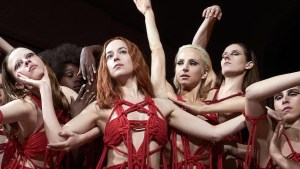 The new Suspiria toggles through three tepid lead characters: 1) Johnson’s new dance recruit, 2) Swinton’s artistic director at the school, and 3) Swinton in old-age makeup as a grieving psychiatrist trying to make sense of his life (yes, “his,” as she plays a man). Two of these characters matter in strict plot terms and only one of them are granted some degree of characterization. Susie is essentially an empty vessel who is extremely passive, going along with whatever she’s told (there is a reason for this but it falls under the category of contrived dues ex machina). There are hints of the connection she has to some occult force at play, but we don’t really see any transformation on her part because she’s so opaque to start with. Madame Blanc is the most interesting character, somewhat by default, but she only becomes that in the last third of the film when her personal feelings for Susie make her doubt how far she’s willing to go to achieve the coven’s goal. It’s the only character with a direct internal conflict that seems to matter to the story. The old man has no reason to be in this movie. By the end, it feels like the film has found a significant story reason for his inclusion, one that will actually produce some thematic relevance for Swinton also playing this role, but nope. He serves no purpose other than exposition and to hammer home a tangential historical context of generational guilt. There is a nice character moment between two characters in the resolution but by then it’s too little too late. Even this nice moment doesn’t really need to happen. I think the reason the film toggles between these three characters is even it knows you will get bored with them.
When the horror hits, that’s when Suspiria is at its most rattling. Watching a woman’s body betray her, one excruciating limb convulsion after another, culminating in her own jaw seeming to rotate out of her head, is wince-inducing and terrifying. The sudden jolts of violence made me gasp and squirm every time. This culminates in a third act that is heavy on blood and lunacy, so much so that it feels like the finale to another movie. If the proceeding two hours was understated, atmospheric horror, the last thirty minutes feels like the splatterific Sam Raimi Evil Dead 2. There’s an explicit campiness that feels at odds with the self-serious meanderings of earlier. There are also moments that cannot be described as any other word than “goofy.” There’s an ongoing shot of characters being dispatched in a very exaggerated and theatrical manner, and the fact that we watch thirty of these in a row just invites some degree of laughter. I know I laughed. The final act and confrontation is my favorite part of the film, delivering some long-sought vengeance, but it feels like a different movie. It’s also where Guadagnino’s “put the camera anywhere” stylistic approach betrays him. It’s hard to tell what exactly is happening on a literal level, let alone understanding it, and that’s not even taking into account the muffled sound design of several characters when they hoarsely whisper aloud whatever.
 I would be more forgiving if the new Suspiria had not been as exasperatingly long, a full hour longer than the 1977 original. Long movies only feel long when they haven’t fully engaged you, and there are generally only so many ways to keep an audience’s sustained attention and investment. I understand wanting to allow a movie to breathe or wanting to create an uncertain atmosphere of intoxicating dread, but there has to be more than that. There’s also what I’ll affectionately coin the Nicolas Refn Trap, meaning where all of that breathing space ultimately exposes a lot of empty indulgences and vamping. Suspiria 2018 falls into this trap too often; there simply isn’t enough of anything to spread over those 150 minutes. The odd comparison I would make is to the notorious 1980 Western disaster, Heaven’s Gate, a movie I watched for the first time two years ago and actually appreciated. Let me be more specific: I appreciated the 100-minute very good movie somewhere inside there suffocated by the artistic excesses and peculiar and mercurial artistic demands from its uncompromising director (the man refused to shoot anything for ten hours until he got a cloud positioned exactly where he wanted). I’m convinced there’s a potentially great movie in Suspiria but it’s going to require a lot of excavation to allow it to see the outside.
I was interested in re-watching Argento’s 1977 original for the first time in years, and some things have aged better and some things have aged worse. Argento is a first-class visual stylist and his famous use of color makes the cinematography often beautifully horrific as young women are terrorized. There is even less plot than I remembered, a series of surreal murders finally leading to the obvious reveal of the dance company being a coven of witches. The characterization is even thinner than the thin 2018 film, which means that Guadagnino and company had a lot of room to roam when it came to their grandly grotesque remake. Argento’s film is a remarkable example of the immersive power of the screen, with his gorgeous use of light and color, production design, and a pulsating score that is perhaps a bit too omnipresent and anxious. There is one reoccurring musical sting that sounded precisely like the beginning of “Footloose” and it made me laugh every time, imagining Kevin Bacon dancing through the hallways. It’s a testament to the transcendent power of style when done by a first-rate stylist, and it works so far as to create a nightmarish, oppressive atmosphere. However, that eerie atmosphere and technical craft are about all the original Suspiria has to offer since there is a gnawing scarcity when it comes to characters, structure, and story. That makes the 2018 Suspiria a little more confounding. While it clearly works as an homage to Argento it’s also radically different, and yet it still manages to also have underwritten characters and bad storytelling choices even when it could have ditched the original’s original sins. At least Argento’s version is only 90 minutes and a lot easier to watch in one sitting.
 The Suspiria remake was clearly a labor of love and not a soulless paycheck for all those involved. The technical craft is accomplished, and even though it lacks the vibrant colors of Argento’s original the cinematography is still highly evocative and unsettling. Guadagnino has put a concerted effort into making his movie operatic, lavish, and radically different from the source material. I think it’s different yet reverent enough that fans of the original will find something to enjoy as the film asserts its own identity. And yet the moody atmosphere is undercut by the shortcomings of the characters and the contrived nature of the overly padded and meandering plot. The more I think back on the movie the more it falls apart under further scrutiny. Suspiria is a tonally confused movie that doesn’t have enough substantial material to fill out its gargantuan 150-minute running time. There will be blood but what there needed to be was a more judicious editor.
Nate’s Grade: C
Share this:

Bohemian Rhapsody (2018)
 Biopics are trickier than they appear because how best can you distill the essence, and significance, of a person into two hours? We’ve edged away from the standard cradle-to-grave biopics more in favor of stories that hinge on monumental moments in a person’s life, meant to encapsulate their life both in micro and macro. Bohemian Rhapsody favors the former approach, which causes the movie to feel like it’s rushing through the cornerstones of Queen singer Freddie Mercury’s life. Even at over two hours, the movie feels like it has little time for things, often jumping into polished, well-edited montages of time progression. The creative birth of many of the band’s hits are treated as absurdly easy formations, going from a clap of hands and stomp of feet to “We Will Rock you,” or a bass line to “Another One Bites the Dust.” It’s like the movie is checking boxes for a biopic with an anxious eye toward the clock. Mercury’s homosexuality (he comes out as bisexual to his long-time girlfriend who corrects him and calls him gay) is given its due, not having been underplayed in an effort to court a more mainstream audience. Mercury’s sense of sexuality, and the struggle of his own acceptance, is essential to getting to know this flamboyant front man. Except several of these scenes feel mishandled, which is odd considering director Bryan Singer (X-Men) has often found parallels in big studio films for the gay experience. The movie seems to say if his band mates had only accepted him more then maybe he wouldn’t have fallen into promiscuity by a bad influence and thus contracted HIV. There are also some pat answers as well like a disapproving father. However, the faults of Bohemian Rhapsody are compensated by its virtues, none more so than the electric performance by Rami Malek (TV’s Mr. Robot) as Mercury. The actor struts and preens with infectious charisma, and a mouth full of Mercury’s oversized choppers, and he miraculously captures the powerful stage magic of his character. The concluding 1985 Live Aid performance is astounding to witness and a reflection of just how essential and virtuosic Mercury and company were as live performers. It’s a sustained set of several hits and the movie just sings to a close on the highest of high notes. Bohemian Rhapsody is carried by the music and performance of Mercury the character and Malek the actor. It will make you want to rock out to Queen on the car ride home.
Nate’s Grade: B-
Share this:

Mid90s (2018)
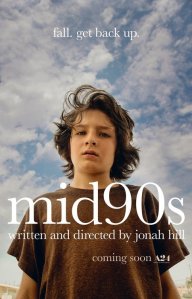 Jonah Hill’s directing debut is a small slice of 90s cinema that’s heavy on sense of time and place, light on plot, but filled with youthful authenticity. We follow a young kid (10? 12?) as he ingratiates himself with a group of older teen skaters. He wants to emulate these cool kids and dedicates himself to being a skateboarder. There are some intra-group conflicts and jealousies that play out as our protagonist becomes part of the gang. He gets exposed to smoking, drinking, and girls at house parties. There is one sequence at a party where a teen girl (15? 16?) takes our young hero into a bedroom to deflower him, and I instantly became anxious and needed to know the ages of the characters onscreen (it’s never verified). Our main character also happens to be one of the more boring people in the film, almost by design. He’s a blank page for the audience to project onto, and he’s trying so hard at such a formative age to emulate the older teens that it makes sense to leave him less defined. Hill hired professional skateboarders and taught them acting, and they act like professional skateboarders. In fairness, they act like recognizable teenagers, and Hill’s natural ear for dialogue rings true for this time of life. The movie takes a few turns into After School Special territory but doesn’t seem to deal with the consequences or resolutions of those dramatic events, which makes the film feel both more realistic and less fulfilling. Our hero takes a lot of injuries, some of them bleeding-head related, but nothing seems to come from them except the growing admiration of his peers. The home life storyline is worrisome and vague. Our protagonist has a physically abusive older brother (Lucas Hedges) who resents him and a single mother (Katherine Waterston) who seems irresponsible in not doing something about her youngest son being gone well into the morning hours. Even our protagonist seems to have penchant for self-harm, something that will presumably lead to problems down the line. In the meantime, mid90s is a pleasant and mostly entertaining, seemingly autobiographical experience. It gets by on enough for a watch.
Nate’s Grade: B


 nathanzoebl
You must be logged in to post a comment.