Category Archives: 2015 Movies
Cinderella (2015)
 What is it about old stories that we enjoy so much? I pose this question after watching a commercial for the TV movie, Killing Jesus, based upon Bill O’Reilly’s best-selling novel. While it’s based upon a popular book, what can possibly be told with this newest rendition of the death of Jesus that hasn’t been shown a thousand times in other movies? There was even a movie that was released in theaters last year, Son of God, which covered the same territory with equal reverence. There’s something to be said for good stories and the universal appeal of the familiar, but why do people constantly pay more money for new renditions of the same old same old? That question leads me to Disney’s live-action Cinderella, a fairly faithful and warm-hearted rendition of the oft-told tale. I can’t exactly muster many reasons for an audience to dust off their best glass slippers and run out to the theater, but if you’re looking for the comforts of old and some family-friendly entertainment, then Cinderella will charm with its modest and achievable goals.
Cinderella (Lily James) is the titular put-upon heroine suffering under the cruelty of her two stepsisters and her new Stepmother (Cate Blanchett). Cinderella thinks back to the advice her mother gave her at a young age, to always be “kind and courageous.” One day she rides off into the countryside and comes upon a handsome man who just happens to be the Prince (Richard Madden). He’s smitten with their exchange and convinces his father to open the royal ball to all members of their kingdom, in order to see his special someone once more. His adviser (Stellan Skarsgard) is against such matters because he wants the Prince to marry for a political alliance, not for love. Cinderella is forbidden from attending the ball by her Stepmother, but luckily she has a Fairy Godmother (Helena Bonham Carter) who, with a pinch of magic, will make sure Cinderella attends in style and steals the Prince’s heart. None of this should be rather new to you, dear reader.
 The first aspect of Cinderella I enjoyed was how it attempts to ground the story without losing a sense of magic to the proceedings. It’s still a fantasy film under director Kenneth Branagh (Thor), but there’s a concerted effort to place these characters in a world that resembles more of our own than the animated landscape from Disney’s original 1950 classic. Thankfully, half the movie isn’t spent with anthropomorphic mice wearing clothes and escaping the clutches of a house cat. There are a handful of helpful mice but at least they don’t talk and are mostly kept as cute accessories rather than co-stars. The reality of Cinderella’s hardships, especially after the death of her parents, is given an appropriate degree of solemnity. I also appreciated that the Prince is given an entire character to portray, one where his pursuit of a bride is placed in a political context about the security of his kingdom. He’s pressured to marry several available ladies for various political reasons, but he’s smitten with the girl he saw in the woods one fine day. The movie also succeeds in advancing a stronger, more developed relationship between Cinderella and her Prince. Instead of love-at-first-sight, they interact before the ball, and there is terrific chemistry between James and Madden (HBO’s Game of Thrones). There’s also a rather nice subplot between the Prince and his father (Derek Jacobi) that opens up their relationship. It’s a subplot that could have just as likely never existed and yet there’s something touching about the love shown between father and son. These moments, and the care to develop them, allow the characters to feel like flesh-and-blood people and to charm us all over again.
Another tilt toward greater narrative realism occurs with the villains, played by Blanchett (Blue Jasmine) and Skarsgard (Thor 2). While she’s still an arch villain, the treacherous Stepmother, who has no actual name, is given a generous treatment by Blanchett and especially writer Chris Weitz (The Golden Compass). The movie actually attempts to articulate her position, one where a woman of her age is left with few options to secure her family’s stability after the death of a husband. She clearly knows how society sees her waning value and Blanchett does a good job of casting that bitterness in way that you’re still reminded why she’s so furious and devious. I was so pleased I wanted more. I wanted the Stepmother to break down and admit that Cinderella is proof that her father will never love the Stepmother the same as Cinderella’s mother; she’ll always be second place to a ghost, and Cinderella is a constant reminder of this. Blanchett is also deliciously dishy as the wicked stepmother every moment she’s onscreen. Skarsgard can’t compete with the main attraction, but he provides an interesting secondary antagonist as he schemes behind the scenes to ensure the Prince marries a specific maiden with a reliable family name. He’s seemingly devoted to strengthening his kingdom, and he can’t let something as important as a marriage securing an alliance to fall aside because the Prince happens to be in love with a commoner. The extra dose of political intrigue is further attempt to ground and humanize the fairy tale, and it mostly succeeds.
 That’s not to say that the movie is without its fantasy pleasures. It is still a Disney movie about a famous Disney princess, and as such it maintains a bouncy, exuberant tone that keeps the heavier moments of drama from getting too heavy. Carter (Les Miserables) works wonders as the Fairy Godmother; she’s only in the movie for a solid ten minutes but she makes every second count. She has a silly nature that provides a welcomed jolt of scatterbrained comedy. Carter is clearly having a ball of her own with the role. The magical coachmen and assorted helpers supply extra cuteness. I also appreciated the quick fix of just creating a spell so that Cinderella’s step-family doesn’t recognize her at the ball. However, I never understood why all the artifacts of magic disappear at midnight but the shoes are left behind. Are they not magic too? Maybe only one of them happens to be magic and that was the one left behind. As presented, the shoe fitting is merely a ceremony rather than the missing clue toward finding the absent Cinderella.
So with all that said, does the new live-action Cinderella justify retelling what is one of the most retold stories in cinema history? I’d conclude a mild affirmative. It’s a charming adaptation that develops its characters with greater attention to detail, providing flights of fancy but also further humanizing the good guys and the bad. It’s no a deconstruction of the fairy tale, nor is it a revision, but it’s a faithful attempt to take what works but ground it in a slightly more realistic context, and it works. It’s at turns magical and touching and fun and buoyant and heartwarming. The casting all around is excellent, with every role impeccably chosen. Blanchett and Carter are great fun, and James and Madden have a winning chemistry. The technical merits are up to the same challenge, as the costumes and set design are gorgeous. Of course the aims of a new Cinderella movie are modest. Even if it benefits from a reworked attention to detail, we’re not reinventing the wheel here. It’s still the same story with the same major plot beats and the same ending we’ll all expect from the moment the Disney logo appears onscreen. The greatest achievement of Branagh’s Cinderella is that it makes you ignore these impulses. You find yourself once again returning to a familiar world and enjoying it all again.
Nate’s Grade: B
Share this:

Insurgent (2015)
 A return to the world of Divergent yields little forward momentum, in fact just enough to end on the point that I thought where a sequel would naturally begin. Turns out we needed a whole other movie, Insurgent, to arrive at this obvious narrative next step. Insurgent picks up with Tris (Shailene Woodley) and company on the run following the coup of two of the five social factions. Tris is a Divergent, able to apply herself to multiple factions, and she and her kind are the only ones who can open a secret box left behind by the founders of this post-apocalyptic civilization. The film does enough to hold your attention and we get to visit the other two factions we missed the first time, providing further shape to what is still a confusing world. I think the Divergent series will always fall short of the YA pacesetter, The Hunger Games, but they offer their escapist moments of entertainment. The second film is a bigger, louder, and more heavily coated CGI affair, especially the magic box’s mental trials that amount to a repeat of the first movie’s psychological trials of fear. Woodley is the strong center of the film and she processes her own PTSD over being forced to kill friends in order to survive; you do start to sense that Woodley is growing restless with the franchise. The third book is, as required by the mandate of milking YA franchises, being split into two movies, and while it served little to the Hunger Games, I hope better for the Divergent series, a group of movies inferior and somewhat mystifying but still interesting enough. For now.
Nate’s Grade: C+
Share this:

Furious 7 (2015)
 The Fast and the Furious series has never been more popular, which is crazy to think about for a franchise entering is sixth sequel. Then in November 2013, it suffered its biggest shock. Actor Paul Walker was killed in an automobile accident. The already-filming seventh film was put on hold, pushed back a year for release, and retooled to accommodate the new tragic reality that one of the core members of a popular series going back to 2001 was no longer walking this Earth. With this context, it’s hard not to apply an added level of gravitas and dramatic weight to a series that previously skirted by on its fun and outrageous stunts. It’s weird to watch an actor’s final filmed moments, knowing this is the last time you’ll see that face, hear that voice, on screen again. I’m already dreading that painful realization in November that, with Mockingjay Part 2, this will be the last cinema will see of Phillip Seymour Hoffman. With tragedy hanging over it, Furious 7 does an admirable job of sticking to what it does best while serving as a fitting tribute and sendoff for Walker.
Coming on the heels of the events of Furious 6, Dom (Vin Diesel) and his crew have dispatched Owen Shaw (Luke Evans, collecting a paycheck for one scene lying in bed). Shaw has an older brother, Deckard (Jason Statham), who swears vengeance and comes hunting after Dom’s team, killing Han in Toyko (events previously seen in 2006’s Tokyo Drift). Then Shaw hobbles Agent Hobbes (The Rock), leaving him sidelined for much of the movie. Dom and Brian (Walker) place their families in safety and then set off to eliminate Deckard Shaw. Little did they know that the government has a similar interest. Mr. Nobody (Kurt Russell) promises to help Dom in his quest if Dom agrees to a secret mission to rescue a computer hacker (Game of Thrones’ Nathalie Emmanuel). This hacker, codenamed “Ramses” has developed a device that taps into every camera and microphone on the planet to track anyone anywhere. If Dom can secure the device, Mr. Nobody will use it to track and take down Deckard Shaw.
 What elevated the Fast and Furious films into new heights of critical and commercial acclaim are the over-the-top action set pieces that don’t just defy the laws of physics, they obliterate them. There’s a fine line between stupid action and stupidly awesome action, and I think Michael Bay is still trying to finesse this understanding. Under the guidance of director Justin Lin, the franchise got bigger and ballsier and enjoyably insane. The action set pieces were huge and wild and well developed with organic complications and world-class stunt driving. The set pieces of the last few films have been stunners, and at its height, the franchise can make you feel giddy like a child watching the unreal unfold with such delight. There’s a tremendous and infectious high watching a well-executed action scene on such a large scale. With every movie our expectations are hungrier, and the franchise has found a way to satiate our action movie demands (for my money, Fast Five is the best). Furious 7 is the first Fast film not directed by Lin in ten years. James Wan, best known as the director of horror films Saw and The Conjuring, stepped into the director’s chair and he assimilates well into the “house style” of the franchise. However, I found myself missing Lin’s touches; he has a natural feel for choreographing action sequences with style and a clear eye for orientation. I found the editing for Furious 7 too choppy and several action sequences hampered by not getting a better sense of the wider surroundings and what was happening. Wan acquits himself well and keeps things running smoothly, though Furious 7 is a slight step down but still plenty entertaining.
Let’s talk about those giddy highs of Furious 7, because they are certainly there, though I wish there was more of them. Am I just getting greedy or building a tolerance? There are two standout moments that made me squeal. The first involved a set piece involving cars parachuting out of a transport plane. The next was a car crashing through the window of an Abu Dhabi skyscraper into another skyscraper and then into another skyscraper. Your brain tells you that there are no way any of these moments could truly happen in reality, and that in these circumstances it’s majority CGI, but if you’re like me, you just do not care because the sheer scale of awesome is too enjoyable to pass up. When you can pull off large-scale and imaginative action that manages to also maintain a strong sense of fun, then you’ve landed upon something special. The previous Fast films have been able to maintain that giddy high for a more sustained period of time, but I cannot deny that the same thrills and over-the-top pleasure is present with Furious 7.
A factor that added to my enjoyment is that Furious 7 never dawdles or dwells too often during its 137-minute running time, save for an extended resolution for Walker. This has never really been a franchise that has soared on the strength of its characterization. Seven movies in, I still don’t really care for any of the characters except for The Rock and that’s mostly because he’s The Rock. I was happy that the film was always active to distract me from how one-dimensional and boring most of these characters are, even the villains. Statham (The Expendables) is the best villain the franchise has had so far but even he seems to be stuck in a lesser gear, failing to capitalize on all his abilities with a car chase franchise. The Rock vs. Statham fight shatters all breakable furniture within near proximity, but you still suspect it should be better given the participants. Djimon Hounsou (Guardians of the Galaxy) is wasted as a number two villain who mostly just shouts orders for people to fire weapons, and martial arts superstar Tony Jaa is definitely wasted as a number three villain, an elevated henchman with too few opportunities to bust a move. MMA fighter Ronda Rousey appears briefly as an Abu Dhabi security chief. She performs well, pummeling Michelle Rodriguez while in evening wear; however, you quickly realize that Rousey is not an actor. She’s no Gina Carano (Fast and Furious 6), and speaking of, when is this woman going to finally be cast as a super hero? She’s practically a living Wonder Woman anyway and she has that “it” factor.
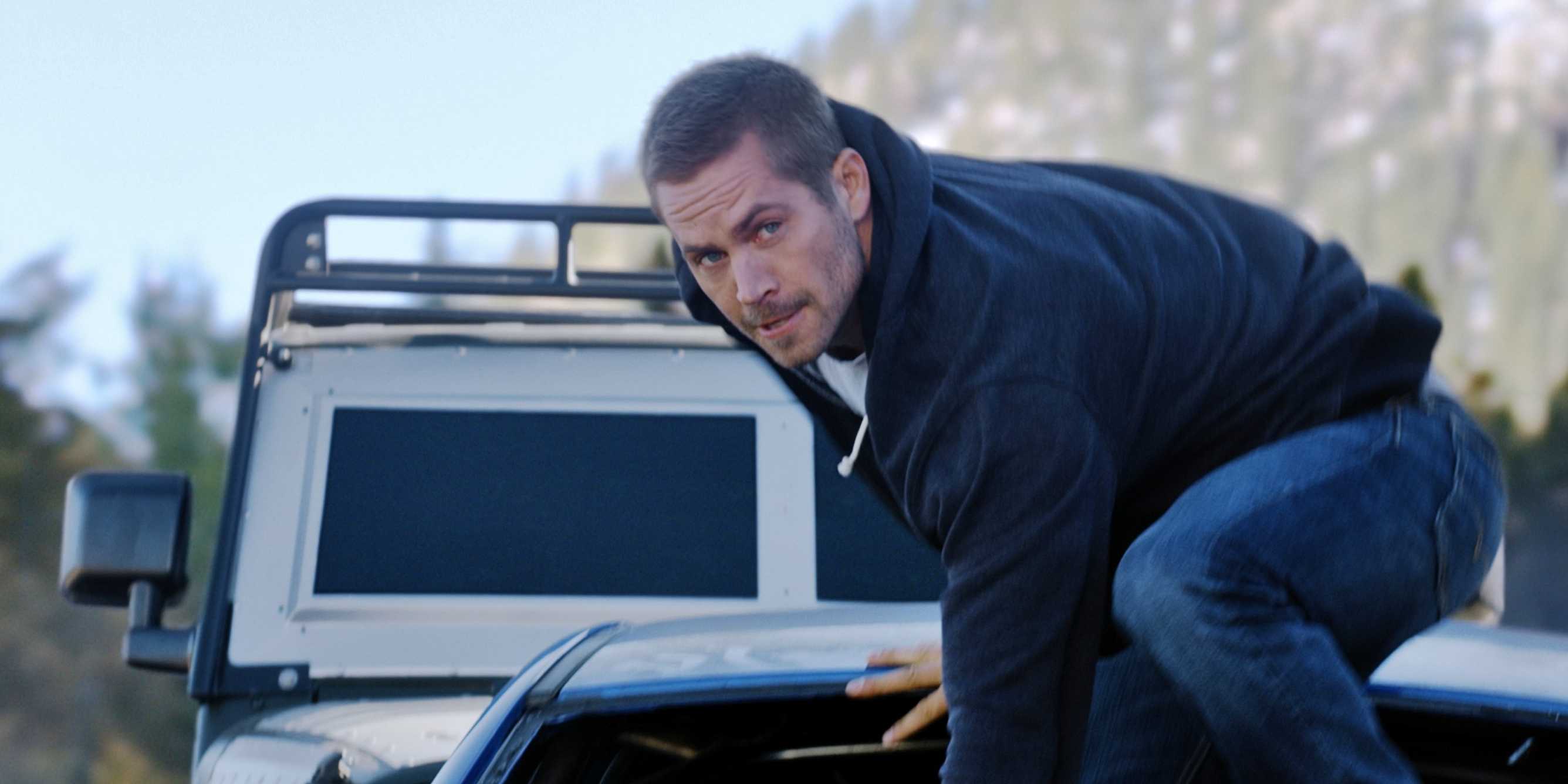 When the movie tries to be dramatic, it starts to stall, which is probably why it relies mostly on platitudes about family (“I don’t got friends, I got family,” Dom says in a weird retort). Jordanna Brewster is once again written to the side as the Concerned Wife, and the movie still doesn’t seem to know what to do with the re-emergence of Rodriguez’s Letty character. She got her memory back in the previous film, but now she’s having trouble readjusting, but before this can develop into an actual plot she disappears again and then the big action just kicks in. There’s enough of a team built up to provide diversity, with Ludacris and Tyrese Gibson serving as comic backup. There’s a sense of camaraderie that doesn’t feel artificial, and the small moments together are perfectly nice, but thankfully the movie has the good sense to know what the audience is paying to see. It’s here for the fast car, eye-popping stunts, and gratuitously framed camera angles highlighting women’s derrieres (there are a lot of thongs in this movie).
With the specter of Walker’s passing, the movie also presents a ghoulish game of looking for the tricks to work around his untimely absence. Reportedly the actor had filmed “most” of the movie and the remaining scenes, retooled after months of production being on hiatus, were completed by Walker’s brothers and some CGI sleight-of-hand. Perhaps I just have a more trained eye for spotting the cinematic wizardry, but by my judgment it sure didn’t feel like Walker was present for most of what was eventually used in the movie. I noticed a lot of wider shots and scenes where Walker is not facing the camera to speak or he’s at an odd angle. At no point did the movie become a strange uncanny valley experience of discomfort; movie productions have digitally attached faces before to other heads, notably for Oliver Reed in 2000’s Gladiator. If you’re not looking for it intently then it will all pass seamlessly. The film’s final ten minutes end up becoming an extended sendoff for the character of Brian, but really it’s the actors saying goodbye to their friend. It’s reverent and respectful and might be the most honestly emotional moment in the series history, which I know isn’t saying exactly much.
I mentioned Phillip Seymour Hoffman in my opening paragraph, and I don’t think anyone is going to confuse Walker for Hoffman in terms of acting talent, but that doesn’t negate or mitigate loss and grief. Personal confession: when I was writing for my college newspaper, I interviewed Walker over the phone for 2003’s Timeline, which if you haven’t seen it, and I’m assuming that’s the majority of readers, is a terrible movie. I’m not going to pretend I had any terrific insight into the man, but I found him to be a good guy with a level head who hadn’t let fame get the better of him. One could argue that the character of Brian was not significant enough in the context of a big, dumb action franchise to deserve this sort of emotional catharsis, but loss is felt, and Furious 7 has two missions: to entertain and to memorialize Walker. While the action as a whole is not up to the same caliber, it’s still plenty engaging and has enough of its characteristically dizzy thrills to be memorable and worth seeing on a large screen. On the second count, it lets Walker race off into the sunset in a way that feels appropriate, sincere, and without tipping over into complete melodrama. In that regard, this is the Fast and Furious movie that had the most to accomplish and it succeeds. It’s a near certainty that there will be a Fast and Furious 8, or a Furious 8, or a Fast 8, or whatever you call it, but for now it’s a chance to take a breath and add a dose of reflection for a series normally about the ridiculous.
Nate’s Grade: B
Share this:

Run All Night (2015)
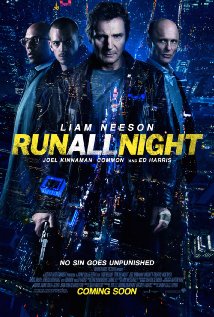 Nobody quite expected the second act that Liam Neeson is currently having. Before 2009, he was seen a dramatic leading man best known for portraying the titular businessman in Schindler’s List. And then Taken came out, and the world decided they liked their action stars with a dash of actorly gravitas, the kind of which was all too lacking from the likes of your Van Dammes. After so many films of Neeson pointing guns and barking at people, you forget that the man can act. That’s because, with few exceptions, the Neeson canon of action vehicles have been found enjoyable but insubstantial, momentary pleasures to be forgotten. The same can be said of Run All Night, a promising urban jungle thriller that’s a step above in several areas but ultimately another mildly entertaining film where Neeson points guns and barks at people.
Jimmy (Neeson) is a man haunted by his memories of his life as a hired gun for his pal, mob boss Shawn Maguire (Ed Harris). Jimmy is a drunk who is living off of Shawn, holed up in a crummy home, and eking out his lonely days. He walked out on his son, Mike (Joel Kinnaman), when he was young because he wanted him to have a better life. Jimmy thought his misdeeds would create a bad influence. Shawn is also experiencing his own problems with fatherhood. His son, Danny (Boyd Holbrook) is ambitious, dangerous, and addicted to drugs. He agrees to a business arrangement with Armenian mobsters before dad gives him the A-okay; when dad balks, Danny is on the hook. He murders the two Armenian mobsters who are looking for their money back. Unfortunately, Mike just happened to witness this execution. Jimmy defends his son, shooting and killing Danny. For the rest of a very fraught night, Jimmy tries to protect his son from the many forces of violence that Shawn has sent for vengeance. 
The premise of Run All Night is strong unless you say it out loud and examine it. I admire the film’s manner of weaving together storylines in a way that they feel like they’re crashing into one another and yet you could see their trajectory coming. That’s not to mean it’s predictable, which it is of course, but that the conflicts are properly established and set in motion. However, when you analyze the revenge-laden intricacies, it can seem like self-parody: “You murdered my son before he could murder your son. So I’m going to murder you.” “Oh yeah? Well I’m gonna murder you before you murder me for murdering your son before he murdered my son.” Gentlemen, commence your murdering. It reminded me of 2002’s Road to Perdition where a crime lord who readily admitted that his son was a dangerous hotheaded screw-up and had made a mess of things… and yet, he had to stick by him because… family. It’s a frustrating contradiction but it’s believable enough to hold onto. I just wish these crime guys could objectively calculate how guilty and irresponsible their kids are and cut them loose. Seriously, what exactly was Danny thinking when he killed the Armenian mobsters? Did he not think they were going to retaliate? Danny is the kind of irritating screw-up you want to strangle because he endangers others with his constant failures.
Screenwriter Brad Ingelsby (Out of the Furnace) has done his genre homework, and Run All Night is a slightly above average thriller that finds ways to flesh out its tropes amidst the urban jungle. After a steady first act, the majority of the movie is a series of chase scenes, several of which are shot and edited well by Neeson’s favorite director of his run and gun pictures, Juame Collet-Sera (Non-Stop, Unknown). The chase scenes make smart use of geography and the way Collet-Sera cuts back and forth with his parallel lines of action does a nice job of quickening pulses. A chase through a train terminal is well choreographed with Jimmy having to out run and out muscle goons and Mike ducking from encroaching police presence on the platform. Ingelsby has a knack for setting up organic suspense pieces and letting them loose. The final act feels a little pat from an action standpoint as well as a moral climax, but it does work. While the characters are birthed from familiar genre archetypes, the film adds interesting shadings to them. Jimmy’s loyalties are tested and he has a strong personal revelation that ties into this theme. The movies finest moment is likely a tense sit-down between Shawn and Jimmy shortly after the events of the night has been set in motion. It’s like Harris and Neeson are competing to see who can be more intimidating Oscar-nominated actor. Bonus: Bruce McGill (Lincoln) plays Harris’ number two and I love some Bruce McGill.
 And yet, I kept wishing for Run All Night to go back to the power of its possibilities. There’s a segment where the movie truly feels like it’s being taken to the next level, namely after the crooked cops have been taken out. Instead of just Maguire’s muscle coming after them, now Jimmy and Mike have the NYPD hot on their tail and none too happy about cop killers. That’s another category of antagonists, another chase participant. I also wanted the movie to keep going, bringing in the Armenian mob, which would be incensed and seeking vengeance after their ambassadors were killed. This movie could have had three categories of antagonists (Shawn’s goons, NYPD, Armenian mob) chasing after Jimmy and his son, and the ongoing conflict would have been terrific. The more people that are on the hunt, for their varied reasons, the more possibilities there are for strong and escalating suspense pieces. It could have easily gotten too complicated and convoluted for a mass audience, which is probably why the movie doesn’t reach its true suspenseful potential and follows a conventional route. The NYPD angle is only really incorporated during a building-wide search of an apartment complex where Jimmy and son are hiding. Likewise, the addition of a contract killer played by now Oscar-winner Common (Selma) is a wasted antagonist that doesn’t add much more to the group of bad guys. He’s better at killing, sure, but he doesn’t offer anything new except some hardware. He’s essentially an elevated heavy. He’s meant to serve as the threat after the threat, and no surprise, he does. I wish the character had more personality because he’s just too rote to separate himself. He’s just another ho hum killer in the mix.
There’s a plot point that annoys me to the point that I need to talk about it in more detail, though to do so requires some spoilers, so tread carefully, reader. At one point, Jimmy insists his son does not pull the trigger and kill Common. His wish is that his son would turn out better, and so he doesn’t want him to be forced to commit murder. They leave the contract killer who, you guessed it, continues to try and hunt them down and kills innocent people in the way. I understand the moral imperative Jimmy is going for, but let’s analyze this. It’s self-defense, he’s determined to come back and kill you, and you know innocent lives will suffer if he stays alive and well, whether on this job or future jobs. If ever there was a situation where maybe Mike isn’t going to be racked with guilt into the odd hours of the night debating the descent of his soul into moral decay, this might be the one. It’s one of those moments where the characters have to behave this way because the plot demands it and we need, as stated above, a threat after the main threat. Again, I’m reminded of Road to Perdition, which had a much better additional hitman.
Some things are better enjoyed at your leisure, and Liam Neeson’s action ouvere fits into that category. With few exceptions, a Neeson action film checks the boxes of what you’re looking for in genre entertainment, and with a strong Neeson finish, but rarely will you be surprised or elated. Entertained, sure, for the time being. Run All Night is an action thriller that has its moments and some well-drawn suspense sequences, and I appreciate that it tries to provide more depth to the main characters besides their preferred killing weapon of choice. However, there’s just too much squandered potential, underwritten supporting characters, and heavy-handed messages about the sins of the father. Run All Night is a solid genre thriller that does enough well to be worth your time, though you certainly don’t need to exert any energy to run out and see it.
Nate’s Grade: B-
Share this:

Chappie (2015)
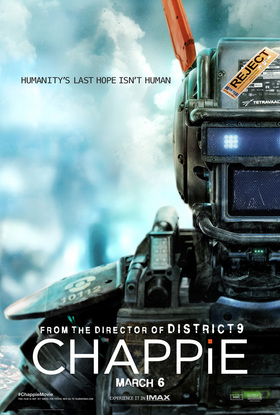 With each passing film, it regrettably is becoming more evident that District 9 seems to be the possible exception for writer/director Neill Blomkamp. It seemed like a new visionary had broken through who could meld heady themes with rousing sci-fi spectacle, a champion of both the visceral pleasures of genre movies and the satisfaction of narrative complexity. After two more films under his belt and with complete creative control, it’s starting to look like Blomkamp’s sense of storytelling is a bit more limited than District 9 would have lead on. The man is excellent at putting together concepts, and he likes to delve into major themes and messages, but the execution has been hobbled and the themes are simplistic to the point of being childish. Perhaps the man is suffering from unrealistic expectations or perhaps the greater world is finally seeing that Blomkamp has been remaking the same movie over and over with diminishing results each time. If you disliked 2013’s Elysium, you’ll probably have an even lesser opinion on Chappie.
In the near future, Johannesburg, South Africa is being policed by a series of rabbit-like robotic “scouts” created by Deon (Dev Patel). His boss (Sigourney Weaver) is happy with the results but very wary of Deon’s interest in artificial intelligence. Deon takes an old robot and installs his A.I. program, giving it sentience. But before he can marvel at his newest creation, a pair of grimy criminals, Yolandi and Ninja, kidnaps him. They dub the new sentient robot Chappie (Sharlto Copley) and plan on making use of him for a heist. Deon strongly disapproves, promising to come back so he can nurture Chappie’s creativity. Yolandi becomes “Mommy” who wants to encourage the robot’s sensitivity, Ninja becomes “Daddy” and wants to toughen him up, and Deon the absent father figure. At work, Deon’s rival inventor, Vincent (Hugh Jackman), is anxious for any opportunity to promote his own police force, a giant flying mech warrior known as the Moose. Unlike Deon’s robotic scouts, a human operator controls the Moose. Discovering Chappie is exactly what Vincent has been waiting for to destroy his competition.
 Chappie is a tonally inconsistent mess that ends up being a weird, garish, and unsatisfying hybrid between Robocop and Short Circuit. It jumps around from being a slapstick comedy, a sentimental unconventional family, an urban warfare action thriller, and a science fiction film exploring the possibilities of artificial intelligence. The tonal shifts can be quite jarring; one moment the movie wants you to feel sorry for Chappie getting beaten (he’s a helpless robot!) by a group of hoodlums (why does a robot fear pain anyway?), and the next moment Blomkamp wants you to laugh at the trashy gangster shenanigans. If the film could ever settle on one tone and take the time to develop it properly, Chappie might have been salvageable. Of course this assumes that Blomkamp restrains himself from explaining everything to his audience. He’s not exactly a subtle filmmaking when it comes to his deeper allegories even with District 9, but it just gets insulting how little faith he has with an audience, bludgeoning them silly. At one point, “Mommy” reads Chappie a bedtime story and it’s about the black sheep, the outcast, and just from that alone, we get the thematic connection. That’s not enough. Blomkamp has “Mommy” explain the thematic significance. Okay, fine, now he’s made the message explicit but even that’s not enough. “Mommy” then literally points to Chappie and says, in case anyone still wasn’t getting it, that he is the black sheep. It’s an illusion of greater intellectual depth that unravels as the film chaotically continues.
Let’s get to the biggest problems with the film: Chappie and his would-be adoptive parents are annoying. While Chappie is a technically impressive visual effect with a motion-capture performance by Blomkamp staple Sharlto Copley, the character is far less winsome. Why would a robot be acting like a child? It’s because Blomkamp wants to rely upon easy sentiment and emotional manipulation to get you to feel for his characters when the story alone is incapable of achieving this. Chappie as a personality is something of a blank slate, and this is filled by the trashy gangster wisdom of Yolandi and Ninja played by South African rap duo Die Antwoord. They’re pretty much playing themselves, credited as their stage names, they wear their own merchandise, and their exaggerated, beyond-ironic-back-to-pseudo-reverent garish style is off-putting in large doses. THEY’RE THE MAIN CHARACTERS. That’s right, two non-actors who plays themselves are the main characters. The movie relies on many Die Antwoord tunes to highlight its sense of funky nihilism. As performers, I’ll admit that there is something unique to them, but it’s foolish to give them a whole movie to carry. It feels like Blomkamp took the profane comic relief characters from another movie and said, “Hey, what would it be like to stretch them out for a whole movie and raise a kid?” Either you find a “gangster talking” robot with gold chains hilarious or you don’t.
The world of Blomkamp seems like it’s stuck on repeat, setting his futuristic steam punk tales in the slums of South Africa, but is this location really integral to tell Chappie? It was essential to District 9 because that movie was an allegory about the apartheid, but none of that specific history of culture plays into this movie in any meaningful sense. The setting then becomes inconsequential, though I could level the same charge at the overwhelming movies set in New York or Los Angeles. The world building of Chappie, like much of its narrative elements, feels half-hearted and curiously rendered. Yolandi and Ninja are threatened with seven days to pay off their debt, but you never feel like there’s a sense of urgency, as if the movie would prefer you forget about this ticking clock. This secondary bad guy seems to be the source of all crime in Johannesburg. Deon has created a widespread police force and yet it never feels like the other characters treat this with the magnitude it warrants. Likewise, Deon doesn’t seem to treat artificial intelligence as a big deal. Then again his boss, of a huge robotics corporation I want to emphasize, has to have artificial intelligence explained to her (again, Blomkamp of little faith). There’s also the way the movie is mired in weird office politics. Vincent is jealous that another program was successful and makes his program look bad, so he works to sabotage Deon’s robots so his project will get the go ahead. Vincent’s project is a glaringly obvious rip-off of the ED-209 from Robocop. It seems so strangely isolated, as if Vincent never thought about selling a flying mobile tank to the lucrative military. The most outlandish moment in the movie might be when Vincent points a gun to Deon’s head, threatens him, all within full view of a slew of co-workers, and then sheepishly retreats with the excuse, “It’s not loaded. Just a joke, mate.” How does this guy still have a job? Is the human resources department of the future replaced with robots as well?
 Here are a small number of other directions Chappie could have gone that I think would be more compelling than what we get, and these just came to me during the movie. Instead of having the robot officers being responsibly used, why not have the world as a police state overrun by these sentinels, an oppressive regime worth toppling. Then Chappie ends up being a robot that’s captured, reprogrammed by revolutionaries, and fights against his programming for what he believes is truly right. Isn’t that a better setting, and far more topical with the current militarization of police forces dominating news? This scenario is better than a work force of robots that most characters shrug over. Then there’s Vincent’s plot to sabotage the robotic scouts (mild spoilers). Instead of just turning the robots off and letting chaos reign, wouldn’t it be a far better angle for him to turn the robots against the civilian populace? Instead of broken robots we have killer robots. Again, it adds a greater sense of urgency but also a route that would seem far more in keeping with the nature of Vincent. Chappie is filled with these hypothetical plot detours you see in your head and wish the film had taken. The movie that Blomkamp delivers is a profane fairy tale that teases a greater experience that fails to materialize.
Chappie is one of those movies you sit and keep hoping it’s going to turn a corner, to get better, to finally capitalize on the setups its been throwing around, to coalesce tonally and magically reveal the madness behind its sloppy methods. Unfortunately, it just remains a disappointing film that feels like several revisions away from proper execution. The plot elements don’t come together. Worst, Blomkamp cannot trust his audience to get even the simplistic metaphors on display. It’s two movies in a row where Blomkamp has miffed on his story. His sense of visuals is unmistakable, and he sure knows how to fill his movies with cool stuff. I imagine his pitch sessions are great with studio execs. It’s just now becoming more apparent that his major shortcoming comes to realizing these stories. There’s a host of other miscues with Chappie. I’m going to go out on a limb and say you’ll never be seeing Die Antwoord as the lead actors in another movie again. Maybe Blomkamp hired them just to get a discount on playing their music throughout the movie. Blomkamp has recently been hired to direct an Alien sequel, and I hope he takes full advantage of this opportunity to creatively leave behind his old stomping grounds. Otherwise in space, no one can hear you yawn.
Nate’s Grade: C
Share this:

Focus (2015)
 The appeal and drawback of con artist films is that you know you’re being conned. You want to be fooled, but at the same time you’re conditioned to never take anything you see at face value, to be waiting for the turns and reveals and twists, and because of this fact it is rare for a con artist film to deserve more than one viewing. Focus fits this description. Will Smith is a smooth con artist who takes Margot Robbie (The Wolf of Wall Street) as his apprentice, but then he dumps her just as their feelings for one another get too real. It’s a shame then that the film peaks during its first act, when Smith and Robbie are first working together to shake down a gloriously irresponsible gambler played by B.D. Wong. The two lovebirds meet again in Argentina as they’re both circling the same rich mark. It’s fun to watch them mess around with one another and spar, and Robbie really shines, but the plot is just too formulaic to be anything more substantial. It’s fun and entertaining in spots, but the end is a cascade of twists that further muddle and complicate an already convoluted con caper involving secret race car fuel. The problem is you’re never engaged enough to forget you’re watching a con, and so you’re always suspecting every angle and doubting every character, which Focus eventually does confirm your suspicions. It’s nice to watch Smith transition into a less flashy role, though his effortless charisma still shines. It’s the kind of role he should be taking more often. You won’t have a bad time watching Focus but you won’t remember much in the morning.
Nate’s Grade: B-
Share this:

McFarland USA (2015)
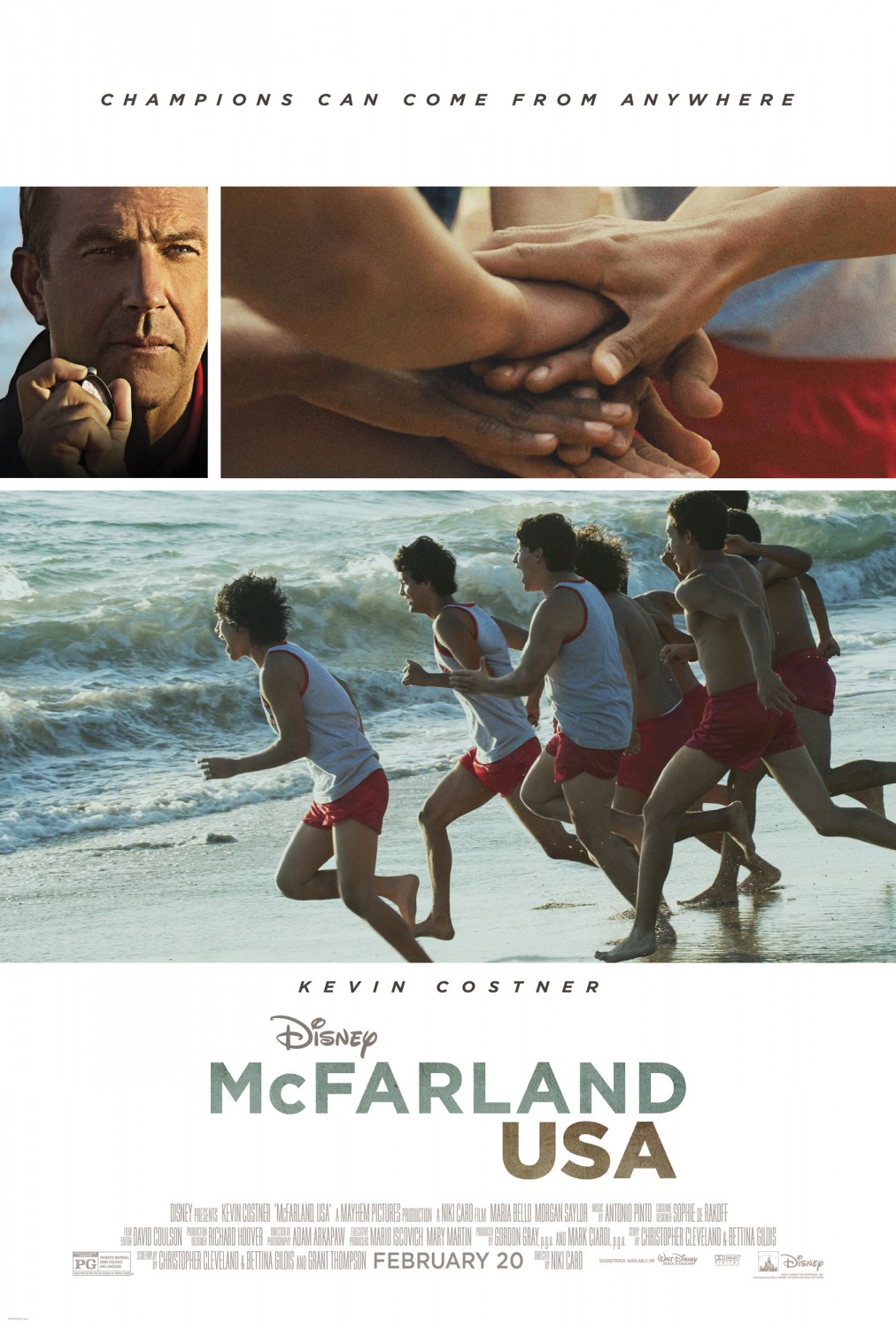 Many movies follow a proven formula very closely, but sometimes a well written, well executed formulaic movie can remind you how appealing that formula can be, and that is McFarland USA, an inspirational Disney sports film that warmed my heart. Kevin Costner stars as a science teacher and sports coach for a working class California town mostly populated with Mexican-American immigrant families. He sees the endurance and speed of several students and decides to form a cross-country team, even though he’s never coached anything related to track in his life. What follows is a mixture of the inspirational teacher film and the inspirational sports team film. Thankfully the screenplay and director Niki Caro (Whale Rider) take their time to flesh out the runners, giving them personalities and different degrees of depth, troubled by real-world problems without easy answers. The movie works as a great tool for empathy as it respectfully illuminates the limited economic opportunities and backbreaking labor of so many Mexican-American immigrants toiling in our fields. The movie creates an amiable sense of community and even though moments can feel contrived, I always had a smile on my face. The people came across as people, complicated, proud, hopeful. It opens up a world and showcases just how hard these people work to assist their families. Costner is a stable anchor for the film but it’s his young cast that really give the film its lift. The emotions are genuine and the uplift is earned, thanks to careful plotting and generous characterization. McFarland USA is a feel-good movie that’s better than good and a perfect film for the whole family.
Nate’s Grade: B+
Share this:

50 Shades of Grey (2015)
 It’s hard to be ignorant of the publishing phenomenon that is 50 Shades of Grey by E.L. James. The erotic trilogy became notorious for its numerous and often outrageous sex scenes. I have many female friends, and relatives, who read the series, and while not a one will admit to finding the series ostensibly “good,” they each read every book. In a way it reminds me of another popular yet critically maligned romantic series – Twilight. It should be no coincidence then that Grey began its early life as Twilight fan fiction. The movie adaptation was a hotly followed topic. After all, people argued, how could it possibly be rated R? How could you adapt it to the screen? With a female director (Sam Taylor-Johnson, wife to actor Aaron Taylor-Johnson) and a female screenwriter (Kelly Marcel) to steer the adaptation process, I figured I would at least get a sense of exactly what was so uncontrollably appealing about the series. For a film designed to be titillating and provocative, I came away wishing it had more action (of any sort) because the movie was just so freaking boring.
Anna (Dakota Johnson) subs for her sick roommate and gets to interview playboy billionaire Christian Grey (Jamie Dornan). He takes an interest in her innocence. And so he runs into her at the hardware store where she works, he fetches her after a drunken text on her part, and whisks her away to his luxurious Seattle high-rise. Before things can get frisky he has to share a secret. He’s a dominant looking the world over for women who are willing to submit to him and be his submissive. The world of sadomasochism is a new one for Anna, a 22-year-old on the verge of graduating college. However, she’s drawn to Christian and accepts his terms, and that’s when the sex gets taken to another level.
 So much of the film is the drawn out flirtation between two characters that I found painfully uninteresting. Wasn’t this supposed to be the exciting and sexy story of risqué sex and overpowering urges? I’m by no means the target demographic but I felt unmoved by the onscreen sex because it was so sedate by Hollywood standards. I’ve seen more enthusiastic and engaging sex scenes skimming the channels of late-night cable TV. It certainly doesn’t even come close to rivaling some of the steamier sequences of films past, like 9 ½ Weeks, The Dreamers, Henry & June, Last Tango in Paris, The Piano, Risky Business, Sex and Lucia, Don’t Look Now, Y Tu Mama Tambien, Dangerous Liaisons, sex, lies, and videotape, Little Children, Mullholland Drive, and Secretary. For fans of romance with BDSM, please give 2002’s Secretary a chance since it is 500 shades superior to E.L. James.
I understand that most erotic TV series and films are readily designed for men, and 50 Shades was designed for women, and there are differences in approach and stimulation, but for a product that is famous for the degree of kink involved, I was sorely disappointed by the results. In short, the movie needs more kink. It plays out as an introductory guide to bondage and S&M. This aspect isn’t even explored until the very end. It’s too timid to really give in to the thrills of its premise and likewise the demand of its readership. There’s a lot of nudity, mostly from Johnson, but the sex scenes themselves are rather ordinary and sedate, all things considered. There are four of them in total for those curious readers wishing to keep track (I also tried keeping track of the times Anna bit her lower lip but lost count). The sex scenes are filled with plenty of moaning but not a one of them builds up to climax, a strange omission since we’re tracking Anna’s pleasures. I wasn’t expecting the graphic, and graphically drawn out, onscreen sex of Blue is the Warmest Color, but I was certainly expecting more after all the hubbub. In the end, a sexy movie is going to be known for its sexy scenes, which may or may not include sex (I feel like fans are going to be justifiably irked by the absence of full-frontal male nudity – come on, give the fans a bone here). 50 Shades of Grey is ironically far too tepid to register as much more than sub-soft core eroticism.
Then there are the characters, both of which are too one-dimensional, and also boring, to bring much interest. Cinema has always been interested in good-looking people getting it on, but unless there’s careful attention to plot and character, then you’re just recycling the same soft core setups. It is wholly transparent that James’ novel began as Twilight fan fiction because the couple occupies the same unhealthy relationship roles. The female lead is a stand-in for the audience/readers; she’s a mousey, shy, normal girl who gets swept away by a brooding and dangerous man who tells her he’s no good, insists she should not be with him, but cannot help himself falling for her because he sees her inner beauty. He’s more male chauvinist than complex character, and his obsession is less a sign of a tortured psyche and more, as displayed, a clear indication of a sexual predator. Anybody who requires his paramours to sign legal documents about what he can put inside them seems like somebody not worth knowing. He tracks her down across the country when she dares to see her mother because Anna didn’t ask his permission. Control freak or a budding sociopath? With a lack of tawdry sex scenes, the far majority of the film is Anna and Christian ramping up their almost endless sexual tension, which the movie will hit you over the head with. I didn’t feel a single thing between the two of them, partly because of how poorly written they are and also because of the lack of chemistry. We watch her bite her lip a thousand times. We watch her stammer. We watch him stare rather intently like a shark. The filmmakers are doing the work for us rather than allowing a romance to blossom organically. It’s cajoled and manipulated and feels inauthentic in every sense, even before the trip to the playroom begins.
There is one standout scene that is actually sexy, and apparently it’s quite different from the source material. As Anna and Christian go over his legal language for his submissive, they treat it as a business meeting with an arch sense of professionalism. It’s one of the few times Anna displays a spark of personality, as well as decision-making, as she goes line by line and says what she will and will not do. It’s played with a wry sense of humor but there’s also a sexy undercurrent throughout the scene, where these two adults are having fun with the preliminaries. If the rest of 50 Shades of Grey had this same sense of personality and fun, it might have worked as an engrossing erotic fantasy.
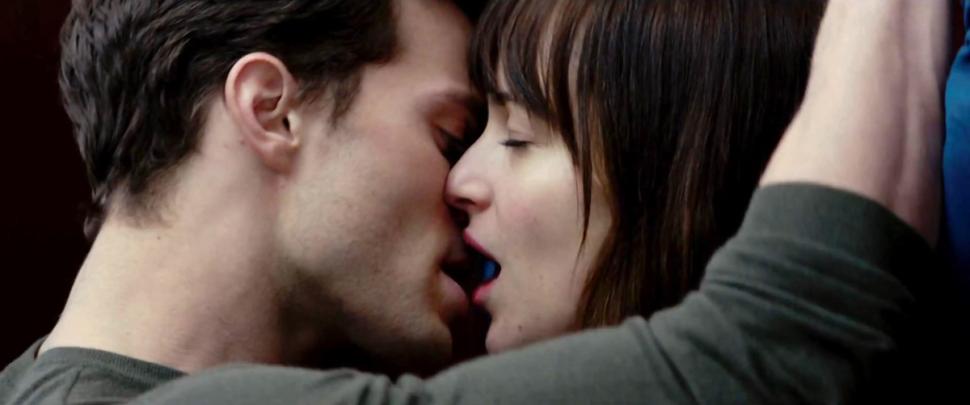 Johnson (Need For Speed) is an enjoyable screen presence even if there’s absolutely nothing interesting about her character. Anna is so absent a personality that it makes it easier for the story to present someone else doing all the work for her, pushing her, prodding her, giving her form. Johnson plays a lot of scenes for laughs, which work in a titter-generating way. I kept hearing Patricia Arquette’s voice whenever she spoke, but I may be alone in this unusual observation. Dornan (TV’s The Fall) on the other hand is terribly wooden. Again, he’s playing a rather terrible character with rather terrible dialogue, but it’s hard to feel any authentic sense of passion from the guy. It’s hard to say whether these actors are miscast or whether there could ever possibly be a suitable matching because of how lacking the simplistic characters are. They’re archetypes, and ones the movie has to keep persuading you are totally hot for one another.
So what is it that makes this property the would-be blockbuster that it is? The story arc has been done before for decades, going all the way back to Rudolph Valentino’s Son of the Sheik: the mysterious prince who comes and sweeps the princess off her feet to his exotic world of privilege. 50 Shades isn’t reinventing the wheel but it has struck a chord, and perhaps it’s the wish fulfillment angle, the introductory angle to a world of BDSM, or the plain Jane ordinary heroine that acts as a cipher for readership. The books are the books and the movie must be judged on its own account. I’m sure most of the series’ fans will be pleased one way or another, though I doubt many of them will find the movie an improvement over the book. Then again it does strip away James’ wretchedly torrid writing. If it wasn’t for the 100 million books sold worldwide, this movie wouldn’t be generating any of the hype it is, but is that the film’s fault? The hype machine unfairly builds expectations that will fail to be met, but then again it’s the over-saturated exposure that has ensured 50 Shades of being a Valentine’s weekend event for half the planet.
Surprisingly boring and rather tepid, 50 Shades of Grey feels too callow to be the provocative film experience it wants to be. It needs more of just about everything; more characterization, more organic coupling, more story, more romance, more kink. It is lacking in too many areas, though the production values are sleek, like it’s the most technically accomplished episode of Red Shoe Diaries. It’s a tedious story of the hazards and joys of giving up control, but I didn’t care about the characters. I need more than pretty people staring at each other for an hour while a breathy remix of a Beyonce song plays over the scene (to be fair that Beyonce remix is hot). The actors don’t connect together and the Christian character comes across as more of a monotone jerk than wounded bad boy. I’m sure 50 Shades has pushed millions into exploring aspects of their own sex lives they would not have felt comfortable exploring beforehand, and good for them. My friend Angie quipped that, if nothing else, the release of 50 Shades of Grey will cause a spike in battery sales for its opening weekend. It’s a shame then that the movie is too limp where it counts to be serviceable.
Nate’s Grade: C
Share this:

Jupiter Ascending (2015)
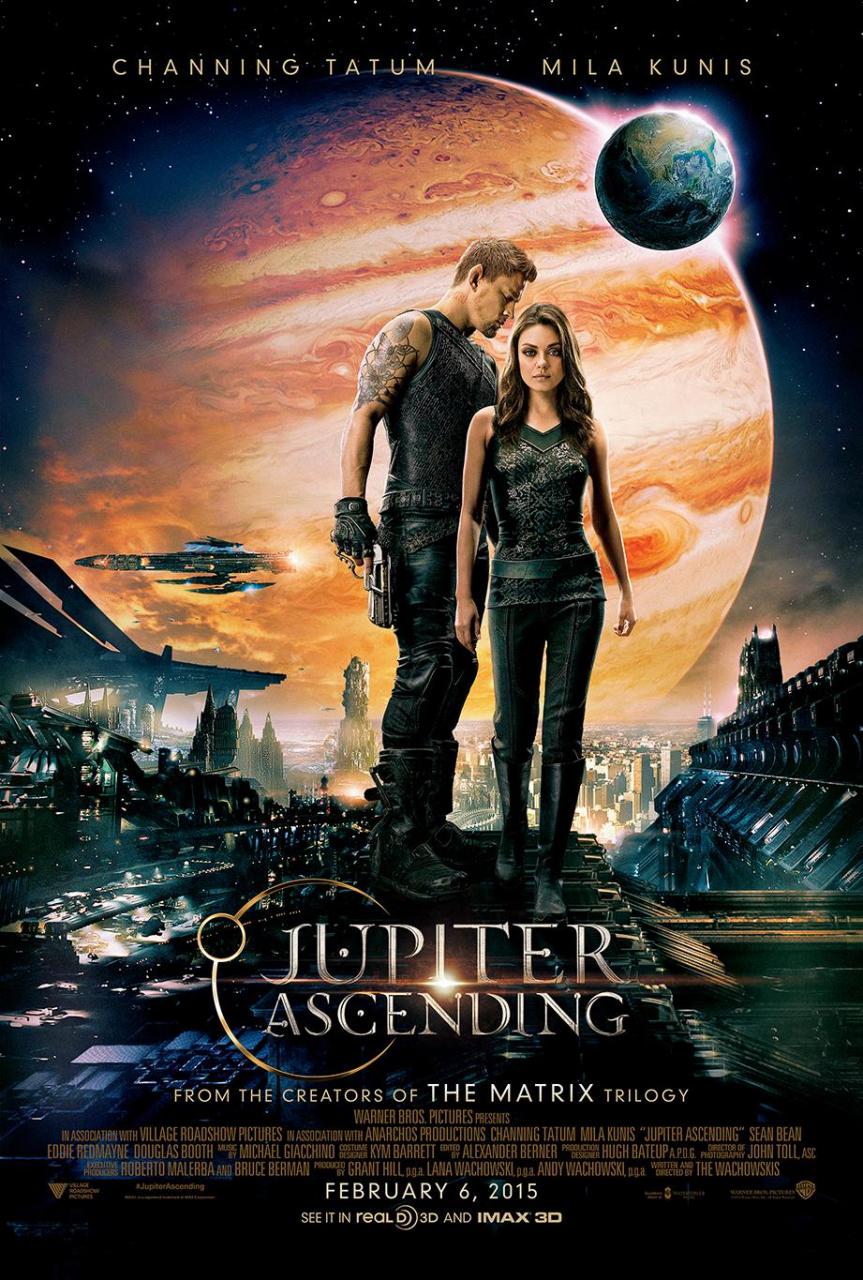 Few would dispute the imaginative powers of Andy and Lana Wachowski. They probably got a free pass from Warner Brothers after creating The Matrix, one of those culture-changing movies that come along so rarely. I was leery of Jupiter Ascending, their newest original science-fiction opus, when Warner Brothers delayed its summer release by nine months. The trailers and commercials were also doing a dandy job of hiding what exactly the movie was about besides cool visuals. I was holding out hope, thinking that maybe Jupiter would be silly but fun in a Fifth Element way, but instead ladies and gentlemen, we have an heir to 1980’s campy Flash Gordon.
Jupiter Jones (Mila Kunis) is an unhappy maid who cleans toilets for a living. Then one day she becomes the most important person in the universe. She discovers she is the reincarnation of the matriarch of House Abrasax, whose three children, Titus (Douglas Booth), Kalique (Tuppance Middleto), and Balem (Eddie Redmayne), are fighting over their inheritance. The biggest prize of them all is Earth, and now the appearance of Jupiter complicates ownership. Various alien species are sent to kill her, but Jupiter has a savior in disgraced galactic solider Caine Wise (Channing Tatum). He’s a “splice,” a result of gene splicing people with animals. He rescues Jupiter and they head off world to explore the much larger, much stranger universe.

Oh look, she’s falling again.
Right away, mere moments after leaving the theater, I knew the first step to make Jupiter Ascending a significantly better movie: completely remove the title character. First off, her name is awful and makes me think she’d be a character in the Jetsons universe. Mostly, she’s a terrible protagonist because she is merely a fairy tale wish fulfillment masquerading as a person. Her normal life is miserable but secretly she’s a space princess who is the reincarnation of a space queen. Allow me to momentarily pause and question this line of monarchy and inheritance law. Apparently Jupiter shares some genes with the deceased Lady Abrasax, but she has no direct bloodline. Does that automatically thrust her into another family’s inheritance squabbles? Why should they even consider her claim valid? Why does that place her at the top of the pecking order? When did we start recognizing reincarnation with inheritance law?
Back to the matter at hand, Jupiter is an annoyingly weak character that’s supposed to follow the arc of weak to strong, inactive to active. Except she doesn’t. Beyond accepting her incredible new position, there’s really not much that changes for her. She remains, from start to finish, weak-willed, gullible, always in need of saving, and so wretchedly annoying and without merit. Her cousin arranges her with a doctor for Jupiter to donate her eggs, but he expects a majority of the money. Why does she need this middleman in this arrangement? It’s another reminder how dim the character is and devoid of agency. And then all of a sudden a romance materializes between her and Caine because of course it does. I use “materializes” because there is no actual setup of any kind beyond the fact that Kunis and Tatum are attractive specimens. Their romantic dialogue will produce dangerously violent eye rolls.
The Wachoswkis are certainly imaginative filmmakers but their ambitious world-building impulses get the better of them and their story. The imagination is on full display when it comes to the visuals, the production design, costumes, and alien designs. There’s a grand mixture of creatures big and small, and even an elephant pilot because why not? However, the storytelling meant to house these cool things is notably deficient. Jupiter Ascending feels less like a story that naturally develops and whose complications arise in a semi-logistical fashion. It feels like somebody guiding you on a tour of Weird Stuff. It’s not so much a story as a collection of Weird Stuff, Weird Incidents, Weird Places, and Weird Creatures. You feel like you’re being skipped off from one exhibit to another, especially when Jupiter is kidnapped and threatened by each of the three Abrasax children in a row. Seriously, the entire scenario is on repeat, so when Jupiter continues making naïve choices, you can slap yourself extra hard having been through this purgatory just moments before. It’s only a matter of time before she gives in to whatever Abrasax demands again. There’s a general sense of repetition to the plot compounded by Jupiter’s incessant need to be saved (she seems to be falling a lot, out of spaceships, buildings, vehicles, etc., which also gets tiresome). The scheming Abrasax children seem to just slide in and out as the plot requires, with little in the way of resolution.
 It’s impossible to discuss the film without acknowledging how damn goofy the whole enterprise comes across. Caine is part wolf, part albino, part human, and apparently part angel since he got his wings removed as a punishment. Does that seem like a good combination of elements or like the aftermath of a drunken writing session? Let’s just run down some of these names: Jupiter Jones, Balem, Kalique, Stinger, Gemma Chatterjee, Phylo Percadium, Chicanery Night (!). To be fair, it’s not like Luke Skywalker or Darth Vader are less preposterous names. Caine has a pair of anti-gravity boots but they’re really just hovering rollerblades. There’s just something silly about watching a guy rollerblade, even if you attach a futuristic spin to it. There’s a hidden factory beneath the stormy Eye of Jupiter, and yet this same important factory seems ready made to fall apart if the slightest projectile pierces its exterior (it’s the Death Star all over again). There are weird small aliens, weird alien bounty hunters who can turn invisible but don’t, weird space police that are really bad at their jobs, weird robots with human faces, and there’s also weird stereotypical Russian immigrants for Jupiter’s obnoxious family. Perhaps all the goofy camp will enchant you but I never got onboard mostly because the story and central characters left me so thoroughly unengaged.
Another ongoing problem is that the Wachowskis are constantly telling you things rather than showing you and allowing the story to organically develop. There are no less than three times when Character A looks at Character B and literally verbalizes what they are thinking or feeling in this moment. It’s lazy screenwriting, beholden to constantly having to explain everything to an audience because either you think they are dumb or your plot is far too convoluted; either way, a problem. Such sample pieces of dialogue include these informational asides: “Bees are genetically programmed to recognize royalty,” and, mere seconds later, “Bees don’t lie.” There you have it; bees don’t lie. Now you know.
The most frustrating part of Jupiter Ascending is that there is a genuinely interesting movie buried under so much of this silly nonsense and ear-clanging noise. The starting premise that Earth is nothing more than a stock portfolio for an alien species, that’s good. The idea that a trio of siblings is squabbling over who gets their galactic inheritance, which includes the deed to Earth, that’s good. The idea that human life is seeded on planets merely to be harvested into an eternal youth elixir for the rich and powerful, that’s even better. It’s not exactly a nuanced critique of capitalism but it’ll do. I’m disappointed that we don’t find out more about a larger market for this rejuvenation technique. There has to be more customers for such a miracle product than one rich family. If this were an intergalactic King Lear or even a space version of Margin Call, it would be far more exciting and creative. Instead, the bigger ideas are grounded into pulp so that we can have more CGI-drenched action sequences. There’s one segment that tonally breaks away from the film, diving headlong into Douglas Adams-style satire on bureaucracy. Like most of the film, it has its moments of entertainment, but it comes from nowhere and has trouble fitting with everything else. I’ll give credit where it’s due and praise the special effects, as well as the overall production design. It’s too bad that the action too often feels like a bunch of pixels exploding, failing to provide a sense of immersion. It’s hard to get a feel for most of the action and its use of space, save for portions of the finale. There is one very fun and well-choreographed fight between Caine and a… dragon… sentry guy (I don’t really know what to call these winged henchmen). That fight is exciting. It’s a shame there aren’t more of them. Bring on more dragon sentry guys.
Kunis is certainly miscast on the part, though I doubt any actress could pull off such a lackluster heroine who is always needing to be rescued. Kunis is more adept in the realm of comedy (Ted) or seduction (Black Swan), neither of which is featured with Jupiter. Let me say one more reason this Jupiter Jones character is awful; part of her struggle concerns whether or not to marry a playboy space prince. I don’t know if the Wachowskis believed that Jupiter was supposed to be a “strong” figure, but reducing feminine value to her being married feels rather reductive for sci-fi (not that there isn’t a storied history of women being treated as objects of fantasy in the genre). Tatum’s (22 Jump Street) remarkable charms are dulled by his silly albino beard and general guard dog characterization. He’s less a character than a protector who inexplicably instantly falls in love with his charge. Both actors will no doubt rebound in short order.
 Reserve some pity for poor Eddie Redmayne, a man who will be experiencing the highs and lows of acting this month. He’s the frontrunner to win Best Actor for his stirring work as Stephen Hawking in The Theory of Everything, which is what makes his performance here even more astonishingly awful. He speaks in this effete whisper for the entire movie, one that is hardly audible at all, except for the occasional line where he screams and spasms, making the contrast all the more funny. He constantly holds his head back like he’s in danger of nosebleeds. This is a performance of such startling misdirection that I physically felt bad for Redmayne. He seemed to be reaching out to me, pleading through his glassy eyes, communicating, “Help me, help me.” Even if his character’s vocal range wasn’t so nonthreatening, Balem makes for a terrible main villain. As a rich lord with power at his disposal, he works, but late in the movie all of that is removed, and he has to be a physical threat. After 90 minutes of watching him on screen, you will never be able to see him as a credible physical threat, and even the movie doesn’t fully treat him this way, and yet the plot still places him in this role. He’s not a heavy. Balem is laughable but he’s another component of a generally laughable movie.
Jupiter Ascending is a rarity in Hollywood, a big-budget epic that overpowers you with a singular sense of style and imagination; it just so happens that so much of the creative fireworks are laughably terrible. The Wachowskis don’t do anything in half-measure, and the film is put in overdrive. There’s a mess of characters and peculiar details to make this world feel larger than life and tethered to the idea of fun. Then why oh why did we have to be saddled with such boring, one-dimensional characters and a secret princess storyline lifted from countless sources? In the past, the Wachoswkis have found ways to turn pop philosophy and pop-culture into an entertaining alchemy that separated them from the sci-fi pack of imitators, which were legion. I still have great fondness for the original Matrix (you can keep the sequels), V for Vendetta, and especially Cloud Atlas of late. The Wachowskis are ambitious filmmakers and they have the imagination and narrative sensibilities to achieve great things. It’s just that with Jupiter Ascending it feels like their real passion was in all the background artifacts, the minutia of the worlds, the alien costumes and makeup, the histories of worlds. It certainly wasn’t on a story or characters or a credible romance. And yet even after all of these words, I have to admit that Jupiter Ascending is entertaining, just not in the way its creators may have intended. It reminds me of 2014’s disastrous Winter’s Tale, a passion project that was so baffling and bafflingly terrible. If you’re curious and willing to part with some money, gather some friends and check out Jupiter Ascending. Just make sure you’ll have suitable time planned afterwards to discuss its particular brand of big screen lunacy.
Nate’s Grade: C
Share this:

Project Almanac (2015)
 I’m going to take a stand right now and declare that Hollywood should simply stop making found footage movies. I don’t hate the subgenre itself, and in fact a found footage approach can be rather interesting if given proper attention and care, but that is just not happening nearly enough. Too often Hollywood execs view found footage as a hook and slap it onto a story that does not need to be told in this limited style. There’s no reason that a perfectly fine buddy cop movie like End of Watch needed a found footage angle, except that’s probably how it was sold. If you’re going to do found footage you better have a god reason why your characters are recording every moment, and most do not. You better stick to the principle that the only viewpoint is from the camera, and most do not. And you better stick to the limitations of this viewpoint, meaning who is editing these things after the fact and adding popular music to make montages? Found footage is too often underdeveloped in approach, a lazy selling point because “the kids” today like documenting themselves doing everything. But really, can you name the last found footage hit? The Paranormal Activity franchise is on the downturn and the last critically lauded one was 2012’s Chronicle. Don’t just stop making found footage movies because they’re too often lackluster; stop making them because the public has grown indifferent. Now, with all that being said, the time travel flick Project Almanac proves once again to be a film that never needed to be found footage to work. As far as January releases go (usually a dumping ground for studio bombs) it’s better than most, but the poorly titled sci-fi drama wastes its premise on the myopic doldrums of youth.
 David Raskin (Johnny Weston) wants to get into M.I.T. but his hard-working mother doesn’t have the money to make this happen. He discovers an old video of his seventh birthday party and is shocked to see an image in the background that resembles him as a teenager. He and his friends, Quinn and Adam, investigate the video. They enter the basement lab that used to belong to David’s father, until he died in a car accident shortly after that birthday recording. There they find plans for a time machine and the boys busily go to work assembling it, perfecting it, and charging it. Jessie (Sophia Black-D’Elia), a popular girl at school, stumbles into their first experiment and becomes part of the group. They have to keep this a secret and they must only travel back as a group. The freedom and possibilities are exhilarating, but soon enough David discovers a spiral of consequences that are difficult to correct without scrapping everything.
From a structural standpoint, this movie gets pretty lopsided and completely misuses the possibilities it established even as it arbitrarily throws its own rules out the window. Project Almanac takes far too long to get the time machine working. The teens discover the manual but it takes almost the complete first act before they successfully travel in time. Why do we have to wait a full 30 minutes and watch trial after trial? It’s not exactly like the audience demands a sense of scientific accuracy. Once the teens do travel through time, they set their sights very low: pass a test, get revenge on a bully, win the local lottery, and go to Lolapalooza. There is the limitation of only going back three weeks into the past, which eventually disappears, but could these kids not aim higher in their goals? When they do go to Lolapalooza, the movie drags and drags, and it’s here where I started to theorize what became of this film (more on that below). Once we come back from the festival, David decides to jump back alone to stop himself from blowing his opening with his crush, Jessie. However, there are disastrous consequences stemming from this and he has to debate whether to undo his good fortune with Jessie. Want to know what those consequences include? Seventy-seven people dying in a plane crash. Our main character seriously agonizes about keeping his new girl or the lives of seventy-seven people. And what would he lose? It’s not like he can’t be suave around Jessie ANY OTHER TIME. All he has to do is say something and kiss her. The hesitation and struggle over this is comically absurd, but the struggle illuminates where Almanac could have gone. These teens could have used time travel to save lives, but I guess that’s not as fun as seeing Imagine Dragons backstage and dancing.
Another problem is that, from a time travel standpoint, this stuff doesn’t really follow its own rules. The gang goes back at several points to repeat the same goal, but at no point do they run into different iterations of themselves. If they keep going back to fix things, and fail, and then go back again, that’s a continuation of one ongoing timeline, not a do-over. Time doesn’t reset. With every time travel story there’s the nagging nature of paradoxes but Project Almanac just ignores them, hence the lack of doppelgangers. At one point, Quinn even seeks out his past self to pull a prank, which sounds really stupidly dangerous from a space-time continuum standpoint to me. The movie ignores paradoxes… until it doesn’t. The entire third act is about the consequences of paradoxes, and now all of a sudden it matters. That doesn’t work. The main third act conflict is David not wanting to lose his girlfriend. He keeps jumping back to fix this and fix that but it’s all to save his girlfriend, which is pretty dumb, as I‘ve pointed out already that Jessie could still decide on her own at any point in the future to be his gal. Then there’s the conclusion, as we all know that we have to get back to that birthday party at some point. I consider myself a smart man but the end doesn’t make any sense because (spoilers to follow) it invalidates the timeline that we witnessed. David makes it so the events will not happen and the machine will not be constructed. But why is there evidence? Why is there still a tape detailing this whole process? It should be wiped.
Requisite found footage griping: why do they record every damn thing in this movie? The gang even breaks into their high school to steal hydrogen canisters from a locked science lab. Why would you record your crime spree? Why would you record people just driving in cars or walking up to school? Why would you record any of this? How do you clearly pick up audio from two people at a distance, mind you, at a freaking outdoor concert with lots of noise to cancel out any discernible dialogue?
 There are moments that I really liked, flashes that show how much fun or even clever Almanac could have been under other circumstances. One of these moments involves Quinn going back to save his grade. Originally he failed his chemistry presentation, so he thinks he’ll easily pass thanks to the foreknowledge that time travel offers. He goes back, lists the first ten elements on the periodic table, and then his teacher asks him another question he wasn’t prepared for. He goes back, prepared for the two, and then the teacher asks another he wasn’t prepared for. Over the course of going back, he is actually forced to study to prepare for this presentation, and so even though he thought he would use time travel to be lazy, it forced him into doing what he should have done in the first place. When they go back to win the lottery, they accidentally write down one wrong number, so their first jackpot prize isn’t the full amount. They bicker about going back, whose fault it was, and then the film cuts immediately to them holding the full amount in a novelty check. All the characters are devoid of excitement, because that excited moment of revelry already happened, and now this is just an exercise to get over. The photographer chides them to be more excited. That is a fun moment. The characters are rather likeable. There’s another moment where Jessie realizes that David went back to fix a slip-up so they would end up together. And she reacts exactly how she should, wounded and mistrusting. How can she trust what he says now? How can she not doubt every moment being carefully pre-programmed for a desired result? She was manipulated. This confrontation was missing from About Time where Rachel McAdams would have learned that her charming husband traveled back in time dozens of times to perfect his courtship, thus manipulating her own sense of choice. Poor Rachel McAdams never finds out, which seems like a completely blown dramatic development, and lives in cherished ignorance instead. At least Jessie gets to know the truth and behaves naturally. There are other little moments that are fun but they are distractions from what could have been.
Allow me to do some serious speculation about Project Almanac’s own past. This film was originally supposed to come out a year prior hence why every date is referenced as 2014. MTV Films expressed some interest in the movie and it was shelved and likely retooled. Except with time travel films, retooling can be pretty monstrous with its carefully placed plot beats. Here’s what I think happened. Originally, the third act was all about David going back to save his father from dying in that car crash. He likely does but there are dire consequences, and so he keeps going back to try and mitigate the negative repercussions while still keeping his father. Doesn’t that sound like a much more emotionally involving storyline? He’s got far more personal stakes in this scenario than simply losing his girlfriend who he can regain. He can’t regain dear old dead dad. It seems preposterous to me from a screenwriting standpoint that they would introduce a deceased parent and not use time travel to save said parent. It’s the ultimate setup. Instead, with MTV attached, we got to keep things lighter and more appealing to the carefree fun of youth, and so the gang goes to Lolapalooza instead where they can watch rock bands. I think MTV came in and jettisoned the third act and the direction of the script, imposing the festival, and reminding people how music is essential to being young and free and alive. I can’t say whether it’s MTV’s influence or producer Michael Bay, but there’s a slew of product placement from start to finish as well. I have no proof of any of this but I think there’s something to my conspiracy theory.
If you needed any other example of how close Project Almanac would uphold to its own sci-fi rule system, a character asks a good question about how they can understand something, and David says, “I’ll tell you later.” Hey, you want to know something important, just wait, where it won’t be answered. The found footage aspect brings nothing to the film, is poorly integrated throughout, and just plain unnecessary. The plot is too underdeveloped and lacking ambition, using the miracle of time travel to party in such limited ways. The concluding half feels too low in stakes and obvious in conclusion. Time travel is all about the untold possibilities, and Project Almanac will ultimately fall in that territory, a somewhat amusing but mostly unfulfilled sci-fi film that should have gone back to the writing stage a few more times.
Nate’s Grade: C+


 nathanzoebl
You must be logged in to post a comment.