Category Archives: 2012 Movies
The Queen of Versailles (2012)
 Meet the Siegels, the subjects of a Sundance-winning documentary, The Queen of Versailles. David is a real estate magnate in his 60s. Jackie is his 40-something wife, a former model, and together they have eight children. It would be an understatement to call the Siegels rich. These people are stupid rich. These are people that have so much money they don’t know what to do with it, which is why David and Jackie set out to build the biggest home in the nation. After the subprime mortgage flameout of 2008, the Siegels took a major hit in their resources. But not everyone sees worldwide economic disaster as a wake-up call. Some just keep on shopping.
The Queen of Versailles is one captivating clinical study in overreaching. In the wake of the financial collapse, politicians were eager to lambaste the poor who bought mortgages they couldn’t afford (the better to shield blame from their friends in the banking cabal). Let this film show you that even the super rich can have trouble living within their (enormous) means. I won’t lie; part of the appeal of this documentary is the continual shock of the wasteful extravagance the Siegel clan called normal. How opulent was their lifestyle? Well their 26,000-square foot home only had 17 bathrooms, so you can see why the Siegels would feel the need to build the biggest home in the nation. This 90,000-square foot fortress was modeled after the actual French palace in Versailles, so you know, it’s going to be modest. It was designed to have 30 bathrooms, 10 kitchens, a bowling alley, an ice-skating rink, and two movie theaters (for counter programming?). The large stain glass window itself cost $250,000. The total cost of the project: more or less $100 million. I repeatedly laughed to myself in disbelief at the untamed lavishness on display. I confess it’s hard for me to put myself into this vapid mindset. I just see all hat money and think of all the better things it could have been spent on. How many children could be vaccinated with $100 million? How many people could have been bought out of slavery with that money? How many low-income students could have afforded college? The kicker, what really gets my ire, is that is was all unnecessary. The Siegel family already lived in a giant mansion. Did they have to live in a giant-er mansion? When is enough just enough?
 By the end of the movie you won’t know whether to scorn the Siegels or feel sorry for them. I’m at a loss myself. There’s a certain level of schadenfreude watching a riches-to-rags story, watching the wealthiest among us find their world of easy money come crumbling down. But then you start thinking what these people are going to do now without the luxury of wealth. The Siegel children are horrified when at one point dad declares they will likely have to go to college and, gasp, earn their own living. And if these kids have to fend for themselves, it doesn’t take a genius to get a sense of what the future holds. At one point, the adopted niece discovers her pet lizard is dead. Jackie harangues her about not taking care of it. “No one takes me to the pet store!” the niece declares. “But why didn’t you at least give him water?” Jackie reasonably asks. The niece responds dead-serious: “That wouldn’t have made a difference.” And these people are going to have to fend for themselves! The horror that waits. The entire family has been wrapped up in a cocoon of wealth, insulated from the real world, and now has no real sense of how to navigate this new, blunt reality.
Adding to the sadness is the dawning realization that David Siegel cannot stand his wife. Jackie is wife number three, and a former pageant winner/model, so we all know what stood out to the older businessman. Even his kids know. Late in the film, when the weight of creditors bears down on him, David sequesters himself in his private room, shows no interest in his wife or his children, and confides to his dog that the two of them could just run away together. With the comforts of wealth stripped away, and Jackie reaching, gasp, middle age, it becomes readily apparent that David’s waning affection is not going to reverse.
But the movie belongs to Jackie, the titular queen, and she is easily the most fascinating figure in the film. It’s easy to dismiss the bleach-blonde woman with huge fake breasts and a shiny, fake life of glamor. Is she a ditz? She got a degree in computer engineering. Impressive. Is she a gold digger? She cannot help herself when it comes to buying, whether it’s at Southerby’s or Wal-Mart. Is she even a good mother? She does admit that she would not have had nearly as many children if it weren’t for the ever-present nannies. What I saw was a woman who knew she could taste the good life and then became afraid of being kicked to the curb. David is happy to fund her personal projects and let her splurge on posh buys, but for how long? Her body, impressive though top-heavy, is aging, and her model looks are naturally fading into a comfortable middle age. Such is life. However, you can tell that Jackie is terrified. Mountains of money acted like a buffer between her and her husband. That’s gone now. He keeps joking that when Jackie gets old he’s going to dump her for two twenty-year-olds. Even when the family is downsizing, Jackie makes sure to fit in her beauty stops (botox, tanning, etc.). Some might charge the woman with being toxically narcissistic, but I think that’s too simple. Her looks are her meal ticket and now they are betraying her. She knows the type of man she married, and they both seem to be failing to live up to expectations. Now that the shiny distractions are removed, they have to live with one another as-is, and as-is doesn’t really work for men of wealth and ego.
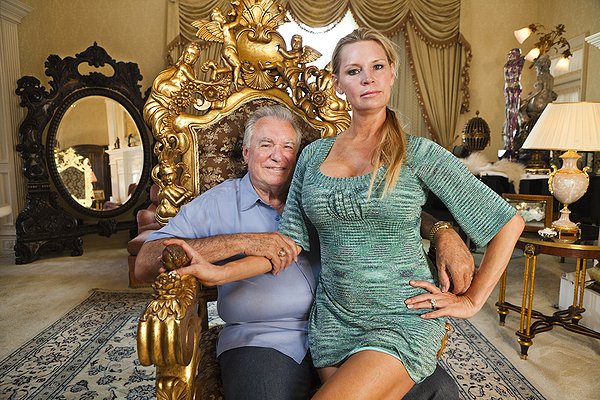 Director Lauren Greenfield (Thin) spent three years documenting the Siegel clan. She must have done something right with her finished product since David Siegel filed a lawsuit against the movie and Greenfield. The suit argues the film damages David Siegel’s credibility by positing that his company is on the verge of financial ruin. His company, Westgate Resorts, sold timeshares in the same kind of high-pressure sales tactics that lead to people buying things they cannot afford. After the 2008 meltdown, guess what? People couldn’t afford their own homes let alone a vacation timeshare. When the bankers freeze the easy money, Siegel and his company cannot pay their bills and have to downsize, sell offices, and foreclose major properties, including their signature Vegas resort. It’s hard to imagine that Greenfield went out of her way to portray a gloomy outlook on Siegel’s company when the facts are pretty black and white. He lost his access to money and lost assets he couldn’t afford any longer. The litigation just seems like desperate spin against the obvious and insurmountable.
From a documentary standpoint, not all of the storylines and messages stick together. You can tell Greenfield wants to use the Siegel clan as an allegory for the American consumerist culture. See, the movie says, even the rich overreached too. But beyond the audience feeling superior to such careless individuals, I don’t think this works. The movie never fails to be fascinating but practically in a car-crash sort of manner, as we vicariously lavish in the pornography of riches. Certainly Greenfield never condones the lifestyles of her subjects, not like the insipid, soul-deadening, vain Real Housewives reality franchise on Bravo (in a surprise to nobody, Bravo has snapped up the broadcast TV rights to Versailles). There’s plenty of derisive laughter to be had throughout, but you do wish that Greenfield had pushed further. Comparing the Siegel’s lives to their live-in nannies seems to be given superficial significance. These immigrant women bust their asses raising the Siegel brood and one of them literally lives in one of the kid’s super sized dollhouses. She literally lives in a former dollhouse. Choke on that metaphor. Then there’s a limo driver who’s had to cut back to make ends meet, but really the stars of the film are Jackie and David. Too often the film seems caught up in the “look how disgustingly rich they are” direction. This is a compelling documentary, to be sure, but it can lapse into an extended Lifestyles of the Super Rich and Famous.
David Siegel makes a very apt observation in the film. “Everyone wants to be rich,” he says. “If they can’t be rich, they want to feel rich.” Of course David Siegel’s company made a hefty profit from making people feel rich at their resorts. Everyone wanted to partake in the same illusion, the same false belief that the good times were never going to end. The Queen of Versailles is alarming, fascinating, and beyond belief at several points (why do these people keep getting more pets they won’t care for?). You’ll feel a general sense of moral superiority but that’s the movie’s weakness as well. The super rich are characterized as extravagantly wasteful, and while this is a notion that will not break any headlines, the movie too often dips into schadenfreude that doesn’t elevate the material. We’re left with the sinking impression that this clan is stuck in their ways and ultimately doomed. Since the film’s release, David Siegel has reclaimed his foreclosed super mansion, and now he’s brought the asking price down to a more reasonable $65 million. It seems that you can lose millions and still not gain a lick of sense and perspective.
Nate’s Grade: B
Share this:

The Campaign (2012)
 Broad and oafish for political satire, The Campaign has some decent belly-laughs to it with the main point that our national political environment has become a parody of itself. It’s Will Ferrell doing his usual boorish boob stuff and then there’s Zach Galifianakis as an effete, weird, family values doofus. When it gets looney, The Campaign is at its best. I loved a town hall that descended into a mob chanting their willful opposition to Rainbow Land. I enjoyed that Ferrell’s punching of innocent creatures was turned into a running gag. Having a racist old man pay his Asian maid to talk like an old black mammy because he misses the good old times? That is downright inspired and I giggle just thinking about it. The campaign commercials were perfect, and who knew Dylan McDermott could be this funny as a political ninja? The problem is that the movie works best as a series of scenes but doesn’t add up to much more. Some of those scenes are hilarious, and others are just passable lowbrow entertainment. Then the movie tries to foster a happy ending, with the evil business tycoons (an obvious avatar of the Koch brothers) foiled. I do not believe that satire can have a happy ending. It undercuts the angry, sardonic message of the movie. It’s just not the right fit for the genre. Alas, The Campaign tries to insert some pathos into the mix and it feels false and far too tidy. As for summer comedies, the movie has a few killer jokes and an amiable presence, plus a very short running time so as not to wear out its welcome. Like most politicians argue… you could do worse.
Nate’s Grade: B-
Share this:

The Bourne Legacy (2012)
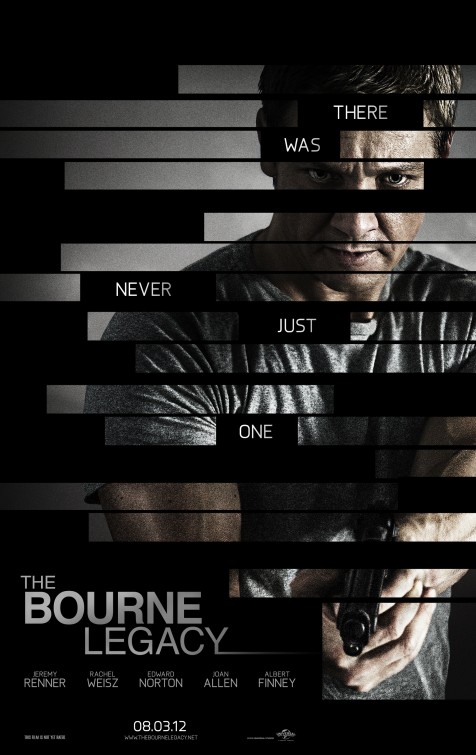 The Jason Bourne spy series has been a financial wellspring for Universal studios, so when Matt Damon and director Paul Greengrass (United 93) decided they had enough spy capers and hijinks, you can understand the studio’s concern. They elevated Tony Gilroy, a writer from the beginning of the series, to director. Gilroy has done some well-received directing gigs of his own now (Michael Clayton), so his ascent made sense from a continuity standpoint. I did wonder how much liberty the studio was going to give him, whether he was going to be boxed in to a style that had worked for the series. I never knew I should have had bigger misgivings, namely that The Bourne Legacy would ransom its conclusion and force the audience to make Legacy a hit.
Apparently Jason Bourne wasn’t alone. The C.I.A. has a team of six different super agents, each undergoing rigorous training and chemical alterations to their DNA via a series of daily pills. Aaron Cross (Jeremy Renner) is out in the Alaskan wilderness when the C.I.A., led by Col. Eric Byer (Ed Norton) and Adm. Mark Turso (Stacy Keach), burn all their agents. They plan on starting over and that means eliminating all evidence of the spy program that gave birth to Bourne. That means Cross has to go as well. That also means the chemists and scientists working on the program must also be silenced permanently, and Dr. Marta Shearing (Rachel Weisz) narrowly escapes a workplace shooting. Cross seeks her out for her medical expertise. They both have a common enemy that wants them dead. Together, the duo heads over to Manila where Shearing’s company manufactures the super meds and so Cross can become a permanent super agent.
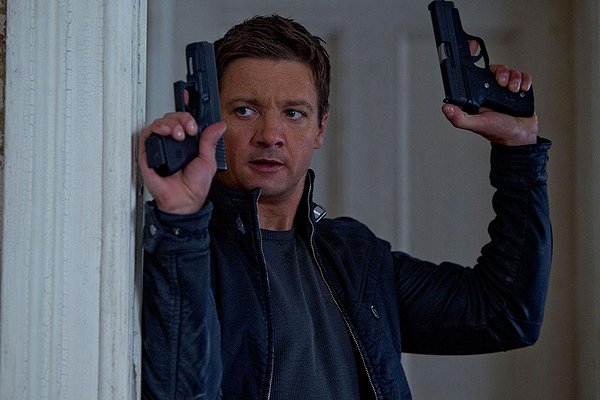 What the hell did I just watch? I know it’s labeled The Bourne Legacy. That part I get. What I don’t understand is that the filmmakers are trying to extort the viewing public into granting a Legacy sequel. Let’s cut to the chase. This movie has no ending. I don’t mean a bad ending. This movie is completely absent an ending. Not just an ending but also a third act. It’s like the filmmakers lopped off the third act and said, “If you want to see where this story ends up, you better get us a sequel.” There is no resolution for ANY STORYLINE in the entire movie. None. The good guys are still scrambling, figuring out how to blow the big bad conspiracy. The big bad conspiracy is still alive and kicking. The patsy for their wicked shenanigans is still the patsy. There is nothing that can be construed as an ending. At least the Damon Bourne movies each had a beginning, middle, and end and tied up their film plots. Sure the characters carried over and there were some larger, overarching storylines, but at least those movies felt complete. The Bourne Legacy is badly incomplete, a gaping void of a third act, and a blunder that makes me question the sanity of the filmmakers. How could you make a big budget summer action movie and not provide any semblance of closure? When the Moby tune kicked in on the soundtrack, I sat stunned, pinned to my seat in disbelief. “No, it can’t be over. They couldn’t possibly just end things here.” Oh, and they do. So enjoy 2/3 of a movie, folks.
With the anticlimactic end in mind, I now understand why the first hour felt so draggy. It’s because they had to fill out a two-hour running time. Especially for the Bourne franchise, the first hour seems to really be paced lackadaisically. For an action movie, it sure takes its time to get going. I wouldn’t have minded if I felt like we were setting up something exciting, but really the story is about a super agent who just wants to get his meds. He travels across the U.S. and the world so he can get his pills, and then he does, and then the movie abruptly ends. I’m simplifying matters in a crass way, I admit, but doesn’t this storyline just feel a tad slight? Legacy also starts to feel like a retread when it comes to its plot mechanics. The C.I.A. is burning all their super spy agents through suicide pills. They are destroying everything before Congressional oversight can reveal their true dastardly deeds. But then we need an antagonist, right? So the government goons reveal they have a SECOND even more super secret program to train super assassins/spies (“It’s Treadstone without the inconsistencies”). How far are they going to take this? Is there going to be a third super duper ultra secret level of killer spies? It’s repeating the same steps the franchise has already taken, the expert spy vs. spy clashes, but now it’s starting to get silly in a way the franchise had previously avoided.
 The action sequences are serviceable but they’re not any better than what the franchise has produced before. Cross has a few nifty escapes but nothing that reminds you of Jason Bourne’s sheer ingenuity. What other man can take down bad guys simply with a rolled up magazine or a book? Aaron Cross just can’t compete with that. The final motorcycle chase is nice but it just seems to be repeating the same danger with little variation. The best action sequence is actually a bit macabre. It involves a workplace shootout. To even call it an action sequence is a bit of a disservice since it’s actually a tense and horrific scenario that is coming eerily all too familiar in the news. Weisz’s character has to hide while her co-worker methodically guns down his fellow lab workers. Oh, and he also took off the door handles, making it dire for help from the outside to get inside. It’s a horrific sequence that’s played out to stomach-knotting levels of tension, as the dread slowly mounts and the pessimistic inevitability looms. Now, obviously Weisz was going to survive, as we know this, but the sequence still resonates with real, primal terror.
So what does The Bourne Legacy have going for it in its favor? Well the duo of Renner and Weisz is a pretty good pairing. Renner (The Hurt Locker) has been rolled out as the next thinking man’s action hero, and he finds interesting depth to his spy character in a rather routine plot. But he’s even better when he’s onscreen with Weisz (The Constant Gardener). There’s plenty of shouting matches and intensity but they have workable chemistry and Weisz’s character gets to be an essential part of the spy heroics rather than a tagalong. I cannot fault the actors for the film’s flaws.
I understand why the Universal suits felt like they needed to pump new blood into their lucrative Bourne franchise. After a while, an amnesiac super spy is going to hit a breaking point; he’s going to run out of essential memories to recall (Bourne 5: where Jason Bourne gets back the memory that he does not like Indian food). I like Renner and Weisz. I even like Tony Gilroy as a director. What I do not like is only getting 2/3 of a movie. Whose bright idea was it to just lop off the third act and provide no resolution? The ending is so unbelievably jarring, so staggeringly incompetent, that I have to dock this movie major points. I can’t say the ending out and out ruins the film considering I was only marginally liking it beforehand. The Bourne Legacy is proof that sometimes imitation is not the best substitute for ingenuity. Gilroy is no Greengrass. Cross is no Bourne. Legacy is no complete movie.
Nate’s Grade: C+
Share this:

Act of Valor (2012)
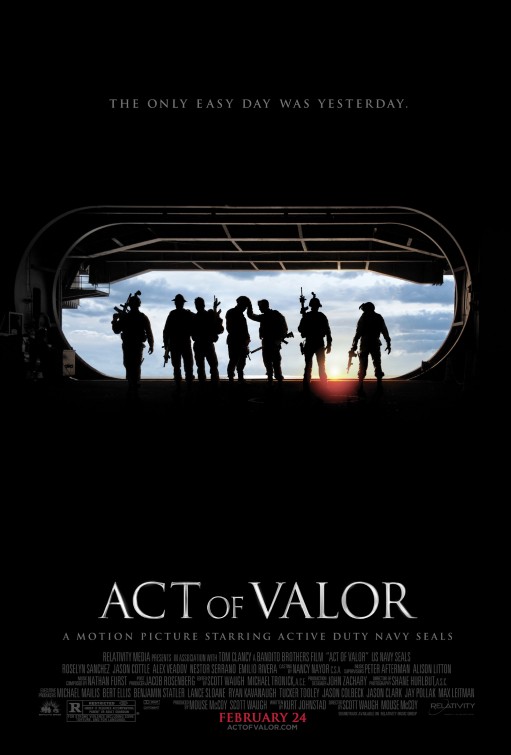 Hollywood often gets ridiculed for its tenuous connection to reality. I doubt any real U.S. Navy Seals look at 1990’s Navy Seals as a paragon of military validity. The makers of Act of Valor thought they could do one better than Hollywood. They hired real-life active-duty U.S. Navy Seals as their stars and made a movie based upon Seal combat experiences. Act of Valor was billed as the real deal. I just wish the filmmakers had spent less time on trivial yet realistic details and more time on plot, characters, and enticing action.
Who cares that the movie stars actual Navy Seals? Apparently enough people did judging by its healthy box-office returns in the spring, but really, why should a movie be any better because it has real Navy Seals pretending to be actors rather than actors pretending to be Navy Seals? Is this movie brought to a greater level of excellence because the characters know intuitively how to hold a gun properly? Was the slight difference in posture the difference maker? I suppose there is some curiosity seeing real Navy Seals go through all their training, but you know who else could be trained? Actors! Which these fellas are not. The line delivery is so flat, like the Seals were just happy to spit out all their dialogue and move along. There’s little emotion to just about any line that isn’t communicated via a bark. I can’t fault these servicemen because they never signed up to be actors; they have bigger things on their minds. Is there anything in this movie that could not have been done with actors? I doubt it. I understand the gimmick but I just can’t comprehend the appeal. Can an actor not be taught how to hold a gun, how to clear a room, how to squeeze the shoulder of his colleague to communicate move forward? I salute the Seals for trying (as well as defending our country, naturally) but I’m reminded of the old adage: it’s easier to teach an actor how to sing than a singer how to act.
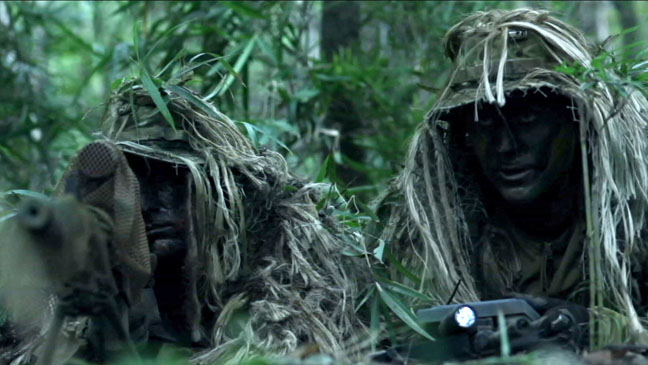 The movie seems more preoccupied with trivial details of authenticity than more important endeavors like story or character development. Here’s the most trivial detail of them all: live ammunition was used during the action sequences. WHY?! Do the guns not work with blanks? Why in the world would you dramatically escalate the danger on set and risk every shoot with live ammunition, actual gunplay? Action sequences are already a risk, so why would you exponentially increase the danger for … a slight uptick in realism? Again, it all feels like a movie in service of a gimmick. The plot is a rather cliché-filled jaunt across the world taking down terrorists, rescuing hostages, and mostly just knocking down doors, sweeping rooms, and shooting people in the head. Sure there’s a bad guy, a Chechen Islamic terrorist (double bonus: Russian and Arab!) and some other bad foreign guys with beards, but none of it ever seems to matter. I also question why a Chechen extremist would plot to attack the U.S., especially since we don’t exactly have the warmest international relationship with Russia. Surely a Chechen attack would strengthen that relationship, and the two countries might work in tandem targeting Chechnya. I’m saying this villainous plan is dumb. The good guys aren’t any deeper. Beyond their bravery, skill in combat, and impending fatherhood, we don’t know anything about these guys. A series of voiceovers try and list the various characters, but once the action starts good luck remembering any of them. In fact, good luck even keeping the two leads apart. I kept mixing them up myself.
And if that wasn’t bad enough, the action is a fairly big let down as well. Directors Mike McCoy and Scott Waugh must have studied under Tony Scott or Michael Bay, because every shot has the sleek beauty to it, the dawning sunsets, the cool gun mettle colors, the rah-rah jingoist spirit. Seriously, most of the action is just people shooting one another. That may sound like a no-brainer to anyone who bought a ticket, but the action needs to be properly thought out as well as the plot. The first mission, rescuing the tortured CIA Agent, is the best sequence because it has different points of action, organic consequences, and makes good use of geography. I’m going to hammer this point time and again until people take notice: geography is essential to well-developed action. You need to make use of your surroundings in interesting ways, otherwise what was the point of even setting the action there? The later action sequences fail to make use of any of these integral ingredients, so it becomes a rote series of people entering rooms, shooting other people, and moving to more rooms. Rather, rinse, repeat. The action has a muscular feel but it gets redundant rather quickly. That’s when your mind starts to notice how transparently the movie is working as a recruitment film for the U.S. Navy. There are sequences in this film that have no bearing on the plot (submarine visit?) other than to showcase the cool things that you, too, can do when enlisted in the Navy. There are plenty of sustained POV shots that give the illusion of a video game, war as a game. This is also why the complexities of war and geo-politics are sanded down to a series of clear-cut missions. I feel like the real servicemen deserve a more complex movie that treats their heroics as something more than clearing a video game level.
 When you get down to it, the audience that made Act of Valor a hit this past spring reminds me a lot of the audience that went to see the nearly four-hour Civil War movie, Gods and Generals. These are audiences obsessed with the details of realism. They’ll pore over the details of costumes and tactics. Whether the movie is actually any good or not, the characters engaging, the plot entertaining, is all immaterial. It’s the details they came to see. Hence the real-life Navy Seals, the missions inspired by real Seals, and the live ammunition on set. That’s what makes a movie to them. For me, I need more than realistic details; I need people and a story, and if it’s an action movie, then there better be well-developed action. It’s not like Act of Valor is a documentary people. It’s all pretend. I’ll be interested in how audiences respond to director Kathryn Bigelow’s movie about the hunt and execution of Osama bin Laden, Zero Dark Thirty. That movie uses actors and has an Oscar-winning director and screenwriter. Let’s see if anyone can tell the difference.
Nate’s Grade: C-
Share this:

Total Recall (2012)
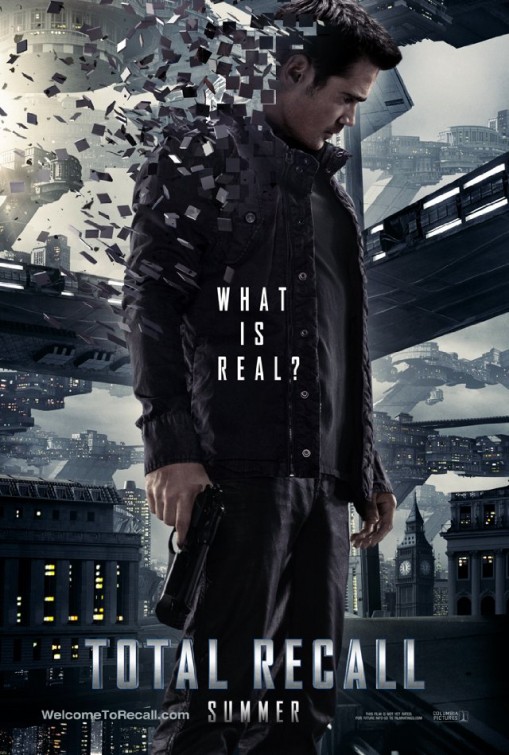 The latest needless remake takes the basic elements of 1990’s Total Recall and streamlines them into one very long chase sequence. And for those concerned males, the three-boobed lady makes a triumphant reappearance, because surely the movie wouldn’t be the same without her. Though in the age of the Internet, the sight of a three-boobed woman seems less indelible to impressionable male minds. But I digress. I was ready to dismiss this as another soulless Hollywood remake. Then I found myself enjoying Total Recall, and even the stuff that was dumb I had to also admit was cool. Take for instance a commute that goes through the center of the Earth. How exactly could such a thing be built? What does one do for maintenance? How does this not affect the Earth’s rotation? But then I forgot all about it because, in pure movie terms, it was cool. The zero gravity change-up as the transport changes directions at the core – cool. The fact that we get a zero gravity action sequence in this environment – cool. The fact that this transport system becomes a conduit for an invasion – cool. The plot mechanics are all familiar, notably the memory wipes and the super spy histories, but I didn’t care because the movie rarely lets its foot off the gas. When this thing starts, it doesn’t let up. The chase sequences are well executed amidst an imaginative array of locations, from a flying highway to a series of hanging housing developments. It’s not terribly smart but Total Recall is an entertaining escapist thriller that delivers some robust action and enough imagination in its future settings. Plus, there’s a woman with three boobs in it.
Nate’s Grade: B
Share this:

The Intouchables (2012)
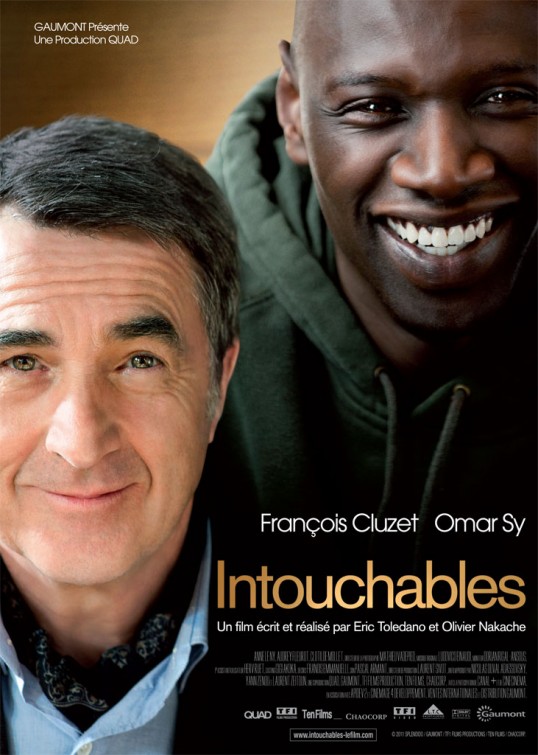 You’d never know it, but the highest-grossing film in Europe last year had nothing to do with super heroes, or sequels, or Hollywood itself. A small French film with the strange title of The Intouchablesmanages to break down just about every European box-office record last fall, sweeping across the continent and winning over hearts of numerous nationalities. The Weinstein Company bought the English-language adaptation rights, but before that gets underway they’re also releasing the original French movie to American audiences. Will subtitle-averse American audiences warm up to the little movie that has proven so hard to resist worldwide?
Philippe (Francois Cluzet) is rich quadriplegic and looking for a new caregiver to his many needs. In walks Driss (Omar Sy), a brash and headstrong man from a very different world: lower class, urban, and black. Philippe responds to the man’s irreverence and gumption and hires Driss on a trial basis. The upper-class lifestyle is like a fantasy to Driss, but the many responsibilities of caring for a man with no feeling below the neck are harder than anticipated. He objects at the very idea of having to manually evacuate the man’s… insides. The two opposites attract and the men become close friends and open one another up to new experiences.
 At its core, The Intouchables is the story of two men and their unlikely friendship. It’s told with enough weight, conviction, and character development that it’s easy to get wrapped up in the movie’s sweeping emotional tide. It’s a familiar tale, essentially that of the coming together of two people from distinctly different walks of life. You’ve seen this type of story before, where the upper class learns to cut loose and embrace life more fully, where the lower-class individual finds a path of dignity and responsibility. It’s been done before but rarely has it been done with such aplomb. Any storyline that involves a quadriplegic man and an inner city youth coming together sounds rife for after-school moralizing and sappy life-lessons. Thankfully, The Intouchables finds an angle that hits the emotional highpoints without tipping over into overt maudlin territory. Phillippe doesn’t want anyone’s pity. What is meant as good intentions can become another handicap; public perception of the individual’s limitations. Like The Diving Bell and the Butterfly, the 2007 inspirational French film about a significantly paralyzed man who could only move his left eye (what is it about French films and paralysis?), The Intouchables brings you into a world few glimpse and shows us what the perseverance of the human spirit can reap. Even a conversation that steers to sexuality can be illuminating and, for concerned male viewers, comforting that even if you can’t feel anything below the neck, the human body can adapt. In this regard, the film is a fascinating look into the life and care of a quadriplegic man (albeit an insanely wealthy one), and the fact that it’s also a moving and winning buddy comedy is yet another virtue. It’s like France’s version of a bromance.
It’s easy to see why The Intouchables has had runaway success in Europe, totaling over $300 million before ever opening in the States. This thing is a born crowd-pleaser. The characters are given room to roam, flesh out, and the interaction between two different men and their growing affection is a natural emotional foundation. We care about these characters, we smile and laugh with their interactions, the way that both men realize they need the other. It’s touching without being cloying and rich with emotional rewards by film’s end. Then there’s the fact that it’s also consistently funny without overplaying the class conflicts. There is an amusing subplot about the nebulous nature of modern art and what qualifies as “art”: the work or the knowledge that it’s from an “artist.” There’s a nice payoff with that one, but most of the humor is character-based, with the jovial Driss bouncing off the staid sarcasm of Philippe. There’s one comic subplot that seems to be hitting the same note time and again — Driss’ dogged romantic pursuit of Philippe’s assistant (Audrey Fleurot). It’s almost forgivable given the immense charms of Sy, but her character gets reduced to little more than a potential love match for Driss’ energetic libido. The humor, buoyant but also sensible, gives the film a defter touch when it comes to the more dramatic moments of loss and isolation and mourning. It’s easy to see why audiences have been falling in love with The Intouchables around the globe; they’re programmed to cry and laugh in equal measure.
And it’s that vague sense of programming that lingers. This is a film that knows exactly what chords to strike and how often. It can be accused of pandering and you’ll be able to guess every point of the plot. You think Driss will get Philippe to finally meet the woman he’s corresponding to for months? You think the upper crust will break from their immaculate stuffy prisons and learn to cut loose, spurned from Driss’ involvement? Do you think Philippe’s bratty teen daughter will learnt to shape up and fly right? Will Driss take a stand and stop his younger sibling from falling under the sway of criminal influences? Will the two men realize they truly need one another’s companionship? The answers are obvious; as are the plot turns and the happy ending, but The Intouchables goes about its business with such mass-appeal precision that you don’t really mind being manipulated. When someone can pull strings this skillfully, and quite transparently, almost daring the audience to resist, I almost admire the manipulation. Unlike Extremely Loud & Incredibly Close, another blatantly manipulative teary adult drama, at least this movie succeeds because we care about the characters rather than just bad things happening to people onscreen. The Intouchables isn’t subtle about its aims, but it is hard to resist a film this beguiling and tender and involving.
 Sy (Micmacs) is the breakout star of the movie. His gregarious, jubilant charisma instantly engenders the character of Driss to the audience. He’s constantly smiling, laughing, and cracking wise, and pushing others to be better. Sy brings such life to the movie that you instantly miss him when he’s gone. Cluzet (Tell No One), a dead ringer for Dustin Hoffman, has the more restrained role, no pun intended. His performance has to be very controlled yet believable, and Cluzet does an admirable job of building a character from the neck up. He’s a wounded man still recovering from the loss of his wife as well as his own crippling fears of loneliness. When these two are together onscreen, that’s when all the movie’s potential problems become a distant memory. The conviction in their big-hearted performances makes all the sentiment easy to swallow.
Several critics have accused the film of being borderline racist. I think the charge of racism is overdone. Just because Driss’ family lives in low-income housing doesn’t mean it’s making some blanket statement about the black experience in France. I suppose some chafe at the energetic, outspoken, and general virility of Driss. But I think critics looking for racist depictions of black males are overlooking the point that Driss had to be outspoken and energetic because Philippe is immobile and reticent. It’s in service of character contrast, not just recapitulating the figure of Loud Outspoken Black Male (a.k.a. the modern-equivalent of the age-old Noble Savage treatment). The significant part of Driss is that he has a sketchy past and comes from a low-income family struggling to get by. His race certainly plays up the contrast between the world of white privilege in France, but it’s not the central difference between these two men. Critics have also brought up the fact that the facts of the true-life story are different than what we see onscreen. Philippe’s caregiver, Abdell Sellou, was a Muslim man from Algeria, not a black man from Senegal. Does this truly bother anybody? Does the man’s heritage and ethnic background drastically alter the relationships formed or the earnest connections made? The movie doesn’t seem to think so and closes with the real-life figures onscreen, showing to each audience member the adaptation differences. Unlike something as racially questionable as The Blind Side, Driss is not rescued by saintly white people; he is an active member in his own self-actualization and not a passive receptor of the benefits of rich white people. With that said, there are still a few moments of ethnic depictions that might make you cringe, like Driss’ reaction to a night out at the hoity-toity opera.
During my viewing, I was reminded most of Scent of a Woman, another down-the-middle buddy comedy about a disabled man and his caregiver learning from one another and pushing beyond their comfort levels. It’s emotional without being too squishy and funny without going overboard, but make no mistake: The Intouchables is just as formulaic as a Hollywood production. The story and conflicts are familiar, the afflictions and backgrounds only differ. It’s feel-good, mass appeal comfort food, and when done this skillfully it’s hard to resist its call (I had a similar reaction to last year’s The Help). Its story of friendship, personal triumph, and all those happy things, but it’s also emotionally manipulative, littered with undeveloped subplots and a few uncomfortable moments of ethnic depictions. Fortunately the shining, vibrant performances from Sy and Cluzet, and their chemistry together, elevate the film’s softer and quasi-pandering sensibilities. It’s the story of two men, and by the end we greatly care for these two men, and their deep friendship and appreciation of one another. The Intouchables is a sly crowd-pleaser that dares you to defy its mass charms. And with actors this good, resistance is futile.
Nate’s Grade: B
Share this:

Haywire (2012)
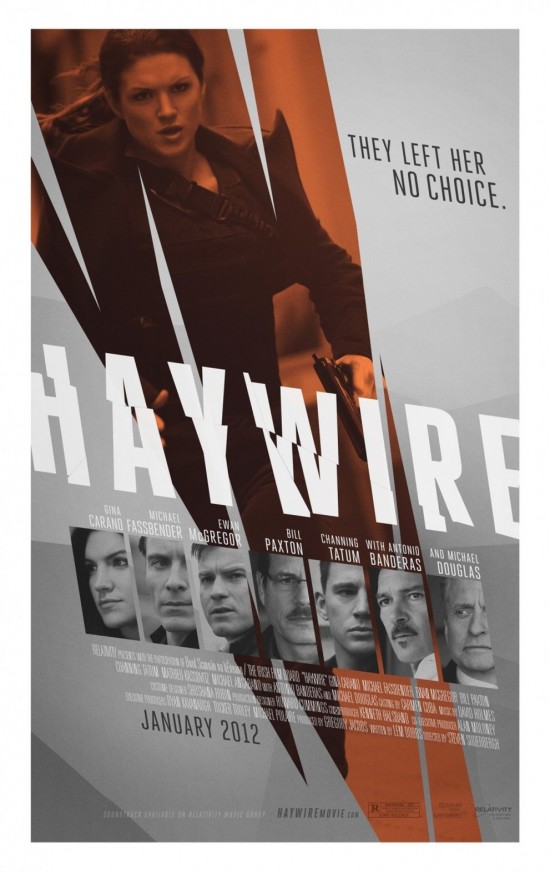 Haywire is director Steven Soderbergh’s experiment in the field of the action thriller, and it’s sparse and arty and pretty boring too. Soderbergh takes another non-actor, this time MMA fighter Gina Carano, and builds a spy thriller around the talents of this imposing fighter. Carano is no actor and her flat line delivery will routinely remind you of her limitations, but man alive does this woman just kick ass. To Soderbergh’s credit, the fight scenes occur in longer takes at a safe distance so that we the audience can watch and comprehend. Carano impresses as a physical specimen, both as a fighter and in other ways (she’s certainly got movie-star looks). I just wish this had been a more traditional action movie instead of Soderbergh’s jazzy, clinical genre experiment. There’s a handful of fights and a handful of chases, but mostly the plot is tied up in knots of who betrayed who and why. The dialogue volume is also curiously kept at a very low level, which obscures many conversations (I was forced to turn on the subtitles just to keep up). The plot itself is such a familiar rehash so why doesn’t Soderbergh pump it with more action? A bevy of stars appear in this thing (Ewan McGregor, Michael Douglas, Antonio Banderas, Michael Fassbender, Channing Tatum) but gives them precious little to do. Unless Haywire is in fight mode, it’s a rather soggy bore. The minimalism in a genre known for bombast is commendable but when that minimalism also stretches into plot and character and pacing, then you’ve entered into another Soderbergh indie experiment. For my money, Haywire is too sparse, too generic, and too dull to recommend, but I’d love to see more of Carano cracking skulls.
Nate’s Grade: C
Share this:

One for the Money (2012)
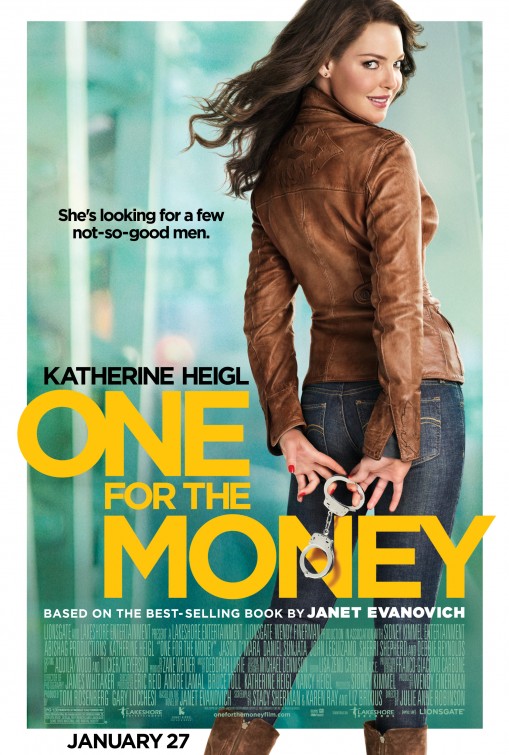 I think it’s about time we all conduct an intervention for actress Katherine Heigl, whatever it takes to stop her from starring, and producing, such middling junk like One for the Money. Heigl plays a novice bounty hunter, a Jersey girl on hard times who is tracking down her ex-boyfriend for a big payday. Yes, it’s essentially a gender reversal of the loathsome Jennifer Anniston movie, The Bounty Hunter, but at least this movie doesn’t foster a forced romance. I give the movie some credit for presenting two potential love interests for Heigl and by film’s end she’s still on her own. Bravo. The rest of the movie, however, is all strictly by the book, including the colorful characters that Heigl seems to collect. One for the Money isn’t particularly funny or particularly good. It also isn’t particularly offensive; it’s just the standard pap you expect from Heigl at this point. Here’s a confession: I really, truly enjoy Heigl as an actress. She’s terrific at comedy and has star-power charisma, and even in junk she’s still effortlessly enjoyable to watch. This woman has talent, she just doesn’t have taste when it comes to picking movie roles. Or maybe she’s content with churning out a mediocre rom-com every year or so for her fans. I just wish Heigl would gain some confidence and bounce from the ghetto of rom-coms, or at least poorly written, blandly formulaic ones. She’s taken the rom-com crown that once belonged to Julia Roberts, Meg Ryan, and Sandra Bullock, but look to them as example. You will have to adapt or die, because eventually Hollywood will find the next Katherine Heigl and supplant the old one.
Nate’s Grade: C
Share this:

The Dark Knight Rises (2012)
 Let’s be honest, The Dark Knight Rises movie was never going to meet fan expectations after the high-water mark between superhero movie and crafty crime thriller that was the pop-art masterpiece, The Dark Knight. Whatever director/co-writer Christopher Nolan put together was fated not to match the pulpy big blockbuster alchemy that he worked so well in 2008. Minus Heath Ledger’s instantly iconic performance, a role that set the film on fire whenever he was onscreen, there is going to be a certain void to this capper to the trilogy. Now having seen the movie twice, including once in sphincter-rattling IMAX, I feel that I can truthfully state the most obvious: The Dark Knight Rises is not as good as the previous movies. While a fine finale for an ambitious series, this is definitely the weakest movie of the trilogy.
It’s been eight years since Gotham City last saw the likes of Batman. Bruce Wayne (Christian Bale) is an older man, hobbled by age, and living as a recluse in his mansion. His trusted friend and butler Alfred (Michael Caine) keeps encouraging Bruce to seek a life outside that of Batman. In those eight years, Gotham’s police have cracked down on organized crime thanks to the Dent Act, a law named after the late district attorney Harvey Dent (a fallen idol that only a handful know the real truth about). Commissioner Gordon (Gary Oldman) is growing sick with the secret of Harvey Dent and looks to retire from the force. Miranda Tate (Marion Cotillard) is a businesswoman eager to restart Wayne’s clean energy project, and a woman interesting in getting Bruce back on his feet. There’s also Selina Kyle (Anne Hathaway), a.k.a. Catwoman, a master thief who gives Bruce a new challenge. But then along comes Bane (Tom Hardy), a master terrorist and figure of brute strength. His goal is to fulfill the League of Shadows’ plan and destroy Gotham City and expose its rampant corruption. He sidelines Batman and takes over the city, unleashing criminals and hordes of the downtrodden upon the wealthy. There is no escape from Bane’s plan, his wrath, but Bruce Wayne must rise to the occasion and be ready to sacrifice the last of himself for the people of Gotham.
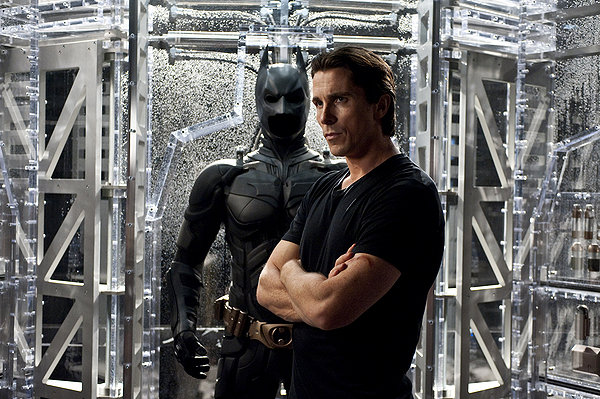 Firstly, Bane is no Joker. The bad guy lacks the fiendish charisma of Ledger’s Joker and he’s not as well integrated thematically into the movie. The Joker was an anarchist that wanted to tear down the pretensions of society and watch people “eat each other.” And we watched a city come unglued. We explore the notion of escalation and what the blowback would be for a man fighting crime in a costume. With Dark Knight Rises, Bane wants to take up the mantle of Ra’s Al Ghul (Liam Neeson) and wipe Gotham off the map. He’s got moments of being a master planner but really he’s just a big heavy. He’s the big tough guy that beats up old man Bruce Wayne, and Bane is continuously diminished in the film as it goes. A late revelation with the character completely diminishes his role and turns him into the equivalent of a mean junkyard dog. His big plan is simply to rile up the masses and wait for the inevitable. Hardy (Bronson) is a great actor prone to mesmerizing performances. This isn’t one of them. He’s super beefy but the facial mask, looking like some sea urchin, obscures half his face. It’s all physicality and eyes for his performance, along with very amped-up dialogue that you can tell was rerecorded after filming. Every time Bane speaks it’s like he has a speaker system installed in his face. And then there’s the matter of his sticky accent, which to me sounds like German mad scientist but to my friends sounded like drunken Sean Connery.
Bane keeps espousing about the corruption of Gotham but you really never get a strong sense of what that corruption has lead to. Catwoman talks about the Gotham elites living large while the rest of the city struggles; but rarely do you get a sense of this. So when Bane flips the tables, and the elite and wealthy are stripped of their decadence and put on trial by mobs, it feels improperly set up. Just because you have characters talk about wealth disparity and the city’s corrupting influence doesn’t mean it’s been established. Nolan’s Batman movies are a reflection of our modern-day anxieties in a post-9/11 world, so I wasn’t surprised to see a society rotting away from the sociopathic greed and wanton excess of the 1%. But rather than serve up a wealth disparity parable of class conflict, the movie simply turns to mob rule, a far less nuanced and interesting dissection of current events and fears. It’s like the French revolution took a trip to Gotham City (Gordon even quotes from A Tale of Two Cities). It’s a society built upon a central lie, the idol of Harvey Dent, but the movie fails to make the corruption felt. In the end, this is all pretty weak social allegory. And would it have killed Bane to be a little more brutal to stock exchange short-sellers?
 Then there’s the typical Nolan origami plot with the myriad of subplots intersecting. This is the first time in the series where the plots felt poorly developed. Rewatch Batman Begins or The Dark Knight, as I recently did, and you’ll see there is not an ounce of fat in those movies, not one wasted scene or one wasted line. Sure they got secret super ninjas and Katie Holmes, but those movies were well built blockbusters. I could have done without Bane entirely and certainly would have loved more of Catwoman. Hathaway (Alice in Wonderland) is terrific in the antihero role and brings a very interesting dynamic relationship with Batman. She may be the only person who understands him. I wanted more Catwoman, the movie needed more Catwoman, but alas she is just a plot device to connect Wayne to Bane. She has a larger role in the concluding melee but essentially becomes Batman’s reluctant wingman. The whole theme of the 99% vs. the 1% could have been generously explored with this character, and her spark and charisma would certainly be enough to get Bruce Wayne out of bed again. Then there’s the regular cop (Joseph Gordon-Levitt) doing the unheralded good deeds that so easily get overlooked. Here is an interesting character that, due to some leaps in logic, connects with Bruce Wayne on a unique level. He presents a counterbalance to all the souped-up superheroes, a recognizably regular human trying to do good. It’s then a shame that he gets entirely relegated during the third act so that the superheroes and their super toys can make some noise.
For a Batman movie there’s hardly any Batman in it. The caped crusader has been in retirement for eight years, so it takes some time before Bruce puts the suit back on. But then he’s also sidelined for a good third of the movie, stowed away in a far-off prison. The entire Indian prison sequence really could have been exorcised. It essentially becomes a Rocky training moment for Bruce Wayne to recover and a plot device to explain why there needs to be a time gap in the story. But this part of the movie just feels like it goes on forever, and we all know where it will go so we just keep waiting for the movie to get there. No one wants a Batman movie where Batman sits the middle out. The end feels relatively fitting but any fan of The Iron Giant will recognize some similar key elements.
And while I’m on the subject, let me do some estimates here. The timeline between Batman Begins and The Dark Knight is about a year, as the Joker notes to a congregation of mobsters. I’ll be generous and say that the events of The Dark Knight last two months. We learn that Batman never appeared again after the death of Harvey Dent, and now we flash to eight years later with The Dark Knight Rises. So you’re telling me that we only really got a solid year of Batman being Batman? That over the course of nine years he was Batman for only one of them? That’s very little Batman-ing for a Batman franchise.
But even with these flaws in tow, The Dark Knight Rises is still an exciting, stimulating, and mostly satisfying close to a trilogy of unprecedented ambition and scope for a modern blockbuster. The action sequences in this movie are huge and exhilarating. I loved Bane turning Batman’s armada of weapons against him. The Bat fighter plane is a nice addition that gets plenty of solid screen time. The sheer scope of what Nolan produces is epic; from a plane being hijacked in mid-flight and torn apart, to a city being leveled by explosives, to a face-off between a bevy of armored Batmobiles and the Bat plane through the streets of Gotham, the movie does not disappoint when it comes to explosive, large-scale action set pieces. This is also the first Batman movie where the climax is the best part of the film. The last half hour is solid action but also a fitting sendoff for a beloved character. Some will grumble with certain hat-tipping moments at the end, but I found it entirely satisfying. It all comes back to the central thesis of Nolan’s Batman films about becoming something more than just a man, becoming a symbol, and that symbol is meant to inspire others. By the end, you feel that the inspiration has been earned as so has our conclusion.
 I want to single out Caine (Harry Brown) who has very few scenes but absolutely kills them. He’s the emotional core of the movie, perhaps even the series, and has always been hoping that his charge, Bruce Wayne, would never return to Gotham. He’s the voice of reason in the movie, the man that reminds Bruce about the costs of a life spent seeking vengeance and sacrificing his body. I wish Caine was in the movie longer but his scenes are pivotal to the plot, as is his absence.
The Dark Knight Rises doesn’t rise to the level of artistic excellence of its predecessors, but it’s certainly a strong summer blockbuster that works as an agreeable finale to the premier franchise of the era. It’s not quite the knockout we were expecting from Nolan but it still delivers where it counts. I wish it had give a fuller, richer portrait of a city corrupt from the inside out, a society rotting away and ready for revolution, and plus I also wish we had plenty more Catwoman and plenty more shots of Anne Hathaway in her Catwoman cat suit (Michelle Pfeiffer still has nothing to fear), but these are the things of dreams. Nolan’s aim has always been to place Batman in a world that is recognizably our own, and with that comes the responsibility of bringing a stolid sense of realism with all the blockbuster pyrotechnics. This artistic ethos has given us some extraordinary movies, though some Batman purists would object that Nolan’s hyper-realism is not the Batman they grew up with. It’s hard to really get a sense of the accomplishments that Nolan and his team has been able to pull off over the course of three bladder-unfriendly movies and seven years. He’s taken the superhero movie and redefined it, brought it unparalleled psychological depth and philosophical analysis, and given a human quality to what normally gets dismissed as escapism. The Dark Knight Rises isn’t as revelatory as its previous entry but it sticks the landing and puts to rest what is indisputably the greatest superhero trilogy of all time.
Now get ready for the reboot in three years.
Nate’s Grade: B
Share this:

Beasts of the Southern Wild (2012)
 After months of rapturous praise from Sundance and Cannes, allow me to be the wet blanket of the critical community, because Beasts of the Southern Wild is one big helping of “meh.” I didn’t enjoy this movie at all and its mixture of strange fantasy elements and a hellish childhood reminded me of another misfire, 2009’s Where the Wild Things Are.
Six-year-old Hushpuppy (Quvenzhane Wallis) lives on a spit of land off New Orleans and below the levy. This tucked-away land is nicknamed by its colorful, besotted residents as the Bathtub. Hushpuppy lives with her father Wink (Dwight Henry) in large shacks elevated high off the ground. This comes in handy because after a disastrous flood, Hushpuppy and her father have to navigate the waters to find others and scramble for some return to their life and culture. The residents must also make sure to be cautious because the U.S. government, which is evacuating all flood-devastated areas, is looking for survivors to forcibly remove. Wink is sick and has to impart the ways of his family and culture to young Hushpuppy, who sees herself as one piece in a big puzzle.
 This movie is awash in all sorts of tones and storylines, failing to cohesively gel together or form some kind of meaningful message. I could have sworn that the fantasy elements, namely the giant thundering pack of large boars, were just going to be a visual metaphor for Hushpuppy’s journey. And then they actually show up and every person can see them. So, now what? The boars are one of many ideas that the movie just sort of toys around with before losing interest. This is not a film of magic realism. This is not a film about the escapes from a hard reality. In a way, this movie plays out like if Terrence Malick had made Gummo, and if you know me, you know I loathe both Gummo and Terrence Malick movies. Beasts constantly flirts with pseudo-intellectual pabulum, trying to reach something profound but instead settling for confounding. Hushpuppy’s curlicue unnatural narration talks about being a little piece in a big universe and the interconnectedness of all things, but by film’s end you get no dynamic sense of this. What I got was a little kid’s poor life getting worse, and that’s about it. If the film has anything larger to say about the world, Katrina, human connection, then I’m at a loss as to explain what that may be. Beasts offers half-formed ideas, strange, conflicting imagery, and characters that are rather thinly written and barely register. I never found Hushpuppy an engaging protagonist and felt like her very age and the heavy burdens she is forced to carry were manipulative substitutes for actual characterization. I cannot understand the love here.
The movie is something of a wild stew of Southern folklore and coming-of-age tropes and plenty of indie trappings, like weak political allegory, roaming handheld camerawork, and sacrificing story to the altar of realism. So much of this movie feels like it was made to give a sense of how an overlooked life in poverty is lived. From that standpoint the film does a commendable job of showing everyday life and the struggle to feed and survive. There’s a certain sense of ingenuity at work. But all of these setting details do not take the place of an involving story and characters we should care about. I felt sorry for the various residents of the Bathtub and their lot in life, but I never felt attached to any of them. That’s because, as mentioned before, they’re bland and simplistically drawn, but also because Beasts doesn’t bother to do anything else other than create its rich, tragic, harsh world. It’s authentic all right, but what does all that authenticity have to add to genuine character work? Artistic authenticity is not always synonymous with telling a good story. The Bathtub feels real, got it. So now what?
Hushpuppy lives in squalor and the movie has a disquieting romanticism of abject poverty. To the residents of the Bathtub, they are living in some forgotten paradise away from the concerns of the mainland. They refuse to leave their homes and their lives, even though there isn’t much of a home to call one’s own. We wade in this horrible existence and are meant to pretend like it’s an idyllic lifestyle, you know, with all the creature comforts of child abuse thrown in for extra measure. While Beasts looks entirely authentic with its impoverished, junkyard-esque production design, the overall mood and atmosphere hardly seems worth celebrating. Now, I’m not saying that characters can’t make the most of whatever life has given them and meet the implacable with fearless optimism. These characters would likely shun our pity; they reject any government assistance after the great flood and just want to sneak back to their simpler lives. This is not an enviable life, and the fact that the movie tries to romanticize it feels deeply irresponsible. At least with a film like Winter’s Bone, where you felt the crushing existence of systemic poverty, the filmmakers didn’t try and put a smile on all the drudgery. In that movie, you felt the trappings of poverty and how it can sink into your soul. On some level perseverance in the face of adversity is noble, but so would escaping poverty. Regardless, this is not worthy of romanticizing or fetishizing.
 Little Wallis is certainly getting her fair share of attention for anchoring the film. She’s six years old so it’s hard to assess her full acting potential, but the kid looks to have some fire in her. However, it is not a performance that leaves a lasting impression. I realized that much of her performance was long reaction shots and that ponderous voiceover narration. True, she does get some dramatic sequences and lets loose a few tears, but it feels like the movie didn’t want to push her too far and settled on a barrage of shots of Hushpuppy being stoic. I was more impressed with Henry, he too an acting novice making his debut. His character is more complex than an innocent naïf we have as our protagonist. He’s clearly dying and trying to quickly get his daughter prepared for a life of independence. He’s also quick to anger and you can feel the heavy weight of his life and his fledgling mission. In fact, I think Beasts would have been better if it had been told from the father’s perspective rather than our child trying to understand the great big scary world. There’s certainly a lot more drama and an easier route for sympathy, even if he could be accused of being cruel and neglectful.
I’ll admit that Beasts of the Southern Wild is different, daring, and fitfully imaginative, as well as benefiting from strong production design and special effects work. But “different” and “daring” doesn’t always mean good. I cannot in good faith say I enjoyed this movie, especially with its freeform plot, messages, tones, and occasional garish imagery. The plot seems desperate for some form of greater meaning, defaulting to ponderous poetry rather than supply a workable narrative and characters that are developed. Then there’s the whole romanticizing of systemic poverty that I find off-putting and wrongheaded. This is just a swampy mess of a movie, one that sinks under the weight of its own pretensions. It’s admirable from a technical standpoint but as a movie, Beasts of the Southern Wild is an exercise in eclectic navel-gazing.
Nate’s Grade: C+


 nathanzoebl
You must be logged in to post a comment.