Category Archives: 2012 Movies
Argo (2012)
 The reinvention of Ben Affleck as movie director took a big step forward with the critical and commercial success of the 2010 Boston cops-and-robbers thriller, The Town. While I’d argue Affleck’s first outing as a director, 2007’s Gone Baby Gone, is still his best, The Town won over plenty of doubters. Here was an actor-turned-director who could deliver smart drama, intense suspense, and coax Oscar-caliber performances from his brilliantly assembled casts. Have you seen Blake Lively half as good in anything as she was as a tragic junkie single mom in The Town? She’ll be able to get work for years just from the demo reels of that performance. But with two sturdy, complex, taut genre movies under his belt, Affleck still had doubters. The political thriller Argo takes Affleck far out of his Bostonian comfort zone. The creative stretching proves fruitful because Argo is a stirring, fascinating, and engrossing true-life story that should at last silence the remainng doubters concerning Affleck’s talents behind the camera.
In 1979, The U.S. embassy in Tehran was overtaken by a storm of Iranian protestors. Fifty-two Americans were held hostage for an exasperating 444 days. During the takeover, six Americans escapes through a back alley and found asylum with the Canadian ambassador (Victor Garber). There they waited for months, trying to work out a plan to escape. If caught by the mob, it’s very likely they would be deemed spies and executed. Enter CIA agent Tony Mendez (Ben Affleck) and his scheme. His idea is to pretend the six American hostages are part of a Canadian film crew scouting locations in Iran for their sci-fi movie. His superiors seem dubious but Mendez gets the green light. He heads to Hollywood and puts together his team, a veteran makeup artist (John Goodman) and an established producer (Alan Arkin) on the outs with the industry. They settle on the screenplay “Argo” and have to build a credible cover story. From there, Mendez travels into Iran to meet with the hidden hostages to sell them his scheme. They were all coming out together or nobody was getting back home.
 Argo is a fascinating story that seems like it could only exist in the movies, and yet it’s a true story and one hell of a story. It’s a mission movie, so we know the familiar flow of the film even as the details seem fresh (unless you’re Canadian). The very idea is one of those “so crazy it might work” plans; one State department official asks, “You don’t have any better bad ideas than this?” Even though we know it was a success, that doesn’t stop the movie from being engrossing. Argo flies by like a caper film as the CIA gathers the resources and experts to try and put together a ramshackle rescue mission. There’s feeling out the Hollywood angle, gathering the pieces to create the illusion of an actual film production, and the urgency of the façade. Even though it’s a bit outlandish, the fake movie plot seems worlds better than the other possible plans being pitched by the government agencies (smuggling in bicycles and maps?). I thought it was genuinely interesting just to be granted access to a room where people where debating rescue options and picking them apart. The film is consistently intriguing watching smart people come up with smart solutions to challenging problems.
Argo really is three movies expertly rolled together into one; a Middle East thriller, a Hollywood satire, and a D.C. procedural. It’s a bonus that every one of these segments works but it’s even more surprising, and rewarding, that the different segments all snap together without breaking tone. Credit Affleck the director for making sure his movie parts don’t overpower one another. We can go from a tense Middle East sequence where the hostages might have just risked exposure, and then we’ll cut to Hollywood and laugh at the cantankerous Lester. It’s a delicate balancing act that Affleck superbly handles. The humor of Hollywood doesn’t detract or minimize the seriousness of the Middle East chapters; it allows room to breathe, to let off steam. The D.C. segments are the biggest expository moments but they give scope and meaning to the danger. Each of these segments is compelling and each one could have been a captivating movie all its own. We’re fortunate that Argo gives us all three.
Audience ignorance aside, we may know how this story ends but that doesn’t stop the film from being completely nerve-wracking. Affleck showed remarkable skill in The Town when it came to building exciting sequences that felt like they would explode with tension. When it came to Argo, there were moments that literally kept me on the edge of my seat, a rarity with action films. The beginning sequence of the American embassy is rapt with suspense, as the security system deteriorates and the people inside realize the inevitable. They start destroying classified state evidence but really they just have to sit and wait, hearing the footsteps, knowing what is near. The sharp screenplay from Chris Terrio (Heights) does a tremendous job of developing clear suspense sequences. There’s the tension of the precarious subterfuge, of the hostages hiding behind enemy lines, so to speak. If one wrong person were to discover their identity, it could quickly unravel. There’s a whole team of children being paid to piece together shredded documents and photos like they were jigsaw puzzles. Knowing this, it makes the scenes where the group ventures out of the embassy thrilling. The group has to visit a marketplace as part of their cover and it’s terrifying. We know the steps of escape, and each one could easily blow up and get everyone killed. Just when you think you can breathe a sigh of relief we’ve moved onto the next challenge and the tension washes over you again. The climax is so tense that your audience will likely erupt in applause when the hostages eventually escape, relieved and proud of the accomplishment.
The maturation of Affleck as a bonafide directing talent continues. There’s a growing confidence in his direction. The man doesn’t have to rely on flashy visual artifice nor does he seem to be hewing to one notable style. He’s directing each movie as its own beast, be it crime thrillers or true-life suspense story. The man knows where to put his camera in the thick of the action. Affleck also eschews the popular shakycam docu-drama approach that too many filmmakers automatically does all the work of establishing realism. Docu-drama visuals can work when properly utilized, but too often I find it to be self-consciously arty and an annoying distraction. Affleck’s camera remains steady but holds on his actors, giving them space to emote. Three movies into his directing career, Affleck has established himself as one of the best men to direct actors. He’s already lead two actors to Oscar nominations and might just earn a third for Arkin. Plus there’s the fact that Argo, top to bottom, is cast with great character actors. You have people the likes of Michael Parks (Red State) who are there for one line. It also helps Affleck the actor to have Affleck the director.
 The only nagging problem with Argo is that it’s rather light when it comes to character development. The caper is the star of the movie and sucks up most of the screen time. The film does an excellent job of recreating the anxiety that the hostages felt. I can’t say we get to know any of them well as people. I can’t say we get to know much about Tony Mendez either, beside the de rigueur parts of being a CIA agent like divorce, child custody, and long nights of loneliness. The best-developed character in the movie is Lester Siegel, and while he’s terrifically entertaining, it’s something of a misstep for the cranky Hollywood producer to win that title. He’s a man who knows his value in the ever-changing currency of Hollywood; bitter, crabby, but hopeful of making a difference. Arkin (Little Miss Sunshine) is a natural fit for the character and brings more dimensions to the role. I wish the same care were given for the other people in the story, particularly those in harm’s way. The nuanced approach to character with Gone Baby Gone and The Town is just absent. Thankfully, the story is so engrossing that it’s not a mortal wound, but you do wish there was a greater emotional involvement in the film rather than a generic empathy of rescuing those in danger. Also, the Canadian involvement seems curiously downplayed even though their ambassador was the one hiding them for months. His role in the movie plays like he’s Guy #8. I know we tackle the CIA’s involvement but Canada could use more recognition for their integral contributions.
Argo establishes Ben Affleck as a dependable, versatile, actor’s director; someone along the likes of a Sidney Lumet or Sydney Pollack (I swear I don’t have a “Sydney” key lock in my brain). Affleck has proven to be a director who immerses himself into his stories, and his fingerprints are on every frame, every performance. He just nails it. The pacing is tight, the suspense builds to near unsustainable levels, and the tones are expertly juggled to prove complimentary rather than distractions. Best of all, Affleck lets Terrio’s terrific script take center stage. The incredible true-story of Argo is the biggest selling point for the movie, and Affleck doesn’t try to gussy up a whopper of a tale. The film has even more unexpected resonance given the recent spur of violent protests in the Middle East, notably the deadly attack on the U.S. embassy in Benghazi. Argo doesn’t sensationalize the hostage crises for cheap popcorn entertainment. Nor does it glorify or denigrate the Iranian’s outrage over the U.S. giving sanctuary to the deposed Shah. For a very political subject, the movie takes a very muted political stance, relying on the facts of the situation. The movie finds a rare poignancy in its appeal to the power of international cooperation. By the end of the movie, you might even tear up when you hear the actual hostages and government officials recount their struggle and ultimate triumph. Argo is that rare breed of a movie that seems to have everything. While it’s not perfect, it’s clear that Affleck is here to stay as a top-level director.
Nate’s Grade: A-
Share this:

Taken 2 (2012)
 Taken 2 (no, Taken Again, or The Retakening?) follows the all-too familiar path for action movies when sequel digits get added to titles. They attempt to redo the original premise, but bigger and better, but rarely does it succeed unless there’s a fresh take. Taken 2 is reheated leftovers. The first film was a pleasurably surprising action film, led by a steely performance from Liam Neeson. Now Bryan Mills and his family are vacationing in Istanbul and they all get taken… again (or retakened). But what really kills this movie, besides the compilation of genre clichés, is that these are the dumbest bad guys I’ve seen in some time. If I were hiring these goons I’d want to see where their class rank was at Goon University, or if they actually completed their goon studies. These guys give new meaning to the term incompetent. They don’t search Bryan’s person, they leave him unguarded and alone, and naturally they even poke their heads through bullet holes in the wall, only to be shot in the face. When the bad guys are this inept, it removes all danger. Part of the enjoyment of Taken was watching Bryan work up the food chain to rescue his daughter. Now we just get Neeson too easily taking out the bad guys. The action is a bit too hectic and doesn’t have the same crackle that helped the first film.Then there’s the dumb plot, which is best exemplified by the rooftop grenade sequence. Bryan’s daughter (Maggie Grace) is running across rooftops and just randomly tossing grenades (vacation grenades?), so Bryan can hear the sounds of explosions and note how close she is. Except she never looks where she’s tossing, so she’s indiscriminately tossing live explosive devices on the innocent civilians of Istanbul. If there’s a Taken 3, I think one of these innocent Turkish families should seek vengeance. Oh but there’s more stupidity, like Bryan killing a corrupt Turkish cop and having no ramifications for this whatsoever. It’s never spoken of again. Or Bryan and his daughter crashing through the U.S. embassy’s gates in a car, and two minutes later he’s walking the streets with no hassle. To sum up: Bryan and family murder a police officer, throw grenades into the city streets, and crash into the U.S. embassy.Taken 2 is a classic example of sequel-itis, and while it tries to make you remember the parts you liked in the first film (Neeson on a paternal rampage, his speech), I just kept remembering how much better Taken was the first takening.
Nate’s Grade: C
Share this:

The Master (2012)
 Writer/director Paul Thomas Anderson met with great resistance when he was shopping his script around for The Master. It was dubbed the “Scientology movie” and reportedly based upon the controversial religion and its leader, L. Ron Hubbard. It looked like Hollywood was spooked by the prospect of a movie that appeared to take on Scientology. Eventually Anderson got his financing and made the movie he wanted to make. Calling it the “Scientology movie” is misleading. I wish The Master was a Scientology expose because that would be far more interesting than the exasperating film I got, which is one nutty guy who dabbled in a Scientology-like cult. Maybe the resistance Anderson experienced wasn’t an indication of the subject matter. Perhaps it was only an indication that The Master just wasn’t a compelling story, a charge I can agree with wholeheartedly after viewing this disappointing film.
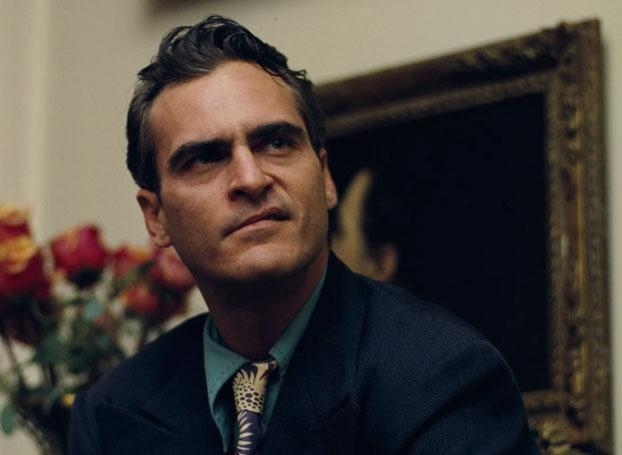
Freddie Quells (Joaquin Phoenix) is struggling to adjust to life after World War II. Fresh out of the Navy, he works as a department store photographer, until his rage and social awkwardness lead to him being fired. He’s drifting about and hops onto a ferry leaving town. Onboard is Lancaster Dodd (Phillip Seymour Hoffman) who describes himself as “a writer, a doctor, a nuclear physicist, a theoretical philosopher, but above all, a man.” Dodd has gathered a revered following. He believes that people can regress to past lives trillions, yes you read that right, of years into the past. Dodd’s own children admit that dear old dad is “making it up as he goes along.” His movement, known as The Cause, has been called a cult by detractors, the will of one man, and the followers don’t take kindly to challenges from the outside. Dodd adopts Freddie as a project. He’s on the verge of completing his second major treatise and Freddie seems to be an inspiration for him. Freddie finds some measure of acceptance within Dodd’s community of followers, but his erratic behavior keeps people on constant edge.
I found The Master to be boring; uncompromisingly boring, hopelessly boring, but worse than all that, pointlessly boring. Was this really a story that needed to be told? I cannot fathom why Anderson chose to tell this story or, in particular, why he chose to tell it through the character of Freddie Quell. A story about a huckster exploiting people with a religion he made up is a fascinating story with or without the Scientology/L. Ron Hubbard connections. That’s a story worthy of being made. Now, instead of this, we have two hours of a guy acting nuts. I would better be able to stomach the Freddie character if I felt like anything of significance was happening to him. He’s a broken man, clearly mentally ill in some capacity, and prone to outbursts that turn violent. Does he change? Does he grow? Does he do anything? Does his life have anything of significance happen to him over the course of 137 minutes? Not really. He’s pretty much the same guy from start to finish; his arc is essentially that he’s crazy at the start, meets Dodd, and then is crazy at the end. We get it, the guy is messed up. He makes a drink out of paint thinner for crying out loud. I didn’t care about him at all. I don’t need to see static scene after static scene of this guy acting out. I wasn’t a There Will Be Blood fan but at least Daniel Plainview was a strong central character with enough dimensions to carry a film. Freddie Quell just isn’t that interesting or entertaining. He’s actually a tiresome character because you get a perfect sense of who he is in just 10 minutes. The rest of the movie just seems to remind you what you already know.
 It is a disappointing realization but I feel like the Paul Thomas Anderson I enjoyed is slipping away, as his flashy, propulsive, plot-heavy early work has given way to opaque, reserved, and plotless movies. It’s like I just watched someone with the verve of Martin Scorsese transform into a poetic film somnambulist like Terrence Malick; not a good move. I don’t know what Anderson’s message is or what he was trying to say, and I’m unsure why he decided to use a limited character like Freddy Quells as his prism. It almost feels like Anderson is compensating for his plot-driven films of his early career, like he has to balance the scales in his mind. I shudder where this recompense might take Anderson for his next film. I like to think of myself as an intelligent moviegoer who enjoys being challenged by movies. But that doesn’t mean I’ll accept anything challenging as quality. Case in point: Jean-Luc Godard’s Film Socialism, which was contemptuous of its audience. I don’t mind doing work but you have to give me a reason. There has to be a reward, either with the narrative or with the characters. I found no rewards with The Master and it’s not because I didn’t “get it,” film snobs, it’s because the movie was too opaque to say anything of substance beyond simplistic observations about the abuse of power and influence.
When I say plotless I don’t mean that we’re simply watching paint dry, though there are stretches of The Master where I would feel that could be a suitable test from Dodd. There are events. There are scenes. There are changing relationships. It’s just that none of this seems to matter, or at least it never feels like it does. There’s no build, no increase in urgency, and The Master just sort of drifts along to the detached rhythms of Freddie. The movie can feel interminable, and you may ask yourself, on a loop, “Is this going anywhere?” There are two scenes that stand out because there are so few that seem to matter. One is shortly after Dodd and Freddie have been arrested. The two men are locked in opposing cells and they explode in venomous anger. It feels like Anderson can finally allow his characters to vent out what they’ve truly been feeling. Another memorable scene, just for weirdness, is when we jump inside Freddie’s head. All the women, young and old, at a social gathering suddenly lose their clothing (think: Choke). It’s one of the best scenes at exploring Freddie’s sexual compulsions, plus it’s just peculiar. I wanted more scenes like this where we try and get inside the man’s mind. The rest of the characters are underwritten, especially Amy Adams (Trouble with the Curve) as Dodd’s wife and fierce protector. This is a movie about two strong-willed men and everybody else gets relegated to minimal supporting positions. I miss the sprawling humanism of Boogie Nights and Magnolia.
From a technical standpoint, the movie is very accomplished. The 1950s era setting is lushly recreated, aided by cinematography that seems to present this bygone age in a colorless manner. By this I mean that the world feels muted, repressed, the colors are there but they don’t pop, and I think this look fits the movie marvelously. Anderson shot the film in 70mm, which would offer startling detail to his images. I did not see the film projected this way (as will most) but you could sense the time and effort put into getting the details of his world right. The musical score by Johnny Greenwood is minimalist but effective, with a few key strokes of a guitar to note rising tension.
 The true draw of the film is the performances, which are excellent and at least provide a reason for staying awake. This is Phoenix’s first role since his two-year performance stunt documented in I’m Still Here. It feels like his off-putting, confrontational, bizarre antics for that faux documentary were all just training for playing the character of Freddie. The man has sad, droopy eyes, a fixed sneer that denotes his permanent displeasure and cocksure attitude. He speaks in mumbled sentences, he walks with his arms pinned out, donning the posture and behavior of a chicken. It’s at once an odd and striking performance, and Phoenix does his best to make the character worthy of your attention. He gives it his all, but sadly Freddie just doesn’t merit prominence. Hoffman (Moneyball) is equally alluring as the charming huckster who seems to come alive under a spotlight; the man exudes an oily presence, and yet there are a handful of moments where he lashes out, venting the roiling anger that seems to be barely contained at times. Hoffman’s performance is one of willful self-delusion rather than rampant self-destruction, which makes him far more compelling in my opinion. I would have preferred a Lancaster Dodd movie rather than a Freddie Quells movie.
The Master is a confounding, airless, opaque character study that is far from masterful. The faults of the film and its stilted ambitions lay squarely at the feet of its flawed central character, Freddie Quell. The movie adopts Freddie’s demeanor, managing a distant, standoffish, defiant attitude that thumbs its nose at audience demands. Don’t you know entertainment has no place in art, silly filmgoers?
Anderson is still a vastly talented filmmaker but I lament the path his career has taken. I adored the first four movies of Anderson’s career, but now I wonder if I’ll ever get something along the likes of Boogie Nights or even Punch-Drunk Love again. At this point Anderson has earned enough artistic latitude to tell whatever stories he so chooses. This is why my frustration has mounted because I am at a loss to why he feels compelled to tell this story and in this manner. The Master is an artistically stillborn affair. You want to believe there’s more under the surface but I don’t see it. The main ideas and themes are hammered with little variation, the slight plot drifts aimlessly finding no sense of momentum, and the characters are kept at such distance that the film feels clinical, like we’re observing creatures under glass for study. It just so happens that none of these characters warrant the attention. The Master will be praised by a plethora of film critics. Peter Travers of Rolling Stone said it renews your faith in American cinema. I had the opposite reaction. The Master made me lose faith, mainly that I’ll ever enjoy a Paul Thomas Anderson film from this point on.
Nate’s Grade: C
Share this:

Looper (2012)
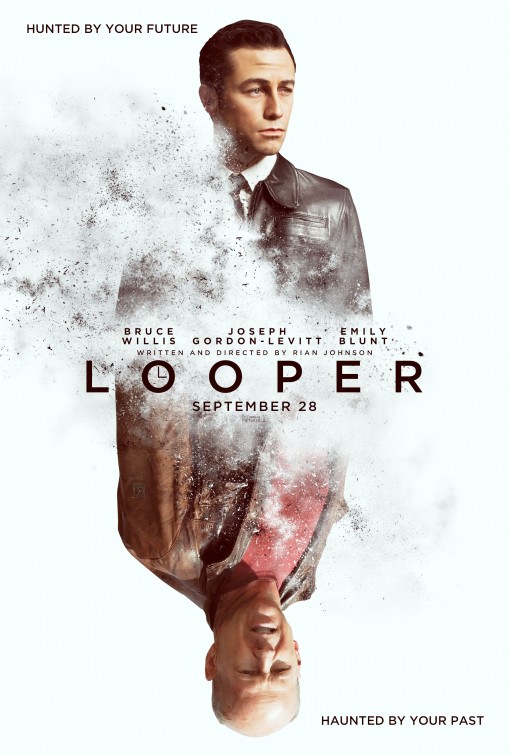 I became a Rian Johnson disciple the second that 2006’s Brick ended. I was floored by the originality, the artistic vision, the intelligence, and the creative voice. This was a unique filmmaker and I instantly knew this writer/director would be a man worth following. His follow-up, 2009’s The Brothers Bloom, was three fourths of a great movie, but a bit of an overdose on whimsy. Then I read that Johnson was next going to try his hand at time travel, and I could not contain my excitement. One of my favorite film genres and one of my favorite up-and-coming indie filmmakers together. I was expecting Johnson to do for time travel what he did with film noir (Brick) and the con movie (Brothers Bloom). How could Looper disappoint? Well, sadly, the movie found a way. It feels like Johnson smashed two halves of two different movies together, one good and one not so good.
In 2072, time travel is invented but instantly made illegal. The only people who have access to time travel are the mob. They have a surplus of dead bodies that need to disappear, so the mob sends them back 30 years. In 2042, Joe (Joseph Gordon-Levitt) is employed as a looper. He kills the guys the mob sends back in time and then disposes of the bodies. He’s paid well, and he and his fellow loopers live it up as privileged members of the Kansas City social sphere. Abe (Jeff Daniels) runs the show in town; he’s a mob guy from the future. There’s a catch to all the looper riches. The mob also wants to protect them in the future, so they send back the looper’s future self to be executed. It’s called closing the loop. And if you don’t kill your future self, bad things will definitely happen, just ask Seth (Paul Dano), a looper hacked apart to lure his future self back.
 The day comes where Joe is tasked with executing his future self, Old Joe (Bruce Willis). Old Joe escapes and goes on the run. Younger Joe is now under extreme pressure to kill his guy, or else the mob might just find him and start slicing body appendages. Old Joe is looking for the Rainmaker, who in 30 years will become a criminal tyrant responsible for much death. But in 2042, he’s only a child. Old Joe’s mission is to kill the child before he becomes the Rainmaker, and before he murders Old Joe’s eventual wife. While fleeing the mob, Joe takes refuge on a farm outside of the city. Sara (Emily Blunt) and her young son Cid (Pierce Gagnon) warily take in Joe but they’re also hiding a secret, that Cid has powerful telekinetic powers that can be put to great damage.
The film’s premise is compelling and allows for plenty of mind-bending possibilities, and Johnson has a fresh take on the sci-fi genre. Hunting down your future self is a grabber of a concept and I loved the scenes where Joe and Old Joe would sit down and converse. There’s the natural tension of Joe’s mission to eliminate his future self, but there’s also a flurry of ideas, ones that make the film better developed. Old Joe has an edge in foreknowledge but Joe has his own edge. He can change Old Joe’s memories by choosing different actions. He swears if he ever sees a picture of Old Joe’s wife that he’ll do everything in his path to alter fate, to make it so he never finds her. As a result, Old Joe is hobbled by headaches and fuzzy memories because the order of events is no longer concrete. “This time travel stuff fries my brain like an egg,” Old Joe admits. That, my friends, is a fascinating struggle for dominance and a refreshing take on time travel. Then you throw in the mob chasing after both Joes and you got an extra sense of urgency. Looper is playfully heady but easy enough to follow. It’s a thriller that doesn’t get bogged down in time travel logistics but it doesn’t pander to its audience either. If it did, I’m fairly certain Joe (addict, criminal, selfish) and Old Joe (eventual child slayer) would have taken turns to be more likeable. For a solid hour, Looper is alive with narrative jujitsu, a nice balance of action, drama, dark humor, intelligent plotting, stylish direction, the occasional startling visual, and strong acting from Gordon-Levitt and Willis.
And then the Looper becomes a completely different movie. Once the action shifts to Sara’s farm is where this movie completely unravels. I just couldn’t believe what was happening. The first half was so intriguing, intellectually stimulating, and thrilling, and then I got stuck on a farm and the movie turned into a lame version of Children of the Damned. I didn’t come for a telekinetic kid movie; I came for a time travel movie. The second half of this movie is practically wall-to-wall telekinetic kid stuff. The action slows down to a crawl and the flurry of ideas turns to a trickle as we introduce Strong Single Mom and Weird Son. I may have a cold heart but I didn’t care about these characters. I found the romance forced and Sara to be poorly developed. I found the kid annoying, and when he got mad and made his stupid mad face, it irritated me. Mostly I was irritated that the promise of the first half of the film had stalled out, and that this was where the movie was choosing to spend its dwindling time. It’s like the movie has been swallowed inside out by this stupid telekinetic subplot. The climax is fine but why did we have to travel through Dumb Farm Rest Stop to get there? Is it so that Joe can learn to be a better person? I didn’t buy that growth, especially with a kid as annoying and obviously dangerous as Cid. I suppose one night of sex with Emily Blunt (The Adjustment Bureau) could do the trick.
Besides the whole farm deal, there are other nagging questions I have that devalue Looper in my eyes.
 1) So in the future the mob is the only entity with access to time travel, but all they use it for is to dispose of bodies? That’s it? Biff Tanner used a sports almanac from the future to become king of the world. Are you telling me an organization that has historically profited from gambling would make no use of foreknowledge for personal gain?
2) Why would the mob have the loopers kill their older versions of themselves? This seems like a natural conflict of interest that could readily be avoided. Instead of having that particular looper kill his future self, thus closing the loop, why not assign that future version to a different looper? That way you don’t have to run the risk of the past looper letting his future self go. Or you could just never tell them what happened. For that matter, why does the mob have to send the guys back alive? Could they not simply just kill them and send the dead bodies 30 years back in time? This seems like an easier solution that also minimizes risk.
3) If you’ve just uncovered the power of time travel, why are you even bothering to send back your dead bodies 30 years into the past? Why not send your dead bodies back BILLIONS of years where the Earth is still forming, hot, and uninhabitable? I find this to be a better solution (I also wrote this solution in my own time travel screenplay, so there’s that too). Why can’t the mob feed dead bodies to dinosaurs? I’d love to see that.
4) You have a mob guy from the future, and you do nothing with that? Abe has one wisecrack about being from the future, and it’s a good one, but otherwise this guy could have just been from the present. The movie does nothing with the juicy element of a mob boss from the future. Maybe he doesn’t do as he’s told and arranges for his own rule. Or maybe he utilizes a sports almanac and makes some prescient bets, huh?
5) The movie takes place almost entirely around the confines of Kansas City. I find it hard to believe that a criminal organization would be sending all its bodies to Kansas City. Perhaps the mob also sends people across space and time, otherwise this means that we’re only following the future evil masterwork of the Kansas City mob.
6) I suppose you have to ask at what point do you really start to nitpick the whole butterfly effect of cause and effect paradoxes. With all time travel movies, there’s going to be some degree of suspension of disbelief, because changing one action can have wide-ranging consequences. However, with Looper there are several instances that gave me pause. Firstly, there’s the central idea of killing the Rainmaker as a child, which would negate the killing of the loopers, which would negate Old Joe seeking out the Rainmaker to kill. I’ll look beyond that. So Old Seth, in the film’s most horrifying sequence, starts noticing his fingers are disappearing, then his nose, and then his legs, etc. The mob is torturing young Seth to lure back the missing target. It’s an amazing visual sequence, but are you telling me that cutting off young Seth’s body parts would not have altered his future to a greater degree? I’m fairly certain when you start removing fingers and legs that Old Seth’s timeline would have been dramatically altered and he would cease to exist or follow the exact path to wind up in the past again. For that matter, why even bother luring the older Seth back? Could they not just take care of him by killing young Seth? What are they going to do with young Seth? If they’re just going to kill him then they should have just done that to begin with.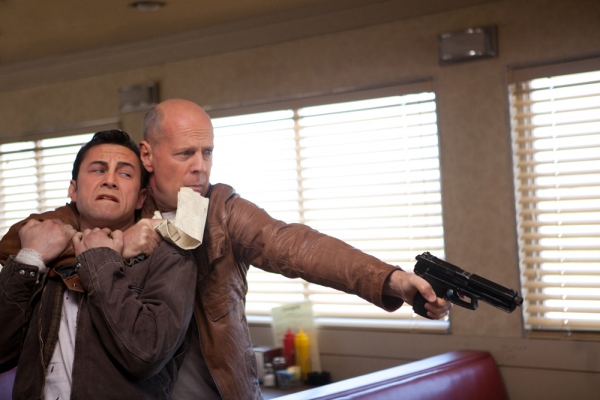
Johnson has plenty of thought-provoking questions he’d like to address within the bounds of a sci-fi action thriller. Would you kill a child if that kid were going to grow up and be a monster? Is redemption possible after doing horrible things? Could you kill your future version of yourself? Would you sacrifice everything to prevent future misery? These are legitimate questions and Looper deserves credit for spending time to ponder them, but I just wish Johnson could have gone back in time and chosen a different path.
Coming off of the stupendous Brick and the perfectly enjoyable Brothers Bloom, my expectations for Johnson’s third film were astronomical, especially given this crafty man’s take on time travel. I love the premise, love the actors involved, and love the ideas toyed around with, but the movie completely falls apart at the halfway mark. The pacing gets slack, the story becomes forced, and Looper transforms into a different, unwelcome movie. I can’t help but feel disappointed, partly from my expectations but also from the knowledge that Johnson could do better. The story just isn’t as well developed as it carries on, and the telekinetic subplot feels like a dull leftover from another movie. After an invigorating first half, Looper crumbles under the weight of a weak subplot that consumes the movie. There’s a good amount of thrills and intellectual stimulation aboard, but it’s all concentrated in the first half of the movie. I can’t recommend one half of a movie. I’ll still eagerly anticipate Johnson’s next project, but Looper is a sci-fi thriller that unravels at an alarming rate, turning a possibly great movie into a mediocre one.
Nate’s Grade: C+
Share this:

Dredd (2012)
 In 1995, Sylvester Stallone starred in Judge Dredd as the titular law enforcer. This big budget sci-fi action flick was goofy and violent and had the added punishment of Rob Schneider as pained comic relief. No wonder it failed at the box-office. I was never a fan of the comics so I can’t say how close the movie was to the source material, but given the presence of Rob Schneider, I’d say it’s doubtful. Because the 1995 film was such a flop, nobody wanted the rights to the character when they went back up for sale. That’s what allowed screenwriter Alex Garland (28 Days Later) to swoop in and write a new version. Dredd is an attempt to resuscitate a franchise that never got started. I don’t know if it’s particularly a good Judge Dredd movie, but as an action film it’s viciously entertaining and it has 100 percent less Rob Schneider.
Dredd (Karl Urban) works for the police of Mega City 1, one of the last metropolises of the irradiated waste land that is the United States. Crime has taken over and crime lords rule neighborhoods. Ma-Ma (Lena Headey) is the leader of a gang pushing Slo-Mo, wa drug that alters people’s perception of time. She controls the 20-story high rise that serves as her base of operations. Dredd is partnered with a young cadet, Anderson (Olivia Thirlby), who also has psychic abilities. She could be an asset to the force, but first she needs to be field tested. They get called to arrest Ma-Ma, but this prostitute-turned-ruthless drug kingpin isn’t going quietly. She locks Dredd and Anderson inside her high rise and orders her inhabitants to take care of the pesky officers.
 I had my doubts, but when it comes to action Dredd delivers. As soon as I saw the trailer, I screamed that this film was little more than a Hollywood remake of the awesome action film from Indonesia, The Raid: Redemption. The plots are identical but I’ll give Garland the benefit of the doubt that he came to his story independently. Whereas The Raid was heavy on martial arts and different fighting styles, and creative weapons, Dredd is really all about the firepower, the gunplay, the blowing up of material, the riddling of bodies with bullets. Each floor presents a new challenge and gives another opportunity for Dredd to outgun or outsmart the competition. This plot model feels like a video game come to life, clearing stage after stage, awaiting boss battles, collecting power ups. Readers will know I am not a strong believer that video games will ever give birth to a solid movie, but I’m ready to concede that this specific plot structure can allow for kickass action. The plot is simple but when given enough attention to geography and organic consequences, then great action can be unleashed, and Dredd is great action unleashed. It looks great, it’s constantly offering something new, raising the stakes, bringing in new elements to contend with, and it’s more than just things going boom. There are some genuinely suspenseful sequences to go along with all the stylish shoot-em-ups.
And the gunplay is vicious and bloody, reveling in the gory display of bodies being blown apart. There are slow-mo bullets traveling through people’s faces, all the better to see the care CGI artists put in to the gore. The ruthless violence is practically casual, and we’ll just see character walk by and fire into the backs of downed characters, giving us another explosion of blood to marvel upon. It would be really easy to call this movie sick, except it works so effectively as an action thriller that the bloody violence feels like a constant jolt. Our introduction to Ma-Ma is her hurling three men off the roof of her 2000-foot high penthouse, watching them splatter below. These are some nasty people and Dredd is dispelling some nasty justice, but because we recognize the antagonists are ruthless, and a real threat, then the violent dispatching of them doesn’t feel exploitative. It feels like keeping pace with some bad folk. Maybe that’s just a contrived way for me to justify that I found the brutish violence entertaining. Simple pleasures.
As far as a Judge Dredd adaptation, the Dredd elements almost feel grafted on, inconsequential. The screenplay could have been completely wiped of the Dredd elements and the plot would essentially be the same. It’s a dystopian world where crime has run amok and the police have resorted to become ruthless enforcers of justice. Dredd as a character, his worldview, his rookie partner who needs to prove herself on the mean streets, all of this is boilerplate cop movie stuff. It has some sci-fi stylizing but the content is still the same. I enjoyed the advanced gun that follows voice commands but nothing in the plot hinged on this element. Dredd just as easily could have been Cop #1 running from room to room, floor to floor, taking out the bad guys. So in this regard, Dredd works really well as a confined action movie but it’s questionable whether this is an effective adaptation of the comics.
 I’m surprised that with a drug called Slo-Mo that the movie didn’t make more use of this plot device. We get sequences of people blissfully on the Slo-Mo; the world looking like it was filmed through a glistening soap bubble. It’s neat but it can really become something cool for the sake of cool, ultimately superfluous except for a snazzy visual that plays into the 3D. It doesn’t appear like the drug lasts long either. But if time slows down for the people on this drug then wouldn’t you think somebody would want to make use of this when fighting Dredd? Perhaps it would sharpen their reaction time by making the world seem to slow to a crawl. However, if this is just an altered state of the drug, I think there could have been a fun moment where a Slo-Mo user tried to take on Dredd and we get differing points of view. For the user, time seems slow and they seem at an advantage. For Dredd, the user would just be acting slow and stupid. It’d punctuate the illusion of the reality-altering drug and explain why none of these gang members spark up before battle.
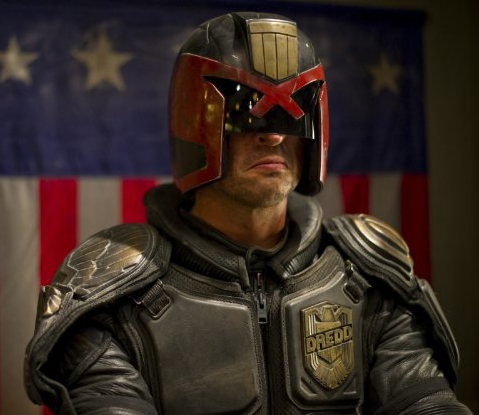
The acting in Dredd is competent and hardly dreadful (forgive me, it had to be done). Urban (Star Trek) goes the entire movie with his helmet screwed on. You never see the top half of the man’s face, presenting an interesting acting challenge (just ask Tom Hardy how tricky it is to act with your face obscured). The man has a permanent grimace carved into his face, grumbling his line throughout. Dredd is supposed to be a grim, no-nonsense enforcer. He’s not exactly got a lot of dimension to him. Urban inhabits the role well but you get the impression anybody could have been in that suit and the film would roughly be the same. Dredd also answers the question of what Olivia Thirlby (Juno) has been up to since 2008. She acquits herself well in all the bloody business and she’s not a bad blonde either. Headey has got the sneering villain act down cold thanks to TV’s Game of Thrones.
Dredd is your best bet when it comes to action movies right now. You’ll get the biggest bang for your buck. The action is brutish and routinely entertaining. It pulls no punches and the bloody melee is full of beautiful carnage. It’s a simple story with pretty simple characters and relatively shallow depth, but where Dredd succeeds is in execution. The emphasis is spent on constructing thrilling actions sequences that build, that change, that impress. It’s not for the faint of heart but for those hungry for a hard-R, bloody, sci-fi thriller, the likes of Paul Verhouven, then I suggest checking out Dredd. And you better hurry, because this version of Judge Dredd is also failing at the box office. Maybe Rob Schneider has been vindicated after all.
Nate’s Grade: B
Share this:

End of Watch (2012)
 David Ayer has written seven movies and directed three, and almost all of them have followed the Los Angeles police department. The man wrote a character that got Denzel Washington a Best Actor Oscar, and from there it’s been all cops all the time, some dirty, some noble, but all residing in the LAPD. I suppose Ayer knows what he does best and is sticking to his wheelhouse. End of Watch is Ayer’s newest tale featuring one of the protagonists recording his activities on the force to put together for a documentary. And with that flimsy excuse, we have ourselves the first found footage cop drama.
Officers Brian Taylor (Jake Gyllenhaal) and Mike Zavala (Michael Pena) are two young police officers patrolling the mean streets of Los Angeles. Rather than dark and brooding, these guys are often quick with a joke and get along peachy. That doesn’t mean they don’t take their jobs seriously, and we watch them take down suspects, save children from burning buildings, and discover horrible mass slayings by Mexican cartels. During their off duty time, Taylor is dating a spunky woman (Anna Kendrick) whereas Mike has a wife (Natalie Martinez) and children of his own. The guys are honorable cops and run afoul of the local gang leader Big Evil (Maurice Compte), a man with connections to those dangerous cartels.
 The best reason to watch End of Watch is the ebullient yet natural chemistry between Pena (World Trade Center) and Gyllenhaal (Source Code). These guys really come across like partners that have been through thick and thin. Their interaction is arguably the best part of the movie, watching two guys who defy cop movie stereotypes. First off, neither is naïve or world-weary; they’re idealistic but grounded. Both men get to be complex individuals, each funny, each warm, each flinty when called upon, each dealing with the heavy toll of protecting and serving, each an honorable police officer trying his best. These guys feel like real-life partners and not just Movie Partners, and that is a great testament to Ayer’s script and the performances by Pena and Gyllenhaal. I also appreciated that the guys are presented as co-leads; I would have assumed Gyllenhaal was going to anchor the movie. These guys really love one another and you understand their camaraderie. The actors went on ride alongs for a solid five months before shooting, and that must have been an invaluable tool for an actor because these guys are so natural with one another. They can bicker but it’s mostly playful, and the dialogue feels authentic and crisp. The performances are measured and meaty and we emotionally invest in these characters and fear for their welfare. These guys are great together and so you worry that we may not see them both live by the end credits.
These guys are such pals, you’ll start to ask yourself, “Hey, shouldn’t there be like some conflict some time?” For almost tow full acts, we are immersed in police procedure details, routines, mundane realities, with the occasional burst of action. Except it takes until the very end of Act Two before there’s a real conflict, one that lasts beyond an individual sequence. These guys are so chummy, so lovingly buddy-buddy, so there’s no tangible conflict between the two of them. The LAPD seems mostly supportive despite some paranoid warnings that do not bear fruit. Even the local thug, Big Evil, doesn’t prove to be an active threat until the Mexican cartel pays him to kill our lead cops (the cartel also wants an expense report of the hit). But this threat doesn’t emerge until well into the film, so much so that the plot feels rather aimless, like we’re on one eternal ride along with our boys in blue. It’s a good thing I enjoy their company.
Here’s why I speculate why Ayer chose to tell his story through the guise of found footage. I don’t out rightly see it as a cash grab, Ayer’s attempt to repackage something old with something new (that is quickly becoming something old). Ayer is not particularly dogmatic about the found footage approach; often we’ll get first-person angles, gun POV angles, or just general angles that could not have been captured through the found footage mechanics. I think Ayer chose this route because he felt it afforded him greater latitude to craft a realistic depiction of the daily grind of the embattled LAPD officer. This approach allows Ayer more freedom to flout cop movie clichés we’ve become well accustomed to. There are no wildly mismatched partners, no long gun heroics, and no long-suffering personal relationships. Though I find it extremely unbelievable that the LAPD would be so casual and blasé about an officer recording his activities and internal workings. That seems like an open invitation for a lawsuit or a subpoena especially if a criminal attorney gets wind. To a degree, the found footage edict works and the authenticity of End of Watch is never in question, but it also seems like Ayer’s convenient go-to excuse when you’re looking for that missing conflict. It is a fictional movie after all.
 The visceral nature of the camerawork, and the extra emotional attachment we feel for the leads, makes for some pretty nail-biting suspense, though only after the cartel issues their hit. The movie teases you with a gutsy ending, one that exemplifies the men’s sense of brotherhood in arms and the fatalistic prospect of protecting the City of Angels. It felt fitting and poignant. I was surprised that Ayer was taking an audience in this direction… and then he didn’t. The film chickens out and gives us a miraculous plot turn that also reinforces the Hollywood pecking order of racial significance. It’s a misstep and one that costs End of Watch from being more emotionally resonant.
As a side note, I’m not a prude when it comes to the use of salty language. Films that reflect certain realities should not curtail the way people genuinely speak. Some people just have filthy mouths. However, the profanity level in End of Watch is off the chart, notably concerning the character of Big Evil. I am dead certain that every second or third word out of this guy’s mouth is some variation of the f-word. If you catalogued all of his dialogue, I bet over 75% of total words would be profanity. It starts to get ridiculous and even funny when you hear nothing but the same three words during an angry outburst. And this is no David Mamet or Kevin Smith poetic composition of vulgarity and the profane; this is just lazy dialogue, like Ayer told his actor that, when in doubt, let loose a litany of f-bombs. Perhaps Big Evil would be less evil if people just helped him with his limited vocabulary.
End of Watch is an involving police procedural with some gripping moments of tension thanks to the stellar performances from its pair of police officers, Pena and Gyllenhaal. Ayer’s found footage motif gets some visceral excitement out of an old story, but what really sucks us in are the emotional bonds we’ve forged with these two men over the course of an hour. That makes the danger feel very dire. The movie feels like a bromance at times. I wish Ayer hadn’t pulled back from his more dour ending but it’s not enough to spoil what is an above average genre film with a spiffy new visual polish. I don’t know how many films Ayer can keep cranking out about the LAPD but as long as he pays due attention to character, and gives us the occasional break from the ubiquitous antihero with a badge, then at least he’ll keep making compelling genre cinema.
Nate’s Grade: B
Share this:

Robot & Frank (2012)
 It’s the age-old story about an elderly man (Frank Langella) suffering from Alzheimer’s who teaches his robot helper to be his partner in jewelry heists. While that sounds a lot more fantastic than the movie we eventually get, Robot & Frank is a mellow, sincere, and overall nice movie that treats the particulars of its world with a wry sense of whimsy. The movie is really a mismatched buddy film as Frank is hostile to being forced to live with robotic help, but soon the two of them form the basis of a friendship, and when things get dangerous it’s heartwarming the lengths they’ll go to save the other. Give the Alzheimer’s subject, expect some twists in the final act concerning Frank’s world. The movie wants to hit us emotionally but I felt mostly remote, smirking at some of the fun of the old codger back in the burglary business of his youth. But the film just stays at a very even-keel level of emotional resonance, drawing us in but not exactly taking us anywhere. The ending is curiously without any sort of comforting resolution that could have put a solid piece of punctuation on the film’s emotional drama. Langella, it should be said, is excellent. Robot & Frank is a high-concept buddy film, fairly pleasant and entertaining but when it comes to a close you may wish that the film had relied less on chaste understatement.
Nate’s Grade: B
Share this:

The Expendables 2 (2012)
 The Expendables was a surprise hit two years ago. Sylvester Stallone collected an all-star team of aging AARP action stars and they kicked ass, took names, and didn’t apologize. It was a fitfully amusing throwback to the burly, macho action movies of the 1980s and the early 90s, a time where many of these men were kings. The nostalgia trip worked box-office magic for Stallone. A sequel was commissioned and these men of action were put back to work. There was already preliminary talk about the possible stars that could sign up for a third Expendables (Nicolas Cage and Clint Eastwood are on a wish list). Maybe people should see The Expendables 2 before getting too excited plotting out the future of this franchise. This is not a good movie even by Stallone’s standards.
Barney Ross (Stallone) is back with the best team money can hire. No, not the A-Team, the Expendables. There are also the preposterously named team members Lee Christmas (Jason Statham), Ying Yang (Jet Li), Gunner Jensen (Dolph Lundgren), Toll Road (Randy Couture), and Hale Caesar (Terry Crews). The over-the-hill gang also has some new blood, namely Bill(y) the Kid (The Hunger Games’ Liam Hemsworth). The gang runs afoul with Vilain (Jean Claude Van Damme), a terrorist mining for plutonium to sell to the highest bidder. Barney swears to thwart Vilain and calls in help from other living action legends like Chuck Norris, Bruce Willis, and Arnold Schwarzenegger.
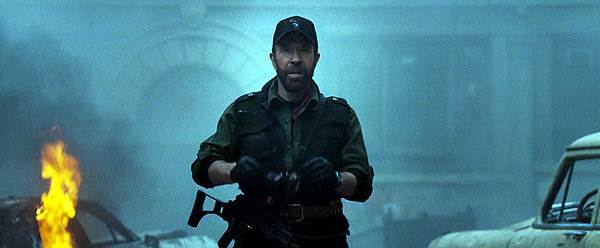
 What made the first Expendables enjoyable, at least for sustainable spurts, was its over-the-top nature comingled with a lack of irony. The movie felt often like a satire of the genre but you knew that Stallone was never winking at the camera. Stallone was never in on the joke. That changes with The Expendables 2, which often resorts to self-aware humor to poke fun at itself. This approach simply does not work. There’s an entire sequence where Chuck Norris even makes a Chuck Norris Internet joke, merging reality with irony. The bad guys are lousy shots and the good guys are the world’s greatest marksmen, but I don’t even know if this is intentionally self-aware or just par for the genre. Having Arnold repeat other people’s famous one-liners and quips (“Who’s next? Rambo?”) are not funny. The self-awareness never rises to the level of commentary or intentional satire, like say the underrated Last Action Hero. It’s just the same mindless violence but with the slightest of nods, the bare minimum to say, “Hey, we get it.” Except the movie feels shackled to this flawed approach and often the action fails to gestate into something larger than old guys shoot guns and make occasional wisecracks. The action sequences are really disappointing here. Little attention is given to geography, short of a climax set amidst an abandoned airport. I kept hoping for more of the gonzo, hyperbolic touches that the first film had in abundance. The best ridiculous moments this go-round are Van Damme roundhouse kicking a knife into a guy’s heart, and the piece de résistance, Norris shooting a guy onto an airport security conveyer belt where we then see the body full of lead on the x-ray machine.
Most of the Expendables teammates simply have nothing to do. Granted with a large cast the ratios of screen time are not going to be equal across the board, but I’d expect that Stallone and crew would at least give these people some reason to exist in the plot. Jet Li vanishes after the twenty minute mark and never returns. There’s truly no reason that Randy Couture and the great Terry Crews couldn’t have been Guy #5 and Guy #6. Lundgren is setup to be a chemistry genius, and then when trapped inside a mine, it looks like he’s about to utilize his chemistry knowledge to save the day. Nope. Then why would you even set this ability up if you weren’t going to do anything? Even Statham is pretty mitigated and he’s the number two guy. If you’re going to have a team-oriented action movie, then make use of the team and their unique skills. Part of the joy of these kinds of movies is watching the crew work together, like in The Avengers. With this film, we just get rapid-fire shots of the good guys shooting the bad guys, sometimes separately, sometimes together. It gets boring plenty quick.
 The plot is fairly bare-bones even more an action movie. It’s a rote revenge movie where Stallone and the boys are out to get Van Dame after he killed one of their guys (the only expendable Expendable, it seems). The plot never gets much more complicated than that. The gang encounters a group of terrorized villagers who want to rescue their husbands from Van Damme’s forced labor. Our bad guy even has a name that is a single letter away from spelling “villain” in case you needed the help. You know how he’s one evil man? He wears his sunglasses at all times even underground inside a mine. Of course this may also be a stylistic choice to hide Van Damme’s horribly Botoxed face. The Muscles from Brussels is actually the second best actor in the movie (Crews easily remains the best), good enough that I wouldn’t mind seeing the older Van Damme in more movies. Sadly his big showdown with Stallone is pretty short, with Van Damme resorting to the same roundhouse kicks before being subdued.
Stallone sat out the director’s chair and instead Simon West (The Mechanic ) takes the reins. I suppose this freed up Stallone to… focus more attention on the script? Emoting more? The visuals are fairly muddy and lack the polish of West’s other hyperactive action movies like Con Air. The opening assault sequence, where Barney and the Expendables roll through an enemy compound, literally busting through walls, is the visual highpoint for the movie. I credit the filmmakers for sticking with the R-rating and not toning down their violence. It would seem like hypocrisy to have a movie about a bunch of crusty old-timers lamenting how soft the world has gotten and then wuss out to a bloodless PG-13 rating. At least this wrecking crew doesn’t hold back when it comes to their specialty: mayhem.
The Expendables 2 should have been more than just Stallone and his peers patting themselves on the back. I’m glad Willis and Schwarzenegger graduated from cameos to supporting roles, but I wish the movie just had something for these men of action to do. There’s far too much repetition with its action, which becomes a formless montage of people shooting guns in slightly varying locations. The self-aware humor kills the development of the action and it’s simply not funny enough. It’s the kind of sad humor of old men trying to still look hip, like they’re in on the joke. Hey, they can make fun of themselves too. It’s just not a fun movie. There are only so many tried wisecracks you can endure, only so much redundant action, plotless excess, and crowbarred cameos. The Expendables 2 takes the little merits of the first film and completely loses touch, all to try and make a joke. In the end, the real joke is still on Stallone and the filmmakers. They wanted to make a movie that knew it was stupid. Instead they just made a stupid movie.
Nate’s Grade: C-
Share this:

For a Good Time, Call (2012)
 Given the success of the female-centric mega hit Bridesmaids, it was only a matter of time before we got a slew of girls-behaving-naughty R-rated sex comedies. Enter the phone sex comedy For a Good Time, Call, which has the distinction of being co-written by Seth Rogen’s real-life wife, Lauren Miller, who also stars in the film. It advertises a good time and mostly delivers, though you might not think as much about the movie in the cold light of day.
Lauren (Miller) has just been dumped by her self-involved boyfriend and fired from her job. She’s looking for a new place to live when a mutual friend sets her up with a huge New York City apartment. The catch: her roommate is Katie (Ari Graynor), an acquaintance from college she has despised ever since a very horrifying party foul of seismic proportions. Katie’s going to lose her posh home unless she gets a roommate, so the women reach a mutual understanding. Then one day, listening to Katie’s hyperactive sexual noises, Lauren discovers how her roommate really pays the bills. She’s been running a phone sex line and getting guys off for $3.99 a minute. Lauren decides to get involved in the business end, and before long the ladies have become a professional outlet and roll in their riches. Invigorated, Lauren starts experimenting herself, letting her freak flag fly, and before long she’s also getting in on the calls.
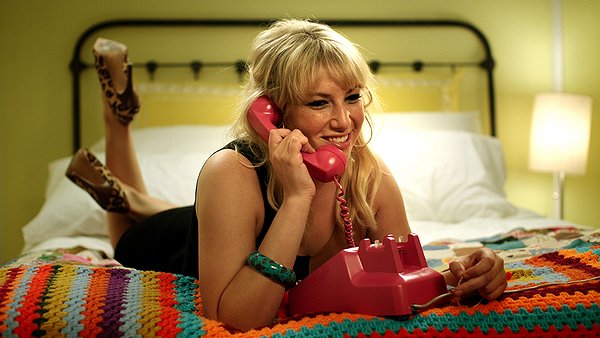
 Graynor is no stranger to stealing a movie, as she did perfectly in the sweetly unassuming 2008 teen romance, Nick and Norah’s Infinite Playlist. This girl has had the markings of a star for years and finally she’s found the vehicle to showcase her comedic vivaciousness. To say Graynor makes this movie is an understatement to her talents. Graynor is this movie’s pulse, its lifeblood, its font of energy, its wickedness, its exuberance, its very soul. This woman is amazing. She can take a simple line and with an effortless dose of comedic verve, it can become a gut-buster. I could watch twelve movies in a row with Graynor playing at this level of exciting excellence. The part is pretty familiar, the dirty girl who has problem with a filter, but Graynor makes the most of every opportunity. I loved her adorable theatricality, like a foxy, younger, brassy Bette Midler (God, did I ever think I’d string those words together?). I loved her enthusiastic hip shake, wearing large body stockings, while singing, “I’m ready to beat date rape!” Naturally, Katie gets all the best lines but her interplay with Lauren also works well. When the movie focuses on Lauren, and by extension the unremarkable performance by Miller, you start to feel things slag. Lauren is passive becoming active, but really even by the end she can still be cited as boring. Katie is active, hungry, brash, charming, and wonderfully portrayed by Graynor, and when she dominates, you’ll ask for more.
Except for the lively theatrics from Graynor, the movie can often feel hung up on generic sitcom plot devices and character generalities. The premise itself is perfectly fine, but the movie seems to exist in some randy fantasy world. We still have a main character in the world of publishing that will obviously be offered the Big Job at an inopportune personal time (as movies have shown, every human being on the planet either works in publishing, advertising, or theater). And then there’s the Bad Boyfriend, who breaks up with our heroine in the opening moments of the movie because they are “boring” together. Any guesses whether he shows up late as well, begging her back? I’d probably be more forgiving of these contrived plot turns if the movie did more to present Lauren and Katie as real characters. As written, they are pigeonholed into opposites (prude/wild woman) and rarely do we learn more about them. Lauren loosens up, Katie gains some self-respect, and they girls becomes BFFs. That development I found rather unconvincing, probably because there was little development. All of a sudden Lauren has an interest in joining the business, and one montage later, the girls have buried the hatchet. It feels like everything changed overnight. The attempts to ladle in some forced sweetness feels, in some regards, more crass than the sex jokes. I’ll credit the movie for keeping me amused while watching, but upon further reflection, the girls and their relationship feels rather slapdash and rote.
The comedy itself gets too easily complacent with all those naughty words bandied about. Oh sure there’s plenty of effective jokes about sexually frank conversations, and the inherently awkward nature of phone sex mechanics, but For A Good Time, Call seems too easily satisfied. I wish that Miller and co-writer Katie Anne Naylor had pushed their comedic setups further, had taken a few more left turns rather than settling for the familiar sex gag. Here’s an example: Lauren’s prissy parents make an unexpected visit and the girls have to hide their business particulars. That’s a fine starting point, but where else does it go? The comic tension is too easily resolved instead of escalated. Then, surprise, the parents make a SECOND unexpected visit. This time the sex decorations are prominently displayed. We’re waiting for some good comedic tension, some squirming, but again, it’s over before the good stuff can even get going (am I right, ladies?). The Justin Long (Going the Distance) flamboyantly gay friend is never as funny as the movie thinks he is. There’s a scene where Lauren is interrupted while masturbating, but we only realize after the fact when the joke is already over. Why introduce such a scenario if you were just going to settle for a weak “smelly finger” joke? Perhaps I would find the material funnier if I was a woman, relating more to the female dynamic on screen, but do you see how condescending that line of thinking gets? I unabashedly adored Bridesmaids (my #3 film of that year). I don’t think anyone needs to grade a comedy on a curve for any reason, especially if they think they’re trying to be polite.
 I’m not going to make more or less of its sexual politics than what is presented. I think there is genuine merit when women take ownership of their sexuality. Why should women feel judged for wanting equality when bedroom activities and impulses are concerned? Whatever helps people build a healthy self-image should be championed, as long as it’s between consenting adults. Watching Katie and Lauren personally grow based upon their unique entrepreneurship is welcomed. However, I can’t help but shake my feelings that there is something lurking, some deeper sub current that is not worth celebrating because the movie seems to play into male fantasy. Even though I adored Graynor, I think it would have served the film better if the more sexually-liberated character, the pro when it comes to working the phones, was actually a less attractive woman, perhaps a mousy gal you’d never expect such lurid behavior from. I think that would offer more comedic potential as well. I think this would also puncture some of the airbrushed fantasy of the film’s cheescake world of a phone sex line.
I have my complaints but I was laughing fairly regularly and enjoyed the experience, so if you’re just looking for a good time at the movies you can consider For A Good Time, Call. Watching Graynor sink her teeth into her role and go full gusto is a rowdy pleasure, and it’s easy to see that this woman is a star. The smutty jokes are fun and offer plenty of ribald laughs, but I always felt like the movie was too complacent, too settled, and curiously clumsy when it came to comic payoffs. The film is pretty flatly directed by Jamie Travis. The characters are pretty thin, and the plot feels ripped from a flimsy TV sitcom, but I laughed aplenty and found the movie difficult to dislike. It’s not the most nuanced sex comedy, or the most ribald, but For a Good Time, Call delivers enough big jokes and Graynor is too sensational to miss.
Nate’s Grade: B
Share this:

Lawless (2012)
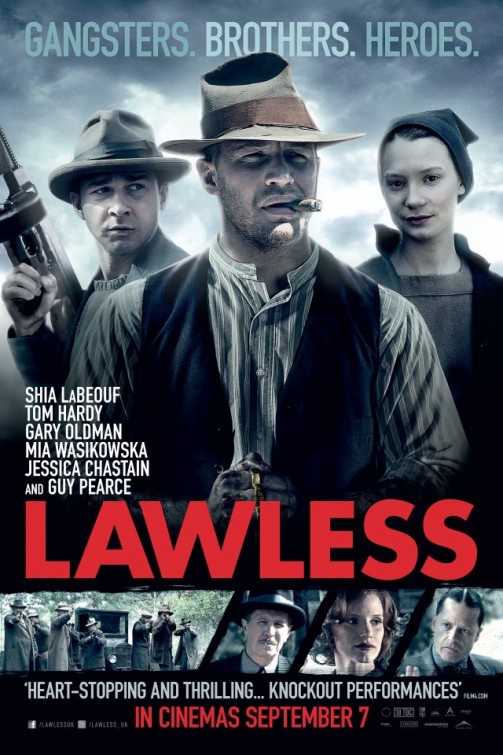 The bootlegging drama Lawless certainly has all the right elements to be an enjoyable movie. It’s by the men who gave us the great noir-Western The Proposition (director John Hillcoat, writer Nick Cave), it’s got a star-studded cast, plenty of bloody action, and a handsomely recreated production of the Prohibition era. But as I watched the Bondurant boys struggle against those who would like to put them in jail and/or murder them, I kept noticing something odd. I wasn’t that engaged. There was plenty of life-and-death drama, but why wasn’t I involved in the story more? Lawless feels like a series of scenes rather than a movie. Even when the plot changes it doesn’t feel like the movie is advancing. Even when things are more desperate it doesn’t feel like the momentum is building. The characters are somewhat sluggish as well, Shia LaBeouf as the scared youngest brother, Tom Hardy as the grumbly big brother who talks like his mouth is full of molasses. Jessica Chastain as the abused Good Woman who opens herself up to our Strong Hurting Man. Then you got a plot with a mobster (Gary Oldman) that weirdly climaxes with an hour left in the movie. He’s ignored for the remainder. Then there’s Guy Pearce as a colorfully fiendish and foppish special deputy that terrorizes the town. I am a Pearce fan but this guy is acting like he’s in his own weirder personal movie; it’s the kind of stuff Marlon Brando did. I appreciated that Lawless kept things gritty and bloody for realism, but I kept finding moments that ripped me out, namely the indestructible nature of Tom Hardy. Seriously, this guy has to be the Terminator. When he miraculously survives yet another seemingly fatal injury, all you can do is laugh. Lawless is passable entertainment but with its pedigree this should have been better.
Nate’s Grade: B-


 nathanzoebl
You must be logged in to post a comment.