Category Archives: 2012 Movies
The Fountain of Youth (2025)
 Ever since Indiana Jones famously swashbuckeled his way onscreen in 1981, studios have been chasing after recreating that dashing action-adventure treasure hunting caper that can win over mass audiences. The tough love is that there are very few that actually succeed. The closest might be the 1999 Mummy movie or perhaps the popular Uncharted video games. For some the National Treasure movies might apply. Unfortunately, most of these Indiana Jones hopefuls end up being proven unworthy of one’s time and especially in comparison to the great Dr. Jones, and so The Fountain of Youth also fails to recapture that excitement. The reportedly $180-million Apple TV original is directed by Guy Ritchie (Aladdin, The Gentlemen) and stars John Krasinski and Natalie Portman as the Purdue siblings who are racing to discover the famed Fountain of Youth before another team of shady corporate archeologists (booo!), that feature’s an ex-girlfriend (Eiza Gonzalez) of our lead, gets there first. He’s a wild adventurer trying to clear his disgraced father’s name, and she’s a professor who’s settled down with a family and needs a reminder of her adventurer roots. These kinds of movies live and breathe by their set pieces and charm. The problem with The Fountain of Youth is how forced everything feels. Krasinski can be a very charming actor, as evidenced to any fan of the American Office, but he’s the wrong kind of energy for this role. His carefree attitude comes across as smarmy and detached. Portman is also completely wrong for her role, never finding a degree of fun for her character, only becoming the nagging tag-along. There are some intriguing set pieces, especially aboard the literal Lusitania as it’s dredged back to the surface and then begins sinking again. That’s the highlight of the movie and it happens before the hour mark of a two-hour experience. Ritchie feels restrained in his application of his signature style, once more feeling like a journeyman for hire. The final setting whereupon our characters do find the Fountain of Youth is anticlimactic and builds up its magic hokum with late rule-changing as well as the most telegraphed villain turn. The movie’s tone is aiming for frivolity but because everything feels so forced and empty it instead comes across as obnoxious and tiresome. The drought continues.
Nate’s Grade: C
Share this:

Babygirl (2024)
 It’s so rare to see erotic dramas with the kind of pedigree, and set up for potential awards buzz, of Babygirl, and I think that’s because they’re a little hard to take seriously (see the ridiculous and tone-deaf Deep Water for further proof). What distinguishes the artistic erotic drama from the tawdry erotic drama will be a perhaps invisible line. Still, it’s rare for an actress of Nicole Kidman’s caliber, and let’s also be frank -her age- to headline an erotic drama, so that naturally draws some intrigue and eyeballs. Babygirl follows a familiar premise of taboo desires at the expense of domestic upheaval, but where it goes makes it ultimately feel like an unsatisfying morality tale.
Kidman plays Romy, a powerful tech CEO suffering from a lack of spark in her love life. She loves her husband (Antonio Banderas), her three teenage girls, and the life she’s built for herself, but she also needs to masturbate if she ever wants to be physically satisfied. Along comes a lanky hunk by the name of Samuel (Harris Dickinson) as an intern at her company and immediately makes her feel hot and bothered. He’s direct and wants to tell her what to do, and the excitement Romy feels makes her question how far she’s willing to go and what she’s willing to risk to chase her passions.  Babygirl is another rich person’s fantasy romance where a character risks losing their family on a fling, and usually these stories only go so many ways, primarily with the protagonist regretting their affair and learning some kind of lesson from the ordeal. For a formula meant to inspire titillation and transgression, these movies can be, at their core, very moralistic and conservative. There are so many movies that prominently feature cheating only for the person to realize how much they were taking for granted what they had all along. So many of these wayward participants don’t feel like they have lost something by the end even after risking their relationships, so the conclusion of these movies seems to be a facile “don’t do that again” lesson of sowing one’s oats. It strikes me as ironic that these stories are about untamed passions but they end so dispassionately. For the first half of Babygirl, I was questioning where this movie could lead: would the husband kill his wife’s lover and through the shared disposal of his body bring them closer together? Would it be revealed that Samuel was a stalker who manipulated his way into Romy’s life? Was her husband secretly behind this strapping young lad coming into her path and trying to provide her that spark of danger but in an unknowingly controlled environment? The eventual path of Babygirl is probably the most realistic path and yet it’s rather dramatically lacking and insert. Ultimately, the movie’s message seems to coalesce around accepting your desires and being open about sharing them; however, the proceeding movie doesn’t feel like a meaningful road to that cozy conclusion.
There’s a dramatically rich idea that could have been explored more maturely, namely that this woman has sacrificed her own physical pleasure for her career achievement. During one awkward night, Romy admits to her husband that over the decades of their relationship that he has never made her climax. His manly ego is bruised severely and Romy tries to wave away the statement, but the movie only seems to use this detail as further establishment for the motivation to have an affair. Director/writer Halina Reijn (Bodies Bodies Bodies) sets this up within the very first shot of the movie, with Romy finishing having sweaty sex with her husband only to finish by herself with the help of Internet pornography. Right away we know her husband isn’t doing it for her. There’s one moment where Romy explains that she feels like her desires are degrading and self-destructive, but she won’t share them with her husband. She tries to guide him there, planting a pillow over her head to cover her sight to facilitate her imagination, but it makes him feel uncomfortable to continue (“I feel like a villain”). There’s an interesting exploration of keeping passion stoked in a long-standing relationship where inertia can settle in, but the ultimate revelation is rather pat and all-too familiar: communicate more. Thanks, movie. So much of the movie is built around what Romy learns from how far she goes, but what do we learn about Samuel too? He’s kept a frustrating blank of a figure, more catalyst than fully developed character. If he’s ultimately just the excuse to push her out of her comfort zone, did he have to be this boring even with his kinks?  Will you find Babygirl sexy? I don’t know. It primarily trades in dominance/submissive dynamics, and the director keeps her camera’s gaze on the pursuit of feminine pleasure rather than closeups of pert anatomical parts. The sequences where Samuel orders Romy around played more unintentionally comical to me rather than decisively arousing, especially moments like him forcing her to eat out of his hand like a dog. I can understand being in such a high-powered job of constant decision-making might make a fantasy of giving up control and agency seem appealing, but this isn’t really explored in the movie. I can also understand the shame of feeling like your hidden desires might be too embarrassing to share with your partner, but this isn’t fully explored either. For all its heavy breathing and sultry glances, the movie feels far more clinical than passionate. The sensation I felt the most was a lulling curiosity that ultimately went unmet. Your mileage may vary.
Babygirl is the kind of movie that critics declare the lead actress being so “brave” to push boundaries at her age, to bare her body in an age bracket that Hollywood finds less-than-desirable. However, Kidman has long been an actress unafraid of the demands of nudity as well as challenging roles, which mitigates the perceived daring of this latest performance. Babygirl is ultimately a disappointing erotic drama that, for me, lacked heat, better character development, and a surprising or insightful plot. In short, Babygirl comes up short where it counts.
Nate’s Grade: C+
Share this:

Red One (2024)
 Is Amazon’s $250 million holiday adventure the harbinger of doom for modern movies as many alarmist film critics have claimed? No. Is it the next great Christmas classic? No. It’s a thoroughly mediocre holiday action movie borrowing heavily from the familiar Marvel movie formula; it strains very hard to be a breezy spectacle and a buddy comedy. There’s a fun concept here about Santa Claus (a buff J.K. Simmons) being kidnapped, but the focus is on the wrong characters. The best segment of Red One is when we’re introduced to Santa’s cranky brother, Krampus (Kristofer Hiivju), a half-demon half-goat creature with excellent practical makeup application and design. The movie feels dangerous and finally intriguing with their history, and it’s here that I realized the best version of Red One would have been one where Santa AND Krampus, two feuding brothers with very different perspectives on how to handle the naughty, are forced to work together to escape their holiday hostage-takers. Alas, the characters we get are The Rock playing a minor variation on the character archetype he’s been grinding into dust for a decade, and Chris Evans as a cynical adult super hacker who needs to learn the true meaning of Christmas. The inclusion of Evans’ character is flimsy and he’s far too annoying to offset whatever advantages he might provide to Santa’s extraction team. The fantasy elements and lore can be fun, like an abominable snowman fight in the tropics, but too many of these elements feel underdeveloped, like the Rock growing big and small for… reasons. Just like how our villain wants to teach the world a lesson in terror… that can be broken by self-reflective apologies. It’s a movie consumed by its many influences. Red One isn’t exactly for little kids, isn’t exactly for adults, and isn’t exactly for teenagers, so who is this for? It’s destined to play in the background and be ignored while holiday naps are had, and to that end, Red One succeeds.
Nate’s Grade: C
Share this:

Rebel Moon: Director’s Cut (2024)
 What a rarity for a movie to potentially appear twice on my worst of the year list, and such is the destiny of Zack Snyder’s Rebel Moon, originally released in 2023 and the first half of 2024, and now with added lengthier director’s cuts. So what do you get in the newest “Snyder cuts” besides fewer hours in your day? Let’s tackle the opening sequence demonstrating the power and villainy of our evil empire as they invade a crumbling city in resistance. Within short order we’ve witnessed: 1) female priestesses being forcefully disrobed and having their breasts branded, 2) an adorable little CGI pet become a literal suicide bomber, 3) a son brutally beating his father’s brains out of his skull to spare their family only for them all to be massacred anyway. Yikes. While there is a little more world-building absent from Snyder’s prior cuts, like a religious sect that turns the teeth of their conquered victims into a decorative washboard, even the extra time, and it is literally hours over the course of the two parts, feels strained and still poorly developed to better understand the world, the characters, the conflict, the history, anything that could make Snyder’s hopeful franchise its own universe. Theres now a giant metal goddess whose tears fuel space travel. All right then. One of the more interesting characters, the samurai-esque loner robot, is given more material but he’s still just as inscrutable. There’s plenty more cruelty here, slow-motion head shots painting the screen in sticky viscera. There’s also plenty more breathless and awkwardly extended sex scenes, but hey, at least those are consensual, so there’s that. I’m just stunned why Netflix would want different versions of these movies when they’re ultimately all housed under the same banner. It sure feels like the “Snyder cut” brand is now an expected marketing ploy to be exploited for added publicity. After all, why watch one long slightly bloody poorly written sci-fi space opera, when you could watch TWO versions, one of which being even bloodier and more miserable? Will there be an even Snyderier Snyder cut, adding more scenes of side characters suffering and even more festishized gore in even slower motion? Will the whole movie just be played in slow motion, now requiring nine hours? Where does it even end, Netflix?
Nate’s Grade: D
Share this:

Twisters (2024)
 It’s twenty-eight years later and people are still fascinated by the destructive power of tornadoes that cavalier daredevils will chase after them for clout, thrills, or the progress of science. Twisters faithfully replicates a lot of the elements that made the 1996 original a hit without coming across as overly fawning fan service, from the large-scale action treating the looming tornadoes like a monster awakening in righteous anger, to the scientific adventure and exploration of understanding the worst of nature, to the snobs vs. slobs of competing teams of eager tornado chasers. The core dynamic between Daisy Edgar-Jones and Glen Powell is combative and fun and eventually quite flirty, and oh will you be compelling these two crazy weather-obsessed kids to kiss by the end credits. If somehow you missed out on Hit Man, here is further proof about the indefatigable power of Powell’s immense charms. You, much like Edgar-Jones, cannot resist this man and his drawl. Give great praise to director Lee Isaac Chung, who made the poignant autobiographical immigrant family drama Minari and then followed it up with wrangling tornadoes in a blockbuster sphere with the same level of confidence and dedication. This is a sequel that thankfully doesn’t need to lean into the callbacks or cameos from the earlier movie. It’s still relatively predictable but that doesn’t make it less satisfying when our heroes come together. Twisters is a solid sequel that clearly understands the appeal of its predecessor and big screen disaster-laden escapist entertainment as a whole. It’s a perfect movie to pair with a big bucket of popcorn.
Nate’s Grade: B
Share this:

In the wake of COVID-19, some changes…
Everyone is feeling the effects of COVID-19 and the entertainment industry, in particular movie studios and theaters, have been dramatically affected. I will be continuing to review new films when I can, albeit many will likely be smaller indies unless Hollywood embraces Video on Demand. I’m also going to make a real effort to continue seeking out Ohio-made indies and providing reviews for them. I will continue what I did for my huge 1999 in Rewind article and look back at my original teenage reviews and assess my current feelings on the movies and my old writing, for the year 2000, 2001, 2002, 2003, and now 2004. I’ll be on the lookout for amazingly new so-bad-it’s-gotta-be-seen movies (have you seen Love on a Leash?). In short, I’m going to keep writing. I hope you keep reading.
Share this:

Pitch Perfect (2012)
 Take the plot of Bring it On, add remixes and mash-ups of popular music thrown through the Glee grinder, Rebel Wilson’s adlibbed one-liners, and shake, and you have Pitch Perfect, an a cappella singing comedy that was a sleeper hit last fall. My female friends raved about it. It’s from a 30 Rock writer. It’s from the director of the irreverent musical Avenue Q. I like Wilson and the movie’s star, Anna Kendrick (Up in the Air). I wanted to like it, and while I found most of it passably cute, I could not get too attached and the chief reason was Kendrick’s character. She’s so surly and standoffish and just plain bratty, and for no good reason. It gets really annoying. Her rote romance with a bland hunky guy is made even more incredulous because Kendrick, get this, hates movies. Not certain kinds of movies or movies with certain actors, just the entire medium. Who is like this? That’s like disliking all of music entirely. The overall comedic spirit of the movie is amiable with a few oddball touches that keep things interesting, notably one girl who talks very quietly and says outrageous confessions. Listen well. The performance segments are impressive in their own right enough so that I wish there were more of them. There’s also a level of reality to projectile vomit that I was not prepared for. Overall, Pitch Perfect is a fitfully amusing comedy that never really settles down a functional tone, and Kendrick’s bratty character drags the movie down. It’s far from perfect but depending upon your love of a cappella, it could be good enough.
Nate’s Grade: B-
Share this:

House at the End of the Street (2012)
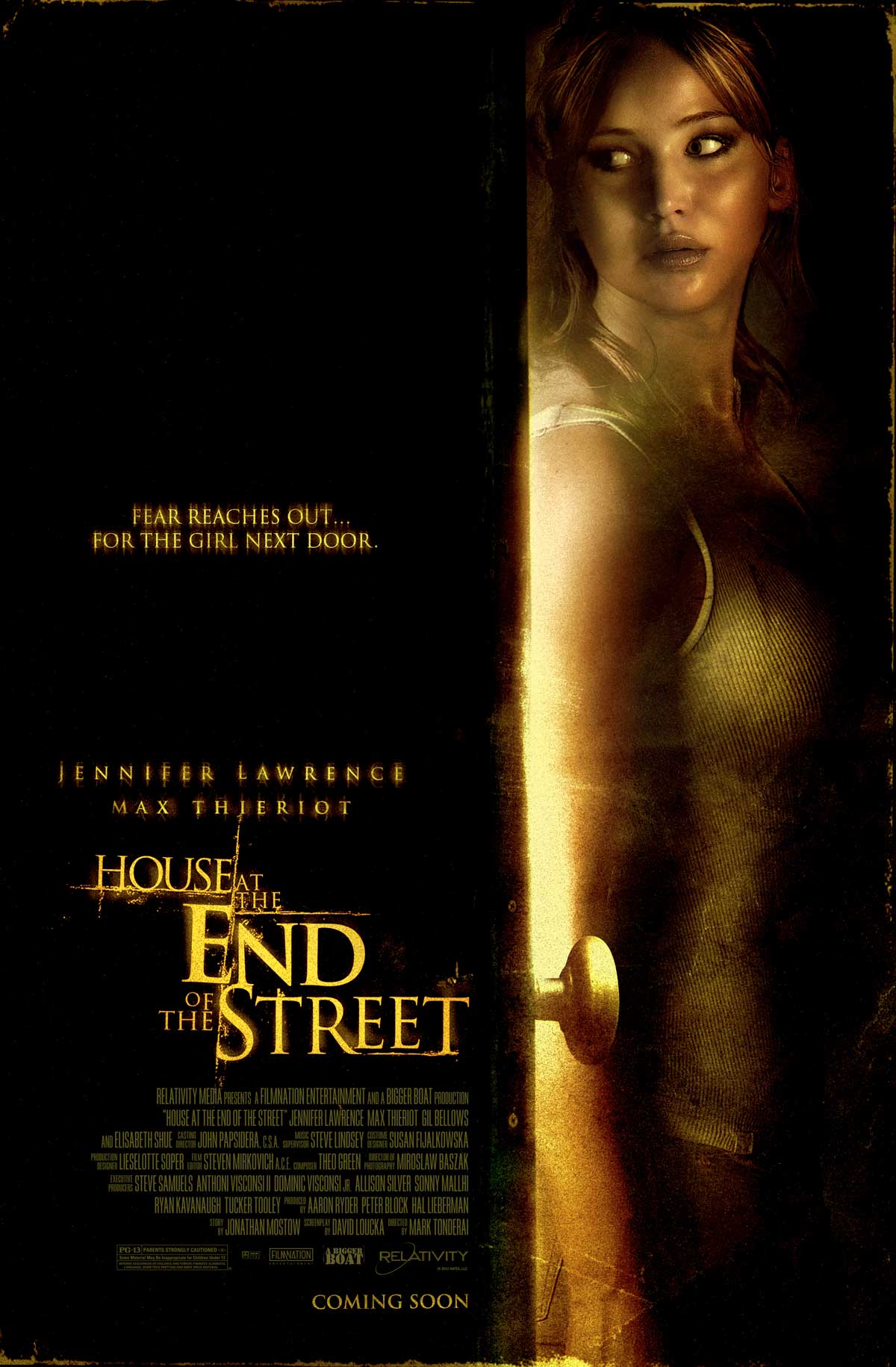 As readers will attest, I am a fan of actress Jennifer Lawrence. Some of my pals might say limiting the word to “fan” is being too modest on my part, but I don’t want to alarm anyone. I think she’s a terrifically talented actress and her Best Actress Oscar was well deserved for a film I unabashedly adore. With all of this being said, good actors can still make really bad movies, and that’s what we have with the stillborn horror flick, House at the End of the Street, referred to by marketing by the Twitter-friendly acronym HATES. That seemed like a tip-off, didn’t it? The problem is that for a good hour this movie is more of a drama than a horror movie, and everyone in town seems to be jerks to this guy in town whose sister murdered his family. Apparently him still residing in town lowers their property values… for some reason. I think it wants to be a psychological thriller, but even giving it that much credit assumes there’s some degree of competent execution. It’s not scary, the twists should be easily telegraphed to anyone with a modicum of sense, and Lawrence’s presence is just downright questionable. Why did she agree to do this? What about this clunky script, with its obvious padding to its “shocking” revelation, appealed to this woman? I suppose with her fast ascent to the top of Hollywood, Lawrence now has the clout to never again star in something as drecky as this would-be thriller. Then again, if she does, it’ll be by choice. Or a fat paycheck.
Nate’s Grade: C-
Share this:

Fist of the Reich (2012)
 It’s been too long since I’ve last had the pleasure of viewing a Uwe Boll movie. The man is downright prolific when it comes to spitting out multitudes of projects every year sometimes three or four. And yet there’s no guarantee I’ll have a speedy and easily accessible avenue to watch the man’s finished products. Take for instance his biopic on Max Schmeling, finished almost three years ago, and undergone a title change for American audiences to Fist of the Reich. Americans might not know who Max Schmeling was but by God do we know ourselves some Nazis. I can understand why this one was put on the shelf for as long as it was. There’s the fact that it’s entirely in German, Boll’s first completely foreign-language film since 1997. There’s also the fact that it’s still a pretty dull and uninvolving movie, and given the figure and subject matter, that may be enough to make Fist of the Reich the most disappointing film of Boll’s career.
 From 1930-1948, Max Schmeling (Henry Maske) was Germany’s most prolific athlete. He boxed overseas in America quite often, earning the world title in a controversial bout where his opponent was disqualified after a below the belt punch. Schmeling romances a movie star, Anny Ondra (Susanne Wuest), and proposes to her the day their courtship hits the gossip pages. Schmeling also has to fight the growing nationalistic influence of Hitler’s Nazi party, which looks at him as a powerful propaganda opportunity. After a high-profile loss to Joe Louis, in a rematch no less, Schmeling loses value to the Nazi machine and he’s drafted into the oncoming war.
When I say “most disappointing” I know that’s going to strike a chord given Boll’s oeuvre of craptacularcinema, but I really mean it. The biggest failing of the two-plus hours of Fist of the Reich is that it does not provide adequate evidence why Schmeling is a compelling figure of history. It’s a biopic that doesn’t have enough juice to justify why its central hero should even earn a biopic. I don’t think I’ve seen too many movies based upon real people where I left thinking, “Well that person didn’t deserve a movie.” And the ridiculous thing is that Schmeling of course deserves his own movie. The man was an international superstar, the pride of a nation during a tumultuous time, one of only three men to beat Joe Louis in his career, and then became a propaganda pawn for the Nazis. The man was even forced into service in the war and was one of only two survivors during a hellish battle. His manager was Jewish, his wife a Czech movie star, and they had to flee their country home to escape from the advancing Russians. That is some compelling stuff even before you get into the psychological depth at play with a man being pushed as a tool of Nazi propaganda and how that constrictive, humiliating, and infuriating chapter would have taken its toll on Schmeling’s soul. There is a wealth of material there to stage a rousing and engrossing biopic, and the fact that Boll and screenwriter Timo Berndt cannot is just inexcusable.
There’s very little depth given to Schmeling as a character; all the edges are sanded off and we’re left with a rather bland do-gooder that really just wants to box. He’s sort of this nondescript, milquetoast nice guy who trudges from scene to scene, doing bland but nice things. You won’t dislike the lug but you’ll find it hard to explain why he’s interesting. This shallowness just compounds as the movie continues, going further into the war as well as the downturns in Schmeling’s boxing career. His relationship with Anny is also pretty bland. They’re nice together and loving in appearance but also mundane. It’s like the movie is progressing scene-by-scene establishing facts and plot points rather than exploring the relationships of characters. Max gets married. Max gets a big bout. Max wants to give Joe Louis a rematch. The film seems so devoid of passion, bled dry by going through the checklist of what audiences desire in their biopics. The movie even attaches a weak framing device where Schmeling and a war prisoner are walking to a border and Schmeling recounts his life. Except this framing device ends with thirty minutes left to go. Can it be termed a framing device if it doesn’t frame a quarter of the movie? It’s not even necessary except to throw in a bit of war violence at the opening to hook an audience. It feels like nobody knows what to do with Schmeling so they’ll just breeze through his life’s big events, make him seem like a charitable fella, and then pray the audience understands the man’s historical significance.
Another reason for the stilted drama is quite possibly the noticeable acting limitations of our lead, Maske. The man is a former champion boxer in Germany who reportedly underwent eight months of acting training to prepare for this movie. Well, apparently eight was not enough (did I just backend into a pun?). He may be a great boxer but he is a very poor actor. His monotone, caveman-like warble reminds me of the speaking tones of early Arnold Schwarzenegger. I don’t think the guy has more than two sentences at a time. Again, I’d rather have my actors learn how to do something rather than teach a non-actor how to act. Actors can fake singing or boxing, plus there’s editing. Was it really substantial to have an actual boxer in the role? I know Schmeling himself actually wanted Maske to play him in a would-be movie, so there’s some passing approval, but there’s a reason that Maske hasn’t acted in a movie since this one. Maske’s pained acting, limited emotional range, and overall stiffness, combined with the thin characterization, makes for a void at the center of the movie.
 I also assumed given Boll’s own background in boxing (he famously boxed a group of critics several years ago in a publicity stunt) that the onscreen bouts would be thrilling to watch. The excitable German ringside announcer seems to be watching different fights than I am. The fighters just don’t have any fight in them, carefully going through the motions, but when they hit they do so like they’re timid, afraid to put any force behind it. The camerawork and editing also fail to mask this feeling. Boxing is such a ferocious sport and we need to feel the danger and ferocity within the ring, but all too often it just feels like another ho-hum occasion for Schmeling, one where he’s rarely put to the test. Even the boxing matches that go to 15 rounds show us two fighters without any blood on them or bruises or any sign, beyond a glistening coat of faux sweat, that these two men have spent over an hour beating the crap out of each other. This limited sense of realism handicaps the movie as well as drawing out the accomplishments of Schmeling.
Boll’s direction also seems rather remote on this movie, curiously so. He relies almost entirely on bobbling handheld camerawork that can get a bit tiresome when it feels like the camera rarely settles. The movie is almost entirely comprised of a series of medium shots, which further adds to the overall blandness of the movie. The cinematography by longtime collaborator Mathias Neumann is entirely lackluster and downright incompetent. The visual compositions are supremely lacking; I don’t think Boll and Neumann even stumble into one engaging visual shot. And we’re talking about a boxer’s career here. The colors of the movie feel so drab and restrained but not in any sort of elegant artistic manner. It just looks like a drab movie, which suits a drab script with a drab lead actor. I’m also fairly certain that Boll’s longtime musical collaborator Jessica de Rooij borrows liberally, if not outright lifts, the musical themes of John Williams’ score for Saving Private Ryan. Has anyone else caught this?
It may seem foolish of me to admit, especially after twenty movies reviewed, but I actually had some semblance of hope that Fist of the Reich was going to be Boll’s first actual good movie. As it stands, Tunnel Rats is still the best Boll film, relatively speaking. I really thought that Boll’s background and boxing experience would carry over and we’d get a handsomely made, reverent, and absorbing look into the life of Max Schmeling, but time after time, the movie settles for bland. There’s a lot of meat to this guy but it feels about as in depth as a child’s book report, skimming over the drama to cover the significant signposts of the man’s life. As a result, we get an overview of the guy’s life but lack the evidence why we even took the journey. Saying a guy’s a great boxer, or a great humanitarian is one thing, but we need to see this, we need to feel it, and that’s the saddest failure of Fist of the Reich, that it takes an important historical figure and squeezes out all the lingering resonance.
Nate’s Grade: C
Share this:

Magic Mike (2012)
 After all the hype and the derision from my friends, I finally saw Steven Soderbergh’s male stripper opus Magic Mike, and it does not pain me to say, as a red-blooded heterosexual male, that I found it mostly enjoyable. I understand the detractors, many of whom were let down by the relentless, frothing hype generating the film’s box-office success. The characters are fairly shallow, and almost all of the supporting players are one-dimensional; many of the male strippers only have their abs and a name to work with as far as characterization. There’s also the general absurd nature of the world of male stripping, where women are whipped into a frenzy and men almost comically gyrate atop them, or in some instances, literally pick them in the air to swing their junk into. The last act also rushes all sorts of storylines: the rookie’s fall from grace, Mike (Channing Tatum) coming to the realization to leave the business, a hastily thrown together romance. With all that said, I was always interested in just watching the ins and outs of this profession put on screen. And when the plot falters, there are always the impossible charms of Tatum to bring me back. Matthew McConaughey is also fascinating to watch as a mixture of showman, zen artist, and sexual being. I even found the dance/stripping sequences to be worthwhile as few insights into the various characters. While being less than magical, Magic Mike’s shortcomings don’t take away from what it has to offer. That may be the most unintended inuenduous statement I’ve ever written for a film review.
Nate’s Grade: B-


 nathanzoebl
You must be logged in to post a comment.