Category Archives: 2011 Movies
Martha Marcy May Marlene (2011)
 Unsettling but testing, the film Martha Marcy May Marlene is more than a mouthful. It’s about a gal, Martha (Elizabeth Olsen, younger sis to billionaire twins Ashley and Mary-Kate), who enters a creepy cult, and then in due time runs away to live with her detached older sister (Sarah Paulson). Writer/director Sean Durkin cleverly jumbles the timeline, so we follow two parallel storylines: Marcy May (her new identity) entering the cult and Marlene (her identity after fleeing?) adjusting back to the real world. At heart is Olsen, who gives a star-making turn as the troubled heroine fighting back prior programming. We get flashes of what cult life was like under charismatic leader, Patrick (John Hawkes, goin’ country once more). The sections concerning the cult are creepy but not exaggerated to break the film’s fragile realism. It’s uncomfortable stuff with lots of ritualistic raping. The film moves at a slow, deliberate pace, echoing Olsen’s dueling transformations. She’s having trouble readjusting but she can’t open up about her experiences for fear that she’ll endanger others. The film cranks up the paranoia and looks to be coming to a head when … everything just stops. End credits. Martha Marcy May Marlene feels like ¾ of a movie until you stop and think that we’re trapped in her omnipresent paranoia and that she will be essentially broken for life. While I wanted Durkin to find a way to reach that conclusion that felt conclusive and fulfilling, the ending, while abrupt, does feel appropriate. Olsen is terrific and expresses so many complex emotions even through her veneer of emotional reserve and mistrust. She has a bright future ahead of her. She’s no longer “the other Olsen sister.” Now she’ll be the “talented Olsen sister.”
Nate’s Grade: B
Share this:

The Muppets (2011)
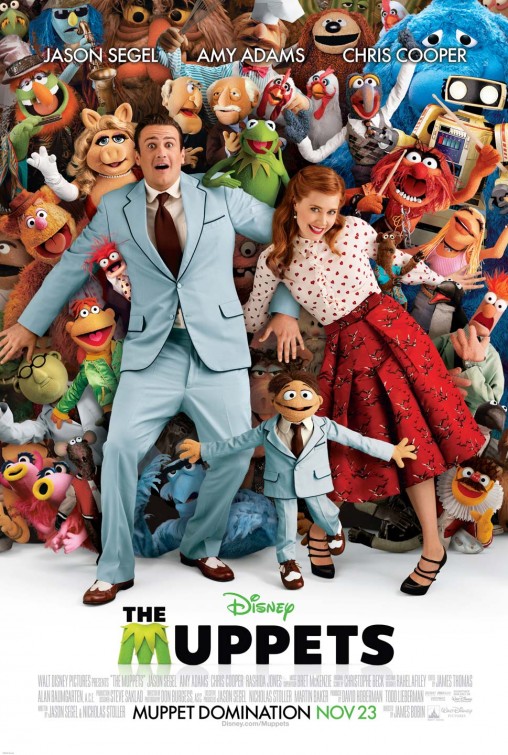 You’d hardly expect the duo behind the raunchy, R-rated comedy Forgetting Sarah Marshall to be the saviors of the Muppets, the famous puppet crew that has been languishing since their last big screen outing, 1999’s underwhelming Muppets in Space. Actor Jason Segel took a meeting with Disney after the Jim Henson Company did some puppet work for Sarah Marshall. He just point-blank asked them what their plans were after acquiring the Muppets. They had nothing. Segel and Nicholas Stoller (Get Him to the Greek) put together a script and, lo and behold, the two self-described Muppet enthusiasts were given the opportunity to bring new life to the classic creatures. The Muppets is just about everything a Muppet lover could ask for and will be sure to entertain a new, younger generation of fans with the Muppets core brand of silliness and sweetness.
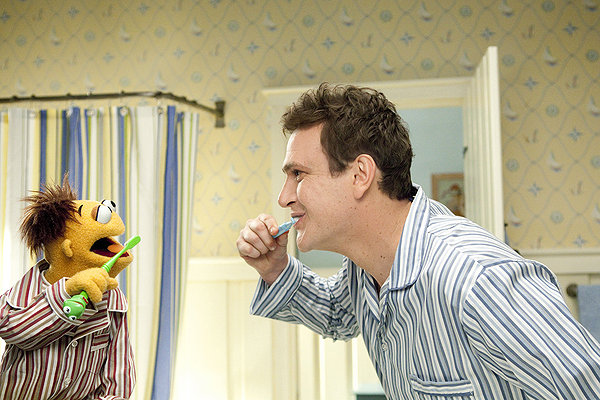
Set in the town of Anywhere, Gary (Segel) and his girlfriend Mary (Amy Adams) are planning a trip to Los Angeles. She’s hoping that he’ll finally propose to her in the scenic city of angels. There’s one catch: Gary’s brother Walter is coming along too. Oh, and Walter is a Muppet. Walter is obsessed with the Muppets ever since he watched their TV show in the 1980s. The show was an escape for a kid who felt… different. Walter is anxious to visit the Muppet studios, but the studio is in disarray and the Muppets have all gone their separate ways. Tex Richman (Chris Cooper), what else but an evil oil barren, plans to buy the Muppet studio and tear it down. Walter, Gary, and Mary must seek out the Muppets to rescue the old studio, and the only way to raise enough money in time is to put on one more rendition of The Muppet Show.
 The Muppets is a refreshingly retro and charming vehicle that reminds you of all those warm and fuzzy feelings you had for this crew. It’s unironic, innocent, sweet and wholesome in a way that doesn’t make you gag but self-aware and silly enough to continuously be clever. When a big song-and-dance number breaks out in the town of Anywhere, once the stars have left the townspeople collapse in exhaustion. The gang decides it’ll be quicker to “travel by map,” so we cut to a map and see a red line charting onward. Muppets will regularly break down the fourth wall, with Fozzie commenting on a sudden explosion, “Wow, I didn’t think we had that in the budget.” Tex Richman actually verbally articulates “maniacal laugh.” The group gathering is sped up when the character 80s Robot suggests streamlining the rest in a montage. It’s not the kind of jokes that will make your sides ache with laughter but it pins a smile to your face from beginning to end, although Chris Cooper’s out-of-nowhere rap number left me in stitches. The very question of whether the Muppets can fit into our snarky, over-caffeinated, self-indulgent culture is addressed. Segel and Stoller have found a way to reenergize the Muppets for a new generation while staying true to what makes them special. My friend Eric Muller said watching The Muppets was like “getting an oil change for your soul.” He couldn’t be more right.
Watching the movie, I’m awash in feelings of nostalgia for Jim Henson’s finest creations. Segel is an unabashed Muppets fan and the movie is a celebration of the TV show that inspired him; the TV show is lionized for its inspiration to children. Because of that heavy helping of nostalgia, Muppet fans will feel like their spirits have been lifted. Those who had a mild curiosity about the Muppets will probably just scratch their head and call the film pleasant. The movie’s goal is rather huge: to make the Muppets relevant again. However, the vehicle for this goal, the old puttin’ on a show routine (Mickey Rooney has a cameo!), can feel slight. Also, the Disney product placement can be a bit annoying at times. Really, thanks for reminding us once again about how poor Cars 2 was thanks to a billboard advertisement. The movie isn’t in the same league as Henson’s troika of Muppet movies from the 1970/80s, but Segel and Stoller’s efforts should be a delight for Muppet fans waiting for the triumphant return of their favorite characters. You may find yourself unconsciously singing along to “Rainbow Connection” at the close of the film.
One aspect that is never spoken openly about is the fact that Gary and Walter are brothers, a human and a Muppet. I was expecting some throwaway reference to Walter being adopted, or maybe there could even be a funny sit-down where Walter is given the devastating familial news. We see a montage of the two brothers growing up, and while Gary shoots up like a weed Walter remains at the same height through the years. Does this mean that Muppets attain maturity at a faster rate? That Muppets are fully formed at birth? The mysteries of the universe are left undisturbed.
The music is cheerful and eminently hummable. Recent Muppet outings in the 1990s tried to keep the musical comedy formula going, but the result was some rather tin-eared musical numbers. I challenge anyone to be able to recite more than a few bars from Muppet Treasure Island (my favorite of the three), Muppet Christmas Carol, or Muppets from Space. To everyone’s good fortune, this newest Muppet incarnation has Bret McKenzie, one half of the daffy Flight of the Conchords, supervising the songs. You can instantly tell the musicianship has been raised considerably. The opening number “Sing a Happy Song” is a catchy and bouncy track, putting the audience in the right kind of upbeat mood. “Man or Muppet” is a ballad where Gary and Walter must confront their identity crises. It’s played completely straight, which makes the song even funnier as it builds into a crescendo of self-actualization: “If I’m a man that makes me a Muppet of a man.” There’s also a G-rated performance of Cee-Lo Green’s famous f-bomb kiss-off song, this time performed entirely by chickens. And the aforementioned rap by Chris Cooper is just astoundingly random, and not that bad either. The funny and cheerful music greatly adds to the overall enjoyment of the film.
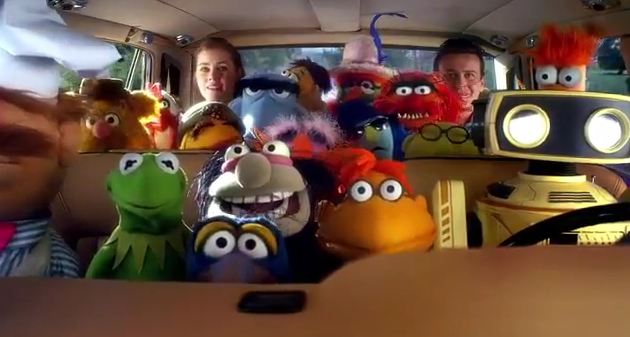 Segel (I Love You, Man) is pretty much a big goofy human version of a Muppet. He’s a winning presence, much like Adams, who slides right back into her adorable Enchanted-flavored M.O. The two actors are a near perfect union of humans who capture the ineffable “Muppetness.” The multitude of celebrity cameos makes for some fun sightseeing (Jack Black has the most extended stay, not by choice). “Hobo Joe” might be my favorite of the cameos. But while the new characters are the initial focus, the emphasis on the film is rightly placed upon the classic Muppets. Kermit and Miss Piggy and the gang are back and the film’s entire plot is essentially their reunion. That means we get wonderful sequences rediscovering the Muppet team, like getting the gang together for a heist. These characters need one another; the bonds are undeniable. It’s actually touching when the Muppets speak candidly about how much they need one another. Fozzie has fallen on hard times especially. Kermit’s mournful song about losing touch with his old pals includes the line, “Was there more I could have said?/ Now they’re just pictures in my head.” While the film’s goal is to really just gather the Muppets back together, you’ll be glad that this goal is accomplished. You will be amazed how much you feel for felt.
The Muppets is a triumphant return to form and rekindles the fondness fans have felt for Jim Henson’s lovable creations. Thanks to Segel and Stoller, and the whimsical direction of Flight of the Conchords director James Bobin, the Muppets is a delightful, charming, and heartfelt family film that will give you a serious case of the warm fuzzies. The songs are catchy, the jokes are amusing, the pacing is swift, and the movie is fun from the start. As a Muppet fan, it left me with a smile pinned to my face the whole time. Like the big screen Simpsons movie, the universe of the Muppets is too big for 90 minutes, so naturally some favorites will be shortchanged when it comes to screen time. Since Disney paid half a billion dollars for the Muppets, I’d expect they plan on making use of the property. After this splendid relaunch, one can only hope that we won’t have to wait too long for the next Muppet movie.
Nate’s Grade: A-
Share this:

The Tree of Life (2011)
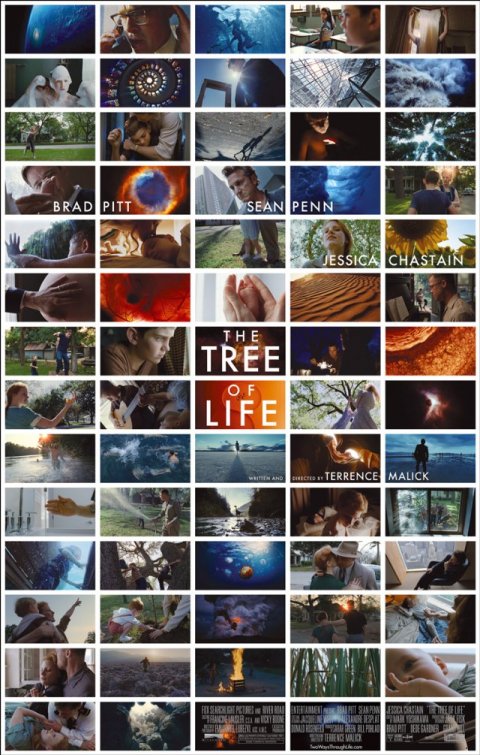 If a Terrence Malick film (The New World, The Thin Red Line) is the closest thing cinema has to creating a religious experience, turning the theater into a church, then I choose to worship elsewhere. After four movies I can decisively say that I am not a Malick fan. The man is more interested in making ponderous nature documentaries attached with pretentious, whispery, obtusely poetic voice over. The man is not interested in narrative filmmaking. The Tree of Life, the inexplicable winner of the Cannes Palme d’Or, is less a movie than an impressionistic experience inside a dying man’s brain. It feels like all the synapses are sizzling, memories and fantasies bouncing around and melding. We see a 1950s childhood and a pushy father (Brad Pitt), but then we also see mom (Jessica Chastain) floating at one point, and Malick also manages to squeeze in a 15-minute sequence charting life from the Big Bang to the end of the dinosaurs. What? The Malick faithful declare their man a singular auteur, a man who uses cinema to explore the unanswerable questions of life, the universe, and everything. Terrific. However, most of these edits are only a couple seconds, and with little narrative momentum the scenes drag and drag, and every Malick minute feels like a thousand hours. Sean Penn, as the adult son, probably filmed his stuff during a pee break from another movie; it’s that short. The film is a technical marvel, the cinematography making tremendous use of different light levels, but that’s all this movie is for me — pretty pictures. It’s yet another frustrating, pompous, punishing “film,” a term I’m being generous with, from Malick. The Tree of Life moves so slowly and intractably that I wondered if literally watching grass grow would be a better use of my time. Sorry Malick disciples, I guess I am a movie secularist.
Nate’s Grade: C
Share this:

The Descendants (2011)
 We’re so used to seeing George Clooney as a smooth operator, a guy who coasts on his suave charm and chiseled-from-granite good looks. But in The Descendants, Clooney is more vulnerable than he’s ever been, trying to keep his family together, and as the film plays out we realize just how mighty a task this goal is. His character is ill equipped to take the lead of his family, especially a family of growing girls he is consistently confused with. His journey is much more than just becoming a better father. That lesson would be far too pat for director/co-writer Alexander Payne. It’s been a good while since Payne’s last film, 2004’s Sideways, but in that time away he has shaped another outstanding human comedy that manages to squeeze in more emotion than most Hollywood movies could ever hope for.
Matt King (George Clooney) is a self-described “backup parent” who has been thrust into the lead role. His wife, Elizabeth, is in a coma after suffering a traumatic head injury from a Jet Ski accident. The doctors say that she has no hope of waking up and she will die in a matter of days. Matt must break the news to his 10-year-old daughter Scottie (Amara Miller) and his rebellious older daughter, Alexandra (Shailene Woodley). The headstrong Alexandra clashes with her faltering father, finally revealing the reason why she blew up at mom months ago. She found out that Elizabeth was having an affair. Matt is reeling and searching for answers from friends, family, and his two daughters.
 Payne’s specializes in pitch-perfect bittersweet character-based comedies, ones that seem to unfurl over a journey of self-awakening. His fictional worlds feel exquisitely rendered, where every character beat and every line of dialogue feels genuine. That’s quite an achievement for a filmmaker of any scope. Even when dealing with caricatures (like in 2002’s About Schmidt), somehow Payne gets away with it. With The Descendants, the sunny setting of Hawaii is just an exotic backdrop for some wonderful, and wonderfully relatable, family drama. It’s hardly the worry-free paradise. Uncovering his wife’s secrets has lead Matt to reassess the woman he loved. The movie completely upends the standard deathbed goodbye trope. Instead of characters openly bawling about the loss of a saintly soul taken far too soon, we have characters dealing with real conflicted emotions, particularly anger, directed at the indisposed and unfaithful mother. Every character is approaching grief differently, and every character is trying to make sense of their feelings before Elizabeth’s inevitable passing. Matt’s father-in-law (Robert Forster) is harsh with accusations at the ready, blaming Elizabeth’s tragedy on Matt’s shortcomings as a husband. His pain is raw but al too recognizable. Matt and Alexandra are plotting how much info to reveal to young Scottie, trying not to ruin her image of her mother, a tremendous challenge with no easy answer.
This is the stuff of grand drama, and Payne doesn’t skimp on the heart-tugging moments. The Descendants is also a great comedy, naturally finding humor drawn from the situation and characters. The advertising has made The Descendants appear like a broad family comedy, with Clooney flapping around in his noisy flip-flops. This is not the case. The comedy doesn’t feel insensitive or too macabre, instead it adds another enlightening level to these people and their pain. We try and make sense of our world, to cope with our struggles and failures, with comedy, and so too does Matt and his family. You’ll probably be surprised how often you laugh and then in the next moment feel a lump in your throat. The character of Sid (Nick Krause) starts off as a questionable plot tagalong, a doofus for some easy laughs. His reaction to an elderly woman with Alzheimer’s is the movie’s one point of questionable validity. As the film progresses, this laid-back guy is revealed to have more layers, just like the rest of the clan. The second half of the film becomes something of a minor key detective story as Matt and Alexandra search for the elusive “other man.” As Alexandra eggs him on, the two bond over this manhunt and Matt becomes bolder, more confident, and clear-headed about the hard decisions that are necessary for his new life. The emotional rewards of the film are nourishing. Watching Matt and his daughters sit on the couch watching a movie together (March of the Penguins no less. Draw your own connections about parental turmoil), you’ll feel satisfied that this broken family has begin to heal itself.
The Descendants takes an interesting turn when we learn more about the other man’s background. Matthew Lillard (Without a Paddle) is actually respectable as Brain Speer, the real estate titan having the aforementioned affair with Elizabeth. Matt’s confrontation is subdued, sidestepping righteous grandstanding for a better attempt to seek understanding. Instead of lecturing Brian, he wants to know more about what his wife was after that Matt could not offer. Sure he’s still angry and doesn’t let the guy off easy. Complicating matters is the fact that Brian has a wife, Julie (Judy Greer), and two children. Matt is trying to find answers without willfully harming Brain’s family. Greer (Love Happens) has an outstanding sequence where she feels beholden to forgive rather than hate, a note of grace that feels rather profound.
Clooney at one point says he’s just trying to keep his head above water, and you can see why. The man shows a great deal of range as his character confronts his grief. There is no “right” way when it comes to grieving, something deeply personal. Matt’s dilemma is given an unlikely situational twist, but the feelings of betrayal and confusion are all too believable. Matt is looking for answers when the person who holds them all lies sleeping. As he develops a lager picture of his wife and her unhappiness, Clooney expertly flashes through a multitude of thoughts. While arguably not as textured as his performance in Up in the Air, Clooney is in fine form, showcasing a deeper sense of loss and anxiety. Matt is trying to find his footing while his world radically adjusts, and nothing has adjusted more than his feelings toward his wife. Clooney doesn’t have any Big Moments of Great Emotion, though lashing out at his comatose wife comes close, but the man’s nuanced portrayal of a life in flux is the stuff that award ceremonies were made for.
 Woodley is a remarkable discovery, more than holding her own with Clooney. She is excellent in her portrayal of an aggressive, mouthy, rebellious teenager. It’s all the more astonishing because Woodley’s long-running TV show, The Secret Life of the American Teenager, is one of the worst shows still running on television. The show is so inartful, the dialogue is so tin-eared, and the acting is wooden like the actors have been imprisoned. Where has this actress been the whole time? Woodley’s performance is so alive with genuine feeling, stripping away any reservations of the too typical bratty teen role. She’s much more than a troubled teen sent off to boarding school. Her every inflection, hesitation, motion feels completely natural for her character, and when Woodley gets her big dramatic scenes she is a force to witness. Upon the sudden news that her mother will die soon, she plunges underwater in the family pool and screams as loud as she can, tears squeezing out of those sorrowful eyes. For goodness’ sake, this girl cries underwater. An Oscar nomination is assured for the 20-year-old young actress. Maybe she can quit her crummy TV show after the wave of good press and fawning praise that await her.
The Descendants is an incredibly observed human drama, a humane and touching comedy, a movie so engaged and plugged in to the messiness of human emotions, eschewing the bitterness of some of Payne’s earlier works. This is a thoughtful and nuanced flick that is elevated to even grander heights due to the excellent performances of father/daughter team Clooney and Woodley. The film hits all those traditional emotional notes but on its own terms. The movie approaches a graceful resolution by accepting the incomprehensible disarray of life. The Descendants is just about everything you’d want in a movie: supreme acting, strong characters, an affecting story, and emotions that are completely earned. Payne’s mature and tender movie is, by the end, rather hopeful, a celebration of family overcoming adversity. It’s not schmaltzy in the slightest but a powerful antidote to simple cynicism. This holiday season, be a good movie citizen and spread the word of The Descendants.
Nate’s Grade: A
Share this:

Breaking Dawn: Part One (2011)
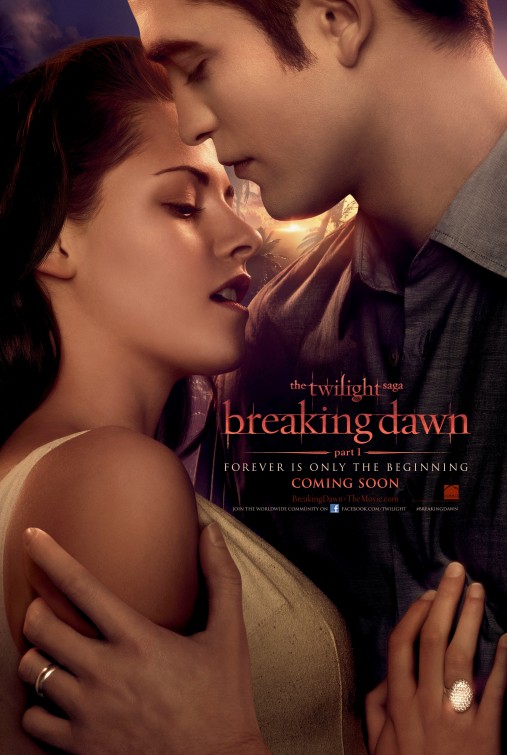 Taking a cue from the blockbuster film franchise of our age, the Harry Potter series, the producers and studio heads decided to split the final Twilight film into two separate movies. Yes, for you cheerless, unfortunate males dragged along to author Stefenie Meyer’s estrogen-drenched soap opera, hoping to be done with Bella Swan and her sparkly vampire boyfriend, well your pain soldiers onward another year. If Breaking Dawn: Part One is any indication, we’re all in for a world of hurt come November 2012.
Wedding bells are ringing for Bella Swan (Kristen Stewart) and her undead boyfriend, noble vampire/undead heartthrob, Edward Cullen (Robert Pattinson). Bella’s persistent demand to be turned into a vampire is finely about to come true. She wants to stay human a bit longer, to savor her last days on Earth before sipping blood through a bendy straw. Her always-in-second best bud, Jacob (Taylor Lautner), is worried for Bella’s well being. The wedding is like a fairy tale and Edward sweeps his new bride away to a tiny island off of Rio de Janeiro, where the housekeepers illogically speak Spanish. The couple makes the most of their time alone, and by this I mean they have sex (I refuse to believe this couple would play chess in their newlywed downtime). Edward withholds any second rounds of sex, fearing he’ll seriously harm his bride (he destroyed the bed in mid-copulation). No matter because Bella gets pregnant right out of the gate. We’re told this is impossible, yet her half-human/half-vampire fetus is rapidly growing inside momma’s belly. The baby is also destroying its host, eating away Bella’s body. Edward demands to kill the baby but Bella will have none of it. She’s going to deliver this baby even if it kills her. If it does kill her, then the truce between the werewolves and vampires will be broken, and Jacob’s feistier tribe mates will be knocking down the Cullen doors looking for some tasty vampires to chomp.
 Director Bill Condon, he of Dreamgirls fame and an Oscar-winner for 1998’s Gods and Monsters, goes hog-wild with the emotions, fittingly reminiscent of the life-and-death swings of emotional polarity that orient a teenager’s life. Condon plays all of the ridiculous melodrama straight. It successfully channels the feelings of teenage angst and obsession, much like the first Twilight film. This Teutonic exhibit of buzzy hormones is like catnip to the Twilight faithful. Finally, they get what they’ve been waiting for, and Condon and screenwriter Melissa Rosenberg delay that gratification even longer. This is the longest wedding I’ve seen on screen since The Godfather. It takes up about 45 minutes of the movie. The protracted walk down the aisle literally takes longer than the rest of the ceremony combined. I can already envision thousands of young girls asking for the “Bella dress” when their time down the aisle comes. At no point does the movie address the fact that the “groom’s side” probably are all absent a heartbeat (“Hmm, extreme paleness? Are you with the bride or the groom? I’m at a loss.”). That’s a missed comedic opportunity. What’s with the wedding guests played by name actors like Maggie Grace (TV’s Lost, Taken)? Did they hire recognizable actors for one-line bit parts? They better have larger roles in the second feature. Under Condon’s direction, the film looks marvelous, and even the long-awaited love scene has some discernible heat to it that will give teen girls “funny” dreams for the next few months. Condon’s also helming the next and final film, so I can at least say it’ll look swell.
This last film was broken into two parts due to the mountains of money the studio would make. It surely wasn’t for some sort of artistic necessity. The plot of BD: Part One is stretched mighty thin. It’s no joke that the wedding and honeymoon takes up half the running time. The baby drama is handled so amateurishly, and the plot ramps up the incubation time so that everything happens too fast for the audience to adjust to how stupid everything truly is. The first half of the movie is free of meaningful conflict. It’s just concerned with payoffs. From everything I’ve read online, and from female friends who have partaken of the series, BD: Part One pretty much covers most of the plot of the 400-page book. What’s left? I would totally give the series a pass if the second movie started with Bella, hair a knotted mess, holding a shrieking baby. Edward sits at the table, drinking. “When are you gonna get a job?” she yells. “When are you gonna stop being a bitch?” he retorts, then gulps down a swig of booze. This domestic downer of an ending would almost make the whole series worth sitting through. Truthfully, as the teaser during the end credits advertises, if Michael Sheen (Frost/Nixon) has a larger part in BD: Part Two, it automatically becomes, sight unseen, the best movie of the series. Thus is the awe-inspiring power of Michael Sheen.
This has long been a silly franchise filled with poorly veiled messages that seem less empowering to teenage girls than reassuring to their parents. Long a heavy-handed message about abstinence, the characters finally get to have sex, after they’re properly married of course (does God really object more to vampire-human relations or when it occurs?). And you better believe the moment Edward and Bella eventually do the deed is a moment that teen girls, and their mothers, around the nation have been anticipating for three long, hard years. The buildup to the carnal climax is a rapturous release for the audience of Twi-hards; my theater felt like it exploded in pubescent hormones and giggling as soon as the proverbial train entered the station. Speaking of euphemisms, I find it telling that not a single character ever refers to sex as, well, “sex.” They keep dancing around the term, referring to it as indistinct pronouns like “this” or “that” or the slightly more specific “honeymoon activities.” It’s like the characters can’t talk about a mature topic without a case of the giggles. There’s even a scene where Jacob talks about Bella’s forthcoming tangle between the sheets, openly, and with alarm: “You’ll kill her,” he tells Edward. He doesn’t kill her but he does leave bruises all over her body. Bella assures her new husband that he’s not to blame, arguing, “You just couldn’t control yourself.” What kind of irresponsible message is that sending to teenage girls? But after enduring three movies of “save it until marriage,” the message is made even clearer when Bella, after one bout of sex, gets pregnant. Boom. Bella breaks the news by saying, “The wedding was 14 days ago, and my period’s late.” Edward stares dumbfounded and replies, “What does that mean?” Apparently, after graduating from high school 200 times just for kicks, Edward must have been absent every damn time for sexual education (“Condoms go OVER? Oh! This whole time I thought they went UNDER, you know, to hold everything in.”).
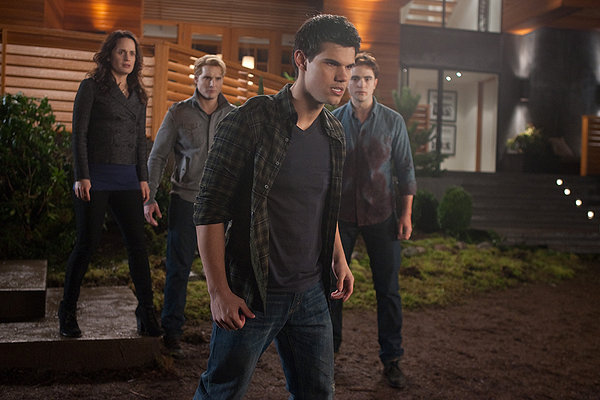 It’s here where the movie awkwardly shifts into a relentlessly pro-life message on legs. I’m not against movies presenting messages, but when a movie is as narratively empty and transparently padded as BD: Part 1, then the movie just gets swallowed up by the clumsy message. It doesn’t matter that Bella’s unborn hell spawn is literally killing her, sucking her dry from the inside out, she’s going to have this baby no matter what, even if she dies in the process. Okay, Meyer, we get it. Here’s a question for the world: can anyone really tell that much difference between emaciated Kristen Stewart and her normal self? She always appears a little sickly and hollow-eyed, but maybe that’s just me. The baby is basically the only conflict the movie presents and it happens so late in the film. Thanks to a fast gestation period, the demon fetus is determined not to wait until Part Two to make its grand entrance. Now that Bella is preggers, she’s become instant buddies with Rosalie (Nikki Reed, a long way from Thirteen), and the two of them begin a war against non-gender pronouns (its vs. he/her). The baby conflict would be more interesting if it was a tad more ambiguous, but the fact that it literally is killing Bella, not to mention its monstrous possibilities, and yet she persists to give birth is less characterization and more stubbornness. If Bella’s worried she’ll never have another chance to have a flesh-and-blood daughter, then explore this. Otherwise it makes Bella look blithely cavalier with her own life.
It’s here where Meyer and the Twilight franchise, already deliriously high on teen angst, goes off the charts into weirdo territory (some spoilers will follow). Never mind where the werewolf boys (and a girl) manage to find new clothes after they destroy them after each beastly transformation, we’ve got far weirder moments to process. There’s a vampire C-section via biting. There are giant wolves communicating via growling telepathy and bad CGI. There are Bella’s completely batshit names for her child; if it’s a boy she wants to combine Edward and Jacob’s names because that’s not awkward (“See, son, you’re named after the other guy I could have slept with but decided to just string along instead.”). And if it’s a girl she wants to combine her mother’s name and Edward’s mother’s name forming the atrocious “Reneesmee.” Excuse me? That makes “Apple” seem as traditional as apple pie. No one tells Bella these names are horrific because she’s pregnant, naturally. I imagine all the characters broke out into laughter as soon as Bella left the room to go puke into a bucket. Easily the weirdest and dumbest thing in the history of the Twilight franchise occurs as a contrived deus ex machina and a tidy solution to Jacob’s eternal, annoying pining. Jacob is determined to slay the monster he believes responsible for killing his unrequited love, Bella, but then he looks into those cute little baby eyes and… swears devotion to this newborn babe. He “imprints” on her, which means that they are meant to be together, and thus the werewolf/vampire truce holds. “Of course,” Edward intones, “Imprinting is their number one law. They cannot break it.” Of course! This reminded me of the scene at the end of the second Harry Potter movie where a phoenix comes from nowhere and cries into a wound (“Of course, phoenix tears can heal anything,” Harry informs while I was physically smacking myself in the head). Doesn’t anyone else find this whole plot development creepy? Jacob can’t have the mother, so he’s going to have the baby? And he’s got to wait 18 years if he wants their coupling to be legal on top of that. I think a messed up name is the least of this kid’s worries.

- Does she look like a healthy person? This is pre-baby succubus.
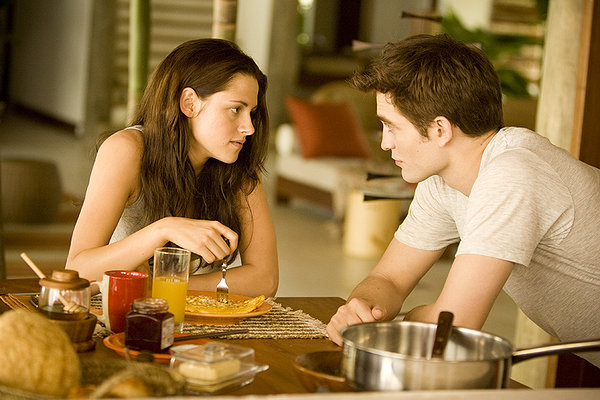
It all comes down to the heroine of the franchise, Miss Bella Swan (sorry, Bella Cullen now). I just don’t get what all the fuss is about. To me, Bella isn’t worth the effort. She’s never really been anything close to a fully formed character. Bella Swan has always defined herself by having a boyfriend, and when he was gone it was about pushing her friends away and moping until she finally found a new guy. She has zero self-identity, no center, she is an empty shell, there is no there there. She’s a cipher, meant for the teenage readership to plug themselves into her place. I won’t restate my theory that the Twilight series is glossed-up pre-teen wish fulfillment, but there you have it. Yet there are sneaking moments where Bella seems almost shockingly… human. Her anxious montage of preparation before her first night of sex is relatable and sympathetic (what outfit to wear? Shave the legs? What kinds of makeup?). Too bad this relatable side of her character vanishes all too quickly. Before Bella defined herself by her boyfriend and now she defines herself by her baby. She’s still the same whiny, selfish, morose, and cruelly manipulative Bella, though. She can’t let Jacob alone; she has to continue stringing him along, bringing him into inappropriate personal matters. Jacob’s always been a bit of a control freak who seems to spout quasi-rapist dialogue (the classic “You love me, you just don’t know it yet.”), but the guy’s always gotten a raw deal as far as I’m concerned. Betrothed to a baby is not a worthwhile parting gift. I worry that young, impressionable girls are going to look at Bella as an influential figure. If these same gals want a literary heroine they could truly look up to, they should feast their eyes on Katniss Everdeen, proactive and laudable star of the Hunger Games and forthcoming movie of the same name.
The three actors have been playing the same character notes for so long that they could all just go on autopilot and collect their paychecks. Stewart (Adventureland) is less annoying than she has been in previous films. I’m trying not to take out my disdain of her character on the actress, who I’ve genuinely liked in pre-Twilight projects (even her Joan Jett performance was pretty decent). Pattinson (Water for Elephants) seems to shrink into the background for this movie. There are a lot of long, ponderous, somehow meaningful stares between the two, with the soundtrack trying to communicate emotions that the screenplay has failed to do (a little more variety on the soundtrack next time, fellas? I think I tuned out after the twelfth melancholy piano ballad). Luckily, Pattinson does have something of a screen presence to go with those abs. Unfortunately, the same could not be said for Lauthner (Abduction). The young buck, formerly of Shardkboy fame, just cannot act. He has a nostril-heavy manner of expressing emotion that makes you wonder if he’s about to blow your house down. It’s telling that within mere seconds of the film beginning, the guy rips off his shirt, the peak of his acting abilities. I suspect it will not be long before Lautner and his six-pack and sitting at home, unemployed, and indulging in a different six-pack.
 Breaking Dawn: Part One is certainly not intended for critics of the book and film series or really any audience member lacking ovaries. But I think that even the most ardent Twi-hards will walk away giggling at the silliness of the overripe melodrama. I try not to be out rightly dismissive of the whole series, but the bad characters, bad plotting, and questionable messages make it hard to continue bending over backwards to find slivers of quality to support. I get the appeal of the series, the fact that Bella Swan is a cipher to exercise frothing teenage wish fulfillment, but that doesn’t excuse the movies from being so bad. This isn’t the painful abomination that was 2009’s New Moon, but it’s come the closest. Only the promise of more Michael Sheen makes me hopeful that BD: Part Two will be better than its predecessors. When you’re talking about an obscenely popular moneymaker, quality becomes secondary to delivering a product that is recognizable to the demands of the screaming fans. BD: Part One is less a payoff than a warning. There is more to come, and if you thought Bella was intolerable before just wait until her vampire growing pains.
Nate’s Grade: C-
Share this:

Immortals (2011)
 Director Tarsem Singh has only made two movies but is widely regarded as one of the finest visual artists working in the film medium. He’s made tons of commercials, which is apt because his first feature, 2000’s The Cell, felt like the world’s longest perfume ad. While amazing in its design, the movie was incredibly stupid. I haven’t seen his other feature, the more personal work The Fall, a movie that nobody wanted to make. It’s probably because they regrettably saw The Cell. Now the guy seems downright prolific, with a Greek mythology action movie in release and next year an update on the Snow White fairytale, the first shot in the Great Snow White Duel of 2012 (Kristen Stewart stars in the other, next summer’s Snow White and the Huntsman).
In 1200 B.C., King Hyperion (Mickey Rourke) is marching an army across Greece, laying waste to city after city. He’s looking for the mythical Epirus Bow, believed to be the only weapon capable of unleashing the titans, who were imprisoned after a war with the Olympian gods. Mankind’s only hope is Theseus (Henry Cavil), a strapping young lad born into low class. His real father is Zeus (Luke Evans) who keeps tabs on his spry son by posing as a wise old man (John Hurt). Phaedra (Freida Pinto) is a virgin oracle, a priestess who has been granted prophetic visions. Theseus rescues her and other prisoners of Hyperion. Together, they must find the bow and convince their countrymen to fight against the overwhelming forces of Hyperion. In the meantime, Zeus has sworn death to any god who interferes in the affairs of man and helps Theseus on his important quest.
 One word I feel accurately that sums up the experience of watching Immortals is… “viscera.” This movie is obsessed with filming the destruction of human bodies in the most gloriously beautiful ways possible. The violence and gore are given an intensely operatic boost. One moment involves a god zips around the slow-moving mortals, smashing one head after another with his humongous war hammer. The scene plays out at a slower speed, allowing the explosions of glistening blood and skull to fill the screen, each a mesmerizing fireworks display of human goo. The visuals are often a balletic, phantasmagorical, Grand Guignol display of human carnage. When you watch this at home, you may need a squeegee to clean your TV. It’s mesmerizing to watch, getting lost in the painstaking yet sumptuous visuals, even when it’s buckets of spaltterific gore. There’s one scene involving a sledgehammer that’s guaranteed to make every male in the theater uncomfortably cross his legs. The final image is also memorably striking – the sky filled with thousands of battling titans and Olympians, suspended high in the air and hacking and slashing away (Grecian weather report: 50 percent chance of blood showers. Bring an umbrella).
Tarsem never skimps out when it comes to the look of his movies. Immortals looks like a living Renaissance painting; the director of photography should be credited to Caravaggio. Unlike Tarsem’s earlier films, this movie does not take place within the realm of imagination, but that doesn’t hamper the movie’s aesthetics. Taking a cue from the golden-hued Greek/Roman epics of recent year, notably Zack Snyder’s 300, the film exists in a heightened reality. We’re dealing with mythology after all (more on the specifics of that later). The iconic imagery of Greek mythology is all there, stunningly realized in lavish CGI and a production design that is frequently jaw dropping. The action sequences are resolutely exciting, with special mention for the climactic gods vs. titans battle. The gods, decked out in spiffy gold armor and capes, bounce off the walls aided by Matrix-style moves and slice and dice their wicked immortal brethren in creatively gruesome ways. It’s a thrilling sequence that almost makes you forget the movie’s catalogue of sins.
The movie plays fairly fast and loose with the Greek lore. The Theseus of legend was mainly known for slaying the ferocious Minotaur, the guardian of a great labyrinth. His father was Poseidon, not Zeus. Some versions even have Phaedra falling in love with Theseus’ son from his first wife (Theseus was a busy boy, taking after his father). These details, and more, may seem inconsequential but if they’re going to be so loose in the adaptation, why even bother keeping the name Theseus? Immortals does have an interesting albeit brief bit where the Minotaur is seen as a human warrior wearing a bull mask made of barbed wire. Short of the gods and titans, there isn’t any depiction of the supernatural occurring on Earth. The monsters and mythic creatures are absent, leaving some Greeks to question the validity of the gods. The movie takes an unexpected twist early by declaring, in a self-serious tone, that immortals can… die. It seems that the gods just discovered one day that they could kill each other. I would have liked to be there for that discovery (“Yeah, go ahead and lick that electrical socket.”). The film lays out that the titans and the gods were one in the same, it’s just that the winners of the battle of the heaven called the losers “titans.” If they’re the same then why do the titans act like feral monkey creatures and look like ashen, Hindi gods (no disrespect, one billion Hindus)? Have they simply gone wild after being locked away in such a unique prison? When they fight, the titans move at the speed of mortals, not gods. I also believe the titans were supposed to be considerably larger.
 But as enchanting as the visuals are, there are still the other senses that are criminally malnourished. The screenplay by brothers Charlie and Vlas Parlapanides is about as bare-bones as you can get. It’s your basic hero’s quest, trusting young stud Theseus with finding a magic item and stopping a bad man. If that sounds plainly generic then congratulations, you’ve seen more than one movie with men in togas (Animal House does not count). Mysterious parentage? Check. Close relative that dies early to spur vengeance motivation? Check. Noble sacrifices by members of his team? Check. Eventual intervention of the gods? Check. What I just described could also have been the plot for 2010’s joyless Clash of the Titans remake. What’s up with Zeus and these noncommittal gods? He refuses to get directly involved in the affairs of man, but if King Hyperion releases the titans (should have gone the long route and unleashed the Kraken) then the Olympians are jeopardized. It seems like they have an interest in giving Theseus a mighty assist. The magic item, a bow that creates unlimited arrows when plucked back, is pretty much a forgotten relic. It gets used, I kid you not, exactly three times in the entire movie. All of this fuss over a super weapon that the characters can’t be bothered to utilize. They’d rather fight it out with a traditional bronze sword. What exactly does it mean to be immortal when even the gods can die? King Hyperion says he’ll be immortal by essentially raping a nation of women, keeping his bloodline alive for centuries (the Genghis Kahn defense, your honor). But if having kids is being immortal, I think we’re setting the bar pretty low.
The Phaedra character is so underwritten that she almost comes across as a parody of the role of women in these guy-heavy action spectacles. As portrayed, Phaedra is the definition of convenience. She doles out a prophetic vision to save the day, provides some grade-A eye candy thanks to the splendor of Pinto (Slumdog Millionaire), and even casually slips into Theseus’ bed for a deflowering (sorry guys, it’s clearly a body double). She will be haunted by visions of the future until the moment she loses her virginity. Let’s stop and think about this. Having one member of your team be able to SEE INTO THE FUTURE seems like a decisive tactical advantage. I understand the lure of a naked and willing Pinto, but Theseus needed to think beyond the needs of his little Greek. In an abrupt and off-putting turn, Phaedra is never really dealt with in any capacity after this seismic bout of lovemaking, nor do she or Theseus talk about what has transpired. She just provided some casual sex while the hero was recuperating and then checked out. Her major prophetic vision of Theseus and Hyperion joining sides is also just forgotten, turning out to be a letdown.
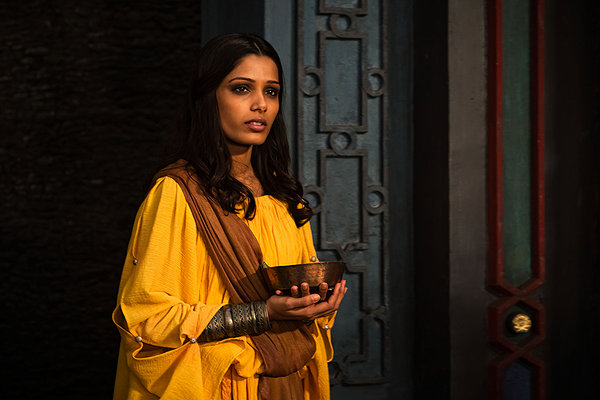 The actors were basically hired for their visual appeal, and to that end they succeed. Cavill (TV’s The Tudors), tapped to wear Superman’s cape in 2013 by Zack Snyder, is suitably buff and hunky. His performance is rather flat, no matter how many times he makes his eyes go big with anger. In contrast, Rourke (Iron Man 2) will chew whatever scenery he can find. His flamboyantly costumed villain at one point seems to wear a lobster claw on his head. He wants to punish the gods because they refused to intervene when Hyperion’s wife and child were slaughtered. When the gods do intervene to save Theseus, that’s when the character should go off the rails. Rourke just plays it in the same sleepy menace. Pinto gets to stare off into the distance regularly and pray. It’d be a stretch to say that the material challenges any of these actors.
Immortals is a testosterone-soaked action movie that feels like it minored in Art History. The production design, CGI, and practical special effects, all attuned to the extraordinary vision of Tarsem, makes for a brilliant looking movie with several sequences of memorable carnage. But we entered the age of “talkies” since 1927, and Immortals suffers when it concerns dialogue, story, characterization, and acting. The movie is a pretty loose adaptation of Greek mythology, falling back on a rote hero’s quest and leaving plenty of narrative dead spaces for the visuals to fill in the interest. Even a movie as visually resplendent as Immortals can only go as far as its story will allow. In this case, Immortals might just be the best-looking piece of borderline mediocrity you’ll ever see in your life.
Nate’s Grade: C+
Share this:

Circumstance (2011)
 Despite a slate of quality movies by homegrown filmmakers, Iran is not exactly the most film friendly country conceivable. Governed by a strict set of Islamic moral laws, filmmaking has often been conflated with Western cultural corruption. In 2010, Jafar Panahi, an internationally renowned Iranian filmmaker, was sentenced to six years in prison for nebulous charges of conspiring against ruling forces. He was also banned from making any movies, or even scriptwriting, for 20 years. Just imagine what the country’s moral authority would say about Circumstance, an independent drama about teen lesbians. The controversial movie was filmed in Lebanon and populated with Iranian-born actors living in North America. The movie is, no surprise, banned in Iran.
Atafeh (Nikohl Boosheri) and Shireen (Sarah Kazemy) are two teenage girls living in modern-day Tehran. They are both free-spirited and yearning for the freedoms not afforded under strict Islamic law. They sneak away from their families to go to parties where they drink, smoke, listen to forbidden music, and dance with boys. The two girls’ lives become even more complicated when they start having new feelings for one another. Shireen’s parents are dead and she lives with her traditional uncle, who is looking to marry the girl off. A suitable suitor is Mehran (Reza Sixo Safai), Atafeh’s older brother. Mehran is back after an, unsuccessful, stint in drug rehab and looks to stern religion to guide him. Shireen and Atafeh must keep their love a secret or risk losing everything they hold dear.

Circumstance seems, under the circumstances of geopolitical intolerance, to be casually tagged as “that Iranian lesbian movie,” much like Brokeback Mountain was initially dismissed as that “gay cowboy movie.” In a sense the movie doesn’t rise beyond the sum of its parts, but it does portray an intriguing slice of life hidden from mainstream society. You pretty much expect that things are not going to work out for these star-crossed Iranian girls, but that doesn’t stop you from hoping that they’ll beat the long impossible odds (the girls talk about running off to Dubai where “anything is possible”). The character work can be lacking, sadly. The girls will drift from scene to scene, perhaps metaphorically indicating the limited role of women in this strict environment. Then again it could just be a screenwriting deficiency. There’s enough interest in a secret lesbian romance behind the veil, but the story would have resonated greater had the characters been given greater attention. They seem real; there’s little in the film that seems inauthentic. The girls and their lives of limited options feels pressingly real, I just wanted to buy into their romance more. The friendship is there but the establishment of desire is taken for granted. A couple of sequences with roaming hands do not substitute for laying down character work. By the end of the movie, one of them blithely accepts her destiny as an unhappy subjugated bride, while the other escapes for a life abroad with possibility. The emotional impact of the ending is diminished. We feel sorry for them, but do we feel the ache of tragedy? I could not, and the unreasonably abrupt ending left zero in the way of resolution.
If you’re looking to quicken a few heartbeats, Circumstance should do the trick. Naturally a story about two young women falling for each other has a spark of eroticism. Writer/director Maryam Keshavarz offers a welcomed feminine perspective on budding sensuality. Her camera lingers on close-ups of hands, fingers dancing across goose bumped flesh. The film manages to be erotic without dipping into exploitation; there is only the briefest of partial nudity and the girl-on-girl activity is tastefully portrayed. Keshavarz could have pushed further so that the audience would feel the sense of longing that drives Shireen and Atafeh.
The unrequited lesbian romance is practically a genre unto itself in independent cinema. It’s a natural magnet for drama: suppressed feelings, oppressive regimes forbidding the forbidden love, and the spark of sensuality at the bloom of youth. I would argue that 1999’s Aimee and Jaguar is the best unrequited romance of modern cinema, gay or straight. Like Circumstance, that film dealt with a surprising lesbian romance during a time when homosexuals were persecuted (Germany in World War II). It seems given the terrain that you’d expect Circumstance to walk the line between unrequited lesbian romance and coming of age tale. While not as fully convincing about the sickness that first love can develop, like 2004’s teen lesbian romance My Summer of Love which gave the world Emily Blunt, Circumstance does present an interesting story due to the particular hostilities the girls must evade. Iran is a rather hostile place for women of all stripe, let alone ones with homosexual tendencies. This is, after all, the same country whose leader publically proclaimed that Iran did not have one gay citizen. The pressures to conform are omnipresent. Atafeh and Shireen are detained simply for going out late and wearing makeup in public. I wish the film had gone into greater specifics about the dangers the girls faced, rather then operate on the assumption that their actions would easily fall in the “no-no” category. I don’t consider myself a sadist, but more scenes like the police detention would dial up the peril as well as better articulate the impossibility of their romance.

While not living to its potential as an unrequited romance, Circumstance succeeds in other ways, namely as a showcase of the cultural struggles of modern-day Iran. We get an interesting glimpse into the underground youth culture, showcasing a world that fights for existence where young people will risk their lives for a taste of Western or modern culture. The particulars of this underground scene are not dealt with in any meaningful way; the characters just seem to duck into hidden parties and peel off their street clothes. One of the characters in the film states that everything is political, and just by showing the flourishing underground youth culture Keshavarz has made a political statement. I would have enjoyed more examination on this cultural schism. We see friends of Atafeh discussing the finer qualities of Milk in a hidden video store, discussing the relatability of the human rights message. They even plan on dubbing it over into Farsi and attaching it to a bootleg of the Sex and the City movie for maximum exposure. When this youthful rebellion gets uncovered late in the film, Iranian officials blame a widespread conspiracy involving Israel and the United States to weaken Iran. Circumstance oddly steers clear from showing many consequences of being caught. As a result, the hidden youth culture feels too protected from the country’s powerful Morality Police.
The Mehran character is the movie’s biggest stumbling block. He’s supposed to be an antagonist in some respects, though his long creepy lustful stares don’t seem to amount to much. His transition from failed musical student to religion convert is poorly handled. He’s seen smoking hardcore drugs but then it appears that Mehran is never tempted again with drugs. I assume that, as presented, Mehran has replaced drugs with religion (Karl Marx would nod to himself). The film’s conflict between modernism and theocratic rule is minimally addressed. The fact that the father, an affluent, college-educated middleclass secular man who was a rebel in his youth, is drawn back to religion by the film’s end is hard to swallow without more convincing evidence or commentary. The entire storyline where Mehran secretly spies on his family with hidden videos seems completely superfluous. It’s just another way to make the guy look creepy, which is just piling on. The hidden surveillance, the idea that women are always being scrutinized, could make for an interesting addition, but not as presented.
The two female leads, Boosheri and Kazemy, are both lovely ladies, giving tender, emotional, affecting performances. I just wish that Circumstance were less shallow when it came to its characters and specific plotlines. This unrequited romance is missing some necessary ingredients to work as a movie. The character work and plot can be frustratingly shallow at times, and the obvious peril of being young, female, and gay in Iran is too often left assumed. Circumstance is an interesting cultural document of Iran, but as the “Iranian lesbian movie” it fails to stretch beyond this simplistic branding.
Nate’s Grade: B-
Share this:

J. Edgar (2011)
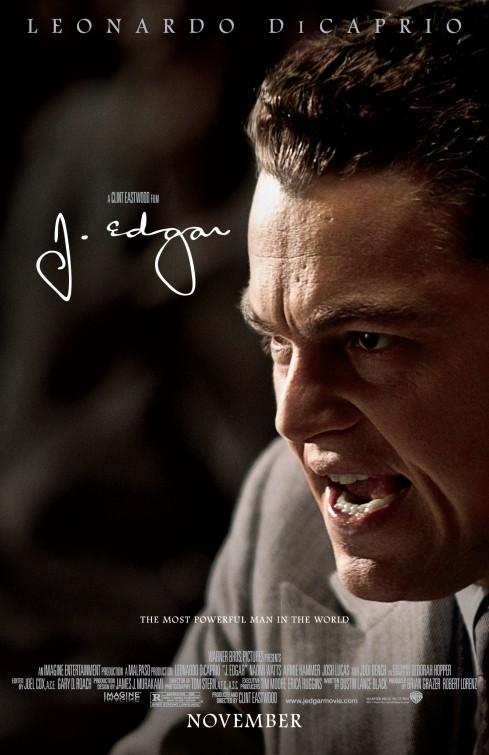 J. Edgar has all the qualities you’d want in a high profile, awards-friendly movie. It charts the life of legendary FBI head J. Edgar Hoover, it stars Leonardo DiCaprio in its title role, and it has Oscar-winner attached as screenwriter (Dustin Lance Black) and director (Clint Eastwood). The only way this movie could be bigger awards bait was if Hoover personally challenged Adolf Hitler to a duel. At a running time of 137 minutes, J. Edgar misses out on explaining why this complex man was who he was, a difficult prospect but I would have at least appreciated some effort.
J. Edgar Hoover (DiCaprio) was, at his height, said to be the second most powerful man in the United States. The first director of the Federal Bureau of Investigations served under eight presidents and for over 50 years. The man rose to power fighting against radicals and Bolshevik terrorists in 1919. Hoover successfully arranged for America to deport foreigners with “suspected radical leanings.” He was appointed to head the, then, Bureau of Investigations, where Hoover remade the agency in the image he desired. His agents were going to be clean-cut, college-educated, physically fit, and God help you if you had facial hair. Hoover also fought to bring modern forensic science into investigations and trials, proposing a centralized catalogue of fingerprints, which at the time was dismissed by many as a “speculative science.” Hoover also amassed an extensive system of confidential files on thousands of American citizens he felt were potential threats or if he just didn’t like them. Hoover wasn’t afraid to bully presidents with this secret catalogue. On a personal level, Hoover was admittedly without any friends or interests outside the agency he felt responsible for. His life was defined by three close personal relationships: his mother (Judi Dench), whom Hoover lived with until the day she died; Helen Gandy (Naomi Watts), his loyal secretary and confidant of 40 years; and Clyde Tolson (The Social Network’s Armie Hammer), an FBI agent that Hoover shared a decades-long unrequited romance with. Upon Hoover’s death in 1972, Tolson was given Hoover’s burial flag, and Tolson’s own grave is a mere couple plots away from J. Edgar’s.
 The movie feels trapped in a closet alongside Hoover. The guy was rather enigmatic and hard to nail down, but I would have appreciated Eastwood and Black at least trying to figure the guy out. They treat the subject with such fragility, such sympathetic stateliness about his more salient personality points. It feels like Eastwood doesn’t want to get his hands too dirty, so the provocative material, like the gay stuff, is kept to very period appropriate acts of discretion. A handholding in the backseat of a car is practically scandalous given the treatment on the gay material. The oft rumored cross-dressing aspect is hinted at but explained, in context of the scene, as Hoover’s way of mourning the loss of his mother. With Hoover, there was only his public persona of a moral crusader, a face that he never removed even in his private moments. The guy could never embrace happiness, only duty. It feels like Eastwood couldn’t decide on what stance to take, and thus the film settles on a bloodless examination that won’t upset any of the, presumably, delicate sensibilities of the older audience members. A towering figure of moral certainty, extreme paranoia, righteous conviction, a vindictive streak against his mounting collection of enemies, and a shaky hold on the truth, all in the name of protection against America’s many real and imagined enemies – I feel like the blueprint has been established for the eventual Dick Cheney biopic. It’ll just be slightly less gay.
Let’s talk more about the gay factor. It feels like this area is where Eastwood definitely could have pushed much further, but the old school director seems to be of the opinion that a biopic need not pry nor speculate. Excuse me, but you’re telling me about a man’s life, the least you could do is dig deeper. A domineering mother, who said she’d rather have a dead son than one of those “daffodils,” and the moral restraints of the time, are easy enough to identify why Hoover was a repressed homosexual. That doesn’t separate him from probably a far majority of homosexual men in the first half of the twenty-first century. What makes Hoover, a repressed homosexual, tick? This is no Brokeback Mountain style whirlwind of untamable emotion. Eastwood keeps things chaste, choosing to view Hoover as a celibate man. Hoover and Clyde becomes inseparable “companions,” eating every dinner together, going away on trips, and enjoying the pleasure of one another’s company – the life of the lifelong “bachelor.” But that’s as far as the movie is willing to go (remember the scandalous handholding?). There are hints about how socially awkward Hoover can be, a guy who seems downright asexual at times. He proposed to Helen on a first date where his attempts to charm included showing off his card catalogue system at the Library of Congress (“I bet you show this to all the girls…”). You get the impression he’s not comfortable with this necessary area of human biology. That’s fine room to start, but J. Edgar doesn’t do anything but start its characterization ideas. It gives you ideas to toy with and then moves along. The relationship with Clyde hits a breaking point when Hoover discusses, during one of their weekend getaways, the prospect of finally choosing a “Mrs. Hoover.” Naturally Clyde does not react well to this development, and the two engage in a brawl that ends in a shared bloody kiss. This is about as passionate as Eastwood’s movie ever dares to get.
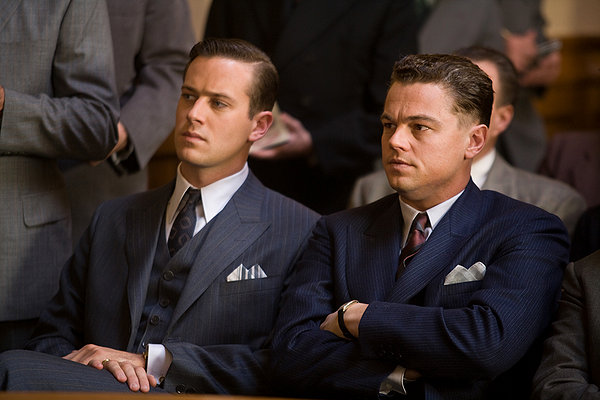 I expected more from the Oscar-winning writer of Milk. Black’s lumpy script can often be confusing, lacking a direct narrative through line. Some leaps in time can just be confusing, like when J. Edgar is asking his junior agent typist what figure was most important in the 20th century thus far. The agent answers, “Joe McCarthy,” and then we have a new agent sitting there, and Hoover asks again. Finally we have another agent who responds with Hoover’s desired answer, “Charles Lindbergh.” I suppose we’re left to assume that Hoover fired his typists until he found one who mirrored his own thoughts. There is also far too much time spent over the Lindbergh baby case. I understand it’s the so-called Crime of the Century and, as Black sets up, a situation for Hoover to prove his bureau’s value when it comes to modern criminal science. It just goes on for so long and rarely offers insight into Hoover. Sans Clyde, the majority of the supporting characters offer little insight as well. Hoover’s mother never goes beyond the domineering matrimonial figure. Helen seems like a cipher, rarely giving any explanation for her decades of loyalty despite clear objections to certain choices. She’s too often just a “secretary” there to move the plot along by introducing more characters of minimal impact. With Hoover being such an enigmatic and closeted figure, the supporting characters could have been the areas we found the most insight into the man. Nope.
The entire plot structure feels like a mistake. Hoover is dictating his memoirs so we primarily flash from the 1930s, when Hoover was making a name for himself, to the 1960s, when Hoover is fighting a secret war against, of all things, the Civil Rights movement and Martin Luther King Jr. (he was convinced King was tied to communists). The back-and-forth nature of the story can lead to some confusion over facts and timelines, but the concept of Hoover dictating his memoirs means that the movie becomes a greatest hits compilation, a showcase of Hoover’s finest hours in an attempt to win public support back. He can explain his obsessions and justify his overreaches. That’s why Hoover’s entire catalogue of secret files on thousands of American citizens, including presidents, is given such short shrift. Why would he want to discuss his own subversive tactics hunting subversive elements? The only time the screenplay discusses this secret catalogue is when Hoover and Clyde want to have a good laugh over Eleanor Roosevelt’s lesbian paramour (irony?). Richard Nixon covets these files, so Helen swears that upon the death of her boss that she will shred every page before Tricky Dick can get his hands on them (J. Edgar is rated R for “brief strong language,” and they are all provided by potty-mouthed Nixon). Black attempts something of an Atonement-styled ending with an unreliable narrator, but the effects are slight and only superficial and too late.
 At this point it’s probably going to be rare for DiCaprio (Inception, Revolutionary Road) to give a dud performance. The actor isn’t the first name you’d think of for a Hoover biography. Regardless, the guy does a great job especially with the emotional handicaps given to him by Black’s script and Eastwood’s direction. Given all the emotional reserve, it’s amazing that DiCaprio is able to make his character resonate as much as he can, finding small nuances to work with. Hoover’s clipped speaking style, likely the most readily recognizable feature of the man, is here but DiCaprio does not stoop to impression. He’s coated in what looks like 800 pounds of makeup to portray Hoover in the 1960s. The old age makeup looks good on DiCaprio, though the same cannot be said for his inner circle. Older Clyde looks like he is suffocating behind a gummy Halloween mask; the man looks like he is mummified in his own liver-spotted skin. Older Helen just looks like they powdered her face and added some gray to her hair.
The movie seems to take its emotional cues from its subject; far too much of J. Edgar is reserved, hands-off, and afraid to assert judgment on what was a highly judgmental man of history. What makes Hoover compelling is his array of contradictions. He’s defined by three personal relationships (mother, Clyde, Helen), all of whom he could never have. That’s got to mean something. Instead of exploring these contradictions in any meaningful psychological depth, Eastwood seems to take his hand off the wheel and the film just casually drifts along, steered by the self-aggrandizing of Hoover himself, given so much room to explain detestable behavior in the name of protecting America. J. Edgar is a handsomely mounted biopic with some strong acting, but from Eastwood’s impassive direction (his piano-trinkle score isn’t too good either) and Black’s lumpy script, the finished work feels too closed off and arid for such a controversial subject worthy of closer inspection.
Nate’s Grade: B-
Share this:

Insidious (2011)
 Insidious is like a fresh coat of paint on the old haunted house movie. Director James Wan and writer Leigh Wannell, the team that birthed the grisly Saw franchise, are working in a completely different realm of horror, tying together familiar genre elements (creaky doors, séances, possession, demons with a lipstick fetish?) into one seriously effective spine-tingler. This PG-13 frightfest is well paced and methodically constructed, giving you pause whenever a character ventures offscreen. It finds a way to make old fears scary again. Wan and Wannell find ways to get under your skin. The final act lacks the precision of the rest of the movie, settling on too many explanations and a jumble of action, but the movie works. There are plenty of memorable, deeply creepy images afoot, the score of shrieking violins is a great addition to the ambiance, and the characters seem, given the outlandish scenario, fairly realistic and relatable. Rose Byrne and Patrick Wilson make a rather sweet married couple. Insidious is something of an old school horror film, using clever tricks and avoiding obvious clichés while building a genuine atmosphere of trepidation. The movie got me to yell at my TV, which is an achievement in itself for a horror flick. I lost my sense of place and reverted back to a participant, spooked at what may be lurking in the dark. Not too bad for PG-13.
Nate’s Grade: B+
Share this:

Take Shelter (2011)
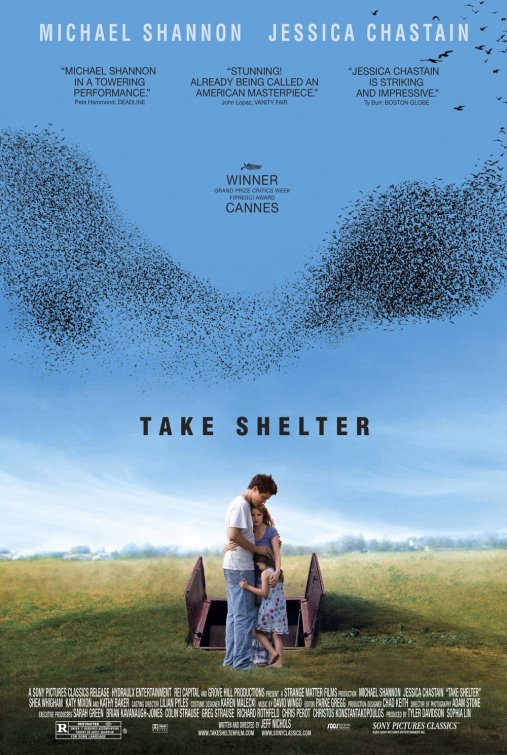 It’s rare that I get to take some local pride and puff my chest about a movie being shot in Ohio. Take Shelter, a small, suspenseful character-piece, was filmed in Loraine County, near Cleveland. Several of the actors in the production are local actors, including Tova Stewart, the adorable seven-year-old who plays the onscreen deaf daughter. The young gal, who is also deaf in real-life, is from Columbus and was in attendance at the theater I saw Take Shelter at. And I can beam with even more local pride at the fact that Take Shelter is unwaveringly magnificent. It’s a remarkably tense movie, deeply realized, expertly crafted, and one of the best films of the year.
Curtis (Michael Shannon) is a working-class family man in rural Ohio. He works as a manager of a two-man drill team, scouring the earth for valuable deposits. His wife, Samantha (Jessica Chastain), cares for their recently deaf daughter, Hannah (Stewart), and sews pillows and embroidery on the side. They are making ends meet to save up for Hannah’s cochlear implant surgery. This family tranquility is interrupted when Curtis begins having strange visions. He sees dark, ominous storms that no one else seems to see. He hears loud cracks of thunder during clear skies. He feels the dark rain fall on his person. He wakes from frightful dreams detailing friends and family turning on him. What does it all mean? Curtis feels compelled to remodel the storm shelter in the backyard. He even purchases a cargo container and buries it in the yard, collecting some end-of-the-world provisions. Could Curtis just be crazy? His mother has been in a psychiatric home since she abandoned Curtis as a child. She began having schizophrenic episodes in her mid 30s, and Curtis is now 35. Is he being warned of what lies ahead or is he succumbing to the pull of a hereditary mental illness?
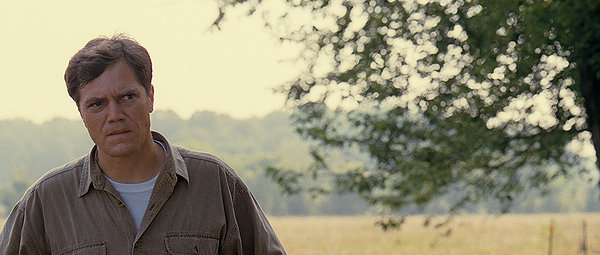 This is very likely the most nerve-racking, tense, dread-filled film I’ve watched since 2009’s Oscar-winner, The Hurt Locker. Writer/director Jeff Nichols (Shotgun Stories) masterfully lays out the particulars of his tale. Even the family drama has some nicely constructed tension. Curtis’ family is living paycheck to paycheck, so his backyard project is a real financial setback. By borrowing equipment from his work, Curtis is even risking losing his job, the only way he can afford his child’s cochlear implant. Not only do we dread stormy weather and strange flocking patterns for birds, we dread the everyday struggles of keeping afloat. Curtis following his visions can very likely put his family into financial ruin, but is that a risk worth taking? Nichols nicely creates an authentic small-town setting. There are small, acute character touches that enrich the story, like when Dewart (Shea Wigham) concludes that the best compliment a man can give is that “he’s lived a good life.” When Curtis and Samantha watch their daughter sleep, they share behavior they are still trying to kick in adjusting to having a deaf child (“I still take my boots off not to wake her,” he confides. “I still whisper,” she returns). These people and their troubles feel believable, and their reactions to Curtis’ strange behavior feel extremely believable. Whispers begin to spread and people start to treat madness like it’s a communicable illness. Religion seems like a natural landing zone when discussing anything apocalyptic and/or prophetic, but Nichols sidesteps this discussion. There could have been some interesting theological room to explore here, considering a Biblical prophet would likely be derided as mentally ill in our modern age. Nichols keeps things secular. Curtis is admonished for missing church again, but that’s about the extent of religion in the man’s life. He does not seek out spiritual advice. He seeks out psychiatry, at least if he could afford it he would.
There are some terrific standard thriller moments, like some well-calculated jump scares and many nightmare fake-outs, but the film’s real skill is drawing out tension to the point where you want to shout at the screen. This is a deliberately paced thriller knotted with unbearable tension. We become conditioned to start doubting the onscreen imagery after Curtis’ series of nightmares. Every time there’s a storm now the audience, too, fears the validity of what we witness. What is the significance of these portent signs? There’s a moment toward the climax, where a storm door needs to be opened, and I simultaneously was dreading every second leading up to that door opening and silently screaming in anticipation. Every part of me wanted to see what was going to happen next and I could not guess where Nichols would take us. I was a nervous wreck. The dread was so heavy, so all consuming, and not just from an apocalyptic standpoint. Curtis understandingly thinks he may be nuts, especially since his own mother is a paranoid schizophrenic. The threat isn’t just the strange apocalyptic signs but also Curtis himself unraveling and lashing out. He worries that he’ll become a danger to his own family, and if he cannot discern the difference between reality and fantasy it’s only a matter of time before he jeopardizes his loved ones. He fears he’ll be ripped away from his family. He wants to be better, he wants to be “normal,” but he can’t trust his own senses.
 Take Shelter is also so effective thanks to Shannon, a talented actor who always seems to be on the brink of freaking out. The bug-eyed, crazed, monotone actor has played plenty of nutcases in the movies. He was nominated for an Oscar in 2009 for Revolutionary Road for playing such a nutter. He’s a live wire of an actor, simmering, waiting for the final cue to explode. Shannon uses this intensity to his great advantage, wonderfully mirroring the movie’s compounding dread. Shannon’s character is troubled, that’s for sure, and worries about slipping into insanity. His performance is simply riveting, searching for answers amidst the desire to keep his family safe at all costs, even if that eventually means his removal. When he has to confront his central dilemma, the legitimacy of his visions, Shannon is racked with fear, eyes glistening with tears, terrified to go on faith, and your eyes are glued to the screen, completely taken in by the depth of the performance. I hope Shannon gets some due recognition come awards season because I doubt I’ll see few performances more compelling.
Chastain has had quite a breakout year for herself with lead roles in Tree of Life, The Help, and The Debt. She has a remarkable vulnerability to her, radiating an ethereal vibe (no doubt why Terrence Mallick chose her), and both aspects are put to fine use in Take Shelter. She’s much more than the oft underwritten put-upon wife, silently enduring her husband’s foibles. She’s desperate for an answer to explain her husband’s actions and motivations. She’s alert, angry, compassionate, and deeply concerned. Chastain holds her own with Shannon, and the two elevate each other’s performance subtlety, making their supportive relationship even more believable.
Take heed movie lovers, and make sure to find Take Shelter, an intelligent, expertly constructed, suspenseful drama with powerful performances and a powerful sense of dread. Shannon’s coiled intensity nicely fits the mounting tension. Nichols has created a taut thriller, a fiercely felt human drama, and an involving character-piece attuned to the talents of its cast. Take Shelter is a commanding, unsettling film that puts the audience in the unreliable position of the main character’s point of view. You may almost hope for some actual apocalypse just to validate the guy’s struggle. When was the last time you secretly hoped for the end of the world just to give one person a sense of relief? Take shelter from inferior movies and find a theater playing this tremendous movie.
Nate’s Grade: A


 nathanzoebl
You must be logged in to post a comment.