Category Archives: 2009 Movies
Last Chance Harvey (2009)
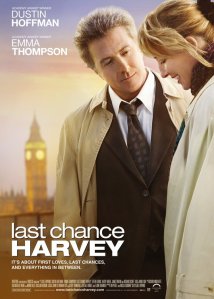 There aren’t too many movies that feature a middle-aged romance. That’s really the sole draw here. Harvey follows the titular dad (Dustin Hoffman) as he travels overseas to his daughter’s wedding. His life is in shambles and he strikes up a friendship with a downtrodden woman (Emma Thompson) that eventually percolates into romance. The interaction between Hoffman and Thompson is relaxed and charming but the storyline is too slight and predictable. This whirlwind courtship spans one single day, so the movie feels too brief. We’re just getting to know these characters and enjoying their chemistry when the movie just limps to a close. Last Chance Harvey feels less like a movie and more like the first act of a movie. The plot is predictable and hits all the resolution points it needs to, which means get ready for tear-jerking wedding toasts from men who’ve changed and grown wiser over the course of 24 hours. Last Chance Harvey is a mildly pleasant diversion with two talented actors making the most of a shopworn and abbreviated story.
Nate’s Grade: B-
Share this:

Street Fighter: The Legend of Chun-Li (2009)
 It’s not every day that Jean Claude Van Damme gets some marginal level of redemption. The original 1994 Street Fighter film took the classic arcade fighting game and took it as seriously as possible, which meant it was incredibly silly. Van Damme was Colonel Guile and entrusted to rescue hostages from the evil dictator, Bison (Raul Julia). The big screen adaptation rewrote entire characters but managed to keep the stuff fans really care about, like catchphrases, costumes, and super moves. God forbid that audiences see Cammy (Kylie Minogue, yes that Kylie Minogue) make the wrong victory pose. It’s always the unimportant things that somehow matter the most to execs. Street Fighter is a campy blast. How could you despise a movie that has its villain say, “For you, the day Bison graced your village was the most important day of your life. But for me… it was Tuesday.” Though the movie does have the depressing distinction of being Julia’s last film before he died. Let this be a lesson to all actors looking to take a paycheck role. Years later, in the wake of a writer’s strike, the execs at Fox thought they could pump new blood into a Street Fighter franchise. Street Fighter: The Legend of Chun-Li purports to tell the back-story of one of its most popular fighters, the diminutive fireball-tossing lass with Princess Leia’s haircut. This movie proves that you don’t need a Van Damme to make a boring and mediocre action movie.
Chun-Li (Kristin Kreuk) is trained to be a master pianist and also a master martial arts warrior. You don’t realize the kinds of dangers classical pianists constantly run into. Her father is kidnapped by the crime lord Bison (Neal McDonough) for some reason or other. Three years later, a mysterious scroll falls into her possession. She travels to Bangkok to find her father. Bison has the ingenious plan of buying waterfront property, introduce high levels of crime, and then making money on lowered property values, which is simultaneously confusing and stupid. Bison has a few evil henchmen, notably the giant boxer Balrog (Michael Clarke Duncan) and the masked warrior Vega (Taboo from the Black Eye Peas), who help wipe out his criminal competition. In Bangkok, Chun-Li is mentored by Gen (Robin Shou, who played Liu Kang in two Mortal Kombat movies) and together they attempt to thwart Bison and his dastardly real estate scheme.
 For a movie about streets and fighting, well there’s a clear shortage of the latter. Much of the movie is structured around Chun-Li conducting her own private investigation and achieving some level of inner peace. She decides to try and make it on the streets of Bangkok. There are forgettable training exercises with forgettable platitudes disguised as wisdom (“You’re hurting me,” “No, you’re hurting yourself”). There are a handful of lackluster fights and chases, some of them through streets even, but the movie has a scarce amount of action until it revs up for a climactic showdown. The action is also poorly shot and poorly edited, distracting the senses and making it downright impossible to understand. The choreography is nothing special. When the movie suddenly introduces a supernatural element the other characters don’t even bat an eye. Screenwriting neophyte Justin Marks has too much revenge-seeking father drama and real estate scheming and not enough brawling. The Legend of Chun-Li has zero respect for the intelligence of its audience. It has flashbacks to flashbacks that just aired minutes earlier. How hard would it have been to just actually base a Street Fighter movie on a fighting tournament?
Director Andrzej Bartkowiak (Doom, Romeo Must Die) shoots the movie in such a dull manner that the fight sequences fail to even elicit any interest. There’s one scene in the middle of the film that serves as a testament to the lack of care put into this movie. Chun-Li has battled a Bison henchwoman in a women’s bathroom. The bathroom set design includes partition walls with portholes. Chun-Li is on one side and the henchwoman tries to punch her through the porthole. Chun-Li grabs the woman’s arm and squeezes. The camera angle is from the side of the actresses, so it would make the most sense to have the henchwoman’s right arm caught, that way her expression could be seen. Nope. Chun-Li is gripping the woman’s left arm, meaning that her raised arm and shoulder block any view of the woman’s face, and yet she talks through this scene. How difficult would it have been to just switch arms? Why purposely obscure an actor’s face, especially in a scene that doesn’t require a stunt double?
 Here’s a curious item. Chun-Li has always been a full-blooded Chinese woman in the history of the video game. When we see her as a child, baby Chun-Li and child Chun-Li are very obviously Chinese in features. Flash forward a few years and she’s transformed into looking like Kreuk, who is half-Chinese. Apparently, one of the less common side effects of trauma is becoming less Chinese looking as you age. Along these same strange ethnic lines, we’re told that Bison was the child of Irish missionaries and was left behind in Bangkok. And yet, the child grown up completely in Southeast Asia manages to sport an Irish accent. Anybody want to explain that particular linguistic loophole?
Kreuk (TV’s Smallville) is one of the film’s biggest handicaps. The script saddles her with great amounts of pointless voice over, to the point that half of her performance is listlessly explaining what is literally happening on screen. Kreuk is a dead-eyed robot in this movie; she displays some glimpses of human emotion, like sadness and rage, but they never feel remotely credible, like someone who only knows the definitions of emotions and not proper application. Her lesbian seduction dance is a small moment of absurdity. She thrashes on the dance floor and her “dancing” reminded me more of a bird’s mating dance without the excessive plumage displaying. Kreuk can run and flex well enough, which is also a nice benefit for a martial arts action flick.
The acting is terrible but there is one bright spot in a most unexpected location. Ladies and gentlemen, I present to you the best worst performance of the year, brought to you by Chris Klein (American Pie). Klein plays Interpol agent Charlie Nash who is conducting a parallel investigation into Bison’s Bangkok activities. He’s partnered up with a local gangland homicide detective (Moon Bloodgood) who takes extra care to showcase her cleavage thanks to work outfits with plunging necklines. Klein is awful to a powerful degree but here’s the thing — I’m fairly certain it’s one hundred percent intentional. Being a conosoire of trashy cinema, I feel that I’ve adopted the skill of being able to deduce when an actor is hopelessly serious or just goofing off. Klein comes across like a self-aware man; he knows this is a crummy movie with crummy dialogue, so he’s going to have as much fun as possible. His performance is all forced swagger, from the way he constantly swivels his head to the way he cannot purposely walk in a straight line. He overemphasizes lines, chewing over the faux hard boiled detective talk and spitting it out in a singsong delivery. He grimaces and furrows his brow, widens his eyes to comical levels, and when he crouches in a gunfight the man spreads his legs as far apart so that he looks like he could have effectively doubled as a backup dancer in an MC Hammer music video. It’s obvious that Klein has given a staggering performance, but the observant will note that this is not an inept performance. This man knows exactly the kind of movie he’s in. I always tabbed Klein as a wooden actor that came across like Diet Keanu Reeves, but I must credit him for making a bold acting choice to knowingly dig deeper when it comes to being bad.
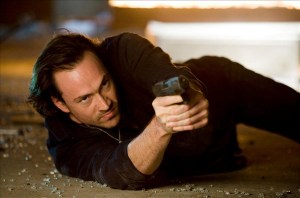
Hero of this movie, Chris Klein.
Readers know that I am skeptical and dismissive about the prospect of a good movie ever being born from a video game adaptation. Games call for interactivity and movies passivity. But if you’re going to make a movie called Street Fighter than stick to the script. This borefest wants to be a gangland drama with a tacked-on buddy cop side plot. Street Fighter: The Legend of Chun-Li is an awful work partially redeemed from the sheer amount of unintentional hilarity. Kreuk is extremely miscast as a warrior woman. The acting is bad, the direction is bad, the writing is bad, and Chris Klein tries to outdo them all in badness, and I admire the chap for trying something different in an admittedly abysmal movie. To be fair, I was never a big fan of the original video game. The special moves always seemed much more tricky to pull off. How many different incarnations of Street Fighter II were there before they eventually mastered basic math and released Street Fighter III? These are the things I was thinking about wistfully whenever Klein or Bloodgood wasn’t on screen.
Nate’s Grade: D
Share this:

The Brothers Bloom (2009)
 Con movies work thanks to P.T. Barnum’s belief that the audience wants to be fooled. We all enjoy being conned to some degree. The excitement of con movies is being outsmarted and figuring out how it was accomplished. The Brothers Bloom, by writer/director Rian Johnson, one of the more exciting new filmmakers in Hollywood, is a con artist caper that understands the rules of the game and then aspires to transcend the game. Whether or not it succeeds depends on how much whimsy you can stomach in a two-hour duration.
Stephen (Mark Ruffalo) and Bloom (Adrien Brody) are a pair of con artist brothers. Stephen has been drawing up elaborate schemes ever since childhood, and he always uses his brother as the face of the operations. The brothers have a third member to their team, the mysterious and mute Bang Bang (Rinko Kikuchi), who, we’re told, just appeared out of thin air one day and they expect she’ll leave in the same style. Bloom is tired of playing characters and roles and wants out, but his big bro comes back with one last con in the works. Penelope Stamp (Rachel Weisz) is rich, peculiar, and lonely, ripe for the taking. Bloom snares her with the exciting prospect of being apart of an adventure. There’s a globetrotting plot to profit from selling a book to some shady characters (Robbie Coltrane, Maximilian Schell), and it’s just what Penelope needs to feel alive and leave the confines of her large cage-like home. Naturally, Bloom falls for the “mark” and feels conflicted, but was this part of Stephen’s plan all along? Is he setting up some form of a happy ending for his little brother? Is Penelope in on the con? Who’s conning whom?
 The Brothers Bloom is steeped in whimsy and at times runs dangerously close to falling into the inescapable gravitational pull of “cutsey.” Some have compared the film’s quirky, precocious style to Wes Anderson, but the movie reminds me more of the style of Barry Sonnenfeld, a filmmaker who made outsized whimsy seem like everyday reality; Anderson’s movies seem to exist in their own impeccably handcrafted worlds. I loved the opening 10-minute prologue which explores the childhood history of Stephen and Bloom, examining their first con on local rich kids. It’s quick-witted, snappy, and even has Ricky Jay provide narration, reminiscent of Magnolia or the David Mamet con movies. The Brothers Bloom has a sunny disposition that doesn’t come across as smug. Stylistically, the movie never crosses the line into feeling overly mannered. The Brothers Bloom exists in some unknown time period. The cars are modern, the clothes are from the 1930s (everyone wears a bowler hat with such flourish), and the sets look like they’re from the 1960s. There is no dependence on technology, just good old-fashioned brains and charm.
And yet this is more than an exercise in style. Just as he did with the adroit, neo-noir movie Brick, Johnson takes a genre and subverts its expectations. The Brothers Bloom treats cons more as storytelling, and it positions the film and its characters in an interesting new light. Bloom yearns for an “unwritten life” because all he’s known have been roles in his older brother’s games and cons, and the poor sap doesn’t even know if he has an identity beyond fabrication. Stephen has also begun to blur the lines between reality and his cons, and his life’s ambition is to stage the perfect con where “everybody gets what they want.” Get that? The Brothers Bloom aims for deception that gives everyone, including the deceived, a happy ending. It almost sounds like a charitable goal. Johnson has injected the con artist genre with some pathos and self-reflection. Too many con artist movies are only good for one viewing; once you know the particulars of the con, do you feel invested in watching it play out again? Johnson puts some melancholy into the mix and it gives the film more weight than being the sum of its many quirky parts.
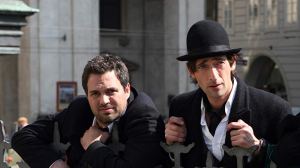 The acting across the board is superb. Ruffalo is his typically low-key yet engaging self, and he seems sincere even when you know he isn’t. His love and concern for his little brother is touching. His schemes are all for his brother to get out of his shell and experience some level of happiness. Brody embraces the weariness of his character. He is confused and tired and feels like he cannot trust human connections; he’s paranoid that all roads lead back to some machination from his brother. His affection for Penelope is like an awakening for his character, and yet he cannot fully give into it because is it genuine? This incredible level of uncertainty with every aspect of life casts a heavy toll, and Brody convinces you of that toll. Kikuchi (Babel) makes great use of physical comedy and has a lot of fun with her mysterious character. She’s mute for practically the entire film yet manages to communicate plenty. But it is Weisz (The Fountain) that steals the movie and steals your heart. Her screwy eccentric is deeply lonely but radiates a ditzy glow. She fully embraces the prospects of adventure and bounces in glee. This woman is powerfully adorable.
There are a handful of missteps in the narrative. The movie likely lasts twenty minutes longer than it needs to, with false endings and even a false third act. Audiences are used to con movies revealing the larger scope by the end after a bevy of last-minute twists. This is not the case with Bloom. The movie gets more muddled and introduces new conflict that isn’t ever really resolved. Audiences expect clarity by the end of the third act, not confusion. I feel like I’m missing something with the duplicitous Diamond Dog character (Schell), and maybe that’s the point; perhaps I’m supposed to be in the dark about his connection to the brothers Bloom. I won’t get into spoilers, but I was expecting more reveals at the end of the movie, perhaps Stephen showing one last final box, and the movie gives you nothing. I suppose the purpose is to play against con movie conventions and the surprise is that there is no real surprise by the end, no “I was in on it” or “It was all part of the plan” a-ha moments of ironic revelation. That’s nice but it doesn’t always make a movie more satisfying. The ending would be more moving if the audience didn’t already feel spent by the time they have to process something more emotional.
Johnson’s follow-up to his immensely entertaining debut is a solid winner, though it leaves you hanging and wanting at the end. The movie is quirky and heavy on the whimsy, and yet it also squeezes in some pathos. Yet the movie falls short of its ambitions and the talent of Johnson. The Brothers Bloom will seem enchanting to some and insufferable to others; it defies expectations and genre conventions, and sometimes would be better off adhering to them. It’s an amusing caper comedy but it could have been something even more special. It just needed a little less narrative sleight-of-hand.
Nate’s Grade: B+
Share this:

Every Little Step (2009)
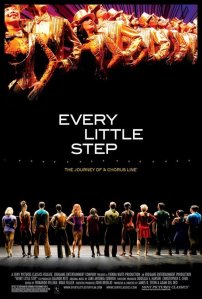 Being that A Chorus Line is a famous Broadway musical all about auditioning for a Broadway musical, Every Little Step, an agile documentary following every heel-toe-kick, takes place almost entirely in the world of high-stress auditions. The documentary traces the origins of the meta-theatrical show all the way to a taped conversation director Michael Bennet had with a handful of New York City dancers in 1974. That night they opened up about their lives and then it became character backstories. I would have liked more of an exploration about the nature of art transposing someone’s life story, but this is not that movie. Every Little Step examines the elation, disappointment, and sheer exhaustion of getting a part in a show. We watch scores of actors try out for the 2006 revival and we also listen to interviews from key participants in the original 1975 production. The movie does have some issues and one of them is that it doesn’t become personally involving to a Broadway naïf until after an hour in. I understand that the casting crew was weeding out hundreds of talent, but the movie doesn’t give enough time to specific hopefuls to follow, build a connection with, and eventually root for. Every Little Step only begins to flesh out its finalists at the final round of callbacks, which makes the stakes less emotionally involving. Still, it’s hard not to feel the rush of joy when some dancers achieve their dreams.
Nate’s Grade: B
Share this:

Land of the Lost (2009)
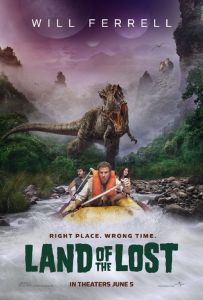 Does money make something funnier? I have always been hesitant about Hollywood comedies that overspend like crazy, running up staggering budgets. In 2007, Evan Almighty became the most expensive comedy of all time, toppling a $200 million budget thanks to costly special effects and animal wrangling (and those assorted Steve Carell beards couldn’t have been cheap either). Did all that spending make the movie any funnier? Comedy is a cost-friendly enterprise because it all truly starts at conception: the setup, the payoff, the buildup, the delivery. If an idea isn’t funny at its core conception, it’s usually not going to be funny no matter how expensive the window dressing. Here comes a big budget Land of the Lost movie with Will Ferrell in the lead, and I ask again, does more money make something funnier?
Dr. Rick Marshall (Ferrell) has devoted his life, and taxpayer dollars, to researching time portals that open dimensions that combine the past, present, and future. After an interview on the Today Show with a hostile Matt Lauer, Marshall becomes a laughingstock in the scientific community. Holly (Anna Friel) is a science grad student who believes in his crackpot theories. The two of them use Marshall’s tachyon device to find a cosmic hotpot. It just so happens to be in the middle of a low-rent attraction, “The Devil’s Canyon” run by hick opportunist, Will (Danny McBride). He takes Marshall and Holly along on a tour of the cheap attraction but then suddenly the earth shakes and the people fall off a waterfall into a time portal. They awake in a strange land filled with dinosaurs, primate people like the hairy sidekick Chaka (Jorma Taccone), hissing lizard creatures known as Sleestaks, and all sorts of prehistoric danger. The only way home is to find the tachyon device to open another portal. Too bad the device, too, is lost.
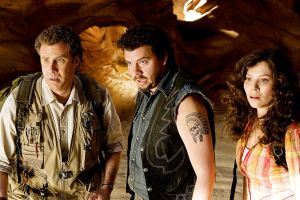 The original Land of the Lost TV show was a dopey sci-fi show for kids that had silly plots, terrible special effects, and the unmistakable feeling that the creators and writers often indulged in psychotropic substances. But let’s face it folks, the Land of the Lost TV show was squarely aimed at kids and does not hold up well. You could seek the zippers on the back of the Sleestaks. I don’t intend to trample anyone’s good time nostalgic feelings, but this show was just not very good. However, the movie almost plays like a loving parody of the material. It doesn’t point out the flaws of the original TV show in a meta-critical manner like the Brady Bunch movies; Land of the Lost channels a childish, goofball tone and brazenly heads along at full-steam. This movie was marketed as a “family” film based on a children’s TV series. Warning to parents considering taking young children: this is not a family movie. This is a raunchy PG-13 comedy with plenty of kid-friendly gross out humor and parent-spooking sexual humor. There are masturbation gags, an F-bomb, an out-of-the-blue Jesus-on-the-cross comparison that could raise eyebrows, and all sorts of crude behavior, including two instances of self-imposed dinosaur golden showers.
The movie is completely juvenile, crude, surprisingly raunchy for a PG-13 movie, and yet it has an absurdist bemusement to be had. If you can catch on to its wonky wavelength that manages to satirize the original series, there are subversive, guilty pleasures to be had. There is a campy and irreverent spirit that I was able to latch onto and enjoy. I’m not saying Ferrell dousing himself in dinosaur urine is witty in any regard, but I laughed. When he does it a second time I laughed some more. This is like a gonzo update of a Saturday morning children’s series, like what would happen if Terry Gilliam took a crack at writing an adaptation (not to sully Gilliam’s creative integrity, the poop and pee jokes will be added by a screenwriting hack in a re-write). The jokes seem aimed at kids, like the bodily function stuff, but then there are jokes that will certainly go over the kids’ heads, like a drawn out sequence where the boys partake in a drug trip thanks to a local narcotic fruit. The TV series has been adapted into a big budget Will Ferrell comedy, a mixture of juvenile gags and goofball hijinks with a wink, which will alienate fans of the original series. It’s not sophisticated high comedy for adults but then the jokes can also be too wordy for small kids to understand why it should be funny. The opening scuffle between Marshall and Lauer is a good setup and also provides a satisfying payoff by the movie’s conclusion. Not all of the jokes work and there are too many scenes that drag on, long after the joke has already been given a burial ceremony. Many jokes are one-sceners and don’t build into something stronger and more satisfying than an in-the-moment chuckle. Land of the Lost is a somewhat muddled, somewhat confusing, somewhat chintzy, somewhat bizarre movie, which makes it an oddly fitting adaptation of its odd source.
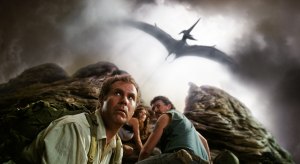 The plot is a thin strand to tie the comedic setup together, but the movie also has dashes of adventure and action. Marshall insults a T-rex by ridiculing its brain size, and the T-rex becomes an ongoing antagonist, chasing the trio all around this so-called land of the lost. Usually every action beat is tied into some form of a comic setting, like when Marshall has to rescue his special tachyon machine by singing and dancing to “I Hope I Get It” from the Broadway show, A Chorus Line. Director Brad Siberling (Lemony Snicket, City of Angels) and production designer Bo Welch (Batman) make this movie look downright gorgeous. The trippy production design is Oscar-worthy. I enjoyed the visual landscape of this cosmic dumping ground, where a desert could be strewn with odd fixtures like a Viking ship or a gas station sign or a motel pool. The special effects are fairly good as well, especially adding detail and personality to the T-rex. This is a high-gloss comedy that might appeal to Salvador Dali if Dali had a secret love for defecation humor and boobs (maybe not as much with the latter).
The actors make the material better; thanks to Ferrell and McBride I was able to laugh at churlish humor that I might otherwise have scoffed at. This movie had me laughing at the basest humor, jokes chronicling the assured comedic assets of the female mammary and, well, dino pee. But you know what, context and an appealing actor with good comedic command can make anything funny. Ferrell and McBride have great comedic chemistry and the two of them know how to take a semi-lame joke and give it life with just the right delivery. Granted, Ferrell is playing the same character he has been for years, the sweet-hearted idiot man-child, and McBride (Pineapple Express, TV’s Eastbound and Down) is playing a toned down version of his blustery insincere jerk, and Friel (TV’s Pushing Daisies) is there essentially to be a love interest/straight man/source for boob groping. At one point, Holly rips away her pant legs for no good reason other than it allows the camera to get some high-grade butt shots of Friel in her short shorts.
I had fun with Land of the Lost and I’m not too ashamed to admit it. I enjoyed most of this psychedelic adaptation and grooved to its absurd, antisocial, irreverent spirit. It’s loosely based on the 1970s TV show by Sid and Marty Krofft, but this is a positive given that the original series was dumb. Not that this movie is intellectually riveting. This isn’t a daring movie or a cleverly diverting comedy, and it has unnecessary moments where they cram six pages of scientific nonsense into a one-minute exposition dump, but Ferrell and his time-traveling companions kept me smiling more often than not thanks to their camaraderie, improvisation skills, and ability to transcend the sophomoric material. It’s a silly mess but Land of the Lost is an entertaining time as long as you lower expectations and know what you’re getting into, dino urine and boob groping and everything.
Nate’s Grade: B
Share this:

The Hangover (2009)
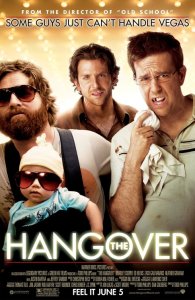 The Hangover is the breakout hit of the summer. It’s a simple concept that’s fully executed by Old School director Todd Phillips, the biggest name in the movie is Mike Tyson, and the people are lapping it up. It’s going to become the first comedy to pass the $200 million mark since 2005’s Wedding Crashers. Is it that good? The studio was already planning a sequel before The Hangover was ever released.
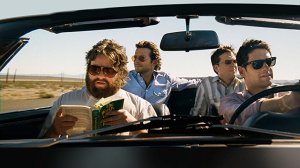
Doug (Justin Bartha) is getting married and thus must embark on that last passage of manhood — the bachelor party. Doug and his groomsmen are headed out to Las Vegas for a wild night. Phil (Bradley Cooper) is a handsome science teacher ready to cut loose. Stu (Ed Helms) is a nerdy dentist completely at the command of his icy, domineering girlfriend (Rachael Harris). And then there’s Alan (Zach Galifianakis), Doug’s prospective brother-in-law. Alan is clueless to the point that he asks a hotel clerk if Caesar’s Palace was at one point the emperor’s actual residence. He’s also desperate for some friends and he wants this Vegas trip to be unforgettable. Cut to the next morning and the boys awake to discover their hotel suite in shambles, a tiger in the bedroom, a crying baby on the floor, and Doug is nowhere. Phil, Stu, and Alan have to retrace their steps and fill in the holes of their collective memories.
 The central mystery provides surprisingly intriguing glue for all the gags. The idea of Vegas-laden debauchery is practically a cliché of a cliché at this point, especially with how Vegas has been somewhat morphed into a family-friendly Disney Land theme park for adults compared to its mob origins. With that said, the movie hits all the regular Vegas bender exploits you would think it would, which includes, speedy marriage ceremonies, strippers, drugs, gambling. Several of the jokes themselves are somewhat on the cheap side; however, their laugh quotient is elevated by spontaneity and the comic abilities of the cast. The plot to The Hangover is cleverly constructed so that the audience is trying to figure out the latest clues just like the main characters. The movie trades heavily in raunch and crudeness, but this is a comedy that never gets too dark or too mean-spirited; there’s always a playful bemusement at the “What did we do last night?” revelations. Screenwriters Jon Lucas and Scott Moore (Ghosts of Girlfriends Past) are silly about their naughtiness. It doesn’t go to the limits of good taste like Peter Berg’s pitch-black bachelor party gone wrong comedy, Very Bad Things. That movie, which is a guilty pleasure heavy on the guilt, really looked at the hedonist philosophy about “whatever happens in Vegas, stays in Vegas” — including murdered hookers buried in the desert. The Hangover actually comes across like some absurdist film noir, and Phillips shoots the movie like it is a film noir. The cinematography even includes watching a car drive into the desert via the reflection of a man’s sunglasses. The movie looks like a serious film noir, a caper filmed in the rarely seen daylight of Vegas, which only makes everything that happens even funnier.
The Hangover is consistently funny once the boys get to Vegas. Beforehand it’s all setup, and generally setups are not that funny because they lay ground for the punchlines to come later. There are well-executed running gags and then there are also missed opportunities, like the baby and the surprise wedding. Certainly a newly discovered baby offers better gags than miming the little fella masturbating. The jokes themselves aren’t terribly sophisticated (hence: male nudity = laughs, taser to the balls = bigger laughs) and plot revelations, like how Stu lost his tooth, can be letdowns. The screenplay speeds through its comic setups too quickly, briskly running to the next and leaving little room to settle. A healthy dose of the adolescent humor is unmemorable from other crass-fests, but the setups allow the actors to bounce off each other for better jokes. The best laughs come from the threesome of dudes just ping-ponging back and forth in the moment. The end credits finally reveal what really happened that debased night, and the montage of pictures serves as a meaty, satisfying payoff to 90 minutes of sophomoric setup. It’s a terrific way to get the audience laughing all the way to the parking lot.
The humor is mostly situation based. The characters all fall under comedy archetypes (henpecked husband, loudmouth, socially inept doofus) but it’s the interaction and male camaraderie between the actors that made me smile the most. Cooper (He’s Just Not That Into You) is full of smarm but he comes across like a less manic, still self-absorbed and obnoxious version of his jerky character from Wedding Crashers. His main job is to center the other two actors. Galifianakis (The Comedians of Comedy) is the go-to source for the screenplay’s laughs and his role makes good use of his talents. He plays a buffoon without an ounce of self-awareness, which gives the character a touch of sweetness even as he bumbles in total social awkwardness. He plays the character straight and innocent, which makes his moony behavior more unnerving and yet acceptable at the same time. But for me, this is Helms’ movie. The supporting actor from TV’s The Office has honed comedic chops, which explains how he can find the perfect tone for an uptight, hopeless, delusional dentist to be sympathetic and not overly pathetic. He comes completely undone over the course of the film’s events and Helms bounces off the walls in hysterics.
 Like other Phillips movies, specifically Old School, the women not only get shortchanged as comedy characters but they are presented in an unflattering light. Essentially, the women are either vicious, soul-sucking shrews or exploitative whores. It’s not exactly an enlightened atmosphere but then again The Hangover is a vulgar comedy set in Sin City. The nicest female character is portrayed by Heather Graham (Boogie Nights) as a breastfeeding prostitute (“I’m a stripper. Well, I’m an escort but stripping is a great way to meet the clients.”). I’m not asking for every comedy to be written from a feminist standpoint, but it’s disconcerting when the women in a comedy only get to be the jokes instead of being in on the jokes. The extremely flamboyant, overripe gay Asian mobster (Ken Jeong of Role Models) ensures that women aren’t alone in getting marginalized for giggles.
Let’s face it; once you know the solution to the mystery and all the surprises, will this movie still play out as funny? I think perhaps Phillips has crafted a comedic version of The Game, David Fincher’s 1997 thriller that plucked Michael Douglas into a crazy “what the hell is going on?” trip down the rabbit hole. But once you knew who was behind what, and how the whole game was staged and operated, could you even watch the movie a second time? Would it still work now that a repeat viewer knew all the secrets? Does this comedy have a built-in expiration date? I think The Hangover will lose some of its appeal once the surprises are all out in the open, but I think the chemistry of the cast and some of the riffs on Vegas will still earn chuckles even on multiple viewings. This isn’t the instant classic that its rapid grosses and frothing word-of-mouth might have you believe, but The Hangover is an enjoyable guys-gone-wild trip down the empty road of Vegas hedonism.
Nate’s Grade: B
Share this:

Up (2009)
 With every new movie Pixar re-establishes itself as the most creatively reliable studio in the business. And every year some critics beat the drum that THIS is the movie that will break free from the animation ghetto and earn a Best Picture Oscar nomination. If anyone out there would like to tell me how The Reader could be a superior film to WALL-E, by all means enlighten me. Pixar has been producing engrossing and complex entertainment, not merely cute cartoons. But if WALL-E failed to score a nomination in a so-so film year, then I doubt that Pixar’s latest, Up, will fly into the winner’s circle.
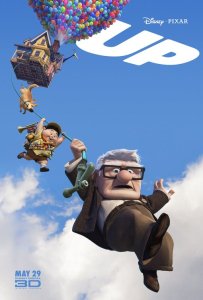
Carl Frederickson (voiced by Edward Asner) is a cantankerous 78-year-old man who wants nothing more in life than to be left alone. He lives in a house he built with his late wife, Ellie. They met when they were kids and bonded over a shared love of thrill-seeking adventure, like their hero, explorer Charles Muntz (Christopher Plummer). Ellie’s dream is to eventually travel to Paradise Falls in South America, but she never lives to see it. Carl is about to be thrown into a retirement center and have his home demolished, so the geezer hatches an escape plan. The former balloon salesman attaches thousands of balloons to his house and floats away headed for Paradise Falls. Carl is ready to enjoy the quiet when he gets a knock at his front door. He has a stowaway. Russell (Jordan Nagai) is an overweight eight-year-old determined to get his last Wilderness Scout badge, which involves helping the elderly. Together, they journey through the jungles of Venezuela and find remarkable discoveries and constant danger, including the presence of a sinister and still very-much-alive Charles Muntz.
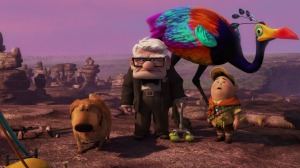 Up is the colorful tale of a dreamer who longs for escape, and you feel the same rush of excitement to be unbound and take off. Naturally, there will be bonding between the grouchy old man and the earnest kid. Up really becomes an altogether different movie once it lands in Venezuela. It transforms into an unconventional adventure story replete with talking dogs and giant birds. I loved the Dug character and was bemused at hearing the scattered thought patterns of man’s best friend (“I have just met you and I love you”). The side characters somewhat steal the show and, at the same time, feel overextended. With that said, I’ll probably end up buying my wife a talking stuffed Dug. The last act soars with about 20 minutes of thoughtful, exciting, well-constructed action weighted by an emotional connection to character. At the same time, Up tackles some major issues and does so without getting mired in sappy sentimentality. Carl is dealing with loss and has hardened against a world he feels indifferent to. Up almost had me in tears within the first 10 minutes during its elegant wordless montage charting the courtship and marital life of Carl and Ellie. It’s a fabulous moment and greatly economical, packing an emotional punch unequaled by the rest of the film.
The visual storytelling is still top of the line entertainment. The animation is superb as usual. The flying house is an explosion of colors and instantly brought a smile to my face. Carl’s character design looks like he was a Lego character that was brought to life. He’s all square and boxy whereas Russell is round to the point of being an Easter egg with legs (is Russell Asian-American or biracial, or is it just a character design that I’m reading too much into?). The South American jungles are lush and filled with inventive creatures. I saw the movie in a conventional theater but the option is out there to catch the movie in Disney 3-D, but I don’t think it will add much to the whole experience.
The central image is lovely and instantly iconic: the house floating through the clouds thanks to thousands of colorful balloons. It’s a beautiful image and a perfect metaphor for the memory of Carl’s deceased wife. They built that house together and lived a full life inside, he refers to the house as “Ellie,” and at one point Carl even ties the floating house to his back, tethering her memory to Earth while simultaneously carrying his grief with him at every step. The idea of a flying house tickles the imagination and yet never once demands more critical examination. We accept that Carl has rigged the house to take flight and never once stop and question the extreme engineering improbabilities. The flying house is just the mode of transportation for the characters to complete their story, but it is not the whole story. Think of it as a more comfortable mode of family flying than a queen-sized mattress that included Angela Lansbury (1971’s curious Nazi-fighting family flick, Bedknobs and Broomsticks). The rest of the movie never quite matches the directness and depth of that visual metaphor.
 Up ducks out on making its tale more of a feeling, living movie, something more than striking visuals and some fun set pieces and odd characters with a dash of sentiment. Up establishes its strange story elements but then doesn’t plausibly make much more out of them. The story becomes a somewhat constricted rescue caper to return a Mama bird to her babies and keep her out of the hands of a Bad Man. Charles Muntz is a fairly weak villain. I’ve also got a burning question: if Carl is 78 years old, how old exactly is his childhood hero, Muntz? It’s a bit simplistic and that’s fine, and it’s still an enjoyable conclusion, but the movie doesn’t ascend from the sum of its parts like the finest works of Pixar, like WALL-E and The Incredibles. This one’s just missing some of that Pixar magic. Yeah, there’s the overall arc of Carl overcoming the loss of his wife and softening his hard exterior, but tell me what exactly else happens that matters? The kid makes a friend? It’s about human connection but how exactly is that best served by giant birds and talking dogs flying biplanes? Up also isn’t as visually arresting or creative as previous Pixar flicks, aside from that floating house. As far as Pixar films go, this is about square down the middle (between Monster’s Inc. and Finding Nemo, better than Cars and A Bug’s Life). But even that statement is prefaced by the fact that Pixar’s output is generally head and shoulders above every other studio in technical precision, creative ingenuity, and emotional heft.
Up takes some fancy flights of imagination and has plenty of humor and charm to make it a family-friendly winner. I have some reservations with the movie and its plot, but there’s no question that Pixar knows how to construct a movie that manages to appeal to everyone, even if it involves cranky old men as unlikely action heroes. I feel like perhaps Up is suffering because it has the rotten luck of following the release of WALL-E, a timeless masterpiece that I have since watched probably over 30 times. Up is a warm-hearted and engaging film even if it never reaches the creative and emotional heights of other Pixar masterworks. Still, a “pretty good” Pixar movie has a legitimate shot at being the best movie I see this summer.
Nate’s Grade: B+
Share this:

Angels & Demons (2009)
 Angels & Demons works better as a movie. It is a better movie than The Da Vinci Code, but since I found that film to be one of the worst of 2006 you should know this is not high praise.
Professor Robert Langdon (Tom Hanks, with a better haircut) is the world?s foremost expert on ancient symbols and texts, which is why the Vatican recruits him for a very important mission. The Pope has recently died and Vatican City is in the middle of the cardinals deliberating who will be the newest leader of the Roman Catholic Church. Four of the cardinals, top candidates for the Pope position, have been kidnapped. The Illuminati, a centuries-old secret society, says that a cardinal will die every hour, from 8 PM to 11 PM, and then at midnight Vatican City will be destroyed. The Illuminati was made up of followers who felt the church was rejecting science, and so we?re told that in the 16th century the Catholic Church responded reasonably by branding the Illuminati followers and executing them. 400 years is a long time to wait for revenge. To make matters worse, antimatter was stolen from the CERN facility in Switzerland and placed somewhere within Vatican City. The battery holding the antimatter is scheduled to die about, conveniently, midnight, and the antimatter will result in a huge explosion (science note: antimatter is real but it is entirely harmless and not combustible). With the help of Carmenlengo Patrick McKenna (Ewan McGreggor), acting church leader until there’s a new Pope, and particle physicist Vittoria Vetra (Ayelet Zurer), Langdon must race against time to save the Catholic Church.
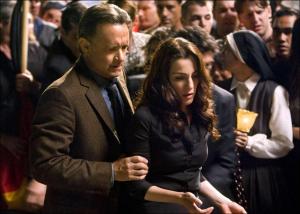 The time element gives the movie a sense of urgency that was missing before, and a kidnapping plot provides a firm structure and supplies more chances for action than unraveling a 2000-year old church conspiracy on the divinity of Jesus. The plot of Angels & Demons works out like a high-stakes scavenger hunt, shuttling Langdon across the many sights of Rome to find the next clue. However, the narrow timeline of killing a cardinal on the hour every hour makes for some tight squeezes, both for Langdon and the cardinal-killing man. I never understand why the villains give themselves such a small window to work with. I know the whole “dead cardinal every hour” thing has a nice ring to it, but is it wholly practical? There’s all that driving around Rome and the Vatican, which has got to be crowded since millions are awaiting news about a new Pope. Beyond this, why must Langdon and crew always show up to a site with like five minutes before the cardinals will be murdered? Are they stopping to get subway sandwiches in between? The timeline and plot setup provide more action sequences that make the movie fleetingly entertaining in spurts.
What doomed the Da Vinci Code movie was not the endless blather, though that certainly bored me to tears, but the fact that the film wanted to have its cake and eat it too — it wants to be a brainy thriller but get away with hokey thriller shortcomings. Angels & Demons suffers more or less the same killing blow. The flick wants you to shut your brain off and swallow these trite lapses in judgment and reality, forgiving the movie for zero character development and polluting the narrative with stupid genre stock roles, but then it also wants you to pay close attention and activate your brain to untangle the origins of symbols, conspiracies, and church doctrine. Angels & Demons introduces the idea of a ticking clock so it’s a far better paced affair than the previous film, but the movie still finds ways to get bogged down. Once again, Dan Brown’s novel has been adapted to a series of chases and sit-down chats, although this time Langdon does a lot of speed walking while he dishes out the minute history of church doctrine and architecture. To borrow from my own review of The Da Vinci Code: “You can?t be a brainy thriller and fill the story with hokey moments and lapses in thought, and likewise you can?t be an enjoyably straight forward thriller if you bookend all your action sequences with talky sit-downs to explain the minutia of your story.”
These stories are just meant to work better on the page than on screen. Puzzles and word games work when the audience can take a moment to pause but film is a medium of images and cannot simply go dead waiting for the audience to posit a guess. Movies don’t have time for you to chew things over. So then the puzzles just devolve into waiting for Langdon to explain everything, which he will do at great length. This can get tedious at a rapid rate. Langdon is less a character in this movie and more a walking, talking encyclopedia of exposition. He is robbed of anything that could be charitably described as characterization. Symbol decoding just does not work on the big screen, and Langdon is an expert whose profession is limited in application. I can’t foresee too many instances where a top-notch symbologist will be needed at a moment’s notice. Sure, it’s nice to get a history lesson and see plenty of those swell ancient churches, even if the filmmakers had to recreate them as sets because the Vatican refused them entry to film, but what point do these Dan Brown thrillers serve as movies? There is an intriguing discussion between science and the role of the church somewhere in this movie, but good luck finding much to stir your intellect. I confess never having read one of Brown’s tomes, including the super colossal mega-selling do-it-all Da Vinci Code, but surely the man deserves a better fate than to have his works die on the big screen as lamentably lame thrillers.
 There are no characters in Angels & Demons, only stock roles and suspects. Langdon’s female sidekick (Zurer,Vantage Point) serves no other purpose but to translate Latin and Italian. Really, if Langdon is a scholar on the conspiracies revolving around the Catholic Church then perhaps he should put in the time and money to learn the language. The Vatican police are there as escorts and little else. Stellen Skarsgård (Mamma Mia!) serves as the chief of the Swiss Guard, the Pope’s security team, and Armin-Mueller Stahl (Shine, Eastern Promises) is a German cardinal running the ongoing recounts for a new pontiff. Both men are presented as sly, untrustworthy suspects. Stahl’s character routinely dresses down McKenna as well, saying the young pup in the collar is not fit for church hierarchy. It?s not much to go on but the “characters” are just figures that occasionally get in the way of the film’s long-winded art history tour.
I think a lifetime of watching movies has just made my mind too analytical to be surprised by the twists in these kinds of dead weight thrillers. I?m already thinking ahead from the first minute and I don’t think I’m alone. When we are introduced to two characters, one gruff and unhelpful and one kindly and overly helpful, it is rather obvious which character will be revealed as being treacherous to provide the biggest jolt. Does anyone still suspect that Hollywood would produce a pointedly obvious evil suspect and then have it actually be that person? Not in today’s class of Hollywood thriller. You see kids, today’s Hollywood thriller is more concerned with piling on the twists than constructing a story that sticks together upon reflection, which is why many a Hollywood thriller simply falls apart as a jumbled mess by the time the end credits roll. Sometimes the endings sabotage everything logically that happened before. For an example of a textbook modern thriller, go rent the French film Tell No One and marvel at how the movie manages to be mysterious without being ludicrous. Angels & Demons doesn’t quite suffer from this screenwriting malady, but the essential evil plot by the eventually revealed evildoer is the most convoluted, ridiculously complicated scheme I have seen since that terminal 2005 thriller, Flightplan.
Director Ron Howard is able keep the film moving, almost distracting the audience away from the plot holes, but Angels & Demons is an adaptation that was doomed to fail from the start. The film plays like a lecture on tape with the fast forward button stuck. I might find more of the blitzkrieg of acts and anecdotes more intriguing if I could verify that they were all accurate. This is a thriller that wants to be seen as smart, so it empties exposition without haste, but it also wants to get away with narrative cheats common in your direct-to-DVD idiotic thrillers. You cannot simultaneously tell me to engage my brain and then a second later tell me to shut it off, sorry. Angels & Demons would have been better served without the Illuminati conspiracy and just plunged fully into the debate about bringing religion into the modern age, the friction between science and religion. Any substance the movie does present ends up being window dressing to an average potboiler mystery. This isn’t an awful movie but it never rises above “acceptable waste of time.” Hanks and Howard will probably be back in due time with the movie version of Brown’s upcoming new novel, The Lost Symbol, which will be released in September 2009. I just hope the duo, and screenwriter Akiva Goldsmith, have learned enough from their mistakes. I myself have little faith.
Nate’s Grade: C
Share this:

Star Trek (2009)
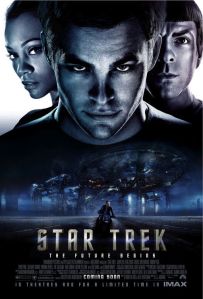 Star Trek has a hold on geek culture like no other franchise. It’s lasted over forty years, sustained five television series, and ten feature films (about four of them good), and let’s not forget the plethora of fanatical merchandise that includes everything from Trek cologne to Trek coffins. Star Wars has all the box office clout, but Trek has followers so devoted that they will create and learn a separate language, Klingon, that almost assuredly will never be spoken by anyone else outside of the festival circuit (you will never see a written Klingon exam that asks you “Where the library is?”). The Star Trek fans have been a foundation of geek culture for over four decades. People take this stuff very seriously. Trek has always been a headier brand of sci-fi, more devoted to ideas and moral dilemmas than shoot-outs and space chases, though Captain Kirk did teach the universe how to love, one green-skinned buxom alien babe at a time. 2002’s abominable Star Trek: Nemesis was meant to open up the franchise to a wider audience, but the film was the low-point for a franchise that also included William Shatner writing and directing the fifth flick (Nemesis also broke the odd/even movie curse).
When director J.J. Abrams approached Star Trek with the purpose of reinvigorating the flagging film series, you would think the man would wade into such a storied franchise with trepidation. Nope. He openly said he was making a “Star Trek movie for people who weren’t fans of Star Trek.” He was even going to change Trek canon. I imagine Trekkies (and no, I will never use the preferred nomenclature “Trekkers”) were nervous about an outsider, the author of the cinematic classic Gone Fishin’, meddling with hallowed ground. As I suspected, these fears were unfounded. The newest Star Trek does more than put a new coat of paint on an old franchise. This movie boldly goes where none of the Trek movies have gone before — turning reverent geek culture into a grand populist entertainment smash.
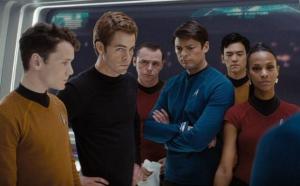 This new incarnation looks backwards, explaining how the crew of the U.S.S. Enterprise came together. The movie shows the path of Jim Kirk (Chris Pine), from troubled youth to eventual starship captain. Kirk’s father captained a starship for about 10 minutes, but he managed to save 800 lives under attack, including the birth of his son. Captain Pike (Bruce Greenwood) recruits Kirk to Starfleet Academy with the promise of doing something more with life. We also witness the boyhood of Spock (Zachary Quinto), who is teased for being half-Vulcan and half-human. His human mother (Winona Ryder) encouraged Spock to embrace his human emotions instead of cutting them off, Vulcan-style. Kirk and Spock clash at the Academy, and then an emergency requires all the recruits to saddle up for their first mission in space. Nero (Eric Bana) is a dastardly Romulan who has traveled back in time. In the future, he blames an older Spock (Leonard Nimoy) for the destruction of his home planet and the deaths of billions of Romulans. To ensure this does not happen, Nero is going to eradicate Starfleet home planets, starting with Vulcan and then Earth.
J.J. Abrams is a geek’s best friend. He understands geek culture, and yet the man is able to take genre concepts and make them easily accessible to the unconverted while still making a finished product that is respectful, playful, and awesome. Abrams is an expert on the pop culture catalogue, and he knows how to make genuinely entertaining productions that succeed on brains as well as brawn. He brought tired spy conventions into the twenty-first century with the cool, twisty Alias and Mission: Impossible III, which was really an extravagant two-hour episode of Alias, and I mean this in the best way. He has an innate understanding of action sequences and knows well enough that an audience needs to be engaged emotionally, so he makes the action as character-based as much as possible. Abrams has a terrific imagination behind the camera, and he reminds me of a young Steven Spielberg in his ability to marry artistic integrity with big-budget crowd pleasers. Abrams and his screenwriters Alex Kurtzman and Roberto Orci (Transformers, TV’s Fringe) have crafted a stellar Trek that will appeal to die-hards and those who couldn’t tell a Romulan from a Vulcan (I fall somewhere in between).
 The time travel storyline could have used more juice, however, it serves its purpose by establishing a parallel Trek universe to work with. Beforehand, Trek had established so many previous stories that it hamstrung writing new stories because they had to be extensively researched to make sure they did not conflict with 40 years of canon. Abrams and company wrestled free from the grip of the established history and can now play around unencumbered to a degree. I mean, fans don’t want to see something radically inauthentic, but Uhura and Spock as a couple? Sure, why not? The fan favorite character catch-phrases (“She’s givin’ it all she’s got,” “Dammit Jim, I’m a doctor?,” etc.) are organically worked into the story so that they don’t become falling anvils.
Star Trek‘s pacing can be whiplash inducing. It speeds through two hours of action and setup while still maintaining an emotional connection to the characters involved. The movie has a boyish enthusiasm for adventure and it’s fun watching well-known characters assemble and amble into new and interesting directions. The action is routinely thrilling and I enjoyed Abram’s small touches, like watching a crew member get sucked out into space and cutting all sound to illustrate the cold, empty vacuum. The amount of humor injected into the movie can be distracting at times, not because it isn’t funny but because of the brisk tone breaking. One second it’s a life-or-death scenario and the next Kirk is running around with giant goofy hands. Still, it’s good to see some humor in the Trek universe that isn’t related to alien culture clashes.
The young ensemble is amazingly well cast. I didn’t think a younger generation of actors would be able to step right in and play such lived-in characters, but they pull it off. The hardest shoes to fill are unquestionably Kirk’s, and Pine (Smokin’ Aces, Just My Luck) carries that same cocksure bravado without stooping to a stilted Shatner impersonation. His performance feels at times like Han Solo and Luke Skywalker rolled into one, and he’s an appealing presence that captures the essence of a dashing and rebellious scrapper. This Kirk is still an adventure-seeking, skirt-chasing 1960s kid at play. Quinto (TV’s Heroes) is blessed to look remarkably similar to Nimoy, but the actor also gets to explore the human side of Spock. He feels compelled to harness emotion, like all Vulcans, yet it’s intriguing when certain emotions slip out and build a bigger picture about what’s going inside the mind of a being dominated by logic. Quinto has less to work with by design and yet the man finds interesting ways to ensure Spock can be recognizable. Each of the supporting actors has their moment, but my biggest surprise was Karl Urban as Dr. Leonard “Bones” McCoy. Urban has mostly been confined to lame action movies as of late, like Doom and Pathfinder. But he’s really funny and his performance captures DeForest Kelly’s mannerisms down without turning into a caricature.
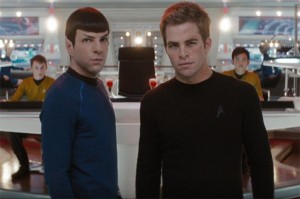 If there is a main weakness to Abrams’ Trek outing it’s that it feels far more like the opening act of a larger movie. Nero is a fairly weak villain, though Bana gives him a nicely polished glower. The villain is really just a tie-in for the time travel storyline, which is also a narrative quirk to secure an open field for further stories. Meaning, that much of the movie can be seen as assembling the pieces to simply move forward on their own. It’s an expensive set-up movie, and Abrams makes sure that the audience sees every dollar of the splashy visuals onscreen. Personally, I was also getting tired of the cinematography decision to fill the screen with as many light flares as possible. It seemed like every other moment had a blast of light beam in from some direction. After a while it sort of felt like an eye exam where the optometrist shines a flashlight back and forth. And it takes far too long for Scotty (Simon Pegg) to appear in the movie.
J.J. Abrams does more than hit the restart button. He has made a Star Trek that manages to be respectfully reverent but at the same time plays along to the mainstream visual sensibilities of modern cinema. It’s fun without being campy, reverent without being slavish, and this Trek never forgets to entertain from the opening assault on a starship to the Michale Giacchino’s closing credits score. This is an enjoyable rush of sci-fi escapism. The Star Trek series was always deeply hopeful and humanistic, believing in the best for humanity and that man, in cooperation, could achieve greatness. I think further escapades with this cast and Abrams at the helm could reach greatness. For now, I’ll be happy with this rollicking first entry into a franchise that seemed adrift in space. Bring on more of the green-skinned women.
Nate’s Grade: A-
Share this:

Paul Blart: Mall Cop (2009)
 Cute but very dumb would be the best way of describing Paul Blart: Mall Cop, which is miraculously one of the highest grossing movies of 2009. Kevin James stars as the titular security man and he proves to be a capable physical comedian, throwing himself into the jokes. It’s too bad that some of these jokes don’t deserve James’ efforts. A group of extreme sport crooks (they ride around on BMX bikes and skateboards like they’d rather be at the X-Games) hold Blart’s mall hostage on Black Friday, and Blart is the only security officer of any kind left on the inside. It’s Die Hard in a mall, but, surprisingly, the movie has some decent jokes when it’s riffing on tired action movie tropes. Some of the comic setups have funny payoffs because they work against audience expectations (like a bottle of hot sauce you know will be key at some point). Mostly, this is a goofy, almost saccharin comedy, with James earnestly playing a man held back from his life’s pursuit by his diabolical blood sugar. The flick is a bit more character-based than most slapstick farces, so I’ll give it that. Blart is a lovable loser who eventually wins respect and the girl of his dreams (Jayma Mays). The film is also more leisurely than an 87-minute comedy should be. The bad guys don’t take over the mall until after 40 minutes in, leaving little room for the comic clashes with Blart. The movie also doesn’t maximize its potential, much like its title figure. This is Blart’s mall, and he has an innate knowledge of it, but he doesn’t use this to turn the tables on his opponents. Paul Blart: Mall Cop has plenty of dead moments but in the end I found the movie to be tolerable thanks to James.
Nate’s Grade: C


 nathanzoebl
You must be logged in to post a comment.