Category Archives: 2008 Movies
Son of Rambow (2008)
 The film takes a few notes from 2005’s Millions and presents an amateurish tale of English schoolboys making their own amateurish sequel to a Rambo film. From a visual standpoint the film looks great, it has a slightly offbeat appeal, but there just isn’t any substance here beyond the imaginative visuals. The friendship between the two boys, one a bully and the other a lonely kid apart of a strict religious sect, doesn’t draw much out of the characters or the actors. The kooky stunts and homemade moviemaking made me smile and gives the film a fun, quirky energy. But then Son of Rambow seems to butt heads when it enters more serious dramatic territory like family loss and betrayal. The tone is uneven and the mixture of slapstick and whimsy and real pain and suffering never fully works. Certain subplots like a cool French foreign exchange student (who may not be so cool after all) feel grafted onto a story that needs direction and depth. They feel like distractions. Writer/director Garth Jennings (The Hitchhiker’s Guide to the Galaxy) tries to imbue the project with a childlike spirit but the story needs a whole lot more emotional focus and a whole lot more work. This ain’t no Millions.
Nate’s Grade: C+
Share this:

Indiana Jones and the Kingdom of the Crystal Skull (2008)
 I lived in New Haven, Connecticut for a year while then-partner was earning her Master’s degree at Yale. We hated it. New Haven is a college town that doesn’t know it’s a college town, so everything closes at 10 PM, there are no student prices for anything, and the people there more or less sucked. We were happy to depart from the Nutmeg State. Then the week after we were going to leave was when Steven Spielberg, Harrison Ford, and the production team for Indiana Jones and the Kingdom of the Crystal Skull were coming to town. They were going to film a motorcycle chase along Chapel Street (where I walked to work every day) and all along the Yale campus. Finally, a reason to stay in New Haven presents itself and it has to happen after we escape. It’s not often one of the most anticipated movies comes to your doorstep.
I could have been an extra in the motorcycle chase, which set in 1957, could have used a long-haired Beatnik type (played by yours truly) for an exaggerated reaction shot. I could have been sipping on an espresso and then Indiana Jones could have zoomed by on the bike snatching by hot beverage, leaving a long-haired Beatnik type (me again) to mug shamelessly for the camera. It would have worked. Alas, it was not to be, though it certainly would have made this ages-in-development sequel more enjoyable on my part.
It’s been a long time since part-time archeology professor and full-time treasure hunter Henry “Indiana” Jones (Ford) beat the Nazis. The world has gotten a lot more complicated thanks to the Cold War, the atomic bomb, and the fact that Jones is now well into his 60s. It’s been 19 years since his last adventure but the man with the bullwhip and the dusty fedora still has a knack for intrigue. Soviet KGB agents have captured Indy and his friend Mac (Ray Winstone) and taken them to the Area 51 warehouse. They’re seeking a recovered artifact of alien origins that can wield tremendous power, as they always do. Irina Spalko (Cate Blanchett) is the head KGB agent and likes to threaten her enemies with a riding crop (perhaps she earns some extra money on the side punishing bad, bad comrades). Indiana Jones manages to escape and is pursued by the Soviets and blacklisted by his government due to his perceived involvement with Russia.
 Mutt Williams (Shia LaBeouf) seeks out the help of Dr. Jones. Mutt is a greaser on a motorcycle that might be a chip off the old block. His parents are in trouble. The stepfather that raised him (John Hurt), an old archeology buddy of Indy’s, has traveled to South America and found a legendary crystal skull. The bizarre artifact would lead the way to the mythical golden city and crazy amounts of Mayan supernatural power. Unfortunately, the skull has also made him as batty as a bat and Spalko is going to kill him. Indy and Mutt fly down to South America to save the crazy old man. Oh, and Mutt’s mother is also in danger, and she would be none other than Marion Ravenwood (Karen Allen), who has plenty of romantic history with a certain swash-buckler afraid of snakes.
Seeing Ford back in action just feels right. His character has grown into a bit of a curmudgeon but he’s working the same territory Bruce Willis did last year in the long gestated Die Hard sequel. He’s an old man serving some justice to all these young punks that won’t get off his lawn. The film acknowledges his age and mostly uses it as a means for comedy (he cracks that a life of adventure isn’t “as easy as it used to be”). Ford looks more alert than he has in years.
Blanchett is one of our finest actresses on the planet but she has serious trouble maintaining her Ruskie accent; she alternates between Russian and British the whole movie. Her dominatrix-styled villainess is certainly interesting, and man does she have great posture, but the film doesn’t really know what to do with the Soviet bad guys. They become more or less Nazi stand-ins and seem to repeat the same ambitions that the Nazis carried out in two or the three previous films. Allen has aged magnificently and is a welcome return. She and Ford have terrific screwball comedy chemistry and pick up right where they left off in 1981’s Raiders of the Lost Ark. LaBeouf does a solid job even though he doesn’t have any meat to his character after his Marlon Brando-like introduction in leather jacket and motorcycle. Instead, Spielberg continuously winks at the audience about Mutt’s obvious familial line. It wouldn’t be a Spielberg movie without some family dynamic.
 I’m pleased to reunite with Indiana Jones, I like the new characters, and I even like Mutt, but the story the characters are saddled with is lousy. This is the script that Ford, Spielberg, and co-creator/producer George Lucas all agreed upon? I’m not one of those people that have an issue with aliens being the primary movers and shakers in the plot (in informal talks with friends, many are upset that little green men are the stars). The first three Indy films dealt with a religious supernatural power and now this new installment covers a space alien supernatural power, so that doesn’t concern me. What bothered me is that Crystal Skull is a murky mash-up of [i]Temple of Doom[/i] and Stargate. Once the primary characters reach their hidden temple the movie takes a nosedive. Spielberg almost crafts an anti-intellectual message, where finding out the reality behind the magic ruins the soul. The exact story behind the Crystal Skull is frustrating in how oblique it is, and Spielberg doesn’t want to offer any clarity. I’m at a loss to explain exactly why anything happened in the concluding 20 minutes, least of all how an alien race must have a very different definition of the word “gift.”
Never before has the action in an Indiana Jones film come across as so campy. This is likely the most disappointing part of Crystal Skull: the action is too tongue-in-cheek. There were moments where I thought the film was one step away from Army of Darkness. Spielberg is enough of a brilliant tactician to know how to setup and build satisfying and stylish action, which normally involves organic complications and letting the audience fully grasp what’s happening. This means no rapid-fire edits and plenty of long, high angle shots to get the big picture. And when he’s in his groove, there are few that can top Spielberg when it comes to an action sequence. There are points in Crystal Skull where the action is rollicking and joyously packed with excitement and wonder. The opening sequence inside Area 51 starts the film off with a bang, the motorcycle chase through Yale is well choreographed, and a car chase in the jungle is fantastic in the amount of back-and-forth scuffles and emerging obstacles. It’s by far the film’s high point and then there was one point where Mutt was swinging from vine to vine like freaking Tarzan and he enlisted the help of monkeys. It took me completely out of what had been a rip-roaring action sequence. Then there’s the moment where Marion drives everyone off a cliff and onto a tree that bends to drop them safely before smacking back like a rubber band. I’m not asking for complete believability in an action caper but I’d prefer it not become an embarrassing Looney Tunes cartoon. Crystal Skull is filled with little moments that will completely yank you out of the movie.
The action sequences feel too pat for the material the film wants to cover. Even that great jungle car chase could have been boosted with some extra ingenuity. The scene opens with the Soviets driving a vehicle that is slicing the forest to splinters and clearing a path for the caravan of cars to follow. Now I know the Spielberg of 1981 would never have introduced such an interesting machine in a unique setting without using it later. The Spielberg of 2008 is different because this nifty blade mobile isn’t even seen again after its initial introduction to establish how a car chase in a jungle could be possible. The action relies too heavily on distracting CGI that takes the action sequences on annoying, over-the-top detours. Just because computers can make it happen doesn’t mean it’s always a good avenue to go down. In short, the CGI is undercooked and over used.
 I also need to speak frankly about the CGI — it is terrible. However, when I watched Crystal Skull my party got a tad lost on the way to the theater so the only seats left were the third row from the screen. I spent the entire movie with my neck craned up. Perhaps if I saw the film in a position it was more intended to be seen the special effects would come across as more professionally polished, but from my neck-cramping position they looked pitifully amateurish for a major summer blockbuster with Spielberg and Lucas’s names attached. The effects work is shockingly shoddy, but the practical production design is amazing. Unfortunately, this does not balance out in the film’s favor.
I’m coming across as harsh but I only get this way when my expectations are raised because of a pattern of quality. The three prior Indiana Jones films were lively, imaginative, and deeply charming and satisfying adventures that leaned toward the exaggerated but still managed to thrill without feeling dumb. Raiders of the Lost Ark is one of the few perfect movies in existence, in my opinion, and set the standard for all action/adventure movies to follow. It’s unfair to expect the same sensation watching a sequel 19 years after its predecessor, but Kingdom of the Crystal Skull does manage to hone in on the same spirit that made the other Indy films such high-flying thrill rides. If you set your brain to a low frequency, enter the theater with lowered expectations, and already know that at one point Mutt will swing from vine to vine like freaking Tarzan, then Crystal Skull will provide the necessary popcorn entertainment you’d seek in a summer blockbuster. It is possible to think Crystal Skull ranks up with its predecessors but that requires so much contortion that I wouldn’t know how to arrive at that opinion. I suppose we should all resort to the consolation that even with E.T. taking over the plot, this thing could have been a lot worse. Just remember that if an alien offers you a “gift” to run in the other direction.
Nate’s Grade: C+
Share this:

Iron Man (2008)
 Robert Downey Jr. and Jon Favreau seem like decidedly odd choices for a studio to hand over a multi-million dollar potential comic franchise. Iron Man certainly isn’t one of the better-known super hero properties but Marvel Studios felt confident that having Favreau behind the lens and Downey Jr. in a heavy suit of armor was the right direction. They couldn’t have been more right. Iron Man is a rock solid action vehicle that flies by in a blast. My biggest complaint: the film never utilizes the ready-made theme song by Black Sabbath.
Tony Stark (Downey Jr.) is the billionaire CEO of Stark Industries, a high-grade weapons manufacturer creating bigger and better ways for people to kill each other. His life is a never-ending party, going from gambling to girls to gizmos. His assistant, Pepper Potts (Gwyneth Paltrow), keeps Stark as grounded as he can be. Stark is traveling to Afghanistan to demonstrate the awesome might of some of his new missiles when his convoy is ambushed. One of Stark’s own weapons sends shrapnel into his chest. He is kidnapped by terrorists (read: Arabs with guns) and held captive inside a cave. Stark is kept alive by a glowing electromagnet do-dad in his chest that manages to keep the shrapnel from entering his heart. Raza (Faran Tahir) orders Stark to build him a missile or else. So Stark does what any mechanical boy genius would do: he builds a giant suit of armor and busts his way out.
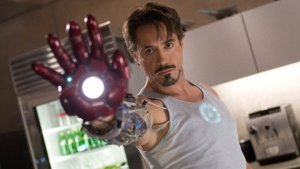 Stark’s friend Jim Rhodes (Terrence Howard), an Air Force officer, rescues him in the desert. Once back at home in his Malibu mansion, Stark has a personal epiphany. After seeing the human damage his weapons cause he no longer wants to manufacture weapons. His business partner Obadiah Stane (Jeff Bridges) and the board of directors are not interested in Stark’s revision. They want to keep doing what they do, making weapons for the highest bidder. Stark begins building a more advanced mechanical suit based upon the prototype from Afghanistan. He will use his technical expertise and great fortune to destroy his own weapons, even if he has to become an ironclad superhero to do so.
Downey Jr. is Iron Man, yes, but he IS Iron Man. He makes this character, this movie, and serves as the film’s ambassador to an audience that has grown tired of mopey teenagers imbued with super powers. His character is a man going through a mid-life crisis of sorts, reevaluating his life and trying to find meaning in his work. There’s something satisfying about watching an older adult wreck of a man taking on a genre that feels like it’ stuck in a high school atmosphere. Downey Jr. is a fantastically engaging, talented actor and when he turns on his narcissistic quick-witted charm it is impossible not to be won over. He provides the film with a tremendous spark and manages to make a womanizing, alcohol-swilling, super wealthy arms peddler/playboy into a figure of sympathy and a hero for the masses. Downey Jr. has expert comic timing and makes Tony Stark a cool swinging superhero. Just listen to his line deliveries and the energy and pacing he puts into the dialogue; it’s terrific. He also gives Stark the necessary drama to pull off the weight of guilt.
Iron Man is also a victory for Favreau as a director. The Swingers star has become a stealthily competent director. He helmed 2003’s Elf and 2005’s underappreciated Zathura and I suppose Marvel Studios saw what I saw in those films. The direction is focused and he makes smart decisions, never overwhelming an audience and always centered closely to the story. Favreau is more concerned with storytelling than noisy, empty special effects. Hell, Iron Man doesn’t even enter the film until an hour into it. There is a confidence and patience to his direction; it manages to convince an audience that they will be rewarded for their time.
 Favreau doesn’t pander and knows well enough that practical special effects will inspire the greatest sense of awe in a summer flick. Iron Man‘s special effects are almost seamless from the practical to CGI. I enjoy popcorn action movies so much more when I’m not nit-picking the special effects. This isn’t a slam on CGI itself, but computer effects have the tendency to declare their fakeness. Sure the special effects were amazing in last summer’s Transformers (how it lost the visual effects Oscar to the subpar Golden Compass I’ll never know), but the CGI-ness of it could be overpowering. When I cannot decipher a special effect automatically, then I know I have been fully immersed in the action. Favreau smartly lays out a bevy of nifty practical effects for the first half. By the time he transitions to broader CGI then he’s already laid the foundation for realism.
Favreau isn’t the best action director but this only presents an issue in the film’s last act. The action sequences in Iron Man take a back seat to watching Tony Stark piece together his new life. I was more interested in seeing Stark test and reconfigure his designs. The construction of Iron Man, to me, is more intriguing than seeing a man in an iron suit battle some guy in a bigger iron suit. The fun is watching him become Iron Man. The action sequences are serviceably kick-ass but too short. I loved watching Iron Man punch people and seeing their bodies fly backwards. Even at over two hours there just isn’t a whole lot of traditional action to Iron Man but this suited my tastes. I’d rather watch an actor with Downey’s talent interact with an A-list cast than watch robots fight and smash personal property.
Iron Man is aided by a strong script credited to two of the writers of Children of Men. It’s structured as an origin tale but it takes its time to set up events and characters that will have lasting meaning. Stark confronts being a weapons manufacturer in a post-9/11 world. He finally stops and asks, “What is the cost?” His own company is double dipping, selling weapons to both sides in a conflict, weapons that will kill U.S. men and women pledged to protect America. Stark has a true change of heart, both figuratively and, later, literally with the assistance of Pepper. There’s a political undercurrent to the film’s drama that manages to be timely and provide at least some thought to go along with the popcorn thrills. Iron Man finds a way to force its characters to combat real moral questions that result from their actions.
 The supporting cast has a combined seven Oscar nominations for acting, so this is a step above the acting level of a Fantastic Four. Howard is mostly underwritten but he provides a nice sense of camaraderie with his friendship with Stark. Bridges is an obvious villain just from the first sight of his bald dome and big, bushy beard. He’s got a mean scowl but Bridges provides a warm and fatherly guide for Stark. But man, when he gets menacing he is rather scary. But my highest praise in the supporting work goes to Paltrow, who coolly delivers arch snappy one-liners in a retro do-everything secretary role. And yet the role also offers some reflection, like after dancing in public with her boss she worries over gossip and what perception will construe the moment into. She, his employee, wearing a plunging backline dress that looks gorgeous on the actress, dances with her boss, an infamous womanizer. And then in this moment of doubt there’s a nice, unexpected moment for both a comic book movie and a would-be romance, and the “would-be” is the correct term. She has great chemistry with Downey Jr. and watching the two of them playfully bicker is another reason Iron Man soars above the confines of genre and formula. Plus she looks great with red hair.
Iron Man is a great start to the summer movie season and will be hard to beat. It doesn’t have the psychological depth of Batman Begins or the high-flying fun of Spider-Man 2, but this film certainly deserves to be mentioned in that same group. Favreau has crafted a respectful comic book movie that manages to place special effects in service of an interesting story played by extremely engaging actors. Downey Jr. is the movie’s secret weapon and he delivers a smart, witty, charming, sardonic and enormously entertaining performance that anchors a fine example of what big budget popcorn filmmaking done right looks like. Batman and Spider-Man might want to be on the look out because the new kid on the block is generating some serious heat.
Nate’s Grade: A-
Share this:

The Hottie and the Nottie (2008)
 Paris Hilton is certainly a polarizing figure. The hotel heiress and tabloid star inspires so much hatred from the public and yet others still fawn over her. She simultaneously inspires ire and interest, and filmmakers have been trying to give their movies a publicity boost by adding Hilton into the cast. It didn’t work wonders for 2005’s House of Wax, though audiences got to witness Hilton get nailed (tee hee). Most of her starring ventures have been straight for DVD, except for this year’s beauty-and-the-beast crude comedy, The Hottie and the Nottie. It was released just in time for Valentine’s Day (hooray!). According to the numbers-crunching website Box Office Mojo, The Hottie and the Nottie played at 111 theaters for a mere three days before being yanked for DVD. It made a total of $27,696, averaging a pitiful $250 per screen. That averages out to 28 people seeing it per screen for its entire theatrical run.
Nate Cooper (Joel Moore, Dodgeball) is a 26-year-old dude who is just dumped by his latest near psychotic girlfriend (Kathryn Fiore). His latest dustup in love makes him reflect fondly to his first experience with the L-word. It was first grade and Christabelle moved into town. Nate moved to Maine after the first grade and never saw her again (seriously, does anyone ever remember the first grade with such clarity and deep feelings?). He decides to track down the adult Christabelle (Paris Hilton) who is working in Los Angeles. But before he can woo the “hottie” he has to get around the “nottie,” said nottie being the hideous likeness of June Phigg (Christine Lakin, Georgia Rule, TV’s Step by Step). Christabelle and June have been friends since the first grade and Christabelle has sworn a vow of abstinence until she can find a guy for her friend. Nate goes to great lengths to find a man willing to plumb the depths of “nottie-tude,” including hypnotizing a man (Adam Kulbersh, the only funny actor in this mess) into associating the image of June with a space babe. Then along comes Johann (Johann Urb). He’s a chiseled hunk who works as a dentist and insists on helping June’s unorthodox chompers for free. He seems too good to be true and Nate is convinced that Johann is buttering up the “nottie” because he really has his eyes set on scoring with the “hottie.”
 The central premise is that Hilton is the pinnacle of beauty and that no man could resist her. The script is filled with all sorts of flattering compliments on how Hilton is the perfect specimen of desire. Early on she’s described as Nate’s “first real vision of beauty” and the one “all other girls will have to measure up to.” Men line up just to watch her pass by on her jogging route. She just doesn’t turn heads she makes men lose their minds, pour drinks in their laps, and force their wives to slap them in the face. She even has an albino stalker. Johann asks Christabelle, “Have you ever done any modeling? You have great bone structure.” The movie is a shallow 90-minute tribute to Hilton’s genetics.
The film tries to champion a misguided message but fails. There’s some lip service paid to inner beauty but Nate never sees the “nottie” as a “hottie” until she starts to physically transform and reconfigure her body. He remains shallow until the ugly girl meets the demands of others. No one seems to see her inner beauty until she focuses on the outer. Not only this, the film presents no rationale why Nate would start to fall for the “nottie.” There is no groundwork, they just all of a sudden talk more, make a few jokes, and then it’s straight to the longing looks and soft emo music. It makes no sense even for a cheap romantic comedy.
The dialogue is full of clunkers. Christabelle tells Nate, “I think a life without orgasms is like a world without flowers.” Um okay then. When she gets into the requisite third act fight with Nate, Christabelle says, “I am out of your league. You can’t sing, you can’t dance, you’re a terrible athlete and a really crappy liar.” Now what does that mean exactly? It’s meant to be dramatic but it ends up with a different meaning. Christabelle is inferring she can sing, dance, is an athlete, and… is a good liar? I would also like to know what the hell Nate does as far as a job, because it’s never mentioned and yet he has the time and money to buy lavish gifts like $2000 spa treatments.
 The comedy is excruciating. The Hottie and the Nottie is physically nauseating to watch. I’ve written before that there’s a difference between gross-out and just gross, and this movie doesn’t seem to understand this. I nearly vomited after seeing an infected toenail land in some guy’s mouth. Snot bubbles, varicose veins, gnarly teeth, extreme acne, and overgrown hair are not comedy without context. Presented alone, they compose a vile health department slide show. There’s nothing funny in just being gross. Beyond that, the film is fairly lazy and obvious with its setups and punch lines. There may have been one moment that genuinely made me laugh and that was because it was unexpected. There aren’t any memorable or even remotely clever comic set pieces.
It is difficult to describe Hilton as an “actress” because her whole public persona she’s built for herself something of an act. The film seems to cut around her limited acting skills because there’s never a shot that lasts longer than two or three sentences. If director Tom Putnam is honest with himself he will some day release a fascinating commentary about the pains of directing this movie.
But special mention must be made to a man that feels so audacious he must put the term “the” in front of his name. (The) Greg Wilson plays Nate’s only friend in this reality and oh God is he terrible. He does the word “terrible” an injustice. He seems to be shouting every line completely overboard as if he were on some glib VH1 pop culture show where every line feels like it should be followed by a rim shot. His jokes are groan worthy and his spastic line delivery is all over the place.

This is a vapid excuse for a movie and a waste of time. And yet, for my vast knowledge on the world of bad cinema, The Hottie and the Nottie is awful, unfunny, stomach-churning, and morally repulsive but it is still a better movie than Meet the Spartans. Hell, at least this flick even attempts a three-act story structure with something close to characters.
Nate’s Grade: D
Share this:

Forgetting Sarah Marshall (2008)
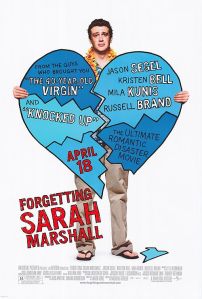 So much ink has been spilled on Jason Segel’s full-frontal nudity that you would think the public has never known that penises have appeared on film before. It seems that female nudity is used to titillate and male nudity is used for awkward laughs, and this is the case with Forgetting Sarah Marshall, which Segel stars in and wrote. His character Peter is humiliated by a breakup, even more so because the man is breaking down while in the buff. He even states at one point the naive belief that as long as he doesn’t put clothes on reality cannot hit. It’s funny and sad and he’s completely vulnerable, but Forgetting Sarah Marshall is much more than the story of one slightly doughy man and his penis. This is a story from producer Judd Apatow (The 40-Year-Old Virgin, Knocked Up) about heartache and mending and the struggle it takes to keep a relationship healthy. But it is also about a man and his penis.
Peter (Segel) is dating TV actress Sarah Marshall (Kristen Bell), star of the brilliantly reflexive title Crime Scene: Scene of the Crime. Peter provides the music for the TV show, which he laments is nothing more than “ominous tones.” Then one day she has some bad news. She’s breaking up with him (this is where Segel loses it, both emotionally and from a clothes perspective). Peter mopes and cries for days, goes out to clubs with his step-brother (Bill Hader), and tries to engage in meaningless sex but that too leads to crying and moping. Peter takes a vacation to Hawaii in order to forget his ex, but as chance would have it Sarah is already there with her new man, British rocker Aldous Snow (Russell Brand). Peter is stuck in the same hotel as his ex and her new lover. The hotel staff takes pity on Peter and they all seem to look out for him, setting him up in a $6,000 suite, involving him in hotel activities, and feeding him drinks. Rachel Jansen (Mila Kunis) works at the front desk and takes a special interest in Peter and his woes. She helps Peter get over Sarah and fin
 Forgetting Sarah Marshall is another hit from the Apatow brand. It features another leading man with an unorthodox physique and a healthy interest in geek culture. However, Peter doesn’t need to learn to be responsible, or outgoing, or to transition from boy to man. He’s actually fairly well adjusted and even has a job that suits his composing talents. His dilemma is heartbreak, a universal affliction if ever there was one. He’s a little frumpy and has a thing for puppets, but Peter is really a sweet guy who is working through the pain of a breakup. He was together with Sarah for over five years, so it feels strange when the characters keep harping on him to get over it in the span of a few weeks. He is awash in self-pity and wails so loudly that other guests complain about a woman crying in his room. He makes for a capable lead and his budding romance with Rachel allows him to heal. The romance is strongly felt and I was completely absorbed by wanting Peter and Rachel to have a happily ever after.
Segel is a charitable screenwriter. The could have easily become a vanity wish-fulfillment project, but instead he rounds out the main characters and builds a deep supporting cast that add delightful additions that enrich the narrative. I admire Segel’s decision making when it came to fleshing out his characters instead of writing them off as stock types. In an ordinary romantic comedy, the beautiful girl that dumps the lead is a bitch. It would have been extremely easy for Segel to demonize Sarah and keep her as an established antagonist, but instead he makes her feel real. She has real, solid reasons for her breakup with Peter, and she has several revealing moments that open her character up and humanize her. Aldous is another pristine example of Segel’s screenwriting skill. In an ordinary romantic comedy, the girl always dumps the nice guy for the douchebag, and Aldous starts in that territory. But a magical thing happens and as the film continues Aldous becomes very charming; he’s unpretentious and is the same transparent and genial man to everybody. He appreciates Peter’s music and gets him and Peter’s passions. Peter says at one point, “This would be so much easier if you weren’t so cool.” It would have been easy and even expected for Segel to cast both the ex-girlfriend and her new boyfriend as evil cretins. Instead, he broadens and rounds out all the central characters to the point that they feel like real people and not just comedy types.
 The movie is resolutely pleasant and amiable, lacking gut-busting laughs but offering plenty of cringe comedy. It’s not as outrageous as other Apatow comedies, or as good, but it is completely entertaining. There is one terrific sequence that stands out in my memory. It involves the two couples sitting at an awkward dinner. Then they comment on how awkward it is, then they comment on commenting how awkward it is. The dinner bathes in unease but then as it carries on you see the different tensions. Aldous and Peter hit it off discussing their dislike for a terrible horror script offered to Sarah that involved a killer cell phone (sounds like One Missed Call). They are genuinely bonding. Sarah hides her growing dissatisfaction with the decisions she’s made, but Rachel catches on. She kisses Peter long and hard and shoots Sarah a very knowing glance that all women know as “back off.” This dinner packs all of the different tensions of the movie into one well-written, expertly performed scene. The characters aren’t shouting their feelings point-blank but you can follow along to the conversations that are unsaid.
I love comedies that involve deep supporting casts, where a supporting player can enter at the right moment and deliver a perfect in-character addition. I was delighted at how wide Segel cast his net of characters and yet how well incorporated they are. There’s a newlywed couple (30 Rock‘s Jack McBrayer, Maria Thayler) that haven’t mastered the art of sexual intercourse. They’ve waited until marriage and know are wondering what all the fuss is about. Hearing McBrayer’s amped-up frustration is funny, but it’s even better when he solicits advice from Aldous on pleasing a woman. The tutorial between the two left me in stiches and made me like Aldous even more. I enjoyed spending time with all of these characters. Apatow regulars Jonah Hill and Paul Rudd pop up in hilarious cameos. Rudd is a super stoned surf instructor and Hill is an obsessed Aldous Snow fan who creepily doesn’t abide touching boundaries. The supporting players never outstay their welcome and add great splashes of variety to the story.
Forgetting Sarah Marhsall continues the Apatow tradition of mixing raunch with sentimentality. There’s plenty of dirty humor but it’s the little touches that won me over. I loved the title of Sarah Marshall’s TV show, perfect references to movies like The Buena Vista Social Club, Rachel reflecting Peter’s romantic advances only to initiate the first kiss, the brilliant music video for Aldous Snow where he carries an earnest sign that reads, “Sodomize Intolerance,” the flashbacks to Peter and Sarah’s relationship, the helpful advice of Dwayne the bartender and his great knowledge of fish native to Hawaii, and a vocally competitive dual of sexual intercourse. This is a comedy that works because even they details have been looked after with care.
 Segel easily conveys his character’s sweetness; the man can’t help but be sweet even in anger. Bell is given complexity with her role and nails bitchiness and tearful regret with the same skill she radiated on her defunct TV show, Veronica Mars. I never thought Kunis was capable of playing more than a shrill ditherhead thanks to her role on TV’s That 70s Show but she nicely handles the drama. She makes the romance more than believable but desirable. The actors all do a great job but it is Brand that steals every single scene he is in. His carefree demeanor and hysterical physical gyrations cast him early as one type of character, but his charisma rules the day and will win over audiences.
This is all familiar romantic ground covered by countless other movies. Boy loses girl, boy meets new girl, boy gets new girl, but Forgetting Sarah Marshall adds the Apatow touch. Another Freaks and Geeks alum writes another male-centric but hilarious comedy that deals with mature themes in untidy ways. The movie takes place in a world that resembles ours, where people are not cast in black and white, good or bad, victim and victimizer. Segel’s screenplay lets the audience empathize with a wealth of characters, and the humor is bittersweet but mostly on the sweet side. Any film that ends with a puppet musical about Dracula has to be seen as special.
Nate’s Grade: B+
Share this:

10,000 B.C. (2008)
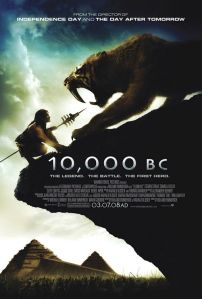 Roland Emmerich is a director used to making big budget, effects laden mainstream blockbusters that baffle film critics. I enjoy some of the man’s output but hold little pretension that Emmerich is not a filmmaker who knows the terms “nuance” and “subtlety.” 10,000 B.C. is another Emmerich flick in the would-be blockbuster mode. It has magazine cover leads, large-scale action set pieces, and a familiar rescue plot route. It also happens to be as dumb as rocks.
Way back in 10,000 B.C., life is more along the lines of nomadic hunting and gathering. The featured tribe has the old staple of the spiritual guide who lays out prophecies. This prophet foresees great calamitous change for the tribe. “Four-legged devils” will bring about destruction. But there is hope. D’leh (Steven Strait, Sky High) will save his tribe from annihilation. He is also destined to love Evolett (Camilla Belle, When A Stranger Calls), who is coveted because she has blue eyes. This, we are told, is a fortuitous sign. One day after a successful mammoth hunt, the tribe falls prey to raiders on horses. These raiders raze the huts and slaughter the people. They cart the rest, including Evolett, off to work as slaves building what appear to be pyramids or ziggurats in Egypt. D’leh must regroup and travel with Tic’tic (Cliff Curtis) all across Africa to save his loin-clothed love.
 This is a colossally stupid movie. Emmerich spins a host of clichés and prays it’s enough to stage some pre-history visual wonders. The movie’s visuals are certainly pleasing to the eye, but the plot and characters are totally vacant. The characters are one-dimensional morons. It’s not even worth mentioning what the numerous historical inaccuracies are (Egypt wasn’t even settled until 7,000 B.C.) because it would be less time consuming to simply state the historical accuracy the film presents. 10,000 B.C. makes Quest for Fire look like a documentary. The plot framework is your usual hero’s journey pastiche, where our lead must accept the responsibility that goes with being a leader. There’s also familiar plot turns like rescuing the damsel in distress, learning important back-story about an absent father, and finally, a slave uprising. 10,000 B.C. is a rip-off of Apocalypto and generally every historical uprising movie where the people band together under the leadership of an individual to tackle an antagonistic authority. This movie feels like it is barely held together by its plot threads, and those threads merely link to tired, groan-inducing clichés that act as placeholders for an actual plot.
What is even worse, 10,000 B.C. is a total bore. The only way something this silly and gleefully historically inaccurate could work is if it offered some adventure thrills. 10,000 B.C. seems to sputter for long stretches, having characters assemble and depart and walk and speak their ridiculous caveman speak. The pacing is rather slack and the action sequences, when they do occur, aren’t very well developed, hoping to leave their mark with plenty of long shots. Several action sequences are doomed from their very conception, like the laughable giant ostriches eating people. The action is just not good at all. Emmerich can generally pull out an exciting, functional action sequence even if it requires you to officially turn your brain off to enjoy. The first half of 10,000 B.C. has a few limited action sequences but they are brief and poorly staged. The second half has one climactic action sequence but it’s hard to tell what the hell is going on. Emmerich does not setup his climax and allow the audience to understand the attack process. When the climactic attack does occur it feels overly chaotic and senseless. How can the audience enjoy the progress of action if it cannot even verify what is happening? If I can’t follow what’s happening then I can’t enjoy it. The equation is that simple. The end of 10,000 B.C. is a big, mammoth-filled mess of a sequence that fails to serve as any payoff.
 The movie is so serious that the silly adventure heroics come across as downright insufferable. I cannot possibly sit through a 1 hour 45-minute film that deals with pet saber tooth tigers, traveling across the entire continent of Africa by foot at record speed, and giant freaking killer ostriches and have the movie try to uphold a serious reality. No movie in the history of mankind will ever be serious as long as it has a killer ostrich. 10,000 B.C. would classify as camp if it weren’t so resoundingly boring. I think Emmerich really stuck to his initial concept and decided somehow the movie would form by itself. He shows a definite interest in recreating sprawling vistas of a time long ago, but he shows barely a whiff of interest in depositing a story to go along with those oh so pretty pictures and ancient landscapes.
The film also feels eerily semi-racist. The good guys are slightly tanned but mostly Anglo-Saxon in their appearance. They even speak English, though really terrible monosyllabic English. Note to all filmmakers: if you are going to make a movie that predominantly features cavemen then do not give them any speeches. They sound absolutely hilarious trying to deliver a rousing speech in their stilted, monotone voices. The villains are outsiders who look very Arabic and Middle Eastern. They speak a different language. They come to terrorize the God-fearing hunters and gatherers, enslave their people, and drag them to a giant temple to be killed in the name of a competing God. I don’t know if the movie is necessarily anti-Arabic but I was given the opportunity to contemplate this subject with all the downtime 10,000 B.C. afforded me.
The special effects are bad. The acting is bad. The story is dreadful. The action is poorly planned and sporadic. And every aspect of this movie radiates stupidity. I suppose some moviegoers can discover some derisive pleasure from watching a really terrible movie about a dreadlocked boy trying to reclaim the only girl in 10,000 B.C. that vigorously tweezes her eyebrows. For me, the movie was far too stagnant and boring to enjoy derisively. 10,000 B.C. takes itself far too seriously for something far too silly. Emmerich has created a movie that manages to be dopey even by caveman movies standards, and this includes a 1981 movie actually called Caveman featuring Ringo Starr. My biggest question after the movie concluded was, “How in the hell did they get Omar Sharif to narrate this stone-age turkey?”
Nate’s Grade: D
Share this:

Expelled: No Intelligence Allowed (2008)
 Ben Stein is best known as the monotone teacher in Ferris Bueller’s Day Off, but the man has also been a speechwriter for Nixon, a game show host, and popular figure of deadpanned irony. Expelled: No Intelligence Allowed follows Stein as he travels across the world interviewing scientists, authors, professors, and others about what he sees as a disservice to science and America. “Big Science,” as he refers, is so heavily entrenched in the theory of evolution and the teachings of Charles Darwin that they are unwilling to even broach alternative approaches. Intelligent Design believes that life is far too complicated to occur randomly, and thus must have been created by some powerful supernatural designer. The teaching of evolution is still seen as a controversial subject and I.D. proponents want their theory to be given equal time.
Stein tries to skew his argument into one about freedom. The Constitution calls for the freedom of speech and our nation is built upon the bedrock of being a marketplace of ideas. Stein compares the resistance in the scientific community to Intelligence Design to the Berlin Wall, and he argues that I.D. proponents just want to open up the dialogue. Detractors warn that I.D. is just Creationism in sheep’s clothing, and indeed the U.S. courts have ruled the same way. The problem with Intelligent Design is that it can’t really apply to science. Science can only test what exists in the natural world, and religion by definition deals with the supernatural and thus can’t be tested. It’s one thing to say, “The sky is blue because God made it so,” but what else do you do with that as a scientist? Where do you go from there as a teacher? Science textbooks would be awfully thin, since you would just need one sentence to sum up all of existence. Evolution begins with the start of life and no one has a strong feel for how life began, but I.D. runs into the same wall if you think about it. Saying, “God created life” leads to the question, “How was God created?” and now we’re back where we started. Personally, I don’t see why evolution and religion have to be seen as forces that cancel each other out.
 Ignoring the subject matter, Expelled just doesn’t even work effectively as an expose documentary. The movie continuously jumps to old newsreel footage as a visual resource even for mundane conversations. It happens again and again. Either the filmmakers thought their audience had ADD or was too stupid to sit through an interview without several jump cuts to visual reference points. Some of the clips are fun in a goofy retro way but the whole decision comes across like a narrative crutch and it makes Expelled feel erratic. Stein doesn’t try very hard to disguise his interview style, which includes him leading his interview subjects and lobbing softball questions like, “Intelligent Design is just Creationism, right,” and the audacious, “What was the purpose of the concentration camps?” I think it is telling that the interview subjects are not given lengthy reactions and are not pressed into actually presenting what Intelligent Design proof that exists. In contrast, the evolutionary scientists interviewed are intercut with clips of Nazis and Communists soldiers. I don’t even think Michael Moore would have chosen to go that obvious.
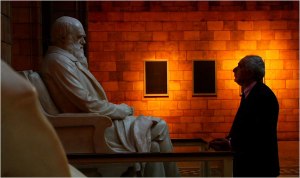
While I’m on the subject of Moore, Stein follows some similar ambush tactics and they are obvious and obnoxious. Stein tries to walk into the Smithsonian Center to get a statement as to why a prominent scientist was released and ends up getting kicked out. Did he expect anything different? Portions of Expelled come across as transparently staged, and upon some research I have learned that some were indeed staged. The film opens and closes with Stein addressing a full crowd of college students. They erupt in rapturous applause by the end of his speech and give the man a standing ovation. That crowd was nothing more than paid extras and Stein has never traveled the college circuit to speak on Intelligent Design. The scientists that were interviewed were also misinformed and told that they were being filmed for a documentary called Crossroads about the “intersection of science and religion.” The evolution scientists interviewed were then barred from free public screenings. That should tell you something.
Scientists being blacklisted by their peers seems rather unfair, but the movie takes their subjects strictly at face value. I am convinced there is more to the story than Expelled lets on. One woman off-handedly mentioned the phrase, and that was all, and was let go. I want to know more, but the film apparently doesn’t. Stein even cuts her interview off and dubs his own voice over as she continues her story. I would have appreciated some interviews with scientists who believe in evolution and God. Given that approximately 99.97 percent of life scientists believe in the theory of evolution, so statistically there must be a healthy slew of scientists who happen to be Christians that believe in the existence of evolution.
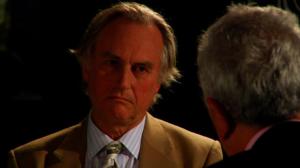 The film is heavy-handed propaganda, sure, but man oh man does it just take an ugly turn in its last third. Ben Stein eventually makes the leap from evolution to… wait for it… Nazism and the extermination of those less desirable. Stein and some of his interview subjects are making the case that Hitler was directly influenced by the tenets of evolution and that he used Darwin’s template to snuff out Jews, Gypsies, gays, the handicapped, and all those holding back the human race with their inferior genetics. There are many steps removed from Darwin to Hitler, but Stein is laying the blame of the Holocaust at the feet of Darwin’s ideas. Arguably, exterminating an inferior race could be applied to the idea of natural selection (though forcibly killing millions doesn’t seem very natural to me) but people were killing each other long before Darwin was ever born. Before Darwin, there was still genocide in the name of eliminating those deemed inferior, and mostly it was performed with the justification of religion. Surely historically religion has been the motivator for more death than Darwin (count the Crusades and the Inquisition). Even specifically Jews have been persecuted and put to mass death centuries before Darwin. And what about all the countries in the world that have embraced evolution as science and not gassed millions of people? But Stein persists in trying to attach the Holocaust and Nazism to evolution. To me, this is like blaming The Catcher in the Rye for shooting John Lennon in the head. Darwin posited ideas and cannot be blamed for others perverting those ideas for their own gain. The film also glosses over the fact that it was Herbert Spencer who introduced the phrase “survival of the fittest,”
And yet after spending a good deal of time linking Darwin and the Holocaust, Stein throws out this caveat: “But I know that Darwinism doesn’t automatically lead to Nazism.” Expelled is filled with other such contradictions. It argues that science and, specifically, evolution does not disqualify the existence of God, and to this I agree whole-heartedly. Science provides the “how” in life and religion can provide the “why” for people. Science does not disqualify God and vice versa; however, Expelled then trumps interview after interview of scientists that explain how evolution turned them into atheists. Huh? The film presses the irritating and confusing point that evolution will turn everyone into a bunch of atheists, but this conflicts with one of the film’s central points on the roles of religion and science. Stein never goes into great detail in this area and ignores the fact that a majority of the American public is both religious and believes in evolution.
 Expelled starts to become an ideological dartboard by the end of its experience. Stein says evolution is responsible for eugenics, which lead to the idea of population control, which lead to Margaret Sanger founding Planned Parenthood. My reaction is: so? Planned Parenthood promotes safe sex and performs legal abortions, yes, but they have nothing to do with eugenics and religion. Henry Ford and Walt Disney were also believers in eugenics. But the interview subjects all seem to repeat the phrase “euthanasia and abortion” like it was a talking point they were handed. The exact phrasing is so precise for several interview subjects that it seems deceptive. Why does this matter at all in a movie reportedly about Intelligence Design?
I cannot honestly see anyone being converted by Expelled. Skeptics and believers in evolution will fail to be swayed, and for the large Christian community the film is courting, well it will be preaching to the choir. I just discovered that there’s a website called expelledexposed.com intent to hold Stein’s film to review. I’m a firm believer in evolution and that Intelligent Design is religion; yeah they don’t specify “who” but how many I.D. proponents were the same ones pushing Creationism in schools earlier? If they stick to the tenets of Intelligent Design then I’d like them to accept the Raelians in their camp (Raelians believe that aliens seeded our planet). Expelled never makes the case for why Intelligent Design should be taught, merely that it is unfair to exclude it from the classroom. The movie presents contradictions, logic fallacies, and some disconcerting guilt-by-association arguments that border on exploitation. Even though I disagree with its ideology, from a filmmaking standpoint it falls apart. The topic of evolution’s relationship to religion deserves a thoughtful and intelligent movie. This is not it.
Nate’s Grade: F
Share this:

The Ruins (2008)
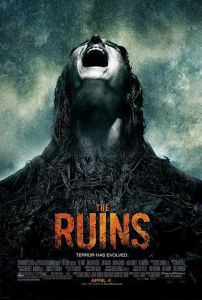 Author Scott Smith is from Ohio, my home state, which makes me like him. What made me respect him was his adaptation of his own novel, A Simple Plan. The movie version was splendid and taut, well acted and riveting and disturbing. Smith even received an Oscar nomination for his screen adaptation. When Smith released The Ruins, his second book, in 2006 I was mildly intrigued but never got around to reading it. Something about tourists, and Mayan temples, and bad things, and it got plenty of good reviews. Then I saw that Hollywood was producing a film version and that Smith had written the screenplay himself. Well, I figured, I’m going to be in for a chilling treat. Let’s just say my opinion of Smith has been slightly diminished.
Four over privileged American tourists are enjoying their final hours of a vacation to Mexico. Jeff (Jonathan Tucker) is studying to be a doctor. His girlfriend Amy (Jenna Malone) is best friends with Stacy (Laura Ramsey), and the two pal around together. Stacy’s boyfriend Eric (X-Men’s Shawn Ashmore) is along for the ride and enjoying every sun-soaked, boozy second. Lounging around the hotel pool, the group comes across a German (Joe Anderson, Across the Universe) who has a map to a hidden Mayan ruin. It’s a bit off the beaten path but the group decides to witness some genuine history. They take a taxi 12 miles into the jungle, hoof the rest, and discover a not very well hidden path to a not very well hidden Mayan temple (seriously, you’re going to have to do better than a couple of palm leaves if you want to obscure the path and keep people out. Try a fence next time). As soon as they arrive so do a band of armed Mayans that really insist the tourists do not leave the site. The Mayans chase the tourists onto the ruins and then they set camp around the perimeter. The Americans are being kept quarantined. Why? Inside and atop the ruins are a deadly plant that has a powerful hunger.
 For a horror movie filled with unremarkable and generally unlikable characters, I must say that they at least don’t do anything incredibly stupid as is accustomed to the genre. Once they are chased to the top of the ruins you, the audience, are now put in their shoes. Every choice they make seems decently reasoned and cautious, exploring their surroundings and testing their boundaries. The Ruins features cheesy killer plants, yes, but the more interesting element to me was the survival game. These characters are quarantined in a remote area with little water, armed guards, and a handful of useful tools. What will they do next? This scenario grabbed my interest, as I played out my own personal survival scenario step-by-step and it wasn’t too different from what befalls the characters onscreen. However, I’m surprised no one tried setting the freakin’ plants on fire. The eventual psychological meltdowns and increasingly grim outlook help The Ruins maintain some level of credible drama.
But I think in the end I just couldn’t get over the fact that the main culprit was killer fauna. I can accept carnivorous plants, but seeing them is a whole different matter. Somewhere from pages to screen a step was forgotten to make them believable. The ancient plant system inhabiting the ruins looks like an overgrown swatch of ivy and marijuana leaves, and the vines would slowly inch forward to retrieve fallen pieces of meat. It’s downright comical to see a stringy piece of a vine trying to discreetly drag a dead body away, and frankly that’s where the movie fails. I shouldn’t be giggling at the killer plants. The execution comes across as way too goofy and made me shudder that I could be watching Little Mayan Shop of Horrors. I’m also wary that this highly localized plant has evolved to the point that it can duplicate exact sound. It mimics a specific cell phone ring tone to lure our vacationers deeper inside the ruins. Now, how in the world would it know well enough to do that? I can’t imagine in its potentially thousands of years of existence that it was come across a significant amount of cell phones. How would it know that exact sound would effectively lure others? I did enjoy the notion that the indigenous birds and insects have wised up and learned generations ago not to go anywhere near the ruins. Let this be a lesson to you, backpackers of America, that when insects refuse to go somewhere then perhaps you should take note.
 The Ruins should play out with a slow-burn sense of dread where the characters sadly realize with setback after setback that they are doomed; to be played right the plot needs to be methodical. Instead, Smith’s adaptation is more like a haunted house tale with crummy, obvious jump scares and lackluster spook setups. It seems like most of the film is intended to be a setup but the payoff is badly muffed, like seeing the stupid thin, twisty vines creeping out to sneak inside people’s open wounds. The Ruins has some fittingly disturbing scenes where something is moving and growing under the surfaces of people’s skin, but then you remember it’s just a plant vine and your mind starts racing with questions that illuminate how inane this whole situation comes across (How does a plant stem continue to grow inside a human body? What purpose does having an offshoot inside the prey serve? How does it penetrate open wounds without anyone noticing at all? Why should I be watching this?). I would have preferred if the under-the-skin creatures were some kind of insect or worm that had a symbiotic relationship with the plants. That would be cool and far creepier than stupid ivy vines.
From a gore standpoint, The Ruins has a few squirm-inducing moments. One character is badly injured and needs to have their legs amputated to survive. Oddly enough, this amputation sequence comes across as the most memorable part of a movie dealing with killer vegetation that can mimic cell phone ringtones and, later, lovemaking noises (now who goes out to have sex atop Mayan ruins?). The imprecise nature of the amputation is what makes it so gruesome. In one feel swoop, this character has to have leg bones crushed, then legs sliced off, and then have the stumps cauterized with a frying pan. And the only anesthetic is a bottle of Jack Daniels. Yikes. The amputation is played out with a deliberate pace and allows a satisfying buildup of nervous, queasy anticipation. Aside from that, there isn’t anything notable from the makeup department.
 None of the characters approach anything closely resembling characterization, but the acting is a notch above what you might expect from a horror movie populated with expendable, good-looking twenty-somethings. Tucker makes for a capable lead and projects a cool and controlled persona, never rising to hysterics. When he does realize the inevitable he begins to crack and it’s more effective because of how stoic he was before. The actor who gets tested the most is Ramsey, and this isn’t because she started her career in the derided “reality TV documentary” The Real Cancun. Her character is put through an emotional wringer and she sells the distress and Stacy’s fraying mental state. I never once was tempted to laugh even as she sliced herself open and fished around her insides. Malone and Ashmore are stuck being in the stock roles of whiny girlfriend and horny carefree dude.
The Ruins is a horror movie that’s far from horrible but not scary or perverse or funny enough to be recommended. The setup of isolation in unfamiliar territory could definitely produce some chills and thrills, however, when you throw in a ridiculous carnivorous plant that looks as menacing as your mother’s flower bed, well then, things just fall apart. I’m sure The Ruins worked well on the page, since it demands the reader create their own version of what goes bump in the night. Too bad that when you see it fully realized on the big screen it comes across as stupid. I really expected a lot more from Smith than this. The Ruins doesn’t justify why it should be treated any different than cheap, straight-to-DVD cheesy horror flicks (If there are multiple horror movies about killer snowmen, then there has to be an entire sub-genre of killer plants). I know M. Night Shyamalan’s upcoming summer release The Happening also features plants turning on humans. Let’s hope the creative force that brought us Lady in the Water can do more with the subject.
Nate’s Grade: C
Share this:

Meet the Spartans (2008)
 Writer/directors Jason Friedberg and Aaron Seltzer are, and I do not say this lightly, the worst filmmakers of all time. They are worse than Ed Wood, they are worse than Uwe Boll, they are worse than Harold P. Warren, who wrote and directed the worst movie of all time, Manos: The Hands of Fate, because of a bet that he couldn’t make a movie (I’m fairly certain he still lost). Friedberg and Seltzer are the antithesis to funny. They mock funny, they spit at funny. Meet the Spartans is their third spoof in three years, or, as I see it, their third miscarriage of comedy.
The plot to 300 is the framework for Friedberg and Seltzer to purge their juvenile gags. King Leonidas (Sean Maguire, who actually used to be a pop singer) leads a band of 13 Spartan warriors, including Hercules‘ Kevin Sorbo, against the mighty army of Xerxes (Ken Davitian). Back at home, Queen Margo (Carmen Electra) must seduce Traitoro (Deidrich Bader).
Meet the Spartans would be hard-pressed to fit the definition of a movie, no matter how generous you are with the term. True, it is a collection of moving pictures, but surely we must have greater stipulations for our movie going entertainment. The actual flick is only 65 minutes long, barely a little over an hour, and then it’s crammed with 15 minutes of outtakes and needless extra scenes to be strewn over the credits. I should be more upset by the total transparent laziness to even construct a film of suitable length, but every minute I was spared more of this junk was an act of divine mercy.
Friedberg and Seltzer are not filmmakers but regurgiatators, wildly lampooning anything that they feel approaches their young teen male demographic. Meet the Spartans, like Epic Movie and Date Movie, cannot be classified as a “spoof” because all the film is doing is setting up references and the references are supposed to be the joke. The film is like a meaningless and random scrapbook for the year in pop culture; the film’s only function to pacify total idiots with attention-deprivation issues. That’s why the movie just continues reciting 2007 movies and 2007 cultural figures endlessly, with no context and no setup or payoff; the payoff is intended to be the reference. So 12-year-old boys can recline in their chairs and think to themselves, “Hey, I remember Spider-Man 3. Hi-larious.” When the fat guy from Borat turned into a Transformer and then hit his TV screen mid section, which played the “Leave Britney alone!” kid … I swear, part of my soul died.
 Friedberg and Seltzer have little grasp on he tenets of comedy. Their over reliance on lame pop culture references means that they have set a self-imposed expiration date on their movie. Once time passes this film will serve no purpose other than a crushingly unfunny time capsule. Friedberg and Seltzer think they must be the first ones who poked fun at the homo eroticism in 300. The armada of gay jokes they come up with would be on par with a sixth grade locker room. You want another cutting edge joke? They make a joke about how Angelina Jolie likes to adopt kids. Never heard that one before. Ever. In my life.
There is no such thing as wit when it comes to the comedy black hole. They are simply repeating the plot structure of 300 and throwing in aimless appearances by figures like Paris Hilton, Britney Spears, and Lindsay Lohan, and blurred shots of all three’s vaginas. At one point the judging casts from American Idol and America’s Next Top Model appear inexplicably, and then they too get knocked down into the pit of death. I ask this question: had Sylvester Stallone not made another Rocky movie and released it in December 2006, would the figure of Rocky Balboa even appear in this flick? I doubt it. The core audience for these cannibalistic films has such short attention spans that they need their fragile brains stroked, and Meet the Spartans will not challenge them in the slightest.
And yet, astoundingly, the movie still feels like it needs to set up its dumb, obvious gags. The film has one Spartan point off screen and say, “Look, it’s Ghost Rider,” and then we cut to a skeleton biker swinging a chain. Gee, the Ghost Rider movie came out not even a year ago, and the character is rather hard to confuse with, say, Marry Poppins, so why did Friedberg and Seltzer feel the need to name check? It’s even more confusing considering that the audience that would go see Meet the Spartans is likely the same audience that saw Ghost Rider. It happens again when Queen Margo changes into a black Spiderman suit and the narrator assist by saying she’s becoming Venom. I got it with the suit, yeah, because everyone saw Spider-Man 3. I can also recognize Ugly Betty when I see her, thank you useless narrator. I don’t need a handicap for non-obscure pop culture bon mots.
The product placement is also insulting and annoying. At one point the Spartan narrator tells us that the fighters needed to take a break to replenish their electrolytes. We are then treated to quick cuts of the Spartans holding Gatorade bottles until one looks directly into the camera and says, “Gatorade: Is it in you?” I must have missed what the joke was when the film just repeats the advertising slogan word-for-word without any alterations in tone and context. There is also a scene where Xerxes imitates a Dentyne Ice commercial and holds the product up to the camera. What is the purpose of either of these moments? If I wanted to watch commercials verbatim I’d stay at home and tune on QVC.
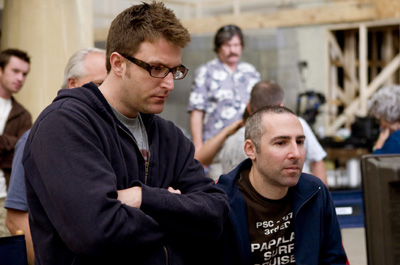
If you see these guys (Friedberg and Seltzer) please convince them never to make another movie.
From a production standpoint, this movie looks really cheap. The sets and costumes and props look horrible, like something a high school production would ditch. Just because it reuses the same camera styles as 300 doesn’t mean it gets any closer to parody. For God’s sake, they couldn’t even come up with puns on character names, the only exception being Traitoro and Sonio, neither of which will induce a chuckle. Most of the non-reference “humor” is either insipid slapstick or a handful of moderately gross scatological jokes, and, oh, yes, lots of gay jokes, because those just get better the more you hear. Tasteless doesn’t always equal funny, and people drinking urine is rarely funny without some extra setup.
The actors all seem mildly embarrassed and they do nothing with their roles. It’s not their fault the material sucks so deeply, however, it is Electra’s fault for appearing in her third straight Friedberg-Seltzer spoof fest. The key to a good spoof is to play the damn thing straight. It’s annoying and redundant if the film keeps winking back at the audience.
Meet the Spartans is pop culture vomit. No, this is worse, this is cinematic diarrhea. It’s watery pop culture discharge masquerading as entertainment. This movie is offensive to anyone that appreciates laughter. This film and its ilk are offensive to mankind. And plus, it’s just not funny people, not in the slightest. There’s no wit here, no comedic payoffs, no running gags (besides gay jokes), no thought or upheaval of convention; instead, this movie is a lazy, cheap catalog of pop culture events from late 2006 to summer 2007. Even at 80 minutes (really it’s 65) this thing drags and feels exhausted long before it bows out. Just as I said in my review of Epic Movie, Friedberg and Seltzer must be stopped at all costs if comedy is to survive.
Nate’s Grade: F
Share this:

Definitely, Maybe (2008)
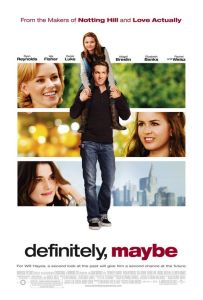 Adam Brooks has spent his whole career in the romantic comedy gutter. His screenwriting credits include French Kiss, Practical Magic, Wimbledon, and the second Bridget Jones flick. Not a whole lot of quality there. Definitely, Maybe is Brooks fourth writing and directing effort but the first to get a major push from the Hollywood studios. Maybe the same purveyors of formula fluff realize that Brooks finally has something good on his hands.
Will Hayes (Ryan Reynolds) picks up his ten-year-old daughter Maya (Abigail Breslin) from school on perhaps the worst day of the school year: sex education day. Kids are crying, parents are stammering to explain, and Maya casually exits her classroom, walks up to dad, and says point blank, “We need to talk.” She wants to know all about the story of how her father and mother, now divorced, met. Finally Will agrees but decides to play a game. He will changes names and identifying characteristics and Maya will have to guess which of his three loves became her mother. Emily (Elizabeth Banks) is Will’s college sweetheart from Wisconsin. Summer (Rachel Weisz) is an ambitious journalist with a taste for older men. April (Isla Fischer) is a Bohemian free spirit that Will meets working on the 1992 Bill Clinton presidential campaign. Maya sits in her bed and pays rapt attention to what she calls a “mystery romance.”
Miraculously, Brooks has written a romantic comedy where the characters are, dare I say it, well developed human beings. These folks are more than stock roles for the genre; in fact, each woman is smart, genuine, charming, fun, and desirable, and yet each woman also has her own set of realistic flaws. Brooks makes sure that we, the audience, admire each woman and recognize that any of the three would make a fine selection. These characters feel real, which is almost unheard of for a genre about ticking biological clocks, cloying and precocious tykes, irrationally sexist and self-absorbed characters, forced misunderstandings that lead to contrived reconciliations that involve some form of chase. Having recently seen 27 Dresses, which plays close to the typical rom-com formula, I appreciate Definitely, Maybe even more.
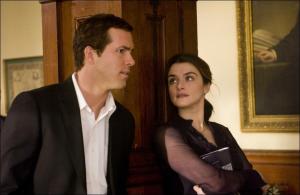
This is a romantic comedy that respects its characters and respects its audience. The people might make bad or impulsive decisions but Brooks doesn’t pass judgment, and, my God, it’s refreshing for the genre. I rolled my eyes when I read blurbs about Definitely, Maybe being “the best romantic comedy since [1976’s] Annie Hall.” While I wouldn’t necessarily go that far, Definitely, Maybe is definitely the best and most enjoyable conventional Hollywood romantic comedies in years (For those wondering what non-conventional romances got me jazzed, here is a small list: Eternal Sunshine of the Spotless Mind, Amelie, Secretary, Once, Sweet Land, A Very Long Engagement, Brokeback Mountain, Aimee and Jaguar, and Before Sunset).
Brooks chronicles Will’s romantic escapades along the timeline of Bill Clinton’s rise in national politics, which is an interesting way to look backwards in time and still be relevant to modern audiences thanks to Mrs. Clinton’s race to reoccupy the White House. I found it interesting that Will’s emotional journey seems to be charted along the same ups and downs as Bill Clinton’s time in office, so when Clinton is mired in the Monica Lewinsky scandal and questioning the definition of the word “is,” Will has lost his idealism and grown into a cynic. He even openly criticizes with great frustration and ire the man he helped put into office. Will’s enthusiasm and disenchantment for Clinton mirrors his budding relationships with women.
Definitely, Maybe has a handful of memorable moments and some amusing dialogue, but Brooks has crafted one hell of a meet-cute scene between Will and April. After an initial first meeting at the campaign headquarters, Will is purchasing a pack of cigarettes when he spots April purchasing a pack of organic cigarettes. He playfully mocks her more expensive purchase. She counter punches and says that her brand is made from better stock and will actually smoke slower, thus being the better purchase. He challenges her to a smoke-off and the two step outside, light up, and for the sake of scientific research they take equally long drags, and sure enough Will’s cigarette cannot last as long. They laugh and eventually Will visits April’s apartment and learns about her poignant search for her lost copy of Jane Eyre out there that has her father’s inscription. It’s a great scene that allows both actors to size each other up.
Thanks to each woman being presented fairly the movie doesn’t make it obvious which woman will eventually become Maya’s mother. The ladies fade in and out through the plot. The guessing game gimmick grabs our intrigue early and Brooks doesn’t tip his hand until the film’s end. What I find interesting is that Will changes with each woman and could feasibly be happy with any of the three, a desirable predicament if ever there was one. The movie even tackles divorce sincerely and without any doom and gloom overly dramatic pronouncements. Definitely, Maybe doesn’t go out on a limb and certainly isn’t remotely edgy, but the flick has a soothing, amiable adult spirit. It may not be revolutionary but simply telling a good story with mildly relatable characters seems like a great step in the right direction for this oft-sneered at genre.
Reynolds knows how to work his suave charisma to a fault. He’s certainly a capable leading man for romantic comedies and he can deadpan with the best of them. He seems like he could use a bit more direction, because there are moments where he seems to be falling back on his standard sly, indignant persona that has characterized his comedy work from 2002’s Van Wilder and on. His interaction with all three women produces varying spikes on the chemistry chart, and for my money he scores the best sparks with the subdued seduction of Weisz.
 The women of Definitely, Maybe are the real winners here even if only one will eventually take home Will. Fisher becomes the heart of the movie and, given the most emotional material, shines the greatest. Banks is wholesome and easy to get cozy with. Weisz is the most enigmatic of the three and offers a beguiling yet very knowing charm. She has a very seasoned sensibility. Her on-again off-again affair with an aging literature professor (a fabulous Kevin Kline playing a fabulous blowhard) adds an intriguing dynamic to her character. The only irritant for me was Breslin’s acting, which was just off enough to annoy me.
Definitely, Maybe is a romantic comedy that proudly treats its characters with respect and develops them into relatable, authentically human characters in a typically inauthentic universe. Brooks mines a gimmick for all its worth, but even after the signs become clear the film is still pleasurable in its predictability thanks to the great characters. It’s rare to see a romantic comedy that bestows a moderate amount of characterization; usually these roles just fall under archetypes. Brooks has shied away from the trappings of the genre (there isn’t a single sing-a-long!) and crafted a genuine romantic comedy that doesn’t rely on sentiment and easy answers even as it heads toward happy ending material. The movie even tackles divorce from a non-judgmental yet honest approach. As far as I’m concerned, Brooks has made amends for his previous screenwriting duds and made a movie that men can truly enjoy as they’re dragged into the theater by their significant other. I would definitely recommend Definitely, Maybe to fans of the genre. This is one worth seeing, folks.
Nate’s Grade: B+


 nathanzoebl
You must be logged in to post a comment.