Category Archives: 2007 Movies
Spider-Man 3 (2007)
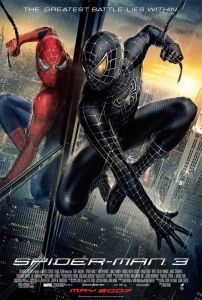 Who the hell are you Spider-Man 3 and what have you done with the franchise I loved? After the massive commercial success of first two Spider-Man chapters, my expectations had been raised fairly high. The more time that passes the more I reflect on how disappointing Spider-Man 3 sadly is. Part of my dashed hopes are because the 2004 Spider-Man sequel was a wonderful follow-up to a pretty swell introduction, and I placed that movie in my Top Ten list for the year and consider it one of the best comic book movies of all time. There’s some great popcorn entertainment to be had with Spider-Man 3, but man is this film just beside itself in wasted potential, a lack of focus, and some really poor choices.
Things are going pretty well for Peter Parker (Tobey Maguire). He plans on asking Mary Jane (Kirsten Dunst) to marry him and New York City is planning a parade out of appreciation for Spider-Man. But the good times can’t last long. Harry Osborn (James Franco) has accepted his fate and become a second generation Green Goblin villain, out to avenge his father’s death at the hands of Spider-Man. But Peter also has to be on the lookout for his job at the newspaper. Eddie Brock (Topher Grace) is an unscrupulous photographer out to replace Parker and nab a picture of Spider-Man caught in a bad light. An alien substance has also hitched a ride to Earth via meteorite and sought out Peter Parker. The black goo attaches itself to Peter and forms a black Spidey suit, one that gives him intoxicating power and a slimy menace. The new Peter cavalierly flirts with bouncy lab partner Gwen Stacy (Bryce Dallas Howard), hurts his friends, and loses his do-gooder ways.
Meanwhile Flint Marko (Thomas Haden Church) has escaped from prison. It seems the police got it wrong and now inform Peter that Marko confessed to being the one who killed Peter’s uncle. While on the run Marko happens to tumble into an open pit that is a science experiment and becomes fused at a molecular level with sand. He uses this new power to rob banks in order to save his sick daughter at home. Peter, with the power of the alien suit, hunts the Sandman to get his own slice of sticky vengeance.
 The film has way too much on its plate. There are too many characters, too many undeveloped storylines, too many coincidences, too many contrivances (Amnesia? Really? Really?), and too many aborted moments of drama. Spider-Man 3 is an undisciplined mess. The film practically stumbles from one scene to the next and lacks the coherency and intelligence of the earlier entries in the series. The third film tries to do too much and please too many interests, and as a result it may end up pleasing few fans. I had some trepidation when I learned that there was going to be upwards of three villains for this movie, but I swore that it could work since Batman Begins confidently worked around a trio of big bads. Three villains do not work in Spider-Man 3. Let me dissect this rogue’s gallery and where they fall short.
1) The Sandman is kind of a lame idea from the start. His power seems to limit his available locations, and I’m surprised that he wouldn’t stick to beach areas as a means of playing to his sandy strengths. Regardless, the character plays no part in almost anything that happens, and the Sandman is given one note to play. He’s got a sick daughter and he robs to try and pay for her medicine. That’s great on paper but it never really seems to give the character any sense of urgency or frustration. If he got special sand powers why not sneak into banks through cracks in walls instead of forming as a giant sand monster? Church attempts to imbue the character with a sad soul but he just comes across as being wooden. If he was really on the hunt for money to save his daughter then why does he just slouch around all the time? Wouldn’t it be easier to rob a city not patrolled by a web slinging super hero? How can he say he’s a misunderstood victim of luck just minutes after he tried killing Peter? He seems like a dull lunkhead. The Sandman is given a tiny wisp of character detail (sick kid!) and that’s it. He doesn’t get any other characterization and is kept on the run and pops up whenever the film needs him. He becomes a token character until the very end where Church is given 2 minutes to pour his heart out to Peter. Two minutes of character at the start, two minutes at the end, and a gaping center. The Sandman isn’t so much a character as the ideal of some issue that the filmmakers want to have Peter work through.
And what is that issue? Why vengeance and forgiveness. You see, Spider-Man 3 foolishly rewrites its own history and now it was the Sandman hat killed Peter’s Uncle Ben. This revision does not work at all and actually legitimately damages Spider-Man. Just like Bruce Wayne is tackling crime to alleviate his guilt, so too is Spider-Man, who can never shake the fact that he could have prevented his uncle’s death had he done the right thing moments before. By introducing a new killer it means that Peter has no responsibility for his uncle’s death. This completely strips away the character’s guilt and rationale for what compels him to swing from building to building to fight crime.
 2) Eddie Brock/Venom is wasted as well. Director Sam Raimi has said before he’s not a fan of Venom and doesn’t get the character, and I feel that his contempt carried over into the film. Venom and the black alien goo are given about the same abysmal care as other half-baked plot points. Eddie Brock has about three total scenes before he gets to transform into Venom thanks to the alien substance, and none of these scenes fully flesh out who the character is or justify his relationship with Peter Parker. When we do see Venom in the finale its all too rushed and hokey. The effects make him look less like alien and more like a wax figurine (I suppose there could be intelligent wax life amongst the stars). For whatever dumb reason the alien suit has to retreat so we can see Grace’s face while he taunts and mocks with bad vampire teeth that are meant to inspire what exactly? The character is rushed and underdeveloped and should have been saved for the next sequel instead of being given lip service in this one. Venom is supposed to be the evil doppelganger to Spider-Man, not some smart-alleck with frosted hair that gets about 15 minutes of screen time. I like Grace, I really like him a lot and envision him as his generation’s Tom Hanks, but he does not work in this movie. He could, but I get the sneaking suspicion that Raimi sabotaged the Venom role on purpose or at least subconsciously. The villain goes out with a whimper and it feels like a giant, foolish wasted opportunity that becomes more maddening the more I discuss it. The presence of Venom feels like a shallow attempt to placate a younger generation of comic fans and to sell more action figures.
The alien goo suit is supposed to tempt Peter and bring out his wicked wild side. So what does he do? He acts like he’s auditioning for the lead in The Mask. This embarrassing sequence is painfully goofy and will make you cringe and shield your eyes. Peter flirts with girls and dances at a jazz club, and this is supposed to be the dark side of Spider-Man? What the hell? I acknowledge that Peter has always been an unpopular dork and would be a dork even if he ventured to the dark side, but how does this square with the more serious and edgier tone the film is grasping for? Evil Peter seems more like a broody emo kid, with shocks of black hair in his eyes and traces of eyeliner. The dark side of Spider-Man, much like the rest of the film, is given little time or thought. Peter’s trials with the symbiotic suit last about a reel or two and then it’s abruptly finished.
 3) Harry should have been the main focus of this sequel and it?s a shame the filmmakers had to cram so much crap into a story already heavy with plot leftovers. Harry has the most obvious arc through the three movies and deserves better than to be knocked out of commission by amnesia. The conflict between Peter and Harry is where the film finds its emotional core and it would have been wise to expand this section and eliminate one of the other underutilized villains (my vote: both Venom and Sandman). Harry’s vow to avenge his father is far more interesting than what the other two villains have as motivation, and plus Harry requires no extra time-consuming setup to slow the pacing down. I’m glad the final battle encouraged Harry to come out and play; the film finally gives Franco the screen time he deserves, but it should have been more. The worst plot device in the film involves Harry’s all-knowing butler who has some vital information he most certainly should have shared years ago. So much time is spent on storylines that go absolutely nowhere, and the musical chairs of villains, that the film resorts to having a freakin’ butler tap someone on the shoulder and say, “Excuse me sir,” just to tie things up in the most awkwardly shrift way possible. And even if what the man says is true, how does his perspective add any clarity to the situation? Think about it. I have.
The romance between Peter and Mary Jane feels awfully trite and meandering. Spider-Man 3 lacks the tight focus of the second film. It throws contrivances to place a wedge in their relationship, like the fact that Mary Jane is fired from her Broadway gig but doesn’t tell Peter, or the fact that they never seem to answer the phone on time when the other person is apologetic. Gwen Stacy is less a character than simply a dimwitted blond tool to make Mary Jane jealous and sulk. The ups and downs in this relationship feel pretty forced and some moments defy all human understanding. At one point Mary Jane is forced by Harry to break up with Peter to spare both their lives. So she breaks the news in a park, and Peter is devastated, but why in the world does she never say anything again? Why would she not clear things up after time had passed to explain her actions? Spider-Man 2 ended with Peter finally getting the girl but also on a hint of doubt, and it was marvelous. Spider-Man 3 just sort of ends with everyone presumably in the same place they started.
Spider-Man 2 really succeeded on how focused it was and how it related its action with character. Spider-Man 3 has to resort to cheap and lazy devices to cover its storytelling pitfalls. Don’t even get me started on the fact that the film has to resort to a newscaster narrating our final battle where he actually asks, “Is this the end of Spider-Man?” This might be the end of the quality associated with Spider-Man.
 After having spent a whole slew of words detailing in length where the film goes wrong, allow me to illustrate some of what the film does right. Whenever it sticks to action, that’s when Spider-Man 3 works, and Raimi has cooked up some wonderful whiplash-inducing action sequences. The first battle between Peter and Harry is intense and sets the film on the right path, but the action as a whole isn’t as closely tied to Peter’s domestic life and emotional troubles as it was in the other films. A high-rise rescue from a crumbling office building will stir some 9/11 memories but it is awesome to behold. The effects have improved and the swinging shots through New York look the best they ever have. The greatest moment in the film is perhaps the birth of the Sandman as he rises grain by grain from a pile of sand and attempts to reform himself. Aided by some lovely music, the moment takes on a beautiful and unexpected poignancy. This is where Raimi and the CGI wizards hit it out of the park. Nothing rivals the train sequence in Spider-Man 2, though.
It might be dangerous to say, but I feel jilted from this film and either new blood needs to be brought in or the filmmakers need more time and control to make a Spider-Man sequel worthy of its name. This is the gold standard for super hero movies and its been tarnished and sullied. Spider-Man 3 has moments to dazzle and excite but it also feels battle fatigued from carrying the dead weight of extraneous characters and half-baked storylines. There are too many balls in the air for Raimi to juggle. This Spidey chapter squeezes too many ideas in too short a space. After obliterating box-office records, Sony has stated that they plan on three more Spider-Man sequels. If this film is the tipping point, then I’m afraid of what will be swinging down the pipe in years to come.
Nate’s Grade: C+
Share this:

License to Wed (2007)
 Someone just tell Robin Williams to stop already. This painful and dated movie exists in another realm, a realm too fanciful and bizarre to exist even in sitcoms. The characters are all unlikable nitwits and I could not suppress to urge to want to dropkick William’s astoundingly annoying pre-teen sidekick. This implausible and puerile comedy is like an enema for the brain; it will wipe you clear out. The PG-13 movie regularly wades in tired pee and fart jokes, sometimes combing the two, but what really irritates me is how lazy the whole enterprise is. Williams makes a joke about O.J. killing his wife. I repeat, in the year 2007, Williams makes a joke about O.J. killing his wife. How topical and cutting edge. This whole movie induces one long, never-ending exasperated sigh from anyone that appreciates good comedy. If it weren’t for casual cameos by stars of NBC’s TV show The Office, this film would be totally worthless. As it is, License to Wed is yet another nail in Williams’ comedy coffin.
Nate’s Grade: D
Share this:

In the Land of Women (2007)
 Nepotism is about as prevalent in Hollywood as venereal diseases. Plenty of people get their foot in the door because they just so happen to share genetic material with successful filmmakers. It happens all the time in the world of business, and movies rake in the cash, so the Kasdan clan isn’t any exception to the rule. Papa Lawrence has a storied pedigree. He’s responsible for Body Heat, Raiders of the Lost Ark, The Big Chill, The Accidental Tourist, and two, count ’em, two Star Wars movies (the good ones). His oldest son Jake has directed Zero Effect and Orange County. Now younger son Jon Kasdan is taking the leap into the family business with In the Land of Women.
Carter (Adam Brody) is a Los Angeles writer for soft-core pornography. He?s just been dumped by an up and coming Spanish actress (Elena Anaya). He feels lost and comes up with a plan that will help inspire him to write his serious novel that’s been gestating for ten years. He heads out to a small Michigan suburb to live with his crabby hypochondriac grandmother (Olympia Dukakis). Across the street is a glum family. Sarah (Meg Ryan) is coping with raising a family and undergoing chemotherapy for the lump in her breast. Her teen daughter Lucy (Kristen Stewart) is full of angst and hates her mom. Carter inserts himself into the family’s life and may just heal longstanding wounds.
 In the Land of Women is a strange experience because it feels like the entire movie is cobbled together by subplots. There doesn’t seem to be a strong central storyline, a strong central character, or any real connective tissue. You start to feel the lack of direction and discipline from Kasdan. The characters are all underdeveloped when they aren’t behaving in unbelievable manners. This is another drama where the characters take long strolls and wax introspectively about their life, spelling everything out with rare clarity to strangers. This would be more permissible had the film presented any other avenue for character development. Ryan gets the sick mom storyline, Stewart gets the awkward and angry teen storyline, and Dukakis gets the crazy grandma storyline. It may be a land of women but these aren’t very well constructed women, and I’m uncertain what exactly Carter has learned from this supposedly life-changing experience. He met some women, he listened; in fact, I think that’s where the film takes its first wrong turn. Carter is a self-described great listener, so guess what happens when he meets women who have bottled up their secrets and true feelings? Yep, he listens. And we watch him listen for most of the movie. This allows characters to unload dramatic monologues that do the major work for characterization, but it still keeps our main character, the traveler to the titular land of women, as nothing more than a low-key cipher. He’s a handsome couch for the female characters to unwind. When Carter is typing his Big Serious Novel I’m clueless as to how he has changed as a person and how he reached his point of enlightenment.
I get the unmistakable feeling that Kasdan is really trying to make his own Garden State. This is another story of personal maturation and it takes places with a visit home to a simpler life with comic oddballs. He’s taken the elements that made Garden State click, including a hip and frequently heard soundtrack, but Kasdan must have missed the part where Garden State benefits from strong, likeable characters and a plot. Just like Carter, Kasdan is striving for something grandiose to say about the world, but the end results are no better, and no worse, than something you could catch on a nondescript cable channel. The movie is stuffed with familiar moments, like the bustling teen party, the precocious teen wise beyond her years, the feeble love triangles, and the asshole jock boyfriend. The handful of new wrinkles that Kasdan does explore is easily forgotten; Carter’s job deserves far more discussion. When the Hollywood life butts back in Kasdan doesn’t push the juxtaposition as hard as he should, so Carter’s troubles feel puny, especially compared with cancer. In the Land of Women has some touching moments to it and an occasional wise bit of dialogue, and they stand out amongst an otherwise underwhelming panorama.
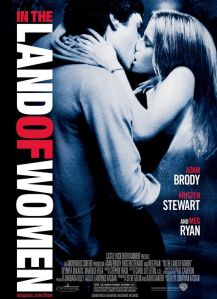
 In the Land of Women reaches its awkward peaks when it treats Carter?s mother-daughter interaction like two choices for romance. Carter is supposed to be 25, making him about 20 years younger than mom and 10 years older than daughter. In my book, that’s an “ick” on both accounts. Carter gets to smooch both women (hell, one of the kisses is the poster) and the audience gets to squirm both times. Our sense of guilt is alleviated by multiple characters telling us that Sarah’s father is having an affair, so then it shouldn’t matter if she finds understanding and warmth in the arms of a young emo pup. But what makes these sidesteps so awful is how clumsy and meaningless they prove to be.
The acting in the movie is well done. Brody is apt for a romantic comedy leading man. He’s got oodles of laid back charisma and a winning sense of humor that made him the breakout star of a prime time soap. He’s affable and enjoyable to watch, but his relaxed acting style doesn’t help an undefined character. Stewart is a wonderfully natural actress and largely communicates with her gangly physicality. She has the teen contempt down perfect and looks like an average teenager, which compounds how icky it seems to see her kiss Carter. Ryan hasn’t been onscreen in 3 years, and to tell the truth, I kind of missed her. She gets some standard emotional scenes as an afflicted, underappreciated mother and sells them well.
Jon Kasdan’s filmmaking debut isn’t going to do much to redefine his artistic image other than that of a lucky genetic benefactor. In the Land of Women is earnest and well acted, but the movie is just far too underdeveloped and shapeless to succeed. The film is a collection of non-starting subplots and familiar elements; you just feel that the movie needs a kick in the ass to get on track. The soundtrack is pleasant, the production is competently made, but the story is ultimately lacking and underwhelming. The land of women and men deserves better.
Nate’s Grade: B-
Share this:

Smokin’ Aces (2007)
 Writer/director Joe Carnahan (Narc) wants to impress an audience so bad with his muscular and macho gangster flick, but his Smokin’ Aces is vapid, nihilistic, and opines not to simply be a Tarantino rip-off, but a rip-off of a Tarantino rip-off. The premise seems ripe enough as we follow a rogue’s gallery of hitmen and killers trying to be the first to knock off a mob snitch/Vegas magician (Jeremy Piven) for a million dollar bounty. The colorful characters are introduced and some are quickly and unexpectedly taken out, but Carnahan never fully knows what to do with his bushel of baddies after he establishes their character quirks. The killers don’t really interact that much with one another and some of them hardly have any screen time at all; perhaps less would have been more in this jumbled stew. Carnahan throws out a few nifty visual tricks but it’s all superfluous and empty. Smokin’ Aces moves quickly, doesn’t make much sense in the beginning and end, and little to any of the characters have satisfying conclusions. So much of the writing feels like lame macho posturing without anything new or interesting to add to an overstuffed shoot-em-up. There are cops, robbers, plenty of gunfire, lesbians, and all sorts of convoluted twists, but it never holds together. Carnahan throws a lot of different elements together but they never extend beyond the elemental stage, so every storyline and character feels like an introduction that?s never capped off. The man has no idea what to do with what he’s started, and a karate kid on Ritalin is all the proof I need. Guy Ritchie did this territory far better service with the marvelously entertaining 2001 film Snatch. Rent that instead and save yourself the headache.
Nate’s Grade: D+
Share this:

The Reaping (2007)
 Forgive me father for I have sinned… I think The Reaping is not a terrible movie. Now, that would be damning praise in most circles, but when it comes to the notoriously implausible and awful genre of religious-based horror, well then “not terrible” is worthy of being brandished in the film’s ad. All of my fellow critics need to take a step down from the pulpit and see The Reaping for what it is: mild harmless fun.
Katherine (Hilary Swank) is a professor at Louisiana State who specializes in debunking claims of religious miracles. “38 miracles and 38 scientific explanations,” she says matter-of-factly. Katherine has something of a grudge against the Big Guy, being that she used to be a minister before her husband and daughter were murdered on an overseas missionary trip. Doug (David Morrissey) has a case only that only Katherine can crack. In the sleepy town of Haven, along the Louisiana Bayou, is being beset by Old Testament style plagues. The river has turned to blood and the Bible-beating townsfolk are itching to blame a little blonde girl (AnnaSophia Robb) who they feel could be the spawn of Satan.
 The Reaping starts off with tiny amounts of promise and intrigue because of Swank’s character. She?s a globetrotting spiritual investigator and a skeptic that an audience can get behind. She has a checkered history and Swank uses glances and moments to make her seem convincing. The Reaping isn’t complicated when it comes to its spiritual message. It’s all about renewal of faith, and I?m not exactly certain how all the pieces add up but that’s the gist. The Reaping isn’t too deep when it comes to thoughts of any kind, but that doesn’t mean much from a genre that requires a healthy suspension of rationale thought.
As a horror movie The Reaping relies on routine jump scares and the occasionally jump cut to a dream or a flashback in Africa with a lot of loud, abrasive sound effects to jolt the viewer. The plagues themselves are kind of weak, especially when plagues of maggots and frogs are seen as being so contained and limited. For maggots, we see a grill loaded with fish now covered in maggots. We never get any other anecdotes of what may have been reaped by the maggot plague. The frogs fall for about ten seconds and only in one part of the swamp. These pathetically isolated incidents don’t do much to ratchet up any scares and they certainly belittle the powerful wrath of the Almighty. Then again, maybe God is trying to tell people in unorthodox ways to eat less meat, thus the ruined fish and diseased cows. The plagues lack some oomph when they just happen to a handful of people, especially when it comes to lice or boils. I think the small-scale plagues really say, “We blew our budget on that river of blood, but hey, that was pretty cool right?”
 I don’t think I’ll ever utter these exact words again but here goes. The Reaping is a rather so-so movie that is mostly redeemed by an implausible and foreseeable twist ending. Yes, as horror and supernatural thrillers are go, twist endings seem pretty common place and often times forced, like the studio is dictating that they need something just a little extra to fool the audience into thinking they got their money’s worth. We as a movie watching society are so attuned to twist endings now that we can sniff them out like bad CGI. Twists generally become worked into the advertising campaign. The Reaping has some last-second turns to it, and even though I had my suspicions, I was quite pleased the movie walked the path it did. In fact, I would even go as far to say that it turned a spiritually thin schlocky horror movie into a moderately enjoyable spiritually thin schlocky horror movie. This is far from a good movie, but as a dumbed down genre flick it will be like home cooking for the right audience. Now, I cannot defend the gaps in logic brought about by the twists in The Reaping, and you will be spending the rest of your day coming up with a new problem every minute (the line ?some people just don’t wanna go to heaven? takes new life). The film takes one step too far with trying to up the ante. Just know that the upcoming crisis in Katherine’s life has been solved by a little thing called Roe vs. Wade.
Director Stephen Hopkins has some stinkers to his resume, chief among them 1998’s abominable Lost in Space, so he will take kindly to having his latest film deemed “not terrible.” Swank struts around in a tank top in the balmy South, gets knee-deep in blood, and convincingly sells this nonsense as only a two-time Oscar winner can. The scares are clunky and the story is rife with lots of explaining for a 90-minute movie built around the simple concept that the devil is nasty. The Reaping will play best for fans of the religious horror genre as well as those willing to lower their expectations. This isn’t a good movie, but then again, it’s not terrible.
Nate’s Grade: C+
Share this:

Grindhouse (2007)
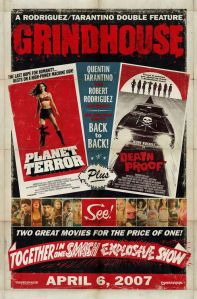 The movie going experience isn’t what it used to be, and Quentin Tarantino and Robert Rodriguez want to do something about it. There?s no denying that the joy of seeing a movie has been watered down a bit; there’s soaring ticket prices, floundering product, and let’s not forget the influx of teenagers with cell phones. Rodriguez and Tarantino grew up gorging upon the exploitation films at their neighborhood grindhouse, where they could see kung-fu, blaxploitation, gory Italian zombie movies, and nearly anything that promised to be titillating and shocking. These movies dealt in copious amounts of sex and violence on a shoestring budget and teenagers lapped it up. Grindhouse was designed to be a double feature with Rodriguez and Tarantino each writing and directing an 80-minute movie. This three-hour plus movie is stuffed to the gills with 70s reverence, right down to cheesy retro clips telling us the film rating via an animated cat. If Rodriguez and Tarantino could, they probably would make the floors stickier just to round out the experience. But that’s the marvelous thing about Grindhouse — it turns the filmgoing experience into an event once again.
First on the bill is Rodriguez’s Planet Terror. An outbreak is about to sweep across a small Texas town. A toxic green gas is causing people to break out in festering wounds that are spreading rapidly. Cherry Darling (Rose McGowan) is a go go dancer who runs into an old flame, Wray (Freddy Rodriguez), a badass drifter with a dark past. They get attacked by a group of “sickos” who take Cherry’s leg as a chew toy. At the hospital we’re introduced in rapid succession to Dr. Block (Mary Shelton) and her creepy husband (Josh Brolin) she plans on leaving for the lovingly massive cleavage of Fergie from the Black Eyed Peas (she gets eaten and can, one assumes, be described as being Fergilicious). The sheriff (Michael Biehn) has an unsettled score with Wray and refuses to trust him, even though the town is slowly being overrun by what appear to be zombies. The survivors take refuge at a Bar-B-Q joint, run by the sheriff’s brother J.T. (Jeff Fahey), located only two miles away from the military outpost that released the gas.
 Planet Terror is a great blast of fun, a perfect ode to schlocky B-movies. Rodriguez creates action movies closer to cartoons, and the more over-the-top and crazy things get the more joyous his films generally turn out. This is a gonzo world cranked up to a wonderfully weird wavelength, where Cherry can have a machine gun leg without any nagging question on how she even gets it to fire let alone why it would be more accurate. It doesn’t matter because this movie is all about 80-minutes of awesome, twisted, gloriously gory fun. Planet Terror isn’t the first zombie comedy, and its inspirations are quite plain, but the film establishes a wide-range of colorful characters effectively and then ramps up the chaos. Rodriguez amuses with even small touches, like a woman trying to operate a car with a anesthetized hands, a pair of skimpy babysitters who clobber a car with baseball bats, and a bio-chemical scientist (Naveen Andrews) that has a penchant for collecting and bottling the testicles of the men who fail him (hey, we all need hobbies). Even amongst an exaggerated canvas there’s still plenty of humor and adoration for the grindhouse experience, like when the beginning of a sex scene is interrupted with a “reel missing” sign. Rodriguez also intentionally downgrades the look of his film, adding hairs and scratches and pops in the film to look like it had been dragged across the floor. Planet Terror even has a dreadfully dated synth score to compliment the full-tilt celebration of splattery schlock.
Tarantino’s Death Proof is going to sharply divide audiences. The action in Planet Terror is relentlessly paced, which makes the adjustment to Tarantino?s half all the more hard. Rodriguez is all about genre relevance and making a film that would excel in the grindhouse era; Tarantino, on the other hand, is all about taking the genre and catapulting it into something ambitious and different and greater.
 Death Proof is Tarantino’s take on the slasher horror genre, with the unique twist being that Tarantino?s roving killer takes out his prey with his car. Stuntman Mike (Kurt Russell) is a stuntman of the old guard. The youth of the day have no idea of the TV shows he worked on or the celebrities he rubbed elbows with. The only lasting visages he has from those removed days are a long scar decorating the side of his face and his stunt car. The vehicle has been outfitted to be death proof, meaning that Stuntman Mike can get into any wreck and come out alive. A group of women are visiting Tennessee for a film shoot. Abernathy (Rosario Dawson) is a makeup artist, Lee (Mary Elizabeth Winstead) is an actress, and Zoe Bell (herself) and Kim (Tracie Thoms) are professional stunt women. The stunt ladies are interested in test-driving a Dodge Charger, the same iconic car used in Vanishing Point. Zoe wants to play a dangerous game known as “Ship’s Mast,” which entails strapping herself to the hood of the car as it speeds along. This is when Stuntman Mike comes roaring with his death proof material and plays an extreme game of chicken.
The narrative structure of Death Proof is deliberately slow. The focus is on a group of Texas girls (including Sydney Poitier’s daughter named, rather unoriginally, Sydney Poitier). They dance to jukebox jams and drink. And they talk, and talk, and talk, and talk. The dialogue is clever but you worry Tarantino has been hypnotized by his own pithy writing. The movie drags a bit but mostly because it follows a film that had the pace of a runaway train. The slow buildup is an intentional correlation to slasher films, which would spend their first half hour setting up characters for the eventual slaughter. I liked how Stuntman Mike was seen playing with his prey and interacting with them. The wait is worth it, though, but then Tarantino turns around and repeats this same setup with a new batch of girls. Many will grow impatient going through the same process all over again and become irritated that they have to endure another round of talky pop culture diatribes in order to get to some more vehicular manslaughter. And at this point, the only character the audience has any affinity for is Stuntman Mike, so it’s a little tough to wait so long for his reappearance. When he does appear, the movie takes some unexpected turns and transforms into a female revenge thriller that left my audience cheering by its conclusion. My wife loved it. I married the right woman.
The makeup work is outstanding. Most of the effect work gets its spotlight during Rodriguez’s half, and Greg Nicotero and KNB have created the most gut churning, sickeningly inventive makeup work since John Carpenter’s The Thing. Rodriguez’s Planet Terror is dripping in blood, and the gore is heightened to such an unrealistic, comical degree that it becomes more tolerable and, in the end, another element in the overall outrageous vibe of the film. Some memorable gore work includes makeup pioneer Tom Savini being ripped apart like a child’s jigsaw puzzle, soldiers whose faces undulate and bubble until they look like close relatives of the Elephant Man, and a truck smashing against bodies like they were made of paper and filled to the brim with Kool-Aid. This is the kind of movie where entire hoses of blood explode from single gun shot wounds. It is a gory, gruesome, sticky icky movie but that?s part of the fun.
 Whereas the makeup work shines in Planet Terror, the stunt work in Death Proof is stupendous. Bell was Uma Thurman’s stunt double in the Kill Bill tandem, so by writing a part specifically for her Tarantino knew he could get up close and personal during the scary moments. Seeing Bell struggling to stay atop the hood of a car zooming at 80 miles per hour is nerve-racking and exhilarating, and you know there isn’t any computer trickery given how Tarantino’s own characters bemoan how computers have blunted action cinema output. That really is Bell and even though it’s all a movie a part of you does think, “Oh my God, this woman is going to die for real.” This killer bumper-car sequence in Death Proof will have you holding your breath. It takes much longer for Tarantino to rev up his action, but when he does he puts the pedal to the mettle.
But don’t get up for pee breaks once Planet Terror is over, because you may miss some of the best parts of Grindhouse. In between the feature films are three fake trailers directed by friends of Tarantino and Rodriguez, who made a fake trailer himself for Machete, about a Federale (Danny Trejo) out for revenge. The Machete trailer gave me the everlasting gift of a line, “They f***ed with the wrong Mexican.”
The best trailer, hands down, is Shaun of the Dead director Edgar Wright?s trailer for Don’t, a Dario Argento style horror film where a narrator instructs the audience lots of items not to do (“If you are thinking about turning this door… DON’T! If you think about going into the basement… DON’T!”). What makes Don’t so wonderful is that the trailer builds a thick head of steam, to the point where all wee see are bizarre rapid-fire images and the announcing repeating the message, “DON’T!” The momentum builds to a great comic high that left me giggling.
Eli Roth, who gave us Hostel and Cabin Fever, one of my all-time favorite filmgoing experiences, runs a close second with his slasher trailer for Thanksgiving. The concept is rather straightforward, a person dressed as a Pilgrim picks off residents around Turkey Day, and a great showcase for Roth’s sense of tongue-in-cheek homage and his warped sense of humor. This trailer has some gasp-inducing moments, chiefly among them a topless cheerleader who performs the splits right onto a knife blade. Wow. Then there’s a guy humping a stuffed turkey with a human head attached. I’ve said it before and I’ll say it again, Roth is one sick bastard but he’s my kind of bastard.
 Rob Zombie’s trailer for Werewolf Women of the S.S. sounds better on paper than how it turns out. There’s a subgenre of Naziploitation films (did you know you could add “-sploitation” to damn near any word?), most famously popularized by Ilsa, She-Wolf of the S.S. Zombie’s trailer has got hairy wolf boobs, Nazis, shiny fetish outfits and S&M, but it feels too new and doesn’t work on the same vibe of Grindhouse. It feels too polished and too happy with itself; it spends more time telling you who’s in this fake movie than delivering anything juicy. The trailer is saved by a brilliant cameo by an actor whom I will not spoil, but suffice to say that I was left in stitches.
Honestly, I cannot say another movie released this year that provides more bang for your buck than Grindhouse. Tarantino and Rodriguez’s double bill will leave you giddy. This is the fastest 3 hours and 10 minutes of your life, folks. Unfortunately, the film hasn’t been doing as well at the box-office and this has caused the Weinsteins to contemplate splitting the films into two to make the most of their investment. I suppose Grindhouse was never going to have a 300-sized audience, since the idea of making a sloppy three-hour love letter to trashy cinema seems destined for a limited appeal. This is a high-art tribute to high camp, and you really do feel you get more than your money’s worth even if you pay, like I do, 10 bucks a pop for a show. I can’t imagine having a better time at the movies this year than the one I had during Grindhouse.
Nate’s Grade: A
Share this:

Reign Over Me (2007)
 Adam Sandler in a serious drama? Well it worked in 2002’s Punch-Drunk Love, but that was aided by Paul Thomas Anderson deconstructing the typical Sandler goofball in his glut of crude yet successful comedies. Can Sandler work his thespian skills in a story not tailor-made for him? I think writer/director Mike Binder’s 9/11 human drama, Reign Over Me, is proof that Sandler can step outside his popular persona for a worthy cause. But this movie isn’t it.
Alan Johnson (Don Cheadle) is an ordinary dentist living his family life in Manhattan. Then one day he spots his old college roommate, Charlie Fineman (Sandler), zipping along on an electric scooter. He looks drastically different than Alan remembers, and this is because Charlie’s wife and children, and even his dog, were on one of the hijacked planes that crashed into the World Trade Center on 9/11. Charlie’s life now consists of a new adolescence where he does what he wants because of the insurance money, so he plays video games late at night, goes to see Mel Brooks retrospectives, and keeps remodeling his kitchen over and over. He is without friends and refuses to even think about any painful memories. Alan takes it upon himself to help his former dentist school pal confront his grief and get back on his feet.
 The varying elements never truly mesh, and Reign Over Me has a very haphazard, clumsy feel as it never comes to a firm landing. There’s a mixture of the serious and the sitcom, and both elements go together as well as vodka and motor oil — sure it may work in the immediate but couldn’t it be much better? Many of the connections feel tenuous and it’s hard to care about certain storylines, especially the film’s preoccupation with Alan’s midlife malaise. Are we supposed to be in Alan’s corner as he argues his adult life sucks because women at the office throw themselves at him and his wife wants him to open up? Am I really supposed to believe the film’s assertion that he covets the freedom of a 9/11 widower? Reign Over Me never shifts gears smoothly when it comes to tone. The audience is left to question why this story needs to be told through the prism of a bored dentist. It never truly feels right.
Charlie isn’t just bummed out, he is severely damaged from the shock of 9/11; this is far beyond post-traumatic. At several points he just freaks into violent fits out for no discernible reason, but people still tolerate him and don’t call for greater help. It would be naive to think that one friend could fix all of the psychological horrors of one man, but then you remember this is a movie. Charlie could use some serious meds. Friendship is important, but Reign Over Me toys with the object of abject loss without delving too deep, instead feeling that one good crying confessional and a terribly manipulative and unbelievable court battle will sum everything up.
I think that feeling was pervasive for me while watching Reign Over Me was that I felt toyed with. The drama takes a long time to wind down and even then it settles on surface-level solutions that always seem so easy in movies. Many of the comedic elements feel too dependent on sitcom generalizations. Charlie comes to Alan’s apartment late at night and asks his wife if he can go out and play. Alan chastises his friend, saying he’s an adult and doesn’t need his wife’s permission to go outside. Can anyone guess what the next moment will entail? That’s right, he asks his wife if he can go out and play. You’ll be forgiven if you hold for expectations of a laugh track. Reign Over Me even is also filled with the usual suspects like the brassy receptionist, the shyster lawyer, and the hilarious misunderstandings between the sexes that bring about sexual harassment lawsuits.
 Let me stop and illuminate on that last bit. Alan’s patient is obsessed with wanting to orally pleasure the good doctor, enough that she sues when he declines a second time. For whatever reason, he sees her again and she apologizes in some ham-handed back-story about how her husband dumping her left her devastated (and if you can figure out what Binder has in store for the film’s broken female and broken male, then you too deserve a lollipop). This storyline is beyond tacky, a bit humiliating for the actress, and a prime example of how poorly the all the female roles are written. It’s shocking that Reign Over Me can examine male adult male bonding so well but completely drop the ball with every single female character. Alan’s wife seems nice and responsible but the film tries to convince us she’s sucking the life out of him because she likes jigsaw puzzles, quiet nights at the home, and knowing where her husband is when he’s out odd hours of the night. It’s appalling how this movie treats its female characters. They are either seen as flighty beings at the control of their sexual desires or as cold, non-sexual wet blankets. After the hour mark you can almost forget about seeing anything about Alan’s family except for an implausibly tidy “I’m sorry/No I’m sorry” phone call.
Sandler can be a fine actor when given the right material, and a character that retreats into an infantile existence seems like a plum role for him. He effectively channels Charlie’s disconnect from reality, but a lot of his grief tics will start to remind you of Rain Man-style autism, like repeating phrases, obsessive behavior, and moaning and rocking while upset. He gets lots in his Bob Dylan bird’s nest of hair.
Cheadle is always dependable as an actor and proves to be a stable center the film needs because of its narrative shortcomings. He’s doing primarily a lot of reaction but still manages to work above his material and build sympathy to a character that really deserves less. Sandler bounces around like a ping-pong ball and Cheadle holds steady, and the two men form a rather strong acting unit that just makes me wish the material were up to their task.
Ultimately Reign Over Me is hard to pile on because of its wealth of good intentions and fleeting moments of dramatic heft. It’s a messy film that somehow believes all its disjointed elements fit together, when in reality the movie never settles on a cohesive tone. The acing is generally strong and there’s some mature and realistic writing regarding male relationships, however, there are just as many frustrating moments. The film skims the surface of Big Issues like 9/11 grieving but never wants to develop into something more thoughtful. Instead, the film retreats much like Charlie into an easier existence where the questions are only momentary. Reign Over Me is a fine if unremarkable drama, but good intentions can only take you so far. At some point, to be memorable, you have to actually be good.
Nate?s Grade: B-
Share this:

300 (2007)
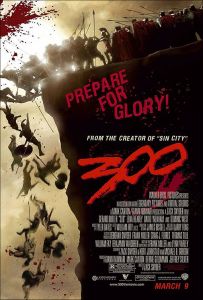 The story of the 300 is the story of the Battle of Thermopylae in 480 B.C, 150 years before Alexander the Great. Xerxes (Rodrigo Santiago) has deemed himself a “God king” and his Persian army has been conquering Asian nations and acquiring the most massive military force of its time. He sets his sights on conquering Greece, and to do so must go through the narrow passage of Thermopylae.
King Leonidis (Gerard Butler) assembles 300 of his finest Spartan warriors to thwart the Persian invasion. The Spartans were the super soldiers of their time, a society that valued brute strength and the honor of combat. Children born with imperfections were cast onto the rocks to perish; the society couldn’t afford a weak link in its protection. One day a Persian emissary rides into Sparta carrying the skulls of other kings and princes and a message from Xerxes: submit or you’re next. Well, after the emissary insults Queen Gorgo (Lena Headey), he refutes the message and kicks the emissary down a giant black pit in the middle of town (is this where they dump their garbage?). Thus, as they say, it is on. The Greek city-states have no sense of nationalism, so Leonidis commands little support to thwart the advancing Persian hordes. The Spartans have discipline and superior equipment, and because of these advantages they are able to hold back overwhelming numbers from the Persian army.
 Back at the home front, Queen Gorgo is wheeling and dealing behind the scenes to state her case to the Spartan assembly. She needs to shore support for more troops to help her husband. Theron (Dominic West) is a member of the priesthood that looks to sexually charged Oracles for guidance. However, he’s willing to drop his pacifist stance if the queen drops her robe and grins and bares it.
Xerxes is not a happy “God king.” He tries appealing to Leonidis, insisting that if he will simply bow down and relent than he will be spared. “Imagine what horrible fate awaits my enemies when I would gladly kill any of my own men for victory,” he threatens. Leonidas replies, “And I would die for any of mine.” The two men (well one man and one God king) go back to their corners ready for another round of this epic slugfest.
The action sequences are intense and director Zack Snyder (2004’s Dawn of the Dead) heightens their realities with surreal touches. He fondly gives life to the bloodshed and exaggerated combat popularized from Frank Miller?s graphic novel. The Sin City author has created another testosterone-soaked hyper-real adventure. The movie doesn’t even flirt with the notion of rigid historical accuracy (I doubt the Spartans fought rhinos, giant mutants, and were done in by a disgruntled hunchback); the film uses Miller’s artwork as a jumping point, which means that the Spartans fight in leather codpieces and red capes and that combat is more one-on-one even after we learn about the important of the phalanx. But quibbling over inaccuracies is a waste of time, because 300 is a pumped-up, super cool action movie that plays out in a vivid dreamscape. The movie was filmed with extensive green screen, much like Sin City was, and it feels like a direct transition of Miller’s pulpy comic book. Even the farewell sex between the King and Queen is stylized and seems to be snippets or panels from a comic book.
Let’s all be honest, there’s something undeniably homoerotic about 300. The movie worships the male form, with rippling abs and bulging biceps lovingly showcased in glowing, sweaty, fawning detail. The movie also focuses on manly men primarily spearing one another with phallic weaponry while the spurting blood dances across the camera in balletic CGI spasms. There?s a definite gay appeal to this film, not that there’s anything wrong with that. However, 300 also manages to curiously be homophobic at the same time (I swear this came to me independently, Phil). Xerxes is designed very as being very fey even at a massive height of eight feet. He lays his hands against Leonidis’ shoulders and asks for him to submit, and you can’t help but wonder what the teen boys in the audience are thinking. Xerxes also has a party tent filled with whores, the disfigured, transvestites, and the overall effeminate opposite of all those Greek macho muscle men the film postures as elite specimens.
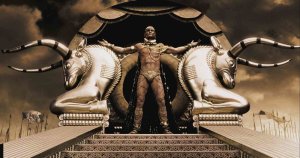 The acting is set to one tempo and that’s a mesmerizing use of yell-speak; it’s part guttural and part long-standing bellow that makes any piece of dialogue sound macho. King Leonidis growls, “SPAAAAAAAARTANS! TONIGHT WE DINE IN HELLLLLLLL!” After two hours of this primal style of speech, it becomes somewhat infectious and you want to try it in everyday situations in your life. Next time you’re out with friends at a fine dining establishment, I suggest asking for the salt thusly: “DINING PAAAARTNAAAAAH, COULD. YOOOOOOOOOU. PAAAAAAAAASS. THE SAAAAAAAAAAAALT?!” You’ll be guaranteed to get a reaction. It strains my throat even writing about the 300 yell-speak.
300 is a rousing movie going experience that plays out in a beautiful, pristine dreamscape that closely resembles our planet. The action is highly stylized and frenetic. It’s just that when the film stops to take a breath you start to look elsewhere, and when you do you realize there isn’t much below the blood-caked eye candy shell. 300 is grand spectacle that elicits thrills and chills, but the movie fails to touch on emotions beyond loyalty and courage. Both are essential for a soldier, and one as dedicated as a Spartan warrior, but the lack of substance keeps 300 from being anything other than a visually arresting, if ultimately disposable, two hours at the movies. There’s nothing wrong with a movie whose sole purpose is to quicken the pulse for a short supply of time, and 300 succeeds smashingly with this singular ambition. It is an ass-kicking history lesson that makes me wish I could learn more about Persian executioners with blades for hands at my local library.
Every culture has their own account of a last stand, a small group that heroically held off seemingly superior forces (remember the Alamo?). Snyder and Miller present an entertaining hack-and-slash primer through history that’s rarely dull and often enchanting to the senses. Deep down, there may not be much more to 300 than a lot of pretty pictures and a bunch of chiseled hunks, but that?s enough for most carnage fans with a free afternoon.
Nate?s Grade: B
Share this:

Zodiac (2007)
 Zodiac is something altogether different from a genre best known for cannibalism, skin suits, and express shipping of human heads. It has more in common with All the President’s Men than director David Fincher’s 1995 masterpiece, Seven. This is a serial killer thriller steeped in police procedural, closed door deliberations, and the slow drip of a decades long investigation into the Zodiac killings that terrorized California from the 1960s and 70s. Watching close to 3 hours of procedure with nary a car chase or a shoot-out may not sit right for fans of the genre, but I enjoyed the film for the same reasons people will decry it — the details. I loved how methodical this film is, how dogged and stubborn it is, and I found myself being enveloped into the minutia of the case.
It all began with a young couple looking for a bit of privacy in 1968. They park at a lover’s lane and nervously engage in a bit of the old “neckin.” A passing car interrupts them, and then that car returns with its headlights blasting into the couple’s faces. This man then takes out a gun and starts firing, killing the woman and badly injuring the young man. Robert Graysmith (Jake Gyllenhaal) is a political cartoonist for the San Francisco Chronicle when a curious letter has stirred up a lot of discussion. It’s a cryptic message with a puzzle attached made up of symbols and codes. The author demands his puzzle run in the newspaper, and if not, more will suffer at his hands. There are further attacks along the California coast and the mysterious figure finally gives himself a name at the end of one of his letters: Zodiac.
 San Francisco detectives David Toschi (a great, raspy Mark Ruffalo) and William Armstrong (Anthony Edwards) are called in after Zodiac executes a cab driver in the city. The Chronicle‘s star crime reporter, Paul Avery (Robert Downey Jr.), pesters the police for details and eventually gets under Zodiac?s skin. Graysmith becomes obsessed with the case through a life-long love of puzzles and the case eventually consumes him, dooming his marriage to a pretty girl (Chloe Sevigny). Thanks to the tutelage of Avery, Graymsith becomes an amateur detective of his own, and his zeal to solve the case outlasts the actual police.
The Zodiac killer was really the first mass media serial killer. As the news of brutal attacks spreads, the media ate it all up and enlarged the figure of Zodiac to grand heights. And he was eager to help inflate his image, taking credit for crimes and slayings that were not his doing. The killer used the media age to terrorize the populace and increase his notoriety, similar tactics used by today’s stream of terrorists. The detectives didn’t just have to navigate all the shifting evidence but the formation of an urban legend.
This is before the day of DNA and super computers, so all progress comes from good old-fashioned police work. Long hours are spent pouring over mounting evidence while coordinating around bureaucracy; because Zodiac has struck in several different small communities it can take a saint’s patience to figure out the correct jurisdiction and compile the various parts in various offices. The film packs a lot in its running time introducing scores of information, suspects, witnesses, and varying theories, but the film cannot be faulted for pace; nearly every scene takes place weeks, months, even years after the last.
 Zodiac is Fincher’s most restrained work even at a gargantuan running length. Fincher is a master tactician with slick visuals but has a penchant for getting too dazzled by needless visual flourishes (did the camera really need to zoom through the handle of a coffee pot in Panic Room?). He tones down the excess but still maintains a refined visual palate that makes the film feel fluid. The period detail is incredibly reconstructed, giving an authentic feel for a very serious story. But Fincher knows that with Zodiac the impetus lies with the story, and he devotes his considerable style to the service of the story. The mood balances nicely with intrigue, humor (after Zodiac singles out Avery fellow journalists start wearing “I’m Not Avery” buttons), and some truly terrifying moments involving the Zodiac attacks. The violence is sparse but when it does occur it is shocking, particularly watching a knife plunge repeatedly into the writhing body of a woman at a lake. One key element of sustaining such an ominous mood is fabulous song selection. Very often pop songs can be counter-productive to a movie, coming across as a lazy attempt to cobble together a soundtrack to shill. With Zodiac, “Hurdy Gurdy Man” becomes a powerfully haunting medley for the killer and the sonic linchpin for the film.
Fincher does an excellent job of transporting us back in time and recreating the sense of paranoia that grappled many. There is a great scene late in the film where Graysmith comes to the sudden realization that he may have walked right into the spider’s parlor. The scene plays out to an agonizingly uncomfortable length, and you too feel like running out the door as fast as your legs can take you. By not knowing definitively who the Zodiac may be, the film gets a boost of suspense from a multitude of creepy suspects. In an interesting decision, Fincher uses different actors of different shape during the Zodiac attacks, playing against the varying reports from witnesses and survivors.
There?s a sizeable danger trying to find a climax to a case that remains open to this day and where no one has been officially charged. Zodiac does as good a job as possible to present a fitting, mostly satisfying conclusion. The movie presents the best theory and points a convincing finger at who Zodiac perhaps really was.
 Zodiac is expertly crafted but has a handful of minor flaws that hold it back. The overall script is rather nimble with how it dishes new information to digest, however the intricacies can amass and become too great, and some scenes congest too much without needed forward momentum which causes the flow to get caught up in an expository pile-up. Still, the film is demanding but not overwhelming and not without reward. The film follows the ups and downs of the Zodiac investigation, and that means characterization runs short and simple. I fear the only false note amongst a vastly talented cast is Gyllenhaal, an actor I adore. He works fine in the portrayal of a young kid in the newsroom trying his hand at crime solving, but it’s the film’s second half where the actor falters. He fails to sell the obsession and desperation that dominates his life, instead looking wiped out but no worse for wear, like the temporary results of an all-nighter before a big test.
It was five years since Fincher’s last film, and he wasn’t sitting on his laurels when he crafted Zodiac, an exceptionally intelligent and demanding movie. Decades pass, suspects weave in and out, evidence and testimony contradict one another, it’s all a lot to keep track of but I found myself absorbed in the case just like Graysmith. This is a serial killer movie that could bring the smarts back and redefine the genre, that is, if fans are willing to sit through 3 hours of police work. If not, well they might get their kicks out of the more genre loyal The Zodiac, released in 2006. And that movie’s only 97 minutes long.
Nate’s Grade: A-
Share this:

The Number 23 (2007)
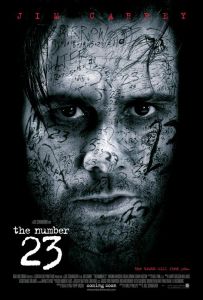 “Nobody likes you when you’re 23.”
-“What’s My Age Again?” by Blink 182
I know math scores have been systematically dropping with America’s youth, but have we gotten to the point where numbers themselves are scary? The Number 23 is a thriller built around the spookiness of a digit greater than 22 but a little less than 24. Does anyone have nightmares about walking down an empty hall only to have the number 23 pounce from the shadows and scream, “Boo?”
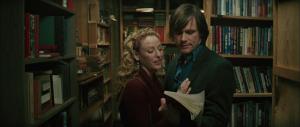
Walter Sparrow (Jim Carrey) is a dogcatcher that gets bit on the job. This event causes him to be late for a scheduled birthday rendezvous with his wife Agatha (Virginia Madsen). She wanders into a local bookshop and picks up a worn, self-published book called The Number 23 as a present for her hubby. The book seems to be littered with private details from Walter’s life and he’s left dumbfounded. The main character is haunted by the number 23, which seems to be everywhere and nowhere. Walter starts to see the number dominate his life and fears that he too will fall victim to its control. Walter is also worried that his life will start mimicking that of the book, including the part where he goes psycho and kills his loved ones.
 The film spends the majority of its time on two obsessions: the book and the number 23. Now, the number conspiracy is just ludicrous and silly, and it contorts and strains to prove its message. In the flick, someone will scream about some important date in, say, 1940, and then go theorize that it has eerie significance because 19+4+0 equals, tada, 23. But why not 1+9+4+0, or 19+40, or even 1+940? Because then it doesn’t work. Sometimes you take the date, sometimes you add up the numbers in the month, sometimes you need to add up the numbers in the month and the year, sometimes you add and then multiply and then divide numbers (like the contrived manner of making the word “pink” part of this theory); the point is that it’s all arbitrary and worthless. You could go through the same convoluted dance with any number. The same effect happens with cold readings where a “psychic” will spout some vague declaration (“I feel like someone with an ‘R’ in their name died in the last five years”) and rely on the sucker, in this case the audience, to imbue it with some personal meaning (“Oh my God, there was a guy on my street named Rick that died four years ago!”). And all of this relies on the assumption of accurate record keeping for time.
Being haunted by a reappearing number is just dumb, but reading a mysterious book that depicts your own life and predicts you will become a murderer, now that’s interesting. I wish The Number 23 had spent more time with this idea instead of the numerical nonsense. I wanted more questions and contemplation about a book that knows all instead of a number that people bend over backwards to locate in their daily lives. And yet, even this storyline needed a metaphysical jolt. The conclusion follows the most boring, tame, and predictable route that can be best explained. The second half of The Number 23 needed to be more Stephen King and less James Patterson. The psychological aspects of this conundrum are barely explored before the movie seems to lose interest even with its own brand of hokum. Debut screenwriter Fernley Phillips takes the path of least resistance to the finish line.
 There are some leaps in logic and character motivation throughout. The Number 23 has a strange moral reminder, namely that of a dog that saw something bad and has convinced its doggy self to do something about it, which means spontaneously appearing all over town like a nagging ghost. It is just another plot point that goes too far and breaks credibility, especially since The Number 23 wants to be remotely plausible. Another example is a murder victim who berates her would-be killer while he holds a knife to her throat. She says, among other things, that he’s a freak, she never loved him, and then the final dagger is aimed straight at some long-suffering daddy issues. I doubt anyone picks “knife to throat” as the time to unload their personal grievances. The dialogue also suffers from being so serious to the point of hilarity: “Is 23 a blessing or a curse?” What? Huh?
Director Joel Schumacher (Phonebooth) seems to be having a fun time getting his hands dirty with the material. He can get carried away, and sometimes he uses a sledgehammer when he should have used a slight tap to establish mood. Still, this is one film that you cannot blame the oft-reviled director for ruining. He attempts to goose up this psychological thriller with some persuasive visuals, but all the tricks can’t hide the fact that The Number 23 needs a lot more bite to come across as edgy. It’s too plodding to be disturbing; it’s mostly dank.
Carrey seems an ill choice for this material. Dark brooding doesn’t come natural for America’s foremost manic funnyman; he has some dramatic skills, Eternal Sunshine of the Spotless Mind and a spot-on Andy Kaufman are proof of that, but this isn’t drama, it’s serviceable, gussied-up trash and Carrey doesn’t have the reservoir to show us the dark depths of the human soul. It is somewhat comforting to see Madsen getting more roles since her 2004 Oscar nomination, but she seems to be parlaying that nom into a permanent slot as “wife to lead.” She at least gets to vamp it up in the story within a story as a raven-haired femme fatale.
Even with the preposterous killer number thing, this is a movie with remarkable guilty pleasure potential upside. It’s equal parts interesting and frustrating, and builds a good head of steam before totally unraveling in the last act. The Number 23 is a psychological thriller that just needed better focus with its own obsessions.
Nate’s Grade: C


 nathanzoebl
You must be logged in to post a comment.