Category Archives: 2007 Movies
Away From Her (2007)
 Actress Sarah Polley makes a remarkable directorial/screenwriting debut telling the story of a couple going through the late stages of Alzheimer’s. This is a truly adult tale that deals in the heartbreak of losing a loved one gradually and slowly. The film centers on a long-standing marriage that endures the hardships of becoming a victim in your own mind, first forgetting small things and then finally shutting down completely. While plenty of films have articulately dealt with the point of view of the afflicted, I feel Away from Her is one of the better perspectives on seeing the devastating effects of the illness from the spouse. The movie deals with its real world dilemmas in a respectful and realistic manner and Polley has put herself on the map as a thoughtful, mature, and engrossing talent to watch whenever she hops behind the camera.
Nate’s Grade: B+
Share this:

Breach (2007)
 Chris Cooper is masterful in an unnerving and deeply contradictory role as a man of God, country, patriotism, and family. He was a respected FBI expert eventually discovered to be the biggest mole in U.S. intelligence history, directly responsible for the deaths of U.S. spies and interests in Russia during the Cold War. Writer/director Billy Ray infuses the film with the same stoic, controlled calm of his exceptional earlier effort Shattered Glass, and the movie unwinds like a great political thriller from the 1970s. The story is smart and engaging but it is Cooper that turns Breach into one of the best films of 2007. His performance is as varied and complex as the man he is portraying; frightening and intimidating but also empathetic and bound by a sense of honor, Cooper gives a performance that plays upon ambiguity and understatement. Watch the way he even drives people into walls when he walks alongside them in hallways. It’s that kind of intense, highly focused, and morally challenging work that deserves an Oscar nomination.
Nate’s Grade: A
Share this:

Ghost Rider (2007)
 Nicolas Cage’s career has been flaming out, so what better role than a burning skeleton biker who serves as a bounty hunter for the Devil, in this case Peter Fonda. A cliché-riddled script, laughable performances, cheesy effects and dull villains doom any entertainment prospects this movie might have had. Cage, as the titular rider, gets to fight a group of escaped demons who all have one connection to an element; one has the power of fire, another the power of wind, etc., it’s like a hellish Captain Planet squad. But what’s the point when Ghost Rider simply vanquishes them so easily? It’s repetitive and goes nowhere. There’s one moment Sam Elliot “turns” into an older ghost rider/bounty hunter and rides along with Cage to save the day. But then he says, “Well, I could only do that once more, so good luck.” What? You could only turn into a flaming ass kicker one more time and you wasted it on riding a horsey through the desert? Eva Mendes is awful as her role of “girlfriend from past,” and why, if she and Cage grew up as childhood sweethearts, does he look over 15 years older than her in the present? I guess working for Satan can really take a lot out of you.
Nate’s Grade: D
Share this:

The Kingdom (2007)
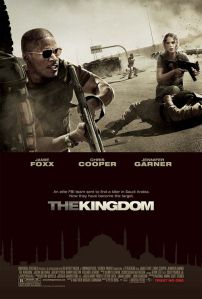 Now that summer is but a hazy memory, get ready for a roll out of serious minded movies Hollywood hopes vie for serious award attention. It may be five years into the current war, but the movies are now cranking out Iraq-themed dramas that will dominate the release schedule for the approaching months. Things are about to get heavy and somber. First out of the gate, though, is The Kingdom, a film about the nebulously termed War on Terror set within the confines of an action movie. Actor-turned-director Peter Berg (Friday Night Lights, The Rundown) knows how to create a stylized movie that feels organic to its genre, and The Kingdom is another example of his growing cinematic pedigree.
In Saudi Arabia, a housing enclosure of American contractors and their families is brutally attacked by terrorists that have infiltrated the Saudi security. Two hundred American lives are lost and FBI agent Ronald Fluery (Jamie Foxx) is intent on leading a team of experts (Chris Cooper, Jennifer Garner, Jason Bateman) to the soil of the Saudis, otherwise known as The Kingdom. The State Department refuses to authorize an investigation citing the jurisdiction of the Saudis as well as the danger of violent reprisals if agents are within reach of the perpetrators. Colonel Faris Al Ghazi (Ashraf Barhom) is assigned to baby-sit the American agents and keep them stuck in red tape during their five days allotted to them. Fluery refuses to take a subservient role and works with Al Ghaazi to get some answers.
 The animated opening credit crash course in Saudi history is fun and informative, however, it really doesn’t relate to The Kingdom even though the damn movie is set in that country. Curiously, the movie only makes cursory statements on the wary relationship between the Saudis and the United States, but otherwise this movie could have been dropped in any nondescript Muslim country in the Middle East. If The Kingdom was relocated to, say, Yemen, I doubt the script would need that much fine-tuning; snip some references to royalty here and there. This is a story about the balance between a moderate Middle East regime and radical elements within the country willing to buck Western influence by any destructive means necessary. I’m measurably disappointed that the movie didn’t tackle more about the unique and tenuous Saudi-U.S. relationship, but then I accepted the fact that The Kingdom wasn’t so much about a country but an ideology that knows no borders.
To that end, The Kingdom is one part CSI: Saudi Arabia, one part political thriller, and one part gung-ho Hollywood action extravaganza, and none of the parts seems to work well together as a whole. The film doesn’t work as a cohesive unit and perhaps tries to do too much. Now, this does not mean that any of those parts are not entertaining. The criminal investigating is rather interesting because of all the cultural barriers between the U.S. agents and the Saudi governing system (a miscast Jeremy Piven, as an ambassador, admonishes Janet, in a very Ari Gold way, to “dial down the boobies”). The central mystery of who is responsible is pretty thin and easy to solve, which may be why the film spends so much time finding obstacles to delay our FBI team from getting their hands on the evidence. The political thriller elements are expressed with the subtlety of a sledgehammer, and yet they feel like thoughtful counterpoints to any rah-rah jingoism that The Kingdom may instill in an American audience. The climax provides plenty of fist-pumping violence but it also ends on a note about the futility of violence as well as the durability of hate. I even appreciated devoting time to interdepartmental jockeying and watching agency heads seeing who will blink first in a public relations-dominated world. The Kingdom doesn’t have a desire to become Syriana 2: No Blood for Oil, but it does possess a greater deal of intelligence and relevance than most of what big budget Hollywood is spewing out (I refuse to believe the FBI would send an agent, with a personal family tie to Israel, into a Muslim country).
Strict action fans, however, are going to have a lot of downtime on their hands. The Kingdom opens with an action sequence and closes with an action sequence, and there’s a wide gap in between those bookends. The final 20 minutes are devoted to a nail-biting ambush and rescue that transforms our FBI agents into improbable action movie warriors. Berg’s restless camera isn’t as well honed as Paul Greengraas (The Bourne Ultimatum), and sometimes you just wish the jittery cameraman would allow you to see what’s going on. I don’t know if the docu-drama emphasis is fully needed, especially when the movie jumps between shots of just two people having a conversation. Berg is a terrific director and the action sequences hit hard; I just hope he doesn’t become trapped trying to fit himself into one style.
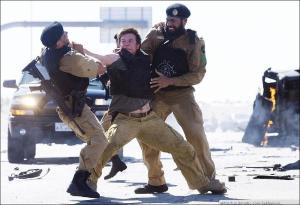
In truth, the most intriguing part of The Kingdom is the relationship between Fleury and Al Ghazi. They begin frustrated and fighting for control, but soon, in true buddy cop genre fashion, a mutual respect forms as they search for the bad guys. The script offers helpful examples of good Movie Arabs and bad Movie Arabs, and the audience is able to easily identify the two sides. The interplay between Fleury and Al Ghazi leads to some humorous exchnages as well as some reflective opportunities, like where the men recount their families and declare they do not care why such dastardly acts were done, they just want to inflict some punishment on the rightful parties.
The acting, like the film, is a bit all over the place. Foxx seems to be on autopilot. Foxx has bunkered into his acting troupes; intense, penetrating stare, whispery dialogue recitations, and a cocksure attitude. Cooper is cranky and incredulous older timer along for the ride. Garner does her best with a character that was written for the sole purpose of concocting culture squabbles over the role of the opposite sex. She does unleash a torrent of anger and power in one very hard-core and frighteningly extreme fight scene. Bateman is playing comic relief and does sarcastic quips with great ease, but his character also gets unexpectedly thrown into a very harrowing experience and Bateman makes you feel every drop of his fear. Barhom (Paradise Now) gives a convincing performance of a man torn apart by his moral compass and the path of his country. He feels a sense of duty to protect the innocent but at the same time he is scoffed at by colleagues for helping “them.”
The Kingdom is an action movie with more on its mind than blowing up the enemy real nice like, though that also plays a key component. The pieces don’t fully add up to a whole and the film’s politics are a little tricky to get a bearing on; is this a red state movie, a blue state movie, or something for both audiences? Berg’s ambition is admirable and his film never drags out a soapbox to preach. The Kingdom is a topical movie aimed at planting seeds of debate among a mainstream audience in between their handfuls of popcorn and gulps of soda.
Nate’s Grade: B-
Share this:

The Brave One (2007)
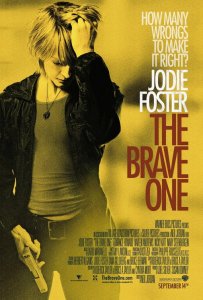 The Brave One, when distilled to its purest essence, is Jodie’s Foster’s Death Wish, but there isn’t anything necessarily wrong about exploring this scuzzy territory again with a fresh set of eyes. The film chronicles a New York City radio host (Foster) who is the victim of a brutal attack that leaves her boyfriend dead and her in a coma for three weeks. Shattered and hardened, she buys a gun for her own protection and finds herself in situations that require one. The Brave One features a lot of audience-approved ass kicking and an absurd amount of dangerous scenarios that Foster seems to casually find on a nightly basis. But what separates The Brave One from the usual grisly pap of the genre is that it refuses to pander to audience bloodlust. Director Neil Jordan (The Crying Game) complicates a simple case of vengeance by making an audience contemplate the true ramifications of violence and whether they are ultimately worth the price. Foster gives a ragged and emotionally raw performance. She discovers how easy killing comes to her and Foster struggles to keep her crumbling sense of humanity, with her last tie to the working world is her friendship with a deeply compassionate cop (Terrence Howard, terrific yet again). The most affecting moments are between Foster and Terrence as they construct a rather moving companionship where each feels out the other and Foster actively tries to avoid getting caught. The end of The Brave One certainly could have followed through with its morally ambiguous deliberations and open-ended questions, but while its climax does pull some punches it doesn’t wrap everything up with a bow either. This is high-end work for a guilty pleasure genre most noted for having its morals face down in the gutter. Now what the hell does the title refer to?
Nate’s Grade: B
Share this:

Premonition (2007)
 Linda (Sandra Bullock) is having a unique martial crisis. Her husband Jim (Julian McMahon) has died in a horrific car accident and she must now raise their two daughters by her lonesome. Or so she thinks, because she wakes up the next night and Jim is alive and well and enjoying a hot cup of java. Linda is perplexed and finds herself living the days of this week out of sequence. One day Jim is alive and the next day he isn’t. She plots to use her knowledge to save her husband if it’s even possible to defy fate.
Premonition is in hopeless want to be a modern-day version of Kurt Vonnegut’s Slaughterhouse Five with the added sprinkle of a Lifetime movie. Linda is, like in Vonnegut’s classic sci-fi novel, unstuck in her time, however, the time has been pared down significantly to a mere week. Thankfully the movie has enough sense not to implicitly try to make sense of why this is happening to her, though she does visit a priest who has conveniently studied this sort of crazy thing (short answer: God is testing your faith). The problem with limiting the timeline to just seven days is that when Linda makes her quantum leaps the audience is left scrambling to figure out when she is. This works in placing the audience alongside Linda in confusion, but it gives no sense of overview or clarity and the events aren’t significant enough to warrant being memorable enough to connect cause and effect. The narrative structure is purposely jumbled but it’s also missing suspense if we never know what’s going on. Hey, I’m not even asking for much either, just some titles indicating the days would be helpful.
 The people that populate this film behave in completely contrite ways because the half-baked story demands it of them. When Linda finds her daughter’s face covered in scratches for the first time, she asks what happened to her. Instead of actually answering, the child remains silent because apparently that would spoil the dramatic surprise of her running into a glass door. Wow, that was worth it, and it must have been something so traumatic that neither of Linda’s daughters could casually mention it. A child would not behave this way. The only way this would make sense is if the contriteness got kicked up a notch and the little girl got a sliding door-bound case of laryngitis. Like romantic comedies, Premonition is a movie that needs to survive due to no one ever having a rationale conversation explaining all that they know to dispel misconceptions. This whole dumb sliding door incident is made even worse when Linda’s mother wants to have the children removed from their mother’s custody because of those scratches. Huh? Would she not know too that it was an accident? And just one more reason to hate this plot point: when Linda tells her daughters that their daddy is dead the little girl does not have scratches, however, in the timeline, she ran into the door the day before. The day after the death, and two days after she broke the door, the glass is replaced because I suppose that took priority over mourning. The discontinuity is terrible.
Also, when Linda gets the tiniest whiff that her (sometimes dearly departed) husband was even contemplating infidelity, she performs a full 180 on the spot and coldly considers letting him die as punishment. The speed of her abrupt about-face is a cheap roadblock to squeeze more tension out of this dumb story. I won’t even mention how lazy it is to have a priest who’s an expert on “unstuck time” living nearby.
The plot may be maddening, but I think Premonition was meant to be a comedy because it’s not an effective thriller. The movie’s feeble attempts at attaching scares to its central puzzle are astounding bad. This is the type of film that not only thinks a dead crow is spooky but that the mystery of what happened to the dead crow is integral to audience satisfaction. It’s hard to believe that Premonition preoccupies so much time with the mini timeline of one dead bird. There are cheap jump scares in abundance but no lasting tension of sense of unease because the filmmakers have left the audience in the dark. There is one horrendous moment where the funeral pallbearers drop the casket and Jim’s head snaps and rolls out. You know they’re not getting any repeat business.
Premonition has an ending that just lays there in utter defiance of taste, causing the audience to upturn their nose in disbelief as if they had just discovered someone defecating in a store aisle. The ending is terrible and grasps for some kind of deeper Twilight Zone level of irony, but instead what comes across is a clumsy, irritating, and plain idiotic excuse at futility. It really calls into question whether or not the movie had any point. Premonition was beyond redemption but its stinker of an ending and Linda’s voice over summation will cause you to roll your eyes at incredible speeds.
 Bullock is in new territory with Premonition, though she dabbled with time travel in last year’s The Lake House. She’s in way over her head and cannot effectively convey any of Linda’s increasingly ragged emotions. I laughed out loud several times as Bullock tried to express her growing apprehension, and her take on the line, “Because we’re running out of time,” had me in stitches. Her performance isn’t particularly embarrassing but more of an exasperating reaction to all the mess surrounding her. Bullock may want to stick to her romantic comedy wheelhouse.
Personally, if I was unstuck through time and needed some help figuring out important events, I would leave a lot of Post-It notes for myself filling me in on what I know. That would make sense; this movie doesn’t in any capacity. Bullock, writer Bill Kelly, and director Mennan Yapo need to wake up the day before they ever started to make Premonition and then they can spare us all. Then again, I suppose we can only fight fate one sliding door at a time.
Nate’s Grade: D+
Share this:

Superbad (2007)
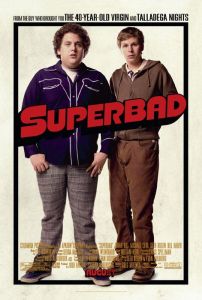 Seth Rogen makes me feel like a slacker. I’m two months older than him, but already he’s broken out as a comic actor on great-but-cancelled shows like Freaks and Geeks and Undeclared, and now he has risen to headlining star thanks to the runaway success of Knocked Up. Now here comes Superbad, a comedy he’s co-written with his friend Evan Goldberg, and I haven’t even gotten one movie off the ground or, for that matter, a starring role in any TV series, canceled or on the air. Oh well. At least Rogen’s consistent attachment to quality projects makes me a happy, if marginally envious, moviegoer.
Seth (Jonah Hill) and Evan (Michael Cera) are high school seniors looking to score with the ladies. Their nerdy friend Fogell (Chistopher Mintz-Plasse) has a scheme to get himself a fake ID, and the trio seizes upon this opportunity to become important figures in the teen circuit. With the promise of the fake ID, Jules (Emma Stone) has asked Seth to provide all the alcohol for a house part that she’s throwing that night. Not only that, Evan’s unrequited crush Becca (Martha MacIsaac) is going to be there. Seth and Evan figure that this party will be the best chance they have ever had to get lucky thanks to the miracles of what some would call, “liquid panty remover.” They just have to get the booze first. Fogell’s ID lists him as simply as McLovin. He is set back when his attempt to purchase alcohol is interrupted by a robber. He’s interviewed by Officers Michaels (Rogen) and Slater (Bill Hader) who take a shine to McLovin (“It sounds like a sexy hamburger”). The threesome spend a madcap night drinking, busting crime, sharing worldly wisdom, and running away at the faintest sign of other police officers.
 First off, Superbad is raucously funny. It’s plenty profane and has several memorable moments, like Seth’s imaginative scenarios for buying alcohol and a dance that goes in a very unexpected direction. The humor is timeless and built around the nervous interaction between the sexes; there are very few jokes that reference pop culture or dependent on a specific context. I imagine what makes Superbad hilarious will still make it hilarious in 20 years to a new audience that can relate to the same trials and tribulations of teen life, though perhaps at that point we will be replaced by robots.
What separates Superbad from other offensive sex comedies is that it’s really a story about male friendship. I don’t mean in the tacky, Hollywood vein of working together for a common goal, which is commonly to lose one’s virginity. Superbad is another entry into the Judd Apatow (40-Year Old Virgin, Knocked Up) school of comedy that professes that a comedy should be character-based and that those characters should be painfully human. This is no mere genre movie. Underneath all the boobs and booze discussion is the pain and worry of a long-standing friendship being able to survive. Seth and Evan have been close friends all of their lives, but many good friends have grown apart in time thanks to their lives moving in different places. There’s unspoken tension between the two of them and Seth is concerned he’s about to be abandoned by the person that means the most to him. Many films touch upon the indelible companionship between men but few can accurately articulate the authentic love that can foster bonds of friendship. Superbad explores the exploits of real friendship, and while it’s chock full of funny the film also has its fair share of moderately touching moments. You really do care about the characters and want them to triumph. Fogell’s ascension to becoming a confidant, cool lady’s man is one of the summer’s true pleasures. Apatow’s fingerprints are all over this, and that is a glorious thing.
But this isn’t some phony Porky’s-style high school sex comedy with male fantasy set pieces and lots of dunderheaded beauties prone to bouts of frequent nakedness. Superbad is a relatively realistic portrayal of high school life in the world of movies. This isn’t a school ordered by cliques of entrenched stereotypes like the jocks, the Goths, etc. In fact, I don’t think Superbad makes any social distinction between the students.
 Superbad is a celebration of the glories and anxieties of the male members’ member. Even for a teen sex comedy, the film is very phallus-centric, complete with a hilarious anecdote about a “treasure chest of dick drawings.” It seems Seth, at a young age, was stricken with the unique compulsion to draw a phalanx of penises. The anecdote is quite unexpected and funny and underscores how often the penis prevails in the minds of young men. The boys discuss at length the life and times of the penis, especially how women can compliment this. The constant dick-chat may get old after a while for most of the female audience in attendance (a.k.a. those without), and I can’t exactly blame them, but Superbad does convey, in a convincing manner, how much teenagers think about sex (“You know how many foods are shaped like dicks? The best kind”). Some have argued that there’s an undercurrent of misogyny with Superbad, but I feel like those detractors are missing the deeper point. These guys are totally terrified of women and go through one wild night just to avoid actually confessing their feelings to the objects of their affection. These guys don’t hate women, they’re just frightened and utterly bewildered by them, and so they rely on what pop culture and their peers have taught them is the way to a woman’s heart: booze.
The movie is taken to an extra level of excellence thanks primarily to the outstanding comedic performances by its cast. Cera was a star of brilliant understatement on TV’s Arrested Development, and when it comes to portraying awkwardness, Cera is king. The gangly teen is a textbook example on high school awkwardness; he feels uncomfortable in his own skin. He seems antsy to leave most scenes. His self-effacing smile, wide-eyed gawk, and nattering stutter are spot-on signals of clumsy, confused, and embarrassed teen life. Cera is a master with impeccably punctuated line deliveries. The kid could make any line funny by flawlessly placing a pause in the right place. Arrested Development was a great showcase for Cera’s comedic chops, and now Superbad is a juicy platform for the funniest straight man on the planet (and he’s only 18 years old).
 Hill has been a supporting player in previous Apatow productions, but this is his first major role. Hill is the loud, boorish, vulgar, and more outlandish half of the duo. When he gets worked into a frothy rage you can practically feel his indignant teen spittle. What makes Hill special is that, in an instant, he can go from foul-mouthed cretin to a vulnerable buffoon. In the end, when the police bust a party, Seth runs on instinct and his instinct is to save his friend. It’s the versatility of Hill that allows Superbad to channel the sweet, gooey center behind all the sex-obsessed hijinks.
Not all the different elements of Superbad seem to fit together. The cops subplot is played very broad and relies on a lot of physical comedy; it feels at odds with the genuine teen comedy that is the heart and soul of the movie. The subplot is indeed full of laughs and it turns McLovin into a legendary teen character, but it feels like a separate movie, albeit an interesting one. For a male-dominated comedy, the female roles are pretty sparse but even those take heed not to slip into empty stereotypes. Becca and Jules are portrayed as sensible and approachable.
In short, Superbad is super good, and it’s thanks to relatable characters, a sweet sensibility, plenty of raunch, and some excellent performances. Apatow has opened the 2007 summer with a winner and now he closes it with another one.
Nate’s Grade: B+
Share this:

Stardust (2007)
 Director Matthew Vaughn is about as far away from his previous film as he can get. 2005’s Layer Cake is about as far from princesses and unicorns and pixie dust as can be expected. He turned down X-Men 3 to helm this adaptation of famed comic scribe Neil Gaiman’s graphic novel, Stardust. In style with one of the film’s characters, allow me to say to Vaughn, well played, sir.
In turn of the century England, Tristan (Charlie Cox) is trying to woo Victoria (Sienna Miller), the haughty town hottie in the small village of Wall. The town is called such because there is a winding stonewall that runs alongside that people are forbidden to cross. He’s given seven days to retrieve a fallen star for Victoria to prove his affection for her. In order to do so, he needs to venture beyond the wall, and beyond the wall is another world altogether. The fallen star is a result of an dying king (Peter O’Toole) hurling his enchanted necklace to the heavens. The jewelry collides with a star and causes it to crash to earth. But it’s no smoldering rock taking refuge in that crater; the star has actually taken the form of a slender, long-haired blonde woman named Yvaine (Claire Danes). I can only hope other astral bodies that crash into this planet will result in the same lucky outcome. But Tristan is not the only one after the fallen star. Three very old witches have taken notice and seek to cut out the star’s heart and consume it, which will grant them youth once again. The oldest witch (Michelle Pfeiffer) uses the last bit from the previous star to shed her wrinkles, but every time she uses a speck of magic she loses part of her much-desired youth. Also on the hunt for the star are the king’s ruthless sons, each trying to retrieve their father’s necklace and declare themselves the next king, and each trying to bump off their family competition.
 Stardust is very much in the fractured fairy tale style of The Princess Bride, complete with nudges and winks. The movie works more with the macabre, but this only seems to heighten its magical qualities. I loved the ongoing wisecrack-filled commentary from the increasing number of ghost princes (“Well played”), and I loved that each was stuck in limbo Beetlejuice-style looking as they did when they died. Stardust is stuffed with hocus pocus hokum but it never seems foolish; the movie takes great steps to present the rules and characters of its universe, and as all of the assorted creatures race toward a showdown, Stardust makes total sense. It doesn’t betray the logistic parameters it establishes for such a fantastical parallel world. It means that if you can accept the opening 20 minutes than you should be fine for the duration of Stardust. The film spins a familiar tale of hidden princesses, races against time, battles over a throne, and wicked witches, but it handles the material with aplomb. Stardust‘s biggest asset, beyond the cheeky sense of humor Vaughn instills, is that literally anything could happen next. Suddenly there’s a flying pirate ship out to harness lightning, or a goat-turned-inn keeper, and it’s all so exciting what could be waiting around the corner next.
Vaughn assembles a lot of pieces and then keeps the momentum strong. He makes judicious use of special effects and keeps the audience involved with all the story’s moving pieces. Vaughn has taken the usual fantasy quest framework and channeled the imagination and dry wit of Gaiman. Not every moment runs as smooth as possible, and some are downright awkward, but Stardust stokes a nice balance between high-flying adventure and doodle-on-your-notebook romanticized love. Vaughn’s steady control and vision allow the material to really shine because the audience can open themselves to the magic of the movie.
The acting ensemble brings a lot of enjoyment to this enchanted tale. Pfeiffer is a bewitching villain and relishes her bad girl role; she’s a devious delight but is even better when dealing with the physical comedy of her increasingly aging body. De Niro is immeasurably enjoyable thanks to a role that conflicts with audience expectations for the famous force of movie masculinity. I was howling with laughter watching him cross-dress, swish, and become a giant exaggerated gay stereotype. It might seem trite or offensive to some had it not been for the setup and the film’s tolerant philosophy. Danes delivers a performance that seems to teeter on camp. She ramps up her vocal inflections thanks to her hyper English accent and seems to perform like she’s in front of a mirror and testing out all of her facial muscles. A bit odd. Cox fits snugly into the Hollywood slot of bland male lead.
 The one main drawback for the film is that the screwball bickering between Tristan and Yvaine never really works. The constant arguing rarely comes across as funny and is too poorly veiled to camouflage the film’s romantic intentions. The romantic setup is pretty formulaic. The audience will know right away that Tristan is not meant for his conceited and high-maintenance village girl, and that true love is staring him in the face along the course of his most fantastic voyage. We know from the first second of their meeting that their combative relationship will in time transform into a romantic relationship. But that’s not to say Stardust isn’t a romantic fable. Its heart is simple but it is genuine. While its path is predestined and unshakable, this does not stop the audience from feeling something between Tristan and Yvaine and their eventual coupling. I may be going soft, or perhaps Stardust just won me over completely, but I found myself even slightly moved by the romantic climax.
Stardust is assembled, like most fairy tales, from the working parts of other tales. It’s rather predictable with its big moments (boy meets star girl, boy loses star girl, boy regains star girl), but oh what a fun time the film has from point to point. Stardust is vibrantly alive and cheerfully creative and watching the film almost becomes a dizzying experience. It has a sweet and gentle romance at heart, and its knowing whimsy and charms are hard to resist. You’ll never look at Robert De Niro the same way again.
Nate’s Grade: A-
Share this:

I Know Who Killed Me (2007)
 We interrupt the nonstop barrage of Lindsay Lohan media coverage and speculation to bring you her movie, or, more accurately, further proof that Lohan is in desperate need of a career makeover. The tabloid target has a pretty shoddy track record of late when it comes to picking acting projects, so it’s no wonder that her splashy private life has overshadowed her cinematic duds. Thanks to a second summer DUI Lohan was unable to promote her new movie, I Know Who Killed Me. This may be a blessing in disguise because if I were her I would want to draw the least amount of attention possible to what is destined to contend for the worst film of 2007.
We open to Aubrey (Lohan) reading her story in her high school class. The story revolves around a stripper named Dakota and the amorous attention she earns from creepy older gentlemen. One night Aubrey goes missing and the police believe she may be the next victim of the local blue-gloved serial killer that hacks off the limbs of his victims. The last girl, currently residing in the morgue, is missing her right forearm and her right leg. Her parents (Neal McDonough, Julia Ormond) fear the worst. Then a motorist finds Aubrey’s mutilated body on the side of the road. She wakes up in the hospital and will survive, except the problem is that she has no idea who any Aubrey is; her name is Dakota and she worked as a stripper. She vows to find the “real” Aubrey.
This films is sleazy and tries to energize a lame straight-to-video thriller with some tawdry turns. Without Lohan’s name, I Know Who Killed Me would never have gotten a theatrical release. The torture sequences are drawn out to the soundtrack of Lohan’s muffled screams. The violence fails to excite or horrify, but instead it just seems like a sorry attempt to ape the success of recent torture-heavy horror flicks.
 The sex is even less believable. Aubrey/Dakota, fresh from the hospital, beds the quarterback in one of the least convincing, most unintentionally hilarious sex scenes of recent memory. She throws the jock onto her bed and pins him down for a good pumping. In the ensuing two minutes, the pair engage in exaggerated and noisy PG-13 sex where the woman stays on top and keeps her bra on the whole time (does any woman do that?). The whole time the movie cuts back and forth to Aubrey/Dakota’s mother listening and furiously cleaning the kitchen sink. I think the juxtaposition is intended to be funny, and it is, just not in the manner the filmmakers were probably hoping for.
The movie would be more revolting if it weren’t so incomprehensible. I Know Who Killed Me begins to disassemble at a fantastic rate of idiocy once it attempts to explain its central Aubrey/Dakota conflict. But the movie only presents two options: 1) Aubrey and Dakota are the same person and she just created a fictional persona as a means of post-traumatic stress (yawn), or 2) somehow there are TWO Lohans on this planet (what?). The first scenario is pretty dull and obvious and way too feeble for such a dank exploitation thriller. The second scenario requires a scheme so convoluted and ridiculous that it cannot be taken seriously. In the end, the movie becomes Saw meets The Parent Trap, and it’s every bit as terrible as you would concur from such a description.
For the sake of the morbidly curious, I will be discussing some heavy-duty spoilers to fully shine the spotlight on how ludicrous the movie gets. Don’t say you were not warned. Aubrey/Dakota keeps swearing she is indeed her own woman but no one seems to believe her. She researches the unexplainable via the Internet and it is here that she gathers the theory of stigmatic twins. The idea is that whatever happens to one twin will magically happen to the other, no matter the distance and no matter the situation. In the online example, a man with gambling debts is shot in the throat, and thousands of miles away his twin brother bleeds to death thanks to a perfectly placed and ill-timed hole in his own throat. I Know Who Killed Me tries to wrap up its questions with answers that would seem preposterous even in a soap opera. Not only does the film give us the old long-lost twin chestnut but it also goes the extra inane inning to say that one twin endures whatever happens to the other. So when Aubrey is losing limbs during her capture, Dakota is mysteriously waking up some considerable weight loss. If my limbs were disappearing I might consult a doctor. Essentially, if there’s any merit to this theory, the best way to get revenge on your twin (long-lost or not) is through extreme masochism.
 I Know Who Killed Me is littered with stupid behavior and stupid plot points that stick in your brain. A doctor fixes Aubrey/Dakota with a pair of prosthetics – a fake leg and a robot arm. He slides the robot hand onto her stump and it reacts to her nerve impulses. As soon as I saw this scene I blurted out, “Oh my God, Lindsay Lohan becomes the Terminator!” Where the scene earns its stupid wings is that the doctor says she’ll have to charge her prosthetic when not in use or else the battery will go dead. Naturally, I’m thinking he’s referring to the robot arm of doom, but no, he’s talking about her freaking leg. Aubrey/Dakota’s leg amputation is below her knee; therefore this fake leg is little more than a pole. There’s nothing mechanical to it. Why does it need to be plugged in? Will it hop away? It doesn’t matter because the leg and arm never pose any trouble or danger for Aubrey/Dakota. It’s a strange setup without any payoff.
The bloody ending to I Know Who Killed Me is such a mess that it takes special attention just to pick apart its awfulness for further clarity. Aubrey/Dakota figures out the whole complicated rigmarole and declares in titular fashion, “I know who killed me.” Given the silly stigmatic twin theory, even this statement is incorrect from a tense standpoint (if it was true she wouldn’t be able to utter the words). Aubrey/Dakota and her dad head off to the dismembering serial killer’s home without bothering to contact the authorities. She says they don’t have time because, apparently, cell phones do not exist in this universe. I don’t know how it’s possible for Aubrey/Dakota to dig up a grave with one arm. When she goes running into the woods she’s looking for an owl from a vision. That’s good. It’s not like the woods are big or have more than one owl. For that matter, how did Aubrey even get kidnapped in the first place when she was among a large crowd on a busy sidewalk? Would no one have noticed and done something? Even the identity of the serial killer cannot give the movie a sense of finality that it wants. This is your standard serial killer movie where the killer has no working motivation and their identity is relatively meaningless. The limb-slicing maniac might as well have been the janitor seen in the background of one scene for a fleeting moment.
 Lohan gives a performance that suits the material – dreadful. Her idea of a bad girl seems more like a perturbed and insolent child. Lohan gets to hurl her share of F-bombs but never seems adult in whatever she’s doing onscreen. I Know Who Killed Me is a depressing low point for such a once-promising young actress who had the world on a string.
Director Chris Sivertson seems to know he’s the captain of a doomed vessel. He overwhelms the movie with irritating lighting excesses. Sivertson takes a cue from Shyamalan and ramps up the color symbolism; there’s blue roses, blue gloves, blue killer tools, blue stained glass of blue roses. You may start to wonder if the Blue Man Group suddenly became a symphonic serial killing side project.
I Know Who Killed Me is a disaster in every sense of the word. The ineptness on display is staggering. The movie is trash from start to finish but it’s not even redeemable trash. The movie tries to cover its numerous plot holes with images of Lohan canoodling with a stripper pole. I Know Who Killed Me is a ludicrous, incomprehensible, and rather sundry thriller that won’t help Lohan’s troubled life. I have a lot of good will for Lohan after her performances in Freaky Friday and Mean Girls. I want her to succeed, but truthfully, if she needs to know who’s killing her career, the answer is in a mirror.
Nate’s Grade: D
Share this:

The Bourne Ultimatum (2007)
 I think the best aspect of the The Bourne Ultimatum, the third in the memory-troubled spy series, is how kinetically improvised it feels. Jason Bourne (Matt Damon) is a human weapon and he thinks constantly with his body, feeling the situation and his environment, and he comes up with improbable weapons, be them pens, magazines, or kicking ass with just a book (knowledge is power). Bourne doesn’t rely on fancy gadgets or a caustic wit; he just outsmarts the competition by reading his world and reacting instinctively, and that is thrilling to watch. The Bourne films have separated themselves from other spy series like James Bond and standout because of how viscerally realistic they play out. That said, Bourne still survives scrapes that would kill any mortal. At this point, we know just about all we need to know with most of the characters, so Ultimatum is one long, fantastic, and gripping series of chases between Bourne and the CIA operatives that want to rub him out. Ultimatum is Paul Greengrass’ (United 93) second film in the series and he enhances the excitement through his docu-drama style of shooting. The editing is constantly roving and perfectly channels the nervous wariness of a spy that is constantly looking over his shoulder. The action sequences are stellar and raft with suspense and top notch stunt work amongst exotic locales. Ultimatum tacks on some awkward political commentary (black hoods, secret CIA torture, breaking the law to “win” the battle against terror) and tries squeezing its story into a fight between Bourne and the dangerous and lawless elements of the American government that have flourished under President Bush’s watch. It doesn’t quite work in the context of a summer action movie, but thanks for trying. The Bourne Ultimatum is a spry and refreshing action movie that serves to cleanse the summer palate of huge special effects blockbusters.
Nate’s Grade: A-


 nathanzoebl
You must be logged in to post a comment.