Category Archives: 2003 Movies
Hulk (2003) [Review Re-View]
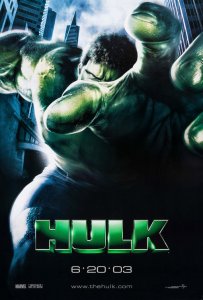 Originally released June 20, 2003:
Comic book movies are all the rage these days. The X-Men films, Spider-Man, even Daredevil all managed some level of success because they were, at their heart, entertaining pulp and treated the source material with some sense of reverence. Now Ang Lee’’s monstrous film Hulk lumbers into theaters and one could best describe it as being too serious for its own good.
Bruce Banner (Eric Bana) is the quiet guy, the one who bottles everything inside. His lab partner Betty Ross (Jennifer Connelly) has recently broken off their relationship due to his emotionally shut-off demeanor. Well Bruce gets hit with a lethal dose of gamma rays and it kicks up something inside him. You see, Bruce’s long-absent father (Nick Nolte, looking frightfully like his drunken mug shot photo) experimented some kind of regeneration serum on himself. When he fathered Bruce he passed on whatever genetic alteration. So now when Bruce gets mad he turns into a 15-foot raging Jolly Green Giant (the CGI in this movie is not good). He starts enjoying the freedom letting go can bring. Nothing gets him more mad than some yuppie (Josh Lucas, badly miscast) trying to buy out his lab and then kill him to sell his DNA to the military. Along the way, Betty’’s father (Sam Elliott) tries to hunt Bruce and his greener-on-the-other-side alter ego for the good of us all.
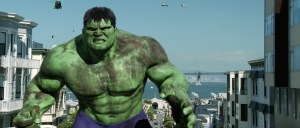 Director Ang Lee has injected most of his films with a sense of depression and repression, from the biting and darkly astute The Ice Storm to the stoic Gary Cooper-like silence of the aerobatic samurai in Crouching Tiger, Hidden Dragon. He’’s a master filmmaker without question. Lee bites off more than he can chew with Hulk much like the gifted Cameron Crowe did with the sci-fi Vanilla Sky. Lee is so damn ambitious that Hulk tries to be everything and it ends up fulfilling nothing. His film is the most ambitious and the most tedious super hero/comic book movie of all time. What does it say when the super green Hulk has more personality than the bland Bruce Banner?
The acting is a non-issue here. Connelly remains one of the most beautiful women in all of movies and has incredibly expressive eyes and brows. She has this strand of hair that’s always in the right side of her face. It’’s so awkward. Bana gets the least fun part as the mentally scarred kid afraid of his own anger. He doesn’’t do much but then he isn’’t given much. Elliott overacts with impressive gusto whereas Nolte overacts like every line was his last breath.
After about an hour or so of beleaguered talking and flat characters, I started to become restless. I wanted to see Hulk smash, Hulk smash good. Instead what you get is endless scenes of cheesy speeches, sci-fi babble speech, phony philosophy, and mind-numbingly awful pacing. Seriously, Hulk has worse pacing than glaciers. You’’ll see the Mona Lisa yellow faster than this movie will be over. And in some weird paradox, I think it’ will never be over.
 Lee attempts to make the film a living comic book. You’’ve never seen this many wipes short of a Brady Bunch marathon on TV Land. Lee splits his screen into multiple panels and slides them around much like the layout of a comic book. However, this visual cue is overused and calls attention to itself in a “how-arty-are-we” kind of pretentious way. If Hulk was attempting to be a comic book movie, then where the hell did all the action go? This movie could have been subtitled The Hulk Goes to Therapy because everything excluding an over-the-top final act revolves around people working out childhood issues. Man, there’’s nothing I like to see more during the summer than a $150 million-dollar movie about – people working out childhood issues.
Hulk is an overlong and meandering film that’s incredibly serious, incredibly labored, and incredibly boring. Someone needs to tell the creators of this film to lighten up. The big-screen adaptation of the big green id may have heavy doses of Freudian psychoanalysis (try and tie THAT with the merchandising onslaught) but the film is barren when it comes to fun. Even comic book fans should be disappointed. I heard a story of a kid who saw Hulk and asked his mom when the movie was going to start, and she replied, “90 minutes ago.” Should you see Hulk in the theater at full price? No. Instead, give your money to me. It will have more resonance.
Hulk mad? Audience mad! Audience leave theater. See other better movies instead. Hulk sad. No Hulk 2. Audience happy.
Nate’s Grade: D+
——————————————————
WRITER REFLECTIONS 20 YEARS LATER

Ang Lee’s Hulk is a unique experience that no other comic book movie has delivered in the ensuing twenty years. It’s clearly trying to do something heady, something more Freudian and psychological and cerebral, and yet it’s also doing so in a clumsy, wipe-heavy, panel-sliding bonanza of split screens and goofy transition shots. This movie would be fascinating to dissect if it wasn’t also so crushingly and unrepentantly boring. Even having seen the movie in 2003, I was still shocked how bored I was re-watching all 138 minutes in 2023. It’s such a strange experience to watch a movie that, at any moment, can be so weird and different, and then in the next minute make you contemplate doing your taxes again.
I think what Lee and his screenwriting partner James Schamus, who has written nine Lee movies going back to their very first, 1991’s Pushing Hands, were most intrigued by the Jekyll/Hyde allegory. Hulk is not alone in this regard in the realm of super hero dramatics; many characters lean into their alter ego as a form of personal wish-fulfillment, processing trauma, and/or freedom not allowed under their normal persona. The added complication with the Hulk is the monster factor, that when the man, Bruce Banner (Eric Bana), loses his temper and he unleashes his “big green id,” the ferocity he was holding back. The man/monster dynamic is what clearly interested Lee and Schamus, so we get plenty of dweeby Banner being bossed around and then confessing that, after his transformation, he likes it when he lets go and just succumbs to his more “smash everything” urges. However, this story angle is just crushed by the overwhelming weight of the overwrought psychoanalysis of Banner’s daddy issues and repression. The problem with this heavy-handed approach is that the answers are obvious and yet also confounding at every turn. Bruce’s father David (Nick Nolte) experimented on his own DNA, which he passed onto baby Bruce. The implications are used more as a handy explanation for why Bruce didn’t die from his fateful gamma radiation accident than as a cautionary tale of human experimentation. The repeated flashback reveals are drawn out far too long with the most obvious conclusions (Baby Bruce watched his father kill his mother and now he’s… upset). Every time his old family bedroom door showed up again, I would slump in my seat, losing more willpower. Likewise, it feels like Nolte is just crashing into the plot like an unwelcome sitcom guest, on a different acting plane and hamming it up as part-hobo and part-very transparent mad scientist. The man creates Hulk dogs from poodles and sets them on his son’s girlfriend. He bites a thick electrical cable like he’s in Who Framed Roger Rabbit?. It’s silly and not worthy of portentous psychoanalysis with a figure this one-dimensional. David is such a boring and obvious bad dad figure with traits of megalomania and score-settling, so Bruce’s daddy issues are an extended story obstacle I was eager to already have gotten over.
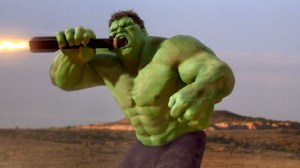 Then there’s Lee’s artistic decision to film the movie like a living comic book, with the screen transforming into the panels and splash page art of sequential media. The problem with this is that movies are already sequential media, they’re already one image leading to the next to create a specific artistic impression. Lee’s editing and visual artifice lets you know at every turn that You Are Watching a Comic Book Movie. It broke my immersion every time, and even worse it detracted from the drama of the moment. A poorly timed split-screen or image swap can create its own form of derisive attention. I challenge anyone to watch the demise of Josh Lucas’ smarmy corporate bully and celebrate the freeze frame that then gets engulfed with flames and speed wipes to the next scene. It’s reminiscent of 2008’s Speed Racer, a movie I also just recently re-watched for a new evaluation since it’s taken on a bit of cult status, where the screen is overburdened with oppressive visual gimmicks, many transitional, to make it feel like a living anime. The problem is that live-action is its own reality, and trying to duplicate one from the pages of comics or the screen of high-energy anime brings its own tonal risks. Some times an artist can perfectly meld the different worlds, like 2010’s Scott Pilgrim Versus the World or 2018’s Into the Spider-Verse, and then other times, most often, you get stuff like Speed Racer and Hulk, movies that are trying so hard and annoying you with their try-hard visual whimsy. It’s not pretension as I dubbed it in 2003, it’s more grasping desperation to ape the source material, and it gets oh so tiresome. You might as well turn it into a drinking game whenever there’s a snap zoom or a strange transition wipe that makes you roll your eyes or release a deep, lung-clearing sigh.
The special effects weren’t quite there at the time to better realize the big green guy, though they were close. Most of the brief Hulk appearances are during darkness, to better camouflage the special effects (naturally Lee would say it’s to build up anticipation, but I think we know why). The big action doesn’t kick in until 90 minutes, and it’s a long slog to get to that point, almost like Lee and Schamus were wanting to stoke audience rage, grumbling and demanding something get smashed after the protracted buildup to perhaps better identify with the hero. This is a movie with a Hulk poodle and Nick Nolte turning into an electrical monster (his infamous 2002 mugshot was mere weeks after filming finished). The abilities of the Hulk also feel inconsistent, and I’m not just talking about the elasticity of his pants never breaking. He can jump miles into the air from simply standing? The darker human impulses that gave birth to the Hulk are so emphasized that the green guy feels less like an alter ego or other half of Banner and more like a fleeting dream, a mirage of a character that is merely this boring man getting to feel like a big man. Even the dichotomy feels so overwrought and limited in exploration, settling on psycho babble patter. As I said in my incensed 2003 review, “This movie could have been subtitled The Hulk Goes to Therapy because everything excluding an over-the-top final act revolves around people working out childhood issues. Man, there’’s nothing I like to see more during the summer than a $150 million-dollar movie about – people working out childhood issues.”
 This is an interesting misstep for Lee, who has since gone to win two Oscars for Best Director in 2005 and 2012. He was hopping from genre to genre with wild abandon. He went from a dark suburban drama to a Civil War drama to a martial arts fantasy to Hulk to an award-winning tragic gay romance to a historical thriller set in occupied China that earned an NC-17 rating to a comedy about putting together the famous Woodstock concert to a mystical fantasy drama about a man abandoned at sea with a wild tiger. Perhaps only Steven Soderbergh could cite a comparatively varied resume. Lee’s last two movies feel more like failed exercises in the technology of high-frame rates than complete or engaging movies. He hasn’t directed a film since 2019’s Gemini Man, though he has a movie dramatizing the Thrilla in Manilla in the works (NOT written by Schamus, at least as of this writing). The man’s artistic need to experiment with form and special effects is evident with the entire visual approach to Hulk.
You’ll likely never see another Hulk solo movie again, and that’s because Universal still owns the rights to the character, at least for solo adventures. So if Marvel were to give their version of Banner (Mark Ruffalo) his own movie, they’d have to split the profits with Universal, and even though the Marvel Cinematic Universe (MCU) has become the gargantuan money-making machine it is today, they don’t want to share the wealth. You’ll just have to enjoy Ruffalo’s appearances in Marvel movies and the occasional TV series, like last year’s She Hulk. It’s probably for the best considering that the character seems to work best as part of an ensemble rather than a lead, as also evidenced by the 2008 big screen Incredible Hulk with Edward Norton. The only lasting factor from that movie that carried over into the ongoing MCU was William Hurt as General Ross, and since Hurt passed away in 2022, he has been recast as Harrison Ford, so now there is no connective tissue at all between the last big screen Hulk movie and the Marvel movies.
My original review in 2003 was full of incredulous snark, much of which I can still feel to this day. I’m less angry by this movie, as it takes something really offensive to get under my skin as a moviegoer these days, unless you’re Dinesh D’Souza, but I’m just as baffled, not that the filmmakers wanted to try something more cerebral and psychological but that their idea of that was so murky and underwritten. It’s not a smart movie, and the visual razzle dazzle is distracting, goofy, and tonally incongruent with the overwrought attempts at drama, in between killer poodles that is. This is a curious movie, a rare example of talented artists really just fumbling at a high level of studio money. I felt bad for Jennifer Connelly who seems to have been given one acting note: look wide-eyed and stunned. As a superhero movie, and as a summer blockbuster, Hulk will disappoint. As an experimental big-budget Freudian analysis of the duality of superheroes, Hulk will also disappoint. This is such a strange and boring movie, but it’s not worth your time in 2003 or 2023 or any other year. The grade remains the same twenty years later, sad to say.
Re-View Grade: D+
Share this:

The Matrix Reloaded (2003) [Review Re-View]
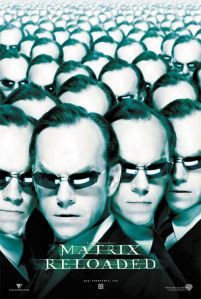 Originally released May 15, 2003:
Imagine my disappointment as I viewed the highly anticipated sequel to 1999’s sci-fi smash The Matrix and learned that the writing and directing team of the Wachowski brothers had taken a page from good ole’ George Lucas on how to make sequels: the “bigger is better and more is more” approach. Like the first two Star Wars prequels, the second Matrix movie is overstuffed and unfocused. Unlike the Star Wars prequels, it’’s also extremely talky when it comes to psychobabble that would only impress the bong-carrying peanut gallery.
Reloaded picks up some time after the first. Morpheus (Lawrence Fishburne), Neo (Keanu Reeves), and Trinity (Carrie-Anne Moss) are late for a pow-wow with other leaders including Morpheus’ former flame, Niobe (Jada Pinkett Smith). In this meeting, which is within the Matrix, we learn that the humans have discovered that the machines are drilling at an incredible speed and will reach Zion, the last human city far beneath the Earth, in a matter of days. Add this to the bad dreams Neo keeps having where Trinity falls out of a building and gets shot by an Agent, and things are not looking good for our heroes from the first film.
At Zion, Morpheus stokes up the crowd who already believe that Neo is The One in the prophecy of the Oracle (Gloria Foster). They believe he is the one who will lead them to topple the machines. Morpheus informs the many citizens of Zion (okay, the last battalion of the human race lives in caves under the surface and people are STILL wearing sunglasses all the time? Watch your heads.) that the machines are digging to a town near you, and they have 250,000 Sentinels to wipe out what remains of humanity.
 So what do people do next; what would your standard response be? Apparently, in Zion, it involves a massive spontaneous, sex-charged rave. The multitudes of Zion start grinding and sweatily dancing to electronic beats. And curiously, as you’ll notice with the slow camera movement in the scene, NO ONE in the future wears a bra. Perhaps the machines got those too. So after a tremendously long span of raving with nipples, inter cut with Neo and Trinity knockin’’ boots (though could you imagine zero-gravity sex in the Matrix?), the heroes set off to find the Oracle once more. Zion is preparing to mount a counterstrike against the burrowing machines and is hopeful that it will buy them some time. They plan on sending the entire fleet out, save Morpheus’ ship and one or two to aid him in his quest.
Neo finally regroups with the Oracle along a park bench inside the Matrix. She puts forth more psychological babble about choice and how choices are already made before you make them. You may start zoning out and wondering when people are gonna’ start punching people again, because it takes a good 45-50 minutes to get into this movie. The Oracle does have an interesting tidbit of information however. She reveals that the Matrix if just chock full of rogue programs living out their days in the confines of this virtual reality. Included in this group are werewolves, vampires, ghosts, angels which are all programming errors that walk among the Matrix. So, wouldn’’t it be kind of neat to see Neo fight the monsters from Universal Studios (“Hey Frankenstein monster … I know kung-fu” “Fire baaaaaaaaaad!”)?
The supreme drawback of Reloaded is that it introduces us to a plethora of new characters, all with minimal screen time and even more minimal plot impact, and then fails to advance the story. Niobe is pointless except for the old action picture adage of being at the right place at the right time to rescue our seemingly doomed heroes. A rogue program that calls himself The Merovingian (Lambert Wilson), who decides on being a European playboy with an accent that renders all speech useless, snoots and huffs his way around. Monica Bellucci plays his wife. This Italian actress can be enthralling, and not just on the eyes, but she also serves minimal purpose other than some heaving chest shots. Then there’’s the Keymaker, who will somehow lead Neo to his destiny or whatever. There’’s about fifteen or so new characters and hardly any of them matter. The coolest additions are the twins, a pair of pasty dreadlocked fighters who can go through walls and parry any enemy assault. More time is needed for these two before they turn into another wasted villain, like Star Wars‘ Darth Maul.
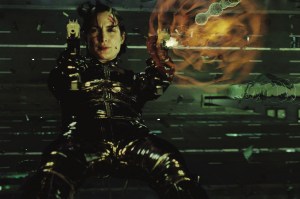
 All of this criticism is moot, of course, because the center of The Matrix is on inventive and pulse-pounding action, right? Well I’’d say that is so with the 1999 film but its sequel suffers when its action sequences drone on and become repetitious and dull. Neo fighting twenty or so replicates of Agent Smith (Hugo Weaving) is interesting and fun, but when ninety more show up and it’s painfully and slightly embarrassing when the people fighting are CGI, then the fun level drops with the film. Neo ends the big brawl by flying away. My friend next to me whispered in my ear once this scene concluded, “If he could fly, why didn’’t he fly away at the beginning?” My response: “That would be using your brain.” Seriously, this action sequence is nifty and all but it serves no purpose, just like much of the first half of the film.
The freeway chase scene seems to already be famous and with due cause. Trinity and Morpheus zooming through traffic, fighting Agents and the twins, is a fantastic set piece that is reminiscent of the inventive action the first Matrix gave us. When Trinity zooms through oncoming traffic on her motorcycle the film comes alive and my attention was certainly front and center. The scene does fizzle a bit as it segues into Morpheus fighting an Agent atop a speeding semi. Again, the CGI rotoscoping of the landscape and the people is painfully obvious and detracts from the enjoyment.
What ultimately kills The Matrix sequel is that no one had the heart to question if maybe more wasn’’t better. Sure the Wachowski brothers had all the riches unto Caesar to make this movie, but what perplexes me is that once we do get much more it only feels like more of the same, and disappointment sets in. Agent Smith is shoved to the side of the film and pops up here and there to glare. He’s more or less just repackaged with nothing new and no personality, like much of the film. The purposely perplexing psycho-babble does not help. I’’m sure hundreds of websites will dissect the exact philosophical links the movie presents, but man, all this talking about stuff that’s shutting down my brain is getting in the way of ass-kicking. I felt bloodlust the more I heard people, usually some old bat, endlessly blab about causality and choice. When it comes to action-packed sequels from 2003, I’ll take X2 any day over Reloaded.
 This is not to say that Reloaded is a bad film because it does have some nice special effects, cinematography, and some cool action sequences. These points of interest do not, however, justify its bloated running time. Some things were better left to the imagination, like the city of Zion, which looks about as dreary and dull as you might expect the last bastion of human civilization to look like in a ruined world, but this is science-fiction. Where’s the fun in dreary and dull? Again, whereas the first Matrix took place mainly in the false virtual reality where we could watch fantastic feats defying the laws of physics, Reloaded spends half its time running around the dank real world.
Some moments did have me giggling, like the Merovingian’s joyous creation — an orgasm cake. A woman has a piece of cake and her temperature rises. Finally the camera literally zooms into her vagina (it’s in computer-code so it’s all columns of spicy green numbers) and we see an explosion of light. Very interesting indeed. Essentially, this is a key metaphor for the film itself: an attempt to have its cake and eat it too.
The Matrix: Reloaded is an occasionally entertaining and often mind-numbingly talky summer entry. You’ll get some thrills, maybe the philosophy will connect more for some (even though to me, at the heart, they say very little very eloquently), but because The Matrix is a colossal franchise that will make a gazillion dollars and then some, the power of editing has been kicked to the curb. If that power had been present perhaps someone could have trimmed a few of the many peripheral characters, kicked the pace up a few notches, reworked the fight scenes to advance the plot and stopped events from being so repetitive, and while they were at it maybe they could have done away with all the philosophy and stilted love dialogue. As it stands, The Matrix sequel has lost a lot of edge and this is because of the initial success of the first film. Sure, you might have an intermittently good time, but you should have had a great time. The Wachowski brothers had every tool at their fingertips but they became so enamored with fame and fortune that their work of creativity and genius has morphed into a self-indulgent, adolescent (with its hormone-driven sexual events and its stoner philosophy) cash cow.
Nate’s Grade: C+
——————————————————
WRITER REFLECTIONS 20 YEARS LATER

It’s taken me close to twenty years but I’ve come around on the notorious 2003 Matrix sequels. Before the release of The Matrix Resurrections in 2021, I sat and re-watched the two prior sequels, both of which I was dismissive and disappointed with when they were originally released, as it seemed was the general public. I had an ongoing joke about lambasting The Matrix sequels whenever I could in other film reviews, and my takeaway was that the Wachowskis had turned their masterpiece of a single film into a mediocre franchise. There are still criticisms to be had with Reloaded, released in May of 2003, and Revolutions, concluded in November of 2003, but I feel confident to say that the much-maligned sequels have gotten an unfair rep. Yes, part of this reappraisal was a result of just how staggeringly stilted and self-loathing the 2021 sequel/reboot was, so I guess we can just shift the sequel ire to the newest member of the club. I only selected one Matrix movie for my twenty-year re-watch and I chose the more controversial of the pair, the talkier and more esoteric one, and I’m here to say that The Matrix Reloaded, while not soaring to the same sci-fi heights as the first, is actually a worthy sequel that is ultimately sabotaged by unrealistic audience expectations as well as a pedestrian concluding movie.
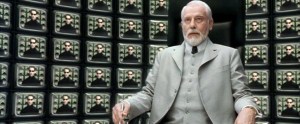
 The charge against Reloaded, and one that I was making with the rest of the keyboard mob, was that it was pretentious and filled with too much bloated speechifying and not enough fun action. This is untrue on both counts. Much of the charges of pretension related to two specific characters within the virtual reality Matrix, the Merovingian (Lambert Wislon) and the man behind the curtain, The Architect (Helmut Bakaitis), and both of the characters are meant to be pompous. The Merovingian enjoys the sound of his own voice, though the language he most prefers is swearing in French (“Like wiping your ass with satin”). He’s the virtual equivalent of a self-satisfied mobster, experimenting and collecting old code that was meant to be eliminated over time, such as literal werewolves and specters. He’s full of himself because of his position and definitely condescends as a means of appearing even more the elite information broker. He cites choice as an illusion because he’s the collector and creator of code, controlling his reality. He’s annoying on purpose, so his verbal excursions are only meant to land in a broad sense. Choice versus fate will be the biggest and most obvious theme of Reloaded, so the Wachowskis don’t care about one more character nattering on a philosophical tangent of his own flattery.
The Architect was such a letdown for me in 2003 but I now appreciate the choice more for its subversive slap. You’re expecting our hero Neo (Keanu Reeves) to confront the machine version of himself, and instead it’s this fussy old man and his above-average vocabulary is part of his disdain and boredom. The revelation that Neo is not the Chosen One but the sixth Chosen One in an ongoing cycle of destruction and renovation is a startling revelation. It’s the necessary step to push Neo out of his boring overpowered Superman role. Now he has a real choice, to follow the script in order to save the masses, or to risk everything for the human equation of love. If everything in the two movies was following a predestined path, this is when the franchise and Neo chart their own path, choosing to be reckless in the face of redundant and never-ending conflict. The knowledge that what happens next will be a significant change is a far better ending than simply watching a CGI Neo pummel more CGI Agents. It’s the ending audiences weren’t prepared for but it redefined the conflict between the machines, the nature of Neo, and the relationship between Neo and Trinity (Carrie Anne-Moss). It was more interesting by rejecting the same old. It deepens the conflict and the personal sacrifices, and it set up the humans versus machines war to have even more meaning, a promise that Revolutions could not fulfill satisfactorily. There wasn’t even anything as weird as the slow-mo cave rave or the orgasm cake.
 As far as action, there are some clunky fight sequences that feel perfunctory, like the Wachowskis are closely monitoring the 140 minutes and making sure they have some fisticuffs at precise moments to sate their mass audience. However, the massive highway sequence is legitimately one of the greatest action set pieces of the twenty-first century. The movie takes a while to get going but once it hits the Merovingian part everything that follows is good-to-great. The fight with the Merovingian’s henchmen eschews guns for bludgeoning tools and allows a more interesting array of fight choreography. Then we’re introduced to the ghostly twins who can phase in and out of physical being, which adds a fun new complication to fight choreography. Then we’re onto the highway, the place that Morpheus (Lauerence Fishburne) always warned others to avoid at dire cost. We see why because it becomes a bumper-car collision course with Agents jumping in and out of drivers and creating even more havoc (Ford donated over 300 cars to the production and by the end each one was totaled). This entire sequence is exhilarating, morphing from new complication to another, and the Wachowskis make it clear at every point what is essential, what the geography is, and how the organic challenges emerge. It’s a big, splashy sequence and it’s no coincidence that Neo isn’t involved until the very end, serving as a convenient deus ex machina to snatch our characters from imminent danger. The problem with Neo is that he’s too powerful that it removes stakes. He can stop bullets, take on a hundred Mr. Smiths (Hugo Weaving, the devious highlight of the 2003 sequels), and even restart human hearts. Watching Neo flex his muscles in various fights is fine (though the CGI people drain the momentum of many of these brawls) but it’s far more exciting to watch “normal characters” against daunting challenges. Even the final mission involves an alignment of many people working together so it creates some sense of risk. The action might not be as innovative as it was in 1999 but it still packs its own explosive entertainment with a clear vision and sense of style.
I think my own previous sour feelings were a result of The Matrix Revolutions flubbing the hand-off, dropping many of the more interesting additions from Reloaded and spending far too much time in the dingy underground real world. It’s confusing to introduce a reality-defying world of the Matrix where characters can act like superheroes, and then the movie spends more of its time on people in mech suits firing endless bullets at a shapeless cloud of robot tentacles. The clever redefining of Neo as but one of many Chosen Ones is downplayed when it turns out he might be the most Chosen One-d of chosen ones, having mystical powers inexplicably outside the world of the Matrix. And the romance between Trinity and Neo was yet another aspect that felt swept up in an overly familiar messianic mission, which might be why Lana Wachowski chose to re-emphasize this relationship as a romance for the ages in Resurrections. It’s not Reloaded’s fault that the next two Matrix sequels failed to live up to its promising ideas, new characters, and dynamic action. I think the jilted reaction to Reloaded lowered the expectation bar for Revolutions, which might be why I, at the time, preferred the third movie to the talkier and more esoteric second entry.
 Re-reading my original 2003 review, I was clearly charged with my disappointment. There is a healthy level of snark throughout the review, as per a 21-year-old smart aleck. There’s more than a couple iffy references to stoner philosophy. I still agree with several of my old criticisms, such as spending far too much time in the “dank real world,” but I believe my hostility was misplaced. I was expecting a very different movie than the Wachowskis were interested in exploring, and it took me twenty years (technically 18 since I watched them all again in December 2021) to reassess my feelings and appreciate them on their own artistic terms. If you’re like me and only remember The Matrix sequels in a rather negative fashion, I recommend visiting them again with an open mind. That’s not to say they’re bulletproof, but after twenty years of rampant superhero movie escapades, I appreciate the thoughtful and subversive attempt to re-insert stakes and meaning into their original Chosen One franchise. Now, if Resurrections is any sign, please pass the creative reins to a worthy successor and let someone else dabble in this virtual reality sandbox for any possible future tales.
Re-View Grade: B
Share this:

Bulletproof Monk (2003) [Review Re-View]
 Originally released April 16, 2003:
This is one of the dumbest movies you will ever see. I don’t mean to sound overly sensational or alarmist, but this is the honest truth if you sit and watch all of Bulletproof Monk. Item #1: The bad guys in the film are –get this– the grandchildren of Nazis. Yes, that’s right, Nazis. We had to have Nazis as the bad guys. There’s actually a scene where a blonde-haired blue-eyed granddaughter wheels her decrepit Nazi grandpa around. Oh yeah, and one of the Nazis runs the –get this– Museum of Tolerance. Oh stop it, you’re killing me. Item #2: The titular monk (Chow-Yun Fat, pray for him) recruits pick-pocket Kar (Seann William Scott) to be his apprentice. Kar is an idiot. The Monk doesn’t help. His big mystery is –get this– why hot dogs and hot dog buns come in different numbers? Man, haven’t heard that one since the third grade. That would heartily explain why a character is called “Mr. Funktastic.” Item 3#: The monk teaches in stupid opposite talk (“You cannot be free until you have been taken. You cannot be cold until you are hot. You cannot die until you have lived,” you try some). One of the monk’s lessons is that the laws of physics, mind you the LAWS of physics, can be bent just by putting your mind to it. He says gravity can be overcome if you just don’t believe in it. This is insane. At least in The Matrix it had some plausibility. Item #4: The movie is a complete rip-off of The Matrix. I’m not just talking style, no, I’m talking everything. There is a scene where the monk and Kar run through a street and building, defying gravity, being chased by men in suits and sunglasses, and they get to a roof where they must combat a helicopter. What movie does this sound like, hmmm? Item #5: The visual effects are done by –get this– Burt Ward’s effects house. Yes, that’s right, the guy who played Robin on the campy 60s Batman show has an effects company. And they did the horrible work on Bulletproof Monk. This movie is so terrible at every level of filmmaking that it becomes enjoyable to watch, in the same vein as 2001’s stinker Dungeons and Dragons. I defy anyone to find merit in any of it. Sometimes you have to wonder what Hollywood was thinking.
Nate’s Grade: F
——————————————————
WRITER REFLECTIONS 20 YEARS LATER
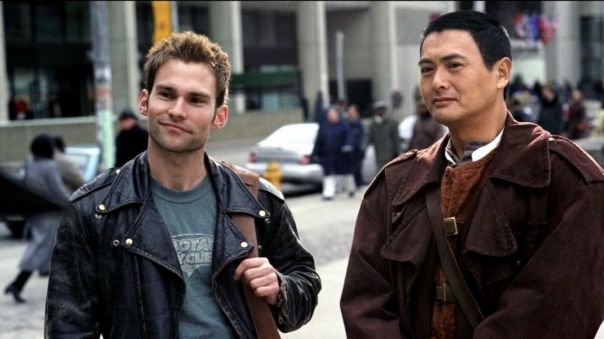
This is, without a doubt, one of the worst movies I have ever seen, and I was entertained for every bizarre, outlandish, and awful second of it. Bulletproof Monk is based on a comic book series but it’s really an incompetently designed and executed $50-million mock version of The Matrix. Within seconds of the movie, I was already laughing out loud, and I need to go into detail just for the first ten minutes, which I highly recommend to everyone as a taste setter. We open with two monks battling atop a rope bridge and, even accounting for the poor aging of special effects two decades later, it is some of the hokiest green screen I’ve ever seen. The way both characters leap, the way the movie haphazardly edits around the fight, the speedy levitating like a video game glitch, the duel spinning that goes on and on without orienting the audience, and then it all concludes with the apprentice grabbing the elder monk’s incongruous rubber sneaker before he falls. In just a short couple of minutes, we already have a clear indication what a mess this will be. Then the Nazis show up and kill the Tibetan monks and search for a mystical scroll that has the power to destroy all life on the planet, which is a good enough reason not to leave it easily accessible to Nazis. The lead Nazi massacres the monks with the exception of Chow Yun-Fat’s nameless monk who has just recently been dubbed the supreme monk in charge of scroll security. The main Nazi shoots him and the monk falls off a cliff, but not before the Nazi says “monk” a dozen times, including screaming it to the heavens to conclude the scene when he cannot find the fallen body. I defy anyone to watch and appreciate the opening on an intentional level.
The action goes from incomprehensible to boring. It’s the kind of movie where the bad guys will just show up with a helicopter with attached Gatling guns and fire into a warehouse even though there’s been no established reason they know our characters are inside or where inside they should start firing. It doesn’t matter because all the movie wants is a sudden burst of action with a vroom-vroom going pew-pew-pew until there’s a big boom. These same goons are also perhaps the dumbest hired goons in memory, as they’ll miraculously get the jump on our heroes, complete with helicopter action, but not check behind doors when coming onto a roof. There’s a moment where Sean William Scott is overpowering a man six inches taller than him and clearly with a hundred more pounds on him. This isn’t through some ingenious example of outsmarting the competition or using torque to your advantage, it’s just Scott out-pulling this guy, and this is before he even adopts the fantasy-blurring superpowers the monk will teach him.
The action scenes are all chopped up with jumbled edits. The choreography can be passable at points but seems to emphasize the exact wrong moments, like the duel spinning monks that twirl needlessly forever in the opening or Fat leaning forward and spinning around the floor while casually eating a bowl of noodles to clown Scott. It’s badly composed and badly edited. The action scenes are so silly and stupid and then you throw in the willful distortion of gravity because, as we’re told, physics are only real if you believe in them. The world of bending reality worked in The Matrix because reality was an illusion (or, as the Merovingian would say, “an eloooschean”) and a virtual reality setting where rules could be bent. What we’re entering here is a realm closer to 2008’s Wanted, where the tried-and-true laws of nature are merely suggestions, and all the cool kids can curve bullets if they really put their mind to it. It’s not like action movies don’t already exist in a heightened world of expectations and genre pyrotechnics, and then you add martial arts mysticism on top of it with wire-fu and we’re already stretching the bounds. I think what rubs me the wrong way thoroughly with Bulletproof Monk is how lazy it is. It’s not like this monk has some special power that allows him to overcome physics, some master knowledge that will educate his protégé. He just tells him that belief is stronger than physics, like this was a sentimental children’s movie about Santa Claus. If that’s the level of explanation that’s acceptable, it’s a bad sign how much more effort will be put into any storytelling or entertainment factor in this ridiculous mess.
Let’s also zero in on the apprentice character played by Scott, an actor I’ve generally enjoyed and who was hitting his commercial heights circa 2003. He plays Kar, though when the monk informs him that he is mispronouncing the Cantonese word for “family,” the American pickpocket brushes away the cultural correction from the native speaker. Here is a man who lives and works in an old Chinese movie theater with a crotchety old Japanese owner (Mako) and where he watches classic kung-fu movies and teaches himself martial arts. I suppose Kar could be a self-taught genius but he displays little dedication or skill beyond pickpocketing, which has always been a nagging movie cheat to me where people can just barely bump into you and magically gone inside your coat pocket and lifted a wallet all without your awareness. He’s the wise-cracking sidekick-slash-protégé learning about the wider world and breaking the rules, like Neo. Except he’s mostly obnoxious and useless, that is, whenever he isn’t inexplicably taking out professionally trained mercenaries with moves he learned from Bruce Lee marathons. Kar is not even an enjoyable annoying role for Scott like in 2003’s The Rundown.
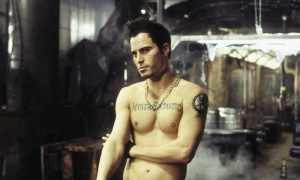
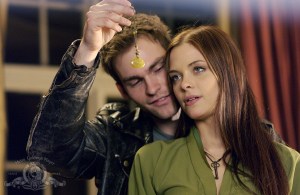
Another ridiculous character and storyline involves the leader of the underground street gang and his name is Mr. Funktastic. I know this because Marcus Jean Pirae (Girl Next) literally has “Mister Funktastic” tattooed on his bare chest (though it looks like he might be missing a well-placed “N” as well). He’s British and the leader of a gang of would-be street toughs and orphans, and it’s like the movie has dipped into something downright Dickensian, or maybe the 1991 Teenage Mutant Ninja Turtles movie. These guys are upset that Kar is stealing on their turf and challenge him to prove his mettle. I don’t know what this idiot character adds to this universe besides further making it incredulous. He and “his girl” even party in the underground raves in old subway cars, and all of this just makes me wonder what adults think goes on in subway systems. Oh, and that’s right, the female love interest is named Jade, played by Jaimie King (Sin City, Pearl Harbor), and this plays into one of the most stupid yet hyper specific ancient prophecies that tips off the monk to Kar’s potential. All you need to know about the supporting characters in this movie is that there are multiple generations of Nazis and they are running a Holocaust museum secretly to hold onto their trophies under the cover of enlightening the world about anti-Semitism and white supremacy.
Bulletproof Monk is the only movie directed by Paul Hunter, a respected music video director who has worked for decades and is responsible for Aaliyah’s “One in a Million,” Mariah Carey’s “Honey,” the “Lady Marmalade” remake from Moulin Rouge, and the unfortunately titled duet by Jay-Z and convicted rapist R. Kelly, “Guilty Until Proven Innocent.” This experience must have been so bad that Hunter swore off ever helming another feature-length movie again. The nature of music video direction attracts stylists, but this movie is so overburdened with trying to ape The Matrix on a scaled-down budget, with janky bullet-time effects and wire work (our heroes are even on the run from men in suits and sunglasses). The wire work doesn’t add grandeur and majesty to the movie because it doesn’t have the understanding of how to present it so that it looks cool; it always just seems goofy and inferior to better references. I think Hunter’s personal vision and style were just swallowed whole by the demands of making this silly movie, encroaching studio pressure, and it feels like he just gave up and the movie was benignly born by committee. I don’t blame Hunter for giving up on this movie and I guess on all movies.
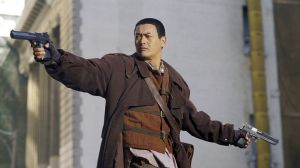
Can you enjoy Bulletproof Monk on a so-bad-it’s-good level? Do hotdogs come in packages of ten and hotdog buns come in packages of eight? The answer is an enthusiastic yes. This movie is ridiculous in every moment, only forming a somehow more ridiculous whole that defies not just the laws of physics but conventional storytelling and good taste. It’s a movie that has no idea what to do with Chow Yun-Fat and his abilities, instead coasting on the idea of the man’s involvement like the geezer teasers of recent memory that don’t so much challenge their famous stars as advertise they could afford them for a weekend or two of un-taxing demands. It’s a movie that begs to exist on a dumbed-down level of action movie junk science but doesn’t understand how to, properly, have fun within that setting. It’s so transparently indifferent or lazy or ripping off its many action/sci-fi inspirations, chiefly The Matrix. John Woo is a producer on the movie and it’s not hard to see how a Woo-directed Monk would have played to its outlandish peaks. Instead, everything is an inferior version of the better reference point. It’s silly and worthy of a night with friends, adult beverages, and lots of boorish and increasingly incoherent commentary.
Looking back at my initial review from 2003, I think my criticisms still hold but I would elevate the grade simply from its unintentional entertainment value. This is pure unintended camp, and as such Bulletproof Monk might be one of the worst movies I’ve watched and still undeserving of a failing grade, and so I will charitably raise it a letter to a D grade (on a curve, a bullet curve).
Nate’s Grade: D
Share this:

The Core (2003) [Review Re-View]
 Originally released March 28, 2003:
I knew about 15 minutes in that The Core was not going to take its science too seriously. Aaron Eckhart, as a hunky science professor, is addressing military generals and essentially says, “We broke the Earth.” He tells them that because the Earth no longer spins (don’t think about it, you’ll only hurt yourself) the electromagnetic shield will dissipate and the sun will cook our planet. And just to make sure people understand the term “cook” he sets a peach on fire as an example. At this point I knew The Core was going to be a ridiculous disaster flick with its tongue firmly planted in its cheek.
Earth’s core has stopped spinning and horrific disasters are starting to be unleashed with anything from drunken bird attacks to lightening strikes in Rome. I always love how in disaster films Mother Nature always instinctively goes after the monuments, the landmarks, the things of cultural importance. The United States government hires a ragtag group of scientists and NASA pilots to journey to the center of the Earth and jump-start our planet. Of course everything that can go wrong on this fantastic journey will eventually go wrong.
The Core is so improbable, so silly, that it ends up being guilty fun. If you let go, ignore the incredible amounts of birth imagery (the sperm-like ship tunneling through to get to the egg-like core), then the very game cast will take you for a fun ride.
There’s a scene where the government approaches kooky scientist Delroy Lindo to build the super-ship that will take them to said core. When asked how much he thinks it’ll cost Lindo laughs and says, ”Try fifty billion dollars.” The government responds, ”Can you take a check?” I was pleasantly reminded of an episode of Futurama where the space-time continuum is disrupted and time keeps skipping forward. The old scientist and a Harlem Globetrotter (it was a very funny episode) theorize that to create a machine to stop this problem they would need all the money on the Earth. Flash immediately to the two of them being handed a check that says, “All the money of the Earth.” Richard Nixon’s head, in its glass jar, then says, “Get going, you know we cant spend All the Money on the Earth every day.”
 The assembled cast is quite nice. Hilary Swank assumes a leadership role quite nicely. Eckhart is suitably hunky and dashing. Stanley Tucci is very funny as an arrogant science snob. Tcheky Karyo (the poor man’s Jean Reno) is … uh, French. I don’t think anyone would believe that these people were the best in their fields (only in movies are scientists not old white men but hunky and sexy fun-lovin folk).
Director Jon Amiel (Entrapment) seems to know the preposterous nature of his films proceedings and amps up the campy thrills. An impromptu landing of the space shuttle in an L.A. reservoir is a fantastic action set piece, yet is likely the reason the film was delayed after the Columbia crash. The cornball science and steady pacing make The Core an enjoyable if goofy ride. The film does run out of steam and goes on for 20 minutes longer than it should.
The Core is pure escapist entertainment without a thought in its head. And in dire times of war and harsh realism blaring at us every evening, there’s nothing wrong with a little juicy escapist fair. Buy a big tub of popcorn and enjoy. Does anyone else wonder if we broke the Earth just after its 5 billion-year warranty was up?
Nate’s Grade: C+
——————————————————
WRITER REFLECTIONS 20 YEARS LATER

I never knew just how influential the 2003 disaster movie The Core has been. It’s a schlocky Hollywood sci-fi thriller built upon junk science but still enjoyable junk food entertainment. However, the science was so unrepentantly bad, that the science community as a whole decided to do something about it, and in 2008 the Science & Entertainment Exchange was launched. Founded by the National Academy of Sciences (NAS), its director Rick Loverd told Salon magazine how influential pop culture can be in its depiction of science, citing Star Trek inspiring scientists, Top Gun inspiring pilots, and CSI inspiring young forensic students. He also cites the power of seeing positive representation, like 2016’s Hidden Figures. The Science & Entertainment Exchange is an organization that is intended to consult on the application and depictions of science in cinema, hoping to make things more realistic. Apparently, The Core’s director, Jon Amiel (Entrapment), was so taken back when a science advisor was bad-mouthing the movie to Scientific American because he was under the impression that his movie, including restarting the Earth’s iron core with atomic bombs, had been scientifically accurate. Among the scientific community, they regard The Core as the nadir of big screen accuracy (as an example of a movie that got the science fairly accurate, they cite 2014’s Interstellar). I bet you never knew how truly influential and world-changing The Core was, albeit for being a junk movie. However, as it was in 2003, and even twenty years later, this is exactly my kind of junk.
I recognized the campy appeal of The Core right away. It’s a goofy movie from the premise to the science to the action set pieces but it’s all played one hundred percent straight, which makes it that much more entertaining and amusing. The opening sequence involves people with pacemakers dropping dead (approximately 1.5 million people worldwide). Then the birds start acting funny and crashing into buildings and cars and panicked outdoor crowds. For a disaster movie literally about the possible demise of the planet, this is such a strange and minimalist start to the looming threat at hand. The movie feels like it’s a throwback to the science fiction mission movies of the 1950s with a touch of the worldwide disaster movies of the 1970s. Even with the modern special effects, which are as delightfully cheesy as the rest of the movie, it doesn’t feel akin to the disaster epics of Roman Emmerich. The movie feels cornier and more dated and less interested in large-scale disaster spectacle. The surface-level disaster carnage is marginal, mostly an out-of-control lightening storm in Rome that knows to always steer for the monuments and cultural artifacts. The Core, at its core, is about the fantastic journey of its brave scientists. Take for instance a scene where the Serge is locked behind and being crushed to death by extreme pressure. I don’t know how anyone could keep a straight face while Aaron Eckhart, our handsome lead scientist, shouts, “Serge!” over and over while Tcheky Karyo (The Patriot) pretends he’s being squished to death while the walls get closer and closer to his face. That’s the kind of stuff I want, not CGI waves killing thousands in large-scale yet antiseptic spectacle.
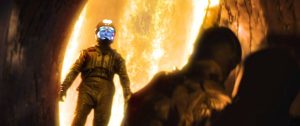 The movie takes about an hour before it really gets going, which is also admirably silly. Why devote so much time to setting up the reality of this dilemma for the complications and solutions to seem so throwaway? Seriously, the government uses one hacker (DJ Qualls) to control the entire Internet so that they can cover up the news about the possible impending apocalypse. It reminds me of an episode of The X-Files from the early 1990s where the government sends out an “all-Internet alert.” Perhaps the screenwriters felt we needed more time to accept the outlandish premise, which is strange because most disaster movies get a significant benefit of the doubt from audiences. Just having a person in glasses, and maybe a lab coat, or sweater if you want it to be more casual, explaining in a grave tone while removing their glasses dramatically, is likely all we need to accept the craziness to come. However, we do spend more time with our characters so that, when they depart one-by-one through sacrifice and accident, I actually cared enough because I was enjoying their comradery. I enjoyed Stanley Tucci being a blowhard who would even record his own narration as they travel through the Earth. I enjoyed Bruce Greenwood as the stern father figure that of course has to die first. I enjoyed Delroy Lindo as our excited but exasperated drill scientist. I enjoyed Hilary Swank as, essentially, the “best damn pilot I’ve ever seen.” I liked simply watching them all banter and bond together. It had enough development that their losses actually felt like losses and/or the accumulation of a character arc.
The question arises how do you keep things interesting when you’re burrowing through layer after layer of rock, and the answer is to just make things up. How about a layer of air? Could the Earth, compact as it is through billions of years of gravitational forces, have a layer of air like it was an English muffin? I did enjoy how the team had to restart their vessel before the magma poured into the vacant and awaiting space from their entry point. Of course, that raises the question now that magma is filling this vacant layer, have these scientists unintentionally ruined this unknown layer of the Earth? How about a layer with diamonds the size of states? These internal layers might as well be alien planets for as little they connect to reality.
 The movie is overlong and too uneven, but for fans of schlocky science fiction, it’s a delicious combination of campy entertainment. The silliness, played completely straight, even down to the part where Richard Jenkins explains man’ hubris is at fault for destroying the rotation of the Earth, is the grand appeal. I’m not going to call The Core a good movie but it sure feels like it knows exactly what kind of movie it is, and boy does it lean into that. My original review in 2003 caught on right away and I still recognized that same knowing vibe (why do we need a visual demonstration for the obvious concept of the sun cooking the Earth?). There really is a lot of birthing imagery too with the shape of the vessel burrowing to that egg at the center, so there’s that as well. The special effects are pretty murky and hokey for this kind of budget, but in 2023, that even works to the bountiful charms of the movie. I won’t pretend that most people will watch The Core with derision regardless of whether or not you’re an actual scientist. It inspired a generation of movies to be more scientifically sound, and it also inspired one of the biggest filmmakers on the planet. The metal that encases the spaceship? Unobtanium. You cannot tell me James Cameron wasn’t watching and taking notes.
Re-View Grade: B
Share this:

Daredevil (2003) [Review Re-View]
 Originally released February 14, 2003:
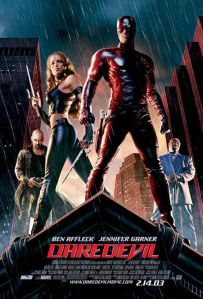
Not as bad as it could have been. That’s the best way to sum up Ben Affleck in tights.
Nate’s Grade: B-
——————————————————
WRITER REFLECTIONS 20 YEARS LATER

For many years, 2003’s Daredevil has become my handy threshold for assessing superhero cinema: if I liked the movie better than Daredevil, it was likely a good movie, and if I liked it worse than Daredevil, then it was a bad movie. It’s also fascinating to think back to a time after X-Men but before the behemoth of the Marvel Cinematic Universe, where superheroes could be cheesy while trying to be edgy and cool. This is a time before Ben Affleck was Batman, before Jon Favreau kickstarted the MCU by directing 2008’s Iron Man, before the gritty Netflix TV series of the same character, and before Colin Farrell became a widely respected actor. Behold the cheesefest that is the big screen Daredevil, written and directed by Mark Steven Johnson, previously best known as the writer of Simon Birch and Grumpy Old Men. Johnson is an avowed superfan of the comics and blind crime-fighter from Hell’s Kitchen, but in a recent 2023 interview on Yahoo, even Johnson admits his fandom sank the movie. The director admits to trying to cram in too much to appease fans and hook new audiences, and then there’s the obvious studio notes trying to make Daredevil into more popular and well-known super folk.
In the age of dour, gloomy superheroes that are held to unreasonable standards of gritty realism, or the creative control of the MCU, it’s fun to look back and see something stand out, even for some of the wrong reasons. Daredevil is still, to this day, a cheesy delight that you can have fun with or you can laugh yourself silly. Early into my re-watch, I settled into the kind of movie I was in for, with a smile on my face and the knowledge that things were going to be goofy. Young Matt Murdock is looking for his dad when he comes across him shaking down someone for money. Oh no, his dad really is a mob goon, and after he swore to his son it wasn’t so. Matt runs away from this traumatic realization only to get magic toxic waste sprayed into his eyes, but before he does so, he drops a paper in the alleyway, and it just so happens to be his report card with straight As that he couldn’t wait to show his not-a-goon dad. I laughed out loud. Daredevil cannot be taken seriously and that’s okay. He leaves a calling card of two criss-crossed D’s written in flammable liquid on the ground, which is a mystery how someone would discover this and even funnier thinking of Daredevil writing this signature after his work. Another fine example is the entire introduction to Elektra (Jennifer Garner) where adult Matt smells her before she arrives, becomes infatuated with her enough to use his blind status as an excuse to hit on her, then grabs her hand and refuses to let her go, which corresponds to the two of them flirt-fighting on a playground. It is an absurd, and occasionally creepy, sequence from start to finish, and that’s not even accounting for the blood-thirsty children chanting against the fences for the adults to fight. I was smirking or chuckling throughout Daredevil, and while I doubt that was Johnson’s artistic intention, it’s his movie’s best selling point from an entertainment standpoint.
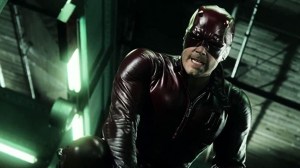 There is too much going on here, which makes all the storylines feel clipped, underdeveloped, and ultimately also worthy of derisive entertainment. We get two scenes with Elektra before she’s fallen in love with her blind man in shining leather, and then the next moment she blames Daredevil for her father’s death, and then the next moment she’s seeking vengeance, and then she’s dead, but she’s not really dead because she’s been resurrected… somehow… and spun off into her own solo movie that will be released in 2005. In this regard, being over crammed with side characters and storylines with the intent on setting up later movies, conflicts, and commercial chains of characters is very in-keeping with today’s overburdened, interconnected IP universe. It’s the same with the villains. We have two; Kingpin, the hulking crime boss played by Michael Clarke Duncan, and Bullseye, a hired killer with killer aim played with gusto by Farrell. It’s not enough to make the Kingpin the big boss of crime, the movie has to also make him literally the one responsible for the death of Matt’s father in Act One. Jack Murdock (David Keith, not to be confused with Keith David) is a washed-up boxer who wants to try again but be legit, so he ignores the warning to take a dive and is murdered for his pride. Seriously, I know his kid wanted him to win, but I think Matt would rather have an alive father with wounded pride. Bullseye is a contract killer from Ireland but why would Kingpin hire him and fly him across the Atlantic to just bump off one of the man’s subordinates? Surely there are any number of more efficient and less time-wasting manners to eliminate an underling. I guess he’s another of those comic book villains that just gets so involved in their overly complex schemes. Maybe it’s really the schemes that bring him to life (Evanescence nod) and keep the big guy from getting bored.
The action vacillates greatly from decent to ridiculous. I am absolutely positive that the Fox executives saw those 2002 Spider-Man box-office records and said, “Hey, put some of that building jumping stuff in there too.” This is a Daredevil where he just dives face-first off of buildings and plummets to the ground. Remember, he has advanced hearing and other senses, but he’s still supposed to be a human being, not a mutant, not a meta human, not a god. Diving face-first off of high buildings seems like a sound way to practice your eventual suicide. He also leaps and kicks like he’s in The Matrix, including dodging bullets too, which seems like his skills are pushing the “faster than a speeding bullet” realm of other heroes. In fact, Daredevil’s abilities seem to rival that of Superman with his intense hearing. Apparently, the man can lock in on a specific conversation blocks away. It’s these heightened moments of super impunity that make him less vulnerable even though the movie also wants to highlight his scars and bruises. This is the guy that needs to sleep in a water-filled sensory deprivation chamber (so pruny) but will throw himself into battles with multiple points of competing gunfire. The fight choreography has some slick moves but is also fairly mediocre, and it’s worse when the rubbery CGI Affleck is slotted into action to make even more preposterous moves (never dodge when a glorious backflip could do). I was beside myself when Bullseye collected broken stained glass, that he plucked from the air like snowflakes, and then piled into his hands like a server balancing stacks of plates, and then he started hurling them at Daredevil. For a guy whose notoriety is not missing, you think he would readjust or figure out that a guy flipping backwards is always going to have a turning middle of mass.
 The movie is struggling to juggle all these characters, all these storylines, and all of its would-be brooding themes and Catholic imagery of sacrificial bloodshed. It makes the movie feel like you’ve accidentally sat on the remote, speeding up the process of its 105 minutes. Johnson had a longer cut of the movie with a whole subplot of lawyer Matt Murdock, but that’s not what the people come to see. The character arc of Matt finding love and losing love is rushed and feels insufficient, more of a checkbox for the studio. Given the material, it’s surprising that Affleck and Garner would fall in love in real life and get married in 2005 (and then divorced in 2018). The arc of him learning restraint, to not be “the bad guy,” is laughably simplified to the point where just not killing the big crime lord is supposed to qualify as applause-worthy character growth. It’s enough that the crusading journalist (Joe Pantoliano) trying to bring light to this case decides to become part of the conspiracy and withhold information, enough so that he stares out of his home, jacket slung over his shoulder, and sees Daredevil watching from atop the street (how would he know?) and says, “Go get ‘em,” like he’s Mary Jane Watson cheering on her web-slinging beaux. It’s moments like this that you can’t take seriously but can appreciate as goofy mid-level supes entertainment. Daredevil is not great but it could have been much worse.
After the reception of this movie, it’s surprising that Affleck would want a second chance to suit up as a superhero, but then again being Batman is like playing Hamlet in our modern society. With Daredevil, he does seem uniquely qualified as a handsome man staring blankly. Garner was ascending thanks to her breakout role in J.J. Abrams’ Alias, and Farrell was becoming a Hollywood It boy in 2003 before finding a higher artistic ceiling with 2008’s In Bruges. He’s a hoot in the movie but he might have twenty total spoken words. It’s more a performance of grunts and scornful growling. Duncan was a controversial casting but an early example of race-blind casting traditionally white comics characters. It’s rare to find an actor of imposing size and stature that can still, you know, act well. With respect to Vincent D’Onofrio, who was my favorite part of the Netflix Daredevil series, but if the Kingpin were cast today, it would be Dave Bautista (Knock at the Cabin) hands down. Johnson was given another chance at superhero franchise-making with 2007’s Ghost Rider, which was also enjoyably goofy but also bad. I feel for the guy because he was fighting battles for genre credibility and superhero universe logic that most of the filmmakers in the MCU today take for granted. He walked so that James Gunn could run.
Twenty years later, Daredevil still kind of works as my superhero movie grading threshold. It’s not traditionally good but it has a nostalgic charm, an artifact of a time before the eventual boom. It’s so goofy and so early 2000s-edgy (the hard rock soundtrack is its own contribution of hilarity). With the right mindset, I think Daredevil can be fine albeit dated and cheesy passing enjoyment.
Re-View Grade: C+
Share this:

The Room (2003)

I consider myself to be a connoisseur of crappy cinema, thanks in large part to growing up on the fabulous TV series Mystery Science Theater 3000. To me, truly bad movies can be just as enjoyable to witness as great, competent works of filmic art. So imagine my surprise when it I had never heard of a little flick called The Room until a month ago. I was reading an Entertainment Weekly article about this tiny 2003 movie that has developed a rabid cult following. I felt betrayed. How did I go five years without ever hearing about this movie? The Room is writer/director/star Tommy Wiseau’s magnum opus. It must be seen to be fully believed.
To watch The Room is truly a life-altering experience. This movie goes beyond bad. It’s so bad that it almost seems like Wiseau is a mad genius. This movie is bad on multiple levels and hooks you from the beginning, instantly daring the audience to stick around to see if it gets worse. And it does in the most wonderful ways. If I was stranded on a deserted island and could only bring five movies, right now The Room would be one of them (I may even be tempted to just bring five copies of this movie). Wiseau’s film cannot displace Manos: The Hands of Fate as the worst film of all time, but The Room easily belongs in the upper echelon of craptacular cinema among the likes of The Land of Faraway and Lady Terminator and Bulletproof Monk. I am simultaneously appalled, bewildered, fascinated, delighted, and comforted by this movie, comforted by the fact that something this singularly inept could still sneak through the system. But this film is so perfectly inept on a multitude of levels that it feels like it could never be recreated again, like the human race benefited from this chance artistic encounter. The only way I can fully describe my unhealthy appreciation for this cinematic slice of the absurd is to simply list off my list of loves.
 1) The film’s plot involves a love triangle with the three least personable people imaginable. Johnny (Wiseau) is a broad shouldered, marble-mouth Austrian who supposedly works at a bank, we’re told. Lisa (Juliette Danielle) stays in their apartment doing very little, though she says that she shouldn’t have gotten into the computer business because it’s “too competitive.” Lisa declares in damn near every scene that after five years together (though the characters say seven at the end of the film) she no longer loves Johnny. She now loves Mark (Greg Sestero), Johnny’s best friend. And if you forget that key point then Mark will assist you because one third of his dialogue is declarations of “Johnny’s my best friend.” Another third of his dialogue might as well be, “What are you doing?” Mark is one of the thickest dolts in history. Even after Lisa has sex with him twice, calls him repeatedly, and leads him to places where they can be alone and intimate, he looks at her dumbfounded and says, “What are you doing?” like a kid who will never comprehend that 2 + 2 = 4. This is the basis of the plot and yet so much of the movie is gloriously repetitive and involves characters sitting around, saying the same things over, without ever really advancing the plot.
2) The Room hooks you from the start, and it’s all thanks to the weird neighbor kid/surrogate son Denny (Philip Haldiman). This supposed student is an orphan that Johnny has taken a shine to; Denny has his rent and tuition generously paid for by Johnny. In the very opening scene Johnny gives Lisa a slinky red dress as a gift. She tries it on and both Denny and Johnny make favorable remarks. Johnny says he’s a bit tired and leads Lisa by the hand up the stairs. The camera stays on Denny, who, instead of taking the hint and leaving, remains standing, grabs an apple, takes a bite out of it, then slowly walks up the stairs after the amorous couple. He then hops on their bed and joins in on their pillow fight foreplay. The characters have to literally spell it out to the guy that they want some privacy for sex. “I know, I just like to watch you guys,” Denny responds. What? Denny confesses to Johnny about experiencing weird feelings for Lisa. This kid is supposed to be in college but he acts like he’s developmentally challenged. A friend has a theory that Denny has a confusing gay crush on Johnny, but I believe that would be way more deep and subtle than the movie seems capable of.
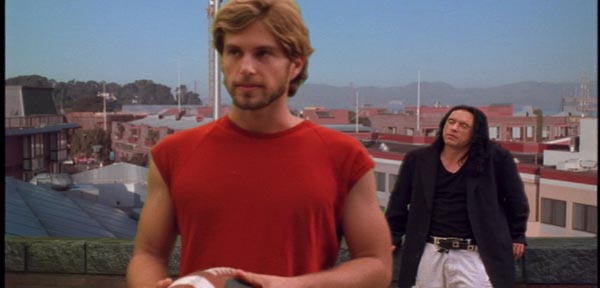 3) The movie is littered with subplots that come out of nowhere and never resurface again. All of a sudden Lisa’s materialistic mother (Carolyn Minnott) announces she has breast cancer. This is never commented upon again. All of a sudden Denny is confronted by an angry drug dealer who wants his money, which means he’s also the world’s worst drug dealer if he’s willing to give out drugs on credit. The characters all collect on the roof and yell. This is never commented upon again. Lisa makes up a story that Johnny hit her. He publicly denies it. This is never dealt with again in any capacity. Lisa lies to Johnny that she’s pregnant, just to “make things interesting.” Her rationale is that they’ll eventually start trying to have a baby anyway, which conflicts with her frequent statements that she doesn’t love Johnny and wants to leave. This fake baby is never commented upon again. About thirty minutes into the movie, another couple sneaks into Johnny’s apartment to have sex. Why I cannot fathom. When Lisa and her mother intrude upon this scene, the mother asks astutely, “Who are these characters?” Exactly madam. The movie keeps going over the same material because nothing new ever sticks.
4) The line readings are astoundingly inauthentic. Half of the film seems to be dubbed, especially Johnny’s lines. Much of the dubbed dialogue fails to match up with the actor’s mouth movements. There is one sequence in a flower shop that is nothing but dubbed dialogue and it happens so quick. The scene itself lasts like 10 seconds but it still manages to squeeze in this entire conversation: “Oh hey Johnny, I didn’t see you there.” “Yep, it’s me.” “Here are the flowers you wanted.” “How much?” “18 dollars.” “Here ya go. Keep the change. Hi doggy.” “You’re my favorite customer, Johnny.” “Byeee.” It happens so rapidly with so little breath in between. Wiseau’s quick changes in temperament with consecutive lines will amaze you. He goes directly from, “I did not hit her! I did not! I did naaaaaaaut,” to a very casual, “Oh hey, Mark,” in a nano-second flat. The speech patterns rarely approach realistic human cadences.
5) Lisa is routinely told by the several male characters that she is exceptionally beautiful and lovely, but this woman’s personality is like a dead plant. Danielle is a fine enough looking woman, though the hair and makeup people do her no help with those thick eyebrows, but as a beauty that could manipulate multiple men? I don’t think so. Danielle has a bit of a tummy to her, which is fine by my standards of beauty, but from a Hollywood perspective a woman that lacks a concave stomach is considered “fat.” Lisa’s friend Michelle (Robyn Paris) is in fact a more attractive female and might have served as a better Lisa. I think perhaps Danielle was willing to do nudity and Paris was not, but really, if you’re a struggling L.A. actor and you’re willing to agree to be apart of something like The Room, surely you’ve already ignored any internal misgivings. What possible hang-ups could there be left?
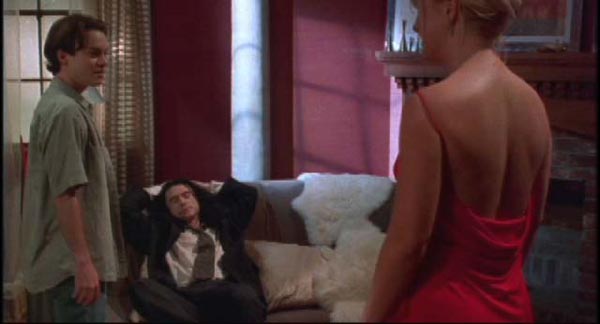 6) The film is structured like the soft-core porn that dot the late hours of premium cable channels. There are four lengthy sex scenes in the first hour, though one of them is composed almost entirely with recycled footage from the first bout of lovemaking between Lisa and Johnny. The sex scenes are deeply un-erotic and consist of several camera angles that make it impossible to see what is actually happening. There is nothing sexy about watching Wiseau’s pasty posterior humping the hips of Danielle (seriously, the body alignments are way off here). When Lisa and Mark have sex on top of a spiral staircase, Wisuea can barely frame the action coherently. Why would anyone want to have sex on a spiral staircase? That’s just asking for chronic back pain. Mark fails to even take his pants off. For such lengthy sex scenes, Wiseau does so little with the talent on display. What makes all the sex scenes even better is that they each get a wretched pop song as a soundtrack. It’s all mid 1990s R&B with some growling sex guitar, and it’s all awful. There’s one song that repeats the phrase “you are my rose” like nine times in a row. If you fail to cringe and howl from the sex scenes then the songs ought to do it.
7) Wiseau makes the most mysterious decisions as an artist. He sticks to a minimum of locations and one of them happens to be the roof of Johnny’s apartment complex. The sensible thing would be to film on an actual roof. Wiseau decided to film on a roof set and use an ineffective green screen backdrop that makes San Francisco look like it inherited Los Angeles’ smog. The film keeps cutting back to exterior stock footage of the city that signifies the passage of hours, a day, or no time whatsoever. When Denny is confronted on the same rooftop about his sudden drug disclosure, Lisa berates him. As she cries and shrieks and overacts, you cannot see it because Wiseau’s camera has cut her facial reactions out of frame. The scene cuts back and forth between Denny facing the camera and the left side of Lisa’s head. At another point Lisa is talking about her cheating ways with her pal Michelle, who seems way too giggly to be disapproving. During this scene Lisa has angled her body in such a manner that when she speaks it appears like a subcutaneous alien is about to burst forth from beneath her neck. Wiseau did not catch this unnerving and distracting sight. The film’s lone idea of male bonding involves tossing a football together. So Mark and Johnny will go out running in a park and toss a football back and forth, all the while having a faint conversation that gets drowned out by an overly anxious score. There will be swaths of the film where the score just competes with the onscreen dialogue.
8) There’s like a whole other level of offhand dialogue throughout, where characters will stand around and Johnny or someone else will mumble to no one in particular. The actual dialogue is full of other memorable head-scratchers, such as:
Random disapproving guy to Mark: “Keep your stupid comments in your pockets!”
Same disapproving man: “It feels like I’m sitting on an atom bomb that is going to explode!”
Michelle using chocolate candies as a means of foreplay: “Chocolate is a sign of love.”
Lisa’s mother: “Nobody ever listens to me.”
Lisa: “You’re probably right about that, mom.”
Johnny’s profound wisdom: “You know, if more people love each other the world would be a better place.”
Johnny refers to someone as a chicken and then proceeds to make this accompanying sound: “Cheep, cheep, cheep, cheeeaaaaaaaaiiiiiiiiiip.” This bizarre chicken impression will be repeated no less than three times.
 This brief exchange at a coffee shop between Mark and Johnny:
Mark: How was work today?
Johnny: Oh pretty good. We got a new client… at the bank. We make a lot of money.
Mark: What client?
Johnny: I cannot tell you. It’s confidential.
Mark: Oh come on. Why not?
Johnny: No I can’t. Anyway, how is your sex life?
And finally, the signature line, where Johnny has had enough of Lisa’s mental games and he roars, “You are tearing me apart, Lisa!”
I could keep citing further evidence of The Room‘s cinematic shortcomings, but listing the faults of one of the worst films ever made can be pointless after a while. The staggering amount of faults in Wiseau’s film is also its combined strength. Most bad movies have a finite level of badness, like a poor plot or some troublesome acting. The Room is a movie composed of nothing but 99 complete minutes of badness at every facet of filmmaking. I am a more complete person having seen this remarkable film. I highly recommend gathering a group of friends around and holding a viewing party; the movie plays to even higher levels of enjoyment with a group atmosphere. The Room is Tommy Wiseau’s accidental masterpiece and, to me, proof that a loving God exists.
Nate’s Grade:
Artistic Merit: F
Entertainment Value: A+
Share this:

House of the Dead (2003)
 House of the Dead is Uwe Boll’s first foray into the video game-to-movie niche he’s carved himself. It’s based on a first-person-shooter by Sega that lets players blast their way through a haunted house and its undead tenants. There’s not much to the game. In interviews Boll has remarked at how he hated the film’s jokey script and rewrote much of it on the fly, trapping the film between the genres of horror and action. In the DVD jacket, executive producer/co-writer Mark A. Altman says, “House of the Dead is no Citizen Kane.” This may be the understatement of the millennium, comparable only to Napoleon saying Russia might be a tad cold.
Matt (Steve Byers), Greg (Will Sanderson), Simon (Tyron Leitso) are meeting with fellow college students Alicia (Ona Grauer), Karma (Enuka Okuma), and Cynthia (Sonya Salomaa). They’re ready to party at the rave of the century. This rave of raves takes place on the ominously named Isle del Muerte (The Island of the Dead). I suppose this proves that no one on the rave planning board speaks Spanish. The kids eventually hitch a ride to the island from Captain Kirk (Jurgen Prochnow) and his first mate (Clint Howard). Hot on Kirk’s heels is Casper (Ellie Kornell), a border agent after Kirk for gunrunning. Once they arrive at the island, the kids are shocked to find the rave site vacated, destroyed, and swarming with zombies. Everyone makes a run for it and regroups with some of the rave’s survivors, led by Rudy (Jonathon Cherry). The groups team up, armed by Kirk, and set out to shoot their way home. But there’s also a very evil figure roaming about that has more sinister plans for the island’s fresh meat.
 House of the Dead isn’t a horror movie at all. Boll has no idea how to stage scenes with tension. He has no feel for mood or atmosphere, which are the foundations of a good horror flick. So instead, House of the Dead is a riotously dumb action movie. But under Boll’s direction, it’s not even good at that. The action is repetitious and pedestrian. Boll’s big melee sequence becomes boring because it doesn’t progress. There’s just ten minutes of wall-to-wall shooting zombies, but there isn’t any order to it, no rhyme or reason. If you want a perfect example of Boll’s inept staging, skim to 47:20 into the DVD and watch. You’ll see a zombie leap onto a jumping platform and launch himself into the air. House of the Dead actually has scenes where we see exposed jumping pads and landing mats.
Boll gets drunk on special effects very easily. He loves the bullet time effect and throws it in at odd points. Every single character gets a tiresome slow-mo camera spin as they fire a gun. After the ninth and tenth time, the thing gets old. The characters don’t even have the same weapons in the shots before the slow-mo jazz. Boll doesn’t use flashy effects to benefit his narrative, unlike The Matrix. Boll actually thinks using clips from the actual video game is a good device to transition between scenes. There will be moments where screen shots of the game just pop up. Boll is a kid with toys and no clue when to put them back into the box.
This movie’s silliness is jaw dropping. The so-called rave of the century seems to be poorly attended, and the better for it since it takes place on the Island of the Dead (Isle del Muerte). Is that really the best place to host a social gathering? Perhaps everyone gets what they deserve for being stupid. Kirk, after shooting several zombies, limply remarks, “Now I know why they call this the Island of the Dead.” The line should be accompanied by a rim shot. The movie doesn’t even live up to the lofty ambitions of its title.
 By far the most ludicrous story element is the film’s villain, Castillo (David Palffy). It seems that before he stalked the island in a hooded cloak, looking like Robert DeNiro in Mary Shelley’s Frankenstein, he was a Spanish pirate/doctor. He tried to experiment on living tissue in order to unlock the secret of how to be immortal. He was imprisoned on a Spanish ship and was shipwrecked on the Island of the Dead (what are the odds?). He’s concocted a special Kool-Aid that will bring the dead back to life, though I don’t know why he’s still stuck on an island if he can’t drown. I guess he’s been biding his time and waiting for stupid college students so he can see some T&A.
The characters are made up of people interested in attending a rave, but when the action hits they’re all instantly adept at weaponry and kung-fu. That’s not the typical raver I know, and these people must be super ravers if they’re going to the rave of the century. Simon is described as “the biggest underwear model in America,” and for all I know underwear models encounter a lot of gunfire on the runway. The DVD jacket has character profiles where it lists their name, age, weapon of choice, and skill. After having watched House of the Dead, the skills are laughable at best. Simon the runway model’s skill is “tactical planning.” I also seriously question Rudy’s “leadership” skills since he gets everyone killed.
Of course everyone in the movie is profoundly stupid. While trapped in the island’s only house, Rudy says the kegs of gunpowder are useless without a charge, and then he walks past a series of lit candles. The whole house upon arrival is filled with lit candles (who has the time for that, by the way?). Alicia is convinced that the rave site being deserted, destroyed, and zombie-infested is all a practical joke, as if Ashton Kutcher is just around a tree poised to yell, “You suckas just got punk’d!” There are numerous moments where a character will wander into the dark and say, “[Insert name], is that you?” Kirk takes the last stick of dynamite and plans to sacrifice himself by blowing up some zombies good. He lights the stick, wanders outside their barricaded stronghold, and blows himself sky high. What Kirk failed to do was move far enough from the house, because he also blows the front door wide open and the zombies filter inside.
The acting doesn’t even rise to the level of camp. The actors feel unrestrained and marooned, typical of a Uwe Boll film. The man has no feel for actors and this explains why his films have some of the worst line readings I’ve ever heard (2000’s Dungeons and Dragons is still the worst). Casper acts like a crabby fitness instructor. The dialogue is bad as is, but when added with the poor line readings it turns every spoken sentence into something of unintentional hilarity. Take this nugget from Simon: “We got to the boat but it wasn’t there.” Well, then did you actually get to it?
House of the Dead can be enjoyed for the depths it plumbs. The dialogue is cheesy and leaden. The movie is bad enough that if you have some friends over, drink steadily, you’ll have a blast laughing and hurling popcorn at the screen. The movie does have a decent amount of blood and gore and the make-up effects are good but limited. You can enjoy House of the Dead in a fun derisive way, and it’s hard to argue with the price some retailers charge (I bought it on Amazon.com for 75 cents plus shipping). The DVD commentary is also good for a laugh, that is, if Boll’s self-flagellating remarks are serious. At one point he compares his zombie action movie to Schindler’s List. Boll also marvels at an actor’s ability to carry objects and make them seem heavy. I’m not sure if Boll is serious or just making fun of the movie like everyone else.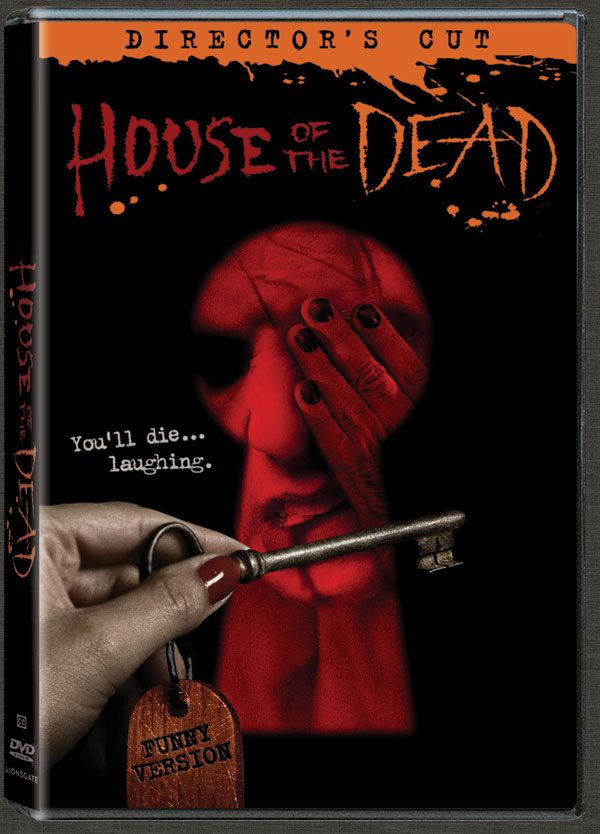
House of the Dead is a dull action movie within the framework of a horror flick. The characters are powerfully stupid, the action is redundant, the effects are chintzy and overused, and the direction is lackluster. Boll has added little in transitioning a game about poppin’ zombies onto the silver screen. The video game is flimsy and the movie based upon it manages to be even flimsier. House of the Dead is incredibly dumb entertainment and the fact that a sequel is well underway cannot be a good sign for human existence. I never thought I’d utter these words but . . . Clint Howard, you’re too good for this.
Nate’s Grade: D
Note: Boll re-released a recut House of the Dead as a comedy. I haven’t seen “the funny version” but I can’t imagine that it could possibly be any funnier than the original.
Share this:

Homeroom: Heart of America (2003)
The film spans one morning of a “normal” high school in Oregon (it looks like the school is a three-story motel). It’s the last day of school and everyone is ready to jump into the real world. The storylines are rife with every high school cliché that can be found. Drum roll please, and they are:
1) Good Virgin (Stefanie MacGillivray) is dumped by Jerky Jock (Will Sanderson) because she refuses to put out. The majority of this storyline takes place in the guy’s car where he sadistically tells her all the details of the many other girls he was “forced” to sleep with (“The whole school f*cks. Everybody except you.”). One of these girls is the transient High Girl (Elisabeth Rosen), who has fallen in love with Jerky Jock over the course of him using her for sex.
2) High Girl has no parental involvement and lots of free time. She thusly gets high a lot and trips out for most of the movie. Dealer Dude spends all day implausibly hanging around the high school with sacks of drugs to sell. He’s stopped by Idealist Guidance Counselor (Maria Conchita Alonso) who wants to make a difference.
3) Good Student apparently wasn’t good at contraceptive planning because she’s pregnant. She wants an abortion and her life back. She’s also upset with her Boyfriend who wants to keep the baby and support her but is also willing to support whatever decision she makes.
4) Mean Creative Writing Teacher (Michael Paré) gets a good talking-to by the school principal (Jurgen Prochnow). The teacher is struggling with his own writing and taking out his frustrations by being overly critical of his students’ works. His grades appear to be unfair and unprofessional. One of his students is High Girl.
5) A team of bullies regularly beat up and humiliates Barry (Michael Belyea) and Daniel, who masterminds a plot for revenge. Daniel (Kett Turton) is tormented by his abusive father (Clint Howard) who just laughs when he sees bruises and black eyes on his son. The bullies are lead by King Bully (Brendan Fletcher) who is visited by his older brother, Former King Bully (Steve Byers), who reminisces about the good ole days of beating people up because they were different. These storylines mix and match until our inevitable shoot-em-up conclusion.
 Heart of America is based on a story by Boll and written by Robert Dean Klein (Blackwoods). The plot structure is competent and the film is mildly entertaining, which was a great surprise for me. The cinematography is above average for its budget and the score is quiet and reflective. Heart of America, with all its shortcomings, is still a better movie than Gus van Sant’s school shooter opus, Elephant (I dread to see this statement on the front of a re-released DVD).
Despite all of its simplicity, Heart of America makes some boneheaded decisions. It closes with lengthy text detailing other school shooters in the previous years. The text takes away from the drama and has no significant purpose other than to say, “You’ve just watched kids shoot up their school. Here’s how some other kids did it. If you’d like to learn more, visit your local library.” Heart of America also lacks subtlety; every item that is meant to carry a message of significance is hit so hard you’ll wonder if a gong is rattling. Then again, Boll isn’t well known for subtlety. This should explain Heart of America’s aches and pains with revealing its twists and revelations.
For two acts we’re led to believe that Daniel and Barry are the ones who are going to shoot up their school. Daniel IM’s his co-conspirator and reminds them not to “punk out on him.” Then minutes before the bloodbath it’s revealed that his co-conspirator is . . . another person! It’s High Girl, who takes a gun and gladly goes about killing classmates. Heart of America intentionally teases the viewer whether Barry will not follow through and this twist is intended to be something of a surprise. Trouble is someone should have told that to the DVD manufacturing folks. On the Heart of America DVD cover (as you can see for yourselves above) are the faces of Daniel and High Girl side-by-side. Superimposed over them is a list of school shooting locations that have been crossed out (it’s little wonder that Boll held back from the final one saying, “Anytown, U.S.A.”). Below all of these images is another picture of High Girl, this time standing in class and pointing an accusatory finger at some unforeseen figure. Any person intending to watch Heart of America will instantly associate High Girl with Daniel and already be thinking they’re Bonnie and Clyde. You can’t have a twist when you’re advertising it on the front cover of your DVD. Would The Sixth Sense have been as effective if the poster had Bruce Willis walking through walls like Ghost Dad (no respect to Ghost Dad intended)?
The most disturbing moment in Heart of America doesn’t even take place around the school. It involves a story Big Brother tells his bully clan about his greatest accomplishments. One of these is inviting a mentally challenged girl into his basement, getting her drunk, and then assaulting her. At first I thought it was rather unwarranted and unethical to have flashbacks of Big Bro’s story so that we can actually see the assult. Then it hit a slightly interesting juxtaposition, as Big Bro’s positive recount of his victim’s experience doesn’ match what we see happening. So I was willing to let it slide for a while until the film hit a deplorable low – a gratuitous nude scene of the mentally challenged girl (dubbed “Slow White”). You can tell it’s gratuitous too because most of the scene isn’t even shot at angles that expose her. It’s disturbing on the level that Boll was knowingly trying to shoehorn in some nudity and elicit titillation. The decision actually detracts from the power of the scene because it feels so tackily gratuitous.
 Once the end credits start to roll, the casual viewer will think two things: 1) What is that awful, tonally inappropriate pop song playing that actually has the lyrics, “The roads you made are the ones you pave,” and 2) what the hell was the message of Heart of America? In the first ten minutes or so we see teens on drugs, teens on medication, teens with no parental involvement, teens with parental abuse, and teens bullying to feel better about themselves. Do any of these things cause school violence, or is it some kind of magic combination? I never expected Heart of America to fashion a thesis on why kids grab guns and shoot up their schools but the ending feels ridiculously, artlessly devoid of meaning.
To further get into this point of discussion I will be spoiling all of the major plot lines of the movie, so in the rare instance anyone is remotely interested in watching Heart of America, scroll down. You won’t be missing much, trust me.
As expected, Daniel and High Girl get revenge primarily upon their tormentors. What I don’t get is that before High Girl sweeps into her classroom for her vengeance, she tells Dealer Dude, “I couldn’t have done it without you.” Huh? Does she mean she wouldn’t have gone to these lengths had she not be high? Or is this statement farther reaching, like blaming Dealer Dude for being apart of a system that has turned her into a degenerate drug user? I have no idea, but High Girl struts into class and kills Creative Writing Teacher, who had made fun of her and forced her to read her poetry aloud. Got it. But then she aims her pistol at Jerky Jock, whispers “I love you,” and then shoots Good Virgin to death. Apparently High Girl did not catch the news that Jerky Jock had dumped her minutes earlier. So what is the point of Good Virgin’s storyline? The only thing I can surmise is that if you don’t have sex you will be killed. If Good Virgin had given up her goodly virginity then Jerky Jock wouldn’t have been on the prowl, and he wouldn’t have used High Girl for throwaway sex, and then she wouldn’t have shot Good Virgin in jealousy. You see how this works? It’s the exact opposite of a horror movie. Daniel also shoots and kills Good Student’s boyfriend/father of her baby. What is that saying? Why couldn’t any of the shooters have clipped Patrick Muldoon’s nails-on-the-chalkboard horndog sex ed teacher? It seems Boll has a soapbox but he has nothing understandable to say.
Heart of America makes the audience not only side with the school shooters but also practically roots for them. Daniel and Barry undergo constant bullying from the get-go. The film, in its simplistic approach, plays the bullies as irredeemable assholes and Daniel and Barry are the hapless victims. Heart of America practically justifies its characters resorting to violence. Sure some innocent people get caught in the fray, but then aren’t they all to blame somehow? Again, I have no idea what Boll is trying to say.
Despite Boll having no command with actors (Muldoon is a constant reminder of this), the younger actors in Heart of America give pretty good performances. Turton (Saved!, Walking Tall) really festers with anger and discontent but also gives insights into a fragile kid just wanting to live. Belyea really works his nervous indecision to a nub, going so far as to hide his mother’s car keys so she won’t chance going to his school. Fletcher (Freddy vs. Jason) is a grinning monster as a bully but, in the film’s lone turn at character depth, also shows how uncomfortable he is being a bully. It seems that he too is just doing it to fit in. Fletcher’s pained and awkward reactions are a welcome sign of humanity, though it seems to be too little too late when we the climax hits. Rosen seems decidedly disconnected and dead-eyed scary.
 It’s puzzling that the top listed actors in Heart of America’s credits are as follows; Jurgen Prochnow, Michael Paré, Patrick Muldoon, and Maria Conchita Alonso. All four of those actors amount to about ten minutes of total screen time; Muldoon essentially has a grating cameo. Why are the kids not credited as the rightful stars of the show? The adults all give terrible performances (seriously, I cannot overstate how awful and creepy Muldoon is) but the kids are all right. The most shocking fact about the cast is that somewhere in this mix is Emmy-nominated Mad Men actress Elisabeth Moss. Look for her in here somewhere as “Robin Walters.”
Heart of America works with paint-by-numbers characters and Boll only doles out one color. The jock is a jerk. The virgin is good. The bullies are mean. The stoners are high. Very seldom does the film delve any deeper than these cursory characterizations. Because of this simplicity Heart of America strains credibility during its more unrealistic moments. At one point, King Bully and his posse force Daniel and Barry to eat dog poop and the moment is played as a defining point of drama. Does this stuff really happen? If it does then it certainly doesn’t happen often enough to be included in Boll’s depiction of a “normal” school. Then again, Boll’s idea of a normal American educational environment also involves raping mentally challenged girls. The name of the movie itself indicates how typical everything is supposed to seem.
This is a thought-provoking film, with the main thought being “What the hell is the movie trying to say?” Heart of America wades in a kiddy pool of high school clichés. The characters are paint-by-numbers and lack definition beyond their social title (Virgin, Jock, Bully, etc.). This film is awash in unresolved statements and stacks the deck so the audience will practically root for the school shooters. With no help from Uwe Boll, the younger actors are the movie’s stars and give good performances despite the limited range of their characters. You won’t know anything deeper after watching Heart of America. It’s Boll’s Big Statement Film but your guess is as good as mine as to whatever that is. Violence breeds violence? Parents need to spend more time with their kids? Don’t force kids to eat poo if they’re not ready? Heart of America is unrealistic, strained, unfocused, shallow and clumsy, and it’s also Boll’s best work to date.
Nate’s Grade: C
Share this:

Monster (2003)
 Monster follows the life of Aileen Wuornos (Charlize Theron, now nominated for a Best Actress Oscar), Americas only known female serial killer. In the late 1980s, Wueros was a roadside prostitute flexing her muscles with Florida motorists. She describes hookin’ as the only things shes ever been good at. One day Wuornos has the full intention of taking her own life, but she meets 18-year-old Selby (Christina Ricci) at a lesbian bar and finds a companion. Driven by a growing hatred of men from sexual abuse, Wuorno’s starts killing her johns to try and establish a comfortable life for her and Selby.
Let’s not mince words; Theron gives one of the best performances I have ever seen in my life. Yes, that’s right. One of. The. Best. Performances. Ever. This is no exaggeration. I’m not just throwing out niceties. Theron is completely unrecognizable under a mass of facial prosthetics, 30 extra pounds, fake teeth and a total lack of eyebrows. But this is more than a hollow ploy to attract serious attention to the acting of a pretty face. Theron does more than simple imitation; she fully inhabits the skin of Aileen Wuornos. The closest comparison I can think of is Val Kilmer playing Jim Morrison in The Doors.
Theron is commanding, brave, distressing, ferocious, terrifying, brutal, stirring, mesmerizing and always captivating. It may be a cliché, but you really cannot take your eyes off of her. Her performance is that amazing. To say that Theron in Monster is an acting revelation is perhaps the understatement of the year.
With previous acting roles in Reindeer Games and The Cider House Rules, Theron is usually delegated to pretty girlfriend roles (who occasionally shows her breasts). Who in the world thought she had this kind of acting capability? I certainly did not. If Nicole Kidman can win an Oscar for putting on a fake nose and a so-so performance, surely Theron should win an Oscar for her absolute transformation of character and giving the performance of a lifetime.
With this being said, and most likely over said, Monster is by no means a perfect film. Minus the terrific central performance, Monster is more of an everyday profile of a grotesque personality. The film weakly tries to portray Wuornos more as a victim, but by the end of the film, and six murdered men later, sympathy is eradicated as Wuornos transforms into the titular monster. Some supporting characters, like Ricci’s narrow-minded Christian up bringers, are flat characters bordering on parody. The supporting characters are generally underwritten, especially the male roles that serve as mere cameos in a film dominated by Sapphic love.
Monster is proof positive that human beings will never be phased out by advancing machinery when it comes to acting. Monster boasts one of the greatest acting achievements in recent cinematic history, but it also coasts on sharp cinematography and a moody and ambient score by BT (Go). Monster is a haunting film that you wont want to blink for fear of taking your eyes off of Theron. She gives an unforgettable tour de force performance that will become legendary.
Nate’s Grade: B
Share this:

Cold Mountain (2003)

Cold Mountain (2003)
Premise: At the end of the Civil War, Inman (Jude Law, scruffy) deserts the Confederate lines to journey back home to Ada (Nicole Kidman), the love of his life he’s spent a combined 10 minutes with.
Results: Terribly uneven, Cold Mountain‘s drama is shackled by a love story that doesn’t register the faintest of heartbeats. Kidman is wildly miscast, as she was in The Human Stain, and her beauty betrays her character. She also can’t really do a Southern accent to save her life (I’m starting to believe the only accent she can do is faux British). Law’s ever-changing beard is even more interesting than her prissy character. Renee Zellweger, as a no-nonsense Ma Clampett get-your-hands-dirty type, is a breath of fresh air in an overly stuffy film; however, her acting is quite transparent in an, “Aw sucks, give me one ‘dem Oscars, ya”ll'” way.
Nate’’s Grade: C


 nathanzoebl
You must be logged in to post a comment.