Author Archives: natezoebl

The Gift (2000)

Sam Raimi is a slick director and is maturing smoothly. The Gift is a nice ensemble pot-boiler in the South. Cate Blanchett gives a remarkable performance that was, as most were that were nominated, better than Julia. Keanu Reeves finds a role he can actually excel with in that of a wife beating redneck; he’s actually quite scary in it. Giovanni Ribisi gives the best performance of his career as a mentally challenged mechanic. The film coasts on some good atmosphere and direction by Raimi, but it is too easy to figure out the final turns in the end.

Nate’s Grade: B

The Family Man (2000)

If I poked this movie it would spray sap in my eye and blind me. It’s essentially a Hollywood remake of Frank Capra’s It’s a Wonderful Life with a bit more cynicism and a bit less success. Cage is a heartless Wall Street whiz who catches a “glimpse” of an alternative life where he’s married to Tea Leoni and has kids in the suburbs. The Family Man wants to kill you with its message of “business is EVIL” and “suburbs and mini-vans and bowling leagues and family… good!” It’s almost caveman like in its bludgeoning. Sap flows freely in this supposed feel-good flick, but stalls in a lackluster ending.

Nate’s Grade: C

Cast Away (2000)

Strand Tom Hanks on a desert island for years? Sounds too good to be true to many a disgruntled movie goer. Such is the state in Cast Away, Robert Zemeckis’ existential meditation on man, nature, FedEx and their product placement checks, and of course… volleyballs.

Hanks is yet another everyman, except he’s a real stickler for time and order as a FedEx supervisor. His girlfriend (Helen Hunt) is pushing for marriage but hey – they’ve got all the time in the world, right? So Tom boards a FedEx flight headed for the Southern Pacific that hits a nasty collision with a powerful storm. The plane goes down abruptly in what is likely the most terrifying plane crash ever performed on film. Hanks washes ashore onto a mysterious deserted island after drifting alone in the vast ocean. Without civilization and without human contact he must start all over just to survive the day. So becomes the Odyssey of Island Tom.

Cast Away hits one out of the park with its near dialogue free middle act with Tom’s first days upon his new island home. Hanks struggles to do everyday things from finding food to creating a makeshift shelter. As Hanks goes through these daily troubles the audience is with him every moment and learns as he does. Cast Away‘s middle is fascinating to watch. After a few days some packages from the crash wash ashore including a volleyball that Tom turns into his best friend. “Wilson” is Hanks’ companion and is totally understandable how one would branch out for contact under the circumstances. Plus, Wilson’s a dynamite celebrity of his own right now.
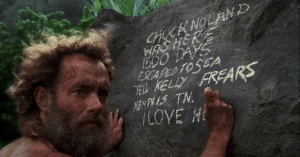
Hanks’ acting is his usually above average output, but his whole role seems more like a showcase for his method acting than the acting itself. The first half of Cast Away was shot then they took a year off so Hanks could become scruffy, thin Caveman/Unibomber Hanks. The transition is fun to watch and remarkable for an actor to devote themself completely to their role. But the part itself, and Hanks’ show, seem more spectacle than substance. Helen Hunt pops up in the beginning and end proving that she can somehow manage to be in every film in December. Pretty much the next actor in the film would be… well, a volleyball. Cast Away is basically a one-man show.

Despite a wonderful middle ‘Cast Away’ is suffering from the opposite syndrome of Saving Private Ryan: strong middle, weaker beginning and end sandwiching it. Our opening plays like an extended commercial for FedEx, complete with the dazzling FedEx package POV cam (coming soon!). The end plays like a thank you card to FedEx. The ending also suffers from extreme let-down from multiple climaxes that don’t end the film but just give way to another climax. By the time the movie does end you’re exhausted.

Zemeckis lends a skilled hand toward the direction, the script plays to the strengths of the tale good enough, and Cast Away has its moments but becomes too heavy-handed at certain periods. Still, the volleyball is good. Go for the volleyball.

Nate’s Grade: B

(For fun, count the amount of times FedEx is mentioned or seen in the film. Hell, do it with this review too. I’ll even help you out – FedEx, FedEX, FedEx, FedEx, FedEx, FedEx, FedEx, FedEx, FedEx, FedEx, FedEx, FedEx, FedEx, FedEx, FedEx. Oh fun.)

Reviewed 20 years later as part of the “Reviews Re-View: 2000” article.

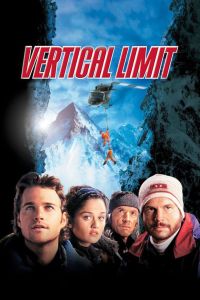
Vertical Limit (2000)

New heights are explored in the mountain climbing expedition that is Vertical Limit. A group of climbers must perform a rescue mission on the second highest mountain in the world or risk losing the lives of their friends and loved ones. With a set-up like this you would assume it would have a lot of great action. Well, yes and no.

Limit stars Bill Paxton (talented but has poor film choices) as the usual corporate villain, Chris O’Donnell (untalented with poor choices) as the tortured rock climbing hero, and Robin Tunney as the overly ambitious climbing sister to O’Donnell. This isn’t all the subplots though — oh no! We get a pair of wise cracking pot head brothers, a religious Pakistani serviceman, a military base, and a grizzled loner that everyone thinks is crazy until we finally realize he’s the best mountain man of them all. By the time it takes to establish all of these subplots, plus others I’ve failed to mention, we haven’t even gotten to the damn mountain yet. Rule #1 of a mountain climbing movie: Get on the bloody mountain within an hour of the movie starting!

The plot is overly cornball and excessively redundant. By the time you actually see the loner’s long lost wife frozen in a wall of ice and looking like a figurine from the Mattel Barbie catalog you will know the ends this film will go.

The experts of rock climbing are all young and seemingly frat house rejects. Why in every film must the experts in any field of scientific research be frat house party animals? How about some realism there and make them all middle aged balding white males. Well… I guess that would be less of a draw.

Director Martin Campbell (GoldenEye) has a great knack for establishing tight thrills and strong suspense. Campbell is clearly the strong point of this picture. When the action is running it’s plumb with excitement and great visceral visuals of the scenery. The only problem is that the action scenes are separated by long stretches of characters coughing or wheezing and terribly cheesy dialogue. If the story is technically built around the action sequences why do we have to devote so much time to it then? It’s a waste of Campbell, a true action talent.

Limit is rigid with expendable cut-outs designed to be its people. The characters are shoe-string and so is the plot but the action, when allowed to actually happen, is first rate. However, I do exclude a series of scenes where Tunney and Paxton are trapped in an ice cave that resembles more of your grocer’s freezer than a Himalayan peek. The 12 year-old behind me kicking my seat figured it all out good enough. I think that says enough.

Nate’s Grade: C-

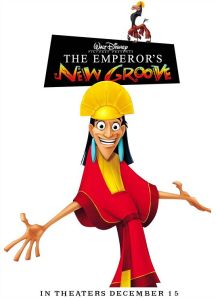
The Emperor’s New Groove (2000)

Originally The Emperor’s New Groove was a grand Disney formula flick known as The People of the Sun concerning the Aztecs and included six Sting songs. We would have had this “same old same old” if it weren’t for someone who courageously raised their hand and said “Isn’t this stupid?” God bless that person. The original theme was scrapped as well as all the songs excluding one. The patented Disney formula was ditched for a fast pace and zany antics that haven’t been seen from Disney hands since Aladdin.

The central message of Emp’s Groove is still a moral lesson – this one over vanity and self-centeredness. David Spade voices a young prince named Kuzco with no regard for any of his followers. He plans on building a special waterslide by destroying the village of Pancha (John Goodman). Spade’s scheming high priestess Yzma (Eartha Kitt) concocts a potion to kill the Emperor with the aid of her dim-witted but loyal assistant Kronk (Patrick Warbutton). Through a mix-up the potion doesn’t end up killing Kuzco but turning him into a llama. So now alive and trying to regain his throne Kuzco can only find help with Pancha, the one he had wronged earlier.

The vocal talents of the four leads are particularly inspired with Warbutton on a different plane of comedy. Warbutton provides the film’s biggest laughs and is a genuine master of timing and vocal inflections. When Disney sequelizes this straight to video (as they do everything now) I hope it centers on Warbutton’s Kronk character. Kitt is fun in an over-the-top parody and Spade provides delicious sarcasm so simply.

What’s being advertised as hilarity is more or less spotty. Some jokes work but others are full of tedium. There are stretches of tedium that shouldn’t be there for something with “zany antics.” Yet, the 15 minute ending is the best piece of the film with multiple comic payoffs.

The anti-Disney Disney movie is anti enough. the jokes need to come more often and it takes a while to truly get into. It has its moments but The Emperor’s New Groove is not new enough. Although, I’m thankful that we got what we did instead of what we could have.

Nate’s Grade: B-

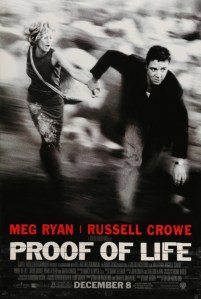
Proof of Life (2000)

Proof of Life is more an interesting idea than an intelligent or well done thriller. The whole concept of the politics involved in K&R (kidnap and rescue) are duly fascinating. But Proof decides to build a different film around this premise and detours into mediocrity. The film ends with the standard take-down in the jungle I’ve seen many times over except I have the pleasure of seeing David Caruso do it this time.

David Morse is an environmentalist hired by an oil conglomerate to build a dam in a small fictional Ecuador looking country. He gets kidnapped by some radical revolutionaries and is held for ransom. Russel Crowe steps in as the hired K&R expert from Morse’s insurance agency.

The supposed romance on set between Crowe and Ryan is beyond my guess. On screen they have little chemistry and any romance bubbling rates a DOA on Dr. Love’s scale. Meg Ryan betrays herself as an actress and wanders the film minus a bra and constantly sniffling.

During play is a long going friction between Morse, who starts to look like he was auditioning for Cast Away, and some revolutionary hot-headed youth. It’s almost laughable the more it goes on. The will-they-or-won’t-they romance gets snuffed every time we cut back to Ryan’s husband enduring hardships. The editing and the concept ruin whatever sexual tension is supposed to build. The flick also has an unsettling theme that if you aren’t an English speaking white person you can’t be trusted.

The film starts off well with Crowe tangled in Russia but shifts into the mundane rather fast. Proof of Life is proof that what transpires off camera doesn’t always connect on camera.

Nate’s Grade: C+

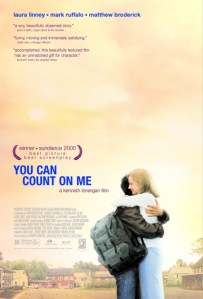
You Can Count On Me (2000)

Kenneth Lonergan has had quite an up and down year. He started the year co-writing the atrocious What Planet Are You From? and writing The Adventures of Rocky and Bullwinkle to ending it with the character ensemble piece that ran away with an armful of awards at Sundance. Lonergan uses subtle moves to create a vivid mosaic of small town America and family relationships with You Can Count on Me. In film, quite often do we see the relationships of sisters or brothers (maybe too often). Rarely, though, do we see a thorough drama hinged upon the relationship of a brother and sister. Both torn by their genders yet always drawn together. You may kid, and get angry, but when danger arises you will always come to the defense of your sibling. It’s this seperational friction yet togetherness that creates the brother-sister bond.

Laura Linney and Mark Ruffalo are brother and sister who years ago lost their parents to a horrible automobile accident when they were young. Forced with the battle of growing up with grief, each goes their separate way. Ruffalo is branded the “difficult” rebellious one, yet deep down he knows that his publicly deified sister is just as much the rebel. Linney is a single mother dealing with the pressures of raising her son (a Culkin kid) and working in her town’s bank branch headed by her new boss (Matthew Broderick). Her brother reappears in her life suddenly and the two learn a little form each other. With her brother she can rely on someone else to watch her child and experiences another flash of the mischief that she had to forfeit from her childhood in order to raise her younger brother. Ruffalo provides he male figure her son is lacking and begins to shed the boy’s over protection and opens him up to the world. One experiences responsibility, one experiences release. but do either learn? That is a good question.

Lonergan crafts a subtle texture that allows his characters to breathe and grow, but not necessarily learn. His modest character driven picture may make you think of Made for TV but its a slice of life that’s immersible. It’s hard to find a film that is subtle, at its own pace, and restrained when it needs to be.

Linney is fantastic as the sister that breaks loose and winds up sleeping with her boss with reckless childish rebellion. Her performance is an Oscar nomination lock as her character runs the emotional gambit. Ruffalo is amazing and establishes himself as one to surely look out for. his mannerisms and expressions are wonderful and his demeanor is reminiscent of Marlon Brando.

You Can Count On Me is a wonderfully affecting story about people who are more complicated then simple plot synopsis will allow. Lonergan has crafted something of an anomaly in modern cinema: a film that takes its time, doesn’t answer any questions, but makes us feel all the more better after seeing it.

Nate’s Grade: B+

Reviewed 20 years later as part of the “Reviews Re-View: 2000” article.

The Grinch (2000)

Ron Howard brings to the screen a lively but languid and ultimately empty revision of Dr. Seuss’ magical tale of a green haired grouch with an ill temper for yule tidings. There’s plenty of noise and effects but none of the magic can be sustained.

The most difficult problem with making a feature film out of Seuss’ How The Grinch Stole Christmas is that it’s 20 minutes of source material. This then requires a lot of padding, and boy does Howard pad like none other. With the aid of the screenwriters of Who Framed Roger Rabbit? (who I’ve now lost all respect for) they go into a psychoanalysis of why the Grinch acts how he does. As it seems with every serial killer movie the Grinch was tormented as a child for being a little green, hairy brussel sprout. What child wouldn’t make fun of a kid that was green? This distaste for the holidays turns the Grinch into a hermit who enjoys his days making prank phone calls down to the city of Who-ville and wallowing in despair. Cindy Lou-Who sees a nice but misunderstood person underneath all that fur and thus embarks on a quest to show the citizens of Who-ville that the Grinch isn’t so bad. Mixed results ensue.

Howard’s direction is very child-like but empty after an initial glow. One wonders what Tim Burton could have concocted with the same material. The art direction looks like a candy-coated Oz instead of the whimsical imagination of Dr. Seuss. The central message of The Grinch is that Christmas doesn’t come from a box or a store but the message is entirely hypocritical when you have a bazillion product deals for the film. The whole “lost view of Christmas” is a very lame moral anyway.

Jim Carrey, on the other hand, puts this movie on his green back and nearly saves it himself. But the immense weight overtakes him in the end. Carrey gives a flat-out slapstick comedic performance like none other. If you had any doubt in Carrey’s ability to contort himself for laughter all doubts will be quelled. While Carrey is marvelous as the central villain/hero (?) the majority of time is spent with the dog-nosed Whos. These people are lifeless and uninteresting. It’s a breath of relief every time we return back to Carrey. The Who’s are populated with a Martha Stewart like former crush of the Grinch’s (Christine Baranski), the mother who strives to be like Martha May-Who and has no other characterization (Molly Shannon), and the dowdy mayor of Who-ville (Jeffrey Tambor). No one can survive unclean.

Without Carrey this family film would be without merit. The writing throws a few bones toward the adult audience but relies too much on Carrey being goofy – which he is good at. Anthony Hopkins as a grandfatherly narrator works only in making you miss Boris Karloff even more. In short, watch the Chuck Jones special instead. This Christmas gift is a lump of coal disguised as candy.

Nate’s Grade: C

Unbreakable (2000)

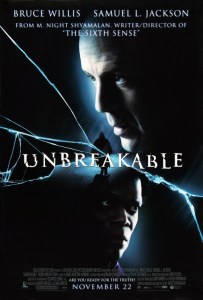
“I should have known it from the children…” Ladies and gentlemen, you have now witnessed the most atrocious ending of this year. Unbreakable has a simple yet moderately sophisticated premise in the examination of what makes a super hero. The psychology going into it would be fascinating, like do you feel a civic duty to help others? This could have made ‘Unbreakable’ a good escapist flick with some imaginative thoughts, but instead it all gets destroyed by a lame lam-shackled ending that will suck the life out of everything good and decent.

There are numerous shots in the film that go on and on and are single coverage. This likely wouldn’t pose as much a problem if it weren’t so persistent and annoying. The opening scene where the camera dances back and forth between two seats to see Bruce Willis fumbly trying to hit on another woman is aggravating to the least in its set-up. Willis himself is a security officer for a college and basically suffering from a faltering marriage and overall loser status. That is, until he is the lone survivor in a horrific train accident. Samuel “Mr. Glass” L. Jackson seeks him out to reveal to Willis that he believes he has been chosen to do good, and comic books are true, and whatever else. How can you trust a man with Gumby hair?

Unbreakable is not a movie without merits, in fact it almost could have been a good film or at least a better one. There are moments of tension, and a scene with Willis stretching out his arms in a bus station a la Christ is particularly well directed. Then there is…. the ending.

M. Night Shyamalan had true break-out success with the monumental Sixth Sense but he is now a victim of his own success because everyone and their invalid grandmothers will be looking and waiting for a twist ending. And the payoff is NOWHERE near as rewarding as Sixth Sense. In fact, it might make you mad. Mad that it ruins the rest of the film that had its few moments. Mad enough … to become a super villain all your own.

Nate’s Grade: C

Charlie’s Angels (2000)

These angels aren’t exactly what your father was enjoying when your mother was away fulfilling errands. These angels aren’t delegated as mere sex objects running around providing the jiggle entertainment that is (or was) supplied by today’s Baywatch. The 90s is a different decade after our minority movements and today’s woman is just as apt to do a flying kung-fu face plant into a baddie as any man. The angels of the film are action heroes for an armada of small girls needing some female empowerment when their only other choices consist of a barely clothed Britney or a barely covered Christina. These angels aren’t just the sex objects that the classic assortment of angelic 70s stars were; these angels are also tough-as-nails, resourceful, and not afraid to tussle or tango. Now that this exposition is out I can concentrate on the scattershot film Charlie’s Angels.

The film has been rumored to have at a minimum of 17 writers who tried shaping a story for Cameron Diaz, Drew Barrymore, and Lucy Lui. The story is pretty much shelved toward the back so the forefront is our trio of ladies kicking ass then shaking it with zig-zaggy and wild camera movements from debut filmmaker and video director McG.

Charlie’s Angels is whiz-bang dumb fun. The overall feel of the film is something more difficult to get a grasp on. At times it shows itself as tongue-in-cheek and satirical but then at other times it seems overly serious or overly dumb. The characters are non-existent and basically only discernible by hair color. The characters are very wooden and I actually found more enjoyment watching the villains and seeing more of them; call it the Austin Powers dilemma. Diaz makes the only notable attempt as her goofy and light-hearted angel connects with the audience best. Lui plays a techno-babe dominatrix but is easy to see that she was the last angel chosen and doesn’t exactly gel with the others as much as she could have.

Charlie’s Angels is best when the action is pumping. The scenes are cut together in a jam-packing sequential way adding distinct flavor and style. McG is a true surprise in the effectiveness he can orchestrate his action motifs even if the Matrix effects and moves make absolutely no sense in the real world.

Crispin Glover shows himself as a silent assassin nicknamed “the thin creepy man.” Glover is so suave and slick in his role of the non-verbal Oddjob henchman role that he exhilarated me with every presence he made on screen. Goodness, he was too cool in this film and everyone gets brownie points for allowing him. He has such energy and charisma that I wanted the film to veer off into him and desert our angels. Seeing our ageless McFly perform action scenes and choreographed fights is something I will be pleased with until my grave. seeing Crispin in the excellent Nurse Betty and now huge exposure in this is a true joy. And man… he smokes a cigarette way too cool every time he’s in this film. Some people can smoke cool some of the time but Crispin does it all of the time. His mere presence almost cancels out the annoyance of Barrymore.

The line is drawn with Charlie’s Angels in that it’s sex-kitten jiggle and an acrobatic arrangement of (light) feminism and humor. These gals know they’re sex objects and they’ll use it to their advantage delighting in every second of it. Therefore, you could argue successfully that Angels is exploitation hiding as meaningful but hell… why think about this stuff? The movie rolls along at a fast pace where you don’t keep track of these issues. It’s just an easy sit down.

The gigantic success of Charlie’s Angels makes sequels and a possible franchise all but certain. I’d be happy for McG to hop back in his directorial chair but have a unique idea for Angels 2: Bigger, Longer, and Uncut… it involves Glover kicking a lot of ass really cool like.

Nate’s Grade: B-

Reviewed 20 years later as part of the “Reviews Re-View: 2000” article.