Author Archives: natezoebl
A Very Long Engagement (2004)
 Deep in the heart of WWI trenches, we begin this sprawling tale by narrowing in on five French soldiers. Each man has been accused of self-inflicting a wound to escape service, and each man is sentenced to spend the rest of their likely short lives in No Man’s Land, the stretch of bare land between the two trenches. One of these men is Manech (Gaspard Ulliel), a young country boy engaged to the charming Mathilde (Audrey Tautou). When she learns his fated punishment and fails to hear word from Manech, she steps out to launch her own investigation into the possible whereabouts of Manech or the possible details of her fiancé’s demise. She enlists her family, solicits strangers, and puts ads in newspapers to unravel the truth. Along the way she hears various stories from all sorts of people and attempts to form them into a clear picture of what went on in that trench, good or bad.
A Very Long Engagement could be flippantly described as “Rashomon in a trench,” but from the get-go it grabs you by the lapels and will not let go. Once again, Jeunet tells his story in a criss-crossing narrative. Front and center we learn about each doomed man’s life in snapshot, and while the device has a slight eulogy feel, it’s a fantastic way to show the depth of characters in such brevity. A Very Long Engagement is an immeasurably rich film where each detail is threaded into the film to create a magnificent artistic tapestry beyond compare. The tiniest details in the film like Mathilde’s tuba playing (the only instrument whose sound mimics a distress call), to the mail carrier choosing to slide his bike over gravel just further enhance the vibrant, animated world of Jeunet.
 Jeunet is quite possibly the most visually gifted director working today (he turned down Harry Potter 5). He couldn’t film an ugly shot composition if he tried with all his French might. As expected, A Very Long Engagement is gorgeous to look at. The production design is massively intricate, the cinematography, while computer assisted, has a shimmering radiance to it. This is simply the best looking film of all 2004, Hero be damned. You could pause any second in this film and use it as a glossy postcard. Jeunet has the technical credentials to fasten together complex and beautiful worlds. A Very Long Engagement is a technical marvel and gorgeous to experience.
Tautou, also as expected, is wonderful once more. She’s the anchor of the film and the audience feels every heartbreak and glimmer of hope this talented actress explores. The supporting cast is full of familiar Jeunet players and each performance adds to the richness of the film. They feel like characters and not stock roles or cliches.
There is some difficulty with following the storyline. There are so many subplots built upon other subplots that the film’s momentum takes a bit of a dive in the second act. A Very Long Engagement can also get very confusing when it comes to remembering so many names. There are maybe 30 characters to keep track of and as the subplots mount new characters are added to the pile, including a widow played by a surprisingly fluent Jodie Foster. It’s best to employ some kind of memory trick to keep the many colorful characters of Jeunet’s world straightened.
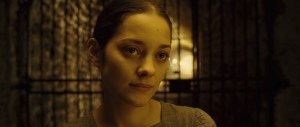 The focus of A Very Long Engagement is on Mathilde’s investigation into what really happened in that trench. She wants to know what happened to her beloved, and as her search picks up steam we get further glimpses of her relationship with Manech. One of my biggest problems I had with 2003’s Cold Mountain was that Jude Law was travailing through hell and back to get back to his beloved Nicole Kidman even though their relationship pre-war lasted as long as a Super Bowl commercial. It’s not that I disbelieve the overpowering nature of love, but I need more from my characters than shifty glances and a quick ejaculation of love (get your mind out of the gutter). Now, in A Very Long Engagement, Jeunet opens by showing the measures Manech will endure to return to his beloved, however, as the film goes on we also see enough peeks into the depths of their relationship beforehand, which dates all the way back to when they were children
A Very Long Engagement forges such a grand and sweeping love story that the audience gets just as immersed as Mathilde about the search for her man. There are so many lovely, intelligent moments between Mathilde and Manech, like their first sexual encounter. Every time Manech lights a new match Mathilde removes an article of clothing until, under the soft light of the newly lit match, she’s nude and blows the match out herself. The characters’ overriding love also taps into small truisms like when Mathilde makes arbitrary games for herself to ensure her love’s safety. (“If I can count to ten before that car passes, then he is alive.”) Mathilde’s faith and devotion are driving her investigation and the audience is behind her 100% of the way, fully invested in this mystery. When we reach our conclusion, I don’t mind telling you I was bawling like a baby.
The film has a merry whimsical tone during its origami-like narrative, but when it hits the trenches the film gets down and dirty. Jeunet shows a fascinating view into the hardships of everyday trench life as well as the machinery of death. Storming the other side’s trench, or “going over the top” as it was called, is seen in all its sordid features. There are hearty splashes of blood and gore that can be jarring.
There’s one terrifying scene in A Very Long Engagement involving the explosion of a makeshift hospital. The hospital is inside a hangar for zeppelins (hydrogen gas) and a missile has crashed into the roof with its nose sticking inside. One of the zeppelins becomes loose and slowly floats to the missile nose with unforgivable certainty. People are running around trying to shield themselves from the inevitable, but it does nothing. The moment is played so agonizingly slow that we become overwhelmed with terror. This was the life of WWI warfare.
 Having said this, the stark war violence doesn’t exactly gel exceedingly well with the whimsical romantic elements. For some, A Very Long Engagement will seem like two very tonally different movies butting heads and intruding upon the other (perhaps Amelie Goes to War?). Sometimes it does take a while to adjust to one tone after spending time with the other. I feel that the emotional investment in the characters and the anticipation of unraveling the mystery serves as thematic glue over the disproportionate tones. Some will feel chaffed by the two stark tones, but I think the power of the love story will conquer most hearts into experiencing the bloodshed of war to earn the shedding of tears by the film’s romance.
Jeunet has re-teamed with Tautou and created another masterpiece. A Very Long Engagement took hold of me from the start and mesmerized me with its beauty, grace, cruelty, excitement, and warmth. This is a great mystery and a great love story with great visuals and great characters. The opposing tones (whimsy vs. violence) won’t work for everyone, and the film takes one too many divergent paths in the middle, but A Very Long Engagement is a film of such startling originality and feeling that it should be treasured. I was floored by what Jeunet had to offer and deeply moved by the time I had to leave the theater. They don’t make them like this much anymore. Now if you’ll excuse me, I have something in my eye.
Nate’s Grade: A
Share this:

Ocean’s 12 (2004)
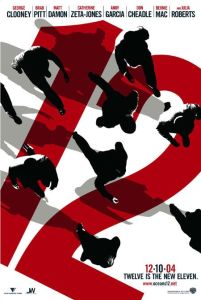 In 2001, Steven Soderbergh’s remake of Ocean’s Eleven was a giant surprise. It was a blast of fun with an impressive collection of Hollywood royalty. It had clever dialogue, fun characters, and a gala of amusing plot twists. It was one of the breeziest, most entertaining movies in years. Now, come late 2004, Ocean’s Twelve is released with the entire cast returning, including the lovely Catherine Zeta-Jones in tow. Expectations are high for another glitzy romp, but what you’re left with in Ocean’s Twelve is all glitz and no romp.
It’s been three years after the gang robbed ruthless casino owner Terry Benedict (Andy Garcia) of 160 million dollars. Benedict tracks down each member of Ocean’s Eleven and gives them the same ultimatum: either pay back what they stole, with interest, in two weeks or they’ll be killed. Danny Ocean (George Clooney) leaves his attempts at normal home life with Tess (Julia Roberts) and reassembles the team, many of whom have burned through their shares of the millions. Danny and his right-hand man Rusty (Brad Pitt) figure they’re too hot stateside so they’ll need to travel overseas if they’re to steal their fortunes. Linus (Matt Damon) also wants to have a greater role in the heist this time around.
In Europe, Ocean is challenged by a French playboy (Vincent Cassel) who moonlights as the notorious thief, the Night Fox. The challenge is to see who can steal a priceless Faberge egg, and if bested the Night Fox promises to pay all of Ocean’s debts to Benedict. Hot on the heels of both thieves is Isabel (Zeta-Jones), an expert police officer that also happens to be the former girlfriend to Rusty.
 Ocean’s Twelve does not work as a heist picture. For starters, the audience has no idea what’s going on for most of it. A general heist movie bylaw is to explain what the heist will entail, and then we watch the team hit it step by step. Forget that. In Ocean’s Twelve we’re never told how they are going to do their heist, and as they commence with their plan it’s not surprising to an audience, only confusing. I had to wait until the very end for some character to go into a monologue to explain how they accomplished their heist, and let me say, it was not worth two hours of waiting and scratching my head. The result seems to push away an audience instead of involving them in the fun of the scheme.
The story doesn’t utilize the talents of the assembled members. There’s a reason you hire a demolitions expert or a pick pocket, and that’s to let them work their skill. Well in Ocean’s Twelve we get none of that. Most of the cast’s skills are not ever put to use, which further gunks up a heist movie. The movie really errs by putting many of its eleven on ice for long stretches of the film. Around the second act almost everyone gets arrested. Pity poor Bernie Mac, who is in jail for near the whole movie. It seems that Soderbergh doesn’t know what to do with all his characters, and the new additions, so he stashes them away for long stages of time hoping an audience won’t notice.
Soderbergh is in danger of becoming a parody of himself. His usual narrative flourishes are present, including jumps in time and perspective; however, they don’t add up to much except unnecessary showmanship. The nonlinear leaps and shell game of information do not add to the film. Soderbergh keeps his audience in the dark for too long and then cheats us with the ending. Ocean’s Twelve is a good looking film (the vistas look beautiful), but it’s a good looking movie with nowhere to go. What’s even more frustrating is the ending to Ocean’s Twelve. You see, in the end we find out that the last hour plus of the movie was unnecessary. Yes, the movie actually makes a reveal that nullifies over half of the film. It’s cheap and unappreciated. Ocean’s Twelve, there’s a difference between tricking an audience and conning them. Maybe some day you’ll realize this.
 The new storylines never really develop. Zeta-Jones doesn’t add much besides another authority figure to chase after Ocean and the boys. Her subplot involving finding her master thief father is abrupt and easy. The best new addition to Ocean’s Twelve was the prospect of a rival, but again nothing really happens with our French thief. He’s more of a catalyst for the plot than anything else, and it’s a shame, because he could have opened the door for a great film pitting two competitive teams of thieves against each other.
Ocean’s Twelve is too satisfied with itself to be that entertaining. It’s now actually reminiscent of the 1960 original film (my grandmother swears it’s wonderful, take that for what you will), starring the Rat Pack. Plot and logic are secondary to a bunch of cool characters having fun. I really enjoyed Ocean’s Eleven (the 2001 film, not my grandmother’s preferred version), but this new sequel lacks any charm and verve. I can’t even say there were many good scenes, just some good ideas that they didn’t fully actualize, like stowing Yen in baggage and then losing their luggage (nothing comes of this). There’s a fun scene involving Topher Grace spoofing his own micro-celebrity, but beyond that many of the scenes and ideas don’t seem developed. The best moment of Ocean’s Twelve, for me, was when I saw Eddie Izzard, the funniest man on the face of the Earth and then some, chat with Hollywood’s A-list on screen. God bless you Eddie Izzard.
Ocean’s Twelve wilts in comparison to its witty, effervescent predecessor. Ocean’s Eleven was fun and hip but didn’t need to coast on star appeal. It had a believable heist, engaging personalities, and it was fun because we knew what was going on and it mattered! I’m sure the cast of Ocean’s Twelve had a blast making the movie together, and their friendly camaraderie shows, but when I left the theater I felt like I had been stuck with the bill for someone else?s good time.
Nate’s Grade: C
Share this:

Michael Moore Hates America (2004)
 Mike Wilson is an ordinary guy. He saw some of Michael Moore’s documentaries, listened to some of his interview bits, and didn’t appreciate what he saw and heard. But unlike the rest of us, Wilson grabbed a camera and did something. He spent the next couple years scouring the country trying to score an interview with Moore and reevaluate some of his assertions. Wilson’s final product is Michael Moore Hates America, a small but potent documentary that’s far sweeter than the title may have you believe.
With camera in hand, Wilson travels around the country to find out what ordinary Americans have to say about Moore’s viewpoints. He visits Flint Michigan, Moore’s self-proclaimed hometown (his real hometown is a middle class suburb) and finds success stories. Wilson interviews various figures from Moore’s films, like bank workers in the opening of Bowling for Columbine and an amputated soldier shown in Fahrenheit 9/11 without his knowledge. Wilson also speaks with some of Moore’s fans who chillingly declare not to care if Moore misleads or makes up facts, because to them the end justifies the means. All the while Wilson hunts for his interview with Moore but is rebuffed at every pass. Moore even goes on air saying Wilson and his movie do not exist at all.
Wilson weaves three subjects into his film: 1) an analysis of Moore’s filmmaking tactics and statements, 2) a look at what America means to people, and 3) Wilson?s own hunt for an interview with Moore. Wilson’s interview pursuit resembles Moore’s own dogged pursuit of an interview with General Motors CEO Roger Smith in 1989’s Roger and Me.
 Michael Moore Hates America is the best of the rebuttal films because Wilson smartly refrains from preaching. He doesn’t stick to party rhetoric or unleash baseless claims without supporting evidence. The name may seem mean spirited and spiteful, but Wilson’s film may be one of the most fairly balanced looks at politics and film in recent years. This is an attempt to understand why Moore does what he does, and if his actions are honest. Wilson is tackling more than Moore’s questionable tactics; he’s examining the nature of documentary film itself. Is it even possible to be objective when it comes to documentaries? Wilson interviews, among others, legendary filmmaker Albert Maysles (Gimme Shelter) and Penn Jilette (of Penn and Teller fame) and gets insights into the troubles of objective editing, context, and overriding agendas.
Michael Moore Hates America is pleasantly well made and articulated. This isn’t some ribald shout-fest. It isn’t some home movie made in someone’s basement either. Wilson’s pacing is tight and he knows when to use humor to assist his points. An animated game show called “Six Degrees of Conspiracy Theory” is a fun way to deflate Moore’s contention about why Disney dropped Fahrenheit 9/11. It’s a shame Wilson doesn’t go back to this segment again. There’s also a funny montage of Moore backing unsuccessful political candidates, topped off by him predicting George Bush senior would eat Bill Clinton alive. It’s a fun sequence but it also proves Wilson’s point that Moore isn’t necessarily mirroring the views of America despite his claims. There is an actual thematic reason for its inclusion in Wilson’s film.
The most frustrating thing about Moore, as Wilson’s film agrees, is the needless sleight-of-hand when it comes to the facts. It’s not too difficult to make President Bush look foolish; just give him enough rope to hang himself. Nor is it too difficult to make a convincing argument that the war in Iraq was misguided (All you’d have to do is quote the 9/11 Commission’s report). But Moore has the maddening habit of putting two images together, or separate pieces of information, and creating meaning when there was none before.
Take for instance Heston’s post-Columbine speech in Bowling for Columbine. In Moore’s film, we see harrowing security camera footage of the school massacre, and then Heston pops onscreen, rifle in non-cold, non-dead hand, proclaiming defiance. Moore narrates that Heston and the NRA came to Denver shortly after the tragedy as a shameless PR ploy. Not so fast. As Wilson’s film illustrates, Moore has cut and pasted different speeches into one false, defiant statement. The image of Heston clenching the rifle comes from a NRA gathering a whole year after Columbine. The NRA had a Denver gathering scheduled a week after Columbine and was legally obligated to hold the gathering because there wasn’t enough time to contact its millions of members and reschedule. Events in Bowling for Columbine seem a tad different when the harsh light of truth shines upon them. Wilson questions why Moore needs to fudge facts so egregiously to deliver his message.
 While watching Michael Moore Hates America, one gets the distinct impression that Moore cannot take criticism of any kind. One subject calls it Moore’s Achilles’ heel. Wilson attends a Moore speaking engagement at the University of Minnesota. He steps up to the mic, requests a brief interview, tells the name of his film, and Moore shouts him down, talks over him, and then cuts Wilson with 7,000 people cheering. Afterwards, some fans do come up to Wilson to comment on his courage or disapprove of how Moore refused to listen to differing points of view. Moore’s die-hard fans seem to refuse to entertain any notion that Moore’s films could be anything but gospel truth, and it’s a shame they’ll likely never view Michael Moore Hates America.
Wilson even finds himself in some sticky ethical situations. He gets an interview from the mayor of Moore’s hometown by disingenuously telling him that he?s making a film about the appeal of small town America. Wilson prods the mayor for any info on local celebrities. Later, Wilson feels so guilty about misinforming the mayor that he sends him an e-mail apologizing and being upfront about his true intentions. The scene is both surprising and slightly amazing to witness, because it speaks volumes to the brevity of Wilson’s ego. It’s quite something that Wilson actually went through with the apology, but it’s even more impressive that he put the whole incident in his own movie. You think Moore ever sent an e-mail to the people he’s misinformed in his films? I wouldn’t hold my breath.
Michael Moore Hates America does have some non-authoritative talking heads. Quotes about the violence in Canada and the resurgence of Flint are not necessarily all encompassing, but I think Wilson is just trying to show different sides of an argument and not the end of an argument.
Ultimately, Mike Wilson has created a good-natured rebuttal. Michael Moore Hates America may be a visceral title, but the movie is a balanced, intelligent, above average examination on Moore and the nature of the documentary film field. Wilson doesn’t rely on misinformation and emotional appeals; he’s looking at all the evidence and instructing us to judge for ourselves. Moore?s fans and enemies would be equally entertained to see what Wilson has captured on film.
Nate’s Grade: B-
Share this:

National Treasure (2004)
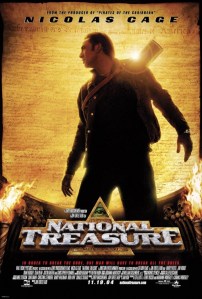 The premise for National Treasure, the newest Jerry Bruckheimer action film, is something of a mess. According to the film, during the Crusades a magnificent treasure was found. The Knights Templar swore to protect it, and the Masonic order carried the vow through the ages. The founding fathers of the Unites States were among this Masonic order, and they went about hiding the fabulous riches and set up a series of elaborate clues to discover its whereabouts. These clues include symbols on the back of our currency and, get this, a secret invisible message on… the back of the Declaration of Independence. Yes, the Declaration of Independence is a treasure map. The silly premise for National Treasure equates the Declaration of Independence with a Denny’s place mat. Can something this outlandish make for a good movie? Well, it depends on your working definition of “good.”
Benjamin Franklin Gates (Nicolas Cage) is somewhat of a laughing stock amongst his peers. His family name is cursed with the crazy belief in some long lost treasure hidden by the founding fathers. His father (Jon Voight) rues the family name being attached to such foolish theories. Of course such foolish theories in Hollywood are always right, no matter how stupid (did I mention the Declaration of Independence is a treasure map?). Ben and his treasure hunting partner Ian Howe (Sean Bean) find a definitive clue, but then Ian double-crosses on Ben and, gasp, wants the treasure for himself. This turns into a race to see who can steal the Declaration of Independence, though Ben wishes to steal it to protect the document and the treasure. Along the way, Ben teams up with a techno-nerd (Justin Bartha) and a hot government official (Diane Kruger) to crisscross historical monuments and sites to unravel the clues before Ian can.
 National Treasure is dumb. Little to absolutely nothing makes sense in this film. This is an obvious, embarrassing attempt to ride the popular coattails of The Da Vinci Code and Americanize the quest. Except that National Treasure really comes across as some half-baked movie version of a kid’s educational game show.
There are so many holes, so where do I begin? First off, why would the founding fathers make it so pointlessly, hopelessly elaborate to find this stockpile of treasure? I’m talking crazy complicated, like having one clue involve finding a ship buried in the Arctic Circle. Yes, the Arctic Circle. Supposedly, the founding fathers decided to hide the treasure because they didn’t want the British to get their grubby, nice-fitting gloves all over it. Something tells me that the founding fathers had more important things going on, like, oh I don’t know, a war! It’s purely absurd to have Washington, Franklin, Jefferson, Adams, and all the rest more interested in hiding some treasure than breaking from England and building an independent nation based on their ideals.
There are some other head-smackers, like the fact that an assembly of clues has been left entirely undisturbed in 200 plus years, like a single special brick. And, for that matter, how does Cage cut through mortar so easily with just a pocket knife? If there’s a gigantic catacomb under D.C., then what’s holding up the city? How come 200 year old oil still burns as well? Wouldn’t that have dried out by now?
 Cage reverts back to his manic show-offy character behavior. In Bruckheimer movies, Cage seems to have theoretic spurts here and there, like he keeps sticking some extremity in an off-screen light socket. He’s generally likeable but his character comes across more like some social studies teacher’s daydream. Bartha and Kruger add less-than-snappy one-liners, but their presence never becomes grating. Bean seems to be playing the stock bad guy role he always is, whether it be GoldenEye, Don’t Say a Word, or Patriot Games.
Sure, even the Indiana Jones films had plot holes (how does closing your eyes guard you from the wrath of God?) but their thrilling adventures overcame any quibbles. National Treasure, on the other hand, is an adventure lacking anything thrilling. This is the first action film to put me to sleep. I can forgive an action/adventure flick being dumb but being boring is a capital offense.
The action sequences in National Treasure are never fully thought out; they usually involve Cage and his cronies outrunning Sean Bean’s group of thugs (repeat). The film’s best moment is the actual theft of the Declaration of Independence. This is the lone sequence in the film that feels like thought was put into drawing out suspense, thinking of natural and interesting complications, and, surprisingly, having the sequence not be overcome by idiocy. After this scene, National Treasure descends into ill-conceived chase scenes strung between crazy elaborate clue hunting. By the time the film reaches its anticlimactic ending, you may have rustled through your change, eyeing the backs of quarters and dimes to ensure there’s no hidden message about a sequel.
National Treasure is a ridiculously stupid, inexcusably boring, ineptly plotted historical adventure for people who get their history solely from movies. Bruckheimer and Cage have an up-and-down partnership, but National Treasure starts with the worst film premise of the year and can?t go much further. Fans of clue-hunting adventure tales may excuse the gaping plot holes, and National Treasure has found a sizeable audience willing to go along for the ride, but the movie doesn’t contain much thrills, entertainment, or anything historically resonant. National Treasure should have stayed buried.
Nate’s Grade: C
Share this:

Alexander (2004)
 I was standing in a theater weeks ago and saw a large banner for Oliver Stone’s epic about Alexander the Great. I listed the names; Colin Farrell, Angelina Jolie, Val Kilmer, Rosario Dawson, Jared Leto. This had to be perhaps the greatest assembly of pretty actors ever in a motion picture. There’s a whole lot of sex appeal there, and Anthony Hopkins, as the film’s reflective narrator, isn’t too shabby looking himself for a man his age. After having seen Alexander, it’s safe to say the actors sure are pretty but the movie is far from it.
Alexander (Farrell) is one of the greatest historical figures. He rose to become a Macedonian king, dominated much of the known world before he was 30, and then died mysteriously at a young age. In flashes to his youth, we see Olympias (Jolie) coaching young Alexander on his future glory. Standing in her way is one-eyed King Phillip (Kilmer), Olympias’ husband though not the father to Alexander. She frets that he will sire a direct heir to the throne, and upon Phillip’s assassination, Alexander reaches new heights. He travels to Babylon with the purpose of avenging his father’s death, rumored to be paid for by Persian gold.
Alexander keeps traveling east conquering new lands but returning kings to their rule and assimilating “barbarians” into his armies. His generals begin to question Alexander’s actions, especially his surprise marriage to an Asian peasant woman (Dawson). He is unable to sire a male heir with her. Hephaistion (Leto), Alexander’s childhood friend and lifelong lover, worries that Alexander has become power hungry and distrustful of those around him. Many of his men only want to see home after seven years of battle. After defeat in India, Alexander decides to turn back but he never sees home again.
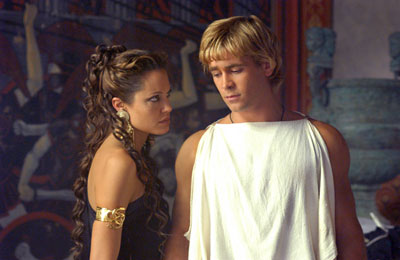 For such a lavish biopic, Alexander seems fairly remote. We don’t really get to know much about the psychology of Alexander. He’s a historical figure with equal parts good and bad ready for debate, but whenever Alexander does hit some of its star’s less-than-stellar moments, it seems to gloss right over them. Hopkins will narrate about some town that resisted, then we’ll see a quick image of it burning, and then we move on. Or we’ll see a slew of dead army officials and Hopkins will say, “He slaughtered all he felt were responsible for mutiny, but I’d expect any general to do the same.” There are several moments where we’ll hear Alexander massacred a town, or sold people into slavery, and then we get the next scene. It’s quite comical, almost as if Hopkins is a tour guide at a museum saying things like, “And then Alexander ate all of the first born babies. Moving on now…”
There are just so many awful laugh-out-loud, loopy moments in Alexander. It’s not enough that Jolie speaks in some bizarre accent; to make sure the audience understands that she’s duplicitous she has a snake wrapped around her in every scene. I’m not kidding; every scene that Jolie is in she has snakes coiled around her.
There’s a moment late in the film that is so hilariously dreadful, it’s hard to believe what you’re seeing. Hephaistion has caught ill and is on his death bed. Alexander is wrought with emotion but then strolls over to a window and begins another huge speech that ends up being all about his glory. What makes the scene go from bad to I-cannot-believe-they’re-doing-this bad is that Hephaistion, in the background, is convulsing and dying. You see his body tense up, twitch, leap into the air, and practically do some kind of triple axle, all while Alexander speechifies blithely unaware. I challenge anyone not to laugh.
Stone needlessly complicates his film with flashbacks, giant leaps forward in chronology skipping Alexander’s rise to respected leader, and skittish hallucinations. Stone is accustomed to breaking up the chronology of his films, but Alexander is too long and too campy to play around with for effect.
The acting of Alexander is set to overkill. Farrell seems miscast and doesn’t have the weight to carry such a historically meaty role. He looks pretty, and he can snarl like a pro, but the only thing worse than his overblown performance is his terrible blonde hair. This just wasn’t the right role for this talented actor. Jolie is so naturally seductive that she could have played her role mute and been effective, maybe more so. Kilmer seems to be working some kind of Irish accent but he comes off the best of the three. Leto gets overshadowed by his bangs.
Alexander also seems to speed over its star’s bisexuality. It wasn’t uncommon for men to bed both sexes, but the movie seems terrified of portraying anything beyond longing glances. Alexander and Hephaistion are reduced to some whispers here and there, but the limit of their physical affection stops at hugs. It actually is kind of funny the amount of times they hug, which I think is over five. You can tell the filmmakers wanted more but then were like, “Eh, let them hug again.” In some weird turn, it seems the film shows more depth with Alexander’s relationship with his horse than with his lifelong lover.
For a three hour movie about a military man who conquered much of the known world, there’s a shocking lack of action. Alexander has two action set-pieces and then that’s it. The first set-piece is a battle between Alexander and the vastly numbered forces of the King of Persia. The battle lasts twenty minutes and is disjointed, bloody, and perfectly indicative of the confusion of war. Stone cuts back and forth between majestic aerial shots showing the progress of battle and hand-to-hand combat amid the sand and dust clouds. Stone also labels certain sections of the armies, which gives a greater understanding of the battle. It shouldn’t be a surprise that this battle is the highlight of Alexander.
The only other action set-piece comes very late in the movie. Alexander’s forces have marched all the way into India. Warriors on the backs of monstrous elephants stampede onward to intercept Alexander’s armies. This battle is also chaotic, and Stone utilizes a lot of quick point-of-view shots like people getting squashed by pachyderms. The action is satisfying if a bit over the top (a warrior gets impaled on a slow-moving elephant’s tusks), that is until Stone goes off the deep end. Alexander gets wounded in battle and suddenly the film switches tints, bathing everything in reddish and bright neon hues. Everything has a tin outline. It’s rather ridiculous and unfortunately reminds me of Ralph Bakshi’s misguided animated Lord of the Rings.
 That’s all you get for action, so I hope you like speeches rich with superfluous historical name-drops, because that’s what Alexander is all about. I’d bet money that nearly an hour of this three-hour opus involves people delivering speeches. Alexander rallies his men, Phillip talks about the Greek tragedies, Olympias strokes Alexander’s greatness and need for kingship, his generals talk about his decisions, and then we get endless moments of Alexander talking about a new world, bringing people together, and respecting other cultures. Alexander seems to go dead as soon as some character pulls out a soapbox. Worst of all, many speeches involve lots of historical references that an audience cannot be expected to keep up with. The overall effect is like listening to an unwanted party guest drone on. Alexander may be trying to talk to death his enemy.
What makes all of this worse is that the dialogue and the drama are so melodramatic. The center of Alexander’s creaky psychology is a domineering mother and a scornful father who scream at each other a lot. Whenever someone has a disagreement in Alexander they resort to over emotive screaming. You may start tuning the actors out after awhile. Much of the dialogue is terrible, but there is the occasional howler line like, “It is said that the only defeat Alexander suffered was Hephaistion’s thighs.” You may concur with Alexander’s men and want to return to your family as soon as possible after watching this.
I was trying to think how something like this, so misguided and off the rails, could chug along without a peep from someone saying, “Hey, maybe this isn’t working.” Then I got it. You see, Alexander is Oliver Stone. Both men are revered for previous victories, both men are generals that take full control of their armies, and both men are fiercely stubborn. If someone questioned Alexander’s decisions, chances are they could be killed. Now I’m fairly certain Stone wouldn’t go that far (there may be many graves dug over the grumblings over U-Turn), but I can see how difficult voicing dissension might have been.
Stone’s long in the waiting Alexander epic is bloody, ponderous, exaggerated, talky, sumptuous and off-the-charts loony. This is a giant mess only a visionary director could amass. Only historical junkies might be entertained by Alexander, and the rest of us will just be glazed over. We never get to really know Alexander, nor do we even get our money’s worth for action, so unless you click your heels to the thought of hours of speeches, skip Alexander. Trust me, it’s far from great.
Nate’s Grade: C-
Share this:

Finding Neverland (2004)
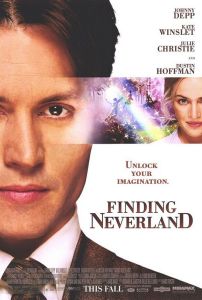 My friend George Bailey and I came to a similar conclusion during a recent conversation. There are a handful of movies, usually released around this time of year, that are packed to the gills with awards hype and general goodwill. Then I see them and feel underwhelmed for whatever reason and I walk out and feel that I should like the movie more than I do (if I do at all). I don’t know what to call it, societal guilt, elitism, but this is exactly what I felt when I left Finding Neverland.
J.M. Barrie (Johnny Depp) is in search of his next play. It?s 1903 London, and the financier (Dustin Hoffman) of his last play has taken a financial bath. Barrie’s also emotionally closed off from his wife (Radha Mitchell). One day in the park, Barrie stumbles across Sylvia (Kate Winslet), a widow managing four boys by her lonesome. Barrie takes a shining to her children and delights in spending long days with Sylvia and her boys. From his encounters with Sylvia and the boys, Barrie works up the inspiration to write a new story, called Peter Pan. Of course the public has its own gossip about a married man gallivanting about with a widow and her boys (think recent Michael Jackson scandals). Then there?s Sylvia?s mother (Julie Christie), who is set to put her house back in order starting with removing Barrie from their lives.
 The message of the movie is about the need for adults to slow down, open their imagination, and become bewitched by the power of believing. Because it’s not like there aren’t any other Hollywood movies out there that teach us to loosen up and enjoy life. Thank you Finding Neverland, I never would have found this out by myself. The message of belief overpowering all is also a bit naive, but then it works into the whole cross-stitching of sap the movie is generating.
Not even Depp can save the film. Long established as one of the most versatile and exciting actors, Depp finds ways to disappear into his oddball characters. In Finding Neverland, Depp sports an impressive Scottish brogue, but, sadly, this is the most impressive aspect about his performance. There had been much talk about Finding Neverland being Depp’s next opportunity at finding Oscar, but it would be a shame if Depp won for such a lackluster, artificial performance especially when he’s been brilliant so consistently in other movies. J.M. Barrie was somewhat eccentric, but in Finding Neverland he comes off as mostly vacant. The film tries to show that Barrie didn’t really fit in, but instead of becoming a showcase for Depp’s acting it becomes a showcase for Depp’s silence. The performance is so subtle that it doesn’t even come off as a performance. If Depp stood in the background of a movie, it would be akin to this performance.
Winslet has also been a very versatile actor. Her role in Finding Neverland never really deepens beyond Disadvantaged Woman. She’s been hit by adversity, she’s beset by four rambunctious kids and an icy mother, but that’s about all the film does for her characterization. Winslet is a tremendously talented actor, as evidenced by her Oscar-worthy performance in this year’s Eternal Sunshine of the Spotless Mind. So why strand her in a role where her character’s greatest acting moment is coughing fits?
Director Marc Forster (Monster’s Ball) has the frustrating habit of having two shot styles he shoots in. He decides between medium shots which usually involve two or three people, or large close-ups. While I was watching Finding Neverland I never once thought to myself that something was filmed in a visually interesting way. Some of Forster’s decisions seem unnecessary, like when he has to visually show us scenes of imagination instead of allowing the audience to, gasp, use their own imagination (hey, isn’t that the message of the movie?).
Finding Neverland tries so hard to be a three-hanky movie (and truth be told I heard a lot of sniffling in my theater during the last half hour), but what stops the film short is how unbelievably transparent everything is. Finding Neverland could have explored the rich complexity of an enigmatic figure like J.M. Barrie, but instead it settles for goopy sentimentality at every opportunity. Barrie becomes sugar-coated into an earnest father figure, and in the process key facts are sugar-coated as well. What do you mean? Well, Sylvia’s husband didn’t die until several years after Barrie wrote Peter Pan. Barrie’s wife didn’t have her affair until long after Peter Pan. Also, the original Peter threw himself in front of a train because of how upset he was about his connection to the famous character. I guess that’s why this is a biographical movie merely “inspired” by true events, much like Hidalgo.
The filmmakers rely on cloying tricks to make an audience care about its characters. The movie paints in very stark black and white tones, mainly “adults = shortsighted” and “children = special.” This is a film that is proud to take the easy road and makes little effort to cover its pride. It plays toward audience expectation and thus loses any long lasting magic.
Finding Neverland takes the easy road for audience-friendly sappiness. Barrie insists that 25 orphans be strategically placed around the theater on opening night of Peter Pan. Sure enough, the theater is full of old white men with monocles, and apparently they just don’t get the spirit of theater. The orphans laugh and squeal from the stage antics, and somehow this triggers all those old curmudgeons to learn to laugh once again. You see, all it takes is strategically placed orphans to make us laugh at life again.

When Sylvia is hanging laundry she starts to gently cough. If you’re smart, you’ll instantly figure out what trajectory is in store for her, but even if you miss this single cough don’t worry, because Sylvia will be doubled over with coughing later to spell it out for everyone. You can all but see the strings being pulled (the audience will cry… now!). All can be overcome in the end, those who didn’t understand will, and we’ll all be happier and live life to the fullest, in theory of course.
Finding Neverland wants to be Shakespeare in Love, another whimsical movie that shows how a writer utilized the people and events around them to pen a masterwork. Except in Shakespeare in Love there was a romance to fall back on, as well as some ripe comedy, but with Finding Neverland there isn’t anything to fall back on. It’s a Hallmark card mass-marketed to the largest possible audience.
Everything about Finding Neverland is disappointingly under whelming. The direction is shabby, the actors are marooned by their weak roles, and nothing is sacred in the film’s pursuit of that tearjerker ending. This is a movie for people that ask little of their movies, and yet I can reasonably see Finding Neverland becoming an audience favorite and riding good word of mouth all the way to awards season. Finding Neverland is a film that never takes flight because it’s too content to stay grounded by going the easy route.
[Nate’s Grade: C
Share this:

The Incredibles (2004)
 You’ve been there before. You know the drill. You’re staring up, mouth agape, at the multiplex’s list of new titles wondering what to see. It happens to the best of us. Who can you trust in these situations? Most people used to think they could trust Tom Hanks, but after his accent experimentation in The Ladykillers and The Terminal, not to mention his giant creepy mustache in The Polar Express (with accents!), that train of trust might have left the station. A lot of people felt they could trust an Oliver Stone movie, and, well, look how that turned out. No, moviegoers, the only trustworthy name that won’t let you down is Pixar. With hits like Toy Story and Finding Nemo you know that those computer wizards are looking out for you. Their newest work, The Incredibles, will keep Pixar alive in the moviegoer circle of trust.
The Incredibles takes place in a world where superheroes walk, run, jump in single bounds, and zip through the sky. They’re beloved and revered, with the super-strong Mr. Incredible (Craig T. Nelson) at the head of the pack. But then a fiend strikes more powerful than any dreaded super villain: litigation. A mountain of lawsuits pile up against superheroes, and the government disbands its programs and relocates all super-abled beings into new identities and homes.
Fifteen years later, Bob Parr, a.k.a. Mr. Incredible, has married Helen (Holly Hunter), a.k.a. Elastigirl, who can stretch her shape, which comes in handy keeping their two children in line. Dash (Spencer Fox) begs his parents to allow him to use his power of super speed, especially at his schools sports. Violet (Sarah Vowell), all long haired Goth angst, uses her power of invisibility to just disappear during school and other functions she feels she doesn’t fit. It seems the only member of the family fully adjusted and happy to a “normal” life is Jack Jack, the Parr’s infant son who may or may not develop super powers of his own. Bob feels crushed by the grind of office work and hiding what makes him and his family special. He escapes at nights with old friend Frozone (Samuel L. Jackson) and the two of them relive the good old days with attempted heroic acts. Helen catches on and they have a huge fight with the kids as witnesses. Helen explains to her family in the best way that she can that their days as superheroes are over. They have to adjust to a different life now.
 Bob’s wanderlust is soon quenched when he receives a mysterious invitation from a beautiful, white-haired woman named Mirage. She offers Bob the chance to become Mr. Incredible once more, to use his gifts and abilities to stop a robot on the loose on some island. Bob leaps at the chance, hiding his ongoing super exploits from his wife, and regains a sense of purpose. He hasn’t been this happy in ages; however, it all comes to a head when he learns that Syndrome (Jason Lee), the one responsible for the run-amok robots, has other plans. Not only this, upon capture Mr. Incredible realizes that he has ties to Syndrome way back during one of his less-than-super moments.
Helen is shocked when she finds out what Bob’s been up to, but also partially relieved it’s not an affair. She visits their old costumer Edna Mode, whose glasses and black wig may be bigger than the rest of her shrimpy body. Edna has redesigned a team of superhero costumes, and with them in hand Helen becomes Elastigirl once more and takes Dash and Violet on a journey to save their father and become a family once more.
The Incredibles is a film bursting with entertainment. This is an explosion of imagination, of wit, of grand storytelling, that the audience should sit and soak up every loving and beautiful second of it.
The voice work is wonderful. I’m sure Disney execs were scratching their heads over Craig T. Nelson, but I cannot imagine anyone else that could deliver as much in the role. Hunter is excellent, as always, as a doting mother and crime fighter. Lee is great with a villainous role that has a lot more depth to it than near any live-action film. His verbal gymnastics are perfectly suited for a slighted super villain.
Writer/Director Brad Bird’s first feature was the 1999 masterpiece, The Iron Giant, which I consider the finest animated film of all time (you heard me, Walt). Bird’s first film was a masterful mixture of little boy fantasy, reality, strong characters, humor, and excuse-me-there’s-something-in-my-eye tenderness. I know many people who, after seeing The Iron Giant, say they were, “crying like they watched a puppy get hit in the face with a shovel.”
 With this being said, my trust in Bird as a master storyteller is still there. The Incredibles is the first Pixar film concerning real people, not just toys, ants, fish, monsters, and, uh, more toys, and the results are astounding. This is a film rich in complexity, human insights, family warmth, and, again, realism. Bird has fully realized The Brady Bunch of superheroes. They feel just as flesh and blood as any characters I’ve seen in any film this year. They have desires, secrets, shame, guilt, anger, burdens, pride, and above all, love. I mean, how many animated films have an actual subplot involving marital suspicion? You won’t find that in The SpongeBob Squarepants Movie. When Elastigirl and the kids go off to save her heroic hubby, she has a sit-down with her children and warns them that, yes, death is very real, and that these people will indeed kill them if discovered (this is the first PG-rated Pixar film, by the way). It’s a great moment that reminds you how much you care for these people.
Bird’s imagination seems incomparable. He has a razor-sharp feel for comedy, like Elastigirl’s scene caught between several sliding doors or the lively, hysterical Edna Mode personality, but he also possesses the ingenuity for crafting some of the most exciting action sequences in a long time. The Incredibles has uncanny action scenes, set to Michael Giacchino (TV’s Lost) blazing jazz score, which should make the James Bond producers die from envy.
Bird has created a stupendous action film, a heartwarming family drama, a hilarious comedy, and a gorgeous film to watch. Movies rarely get this entertaining, but for Pixar, it’s all just part of the norm. I hope someday we don’t take Pixar’s accomplishments and staunch consistency for granted, because they aren’t just reinventing what animation can do, they’re also reinventing what films themselves can do. You can have all the accents you want Tom Hanks; I’ll gladly take The Incredibles and its bounty of offerings.
Nate’s Grade: A
Share this:

Bridget Jones: The Edge of Reason (2004)
 You don’t see too many sequels to romantic comedies, and that?s practically by design. Most romantic comedies consist of keeping the leads apart as long as possible, and then in that final climactic moment they connect, embrace, kiss, usually while a camera pans around them and some up-tempo Top 40 songs swells on the soundtrack. Then we end, our story finished. You see, romantic comedies are essentially modern fairy tales, and they end on the “happily ever after” moment, the most joyous moment. We don?t think about what their lives could be afterwards. I doubt few in the audience are biting their nails to know who does the dishes or if their sex life diminishes.
So for all of these stated reasons, sequels to romantic comedies are rare, unless, of course, they’re based on a book series that’s a cash cow of chick lit. Thus, America, we are given Bridget Jones: The Edge of Reason, the sequel to the smash 2001 film Bridget Jones’s Diary.
 The movie takes place four weeks after Bridget (Renee Zellweger) and Mark Darcy (Colin Firth) cuddling in the falling snow. Their relationship is all lovey-dovey, until Bridget starts reconsidering if she made the right choice of men. Her former boss, Daniel (Hugh Grant) has gone on to fame as a travel correspondent for TV news. He’s a bad boy, for sure, but sparks flew with him. Bridget also suspects Mark of cheating on her with a leggy colleague (whose final plot revelation is quite dumb). Bridget tries her best to fit in with Mark’s upper crust society, but is starting to feel unaccepted. Then she becomes a partner to Daniel on his travel reports, and the two visit exotic locales and sparks begin once more.
Edge of Reason feels like a poor slapdash grab at money. The film lifts entire scenes from the first Bridget Jones movie and tries reworking them for similar effect. Watching Firth and Grant sissy fight each other is amusing … the first time I saw it in 2001. For the most part, it seems like the filmmakers behind Edge of Reason were straining to come up with things after that “happily ever after” moment. What other reason can there be for some of the disastrous plot turns in Edge of Reason? The revolving door of writers (including author Helen Fielding herself) manufacture petty and foolish nitpicks for Bridget that she treats as life or death. It’s hard to feel concern for her. When you strand your main character -in a romantic comedy, no less- in a Thailand prison because she was caught smuggling drugs -in a romantic comedy, remember- then you have some giant plot issues.
The wit and biting commentary from Bridget seem to be stripped away. She only makes two journal entries, which open and close the film, and they were responsible for some of the greatest comedy bits in the original movie. She no longer comes across as a snappy, ordinary girl with a big heart and some big neuroses (did I mention the Thailand prison?). The Bridget of Edge of Reason seems a bit obnoxious at times. The comedy of Edge of Reason doesn’t generally rise above slapstick. Watch Bridget parachute into a dung field (Ha!), watch Bridget ski backwards down a slalom (Hilarious!), watch Bridget get stoned from magic mushrooms (You’re killing me!), and don?t forget to watch her fall down, like, a lot (R.I.P. Nate; cause of death: laughing too hard). The makers of Edge of Reason are just trying too damn hard.
It’s a wonder that Edge of Reason does work at times, and that reason is because of the acting of our romantic trio. Zellweger is still incredibly charming despite some of the things she’s forced to do. She’s never looked better than when she has her Bridget Jones physique; she’s practically glowing. Grant is at his best when he’s a cad, and once again he gets the best lines, especially when he’s undressing Bridget during a work trip. The movie comes alive when he and Zellweger start their flirtatious battle. Firth adds shades of humanity and adoration to his fuddy-duddy role. He’s got a great everyman appeal even when he’s being a twit.
Edge of Reason also seems to flog whatever it feels is funny. If Bridget saying something inappropriate in front of a group of dignitaries and ambassadors is funny, then expect it to happen again five or six times. And it does, sadly. Edge of Reason is almost a wall-to-wall torture chamber of public embarrassment for Bridget, and if the filmmakers thought that would endear her to audiences they were wrong. We were endeared already by her wit and charm, but I guess the people behind Edge of Reason thought we didn’t want more of that. I miss you old Bridget Jones, wherever you are.
 The first Bridget Jones movie was directed by Sharon Maguire, a personal friend of Fielding. Maguire was close enough to know how to adapt the story and retain the elements that made Bridget Jones entertaining. Edge of Reason‘s director Beeban Kidron seems to be assembling a Bridget Jones movie for a focus group. We lose the personality of Bridget and get an accident-prone buffoon. All that’s missing are the banana peels.
Everything about Edge of Reason screams laziness. A great example of this is the film’s choice for music. The songs are so obvious, from “All By Myself” to “I’m Not in Love” to songs that simply have “love” in their title, like “I Believe in a Thing Called Love” to Beyonce’s “Crazy in Love.” Chances are, if your band ever released a song with “love” in the title, the music director of Edge of Reason considered using it.
Bridget Jones: The Edge of Reason will likely entertain its core audience (there were very few men unaccompanied by women in my theater). The cast makes this stilted sequel worth watching. If you really liked Bridget Jones’s Diary, you’ll probably be intermittently amused with Edge of Reason, because it’s the same meal, only reheated with a bit of a chill. Let this be an example of why Hollywood doesn’t make sequels to romantic comedies. We’re happy enough with “happily ever after.”
Nate’s Grade: C+
Share this:

Saw (2004)
 Saw was pieced together by two first-time filmmakers, director James Wan and writer Leigh Whannell. They envisioned that old movie favorite, the imaginative serial killer. Their killer would put people in horrific life-or-death situations, testing our will to live even if it meant rummaging around the intestines of a live human being for our key to freedom. With a budget of a mere million dollars, Wan and Whannell have executed a dark, slick, sometimes thrilling, sometimes laughable fright flick. The only question is if audiences are hungry enough for the splashes of blood Saw can deliver, or if they’d rather watch Sara Michelle Gellar turning Japanese.
Adam (Whannell), a private photographer, and Dr. Gordon (Cary Elwes), a workaholic surgeon, are in a very strange circumstance. They’ve both just awoken and find themselves chained by their feet at opposite ends of a bathroom with a dead body between them. Neither has any idea how they got there. Dr. Gordon theorizes that they’re the culprits of the Jigsaw Killer, a psycho that places his victims in elaborate death traps they must fight to get out of. In the pants pockets of Adam and Dr. Gordon are audio tapes from Jigsaw establishing the rules of this “game.” In eight hours, if Dr. Gordon does not kill Adam, his wife and daughter will be killed. Jigsaw has even left them clues to their escape, most notably a pair of rusty saws not strong enough to cut through their chains, but still plenty strong to slice through their feet if they so choose. Outside this game, Detective Tapp (Danny Glover) is closing in on the identity of the Jigsaw Killer and may be the only hope Adam and Dr. Gordon have.
 Saw is a grisly horror movie that hits the right macabre marks. Horror is such a tricky genre, and you can either build tension in an effective what’s-around-the-corner kind of way (The Ring, 28 Days Later), or, if that fails, and it often does (The Grudge anyone?), you can cut your losses by showing the gory goods (Texas Chainsaw Massacre, any slasher film). This isn’t to say one version is inferior to the other; sometimes we just want to be grossed out. Saw is a horror film committed to horror, sometimes to a rather unpleasant and sadistic point. In a way, the fact that Saw goes for broke in its depiction of the grotesque makes it more enjoyable than recent horror fair that tried to hedge their bets on jump scares and nosy cats.
In some manner, Saw is like a dumber, trashier Seven. They both involve serial killers with agendas and they both give the killer the upper hand. While Seven is a masterpiece of the thriller genre, Saw is a mostly entertaining horror entry. Its premise is razor-sharp and really hooks an audience. We know only as much as the characters do, so their discoveries work two-fold. The pacing is tight, the cinematography is exceptional for its budget, and the end had me jump out of my seat. I will say this; Saw reluctantly seems to think that it needs to reveal the identity of the Jigsaw killer, as well as his motives, to satisfy an audience. I think no answer could ever be satisfying; however, the actual reveal of Saw‘s true killer had me wanting to give the filmmakers a standing ovation. There are fleeting moments of greatness here among the misery. Whannell knows when to show which cards, and it makes the story more enticing.
There are glaring issues with Saw. The acting is one of them. Elwes is usually a stable character actor, but chain him to a wall and say,”Go!” and the man will overact as if his real wife and child depended on it. Whannell, a first time actor and the co-writer, goes deliriously over the top in some battle of scenery chewers. Don’t feel too bad if you feel like laughing during certain moments of “emotional turmoil.”
Saw seems to exist in that magical place known as It Could Only Happen in Movies World. For example, a serial killer designing highly elaborate, and personally clever, death traps could only happen in a movie. I love the fact that the film even shows evidence that the Jigsaw Killer builds dioramas of his future death traps. If he entered them in the Third Grade Sadistic Science Fair, I’m fairly certain he?d at least earn a blue ribbon or a gift certificate.
Yes, only in a movie are we expected to believe one man can kidnap people, lug them around, set up his elaborate Rube Goldberg puzzles, and then kick back and elude police capture. The entire premise of Saw is whole-heartedly ludicrous, and the plot turns are heavily contrived, but, as an audience, you must yield such ordinary eye-rolling to enjoy the pleasures of Saw. If you can swallow plot holes and just go with the film’s skewed logic, there is some enjoyment to be had.
 Wan can also be his worst enemy. Too often he punctuates chase scenes with pounding heavy metal, which does little more than numb an audience. Wan’s film loses some of its focus in the middle as the audience endures flashback after flashback. To goose up the viewing, Wan shoves in extraneous flashes of gore. Just like The Exorcist prequel, flashes of something horrific do little more than to cause an audience to yelp. They’re immediate. If you want true gut-churning reactions, you have to build, and in the end Saw remembers what it came to do and sprints to the finish line.
Saw also exists in the grimiest possible world. Whether it be parking garage, office, or even personal apartment, the characters of Saw exist in some netherworld of filth crying out for an army of scrubbing bubbles. I’m sure this was intentional, but can’t any place in horror movies afford a coat of paint nowadays?
Saw is a gruesome, twisted, sometimes sadistic horror movie with a knock-out premise, a moderately good ending twist (not the final end, though), and some lag time in between. Wan and Whannel really stretch their budget to impressive ends and imply more blood and guts than are shown. Fans of hardcore gore horror should be pleased with Saw, though they may find themselves giggling at it from time to time. I was hooked by its premise and found myself getting more intrigued as the revelations began to sift. Many will find Saw too ugly, gory, or stupid, but for fans of the genre, it should satisfy the itch recent PG-13 horror couldn’t efficiently scratch. Saw is violent, contrived, ridiculous, but also, in the end, gruesomely entertaining in parts.
Nate’s Grade: B-
Share this:

Surviving Christmas (2004)
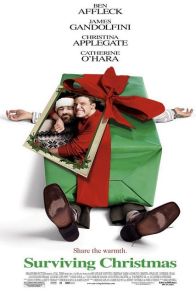 Surviving Christmas was originally supposed to be released, get this, a whole year ago for Christmas 2003. Paramount objected to the original release, saying it was too close to the release of their own Ben Affleck action flick, Paycheck (I doubt anything could have helped that turkey). So Dreamworks held onto it for another year and released it around the holidays. Halloween that is. The nation hasn’t even experienced Halloween or Thanksgiving yet, and we’re already getting a Christmas movie in our stocking. Given Affleck’s recent track record (the man hasn’t had a hit movie since 2002’s Sum of All Fears), audiences might not expect more than a lump of coal when his name’s above the title.
Drew (Affleck) is a cynical ad executive trying to figure out his plans for the approaching Christmas season. He gives his girlfriend tickets to Fiji, but she expected an engagement ring, so she dumps him right there claiming he doesn’t know what family life is. Drew finds his old family home now populated by the Valco family. He offers Papa Valco (James Gandolfini) $250,000 for him and his wife (Catherine O’Hara), son, and daughter (Christina Applegate) to be his family for Christmas. Papa Valco accepts. Drew is a stickler for family tradition, and mandates tree shopping, hat wearing, dinner script reading, and sleeping in his old room. The family’s hostility begins to wear down but things get even stickier when Drew falls for the Valco’s daughter, and then his ex-girlfriend shows up wanting to see his family.
 The central flaw of the film is Affleck’s character. Drew is a jerk. That’s all there is to it. Somehow Affleck has become the go-to actor for arrogant, work obsessed men that desperately need to see that there’s more to life (Bounce, Jersey Girl, Forces of Nature). I think this is also the second or third time he’s played an ad executive. Surviving Christmas seems to exist in some weird dimension where a jerk shows us the true meaning of Christmas and family togetherness. What’s even worse is that Drew doesn’t change as a character, he doesn’t seem to grow, and the ending actually seems to reward him for his selfish, material, obnoxious ways.
I like Affleck, I really do. I like his work in Kevin Smith’s films, and he can make a good action hero if given the right material (Say a Sum of All Fears, and not so much a Paycheck). The man is charming, he’s eloquent, and he’s self-deprecating and constantly funny. He’s the kind of guy you want to buy a beer. Now, having said all this, Surviving Christmas is Affleck’s worst performance of his career. Affleck can do comedy, and not just in a Greek tragedy kind of way with his life in the tabloids. In Surviving Christmas, Affleck mugs like nothing is sacred. His eyes bug out. He exaggerates near any expression, from his smug grin to his childish fits. For a man who has Gigli, Reindeer Games, and Pearl Harbor to his credit, it’s something when it’s said that Surviving Christmas may be his acting low point.
Gandolfini seems to have been cast to play against type. He’s still got that flinty stare and slow simmer of anger, but he’s generally wasted. He’s the comic foil to Affleck’s jerk, and yet he still doesn’t come across that much better. His monstrous woolly beard is also mildly disturbing. Applegate brings more life to her love interest role than the role deserves. Her romance with Drew seems so spontaneous, especially given her natural hostility to him. The only actor that has any real moments to stretch and shine is O’Hara. A veteran of improv, O’Hara has some of the film?s funnier moments, like when she makes mini marshmallows with a butcher’s knife, or her wild photo shoot Drew arrangers for her.
Surviving Christmas is indeed a chore to sit through. The movie, at its gooey heart, doesn’t know what kind of holiday film it wants to be. A good example is the opening montage of holly jolly Christmas sequences. In between standard, saccharine moments of feeling, there?s an old grandmotherly woman who bakes a tray of gingerbread men, with frosted frowns, and then sticks her head in an oven. Huh? Surviving Christmas tries to have it both ways. It wants to lampoon Christmas sentiment with the occasional touch of dark humor, but then it plays into a feel-good holiday formula complete with sled rides, tree lighting, and hot cocoa. The result is a schizophrenic comedy that doesn’t work being dark or cuddly.
 The whole wacky premise of Surviving Christmas screams sitcom, and the conventional proceedings and stock characters that follow guarantee it. The only way this could be more of a sitcom is if they drew a line down the middle of the house, the boss was coming over for dinner unexpectedly, and a pesky cat swallowed someone’s wedding ring. Surviving Christmas‘ relation to a sitcom is the only way I can explain why the film has stale jokes about internet porn (What, there’s porn on the Internet? When did this happen?). There’s even horny old men and wedgie jokes too! This is a movie in desperate need of a laugh track. I kept expecting everyone to turn their heads and go, “Dreeeeeeeeew” and then Affleck shrugs his shoulders, bugs his eyes out, smirks, and the studio audience goes wild.
It probably doesn’t help that Surviving Christmas is credited to over five writers and was directed by the director of Deuce Bigalow: Male Gigolo. The comedy rarely hits its marks because it’s so frustratingly tied up in its identity. The film wants to make incest jokes, but then in the same breath it wants us to listen to some syrupy back story explaining why Drew is the lonely, socially challenged jerk he is. The laughs of Surviving Christmas are mostly limited to broad slapstick and the occasional inappropriate remark. The preview audience I watched the film with seemed to be rolling in the aisles while I mostly rolled my eyes.
There will be a section of the public that enjoys Surviving Christmas. Fans of Christmas cheer and broad PG-13 comedies may find laughs amongst the wreckage. Surviving Christmas doesn’t have the gusto to commit to black comedy like Bad Santa (a new Christmas classic), but it also doesn’t build its characters strongly enough for an audience to care about them. They’re all mainly jerks and twits. This is a Christmas movie that doesn’t know what stripes it is. How else to explain it coming out in late October.
Nate’s Grade: C


 nathanzoebl
You must be logged in to post a comment.