Author Archives: natezoebl
Funny People (2009)
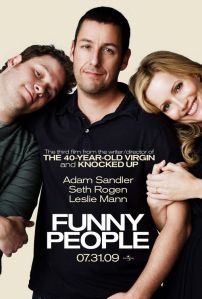 In two short years, Judd Apatow has become the king of comedy. He’s co-written and directed two bona fide hits that will go down as comedy classics (40-Year-Old Virgin, Knocked Up), and produced gut-busters with heart, like Superbad and Forgetting Sarah Marshall. The Apatow brand of comedy centers on characters and less on contrived set pieces. He’s built up enough comedy capital in Hollywood that he felt he could write and direct a project less ideally commercial, something tagged as being more personal and serious like in the James L. Brooks mold. Funny People is the mixed results. I applaud Apatow for trying to grow as an artist, but as the saying goes, if it ain’t broke don’t fix it. Funny People is a broken movie that isn’t funny enough to be fully redeemed.
George Simmons (Adam Sandler) is a famous comedy actor that has made several hit Hollywood comedies. He may live in a giant mansion but his life is extremely isolated and lonely. He has no real close friends and years ago he drove away the love of his life, Laura (Leslie Mann). He has no one to comfort him in his time of need. This prickly man has been informed that he has a terminal blood disease. Simmons decides to go back to his comedy roots, to stand-up, and it is there that he meets the young comedian Ira Wright (Seth Rogen). Ira has grown up with the comedy of George Simmons, so he is flabbergasted when the man himself asks Ira to write jokes for him. Ira’s roommates, fellow stand-up comic Leo (Jonah Hill) and crappy sitcom actor Mark Taylor Jackson (Jason Schwartzman), can’t believe his dumb luck. Ira and Simmons build an unorthodox friendship, and Ira is the only person George has confided in about his disease and his fear of dying. And then something amazing happens. George Simmons gets better. He’s got a new lease on life and he aims his attentions on the girl that got away. Laura is married to Clarke (Eric Bana), a handsome Australian businessman, and she has two adorable kids (Apatow’s own girls), which makes it a very poor time to restart her romance with George.
 Funny People is the first Apatow-helmed film that feels sadly incomplete, even at two and a half hours. The movie is staggeringly sloppy when it comes to plot structure and character work. First off, when a character is informed that he has a terminal illness at minute three, it doesn’t have the impact that it would if the audience got to know and feel for that individual. In fact, the first half of this movie feels like, and this may get confusing, the second half of another movie. It centers on a selfish character coming to grips with his choices in life, mostly wrong, and beginning to reconnect with people once more, building a mentor friendship and finding the “one that got away.” But there are segments during this first half of Funny People where the impact just cannot be felt because the dramatic legwork has not been achieved. Watching Simmons’ estranged family berate him through tears doesn’t have much of an impact when they discover the news. Seeing George Simmons spend his potential last days jamming with Jack White and other musicians is cool, but it doesn’t come across as anything but another indication that the fake George Simmons is famous in this alternative Los Angeles. It doesn’t have setup, like Simmons talking about one of his life’s pleasures is strumming the guitar or playing before things got complicated. So it’s basically just another celebrity cameo snapshot. While I’m on the topic, the multitudes of celebrity cameos are strangely unfunny, save for a bit where Sarah Silverman describes her lady parts.
This is also the first Apatow comedy where it feels like twenty percent of what I saw promised from TV spots, trailers, making-of specials (there was a good one on Comedy Central to check), the advertising unit if you will, was not in the movie. This gave me the distinct impression that even at a lengthy 150 minutes that Funny People feels misshapen, that there are swaths of material on the cutting room floor that would have assisted the narrative and sad amount of underwritten supporting characters. I’m not saying Funny People would necessarily be a better movie at three hours length, but it would at least feel more fully formed and satisfying.
 The main problem with the film, outside of the reverse plot structure, is that everything just goes slack during the uneven second half. George and Ira spend about an hour of the movie with Laura and her family, and it feels like one long uncomfortable detour. Part of the squirmy feeling is intentional, as the audience is supposed to be in Ira’s shoes and see George’s homewrecking as the bad decision train wreck it is. But I also felt uncomfortable because George kept extending his stay day after day and I was getting impatient. I wanted these characters to head back to L.A. and deal more with the Ira/George relationship. During this second half, Ira becomes a background figure that is good for nervous reaction shots. This stalls all the character work that had been done up to this point and Ira goes to pause mode for an hour. This second half section isn’t particularly funny, it isn’t romantic, and it gives little insights into the past between George and Laura. She has established a nice living for herself, with two cute kids and a hunky husband who seems to be a good father when he’s around. In fact, despite the movie’s insistence that Clarke is a cheater (thus ensuring the movie law that it is then acceptable to cheat on him), I found myself liking the hyperactive and sensitive lout. Every plot movement in this second half feels wrong, some of it intentional, but it makes Funny People feel like it has been hijacked and taken hostage. Where did the movie I was kinda liking go? What happened here? This hour feels like a separate movie and one that Funny People would have benefited from simply being dropped entirely.
Perhaps I’ve been watching too much Mad Men in anticipation of its third season, but this movie also disappoints by failing to delve into the creative process of comedians. Despite its running time and subject matter, there isn’t that much standup witnessed. Usually the movie will display about one line or one bit and then cut back to the characters offstage again. We don’t get to see the evolution of comedy or the professionals talking shop about what makes a good joke. There isn’t even much collaboration, so we don’t get to see multiple minds banging out jokes together. There’s a comedian named Randy (Aziz Ansari) who is popular with audiences because he’s loud and spastic, and all the other comedians hate him, but then the movie doesn’t return to this. Go back to this topic. I want to hear more about the divisions within the comedy world, the people that feel like they are more pure or textured in their funny compared to the people that play to the crowd and lap up the easy yuks. Ira’s character work is mostly explored through his changing standup persona, where he seems to gain more confidence and a voice. But there’s this whole other storyline where Ira is a “joke thief” and takes other people’s material and repackages it as his own. This is an interesting story and provides conflict and glimpses into the character of Ira as an insecure and ethically challenged opportunist in a competitive field. It makes him a more dynamic character. I saw more of this storyline in the making-of special for Funny People, and sadly it is only hinted at in the final product. The other comedy players, like Ira’s roommates and his quasi-love interest (Aubrey Plaza), are barely explored as people and professionals.
Apatow comedies are notable for being character-based, but Funny People doesn’t seem too concerned with establishing characters that you want to be around. I found little reason to care. I found most of the characters to not be engaging; some were unlikable but most were simply flat. George Simmons is supposed to be a selfish man, though there’s something inherently selfish about being famous in Hollywood. Comedy itself is inherently selfish, where individuals guard their observations and exploit personal stories for the endorphin highs of audience approval. Is successful comedy linked to selling out? Funny People occasionally visits the dark recesses that comedians utilize for material, like self-lacerating humiliation and family trauma that gets aired out as a means of therapy. Simmons is a selfish and lonely guy and the point of the whole movie is that even after a near-death experience, he’s still selfish and lonely. He’s said he’s changed but has he really? That seems to be the movie’s cosmic joke. This is clearly a personal movie for Apatow, which might explain why it has less resonance for an audience that isn’t as steeped in the history of comedy or the rigors of fame. I just don’t have the same point of interest.
 Sandler revealed his acting talent in 2002’s beguiling Punch-Drunk Love, and in Funny People he plays a completely different character than his other adolescent roles. He doesn’t pander to be likable at any point, and he’s generally standoffish from beginning to end. He hasn’t done a lewd, crude movie in over ten years, and this return to raunch rekindles the Sandler I remember listening to constantly in the mid 1990s. This role isn’t as taxing for him as an actor, nor is he given too many chances to reveal deeper layers to George Simmons. I think this is by design from Apatow. Rogen is less his charming self and during the second half of the movie he pretty much shifts his eyes and makes pained faces. He feels at ease in the stand-up sequences, probably because Rogen performed stand-up comedy when he was 13. Mann gets her biggest acting role in years and cries enough, but it made me realize that she works best as an actress that can steal scenes rather than an actress who has scenes built around her. I think Bana (Star Trek) actually comes off the best. He showcases an exuberance for comedy not seen before, and when his character gets emotional it still manages to be funny and believable.
In the end, Funny People just isn’t that funny. There aren’t any particularly clever comedic setups, the characters don’t get many chances to be humorous even as comedians, and the movie just goes slack during its uncomfortable and uneven second half. The Hollywood satire lacks bite, and the best bits are saved for the scathingly unhip and formulaic “Yo, Teach!” sitcom of Schwartzman’s. Apatow is more interested in purging a personal tale onto the screen rather than fashioning a relatable mainstream comedy. I feel that the salutations that Funny People is “more challenging” and “serious” are unwarranted. This is certainly a different movie but is it any more serious than navigating the uncertainty and awkwardness of an unplanned pregnancy or beginning sexuality at middle age? I don’t think so. Beyond this, the movie doesn’t establish its plot well and spends far too much time in side diversions, failing to round out characters and ignoring intriguing premises and storylines. Even the camaraderie, usually a hallmark of Apatow productions, feels lost as the characters have much more friction. On a personal note, I saw this movie while I was on vacation in the Outer Banks. On our car ride back to our beach house, my then-partner and I got into a car accident. We were both physically fine but her little Ford Focus was totaled. I will now forever associate Funny People with a car accident. If that isn’t enough of an on-the-nose metaphor, while we waited along the hot road for police and tow trucks, I thought to myself, “I just wish the movie was worth this.” It wasn’t.
Nate’s Grade: C
Share this:

The Room (2003)

I consider myself to be a connoisseur of crappy cinema, thanks in large part to growing up on the fabulous TV series Mystery Science Theater 3000. To me, truly bad movies can be just as enjoyable to witness as great, competent works of filmic art. So imagine my surprise when it I had never heard of a little flick called The Room until a month ago. I was reading an Entertainment Weekly article about this tiny 2003 movie that has developed a rabid cult following. I felt betrayed. How did I go five years without ever hearing about this movie? The Room is writer/director/star Tommy Wiseau’s magnum opus. It must be seen to be fully believed.
To watch The Room is truly a life-altering experience. This movie goes beyond bad. It’s so bad that it almost seems like Wiseau is a mad genius. This movie is bad on multiple levels and hooks you from the beginning, instantly daring the audience to stick around to see if it gets worse. And it does in the most wonderful ways. If I was stranded on a deserted island and could only bring five movies, right now The Room would be one of them (I may even be tempted to just bring five copies of this movie). Wiseau’s film cannot displace Manos: The Hands of Fate as the worst film of all time, but The Room easily belongs in the upper echelon of craptacular cinema among the likes of The Land of Faraway and Lady Terminator and Bulletproof Monk. I am simultaneously appalled, bewildered, fascinated, delighted, and comforted by this movie, comforted by the fact that something this singularly inept could still sneak through the system. But this film is so perfectly inept on a multitude of levels that it feels like it could never be recreated again, like the human race benefited from this chance artistic encounter. The only way I can fully describe my unhealthy appreciation for this cinematic slice of the absurd is to simply list off my list of loves.
 1) The film’s plot involves a love triangle with the three least personable people imaginable. Johnny (Wiseau) is a broad shouldered, marble-mouth Austrian who supposedly works at a bank, we’re told. Lisa (Juliette Danielle) stays in their apartment doing very little, though she says that she shouldn’t have gotten into the computer business because it’s “too competitive.” Lisa declares in damn near every scene that after five years together (though the characters say seven at the end of the film) she no longer loves Johnny. She now loves Mark (Greg Sestero), Johnny’s best friend. And if you forget that key point then Mark will assist you because one third of his dialogue is declarations of “Johnny’s my best friend.” Another third of his dialogue might as well be, “What are you doing?” Mark is one of the thickest dolts in history. Even after Lisa has sex with him twice, calls him repeatedly, and leads him to places where they can be alone and intimate, he looks at her dumbfounded and says, “What are you doing?” like a kid who will never comprehend that 2 + 2 = 4. This is the basis of the plot and yet so much of the movie is gloriously repetitive and involves characters sitting around, saying the same things over, without ever really advancing the plot.
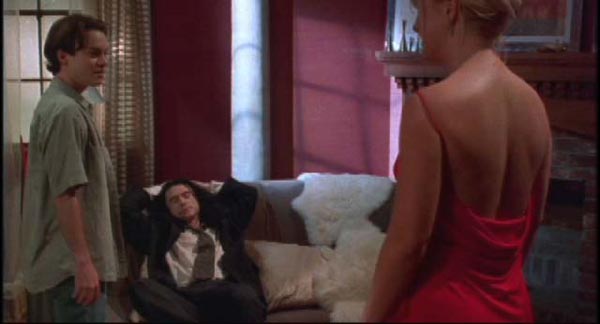
2) The Room hooks you from the start, and it’s all thanks to the weird neighbor kid/surrogate son Denny (Philip Haldiman). This supposed student is an orphan that Johnny has taken a shine to; Denny has his rent and tuition generously paid for by Johnny. In the very opening scene Johnny gives Lisa a slinky red dress as a gift. She tries it on and both Denny and Johnny make favorable remarks. Johnny says he’s a bit tired and leads Lisa by the hand up the stairs. The camera stays on Denny, who, instead of taking the hint and leaving, remains standing, grabs an apple, takes a bite out of it, then slowly walks up the stairs after the amorous couple. He then hops on their bed and joins in on their pillow fight foreplay. The characters have to literally spell it out to the guy that they want some privacy for sex. “I know, I just like to watch you guys,” Denny responds. What? Denny confesses to Johnny about experiencing weird feelings for Lisa. This kid is supposed to be in college but he acts like he’s developmentally challenged. A friend has a theory that Denny has a confusing gay crush on Johnny, but I believe that would be way more deep and subtle than the movie seems capable of.
 3) The movie is littered with subplots that come out of nowhere and never resurface again. All of a sudden Lisa’s materialistic mother (Carolyn Minnott) announces she has breast cancer. This is never commented upon again. All of a sudden Denny is confronted by an angry drug dealer who wants his money, which means he’s also the world’s worst drug dealer if he’s willing to give out drugs on credit. The characters all collect on the roof and yell. This is never commented upon again. Lisa makes up a story that Johnny hit her. He publicly denies it. This is never dealt with again in any capacity. Lisa lies to Johnny that she’s pregnant, just to “make things interesting.” Her rationale is that they’ll eventually start trying to have a baby anyway, which conflicts with her frequent statements that she doesn’t love Johnny and wants to leave. This fake baby is never commented upon again. About thirty minutes into the movie, another couple sneaks into Johnny’s apartment to have sex. Why I cannot fathom. When Lisa and her mother intrude upon this scene, the mother asks astutely, “Who are these characters?” Exactly madam. The movie keeps going over the same material because nothing new ever sticks.
4) The line readings are astoundingly inauthentic. Half of the film seems to be dubbed, especially Johnny’s lines. Much of the dubbed dialogue fails to match up with the actor’s mouth movements. There is one sequence in a flower shop that is nothing but dubbed dialogue and it happens so quick. The scene itself lasts like 10 seconds but it still manages to squeeze in this entire conversation: “Oh hey Johnny, I didn’t see you there.” “Yep, it’s me.” “Here are the flowers you wanted.” “How much?” “18 dollars.” “Here ya go. Keep the change. Hi doggy.” “You’re my favorite customer, Johnny.” “Byeee.” It happens so rapidly with so little breath in between. Wiseau’s quick changes in temperament with consecutive lines will amaze you. He goes directly from, “I did not hit her! I did not! I did naaaaaaaut,” to a very casual, “Oh hey, Mark,” in a nano-second flat. The speech patterns rarely approach realistic human cadences.
5) Lisa is routinely told by the several male characters that she is exceptionally beautiful and lovely, but this woman’s personality is like a dead plant. Danielle is a fine enough looking woman, though the hair and makeup people do her no help with those thick eyebrows, but as a beauty that could manipulate multiple men? I don’t think so. Danielle has a bit of a tummy to her, which is fine by my standards of beauty, but from a Hollywood perspective a woman that lacks a concave stomach is considered “fat.” Lisa’s friend Michelle (Robyn Paris) is in fact a more attractive female and might have served as a better Lisa. I think perhaps Danielle was willing to do nudity and Paris was not, but really, if you’re a struggling L.A. actor and you’re willing to agree to be apart of something like The Room, surely you’ve already ignored any internal misgivings. What possible hang-ups could there be left?
 6) The film is structured like the soft-core porn that dot the late hours of premium cable channels. There are four lengthy sex scenes in the first hour, though one of them is composed almost entirely with recycled footage from the first bout of lovemaking between Lisa and Johnny. The sex scenes are deeply un-erotic and consist of several camera angles that make it impossible to see what is actually happening. There is nothing sexy about watching Wiseau’s pasty posterior humping the hips of Danielle (seriously, the body alignments are way off here). When Lisa and Mark have sex on top of a spiral staircase, Wisuea can barely frame the action coherently. Why would anyone want to have sex on a spiral staircase? That’s just asking for chronic back pain. Mark fails to even take his pants off. For such lengthy sex scenes, Wiseau does so little with the talent on display. What makes all the sex scenes even better is that they each get a wretched pop song as a soundtrack. It’s all mid 1990s R&B with some growling sex guitar, and it’s all awful. There’s one song that repeats the phrase “you are my rose” like nine times in a row. If you fail to cringe and howl from the sex scenes then the songs ought to do it.
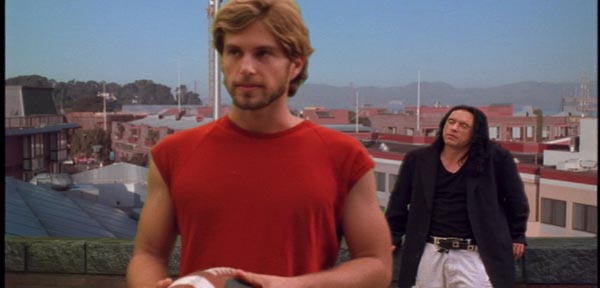
7) Wiseau makes the most mysterious decisions as an artist. He sticks to a minimum of locations and one of them happens to be the roof of Johnny’s apartment complex. The sensible thing would be to film on an actual roof. Wiseau decided to film on a roof set and use an ineffective green screen backdrop that makes San Francisco look like it inherited Los Angeles’ smog. The film keeps cutting back to exterior stock footage of the city that signifies the passage of hours, a day, or no time whatsoever. When Denny is confronted on the same rooftop about his sudden drug disclosure, Lisa berates him. As she cries and shrieks and overacts, you cannot see it because Wiseau’s camera has cut her facial reactions out of frame. The scene cuts back and forth between Denny facing the camera and the left side of Lisa’s head. At another point Lisa is talking about her cheating ways with her pal Michelle, who seems way too giggly to be disapproving. During this scene Lisa has angled her body in such a manner that when she speaks it appears like a subcutaneous alien is about to burst forth from beneath her neck. Wiseau did not catch this unnerving and distracting sight. The film’s lone idea of male bonding involves tossing a football together. So Mark and Johnny will go out running in a park and toss a football back and forth, all the while having a faint conversation that gets drowned out by an overly anxious score. There will be swaths of the film where the score just competes with the onscreen dialogue.
8) There’s like a whole other level of offhand dialogue throughout, where characters will stand around and Johnny or someone else will mumble to no one in particular. The actual dialogue is full of other memorable head-scratchers, such as:
Random disapproving guy to Mark: “Keep your stupid comments in your pockets!”
Same disapproving man: “It feels like I’m sitting on an atom bomb that is going to explode!”
Michelle using chocolate candies as a means of foreplay: “Chocolate is a sign of love.”
Lisa’s mother: “Nobody ever listens to me.”
Lisa: “You’re probably right about that, mom.”
Johnny’s profound wisdom: “You know, if more people love each other the world would be a better place.”
Johnny refers to someone as a chicken and then proceeds to make this accompanying sound: “Cheep, cheep, cheep, cheeeaaaaaaaaiiiiiiiiiip.” This bizarre chicken impression will be repeated no less than three times.
 This brief exchange at a coffee shop between Mark and Johnny:
Mark: How was work today?
Johnny: Oh pretty good. We got a new client… at the bank. We make a lot of money.
Mark: What client?
Johnny: I cannot tell you. It’s confidential.
Mark: Oh come on. Why not?
Johnny: No I can’t. Anyway, how is your sex life?
And finally, the signature line, where Johnny has had enough of Lisa’s mental games and he roars, “You are tearing me apart, Lisa!”
I could keep citing further evidence of The Room‘s cinematic shortcomings, but listing the faults of one of the worst films ever made can be pointless after a while. The staggering amount of faults in Wiseau’s film is also its combined strength. Most bad movies have a finite level of badness, like a poor plot or some troublesome acting. The Room is a movie composed of nothing but 99 complete minutes of badness at every facet of filmmaking. I am a more complete person having seen this remarkable film. I highly recommend gathering a group of friends around and holding a viewing party; the movie plays to even higher levels of enjoyment with a group atmosphere. The Room is Tommy Wiseau’s accidental masterpiece and, to me, proof that a loving God exists.
Nate’s Grade:
Artistic Merit: F
Entertainment Value: A+
Share this:

The Ugly Truth (2009)
 Can’t a woman ever catch a break in romantic comedies? The genre occasionally just comes across as contemptible against women. On screen, female figures will fight against misogyny, but then how often do they usually just give in? How often do the female characters change to suit the male characters? Usually, the male romantic lead has some kind of boneheaded secret, but it’s really the women that do all the changing and the man is left off the hook. It’s somewhat appalling and amazing that the unappealing romantic comedy The Ugly Truth was written by three women and produced by Katherine Heigl. I guess they wanted to prove that women could be just as capable of self-sabotage.
Abby (Heigl) is a career-driven TV news producer who’s a bit unlucky when it comes to love. She has a steep checklist of qualifications for a prospective mate. She is aghast when her boss hires Mike (Gerard Butler), a rude public access host of the dating advice show “The Ugly Truth,” to shore up ratings. Mike is an uncivilized shock-jock who dispels pearls of wisdom like, “No man wants to date a fattie.” Abby and Mike bicker from an ideological divide. But when an attractive doctor (Eric Winter) movies in next door to Abby, she agrees to follow Mike’s dating advice. He coaches her on how to win over the doctor, and it generally seems to be working. Of course now Mike thinks he may have fallen in love with Abby as well. Oh what complications await.
 The humor of The Ugly Truth doesn’t even aspire to be sophomoric; it’s questionable whether the comedy even reaches juvenile levels. It’s tasteless and piggish, but the weird part is that it comes across as knowledgeable on the subject of sex as a ten-year-old kid who just discovered his dad’s secret stash of Playboys. It talks about the right stuff but does so in a clueless manner. It’s like an exaggerated randy cartoon that chiefly plays to a male fantasy. The movie feels that the height of comedy is when Abby wears a pair of vibrating panties to a business dinner, and oh no, some little kid is playing with the remote. So Abby is writhing and convulsing while trying to deliver a business speech. It’s the female orgasm turned into a cartoon. I won’t even get into the icky implications that Abby does not even get to control her orgasm, that she is held hostage by the whim of a child (a boy, no less). It just comes across as morally queasy if you think more about it, which may be why Heigl is practically rolling around on the table and chirping like a dolphin. Meg Ryan has nothing to worry about in the world of public displays of an O-face. At least in that movie, the joke was on the audience, and the man, and the woman was in a position of control. I even saw this routine already with a vibrating egg in the 2006 hard-core sex drama, Shortbus.
It doesn’t get much better. There’s a moment at the ballpark where Abby spills her drink onto her date’s lap, so she furiously tries to rub it out, which in crazy movie world means the man instantly attains pleasure. If that wasn’t enough, the movie then takes another step and displays this ordeal on the ballpark’s Jumbotron. And if even that isn’t enough, the movie takes yet another step to obscure what Abby is really doing, so all you see is her bobbing head by the crotch of her date. It’s not really funny because it’s so forceful to the point of being unpleasant. Abby is the butt of most jokes and after awhile it just seems cruel. The jokes recycle the same lousy observations about the differences between men and women. Men want sex. Women want relationships. Men are cretins. Women are crazy. Men like boobies. Blah, blah, blah. This time there’s just more bad language. There’s nothing truly adult here, either in wisdom or comedy. Just because you imply oral sex and throw out a few F-bombs doesn’t mean that your romantic comedy is any more sophisticated and relevant. The Ugly Truth just reeks of desperation.
 The central characters don’t even come across as believable for a romantic comedy. Abby is an intelligent professional woman who will stand up to rampant misogyny in the workplace. She resents Mike’s attitude that the only value women serve is to please men. So then it would only be natural that she follows Mike’s coaching to win the heart of the hunky doctor living next door. She clearly believes that she must become a sexed-up twit to win over a doctor. What? Excuse me, come again? The characters are at the mercy of whatever contrivances the plot requires. Predictably, this is yet another movie where two characters hate each other for two acts only to finally realize in the last act that, surprise, they’re really in love. Because we know the inevitable coupling, an audience likes to pick up on moments that might help explain how we got to our final romantic destination. Will the crude dude really have a mushy heart deep down? Will our icy businesswoman be able to let her hair down and enjoy the messiness of life? Have you ever seen a romantic comedy before and therefore know the answers to these questions? In The Ugly Truth, I could not explain why either of these people would fall in love with the other. I’m sure there are plenty of great backstories where people realized their true love in the basket of a hot air balloon. Seriously, the climax takes place in a hot air balloon and Abby asks, “Why do you love me?” to Mike. “Beats the shit out of me,” he replies. This is intended as a moment of romantic clarity. I view it as the screenwriters giving up, having failed to establish even a remotely credible relationship in a genre replete with easy choices.
I’m actually a fan of Heigl (27 Dresses) and think that she seems like a natural fit within the romantic comedy universe. She’s expressively comedic, has good timing, and she knows how to hit her jokes hard. She can wait until she’s older to do a family drama because right now there’s gold in them thar genre pictures (practice the finer points of singing into a hairbrush and dancing around a coffee table). But The Ugly Truth is a waste of her ability. Abby is a tightly wound control freak and Heigl plays her without an ounce of warmth. Butler (300) can still come across as likeable even if his character is cheerily boorish. He doesn’t hide his natural Scottish brogue too well, though. He’s got more comic firepower and he openly mocks himself, which makes him more appealing as a character. However, there isn’t much in the way of chemistry between Heigl and Butler, only combativeness. Their fighting is the only emotion that seems real.
 So what is the ugly truth of The Ugly Truth? I suppose if you’re a woman, you better not be successful, talented, smart, or slightly overweight. And your dating failures are completely your own fault. And you better be willing to put out or at least dress a little provocatively. And don’t expect your man to change any of his ways, simply lower your standards. That, ladies and gentlemen, is the concluding wisdom from our trio of female screenwriters. Heigl and Butler squander their talents in such a charmless battle of the sexes cartoon. There’s little in the way of wit or insight or even properly executed comedic payoffs. The Ugly Truth needs to be atoned for. It’s rarely funny and it’s insulting and unflattering to both sexes. It exists squarely in the world of exaggerated male fantasy, peculiar for a genre defined by female wish fulfillment. At my screening, there was a family who brought their adolescent kids with them. I could hear pre-teen giggling at the more slapstick-heavy jokes and heard lots of questions whenever something sexual was discussed. At one point, Heigl covers the eyes of a child and says, “This is not for kids,” and I guess that family finally got the message because they left shortly after. Except this movie isn’t intended for anybody. Everyone in the theater should have followed suit.
Nate’s Grade: D+
Share this:

Harry Potter and the Half-Blood Prince (2009)
 Not every film franchise gets to a sixth installment, although Police Academy and Friday the Thirteenth managed to. After over twelve hours of storytelling, is it even possible for non-fans to enter the Harry Potter world (only an idiot would begin a film series at number six)? I am a willful Muggle to this universe. I am content to wait for the movies, and it drives the readers nuts. “The books are so much better,” they all say. Then they tell me what was left out of the movies, and honestly it’s usually a good thing. Harry Potter and the Half-Blood Prince echoes the increasing darkness of the later books by author J.K. Rowling, but now I can finally walk out of a Potter film and know, without a shadow of a doubt, that the book must have been superior. Half-Blood Prince is a film adaptation that spends too much time in all the wrong places.
Lord Voldermort (Ralph Fiennes, seen only for literally a split-second) is back with a vengeance, and his followers, Death Eaters, are branching out and attacking the Muggle world as well. Headmaster Dumbledore (Michael Gambon) has asked Harry (Daniel Radcliffe) for help in recruiting a former Hogwarts professor. Horace Slughorn (Jim Boradbent) used to be an esteemed potions professor, and one of his bright students was none other than a young Voldermort (Hero Fiennes-Tiffin, Fienne’s real-life nephew). Dumbledore and Harry explore liquid memories that belong to the Dark Lord in hopes of learning how to defeat him. In the meantime, the kids are under attack not by Voldermort but by hormones. Harry’s friend, Ron (Rupert Grint) and Hermione (Emma Watson), are secretly in love but neither has the heart to say something. Ron uses his star Quidditch status to “snog” with the eager Lavender Brown (Jessie Cave), who’s infatuated with Ron. This infuriates Hermione and she seeks comfort in a studly student herself. Harry is starting to feel his heart go pitter-patter for Ron’s sister, Ginny (Bonnie Wright), which requires Harry to be very delicate in negotiating the “Can I snog your little sister?” portion of male friendship. Oh yeah, and apparently Harry is also using a potions textbook that used to belong to some whiz kid known as the Half-Blood Prince.
 The further I get away from Half-Blood Prince the more certain I am that it is the least involving film of the series. The plot is somewhat nebulous and unclear, and so much of the story is dominated by boring teenage romance. I understand that Hogwarts is swimming in hormones, but these kids spend the whole time making shifty doe-eyes at each other than doing anything substantial. That makes for a boring romance, and when the movie is dominated by this stuff for two hours it doesn’t make the movie too engaging. I understand that the Ron/Hermione courtship has been setup for some time, but it takes forever to move even incrementally closer to that coupledom. The Harry/Ginny material is lacking at best. She’s such an empty presence and they do so little with her character that I have no idea what would warrant Harry’s affections. There is no spark, no heat, no sexual tension, and no interest. I was actually relieved when Half-Blood Prince drops practically every storyline with twenty minutes left. Seriously, these plotlines aren’t resolved or capped or even addressed, they just don’t exist once Harry learns the word “horacrux.” And let’s talk about that subject just for a moment. Dumbledore lures Professor Slughorn back to Hogwarts so Harry can learn Voldermort’s secret of eternal life, a secret that Dumbledore already knows because he’s been taking leaves to locate and destroy Voldy’s horacruxes. I felt detached and disenchanted throughout Half-Blood Prince.
There are other plot holes and irregularities, and I wonder if writer Steve Kloves (who took the fifth movie off) is merely serving up 153 minutes of plodding prologue for the big finish. The drama is becoming more static and the supporting characters of previous installments reappear and do little but stand with hands in their pockets; they have nothing to do. The flashbacks to Voldermort as a child reveal relatively nothing new; only indicating her was a creepy kid. The two action sequences squeezed in are not from the book, meaning Kloves was trying to add some excitement to what is a rather sleepwalking storyline. The action sequences mean little; the opening attack on London’s Millennium bridge offers some nice sights but little consequence, and the destruction of the Weasely house comes across like Kloves was grasping for greater conflict. Too much of his film is the young love foibles with the occasional sideways glance at Draco (Tom Felton) brooding in the shadows. The ending, with its notable death, still strikes an emotional cord but it also comes across as rushed and without depth and resolve.
 What is the significance of the Half-Blood Prince in this adaptation? The mysterious figure was good in potions class and his old textbook helps Harry in class. That is it! The late reveal of the identity of the Half-Blood Prince is so incidental and off-the-cuff, that the actor practically has to say, “Hey, remember that whole Prince thing like an hour ago? That’s me. Yep. So see ya.” It’s such an indifferent plotline handled with such indifference. I had to ask my Potter-versed wife why Rowling would even bother naming the book after such a minor, irrelevant plot footnote. Kloves’ adaptation feels lost and mostly like filler.
So why does a slower, less coherent, less interesting Harry Potter rank better than the first two films? Because director David Yates takes an artistic step forward and this addition has style to spare. Returning to the Potter director’s chair, Yates has a stronger feel for the world and creates striking film compositions with the added help of noir cinematography by Bruno Delbonnel (Amelie, Across the Universe) and the foreboding production design by Stuart Craig. The sets have a grand Gothic appeal and help compensate in tone for what is lacking in the screenplay. The opening bridge attack allows for soaring flights through London and then into the magic world, and it’s a great opening visual rush. The memory flashbacks have splendid visual artistry to them as we watch inky brush strokes coalesce into solidified images. It’s a fantastic special effect and it is welcomed every time. This isn’t one of the more special effects heavy installments but the effects are as good as ever especially when seen through Delbonnel’s lens.
It’s interesting to have watched the three main actors grow up in their roles, which also gives them the ability to revert to autopilot when the movie lags. In the Half-Blood Prince, the trio burrows back into previous acting episodes. Radcliffe gets talked to a lot so much of his acting in this jaunt seems to involve intense bouts of nodding. He does have one sequence of exaggerated comedy when he swallows a luck potion, and the actor feels delightfully unrestrained. Grint gets the most screen time he’s had in ages and continues to dial up the daffy humor. As I stated with my review of Order of the Phoenix, I think Watson began as the best actor of the trio and is now on a fast-paced downward slide. Her character gets to experience jealousy and heartache, and Watson shows some ability to convey mixed emotion. The most interesting actor of all the kids is Felton, who I found to be surprisingly empathetic. He’s tortured over his fate, a mission given to him by the Dark Lord. He’s torn apart by moral indecision and a sense of duty. That’s way more interesting than watching Ron and Hermione try to make each other jealous. Why didn’t Kloves devote more time to the anguish of Draco? That’s where the drama is. There just isn’t much room for character growth and acting in the rest of Half-Blood Prince. The best acting award goes to Broadbent (Moulin Rouge, Hot Fuzz). He conveys the regret of Slughorn with every manner and gesture. His sad, poignant confession is oddly the emotional highlight in a movie that includes a momentous death later.
 Harry Potter and the Half-Blood Prince feels like a half-hearted adaptation, with way too much time spent on tepid teen romance. This is the most visually arresting Potter film next to 2004’s Prisoner of Azkaban, but it just fumbles the storytelling. The sixth film is too often boring and inconsequential. Too much of the film feels like it was purely made for the die-hard Potterheads, and if any Muggles have questions of clarity they are required to seek out a friend to ask. This is just sloppy writing. It feels like everyone is just busying themselves before the sprint to the big finale. We’re just about at the end of the long winding road that is Harry Potter, though I’m sure the fact that the producers are splitting the final book into two movies likely will not mean that the individual movies can finally have a two-hour running time. Half-Blood Prince would have greatly benefited by being shorter, more precise, and more significant; the 16-year-old romantic squabbles seem so slight in the backdrop of Voldermort and his army on the rise. I’ll give everyone the benefit of the doubt, but this is not a Potter venture I’ll likely return to again. It just doesn’t measure up when it comes to movie magic.
Nate’s Grade: B-
Share this:

My Sister’s Keeper (2009)
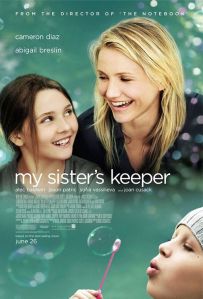 How could a movie about dying children be so schlocky? The best-selling Jodi Picoult novel, My Sister’s Keeper, is awash in drama but it never tipped the scales into absurd and tone-deaf melodrama. How does one botch a tear-jerker? You need only watch the big screen version of My Sister’s Keeper for a primer on how to turn a complicated, challenging book into maudlin mush (hint: make sure to have a sizeable budget for obtaining music rights for endless montages).
Kate (Sofia Vassilieva) is dying from cancer. Her little sister, Anna (Abigail Breslin), was conceived by her parents, Sara and Brian (Cameron Diaz, Jason Patric), to be a genetic match. Anna was born so that she might be “spare parts” for her ailing big sister. Jesse (Brennan Bailey), is the oldest child, and his needs have been overlooked because of Kate’s illness. Anna’s life has been one of prodding and pricking and testing and operations. Then one day, Anna consults with high-powered lawyer Campbell Alexander (Alec Baldwin). She wants to sue her parents for the rights to her own body. She’s tired of undergoing numerous medical treatments. She wants a life of her own, something more than being “spare parts.” Needless to say, Sara and Brian are horrified. Anna clearly loves her sister but by refusing to donate a kidney she is signing her sister’s death notice.
 The movie strikes one false, heavy-handed note after another. There is rarely a moment that feels authentic or genuine; everything comes across as powerfully manipulative and cloying and contrived and like a tuneless melodrama. Things are cranked to such a high degree of overkill. I swear to you that, no joke, at least seventy percent of the scenes in this movie involve somebody crying. People don’t argue, they flail and shout until they go hoarse. There is nothing subtle to be found here. I didn’t feel emotionally invested in these characters and one of them is a freaking teenage girl suffering with cancer! The first half of the movie feels far too rushed, and the majority of scenes last under two minutes, meaning that the plot lurches forward but the film fails to round out and establish its central characters. The movie’s idea of covering up its screenwriting shortcomings and lackluster character development is to produce an extended music montage. There are over five music montages (I lost count) and it possibly takes up a fifth of the movie’s total running time. I don’t know about you, but watching characters smile and laugh set to music that is so painfully on-the-nose literal does not make due. After so many matching lyrics, I was waiting for a song to literally describe everything I was watching on screen, like, “Heaven/We’re all gonna go/You’re gonna go sooner/Because you’re a little girl with cancer/Don’t you think your mother’s crazy?/So what’s on TV?” Is it better drama to hear a somber cover of Cyndi Lauper’s “Girls Just Want to Have Fun”? It’s just one of several flimsy filming decisions that rip you out of the story and make it perfectly obvious that you are watching a movie, and a poor one at that.
There is just way too much material here for it to succeed as a streamlined, two-hour weepie. There are complicated moral issues here about exploiting one child in efforts to save another. Grief can transform the nucleus of a family in small ways. This requires a delicate adaptation and this movie is certainly not it. This is an adaptation that alternates between syrupy music montages and falling anvils. My Sister’s Keeper is beset with convoluted flashbacks, and I often was confused as to where in the timeline several of the scenes were taking place. Is this before or after Sara shaved her head in solidarity? Is this before or after she Katie starts chemo? There are multiple characters that share voice over duties, often just offering up a line or two. What’s the point of having Jesse announce in voice over, “I wondered how much trouble I was gonna be in,” when he sneaks into his house late at night? Could we not communicate this effectively without the added voice over? And only for a single line? This is just shockingly lazy writing and proof that the filmmakers have no trust in their audience. In fact, Jesse as a character is entirely pointless. He adds nothing to the story except to make things more confusing. Why does he sneak out at night to drink milkshakes in downtown L.A.? Why are judges unclear why a lawyer of such fame and stature as Campbell Alexander has a helper dog? There are intriguing dramatic setups that just get overlooked. What kind of life goes on in a family home when one child is suing their parents? Show me this stuff.
 By far, the only believable part of this mawkish mess is a lengthy flashback to Kate’s boyfriend, Taylor (Thomas Dekker, sporting a good-looking dome if you ask me). This is the only segment that’s allowed to breathe and feel naturally developed. It is during this tender sequence where Kate feels like a character instead of a broadly drawn sketch of Cancer Girl. The interaction between Kate and Taylor is sweet and relaxed, until an obvious conclusion that has to spoil Kate’s small hold on happiness. The supposed twist ending is predictable and nullifies the court battle, which makes the ethical struggle of bio-engineered babies just a plot gimmick. In the end, I got the overwhelming impression that the screenwriters, Jeremy Leven (The Notebook) and director Nick Cassavetes, are projecting. We conclude on one character’s voice over, remarking, “I don’t know why she died. I don’t know why what happened happened. I don’t know why we did the things we did.” It’s like a thinly layered confession by the screenwriters that they were clueless. Any tears that manage to squeeze out are unearned and are only the byproduct of such gloomy material.
The acting is typical of such hyperactive melodrama. Diaz fares the worst as the overprotective mom who fights tooth and nail to save her daughter at the expense of everybody else. She’s abrasive and grating even when the movie tries to make her sympathetic. Diaz can do drama and can even manage understatement, as she showcased in the criminally underappreciated 2005 film, In Her Shoes. Cassavetes only knows how to direct actors when they’re being histrionic and unrestrained, as Alpha Dog and John Q. prove. The rest of the cast slogs through the overwrought material with plenty of tears to bailout the Kleenex industry. The lone bright spot amongst the cast is Vassilieva (TV’s Medium) who makes you feel her pain and manages to, at times, cloud your mind that you’re being shamelessly manipulated.
 My Sister’s Keeper is supposed to be one of those moving, heart-tugging episodes that allows us all to re-evaluate life. The movie, in actuality, is a maudlin and overstuffed melodrama (cancer kids, dysfunctional families, court disputes, secret schemes, last wishes, etc.) that is so poorly executed that it manages to make Lifetime movies look like grand art. Cassavetes grounds down all the tricky ethical questions and tortured feelings down into simplistic soap opera gunk. Nothing feels genuine or honest, everything comes across as incredibly forced and contrived, and enough with the music montages. Hitting the soundtrack button does not erase screenwriting deficiencies. My Sister’s Keeper is a malformed, overwrought, clunkily insensitive excuse to empty audience tear ducts. I suppose indiscriminate fans of the weepie genre will find the material forgivable, though fans of Picoult’s novel will find the changes to be unforgivable. I like my emotions to be earned and not strangled to death.
Nate’s Grade: C-
Share this:

I Love You, Beth Cooper (2009)
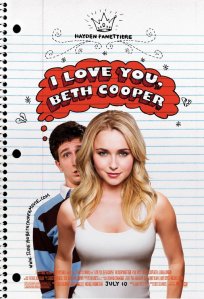 Not the trainwreck it’s been advertised as but still not near the term of “passable,” I Love You, Beth Cooper feels like a forgotten relic from a time capsule of 1980s teen movies. It just feels so powerfully dated and yet unable when to maintain a consistent comedic tone or building interesting characters. During the valedictorian’s (Paul Rust) graduation speech, he loses his filter, lets people know his real thoughts, and Beth Cooper (Hayden Panettiere) gets the titular declaration. Thanks to director Christopher Columbus, the movie wallows in shallow stereotypes; geek goes after head cheerleader. The comedy is ramped-up slapstick that approaches cartoon ridiculousness, including Beth’s ex-boyfriend who assaults and destroys everything in sight without anyone ever calling the police. There are some ham-handed life lessons doled out between the PG-13 randiness. The casting also dooms the flick. Panettiere isn’t a strong actress, and as for Rust, I was irritated by the character’s every movement and word. There are some fun stretches but nothing that ever sticks or resonates. I Love You, Beth Cooper is not worth adulation or scorn, just indifference.
Nate’s Grade: C
Share this:

Anvil! The Story of Anvil (2009)
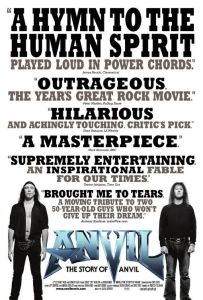 Imagine a real-life This is Spinal Tap! and you’ll have a fertile starting ground to tackle the rock documentary, Anvil! The Story of Anvil. There are so many unintentional references to that landmark mockumentary that you’ll be forgiven for suspecting that Anvil is fake. They even have music knobs that go to eleven! You see, Anvil played with other rock and roll headliners like The Scorpions, White Snake, and Bon Jovi in 1984. They were on the cusp of fame and stardom and then… it just didn’t happen. Flash forward, and the Anvil band members are still playing together and fighting for the fame that has eluded them for over 25 years. Singer/lead guitarist Steve “Lips” Kudlow lives in his native Canada and delivers lunches to school cafeterias. Drummer Rob Reiner (absolutely no relation to the director of Spinal Tap) works meager construction jobs. They both have wives and children, but they haven?t put their dreams on hold and know the fame they deserve is just one more opportunity away.
The band is not without its fans, and one of them is Tiziana Arrigoni, a Swedish woman who loves heavy metal and books Anvil an ill-fated tour of gigs throughout Eastern Europe. And just like Spinal Tap, everything that can go wrong generally does go wrong. The band misses several trains. The clubs they play are small, mostly attracting a handful of die-hard fans and drunks. They get lost in Prague and arrive two hours late to their gig. The club owner refuses to pay the band, instead offering them plates of goulash for their payment. The deepest cut is when the band is booked for the “Monsters of Transylvania” show in Romania at a venue that can seat 10,000. Lips even marvels that, “The mayor of Transylvania is gonna be there!” Only 175 attend the event (it is unclear whether or not the mayor was in attendance). The hapless Tiziana breaks down and cries, “I try,” and you honestly believe her; what kind of European venues should a Canadian metal band 25 years past their prime be playing? I can’t imagine anyone else with no managing experience could do better given the circumstances. Lips seems to see the same silver lining: “Everything on the tour went drastically wrong. But at least there was a tour for it to go wrong on.”
 This section of the movie ends at about the half-hour mark and I was left wondering what would be next. Then I understood the smarts of director Sacha Gervasi as a filmmaker because by watching Anvil endure the inequities of failure and humiliation early on, the audience will quickly sympathize with these rock dinosaurs. They fight for their dreams and surely they deserve better, and you will be on their side. This isn’t a spoof or a self-conscious skewering of a bunch of over-the-hill hasbeens. You feel for these guys, and the film offers several moments of surprising poignancy as they struggle to make ends meet, labor in dead-end jobs, and spend time with their loving families doing simple things like eating a pizza. Both Lips and Reiner are described as great family men, though one wonders what kinds of life moments they have missed out chasing fame. Don’t feel too bad for Tiziana either; she ends up marrying the band’s bassist. Their wedding reception is the greatest comic moment in the movie. Anvil rocks out at the reception and the disinterested audience looks like they are being held captive.
It’s the relationship between Lips and Reiner that gives the movie its heart. These aren’t the most self-aware subjects and are given to outlandish statements, but they’re just so overwhelmingly positive in the face of relentless adversity. He walks into various record company offices and hand delivers the newest Anvil album, hoping to get his calls returned eventually. In Canada, Lips and Reiner meet with an A&R man for EMI, and it is painful to watch. The A&R guy takes notes like a secretive psychiatrist and then he shuts off the music after no more than seconds. He tells the Anvil guys that if EMI doesn’t feel like it can give the band what they deserve then they won’t go forward with any album release. He’s brushing them off and making it sound like he’s doing them a favor. And yet Lips keeps chugging along like the little engine that could because he has to. The band mates look to him for inspiration. Often a band’s relationship is compared to a marriage, and this seems appropriate for Lips and Reiner. They’ve been friends since high school, stuck together through thick and thin, and their brotherhood is undeniably touching. Lips talks about the intense pressure he endures and how he feels like leaping off a cliff sometimes. Reiner, right there by Lips’ side, adds, “Well, you won’t jump off the cliff because I’ll stop you,” and then he just beams with pride in their friendship. Lips looks over and he too gets choked up. It’s a genuinely heartfelt moment and encapsulates the emotion mined in the film.
The family members seem to politely go along with the boys? wishes, especially the wives who say in revealing interviews that they too have put their lives on hold for their husband’s ambitions. In one scene, Lips’ sister agrees to loan her baby brother the money to record another Anvil album. She starts to cry on camera and we’re left with the quiet contemplation over what she may be so tearful about. Does she feel joy helping her brother continue on his quest, giving him another jolt of life and a reason to live for, or does she feel guilt and resignation knowing that she is enabling a comeback that is never going to happen, only delaying her brother’s cruel return back to reality. The Anvil boys do have patient and mostly supportive family members, though Reiner’s sister likes to get in easy digs here and there, calling Anvil a “joke.” At one point, Reiner’s wife rebuts the oft-repeated claim that these middle-aged headbangers need to “give up and get a real job” by being candidly self-reflective, talking about her own desire to touch fame through her husband’s achievements, and that she too dreams as much as her husband. It’s a nice moment and an insightful peak into the family lives of rock musicians.
 If Anvil has one obvious flaw it’s that Gervasi turns the film into a valentine to his favorite band from his youth. The movie ends on a 1985 picture of Gervasi with Lips, and apparently the director also served as a roadie on one of the band’s mid 80s Canadian tours, so I understand his enthusiasm for a subject near and dear to his heart, but his movie also forgoes any real criticism of the band. There is conflict that goes unexplored. Why didn’t the band actually make it? The movie seems to excuse the band from any blame, although perhaps writing rock songs without a hook might have doomed their radio play. They were skilled musically but can their decline into obscurity all be chalked up to fate and bad management? When the band records their thirteenth album, the “comeback” album, why do they even bother going after major labels? Why do they not go to a niche label, a label that specifically markets to heavy metal fans, the only people who may still acknowledge the demand for another Anvil album? Why, in today’s technologically evolving music market, are these guys not selling the album themselves and online, like what Radiohead did in 2007 for their album, In Rainbows? We see in interviews that notable rock musicians from Metallica and Anthrax admired Anvil, so why didn’t any of them help out when the band was falling apart? What is at the heart of the pain between Lips and Reiner? I’m pleased that Gervasi didn’t lambaste his teenage idols but his movie also could have benefited from further inquiry. He may be too close to the topic to make Anvil a seminal music industry documentary, but Gervasi does keep the movie engaging and, like Lips himself, keeps the darkness at bay no matter the situation.
Anvil! The Story of Anvil is an entertaining documentary that manages to be funny, sad, touching, and inspirational. It doesn’t dig too deep but then again you?re kind of pleased just to be along for the ride and explore these aging musicians? family lives. I don’t consider it a spoiler to say that the men of Anvil get some well-earned recognition by the end of the movie, coming full circle from that 1984 Japanese rock festival. You don?t have to be a fan of metal music whatsoever to enjoy this movie; in fact, the film curiously never plays a full song from the band. Anvil is an enjoyable labor of love for Gervasi, and it’s hard not to fall under the same nostalgic spell.
Nate’s Grade: B
Share this:

Public Enemies (2009)
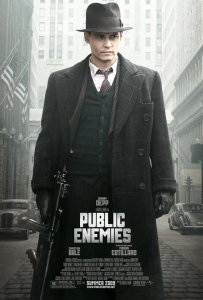 Considering the talent in front of and behind the camera, it’s hard not to describe Public Enemies as anything but a letdown. This Depression-era gangster film is heavy on period details and very tight-fisted when it comes to characterization. You’d think given 140 minutes and the natural charisma of Johnny Depp that an audience would come to some kind of understanding with notorious bank robber John Dillinger. Nope. The characters remain perfunctory the entire time, pushed into conflicts by a brisk pace that manages to squeeze in three bank robberies, two prison breaks, and many police shootouts. Because the movie barely takes time to breathe, the love story between Dillinger and Billie Frechette (Oscar-winner Marion Cotillard, a dead ringer for pop singer Katy Perry) is never credible, the tension never feels palpable, and director Michael Mann (Heat, Collateral) seems overly smitten with his distracting high def digital photography. You never really feel any sense of danger or interest. The characters on screen feel like strangers even after 140 minutes. Depp makes the movie more tolerable than it would be without his presence. Mann, one of three credited screenwriters, seems to assume the audience is well versed in Dillinger history and so he skips over plenty of fertile territory. Public Enemies certainly hums with plenty of polish but it comes across as mostly mundane due to such flimsy character work. It’s a collection of good scenes that fail to make up a satisfying whole.
Nate’s Grade: B-
Share this:

The Hurt Locker (2009)
 The Hurt Locker is an action movie on a very human scale. Sure there is a time and place for your Michael Bay-esque action vehicles, the type that scorch square miles and leave recognizable world cities in ruins. However, those kinds of action movies are never the kind where storytelling ever enters the fray beyond a meager question of how to get from Point/Explosion A to Point/Explosion B. In fact, Bay openly admits to planning the story of Transformers 2 by working on various action sequences during the 2007 writer’s strike and then tasking screenwriters to connect the dots. The Hurt Locker exists in a frighteningly believable world. This isn’t a movie about explosions but about the extinguishing of explosions. It follows the Explosives Ordinance Disposal (EOD) unit, tasked with detecting and detonating bombs and other improvised incendiary explosives (IED) in the field of combat. You will not be restless for loud “booms” while watching The Hurt Locker. In fact, you will be on pins and needles hoping that you never hear another loud “boom.”
Delta Company are the men responsible for protecting the other soldiers by disposing of bombs. The new team leader, Staff Sgt. William James (Jeremy Renner) has defused over 800 bombs during his tour of duty. He knows he’s the best and he’s addicted to the thrill of being so close to death. He will make occasionally reckless decisions putting himself, but not his fellow company men, at higher risk. This does not sit well with Sergeant JT Sanborn (Anthony Mackie), a by-the-book type that doesn’t appreciate his officer chasing a thrill. The other EOD unit member, Specialist Owen Eldridge (Brian Geraghty), is a man more accustomed to taking orders than giving them, and his indecision may have actually cost the life of the former head of the EOD. Both Sanborn and Eldridge worry that their new team member is going to get them all killed.
 Director Kathryn Bigelow (Near Dark, Point Break) has been directing male-centered action flicks for over two decades; it’s been seven years since her last feature, the regrettable Harrison Ford submarine flick, K-19: The Widowmaker. The Hurt Locker is her finest work to date by far. Her action sequences are visceral and downright agonizing to sit through. She is masterful at setting up the geography of the set piece, ratcheting up the suspense, adding organic obstacles and complications, and then makes sure with her camera and editing that an audience knows exactly what’s happening to whom for every minute that ticks off the clock. Bigelow takes her time to establish the particulars of her locations and sequences, allowing the audience to, surprise, understand what is happening and better engage in the movie. Bigelow chose to shoot the movie in Jordan, the neighboring country to Iraq, and the locations and actual refugee extras add an unvarnished sense of realism. The movie goes without music during much of the action, which makes it all the more uneasy. There isn’t any over eager composer telling you how you should feel, no direction that now things will get even more hairy. You will feel every second of danger, and Bigelow crams in a whole lot of danger. Things can go wrong very, very quickly.
There’s nothing to action cinema quite like the bomb that’s only a few tick-tocks away from doing its dirty work. Do you cut the yellow wire or the green wire? Never cut the red wire. The bombs found in Iraq are a stark range of death. There’s the crude incendiary device just wrapped up in garbage, but then there’s also the fiendishly clever devices with multiple charges and there are grotesque devices as well. At perhaps the film’s most guttural and shocking moment, Staff Sgt. William James finds the corpse of an innocent stuffed with explosives. The easiest thing would be to simply detonate the bomb, but that would also desecrate the body of someone we have come to know. Watching James snip open the crude stitching and dig inside the chest cavity, if we didn’t know then we know now, Bigelow has made sure that The Hurt Locker is the most emotionally resonating contemporary war film in memory.
 Bigelow and screenwriter Mark Boal, an Iraq War journalist, create a vivid sense of dread, antipathy, and most of all, paranoia. Is that a kite flying in the air or is that a signal? Is that a nondescript observer with a cell phone or is that a terrorist with a remote detonator? Is that child being friendly or collecting intelligence? Your mind will race through all these possibilities because Bigelow teases out her action sequences to an unbearably taut level. The audience cares about these soldiers and wants to see them make it back home (we’re informed how many days Delta Company has left on their tour throughout the film), which Bigelow uses to her advantage at every turn. What happens matters. My nerves were frayed during several sequences, including one where the soldiers are pinned down by distant enemy gunfire. The moment turns into a duel and a chess game, as each side tries to adjust their gaze in the searing heat and measure their long-range shot before the other side beats them to it. Then the sequence turns into a waiting game. This is the kind of movie that keeps you poised on the edge of your seat fearful that at any moment something disastrous will suddenly happen. Every time Staff Sgt. William James went back out to defuse another bomb, my sense of dread intensified. I began to doubt everything that I would ordinarily take for granted in other movies.
While being a top-notch action movie, Boal (In the Valley of Elah) has also crafted a great character study. In between the bomb episodes we learn more about these men, which makes it all the more hard to see them then head out to defuse another explosive. The film opens on a quote equating war as a drug, and we explore this notion through the character of Staff Sgt. William James and the weight his unique duty bears. It takes a special person to volunteer for defusing roadside bombs. The defuser must be extremely intelligent, be extremely cool under pressure, and be able to work in a giant suit that makes them look like a chubby astronaut, while enduring debilitating desert temperatures of 110 degrees. It sounds like a suicide mission. James is an adrenaline junkie and war is his drug. He exudes a Zen-like calm in the heat of the moment and this is now the only life for him. Shopping for cereal back home has lost its meaning. Being a husband has lost its meaning. His life now has one purpose. Renner (28 Weeks Later, North Country) gives a stirring performance laced with cavalier confidence and resignation. Mackie (Eagle Eye, We Are Marshall) is also another standout in the pared down cast. When he laments about the dishonor of having no one to remember you in death, you feel the man’s existential sorrow.
 Ignore the political cranks that decry The Hurt Locker as another partisan anti-war film from Hollywood. The American public has been mostly indifferent to any contemporary movie that aims to tackle our current military conflicts in Iraq and Afghanistan, but The Hurt Locker eschews the politics of war to focus on the realities and dangers of its characters. These guys are more concerned with surviving the next bomb than the politics of why they’re in the Middle East. The public has voted with their wallets and does not want to see the reality of war onscreen, or at least the Hollywood version of war reality, but I pray that those same people give The Hurt Locker a fighting chance. There is no preaching to be found here. The Hurt Locker could just have easily taken place during other wars, though the current Iraq War allows for added cultural dissonance (Is the central goal of bomb-defusing a metaphor for our conflict in the region?). This is a film that transcends politics and genre.
The Hurt Locker is more than an action movie, more than a war movie, more than a psychological study; this is an outstanding movie. This movie is a drug to the adrenaline senses and I need another hit. This is one of the finest films of the year and as it expands across the nation, I highly encourage everyone to seek out The Hurt Locker.
Nate’s Grade: A
Share this:

Transformers: Revenge of the Fallen (2009)
 Transformers: Revenge of the Fallen pretty much sells itself. More giant freaking robots. That was enough to make the first movie a worldwide blockbuster. My own teenaged brother-in-law, when he first saw the first Transformers movie, declared it his favorite live action film. Director Michael Bay completely empties his creative cupboard into a bladder-unfriendly two and a half hour endurance test. It’s too bad that that cupboard was bare when it came to story.
Sam (Shia LaBeouf) is headed off to college, and he’s leaving behind his girlfriend Mikaela (Megan Fox) and robot guardian, Bumblebee. Optimus Prime and the other Autobots have been working with the U.S. government to hunt down Decepticons around the globe. There?s a war on the horizon, and weasely U.S. bureaucrats want the Autobots to take a hike. Sam discovers a tiny shard from the super Cube, which was the source of life for the alien robots. His brain is zapped with an alien language that will lead him to a secret location to a secret ancient machine. The Decepticons want this info and chase after Sam and Mikaela. The biggest bad of them all, The Fallen, is sitting at home waiting to return to Earth and exact interstellar vengeance. The Fallen was foiled in 17,000 B.C. by the Prime family line, and only a Prime can kill him. The Decepticons resurrect their leader Megatron and go about trying to snatch Sam, kill Optimus Prime, and destroy man’s planet.
Bay has been condemned for his erratic ADD-shooting style, and this was the first film where I really felt pounded and punished. To contest that this movie is just “a popcorn summer movie” is just making excuses. What the hell was going on? The movie is simply a blur of colors and noise. Transformers 2 is entirely incoherent, both from a story standpoint and simply from a visual standpoint. Bay at least pulls back his camera so that the audience can identify the fighting robots easier this time; this time it’s not like deciphering scrambled porn. It’s the rest of Bay’s characteristically bombastic display of carnage that suffers. Bay is a man that doesn’t know the meaning of the word “small,” and so nonstop explosions and massive destruction litter the movie. Sam is always running or riding in his car to escape. At one point, Sam and his posse hide in a campus library only to have the building turned into cinders (showing Bay’s opinion on what books are really good for). But what exactly is happening? Why does it matter? What are the obstacles? Everything is way too busy and accomplishing so little. Half of the movie consists of the human character running and screaming. It’s excessively excessive and taxingly so.
 A strong example of the film’s incoherence is the 40-minute climax set amidst the pyramids of Egypt. At no point does Bay establish the geography or bother to let the audience follow along. The stakes and parameters have not been made adequately understandable. Ordinarily, in large action sequences there will be different groups of segments and we’ll watch each progress. Here we disjointedly cut back and forth between the groups but I have no idea what?s going on, where the characters are, where they need to be, and what is stopping them. Megatron calls down 13 different evil Decepticon robots to take part in the climactic battle but Bay never introduces these new figures; they get no setup to explain each of their unique weapons systems or general appearance. We see them only at a distance walk through wafting smoke clouds. So when they do pop into battle in quick blurs it’s just another point to be confused about. If you’re like me, you can only endure so much confusion before your brain just gives up. Bay is a fantastic visual stylist, but his action sequences are poorly developed and poorly staged. He needs to check out The Hurt Locker and take notes. Transformers 2 is nothing but non-stop careless mayhem. For what it?s worth, the special effects are incredible at every stop.
The highly ramped-up action would have been acceptable if we knew what the hell was going on and we actually cared about the story. Transformers 2 makes the first film look like poetry in comparison. The story for this movie is simply atrocious and it’s made worse by the merciless attempts at comedy. This movie is stuffed with tin-eared exposition, so our only break to try and assess what the hell we just saw is when the characters take a breather and rapidly spout more plot vomit. It’s like listening to a homeless man shout nonsense for an hour. After a while you just tune out the crazy. If the Decepticons can construct a robot that has the ability to take human form, why the hell aren’t they doing this all the time? Why aren’t they infiltrating government offices instead of prancing around colleges in hot pants? Why in the world would an 18-year-old boy leave the mega hot Megan Fox and his TALKING ROBOT CAR? Why would anyone leave these two to live in a dorm and shower in flip flops? What universe does this college that Sam attends exist in? The place is crawling with leggy, waif-thin bombshells. The movie doesn’t even resort to college stereotypes; there isn’t a single gal that doesn’t look like a magazine cover girl. The Fallen is kind of like the evil leader of the Decepticons and he’s, what, confined to sitting in his robo La-Z-Boy on his home world like Archie Bunker? Get up and do something. The Transformers fought ages ago amidst man?s loin-clothed hunter and gatherer ancestors but leave no record? You’d think some caveman type might consider that worthy of painting on a wall. Why is Megatron even in this movie? What was the point of bringing him back alive if he’s just another lackey to The Fallen guy? Why does no one consider turning over Sam to the Decepticons if it could save the planet? In the big Egyptian battle sequence, where is the Fallen the whole time? He just kind of lazily shows up at the end. Also, ancient robots made a special key to jumpstart an ancient planet-destroying machine, but then we are informed when Sam visits, no joke, Transformers heaven that this key does not work unless the holder has earned the right to use it. It’s like some high tech moral barometer. Why didn’t these alien robots say anything about this? It would have spared a lot of time and energy trying to make sure the Decepticons never got a hold of it. How does a dead human end up going to robot heaven anyway? Does that mean there’s a robot God? Was robot God created by our God? Is there a robot Devil? Does Bay do the work of the robot Devil?
 This time the comedy is puerile and embarrassing. The jokes make this movie tonally feel like a cartoon strictly for snickering adolescents. In the span of 150 minutes we’re given dogs humping twice, a tiny Transformer humping Megan Fox’s leg, Sam’s mother going berserk from ingesting pot brownies, a Transformer testicle joke (why would a robot even need genitals?), and let us not forget John Turturro in a thong. The humor aims low and still finds a way to be even worse. To save you the trouble, I am going to spoil the only two good jokes in this self-indulgent, bloated mess. Here there are, enjoy:
1) Sam is at a frat party, and it’s a frat party unlike anything ever seen unless modern fraternities can afford expensive interior decorators. One unamused frat guy asks Sam what he’s doing. Sam responds, “Going out to get you a tighter shirt.” The frat guy’s flunky clarifies: “There isn’t a tighter shirt. We checked.” I laughed. Sue me.
2) Sam and the gang at one point talk to a Transformer that’s thousands of years old. Apparently the guy is being housed at the Smithsonian Museum, which means that this is the second summer movie that is trying to inform the public that there’s something weird over at the Smithsonian. The old Transformer even has a robot cane, which is too bizarre. He rambles about the old days like Grandpa Simpson, and then finally gave this gem: “My father was a wheel. The first wheel. You know what he could transform into? Nothing! And he did so with honor.” This made me want to think about a period Transformers costume drama, where they exist as textile steam engines and phonographs and Model Ts. Would that not be a vastly more entertaining movie?
Despite all the painfully juvenile attempts at comedy, by far the biggest eyesore would have to be Bay’s Sambot twins, Mudflap and Skids. To say that these two irritating robots are politically incorrect does not go far enough. It’s one thing to reflect a cultural or ethnic stereotype, and it’s another thing entirely to keep digging deeper and deeper. These robots talk in eye-rolling faux gangster street talk, one of them has a big gold tooth, and these robots admit to being illiterate. It’s practically breathtaking to watch how racially insensitive and appalling these characters become. It’s essentially a robotic minstrel show. I’m surprised Bay stopped short of having Mudflap and Skids eat a big bowl of watermelon. This got me thinking about what other highly insensitive Transformers characters that didn’t make the cut over these two. Was there an Asian bot that turned into a car that didn’t drive well? Was there a Jewish bot that chided Optimis Prime to settle down and quit running around with those shiksa sports cars (“You know those aren’t her original parts?”). Bay can dismiss these characters as merely dumb robotic comic relief, except for the fact that these two bumbling, detestable heaps of scrap metal are never, ever funny.
 The actors have little impact in this type of movie. I like LaBeouf (Eagle Eye) but he’s got little to do but stretch his legs. Fox became a star thanks to the previous Transformers flick, and she hasn’t gotten any less attractive. Amazingly enough, she manages to lose more clothes the more she runs in slow-mo, allowing the male audience members to follow the nuance of her bouncing breasts. She’s clearly not the next Meryl Streep but this girl deserves more than being wordless arm candy. Many words have been spilled about the quasi-racist twin robots, but I’m disappointed that people aren’t as equally up in arms over the film’s blatant misogyny. Women don’t seem to exist in the Michael Bay world, only parts and pieces of women. They are all like Alice, the robot programmed to do nothing else but seduce the men. All of the special effects and noise just overwhelm the other actors. The robots themselves have no personality to offer, good or bad.
Transformers: Revenge of the Fallen is an obnoxious block-headed mess that feels like it’s being made up as it goes along. It’s sensory overload without a lick of sense, clarity, wit, and general entertainment. This sequel takes everything that was good about the first Transformers film and undermines it, and it takes everything that was awful and magnifies that awfulness. The first Transformers movie was fun. This is just work to sit through. Apologists will try and rationalize their disappointment, decrying anyone who hoped for something more than a big dumb summer blockbuster about rock’em, sock’em robots. Bay wants to show you everything and as a result you rarely get a chance to process little in this movie. There is absolutely nothing more than meets the eye here. It’s all arbitrary and tedious and it goes on for what feels like an eternity. It’ll make a gazillion dollars at the box office but will anyone remember a single moment from this exhausting junk? Make sure to bring the earplugs and aspirin in abundance.
Nate’s Grade: C-


You must be logged in to post a comment.