Author Archives: natezoebl
Twisters (2024)
 It’s twenty-eight years later and people are still fascinated by the destructive power of tornadoes that cavalier daredevils will chase after them for clout, thrills, or the progress of science. Twisters faithfully replicates a lot of the elements that made the 1996 original a hit without coming across as overly fawning fan service, from the large-scale action treating the looming tornadoes like a monster awakening in righteous anger, to the scientific adventure and exploration of understanding the worst of nature, to the snobs vs. slobs of competing teams of eager tornado chasers. The core dynamic between Daisy Edgar-Jones and Glen Powell is combative and fun and eventually quite flirty, and oh will you be compelling these two crazy weather-obsessed kids to kiss by the end credits. If somehow you missed out on Hit Man, here is further proof about the indefatigable power of Powell’s immense charms. You, much like Edgar-Jones, cannot resist this man and his drawl. Give great praise to director Lee Isaac Chung, who made the poignant autobiographical immigrant family drama Minari and then followed it up with wrangling tornadoes in a blockbuster sphere with the same level of confidence and dedication. This is a sequel that thankfully doesn’t need to lean into the callbacks or cameos from the earlier movie. It’s still relatively predictable but that doesn’t make it less satisfying when our heroes come together. Twisters is a solid sequel that clearly understands the appeal of its predecessor and big screen disaster-laden escapist entertainment as a whole. It’s a perfect movie to pair with a big bucket of popcorn.
Nate’s Grade: B
Share this:

Emilia Perez (2024)

Movie musicals can be sweeping, invigorating, and at their very best transporting, They mingle the high-flying fantasies and visual potential of the cinema, and we’ve gone through many waves of kinds of musicals. Today, we’re in an outlandish world of the outlandish musical, an experience in ironic air 210quotes, where stories that you never would have thought could be musicals would then dare to be different and attempt to be musicals. The much-anticipated Joker sequel, Folie a Deux, dares to be a challenging jukebox musical of old favorites. The French movie Emilia Perez tells the story of a cartel leader that undergoes a sex change and tries to do good with her second life. Both movies are deeply interesting messes as well as experiences I don’t think work as musicals.
In contrast, Netflix’s Emilia Perez is like an entire season of a telenovela streamlined into a two-hour-plus movie that manages to also, for better or worse, be a musical. It is filled with many outlandish and provocative elements you would never expect to be associated with singing and dancing, like a sex change surgery center. This movie mixes so many genres and tones that at one point it feels like you’re watching a crime thriller about Mexican cartels and their manipulation of those in power, and then the next moment it feels like you’re watching an absurd rendition of Mrs. Doubtfire, where a spouse has adopted a new identity and uses this to spend time with their kids they otherwise would not be able to do so. It’s a wild film-going experience; I can’t recall too many musicals that use street stabbings in syncopation with percussion. Because of its go-for-broke ambitions and veering tones, Emilia Perez is destined to be a cult movie, some that fall in love with its bizarre mishmash of elements, but most will probably be stupefied by the entire experience and questioning why, exactly, this was made into a musical.

In Mexico City, Rita Castro (Zoe Saldana) is a savvy defense lawyer tired of living in the shadows of her buffoonish bosses that rely upon her writing prowess to win cases. Someone sees great potential with her, and it happens to be Manitas del Monte (Karla Sofia Gascon), the head of a dangerous cartel. He wants Rita to find the international means to finish the process of Manitas surgically becoming a woman. Under the gun, metaphorically and literally, Rita finds the doctors who will transform the dangerous him into a new her. Manitas then fakes their death, leaving his old life behind to start anew, including their children and wife, Jessi (Selena Gomez). Manitas becomes the titular Emila Perez, but rather retire in luxury, she wants to do good, and Emilia begins a non-profit organization that exhumes bodies, victims from the cartels, to provide closure for their widows and grieving families. Emilia then invites Jessi and their kids to come live in her estate, explaining she is a formerly unknown “aunt” to Manitas. Now Rita is trying to run Emilia’s organization, keeps Emilia from going too far in revealing her identity, and looking out for her own sake considering she’s one of the few that knows about a life before Emila Perez.
I know there will be hand-wringing and cultural tut-tut-ing about the movie’s implicit and explicit themes dealing with trans issues, exploring one woman’s exploration of self and securing the identity she’s always wanted through the lens of a lurid soap opera trading in stereotypes. It’s a lot of movie to digest, and while it feels entirely sincere in every one of its strange creative decisions, it’s also the kind of movie whose tone can invite snickers or derision, like the sex change clinic where a heavily bandaged chorus repeats words like, “vagioplastia” and “penoplastia.” It’s a movie with extreme feelings to go along with its extreme plot turns, but the whole movie feels like it’s trying to settle on a better calibrated wavelength of melodrama.

I think this could have been significantly improved by director/co-writer Jacques Audiard (Rust and Bone, A Prophet) had he embraced more of the movie’s outlandish reality breaking through. Too few of the musical numbers actually do something more than witness someone singing. The opening number, one of the best, involves Rita trying to compose a defense through the streets of Mexico City, while a crowd sweeps around her, often stopping to chime in as an impromptu chorus, sometimes setting up props for her use. It’s a great kickoff, the energy crackling, and I was looking forward to what the rest of the movie could offer. There’s only one other musical number that recreates this significant energy and engagement, a fundraising dinner for Emilia’s organization amongst the powerful members of society. While Emilia speaks at a podium, Rita struts around the floor, sashaying between the tables, and informing the audience about all the dirty deeds and skeletons of the assembled muckety-mucks. She’s literally manhandling the frozen participants, dancing atop their tables in defiance, and it’s a magnificent moment because of how it breaks from our reality to lean into the storytelling potential of musicals. These sequences work so well that it’s flabbergasting that Audiard has, essentially, settled for far less creatively for too much of his movie’s staging. The big Selena Gomez song is just her listlessly singing to the camera while shifting her weight while standing, like the laziest music video of her career. Why tease the audience with the crazy heights as a musical if you’re unwilling?
And now let’s tackle the music, which to my ears was too often rather underwhelming.It sounds like temp music that was intended to be replaced and never was. It’s lacking distinct personality, catchy or memorable melodies, anthems and themes, the things that make musicals enjoyable. The best songs also happen to be the best staged sequences, both involving Rita. These songs have a different vivacious energy by incorporating a hip-hop style of syncopation. “El Mar,” the song during the fundraising dinner, offers an infectious chorus adding extra percussive elements like people slamming fists down onto tables, listening to plates and glasses rattle. These are the moments that enliven a musical and convey its style and panache. Alas, too many of the songs lack that vitality, and can best be described as blandly competent and too readily forgettable.

It’s a shame because Saldana is giving her finest screen performance to date (to be fair, I never watched her Nina Simone biopic). The actress best known for being the strong warrior in sci-fi franchises like Avatar, Guardians of the Galaxy, and Star Trek plays an intriguing character with a rising fire of purpose and paranoia. Early on. Rita is ambitious but unhappy, practically dowdy in appearance, and she begins to come alive under her new role for Emilia. Saldana is electric as she sings and dances and slips effortlessly between Spanish and English, possibly to her first Oscar nomination. She’s the standout, which is slightly strange considering the role of Emilia Perez should be the breakout. Gascon, a trans actress, is quite good in such an outsized role, and gets to play her pre-transitioned identity as well under gobs of masculine makeup and tattoos. The fault isn’t with Gascon’s performance, the issue is that her character has such amazing potential but feels criminally underdeveloped. There is a world of issues of self-identity, culture, repression, shame, anger, jealousy, desire, to name but a few, that could be richly explored from the perspective of the leader of a deadly gang wanting to become a woman. The character is left too inscrutable for my tastes, leaving behind so much unobserved drama. As a result, even though the movie is literally named after her, Emilia Perez feels like a projection more than a character, and if that was indeed the point, then we needed more conflict about that friction.
Emilia Perez is a lot of things all at once; campy, ridiculous, sincere, crazy. It’s messy but it’s an admirably ambitious mess, one that even the faults can be the unexpected charms for someone else. I didn’t fall in love with this genre-bending experiment, although I found portions to be fascinating and others to be confounding. I don’t even think the musical aspects were finely integrated and explored, and so they feel like more of a gimmick, a splashy attempt to marry the high-art of musical theater with the perceived lower-art of grisly crime thrillers and melodrama. It earns marks for daring but the execution is haphazard and scattershot at best. There are moments that elevate the material, where the musical elements feel confidently integrated and supported with the dramatic sequence of events, providing an unexpected and rousing response. However, those moments are few and far between, and the absence only further cements what could have been. Emilia Perez might be your worst movie of the year, a grave miscalculation in tone and storytelling, or it might be a transporting and wild experience, one that can lock up multiple Academy Award combinations for its artistic bravura, a middle-aged Frenchman telling the story of trans empowerment through the guise of a Spanish-speaking musical framework. It sounds like so much and yet paradoxically I was left disappointed that it wasn’t more.
Nate’s Grade: C+
Share this:

Joker: Folie à Deux (2024)
 Movie musicals can be sweeping, invigorating, and at their very best transporting, They mingle the high-flying fantasies and visual potential of cinema, and we’ve gone through many waves of kinds of musicals. Today, we’re in an outlandish world of the outlandish musical, an experience in ironic air quotes, where stories that you never would have thought could be musicals would then dare to be different and attempt to be musicals. The much-anticipated Joker sequel, Folie a Deux, dares to be a challenging jukebox musical of old favorites. The French movie Emilia Perez tells the story of a cartel leader that undergoes a sex change and tries to do good with her second life. Both movies are deeply interesting messes as well as experiences I don’t think actually work as musicals.
Joker 2, which I will be referring to it as for the duration of this review mostly because I don’t want to type out Folie a Deux, and not due to some explicit dislike of the French, is a fascinating misfire that comes across as downright disdainful of its audience, its studio, and its very existence. The last time I felt this way from a sequel was 2021’s Matrix Resurrections, another fitfully contemptuous movie that was alienating and self-erasing and also from Warner Brothers. The first Joker movie in 2019 was a surprise hit, grossing over a billion dollars, which meant that the studio wasn’t going to sit idly by and not force a sequel for a movie clearly intended to be one complete movie. While the first movie cost a modest $50 million, the sequel cost close to $200 million, with big pay days for Joaquin Phoenix, Lady Gaga, and co-writer/director Todd Phillips, who I have to remind you, dear reader, was actually nominated for a Best Director Oscar in 2019. Having gotten their paydays, it feels like Phillips and his collaborators have set out to scorch all available earth, going so far as to even insult fans of the earlier movie. Add the bizarre musical factor, and I don’t know how else to describe Joker 2 but as an alienating and miserable protracted exercise in self-immolating artistic hubris. It’s so rare to see this level of artistic clout used to proverbially stick a finger in the eye of every fan and studio exec who might have hoped there could be something of value here.
 Let’s tackle the plot first, as we pick up months after the events of the 2019 film where lowly Arthur Fleck (Phoenix) is being tried for the murders he committed, most famously on a TV talk show where he debuted his stand-up comedian persona as Joker in full regalia. There’s an (un)healthy contingent of the rabble that idolize Arthur, finding the Joker to be some kind of mythic hero of class-conscious revolution, pointing out how society is failing all the little guys getting crushed by the rich and powerful and privileged, like that dead Wayne family. One of those fans is Lee (Gaga), a.k.a. Harleen Quinzel, a disturbed young woman obsessed with getting closer to Arthur, and he is extremely appreciative of the fawning attention. The defense case hinges upon whether or not Arthur was acting on his own accord or had a psychotic break, disassociating as “Joker,” and thus cannot be held accountable for the murders. Except it seems “Joker” is all the people of Gotham want to talk about, whether it’s the media or the public, and what about poor lonely Arthur?
If I had to fathom a larger thematic point, it feels like Phillips is trying to put our media ecosphere and comics fandom into judgement. He’s pointing to his movie and saying, “You wouldn’t have cared nearly as much about this project had it just been some other spooky, disturbed man losing his sanity and lashing out. You only care because he would eventually become the notorious Batman villain or lore, and that’s why you’re back.” Well, to answer succinctly, of course. When your movie’s conceptual conceit is all about providing a gritty back-story for a famous supervillain, don’t be surprised when there’s more attention and interest. This would be the same if Phillips had made a searing drama about teenage nihilism and easy access to guns and then called it Dylan Klebold: The Movie (one half of the Columbine killers, if you forgot). Stripping back layers to provide setup for a famous killer will always generate more interest than if it was some fictional nobody. It’s an accessible starting point for a viewer and there’s an innate intrigue in trying to answer the tantalizing puzzle of how terrible people got to be so terrible.
I found the 2019 movie to be a mostly interesting experiment without too much to say with its larger social commentary. It felt like Phillips relied a bit too heavily on that assumed familiarity with the character to fill in the missing gaps of his storytelling. It was a proof of concept for that proved successful beyond measure (a billion dollars, 11 Oscar nominations, including THREE for Phillips). This time, Phillips is taking even less subtlety with his blowtorch as he actively annihilates whatever audiences may have enjoyed or appreciated in the first movie.
 And in order to fully appreciate the scope of this movie’s active distaste for its own existence, I’ll be treading into some major spoilers, so jump forward a paragraph if you wish to remain unspoiled, dear reader. The conclusion of this sequel is a miserable succession of hits that degrades Arthur. At the conclusion of the 2019 original, at least you could say he was becoming a more realized version of what he wanted to be, albeit a disturbed murderer, but one who became the face of a revolution and gained a legion of adoring followers that he desperately craved. At the end of Joker 2, Arthur pathetically admits in his trial there is no alternate Joker persona and that he’s just a sad loser. Then Lee admits that she was only ever interested in “Joker” and wants nothing to do with Arthur the sad loser. And then upon returning to prison, another inmate confronts Arthur, apparently feeling personally betrayed for whatever reason. This irate prisoner stabs Arthur to death and then laughs in a corner, slicing a smile into the sides of his mouth, Heath Ledger-style. The movie literally ends with Arthur laying in a pool of his own blood, staring dead-eyed into the camera, with Phillips metaphorically painting emphatically at his corpse and defiantly saying, “Look, he’s not even the Joker now! Do you still care? Do you?” These movies were designed to be the untold history of the man who would be Joker, and they now have ended up being four hours about the guy whose idea maybe inspired a criminal lunatic to improve upon what he felt was another guy’s brand. What’s even the point? We followed two movies about the guy who isn’t the Joker? Seems pretty definitive there won’t be a third Arthur Fleck movie, as there’s nothing left for Phillips and his anarchic collaborators to demolish to smithereens.
When I heard that Joker 2 was going to be a musical, I actually got a little excited, as it felt like Phillips was going to try something very different. Now the curse of many modern movie musicals is trying to come up with an excuse for why the world is exploding in song and dance, like 2002’s Chicago implying it’s all in Roxy’s vivid imagination. Joker 2 takes a similar approach, conveying that when Arthur is breaking out into song that it’s a mental escape for him, that it’s not actually happening in his literal reality. Except… why are there sequences outside Arthur’s point of view where other characters are breaking into song, notably Lee? Is this perhaps a transference of Arthur’s perspective, like he’s imagining them on the outside joining him in tandem? The concept fits with his desperate desire to forge meaningful human connections with people that see him for who he is, and having another character harmonize with him provides a fantasy of validation. Except… there’s no meaningful personal connection between Arthur and the allure of movie musicals. It’s not like he or his domineering mother, the same woman he murdered if you recall, were lifelong fans of musicals and their magical possibilities. It’s not like 2001’s Dancer in the Dark where our lonely protagonist dreamed of being in a movie musical as an escape from her depressing life of exploitation and poverty. It just happens, and you’re listening to Phoenix’s off-putting, gravelly voice straining to recreate classics like “For Once in My Life” and “When You’re Smiling (The Whole World Smiles With You).” It’s also a criminal waste of a perfectly game Gaga.
 Phillips’ staging of his musical numbers are so lifelessly devoid of energy and imagination. Most of our musical numbers are merely in the same setting without any changes besides now one, or occasionally two, characters are singing. There’s one number that becomes a dance atop a roof, and several duets that appear like a hammy Sonny and Cher 1970s variety TV show, and that’s all you’re getting folks in the realm of visual escapism and choreography. In retrospect, it feels like the musical aspect of the sequel might have been a manner to pad it to feature-length, adding 16 performances and over 40 minutes of singing old standards. There’s a good deal of repetition with this sequel, as much of the plot is restating the events of the first film; that’s essentially what the courtroom drama facilitates as it trots out all the previous characters to recap their roles and point an accusatory finger back at Arthur.
There is one lone outstanding scene in Joker 2, and it happens to be when Arthur, in full Joker makeup, is cross-examining his old clown entertainer work buddy, Gary Puddles (Leigh Gill). Arthur admonishes Gary, saying he spared him, and Gary painfully articulates how hellish his life has been as witness to Arthur’s killing, how little he sleeps, how it torments him and makes him so afraid. For a brief moment, this character shares his vulnerability and the lingering trauma that Arthur has inflicted, and it appears like Arthur is wounded by this realization, until he settles back into the persona he’s trying to put forward, the “face” for his defense, and goes back to ridiculing Gary’s name and turning the cross-examination into an awkward standup session. It’s a palpable moment that feels raw and surprising and empathetic in a way the rest of the movie fails to.
Is there anything else to celebrate with Joker 2’s troubled existence? The cinematography by Lawrence Sher can be strikingly beautiful, especially with certain shot compositions and lighting contrasts. It makes it all the more confounding when almost all the musical numbers lack visual panache. The Oscar-winning composer returns and while still atmospheric and murky the score is also far less memorable and fades too often into the background, like too many of the technical elements. Joker 2 has plenty of talented people involved in front of and behind the camera, but to what end? What are all their troubles adding up to? It practically feels like a very expensive practical joke, on the audience, on the studio, and that is genuinely fascinating. However, it doesn’t make the end product any better, and the film’s transparent contempt sours every minute of action. Even if you were a super fan of Joker or morbidly curious, steer clear of Folie a Deux, a folly on all of us.
Nate’s Grade: D
Share this:

Daddio (2024)
 A lengthy conversation playing out in real-time between two strangers who open up to one another over the course of one taxi drive from the airport. If it feels Richard Linklater-adjacent, that’s because writer/director Christy Hall (I Am Not Okay With This) has certainly been influenced by the chatty likes of Linklater, as she sticks us in the cab for the entire duration of that 90-minute ride and movie. We have Dakota Johnson as the fare, a woman returning home after visiting family with secrets and shame that she’ll reveal over the course of this cab ride. We have Sean Penn as the cab driver, a seen-it-all cynic who keeps pushing for more answers and conversation from his passenger. The problem with movies based solely around conversations is that the conversation has to be mesmerizing, exhibiting great care to impart artful and authentic character details that make us reconsider these people, and hopefully provide challenges to preconceived norms and ingrained perspectives that can foster reflective growth. Nobody wants to watch a movie about a trivial conversation over 90 minutes. The problem with Daddio is that it’s not really a two-way conversation; Penn acts more as an interrogator, slowly chipping away at the layers that Johnson’s young woman feels comfortable presenting publicly. The dialogue is fine but unremarkable, eschewing overly stylized verbosity for something more natural, but even with that choice the details we are granted are clumsy and minimal. Get ready for lots of protracted pauses awaiting texting replies. The acting is fairly solid throughout, especially Johnson since it is a whole showcase for her in that backseat. If we’re going to be riding shotgun on a 90-minute conversation, I guess I’m just looking for far more scintillating details, whether it’s from the characters, their conflicts, or just their gregarious dialogue. If we’re stuck with two people, let’s be stuck with two people we actually might want to share a cab with.
Nate’s Grade: C+
Share this:

Didi (2024)
 It feels slightly strange when you acknowledge that coming-of-age movies have long-surpassed your own age of adolescent personal discovery. With Sundance indie Didi, we’ve now brought that time frame up to 2008, where we follow the 13-year-old Chris (Izac Wang), a first-generation Taiwanese-American kid trying to flirt with his junior high crush, get better at skateboarding, edit YouTube videos that people might actually want to see, and perhaps make some new friends during the summer before high school begins. This is one of those movies that lives or dies by its slice-of-life details and sense of authenticity. Writer/director Sean Wang does an excellent job placing the audience in the position of his biographical avatar, Chris. We feel his discomfort trying to navigate the different cultural expectations of home life and school life, the perils of trying to step outside your comfort zone and be rewarded rather than embarrassed. This is compounded by Chris having to endure and brush aside the stereotypes his peers project onto him for being Asian-American. The problem with the movie is that our main character is kind of a twit. He’s so harsh and unfair to his long-suffering mother (Lust, Caution‘s Joan Chen) that his own friends eventually complain about his rude behavior. In a moment of awkward discomfort, he calls his friend’s crush “a whore,” and then describes how he and his friend messed around with the corpse of a squirrel once. He also pees in his older sister’s lotion bottle. The whole “befriending cool skateboarders” storyline goes nowhere, nor does it open up some deeper understanding of our character and his wants, talents, or capabilities. Didi’s real distinct angle could have been growing up in the Internet age, and there it too feels lacking. It all feels a little like we’re spending too much time with the wrong family member. The put-upon mother would have been an even more intriguing person to explore, especially as she yearns to be an artist, deals with her bratty kids, an overbearing mother-in-law living with them without a kind word to say, and a husband half the world away busy working. Getting stuck with the angsty kid feels disappointing.
Nate’s Grade: B-
Share this:

Harold and the Purple Crayon (2024)
 As an elder Millennial, I’ll try and ignore my rising bile for what they did to my boy Harold here, and I’ll simply ask who was this movie for? The big screen adaptation of the classic 1955 children’s book by Crockett Johnson that celebrates the power of imagination is a mishmash of mawkish feel-good family nonsense, fantasy power wish-fulfillment, and grating fish-out-of-water comedic antics. Increasingly missable actor Zachery Levi (Shazam!) plays yet another glorified man-baby, this time as an “adult” Harold who ventures into the Real World to search for his narrator, essentially the god of his purple-hued universe. He befriends a lonely boy with a big imagination and the kid’s single mom (poor Zooey Desceanel) and life lessons are learned while “adult” Harold makes a mess of just about everything as he leaves behind chaos and disaster. Eventually Harold has a full-on wizard duel against a villainous librarian and wannabe published fantasy author played by Jermaine Clement. That’s right, Harold and the Purple Crayon transforms into a magic battle over the fate of the all-powerful ring, I mean crayon. Making matters worse is Levi’s hyperactive schtick that has been growing stale for years and is tiresome and annoying throughout the movie. It’s also quite ironic, and phony, that a movie expressly proclaiming the power of individuality and imagination is so thoroughly and depressingly generic. This should have been animated or left alone, period.
Nate’s Grade: D+
Share this:

Trap (2024)
 At this point, there is a certain expectation with any M. Night Shyamalan movie that reality will be heightened, that people will never talk like actual human beings, and that his brand of unreality can become part of the unique selling point, nestling into a campy charm when it all coalesces. Such is the case with Trap, the ludicrous thriller that plays much more pleasingly as a wacky comedy of errors and incompetence as an entire city’s police force is looking for a notorious serial killer, The Butcher a.k.a. Cooper (Josh Hartnett), at a concert for a pop star (Syamalan’s own daughter, Saleka). It’s a silly premise that essentially endangers thousands of innocent concert-goers where the plan is to, I guess, grab any middle-aged white guy in attendance and question them? It’s absurd, but it becomes a fun game of watching our trapped killer try and work out different escape options and adapt on the fly, while also being that supportive girl dad for his starstruck little tween. There’s an appealing “how is he gonna get outta this jam?” conflict resolution, though our deadly dad also acts so supremely weird, from buddying up with the merch guy, pushing ladies down stairs completely unbeknownst to observers, and trying to convince his daughter they should ditch this fancy concert to go explore what’s beneath a trap door. The hilarity is that Cooper is not really good at hiding his tracks, or his peculiarities, but everyone else in this universe is just that dim. It’s grand entertainment but definitely loses something once it leaves the central location for its final act, shifting the protagonist onto a new face that can’t quite carry the movie(reminded me of 2013’s The Call once it abandoned its premise for the final act). Given the heightened atmosphere, this is also the kind of movie that would have benefited from another twist or two, perhaps with Cooper’s family. Hartnett is playing a very specific tone and manages to make his character creepy, daffy, intense, and thoroughly watchable. If you’re in doubt what Shyamalan was going for, look no further than casting Parent Trap(!)-actress Hayley Mills as the older criminal psychologist trying to ensnare our killer with this outlandish ruse. Imagine Hitchcock by way of Peter Sellers, and you have Trap.
Nate’s Grade: B-
Share this:

Kinds of Kindness (2024)
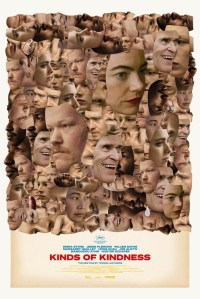
Yorgos Lanthimos might be one of the strangest filmmakers ever to fall into favor with the Oscars. Hot off the critical and commercial success of 2023’s Poor Things, we have a new Lanthimos joint not even six months later. This is a collaboration between his Greek co-writer from The Lobster and The Killing of a Sacred Deer, arguably the less “mainstream” Lanthimos movies. This movie is an anthology of three stories with the same actors playing different roles in each story. The problem is that I didn’t engage with any of the stories and found them long, meandering, and poorly paced. That Lanthimos specialty is a cracked-mirror version of the world, mixing the bizarre as if it were mundane, and it’s a trying tonal tightrope for most thespians to excel within that space. There just isn’t enough here, and each new story feels like starting over rather than fulfilling a conclusion. The prior Lanthimos movies had an interesting premise or turn of events that could sustain a whole movie; Kinds of Kindness doesn’t have stories that can sustain three vignettes. I can take weird, alienating, and challenging Lanthimos, as I’ve been a fan ever since his Dogtooth debut, but this is easily his weakest movie yet. The actors all do credible work having distaff conversations in, what appears like, people’s palatial homes and doctor offices. It’s hard to glean a larger theme, point of view, or even general entertainment value with this dull entry. It feels like Lanthimos and his collaborators had a couple free weekends, the use of some rich friends’ homes, and said, “Well, we’ll make it an anthology because then we don’t have to compose a full movie.” Instead of one disappointing movie, now you get three. Kinds of Kindness is, worst of all, mostly forgettable, and given Lanthimos’ track record, that really is the biggest sin possible.
Nate’s Grade: C
Share this:

Woman of the Hour (2024)
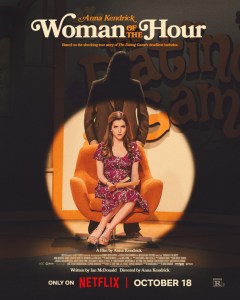 I never knew there was an actual serial killer that appeared on a 1978 episode of The Dating Game, and that he actually won. That’s a killer hook. The problem with Woman of the Hour, Anna Kendrick’s debut as a director, is that there isn’t really a movie here as presented. Because the game show segment can only last so long, we get the creepy first date, that never happened in real life, and watch Kendrick playing our lucky lady with mounting dread. A moment where the killer requests that she re-read the phone number she hastily gave him by memory, because she should know her number, is terrifically tense, as is the scene of him following her to her car. The problem is that this first date can only last so long, just as the cheesy TV game show segment can only last so long, so the movie has to provide extra back-story to fill the time. We get several past encounters with the killer’s unfortunate victims, all played quite unnervingly and seriously. The woman of the hour is less Kendrick getting her fleeting spotlight on TV, and an anecdote to impress people at parties for the rest of her life, than the survivor who eventually leads to the killer’s arrest. Amazingly, at the time of his TV appearance, he was on the FBI’s Most Wanted List but there wasn’t a searchable database, so he clumsily got to keep committing murders, including while out on bail. It’s a harrowing story, but is it one best told through the gimmick structure of the game show appearance? If you were going this route, perhaps best to treat the material like a slow-burn stage play, starting with the first date, and watch in real time as it gets awkward and our heroine begins to have her suspicions that this man does not mean her well. Instead, the game show segments are goofy and broad and the least important moments in the stretched-thin film. There might be a movie with this subject, but I’m not sure that Woman of the Hour is it.
Nate’s Grade: C+
Share this:

The Wild Robot (2024)
 There must be something personally appealing when it concerns movies about hopeful robots that serve as change agents to new communities. WALL-E and The Iron Giant are two of my favorite films of all time, and while The Wild Robot won’t quite enter that all-hallowed echelon, it’s still a heartfelt and lovely movie that can appeal to anyone. We follow Roz (voiced by Lupita Nyong’o), a discarded robot looking for tasks to complete on an island. Fortunately, the robot learns how to communicate with the local wildlife, including a baby goose that our robot feels responsible to train how exactly to be a goose, including how to fly before the advent of winter and the larger flock migrates. The characters are kept pretty simple but that doesn’t mean their emotions are. The movie, based upon a popular children’s book series by Peter Brown, is refreshingly mature about nature’s life cycle, not treating death like a taboo subject too dark for children. The themes of parenting, being different, and finding an accepting home through compassion and courage are all resonant no matter your age, and I’m happy to report that I teared up at several points. The parent-child relationship between the damaged robot and orphaned gosling extends beyond them, inspiring other members of the island’s food chain to work together for common goals and sustainability. There’s a late antagonist thrown in to up the stakes and provide a bit more explosive action, including a magnetic magenta-colored forest fire. The movie doesn’t quite close as strongly as it opens, but writer/director Chris Sanders (Lilo & Stitch, How to Train Your Dragon) knows innately how to execute at such a high level where even simple characters and familiar themes have fully developed stories with soaring emotions that arrive fully earned.
Nate’s Grade: B+


 nathanzoebl
You must be logged in to post a comment.