Monthly Archives: December 2024
The Bikeriders (2024)
 For a four-year period, writer/director Jeff Nichols is a filmmaker who appeared on my Best of the Year list three years, including making my top movie of 2011, Take Shelter. He’s a filmmaker I highly prize, so an eight-year gap from Nichols is an extended leave that makes me personally sad, though his latest movie, The Bikeriders, was delayed by a year after Disney decided to sell it rather than release it for the 2023 awards season. It’s a pretty straightforward drama about a Chicago motorcycle club in the 1960s. It’s all about a group of men that really don’t know how to express their feelings, so it comes out as drinking and fighting and general rebellion against outside authority. These social outsiders find kinship under the leadership of Johnny (Tom Hardy), an unstable man with his own code of honor and retribution. Our narrator is Kathy (Jodie Comer), a plucky woman who falls for a reckless biker, Benny (Austin Butler). There are plenty of interesting moments and sequences, like the rejection of wannabe new members too eager for approval for institutional violence. The changes the club undergoes through the mid 1970s are interesting, especially as the rules of the club begin to fray with the influx of new members and drug addictions, and the challenges to leadership we know will eventually end in tragedy and a betrayal of what the club was intended to be. Regardless, it feels like the movie has all the authentic texture and period details right but is missing a stronger sense of story. It’s more a collage of moments that doesn’t add up to a much better understanding of the three main characters. It’s more like a mood mosaic than engrossing drama, so if you have a general interest in retro motorcycle culture or the time periods, then maybe it will cover the absences in character. I found The Bikeriders to be a good-looking coffee-table book of a movie, more recreation than investment.
Nate’s Grade: B-
Share this:

Nightbitch (2024)
 Motherhood can be a real bitch, right? That’s the lessons for Nightbitch, a bizarre movie that juggles high-concepts and tones like a struggling new mother juggling time. Based on the novel by Rachel Yoder, Amy Adams plays Mother (yes, that’s how she’s credited), an artist who chose to become a stay-at-home mother to her two-year-old son, and her life has become an endless stream of days appeasing a small tyrant who she also unconditionally loves. Early on, Adams uncorks an imaginary monologue about demystifying the glamour of motherhood and the guilt she feels about not finding every tantrum and bowel movement a thing of bronze-worthy beauty. She’s grappling with significant changes, and that’s even before she thinks she’s turning into a dog. I can find thematic connection with motherhood and body horror, as our protagonist feels that she no longer recognizes her body, that she feels a lack of direction and agency in a life that no longer feels hers. The added body horror of transformation makes sense, but this element seems so extraneous that I wished the movie had exorcised it and simply stuck with its unsparing examination of parenthood. You would think a woman believing she is becoming a dog would dominate her life. The ultimate life lessons of the movie are rather trite: assert yourself, establish a balance to have it all, and fellas, did you know that being a stay-at-home parent is actually hard work? There are too many half-formed elements and plot turns that don’t feel better integrated, like flashbacks interwoven with Mother’s mother, not credited as “Grandmother,” as a repressed Mennonite in a closed community who disappeared for stretches. There’s also a few curious reveals relating to Mother’s perception of others that are unnecessary and obtusely mysterious for no real added value (“Why that library book died forty years ago….”). Adams is blameless and impressively throws herself into the demanding roll, going full canine with gusto as she trots on all fours and eats out of bowls. The problem is that all the dog material feels a little too silly when realized in a visual medium rather than a symbol of freedom and rebellion. Nightbitch is more bark than bite, and I’d advise viewers looking for an unflinching portrayal of motherhood to watch Tully instead and, if desired, pet your household dog at home to replicate Nightbbitch but better.
Nate’s Grade: C
Share this:

Nickel Boys (2024)
 This might be the most immersive and biggest directorial swing of the year. Director/co-writer RaMell Ross adapts the Pulitzer Prize-winning novel by Colson Whitehead about a reform school for juveniles more like a prison during the Civil Rights era. Ostensibly, the Nickel Academy is an institution that is meant to teach moral lessons and responsibility through outdoor labor. In reality, it’s a school that benefits from labor exploitation and has no intention of fulfilling its promise that students can possibly leave before they turn eighteen. This is even worse for African-Americans, as the school is also segregated and the students have to endure the racism of the administrators and other white juvenile delinquents who still want to feel superior to somebody. It’s a cruel setting destined to spark risable outrage, especially knowing that our main character, Elwood Curtis, is a victim of profiling and being in the wrong place at the wrong time, a star student selected to take college classes at an HBCU. The big artistic swing of Nickel Boys is the choice to tell the entire movie through first-person perspective, with the camera functioning as our protagonist’s eyes and ears. As the camera moves, it is us moving. It makes the movie intensively immersive, but I had some misgivings about this storytelling gimmick. It limits the resonance of the central performance as we can’t see the actor and his expressions and emotions, which I found frustrating. Ross also decides to do this same trick twice with a second character who befriends Elwood. Now we can see more of our main character, through this other person’s eyes occasionally, but it’s also like having to re-learn the visual vocabulary, and switching from viewpoints was distracting for the immersion and to recall whose eyes were whose at any moment. There’s also flash-forwards to adult Elwood that only served to muddle the tension. There’s enough genuine drama in this setting that I wish Nickel Boys might have been a more traditionally-made drama. Still, it’s a fine movie, but the aspect that will make it stand out the most is also what I feel that holds it back for me from being more profoundly affecting.
Nate’s Grade: B
Share this:

The Brutalist (2024)

The indie sensation of the season is an ambitious throwback to meaty movie-going of the auteur 1970s, telling an immigrant’s expansive tale, and at an epic length of 3 hours and 30 minutes, and an attempt to tell The Immigrant Story, and by that we mean The American Story. It’s a lot for any movie to do, and while The Brutalist didn’t quite rise to the capital-M “masterpiece” experience so many of my critical brethren have been singing, it’s still a very handsomely made, thoughtfully reflective, and extremely well-acted movie following one man trying to start his life over. Adrien Brody plays Laszlo Toth, A Jewish-Hungarian survivor of the Holocaust who relocates to Pennsylvania in 1947. He starts work delivering furniture before getting a big break redesigning a rich man’s library as a surprise birthday gift that doesn’t go over well. Years later, that same rich man, Harrison Lee (Guy Pearce), wants to seek out Laszlo because his library has become a celebrated example of modern architecture. He proposes Laszlo design a grandiose assembly that will serve as a community center, chapel, library, gymnasium, and everything to everyone, standing atop a hill like a beacon of twentieth-century civilization. Everything I’ve just written is merely the first half of this massive movie, complete with an old-fashioned fifteen-minute intermission.
The second half is about crises professional and personal for Laszlo; the meddling and compromises and shortfalls of his big architectural project under the thumb of Harrison, and finding and bringing his estranged wife (Felicity Jones) to America and dealing with the aftermath of their mutual trauma. I was never bored with writer/director Brady Crobett’s (Vox Lux) movie, which is saying something considering its significant length. The scenes just breathe at a relaxed pace that feels more like real life captured on film. The confidence and vision of the movie becomes very clear, as Corbett painstakingly takes his time to tell his sprawling story on his terms. I can appreciate that go-for-broke spirit, and The Brutalist has an equal number of moments that are despairing as they are enlightening. I was more interested in Laszlo’s relationship with his wife, now confined to a wheelchair. There are clear emotional chasms between them to work through, having been separated at a concentration camp, but there is a real desire to reconnect, to heal, and to confront one another’s challenges. It’s touching and the real heart of the movie, and it easily could have been the whole movie. The rest, with Laszlo butting heads against moneymen to secure the integrity of his vision, is an obvious allegory for filmmaking or really any artist attempt to realize a dream amidst the naysayers. The acting is terrific across the board, with Brody returning to a form he hasn’t met in decades. Maybe his career struggles since winning the Best Actor Oscar in 2003 have only helped imbue this performance with a lived-in quality of a soul-searching artist. Pearce is commanding and infuriating as the symbol of America’s ego and sense of superiority. The musical score is unorthodox but picks up a real sense of momentum like a locomotive, thrumming along at a building pace of progress. The only real misstep is an unnecessary epilogue that spells out exactly how you should feel about the movie rather than continuing the same respect and trust for its patient audience. The Brutalist is an intimidating movie and one best to chew over or debate its portrayal of the American Dream, and while not all of its artistic swings connect, the sheer ambition, fortitude, and confident execution of the personal and the grandiose is worth celebrating and elevating.
Nate’s Grade: B
Share this:

Babygirl (2024)
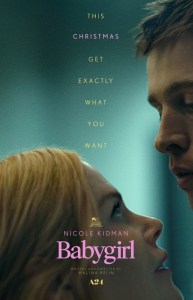 It’s so rare to see erotic dramas with the kind of pedigree, and set up for potential awards buzz, of Babygirl, and I think that’s because they’re a little hard to take seriously (see the ridiculous and tone-deaf Deep Water for further proof). What distinguishes the artistic erotic drama from the tawdry erotic drama will be a perhaps invisible line. Still, it’s rare for an actress of Nicole Kidman’s caliber, and let’s also be frank -her age- to headline an erotic drama, so that naturally draws some intrigue and eyeballs. Babygirl follows a familiar premise of taboo desires at the expense of domestic upheaval, but where it goes makes it ultimately feel like an unsatisfying morality tale.
Kidman plays Romy, a powerful tech CEO suffering from a lack of spark in her love life. She loves her husband (Antonio Banderas), her three teenage girls, and the life she’s built for herself, but she also needs to masturbate if she ever wants to be physically satisfied. Along comes a lanky hunk by the name of Samuel (Harris Dickinson) as an intern at her company and immediately makes her feel hot and bothered. He’s direct and wants to tell her what to do, and the excitement Romy feels makes her question how far she’s willing to go and what she’s willing to risk to chase her passions. 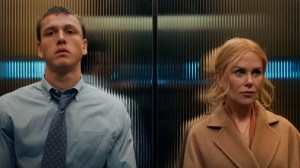 Babygirl is another rich person’s fantasy romance where a character risks losing their family on a fling, and usually these stories only go so many ways, primarily with the protagonist regretting their affair and learning some kind of lesson from the ordeal. For a formula meant to inspire titillation and transgression, these movies can be, at their core, very moralistic and conservative. There are so many movies that prominently feature cheating only for the person to realize how much they were taking for granted what they had all along. So many of these wayward participants don’t feel like they have lost something by the end even after risking their relationships, so the conclusion of these movies seems to be a facile “don’t do that again” lesson of sowing one’s oats. It strikes me as ironic that these stories are about untamed passions but they end so dispassionately. For the first half of Babygirl, I was questioning where this movie could lead: would the husband kill his wife’s lover and through the shared disposal of his body bring them closer together? Would it be revealed that Samuel was a stalker who manipulated his way into Romy’s life? Was her husband secretly behind this strapping young lad coming into her path and trying to provide her that spark of danger but in an unknowingly controlled environment? The eventual path of Babygirl is probably the most realistic path and yet it’s rather dramatically lacking and insert. Ultimately, the movie’s message seems to coalesce around accepting your desires and being open about sharing them; however, the proceeding movie doesn’t feel like a meaningful road to that cozy conclusion.
There’s a dramatically rich idea that could have been explored more maturely, namely that this woman has sacrificed her own physical pleasure for her career achievement. During one awkward night, Romy admits to her husband that over the decades of their relationship that he has never made her climax. His manly ego is bruised severely and Romy tries to wave away the statement, but the movie only seems to use this detail as further establishment for the motivation to have an affair. Director/writer Halina Reijn (Bodies Bodies Bodies) sets this up within the very first shot of the movie, with Romy finishing having sweaty sex with her husband only to finish by herself with the help of Internet pornography. Right away we know her husband isn’t doing it for her. There’s one moment where Romy explains that she feels like her desires are degrading and self-destructive, but she won’t share them with her husband. She tries to guide him there, planting a pillow over her head to cover her sight to facilitate her imagination, but it makes him feel uncomfortable to continue (“I feel like a villain”). There’s an interesting exploration of keeping passion stoked in a long-standing relationship where inertia can settle in, but the ultimate revelation is rather pat and all-too familiar: communicate more. Thanks, movie. So much of the movie is built around what Romy learns from how far she goes, but what do we learn about Samuel too? He’s kept a frustrating blank of a figure, more catalyst than fully developed character. If he’s ultimately just the excuse to push her out of her comfort zone, did he have to be this boring even with his kinks?  Will you find Babygirl sexy? I don’t know. It primarily trades in dominance/submissive dynamics, and the director keeps her camera’s gaze on the pursuit of feminine pleasure rather than closeups of pert anatomical parts. The sequences where Samuel orders Romy around played more unintentionally comical to me rather than decisively arousing, especially moments like him forcing her to eat out of his hand like a dog. I can understand being in such a high-powered job of constant decision-making might make a fantasy of giving up control and agency seem appealing, but this isn’t really explored in the movie. I can also understand the shame of feeling like your hidden desires might be too embarrassing to share with your partner, but this isn’t fully explored either. For all its heavy breathing and sultry glances, the movie feels far more clinical than passionate. The sensation I felt the most was a lulling curiosity that ultimately went unmet. Your mileage may vary.
Babygirl is the kind of movie that critics declare the lead actress being so “brave” to push boundaries at her age, to bare her body in an age bracket that Hollywood finds less-than-desirable. However, Kidman has long been an actress unafraid of the demands of nudity as well as challenging roles, which mitigates the perceived daring of this latest performance. Babygirl is ultimately a disappointing erotic drama that, for me, lacked heat, better character development, and a surprising or insightful plot. In short, Babygirl comes up short where it counts.
Nate’s Grade: C+
Share this:

Sing Sing (2024)
 An uplifting ode to the power of the arts, Sing Sing follows the men of a prison arts program and it’s easily one of the finest films of 2024. We follow the men of the New York prison of the title, lead by Divine G Whitfield (Colman Domingo), a thespian that relishes the dramatic spotlight and the deserved lead of every production. When the next show is suggested as a comedy, Divine G has to accept ceding the spotlight and mentoring a promising but struggling new member (Clarence Maclin) with talent and potential. It’s effectively a “let’s put on a show” formula of old, however, the setting and the weary reflections are what provide the movie its power. All of these men have made mistakes in their respective lives to wind up here, though Divine G maintains his innocence and is preparing his case for a parole board hearing. This program allows them an escape, an opportunity as one puts it to “become human again” While some may scoff at the acting games and costumes, this is sacred ground, a precious oasis for them to discover more about themselves. The sincerity of Sing Sing is wince-inducing. It is beautiful, tender, compassionate, and deeply personal while being very universal. The lived-in details are fantastic and give great authenticity to these men and their stories, wonderfully portrayed by several non-actors making the most of their own spotlights. Domingo (Rustin) is amazing as the proud and generous leader who is ably trying to lift his fellow men up even higher. The film concludes with real footage from the Rehabilitation Through the Arts (RTA) program, and it’s the fitting culmination for a movie that readily reminds us how restorative and needed the arts are for a fuller sense of who we are.
Nate’s Grade: A
Share this:

Blink Twice (2024)
 Zoe Kravitz’s directorial debut Blink Twice has stayed with me for weeks after I watched it, and with further harrowing revelations coming from the fallout of P. Diddy’s empire of exploitation, it has even more relevance. Think of it as a feminist revenge thriller set on Jeffrey Epstein’s island or a Diddy party. Channing Tatum plays a successful tech bro who hosts lavish getaways for the Wall Street and Silicon Valley elite, where the week is an orgy of food, drink, drugs, and of course sex. We follow Frida (Naomi Ackie), a waitress yearning for the finer things in life, so when Tatum’s rich and famous CEO invites her and her friend to his private island, she’s ecstatic. But everything is not what it seems, and Frida and the other women begin to notice weird clues, that is, when they can remember as time frequently seems to be lost for them. Blink Twice is a twisty, eerie mystery and Kravitz shows real skill at developing tension and suspense, with sequences that had me girding great waves of anxiety. There’s also an eye for style and mood here that makes me feel Kravitz has a real career as a genre director. I don’t think it’s spoilers to say that eventually the surviving women team up together to fight back against their oppressors, and it’s gloriously entertaining, bloody, and table-turning satisfying. The ending is designed to spark debate and controversy, and I enjoy that Kravitz and co-writer E.T. Feigenbaum do not want to make things too tidy, even with their protagonists. The themes here are broad but the execution is exact. There are several moments that stand out to me, from unexpected moments of levity to bold artistic choices that are mesmerizing, like an “I’m sorry” apology that goes through every level. If you’re looking for slickly executed genre thrills with great comeuppance, don’t blink when it comes to with Blink Twice.
Nate’s Grade: B+
Share this:

Juror #2 (2024)
 Clint Eastwood’s possible last movie as a director (the man is 94 years old, people) was buried at the theater through a limited release by its studio, which is a shame because Juror #2 is a fairly solid adult drama with some grueling tension built right in. I was wondering how screenwriter Jonathan Abrams was going to make this premise work, where a recovering alcoholic and expectant father, Justin Kemp (Nicholas Hoult), is impaneled on a jury for a murder case and discovers, over the presentation of evidence, that he might actually be the culprit. That same night, at the same location of where the supposed murder took place, is where Justin thought he hit a deer. What follows is a soul-searching account of one man being torn apart as far as what he should do. Does he let this other man take the blame so Justin can live out his life with his new baby and wife? Or does he come forward and admit his own firsthand knowledge of the events would present a very reasonable doubt for this trial? The movie becomes an extended balancing act of how long Justin can keep this secret and what angles he will work, trying to push the jury one direction or another through persuasive appeals. It’s familiar dramatic territory to anyone who grew up on 12 Angry Men, though with an extra high-concept twist. It’s a fairly straightforward drama that allows the story to take center stage and puts the focus on one man’s personal crisis. The acting is strong all around with Hoult (Nosferatu) being the predicted standout, showing the heavy weight of his guilt wirh every pained expeession. I think the ending does a disservice to the kind of movie that came before it, namely that it should be more definitive in its conclusion and provide a fitting resolution. This isn’t exactly the kind of movie that benefits from prolonged ambiguity, so the abrupt ending feels like a miscalculation and hampers a bit of the ending’s impact. However, Juror #2 is a good squirm session.
Nate’s Grade: B
Share this:

Million Dollar Baby (2004) [Review Re-View]

Originally released December 15, 2004:
Million Dollar Baby, much like its fledgling female boxing character, has come out of nowhere and made a considerable deal of noise. This little homespun film directed by Clint Eastwood didn’t have the glitz and sheen of other awards friendly movies, but now it seems that Eastwood?s own baby may clean up come Oscar time. Can Million Dollar Baby tackle the enormous hype surrounding it? Yes and no.
]Frankie (Eastwood) is a hardened boxing trainer too concerned for his fighters’ welfare to allow them to fight in championship bouts. He’s the kind of cynical old man that enjoys pestering a priest and causing him to unleash an F-bomb. Frankie and his longtime friend Scrap (Morgan Freeman) run a rundown gym and talk un-sentimentally about their older days as prize fighters. Then along comes Maggie (Hilary Swank), a 32-year old waitress who’s got nothing to believe in except her possibility as a boxer. She wants Frank to train her into the champ she knows she can be. He refuses saying he doesn’t train girls. She’s so determined she won’t take no for an answer. Frank finally agrees, especially after some help from Scrap, and starts to teach Maggie everything she needs to know to be a star pugilist. The two begin to open up to each other emotionally and Maggie seems destined to become a force in the ring.

Million Dollar Baby‘s greasiest attribute is its trio of knockout performances. Swank owns every second of this movie. She’s unremittingly perky, conscientious but also dogged, stubborn, and irresistibly lovable. Swank embodies the role with a startling muscular physique and a million dollar smile. Her performance is equal parts charming and heartbreaking. Maggie’s the heart of Million Dollar Baby and Swank doesn’t let you forget it for a millisecond. Come Oscar time, I’m sure she will be walking onstage to grab her second Best Actress Oscar in five years.
No one does grizzled better than Eastwood, and maybe no other actor has made as much of an acting mark by squinting a lot. Million Dollar Baby is probably his best performance to date, though for a good while it sounds like Frank has something lodged in his throat (pride?). Frank has the greatest transformation, and Eastwood brilliantly understates each stop on the journey until landing in a vulnerable, emotionally needy place.
Freeman once again serves as a film’s gentle narrator. There isn’t a movie that can’t be made better by a Morgan Freeman performance. His give-and-take with Frank feels natural and casual to the point that it seems improvised on the spot. Freeman unloads some great monologues like he’s relishing every syllable, chief among them about how he lost his eye. It’s wonderful to watch such a great actor sink his teeth into ripe material and deliver a performance that may net him a long-awaited Oscar (I think he’s due, and likely so will the Academy).
For whatever reason, Eastwood is hitting a directing groove in his twilight years. First came Mystic River, an ordinary police whodunnit made exceptional by incredible acting. Now Eastwood follows up with Baby, an ordinary sports film made extraordinary by incredible acting. Hmmm, a pattern is forming. The cinematography is crisp and makes great use of light and shadow to convey emotion. Eastwood’s score is also appropriately delicate and somber. The boxing sequences are brief but efficient.
Million Dollar Baby is a very traditional story that is at times surprisingly ordinary. Maggie’s the scrappy underdog that just needs a chance, Frank’s the old timer that needs to find personal redemption, and Scrap’s the wise old black man. Once again, an old curmudgeon takes on a rookie and in the process has their tough facade melt away as the inevitable victories pile up. Million Dollar Baby is a very familiar story but then again most boxing tales are fairly the same in scope.
What eventually separates Million Dollar Baby from the pack is its third act twist. You think you know where Eastwood’s film is headed, especially given the well-worn terrain, but you have no clue where this story will wind up. The plot turn deepens the characters and their relationships to each other in very surprising ways. You may be flat-out shocked how much you’ve found yourself caring for the people onscreen. It almost seems like Eastwood and company have used the familiar rags-to-riches underdog drama to sucker punch an audience into Million Dollar Baby‘s final 30 minutes. We’re transported into an uncomfortable and challenging position, and Eastwood won’t let an audience turn away.

Million Dollar Baby is not the colossal masterpiece that critics have been drooling over. For one thing, the group of antagonists is not nearly as textured as our trio of leads. They’re actually more stock roles that further enforce the ordinary story of Million Dollar Baby. Maggie’s trailer trash family is lazy unsupportive batch of stereotypes. The evil female boxing champ just happens to be a German who doesn’t mind playing dirty. One of the boxers at Frank’s gym is an arrogant showboat just waiting to be nasty while the teacher’s back is turned. Million Dollar Baby excels at showing depth and humanity with its lead trio, yet it seems if you aren’t in that circle you’re doomed to wade in the shallow end.
Eastwood shows that great acting and great characters you love can elevate a common framework. The package may be similar to a lot of films before about scrappy underdogs, but Million Dollar Baby lacks comparison in its genre when it comes to its enthralling acting and characters. The father-daughter bond between Frank and Maggie is heartwarming. The final reveal of what her Gaelic boxing name means may just bring tears to your eyes. The results are a very fulfilling movie going experience, albeit one that regrettably may not live up to such hype.
Million Dollar Baby has been showered with heapings of praise and become a formidable Oscar contender. The story treads familiar waters but its outstanding acting and deep and humane characters elevate the material. The film can’t match the hyperbole of critics but Million Dollar Baby is an ordinary but greatly satisfying ride led by compelling acting. The film hums with professionalism and seems to just glide when everything comes together magnificently, particularly in that last 30 minutes. Eastwood is hitting an artistic stride and it’s actually exciting to see what Clint will do next. Million Dollar Baby may not be a first round knockout but it definitely wins by decision.
Nate’s Grade: B+
——————————————————
WRITER REFLECTIONS 20 YEARS LATER

Million Dollar Baby was its own underdog story that showed its strength when it mattered most, taking the 2004 Best Picture Oscar, as well as Best Actress for Hilary Swank and Best Supporting Actor for Morgan Freeman. It wasn’t even on many award prognosticators’ radar until the final month of the year. The odds-on favorite for most of 2004 had been Martin Scorsese’s Howard Hughes biopic The Aviator, a lavish recreation of Old Hollywood with the power of Harvey Weinstein behind it. After 2002’s Gangs of New York went 0-10 with its Oscar nominations, Weinstein vowed this would not happen again and that he would get Scorsese that first directing Academy Award, so no expense was spared with a $110 million-dollar budget, exceeding the previous highest Miramax budget from 2003’s Cold Mountain. The narrative was set, the power of Weinstein was behind it, and the context of Hollywood celebrating its own history has long been an appealing formula for an easy Oscar victory. Then came Clint Eastwood’s scrappy little boxing movie and it sucker-punched the established awards narrative, taking the top prize (Sorry Harvey, but if it was any consolation, The Aviator improved upon Gangs’ ratio, winning 5 of 11 noms).
Twenty years later it’s impossible to discuss the legacy of Million Dollar Baby without talking about the legacy of Eastwood as a director. He’s been directing movies ever since 1971’s Play Misty For Me. He initially stuck to what he knew, thrillers and Westerns, with the occasional passion project like 1988’s Charlie Parker biopic, Bird. It all changed for Eastwood with 1992’s Unforgiven, a searing deconstruction of the Western and masculinity and conveniently digested American myth-making that won Best Picture and Best Director for Eastwood. From there, the flinty-eyed, gravelly-voiced filmmaker was seen as an Oscar favorite, though he was only nominated for Best Director three other times out of the twenty-five films he directed after. Eastwood’s been regarded as some higher-minded adult director, but looking over his long list of directorial efforts, the man has always kept to his preferred milieu of thrillers and Westerns with the occasional somber biopic. The more assumed Academy-friendly projects typically gained minimal traction, usually acting nominations like with Richard Jewell, Invictus, and The Bridges of Madison County. Sometimes they’ve just been complete artistic whiffs, like J. Edgar, Jersey Boys, or Hereafter.

The movies that got the most acclaim from Eastwood as director were the elevated genre movies, be they crime thriller (Mystic River), Western (Unforgiven), or sports underdog drama (Million Dollar Baby). The man has an inherent interest in genre movies. He may make a WWII drama from the point of view of the Japanese, completely in Japanese, but then next he’ll make a movie about being a “Get off my lawn” grumpy grandfather taking on street gangs. He made a movie about sending geezers into space, a juror realizing he may actually be guilty of the crime he’s intended to judge, and a corrupt president covering up his crimes (that guy wasn’t even a convicted felon upon inauguration -ha). The man is at his best when he sticks to what he knows, and when he can collaborate with writers who can get the best out of his instincts, the results can be exceptional. He’s a man interested in telling genre stories, and I can respect that. He’s notoriously spartan in his directorial approach with actors, typically only allowing two or so takes before moving on, a.k.a. the anti-Kubrick. The photography is so stark is might be confused for being black and white. There is a stripped-down-to-its-studs quality to the best of Eastwood’s movies, which is why deconstructionist examinations over genres can be especially rewarding. It allows for a larger space for characters to expand and grow and challenge our expectations, which is where Million Dollar Baby still works so well twenty years after it unexpectedly KO’d the awards circuit.
This is a Cinderella sports story balanced by an invigorating surrogate father-daughter relationship. Maggie Fitzgerald (Swank) is so eager to prove herself as a boxer, and we’re so happy to see her gain success and dignity, helping to give her trainer Frankie Dunn (Eastwood) a new sense of purpose. Everything is going right for this pair and it feels like the Hollywood movie we would all know and love, and then it all gets violently torn away when Maggie is injured in the ring and becomes paralyzed from the neck down. From there, Million Dollar Baby transforms from its sports movie formula and becomes something so much more meaningful and interesting and emotionally affecting. We’re constantly playing a mental contrast from before and after the accident. She’s so optimistic and bouncy and full of life. To see the joyous Maggie using her body to give her confidence and identity and overcoming adversity and intimidating more professional opponents through force of will, and then to see her bedridden, wheezing through a ventilator, and so deeply lost in her slack eyes, it’s something awful. She survived the injury but her spirit has been obliterated. Now, this isn’t a commentary on how disabled people cannot live fulfilling lives and might as well be euthanized. Maggie is the one who makes the choice to be euthanized and she will not be swayed, and this decision puts it to her coach, a lifelong Catholic, to demonstrate his love for his pupil through assisted suicide. To me, all that is WAY more dramatically interesting than if she had simply won the big title fight and proven all her many doubters wrong.

Swank rightfully won her second Oscar for Best Actress with a performance of such vitality and despair. At the end, when she’s stuck in that hospital bed, and she’s trying to chew off her own tongue so she can bleed to death, it’s such a devastating change from the chipper, optimistic scrappy underdog. Eastwood is gruff and growly and nearly unintelligible at points, but his reactions and his generosity as an actor help Swank achieve even higher acting greatness. Strangely enough, while Freeman is perfectly good in his Oscar-winning role, you could have cut him completely from the movie and affected very little, besides needing a new outlet for Eastwood to unintelligibly grumble towards.
It can feel like Million Dollar Baby is two different movies smashed together, one without an ending and one without a beginning. If you felt like you were plugged into that rousing sports underdog movie, I can understand feeling cheated by the rug pull. I feel like the version of this movie, by its end, is the one it wanted to be all along, and it’s using your emotional investment in these characters to make the decisions all the more grueling and tragic. Twenty years later, I think I enjoyed the moments before the accident a little less and the moments after the accident much more, and considering the ending seems like the whole point for Million Dollar Baby, that seems like an endorsement for its staying power two decades hence. It still has enough power today from the performances and where it pushes those characters. Million Dollar Baby is still a winner because it fit so well as a vehicle that Eastwood could elevate. He’s 94 years old and not likely directing too many more movies, but if anyone can keep making movies into their triple digits, it’s this man.
Nate’s Grade: A-
Share this:

Red One (2024)
 Is Amazon’s $250 million holiday adventure the harbinger of doom for modern movies as many alarmist film critics have claimed? No. Is it the next great Christmas classic? No. It’s a thoroughly mediocre holiday action movie borrowing heavily from the familiar Marvel movie formula; it strains very hard to be a breezy spectacle and a buddy comedy. There’s a fun concept here about Santa Claus (a buff J.K. Simmons) being kidnapped, but the focus is on the wrong characters. The best segment of Red One is when we’re introduced to Santa’s cranky brother, Krampus (Kristofer Hiivju), a half-demon half-goat creature with excellent practical makeup application and design. The movie feels dangerous and finally intriguing with their history, and it’s here that I realized the best version of Red One would have been one where Santa AND Krampus, two feuding brothers with very different perspectives on how to handle the naughty, are forced to work together to escape their holiday hostage-takers. Alas, the characters we get are The Rock playing a minor variation on the character archetype he’s been grinding into dust for a decade, and Chris Evans as a cynical adult super hacker who needs to learn the true meaning of Christmas. The inclusion of Evans’ character is flimsy and he’s far too annoying to offset whatever advantages he might provide to Santa’s extraction team. The fantasy elements and lore can be fun, like an abominable snowman fight in the tropics, but too many of these elements feel underdeveloped, like the Rock growing big and small for… reasons. Just like how our villain wants to teach the world a lesson in terror… that can be broken by self-reflective apologies. It’s a movie consumed by its many influences. Red One isn’t exactly for little kids, isn’t exactly for adults, and isn’t exactly for teenagers, so who is this for? It’s destined to play in the background and be ignored while holiday naps are had, and to that end, Red One succeeds.
Nate’s Grade: C


 nathanzoebl
You must be logged in to post a comment.