Monthly Archives: February 2024
Drive-Away Dolls (2024)
 Drive-Away Dolls is an interesting curiosity, not just for what it is but also for what it is not. It’s the first movie directed solo by Ethan Coen, best known as one half of the prolific filmmaking Coen Brothers, who have ushered in weird and vibrant masterpieces across several genres. After 2018’s The Ballad of Buster Scruggs, their last collaboration, the brothers decided to set out on their own for an unspecified amount of time. This led Joel Coen to direct 2021’s atmospheric adaptation of Macbeth, and now Ethan has decided that the fictional movie he really wants to make, unshackled by his brother, is a crass lesbian exploitation sex comedy. Well all right then.
Set in 1999 for some reason, Jamie (Margaret Qualley) is an out lesbian who unabashedly seeks out her own pleasures, even if it brings about the end of her personal relationships. Her friend, Marian (Geraldine Viswanathan), hasn’t had a lover in over three years and is much more prim and proper. Together, these gal pals decide to drive to Tallahassee, Florida using a drive-away service, where they will be paid to drive one way, transporting a used car. It just so happens that these women have mistakenly been given the wrong car, a vehicle intended for a group of criminals transporting contraband that they don’t want exposed. Jamie is determined to get laid and help Marian get laid all the while goons (Joey Slotnick, C.J. Wilson) are trailing behind to nab the ladies before they discover the valuable contents inside the trunk of their car.
 Drive-Away Dolls is clearly an homage to campy 1970s exploitation B-movies but without much more ambition than making a loosey-goosey vulgar comedy consumed by the primal pursuit of sexual pleasure. I was genuinely surprised just how radiantly horny this movie comes across, with every scene built in some way upon women kissing, women having sex, women talking about having sex, women pleasuring themselves, women talking about pleasuring themselves, and women talking about pleasuring other women. When I mean every scene I mean virtually every scene in this movie, as the thinnest wisp of a road trip plot is barely holding together these scenes. From a representational standpoint, why shouldn’t lesbians have a raunchy sex comedy that is so open about these topics and demonstrates them without shame? Except it feels like the crude subject matter is doing all the heavy lifting to make up for the creative shortcomings elsewhere in the movie, which, sadly there are many. The script is co-written by Coen and his wife of many years, Tricia Cooke, an out lesbian, so it feels like the intent is to normalize sex comedy tropes for queer women, but the whole movie still feels overwhelming in the male gaze in its depictions of feminine sexuality. I’m all for a sex-positive lesbian road trip adventure, but much of the script hinges upon the uptight one learning to love sex, which means much of the story is dependent upon the promiscuous one trying to then bed her longtime friend and get her off. Rather than feel like some inevitability, the natural conclusion of a friendship that always had a little something more under the surface, it feels more like a horny and calculated math equation (“If you have two gay female leads, you can get them both kissing women by having them kiss each other”).
I’m sad to report that Drive-Away Dolls is aggressively unfunny and yet it tries so hard. It’s the kind of manic, desperate energy of an improv performer following an impulse that was a mistake but you are now watching the careening descent into awkward cringe and helpless to stop. The movie is so committed to its hyper-sexual goofball cartoon of a world, but rarely does any of it come across as funny or diverting. When Jamie’s ex-girlfriend Suki (Beanie Feldstein) is trying to remove a dildo drilled onto her wall, she screams in tears, “I’m not keeping it if we both aren’t going to use it.” The visual alone, an ex in tears removing all the sexual accoutrements of her previous relationship, some of which can be widely over-the-top, could be funny itself. However, when her reasoning is that we both can’t use this any longer, then the line serves less as a joke and more a visual cue for the audience to think about both of them taking turns. It doesn’t so much work at being funny first and rather as a horny reminder of women being sexual together. The same with a college soccer team’s sleepover that literally involves a basement make-out party with a timer going off and swapping partners. It’s not ever funny but features plenty of women making out with one another to satisfy some audience urges. I will admit it serves a plot purpose of first aligning Jamie and Marian into awkwardly kissing one another, thus sparking carnal stirrings within them.
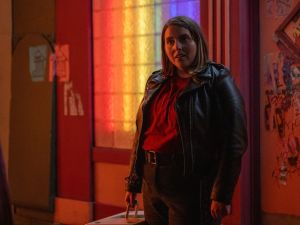 My nagging issue with the movie’s emphasis is not a puritanical response to vulgar comedy but that this movie lacks a necessary cleverness. It doesn’t really even work as dumb comedy, although there are moments that come close, like the absurd multiple-corkscrew murder that opens the movie. It’s just kind of exaggerated nonsense without having the finesse to steer this hyper-sexual world of comedy oddballs. The crime elements clash with the low-stakes comedy noodling of our leads bumbling their way through situation after situation that invariably leads to one of them undressing or inserting something somewhere. The brazen empowerment of women seeking out pleasure is a fine starting point for the movie, but the characters are too weakly written as an Odd Couple match that meets in the middle, the uptight one learning to loosen up and the irresponsible one learning to be less selfish. The goons chasing them are a pale imitation of other famous Coen tough guys; they lack funny personality quirks to broaden them out. There’s a conspiracy exposing political hypocrites condemning the “gay agenda,” and I wish more of this was satirized rather than a briefcase full of reportedly famous phalluses. If you got a briefcase full of famous appendages, I was expecting more jokes than blunt objects.
I feel for the actors, so eager to be part of a Coen movie, even if it’s only one of them and even if it’s something much much lesser. Qualley (Once Upon a Time… in Hollywood) is a typical Coen cartoon of a character, complete with peculiar accent and syntax. She’s going for broke with this performance but the material, time and again, requires so little other than being exaggerated and horny. There is one scene where her physical movements are so broad, so heightened to the point of strain, that I felt an outpouring of pity for her. It feels like a performance of sheer energetic force lacking proper direction. Viswanathan has been so good in other comedies and she’s given so little to do here other than playing the straight women (no pun intended) to Qualley’s twangy cartoon. Her portrayal of sexual coming of age and empowerment was better realized, and funnier, in 2018’s Blockers, a superior sex-positive sex comedy.
 As a solo filmmaker, Ethan Coen seems to confirm that his brother is more the visual stylist of the duo. The movie is awash in neon colors and tight closeups of bug eyes and twangy accents, but the most annoying stylistic feature, by far, is the repeated psychedelic transition shots, these trippy interstitials that don’t really jibe with anything on screen. It felt like padding for an already stretched-thin movie that can barely reach 75 minutes before the end credits kick in. That’s why the extended sequences where the intention seems exploitation elements first and comedy second, or third, or not at all, makes the whole enterprise feel like a pervy curiosity that has its empowering yet obvious message of “girls do it too” as cover. Agreed, but maybe do more with the material beyond showcasing it. Ethan Coen is a prolific writer who has written short story collections (I own his 1998 book Gates of Eden), poetry collections, and he even wrote five one-act plays before the pandemic struck in 2020. I’d love to see those plays. This man has true talent but it’s just not obviously present throughout this film.
Drive-Away Dolls is an irreverent sex comedy with good intentions and bad ideas, or good ideas and bad intentions, an exploitation picture meant to serve as empowerment but still presents its world as exploitation first and last. It’s just not a funny movie, and it’s barely enough to cover a full feature. I suppose one could celebrate its mere existence as an affront to those puritanical forces trying to oppress feminine sexuality, but then you could say the same thing about those 1970s women-in-prison exploitation pictures. It’s a strange movie experience, achingly unfunny, overly mannered, and makes you long for the day that the two Coens will reunite and prove that the two men are better as a united creative force; that’s right, two Coens are better than one.
Nate’s Grade: C-
Share this:

The Passion of the Christ (2004) [Review Re-View]

Originally released February 25, 2004:
The Passion of the Christ is a retelling of the last 12 hours of Jesus Christ’s life (perhaps you’ve heard of him?). In these final hours we witness his betrayal at the hands of Judas, his trial by Jewish leaders, his sentencing by Pontius Pilate, his subsequent whippings and torture and finally his crucifixion. Throughout the film Jesus is tempted by Satan, who is pictured as a pasty figure in a black hood (kind of resembling Jeremy Irons from The Time Machine if anyone can remember). The Passion spares no expense to stage the most authentic portrayal of what Jesus of Nazareth endured in his final 12 hours of life.
For all the hullabaloo about being the most controversial film in years (and forgive me for even using the term “hullabaloo”), I can’t help but feel a smidgen of disappointment about the final product. The Passion is aptly passionate and full of striking images, beautiful photography and production values, and stirring performances all set to a rousing score. But what makes The Passion disappointing to me is the characters. You see, Mel Gibson’s epic does not devote any time to fleshing out the central characters. They are merely ciphers and the audience is expected to plug their feelings and opinions into these walking, bleeding symbols to give them life. Now, you could argue this is what religion is all about, but as far as a movie’s story goes it is weak. The Passion turns into a well-meaning and slick spectacle where character is not an issue. And as a spectacle The Passion is first-rate; the production is amazing and the violence is graphic and gasp-inducing. Do I think the majority of people will leave the theater moved and satisfied? Yes I do. But I can’t stop this nagging concern that The Passion was devoid of character and tried covering it up with enough violence to possibly twist its message into a Sunday school snuff film.

For my money, the best Biblical film is Martin Scorsese’s 1987 The Last Temptation of Christ (also a film mired in controversy). Last Temptation, unlike Gibson’s spectacle, was all about Jesus as a character and not simply as a physical martyr. Scorsese’s film dealt with a Christ consumed by doubt and fear and the frailties of being human. But the best part is the final 20 minutes when Jesus is tempted, by Satan, to step down from the cross and live out a normal life. Jesus walks away from the cross, marries Mary Magdalene, fathers children (this is where the controversy stemmed from but they were married) and dies at an old age. Jesus is then confronted by his aging apostles who chastise him for not living up to what he was supposed to do to save mankind. Jesus wakes up from the illusion and fulfills his mission and dies on the cross. Now, with the story of Last Temptation an audience has a greater appreciation for the sacrifice of Jesus because they witness his fears and they witness the normal life he forgoes to die for man’s sins. There is a sense of gravity about what Jesus is sacrificing.
With The Passion Gibson figures if he can build a sense of grand sacrifice by gruesomely portraying the tortures Jesus endured. Even if it is Jesus, and this may sound blasphemous, torturing a character to create sympathy and likeability is the weakest writing trick you can do. Yes Jesus suffered a lot, yes we should all be horrified and grateful, and yes people will likely be moved at the unrelenting violence he endured, but in regards to telling a story, I cannot feel as much for characters whose only characterization is their suffering. Sure, The Passion flashes back to some happier moments of Jesus’ life, which I like to call the Jesus Greatest Hits collection, but the movie does not show us who Jesus was, what he felt (beyond agonizing pain) or the turmoil he went through in finally deciding to give up his own life for people that despised him. The Passion is not about character but about spectacle.
So let’s talk about the violence now, shall we? Gibson’s camera lovingly lingers on the gut-churning, harrowing, merciless level of violence. But this is his only message. It’s like Gibson is standing behind the camera and saying to the audience, “You see what Jesus suffered? Do you feel bad now? FLAY HIM MORE! How about now?” What was only three sentences of description in the Gospels takes up ten minutes of flogging screen time. Mad Mel has the urge to scourge. After an insane amount of time spent watching Jesus get flayed and beaten the violence starts to not just kill whatever spiritual message Gibson may have had in mind, but the violence becomes the message. The Passion does give an audience a fair understanding of the physical torture Jesus was subjected to, but the movie does not display Christ as fully human, enjoying life and love, or fully divine. The only thing The Passion shows us about Jesus is that the son of God sure knew how to take a whuppin’. For Gibson, the violence is the message and the point is to witness what Jesus endured. Some would call that sadistic.

The actors all do a fine job and it’s impressive that everyones’ lines is in two dead languages (Latin and Aramaic, though for the life of me I can’t tell them apart). But the acting is limited because of the nature of the film. Had there been more moments of character the acting would come across better. As it stands, the acting in The Passion is relegated to looks of anguish or looks of horror, interspersed with weeping. Monica Bellucci (The Matrix sequels) really has nothing to do as Mary Magdalene but run around in the background a lot. Jim Caviezel (Frequency, Angel Eyes) gives everything he has in the mighty big shoes he tries to fill. It’s too bad that his Jesus spends most of the screen time being beaten, which kind of hampers his acting range.
Now let’s address the anti-Semitic concerns. The Passion does portray a handful of Jewish religious leaders as instigators for Jesus’ eventual crucifixion, but there are also Jewish leaders who denounce their actions and just as many people bemoaning the torture of Jesus as there are calling for it. Who really comes off looking bad are the Romans. Excluding the efforts to make Pilate look apprehensive, the Roman soldiers are always seen kicking, punching, whipping, spitting on Jesus and laughing manically with their yellow teeth.
And like I said before, most people will be extremely satisfied with the film because it’s hard to find a person who doesn’t have an opinion on Jesus. Gibson is counting on audiences to walk in and fill in the holes of the character so that The Passion is more affecting. Gibson’s film is worthy spectacle, and despite the vacuum of character I did get choked up four separate times, mostly involving Jesus and his mother. The Passion is a well-made and well-intentioned film that will hit the right notes for many. I just wish there were more to it than spectacle. I really do.
Nate’s Grade: C
——————————————————
WRITER REFLECTIONS 20 YEARS LATER

In 2004, Mel Gibson made an R-rated foreign film that was two hours of savage brutality against Jesus, and it wound up being one of the biggest box-office hits of the decade and forged a trail for other Hollywood execs to chase after a “faith-based audience.” It could be said that this grisly movie gave the people what they wanted, and apparently what they wanted was to watch their messiah suffer physical feats that should have killed any mortal five times over. Twenty years later, The Passion of the Christ is still a curiosity, a movie with so much technical quality and devotion to a specific purpose, but that purpose is so narrow: make people feel bad. If you were being charitable, you could argue that the sacrifice of Jesus is felt stronger when every whipping, beating, scourging, and blood-letting is endured from the audience. Except I don’t believe this, because that assumes that more time spent on visual carnage equals more appreciation earned, as if our empathy has an equation. The emphasis on the death of Jesus feels like a telling insight into certain elements within mainstream American religious culture, where the focus is on violence and loss and less so the resurrection of Jesus, wherein the man conquers death and preaches forgiveness of sin for all mankind. It’s the preoccupation with grievance and brutish power over the helping of others different and less fortunate from ourselves. I’m not going to say the hard-core fans of The Passion of the Christ are valuing the wrong spiritual ideals, but it was this Jesus guy who did say everyone should love thy neighbor as thyself.

This is going to be a rarity for my twenty-year re-review series, but I agree almost one hundred percent with everything I wrote in 2004. I can’t really improve upon that analysis and my explanation for the faults of the movie and its spiritual shortcomings. Some of these lines are still terrific: “…Twist its message into a Sunday school snuff film,” “The only thing The Passion shows us about the Son of God is that he sure knew how to take a whippin’,” and, “Mad Mel has the urge to scourge.” More time is spent obsessing over the blood of Jesus than any of his words. I’m still debating the exact legacy of this movie besides as a harbinger of a wider Christian marketplace as well as Jim Caviezel’s own god complex. Gibson only directed two other movies after, 2006’s Apocalypto and 2016’s Hacksaw Ridge. His personal failings also became hard for many to ignore after his anti-semetic drunken ramblings and allegations of abuse, relegating him chiefly to direct-to-streaming (13 films from 2020-2023). In many ways, The Passion of the Christ represents Gibson at his height of powers within Hollywood, and it was accomplished outside the studio system who thought he was crazy, though he proved them right for different reasons.
Some strange Passion facts lost to history. 1) This movie actually killed a viewer. During the crucifixion scene, a man suffered a fatal heart attack and later died. Sure, the man’s genetics and life-style choices are more likely at fault here, but had this man not seen Gibson’s movie he might have survived or at least been in a better capacity to deal with his eventual heart attack symptoms. 2) Gibson attempted to re-edit the movie for a PG-13 theatrical re-release in 2005, trimming five minutes of some of the more gruesome violence, yet the MPAA still said the movie was keeping its R-rating. 3) During filming, Caviezel was literally struck by lightning. 4) A sequel has been in development for almost twenty years, confirmed by Gibson’s Braveheart screenwriter Randall Wallace in 2016. In 2023, Gibson revealed he has multiple versions of the sequel script in the works, including one that visits hell. Caveizel has predicted the possible sequel would be the “biggest film in history,” but this is the same guy who declared Donald Trump as the modern-day Noah, so maybe let’s not regard this guy too credibly with his opinions.

The challenge with any on-screen depiction of Jesus is fleshing him out as man and god. Only focusing on one obscures the complexity of characterization, denying filmgoers a more engaging examination of the key figure of Christianity. I’d still advise everyone to watch Martin Scorsese’s The Last Temptation of Christ for all the important elements that The Passion of the Christ lacks. This is a movie designed only for brutal spectacle and nothing more, and it’s just as tedious and empty now as it was twenty years ago. Apparently, Scorsese feels like he still has more to say on the subject and is planning another Jesus movie based on a 2016 book by Shūsaku Endō, the same author of the source material for Silence. While I would maintain that Scorsese has already made the greatest movie about Jesus, as well as the greatest movie about the exploration and challenge of reckoning with faith (2016’s Silence), who am I to deny one of our living legends another bite from the apple? It’ll certainly be more spiritually meaningful than watching an execution of Jesus for two miserable hours designed as enlightenment.
Re-Review Grade: C-
Share this:

Madame Web (2024)
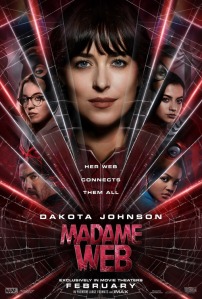 What even is this movie and who is this for? I think the real answer is to help Sony’s bottom line, but that’s generally the real reason for most studio blockbusters, the opportunity for the parent company to make more money. Sony has the rights to Spider-Man and they’re not going to let those things lapse, and while Marvel is shepherding the Tom Holland-lead Spider-Man franchise, Sony is left to their own devices to build out the Spidey universe with lesser-known solo vehicles meant to launch an interconnected web of Spidey’s rogues gallery. It’s about growing more franchises, and it worked with 2018’s Venom, a favorite Spidey villain with a sizable fan base and benefiting from the goofiness of its execution with Tom Hardy and company. It didn’t work out for Morbius in 2022 because nobody cares about Morbius as a character, just like nobody cares about Kraven the Hunter as a character (coming August 2024!), and just like nobody cares about Madame Web, who wasn’t even a Spidey villain and instead an old blind lady that saw the future. The far majority of Spider-Man villains are only interesting as they relate to Spider-Man, so giving them solo vehicles absent Spider-Man is a game in delayed gratification. Madame Web is the latest in this misguided attempt to create an enriched outer circle of brand extension. It’s a promise of a continuity of superhero movies that will never come to pass. It’s a bland return to early 2000s superhero heroics with some substantial structural flaws to its own tangled web.
Cassandra “Cassie” Web (Dakota Johnson) is an EMT in New York City and frustrated by her humdrum life until after an accident she starts seeing the future. You see her mother was researching spiders in the Amazon before she died, and she was researching them with Ezekiel Sims (Tahar Rahim) who killed her because he needed a special spider with special properties. Her dying mother gave birth to Cassie thanks to some… mystical Amazonian spider-people? It’s rather confusing but so are Cassie’s visions. A trio of young students (Sydney Sweeney, Isabela Merced, Celeste O’Connor) is in danger of being killed by a 30-years-older Ezekiel, so she takes it upon herself to save them, as they one day will become Spider-laden superheroes themselves. This Ezekiel, however, has super strength, agility, and the ability to walk on walls, so overcoming a Spider…man’s abilities might be too much for one EMT driver/psychic.
 This movie is more Final Destination or That’s So Raven than a big superhero adventure, and that leads to lots of structural and narrative repetition. Cassie’s power involves her getting glimpses of the future, generally warnings of things to avoid or to intervene. It also makes for a very annoying structure because the movie never gives you clues about what is a vision and what is the real timeline of events. This leads to many repetitions of scenes and fake-outs, and after a while the story feels like it’s mostly jerking you around as well as treading in place. We don’t really know why these flashes happen and what larger meaning they may have. They just happen because the plot needs them to, and so they do. Early on, Cassie gets a vision of a bird flying into her window, and she chooses to open the window, signifying that she can avoid these fates. Why couldn’t Ezekiel Sims think likewise? He’s devoted his whole life to killing these mysterious girls because they’re destined to murder him, but if he’s known for years, why not strike when these girls were younger and more vulnerable, Skynet-style? Or maybe try just not being evil too? I guess that one was too difficult for him as he’s cryptically profited off his Amazon spider steal. More work needed to go into the story to make these characters important and for the fake-out scenes to feel more like horror double-takes. It just gets tiring, and you’ll likely start second-guessing anything of import is merely a vision about to rip away the consequences.
I think a big problem is our protagonist. She’s just so boring and we don’t really understand why she’s so compelled to save these three girls more than anyone else. Her entire back-story with her mother is merely the setup for how she might have super magic powers to kick in at a convenient yet unknown combination of elements and to provide motivation why she might want to kill Ezekiel. It’s all so rudimentary and mechanical, designed just to supply enough connective tissue of plot. As an EMT, finding out how to better save lives could be really useful, although I wish the movie had the gall to make her disdainful of her job beforehand and actively bad at saving lives so that way it would feel like the universe was interjecting and saying, “Here, be better.” You would think if she’s trying to prevent death, and especially the deaths of the people she knows, that it might kick in for her to warn a couple Spider-Man-related characters of note (more on this later). Instead, the Spidey girls have an extended moment learning CPR that feels forever and then tell Cassie, “Wow, you’re a really good teacher” after a rather unimpressive learning session with a motel room pillow. This character just isn’t that interesting even with her new psychic vision powers.
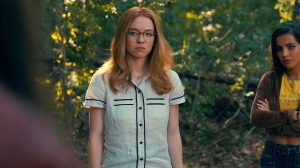 The Spidey girls are also rather uninteresting and given one note of characterization. One of them likes science. One of them has a skateboard and… attitude. One of them is Hispanic. I may have even confused about the characterization, that is how meaningless these characters are. They’re simply a glorified escort mission, a challenge for Cassie to simply keep alive. The scene where they stumble into a brightly lit diner in the middle of nowhere, after Cassie saved their lives and warned them to lay low for their own self-preservation, is immensely irritating. They take it upon themselves to stand on a table of letter jacket-wearing jocks and dance because that’s laying low. They’re annoying characters that never convince you why Cassie should go through such valiant efforts to keep alive. The flashes of them in Spider costumes are only brief glimpses of a possible future, one I can guarantee we’ll never see coming to fruition in this discarded universe.
The strained efforts to transform Madame Web into a disjointed Spider-Man prequel are distracting and generally annoying. It also reveals the doubts the studio had that anyone would be interested in a Madame Web story without additional connections to Peter Parker. Why do we need to have a pregnant Mary Parker (Emma Roberts) in this movie? Why does the climax also involve her giving birth? Are audiences going to wonder whether or not Peter Parker might be born? There’s also the prominent role of Uncle Ben Parker (Adam Scott) as Cassie’s EMT partner. He’s practically the third-leading character. The movie makes several ham-handed meta references about his eventual role in crafting Spider-Man’s development (I also guess he gets to marry Marissa Tomei, so good for you). “Ben can’t wait to be an uncle,” one person says, with, “All of the fun and none of the responsibility.” They might as well just turn to the camera and point-blankly state, “This man will eventually die and inspire Peter Parker to be a hero.” The worst moment of all this forced connectivity is when Mary demurs on picking a name and says she’ll determine when he’s born, even though the film has a “guess the name” baby shower game. Does this mean she saw her newborn babe and the first thing she thought was… Peter? The entire Spider-Man lineage feels so tacked-on and superfluous as glorified Easter eggs.
 I’m generally agnostic when it comes to product placement in movies. People got to eat and drink and drive cars, and as long as it’s not obnoxious, then so be it. However, the product placement needs to be mentioned in Madame Web for its narrative prominence, and this leads to some spoiler discussion but I’d advise you read anyway, dear reader, because this movie is practically spoiler-proof by its very conception. Ezekiel Sims is battling Cass and the Spider girls atop a large warehouse with a giant Pepsi sign built onto scaffolding. Then the engineer of Ezekiel’s doom is none other than the falling “S” from Pepsi. That’s right, the villain is dispatched through the help of Pepsi, as well as a literal sign falling from above (cue: eye-roll). Without the assistance from Pepsi (or “Pep_I”), these women might not have lived. You can’t expect that kind of divine intervention from any other cola company. Coke was probably secretly working with the villain, giving him aid and comfort from being parched (begun these Cola Wars have). Deus ex Pepsi. It’s just so egregious and in-your-face that I laughed out loud. Is it also a reference to the original Final Destination ending or am I myself reading the signs too closely?
For those hoping for a so-bad-it’s-good entertainment factor, I found Madame Web to be more dreary, bland, and confusing than unintentionally hilarious. Johnson is an actress I’ve grown to enjoy in efforts like Cha Cha Real Smooth and The Peanut Butter Falcon, also the much-derided but still enjoyable Netflix Persuasion, but she sleepwalks through this movie. I don’t blame her. I don’t blame any of the actors (poor Rahim’s performance seems entirely replaced by bad ADR lines). The character’s nonchalance already zaps the low stakes of a movie where a psychic character we don’t really have fond feelings over is trying to save a trio of annoying teenagers before a vague hodgepodge of a villain succeeds in killing them before they can kill him, which means they all need to kill him before he can kill them before they are destined to kill him. No wonder the executives decided to crassly cram in some Spider-Man relatives to make people care. Madame Web is less a bad movie and more a poorly executed and confused movie, one that doesn’t understand the desires of its intended audience. It’s barely even a superhero action movie, with few scenes of elevated action, though the director enjoys her ceiling perspective flips. There’s a moment where our villain flat-out says, “You can’t do [a thing],” and literally seconds later, through no setup or explanation, suddenly Cassie can do [that thing]. The whole movie feels like this moment, arbitrary and contrived and desperately reaching for an identity of its own. It should have stayed in the Amazon researching spiders before it was destined to die.
Nate’s Grade: C
Share this:

Night Swim (2024)
 It feels like the genesis of Night Swim was somebody saying, “We need a new way to do a haunted house movie so… what if…?” and then just pointed to different parts of the home and questioned whether it could be haunted. What I’m saying is we were probably a coin flip away from a terrifying tale of a haunted barbecue grill (working title: Dead Meat). A haunted pool would naturally lead to the question, “Well, why don’t you stay out of the pool?” and, well, we don’t really have an answer, so the pool can’t do too much because it’s immobile. There’s a possibility here with some spirit linked to the pool water seeking sacrifices and offering rewards in return, but this is downplayed so much and eventually forgotten during the muddied reasoning that concludes this confusing movie. I don’t think the film can even stick to its own rules. It needs to be either goofier, fully embracing its ridiculous premise of a haunted swimming pool, or going even darker and deeper with its back-story and rules and how this corrupts the new family, not because of some evil possession but from the simple wish-granting opportunity of feeding this monster for personal gain. There’s a way to make this concept work, specifically bringing the revelation earlier and dealing with the devil’s bargain implications and moral relativism. Alas, instead we get a movie about a husband being possessed by evil spring spirits and literally playing a game of Marco Polo with his children and, upon stalking them, pounces by ominously shouting, “You’re supposed to say ‘Polo’!” Just keep swimming, folks.
Nate’s Grade: C
Share this:

Anatomy of a Fall (2023)

I was so looking forward to watching the French drama Anatomy of a Fall, nominated for five Oscars including Best Picture and Best Director for Justine Triet, that I had to track down the publicity department for Neon Studios and hound them to finally get my annual Neon screener box-set for critics. It took several weeks, and email chains, but thankfully the good folks at Neon supplied me with their screener box, like Christmas morning for a film critic. The surprise Oscar nominations only made me more eager to finally watch this movie. As Anatomy of a Fall played, and the criminal case became ever more complicated, shedding further light upon the characters and their stormy marriage, I found myself sitting closer and closer to my TV, finally sitting on the floor right in front of it. Part of this can be explained by trying to better read the subtitles, though truthfully half of the movie is in English, but the real reason was that I became absorbed, waiting anxiously to see where it could go next, what twist and turn would further reassess our fragile understanding of the events, the people, and the possible circumstances. The original screenplay is so thoroughly engaging, and with supremely talented acting and clever directing, that I knew I was in good hands to ensure my investment of 140 minutes wouldn’t be wasted.
Popular novelist Sandra Voyter (Sandra Huller) is talking with a female reporter about her process as they lounge in her home. They’re drinking, laughing, and then the loud sounds of a steel drum start echoing from upstairs, thanks to Sandra’s husband, Samuel (Samuel Maleski), who puts the song on repeat. He’s passive aggressively sabotaging the interview, and Sandra bids goodbye to the interviewer. Hours later Samuel is found on the ground outside with blood seeping from a head wound. The attic window is open, the same attic he was remodeling before presumably falling to his death. Did he take his own life or was foul play involved? Did Sandra actually kill her husband?

At its core, the movie is an anatomy of a criminal investigation, a prosecution and the personal defense, but it’s really an anatomy of people and the versions of themselves that they selectively present to others and themselves. It’s an old maxim that you can never know what’s going on inside a marriage, or really any relationship, as the inner reality is far more complex than what is easy to digest and categorize by the public. It’s not new to hide aspects of ourselves from wider scrutiny and consumption. It also isn’t new for a larger public profile to invite speculation from online busybodies who think they are entitled to know more. The mystery about whether or not Sandra is guilty or a cruel victim of suspicious circumstance is a question that Triet values, but clearly she values other more personal mysteries more, chiefly the mystery of our understanding of people and why they may choose to do inexplicable acts. How close can we ever really know a person? The upending of her life pushes Sandra to re-examine her own marriage in such a high stakes crucible that can determine whether or not she spends the rest of her life in jail. Under those extreme circumstances, the bigger question isn’t how someone may have committed murder, or taken their life, but the unexamined why of it all that nibbles away at Sandra as well as our collective consciousness as viewers. To me, that’s a more compelling and worthwhile mystery to explore than whether or not it was a murder or suicide (there is a wild theory finding some traction online blaming the death on the family dog).
I don’t feel it’s a significant spoiler to prepare the viewer to know that Triet keeps to ambiguity to the bitter end, refusing to specify what actually happened to Samuel. It’s ultimately up to the viewer to determine whether they think Sandra is guilty or innocent, and there’s enough room to have a debate with your friends and Francophile colleagues. I’ll profess that I found myself on the Team Sandra bandwagon and fully believed she was being railroaded by the French judicial system and press. The righteous anger I felt on behalf of this woman rose to volcanic levels, as it felt like much of the French prosecution’s line of questioning and theorizing was mired in blatant eye-rolling misogyny and conjecture. They insist that because Sandra is bisexual that she must have been flirting with her female interviewer on the day of Samuel’s death, because that’s how it works for bisexuals, obviously, to only be able to size every person they meet, no matter whatever anodyne circumstances, as some possible or inevitable sexual conquest. As an outsider to the French judicial system, I was intrigued just by how the trials are conducted, which seems far less formal despite the wigs and robes, where the accused can interrupt anytime to deliver speeches and question experts. I also appreciated how much attention Sandra’s family friend and defense attorney puts into helping her shape her image, to the press, to the court, to the judge, down to her perspective of her marriage to her vocabulary choices. Rather than be a reflection of Sandra as coolly calculated, I viewed it as learning to prepare for the dangers ahead. It reminded me of Gone Girl with the media-savvy lawyer coaching his high-profile client through their trouble.
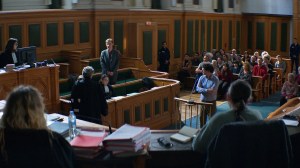
Of course, there are larger implications with this prosecution. Sandra isn’t just on trial for suspicion of killing her husband to clear the way for her next lover, she’s the victim of all the ways that women are judged and found guilty by society. Sandra is a successful novelist, the top provider, and her husband isn’t, and it eats away at him, festering resentment that she is somehow stifling his own creative dreams. Is she giving him space or being distant? Is she doing enough or too little? Is she a supportive spouse or selfish? Is she a good mom or a bad mom? Is she allowed an independent life or should she be fully devoted to the titles of mom and wife? It’s the struggle to fit into everyone’s impossible and conflicting definition of what makes an acceptable woman and mother, and it’s infuriating to watch (think America Ferrera’s Barbie speech but as a movie). It’s also an indication of the cultural true crime obsession and turning people’s complicated identities and nuanced relationships into easy-to-digest fodder for morbid entertainment. It’s not like there’s some grand speech that positions Sandra as the martyr for all of embattled womanhood, but through her trial and media scrutiny, these social issues are projected onto her like a case study.
As much as I loved Lily Gladstone and Emma Stone in their respective performances in 2023, at this point I’d gladly give the Best Actress Oscar to Huller (The Zone of Interest). First off, she delivers a tremendous performance in three separate languages, as her character is a native German who marries a Frenchman and then they agree to speak in English as their linguistic “middle ground,” a language that isn’t native to either of them. Huller slips into her character seamlessly and it’s thrilling to watch her assert herself, press against the bad faith assumptions of others. One of the highlights of the movie is the most extended flashback where we witness the simmering resentment of this marriage come fully to force, and while it’s unclear whether this moment, as the other occasional flashbacks, is meant to be conveyed as Sandra’s subjective memory or objective reality, it serves as a mini-climax for the story. It’s here where Sandra pushes back against her husband’s self-pitying criticisms and projections. It’s a well-written, highly satisfying “Amen, sister” moment, and Huller crushes it and him. There were moments where I was in awe of Huller that I had to simply whistle to myself and remark how this woman is really good at acting. With such juicy material and layers to sift through, Huller astounds.

Another actor worth celebrating is Milo Machado-Graner (Waiting for Bojangles) as the couple’s only child Daniel, a young boy who is partially blind because of an earlier accident from Samuel’s negligence and the one who discovers his dad’s body. This kid becomes our entry point into the history of this marriage but it also turns on his perceptions of his parents, as Sandra is worried over the course of the trial that Daniel will learn aspects of their marriage that she was trying to shield from him, and he may never be able to see his father and mother the same way again. It’s a rude awakening for him, and key parts of the trial rest upon a child’s shaky memory, adding intense pressure onto a hurting little boy. There’s a key flashback that will change the direction of the case, but again Triet doesn’t specify whether this is Daniel’s memory, Daniel’s distorted memory looking for answers whereupon there might not be any, or the objective reality of what happened and what was said. Machado-Graner delivers a performance that is built upon such fragility that my heart sank for him. It’s a far more natural performance free of histrionics and easy exaggerations, making the response to such trying events all the more devastating.
Anatomy of a Fall was not selected by its home country for consideration for the Academy’s Best International Film competition despite winning the Palme D’Or, the top prize, at the prestigious Cannes Film Festival. Not to take anything away from 2023’s The Taste of Things, a French drama I’ve heard only fabulous responses, but clearly they picked the wrong contender and lost a winnable race. Do you know the last time France won the Oscar for Best Foreign/International Film? You have to go all the way back to 1991’s Indochine, a movie about the history of France’s colonial occupation of Vietnam. For a nation known for its rich history of cinema, it’s now been over thirty years since one of their own movies won the top international prize at the Academy. Oh well, there’s always next year, France. It’s truly befuddling because Anatomy of a Fall is such an easily accessible movie that draws you in and reveals itself with more tantalizing questions. It has supremely accomplished acting, directing, and writing. Anatomy of a Fall is a spellbinding, twisty movie and one of the absolute best films of 2023, in any language.
Nate’s Grade: A
Share this:

Argylle (2024)
 Knocked around by critics and tagged as the latest excuse for the Death of Filmmaking thanks to its overwhelming budget and general ironic indifference, Argylle is a goofy spy comedy that, while lesser, is an easy watch and would earn regular rotation as a TNT afternoon giant. It’s not trying to be more than a good time, and while its quippy attitude can feel forced and approaching irony overload, it’s also the kind of movie that entertains as breezy escapism. It’s fun. Enough.
Elly Conway (Bryce Dallas Howard) is a best-selling spy novelist with a dashing super spy Lothario lead character by the name of Argylle (Henry Cavill in the worst haircut of his career). She’s journeying with her pet cat, her closest relationship, when she’s stopped on a train by Aidan Wilde (Sam Rockwell). He tells her that he’s a real spy and that everything she’s written in her five novels has come true, and different covert agencies are taking notice. She’s got teams of assassins and spies coming for her, while Aidan tries his best to protect her and get her to remember key details that could save the world from nefarious forces.
 Argylle is too breezy and too predictable by half. It’s a spy thriller that I’m positive many will be able to predict the big twists miles before they occur. Why do all these spies want Elly Conway, and how could she know about the intricate world of international spy craft? The answer is exactly what you’d expect, if you’ve watched more than your share of twist-laden thrillers. Thankfully, director Matthew Vaughn (Kingsman, X-Men: First Class) and company dispatch with this central twist after an hour, providing more time to deal with the aftermath and build off of its story impact. Ah, dear reader, but there’s going to be another twist once you know the first, and again, if you can predict the first, you’re likely to predict the second, because stories about universally good people are often dull, and movies have provided a new medical maxim that characters use maladies to re-evaluate their prior life and choose to be better (oh how nimbly I’m dancing around these spoilers). What makes these predictions forgivable is that the movie seems to know you will anticipate them and has more to offer.
That’s because in this silly universe, very little seems to matter besides getting to the next scene. It’s not a satirical send-up of the genre like Vaughn’s Kingsman movies. Instead, it’s more of a generic distillation of spy thrillers, complete with bad guys walking through mission control banks of computers and barking impotent orders. The only added cleverness that sets the Argylle world apart is Elly’s writing, the fictional version of this far more bland spy universe. In the book parts, Vaughn takes note to raise the style as well as the tongue-in-cheek comedy. It’s supposed to be tone-deaf and dumb and ridiculous, because it’s the big screen version of bad genre writing. You can have fun with that, with characters so serious to the point of parody, with nonsensical technology and near escapes. But when you try to do the same thing in the so-called real world, then the movie starts to eradicate any sense of a baseline for credulity. I did like the practical advice of Aidan on how to crush the skulls of your downed enemy (“Just imagine you’re dancing The Twist.. twist and smash”). By the end of Argylle, Elly and Aidan can do just about anything because they’re practically superheroes. The entertainment of the fish-out-of-water aspect of Elly’s story is short-lived and unfulfilled because the movie becomes more of a tale of automatic self-actualization rather than growth.
 The direction feels rather drab at points, and many locations and scenes have a general sense of missing… something. Just watch any set and it appears so drastically empty that I questioned whether they cut back on the set dressers and props. Empty dance clubs. Empty streets. Empty hallways. Everything is too pristine, too sleek, and too empty and green screened (might be a result of COVID filmmaking). This carries over into the disappointing visual aesthetic, as Vaughn’s signature style feels dampened by the pesky CGI additions of many sequences, adding to the unreality rather than building out this minimalist world. If there had been an extra EXTRA twist that everything was also a story-within-a-spy-story, I would not have been that shocked, and it honestly would have explained the underwritten and underwhelming world of clandestine spy-making.
Vaughn errs in the core creative decision of having his main character mix reality and fantasy, not through the idea itself, which could be ripe, but through its confusing execution and editing. Having Elly hallucinate Agent Argylle in place of a real secret agent is fine, as we can contrast from her idealized version of a super spy, her James Bond, versus the actual grunts struggling to win the day. There are a couple problems with this execution though and firstly that the “reality” isn’t that far removed from the fantasy. This is still a world where Rockwell’s spy is able to commit amazing acts of dexterity and martial arts and balletic violence flying around rooms, but I guess he falls down more. The difference isn’t that fantastic when it’s already a hyper-stylized action world. The bigger issue is just how confusing it all plays out visually because we’re seeing Elly’s perspective and in rapid blinks Cavill will turn into Rockwell and vice versa. It makes for a jarring sequence that doesn’t fully capitalize on the comic potential while keeping the audience distant from fully engaging with the sheer simple pleasures of watching a fun fight. This happens throughout the first half of the movie and severely hampers the action scenes from being accessible. I think we needed a longer duration for this to work. We see Elly’s version for a period of time, and then we cut to the real world where Aidan is bouncing into walls, falling down, and flailing. By continuously jumping back and forth, not just in the scenes but in the same shots, Vaughn has made his movie harder to watch and harder to comprehend, and with a loud soundtrack blaring.
 There is one sequence of great filmmaking for Vaughn, but to explain such will require some spoilers, so beware, dear reader. There are three instances of the whirly-bird dance where a woman is lifted spread-eagle atop a man’s shoulders who then spins her around. The first time, it’s Agent Argylle and Legrange, played by Dua Lipa (Barbie) dripping with sexual energy. The second time is when Elly and Aidan are on a mission and he lifts her up, to her amusement and flirtation. She’s living out her fantasy version, with Rockwell standing in for Cavill and Howard standing in for Dua Lipa. We’ve gone from these stunningly attractive human specimens to people who look more ordinary, including a fuller figured woman engaging in the same sexy shenanigans as the conventional blonde bombshell. She can be her dream version of herself. Finally, the third occurrence happens during a climactic showdown where Elly and Aidan team up against an onslaught of faceless armed henchmen. With the aid of colorful smoke canisters, their offensive surge plays out like a couples’ dance routine, including holding one another for high kicks to incendiary devices. It’s all set to Leona Lewis’ cover of Snow Patrol’s “Run,” and as the music swells, it’s easy to get swept up too. Even the gunshots are set to the beats of the song, culminating in the final whirly-bird dance, except it’s not Elly being lifted, this time it’s Aidan. See, she’s not the Bond girl bombshell, she’s James Bond. It’s a silly moment but with the added setup, thematic underpinnings, and Vaughn’s virtuoso stylistic seizing of the moment, it plays out as empowerment and an expression of love. For real.
I can understand being generally disappointed with Argylle. It looks and feels like it’s been built on the parts of other better spy franchises and desperately lacks the charisma and personality of Vaughn’s Kingsman movies, themselves giddy and perverse satires. I wasn’t the biggest fan of 2017’s The Golden Circle sequel, but it’s got oodles of style to spare compared with Argylle. I wish Vaughn would push himself beyond the orbit of making cheeky, winky spy action comedies, the same genre he’s been playing in since 2015 and now for four movies. While the original Kingsman was a breath of fresh air with fun characters, a snarky attitude, and slick style, Argylle is all snark and minimal style. There’s so much comedy that feels like it should be funnier, from the travails of Elly’s CGI-enchanced cat to the floundering hand-to-hand combat. When recognizable names start showing up playing forgettable genre stock types, and then they start dabbling in accents as other genre stock types, it feels like the whole exercise is a miss. However, the central buddy relationship between Rockwell and Howard is where the movie works, and fortunately that’s the element that has the most foundational effort. This is a movie that, in the future, if it was on TV during a lazy day, you’d sit down and watch the rest and mostly be happy about it. Argylle isn’t anything new or fresh but it’s buoyed by its stars, and not the magazine cover models but its real stars, Rockwell and Howard. In their hands, even lesser spy comedies can still be fairly worthwhile escapist entertainment. Still, I must deduct some points for the movie missing a perfectly setup opportunity to have Henry Cavill and John Cena kiss onscreen at the end. It was right there, folks, and we all deserved it.
Nate’s Grade: C+
Share this:

It Lives Inside (2023)
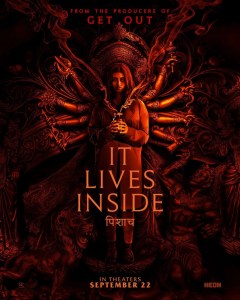 It’s a horror movie as examination on assimilation from an Indian-American standpoint and giving a different culture its own big screen boogeyman. It Lives Inside is about Samidha, a teenage Indian-American girl trying to fit in her suburban high school, which often involves her downplaying or abandoning her cultural roots and practices. She’s all but abandoned her childhood friend Tamira as an impediment to her social acceptance by the cool Caucasian kids. She then feels even more guilt when her friend goes missing and might be possessed by a demon of Hindu lore that feeds off negative energy (no wonder it’s targeting high school girls). This is the latest movie that uses the vehicle of horror to examine more personal themes, bringing a specific culture into the forefront and allowing wider audiences to learn from the horrors of trying to fit in when you feel different and ashamed for being different. As Samidha searches for her missing friend, she’s also forced to seek out help from her disapproving and more conservative mother, a woman steeped in her heritage. Where the movie left me wanting was in the exploration of its specific mythology as well as the development of the divide between mother and first-generation daughter. That’s the core of what can make this movie special, and yet what we get are more scenes of jump scare PG-13 terror and canoodling. It’s not a terribly scary movie, though the eventual creature design has some nicely unsettling angles. There’s one moment of hair floating that really unnerved me, but most of the movie falls on generic atmosphere effects. There are so many sequences of one high school English teacher working alone in the school (where is anyone else? Does this woman do nothing else?) and running through corridors as lights flicker and sinister sounds linger. By the end, It Lives Inside is an acceptable horror movie that would have benefited from spending more of its time on the perosnal elements that would have made it stand out rather than fit in with the horror crowd.
Nate’s Grade: B-


 nathanzoebl
You must be logged in to post a comment.