Daily Archives: December 23, 2021
Vanilla Sky (2001) [Review Re-View]
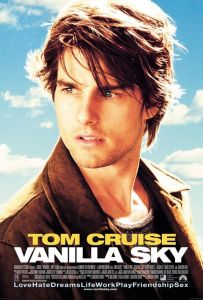 Originally released December 14, 2001:
Talk about a film’s back story. Tom Cruise signed on to do a remake of the 1997 Spanish film Abre Los Ojos (Open Your Eyes) which was directed by Alejandro Amenabar. During the filming the romance between Cruise and Penelope Cruz (no relation) got a little hotter than expected onscreen and broke up his long-standing marriage to Nicole Kidman. At the time she was finishing filming The Others which is the second film by Amenabar. This, by the way, is much more interesting than Vanilla Sky unfortunately.
Cameron Crowe’s remake starts off promising enough with Tom Cruise running around an empty Times Square like a Twilight Zone episode. Afterwards the film begins to create a story that collapses under its own weight. David (Cruise) is a rich boy in control of a publishing empire inherited through his dear old deceased dad. He has the time to throw huge parties where even Spielberg hugs him, and even have crazy sex with crazy Cameron Diaz, whom he tells his best friend (Jason Lee) is his “f*** buddy.” David begins to see a softer side of life with the entrance of bouncy and lively Sophia (Cruz) and contemplates that he might be really falling in love for the first time. But this happiness doesn’t last long as jealous Diaz picks up David in her car then speeds it off a bridge killing her. Then things get sticky including David’s disfiguration, his attempts to regain that one night of budding love and a supposed murder that he committed.
 Crowe is in over his head with this territory. His knack for wonderful exchanges of dialogue and the perfect song to place over a scene are intact, but cannot help him with this mess. Vanilla Sky is an awkward mish-mash of science fiction. The film’s protagonist is standoffish for an audience and many of the story’s so-called resolutions toward the end are more perfunctory than functional. The ending as a whole is dissatisfying and unimaginative. By the time the wonderful Tilda Swinton shows up you’ll likely either be asleep or ready to press the eject button yelling “cop out!”
Seeing Vanilla Sky has made me want to hunt for Amenabar’s Abre Los Ojos and see what all the hype was about, because if it is anything like its glossy American counterpart then I have no idea why world audiences went wild for it.
Nate’s Grade: C
——————————————————
WRITER REFLECTIONS 20 YEARS LATER
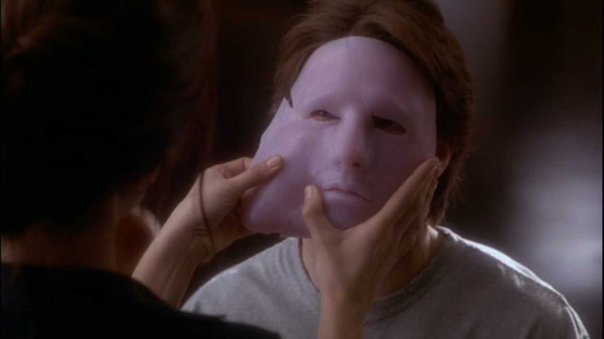
Movies have long resorted to being interactive puzzles, inviting audiences to unravel the mystery and hunt for clues as detectives. That’s essentially what Vanilla Sky is at its best, a messy mishmash of a movie that aims a little too high and pins its hopes with a generally unlikeable lead. This psychodrama is meant for dissection, not in a dreamy, obtuse way that David Lynch films invite but more in a canny re-calibration of pop-culture homages and fantasies. The big twist of the movie is that David (Tom Cruise), a rich publishing scion recovering from a savage accident, has elected to live in a simulation, a lucid dream that has been his home for the last hundred-plus years (how kind of the multiple generations of knob-turners to keep things operating). Other stories have followed a similar Twilight Zone-esque twist on the same territory, including the beloved “San Junipero” episode of Black Mirror (that’s right, spoilers, spoilers all around for older sci-fi). Writer/director Cameron Crowe has stated there are over 400 pop-culture connections and references to be had with this movie. The movie is wall-to-wall cultivated jams, as expected from a Crowe picture, but the homages and recreations go beyond simply placing a piece of music to a scene or name dropping an artist. The visual language of the movie is intended to be deconstructed, built upon twentieth-century album covers, music, movies, and plenty more. It’s a dense artistic gamble and, ultimately, I question who is even going to care enough to dive into this movie? Who is going to want to watch Vanilla Sky as a detective?
 This American remake of a 1997 Spanish movie was, in hindsight, the beginning of the end of Crowe’s career as a major director of studio movies for adults. Crowe had just experienced the apex of his career with 2000’s luminescent Almost Famous, a warm hug of a movie, and he had won the Oscar for Best Original Screenplay. It makes sense to try for something big, reunite with his Jerry Maguire star, and go outside his comfort zone with a wide artistic berth of freedom. The 2001 movie just did not work, though not strictly because of Crowe’s game efforts. This is not a miscalculated folly, an artist flying too close to the sun and getting burnt by their arrogance. I think the major flaw comes down to pinning the mystery on the recovery of the romantic and social life of a disagreeable lead character. Early on, David is established as rich, careless, and smug. He keeps his responsibilities as fleeting as his relationships with women. When his on-again-off-again paramour, Julie (Cameron Diaz), drives off a bridge with David inside, part of you might be thinking he deserves what he got for being so callously indifferent with other people. That’s harsh, I realize, but people will not like David, and this is amplified by the general public’s diastase for Cruise himself. Therefore, watching a movie where he tries to overcome him disfigurement and disability and stop being a jerk to everyone in his life is not a journey that invites the viewer to come aboard. He’s just not that interesting as our centerpiece. What’s happening to him can prove interesting, especially as the movie plays with our mind, but at no point will the extended pity party for poor rich David feel compelling as its own drama.
This is the problem with movies that are built around Big Twists: limited replay value. After you know the super twist, very often these movies fail to justify another two-hour investment. Take for instance 1997’s The Game, the forgotten David Fincher movie. It’s a thriller where Michael Douglas is on the run and doesn’t know who is responsible for chasing him. Then the movie says, “Surprise, it’s [blank],” and then it ends. Not every twist unlocks a new and exciting prism of how to view the preceding hours, like a Sixth Sense or Fight Club. Most movies built upon a big reveal as their conclusion tend to deflate immediately. There’s no real reason to watch The Game a second time if you already know what is happening. There’s no real reason to watch 2003’s Identity again once you know all the ridiculous secrets. There’s no real reason to watch Vanilla Sky once you know the explanation for all the strange little hiccups along David’s fraying mental state.
 Look, tons of movies are built around extended mysteries, from Agatha Christie to Knives Out, but the pleasure goes beyond simply solving of the puzzle. It’s the characters, the red herrings, the inspectors or detectives or chief solver of mystery. There is more there for entertainment. With Vanilla Sky, what we’re left with is a lackluster romance of a former pretty boy moping over his slightly adjusted privilege. It’s not like David’s character arc is illuminating or insightful. It’s not like we’re watching the battle over his soul here. He’s just kind of an affable jerk, and then David becomes a scarred jerk, and then he decides to wake up and be a jerk in real life. Progress?
There is a discussion to be had about how much of the movie is a dream, or where real life ends and the dream begins, and apparently even Crowe has determined there are six general interpretations, from the movie’s true and when Tech Support (Noah Taylor) says he switches over is when the dream occurs, to the unfulfilling “it was all a dream” interpretation. I suppose this could be fun for others but again I don’t think there are enough enjoyable components in the movie to incentivize the debate.
In some ways, this is one of Cruise’s most vain-free performances, yet there is an undercurrent that only seems even more vain. First the obvious; he plays a womanizer who also wears a mask for half of the movie to cover his scarred Phantom of the Opera visage. There’s a lack of vanity playing an annoying, arrogant, unpleasant person, something Cruise has done before and quite well, especially in his extraordinary Oscar-nominated turn in 1999’s Magnolia. He’s even played characters with physical disabilities before, like 1989’s Born on the Fourth of July. However, this “lack of vanity” really plays out as a vain attempt to be even more impressive as a respected thespian. The movie was positioned for a mid-December release, and with Crowe and Cruise on board, it seemed like a legitimate awards contender, until that is it opened wide. While Cruise’s performance is fine, his time under the mask doesn’t proverbially unmask his character for our better consumption.
 Vanilla Sky is mostly known as the big American debut of Penelope Cruz. She was already a muse for Spanish director Pedro Almodóvar and known well in the indie circuit, but from here she became Hollywood’s newest It Girl, only to be stranded in mediocre studio movie after mediocre studio movie (Does anyone remember Captain Corelli’s Mandolin?). It wasn’t until Almodóvar’s 2006 film Volver that studio execs seemed to finally understand how best to utilize her great talent. She won an Oscar for 2008’s Vicky Christina Barcelona and was nominated the following year for the musical Nine. She recently reunited with Almodóvar for 2021’s Parallel Mothers and again is wowing audiences. From early on, she definitely has a spark, an effervescence to her performance in Vanilla Sky. She’s also fighting against being forcibly elbowed into the swampy Manic Pixie Dream Girl category, a term that was originally coined for Crowe’s follow-up film, 2005’s Elizabethtown. Crowe loves writing women under these quirky conditions, however, the movie is told from a flawed male dream perspective, so it also makes sense if its portrayal of David’s idyllic dream woman happens to flatten her down.
It’s true that the story behind the scenes of Vanilla Sky proves more intriguing than the film itself. Cruise and Nicole Kidman were the Hollywood power couple. The ensuing tabloid feeding frenzy over their breakup and Cruise/Cruz relationship outlived the legacy of Vanilla Sky. This was the most ambitious and experimental movie in Crowe’s tenure as a writer/director, and he would never again return to science-fiction as a genre, keeping to the familiar lane of prestige dramas declining in prestige with each new film. My original review in the closing weeks of 2001 was pretty minimal in analysis. I knew this movie didn’t quite work then and it still doesn’t work now. If you’re eager for a dissertation-level analysis on its pop-culture fantasia, then God’s speed to you and your infinite free time.
Re-View Grade: C
Share this:

The Matrix Resurrections (2021)
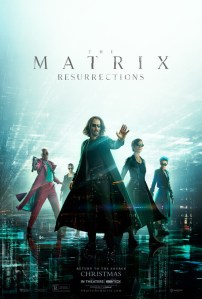 It is hard to overstate how influential The Matrix was upon its release in 1999. It rewrote the science fiction and action genres for Hollywood and introduced American audiences to many of the filmmaking techniques of Eastern cinema. It was exciting, philosophical, challenging, and made an instant brand out of the Wachowskis, the writing/directing siblings who had previously only directed one indie movie. The 2003 sequels were filmed back-to-back and released to great anticipatory fanfare and then, later, derision. The Matrix sequels, Reloaded and Revolutions, became a shorthand joke for bloated artistic miscalculation. They were talky, draggy, and just not what fans were hoping for jacking back into this strange world, and years later I think they’re worth a critical re-evaluation. Flash forward to 2021, and Lana Wachowski has resurrected The Matrix, and with the original actors for Neo and Trinity, both of whom died in Revolutions. Why go back? I think part of this was the declining career of the Wachowskis as directors. I personally loved 2012’s Cloud Atlas but it was an expensive and messy money-loser, the same as 2008’s Speed Racer and 2015’s Jupiter Ascending, a cosmically bad movie. So now it’s back to The Matrix with an older Neo, and older Trinity, and more of the same by design. The Matrix Resurrections just made me sad. It’s a movie that feels resentful for its own inception.
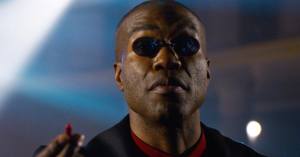
Thomas Anderson/Neo (Reeves) is living out his life as an award-winning game designer. His company and business partner, Smith (Jonathan Groff), are looking for their next big hit, and they’re looking backwards at Anderson’s biggest success… the “Matrix trilogy.” It was a virtual reality program that skewered the difference between reality and fiction. Mr. Anderson might have even based the role of Trinity on Tiffany (Carrie Anne-Moss), a woman he has grown infatuated with over time at a coffee shop. Except Mr. Anderson is having trouble determining what is real and what is only in his head. That’s because a new, younger Morpheus (Yahya Abdul-Mateen II) is telling him that he’s Neo, that he’s destined for greater things, and that he’s been kept in an unorthodox prison to keep him out of the action. Everyone seems interested in reactivating Neo, but for what purpose, and what has happened in the ensuing decades since the end of the war with the machines?
 Part of my struggle with Resurrections is that it too is struggling with its own existence, and not in a meta-textual sort of identity crisis, more like a reason to carry on 18 years later. Fair warning, this movie is far, far more meta than you are anticipating. The entire first hour of the movie features characters justifying rebooting “The Matrix,” the game. It’s a movie where characters glibly talk about parent companies going forward with the IP with or without the involvement of the original creators, so better to be the one trying to staunch the bleeding I suppose. A character literally says Warner Brothers wants a new Matrix and they will not stop until they get one. There are characters that sit around a table and try and break down what made the original Matrix (the game) so cutting-edge, and every person has a different brand slogan. “It was edgy.” “It blew your mind.” “It was a thinking man’s action story.” This prolonged section of Resurrections feels entirely like Wachowski speaking directly to her audience and saying, “Look, I had no reason to be back here. They forced my hand, and I want you to know that I’m not happy about it.” There are literal moments from the 1999 film that are presented as if the characters in the matrix are watching The Matrix to recreate scenes like avid cosplayers. There is one part where a character just starts screaming the word “reboot” with profane intention, promising to get their own spinoff as a threat. The entertainment industry satire about reboots and cash-grab sequels is funny but misplaced and coming from a perspective of defiance. If this was all the movie was then it would have been a fascinating example of an artist burning the bridge to their most successful franchise out of willful spite. However, if we had our own little focus group and asked what made the original Matrix so enjoyable, I doubt anyone would list, “entertainment industry satire and meta humor.”
The Matrix movies are well known for being a smarter, more ambitious viewing experience (“A thinking man’s action story”), blending philosophy and mysticism into anime-style action and kung-fu fights. There’s an intentional repetition here, built upon delivering something familiar and safe to audiences but with a “next gen” feel. We have a new Morpheus and a new Mr. Smith here, but did we require either? When they go through the motions of patterning themselves on characters of old, it feels strained, it feels gassed, and it’s another instance where Wachowski telegraphing to her audience, “Look, the studio demanded I bring back these characters, but I’ll be damned if I know what to do with them.” Morpheus has a little more story leverage as a catalyst for bringing Neo back to his path of enlightenment. Truth be told, I don’t really know half of what was happening in this movie, which lacked the elegant connectivity of the best action movies, linking cause and effect (the Merovingian would be proud of me) and pushing the movie forward to its inevitable conclusion. Even the prior movies felt more like the creators knew what was going on, even if the audience was lagging behind. With Resurrections, it feels like Wachowski and her screenwriters, novelist Dave Mitchell (Cloud Atlas) and Aleksandar Hermon (Sense 8 finale), have just given up trying to make sense of it all.
 Another disappointment is the lack of any signature or memorable action sequences or, in the words of the Matrix round table, moments that “blew your mind.” The use of phones as transport in and out of the matrix has been replaced with mirror portals and doorways, which initially got my hopes up. There are such playful visual possibilities incorporating portals into action (see: Doctor Strange, even Matrix Reloaded), and I felt that Wachowski was up to the imaginative challenge. It too feels like another element that barely registers. The movie takes the anyone-can-become-an-Agent threat of the original trilogy and says, “What if instead of facing deadly Agents, it was just dumb zombies?” The new machines decide to rely upon a hive-mind system of grabbing whatever humans are in the vicinity and taking control of them into mindless foot soldiers. Let’s explore what a downgrade this is. The Agents were dangerous because they had powers that ordinary humans could not hope for, like the bullet dodging. In this movie, ordinary people are easily foiled and often a pathetic excuse for super-powered adversaries. The final act involves an escalation in numbers of the hive mind, but we’ve already been here with the multiple Agents Smiths of the sequels. There is one disturbing change-up where the machines realize how humans can just serve as canon fodder that is dark but a more effective attack. Even the requisite martial arts battles and gravity-defying wire work are humdrum this round.
If there is one thing that Resurrections does well it’s staking its identity out as a romance. Much of the second half prioritizes the relationship between Neo and Trinity, which was always taken for granted in the sequels. It was a romance of more utilitarian purpose, providing Neo with a love interest to motivate him to be saved in times of great peril. With Resurrections, the movie actually takes time to devote to Neo and Trinity as people with desires and what they would find appealing about the other. He’s not the savior of mankind, and she’s not his gateway to knowledge and empowerment. They’re portrayed as people, somewhat unhappy in their lives, and just hoping they might have another chance meeting at their shared coffee shop for one more electrifying conversation. The evolution of the movie places even more importance on this human connection, so I’m glad time has finally been given to exploring what it is that connects Trinity and Neo, especially if their love story is going to play as prominent a resolution to Resurrections. If you have never cared about Trinity and Neo as a couple, then you’ll likely be in for a disappointing second half.
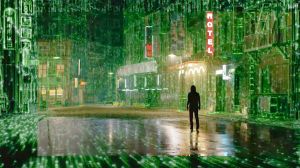 From a technical standpoint, Resurrections is still a feast for the senses. The photography is moody and atmospheric. The musical score is pumping. The special effects are state-of-the-art. There are a lot of talented people working on this sequel. So why then does the movie feel so perfunctory? In some regard each Matrix sequel has felt this way, adding extraneous pieces onto an already perfect standalone film. Having re-watched both Reloaded and Revolutions again, I can affirmatively declare Resurrections to be the weakest Matrix entry yet. We were all a bit too harsh on the prior two Matrix movies, which fall short of capturing the original’s magic alchemy but bring the goods when it comes to memorable set pieces, eye-popping visuals, and narrative zigs instead of zags (It was undercutting audience expectations before it was cool). They are still a bit too stuffy and talk in circles, but there are definite Major Ideas percolating underneath. In contrast, Resurrections feels more powered by resentment, by Wachowski coming back to this world against her better wishes and judgements. Maybe we should have left things alone.
Nate’s Grade: C


 nathanzoebl
You must be logged in to post a comment.