Monthly Archives: November 2021
Venom: Let There Be Carnage (2021)
 Whatever feelings you may have had for 2018’s Venom, I imagine they will only be magnified with the sequel, Let There Be Carnage, where it appears that the filmmakers took the goofy, campy elements from the original and magnified them exponentially. This is a silly, dumb movie that seems almost too aware of its existence as a silly, dumb movie; it reminded me of what a Roger Corman movie might feel like as a modern-day superhero blockbuster. This movie is ridiculous, and that will either be its major selling point of its point of condemnation. I was not a fan of the 2018 predecessor but I found myself enjoying the goofier aspects of Tom Hardy’s performance as journalist Eddie Brock after he shares his body with an alien symbiotic goo. This time we have a second alien symbiotic goo, which is actually what the villain of the first movie was, but this time it’s red and extra trendril-y! The appeal for any viewer is going to be the bonkers buddy film at its core, Eddie Brock and his living id personified as the Venom alien that keeps asking to be allowed to eat people. The movie is almost sitcom-level in it’s portrayal of the two butting heads and going their separate ways to prove they don’t need the other only to learn they were really meant to be. There are some comedic moments that just keep doubling down on silly jokes at the expense of everything else, like the “Not you, Father, you, father” bit that actually made me laugh out loud. Under the guise of actor-turned-director Andy Serkis (Mowgli), the movie is simply a broad cartoon that manages to walk a line between good-bad and laughably bad. It doesn’t always keep that balance but it’s sure entertaining to watch its goofball energy and it’s only a merciful 90 minutes long (almost one half of Eternals). I can’t really tell if everyone attached to the movie is trying hard or really just goofing off on the company’s dime. Regardless, if you were not a fan of Venom before, this movie won’t convince you there’s a compelling character or universe here. Michelle Williams (Manchester by the Sea) is pitifully wasted as Eddie’s ex-girlfriend. The accents are terrible all around. The new villain is a scenery-chewing serial killing dullard and then transforms into a goop monster. The love story with Woody Harrelson (Zombieland) and Naomie Harris (Moonlight) made me think if someone combined Natural Born Killers with X-Men but short-changed us on both counts. What works in this movie is what worked for me in the previous film, but now all elements feel more in alignment with the goofy energy of star-producer-and-credited-“story by”-writer Hardy. I don’t know if this franchise will ever qualify as traditionally good no matter how successful it proves to be. Maybe what the people really want is a screwball comedy with Hardy mugging alongside a wise-cracking, homicidal alien goo suit. Bon appetite, fans of expensive trash.
Nate’s Grade: C
Share this:

Eternals (2021)

Chloe Zhao is the biggest name Marvel has gotten yet for its cinematic universe (MCU). Sure, they’ve had major directing names before like Kenneth Branagh and Ryan Coogler, and successful populist genre filmmakers like Jon Favreau and Joe Johnston and Joss Whedon and Shane Black, and quirky auteurs like James Gunn and Taika Watiti. However, Zhao is the first Academy Award-winning director to jump into the Marvel sandbox. Zhao seems like an odd fit for something as mainstream and successful as the MCU, but she was excited to tell a big story with the biggest studio operating in Hollywood. Eternals (no “The”) is just as much about the question over what it means to be human as Zhao’s Best Picture-winning Nomadland, and it’s a lot easier to watch with one hundred percent less Frances McDormand pooping in a bucket in her van (granted, she did win an Oscar for that performance). Eternals has received the lowest critical rating of any MCU film in its thirteen-year history and I’m trying to figure out why.
Thousands of years ago, the Eternals were created by the Celestials, powerful beings that are responsible for birthing new galaxies into the universe. The Eternals were sent to protect the inhabitants of Earth from the Deviants, terrifying tendril-heavy monsters that will consume and overrun a world. The Eternals are instructed by their masters not to intervene in human conflicts; only to intervene to save them from Deviants. Now that the last Deviant has been dead for over 500 years, the Eternals have settled into comfortable lives among present-day humans. Then the Deviants return, evolving with added powers and posing a new threat to humanity and the Eternals, but the real threat might be outside the confines of Earth.

Eternals feels like a different kind of Marvel movie in that stretches feel like it’s a Stanley Kubrick movie, or a Terrence Malick movie, or a DC movie. The plot structure and tone even reminded me of Watchmen. Don’t get me wrong, the standard Marvel elements are recognizable, but this is a much slower, more methodical, more cerebral, and more challenging movie that really feels like a distillation of Zhao’s humanist indie naturalism and the crazy cosmos from Jack Kirby’s trippy source material. I can understand why some people would find this movie to be boring and poorly paced. There are extensive flashbacks and setup. It definitely doesn’t need to be a staggering 157 minutes long, second only to the three-plus hours of Endgame. Granted the movie is introducing a dozen characters, their relationships, their powers, their histories, as well as a new history for the universe that doesn’t relate to anything that came before it. There are assorted references to Thanos and the events of Endgame, bringing half the population back, but this is more a standalone movie that can serve as an introduction for those less well-versed in two dozen movies’ previously on’s. I knew going into Eternals it was going to be slow, and I knew several friends that outright hated it, but I think pacing is more to its benefit and detriment. The scenes feel like Denis Villenueve (Dune) is pacing them, where moments are given more time to breathe and where characters are given space to reflect and absorb. Like a Villenueve film, Zhao wants her audience to take in the grandeur of the moment, but she also wants the characters to be able to take in the drama of their circumstances. Some people will find it all too boring, and while there were points that could be trimmed, I was enjoying myself because of the attention to character perspectives that are given precedence over splashy beat-‘em-ups.
I was drawn in by the character reveals, their conflicts, and the time Zhao allows to examine their emotional and philosophical states. Look, it’s still a big, action-packed Marvel movie with plenty of monster fights and a world-saving cataclysm climax, and while those are agreeably executed, I was more taken by letting the characters pontificate on their problems. There’s Sprite (Lia McHugh), an eternally looking child who can never live an adult life she craves. There’s Druid (Barry Keoghan), a man with the power to control the minds of all humans on Earth but is explicitly instructed to remain hands-off with their conflicts. He is severely torn and emotionally wrecked over watching them slaughter one another and knowing he has the power to intervene and resolve genocide, prejudice, and poverty. That’s the eternal question over why a loving God seemingly chooses to be hands-off, all rolled into one character. There’s Thena (Angelina Jolie), a legendary warrior of physical renown but whose mental state is fracturing and who poses a potential lethal threat to her family. There’s her partner, Gilgamesh (Don Lee), who would rather watch over his love as she suffers and potentially declines than have her lose her identity and erase herself. There’s Phastos (Brian Tyree Henry), a man who only wants to help the humans with his technological skills but regrets his contributions and declares humans as unworthy of their keep after Hiroshima. Then there’s a reveal halfway through the Eternals that loads a needs-of-the-many sacrificial debate that positions different characters on different sides of the divide for the final act. I enjoyed that even the villains are presented with their rationale and are tortured over their choices they deem to be necessary for the greater good.

I’ve written a lengthy paragraph all on the meaty character conflicts, and none of them revolve around the goal to gather a magic item or learn a special power. I didn’t mind Zhao’s movie taking its sweet time to allow these conflicts and struggles to be felt because they were evocative, and Zhao’s storytelling shines when she focuses on the noble and often tragic struggles of people being complicated, contradictory, and confusing. Even the big dumb beasts evolve and have a perspective that has an understandable complaint. The final confrontation doesn’t come down to a giant sky beam and an endless army of disposable CGI brutes. It rests upon character conflicts and a romance that spans thousands of years where empathy is the secret weapon. Early on, you think it’s going to be a love triangle, and the movie just teleports out of that trope. I found myself more invested in the ending, even if I could already predict the conclusion. I was more interested in what the conflict was doing to the Eternals as a family fracturing under the weight of their destinies and the consequences of defiance. The film ends on a cliffhanger with significant fallout, and I don’t know how the rest of the MCU is going to square what we learned and accomplished here. This seems in sharp contrast to everything down the road.
Eternals is also an often beautiful-looking movie with Zhao’s penchant for natural landscapes and magic hour lighting. The editing and photography feel nicely matched and allow the viewer to really soak up the natural splendor and the impact of the battles. The action is kept at a human level with the camera tethered to the characters even when in flight. There is the occasionally eye-opening shot of a landscape, or Zhao’s use of visual framing, or the special effects revelations that reminded me of 2001: A Space Odyssey. It’s certainly not the most breezy, action-packed movie in Marvel’s lengthy canon of blockbusters, but it’s not devoid of spectacle.

So then why has Eternals scored so low with film critics and a significant portion of general audiences? Some wonder if the level of diversity and inclusivity of the movie is a factor; we have many non-white characters including a deaf character and a gay male character in a committed relationship, with a genuine and loving onscreen kiss no less (your turn, Star Wars franchise), and that seems like a trigger point for certain fans that grumble about “woke culture.” I’m sure for some that’s a factor. I think the length will be a factor too. I think the elevated emphasis on emotional stakes and philosophical conflicts might be another factor. This doesn’t feel like any Marvel movie that has come before. It’s much more comfortable with silences, with patience, and with cerebral matters (again, not to say the dozens of other MCU entries were absent these). This one is just different, encompassing the directing style and humanist attentions of Zhao and looking at a far larger scope of drama than toppling one super-powered being. I saw this in theaters with my girlfriend’s ten-year-old daughter and her friend and they both said they enjoyed it, so I won’t say it’s too mature or impenetrable for younger viewers. Eternals might be too boring for some, too long, and too different, but I was happy to endure it all.
Nate’s Grade: B
Share this:

Escape from Death Block 13 (2021)

Gary Jones is no stranger to schlock. The writer and director’s feature debut was 1994’s Mosquito about killer mosquitos that have fed on the blood of dying aliens. His filmography also includes such amusing titles as Crocodile 2: Death Swamp, Jolly Roger: Massacre at Cutter’s Cove, Planet Raptor, and 2013’s Axe Giant: The Wrath of Paul Bunyan, which was filmed in Ohio and featured several actors that have appeared in other Ohio indies I’ve reviewed, like Dan Kiely (Bong of the Living Dead), Kristina Kopf (The Street Where We Live), and Thomas Downey (Evil Takes Root). Jones knows his schlock. Escape from Death Block 13 is the man’s ode to the prison escape thrillers of the 1970s, and it even stars a lead actor who looks remarkably like Charles Bronson. I hoped that Death Block 13 was going to be the good kind of low-budget indie, the one that swerves into its schlocky genre trappings and limitations. However, too many of its creative limitations felt more notable, from limited actors, the limited location shoot, and especially the limited plot development for payoffs and action goodness.
Mick (Robert Bronzi) is a recent immigrant trying to set right his brother’s fate. He visits his dead brother’s boss, Renda (Nicholas Turturro), and demands the money cheated from his brother. Renda’s goons rough up Mick, and in the scuffle, Mick shoots a gun in defense and he’s the one arrested and charged with attempted murder. Inside the deadly prison, life is rough that the guards will let the prisoners fight to grievous harm because they have bets on who will win. Mick becomes a favorite of Warden Jack (Debbie Scaletta) who pressures him to go along and assist with her lucrative smuggling business of guns and drugs. Mick refuses and makes himself a target. He’ll need to adjust to life behind bars, stand up to the bullies, and plot his escape with the secret tunnels located under the grounds of the prison.

The question arises how far a Charles Bronson lookalike can get you as far as entertainment value, and that’s going to be a question for the soul of every viewer. The movie feels like it was a Cannon production, where the poster and title were the selling point and the rest, well we’ll get to that when we need to. The central image of a man that looks like Charles Bronson, holding a gun, looking grimaced, with a title about a prison break, it all feels meant to target a certain audience’s favorable memories of Bronson and his own popular action filmography. Low-budget exploitation genre movies have been made for less, so it’s not a damnable sin, but it sure means that the movie’s transparent intention to rest on its familiar elements needs to be overcome with story, characters, and most importantly, memorable action and ridiculous moments to satiate an audience’s genre appetites. Escape from Death Block 13 mostly gets there when the escape part happens, but beforehand, it’s a sloppy action movie that can test your patience because there are too many reminders of its own scaled-down shortcomings.
Chief among them is casting Bronzi as the lead. It feels like the mere casting of this Hungarian acrobat, stuntman, and Judo player, as per his bio, was the starting and ending point for his character. He’s an immigrant looking to avenge his brother and immediately gets thrown into the middle of a conflict as everyone seems to be incorrectly judging him (subtle commentary on the audience expectations?) based on his appearance. The gang thinks he’s up to no good, the other prisoners and the warden think he’s a troublemaker, and the law thinks he could be their missing piece and assist to bring down the corrupt warden. It could almost be self-parody the way every new batch of characters project an identity onto this blank hulk of a man. I think even Bronzi is leaning into this helpful projection and association with Charles Bronson. His real name is Charles Kovacs, but Bronzi sure sounds closer to Bronson. He also starred in Once Upon a Time in Deadwood, working to associate Bronson’s Once Upon a Time in the West, as well as the HBO Western series, and Death Kiss, working to associate Bronson’s Death Wish. Again, congrats to Bronzi for finding himself a career as a Charles Bronson stand-in. I look forward to the man’s continued career of kind of reminding people of the departed Bronson.

However, Bronzi is not a terribly good actor. His line readings are resolutely stiff, and his accent is thick, so it can be hard to understand what he’s saying with his flat affect. There’s one joke where he makes fun of another prisoner for not understanding his accent, but I didn’t quite understand the joke because I was having trouble with his vocal articulation. To the man’s credit he definitely has a presence and can convincingly strike an intimidating pose. He’s comfortable with the fight choreography though it’s nothing too complex to be strenuous. His emotional acting range and vocal delivery is another matter. I think the limited nature of Bronzi’s ability forced the filmmakers to minimize the number of lines and dramatic scenes for his character, thus making him even less distinct and relying more on his passing impression.
I legitimately think the movie could have been improved had everyone been dubbed. Bronzi is not the only actor of limited range in the movie, he’s just the one with the most screen time. There are many supporting actors who were clearly hired for their physical prowess rather than thespian abilities. These actors would say lines and it would make me giggle at points. There are other actors who take one note, like the police officer in an interrogation scene trying to go full intense exasperation mode, and then deliver every line in this narrow acting space. It’s moments like this where the movie feels destined to willfully drift into unintentional self-parody. I think having a purposely dubbed audio track would provide two benefits: 1) it would allow better vocal actors to lift some of the lackluster performances, and 2) it would further cement the movie’s silly schlock factor and give the audience permission to laugh along with. The best actor in the entire movie is the prison doctor and just for the one scene where he dies. After being injected with a deadly dosage, he goes into cardiac arrest and the actor is so dedicated, so over-the-top, and so prolonged in his death throes that I had to celebrate the man’s gumption. Here was a guy who took what was handed to him and found a way to make it delightful. I wish every actor was on this same tonal wavelength of good-bad rather than just dull-bad.
Once the titular escape happens, the movie jolts to a new life, enough so that I wish we could have gotten things moving faster. The last twenty minutes of the movie is replete with chaotic violence and over-the-top blood shots. The action is adequately choreographed and fast-paced enough to offer several different set pieces and cross-action to keep your attention. It’s all over the place, it’s more whole-heartedly schlocky, and the frantic pacing is a definite bonus. The problem is that as a prison break movie there wasn’t really any definite reasons why the characters had to wait until this late moment to stage their escape. Usually, these kinds of movies introduce the system of the prison so we understand the routines so that they can then be exploited, like a con or a heist job. We need to know the particular steps for the payoff to feel rewarding. Otherwise, like in Death Block 13, it just feels arbitrary. The evil warden doesn’t come across as too formidable. The guards are not too formidable. These people are not the smartest criminals in the world of smuggling. And the inmates could have banded together at any point and easily overthrown this weak power dynamic. Even the heavy-duty Gatling gun attached to the lookout tower isn’t too hard to overcome. The obstacles are vague or weak, thus making it feel like the big escape could have happened as soon as Mick was thrown into this pokey.
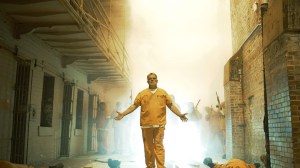
The movie was filmed in the Mansfield Reformatory, the same famously depicted in 1994’s Shawshank Redemption, but at points it sure doesn’t feel that way. I don’t know the exact budget-conscious decisions of the production or the shortcuts they had to work through, but there are several sequences inside and outside the prison that are obviously green screen. It made me start to meticulously examine the visuals and see if it was indeed the famous penitentiary or some other set meant to be stitched together through the power of editing. It’s possible the movie had a very limited availability to shoot inside the prison, so they took extensive pictures to recreate as a more convenient green screen background. I’m uncertain. The green screen work isn’t bad by any means but pretty obvious to the eye and limits the potential visual arrangements for staging the action, which can often resort to shot-reverse shot redundancy.
If the rest of the movie was like its concluding act, I would be recommending Escape from Death Block 13 to fans of low-budget schlocky action and fans of Charles Bronson. It’s strange to think part of the major appeal of this movie is that it stars a guy who strongly resembles another guy that was in movies decades ago that people mostly remember liking. The general association of other, better movies seems to be much of the creative backbone of this movie. The story isn’t packed with careful setups and payoffs, built upon a foundation of obstacles and mini-goals that need to be accomplished before the big escape finish. It relies too heavily on cliched genre moments, like multiple prison yard fights, and the riot ends in a hostage negotiation that could have been its own movie itself rather than a pat conclusion. The movie is weighed down by the acting limitations of its lead who looks the part but fails to do much more on screen. It’s an action movie that, even with caveats and understanding of its limits, manages to disappoint. I wish this had been crazier, or better plotted, or filled with more colorful and arresting characters, or bigger villains, or anything really. It’s an action movie that feels like the ghosts of other, better action movies starring a man who might as well be the living ghost of Charles Bronson.
Nate’s Grade: C
Share this:

Finch (2021)
 Delayed almost two years thanks to COVID and eventually sold to Apple, Finch is the story of Tom Hanks trying to survive the irradiated post-apocalypse with a dog and a robot. That’s the pitch and that’s actually about the extent of the movie. Tom Hanks plays a man dying from UV exposure and trying to create a provider for his beloved dog, who itself has a sad back-story. It’s a simple story but the movie succeeds on the detail of its world-building and the sincerity of Hanks and Caleb Landry Jones (Get Out) in a mo-cap performance as the nascent robotic helper who names himself “Jeff.” It’s a post-apocalyptic buddy film, a road trip movie, and a survival thriller against the new reality of supercharged weather elements and the threat other people can present. The set pieces are effectively developed and open up Finch as a character. Almost after every big moment we have a quiet one where Finch uncorks a monologue that explains more about his own tragic past, the tragic events that left much of Earth to be highly irradiated, or the relationship he had with his own absentee father. Hanks is nicely vulnerable and warmly paternal as a man teaching a robot how to be human in the pursuit of caring for others. This could have been a post-apocalyptic one-man show, a Cast Away meets I Am Legend, but Jones is an enjoyable foil as the clumsy robot who is trying to make his creator proud. The robot design is very minimal but Jones is able to find small ways to communicate the childlike emotions of the character. The movie doesn’t have any devastating moments of suspense, terror, or meaty character drama. It coasts on a pleasant and gentle spirit with a touch of melancholy but Finch mostly keeps things in a relatively heart-warming territory. Finch isn’t much more than its initial pitch, but I’m happy to spend two hours with Tom Hanks trying to teach a robot how to be nice and brave in order to save a dog (spoiler alert: the dog lives too).
Nate’s Grade: B
Share this:

Army of Thieves (2021)

So were you ready for the feature-length back-story for the safe-cracker character in Zack Snyder’s Army of the Dead so that you could feel more emotional involvement and understanding why he was so obsessed with cracking that special super vault in Vegas? Oh, you didn’t, well Netflix decided to spin off the goofy, energetic German character, once again played by Matthias Schweighöfer, who also directs the movie too, and now here it is. The character is too goofy to justify anything terribly dramatic, so the prequel becomes about how he was roped into a heist gang after becoming a star in the… underground safe-cracking betting ring. I would say that seems far-fetched but Netflix’s Squid Games pretty much explained its existence with, “Eh, the rich are bored and will bet on anything.” The most fun part for me was when the movie would take a few self-aware winks, as if it knew it was a movie, and characters would express how, if this were a Hollywood heist movie, this would happen, or that would happen, and then it inevitable does. It’s a small thing but it was something that slightly gave the movie its own identity because everything else is so rote and without charm or intrigue. The requisite gang has their requisite tensions and requisite betrayals and requisite unrequited romances. I just didn’t care much and the set pieces never elevated the suspense or interest level. The heist movie formula is ready-made for enjoyable setups and payoffs, as long as you see it through and hopefully give us fun characters and unexpected complications to overcome and improvise. Army of Thieves feels like a slapped-together action thriller that would have served as the years-later direct-to-DVD franchise ripoff except we got it the same year as its zombie franchise launch. And that’s the thing, this movie is literally taking place during a time there is a zombie outbreak and we’re just shrugging and going along with a standard heist that could have existed in any non-zombie outbreak universe? When even your supporting police characters say, “Hey, shouldn’t we pay more attention to that, you know, zombie apocalypse thing?” then maybe you heed their advice.
Nate’s Grade: C


 nathanzoebl
You must be logged in to post a comment.