Daily Archives: December 22, 2017
Bright (2017)
 Netflix has been fighting to get into the world of theatrical features. While its original series have met remarkable acclaim, Netflix still wants to draw filmmakers. There have been a few high-profile film buys like Brad Pitt’s War Machine, the live-action American Death Note, and it’s become Adam Sandler’s new home. Bright is a $90 million dollar fantasy film directed by David Ayer (Suicide Squad, End of Watch) and written by Max Landis (American Ultra, Dirk Gently). The big buzzy movie has been met with big derision from critics, some even referring to it as the worst film of 2017. After watching Bright, I think my friend Drew Brigner sums it up pretty well: “It’s not terrible, but it’s not great.” Slap that onto the poster, Netlfix.
In an alternate Los Angeles, humans exist side-by-side with fantasy creatures like fairies, elves, and orcs. Daryl Ward (Will Smith) is assigned a “diversity hire,” Jakoby (Joel Edgerton), the first orc on the force. Nobody wants to work with him. The humans are looking for whatever means they can of getting rid of the orc, and Ward’s superiors are looking for his assistance. Then one night on patrol, Ward and Jakoby come across a nightmarish crime scene. Bodies are burned in place. A woman is stuck in a wall. There’s one survivor, Tikka (Lucy Fry), an elf who has gotten hold of a magic wand. It so happens that magic wands are powerful weapons and only Brights can hold them. Word gets out about their discovery and every group in L.A. is after this powerful item. Ward and Jakoby have to escape gangs, orcs, corrupt cops, and an elf cult leader, Leilah (Noomi Rapace), who needs the wand to summon her Dark Lord back to dominate Earth.
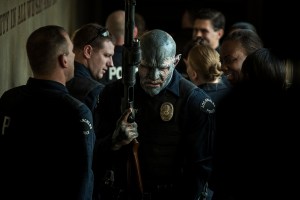 For the first 48 minutes or so of Bright I was willing to give it a welcomed chance. The world building from Landis presented enough interesting wrinkles to keep me intrigued. The banter felt believable enough to fit into its desired genre. Edgerton (It Comes at Night) is engaging and charming as a good-hearted orc whose life’s dream is to be a police officer. He is viewed as a traitor by his own kind, so that makes us like him even more for what he’s willing to sacrifice for this precarious position. There’s a personal source of conflict between Ward and Jakoby that is introduced early for them to work through. There are magic police, which is kind of cool. The world feels lived-in with clever details even though it could have used more of that sense of living. Too often it feels like the only difference in this new L.A. are scattered creatures in different locales. Elves are the rich elite. Orcs are the poor and disadvantaged. I could have used more magical creatures in the mix. What about dwarves, wizards, dragons, anything? Still, Landis’ script was providing enough breadcrumbs to carry me along, building up to the wallop of finding the magic wand. It forces Ward to make a startling personal choice that will define the rest of the film. It took a while to get going, but I was still willing to give Bright the benefit of the doubt.
However, it’s after the 48-minute mark that Bright begins its disjointed descent and never truly recovers, disassembling at an alarming rate. What follows is a series of poorly developed, poorly shot action sequences as the characters bump into one violent group after another. The interesting plot development gets put on hold and the weaker elements begin taking greater significance. It wouldn’t be a fantasy film without a great prophecy, which comes into bearing in the most contrived of ways. Speaking of contrived, there is a coincidental rescue late in the second act that made me loudly groan. Then there’s redoubling back to previous locations presumably to save money on set design. Once the movie sets things in motion for the mad scramble for the wand, it just feels like one unrelated sequence after another to keep our characters on the run. Even with the fantastical world building, you’ll be hard-pressed to muster genuine surprise. That’s because all of the later plot turns are readily telegraphed, like the coincidental save. We’re told that only a Bright can handle a magic wand and anybody else that touches it will explode. First off, why doesn’t this make the magic wand a defensive weapon if you know how rare Brights are? If you know idiots are going to have grabby hands, why not slide it toward your enemies? Regardless, knowing that dichotomy, you know one of the two main character will be revealed to be a Bright during a climactic moment, because why else have it? Anticipating payoffs isn’t necessarily a bad thing, but when you can anticipate all of them, then you’re in trouble. The most surprising aspect of Bright is how ultimately it’s still a formulaic buddy copy movie dressed up with some extra fantasy spectacle.
Another weakness that becomes more apparent as the film continues is the characters. Ward and Jokoby are pretty thinly sketched out with a few clarifying details. Ward is the lightly racist archetype who learns to accept his partner’s differences over the course of one long night. He’s pretty indistinguishable from the character Smith plays in the Bad Boys films. I suppose his prejudice and desire to better support his family is enough setup to question whether he’ll follow in the corrupt patterns of his colleagues. But after he makes his choice at that 48-minute mark, it’s like his character growth just stops. He still barks orders, he still quips one-liners, and he makes the big sacrificial gesture, but his character development is iced for a solid hour. Jakoby has more ground to cover and fairs somewhat better as the Jackie Robinson of the orc community. Except this guy seems way too inexperienced, clumsy, naïve, and simply not good at his job. In order to be the first diversity hire, I’m expecting this guy to have to go above-and-beyond to even be considered for a position. It reminds me of Shonda Rhimes quote where she says, as a black woman, “you have to be twice as good as them to get half of what they have.” I didn’t believe Jakoby was the best candidate for shattering that orc-sized glass ceiling. The harassment from the other cops can be painfully juvenile as well, like tacking on a stupid middle school-esque “kick me” sign to his back. He wants to make more of himself and because of that dream he’s shunned by his fellow orcs and distrusted by humans. That perspective should be far more interesting than what we get with Bright.
 The supporting characters fare even worse as bodies given momentary activity. Tikka is merely a plot device and not a character. She doesn’t even speak until close to 85 minutes into the movie, and it wasn’t really worth the wait. A toaster could have replaced her and the plot would remain relatively the same. She is the definition of a prop. She has no personality, no agency, and no goal beyond keep the powerful thing away from the villain. Because she’s a Bright she’s one of the few who can wield the magic wand, but even those rare occurrences are underwhelming. If this thing is as advertised, a “nuclear bomb that grants wishes,” then why doesn’t Tikka just utilize it to destroy the villains once and for all or at least help Ward and Jakoby? Poor Fry (The Darkness) just gets yanked around from scene to scene, shivering and generally looking frail. She’s got some killer eyebrows though.
Noomi Rapace (Prometheus) doesn’t have much to work with as the chief villain, Leilah. She’s an acrobatic murder machine who wants to summon the Big Evil Thing of Old, and that’s about it. Rapace does have a naturally elfin-looking face, so it’s solid casting. The other characters, especially the various antagonists, are just slight variations on heavies. No real personalities. No dimension. They’re just a video game stage of slightly different looking goons to be cleared before the next stage. Maybe there’s a larger point about the similar darker impulses all races are tempted by, but I think that’s giving the movie more credit than it deserves.
On that front, the racial commentary of this alternate L.A. is muddled, to say the least. The orcs are obviously meant to take the place of lower-class African-Americans in this newfangled City of Angels. However, what does the movie do with this? The orcs are judged to be troublemakers, prone to violence, and generally subhuman, with several people holding a thousand-year-old grudge over the mistakes of previous orcs. Under Ayer’s murky direction, the orcs easily resemble the black and Latino gangs we’ve seen in many of his police dramas. They’re meant to be an underclass. What does that make black people? There’s a tone-deaf joke in the opening where Ward yells, “fairy lives don’t matter” before swatting the winged nuisance to its death. I guess racism against orcs has replaced all other forms of intra-human racism. Landis’ script takes a hot button issue and drops the ball on making the commentary meaningful. Just think about what Zootopia did with its racial allegory on predators and prey. They took a serious topic and had something to say about it. Landis takes a serious topic and ignores the greater potential. By the end of the film, it feels oddly like Landis just took an old buddy cop story concept and grafted some incidental fantasy elements onto it and called it a full day.
 Ayer doesn’t help matters by filming in his Suicide Squad-vision of drizzly grays, cool blues, lens flares, and lots of dim shadows. The very look of the movie is so downcast and the action sequences are too poorly developed and choreographed. The combat is very often close-quartered and the jumpy edits and slippery sense of geography make the brawls practically incomprehensible. The sequences don’t develop organic complications. It’s just the same concept over and over, get to that place, shoot the bad guys before they shoot you, repeat. The action also misses opportunities to connect with the character motivations and to derive mini-goals that can help spice things up. Bright has none of that. Even with the inclusion of magic and magical creatures! The best scene is an attack in a convenience store that gets closest to involving parallel lines of action with some organic consequences related to its specific setting. Otherwise it’s a lot of shootouts in locations you’ve seen in other grimy cop movies (alleys, warehouses, strip bars, etc).
Bright is the most expensive movie in Netflix’s history and they’re already reportedly developing a potential sequel. The world Landis has created has enormous potential. It’s unfortunate that it’s not realized in this first edition. It’s not as bad as some film critics have been harping about but Bright should have been much better. The characters are lacking, the world building feels unfulfilled, the narrative is predictable, the social commentary is simplistic, and the action sequences are dreary and unexciting. I think something like Bright might in the end be intended as a loss leader for Netflix, something they initially lose money on but ultimately draws in new subscribers. It’s almost the same cost for that canceled Baz Luhrmann series, The Get Down (at least got eleven episodes from that). Bright is an underdeveloped genre mash-up that might make you reach for a magic wand of your own, your remote.
Nate’s Grade: C
Share this:

Downsizing (2017)
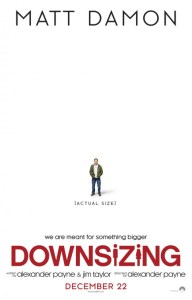 Alexander Payne is not exactly the first name you would think of when it comes to science fiction. The man has a history of road trip comedies, average Midwestern men, mid-life crises, and the colorful miscreants of society. The fact that the director of Sideways and The Descendants is tackling The Incredible Shrinking Man is a bold move. Payne is outside his comfort zone with Downsizing, and it shows at points. While never quite satisfying the possibilities of its premise, Downsizing is still worth watching for its memorable moments and for the sheer brilliance of one outstanding performance.
In the not-too-distant future, science has developed the technology to shrink human beings to five inches tall, approximately 1/100th of their size. A middle-income couple can live like the top one percent because their money goes further. Paul Safranek (Matt Damon) is a schlubby, regular guy suffering from the ennui of a job he hates and a life that feels unfulfilled. He and his wife, Audrey (Kristen Wiig), decide to undergo the downsizing procedure, which is irreversible. Paul’s wife backs out at the last minute but he doesn’t find out until after he’s gone small. Now with a McMansion all to himself, Paul has to readjust to what he thought his new life would be like. He moves into a condo and shirks the offers to join the parties of his hedonist neighbor, Dusan (Christoph Waltz). Paul finally decides to live life and embraces new experiences, the biggest befriending Ngoc Lan Tran (Hong Chau), a one-legged Vietnamese cleaning lady who was downsized against her will for being an overseas political activist. Paul feels drawn to this woman and she opens his eyes to the larger world around him.
 The strangest part of Payne’s movie is that the main thrust of the story could have been told without all of the science fiction dross. This is very much a romantic comedy/drama that follows the formula of a man jilted at the altar who has to get his life back together, finds someone new who changes his perspective on life, and then they get together by the end. You could have plucked this story and set it in an ordinary world and it still would have worked, which begs the question whether the world of Downsizing is properly applied. The consumer commentary seems muddled, with the rationale for downsizing being helping the planet, reducing the population so to speak, but really it’s an escape into a fantasy of wealth. People are downsizing so they can live in luxury and leisure. This should set up Payne for his incisive brand of satire as he skewers the selfish and self-righteous foibles of mankind, except that doesn’t really happen. Sure, eventually in the second half the movie opens up its tiny world a little wider, revealing the not-so-hidden subculture of immigrant labor toiling away to keep everything stable and pretty. It’s obvious social commentary and rarely does it go a step further than just recognition. And so the film becomes another in a long line of movies about a man who must be shaken from his malaise and enjoy the possibilities of life he never knew existed. Downsizing eventually ignores its sci-fi conceit to tell a relatively ordinary tale of self-actualization.
Payne’s premise would have best been explored through the more open parameters of a television series. Downsizing is an interesting concept that leads to other natural questions over how this tiny world operates and also how it interacts with the larger community. There’s a small scene where a drunk overhears Paul’s plan to shrink and argues that little people shouldn’t be granted the same voting rights as “normal-sized” citizens. The normies contribute more to society and should be given more credit, he argues, before being shooed away. This political division could have made for an interesting topic of reflection itself, but like many of Payne’s pit stops, it comes and goes after whetting your appetite for further examination. What about a story where downsizing is a punishment to do away with the “undesirables” of a nation? A TV series would have allowed more room to explore, with finer nuance, the details and possibilities of this fanciful world. Payne allows his movie to breathe, taking extended jaunts on different ideas but rarely enough to satisfy your sense of curiosity. The last act takes place at the original downsized colony in Norway, though at their diminutive size I wonder if it took them months to travel in Dusan’s yacht. It’s meant to think about what will come after humankind has passed the point of no return when it comes to climate change. Paul has to rethink what he wants his legacy to be and what meaning his life will have, which then pushes him into a rather simplistic choice of go with the girl or the cause. Given the rest of the movie’s focus, you shouldn’t be surprised what decision he ultimately makes.
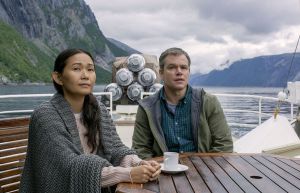 However, the real reason you should legitimately see Downsizing is for the astounding, star-making, can’t-take-your-eyes-off-her performance by Hong Chau (Inherent Vice, Big Little Lies). I cannot recall another movie where a character comes in at the halfway mark and just takes over completely, single-handedly lifting the movie up. Every moment she is onscreen is made better. You’ve never seen a character in a mainstream movie quite like Ngoc Lan Tran. She’s a political dissident, amputee, and lower-class cleaning woman who teaches Paul about the class divides. Tran is tragic, comic, caustic, lovable, and Chau is an acting revelation. I’ve read several reviews that found her to be a cringe-worthy, borderline racist depiction of an Asian woman meant to be laughed at, and I strongly disagree. At no point was I laughing at Tran because of her status, her ethnicity, or her broken English cadences. I was laughing because she was a force of nature that blew away the pretensions of others, that cut to the chase, and spoke her mind in a carefree and honest manner. Her matter-of-fact affectations are so perfectly delivered in accordance with the character’s personality. There are moments where her character is being set up for one thing and Tran goes entirely in another direction, and whereas you might have laughed at the start she surprisingly earns other emotions. Take for instance a scene where Dusan tries to ditch her by making an excuse about a sudden travel commitment. Tran takes this moment and turns it into a genuinely poignant monologue about the unexpected nature of fate. By the end she’s crying out of sheer elation, and those tears are not meant for ridicule. Downsizing realizes what an asset it has and makes her the deserved focal point of the second half. You’ll fall in love with her too. Chau doesn’t just deserve an Oscar nomination; she deserves to win everything.
Downsizing is an episodic high-concept comedy where the shrinking is irrelevant to the main storyline that evolves over two plus hours. This is an adult movie that explores some mature topics with surprising time and scrutiny, and then it can also be a simplistic rom-com that misses the mark on larger, Swiftian social satire. It’s another story in a long line of disaffected, middle-aged men finding their groove again, except then it becomes the story of a Vietnamese activist and her unique persona. Hong Chau is the reason you should see Downsizing above all. She doesn’t so much steal her scenes as just take full ownership over the back half of the movie. Her performance is so uniformly excellent that you wish the rest of Payne’s uneven movie could meet her commitment. There are a lot of ideas here that seem to get brushed aside for the conventional formula of a romantic union, even if the pairing is rather unconventional. Downsizing is an entertaining movie that doesn’t quite amount to more than the sum of its little parts.
Nate’s Grade: B


 nathanzoebl
You must be logged in to post a comment.