Daily Archives: September 9, 2008
The Duchess (2008)
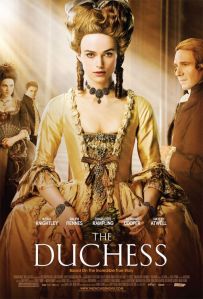 I think I understand the real appeal of costume dramas. No matter what else happens, the costume drama must seem smarter. You have actors, primarily British, waltzing in elaborate costuming in realistic historical settings, each offering demure statements and looking for love and acceptance in a time of chaste expression. You could place Saw 18 in that setting and it would automatically seem smarter. I think the ye olde setting for costume dramas automatically gives these films more plot leeway, but not every film actually proves that it should have earned that leeway. Saul Dibb’s handsomely mounted period drama The Duchess offers little beyond the superficial enjoyment of well-crafted costumes.
In 1770s England, young Georgina (Keira Knightley) has been betrothed to the older Duke of Devonshire (Ralph Fiennes). The newly minted 17-year-old Duchess of Devonshire is whisked away to live in a giant manor. The Duke is rather cold and seems uneasy with human interaction; he shows the most affection for his dogs. He expects Georgina to primarily bear him a son. Several daughters later, the Duke is engaged in affairs and siring illegitimate children. Georgina has become a star of the social sphere, and it is here that she befriends Bess Foster (Hayley Atwell), a woman who is trying to regain her children from her ex-husband. Things get even more complicated when the Duke takes a liking of Bess, and the two become an unofficial union. Georgina has had her only friend taken away and turned into a co-wife. The only solace for the Duchess is in her flirtatious relationship with a politician, Charles Grey (Dominic Cooper). Georgina feels like a prisoner in her own home and yet she cannot desert her children. What’s an oppressed woman to do in 18th century England? That answer should be sadly obvious.
 The Duchess breaks no new ground and, in fact, treads water for the majority of its second half. Georgina was an independent spirit in a time that frowned upon breaking from conformity and tradition. As a woman, she was the victim of a double standard that allowed her husband to sleep with whomever he desired but she could not find physical comfort outside her loveless marriage. Marriage was widely viewed as a means to an end for male progeny, not the culmination of romantic love. Women were pressured into delivering male heirs, despite the fact that men are the ones who determine gender. Typically marriages were family arrangements for class and land ownership, so true passion was procured through marital affairs. I get it because I’ve read Jane Austen novels and seen dozens of period movies that have made the same stilted points. The Duchess presents Georgina as a feminist before her time and then a patriarchal society crushes her spirit. During the second half, when aristocratic life keeps producing heavy obstacles for Georgina, the movie just piles it on. I was left questioning what the point of all this corseted drama actually was.
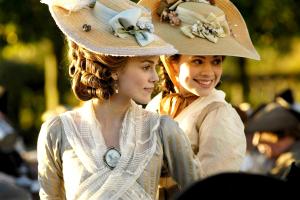
After a while with my downtime I determined whom this movie is really for – hat enthusiasts. This is a Big Hat movie that puts other hat movies to shame. There are gigantic floppy hats, hats that look like fruit displays, hats that look like eighteen-layer cakes, hats that look like they have their own hat, hats with feathers zigging and zagging in every direction, and hats that look like they are consuming their host’s heads. If you work in the haberdashery industry or have an above average interest in hats and hat-related products, then run, don’t walk to The Duchess. You will be enraptured by the orgy of towering hats that jostle for screen time. Rarely are women seen without hats, so you truly will get your hat money’s worth over the course of the film’s two hours. If there were a specific Oscar category for Hat and Hat-like Accoutrement then The Duchess would dominate. I expect it will get nominated for Costumes, and really that seems like half the point in making these powdered wig period dramas.
I think the other point of The Duchess is to channel the modern story of Princess Diana, who is actually a distant relative of Georgina. The two seem to lead somewhat similar lives since they both married young, both had their husbands prefer the mistresses, both were fashion trend setters, both were beloved by the public, and after death both had their husbands remarry the mistresses. The tagline for the film is, “There were three people in her marriage,” a paraphrased quote that Princess Di said in an interview. The Di parallels seem to be all that the filmmakers intended to do with Georgina as a character; she is the least interesting person in her marriage. The Duke and Bess are far more complex and intriguing figures. I’m sure the Georgina biography that serves as the movie’s source is rich in Georgina characterization and personal detail, but all the movie cares about is establishing her as a marital martyr. There is more to this character but she just endures disappointment and punishment; I cannot fully engage with a character when their only personal attribute is suffering. The movie fails to present any notable reason why this woman of history deserves having a feature film.
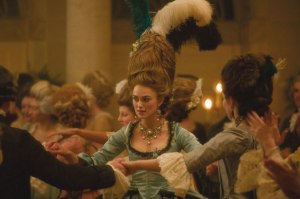 Knightley seems to spend half her film life in corsets. I’m still undecided upon whether she possesses innate acting ability; to me she too often comes across as a pin-up with great cheekbones. That said her eyebrows do a great bit of acting in The Duchess. She has the habit of cocking one ever so slightly and imbuing a scene with a hint of sexual allure or mystique. They’re pretty thick eyebrows too. Knightley does acquit herself well with the material and I doubt this will be the last time I see her in a tremendous silk gown and a humongous hairdo. The most interesting actor is Fiennes because his character is so reserved and awkward in his own skin, so much must be said through the use of gestures, body language, and the perfect execution of line delivery. His character seems just as ill in his setting as Georgina. Atwell is given the most complex character to play. To say that Bess has conflicted loyalties is an understatement. She betrays Georgina but romancing the Duke can ensure that she sees her children once again. Bess should have been the centerpiece of the movie because, as presented, she is far more interesting with more dramatic conflicts and turmoil other than being wronged.
The Duchess is no more and no less than every other costumer period piece you’ve seen before. It starts well but then falls into boring and repetitious plotting (Georgina wants something, she’s denied, she wants something, she’s denied; rather, rinse, repeat, end). The Duchess will delight those in search of yet another unrequited period romance, but I feel that moviegoers should expect more from their entertainment that mechanically fulfilling the period-y checklist. The technical merits like the production art and the costumes, especially the hats, are first rate. There’s little feeling beneath all the fabulous fussing about. It’s too bad the actual drama couldn’t at least be as interesting as the hats.
Nate’s Grade: C+


You must be logged in to post a comment.