Daily Archives: December 2, 2007
National Treasure: Book of Secrets (2007)
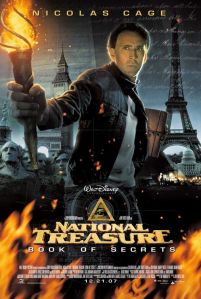 National Treasure: Book of Secrets is like a big dumb puppy that just wants love. It does a trick and thinks it deserves some form of recognition, and me with my cold heart just wants to shrug and move on with my day. How can I be so unmoved when there’s even a cartoon before the movie? For any prospective moviegoers, if you enjoyed the 2004 National Treasure, where I remind all that the U.S. Declaration of Independence had a secret treasure map on its other side, then chances are good you’ll enjoy Book of Secrets. That’s because they’re pretty much the same movie.
Ben Gates (Nicolas Cage) and his father (Jon Voight) are basking in their newfound respect from proving that their crackpot treasure schemes were in fact real. Their respectability is turned upside down, however, when Mitch Wilkinson (Ed Harris, with a dollop of a Southern drawl) has evidence that great-great-grandaddy Gates was responsible for planning President Lincoln’s assassination. He has a piece of John Wilkes Booth’s diary and a list of conspirators is jotted down, with great-great granddaddy Gates listed right there. The diary is authenticated and the Gates are devastated but ultimately unconvinced. They know their Civil War era ancestor would never betray his country and was unknowingly decoding a secret that could lead the Confederacy to an ancient golden temple, something that could help turn the tide of the war. This ancestor ripped pages out of the diary and threw them in a fire to protect the welfare of his country and was then shot by a secret Confederate soldier. In order to clear his ancestor’s good name, Ben Gates will have to find this hidden treasure, which is precisely what Mitch has wanted from the start.
 Gates re-teams with his pals from their first successful adventure, computer whiz Riley (Justin Bartha) and Abigail (Diane Kruger), who has thrown Gates out of their home due to his single-minded focus. Dating a treasure hunter is a certain path to a rocky relationship, ladies. Riley, who even wrote a book about his treasure exploits but still can’t get recognized, is game but Abigail has to be tricked into help. The group finally figures out that the only way to verify the temple’s hidden location is by getting their eyes on the mysterious President’s Book of Secrets, which only presidents can read. This means that Ben has no choice but to get the president (Bruce Greenwood) alone and beg to see a book not meant for outside eyes.
Book of Secrets is a little less dopey than the first preposterous National Treasure adventure, but that doesn’t mean it isn’t chock full of stupidity. According to these movies, apparently damn near everything in this country is built over an Indian burial ground or a giant cavern of treasure. I advise all readers to try digging in their backyards because it appears that the odds are in their favor (also: beware of your real estate company moving the tombstones but not the bodies). The clues are a little less mind-boggling, so instead of a single brick that’s been undisturbed for 200 years we get matching furniture for the Queen of England and the President of the United States. One doozey of stupidity is that one clue requires people to douse a large rock formation with water in hopes that they hit exactly the right spot and have an invisible eagle make its appearance. The plot is still structured on the clue-leads-to-other-clue template, which can be exhausting after a while because there’s never any indication of progress until the end arrives.
The subplot about kidnapping the president is ridiculous in the fact that, while already being dumb, it adds needless conflict. When Gates “”kidnaps” Mr. President he does so through a secret tunnel under George Washington’s Mt. Vernon estate. The passage closes behind them and cuts off the frantic Secret Servicemen. It is here where Gates makes his plea for the titular Book of Secrets, which the president confirms but cannot confirm publicly (well, it is a secret book of secrets). Instead of sensibly saying to his men, “Sorry guys, you know how old these places are, we got trapped, but Mr. Gates here helped get me out,” the movie tries to claim that the next course of action is that Gates will be on the run for kidnapping the leader of the free world. Huh? What makes this sequence stand out is how easily explainable it could all pass, and yet Book of Secrets figures the movie is better served by a contrived complication to add more outside pressure on Gates and his treasure hunting crew.
Of course all of the silliness and off-the-wall shenanigans would be acceptable if the film delivered some exciting action sequences that pinned you to your chair, but just like the first National Treasure, this movie is pretty much devoid of a well-thought out action sequence. Returning director Jon Turtletaub has no real visual flair and lets the material simply lay there on screen without much effort to jazz it up. Many action sequences are brief and never really flirt with complications. Usually, the script will propose a simple sequence of events like, say, “Good Guys on Run from Bad Guys” and then Turtletaub will show us exactly that, no better no worse. There’s nary a scene that actually utilizes its globetrotting destination to its advantage; most of the action is not geographic based, which means that it could happen anywhere because it doesn’t take advantage of the specifics of exotic locales. That is inexcusable to me, a big fan of good action sequences. A lengthy trip to an underground golden temple tries the patience as it rambles on and unabashedly apes the Indiana Jones series. Book of Secrets has a halfway decent car chase through the streets of London and that ends up being the highlight of the film. The trouble is that there’s more than an hour left at that point.
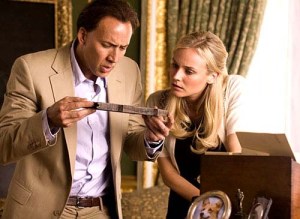 Book of Secrets is a slightly better film than the original. It jumps around in time through the lineage of the Gates clan and gives a better sense of the personal stakes for Ben and his father. Having their long-dead heroic family members linked to a dastardly assassination is good motivation for action, even if that action is ultimately finding an underground temple of gold (how A+B = C I will never know). The production design is skillful and the various European locations bring some sense of grander excitement that, sadly, will never be fully capitalized upon. The characters are still pretty shallow and one-note, but it seems like it’s less annoying this time because there’s less setup on who these characters are, which is, in short, shallow and one-note.
Cage is on autopilot and plays up his goofy mannerisms and William Shatner-esque line readings. This is a paycheck job for Cage and nothing more. Just because the first flick made tons of money is a lark to him and not an indication that he should try something different. He’s giving the people what they seemingly want, which is a wacky Nicolas Cage hamming it up with his patented version of kooky acting. Kruger is the exact copy of her character from the previous National Treasure, meaning she’s the bickering blonde counterweight to the conspiracy theorists on the journey. I suppose she plays a damsel in distress adequately. Voight gets more screen time this go-around thanks to a plump subplot involving the team seeking out the assistance of his ex-wife, played by Oscar-winning actress Helen Mirren. Yes, that Helen Mirren. Harris is given a do-nothing part as the villain and then the movie can’t even follow through on that. Everyone seems to have fun with all the nuttiness and goofy stunts, so I can’t fault them too much for faking it in a big Hollywood blockbuster.
I understand the appeal of these movies, which have found a sizeable audience willing to lap up a Cliff Notes of History along with their popcorn thrills. I imagine the fans of the original will show up in droves and make sure that National Treasure 3: The Mystery of Franklin’s Syphilis is fast-tracked for a future holiday release. I don’t mean to be a killjoy (my mother really enjoys these films) but I cannot get behind the National Treasure movement when the movies are riddled with rampant stupidity, contrived situations, convoluted conspiracies, one-note characters, and inept action sequences that never amount to much of anything beyond teetering homage to better adventure films. Book of Secrets is essentially the exact same movie reheated to take the chill off. Replace Sean Bean for Ed Harris as rival treasure hunter, add another female character, and there you have it, a mostly undisturbed formula that proved profitable in 2004.
Nate’s Grade: C
Share this:

No End in Sight (2007)
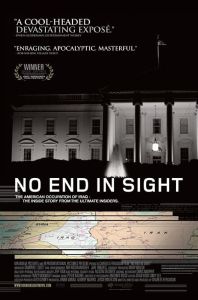 Director Charles Ferguson lived his life as a PhD political scientist, and then he felt compelled to make a movie. No End in Sight doesn’t focus much on the origins of the current Iraq War, which have been well documented and discussed in many other realms, instead the movie takes an exacting look into where the U.S. government fouled up the occupation after toppling Saddam Hussein. Because of this approach, Ferguson’s expose cannot be dismissed under false propaganda claims, and because his interviews mostly consist of the people on the ground who were responsible to stabilize the country, No End in Sight is blessed with plenty of hard-hitting first-hand accounts by the people given the hurried, thankless job of rebuilding a conquered nation.
General Jay Garner and his team, including Colonel Paul Hughes and Ambassador Barbara Bodine, were given 60 days to plan for a post-war Iraq. In contrast, FDR spent years planning ahead for an occupation of Germany. Planning was difficult because when they arrived in Baghdad the post-war looting made setting up a government a formidable task. They not only had to find means to contact people but they had to figure out ways simply to operate in an environment where looting had destroyed buildings and proper tools for communication. They were in charge of ORHA, the Office of Reconstruction and Humanitarian Assistance, which was not run through the State department, as would be normal, but run by the Defense department.
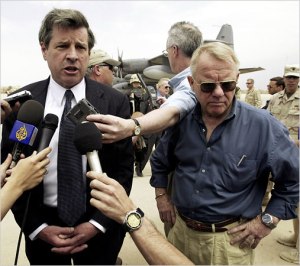 The film holds its harshest criticism for L. Paul Bremer, the man appointed to run the Coalition Provisional Authority, formerly ORHA. Bremer, like many who planned the post-war occupation and were placed in key positions within the occupation, had no military experience, no foreign policy experience with the Middle East, a notoriously tricky region, and he didn’t speak a lick of Arabic. In any other scenario, he would be judged unqualified for his heavy duty ahead. No End in Sight lays out three grievous errors that Bremer made in the summer of 2003 that gave birth to the ongoing insurgency and sent Iraq spinning out of control. The first was absolving any previous work to reach out and include Iraqis in helping to form a working provisional government. Bremer was more a my-way-or-the-highway kind of guy, which may be why he was esteemed in a presidential administration filled with these types. This alienated the Iraqi people and began Bremer’s calamitous habit of bridge burning. His second error was his decision to eliminate the Ba’ath party, Saddam Hussein’s ruling party, and bar members from any future government service. This stripped teachers, engineers, intellectuals, the very people integral to build the infrastructure of a nation, and made them permanently unemployed in Iraq. Many members had merely joined the Ba’ath party because it was the only way to secure a steady job.
But by far the most baffling and incompetent decision Bremer made was to disband Iraq’s army. This boneheaded move went against the recommendations of U.S. military figures, and in the blink of an eye, the 500,000-strong Iraqi army were without a job and an income. There were overtures from military leaders to ORHA; Paul Hughes recounts that one officer promised him 12,000 men in a week if asked. So, in a situation where the U.S. military did not have enough soldiers on the ground to even halt looting, Bremer disbanded Iraq’s best solution for restoring law and order. Half a million angry, disenfranchised, combat-trained, well-armed men were now left to fend for themselves, and if the U.S. didn’t care for their expertise then death militias would. It should come as no surprise that shortly after this colossal miscue is when Improvised Explosive Device (IED) attacks on the U.S. troops surged along with U.S. casualties. It seems like at that point the verdict had come against the U.S. occupation.
 Bremer’s decisions alienated, humiliated, and inflamed the people of Iraq, and they went against the recommendations by people that knew what they were talking about. The greatest tragedy that comes to mind is that, despite morally questionable, downright repugnant reasons for entering this conflict, the U.S. could have done this right. Saddam was indeed a bad man and the people of Iraq were initially receptive to see what the U.S. occupation would bring about. They weren’t expecting rampant unemployment, no tangible security force, being excluded from decision-making, having American private contractors bleed them dry, and an utter lack of basic human services like power and clean water. Add a long-standing religious feud into the mix and it’s no wonder the country has descended into a quagmire. No End in Sight makes the dots easy to follow and connect the cause-effect relationships into where we are today.
It’s hard to watch the film and not feel your blood boil. While No End in Sight is presented soberly and with clear-headed precision, watching the absurd miscalculations and naiveté prevail over the opinions of experts is infuriating. General Shinseki recommended to Congress that several hundred thousand troops would be required after toppling Saddam. Paul Wolfowitz, deputy Secretary of Defense, swiftly countered this assertion by claiming that it was unimaginable that it would require more troops to secure the peace rather than engage in war. “Unimaginable” is the key word here; Wolfowitz just couldn’t potentially fathom a reality that was known by most high-ranking military officials. Stabilizing a country is far more taxing than simply taking out an opposing force. Shinseki, who guided occupation forces in Bosnia and Kosovo, was ignored and pushed into “early retirement,” and Wolfowitz’s plan was followed (Wolfowitz also famously stated that the war would pay for itself thanks to Iraq’s oil revenues).
 No End in Sight does have a figure of amusement and it just so happens to be Secretary of Defense Donald Rumsfeld. The film opens with his farewell address after the 2006 midterm elections where Republicans lost control of Congress and Rumsfeld was shortly ousted from his job days later. He calls the Iraq War little understood and declares that Bush and his team’s accomplishments will one day get the full historical notation they deserve. Of course, the irony is that the designers of the Iraq War had little understanding of what they were getting into and ignored the warnings and advice of those whose opinions conflicted with the Administration line. Many clips of Rumsfeld news conferences are shown and the man comes across as flippant and disingenuous. He dismisses the looting as “stuff happens” and argues TV news is re-running the same image of a man absconding with a vase (“And you have to wonder, are there that many vases in the whole country?” he adds). The Iraq looting destroyed a museum that had artifacts dating back 7,000 years to the dawn of civilization and a library with hundreds of ancient manuscripts was burned to the ground; an entire country’s deep culture and history went up in smoke and Rumsfeld was using it as a setup to a vase joke. The clips further remind the audience that Rumsfeld, one of the chief architects of the war along with Vice President Dick Cheney and Wolfowitz, simply disregards information he doesn’t agree with, whether it may actually be right. The leaders of the Bush Administration demonstrate time and again a supreme disconnect from reality.
No End in Sight is one of the best documentaries yet on the Iraq War and a definitive indictment on the lack of substantial care given to post-war planning. No one can accuse this film of slander or pushing an agenda; this is an exacting autopsy on the current chaos in Iraq, and it has cold facts and hard truths to back up its convictions. Even if you feel that you know all the blunders tied to Iraq, this sensational film is not merely a repackaging of dogma. It’s eye-opening and intensely fascinating and one of the better films of the year; it’s an argument made on the merits of evidence and testimony, and it is damning. One soldier reflects upon the current conditions and flatly asks, “This is the best America can do? Don’t tell me that.” Then after a small pause he adds, “That makes me angry.” You are not alone, brother.
Nate’s Grade: A


 nathanzoebl
You must be logged in to post a comment.